trunk FIAT SPIDER ABARTH 2017 Owner's Guide
[x] Cancel search | Manufacturer: FIAT, Model Year: 2017, Model line: SPIDER ABARTH, Model: FIAT SPIDER ABARTH 2017Pages: 292, PDF Size: 9.24 MB
Page 205 of 292
JACKING AND TIRE
CHANGING Warning!Do not attempt to change a tire on the
side of the vehicle close to moving traffic.
Pull far enough off the road to avoid the
danger of being hit when operating the jack
or changing the wheel.
Being under a jacked-up vehicle is
dangerous. The vehicle could slip off the
jack and fall on you. You could be crushed.
Never put any part of your body under a
vehicle that is on a jack. If you need to get
under a raised vehicle, take it to a service
center where it can be raised on a lift.
The jack is designed to be used as a
tool for changing tires only. The jack should
not be used to lift the vehicle for service
purposes. The vehicle should be jacked on
a firm level surface only. Avoid ice or
slippery areas. Tools Location
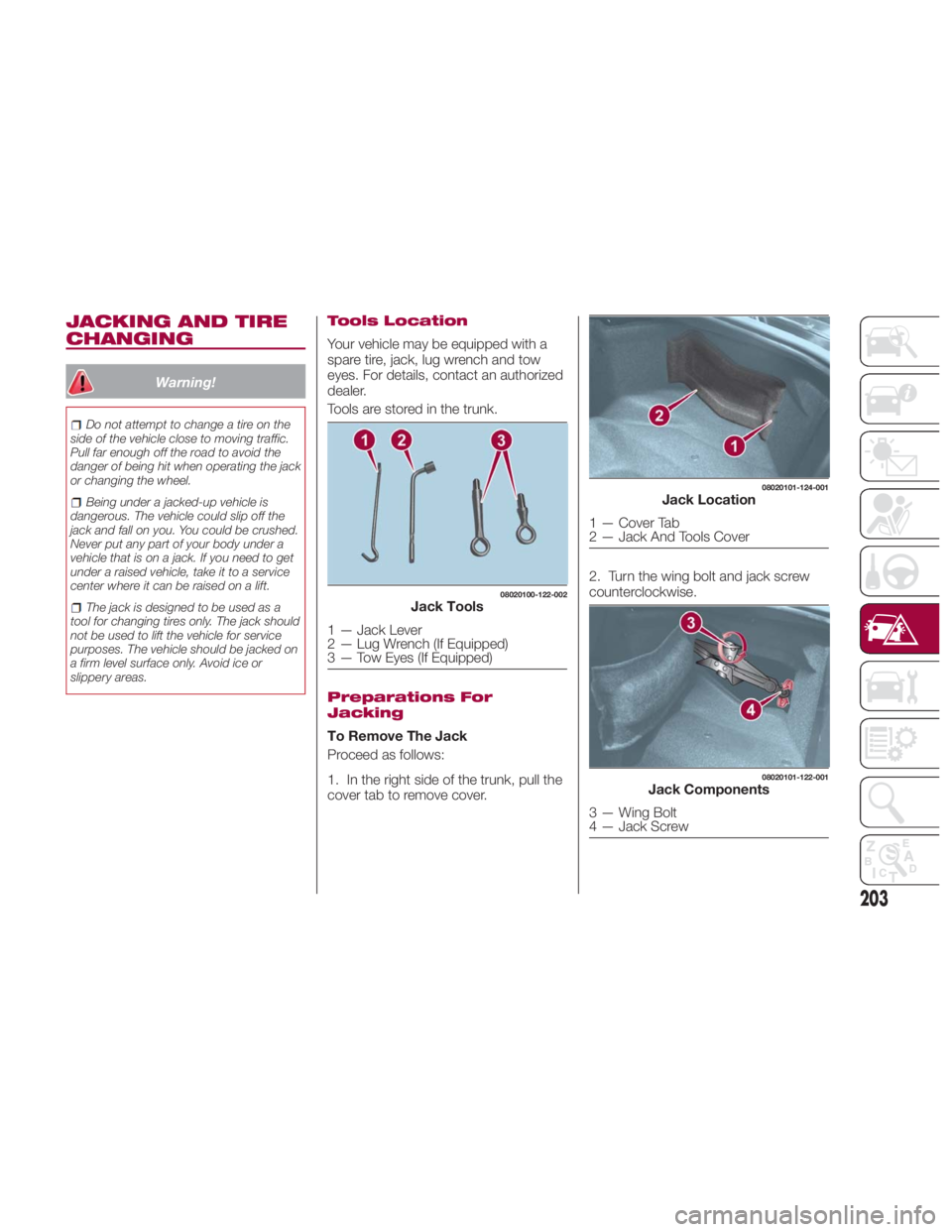
Your vehicle may be equipped with a
spare tire, jack, lug wrench and tow
eyes. For details, contact an authorized
dealer.
Tools are stored in the trunk.
Preparations For
Jacking
To Remove The Jack
Proceed as follows:
1. In the right side of the trunk, pull the
cover tab to remove cover. 2. Turn the wing bolt and jack screw
counterclockwise. 08020100-122-002
Jack Tools
1 — Jack Lever
2 — Lug Wrench (If Equipped)
3 — Tow Eyes (If Equipped) 08020101-124-001
Jack Location
1 — Cover Tab
2 — Jack And Tools Cover 08020101-122-001
Jack Components
3 — Wing Bolt
4 — Jack Screw
203
Page 210 of 292
TIRE SERVICE KIT Tire Service Storage
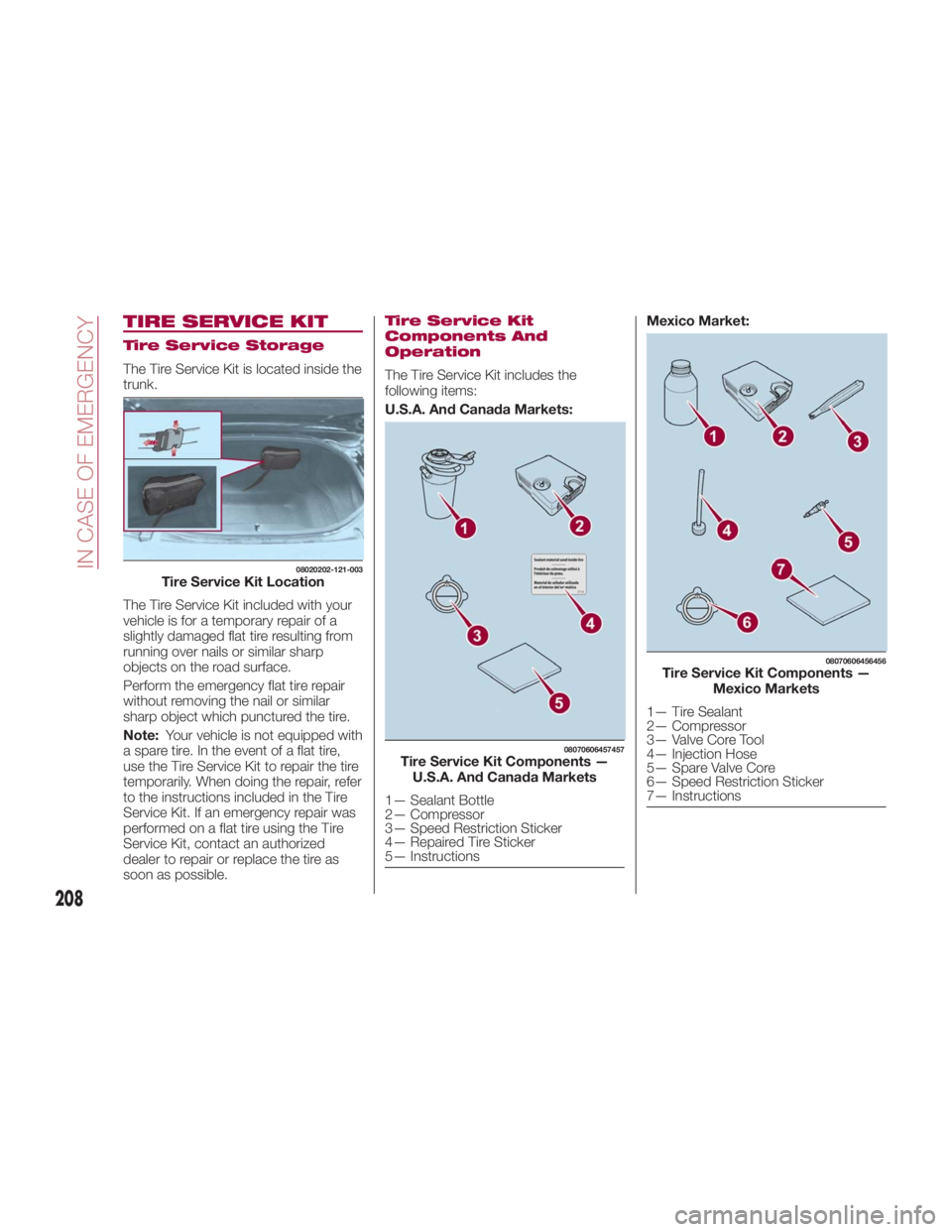
The Tire Service Kit is located inside the
trunk.
The Tire Service Kit included with your
vehicle is for a temporary repair of a
slightly damaged flat tire resulting from
running over nails or similar sharp
objects on the road surface.
Perform the emergency flat tire repair
without removing the nail or similar
sharp object which punctured the tire.
Note: Your vehicle is not equipped with
a spare tire. In the event of a flat tire,
use the Tire Service Kit to repair the tire
temporarily. When doing the repair, refer
to the instructions included in the Tire
Service Kit. If an emergency repair was
performed on a flat tire using the Tire
Service Kit, contact an authorized
dealer to repair or replace the tire as
soon as possible. Tire Service Kit
Components And
Operation
The Tire Service Kit includes the
following items:
U.S.A. And Canada Markets: Mexico Market:08020202-121-003
Tire Service Kit Location 08070606457457
Tire Service Kit Components —
U.S.A. And Canada Markets
1— Sealant Bottle
2— Compressor
3— Speed Restriction Sticker
4— Repaired Tire Sticker
5— Instructions 08070606456456
Tire Service Kit Components —
Mexico Markets
1— Tire Sealant
2— Compressor
3— Valve Core Tool
4— Injection Hose
5— Spare Valve Core
6— Speed Restriction Sticker
7— Instructions
208
IN CASE OF EMERGENCY
Page 227 of 292
At least monthly perform inspection
of:
Tire inflation pressures
At least twice a year (for example,
every spring and fall) perform
inspection of:
Engine coolant
Engine oil
As explained in the “Introduction”
paragraph, several procedures can be
done only by a qualified service
technician with special tools.
For details, read the separate Warranty
Booklet provided with the vehicle. If you
are unsure about any servicing or
maintenance procedure, have it done
by an authorized dealer.
There are strict environmental laws
regarding the disposal of waste oil and
fluids. Please dispose of your waste
properly and with due regard to the
environment.
We recommend that you entrust the oil
and fluid changes of your vehicle to an
authorized dealer. Periodic Checks
Every 620 miles (1,000 km) or before
long trips check and, if necessary, top
off:
Engine coolant level.
Brake fluid level.
Windshield washer fluid level.
Tire inflation pressure and condition.
Operation of lighting system
(headlights, direction indicators, hazard
warning lights, etc.).
Operation of windshield
washer/wiper system and
positioning/wear of windshield wiper
blades.
Every 1860 miles (3,000 km) check
and top off the engine oil level if
required.
Heavy-Duty Use Of The
Vehicle
If the vehicle is used under one of the
following conditions:
Dusty roads.
Short, repeated trips less than 4.4 -
5 miles ( 7-8km)atsub -zero outside
temperatures.
Engine idling for long periods of time
or driving long distances at low speeds
or long periods of inactivity. The following checks must be carried
out more often than indicated in the
Scheduled Servicing Plan:
Check front disc brake pad condition
and wear.
Check cleanliness of underhood area
and all door and trunk locks, cleanliness
and lubrication of linkage.
Visually inspect conditions of the:
engine, transmission, lines and hoses
(exhaust/fuel system/brakes) and
rubber elements (hoses/belts/etc.).
Check battery charge and battery
fluid level.
Visually inspect conditions of the
accessory drive belts.
Check and, if necessary, change
engine oil and replace oil filter.
Check and, if necessary, replace
cabin air filter.
Check and, if necessary, replace air
cleaner.
Severe Duty All Models
Change Engine Oil at 4,000 miles
(6,500 km) if the vehicle is operated in a
dusty and off road environment or is
operated predominately at idle or only
very low engine RPM’s. This type of
vehicle use is considered Severe Duty.
225
Page 230 of 292
Mileage or time passed
(whichever comes first)
10,000
20,000
30,000
40,000
50,000
60,000
70,000
80,000
90,000
100,000
110,000
120,000
130,000
140,000
150,000Or Years: 123 456789101112131415
Or Kilometers:
16,000
32,000
48,000
64,000
80,000
96,000
112,000
128,000
144,000
160,000
176,000
192,000
208,000
224,000
240,000Check windshield/rear
window wiper blade
position/wear. •• •• • • • •
Check operation of
windshield washer system
and adjust jets if
necessary. •• •• • • • •
Check cleanliness of hood
and trunk locks and
cleanliness and lubrication
of linkages. •• •• • • • •
Check parking brake lever
travel and adjust, if
necessary. •••••••••••••••
Visually check the
condition and wear of the
front and rear brakes. •••••••••••••••
Visually inspect condition
of evaporation control
system. ••• • •
228
SERVICING AND MAINTENANCE
Page 237 of 292
BATTERY
RECHARGING BATTERY CHARGING
PROCEDURE
Warning!Battery fluid is a corrosive acid solution
and can burn or even blind you. Do not
allow battery fluid to contact your eyes,
skin, or clothing. Do not lean over a battery
when attaching clamps. If acid splashes in
eyes or on skin, flush the area immediately
with large amounts of water. Refer to
“Jump-Starting Procedure” in “In Case Of
Emergency” for further information.
Battery gas is flammable and explosive.
Keep flame or sparks away from the
battery. Do not use a booster battery or
any other booster source with an output
greater than 12 Volts. Do not allow cable
clamps to touch each other.
Battery posts, terminals, and related
accessories contain lead and lead
compounds. Wash hands after handling. Caution!It is essential when replacing the cables
on the battery that the positive cable is
attached to the positive post and the
negative cable is attached to the negative
post. Battery posts are marked positive (+)
and negative (-) and are identified on the
battery case. Cable clamps should be tight
on the terminal posts and free of corrosion.
If a “fast charger” is used while the
battery is in the vehicle, disconnect both
vehicle battery cables before connecting
the charger to the battery. Do not use a
“fast charger” to provide starting voltage.
Charge battery as follows:
Before recharging the battery, turn off
all accessories and turn the engine off
by placing the ignition in the OFF mode.
Disconnect the negative battery
cable.
Connect the charger cables to the
battery terminals, observing the polarity
(+,–).
Turn on the charger.
When finished, turn the charger off
before disconnecting the battery.
Reconnect the negative battery
terminal. MAINTENANCE
PROCEDURES The following pages contain
instructions on the required
maintenance from the technical
personnel who designed the vehicle.
In addition to these specific
maintenance instructions specified for
routine scheduled servicing, there are
other components which may require
periodic maintenance or replacement
over the vehicle’s life cycle.
Body Lubrication
Ensure that the locks and bodywork
junction points, including components
such as the seat guides, door hinges
(and rollers), trunk and hood are
periodically lubricated with lithium
based grease to ensure correct, silent
operation and to protect them from rust
and wear.
Thoroughly clean the components,
eliminating every trace of dirt and dust.
After lubricating, eliminate excess oil
and grease. Also pay particular
attention to the hood closing devices,
to ensure correct operation.
During operations on the hood, be sure
to perform with the engine cold, also
remember to check, clean and lubricate
the locking, release and safety devices.
Make sure the hood's secondary latch
keeps the hood from opening when the
primary latch is released.
235
Page 276 of 292
DIMENSIONS Dimensions
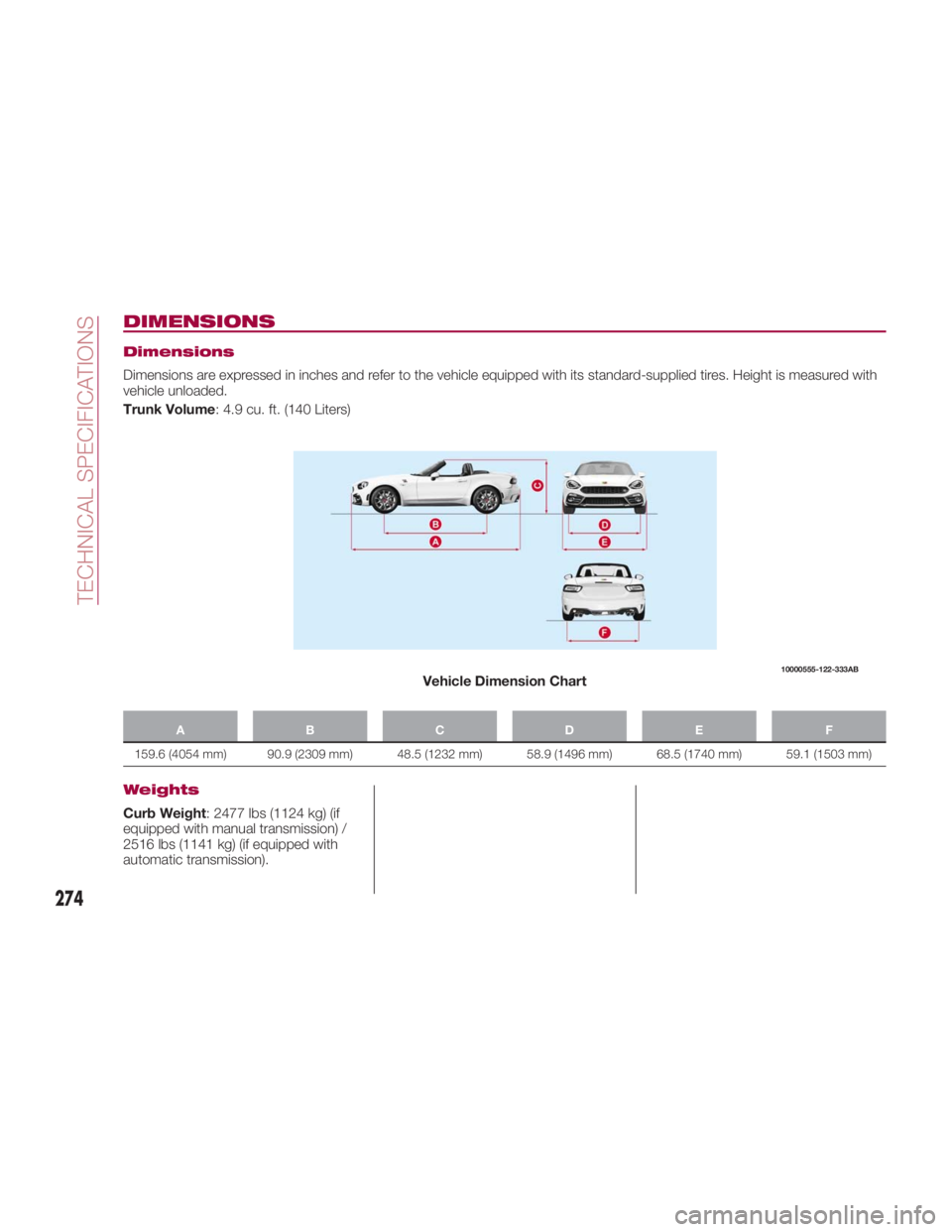
Dimensions are expressed in inches and refer to the vehicle equipped with its standard-supplied tires. Height is measured with
vehicle unloaded.
Trunk Volume : 4.9 cu. ft. (140 Liters)
ABCDE F
159.6 (4054 mm) 90.9 (2309 mm) 48.5 (1232 mm) 58.9 (1496 mm) 68.5 (1740 mm) 59.1 (1503 mm)
Weights
Curb Weight : 2477 lbs (1124 kg) (if
equipped with manual transmission) /
2516 lbs (1141 kg) (if equipped with
automatic transmission). 10000555-122-333AB
Vehicle Dimension Chart
274
TECHNICAL SPECIFICATIONS
Page 286 of 292
INDEX About Your Brakes .......... .150
ABS system ............... .112
Active Adaptive Shift (AAS) ..... .156
Adaptive Front Lighting System
(AFS) ...................42
Additives, Fuel ............. .174
Advanced Keyless Entry System
Key Left In Trunk ............21
Key left In Vehicle ...........21
Locking Doors .............21
Passive Entry ..............21
Request Switch ............21
Unlocking Doors ............21
AirBag............... .131,135
Advance Front Air Bag . . . .131,135
Air Bag Warning Light ...... .147
Event Data Recorder (EDR) .145,222
FrontAirBag ............ .147
Maintaining Your Air Bag
System ............... .145
Air Bag Maintenance ......... .145
Air Pressure, Tires ........... .246
Alarm
Vehicle Security Alarm ..... .24,25
Alarm (Security Alarm) ....... .24,25
Aluminium wheel maintenance . . . .259
Automatic Dimming Mirror ........36
Automatic Headlights ...........40 Automatic Temperature Control
(ATC) ...................52
Automatic Transmission ....... .153
Auxiliary Power Outlet ..........63
B-Pillar Location ............ .242
Battery (maintenance) ......... .234
Battery charging procedure ..... .235
Battery recharging ........... .235
Blind Spot Monitoring ......... .114
Body and underbody warranty . . . .256
Body lubrication ............ .235
Bodywork (care and maintenance). .256
Boot, Convertible Top Lowering ....70
Boot, Convertible Top Precautions . .73
Boot, Convertible Top Raising .....71
Brake System .............. .150
Brake/clutch fluid (level check) . . . .233
Brakes ............... .150,271
Bright-metal maintenance ......
.259
Camera,
Rear ..............
.167
Carbon Monoxide Warning ..... .175
Center Seat Storage Compartment .......................60
Certification Label ........... .176
Changing A Flat Tire .... .203,204,237
Chart, Tire Sizing ............ .239
Check Engine Light (Malfunction
Indicator Light) ........... .110 Checking levels ............. .231
Child Restraint ............. .128
Child Restraints
Child Restraints .......... .128
Clean Air Gasoline ........... .173
Cleaning
Wheels ............... .251
Climate Control ..............45
Close The Hood ..............69
Compact Spare Tire .......... .250
Contract, Service ........... .281
Convertible Top ..............70
Convertible top maintenance .... .260
Cooling
Air Conditioning ............50
Cupholders .................64
Customer Assistance ......... .280
Data Recorder, Event ......... .145
Daytime Running Lights .........40
Diagnostic System, Onboard .... .109
Dimensions ............... .274
Disabled Vehicle Towing .... .220,221
Driver's Seat Back Tilt ..........33
Driving in flooded area ........ .181
Driving tips ............... .178
Electric power steering ..........74
Electric Remote Mirrors .........37
INDEX
Page 290 of 292
Pressure Monitor System
(TPMS) ............... .114
Quality Grading .......... .254
Radial ................ .247
Replacement ............ .248
Safety ............. .238,246
Sizes ................. .239
Snow Tires ............. .249
Spare Tire ........ .203,250,251
Spinning .............. .247
Tread Wear Indicators ...... .248
ToOpenDeckLid.............66
ToOpenHood...............68
Towing
Disabled Vehicle ....... .220,221
Towing Eyes ............... .220
Towing trailers ............. .178
TPMS (Tire Pressure Monitoring
System) ................ .119 Transmission .............. .270
Tread Wear Indicators ......... .248
Trunk Lid
Closing ..................67
Opening .................66
Trunk light (bulb replacement) .... .194
Turn Signals .................41
Undercoating .............. .259
Uniform Tire Quality Grades ..... .254
Vehicle Loading ......... .176,243
Vehicle modifications/alterations .....4
Vent Operation ...............45
Warning Flasher, Hazard ....... .184
Warranty Information ......... .282
Washer Operation .......... .42,44
Washers, Windshield ...........42 Wheel And Wheel Trim ........ .251
Wheel And Wheel Trim Care ..... .251
Wheels and tires ............ .238
Window and headlight washer fluid
(level check) ............. .234
Window interiors (cleaning) ..... .263
Windows
Driver/Passenger
W
indow
Controls .................56
Power Windows ...........56
Window Lockout ...........58
Windshield wiper blades (replacing) ..................... .236
Windshield Wipers ............42
Windstop ..................65
Winter driving .............. .180
Wiper blades .............. .236
Wrecker Towing ......... .220,221
INDEX