lights FIAT SPIDER ABARTH 2017 Service Manual
[x] Cancel search | Manufacturer: FIAT, Model Year: 2017, Model line: SPIDER ABARTH, Model: FIAT SPIDER ABARTH 2017Pages: 292, PDF Size: 9.24 MB
Page 115 of 292
power to the drive wheels, limiting
wheel spin and loss of traction.
The indicator light turns on when the
system has a malfunction. Refer to
“Warning Lights And Messages” in
“Getting To Know Your Instrument
Panel” for further information.
TCS / DSC Indicator Light
The
indicator light stays on for a few
seconds when the ignition is placed in
the ON mode.
If the TCS or DSC is operating, the
indicator light flashes.
If the
indicator light stays on, the
TCS, DSC or the brake assist system
may have a malfunction and they may
not operate correctly. Contact your
authorized dealer.
Note:
In addition to the indicator light
flashing, a slight sound will come from
the engine. This indicates that the
TCS/DSC is operating properly.
On slippery surfaces, such as fresh
snow, it will be impossible to achieve
high rpm when the TCS is on. DSC System (Dynamic
Stability Control)
The Dynamic Stability Control (DSC)
automatically controls braking and
engine torque in conjunction with
systems such as ABS and TCS to help
control side slip when driving on
slippery surfaces, or during sudden or
evasive maneuvering, enhancing vehicle
safety. Refer to “ABS System (Antilock
Brake System)” and “TCS System
(Traction Control System)” in this
chapter for further information.
DSC operation is possible at speeds
greater than 12 mph (20 km/h).
The indicator light turns on when the
system has a malfunction. Refer to
“Warning Lights And Messages” in
“Getting To Know Your Instrument
Panel” for further information.
Note: The DSC may not operate
correctly unless the following are
observed:
Use tires of the correct size
specified for your vehicle on all four
wheels.
Use tires of the same manufacturer,
brand and tread pattern on all four
wheels.
Do not mix worn tires.
Note: The DSC may not operate
correctly when tire chains are used. TCS / DSC Indicator Light
The
indicator light stays on for a few
seconds when the ignition is placed in
the ON mode. It also illuminates when
the DSC OFF switch is pressed and
TCS/DSC is switched off.
If the light stays on, the TCS, DSC or
the brake assist system may have a
malfunction and they may not operate
correctly. Take your vehicle to an
authorized dealer.
DSC OFF Indicator Light
The
indicator light stays on for a few
seconds when the ignition is placed in
the ON mode. It also illuminates when
the DSC OFF switch is pressed and
TCS/DSC is switched off.
If the light remains illuminated and the
TCS/DSC is not switched off, contact
your authorized dealer. The DSC may
have a malfunction.
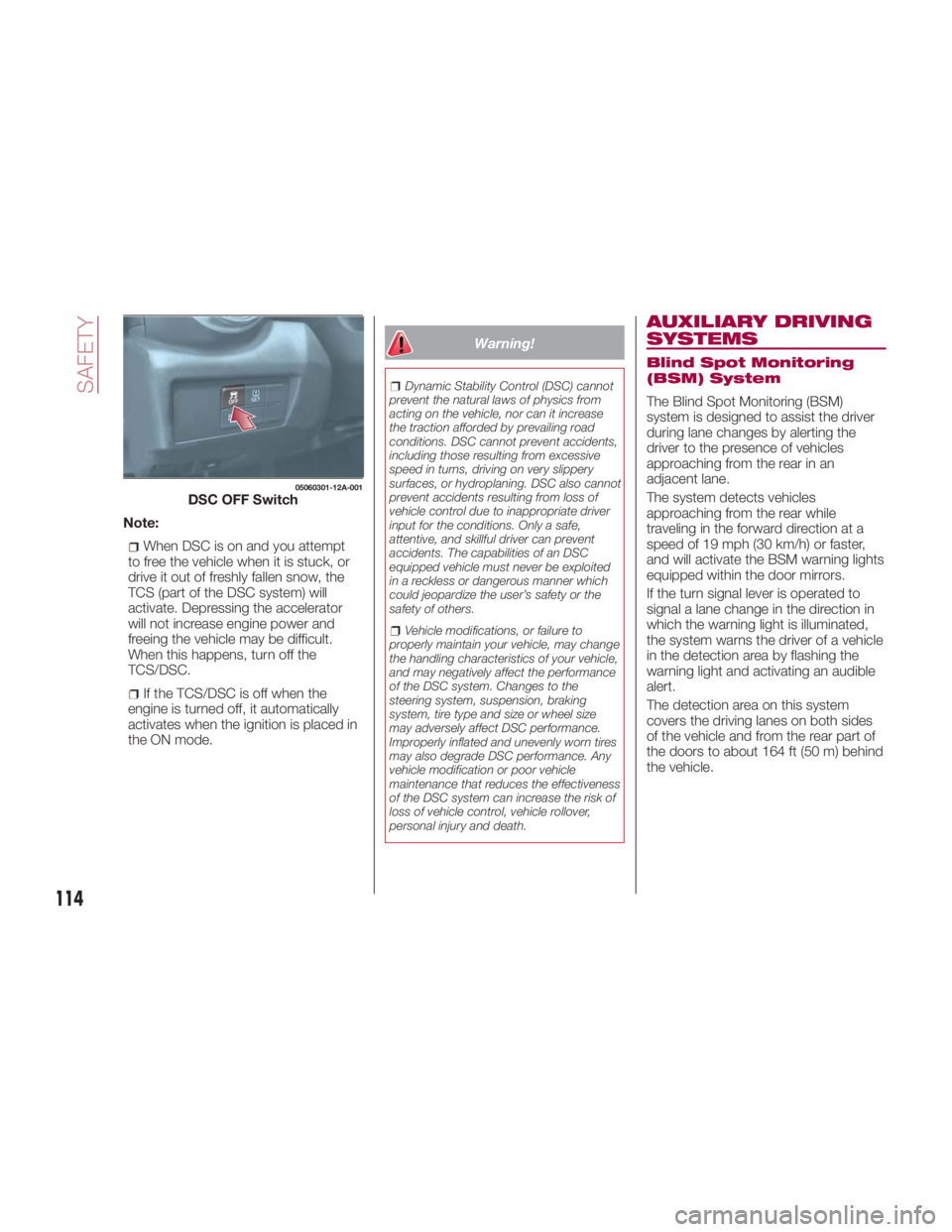
DSC OFF Switch
Push the switch to turn off the
TCS/DSC. The
indicator light in the
instrument cluster will illuminate. Push
the switch again to turn the TCS/DSC
back on. The indicator light will turn off.
113
Page 116 of 292
Note:
When DSC is on and you attempt
to free the vehicle when it is stuck, or
drive it out of freshly fallen snow, the
TCS (part of the DSC system) will
activate. Depressing the accelerator
will not increase engine power and
freeing the vehicle may be difficult.
When this happens, turn off the
TCS/DSC.
If the TCS/DSC is off when the
engine is turned off, it automatically
activates when the ignition is placed in
the ON mode. Warning!Dynamic Stability Control (DSC) cannot
prevent the natural laws of physics from
acting on the vehicle, nor can it increase
the traction afforded by prevailing road
conditions. DSC cannot prevent accidents,
including those resulting from excessive
speed in turns, driving on very slippery
surfaces, or hydroplaning. DSC also cannot
prevent accidents resulting from loss of
vehicle control due to inappropriate driver
input for the conditions. Only a safe,
attentive, and skillful driver can prevent
accidents. The capabilities of an DSC
equipped vehicle must never be exploited
in a reckless or dangerous manner which
could jeopardize the user’s safety or the
safety of others.
Vehicle modifications, or failure to
properly maintain your vehicle, may change
the handling characteristics of your vehicle,
and may negatively affect the performance
of the DSC system. Changes to the
steering system, suspension, braking
system, tire type and size or wheel size
may adversely affect DSC performance.
Improperly inflated and unevenly worn tires
may also degrade DSC performance. Any
vehicle modification or poor vehicle
maintenance that reduces the effectiveness
of the DSC system can increase the risk of
loss of vehicle control, vehicle rollover,
personal injury and death. AUXILIARY DRIVING
SYSTEMS Blind Spot Monitoring
(BSM) System
The Blind Spot Monitoring (BSM)
system is designed to assist the driver
during lane changes by alerting the
driver to the presence of vehicles
approaching from the rear in an
adjacent lane.
The system detects vehicles
approaching from the rear while
traveling in the forward direction at a
speed of 19 mph (30 km/h) or faster,
and will activate the BSM warning lights
equipped within the door mirrors.
If the turn signal lever is operated to
signal a lane change in the direction in
which the warning light is illuminated,
the system warns the driver of a vehicle
in the detection area by flashing the
warning light and activating an audible
alert.
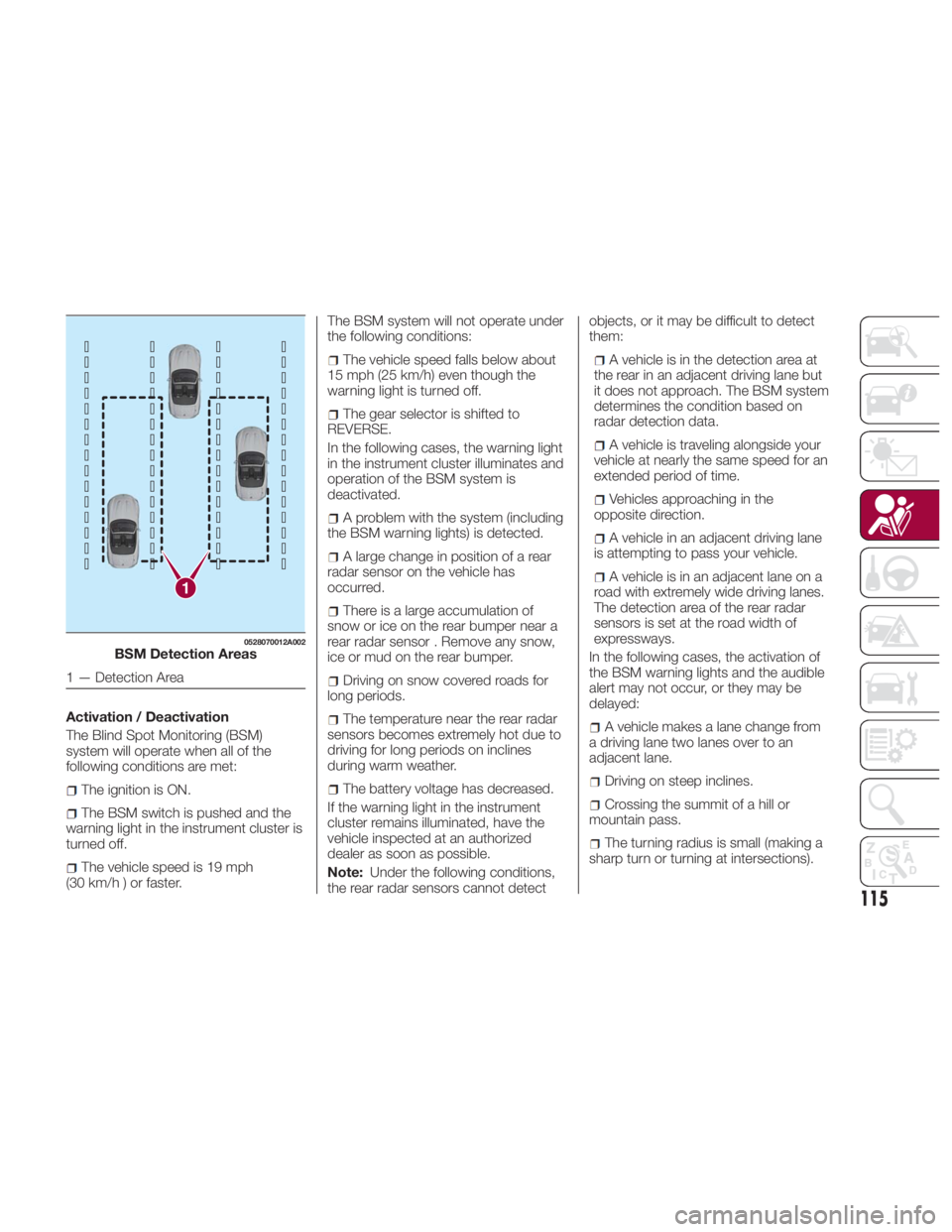
The detection area on this system
covers the driving lanes on both sides
of the vehicle and from the rear part of
the doors to about 164 ft (50 m) behind
the vehicle.05060301-12A-001
DSC OFF Switch
114
SAFETY
Page 117 of 292
Activation / Deactivation
The Blind Spot Monitoring (BSM)
system will operate when all of the
following conditions are met:
The ignition is ON.
The BSM switch is pushed and the
warning light in the instrument cluster is
turned off.
The vehicle speed is 19 mph
(30km/h)orfaster. The BSM system will not operate under
the following conditions:
The vehicle speed falls below about
15 mph (25 km/h) even though the
warning light is turned off.
The gear selector is shifted to
REVERSE.
In the following cases, the warning light
in the instrument cluster illuminates and
operation of the BSM system is
deactivated.
A problem with the system (including
the BSM warning lights) is detected.
A large change in position of a rear
radar sensor on the vehicle has
occurred.
There is a large accumulation of
snow or ice on the rear bumper near a
rear radar sensor . Remove any snow,
ice or mud on the rear bumper.
Driving on snow covered roads for
long periods.
The temperature near the rear radar
sensors becomes extremely hot due to
driving for long periods on inclines
during warm weather.
The battery voltage has decreased.
If the warning light in the instrument
cluster remains illuminated, have the
vehicle inspected at an authorized
dealer as soon as possible.
Note: Under the following conditions,
the rear radar sensors cannot detect objects, or it may be difficult to detect
them:
A vehicle is in the detection area at
the rear in an adjacent driving lane but
it does not approach. The BSM system
determines the condition based on
radar detection data.
A vehicle is traveling alongside your
vehicle at nearly the same speed for an
extended period of time.
Vehicles approaching in the
opposite direction.
A vehicle in an adjacent driving lane
is attempting to pass your vehicle.
A vehicle is in an adjacent lane on a
road with extremely wide driving lanes.
The detection area of the rear radar
sensors is set at the road width of
expressways.
In the following cases, the activation of
the BSM warning lights and the audible
alert may not occur, or they may be
delayed:
A vehicle makes a lane change from
a driving lane two lanes over to an
adjacent lane.
Driving on steep inclines.
Crossing the summit of a hill or
mountain pass.
The turning radius is small (making a
sharp turn or turning at intersections).1 0528070012A002
BSM Detection Areas
1 — Detection Area
115
Page 118 of 292
Whenthereisadifferenceinthe
height between your driving lane and
the adjacent lane.
Immediately after pushing the BSM
switch and the system becomes
operable.
If the road width is extremely narrow,
vehicles two lanes over may be
detected. The detection area of the rear
radar sensors is set according to the
road width of expressways.
The BSM warning lights may turn on in
reaction to stationary objects on the
road or the roadside such as guardrails,
tunnels, sidewalls, and parked vehicles.
A BSM warning light may flash or the
audible alert may be activated several
times when making a turn at a city
intersection.
Turn off the BSM system while pulling a
trailer or while an accessory such as a
bicycle carrier is installed to the rear of
the vehicle. Otherwise, the radar’s
sound system waves will be blocked
causing the system to not operate
normally.
In the following cases, it may be difficult
to view the illumination/flashing of the
BSM warning lights equipped on the
door mirrors:
Snow or ice is adhering to the door
mirrors.
The door glass is fogged or covered
in snow, frost or dirt. The system switches to the Rear Cross
Traffic Alert function when the gear
selector is shifted to the REVERSE
position.
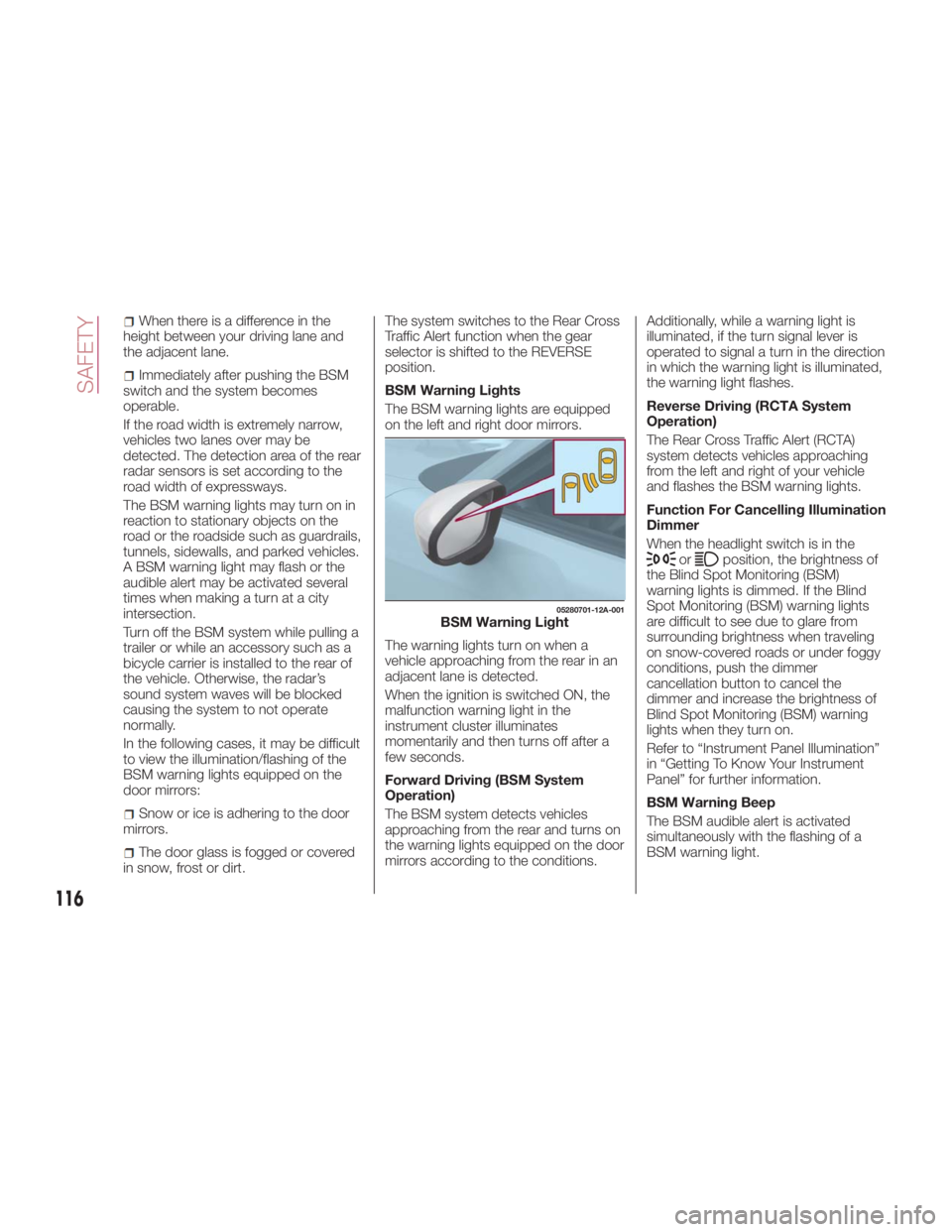
BSM Warning Lights
The BSM warning lights are equipped
on the left and right door mirrors.
The warning lights turn on when a
vehicle approaching from the rear in an
adjacent lane is detected.
When the ignition is switched ON, the
malfunction warning light in the
instrument cluster illuminates
momentarily and then turns off after a
few seconds.
Forward Driving (BSM System
Operation)
The BSM system detects vehicles
approaching from the rear and turns on
the warning lights equipped on the door
mirrors according to the conditions. Additionally, while a warning light is
illuminated, if the turn signal lever is
operated to signal a turn in the direction
in which the warning light is illuminated,
the warning light flashes.
Reverse Driving (RCTA System
Operation)
The Rear Cross Traffic Alert (RCTA)
system detects vehicles approaching
from the left and right of your vehicle
and flashes the BSM warning lights.
Function For Cancelling Illumination
Dimmer
When the headlight switch is in the
or position, the brightness of
the Blind Spot Monitoring (BSM)
warning lights is dimmed. If the Blind
Spot Monitoring (BSM) warning lights
are difficult to see due to glare from
surrounding brightness when traveling
on snow-covered roads or under foggy
conditions, push the dimmer
cancellation button to cancel the
dimmer and increase the brightness of
Blind Spot Monitoring (BSM) warning
lights when they turn on.
Refer to “Instrument Panel Illumination”
in “Getting To Know Your Instrument
Panel” for further information.
BSM Warning Beep
The BSM audible alert is activated
simultaneously with the flashing of a
BSM warning light. 05280701-12A-001
BSM Warning Light
116
SAFETY
Page 119 of 292
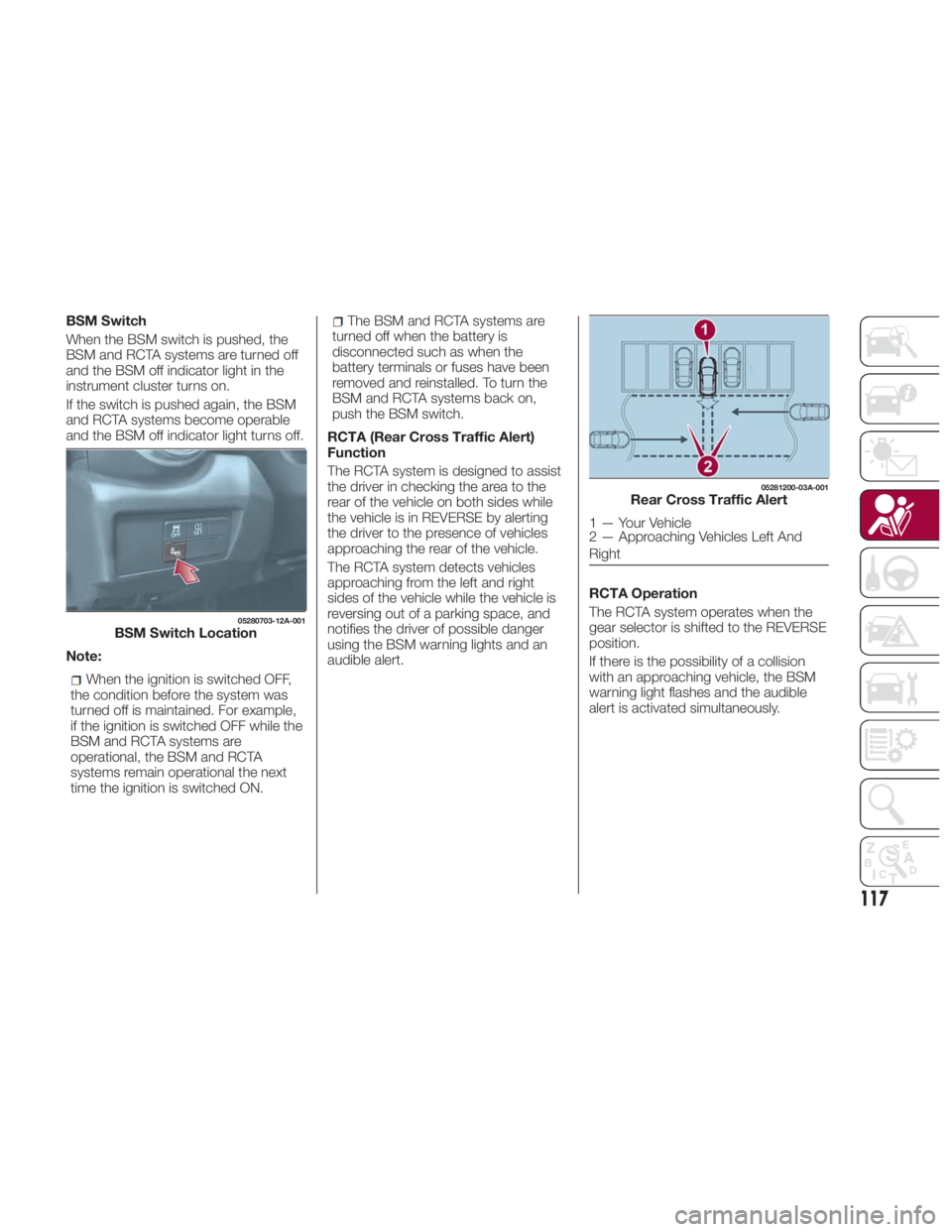
BSM Switch
When the BSM switch is pushed, the
BSM and RCTA systems are turned off
and the BSM off indicator light in the
instrument cluster turns on.
If the switch is pushed again, the BSM
and RCTA systems become operable
and the BSM off indicator light turns off.
Note:
When the ignition is switched OFF,
the condition before the system was
turned off is maintained. For example,
if the ignition is switched OFF while the
BSM and RCTA systems are
operational, the BSM and RCTA
systems remain operational the next
time the ignition is switched ON. The BSM and RCTA systems are
turned off when the battery is
disconnected such as when the
battery terminals or fuses have been
removed and reinstalled. To turn the
BSM and RCTA systems back on,
push the BSM switch.
RCTA (Rear Cross Traffic Alert)
Function
The RCTA system is designed to assist
the driver in checking the area to the
rear of the vehicle on both sides while
the vehicle is in REVERSE by alerting
the driver to the presence of vehicles
approaching the rear of the vehicle.
The RCTA system detects vehicles
approaching from the left and right
sides of the vehicle while the vehicle is
reversing out of a parking space, and
notifies the driver of possible danger
using the BSM warning lights and an
audible alert. RCTA Operation
The RCTA system operates when the
gear selector is shifted to the REVERSE
position.
If there is the possibility of a collision
with an approaching vehicle, the BSM
warning light flashes and the audible
alert is activated simultaneously.05280703-12A-001
BSM Switch Location 05281200-03A-001
Rear Cross Traffic Alert
1 — Your Vehicle
2 — Approaching Vehicles Left And
Right
117
Page 120 of 292
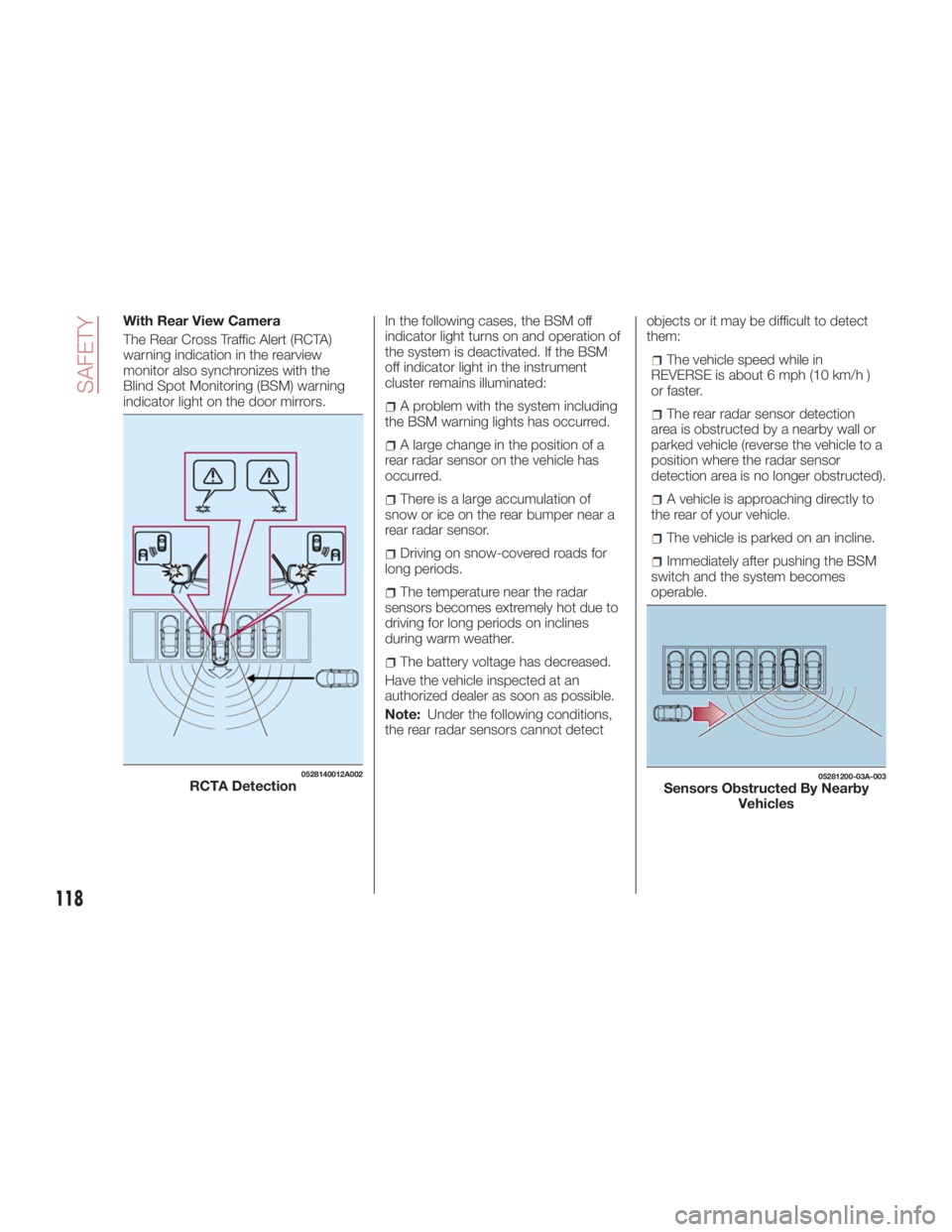
With Rear View Camera
The Rear Cross Traffic Alert (RCTA)
warning indication in the rearview
monitor also synchronizes with the
Blind Spot Monitoring (BSM) warning
indicator light on the door mirrors. In the following cases, the BSM off
indicator light turns on and operation of
the system is deactivated. If the BSM
off indicator light in the instrument
cluster remains illuminated:
A problem with the system including
the BSM warning lights has occurred.
A large change in the position of a
rear radar sensor on the vehicle has
occurred.
There is a large accumulation of
snow or ice on the rear bumper near a
rear radar sensor.
Driving on snow-covered roads for
long periods.
The temperature near the radar
sensors becomes extremely hot due to
driving for long periods on inclines
during warm weather.
The battery voltage has decreased.
Have the vehicle inspected at an
authorized dealer as soon as possible.
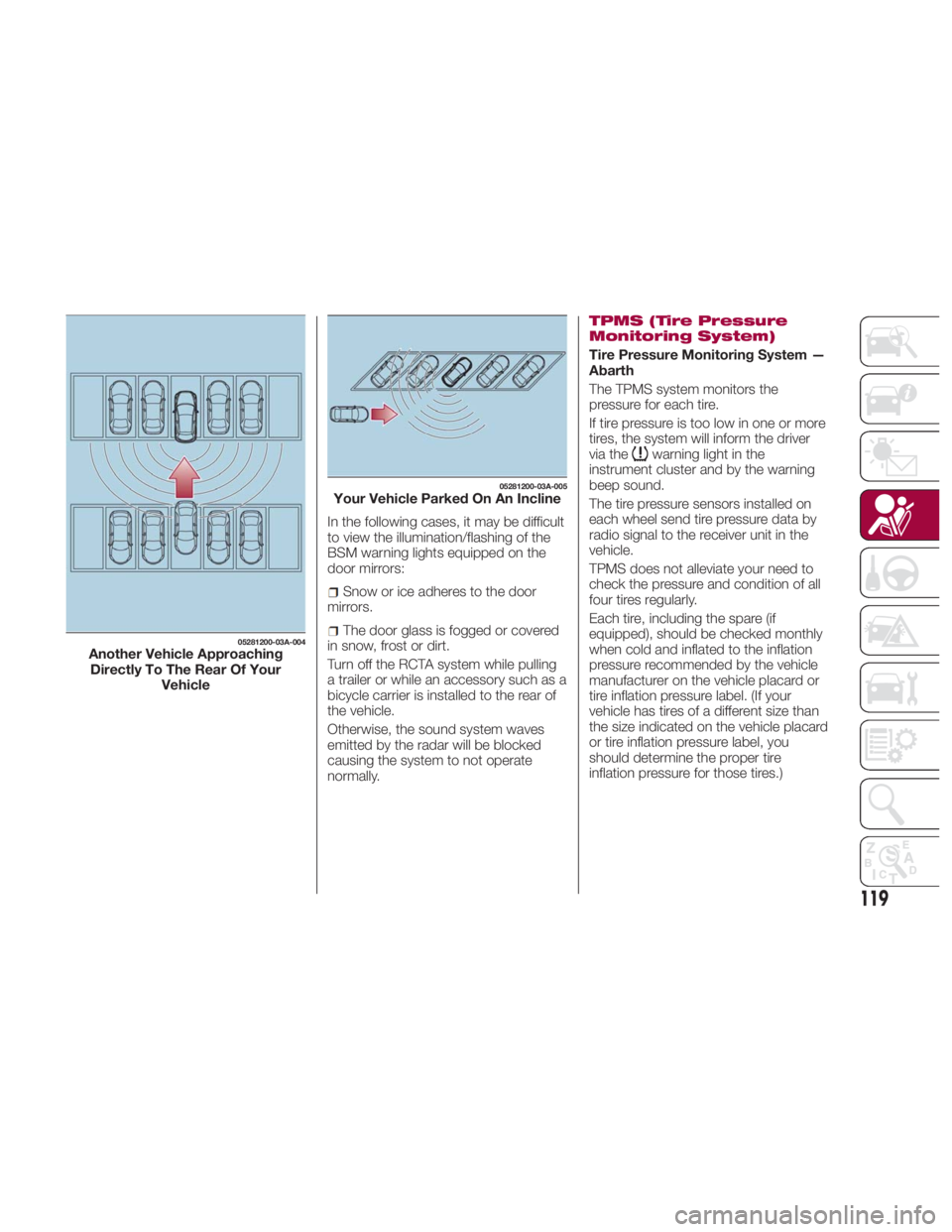
Note: Under the following conditions,
the rear radar sensors cannot detect objects or it may be difficult to detect
them:
The vehicle speed while in
REVERSE is about 6 mph (10 km/h )
or faster.
The rear radar sensor detection
area is obstructed by a nearby wall or
parked vehicle (reverse the vehicle to a
position where the radar sensor
detection area is no longer obstructed).
A vehicle is approaching directly to
the rear of your vehicle.
The vehicle is parked on an incline.
Immediately after pushing the BSM
switch and the system becomes
operable.0528140012A002
RCTA Detection 05281200-03A-003
Sensors Obstructed By Nearby
Vehicles
118
SAFETY
Page 121 of 292
In the following cases, it may be difficult
to view the illumination/flashing of the
BSM warning lights equipped on the
door mirrors:
Snow or ice adheres to the door
mirrors.
The door glass is fogged or covered
in snow, frost or dirt.
Turn off the RCTA system while pulling
a trailer or while an accessory such as a
bicycle carrier is installed to the rear of
the vehicle.
Otherwise, the sound system waves
emitted by the radar will be blocked
causing the system to not operate
normally. TPMS (Tire Pressure
Monitoring System)
Tire Pressure Monitoring System —
Abarth
The TPMS system monitors the
pressure for each tire.
If tire pressure is too low in one or more
tires, the system will inform the driver
via the
warning light in the
instrument cluster and by the warning
beep sound.
The tire pressure sensors installed on
each wheel send tire pressure data by
radio signal to the receiver unit in the
vehicle.
TPMS does not alleviate your need to
check the pressure and condition of all
four tires regularly.
Each tire, including the spare (if
equipped), should be checked monthly
when cold and inflated to the inflation
pressure recommended by the vehicle
manufacturer on the vehicle placard or
tire inflation pressure label. (If your
vehicle has tires of a different size than
the size indicated on the vehicle placard
or tire inflation pressure label, you
should determine the proper tire
inflation pressure for those tires.)05281200-03A-004
Another Vehicle Approaching
Directly To The Rear Of Your
Vehicle 05281200-03A-005
Your Vehicle Parked On An Incline
119
Page 128 of 292
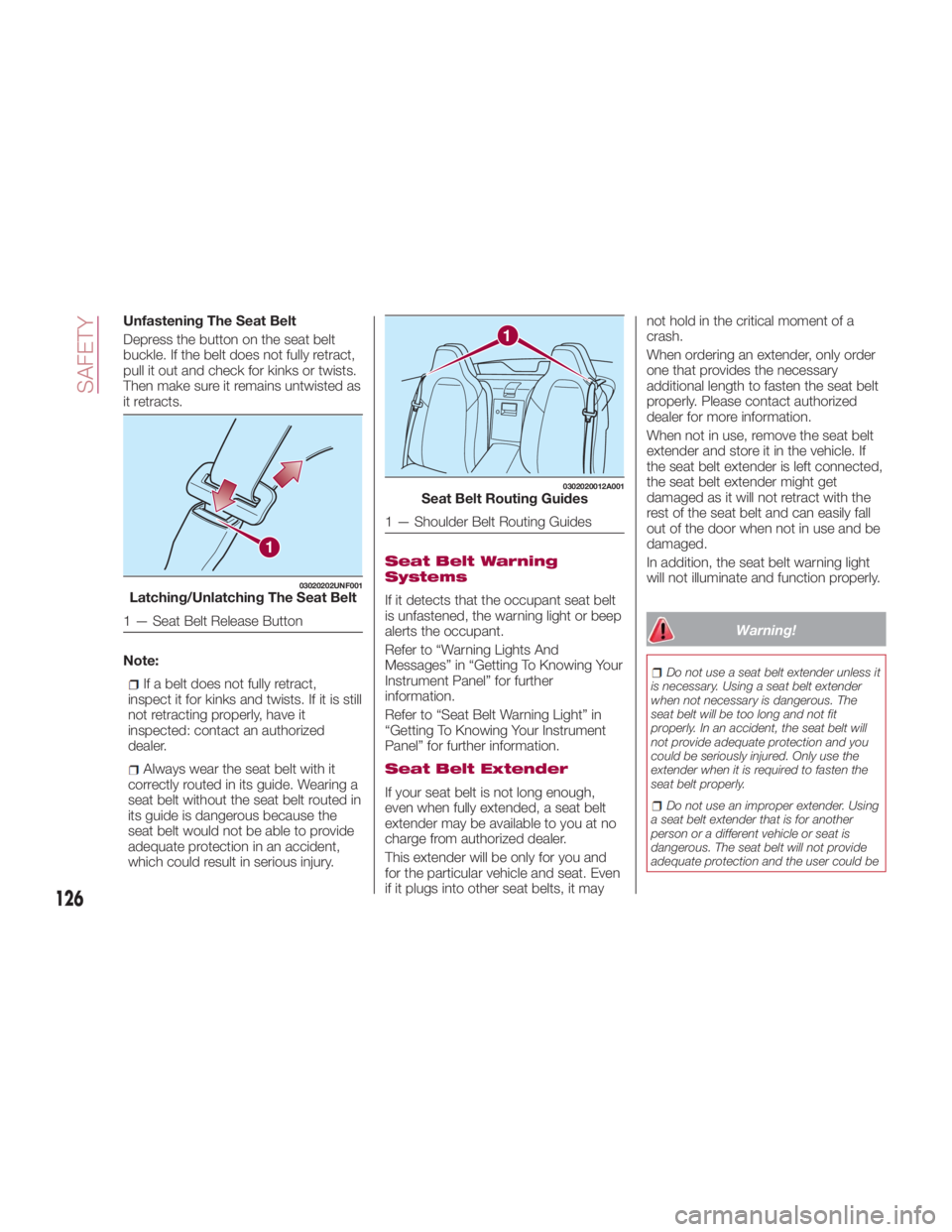
Unfastening The Seat Belt
Depress the button on the seat belt
buckle. If the belt does not fully retract,
pull it out and check for kinks or twists.
Then make sure it remains untwisted as
it retracts.
Note:
If a belt does not fully retract,
inspect it for kinks and twists. If it is still
not retracting properly, have it
inspected: contact an authorized
dealer.
Always wear the seat belt with it
correctly routed in its guide. Wearing a
seat belt without the seat belt routed in
its guide is dangerous because the
seat belt would not be able to provide
adequate protection in an accident,
which could result in serious injury. Seat Belt Warning
Systems
If it detects that the occupant seat belt
is unfastened, the warning light or beep
alerts the occupant.
Referto“WarningLightsAnd
Messages” in “Getting To Knowing Your
Instrument Panel” for further
information.
Refer to “Seat Belt Warning Light” in
“Getting To Knowing Your Instrument
Panel” for further information.
Seat Belt Extender
If your seat belt is not long enough,
even when fully extended, a seat belt
extender may be available to you at no
charge from authorized dealer.
This extender will be only for you and
for the particular vehicle and seat. Even
if it plugs into other seat belts, it may not hold in the critical moment of a
crash.
When ordering an extender, only order
one that provides the necessary
additional length to fasten the seat belt
properly. Please contact authorized
dealer for more information.
When not in use, remove the seat belt
extender and store it in the vehicle. If
the seat belt extender is left connected,
the seat belt extender might get
damaged as it will not retract with the
rest of the seat belt and can easily fall
out of the door when not in use and be
damaged.
In addition, the seat belt warning light
will not illuminate and function properly.
Warning! Do not use a seat belt extender unless it
is necessary. Using a seat belt extender
when not necessary is dangerous. The
seat belt will be too long and not fit
properly. In an accident, the seat belt will
not provide adequate protection and you
could be seriously injured. Only use the
extender when it is required to fasten the
seat belt properly.
Do not use an improper extender. Using
a seat belt extender that is for another
person or a different vehicle or seat is
dangerous. The seat belt will not provide
adequate protection and the user could be1 03020202UNF001
Latching/Unlatching The Seat Belt
1 — Seat Belt Release Button 1 0302020012A001
Seat Belt Routing Guides
1 — Shoulder Belt Routing Guides
126
SAFETY
Page 139 of 292
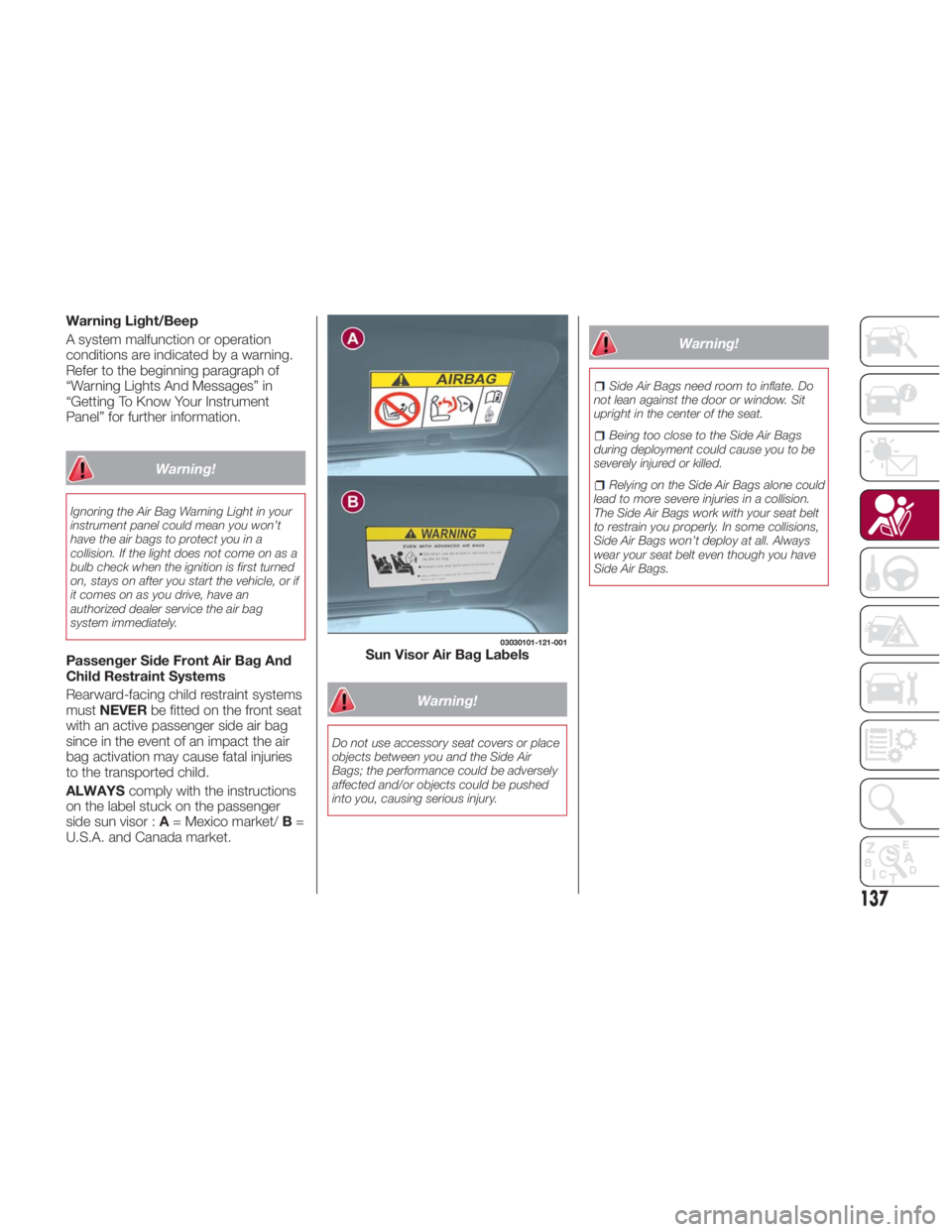
Warning Light/Beep
A system malfunction or operation
conditions are indicated by a warning.
Refer to the beginning paragraph of
“Warning Lights And Messages” in
“Getting To Know Your Instrument
Panel” for further information.
Warning!Ignoring the Air Bag Warning Light in your
instrument panel could mean you won’t
have the air bags to protect you in a
collision. If the light does not come on as a
bulb check when the ignition is first turned
on, stays on after you start the vehicle, or if
it comes on as you drive, have an
authorized dealer service the air bag
system immediately.
Passenger Side Front Air Bag And
Child Restraint Systems
Rearward-facing child restraint systems
must NEVER be fitted on the front seat
with an active passenger side air bag
since in the event of an impact the air
bag activation may cause fatal injuries
to the transported child.
ALWAYS comply with the instructions
on the label stuck on the passenger
side sun visor : A = Mexico market/ B =
U.S.A. and Canada market. Warning!Do not use accessory seat covers or place
objects between you and the Side Air
Bags; the performance could be adversely
affected and/or objects could be pushed
into you, causing serious injury. Warning! Side Air Bags need room to inflate. Do
not lean against the door or window. Sit
upright in the center of the seat.
Being too close to the Side Air Bags
during deployment could cause you to be
severely injured or killed.
Relying on the Side Air Bags alone could
lead to more severe injuries in a collision.
The Side Air Bags work with your seat belt
to restrain you properly. In some collisions,
Side Air Bags won’t deploy at all. Always
wear your seat belt even though you have
Side Air Bags. 03030101-121-001
Sun Visor Air Bag Labels
137
Page 144 of 292
Placing an object on the floor under the
front passenger seat may prevent the
occupant classification sensor from
working properly, which may result in
serious injury or death in a collision. Do not
place any objects on the floor under the
front passenger seat.
If there is a fault present in the occupant
classification sensor, both the Indicator
Light and the Air Bag Warning Light will
illuminate to show that the Passenger
Advanced Front Air Bag is deactivated.
Should this occur, the Passenger
Advanced Front Air Bag will remain
deactivated until the fault is cleared. This
indicates that you should take the vehicle
to an authorized dealer for service
immediately.
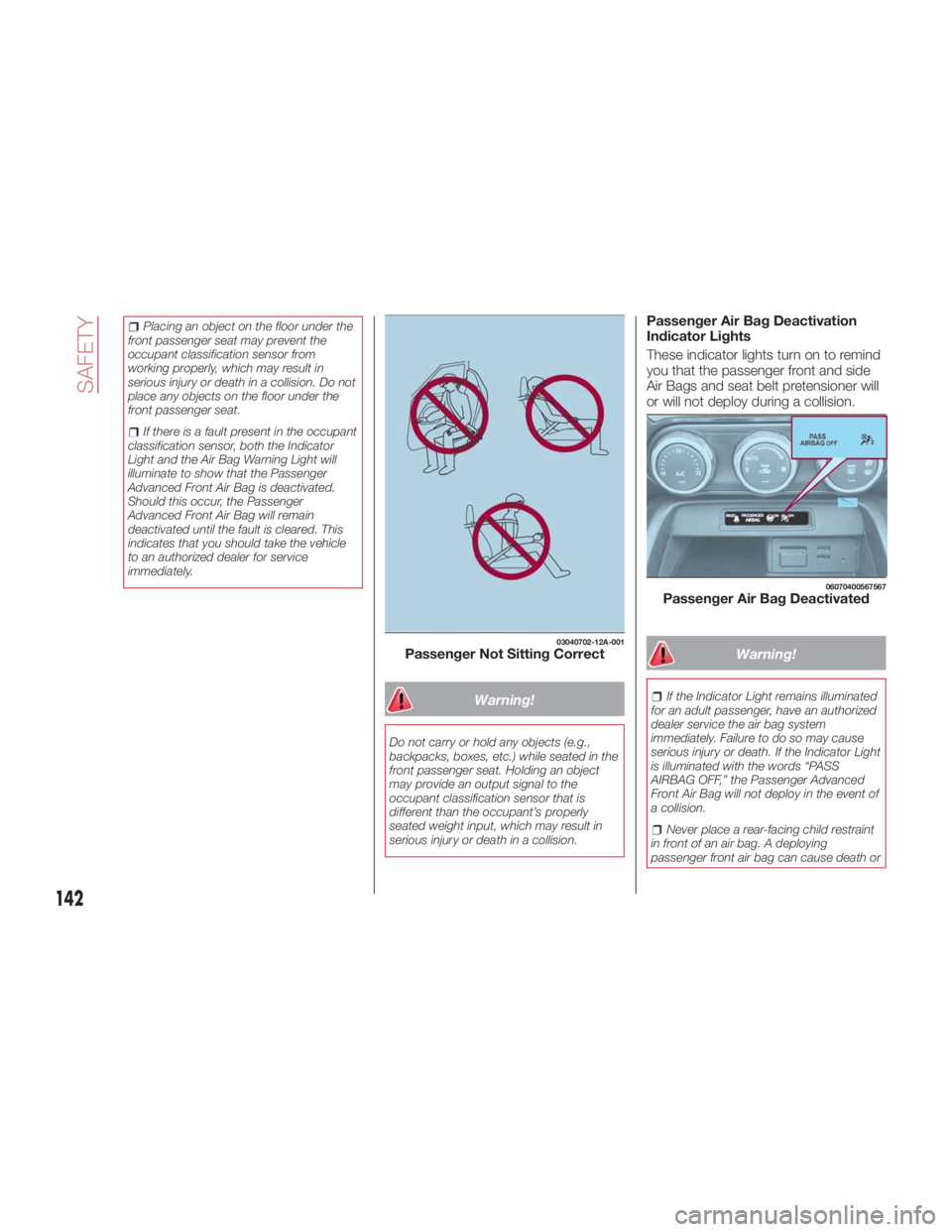
Warning!Do not carry or hold any objects (e.g.,
backpacks, boxes, etc.) while seated in the
front passenger seat. Holding an object
may provide an output signal to the
occupant classification sensor that is
different than the occupant’s properly
seated weight input, which may result in
serious injury or death in a collision. Passenger Air Bag Deactivation
Indicator Lights
These indicator lights turn on to remind
you that the passenger front and side
Air Bags and seat belt pretensioner will
or will not deploy during a collision.
Warning! If the Indicator Light remains illuminated
for an adult passenger, have an authorized
dealer service the air bag system
immediately. Failure to do so may cause
serious injury or death. If the Indicator Light
is illuminated with the words “PASS
AIRBAG OFF,” the Passenger Advanced
Front Air Bag will not deploy in the event of
a collision.
Never place a rear-facing child restraint
in front of an air bag. A deploying
passenger front air bag can cause death or 03040702-12A-001
Passenger Not Sitting Correct 06070400567567
Passenger Air Bag Deactivated
142
SAFETY