lock FIAT SPIDER ABARTH 2017 Manual Online
[x] Cancel search | Manufacturer: FIAT, Model Year: 2017, Model line: SPIDER ABARTH, Model: FIAT SPIDER ABARTH 2017Pages: 292, PDF Size: 9.24 MB
Page 208 of 292
Warning!Being under a jacked-up vehicle is
dangerous. The vehicle could slip off the
jack and fall on you. You could be crushed.
Never get any part of your body under a
vehicle that is on a jack. If you need to get
under a raised vehicle, take it to a service
center where it can be raised on a lift.
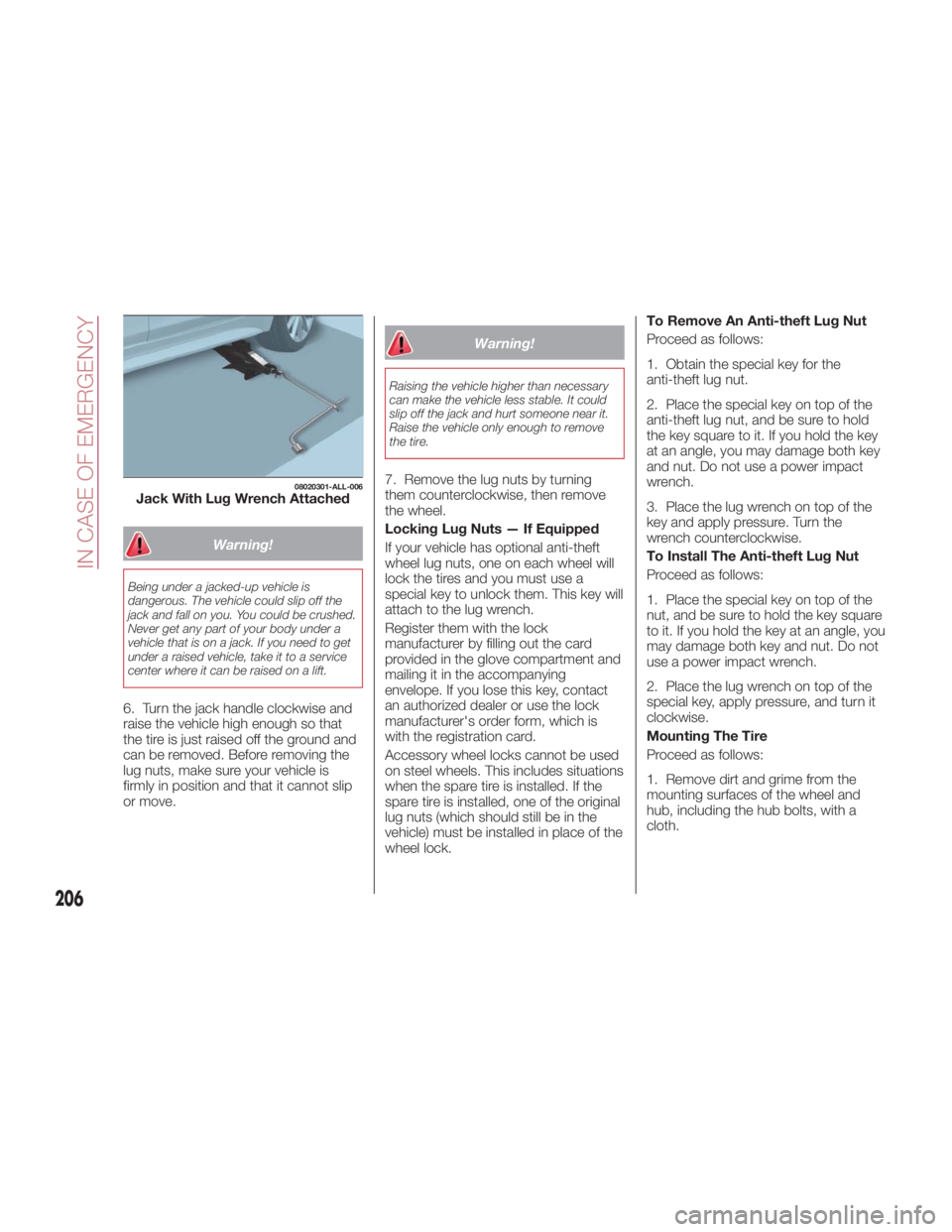
6. Turn the jack handle clockwise and
raise the vehicle high enough so that
the tire is just raised off the ground and
can be removed. Before removing the
lug nuts, make sure your vehicle is
firmly in position and that it cannot slip
or move. Warning!Raising the vehicle higher than necessary
can make the vehicle less stable. It could
slip off the jack and hurt someone near it.
Raise the vehicle only enough to remove
the tire.
7. Remove the lug nuts by turning
them counterclockwise, then remove
the wheel.
Locking Lug Nuts — If Equipped
If your vehicle has optional anti-theft
wheel lug nuts, one on each wheel will
lock the tires and you must use a
special key to unlock them. This key will
attach to the lug wrench.
Register them with the lock
manufacturer by filling out the card
provided in the glove compartment and
mailing it in the accompanying
envelope. If you lose this key, contact
an authorized dealer or use the lock
manufacturer's order form, which is
with the registration card.
Accessory wheel locks cannot be used
on steel wheels. This includes situations
when the spare tire is installed. If the
spare tire is installed, one of the original
lug nuts (which should still be in the
vehicle) must be installed in place of the
wheel lock. To Remove An Anti-theft Lug Nut
Proceed as follows:
1. Obtain the special key for the
anti-theft lug nut.
2. Place the special key on top of the
anti-theft lug nut, and be sure to hold
the key square to it. If you hold the key
at an angle, you may damage both key
and nut. Do not use a power impact
wrench.
3. Place the lug wrench on top of the
key and apply pressure. Turn the
wrench counterclockwise.
To Install The Anti-theft Lug Nut
Proceed as follows:
1. Place the special key on top of the
nut, and be sure to hold the key square
to it. If you hold the key at an angle, you
may damage both key and nut. Do not
use a power impact wrench.
2. Place the lug wrench on top of the
special key, apply pressure, and turn it
clockwise.
Mounting The Tire
Proceed as follows:
1. Remove dirt and grime from the
mounting surfaces of the wheel and
hub, including the hub bolts, with a
cloth.08020301-ALL-006
Jack With Lug Wrench Attached
206
IN CASE OF EMERGENCY
Page 209 of 292
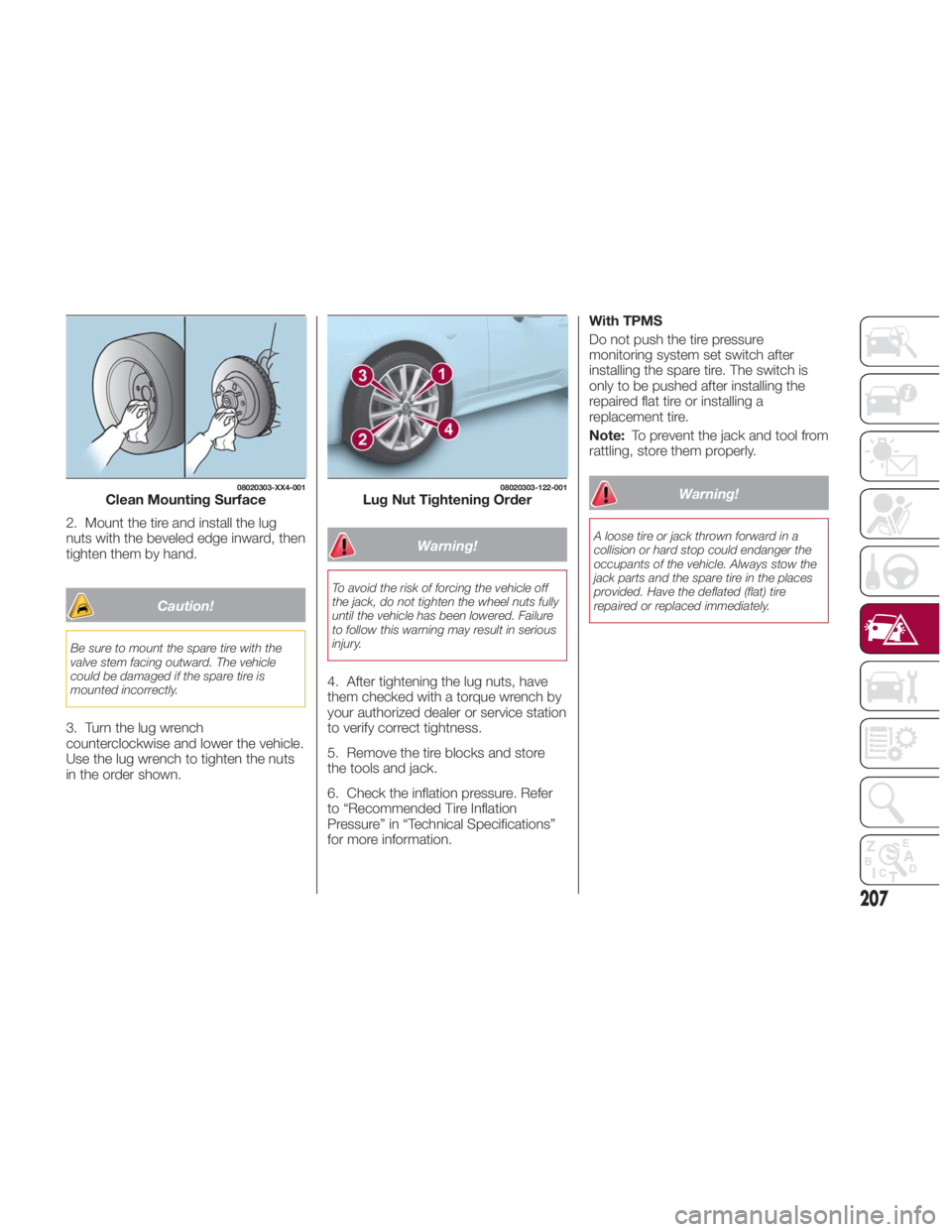
2. Mount the tire and install the lug
nuts with the beveled edge inward, then
tighten them by hand.
Caution!Be sure to mount the spare tire with the
valve stem facing outward. The vehicle
could be damaged if the spare tire is
mounted incorrectly.
3. Turn the lug wrench
counterclockwise and lower the vehicle.
Use the lug wrench to tighten the nuts
in the order shown. Warning!To avoid the risk of forcing the vehicle off
the jack, do not tighten the wheel nuts fully
until the vehicle has been lowered. Failure
to follow this warning may result in serious
injury.
4. After tightening the lug nuts, have
them checked with a torque wrench by
your authorized dealer or service station
to verify correct tightness.
5. Remove the tire blocks and store
the tools and jack.
6. Check the inflation pressure. Refer
to “Recommended Tire Inflation
Pressure” in “Technical Specifications”
for more information. With TPMS
Do not push the tire pressure
monitoring system set switch after
installing the spare tire. The switch is
only to be pushed after installing the
repaired flat tire or installing a
replacement tire.
Note: To prevent the jack and tool from
rattling, store them properly.
Warning!A loose tire or jack thrown forward in a
collision or hard stop could endanger the
occupants of the vehicle. Always stow the
jack parts and the spare tire in the places
provided. Have the deflated (flat) tire
repaired or replaced immediately.08020303-XX4-001
Clean Mounting Surface 08020303-122-001
Lug Nut Tightening Order
207
Page 216 of 292
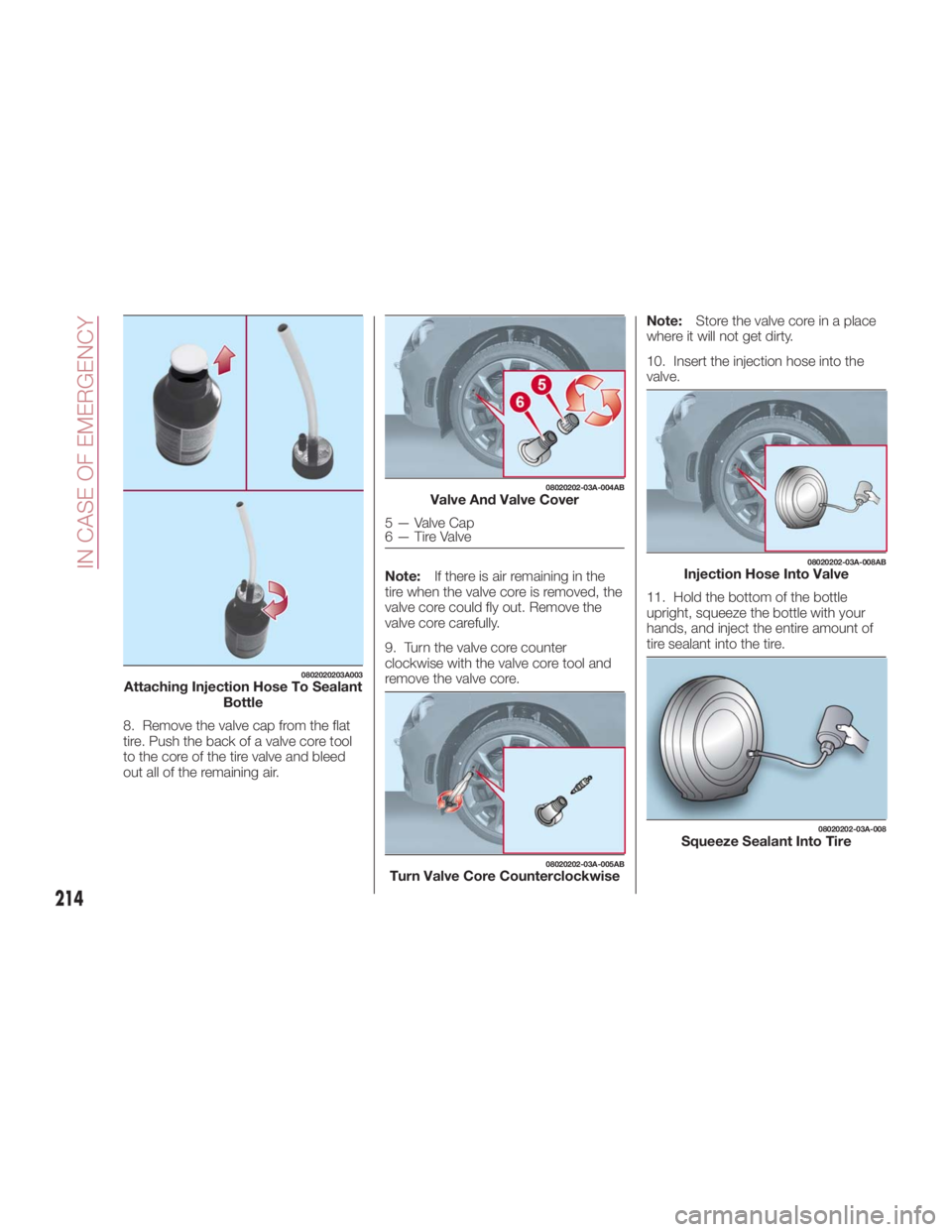
8. Remove the valve cap from the flat
tire. Push the back of a valve core tool
to the core of the tire valve and bleed
out all of the remaining air. Note: If there is air remaining in the
tire when the valve core is removed, the
valve core could fly out. Remove the
valve core carefully.
9. Turn the valve core counter
clockwise with the valve core tool and
remove the valve core. Note: Store the valve core in a place
where it will not get dirty.
10. Insert the injection hose into the
valve.
11. Hold the bottom of the bottle
upright, squeeze the bottle with your
hands, and inject the entire amount of
tire sealant into the tire.0802020203A003
Attaching Injection Hose To Sealant
Bottle 08020202-03A-004AB
Valve And Valve Cover
5 — Valve Cap
6 — Tire Valve
08020202-03A-005AB
Turn Valve Core Counterclockwise 08020202-03A-008AB
Injection Hose Into Valve 08020202-03A-008
Squeeze Sealant Into Tire
214
IN CASE OF EMERGENCY
Page 217 of 292
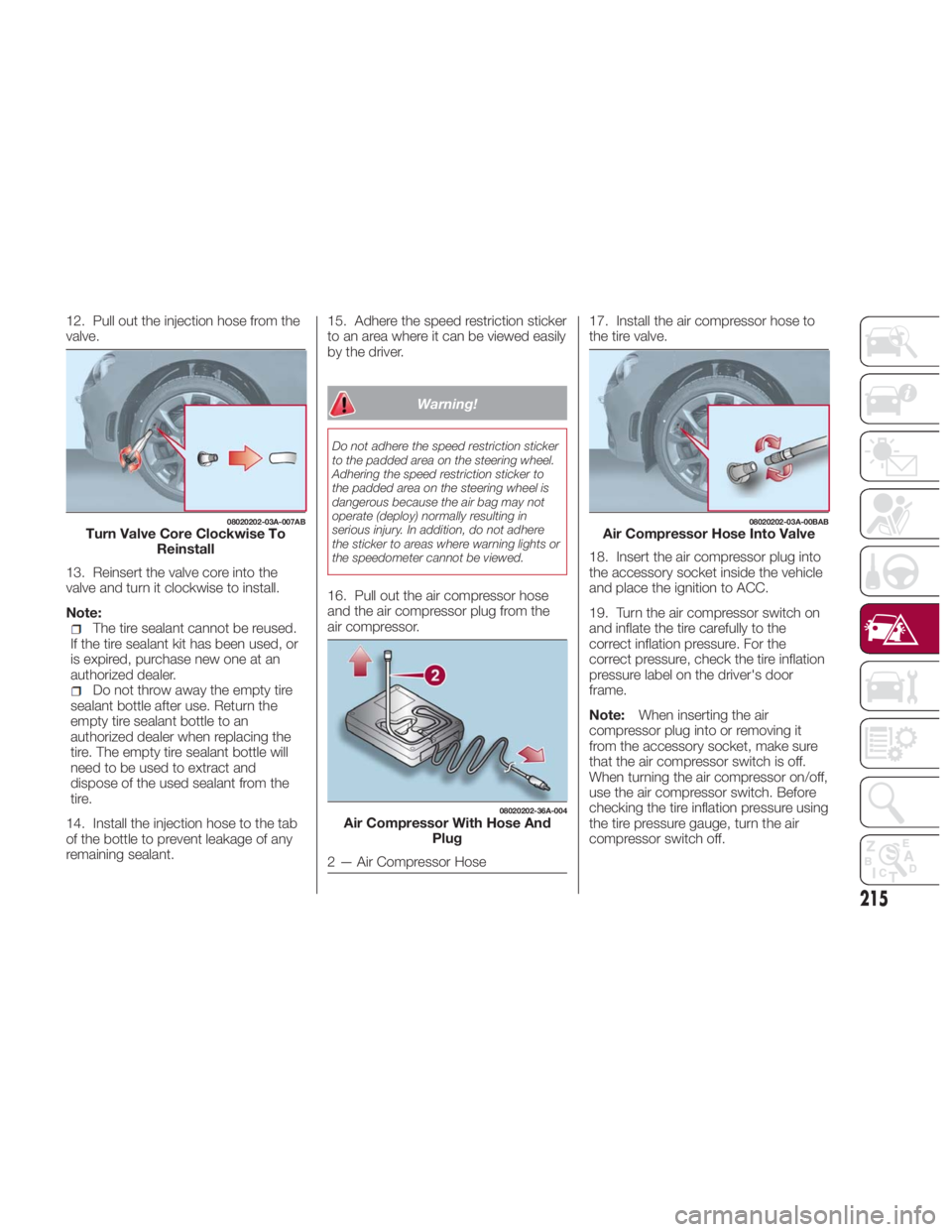
12. Pull out the injection hose from the
valve.
13. Reinsert the valve core into the
valve and turn it clockwise to install.
Note:
The tire sealant cannot be reused.
If the tire sealant kit has been used, or
is expired, purchase new one at an
authorized dealer.
Do not throw away the empty tire
sealant bottle after use. Return the
empty tire sealant bottle to an
authorized dealer when replacing the
tire. The empty tire sealant bottle will
need to be used to extract and
dispose of the used sealant from the
tire.
14. Install the injection hose to the tab
of the bottle to prevent leakage of any
remaining sealant. 15. Adhere the speed restriction sticker
to an area where it can be viewed easily
by the driver.
Warning!Do not adhere the speed restriction sticker
to the padded area on the steering wheel.
Adhering the speed restriction sticker to
the padded area on the steering wheel is
dangerous because the air bag may not
operate (deploy) normally resulting in
serious injury. In addition, do not adhere
the sticker to areas where warning lights or
the speedometer cannot be viewed.
16. Pull out the air compressor hose
and the air compressor plug from the
air compressor. 17. Install the air compressor hose to
the tire valve.
18. Insert the air compressor plug into
the accessory socket inside the vehicle
and place the ignition to ACC.
19. Turn the air compressor switch on
and inflate the tire carefully to the
correct inflation pressure. For the
correct pressure, check the tire inflation
pressure label on the driver's door
frame.
Note: When inserting the air
compressor plug into or removing it
from the accessory socket, make sure
that the air compressor switch is off.
When turning the air compressor on/off,
use the air compressor switch. Before
checking the tire inflation pressure using
the tire pressure gauge, turn the air
compressor switch off.08020202-03A-007AB
Turn Valve Core Clockwise To
Reinstall 08020202-36A-004
Air Compressor With Hose And
Plug
2 — Air Compressor Hose 08020202-03A-00BAB
Air Compressor Hose Into Valve
215
Page 227 of 292
At least monthly perform inspection
of:
Tire inflation pressures
At least twice a year (for example,
every spring and fall) perform
inspection of:
Engine coolant
Engine oil
As explained in the “Introduction”
paragraph, several procedures can be
done only by a qualified service
technician with special tools.
For details, read the separate Warranty
Booklet provided with the vehicle. If you
are unsure about any servicing or
maintenance procedure, have it done
by an authorized dealer.
There are strict environmental laws
regarding the disposal of waste oil and
fluids. Please dispose of your waste
properly and with due regard to the
environment.
We recommend that you entrust the oil
and fluid changes of your vehicle to an
authorized dealer. Periodic Checks
Every 620 miles (1,000 km) or before
long trips check and, if necessary, top
off:
Engine coolant level.
Brake fluid level.
Windshield washer fluid level.
Tire inflation pressure and condition.
Operation of lighting system
(headlights, direction indicators, hazard
warning lights, etc.).
Operation of windshield
washer/wiper system and
positioning/wear of windshield wiper
blades.
Every 1860 miles (3,000 km) check
and top off the engine oil level if
required.
Heavy-Duty Use Of The
Vehicle
If the vehicle is used under one of the
following conditions:
Dusty roads.
Short, repeated trips less than 4.4 -
5 miles ( 7-8km)atsub -zero outside
temperatures.
Engine idling for long periods of time
or driving long distances at low speeds
or long periods of inactivity. The following checks must be carried
out more often than indicated in the
Scheduled Servicing Plan:
Check front disc brake pad condition
and wear.
Check cleanliness of underhood area
and all door and trunk locks, cleanliness
and lubrication of linkage.
Visually inspect conditions of the:
engine, transmission, lines and hoses
(exhaust/fuel system/brakes) and
rubber elements (hoses/belts/etc.).
Check battery charge and battery
fluid level.
Visually inspect conditions of the
accessory drive belts.
Check and, if necessary, change
engine oil and replace oil filter.
Check and, if necessary, replace
cabin air filter.
Check and, if necessary, replace air
cleaner.
Severe Duty All Models
Change Engine Oil at 4,000 miles
(6,500 km) if the vehicle is operated in a
dusty and off road environment or is
operated predominately at idle or only
very low engine RPM’s. This type of
vehicle use is considered Severe Duty.
225
Page 230 of 292
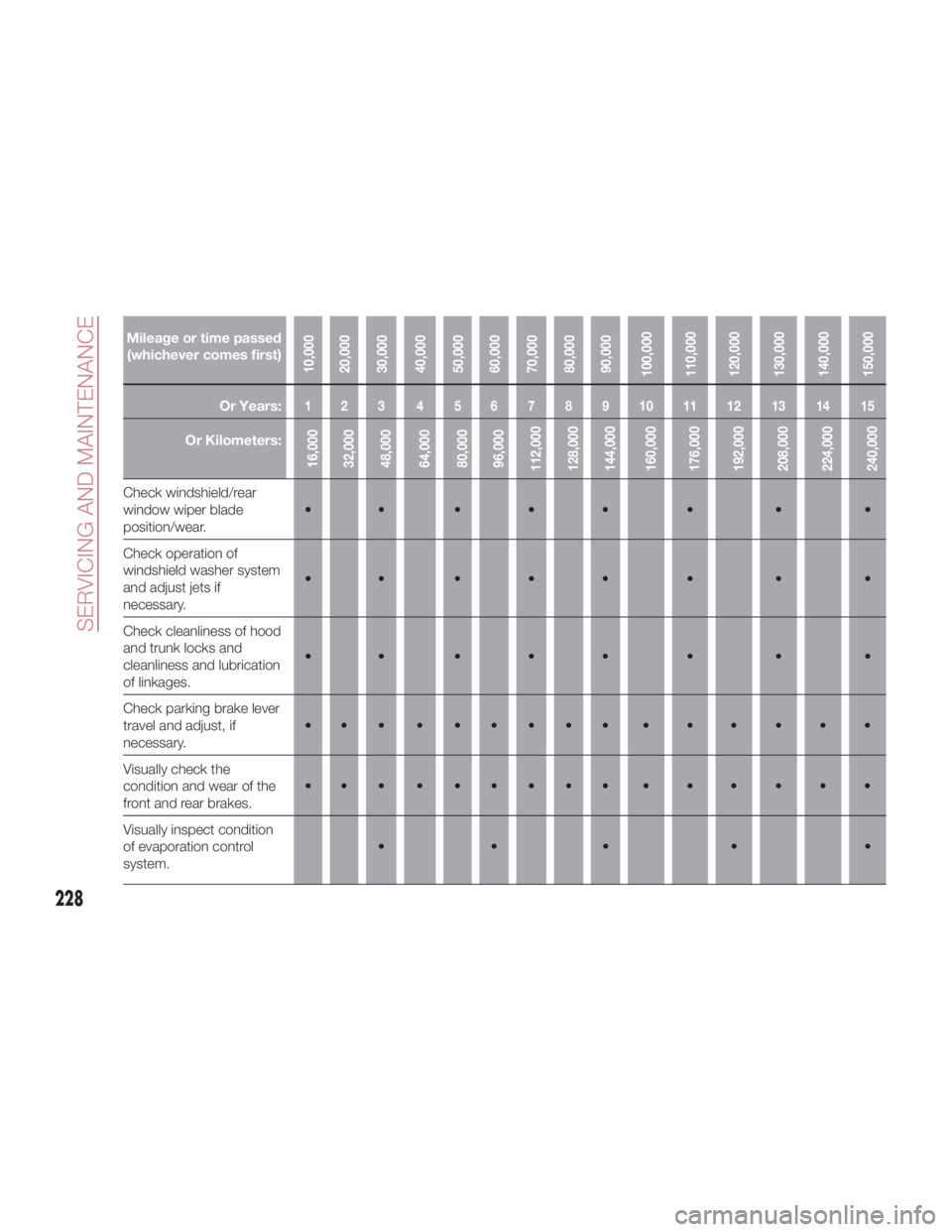
Mileage or time passed
(whichever comes first)
10,000
20,000
30,000
40,000
50,000
60,000
70,000
80,000
90,000
100,000
110,000
120,000
130,000
140,000
150,000Or Years: 123 456789101112131415
Or Kilometers:
16,000
32,000
48,000
64,000
80,000
96,000
112,000
128,000
144,000
160,000
176,000
192,000
208,000
224,000
240,000Check windshield/rear
window wiper blade
position/wear. •• •• • • • •
Check operation of
windshield washer system
and adjust jets if
necessary. •• •• • • • •
Check cleanliness of hood
and trunk locks and
cleanliness and lubrication
of linkages. •• •• • • • •
Check parking brake lever
travel and adjust, if
necessary. •••••••••••••••
Visually check the
condition and wear of the
front and rear brakes. •••••••••••••••
Visually inspect condition
of evaporation control
system. ••• • •
228
SERVICING AND MAINTENANCE
Page 237 of 292
BATTERY
RECHARGING BATTERY CHARGING
PROCEDURE
Warning!Battery fluid is a corrosive acid solution
and can burn or even blind you. Do not
allow battery fluid to contact your eyes,
skin, or clothing. Do not lean over a battery
when attaching clamps. If acid splashes in
eyes or on skin, flush the area immediately
with large amounts of water. Refer to
“Jump-Starting Procedure” in “In Case Of
Emergency” for further information.
Battery gas is flammable and explosive.
Keep flame or sparks away from the
battery. Do not use a booster battery or
any other booster source with an output
greater than 12 Volts. Do not allow cable
clamps to touch each other.
Battery posts, terminals, and related
accessories contain lead and lead
compounds. Wash hands after handling. Caution!It is essential when replacing the cables
on the battery that the positive cable is
attached to the positive post and the
negative cable is attached to the negative
post. Battery posts are marked positive (+)
and negative (-) and are identified on the
battery case. Cable clamps should be tight
on the terminal posts and free of corrosion.
If a “fast charger” is used while the
battery is in the vehicle, disconnect both
vehicle battery cables before connecting
the charger to the battery. Do not use a
“fast charger” to provide starting voltage.
Charge battery as follows:
Before recharging the battery, turn off
all accessories and turn the engine off
by placing the ignition in the OFF mode.
Disconnect the negative battery
cable.
Connect the charger cables to the
battery terminals, observing the polarity
(+,–).
Turn on the charger.
When finished, turn the charger off
before disconnecting the battery.
Reconnect the negative battery
terminal. MAINTENANCE
PROCEDURES The following pages contain
instructions on the required
maintenance from the technical
personnel who designed the vehicle.
In addition to these specific
maintenance instructions specified for
routine scheduled servicing, there are
other components which may require
periodic maintenance or replacement
over the vehicle’s life cycle.
Body Lubrication
Ensure that the locks and bodywork
junction points, including components
such as the seat guides, door hinges
(and rollers), trunk and hood are
periodically lubricated with lithium
based grease to ensure correct, silent
operation and to protect them from rust
and wear.
Thoroughly clean the components,
eliminating every trace of dirt and dust.
After lubricating, eliminate excess oil
and grease. Also pay particular
attention to the hood closing devices,
to ensure correct operation.
During operations on the hood, be sure
to perform with the engine cold, also
remember to check, clean and lubricate
the locking, release and safety devices.
Make sure the hood's secondary latch
keeps the hood from opening when the
primary latch is released.
235
Page 238 of 292
Lubricate the external lock cylinders
twice a year. Apply a small amount of
high-quality lubricant directly into the
lock cylinder. If necessary, contact your
authorized dealer.
Wiper Blades
Contamination of either the windshield
or the blades with foreign matter can
reduce wiper effectiveness. Common
sources are insects, tree sap, and hot
wax treatments used by some
commercial car washes.
If the blades are not wiping properly,
clean the window and blades with a
good cleaner or mild detergent; then
rinse thoroughly with clean water.
Repeat if necessary.
When the wiper lever is in the AUTO
position and the ignition is placed in the
ON mode, the wipers may move
automatically in the following cases:
If the windshield above the rain
sensor is touched.
If the windshield above the rain
sensor is wiped with a cloth.
If the windshield is struck with a hand
or other object.
If the rain sensor is struck with a
hand or other object from inside the
vehicle. Note:
Hot waxes applied by automatic car
washers have been known to affect
the wiper's ability to clean windows.
To prevent damage to the wiper
blades, do not use gas, paraffin, paint
thinner, or other solvents on or near
them.
Be careful not to pinch hands or
fingers as it may cause injury, or
damage the wipers. When washing or
servicing the vehicle, make sure the
wiper lever is in the OFF position.
Replacing Windshield Wiper Blades
When the wipers no longer clean well,
the blades are probably worn or
cracked. Replace them.
When raising both windshield wiper
arms, raise the driver's side wiper arm
first.
When lowering the wiper arms, slowly
lower the wiper arm from the
passenger's side first while supporting
it with your hand. Forcefully lowering
the wiper arms could damage the wiper
arm and blade, and may scratch or
crack the windshield.
Note: To prevent damage to the wiper
arms and other components, do not try
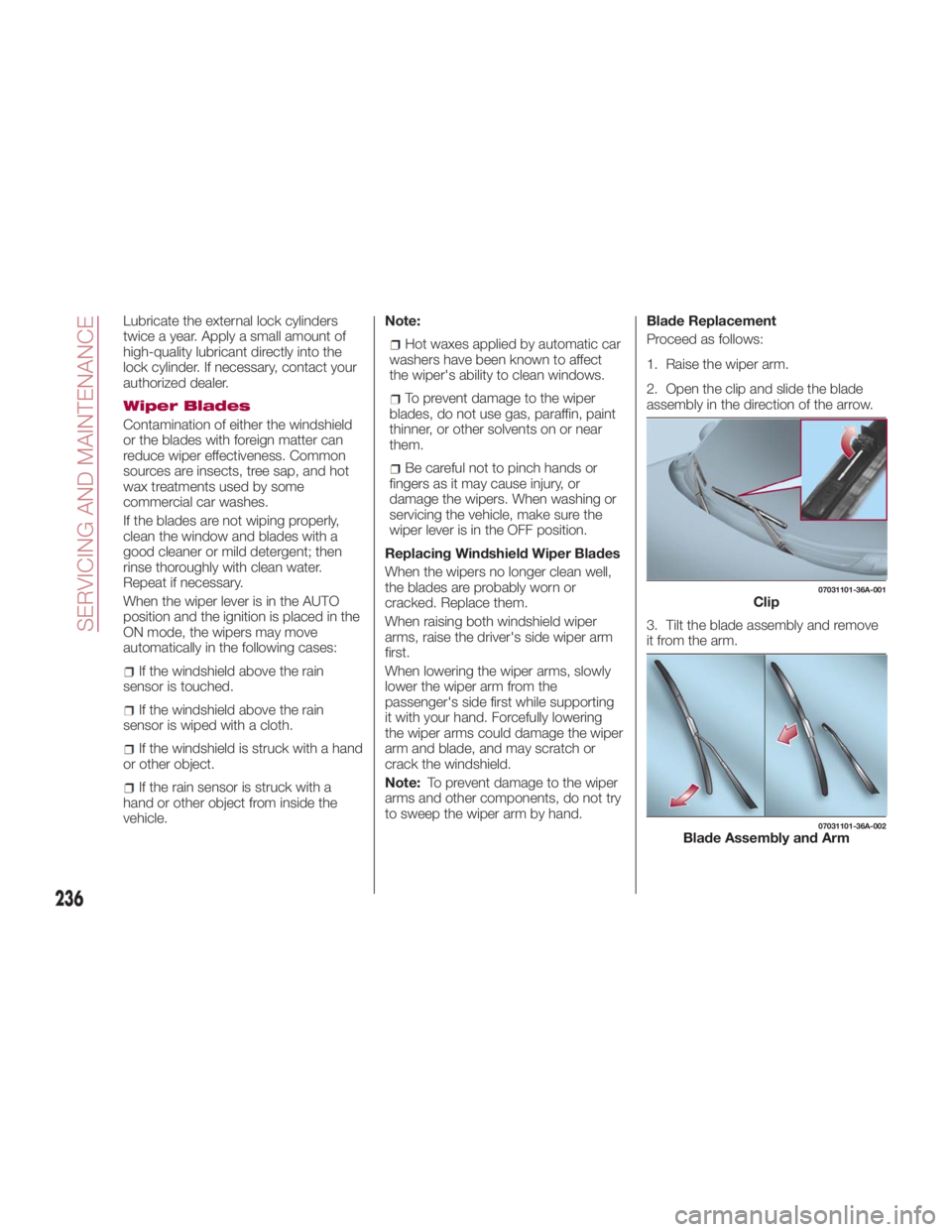
to sweep the wiper arm by hand. Blade Replacement
Proceed as follows:
1. Raise the wiper arm.
2. Open the clip and slide the blade
assembly in the direction of the arrow.
3. Tilt the blade assembly and remove
it from the arm. 07031101-36A-001
Clip 07031101-36A-002
Blade Assembly and Arm
236
SERVICING AND MAINTENANCE
Page 260 of 292
The vehicle is washed with a rough,
dry, or dirty cloth.
The vehicle is washed at a car wash
that uses brushes that are dirty or too
stiff.
Cleansers or wax containing
abrasives are used.
Note: FCA is not responsible for
scratches caused by automatic car
washes or improper washing.
Scratches are more noticeable on
vehicles with darker paint finishes.
When the wiper lever is in the AUTO
position and the ignition is placed in the
ON mode, the wipers may move
automatically in the following cases:
If the windshield above the rain
sensor is touched or wiped with a cloth.
If the windshield is struck with a hand
or other object from either outside or
inside the vehicle.
Note:
Keep hands and scrapers clear of
the windshield when the wiper lever is
in the AUTO position and the ignition is
placed in the ON mode as fingers
could be pinched or the wipers and
wiper blades damaged when the
wipers activate automatically. If you are
going to clean the windshield, be sure
the wipers are turned off completely
(when it is most likely that the engine is
left running) this is particularly
important when clearing ice and snow. Do not spray water in the engine
compartment. Otherwise, it could
result in engine-starting problems or
damage to electrical parts.
When washing and waxing the
vehicle, be careful not to apply
excessive force to any single area of
the vehicle hood. Otherwise, you could
dent the vehicle.
Do not use automatic car washing
machines and car washing devices
using high water pressure.
Make sure that the fuel door is
closed and lock the doors. Otherwise,
the fuel door may be forcefully opened
by water pressure causing damage to
the vehicle or fuel door.
To minimize scratches on the vehicle's
paint finish:
Rinse off any dirt or other foreign
matter using lukewarm or cold water
before washing.
Use plenty of lukewarm or cold water
and a soft cloth when washing the
vehicle. Do not use a nylon cloth.
Rub gently when washing or drying
the vehicle.
Take your vehicle only to a car wash
that keeps its brushes well maintained.
Do not use abrasive cleansers or
wax that contain abrasives. Caution!Do not use steel wool, abrasive cleaners, or
strong detergents containing highly alkaline
or caustic agents on chrome plated or
anodized aluminium parts. This may
damage the protective coating; also,
cleaners and detergents may discolor or
deteriorate the paint.
Pay special attention to removing salt,
dirt, mud, and other foreign material
from the underside of the fenders, and
make sure the drain holes in the lower
edges of the doors and rocker panels
are clean.
Insects, tar, tree sap, bird droppings,
industrial fallout, and similar deposits
can damage the finish if not removed
immediately. When prompt washing
with plain water is ineffective, use a mild
soap made for use on vehicles.
Thoroughly rinse off all soap with
lukewarm or cold water. Do not allow
soap to dry on the finish.
After washing the vehicle, dry it with a
clean chamois to prevent water spots
from forming.
Waxing
Your vehicle needs to be waxed when
water no longer beads on the finish.
Always wash and dry the vehicle before
waxing it. In addition to the vehicle
258
SERVICING AND MAINTENANCE
Page 262 of 292
Convertible Top
Maintenance
The convertible top is made of a special
high-grade material, but if it's not taken
good care of, hardening, staining, and
loss of lustre will result. Maintain it
under these guidelines.
Washing
Do not wait until the convertible top
gets really dirty before cleaning it. Dirt
that's there too long will cause
deterioration.
Before washing, remove dust and
coarse particulate with a soft brush.
Gently clean the convertible top with
a synthetic neutral detergent, lots of
water, and a soft brush.
Rinse it thoroughly with clean water
to remove all the soap.
Wipe it as dry as you can before the
water dries on it.
Then allow it to dry completely before
lowering it. Caution!Automatic and high-pressure car
washes are harmful to a convertible top.
Avoid them.
Do not spray water directly on the area
where the window glass and the
convertible top meet. This would probably
cause water to enter the interior.
Do not spray water directly on the seam
area of the body and the convertible top as
it could result in water penetrating the
interior.
Do not wipe the convertible top using
alcohol, chlorine bleach, or organic
solvents such as thinner, benzene, or
gasoline. Otherwise, they may cause
discoloration or stains.
Too much treatment on the convertible
top can be as damaging as too little. Follow
the manufacturer's directions. Do not over
do it!
Note:
Some leather treatment products
can ruin the convertible top's gloss. Be
careful of the one you choose.
Test on an inconspicuous, small
corner of the convertible top if you are
not sure. Do not get any car wax on the
convertible top.
If you do, remove it with a good
leather cleaner or mild detergent
(about 5% solution).
Let the convertible top dry
completely before lowering after
applying treatment or dressing.
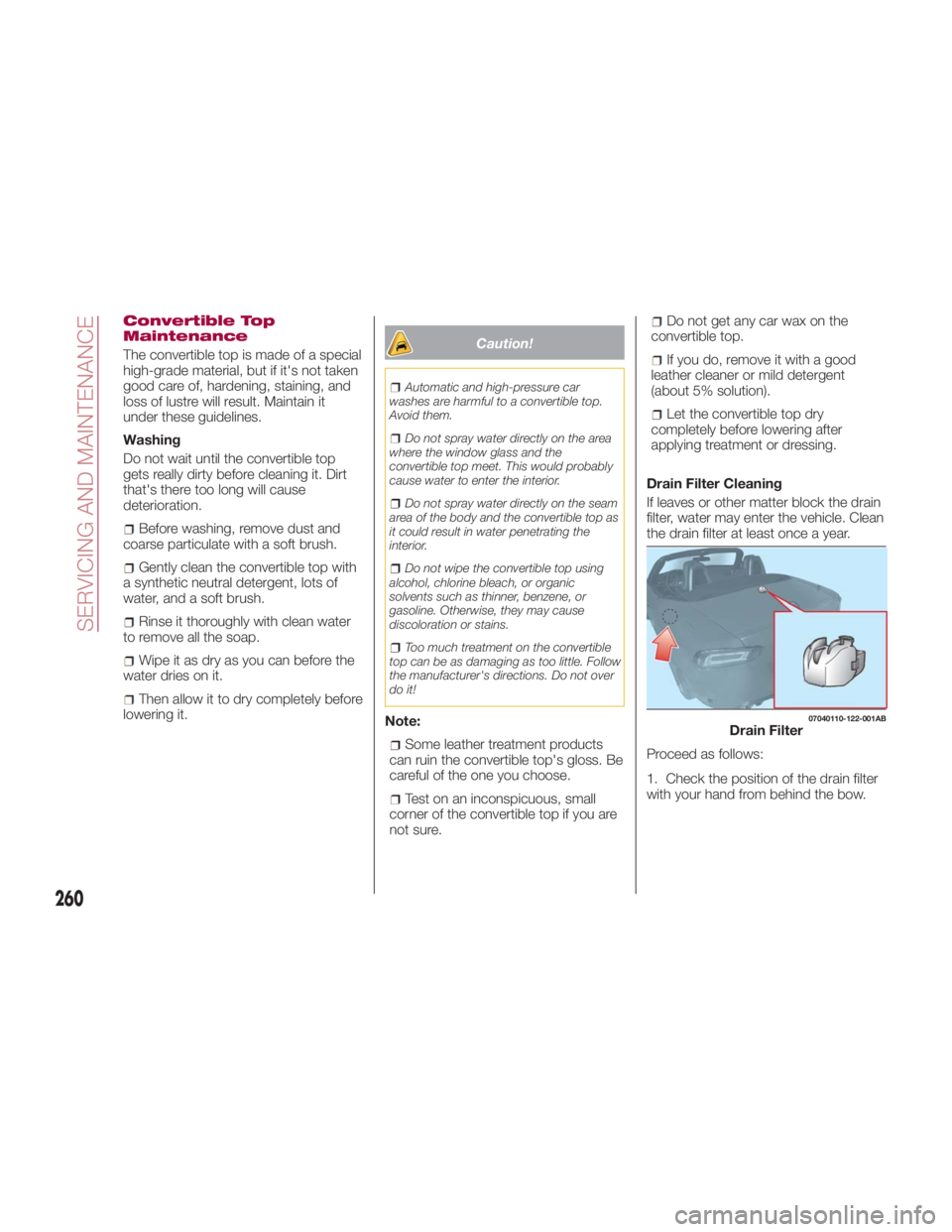
Drain Filter Cleaning
If leaves or other matter block the drain
filter, water may enter the vehicle. Clean
the drain filter at least once a year.
Proceed as follows:
1. Check the position of the drain filter
with your hand from behind the bow. 07040110-122-001AB
Drain Filter
260
SERVICING AND MAINTENANCE