belt FIAT STILO 2006 1.G Owner's Manual
[x] Cancel search | Manufacturer: FIAT, Model Year: 2006, Model line: STILO, Model: FIAT STILO 2006 1.GPages: 274, PDF Size: 4.76 MB
Page 124 of 274
123
CORRECT USE
OF THE CAR
WARNING
LIGHTS AND
MESSAGES
IN AN
EMERGENCY
CAR
MAINTENANCE
TECHNICAL
SPECIFICATIONS
INDEX
DASHBOARD
AND CONTROLS
SAFETY
DEVICES
Group 1
For proper mounting proceed as follows:
❒move the rear sliding seat fully back-
wards with the seat back at 4thposition,
as shown in fig. 16;
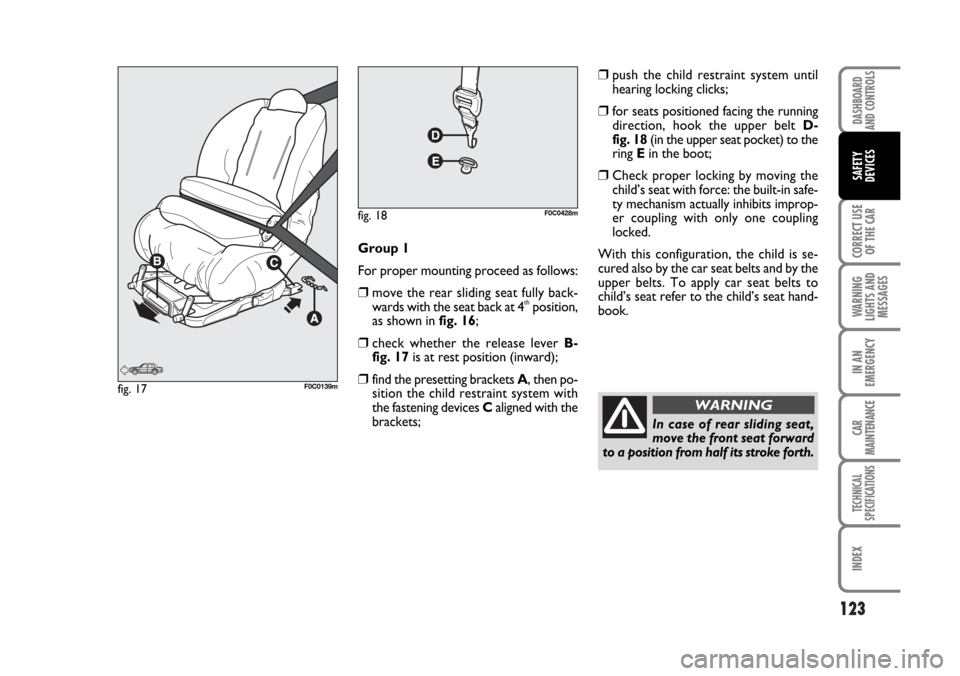
❒check whether the release lever B-
fig. 17is at rest position (inward);
❒find the presetting brackets A, then po-
sition the child restraint system with
the fastening devices Caligned with the
brackets;
❒push the child restraint system until
hearing locking clicks;
❒for seats positioned facing the running
direction, hook the upper belt D-
fig. 18(in the upper seat pocket) to the
ring E in the boot;
❒Check proper locking by moving the
child’s seat with force: the built-in safe-
ty mechanism actually inhibits improp-
er coupling with only one coupling
locked.
With this configuration, the child is se-
cured also by the car seat belts and by the
upper belts. To apply car seat belts to
child’s seat refer to the child’s seat hand-
book.
fig. 17F0C0139m
fig. 18F0C0428m
In case of rear sliding seat,
move the front seat forward
to a position from half its stroke forth.
WARNING
Page 125 of 274
124
CORRECT USE
OF THE CAR
WARNING
LIGHTS AND
MESSAGES
IN AN
EMERGENCY
CAR
MAINTENANCE
TECHNICAL
SPECIFICATIONS
IINDEX
DASHBOARD
AND CONTROLS
SAFETY
DEVICES
PRESETTING FOR
MOUNTING THE
“UNIVERSAL ISOFIX”
CHILD RESTRAINT
SYSTEM
This car is preset for mounting the “Uni-
versal Isofix” child restraint system, a new
European standardised system for carry-
ing children safely.
The “Universal Isofix” child’s seat covers
weight group: 1.
Due to its different anchoring system, the
Universal Isofix child’s seat shall be an-
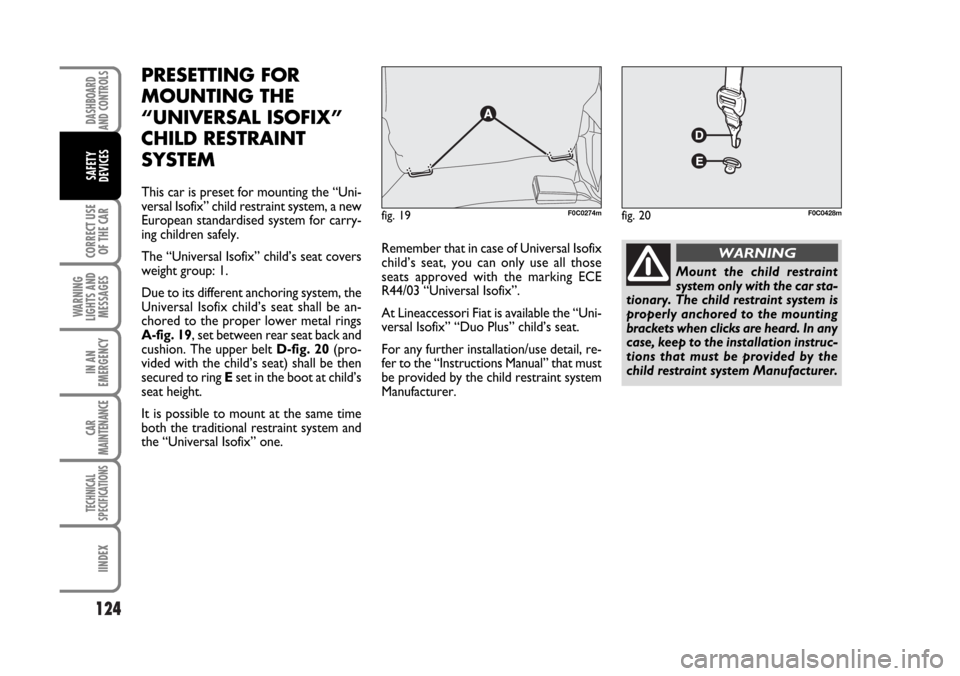
chored to the proper lower metal rings
A-fig. 19, set between rear seat back and
cushion. The upper belt D-fig. 20(pro-
vided with the child’s seat) shall be then
secured to ring Eset in the boot at child’s
seat height.
It is possible to mount at the same time
both the traditional restraint system and
the “Universal Isofix” one.Remember that in case of Universal Isofix
child’s seat, you can only use all those
seats approved with the marking ECE
R44/03 “Universal Isofix”.
At Lineaccessori Fiat is available the “Uni-
versal Isofix” “Duo Plus” child’s seat.
For any further installation/use detail, re-
fer to the “Instructions Manual” that must
be provided by the child restraint system
Manufacturer.
fig. 19F0C0274mfig. 20F0C0428m
Mount the child restraint
system only with the car sta-
tionary. The child restraint system is
properly anchored to the mounting
brackets when clicks are heard. In any
case, keep to the installation instruc-
tions that must be provided by the
child restraint system Manufacturer.
WARNING
Page 127 of 274
126
CORRECT USE
OF THE CAR
WARNING
LIGHTS AND
MESSAGES
IN AN
EMERGENCY
CAR
MAINTENANCE
TECHNICAL
SPECIFICATIONS
IINDEX
DASHBOARD
AND CONTROLS
SAFETY
DEVICES
FRONT AIR BAGS
The car is fitted with front multistage air
bags (“Smart bag”) for driver and passen-
ger, front side bags (where provided), rear
side bags (where provided) and window
bags (where provided).
“SMART BAG” SYSTEM (FRONT
MULTISTAGE AIR BAGS)
The front air bag (driver and passenger)
has been designed to protect the occu-
pants in the event of head-on crashes of
medium-high severity, by placing the cush-
ion between the occupant and the steer-
ing wheel or dashboard.
Front air bags are designed to protect
car’s occupants in front crashes and there-
fore non-activation in other types of col-
lisions (side collisions, rear shunts, roll-
overs, etc.) is not a system malfunction.In case of front crash, an electronic con-
trol unit, when required, triggers the in-
flation of the cushion according to the
severity of the collision.
The cushion immediately inflates, placing
itself as a protection between the body
of the front occupants and the structure
that could cause injuries. Immediately af-
ter, the cushion deflates.
The front air bag (driver and passenger) is
not a replacement of but complementary
to the use of belts, which should always
be worn, as specified by law in Europe and
most non-European countries.
In case of crash, a person not wearing the
seat belt moves forward and may come in-
to contact with the cushion while it is still
inflating. Under this circumstance the pro-
tection offered by the air bag is reduced.
Do not apply stickers or oth-
er objects to the steering
wheel or to the air bag cover on the
passenger’s side or on the side roof
lining. Do not put objects on the
dashboard on passenger side (e.g. mo-
bile phones) since they could interfere
with proper passenger air bag infla-
tion and cause injuries to the car’s
passengers.
WARNING
Front air bag may not be activated in the
following situations:
❒in collisions against highly deformable
objects not affecting the car front sur-
face (e.g. bumper collision against guard
rail);
❒car wedging under other vehicles or
protective barriers (for example under
a truck or guard rail);
as it offers no additional protection com-
pared with the seat belts, consequently,
it would be pointless. Therefore, failure to
come into action in the above circum-
stances does not mean that the system is
not working properly.
Page 128 of 274
127
CORRECT USE
OF THE CAR
WARNING
LIGHTS AND
MESSAGES
IN AN
EMERGENCY
CAR
MAINTENANCE
TECHNICAL
SPECIFICATIONS
INDEX
DASHBOARD
AND CONTROLS
SAFETY
DEVICES
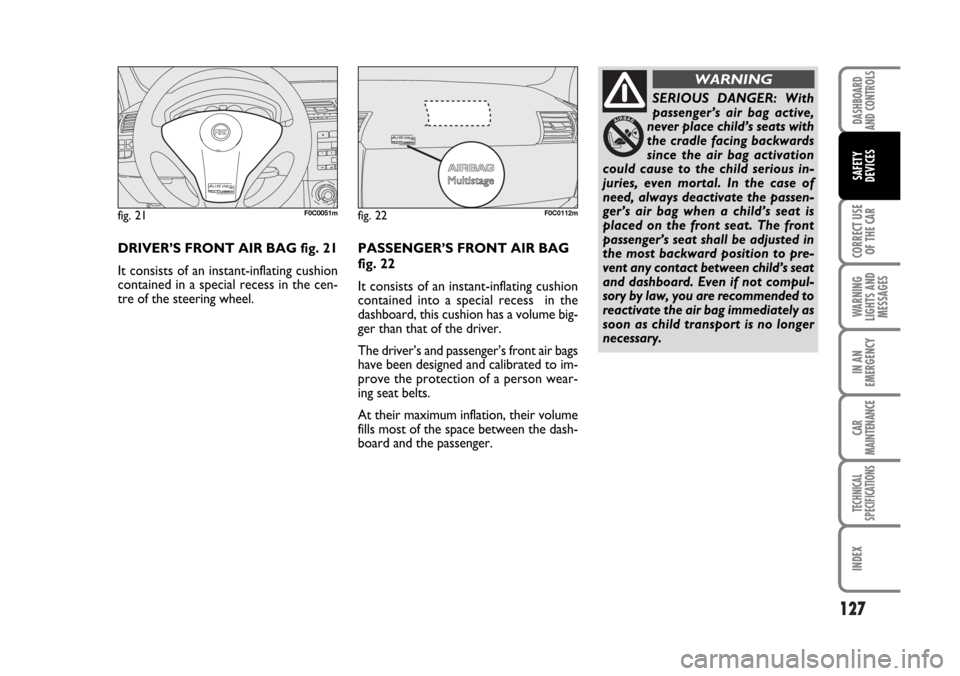
DRIVER’S FRONT AIR BAG fig. 21
It consists of an instant-inflating cushion
contained in a special recess in the cen-
tre of the steering wheel.PASSENGER’S FRONT AIR BAG
fig. 22
It consists of an instant-inflating cushion
contained into a special recess in the
dashboard, this cushion has a volume big-
ger than that of the driver.
The driver’s and passenger’s front air bags
have been designed and calibrated to im-
prove the protection of a person wear-
ing seat belts.
At their maximum inflation, their volume
fills most of the space between the dash-
board and the passenger.
fig. 21F0C0051mfig. 22F0C0112m
SERIOUS DANGER: With
passenger’s air bag active,
never place child’s seats with
the cradle facing backwards
since the air bag activation
could cause to the child serious in-
juries, even mortal. In the case of
need, always deactivate the passen-
ger’s air bag when a child’s seat is
placed on the front seat. The front
passenger’s seat shall be adjusted in
the most backward position to pre-
vent any contact between child’s seat
and dashboard. Even if not compul-
sory by law, you are recommended to
reactivate the air bag immediately as
soon as child transport is no longer
necessary.
WARNING
Page 131 of 274
130
CORRECT USE
OF THE CAR
WARNING
LIGHTS AND
MESSAGES
IN AN
EMERGENCY
CAR
MAINTENANCE
TECHNICAL
SPECIFICATIONS
IINDEX
DASHBOARD
AND CONTROLS
SAFETY
DEVICES
SIDE AIR BAGS
(Side bag -
Window bag)
SIDE BAG (where provided)
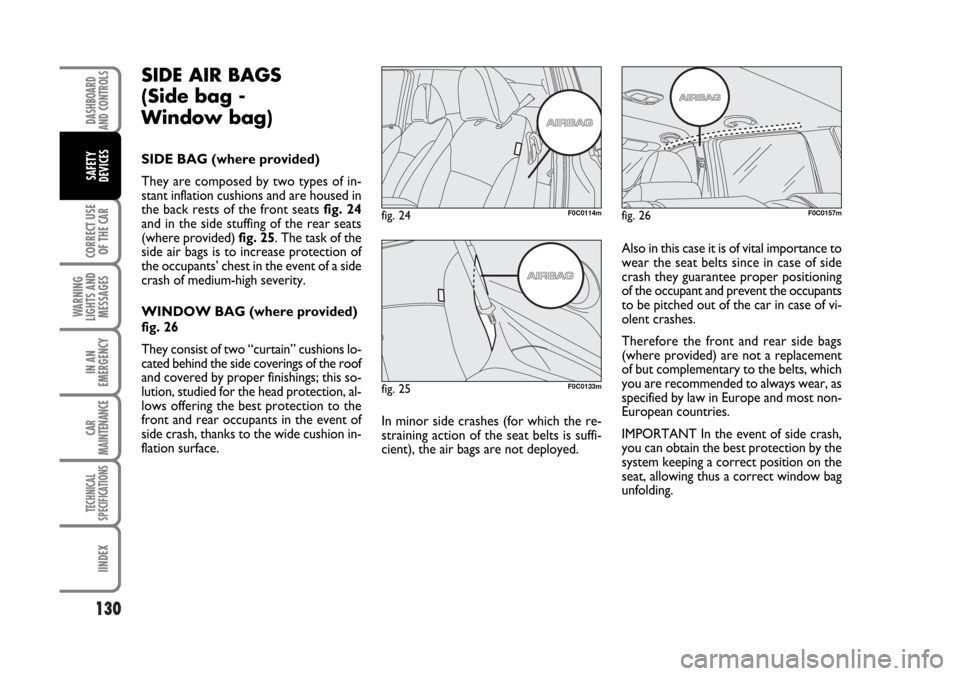
They are composed by two types of in-
stant inflation cushions and are housed in
the back rests of the front seats fig. 24
and in the side stuffing of the rear seats
(where provided) fig. 25. The task of the
side air bags is to increase protection of
the occupants’ chest in the event of a side
crash of medium-high severity.
WINDOW BAG (where provided)
fig. 26
They consist of two “curtain” cushions lo-
cated behind the side coverings of the roof
and covered by proper finishings; this so-
lution, studied for the head protection, al-
lows offering the best protection to the
front and rear occupants in the event of
side crash, thanks to the wide cushion in-
flation surface.In minor side crashes (for which the re-
straining action of the seat belts is suffi-
cient), the air bags are not deployed. Also in this case it is of vital importance to
wear the seat belts since in case of side
crash they guarantee proper positioning
of the occupant and prevent the occupants
to be pitched out of the car in case of vi-
olent crashes.
Therefore the front and rear side bags
(where provided) are not a replacement
of but complementary to the belts, which
you are recommended to always wear, as
specified by law in Europe and most non-
European countries.
IMPORTANT In the event of side crash,
you can obtain the best protection by the
system keeping a correct position on the
seat, allowing thus a correct window bag
unfolding.
fig. 24F0C0114m
fig. 25F0C0133m
fig. 26F0C0157m
Page 135 of 274
134
CORRECT USE
OF THE CAR
WARNING
LIGHTS AND
MESSAGES
IN AN
EMERGENCY
CAR
MAINTENANCE
TECHNICAL
SPECIFICATIONS
IINDEX
DASHBOARD
AND CONTROLS
SAFETY
DEVICES
When the ignition key is
turned to MAR, the warning
light
F(with passenger’s front air
bag deactivation switch at ON) turns
on and flashes for few seconds to re-
mind that the passenger’s air bag will
be deployed in a crash, after which
it should go off.
WARNING
When the ignition key is
turned to MAR, the warning
light
À(with the rear side bag de-
activation switch at ON) turns on and
flashes for few seconds to remind that
the rear side bags will be deployed in
a crash, after which it should go off.
WARNING
Do not wash the seat back
rest with pressurised water
or steam (by hand or at automatic
seat washing stations).
WARNING
The front air bag is triggered
for shocks greater in magni-
tude than the pretensioners. For im-
pacts between these two thresholds,
it is therefore normal that only the
pretensioners are triggered.
WARNING
Do not hook rigid objects to
the coat hooks and to the
support handles.
WARNING
The air bag does not substi-
tute the seat belts, but only
increases their effectiveness. More-
over, since the front air bags do not
come into operation in the event of
front impact at low speed, side colli-
sions, bumps from behind or over-
turning, in these circumstances the
occupants would only be protected
by the seat belts which must therefore
always be fastened.
WARNING
Page 158 of 274
157
IN AN
EMERGENCY
CAR
MAINTENANCE
TECHNICAL
SPECIFICATIONS
INDEX
DASHBOARD
AND CONTROLS
SAFETY
DEVICES
CORRECT USE
OF THE CAR
WARNING
LIGHTS AND
MESSAGES
GENERAL WARNINGS ...................................................... 158
LOW BRAKE FLUID.............................................................. 158
HANDBRAKE ON ................................................................. 158
BRAKE PAD WEAR ............................................................... 158
AIR BAG FAILURE ................................................................. 159
FRONT PASSENGER’S AIR BAG DEACTIVATED ....... 159
REAR SIDE BAGS DEACTIVATED .................................. 160
SEAT BELTS NOT FASTENED ........................................... 160
LOW BATTERY CHARGE .................................................. 160
LOW ENGINE OIL PRESSURE........................................... 161
EXHAUST OIL ....................................................................... 161
SELESPEED TRANSMISSION FAILURE ............................ 161
“DUALDRIVE” ELECTRIC POWER STEERING
FAILURE .................................................................................... 162
HIGH TEMPERATURE ENGINE COOLANT FLUID ... 162
INCOMPLETE DOOR LOCKING..................................... 163
GENERIC FAILURE INDICATION .................................. 163
DIESEL PARTICULATE FILTER CLOGGED ................... 163
FUEL RESERVE......................................................................... 164
ENGINE CONTROL SYSTEM FAILURE (EOBD) ......... 164
ESP SYSTEM ............................................................................ 165
GLOW PLUG WARMING FAILURE ................................ 165
GLOW PLUGS ........................................................................ 165
WATER IN DIESEL FUEL FILTER ...................................... 166INEFFICIENT ABS SYSTEM ................................................. 166
INEFFICIENT EBD
(ELECTRONIC BRAKING DISTRIBUTOR) .................. 166
CAR PROTECTION SYSTEM FAILURE -
FIAT CODE .............................................................................. 167
ALARM FAILURE ................................................................... 167
BREAK-IN ATTEMPT ........................................................... 167
EXTERNAL LIGHT FAILURE .............................................. 167
REAR FOGLIGHTS ................................................................ 167
FRONT FOG LIGHTS ........................................................... 167
LEFT-HAND DIRECTION INDICATOR ........................ 168
RIGHT-HAND DIRECTION INDICATOR .................... 168
SIDELIGHTS AND LOW BEAMS ...................................... 168
FOLLOW ME HOME ............................................................ 168
MAIN BEAMS ........................................................................... 168
CRUISE CONTROL............................................................... 168
POSSIBLE PRESENCE OF ICE ON THE ROAD ............ 168
LIMITED RANGE ................................................................... 168
ASR SYSTEM ........................................................................... 168
SPEED LIMIT EXCEEDED ................................................... 168
W W
A A
R R
N N
I I
N N
G G
L L
I I
G G
H H
T T
S S
A A
N N
D D
M M
E E
S S
S S
A A
G G
E E
S S
Page 161 of 274
160
IN AN
EMERGENCY
CAR
MAINTENANCE
TECHNICAL
SPECIFICATIONS
INDEX
DASHBOARD
AND CONTROLS
SAFETY
DEVICES
CORRECT USE
OF THE CAR
WARNING
LIGHTS AND
MESSAGES
REAR SIDE BAGS
DEACTIVATED
(where provided)
(amber)
Warning light Àturns on when rear side
bags are deactivated.
With rear side bags on, turning the igni-
tion key to MAR, warning light Àwill
turn on with fixed light for about 4 sec-
onds and then it will flash for other 4 sec-
onds. It shall then go off.SEAT BELTS NOT
FASTENED (red)
The warning light turns on
glowing steadily with car station-
ary and driver’s seat belt not fastened cor-
rectly. The warning light will turn on flash-
ing together with the buzzer when, with
car moving, the driver’s seat belt is not fas-
tened correctly.
The S.B.R. (Seat Belt Reminder) buzzer
can only be excluded by Fiat Dealership.
The system can be reactivated through the
set-up menu.LOW BATTERY
CHARGE (red)
Turning the ignition key to
MARthe warning light turns on,
but it should go out as soon as the engine
is started (with the engine running at idle
speed a brief delay in going out is allowed).
If the warning light stays on glowing steadi-
ly or flashing, contact immediately Fiat
Dealership.
À
Page 212 of 274
211
WARNING
LIGHTS AND
MESSAGES
TECHNICAL
SPECIFICATIONS
INDEX
DASHBOARD
AND CONTROLS
SAFETY
DEVICES
CORRECT USE
OF THE CAR
IN AN
EMERGENCY
CAR
MAINTENANCE
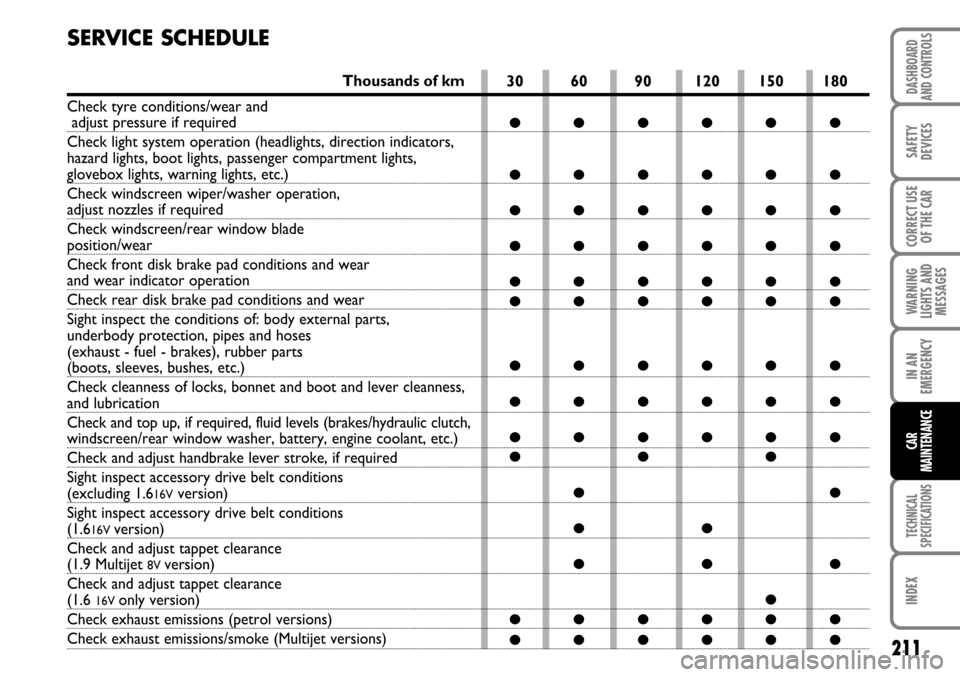
SERVICE SCHEDULE
30 60 90 120 150 180
●●●●●●
●●●●●●
●●●●●●
●●●●●●
●●●●●●
●●●●●●
●●●●●●
●●●●●●
●●●●●●
●●●
●●
●●
●●●
●
●●●●●●
●●●●●●
Thousands of km
Check tyre conditions/wear and
adjust pressure if required
Check light system operation (headlights, direction indicators,
hazard lights, boot lights, passenger compartment lights,
glovebox lights, warning lights, etc.)
Check windscreen wiper/washer operation,
adjust nozzles if required
Check windscreen/rear window blade
position/wear
Check front disk brake pad conditions and wear
and wear indicator operation
Check rear disk brake pad conditions and wear
Sight inspect the conditions of: body external parts,
underbody protection, pipes and hoses
(exhaust - fuel - brakes), rubber parts
(boots, sleeves, bushes, etc.)
Check cleanness of locks, bonnet and boot and lever cleanness,
and lubrication
Check and top up, if required, fluid levels (brakes/hydraulic clutch,
windscreen/rear window washer, battery, engine coolant, etc.)
Check and adjust handbrake lever stroke, if required
Sight inspect accessory drive belt conditions
(excluding 1.616Vversion)
Sight inspect accessory drive belt conditions
(1.616V version)
Check and adjust tappet clearance
(1.9 Multijet 8V version)
Check and adjust tappet clearance
(1.6 16V only version)
Check exhaust emissions (petrol versions)
Check exhaust emissions/smoke (Multijet versions)
Page 213 of 274
212
WARNING
LIGHTS AND
MESSAGES
TECHNICAL
SPECIFICATIONS
INDEX
DASHBOARD
AND CONTROLS
SAFETY
DEVICES
CORRECT USE
OF THE CAR
IN AN
EMERGENCY
CAR
MAINTENANCE
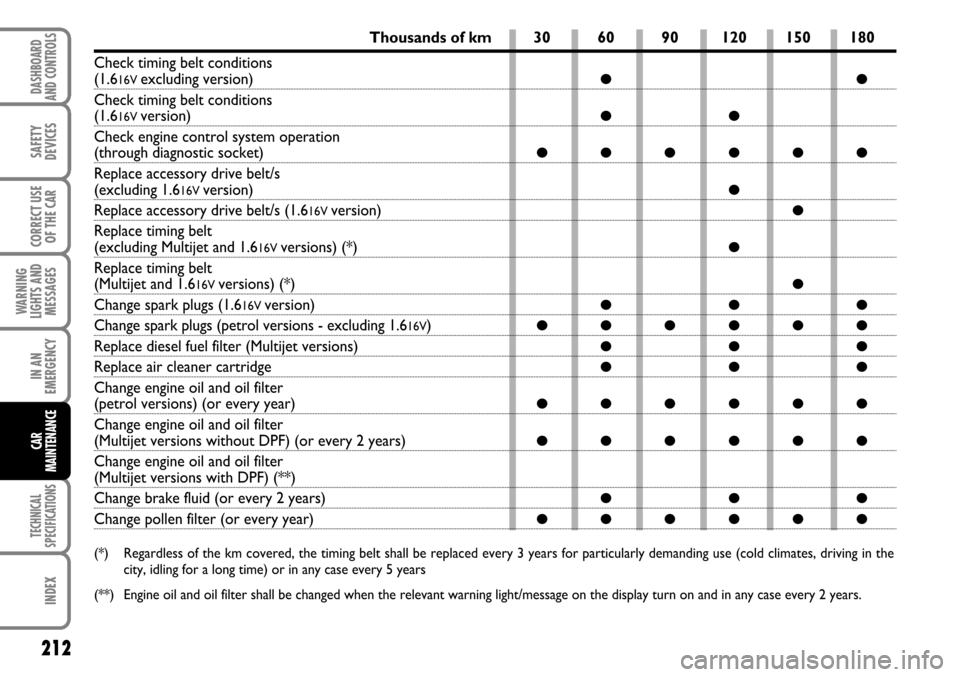
30 60 90 120 150 180
●●
●●
●●●●●●
●
●
●
●
●●●
●●●●●●
●●●
●●●
●●●●●●
●●●●●●
●●●
●●●●●●
Thousands of km
Check timing belt conditions
(1.616V excluding version)
Check timing belt conditions
(1.616V version)
Check engine control system operation
(through diagnostic socket)
Replace accessory drive belt/s
(excluding 1.616V version)
Replace accessory drive belt/s (1.616V version)
Replace timing belt
(excluding Multijet and 1.616V versions) (*)
Replace timing belt
(Multijet and 1.616V versions) (*)
Change spark plugs (1.616V version)
Change spark plugs (petrol versions - excluding 1.616V)
Replace diesel fuel filter (Multijet versions)
Replace air cleaner cartridge
Change engine oil and oil filter
(petrol versions) (or every year)
Change engine oil and oil filter
(Multijet versions without DPF) (or every 2 years)
Change engine oil and oil filter
(Multijet versions with DPF) (**)
Change brake fluid (or every 2 years)
Change pollen filter (or every year)
(*) Regardless of the km covered, the timing belt shall be replaced every 3 years for particularly demanding use (cold climates, driving in the
city, idling for a long time) or in any case every 5 years
(**) Engine oil and oil filter shall be changed when the relevant warning light/message on the display turn on and in any case every 2 years.