fuel FIAT STILO 2006 1.G Owner's Manual
[x] Cancel search | Manufacturer: FIAT, Model Year: 2006, Model line: STILO, Model: FIAT STILO 2006 1.GPages: 274, PDF Size: 4.76 MB
Page 164 of 274

163
IN AN
EMERGENCY
CAR
MAINTENANCE
TECHNICAL
SPECIFICATIONS
INDEX
DASHBOARD
AND CONTROLS
SAFETY
DEVICES
CORRECT USE
OF THE CAR
WARNING
LIGHTS AND
MESSAGES
INCOMPLETE DOOR
LOCKING (red)
The warning light turns on
when one or more doors, the
boot or the bonnet are not properly shut.
The display will show the dedicated mes-
sage.
The buzzer will sound when one or more
doors are open and the car is moving.GENERIC FAILURE
INDICATION
(amber)
The warning light turns on in the
following circumstances.
Inertial fuel cut-off switch
intervened
The warning light turns on when the in-
ertial fuel cut-off switch is triggered. The
display will show the dedicated message.
Sensor failure
The warning light turns on when a fault
is detected to one of the following sensors
(where provided):
❒window anti-pinch sensors;
❒engine oil pressure sensor;
❒twilight sensor;
❒rain sensor;
❒parking sensors;
The display will show the dedicated mes-
sage (excluding in the event of engine oil
pressure sensor failure).
Contact Fiat Dealership as soon as possi-
ble to have the fault removed.
´è
DIESEL PARTICULATE
FILTER CLOGGED
(amber)
(Multijet versions)
The warning light turns on when the diesel
particulate filter is clogged and the driving
conditions do not enable to activate au-
tomatically the reclaiming procedure.
To enable the cleaning procedure, keep
the car running until the warning light
turns off.
The display will show the dedicated mes-
sage.
h
Page 165 of 274
164
IN AN
EMERGENCY
CAR
MAINTENANCE
TECHNICAL
SPECIFICATIONS
INDEX
DASHBOARD
AND CONTROLS
SAFETY
DEVICES
CORRECT USE
OF THE CAR
WARNING
LIGHTS AND
MESSAGES
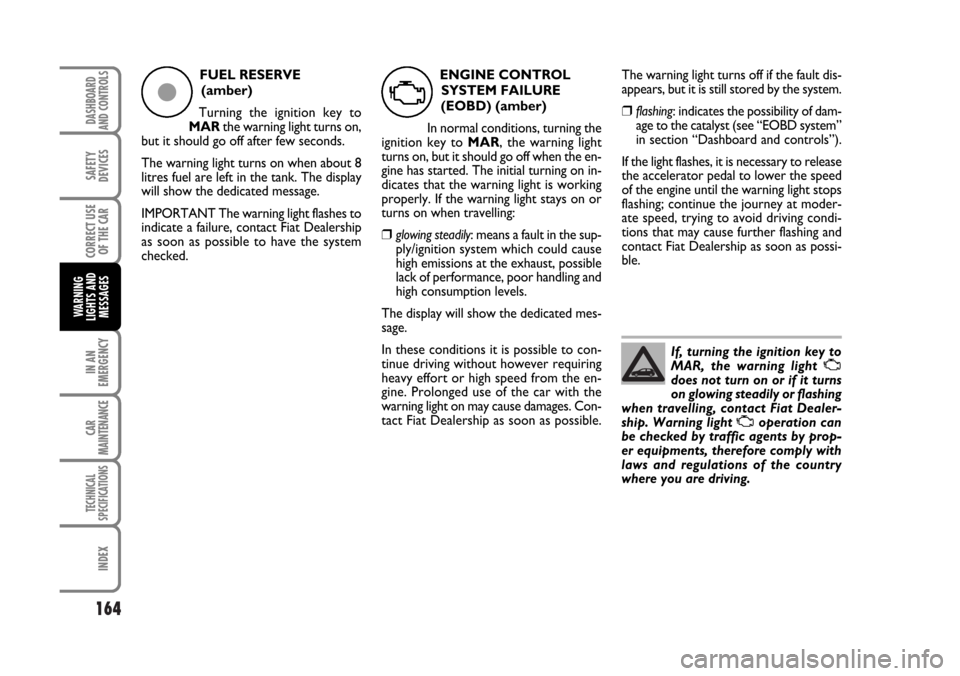
FUEL RESERVE
(amber)
Turning the ignition key to
MARthe warning light turns on,
but it should go off after few seconds.
The warning light turns on when about 8
litres fuel are left in the tank. The display
will show the dedicated message.
IMPORTANT The warning light flashes to
indicate a failure, contact Fiat Dealership
as soon as possible to have the system
checked.ENGINE CONTROL
SYSTEM FAILURE
(EOBD) (amber)
In normal conditions, turning the
ignition key to MAR, the warning light
turns on, but it should go off when the en-
gine has started. The initial turning on in-
dicates that the warning light is working
properly. If the warning light stays on or
turns on when travelling:
❒glowing steadily: means a fault in the sup-
ply/ignition system which could cause
high emissions at the exhaust, possible
lack of performance, poor handling and
high consumption levels.
The display will show the dedicated mes-
sage.
In these conditions it is possible to con-
tinue driving without however requiring
heavy effort or high speed from the en-
gine. Prolonged use of the car with the
warning light on may cause damages. Con-
tact Fiat Dealership as soon as possible.
çU
If, turning the ignition key to
MAR, the warning light Udoes not turn on or if it turns
on glowing steadily or flashing
when travelling, contact Fiat Dealer-
ship. Warning light
Uoperation can
be checked by traffic agents by prop-
er equipments, therefore comply with
laws and regulations of the country
where you are driving.
The warning light turns off if the fault dis-
appears, but it is still stored by the system.
❒flashing: indicates the possibility of dam-
age to the catalyst (see “EOBD system”
in section “Dashboard and controls”).
If the light flashes, it is necessary to release
the accelerator pedal to lower the speed
of the engine until the warning light stops
flashing; continue the journey at moder-
ate speed, trying to avoid driving condi-
tions that may cause further flashing and
contact Fiat Dealership as soon as possi-
ble.
Page 167 of 274
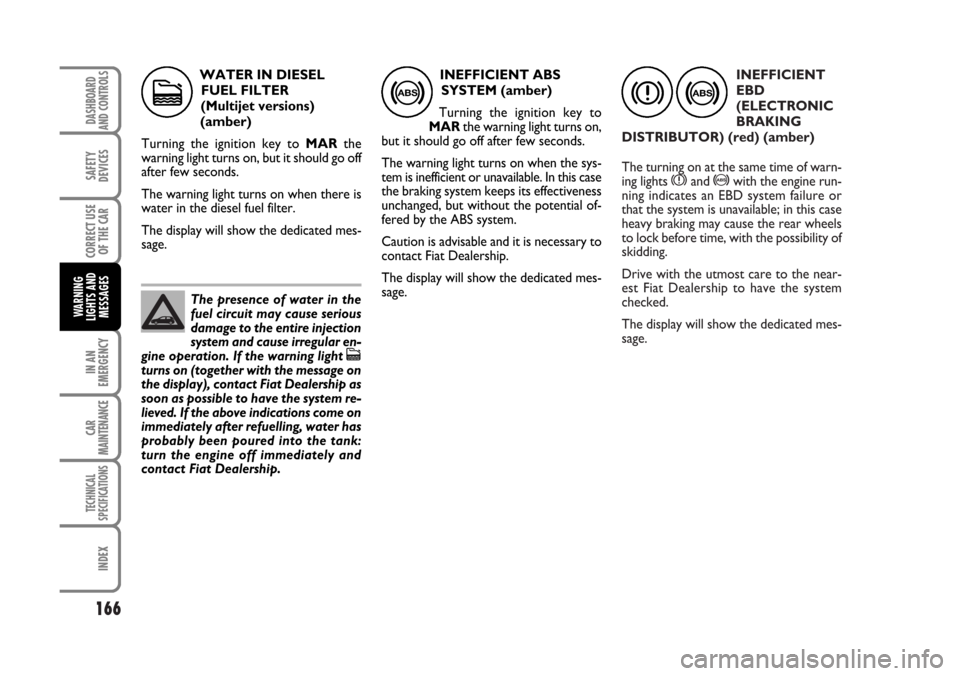
INEFFICIENT
EBD
(ELECTRONIC
BRAKING
DISTRIBUTOR) (red) (amber)
The turning on at the same time of warn-
ing lights
xand >with the engine run-
ning indicates an EBD system failure or
that the system is unavailable; in this case
heavy braking may cause the rear wheels
to lock before time, with the possibility of
skidding.
Drive with the utmost care to the near-
est Fiat Dealership to have the system
checked.
The display will show the dedicated mes-
sage.
166
IN AN
EMERGENCY
CAR
MAINTENANCE
TECHNICAL
SPECIFICATIONS
INDEX
DASHBOARD
AND CONTROLS
SAFETY
DEVICES
CORRECT USE
OF THE CAR
WARNING
LIGHTS AND
MESSAGES
WATER IN DIESEL
FUEL FILTER
(Multijet versions)
(amber)
Turning the ignition key to MARthe
warning light turns on, but it should go off
after few seconds.
The warning light turns on when there is
water in the diesel fuel filter.
The display will show the dedicated mes-
sage.INEFFICIENT ABS
SYSTEM (amber)
Turning the ignition key to
MARthe warning light turns on,
but it should go off after few seconds.
The warning light turns on when the sys-
tem is inefficient or unavailable. In this case
the braking system keeps its effectiveness
unchanged, but without the potential of-
fered by the ABS system.
Caution is advisable and it is necessary to
contact Fiat Dealership.
The display will show the dedicated mes-
sage.
c
The presence of water in the
fuel circuit may cause serious
damage to the entire injection
system and cause irregular en-
gine operation. If the warning light
cturns on (together with the message on
the display), contact Fiat Dealership as
soon as possible to have the system re-
lieved. If the above indications come on
immediately after refuelling, water has
probably been poured into the tank:
turn the engine off immediately and
contact Fiat Dealership.
>x>
Page 171 of 274
170
WARNING
LIGHTS AND
MESSAGES
CAR
MAINTENANCE
TECHNICAL
SPECIFICATIONS
IINDEX
DASHBOARD
AND CONTROLS
SAFETY
DEVICES
CORRECT USE
OF THE CAR
IN AN
EMERGENCY
ENGINE STARTING
JUMP STARTING
If the battery is flat, it is possible to start
the engine using an auxiliary battery with
the same capacity or a little higher than
the flat one.
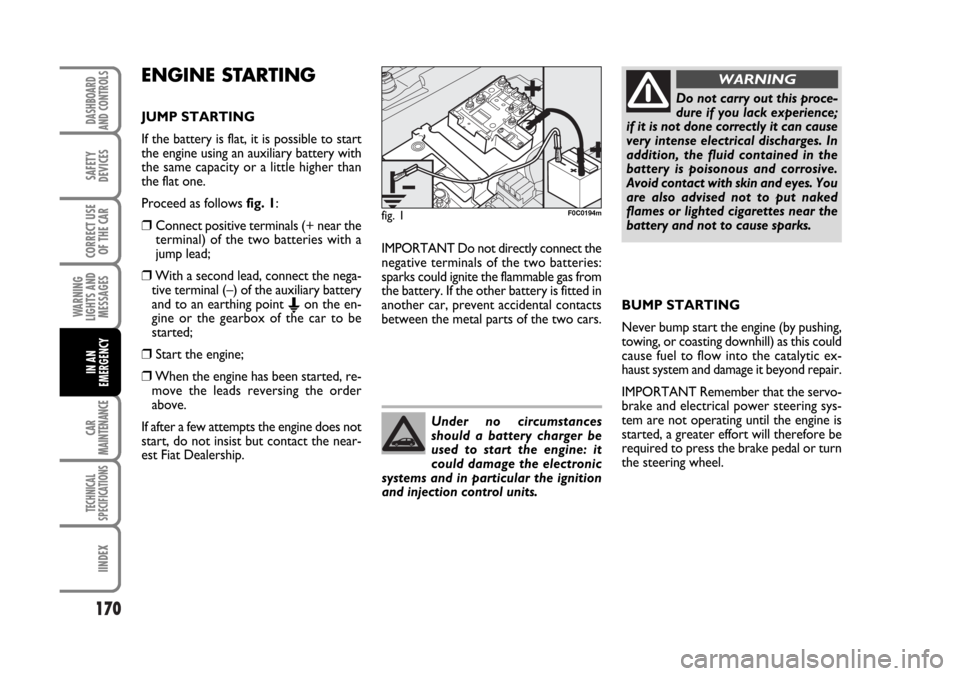
Proceed as follows fig. 1:
❒Connect positive terminals (+ near the
terminal) of the two batteries with a
jump lead;
❒With a second lead, connect the nega-
tive terminal (–) of the auxiliary battery
and to an earthing point
Eon the en-
gine or the gearbox of the car to be
started;
❒Start the engine;
❒When the engine has been started, re-
move the leads reversing the order
above.
If after a few attempts the engine does not
start, do not insist but contact the near-
est Fiat Dealership.IMPORTANT Do not directly connect the
negative terminals of the two batteries:
sparks could ignite the flammable gas from
the battery. If the other battery is fitted in
another car, prevent accidental contacts
between the metal parts of the two cars.BUMP STARTING
Never bump start the engine (by pushing,
towing, or coasting downhill) as this could
cause fuel to flow into the catalytic ex-
haust system and damage it beyond repair.
IMPORTANT Remember that the servo-
brake and electrical power steering sys-
tem are not operating until the engine is
started, a greater effort will therefore be
required to press the brake pedal or turn
the steering wheel.
fig. 1F0C0194m
Under no circumstances
should a battery charger be
used to start the engine: it
could damage the electronic
systems and in particular the ignition
and injection control units.
Do not carry out this proce-
dure if you lack experience;
if it is not done correctly it can cause
very intense electrical discharges. In
addition, the fluid contained in the
battery is poisonous and corrosive.
Avoid contact with skin and eyes. You
are also advised not to put naked
flames or lighted cigarettes near the
battery and not to cause sparks.
WARNING
Page 203 of 274
202
WARNING
LIGHTS AND
MESSAGES
CAR
MAINTENANCE
TECHNICAL
SPECIFICATIONS
IINDEX
DASHBOARD
AND CONTROLS
SAFETY
DEVICES
CORRECT USE
OF THE CAR
IN AN
EMERGENCY
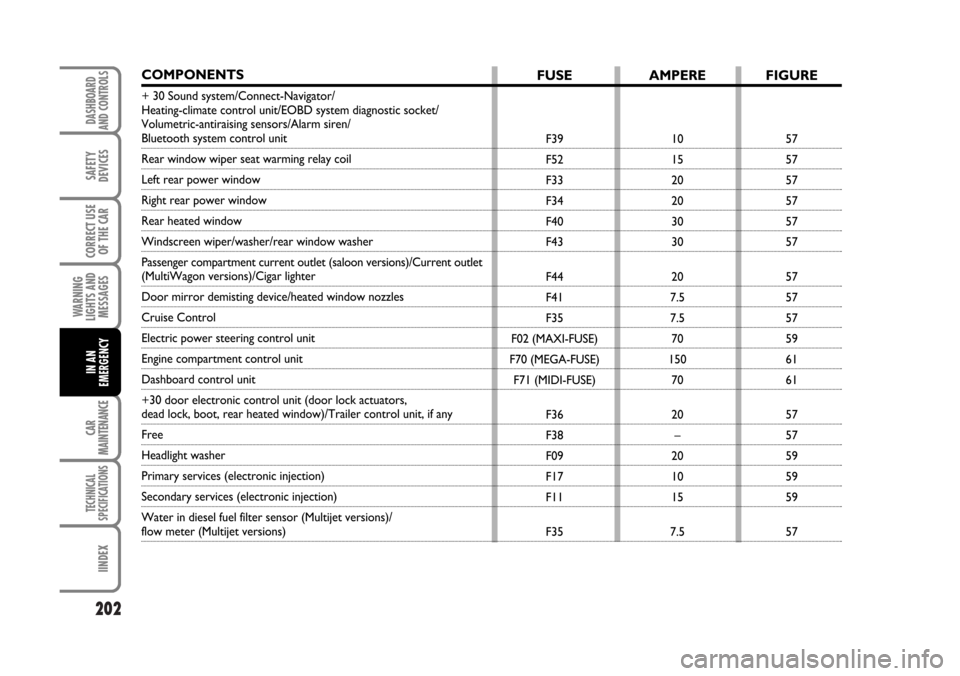
COMPONENTS
+ 30 Sound system/Connect-Navigator/
Heating-climate control unit/EOBD system diagnostic socket/
Volumetric-antiraising sensors/Alarm siren/
Bluetooth system control unit
Rear window wiper seat warming relay coil
Left rear power window
Right rear power window
Rear heated window
Windscreen wiper/washer/rear window washer
Passenger compartment current outlet (saloon versions)/Current outlet
(MultiWagon versions)/Cigar lighter
Door mirror demisting device/heated window nozzles
Cruise Control
Electric power steering control unit
Engine compartment control unit
Dashboard control unit
+30 door electronic control unit (door lock actuators,
dead lock, boot, rear heated window)/Trailer control unit, if any
Free
Headlight washer
Primary services (electronic injection)
Secondary services (electronic injection)
Water in diesel fuel filter sensor (Multijet versions)/
flow meter (Multijet versions)
FUSE
F39
F52
F33
F34
F40
F43
F44
F41
F35
F02 (MAXI-FUSE)
F70 (MEGA-FUSE)
F71 (MIDI-FUSE)
F36
F38
F09
F17
F11
F35
AMPERE
10
15
20
20
30
30
20
7.5
7.5
70
150
70
20
–
20
10
15
7.5
FIGURE
57
57
57
57
57
57
57
57
57
59
61
61
57
57
59
59
59
57
Page 204 of 274
203
WARNING
LIGHTS AND
MESSAGES
CAR
MAINTENANCE
TECHNICAL
SPECIFICATIONS
INDEX
DASHBOARD
AND CONTROLS
SAFETY
DEVICES
CORRECT USE
OF THE CAR
IN AN
EMERGENCY
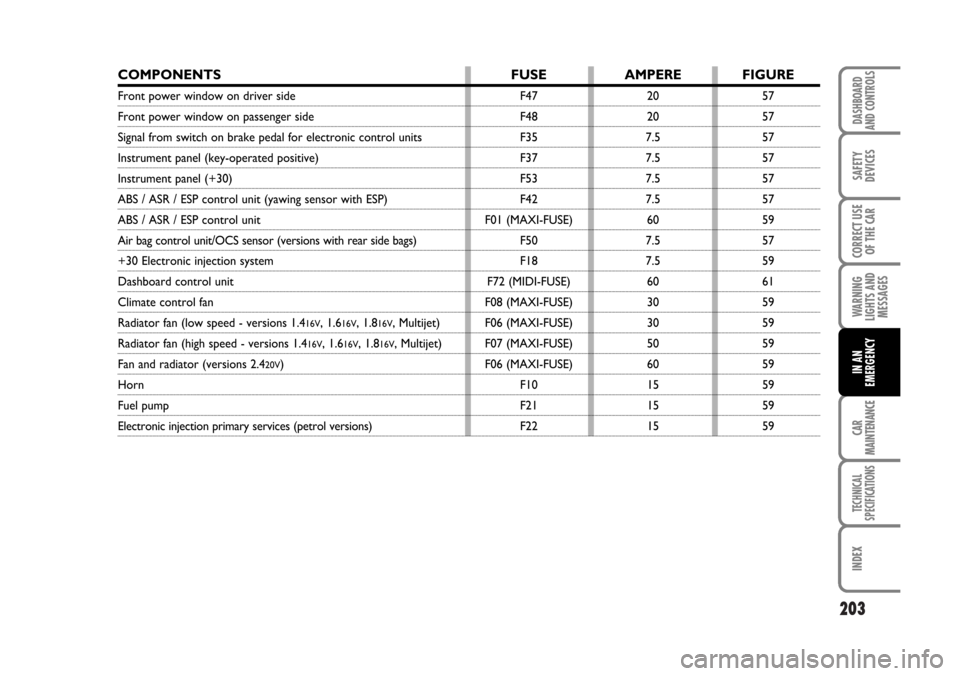
COMPONENTS
Front power window on driver side
Front power window on passenger side
Signal from switch on brake pedal for electronic control units
Instrument panel (key-operated positive)
Instrument panel (+30)
ABS / ASR / ESP control unit (yawing sensor with ESP)
ABS / ASR / ESP control unit
Air bag control unit/OCS sensor (versions with rear side bags)
+30 Electronic injection system
Dashboard control unit
Climate control fan
Radiator fan (low speed - versions 1.416V, 1.616V, 1.816V, Multijet)
Radiator fan (high speed - versions 1.416V, 1.616V, 1.816V, Multijet)
Fan and radiator (versions 2.420V)
Horn
Fuel pump
Electronic injection primary services (petrol versions)
FUSE
F47
F48
F35
F37
F53
F42
F01 (MAXI-FUSE)
F50
F18
F72 (MIDI-FUSE)
F08 (MAXI-FUSE)
F06 (MAXI-FUSE)
F07 (MAXI-FUSE)
F06 (MAXI-FUSE)
F10
F21
F22
AMPERE
20
20
7.5
7.5
7.5
7.5
60
7.5
7.5
60
30
30
50
60
15
15
15
FIGURE
57
57
57
57
57
57
59
57
59
61
59
59
59
59
59
59
59
Page 210 of 274
209
WARNING
LIGHTS AND
MESSAGES
TECHNICAL
SPECIFICATIONS
INDEX
DASHBOARD
AND CONTROLS
SAFETY
DEVICES
CORRECT USE
OF THE CAR
IN AN
EMERGENCY
CAR
MAINTENANCE
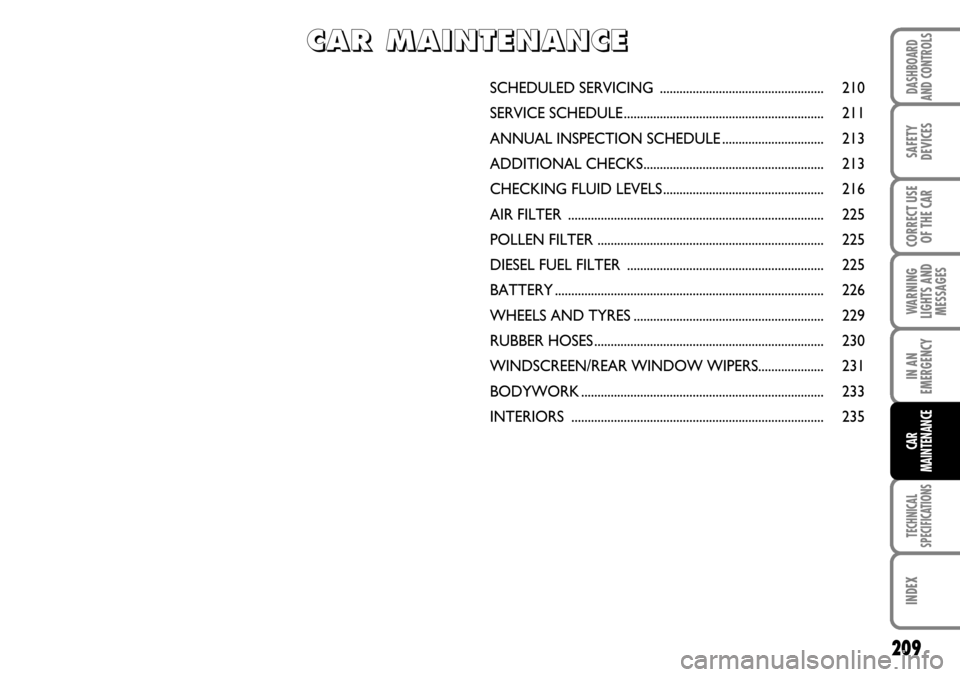
SCHEDULED SERVICING .................................................. 210
SERVICE SCHEDULE ............................................................. 211
ANNUAL INSPECTION SCHEDULE ............................... 213
ADDITIONAL CHECKS....................................................... 213
CHECKING FLUID LEVELS ................................................. 216
AIR FILTER .............................................................................. 225
POLLEN FILTER ..................................................................... 225
DIESEL FUEL FILTER ............................................................ 225
BATTERY .................................................................................. 226
WHEELS AND TYRES .......................................................... 229
RUBBER HOSES ...................................................................... 230
WINDSCREEN/REAR WINDOW WIPERS.................... 231
BODYWORK .......................................................................... 233
INTERIORS ............................................................................. 235
C C C C
A A A A
R R R R
M M M M
A A A A
I I I I
N N N N
T T T T
E E E E
N N N N
A A A A
N N N N
C C C C
E E E E
Page 212 of 274
211
WARNING
LIGHTS AND
MESSAGES
TECHNICAL
SPECIFICATIONS
INDEX
DASHBOARD
AND CONTROLS
SAFETY
DEVICES
CORRECT USE
OF THE CAR
IN AN
EMERGENCY
CAR
MAINTENANCE
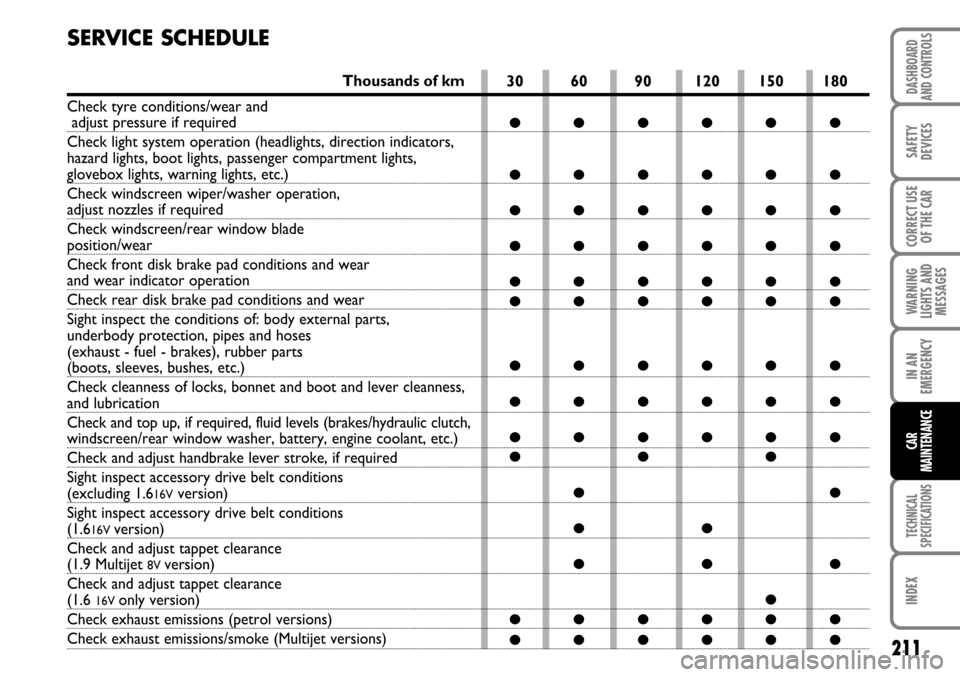
SERVICE SCHEDULE
30 60 90 120 150 180
●●●●●●
●●●●●●
●●●●●●
●●●●●●
●●●●●●
●●●●●●
●●●●●●
●●●●●●
●●●●●●
●●●
●●
●●
●●●
●
●●●●●●
●●●●●●
Thousands of km
Check tyre conditions/wear and
adjust pressure if required
Check light system operation (headlights, direction indicators,
hazard lights, boot lights, passenger compartment lights,
glovebox lights, warning lights, etc.)
Check windscreen wiper/washer operation,
adjust nozzles if required
Check windscreen/rear window blade
position/wear
Check front disk brake pad conditions and wear
and wear indicator operation
Check rear disk brake pad conditions and wear
Sight inspect the conditions of: body external parts,
underbody protection, pipes and hoses
(exhaust - fuel - brakes), rubber parts
(boots, sleeves, bushes, etc.)
Check cleanness of locks, bonnet and boot and lever cleanness,
and lubrication
Check and top up, if required, fluid levels (brakes/hydraulic clutch,
windscreen/rear window washer, battery, engine coolant, etc.)
Check and adjust handbrake lever stroke, if required
Sight inspect accessory drive belt conditions
(excluding 1.616Vversion)
Sight inspect accessory drive belt conditions
(1.616V version)
Check and adjust tappet clearance
(1.9 Multijet 8V version)
Check and adjust tappet clearance
(1.6 16V only version)
Check exhaust emissions (petrol versions)
Check exhaust emissions/smoke (Multijet versions)
Page 213 of 274
212
WARNING
LIGHTS AND
MESSAGES
TECHNICAL
SPECIFICATIONS
INDEX
DASHBOARD
AND CONTROLS
SAFETY
DEVICES
CORRECT USE
OF THE CAR
IN AN
EMERGENCY
CAR
MAINTENANCE
30 60 90 120 150 180
●●
●●
●●●●●●
●
●
●
●
●●●
●●●●●●
●●●
●●●
●●●●●●
●●●●●●
●●●
●●●●●●
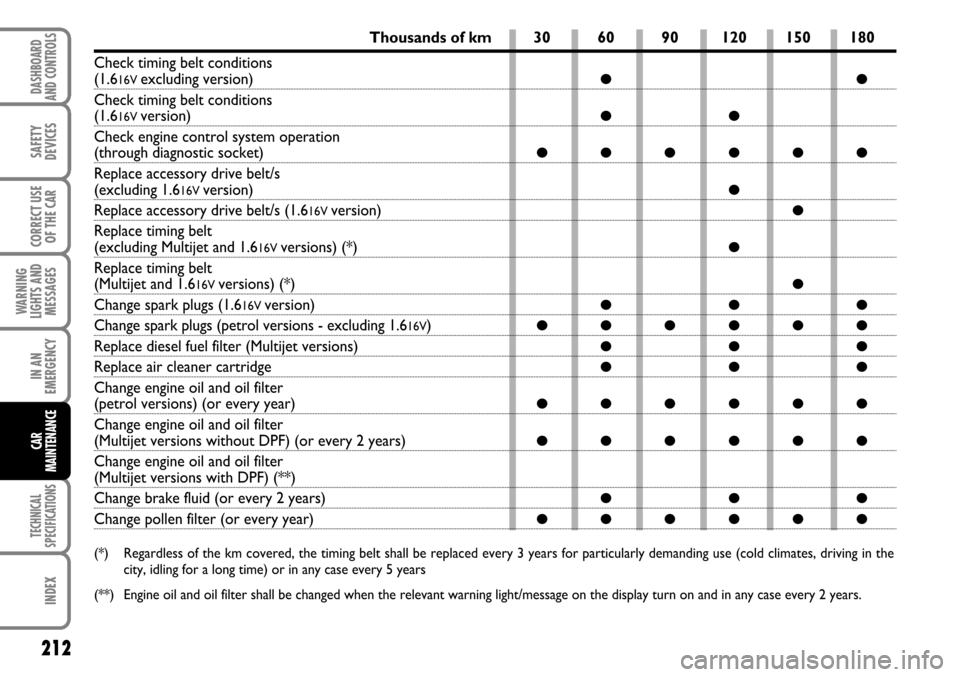
Thousands of km
Check timing belt conditions
(1.616V excluding version)
Check timing belt conditions
(1.616V version)
Check engine control system operation
(through diagnostic socket)
Replace accessory drive belt/s
(excluding 1.616V version)
Replace accessory drive belt/s (1.616V version)
Replace timing belt
(excluding Multijet and 1.616V versions) (*)
Replace timing belt
(Multijet and 1.616V versions) (*)
Change spark plugs (1.616V version)
Change spark plugs (petrol versions - excluding 1.616V)
Replace diesel fuel filter (Multijet versions)
Replace air cleaner cartridge
Change engine oil and oil filter
(petrol versions) (or every year)
Change engine oil and oil filter
(Multijet versions without DPF) (or every 2 years)
Change engine oil and oil filter
(Multijet versions with DPF) (**)
Change brake fluid (or every 2 years)
Change pollen filter (or every year)
(*) Regardless of the km covered, the timing belt shall be replaced every 3 years for particularly demanding use (cold climates, driving in the
city, idling for a long time) or in any case every 5 years
(**) Engine oil and oil filter shall be changed when the relevant warning light/message on the display turn on and in any case every 2 years.
Page 214 of 274
213
WARNING
LIGHTS AND
MESSAGES
TECHNICAL
SPECIFICATIONS
INDEX
DASHBOARD
AND CONTROLS
SAFETY
DEVICES
CORRECT USE
OF THE CAR
IN AN
EMERGENCY
CAR
MAINTENANCE
ANNUAL INSPECTION
SCHEDULE
For cars with an annual mileage of below
30.000 km (for example about 15.000 km)
the following yearly inspection programme
is advised:
❒check tyre conditions/wear and adjust
pressure if required (including the
space-saver spare wheel);
❒check light system operation (head-
lights, direction indicators, hazard lights,
boot lights, passenger compartment
lights, glovebox light, warning lights,
etc.);
❒check windscreen wiper/washer oper-
ation, adjust nozzles;
❒check windscreen/rear window blade
position/wear;
❒ check front disk brake pad conditions
and wear;
❒sight inspect the conditions of: engine,
gearbox, transmission, pipes and hoses
(exhaust - fuel - brakes), rubber parts
(boots, sleeves, bushes, etc.) fuel and
brake system hoses;
❒check cleanness of bonnet and boot
locks, and lever cleanness and lubrica-
tion
❒check battery charge (by optical depth
gauge);
❒visual check on various drive belt con-
ditions;
❒check and top up fluid levels (engine
coolant, brakes, windscreen washer,
battery, etc.);
❒change engine oil and oil filter, if re-
quired (Multijet versions);
❒replace pollen filter.
ADDITIONAL CHECKS
Every 1,000 km or before long journeys,
check and top up if required:
❒engine coolant fluid level;
❒ brake fluid level;
❒ windscreen washer fluid level;
❒tyre pressure and conditions.
Every 3,000 km check and top up if re-
quired: engine oil level.
You are recommended to use FL Sele-
niaproducts, designed and produced
specifically for Fiat cars (see table “Ca-
pacities” in section “Technical specifica-
tions”).