instrument panel FIAT STILO 2006 1.G Owners Manual
[x] Cancel search | Manufacturer: FIAT, Model Year: 2006, Model line: STILO, Model: FIAT STILO 2006 1.GPages: 274, PDF Size: 4.76 MB
Page 5 of 274
4
SAFETY
DEVICES
CORRECT USE
OF THE CAR
WARNING
LIGHTS AND
MESSAGES
IN AN
EMERGENCY
CAR
MAINTENANCE
TECHNICAL
SPECIFICATIONS
INDEX
DASHBOARD
AND CONTROLSDASHBOARD ........................................................................ 5
INSTRUMENT PANEL ......................................................... 6
SYMBOLS ................................................................................. 8
THE FIAT CODE SYSTEM ................................................... 8
THE KEYS ................................................................................ 10
ALARM ..................................................................................... 17
IGNITION SWITCH.............................................................. 20
INSTRUMENTS ....................................................................... 21
MULTIFUNCTION DISPLAY ............................................. 23
TRIP COMPUTER ................................................................. 34
SEATS ........................................................................................ 37
HEAD RESTRAINTS .............................................................. 41
STEERING WHEEL ............................................................... 42
REARVIEW MIRRORS ........................................................... 43
HEATING/CLIMATE CONTROL SYSTEM .................... 44
HEATING AND VENTILATION ....................................... 46
MANUAL CLIMATE CONTROL SYSTEM .................... 48
AUTOMATIC TWO-ZONE
CLIMATE CONTROL SYSTEM ......................................... 51
EXTERNAL LIGHTS .............................................................. 57
WINDOW WASHING......................................................... 60CRUISE CONTROL ............................................................. 64
CEILING LIGHTS .................................................................. 67
CONTROLS ........................................................................... 68
INTERIOR FITTINGS ............................................................ 70
“SKYWINDOW”(BLADE SUNROOF) ........................... 74
DOORS .................................................................................... 79
POWER WINDOWS ........................................................... 80
BOOT ........................................................................................ 81
BONNET .................................................................................. 92
ROOF RACK/SKI RACK ..................................................... 93
HEADLIGHTS .......................................................................... 94
ABS SYSTEM ........................................................................... 95
ESP SYSTEM ............................................................................ 97
EOBD SYSTEM ....................................................................... 99
SOUND SYSTEM .................................................................... 100
ACCESSORIES PURCHASED BY THE OWNER ......... 101
“DUALDRIVE” ELECTRIC POWER
STEERING SYSTEM .............................................................. 102
PARKING SENSORS ............................................................ 103
AT THE FILLING STATION .............................................. 105
PROTECTING THE ENVIRONMENT ............................ 108
D D
A A
S S
H H
B B
O O
A A
R R
D D
A A
N N
D D
C C
O O
N N
T T
R R
O O
L L
S S
Page 6 of 274
DASHBOARD
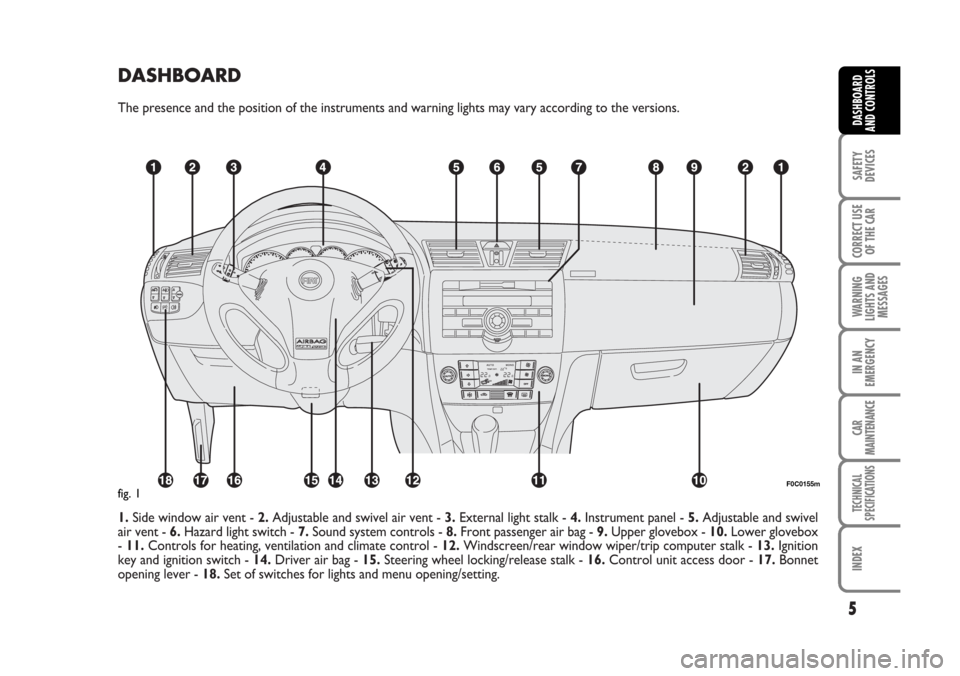
The presence and the position of the instruments and warning lights may vary according to the versions.
1.Side window air vent - 2.Adjustable and swivel air vent - 3.External light stalk - 4.Instrument panel - 5.Adjustable and swivel
air vent - 6.Hazard light switch - 7.Sound system controls - 8.Front passenger air bag - 9.Upper glovebox - 10.Lower glovebox
- 11.Controls for heating, ventilation and climate control - 12.Windscreen/rear window wiper/trip computer stalk - 13.Ignition
key and ignition switch - 14.Driver air bag - 15.Steering wheel locking/release stalk - 16.Control unit access door - 17.Bonnet
opening lever - 18.Set of switches for lights and menu opening/setting.
5
SAFETY
DEVICES
CORRECT USE
OF THE CAR
WARNING
LIGHTS AND
MESSAGES
IN AN
EMERGENCY
CAR
MAINTENANCE
TECHNICAL
SPECIFICATIONS
INDEX
DASHBOARD
AND CONTROLS
F0C0155mfig. 1
Page 7 of 274
6
SAFETY
DEVICES
CORRECT USE
OF THE CAR
WARNING
LIGHTS AND
MESSAGES
IN AN
EMERGENCY
CAR
MAINTENANCE
TECHNICAL
SPECIFICATIONS
INDEX
DASHBOARD
AND CONTROLS
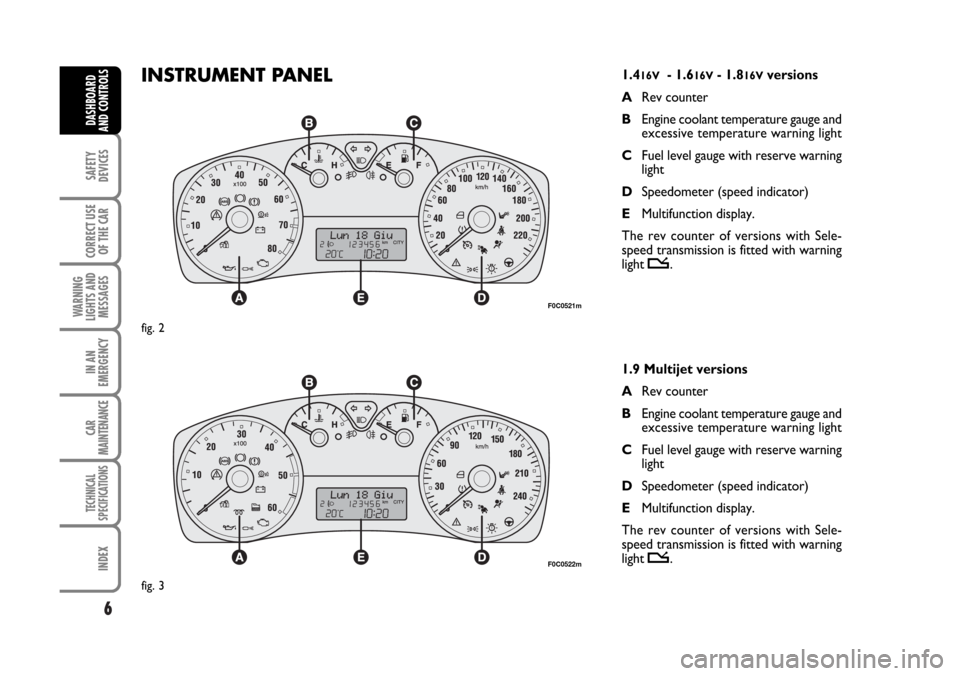
INSTRUMENT PANEL1.416V- 1.616V- 1.816Vversions
ARev counter
BEngine coolant temperature gauge and
excessive temperature warning light
CFuel level gauge with reserve warning
light
DSpeedometer (speed indicator)
EMultifunction display.
The rev counter of versions with Sele-
speed transmission is fitted with warning
light t.
1.9 Multijet versions
ARev counter
BEngine coolant temperature gauge and
excessive temperature warning light
CFuel level gauge with reserve warning
light
DSpeedometer (speed indicator)
EMultifunction display.
The rev counter of versions with Sele-
speed transmission is fitted with warning
light t.
F0C0521m
F0C0522m
fig. 3 fig. 2
Page 10 of 274
9
SAFETY
DEVICES
CORRECT USE
OF THE CAR
WARNING
LIGHTS AND
MESSAGES
IN AN
EMERGENCY
CAR
MAINTENANCE
TECHNICAL
SPECIFICATIONS
INDEX
DASHBOARD
AND CONTROLS
OPERATION
Each time the car is started turning the ig-
nition key to MAR, the Fiat CODE sys-
tem control unit sends a recognition code
to the engine control unit to deactivate
the inhibitor.
The code is sent only if the Fiat CODE
system control unit has recognised the
code transmitted from the key.
Each time the ignition key is turned to
STOP, the Fiat CODE system deactivates
the functions of the engine electronic con-
trol unit.
If the code has not been recognised cor-
rectly, the instrument panel warning light
Ywill turn on.
In this case, the key should be moved to
the STOPposition and then back to
MAR; if the lock continues, possibly try
again with the other key provided with the
car. If it is still not possible to start the car
contact a Fiat Dealership.IMPORTANT Every key has its own code,
which must be memorised by the system
control unit. To memorise new keys, up
to a maximum of eight, apply solely to Fi-
at Dealership taking with you the CODE
card and the keys, a personal identity doc-
ument and the car’s ownership docu-
ments. The codes of the keys not provid-
ed during the new memorising procedure
are erased from the memory. This is to
ensure that any lost or stolen keys can no
longer be used to start the car.
The electronic components in-
side the key may be damaged
if the key is submitted to sharp
knocks.
Warning light Ycoming
on when driving
❒If the warning light Yturns on, this
means that the system is running a self-
test (for example for a voltage drop).
❒If the warning light Ycontinues to stay
on, contact a Fiat Dealership.
Page 34 of 274
33
SAFETY
DEVICES
CORRECT USE
OF THE CAR
WARNING
LIGHTS AND
MESSAGES
IN AN
EMERGENCY
CAR
MAINTENANCE
TECHNICAL
SPECIFICATIONS
INDEX
DASHBOARD
AND CONTROLS
NoteThe “Service Schedule” includes car
maintenance every 30,000 km (or equiv-
alent value in miles) or every year; this is
shown automatically, with the ignition key
at MAR, starting from 2,000 km (or equiv-
alent value in miles) or 30 days from this
deadline and it is shown again every 200
km (or equivalent value in miles) or every
3 days. Below 200 km servicing indications
are displayed more frequently. Servicing
indication will be displayed in km or mi ac-
cording to previous setting. When a pro-
grammed maintenance interval (coupon)
is near to come, turning the ignition key
to MAR, the display will show the mes-
sage “Service” followed by the number of
km/mi or days to go before car servicing.
“Scheduled servicing” message is displayed
in km/mi or days according to the ap-
proaching service interval. Contact a Fiat
Dealership to carry out any service op-
eration provided by the “Service sched-
ule” or “Annual inspection plan”, and to
reset the display.Exit Menu
This is the last function that closes the cir-
cular setting cycle listed in the initial menu
screen.
Briefly press button MODEto go back to
the standard screen without storing set-
tings.
Press button
Ôto return to the first menu
option (Speed Beep).
Instrument panel, display and
button lighting adjustment
(Light rheostat)
With this function it is possible to adjust
the lighting (dimming/brightening) of the
instrument panel, sound system display,
Connect/Navigator display, two-zone cli-
mate control display and steering wheel
controls.
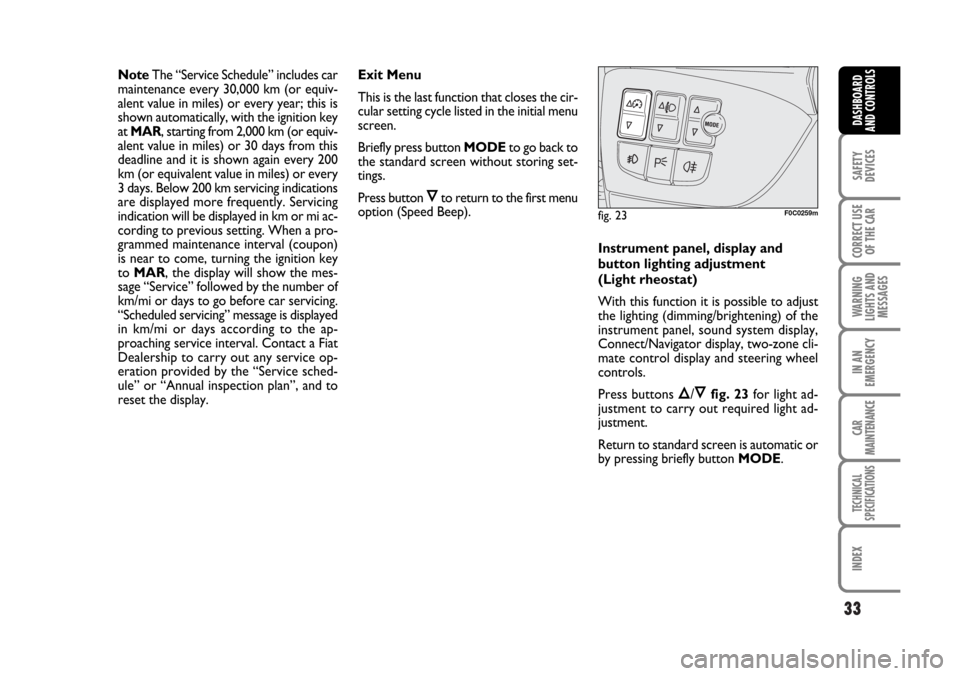
Press buttons
Õ/Ôfig. 23for light ad-
justment to carry out required light ad-
justment.
Return to standard screen is automatic or
by pressing briefly button MODE.
fig. 23F0C0259m
Page 58 of 274
57
SAFETY
DEVICES
CORRECT USE
OF THE CAR
WARNING
LIGHTS AND
MESSAGES
IN AN
EMERGENCY
CAR
MAINTENANCE
TECHNICAL
SPECIFICATIONS
INDEX
DASHBOARD
AND CONTROLS
EXTERNAL LIGHTS
The left-hand stalk controls the external
lights and the direction indicators.
The external lights can only be switched
on when the ignition key is at MAR.
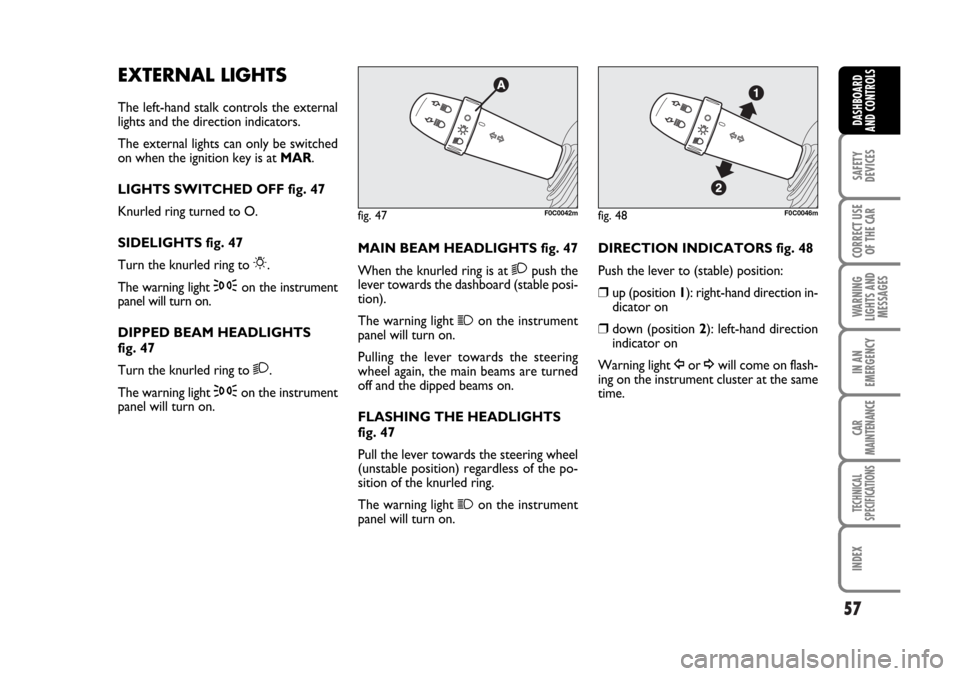
LIGHTS SWITCHED OFF fig. 47
Knurled ring turned to O.
SIDELIGHTS fig. 47
Turn the knurled ring to
6.
The warning light
3on the instrument
panel will turn on.
DIPPED BEAM HEADLIGHTS
fig. 47
Turn the knurled ring to
2.
The warning light
3on the instrument
panel will turn on.MAIN BEAM HEADLIGHTS fig. 47
When the knurled ring is at
2push the
lever towards the dashboard (stable posi-
tion).
The warning light
1on the instrument
panel will turn on.
Pulling the lever towards the steering
wheel again, the main beams are turned
off and the dipped beams on.
FLASHING THE HEADLIGHTS
fig. 47
Pull the lever towards the steering wheel
(unstable position) regardless of the po-
sition of the knurled ring.
The warning light
1on the instrument
panel will turn on.
fig. 47F0C0042mfig. 48F0C0046m
DIRECTION INDICATORS fig. 48
Push the lever to (stable) position:
❒up (position 1): right-hand direction in-
dicator on
❒down (position 2): left-hand direction
indicator on
Warning light
Îor ¥will come on flash-
ing on the instrument cluster at the same
time.
Page 65 of 274
64
SAFETY
DEVICES
CORRECT USE
OF THE CAR
WARNING
LIGHTS AND
MESSAGES
IN AN
EMERGENCY
CAR
MAINTENANCE
TECHNICAL
SPECIFICATIONS
INDEX
DASHBOARD
AND CONTROLS
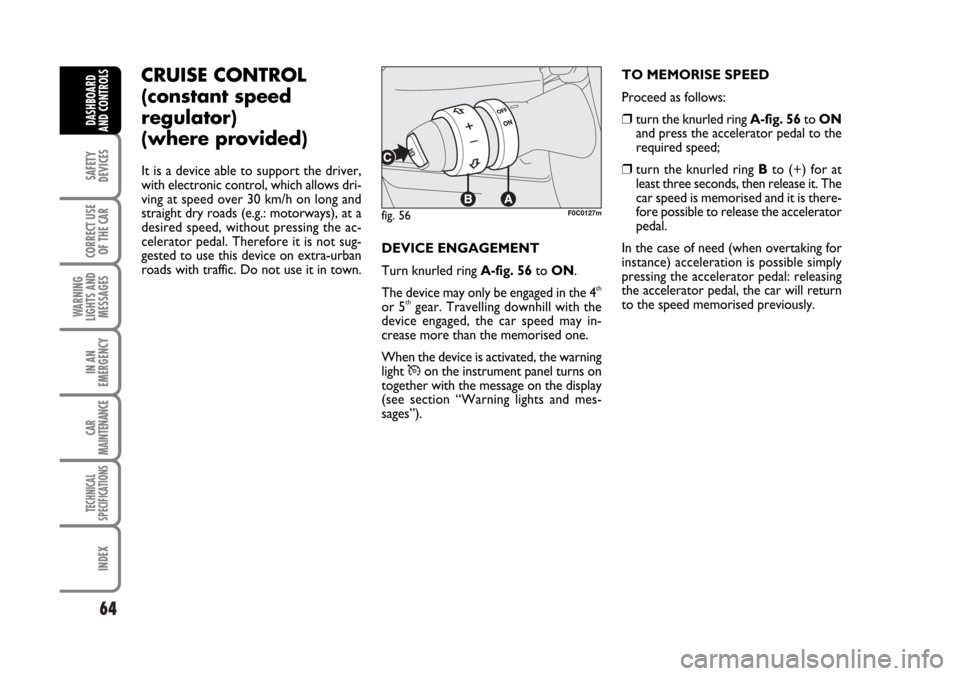
DEVICE ENGAGEMENT
Turn knurled ring A-fig. 56to ON.
The device may only be engaged in the 4
th
or 5thgear. Travelling downhill with the
device engaged, the car speed may in-
crease more than the memorised one.
When the device is activated, the warning
light
Üon the instrument panel turns on
together with the message on the display
(see section “Warning lights and mes-
sages”).TO MEMORISE SPEED
Proceed as follows:
❒turn the knurled ring A-fig. 56to ON
and press the accelerator pedal to the
required speed;
❒turn the knurled ring Bto (+) for at
least three seconds, then release it. The
car speed is memorised and it is there-
fore possible to release the accelerator
pedal.
In the case of need (when overtaking for
instance) acceleration is possible simply
pressing the accelerator pedal: releasing
the accelerator pedal, the car will return
to the speed memorised previously.
fig. 56F0C0127m
CRUISE CONTROL
(constant speed
regulator)
(where provided)
It is a device able to support the driver,
with electronic control, which allows dri-
ving at speed over 30 km/h on long and
straight dry roads (e.g.: motorways), at a
desired speed, without pressing the ac-
celerator pedal. Therefore it is not sug-
gested to use this device on extra-urban
roads with traffic. Do not use it in town.
Page 70 of 274
69
SAFETY
DEVICES
CORRECT USE
OF THE CAR
WARNING
LIGHTS AND
MESSAGES
IN AN
EMERGENCY
CAR
MAINTENANCE
TECHNICAL
SPECIFICATIONS
INDEX
DASHBOARD
AND CONTROLS
PARKING LIGHTS
These lights can only be turned on with ig-
nition key at STOPor removed, by
pressing button B-fig. 61for about 1 sec-
ond.
Press the button again to turn the light off.
REAR FOG LIGHTS
To turn rear fog lights on, press button C-
fig. 61, to activate these lights it is nec-
essary to have the dipped beams or front
fog lights switched on.
Press the button again to turn the lights
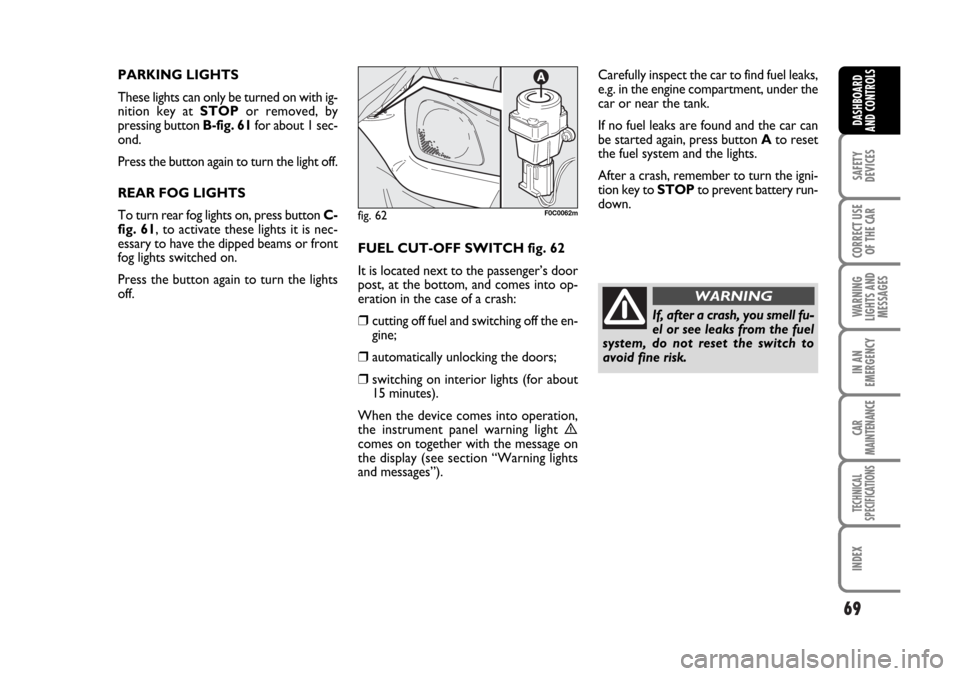
off. Carefully inspect the car to find fuel leaks,
e.g. in the engine compartment, under the
car or near the tank.
If no fuel leaks are found and the car can
be started again, press button Ato reset
the fuel system and the lights.
After a crash, remember to turn the igni-
tion key to STOPto prevent battery run-
down.
FUEL CUT-OFF SWITCH fig. 62
It is located next to the passenger’s door
post, at the bottom, and comes into op-
eration in the case of a crash:
❒cutting off fuel and switching off the en-
gine;
❒automatically unlocking the doors;
❒switching on interior lights (for about
15 minutes).
When the device comes into operation,
the instrument panel warning light
ècomes on together with the message on
the display (see section “Warning lights
and messages”).
fig. 62F0C0062m
If, after a crash, you smell fu-
el or see leaks from the fuel
system, do not reset the switch to
avoid fine risk.
WARNING
Page 98 of 274
97
SAFETY
DEVICES
CORRECT USE
OF THE CAR
WARNING
LIGHTS AND
MESSAGES
IN AN
EMERGENCY
CAR
MAINTENANCE
TECHNICAL
SPECIFICATIONS
INDEX
DASHBOARD
AND CONTROLS
ESP SYSTEM (Electronic
Stability Program)
(where provided)
The ESP system is an electronic system
controlling the car stability in the event of
tyre grip loss.
The ESP system is therefore particularly
useful when grip conditions of the road
surfaces changes.
ABS SYSTEM INTERVENTION
It is signalled by the blinking of the warn-
ing light
áon the instrument panel, to in-
form the driver that the car is in critical
stability and grip conditions.
ESP SYSTEM OPERATION
The ESP system is automatically activat-
ed when the car is started and cannot be
de-activated.FAILURE INDICATIONS
In the event of failure, the ESP system is
automatically disconnected and the warn-
ing light
áwill turn on glowing steadily on
the instrument panel, together with the
message on the display (see section
“Warning lights and messages”). In this
case, go to a Fiat Dealership as soon as
possible.
Performance of the ESP sys-
tem, in terms of active safe-
ty should not induce the driver to take
pointless and unnecessary risks. The
style of driving must in any case al-
ways be adapted to the conditions of
the road surface, visibility an traffic.
Road safety is always the driver’s re-
sponsibility.
WARNING
ESP SYSTEM INITIALISATION
(after disconnecting the battery)
After reconnecting the battery, to restore
regular operation of the ESP system, pro-
ceed as follows:
❒turn the ignition key to MAR;
❒turn the steering wheel 1/4 turn both
clockwise and counterclockwise (to
pass through position “straight
wheels”);
❒turn the ignition key to STOPand then
back to MAR.
A few seconds later the warning light will
turn off; if it stays on contact Fiat Dealer-
ship.
These operations can also be performed
with the engine on.
During the use of the space-
saver spare wheel, the ESP
system carries on working. However,
you must remind that the space-saver
spare wheel has dimensions smaller
than the standard tyre and therefore
its grip is reduced as to the other car
tyres.
WARNING
For correct operation of the
ESP system, the tyres must
absolutely be of the same brand and
type on all wheels, in perfect condi-
tions and, above all, of type, brand
and size specified.
WARNING
Page 100 of 274

99
SAFETY
DEVICES
CORRECT USE
OF THE CAR
WARNING
LIGHTS AND
MESSAGES
IN AN
EMERGENCY
CAR
MAINTENANCE
TECHNICAL
SPECIFICATIONS
INDEX
DASHBOARD
AND CONTROLS
Failure indications
In the event of malfunctioning, the ASR
system is automatically disconnected and
the warning light
áwill come on with
fixed light on the instrument panel to-
gether with the message on the display
(see section “Warning lights and mes-
sages”). In this case contact Fiat Dealer-
ship as soon as possible. MSR system
(engine braking torque control)
The car is fitted with a special system, in-
tegral with the ASR system, that in case of
sudden gear shifting, cuts in providing
torque to the engine thus preventing ex-
cessive driving wheel drive that, specially
in poor grip conditions, can lead to loss of
stability.
EOBD SYSTEM
The EOBD system (European On Board
Diagnosis) allows continuous diagnosis of
the components of the car correlated with
emissions.
It also alerts the driver, by turning on the
warning light
Uon the instrument pan-
el (together with the message on the dis-
play) (see section “Warning lights and
messages”), when these components are
no longer in peak conditions.
The objective is:
❒to keep the system efficiency under
control;
❒warn when a fault causes emissions lev-
els to increase;
❒warn of the need to replace deterio-
rated components.
The system also has a diagnostic connec-
tor that can be interfaced with appropri-
ate tools, which makes it possible to read
the error codes stored in the control unit,
together with a series of specific parame-
ters for engine operation and diagnosis.
This check can also be carried out by the
traffic police.
When using the spare wheel,
the ASR system is excluded
and the warning light
áon the in-
strument panel turns on glowing
steadily together with the message on
the display (see section “Warning
lights and messages”).
WARNING
For correct operation of the
ASR system, the tyres must
absolutely be of the same brand and
type on all wheels, in perfect condi-
tions and, above all, of type, brand
and size specified.
WARNING