Handle FIAT TALENTO 2016 2.G User Guide
[x] Cancel search | Manufacturer: FIAT, Model Year: 2016, Model line: TALENTO, Model: FIAT TALENTO 2016 2.GPages: 232, PDF Size: 5.01 MB
Page 29 of 232
To disable the function:
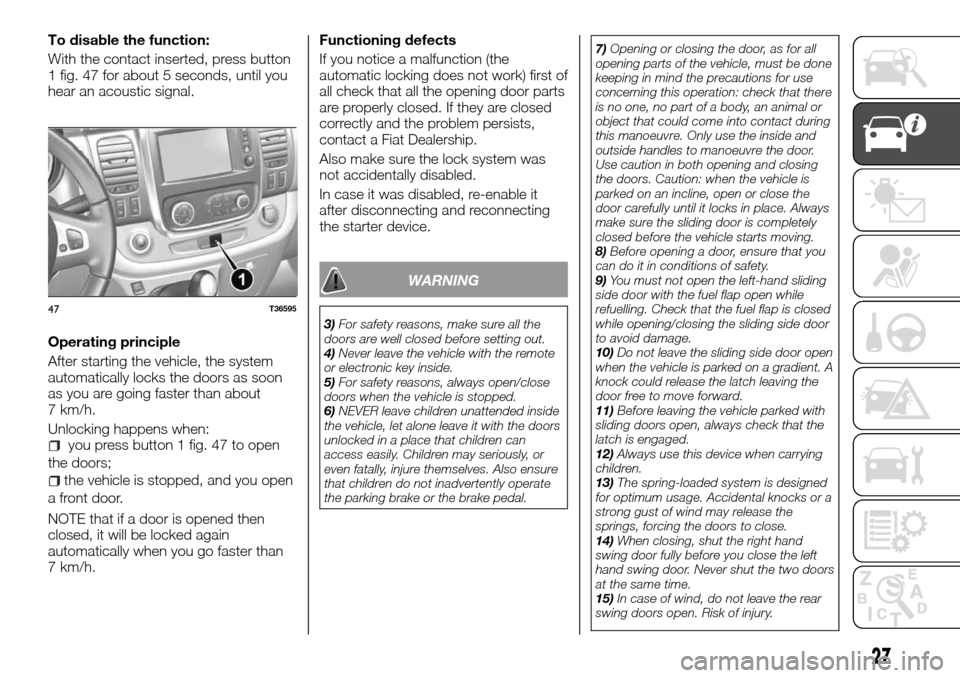
With the contact inserted, press button
1 fig. 47 for about 5 seconds, until you
hear an acoustic signal.
Operating principle
After starting the vehicle, the system
automatically locks the doors as soon
as you are going faster than about
7 km/h.
Unlocking happens when:
you press button 1 fig. 47 to open
the doors;
the vehicle is stopped, and you open
a front door.
NOTE that if a door is opened then
closed, it will be locked again
automatically when you go faster than
7 km/h.Functioning defects
If you notice a malfunction (the
automatic locking does not work) first of
all check that all the opening door parts
are properly closed. If they are closed
correctly and the problem persists,
contact a Fiat Dealership.
Also make sure the lock system was
not accidentally disabled.
In case it was disabled, re-enable it
after disconnecting and reconnecting
the starter device.
WARNING
3)For safety reasons, make sure all the
doors are well closed before setting out.
4)Never leave the vehicle with the remote
or electronic key inside.
5)For safety reasons, always open/close
doors when the vehicle is stopped.
6)NEVER leave children unattended inside
the vehicle, let alone leave it with the doors
unlocked in a place that children can
access easily. Children may seriously, or
even fatally, injure themselves. Also ensure
that children do not inadvertently operate
the parking brake or the brake pedal.7)Opening or closing the door, as for all
opening parts of the vehicle, must be done
keeping in mind the precautions for use
concerning this operation: check that there
is no one, no part of a body, an animal or
object that could come into contact during
this manoeuvre. Only use the inside and
outside handles to manoeuvre the door.
Use caution in both opening and closing
the doors. Caution: when the vehicle is
parked on an incline, open or close the
door carefully until it locks in place. Always
make sure the sliding door is completely
closed before the vehicle starts moving.
8)Before opening a door, ensure that you
can do it in conditions of safety.
9)You must not open the left-hand sliding
side door with the fuel flap open while
refuelling. Check that the fuel flap is closed
while opening/closing the sliding side door
to avoid damage.
10)Do not leave the sliding side door open
when the vehicle is parked on a gradient. A
knock could release the latch leaving the
door free to move forward.
11)Before leaving the vehicle parked with
sliding doors open, always check that the
latch is engaged.
12)Always use this device when carrying
children.
13)The spring-loaded system is designed
for optimum usage. Accidental knocks or a
strong gust of wind may release the
springs, forcing the doors to close.
14)When closing, shut the right hand
swing door fully before you close the left
hand swing door. Never shut the two doors
at the same time.
15)In case of wind, do not leave the rear
swing doors open. Risk of injury.47T36595
27
Page 31 of 232
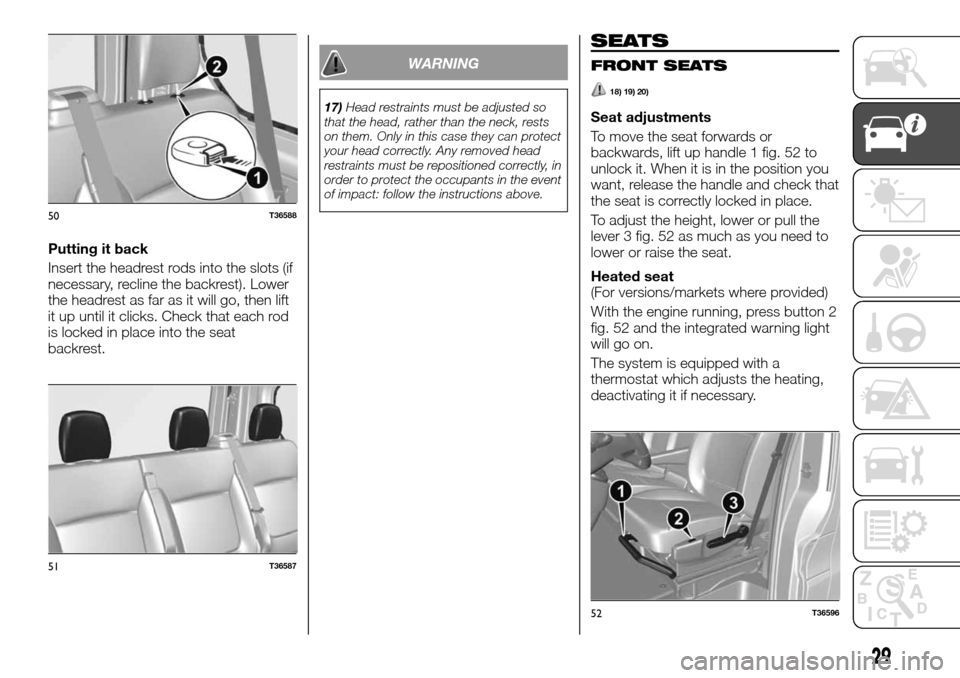
Putting it back
Insert the headrest rods into the slots (if
necessary, recline the backrest). Lower
the headrest as far as it will go, then lift
it up until it clicks. Check that each rod
is locked in place into the seat
backrest.
WARNING
17)Head restraints must be adjusted so
that the head, rather than the neck, rests
on them. Only in this case they can protect
your head correctly. Any removed head
restraints must be repositioned correctly, in
order to protect the occupants in the event
of impact: follow the instructions above.
SEATS
FRONT SEATS
18) 19) 20)
Seat adjustments
To move the seat forwards or
backwards, lift up handle 1 fig. 52 to
unlock it. When it is in the position you
want, release the handle and check that
the seat is correctly locked in place.
To adjust the height, lower or pull the
lever 3 fig. 52 as much as you need to
lower or raise the seat.
Heated seat
(For versions/markets where provided)
With the engine running, press button 2
fig. 52 and the integrated warning light
will go on.
The system is equipped with a
thermostat which adjusts the heating,
deactivating it if necessary.
50T36588
51T36587
52T36596
29
Page 47 of 232
ADBLUE ADDITIVE
RESERVOIR
Make sure that you comply with the
laws of the country you're in.
You need to remember that if the owner
of the vehicle does not comply with the
laws in effect, there could be legal
consequences.
Operating principle
Using additives reduces exhaust
emissions, transforming polluting gases
into water vapour and nitrogen.
Filling
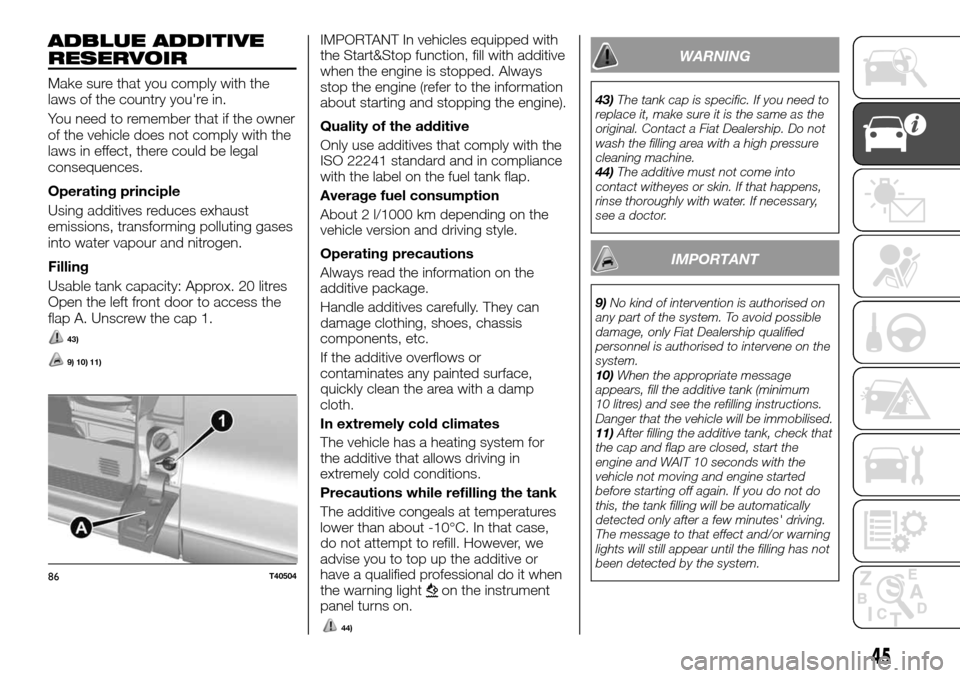
Usable tank capacity: Approx. 20 litres
Open the left front door to access the
flap A. Unscrew the cap 1.
43)
9) 10) 11)
IMPORTANT In vehicles equipped with
the Start&Stop function, fill with additive
when the engine is stopped. Always
stop the engine (refer to the information
about starting and stopping the engine).
Quality of the additive
Only use additives that comply with the
ISO 22241 standard and in compliance
with the label on the fuel tank flap.
Average fuel consumption
About 2 l/1000 km depending on the
vehicle version and driving style.
Operating precautions
Always read the information on the
additive package.
Handle additives carefully. They can
damage clothing, shoes, chassis
components, etc.
If the additive overflows or
contaminates any painted surface,
quickly clean the area with a damp
cloth.
In extremely cold climates
The vehicle has a heating system for
the additive that allows driving in
extremely cold conditions.
Precautions while refilling the tank
The additive congeals at temperatures
lower than about -10°C. In that case,
do not attempt to refill. However, we
advise you to top up the additive or
have a qualified professional do it when
the warning light
on the instrument
panel turns on.
44)
WARNING
43)The tank cap is specific. If you need to
replace it, make sure it is the same as the
original. Contact a Fiat Dealership. Do not
wash the filling area with a high pressure
cleaning machine.
44)The additive must not come into
contact witheyes or skin. If that happens,
rinse thoroughly with water. If necessary,
see a doctor.
IMPORTANT
9)No kind of intervention is authorised on
any part of the system. To avoid possible
damage, only Fiat Dealership qualified
personnel is authorised to intervene on the
system.
10)When the appropriate message
appears, fill the additive tank (minimum
10 litres) and see the refilling instructions.
Danger that the vehicle will be immobilised.
11)After filling the additive tank, check that
the cap and flap are closed, start the
engine and WAIT 10 seconds with the
vehicle not moving and engine started
before starting off again. If you do not do
this, the tank filling will be automatically
detected only after a few minutes' driving.
The message to that effect and/or warning
lights will still appear until the filling has not
been detected by the system.
86T40504
45
Page 63 of 232
NOTE If the window encounters any
resistance during closing (for example a
tree branch, etc.) it stops and lowers a
few centimetres again.
Irregular operation
If the window closing fails to function,
the system moves to no pressure
mode: pull the concerned switch up as
much as needed until the window
closes completely (the window goes
back up gradually); then keep the
switch pulled up (always on the closing
side) for a second, then lower it and
raise it back up completely to reinstate
the system.
If necessary, contact a Fiat Dealership.
Rear sliding windows:
56)
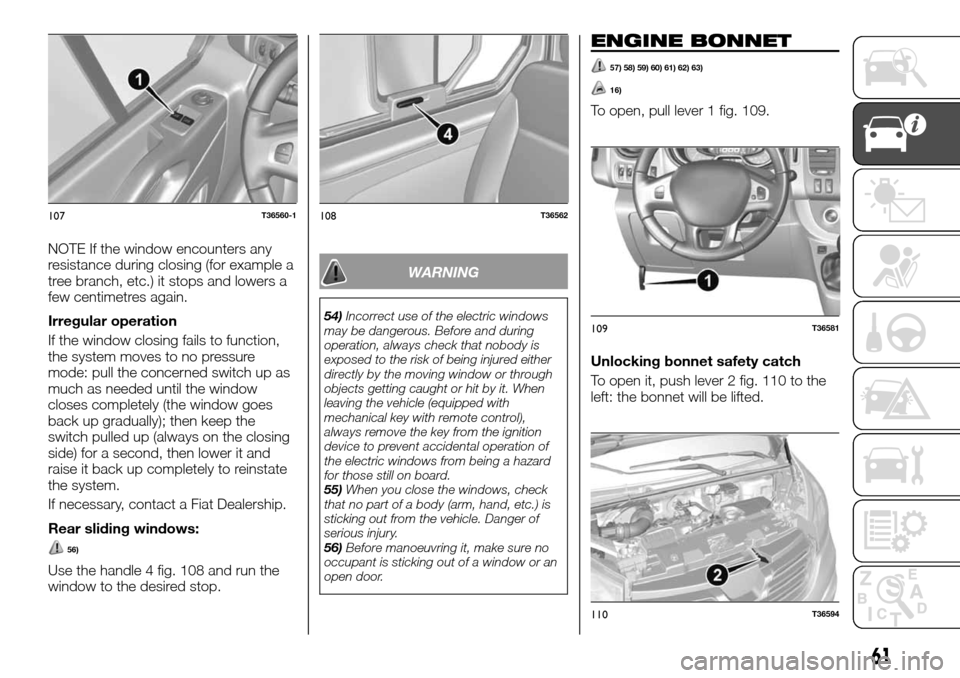
Use the handle 4 fig. 108 and run the
window to the desired stop.
WARNING
54)Incorrect use of the electric windows
may be dangerous. Before and during
operation, always check that nobody is
exposed to the risk of being injured either
directly by the moving window or through
objects getting caught or hit by it. When
leaving the vehicle (equipped with
mechanical key with remote control),
always remove the key from the ignition
device to prevent accidental operation of
the electric windows from being a hazard
for those still on board.
55)When you close the windows, check
that no part of a body (arm, hand, etc.) is
sticking out from the vehicle. Danger of
serious injury.
56)Before manoeuvring it, make sure no
occupant is sticking out of a window or an
open door.
ENGINE BONNET
57) 58) 59) 60) 61) 62) 63)
16)
To open, pull lever 1 fig. 109.
Unlocking bonnet safety catch
To open it, push lever 2 fig. 110 to the
left: the bonnet will be lifted.
107T36560-1108T36562
109T36581
110T36594
61
Page 65 of 232
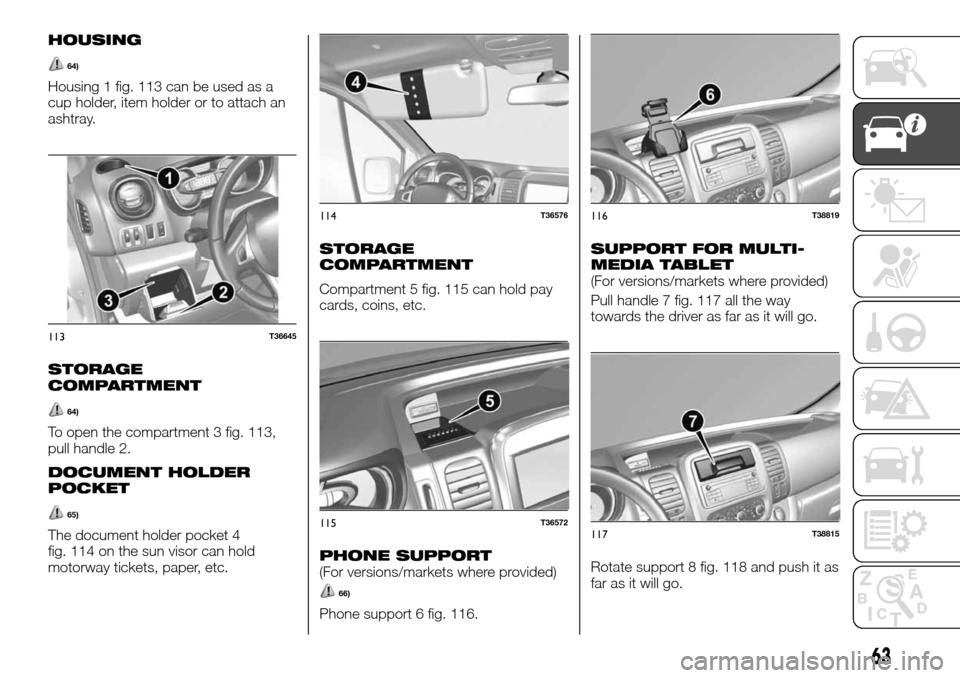
HOUSING
64)
Housing 1 fig. 113 can be used as a
cup holder, item holder or to attach an
ashtray.
STORAGE
COMPARTMENT
64)
To open the compartment 3 fig. 113,
pull handle 2.
DOCUMENT HOLDER
POCKET
65)
The document holder pocket 4
fig. 114 on the sun visor can hold
motorway tickets, paper, etc.
STORAGE
COMPARTMENT
Compartment 5 fig. 115 can hold pay
cards, coins, etc.
PHONE SUPPORT(For versions/markets where provided)
66)
Phone support 6 fig. 116.
SUPPORT FOR MULTI-
MEDIA TABLET
(For versions/markets where provided)
Pull handle 7 fig. 117 all the way
towards the driver as far as it will go.
Rotate support 8 fig. 118 and push it as
far as it will go.
113T36645
114T36576
115T36572
116T38819
117T38815
63
Page 66 of 232
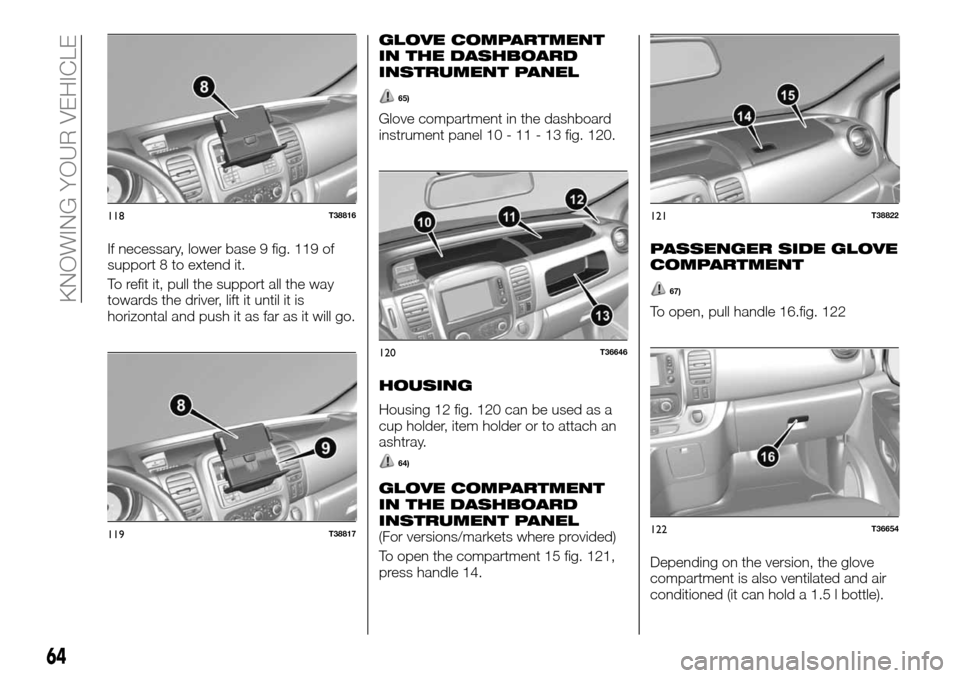
If necessary, lower base 9 fig. 119 of
support 8 to extend it.
To refit it, pull the support all the way
towards the driver, lift it until it is
horizontal and push it as far as it will go.
GLOVE COMPARTMENT
IN THE DASHBOARD
INSTRUMENT PANEL
65)
Glove compartment in the dashboard
instrument panel 10 - 11 - 13 fig. 120.
HOUSING
Housing 12 fig. 120 can be used as a
cup holder, item holder or to attach an
ashtray.
64)
GLOVE COMPARTMENT
IN THE DASHBOARD
INSTRUMENT PANEL
(For versions/markets where provided)
To open the compartment 15 fig. 121,
press handle 14.
PASSENGER SIDE GLOVE
COMPARTMENT
67)
To open, pull handle 16.fig. 122
Depending on the version, the glove
compartment is also ventilated and air
conditioned (it can hold a 1.5 l bottle).
118T38816
119T38817
120T36646
121T38822
122T36654
64
KNOWING YOUR VEHICLE
Page 67 of 232
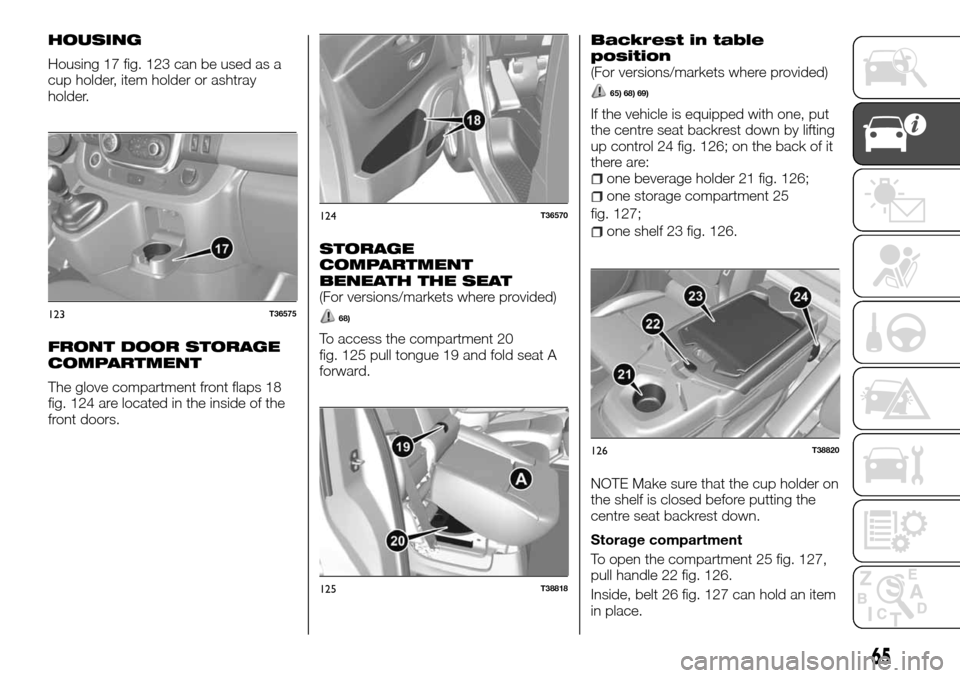
HOUSING
Housing 17 fig. 123 can be used as a
cup holder, item holder or ashtray
holder.
FRONT DOOR STORAGE
COMPARTMENT
The glove compartment front flaps 18
fig. 124 are located in the inside of the
front doors.
STORAGE
COMPARTMENT
BENEATH THE SEAT
(For versions/markets where provided)
68)
To access the compartment 20
fig. 125 pull tongue 19 and fold seat A
forward.
Backrest in table
position
(For versions/markets where provided)
65) 68) 69)
If the vehicle is equipped with one, put
the centre seat backrest down by lifting
up control 24 fig. 126; on the back of it
there are:
one beverage holder 21 fig. 126;
one storage compartment 25
fig. 127;
one shelf 23 fig. 126.
NOTE Make sure that the cup holder on
the shelf is closed before putting the
centre seat backrest down.
Storage compartment
To open the compartment 25 fig. 127,
pull handle 22 fig. 126.
Inside, belt 26 fig. 127 can hold an item
in place.
123T36575
124T36570
125T38818
126T38820
65
Page 68 of 232
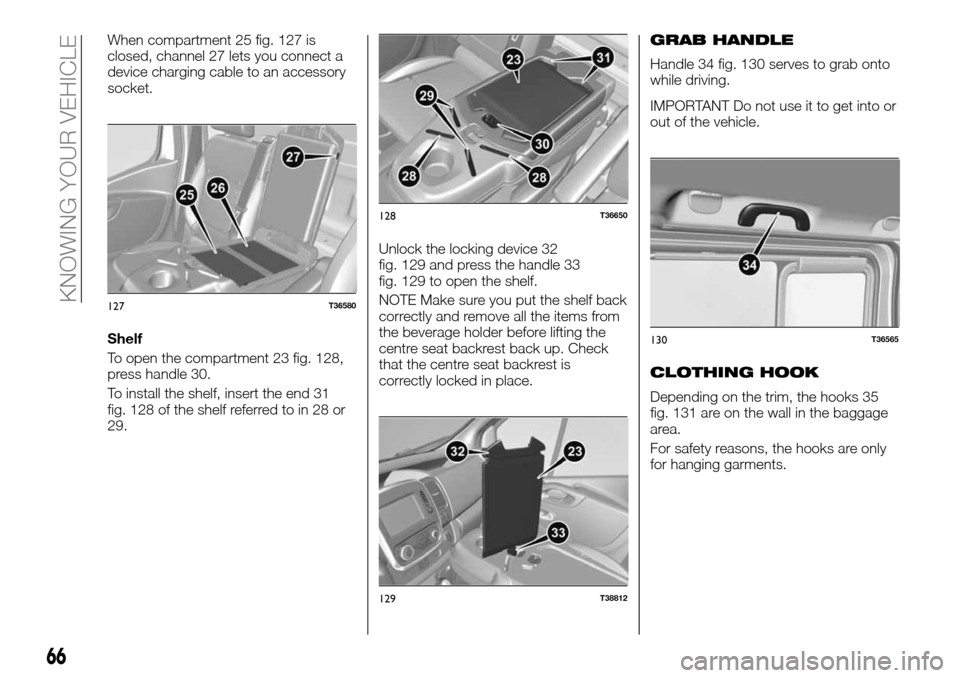
When compartment 25 fig. 127 is
closed, channel 27 lets you connect a
device charging cable to an accessory
socket.
Shelf
To open the compartment 23 fig. 128,
press handle 30.
To install the shelf, insert the end 31
fig. 128 of the shelf referred to in 28 or
29.Unlock the locking device 32
fig. 129 and press the handle 33
fig. 129 to open the shelf.
NOTE Make sure you put the shelf back
correctly and remove all the items from
the beverage holder before lifting the
centre seat backrest back up. Check
that the centre seat backrest is
correctly locked in place.GRAB HANDLE
Handle 34 fig. 130 serves to grab onto
while driving.
IMPORTANT Do not use it to get into or
out of the vehicle.
CLOTHING HOOK
Depending on the trim, the hooks 35
fig. 131 are on the wall in the baggage
area.
For safety reasons, the hooks are only
for hanging garments.
127T36580
128T36650
129T38812
130T36565
66
KNOWING YOUR VEHICLE
Page 150 of 232
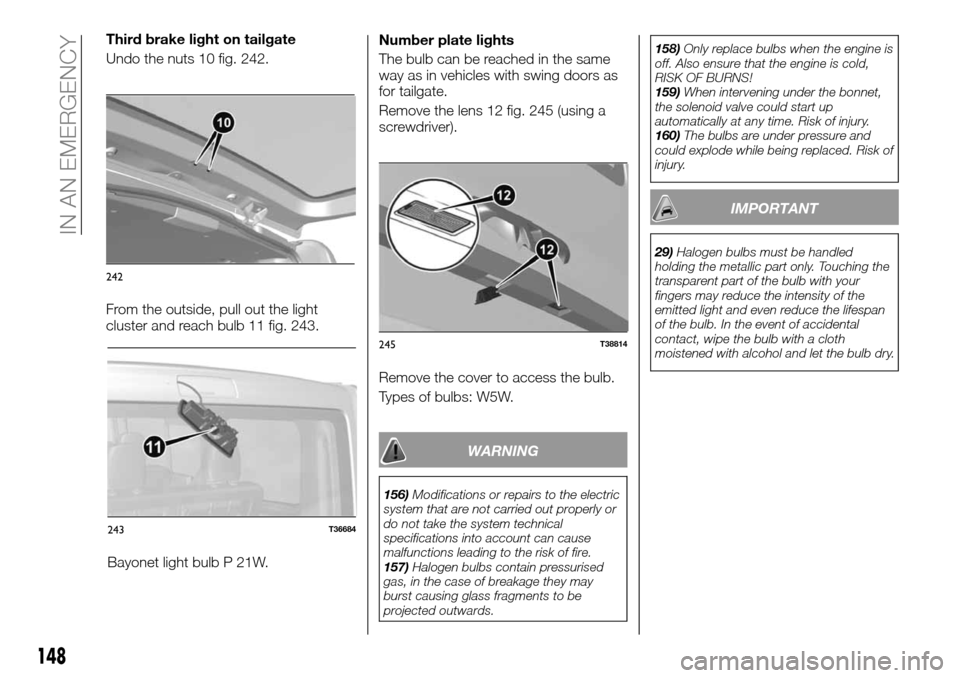
Bayonet light bulb P 21W.Number plate lights
The bulb can be reached in the same
way as in vehicles with swing doors as
for tailgate.
Remove the lens 12 fig. 245 (using a
screwdriver).
Remove the cover to access the bulb.
Types of bulbs: W5W.
WARNING
156)Modifications or repairs to the electric
system that are not carried out properly or
do not take the system technical
specifications into account can cause
malfunctions leading to the risk of fire.
157)Halogen bulbs contain pressurised
gas, in the case of breakage they may
burst causing glass fragments to be
projected outwards.158)Only replace bulbs when the engine is
off. Also ensure that the engine is cold,
RISK OF BURNS!
159)When intervening under the bonnet,
the solenoid valve could start up
automatically at any time. Risk of injury.
160)The bulbs are under pressure and
could explode while being replaced. Risk of
injury.
IMPORTANT
29)Halogen bulbs must be handled
holding the metallic part only. Touching the
transparent part of the bulb with your
fingers may reduce the intensity of the
emitted light and even reduce the lifespan
of the bulb. In the event of accidental
contact, wipe the bulb with a cloth
moistened with alcohol and let the bulb dry.
243T36684
245T38814
148
IN AN EMERGENCY
Third brake light on tailgate
Undo the nuts 10 fig. 242.
From the outside, pull out the light
cluster and reach bulb 11 fig. 243.
242
Page 155 of 232
IN THE EVENT OF A
PUNCTURE
Depending on the vehicle, there may be
a tyre inflating kit or a spare tyre (see
the following page).
CHANGING A WHEEL
166) 167) 168) 169) 170) 171)
Tools
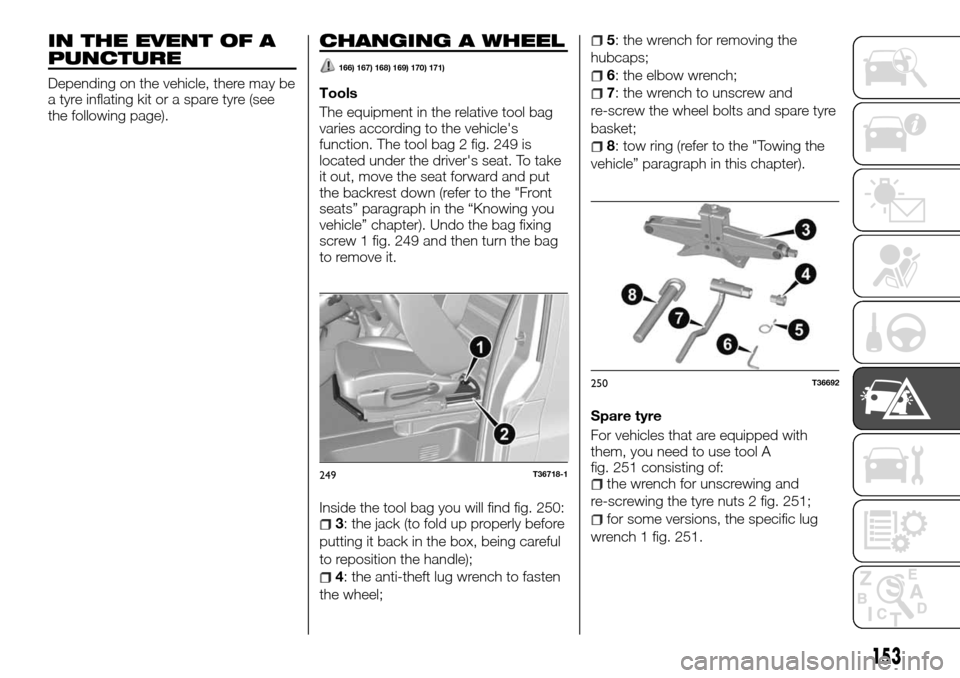
The equipment in the relative tool bag
varies according to the vehicle's
function. The tool bag 2 fig. 249 is
located under the driver's seat. To take
it out, move the seat forward and put
the backrest down (refer to the "Front
seats” paragraph in the “Knowing you
vehicle” chapter). Undo the bag fixing
screw 1 fig. 249 and then turn the bag
to remove it.
Inside the tool bag you will find fig. 250:
3: the jack (to fold up properly before
putting it back in the box, being careful
to reposition the handle);
4: the anti-theft lug wrench to fasten
the wheel;
5: the wrench for removing the
hubcaps;
6: the elbow wrench;
7: the wrench to unscrew and
re-screw the wheel bolts and spare tyre
basket;
8: tow ring (refer to the "Towing the
vehicle” paragraph in this chapter).
Spare tyre
For vehicles that are equipped with
them, you need to use tool A
fig. 251 consisting of:
the wrench for unscrewing and
re-screwing the tyre nuts 2 fig. 251;
for some versions, the specific lug
wrench 1 fig. 251.
249T36718-1
250T36692
153