lever FIAT TALENTO 2016 2.G User Guide
[x] Cancel search | Manufacturer: FIAT, Model Year: 2016, Model line: TALENTO, Model: FIAT TALENTO 2016 2.GPages: 232, PDF Size: 5.01 MB
Page 41 of 232
Adjusting the headlights externally
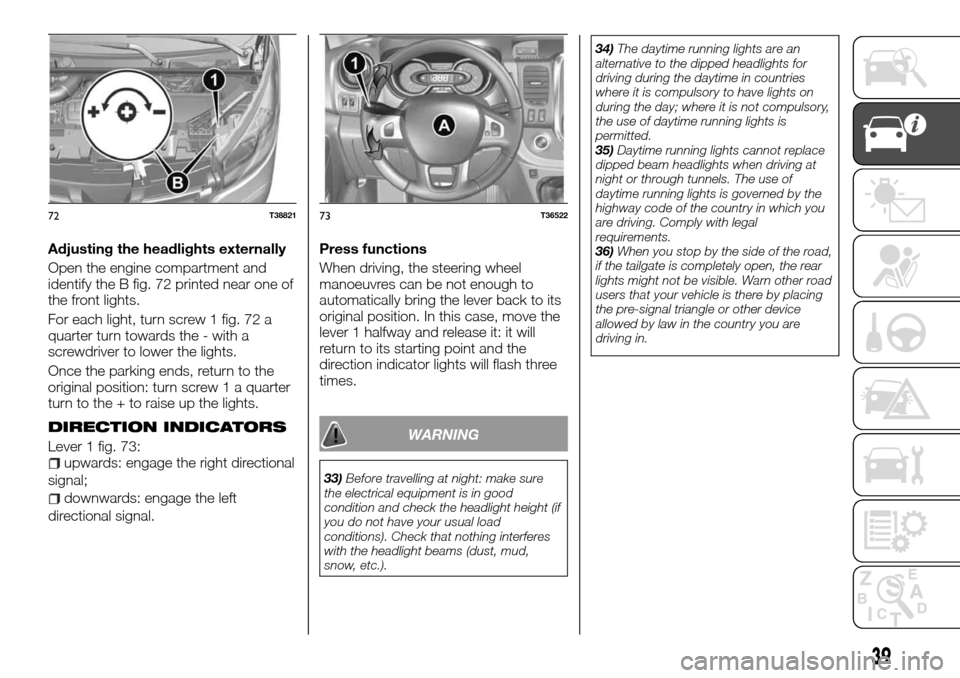
Open the engine compartment and
identify the B fig. 72 printed near one of
the front lights.
For each light, turn screw 1 fig. 72 a
quarter turn towards the - with a
screwdriver to lower the lights.
Once the parking ends, return to the
original position: turn screw 1 a quarter
turn to the + to raise up the lights.
DIRECTION INDICATORS
Lever 1 fig. 73:upwards: engage the right directional
signal;
downwards: engage the left
directional signal.Press functions
When driving, the steering wheel
manoeuvres can be not enough to
automatically bring the lever back to its
original position. In this case, move the
lever 1 halfway and release it: it will
return to its starting point and the
direction indicator lights will flash three
times.
WARNING
33)Before travelling at night: make sure
the electrical equipment is in good
condition and check the headlight height (if
you do not have your usual load
conditions). Check that nothing interferes
with the headlight beams (dust, mud,
snow, etc.).34)The daytime running lights are an
alternative to the dipped headlights for
driving during the daytime in countries
where it is compulsory to have lights on
during the day; where it is not compulsory,
the use of daytime running lights is
permitted.
35)Daytime running lights cannot replace
dipped beam headlights when driving at
night or through tunnels. The use of
daytime running lights is governed by the
highway code of the country in which you
are driving. Comply with legal
requirements.
36)When you stop by the side of the road,
if the tailgate is completely open, the rear
lights might not be visible. Warn other road
users that your vehicle is there by placing
the pre-signal triangle or other device
allowed by law in the country you are
driving in.
72T3882173T36522
39
Page 43 of 232
REAR LIGHT
By moving switch 7 fig. 79, you get:permanent lighting;
lighting controlled by opening one of
the rear doors. It will go off only when
the doors concerned are properly
closed;
it will go off immediately.
WINDSCREEN /
REAR WINDOW
WIPERS
WINDSCREEN WIPER /
WASHER
37) 38) 39)
5) 6) 7)
With the starter device inserted, mover
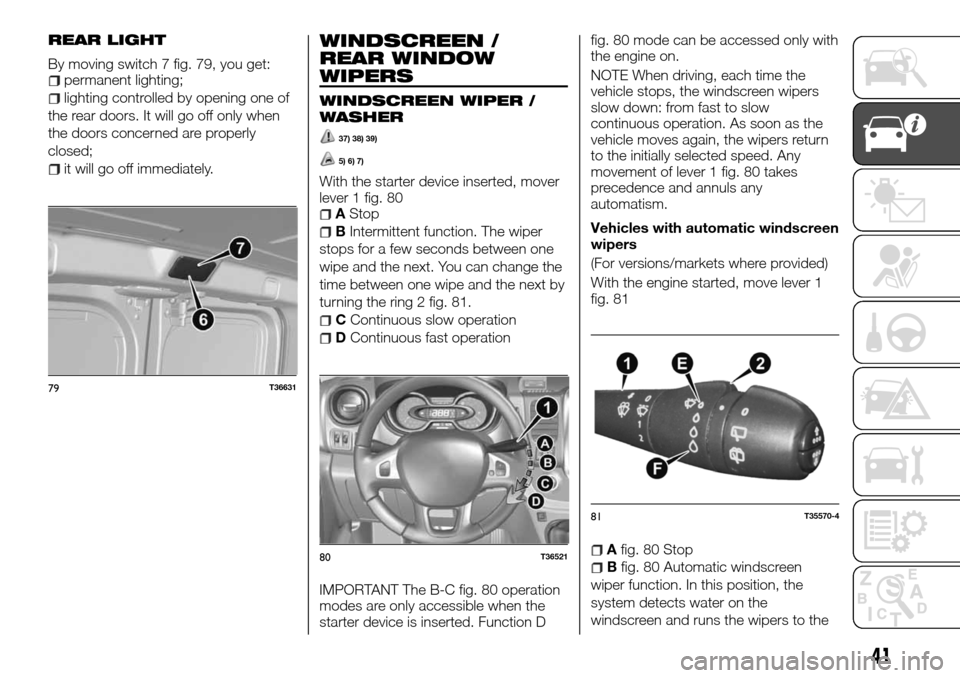
lever 1 fig. 80
AStop
BIntermittent function. The wiper
stops for a few seconds between one
wipe and the next. You can change the
time between one wipe and the next by
turning the ring 2 fig. 81.
CContinuous slow operation
DContinuous fast operation
IMPORTANT The B-C fig. 80 operation
modes are only accessible when the
starter device is inserted. Function Dfig. 80 mode can be accessed only with
the engine on.
NOTE When driving, each time the
vehicle stops, the windscreen wipers
slow down: from fast to slow
continuous operation. As soon as the
vehicle moves again, the wipers return
to the initially selected speed. Any
movement of lever 1 fig. 80 takes
precedence and annuls any
automatism.
Vehicles with automatic windscreen
wipers
(For versions/markets where provided)
With the engine started, move lever 1
fig. 81
Afig. 80 Stop
Bfig. 80 Automatic windscreen
wiper function. In this position, the
system detects water on the
windscreen and runs the wipers to the
79T36631
80T36521
81T35570-4
41
Page 44 of 232
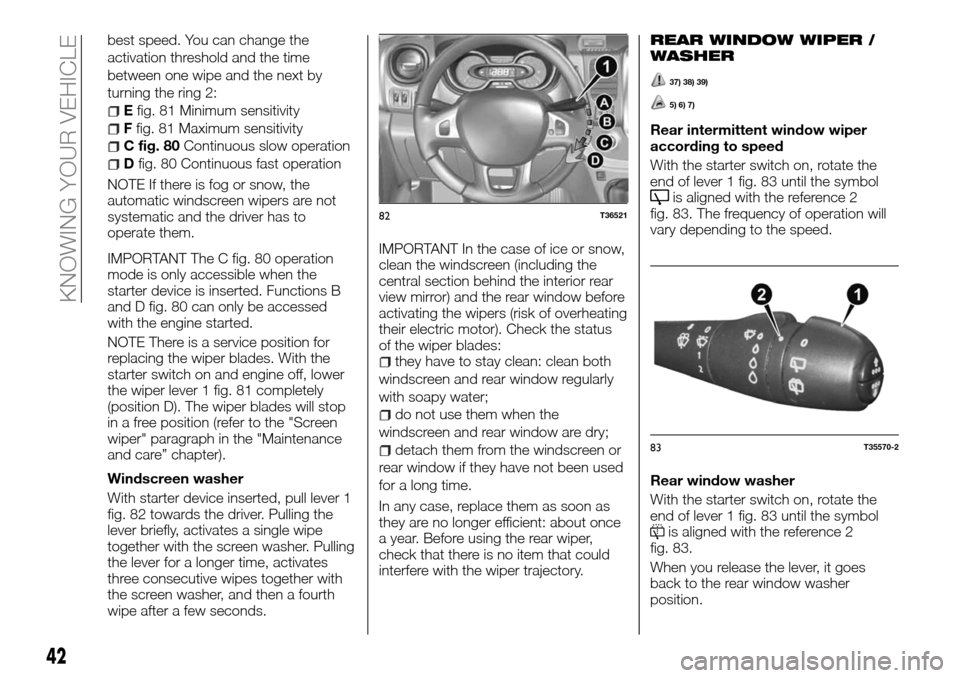
best speed. You can change the
activation threshold and the time
between one wipe and the next by
turning the ring 2:
Efig. 81 Minimum sensitivity
Ffig. 81 Maximum sensitivity
C fig. 80Continuous slow operation
Dfig. 80 Continuous fast operation
NOTE If there is fog or snow, the
automatic windscreen wipers are not
systematic and the driver has to
operate them.
IMPORTANT The C fig. 80 operation
mode is only accessible when the
starter device is inserted. Functions B
and D fig. 80 can only be accessed
with the engine started.
NOTE There is a service position for
replacing the wiper blades. With the
starter switch on and engine off, lower
the wiper lever 1 fig. 81 completely
(position D). The wiper blades will stop
in a free position (refer to the "Screen
wiper" paragraph in the "Maintenance
and care” chapter).
Windscreen washer
With starter device inserted, pull lever 1
fig. 82 towards the driver. Pulling the
lever briefly, activates a single wipe
together with the screen washer. Pulling
the lever for a longer time, activates
three consecutive wipes together with
the screen washer, and then a fourth
wipe after a few seconds.IMPORTANT In the case of ice or snow,
clean the windscreen (including the
central section behind the interior rear
view mirror) and the rear window before
activating the wipers (risk of overheating
their electric motor). Check the status
of the wiper blades:
they have to stay clean: clean both
windscreen and rear window regularly
with soapy water;
do not use them when the
windscreen and rear window are dry;
detach them from the windscreen or
rear window if they have not been used
for a long time.
In any case, replace them as soon as
they are no longer efficient: about once
a year. Before using the rear wiper,
check that there is no item that could
interfere with the wiper trajectory.
REAR WINDOW WIPER /
WASHER
37) 38) 39)
5) 6) 7)
Rear intermittent window wiper
according to speed
With the starter switch on, rotate the
end of lever 1 fig. 83 until the symbol
is aligned with the reference 2
fig. 83. The frequency of operation will
vary depending to the speed.
Rear window washer
With the starter switch on, rotate the
end of lever 1 fig. 83 until the symbol
is aligned with the reference 2
fig. 83.
When you release the lever, it goes
back to the rear window washer
position.
82T36521
83T35570-2
42
KNOWING YOUR VEHICLE
Page 63 of 232
NOTE If the window encounters any
resistance during closing (for example a
tree branch, etc.) it stops and lowers a
few centimetres again.
Irregular operation
If the window closing fails to function,
the system moves to no pressure
mode: pull the concerned switch up as
much as needed until the window
closes completely (the window goes
back up gradually); then keep the
switch pulled up (always on the closing
side) for a second, then lower it and
raise it back up completely to reinstate
the system.
If necessary, contact a Fiat Dealership.
Rear sliding windows:
56)
Use the handle 4 fig. 108 and run the
window to the desired stop.
WARNING
54)Incorrect use of the electric windows
may be dangerous. Before and during
operation, always check that nobody is
exposed to the risk of being injured either
directly by the moving window or through
objects getting caught or hit by it. When
leaving the vehicle (equipped with
mechanical key with remote control),
always remove the key from the ignition
device to prevent accidental operation of
the electric windows from being a hazard
for those still on board.
55)When you close the windows, check
that no part of a body (arm, hand, etc.) is
sticking out from the vehicle. Danger of
serious injury.
56)Before manoeuvring it, make sure no
occupant is sticking out of a window or an
open door.
ENGINE BONNET
57) 58) 59) 60) 61) 62) 63)
16)
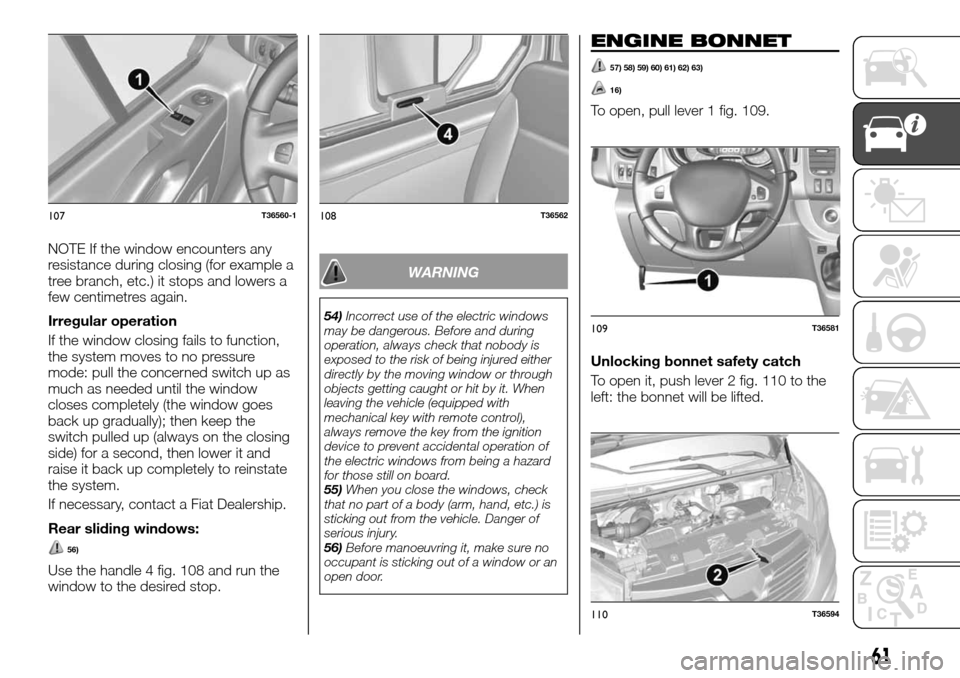
To open, pull lever 1 fig. 109.
Unlocking bonnet safety catch
To open it, push lever 2 fig. 110 to the
left: the bonnet will be lifted.
107T36560-1108T36562
109T36581
110T36594
61
Page 74 of 232
Impossibility to maintain speed
In the event of a steep slope, the speed
cannot be respected by the system: the
stored speed will flash on the
instrument panel to inform you of this.
Placing the function in stand-by
The function can be suspended:
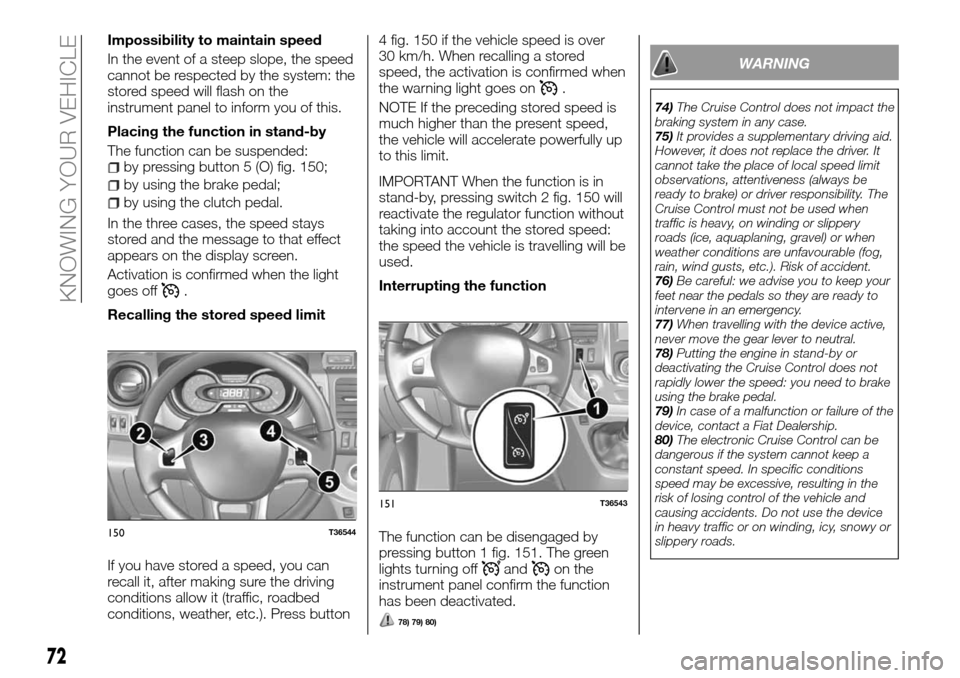
by pressing button 5 (O) fig. 150;
by using the brake pedal;
by using the clutch pedal.
In the three cases, the speed stays
stored and the message to that effect
appears on the display screen.
Activation is confirmed when the light
goes off
.
Recalling the stored speed limit
If you have stored a speed, you can
recall it, after making sure the driving
conditions allow it (traffic, roadbed
conditions, weather, etc.). Press button4 fig. 150 if the vehicle speed is over
30 km/h. When recalling a stored
speed, the activation is confirmed when
the warning light goes on
.
NOTE If the preceding stored speed is
much higher than the present speed,
the vehicle will accelerate powerfully up
to this limit.
IMPORTANT When the function is in
stand-by, pressing switch 2 fig. 150 will
reactivate the regulator function without
taking into account the stored speed:
the speed the vehicle is travelling will be
used.
Interrupting the function
The function can be disengaged by
pressing button 1 fig. 151. The green
lights turning off
andon the
instrument panel confirm the function
has been deactivated.
78) 79) 80)
WARNING
74)The Cruise Control does not impact the
braking system in any case.
75)It provides a supplementary driving aid.
However, it does not replace the driver. It
cannot take the place of local speed limit
observations, attentiveness (always be
ready to brake) or driver responsibility. The
Cruise Control must not be used when
traffic is heavy, on winding or slippery
roads (ice, aquaplaning, gravel) or when
weather conditions are unfavourable (fog,
rain, wind gusts, etc.). Risk of accident.
76)Be careful: we advise you to keep your
feet near the pedals so they are ready to
intervene in an emergency.
77)When travelling with the device active,
never move the gear lever to neutral.
78)Putting the engine in stand-by or
deactivating the Cruise Control does not
rapidly lower the speed: you need to brake
using the brake pedal.
79)In case of a malfunction or failure of the
device, contact a Fiat Dealership.
80)The electronic Cruise Control can be
dangerous if the system cannot keep a
constant speed. In specific conditions
speed may be excessive, resulting in the
risk of losing control of the vehicle and
causing accidents. Do not use the device
in heavy traffic or on winding, icy, snowy or
slippery roads.
150T36544
151T36543
72
KNOWING YOUR VEHICLE
Page 80 of 232
DISPLAY
82)
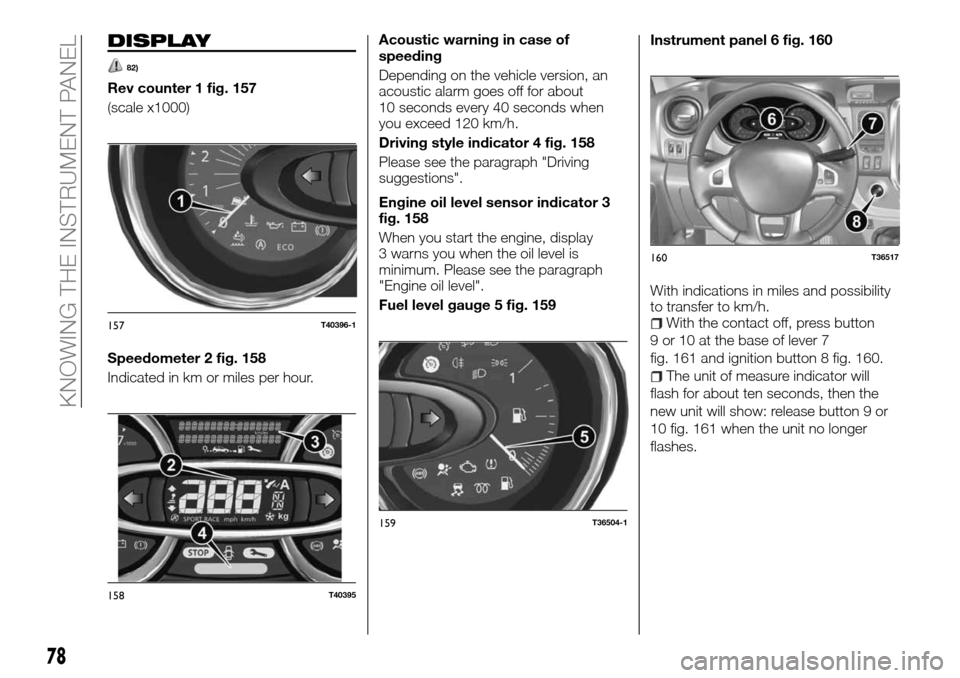
Rev counter 1 fig. 157
(scale x1000)
Speedometer 2 fig. 158
Indicated in km or miles per hour.Acoustic warning in case of
speeding
Depending on the vehicle version, an
acoustic alarm goes off for about
10 seconds every 40 seconds when
you exceed 120 km/h.
Driving style indicator 4 fig. 158
Please see the paragraph "Driving
suggestions".
Engine oil level sensor indicator 3
fig. 158
When you start the engine, display
3 warns you when the oil level is
minimum. Please see the paragraph
"Engine oil level".
Fuel level gauge 5 fig. 159Instrument panel 6 fig. 160
With indications in miles and possibility
to transfer to km/h.
With the contact off, press button
9 or 10 at the base of lever 7
fig. 161 and ignition button 8 fig. 160.
The unit of measure indicator will
flash for about ten seconds, then the
new unit will show: release button 9 or
10 fig. 161 when the unit no longer
flashes.
157T40396-1
158T40395
159T36504-1
160T36517
78
KNOWING THE INSTRUMENT PANEL
Page 96 of 232
safety, the distance between the head
and headrest must be minimum;
adjust cushion (seat) height. This
adjustment optimises visibility;
adjust the steering wheel.
ADJUSTING THE SEAT BELTS
Sit firmly on the backrest.
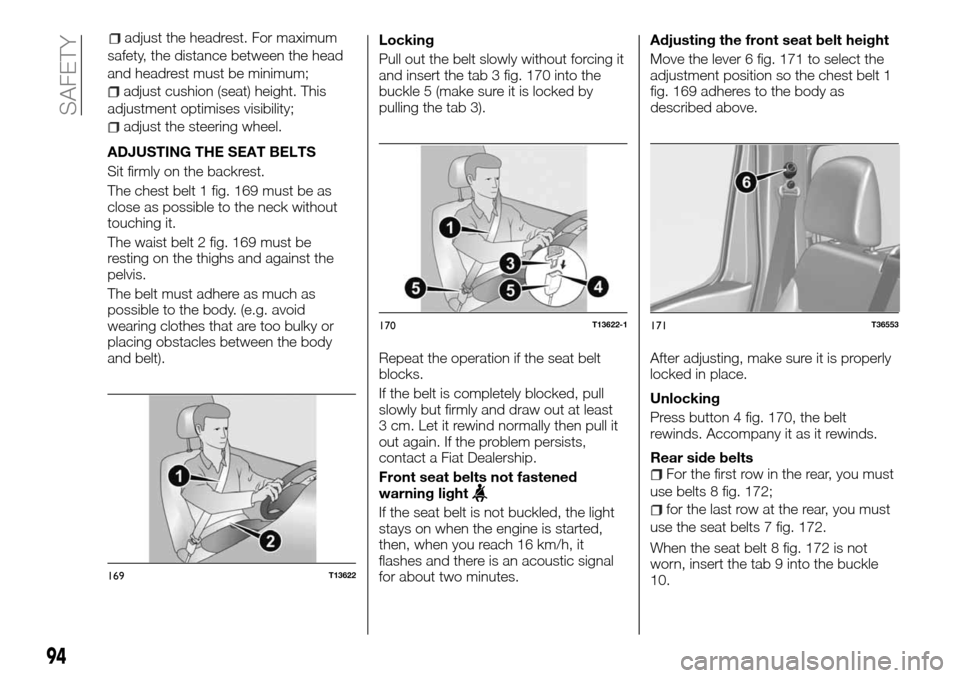
The chest belt 1 fig. 169 must be as
close as possible to the neck without
touching it.
The waist belt 2 fig. 169 must be
resting on the thighs and against the
pelvis.
The belt must adhere as much as
possible to the body. (e.g. avoid
wearing clothes that are too bulky or
placing obstacles between the body
and belt).Locking
Pull out the belt slowly without forcing it
and insert the tab 3 fig. 170 into the
buckle 5 (make sure it is locked by
pulling the tab 3).
Repeat the operation if the seat belt
blocks.
If the belt is completely blocked, pull
slowly but firmly and draw out at least
3 cm. Let it rewind normally then pull it
out again. If the problem persists,
contact a Fiat Dealership.
Front seat belts not fastened
warning light
If the seat belt is not buckled, the light
stays on when the engine is started,
then, when you reach 16 km/h, it
flashes and there is an acoustic signal
for about two minutes.Adjusting the front seat belt height
Move the lever 6 fig. 171 to select the
adjustment position so the chest belt 1
fig. 169 adheres to the body as
described above.
After adjusting, make sure it is properly
locked in place.
Unlocking
Press button 4 fig. 170, the belt
rewinds. Accompany it as it rewinds.
Rear side belts
For the first row in the rear, you must
use belts 8 fig. 172;
for the last row at the rear, you must
use the seat belts 7 fig. 172.
When the seat belt 8 fig. 172 is not
worn, insert the tab 9 into the buckle
10.
169T13622
170T13622-1171T36553
94
SAFETY
adjust the headrest. For maximum
Page 130 of 232
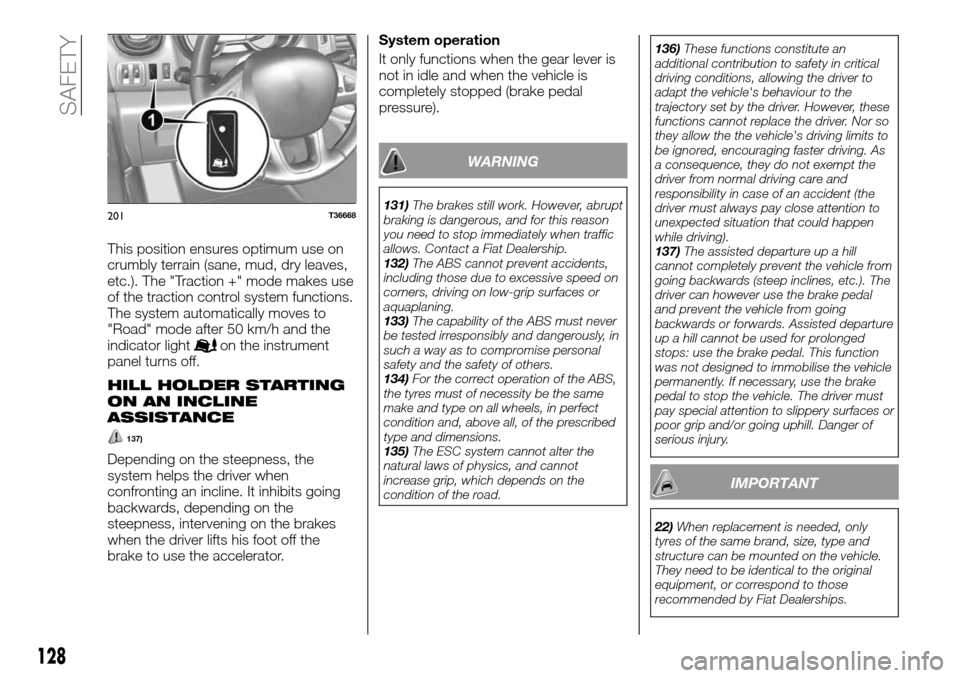
This position ensures optimum use on
crumbly terrain (sane, mud, dry leaves,
etc.). The "Traction +" mode makes use
of the traction control system functions.
The system automatically moves to
"Road" mode after 50 km/h and the
indicator light
on the instrument
panel turns off.
HILL HOLDER STARTING
ON AN INCLINE
ASSISTANCE
137)
Depending on the steepness, the
system helps the driver when
confronting an incline. It inhibits going
backwards, depending on the
steepness, intervening on the brakes
when the driver lifts his foot off the
brake to use the accelerator.System operation
It only functions when the gear lever is
not in idle and when the vehicle is
completely stopped (brake pedal
pressure).
WARNING
131)The brakes still work. However, abrupt
braking is dangerous, and for this reason
you need to stop immediately when traffic
allows. Contact a Fiat Dealership.
132)The ABS cannot prevent accidents,
including those due to excessive speed on
corners, driving on low-grip surfaces or
aquaplaning.
133)The capability of the ABS must never
be tested irresponsibly and dangerously, in
such a way as to compromise personal
safety and the safety of others.
134)For the correct operation of the ABS,
the tyres must of necessity be the same
make and type on all wheels, in perfect
condition and, above all, of the prescribed
type and dimensions.
135)The ESC system cannot alter the
natural laws of physics, and cannot
increase grip, which depends on the
condition of the road.136)These functions constitute an
additional contribution to safety in critical
driving conditions, allowing the driver to
adapt the vehicle's behaviour to the
trajectory set by the driver. However, these
functions cannot replace the driver. Nor so
they allow the the vehicle's driving limits to
be ignored, encouraging faster driving. As
a consequence, they do not exempt the
driver from normal driving care and
responsibility in case of an accident (the
driver must always pay close attention to
unexpected situation that could happen
while driving).
137)The assisted departure up a hill
cannot completely prevent the vehicle from
going backwards (steep inclines, etc.). The
driver can however use the brake pedal
and prevent the vehicle from going
backwards or forwards. Assisted departure
up a hill cannot be used for prolonged
stops: use the brake pedal. This function
was not designed to immobilise the vehicle
permanently. If necessary, use the brake
pedal to stop the vehicle. The driver must
pay special attention to slippery surfaces or
poor grip and/or going uphill. Danger of
serious injury.
IMPORTANT
22)When replacement is needed, only
tyres of the same brand, size, type and
structure can be mounted on the vehicle.
They need to be identical to the original
equipment, or correspond to those
recommended by Fiat Dealerships.
201T36668
128
SAFETY
Page 136 of 232
IMPORTANT
23)When the engine is stopped, never
leave the ignition device in the "M" position
to prevent useless current absorption from
draining the battery.
24)A quick burst on the accelerator before
turning off the engine serves absolutely no
practical purpose; it wastes fuel and is
especially damaging to turbocharged
engines.
USING THE
GEARBOX
144)
25)
To engage reverse (vehicle
stopped)
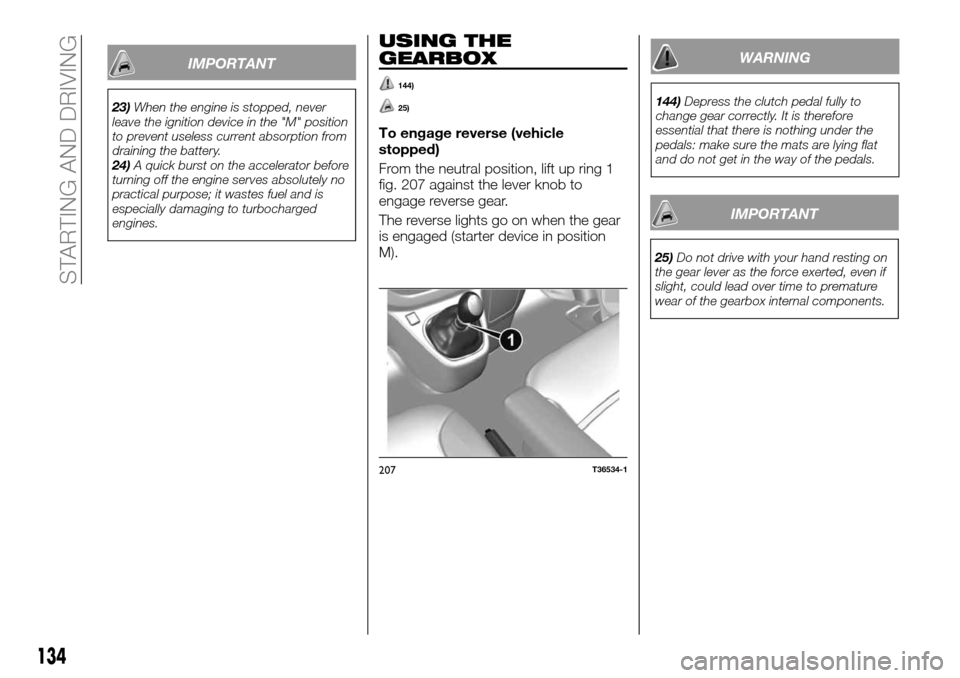
From the neutral position, lift up ring 1
fig. 207 against the lever knob to
engage reverse gear.
The reverse lights go on when the gear
is engaged (starter device in position
M).
WARNING
144)Depress the clutch pedal fully to
change gear correctly. It is therefore
essential that there is nothing under the
pedals: make sure the mats are lying flat
and do not get in the way of the pedals.
IMPORTANT
25)Do not drive with your hand resting on
the gear lever as the force exerted, even if
slight, could lead over time to premature
wear of the gearbox internal components.
207T36534-1
134
STARTING AND DRIVING
Page 137 of 232
PARKING THE
VEHICLE
145) 146)
26) 27) 28)
Proceed as follows when parking and
leaving the vehicle:
engage a gear (1st gear if facing
uphill or reverse if facing downhill) and
leave the wheels turned;
stop the engine and engage the
handbrake;
always remove the ignition key.
Block the wheels with a wedge or a
stone if the vehicle is parked on a steep
slope.
IMPORTANTNEVERleave the vehicle
with the gear in neutral.
HANDBRAKE
To engage the handbrake, pull the lever
up and check that the vehicle is
immobilised properly. The
warning
light will come on in the instrument
panel.
To release the handbrake, pull the lever
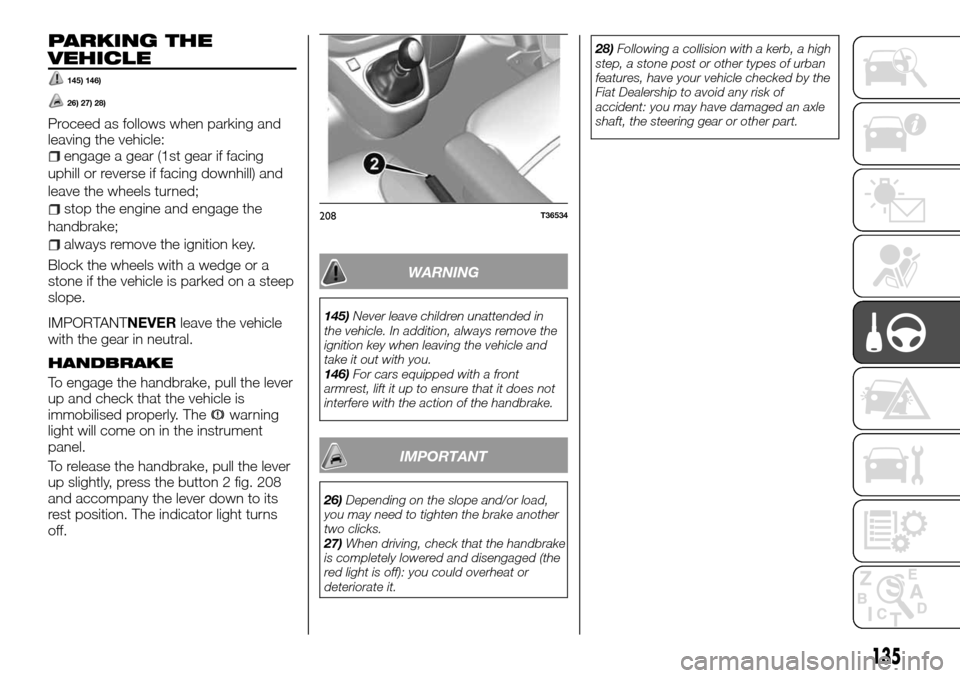
up slightly, press the button 2 fig. 208
and accompany the lever down to its
rest position. The indicator light turns
off.
WARNING
145)Never leave children unattended in
the vehicle. In addition, always remove the
ignition key when leaving the vehicle and
take it out with you.
146)For cars equipped with a front
armrest, lift it up to ensure that it does not
interfere with the action of the handbrake.
IMPORTANT
26)Depending on the slope and/or load,
you may need to tighten the brake another
two clicks.
27)When driving, check that the handbrake
is completely lowered and disengaged (the
red light is off): you could overheat or
deteriorate it.28)Following a collision with a kerb, a high
step, a stone post or other types of urban
features, have your vehicle checked by the
Fiat Dealership to avoid any risk of
accident: you may have damaged an axle
shaft, the steering gear or other part.
208T36534
135