lever FIAT TALENTO 2016 2.G Owners Manual
[x] Cancel search | Manufacturer: FIAT, Model Year: 2016, Model line: TALENTO, Model: FIAT TALENTO 2016 2.GPages: 232, PDF Size: 5.01 MB
Page 13 of 232
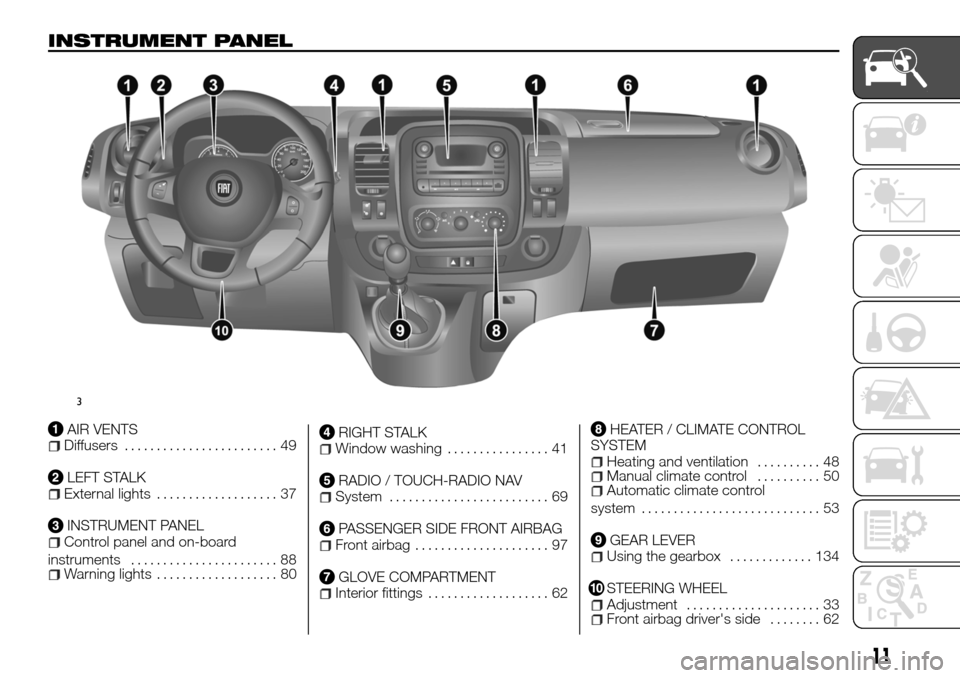
INSTRUMENT PANEL
AIR VENTSDiffusers........................ 49
LEFT STALKExternal lights................... 37
INSTRUMENT PANELControl panel and on-board
instruments....................... 88
Warning lights................... 80
RIGHT STALKWindow washing................ 41
RADIO / TOUCH-RADIO NAVSystem......................... 69
PASSENGER SIDE FRONT AIRBAGFront airbag..................... 97
GLOVE COMPARTMENTInterior fittings................... 62
HEATER / CLIMATE CONTROL
SYSTEM
Heating and ventilation.......... 48Manual climate control.......... 50Automatic climate control
system............................ 53
GEAR LEVERUsing the gearbox............. 134
STEERING WHEELAdjustment..................... 33Front airbag driver's side........ 62
3
11
Page 24 of 232
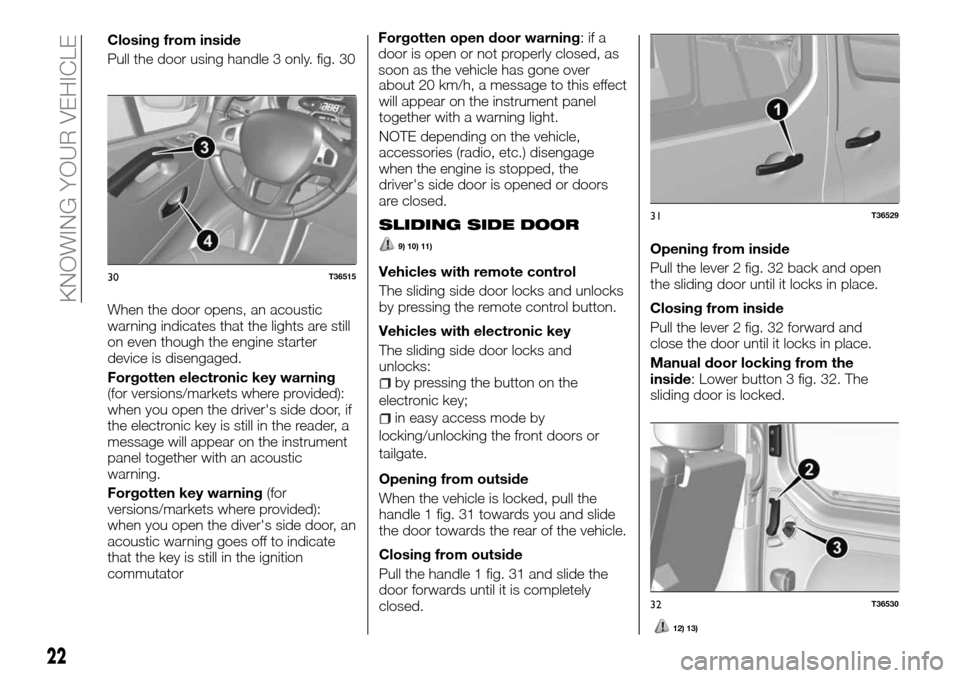
Closing from inside
Pull the door using handle 3 only. fig. 30
When the door opens, an acoustic
warning indicates that the lights are still
on even though the engine starter
device is disengaged.
Forgotten electronic key warning
(for versions/markets where provided):
when you open the driver's side door, if
the electronic key is still in the reader, a
message will appear on the instrument
panel together with an acoustic
warning.
Forgotten key warning(for
versions/markets where provided):
when you open the diver's side door, an
acoustic warning goes off to indicate
that the key is still in the ignition
commutatorForgotten open door warning:ifa
door is open or not properly closed, as
soon as the vehicle has gone over
about 20 km/h, a message to this effect
will appear on the instrument panel
together with a warning light.
NOTE depending on the vehicle,
accessories (radio, etc.) disengage
when the engine is stopped, the
driver's side door is opened or doors
are closed.
SLIDING SIDE DOOR
9) 10) 11)
Vehicles with remote control
The sliding side door locks and unlocks
by pressing the remote control button.
Vehicles with electronic key
The sliding side door locks and
unlocks:
by pressing the button on the
electronic key;
in easy access mode by
locking/unlocking the front doors or
tailgate.
Opening from outside
When the vehicle is locked, pull the
handle 1 fig. 31 towards you and slide
the door towards the rear of the vehicle.
Closing from outside
Pull the handle 1 fig. 31 and slide the
door forwards until it is completely
closed.Opening from inside
Pull the lever 2 fig. 32 back and open
the sliding door until it locks in place.
Closing from inside
Pull the lever 2 fig. 32 forward and
close the door until it locks in place.
Manual door locking from the
inside: Lower button 3 fig. 32. The
sliding door is locked.
30T36515
31T36529
32T36530
22
KNOWING YOUR VEHICLE
12) 13)
Page 25 of 232
Child safety
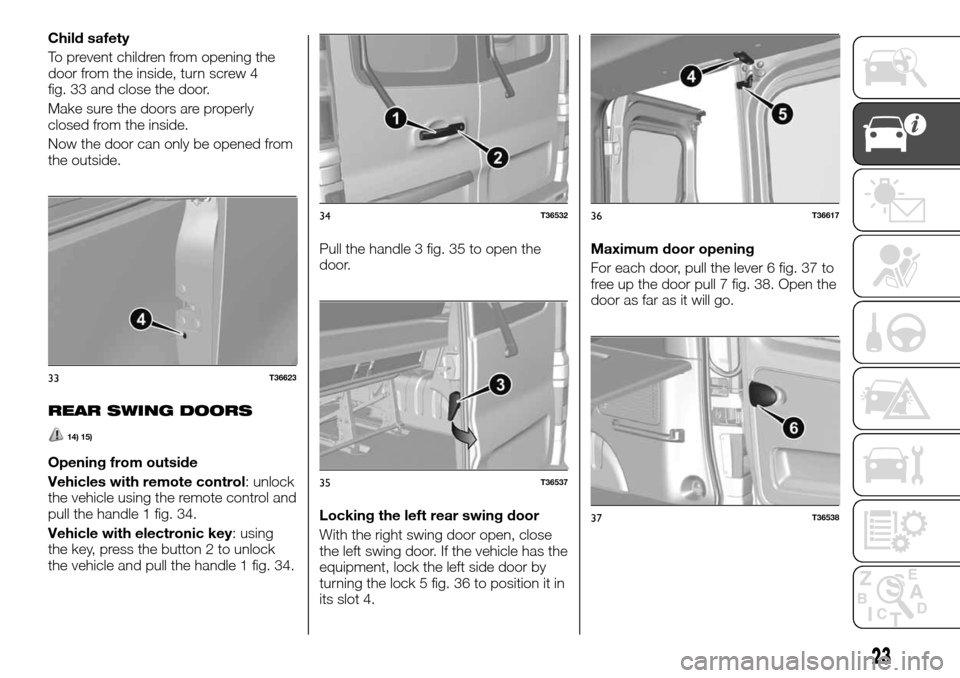
To prevent children from opening the
door from the inside, turn screw 4
fig. 33 and close the door.
Make sure the doors are properly
closed from the inside.
Now the door can only be opened from
the outside.
REAR SWING DOORS
14) 15)
Opening from outside
Vehicles with remote control: unlock
the vehicle using the remote control and
pull the handle 1 fig. 34.
Vehicle with electronic key: using
the key, press the button 2 to unlock
the vehicle and pull the handle 1 fig. 34.Pull the handle 3 fig. 35 to open the
door.
Locking the left rear swing door
With the right swing door open, close
the left swing door. If the vehicle has the
equipment, lock the left side door by
turning the lock 5 fig. 36 to position it in
its slot 4.Maximum door opening
For each door, pull the lever 6 fig. 37 to
free up the door pull 7 fig. 38. Open the
door as far as it will go.
33T36623
34T36532
35T36537
36T36617
37T36538
23
Page 31 of 232
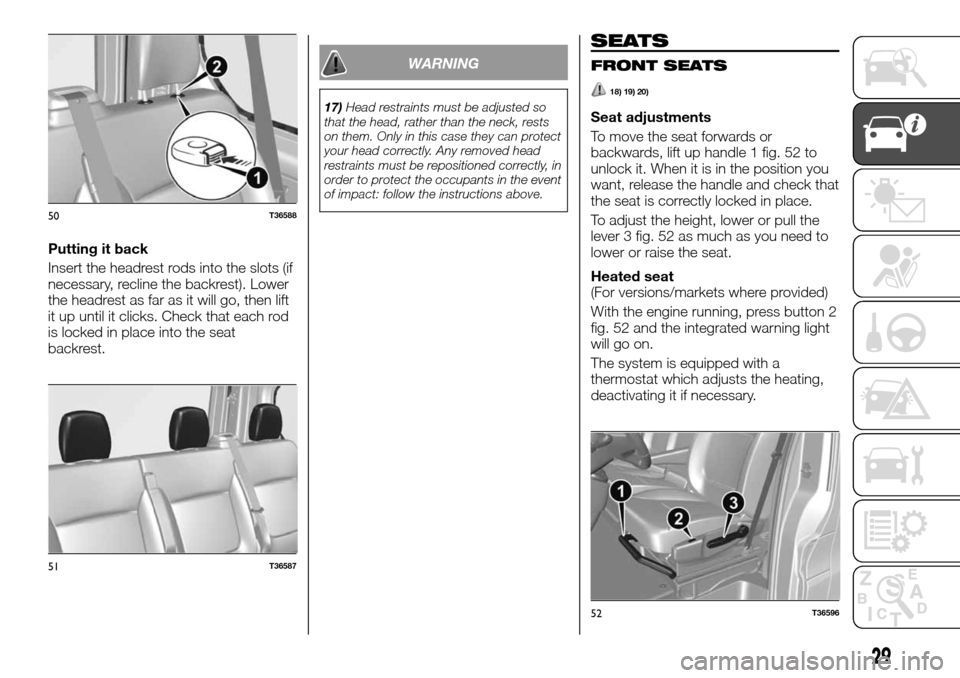
Putting it back
Insert the headrest rods into the slots (if
necessary, recline the backrest). Lower
the headrest as far as it will go, then lift
it up until it clicks. Check that each rod
is locked in place into the seat
backrest.
WARNING
17)Head restraints must be adjusted so
that the head, rather than the neck, rests
on them. Only in this case they can protect
your head correctly. Any removed head
restraints must be repositioned correctly, in
order to protect the occupants in the event
of impact: follow the instructions above.
SEATS
FRONT SEATS
18) 19) 20)
Seat adjustments
To move the seat forwards or
backwards, lift up handle 1 fig. 52 to
unlock it. When it is in the position you
want, release the handle and check that
the seat is correctly locked in place.
To adjust the height, lower or pull the
lever 3 fig. 52 as much as you need to
lower or raise the seat.
Heated seat
(For versions/markets where provided)
With the engine running, press button 2
fig. 52 and the integrated warning light
will go on.
The system is equipped with a
thermostat which adjusts the heating,
deactivating it if necessary.
50T36588
51T36587
52T36596
29
Page 32 of 232
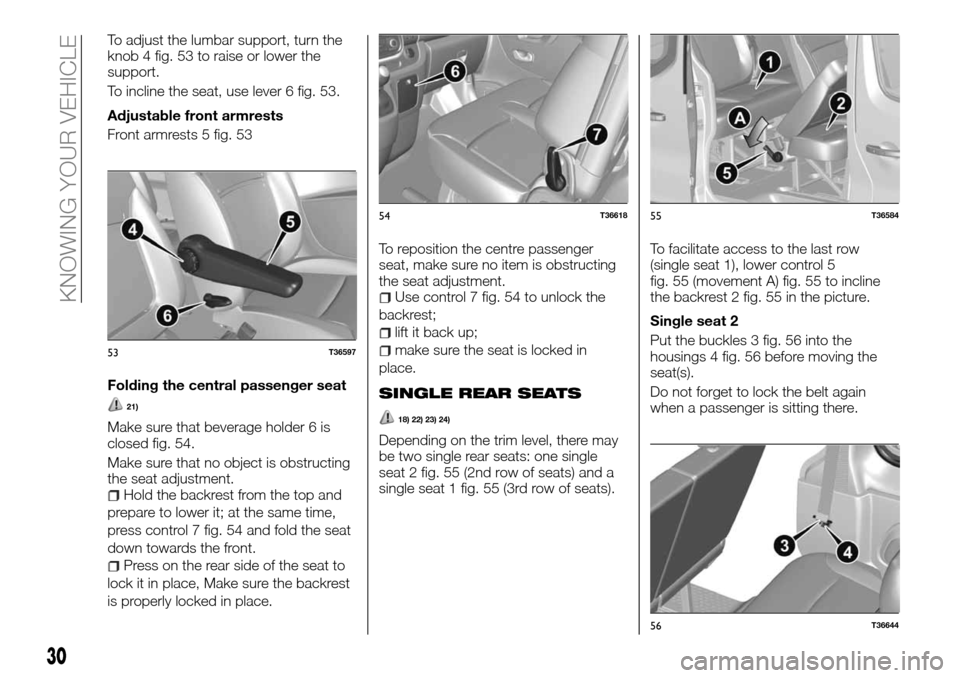
To adjust the lumbar support, turn the
knob 4 fig. 53 to raise or lower the
support.
To incline the seat, use lever 6 fig. 53.
Adjustable front armrests
Front armrests 5 fig. 53
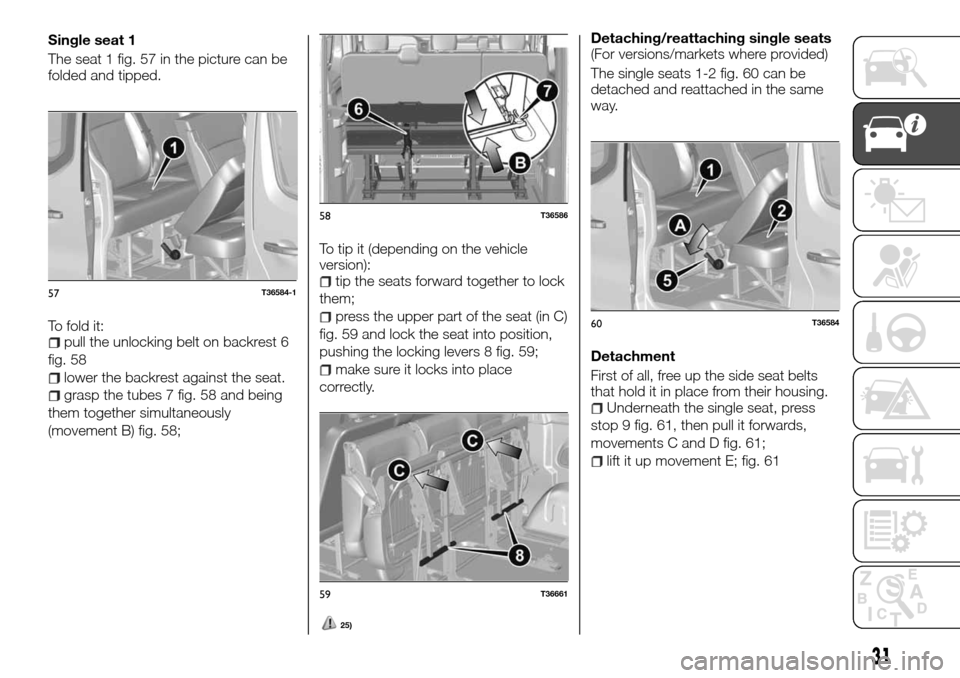
Folding the central passenger seat
21)
Make sure that beverage holder 6 is
closed fig. 54.
Make sure that no object is obstructing
the seat adjustment.
Hold the backrest from the top and
prepare to lower it; at the same time,
press control 7 fig. 54 and fold the seat
down towards the front.
Press on the rear side of the seat to
lock it in place, Make sure the backrest
is properly locked in place.To reposition the centre passenger
seat, make sure no item is obstructing
the seat adjustment.
Use control 7 fig. 54 to unlock the
backrest;
lift it back up;
make sure the seat is locked in
place.
SINGLE REAR SEATS
18) 22) 23) 24)
Depending on the trim level, there may
be two single rear seats: one single
seat 2 fig. 55 (2nd row of seats) and a
single seat 1 fig. 55 (3rd row of seats).To facilitate access to the last row
(single seat 1), lower control 5
fig. 55 (movement A) fig. 55 to incline
the backrest 2 fig. 55 in the picture.
Single seat 2
Put the buckles 3 fig. 56 into the
housings 4 fig. 56 before moving the
seat(s).
Do not forget to lock the belt again
when a passenger is sitting there.
53T36597
54T3661855T36584
56T36644
30
KNOWING YOUR VEHICLE
Page 33 of 232
Single seat 1
The seat 1 fig. 57 in the picture can be
folded and tipped.
To fold it:
pull the unlocking belt on backrest 6
fig. 58
lower the backrest against the seat.
grasp the tubes 7 fig. 58 and being
them together simultaneously
(movement B) fig. 58;To tip it (depending on the vehicle
version):
tip the seats forward together to lock
them;
press the upper part of the seat (in C)
fig. 59 and lock the seat into position,
pushing the locking levers 8 fig. 59;
make sure it locks into place
correctly.
25)
Detaching/reattaching single seats
(For versions/markets where provided)
The single seats 1-2 fig. 60 can be
detached and reattached in the same
way.
Detachment
First of all, free up the side seat belts
that hold it in place from their housing.
Underneath the single seat, press
stop 9 fig. 61, then pull it forwards,
movements C and D fig. 61;
lift it up movement E; fig. 61
57T36584-1
58T36586
59T36661
60T36584
31
Page 35 of 232
24)When you reposition the single seats,
make sure they are locked in place. Make
sure the side safety belts are properly
locked in their housings.
25)Do not exchange seats 1 and 2.STEERING WHEEL/
POWER STEERING
STEERING WHEEL
ADJUSTMENT
26) 27) 28)
1)
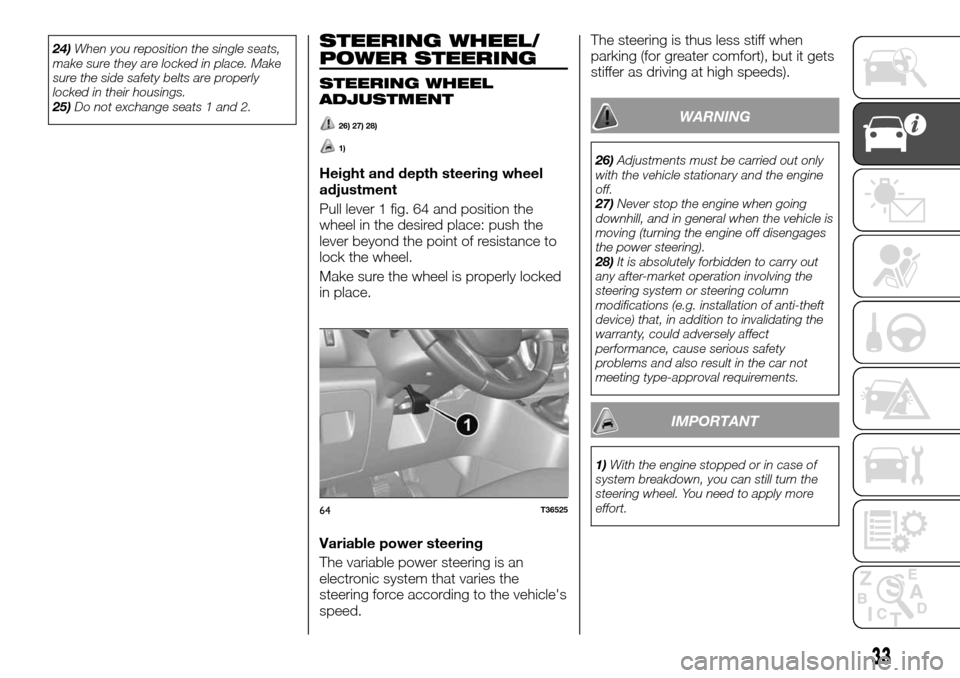
Height and depth steering wheel
adjustment
Pull lever 1 fig. 64 and position the
wheel in the desired place: push the
lever beyond the point of resistance to
lock the wheel.
Make sure the wheel is properly locked
in place.
Variable power steering
The variable power steering is an
electronic system that varies the
steering force according to the vehicle's
speed.The steering is thus less stiff when
parking (for greater comfort), but it gets
stiffer as driving at high speeds).
WARNING
26)Adjustments must be carried out only
with the vehicle stationary and the engine
off.
27)Never stop the engine when going
downhill, and in general when the vehicle is
moving (turning the engine off disengages
the power steering).
28)It is absolutely forbidden to carry out
any after-market operation involving the
steering system or steering column
modifications (e.g. installation of anti-theft
device) that, in addition to invalidating the
warranty, could adversely affect
performance, cause serious safety
problems and also result in the car not
meeting type-approval requirements.
IMPORTANT
1)With the engine stopped or in case of
system breakdown, you can still turn the
steering wheel. You need to apply more
effort.
64T36525
33
Page 38 of 232
REAR VIEW
MIRRORS
DOOR MIRRORS
30) 31) 32)
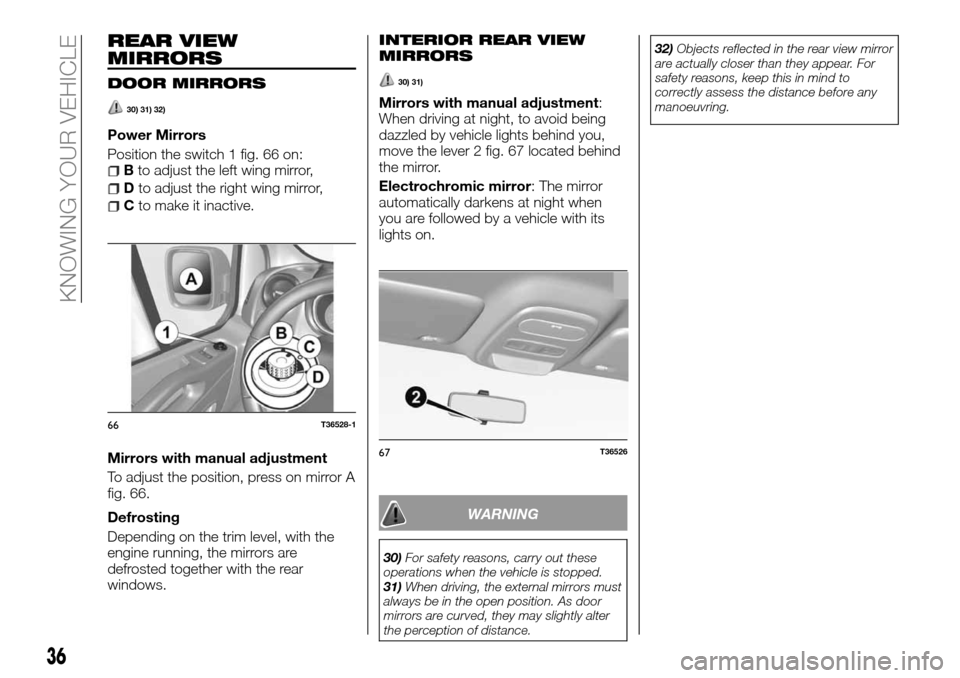
Power Mirrors
Position the switch 1 fig. 66 on:
Bto adjust the left wing mirror,
Dto adjust the right wing mirror,
Cto make it inactive.
Mirrors with manual adjustment
To adjust the position, press on mirror A
fig. 66.
Defrosting
Depending on the trim level, with the
engine running, the mirrors are
defrosted together with the rear
windows.
INTERIOR REAR VIEW
MIRRORS
30) 31)
Mirrors with manual adjustment:
When driving at night, to avoid being
dazzled by vehicle lights behind you,
move the lever 2 fig. 67 located behind
the mirror.
Electrochromic mirror: The mirror
automatically darkens at night when
you are followed by a vehicle with its
lights on.
WARNING
30)For safety reasons, carry out these
operations when the vehicle is stopped.
31)When driving, the external mirrors must
always be in the open position. As door
mirrors are curved, they may slightly alter
the perception of distance.32)Objects reflected in the rear view mirror
are actually closer than they appear. For
safety reasons, keep this in mind to
correctly assess the distance before any
manoeuvring.
66T36528-1
67T36526
36
KNOWING YOUR VEHICLE
Page 39 of 232
EXTERNAL LIGHTS
SIDE LIGHTS
33) 34) 35) 36)
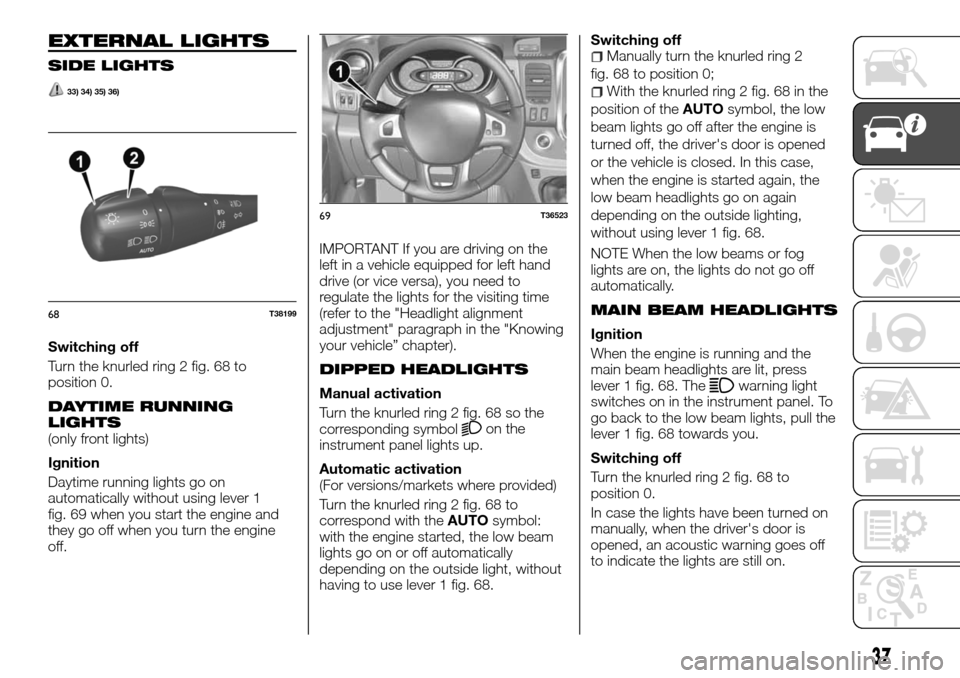
Switching off
Turn the knurled ring 2 fig. 68 to
position 0.
DAYTIME RUNNING
LIGHTS
(only front lights)
Ignition
Daytime running lights go on
automatically without using lever 1
fig. 69 when you start the engine and
they go off when you turn the engine
off.IMPORTANT If you are driving on the
left in a vehicle equipped for left hand
drive (or vice versa), you need to
regulate the lights for the visiting time
(refer to the "Headlight alignment
adjustment" paragraph in the "Knowing
your vehicle” chapter).
DIPPED HEADLIGHTS
Manual activation
Turn the knurled ring 2 fig. 68 so the
corresponding symbol
on the
instrument panel lights up.
Automatic activation
(For versions/markets where provided)
Turn the knurled ring 2 fig. 68 to
correspond with theAUTOsymbol:
with the engine started, the low beam
lights go on or off automatically
depending on the outside light, without
having to use lever 1 fig. 68.Switching off
Manually turn the knurled ring 2
fig. 68 to position 0;
With the knurled ring 2 fig. 68 in the
position of theAUTOsymbol, the low
beam lights go off after the engine is
turned off, the driver's door is opened
or the vehicle is closed. In this case,
when the engine is started again, the
low beam headlights go on again
depending on the outside lighting,
without using lever 1 fig. 68.
NOTE When the low beams or fog
lights are on, the lights do not go off
automatically.
MAIN BEAM HEADLIGHTS
Ignition
When the engine is running and the
main beam headlights are lit, press
lever 1 fig. 68. The
warning light
switches on in the instrument panel. To
go back to the low beam lights, pull the
lever 1 fig. 68 towards you.
Switching off
Turn the knurled ring 2 fig. 68 to
position 0.
In case the lights have been turned on
manually, when the driver's door is
opened, an acoustic warning goes off
to indicate the lights are still on.
68T38199
69T36523
37
Page 40 of 232
FRONT FOG LIGHTS
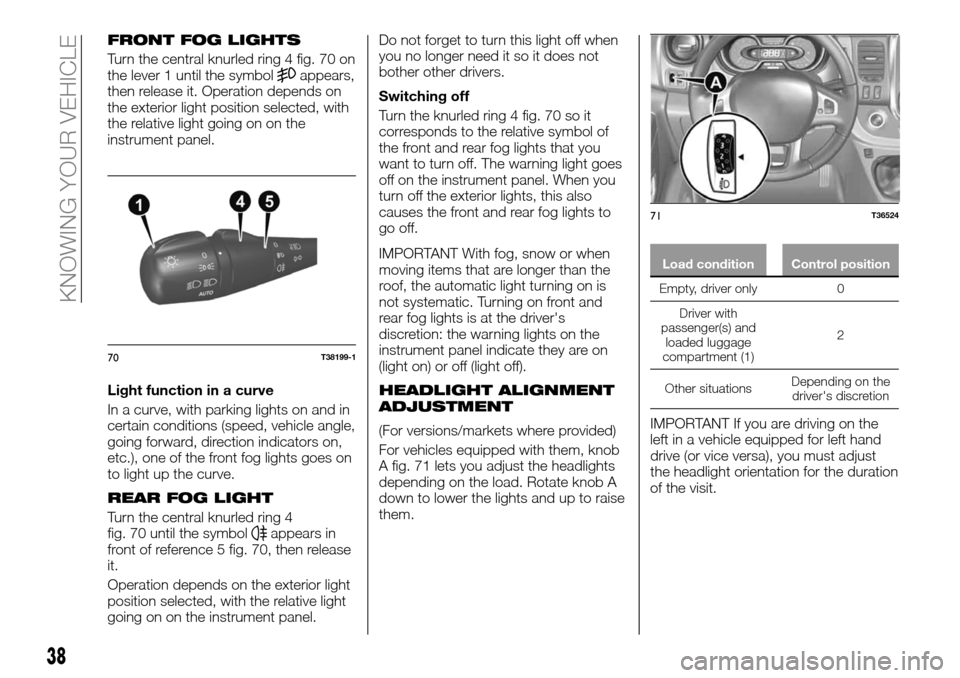
Turn the central knurled ring 4 fig. 70 on
the lever 1 until the symbolappears,
then release it. Operation depends on
the exterior light position selected, with
the relative light going on on the
instrument panel.
Light function in a curve
In a curve, with parking lights on and in
certain conditions (speed, vehicle angle,
going forward, direction indicators on,
etc.), one of the front fog lights goes on
to light up the curve.
REAR FOG LIGHT
Turn the central knurled ring 4
fig. 70 until the symbolappears in
front of reference 5 fig. 70, then release
it.
Operation depends on the exterior light
position selected, with the relative light
going on on the instrument panel.Do not forget to turn this light off when
you no longer need it so it does not
bother other drivers.
Switching off
Turn the knurled ring 4 fig. 70 so it
corresponds to the relative symbol of
the front and rear fog lights that you
want to turn off. The warning light goes
off on the instrument panel. When you
turn off the exterior lights, this also
causes the front and rear fog lights to
go off.
IMPORTANT With fog, snow or when
moving items that are longer than the
roof, the automatic light turning on is
not systematic. Turning on front and
rear fog lights is at the driver's
discretion: the warning lights on the
instrument panel indicate they are on
(light on) or off (light off).
HEADLIGHT ALIGNMENT
ADJUSTMENT
(For versions/markets where provided)
For vehicles equipped with them, knob
A fig. 71 lets you adjust the headlights
depending on the load. Rotate knob A
down to lower the lights and up to raise
them.
Load condition Control position
Empty, driver only 0
Driver with
passenger(s) and
loaded luggage
compartment (1)2
Other situationsDepending on the
driver's discretion
IMPORTANT If you are driving on the
left in a vehicle equipped for left hand
drive (or vice versa), you must adjust
the headlight orientation for the duration
of the visit.
70T38199-1
71T36524
38
KNOWING YOUR VEHICLE