Vin FIAT TALENTO 2016 2.G Repair Manual
[x] Cancel search | Manufacturer: FIAT, Model Year: 2016, Model line: TALENTO, Model: FIAT TALENTO 2016 2.GPages: 232, PDF Size: 5.01 MB
Page 138 of 232
INSTALLING THE
TOW HOOK
TO: 1,090 mm
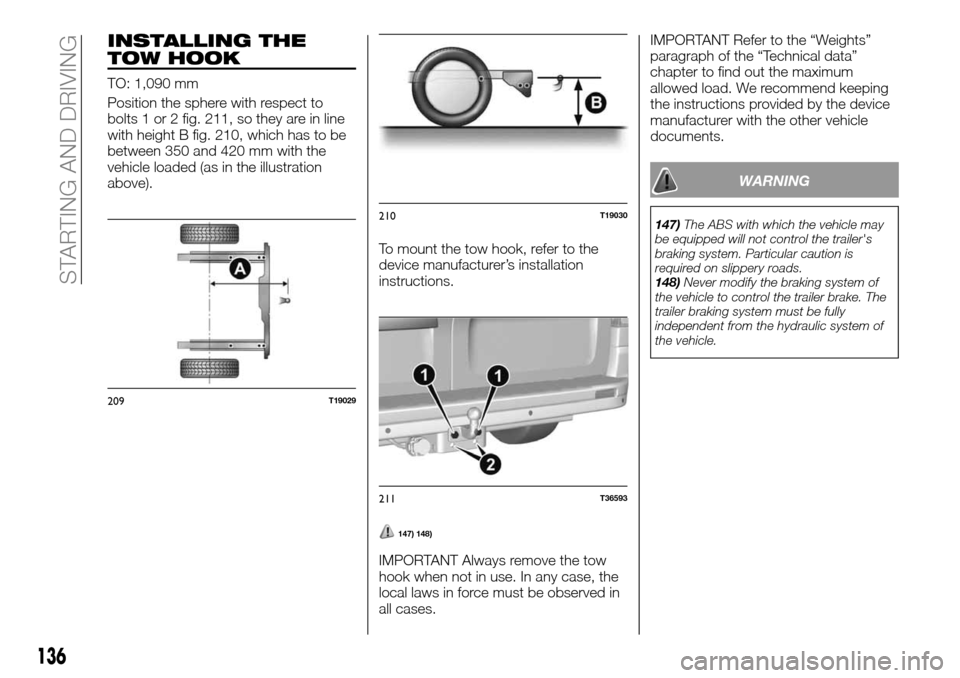
Position the sphere with respect to
bolts 1 or 2 fig. 211, so they are in line
with height B fig. 210, which has to be
between 350 and 420 mm with the
vehicle loaded (as in the illustration
above).
To mount the tow hook, refer to the
device manufacturer’s installation
instructions.
147) 148)
IMPORTANT Always remove the tow
hook when not in use. In any case, the
local laws in force must be observed in
all cases.IMPORTANT Refer to the “Weights”
paragraph of the “Technical data”
chapter to find out the maximum
allowed load. We recommend keeping
the instructions provided by the device
manufacturer with the other vehicle
documents.
WARNING
147)The ABS with which the vehicle may
be equipped will not control the trailer's
braking system. Particular caution is
required on slippery roads.
148)Never modify the braking system of
the vehicle to control the trailer brake. The
trailer braking system must be fully
independent from the hydraulic system of
the vehicle.
209T19029
210T19030
211T36593
136
STARTING AND DRIVING
Page 139 of 232
LOADING ADVICE
Transporting items in the load
compartment
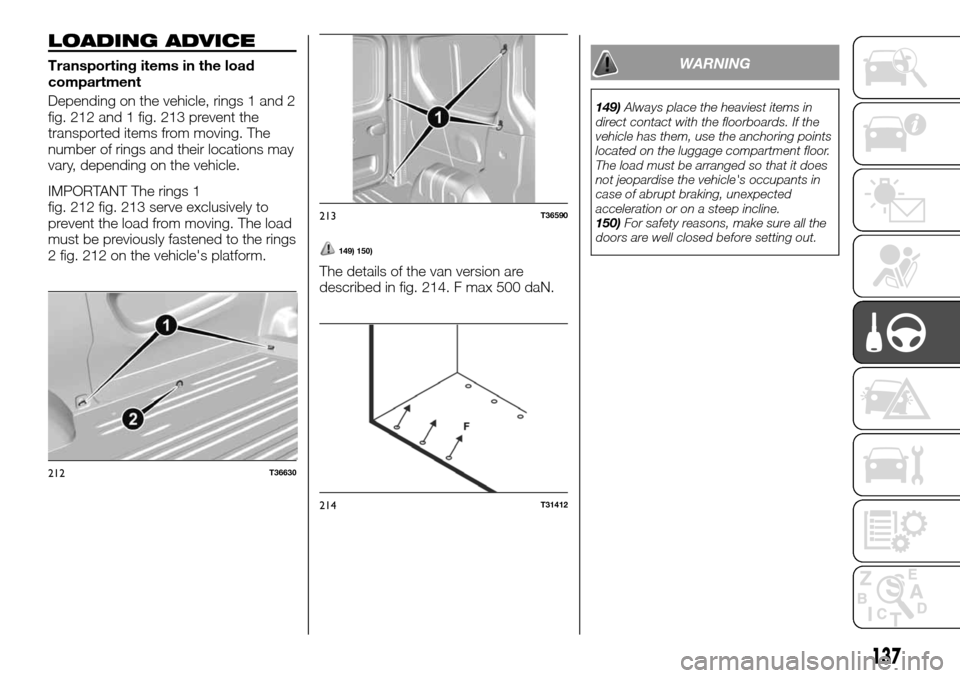
Depending on the vehicle, rings 1 and 2
fig. 212 and 1 fig. 213 prevent the
transported items from moving. The
number of rings and their locations may
vary, depending on the vehicle.
IMPORTANT The rings 1
fig. 212 fig. 213 serve exclusively to
prevent the load from moving. The load
must be previously fastened to the rings
2 fig. 212 on the vehicle's platform.
149) 150)
The details of the van version are
described in fig. 214. F max 500 daN.
WARNING
149)Always place the heaviest items in
direct contact with the floorboards. If the
vehicle has them, use the anchoring points
located on the luggage compartment floor.
The load must be arranged so that it does
not jeopardise the vehicle's occupants in
case of abrupt braking, unexpected
acceleration or on a steep incline.
150)For safety reasons, make sure all the
doors are well closed before setting out.
212T36630
213T36590
214T31412
137
Page 140 of 232
SPEED LIMITER
151)
The vehicle's speed can be
permanently limited according to the
vehicle version and the local
regulations.
Contact a Fiat Dealership to modify the
speed limit or activate/deactivate the
function.
It may not be possible to deactivate this
function for specific markets.
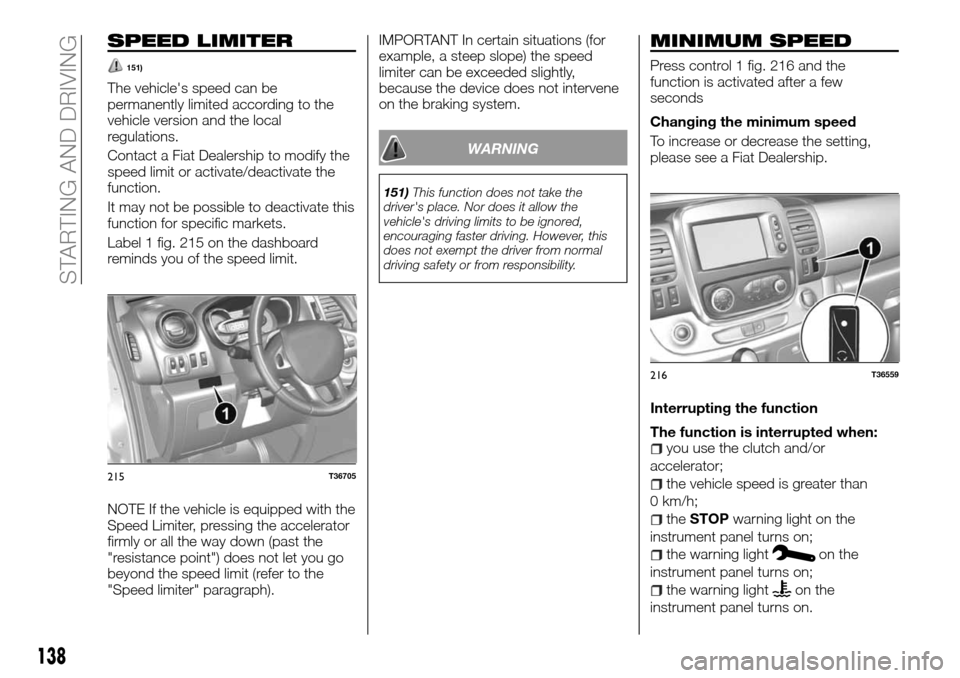
Label 1 fig. 215 on the dashboard
reminds you of the speed limit.
NOTE If the vehicle is equipped with the
Speed Limiter, pressing the accelerator
firmly or all the way down (past the
"resistance point") does not let you go
beyond the speed limit (refer to the
"Speed limiter" paragraph).IMPORTANT In certain situations (for
example, a steep slope) the speed
limiter can be exceeded slightly,
because the device does not intervene
on the braking system.
WARNING
151)This function does not take the
driver's place. Nor does it allow the
vehicle's driving limits to be ignored,
encouraging faster driving. However, this
does not exempt the driver from normal
driving safety or from responsibility.
MINIMUM SPEED
Press control 1 fig. 216 and the
function is activated after a few
seconds
Changing the minimum speed
To increase or decrease the setting,
please see a Fiat Dealership.
Interrupting the function
The function is interrupted when:
you use the clutch and/or
accelerator;
the vehicle speed is greater than
0 km/h;
theSTOPwarning light on the
instrument panel turns on;
the warning lighton the
instrument panel turns on;
the warning lighton the
instrument panel turns on.
215T36705
216T36559
138
STARTING AND DRIVING
Page 141 of 232
SUGGESTIONS FOR
DRIVING
SAVING FUEL
Fuel consumption is approved in
compliance with a standard and
regulated method that is identical for all
manufacturers, allowing vehicles to be
compared with each other. The real fuel
consumption depends on the vehicle's
usage, equipment and driving style.
Depending on the vehicle, you can have
different functions available that let you
reduce your fuel consumption:
gear change indicator;
driving style indicator;
route summary and ecological advice
through a multi-media display panel;
the ECOMODE function that can be
activated by the ECO button.If the vehicle has one, the navigation
system completes this information.
Gear change indicators
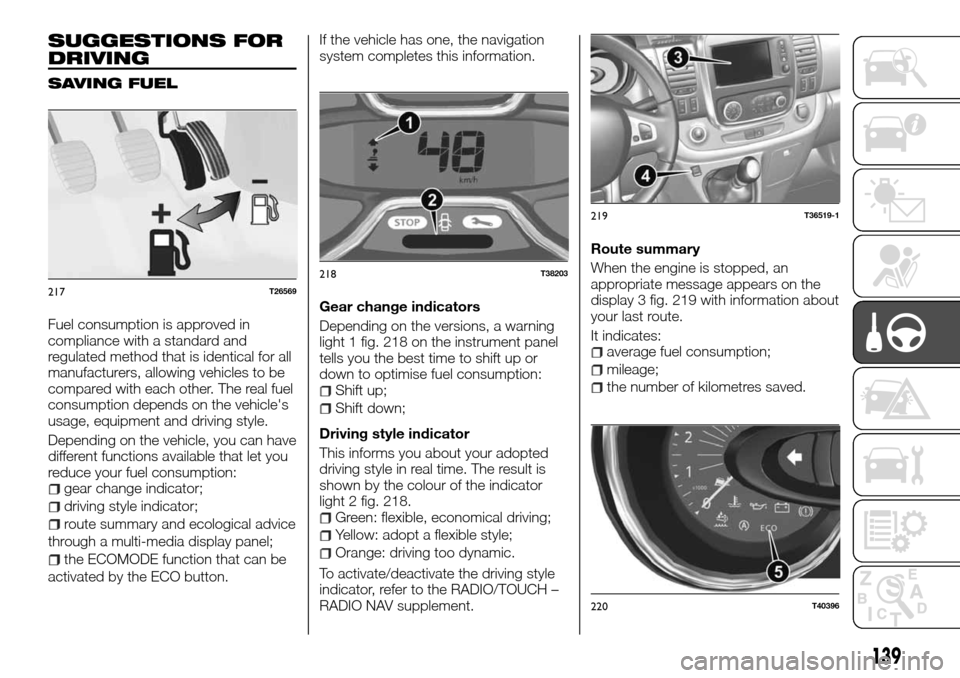
Depending on the versions, a warning
light 1 fig. 218 on the instrument panel
tells you the best time to shift up or
down to optimise fuel consumption:
Shift up;
Shift down;
Driving style indicator
This informs you about your adopted
driving style in real time. The result is
shown by the colour of the indicator
light 2 fig. 218.
Green: flexible, economical driving;
Yellow: adopt a flexible style;
Orange: driving too dynamic.
To activate/deactivate the driving style
indicator, refer to the RADIO/TOUCH –
RADIO NAV supplement.Route summary
When the engine is stopped, an
appropriate message appears on the
display 3 fig. 219 with information about
your last route.
It indicates:
average fuel consumption;
mileage;
the number of kilometres saved.
217T26569
218T38203
219T36519-1
220T40396
139
Page 142 of 232
A general grade from 0 to 100 appears
that allows you to assess your
ecological driving performance: high
values mean reduced fuel consumption.
Below is some ecological advice to
improve your performance. Store your
preferred routes lets you compare
performances. For further information,
refer to the RADIO/TOUCH – RADIO
NAV supplement.
ECOMODE
ECOMODE is a function that optimises
fuel consumption. It acts on a few of
the vehicle's uses (heating, air
conditioning, power steering, etc.) and
on a few driving operations
(acceleration, gear shift, speed
regulation, deceleration, etc.).
Activation of the function
Press button 4 fig. 219.
TheECOfig. 220 indicator light 5 on
the instrument panel turns on to
confirm that it has been activated.
While driving, you can temporarily leave
the ECOMODE function to reset all
engine performances.
To do this, press the accelerator pedal
firmly.
The ECOMODE function is reactivated
as soon as you release the accelerator.Deactivating the function
Press button 4 fig. 219.
TheECOfig. 220 warning light 5 on the
instrument panel turns off to confirm
that it has been deactivated.
Behaviour
Rather than heat the engine while
stopped, we advise you to drive
moderately until the engine reaches its
normal operating temperature.
Speed increases fuel consumption.
Do not strain the engine by
exceeding speed in intermediary gears.
Use the highest gear.
Avoid sudden acceleration.
Brake as little as possible. By
assessing the danger or curve in
advance, it will be sufficient to lift your
foot off the accelerator.
When going uphill, we advise you to
keep a steady speed, without having to
change it.
In modern vehicles, double clutching
before stopping the engine is not
necessary and could even cause
damage.Tyres fig. 221
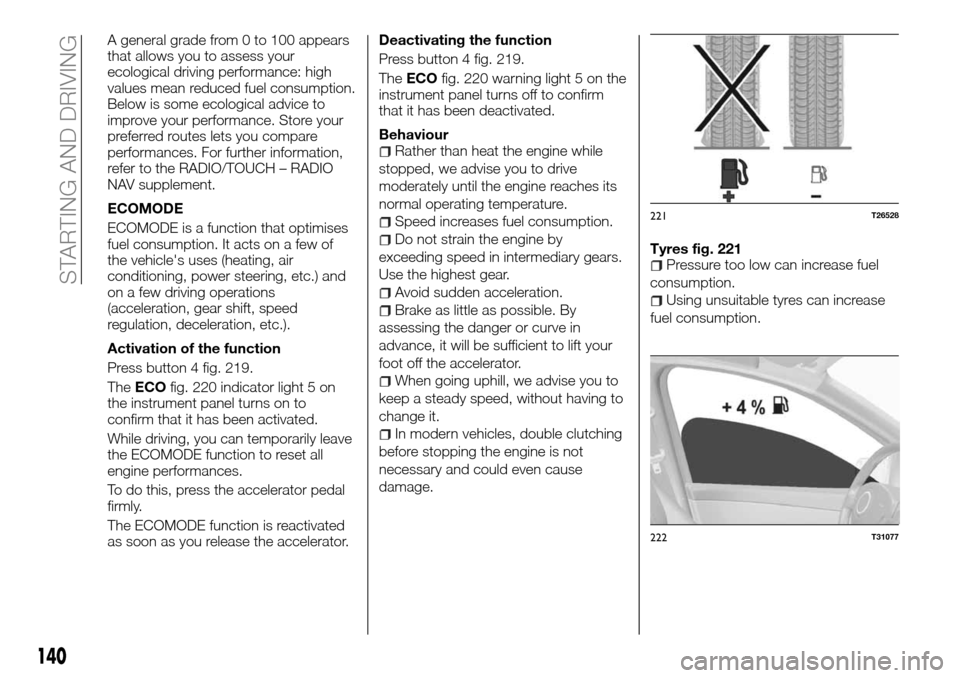
Pressure too low can increase fuel
consumption.
Using unsuitable tyres can increase
fuel consumption.
221T26528
222T31077
140
STARTING AND DRIVING
Page 143 of 232
Advice for useFavour the ECOMODE function.
Electricity increases fuel
consumption. We advise you to turn off
accessories when they are not in use.
You must use your lights according to
the laws in effect in the country you are
in.
Use diffusers as much as possible.
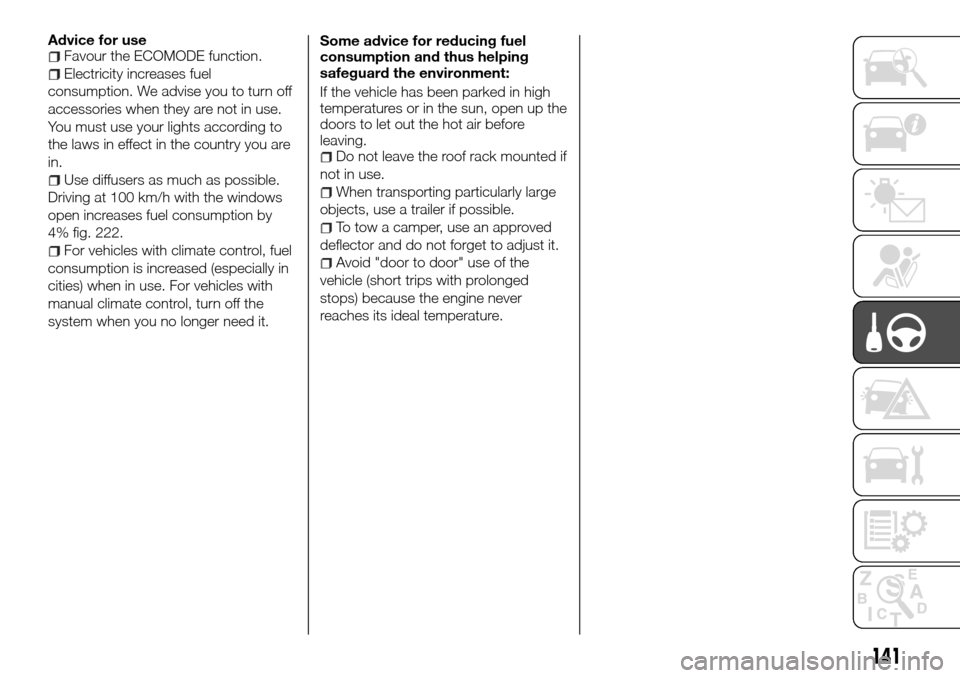
Driving at 100 km/h with the windows
open increases fuel consumption by
4% fig. 222.
For vehicles with climate control, fuel
consumption is increased (especially in
cities) when in use. For vehicles with
manual climate control, turn off the
system when you no longer need it.Some advice for reducing fuel
consumption and thus helping
safeguard the environment:
If the vehicle has been parked in high
temperatures or in the sun, open up the
doors to let out the hot air before
leaving.
Do not leave the roof rack mounted if
not in use.
When transporting particularly large
objects, use a trailer if possible.
To tow a camper, use an approved
deflector and do not forget to adjust it.
Avoid "door to door" use of the
vehicle (short trips with prolonged
stops) because the engine never
reaches its ideal temperature.
141
Page 145 of 232
HAZARD WARNING
LIGHTS
CONTROL
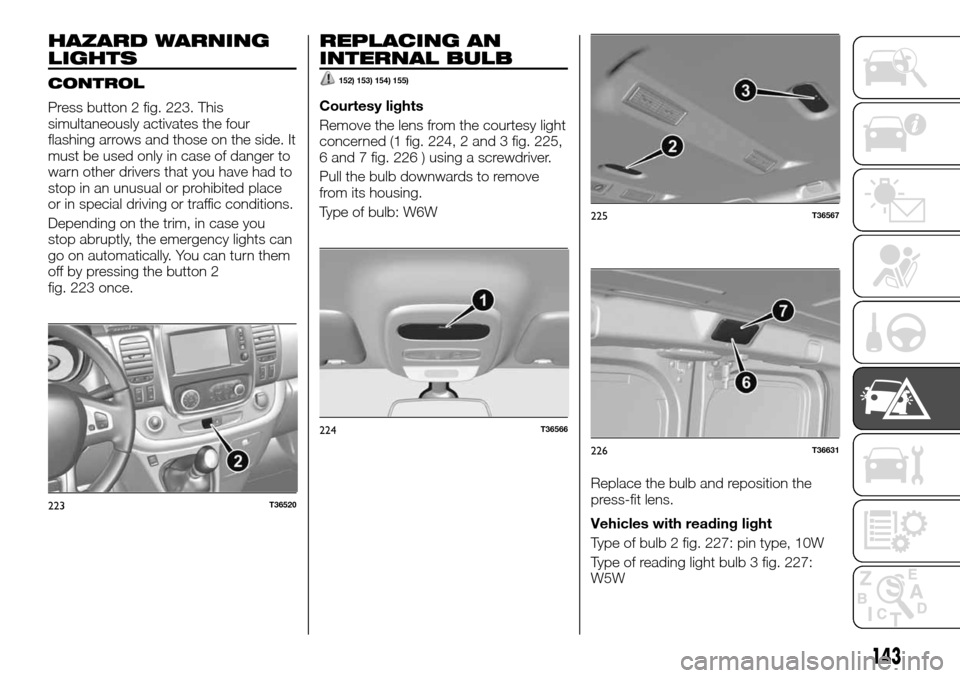
Press button 2 fig. 223. This
simultaneously activates the four
flashing arrows and those on the side. It
must be used only in case of danger to
warn other drivers that you have had to
stop in an unusual or prohibited place
or in special driving or traffic conditions.
Depending on the trim, in case you
stop abruptly, the emergency lights can
go on automatically. You can turn them
off by pressing the button 2
fig. 223 once.
REPLACING AN
INTERNAL BULB
152) 153) 154) 155)
Courtesy lights
Remove the lens from the courtesy light
concerned (1 fig. 224, 2 and 3 fig. 225,
6 and 7 fig. 226 ) using a screwdriver.
Pull the bulb downwards to remove
from its housing.
Type of bulb: W6W
Replace the bulb and reposition the
press-fit lens.
Vehicles with reading light
Type of bulb 2 fig. 227: pin type, 10W
Type of reading light bulb 3 fig. 227:
W5W
223T36520
224T36566
225T36567
226T36631
143
Page 155 of 232
IN THE EVENT OF A
PUNCTURE
Depending on the vehicle, there may be
a tyre inflating kit or a spare tyre (see
the following page).
CHANGING A WHEEL
166) 167) 168) 169) 170) 171)
Tools
The equipment in the relative tool bag
varies according to the vehicle's
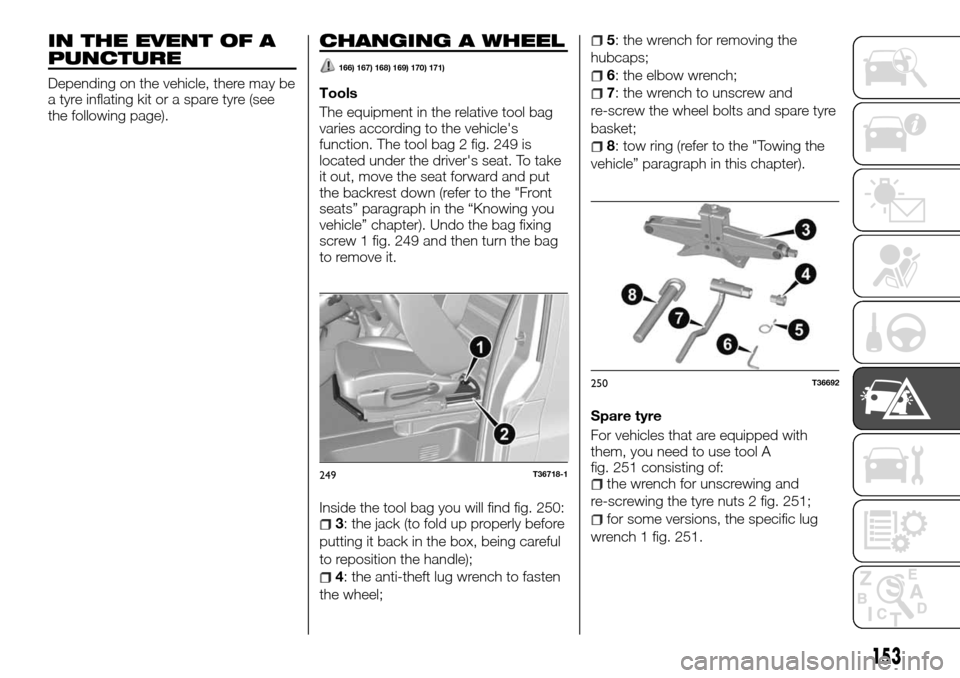
function. The tool bag 2 fig. 249 is
located under the driver's seat. To take
it out, move the seat forward and put
the backrest down (refer to the "Front
seats” paragraph in the “Knowing you
vehicle” chapter). Undo the bag fixing
screw 1 fig. 249 and then turn the bag
to remove it.
Inside the tool bag you will find fig. 250:
3: the jack (to fold up properly before
putting it back in the box, being careful
to reposition the handle);
4: the anti-theft lug wrench to fasten
the wheel;
5: the wrench for removing the
hubcaps;
6: the elbow wrench;
7: the wrench to unscrew and
re-screw the wheel bolts and spare tyre
basket;
8: tow ring (refer to the "Towing the
vehicle” paragraph in this chapter).
Spare tyre
For vehicles that are equipped with
them, you need to use tool A
fig. 251 consisting of:
the wrench for unscrewing and
re-screwing the tyre nuts 2 fig. 251;
for some versions, the specific lug
wrench 1 fig. 251.
249T36718-1
250T36692
153
Page 157 of 232
Replacing a wheel
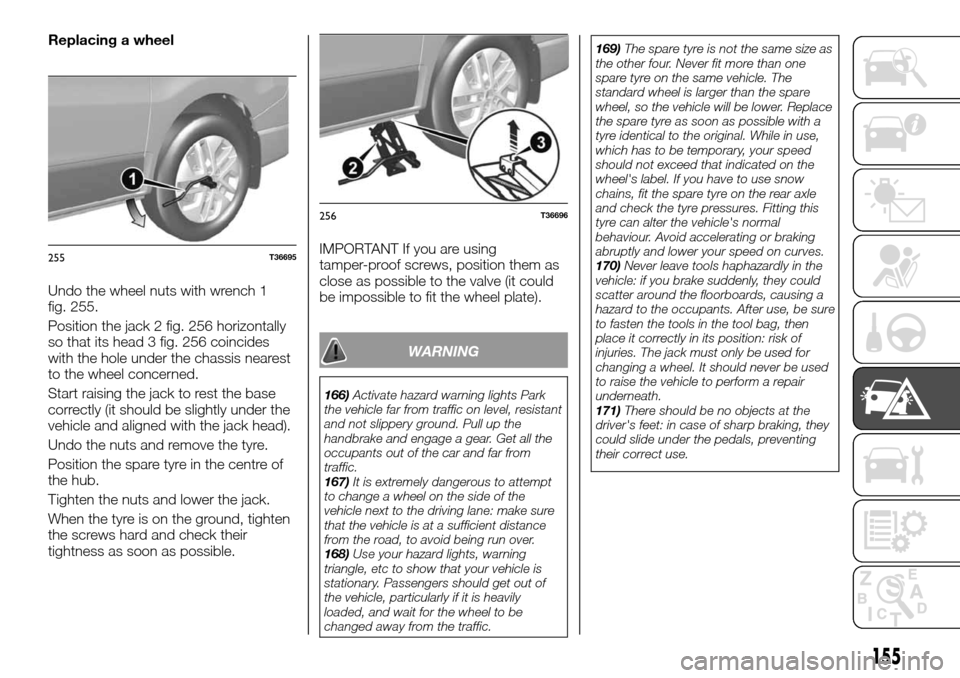
Undo the wheel nuts with wrench 1
fig. 255.
Position the jack 2 fig. 256 horizontally
so that its head 3 fig. 256 coincides
with the hole under the chassis nearest
to the wheel concerned.
Start raising the jack to rest the base
correctly (it should be slightly under the
vehicle and aligned with the jack head).
Undo the nuts and remove the tyre.
Position the spare tyre in the centre of
the hub.
Tighten the nuts and lower the jack.
When the tyre is on the ground, tighten
the screws hard and check their
tightness as soon as possible.IMPORTANT If you are using
tamper-proof screws, position them as
close as possible to the valve (it could
be impossible to fit the wheel plate).
WARNING
166)Activate hazard warning lights Park
the vehicle far from traffic on level, resistant
and not slippery ground. Pull up the
handbrake and engage a gear. Get all the
occupants out of the car and far from
traffic.
167)It is extremely dangerous to attempt
to change a wheel on the side of the
vehicle next to the driving lane: make sure
that the vehicle is at a sufficient distance
from the road, to avoid being run over.
168)Use your hazard lights, warning
triangle, etc to show that your vehicle is
stationary. Passengers should get out of
the vehicle, particularly if it is heavily
loaded, and wait for the wheel to be
changed away from the traffic.169)The spare tyre is not the same size as
the other four. Never fit more than one
spare tyre on the same vehicle. The
standard wheel is larger than the spare
wheel, so the vehicle will be lower. Replace
the spare tyre as soon as possible with a
tyre identical to the original. While in use,
which has to be temporary, your speed
should not exceed that indicated on the
wheel's label. If you have to use snow
chains, fit the spare tyre on the rear axle
and check the tyre pressures. Fitting this
tyre can alter the vehicle's normal
behaviour. Avoid accelerating or braking
abruptly and lower your speed on curves.
170)Never leave tools haphazardly in the
vehicle: if you brake suddenly, they could
scatter around the floorboards, causing a
hazard to the occupants. After use, be sure
to fasten the tools in the tool bag, then
place it correctly in its position: risk of
injuries. The jack must only be used for
changing a wheel. It should never be used
to raise the vehicle to perform a repair
underneath.
171)There should be no objects at the
driver's feet: in case of sharp braking, they
could slide under the pedals, preventing
their correct use.
255T36695
256T36696
155
Page 158 of 232
TYRE INFLATION KIT
172)
32) 33) 34) 35) 36) 37) 38)
To take the kit out, move the seat as far
forward as possible and lower the
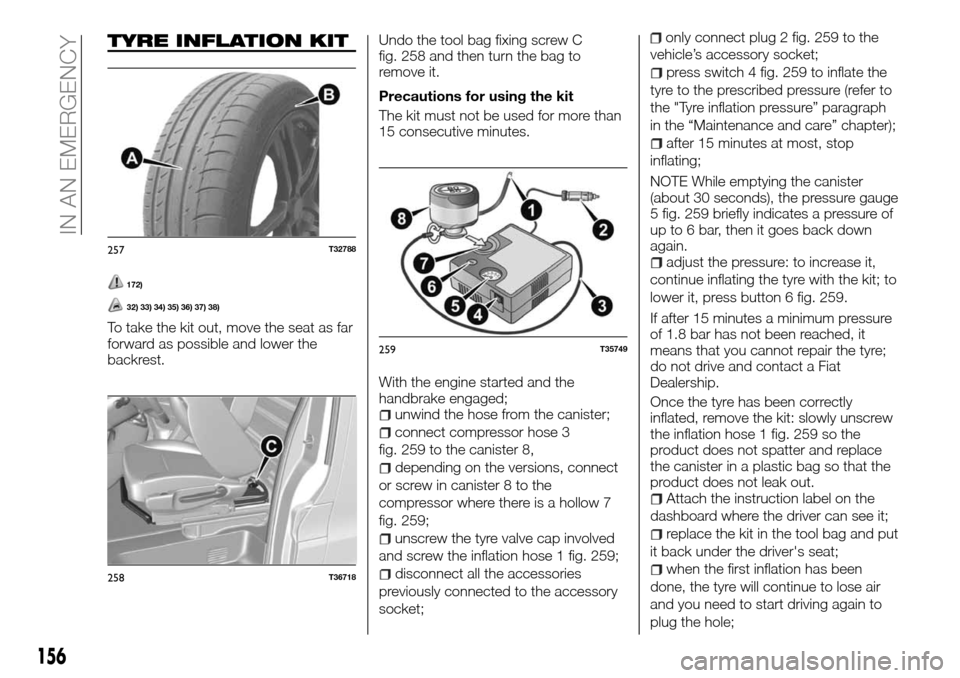
backrest.Undo the tool bag fixing screw C
fig. 258 and then turn the bag to
remove it.
Precautions for using the kit
The kit must not be used for more than
15 consecutive minutes.
With the engine started and the
handbrake engaged;
unwind the hose from the canister;
connect compressor hose 3
fig. 259 to the canister 8,
depending on the versions, connect
or screw in canister 8 to the
compressor where there is a hollow 7
fig. 259;
unscrew the tyre valve cap involved
and screw the inflation hose 1 fig. 259;
disconnect all the accessories
previously connected to the accessory
socket;
only connect plug 2 fig. 259 to the
vehicle’s accessory socket;
press switch 4 fig. 259 to inflate the
tyre to the prescribed pressure (refer to
the "Tyre inflation pressure” paragraph
in the “Maintenance and care” chapter);
after 15 minutes at most, stop
inflating;
NOTE While emptying the canister
(about 30 seconds), the pressure gauge
5 fig. 259 briefly indicates a pressure of
up to 6 bar, then it goes back down
again.
adjust the pressure: to increase it,
continue inflating the tyre with the kit; to
lower it, press button 6 fig. 259.
If after 15 minutes a minimum pressure
of 1.8 bar has not been reached, it
means that you cannot repair the tyre;
do not drive and contact a Fiat
Dealership.
Once the tyre has been correctly
inflated, remove the kit: slowly unscrew
the inflation hose 1 fig. 259 so the
product does not spatter and replace
the canister in a plastic bag so that the
product does not leak out.
Attach the instruction label on the
dashboard where the driver can see it;
replace the kit in the tool bag and put
it back under the driver's seat;
when the first inflation has been
done, the tyre will continue to lose air
and you need to start driving again to
plug the hole;
257T32788
258T36718
259T35749
156
IN AN EMERGENCY