roof FIAT TALENTO 2016 2.G Owners Manual
[x] Cancel search | Manufacturer: FIAT, Model Year: 2016, Model line: TALENTO, Model: FIAT TALENTO 2016 2.GPages: 232, PDF Size: 5.01 MB
Page 2 of 232

We really know your vehicle because we invented,
designed and built it: we really know every single detail. At Fiat Professional Service authorised workshops you can find technicians directly trained by us, offering quality and pr\
ofessionalism for all service operations.
Fiat Professional workshops are always close to you for the regular serv\
icing operations, season checks and practical recommendations by our experts.
With Fiat Professional Genuine Parts you keep the reliability, comfort a\
nd performance features of your new vehicle unchanged in time: that's why you bought it for.
Always ask for Genuine Parts for the components used on our vehicles; we\
recommend them because they come from our steady commitment in research and development of highly innovative t\
echnologies. For all these reasons: rely on Genuine Parts,
because they are the only ones designed by Fiat Professional for your ve\
hicle.
WHY CHOOSING GENUINE PARTS
SAFETY: BRAKING
SYSTEMENVIRONMENT: PARTICULATE FILTERS,
CLIMATE CONTROL SYSTEM MAINTENANCECOMFORT:
SUSPENSION AND WINDSCREEN WIPERSPERFORMANCE:
SPARK PLUGS, INJECTORS AND BATTERIESLINEACCESSORI:
ROOF RACK BARS, WHEEL RIMS
COP TALENTO LUM GB.qxp 29/04/16 12:11 Pagina 2
Page 8 of 232
6
RADIO TRANSMITTERS AND MOBILE PHONES
Radio transmitter equipment (vehicle mobile phones, CB radios, amateur radio, etc.) cannot be used inside the car unless a
separate aerial is mounted on the roof of the vehicle.
Transmission and reception of these devices may be affected by the shielding effect of the vehicle body. As far as the use of
EC-approved mobile phones is concerned (GSM, GPRS, UMTS, LTE), follow the usage instructions provided by the mobile
phone Manufacturer.
IMPORTANT The use of such devices inside the passenger compartment (without an external aerial) may, in addition to
potential damage to the health of the passengers, cause malfunctions in the vehicle’s electronic systems, compromising the
safety of the vehicle.
Page 40 of 232
FRONT FOG LIGHTS
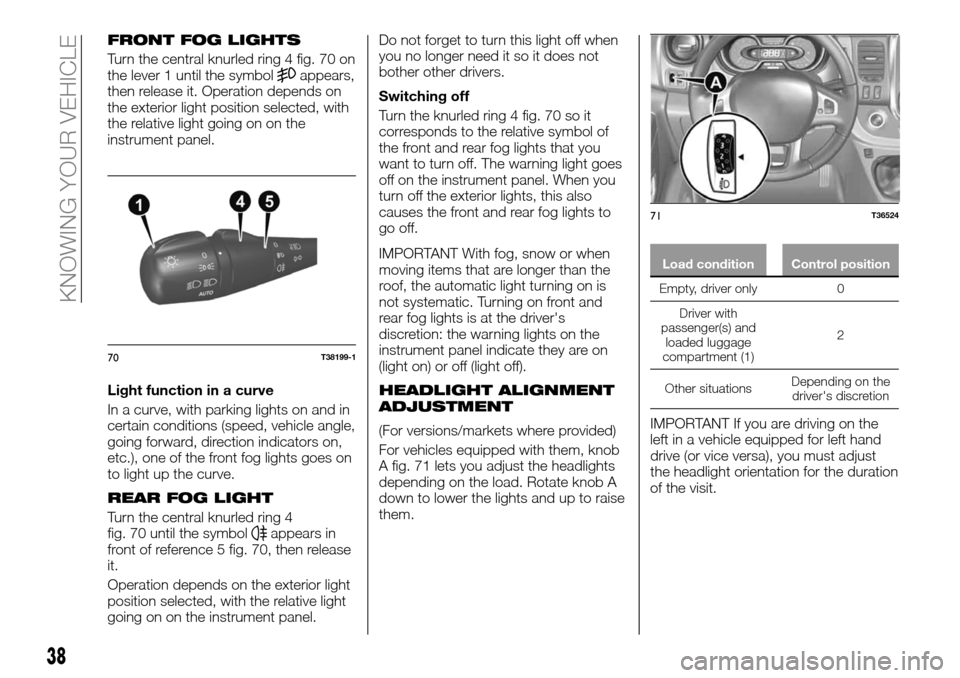
Turn the central knurled ring 4 fig. 70 on
the lever 1 until the symbolappears,
then release it. Operation depends on
the exterior light position selected, with
the relative light going on on the
instrument panel.
Light function in a curve
In a curve, with parking lights on and in
certain conditions (speed, vehicle angle,
going forward, direction indicators on,
etc.), one of the front fog lights goes on
to light up the curve.
REAR FOG LIGHT
Turn the central knurled ring 4
fig. 70 until the symbolappears in
front of reference 5 fig. 70, then release
it.
Operation depends on the exterior light
position selected, with the relative light
going on on the instrument panel.Do not forget to turn this light off when
you no longer need it so it does not
bother other drivers.
Switching off
Turn the knurled ring 4 fig. 70 so it
corresponds to the relative symbol of
the front and rear fog lights that you
want to turn off. The warning light goes
off on the instrument panel. When you
turn off the exterior lights, this also
causes the front and rear fog lights to
go off.
IMPORTANT With fog, snow or when
moving items that are longer than the
roof, the automatic light turning on is
not systematic. Turning on front and
rear fog lights is at the driver's
discretion: the warning lights on the
instrument panel indicate they are on
(light on) or off (light off).
HEADLIGHT ALIGNMENT
ADJUSTMENT
(For versions/markets where provided)
For vehicles equipped with them, knob
A fig. 71 lets you adjust the headlights
depending on the load. Rotate knob A
down to lower the lights and up to raise
them.
Load condition Control position
Empty, driver only 0
Driver with
passenger(s) and
loaded luggage
compartment (1)2
Other situationsDepending on the
driver's discretion
IMPORTANT If you are driving on the
left in a vehicle equipped for left hand
drive (or vice versa), you must adjust
the headlight orientation for the duration
of the visit.
70T38199-1
71T36524
38
KNOWING YOUR VEHICLE
Page 42 of 232
INTERIOR LIGHTS
ROOF LIGHTS
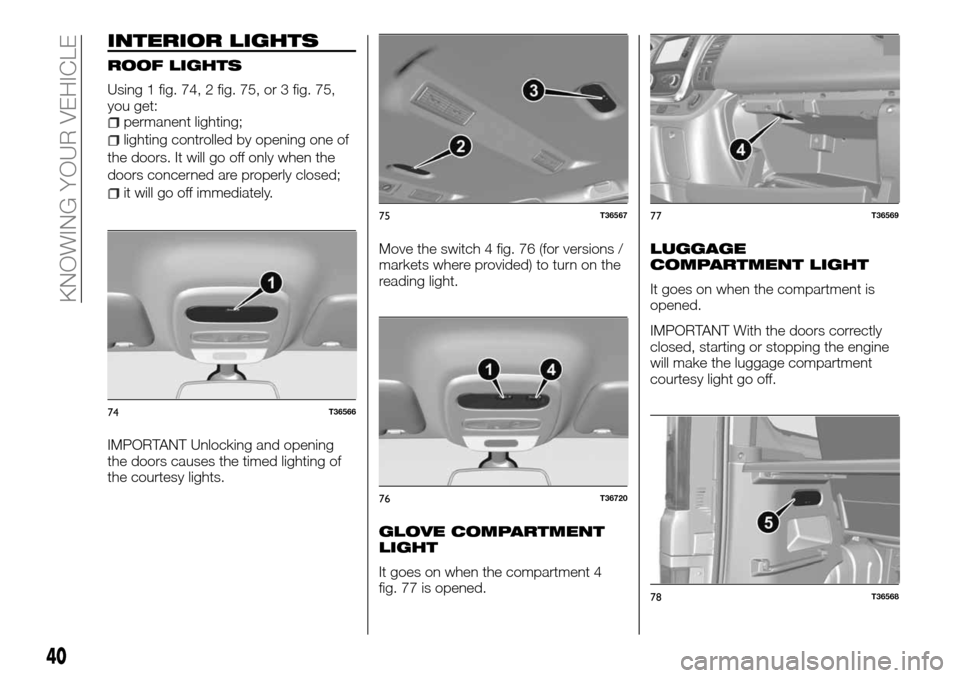
Using 1 fig. 74, 2 fig. 75, or 3 fig. 75,
you get:
permanent lighting;
lighting controlled by opening one of
the doors. It will go off only when the
doors concerned are properly closed;
it will go off immediately.
IMPORTANT Unlocking and opening
the doors causes the timed lighting of
the courtesy lights.Move the switch 4 fig. 76 (for versions /
markets where provided) to turn on the
reading light.
GLOVE COMPARTMENT
LIGHT
It goes on when the compartment 4
fig. 77 is opened.
LUGGAGE
COMPARTMENT LIGHT
It goes on when the compartment is
opened.
IMPORTANT With the doors correctly
closed, starting or stopping the engine
will make the luggage compartment
courtesy light go off.
74T36566
75T36567
76T36720
77T36569
78T36568
40
KNOWING YOUR VEHICLE
Page 143 of 232
Advice for useFavour the ECOMODE function.
Electricity increases fuel
consumption. We advise you to turn off
accessories when they are not in use.
You must use your lights according to
the laws in effect in the country you are
in.
Use diffusers as much as possible.
Driving at 100 km/h with the windows
open increases fuel consumption by
4% fig. 222.
For vehicles with climate control, fuel
consumption is increased (especially in
cities) when in use. For vehicles with
manual climate control, turn off the
system when you no longer need it.Some advice for reducing fuel
consumption and thus helping
safeguard the environment:
If the vehicle has been parked in high
temperatures or in the sun, open up the
doors to let out the hot air before
leaving.
Do not leave the roof rack mounted if
not in use.
When transporting particularly large
objects, use a trailer if possible.
To tow a camper, use an approved
deflector and do not forget to adjust it.
Avoid "door to door" use of the
vehicle (short trips with prolonged
stops) because the engine never
reaches its ideal temperature.
141
Page 157 of 232
Replacing a wheel
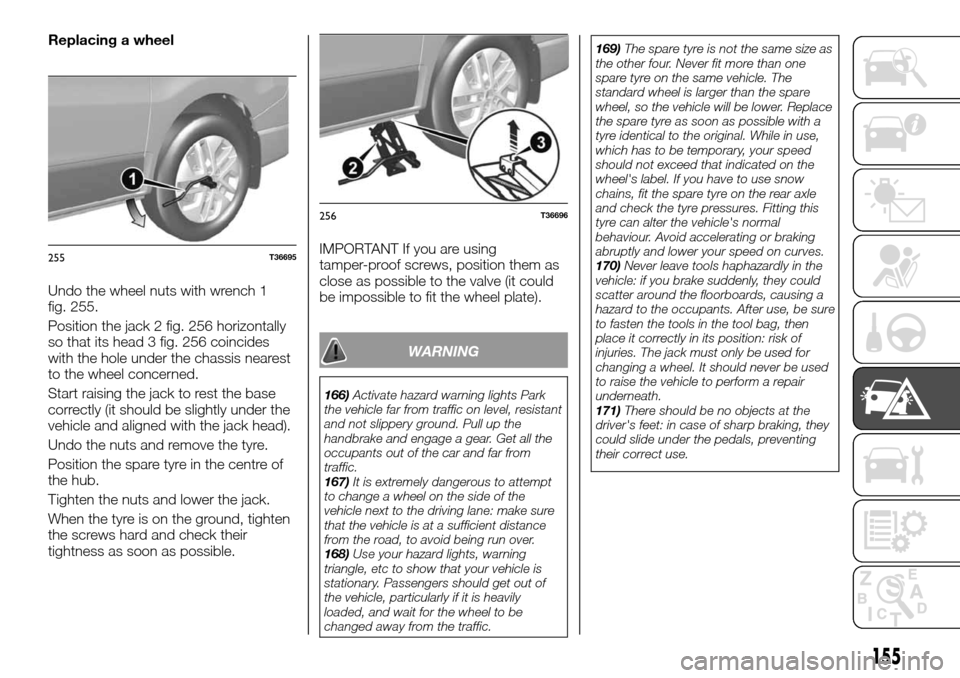
Undo the wheel nuts with wrench 1
fig. 255.
Position the jack 2 fig. 256 horizontally
so that its head 3 fig. 256 coincides
with the hole under the chassis nearest
to the wheel concerned.
Start raising the jack to rest the base
correctly (it should be slightly under the
vehicle and aligned with the jack head).
Undo the nuts and remove the tyre.
Position the spare tyre in the centre of
the hub.
Tighten the nuts and lower the jack.
When the tyre is on the ground, tighten
the screws hard and check their
tightness as soon as possible.IMPORTANT If you are using
tamper-proof screws, position them as
close as possible to the valve (it could
be impossible to fit the wheel plate).
WARNING
166)Activate hazard warning lights Park
the vehicle far from traffic on level, resistant
and not slippery ground. Pull up the
handbrake and engage a gear. Get all the
occupants out of the car and far from
traffic.
167)It is extremely dangerous to attempt
to change a wheel on the side of the
vehicle next to the driving lane: make sure
that the vehicle is at a sufficient distance
from the road, to avoid being run over.
168)Use your hazard lights, warning
triangle, etc to show that your vehicle is
stationary. Passengers should get out of
the vehicle, particularly if it is heavily
loaded, and wait for the wheel to be
changed away from the traffic.169)The spare tyre is not the same size as
the other four. Never fit more than one
spare tyre on the same vehicle. The
standard wheel is larger than the spare
wheel, so the vehicle will be lower. Replace
the spare tyre as soon as possible with a
tyre identical to the original. While in use,
which has to be temporary, your speed
should not exceed that indicated on the
wheel's label. If you have to use snow
chains, fit the spare tyre on the rear axle
and check the tyre pressures. Fitting this
tyre can alter the vehicle's normal
behaviour. Avoid accelerating or braking
abruptly and lower your speed on curves.
170)Never leave tools haphazardly in the
vehicle: if you brake suddenly, they could
scatter around the floorboards, causing a
hazard to the occupants. After use, be sure
to fasten the tools in the tool bag, then
place it correctly in its position: risk of
injuries. The jack must only be used for
changing a wheel. It should never be used
to raise the vehicle to perform a repair
underneath.
171)There should be no objects at the
driver's feet: in case of sharp braking, they
could slide under the pedals, preventing
their correct use.
255T36695
256T36696
155
Page 193 of 232
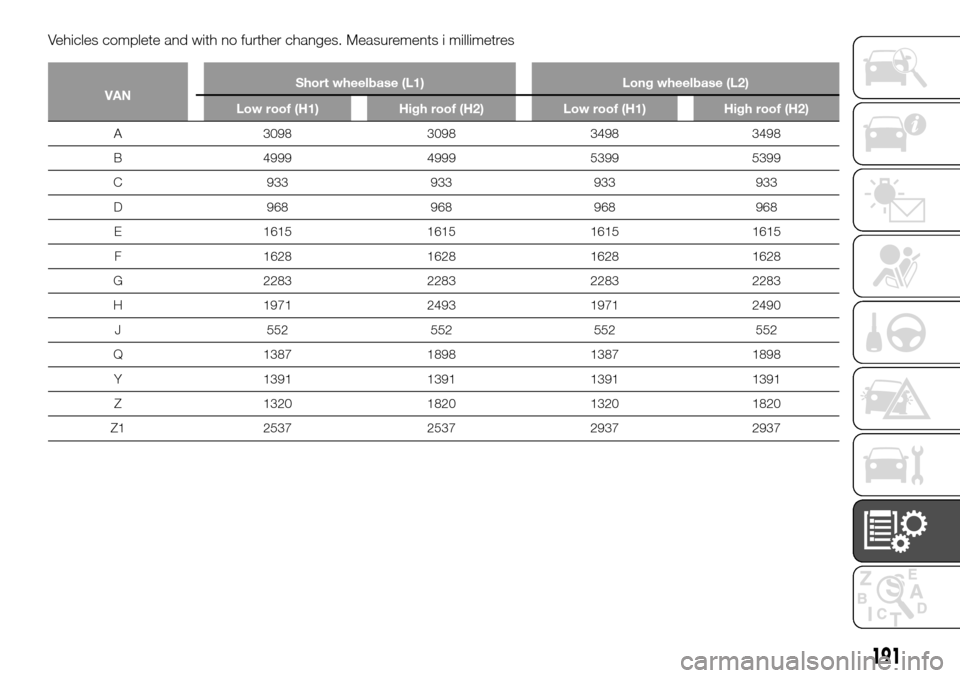
Vehicles complete and with no further changes. Measurements i millimetres
VANShort wheelbase (L1) Long wheelbase (L2)
Low roof (H1) High roof (H2) Low roof (H1) High roof (H2)
A 3098 3098 3498 3498
B 4999 4999 5399 5399
C 933 933 933 933
D 968 968 968 968
E 1615 1615 1615 1615
F 1628 1628 1628 1628
G 2283 2283 2283 2283
H 1971 2493 1971 2490
J 552 552 552 552
Q 1387 1898 1387 1898
Y 1391 1391 1391 1391
Z 1320 1820 1320 1820
Z1 2537 2537 2937 2937
191
Page 195 of 232
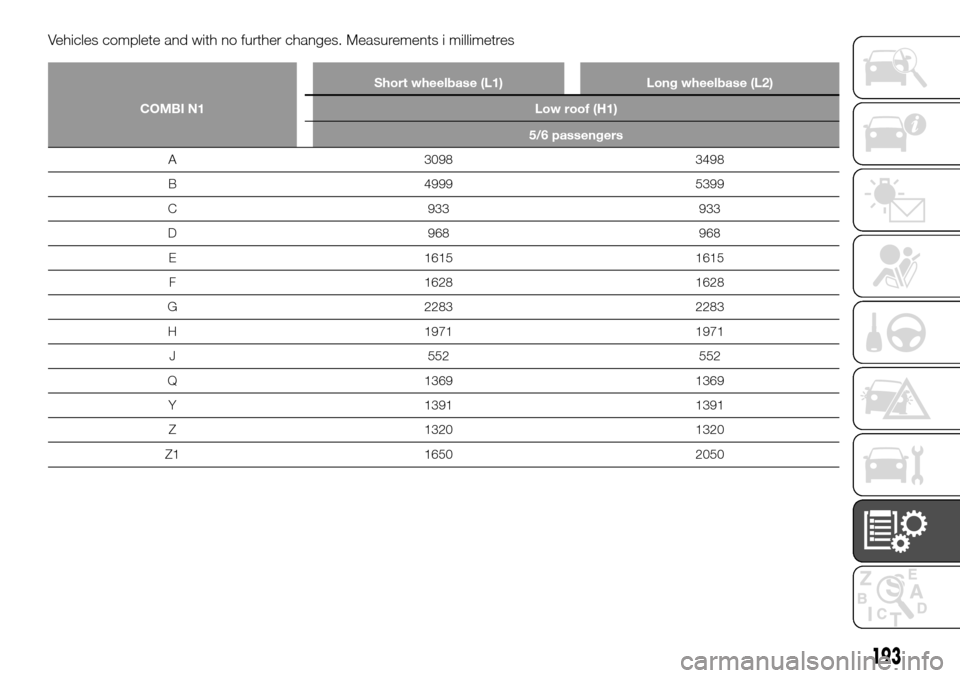
Vehicles complete and with no further changes. Measurements i millimetres
COMBI N1Short wheelbase (L1) Long wheelbase (L2)
Low roof (H1)
5/6 passengers
A 3098 3498
B 4999 5399
C 933 933
D 968 968
E 1615 1615
F 1628 1628
G 2283 2283
H 1971 1971
J 552 552
Q 1369 1369
Y 1391 1391
Z 1320 1320
Z1 1650 2050
193
Page 196 of 232
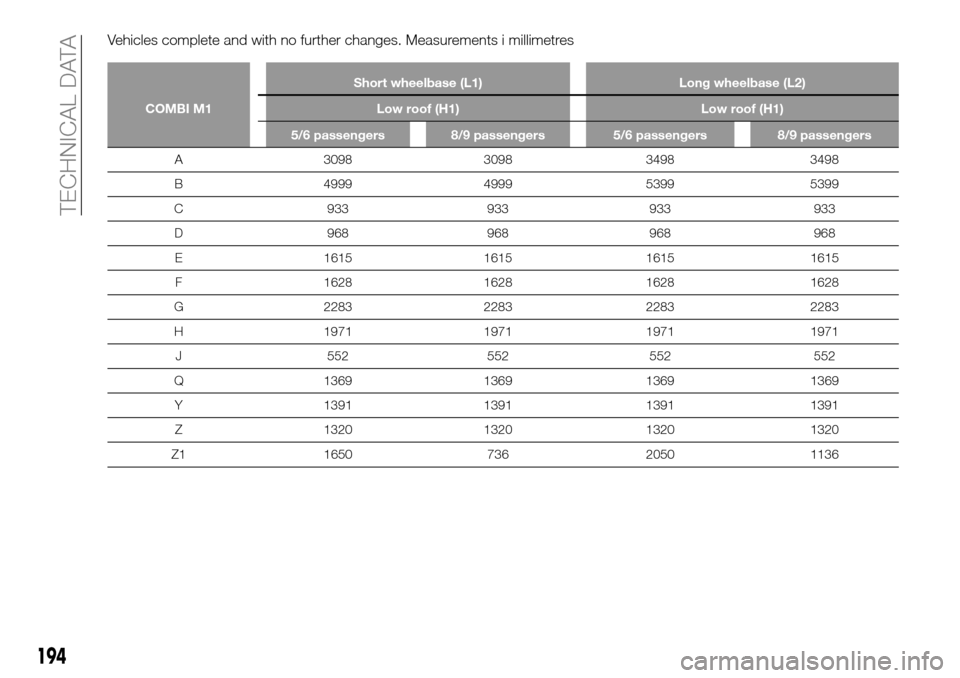
Vehicles complete and with no further changes. Measurements i millimetres
COMBI M1Short wheelbase (L1) Long wheelbase (L2)
Low roof (H1) Low roof (H1)
5/6 passengers 8/9 passengers 5/6 passengers 8/9 passengers
A 3098 3098 3498 3498
B 4999 4999 5399 5399
C 933 933 933 933
D 968 968 968 968
E 1615 1615 1615 1615
F 1628 1628 1628 1628
G 2283 2283 2283 2283
H 1971 1971 1971 1971
J 552 552 552 552
Q 1369 1369 1369 1369
Y 1391 1391 1391 1391
Z 1320 1320 1320 1320
Z1 1650 736 2050 1136
194
TECHNICAL DATA
Page 198 of 232
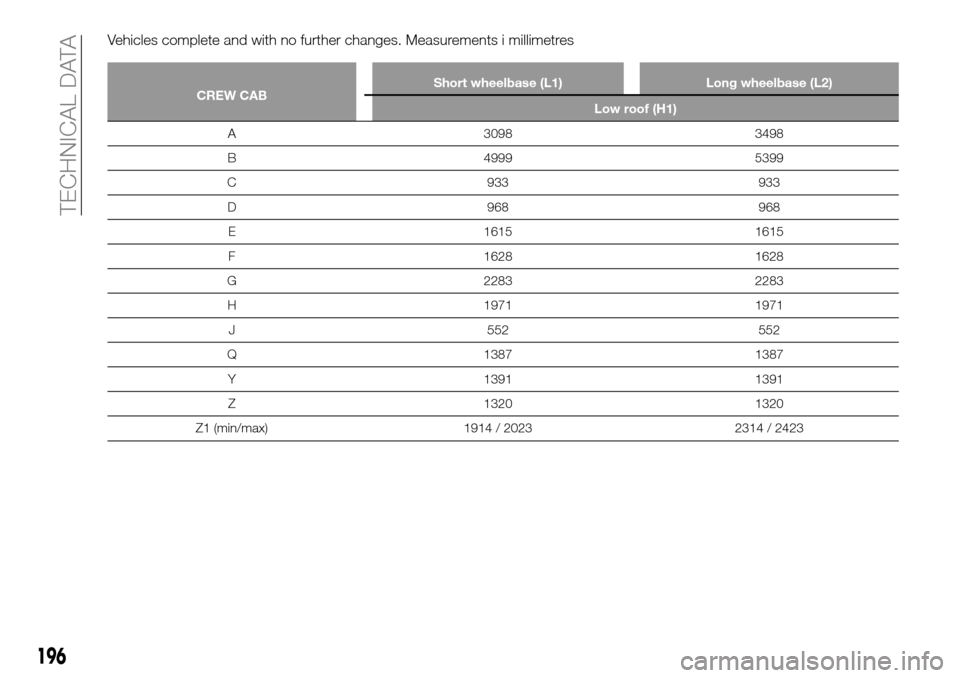
Vehicles complete and with no further changes. Measurements i millimetres
CREW CABShort wheelbase (L1) Long wheelbase (L2)
Low roof (H1)
A 3098 3498
B 4999 5399
C 933 933
D 968 968
E 1615 1615
F 1628 1628
G 2283 2283
H 1971 1971
J 552 552
Q 1387 1387
Y 1391 1391
Z 1320 1320
Z1 (min/max) 1914 / 2023 2314 / 2423
196
TECHNICAL DATA