ESP FIAT TEMPRA 1988 Service And User Guide
[x] Cancel search | Manufacturer: FIAT, Model Year: 1988, Model line: TEMPRA, Model: FIAT TEMPRA 1988Pages: 171, PDF Size: 18.05 MB
Page 34 of 171
ruvj
uivjh I
uuluj
^ Use a magnetic screw-
driver or place some thick
grease on the end of the
screwdriver to prevent the screws from falling
-
especially when replacing the lens.
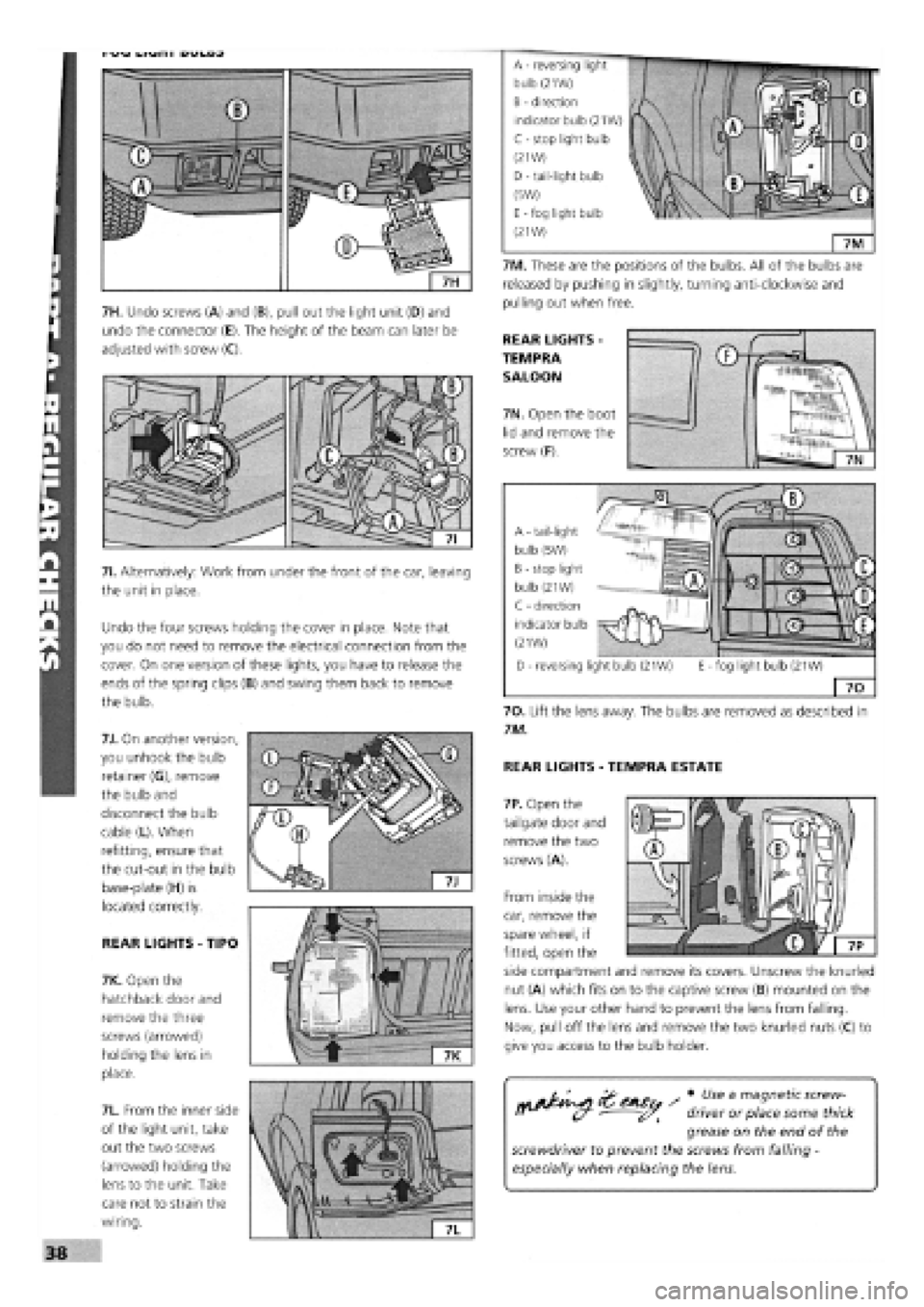
7H. Undo screws (A) and (B), pull out the light unit (D) and
undo the connector (E). The height of the beam can later be
adjusted with screw (C).
71. Alternatively: Work from under the front of the car, leaving
the unit in place.
Undo the four screws holding the cover in place. Note that
you do not need to remove the electrical connection from the
cover. On one version of these lights, you have to release the
ends of the spring clips (B) and swing them back to remove
the bulb.
7J. On another version,
you unhook the bulb
retainer (G), remove
the bulb and
disconnect the bulb
cable (L). When
refitting, ensure that
the cut-out in the bulb
base-plate (H) is
located correctly.
REAR LIGHTS
-
TIPO
7K. Open the
hatchback door and
remove the three
screws (arrowed)
holding the lens in
place.
7L. From the inner side
of the light unit, take
out the two screws
(arrowed) holding the
lens to the unit. Take
care not to strain the
wiring.
7M. These are the positions of the bulbs. All of the bulbs are
released by pushing in slightly, turning anti-clockwise and
pulling out when free.
REAR LIGHTS -
TEMPRA
SALOON
7N. Open the boot
lid and remove the
screw (F).
-fog light bulb (21W)
70
70. Lift the lens away. The bulbs are removed as described in
7M.
REAR LIGHTS
-
TEMPRA ESTATE
7P. Open the
tailgate door and
remove the two
screws (A).
From inside the
car, remove the
spare wheel, if
fitted, open the
side compartment and remove its covers. Unscrew the knurled
nut (A) which fits on to the captive screw (B) mounted on the
lens. Use your other hand to prevent the lens from falling.
Now, pull off the lens and remove the two knurled nuts (C) to
give you access to the bulb holder.
A - tail-light
bulb (5W)
B - stop light
bulb (21W)
C - direction
indicator bulb
(21W)
D - reversing light bulb (21W) E
A - reversing
bulb (21W)
B - direction
indicator bulb (21W)
C - stop light bulb
(21W)
D
-
tail-light bulb
(5W)
E - fog light bulb
(21W)
Page 39 of 171
—I Job 13. Check cooling system.
SAFETY FIRST!
• The coolant level should be checked
-
and the
cooling system worked on, ONLY WHEN THE
COOLANT IS COLD. If you remove the pressure cap or
bleed screws when the engine is hot, scalding coolant
will spurt out.
• Keep anti-freeze away from children. If it is acciden-
tally swallowed or contacts skin or eyes, rinse
immediately with plenty of water and seek immediate
medical help.
Examine the cooling system hoses, looking for signs of
splitting, chafing and perishing. Squeeze the top and bottom
radiator hoses. Any hard, brittle areas or crackling sounds tell
you that the hoses are decomposing from the inside
-
replace-
ments needed!
SAFETY FIRST!
If
a
clearance is outside the tolerances shown in Chapter 3,
Facts
and Figures, the relevant shim will have to be changed.
New
shims
are available from your FIAT dealer. This work is
fully described in Chapter
6,
Repairs and Replacements.
10E. You must
always use a new
gasket, especially in
view of the oil level
mentioned earlier.
Clean the housing
and
cover faces and
use
the gasket dry.
11.
Examine the
belt
for wear. If
there
is
any
cracking, or if the
toothed side
10F.H INSIDE
INFORMATION:
The cover is 'anti-
crush'
-
you CAN'T
tighten beyond
the lugs pointed
out here
-
so
there's no point
trying! H
0 Job 11. Check camshaft timing belt.
Remove the camshaft belt outer cover. See Chapter 6,
Repairs
and Replacements, PART A: ENGINE.
FACT FILE: VALVE IDENTIFICATION:
T
—
Remember that clearances for inlet and
3™ exhaust valves differ. See
Chapter
3,
Facts and Figures. Counting from the
—^ timing belt end the valves are:
1.1,1.2 8-valve AND DIESEL ENGINES:
EXHAUST -1, 3, 6, 8. INLET
-
2, 4, 5, 7.
1372cc AND 1581cc ENGINES: EXHAUST -1, 4, 5, 8.
INLET
-
2, 3, 6, 7.
1.2 16-valve Hydraulic tappets
-
non-adjustable.
13. If original FIAT hose
clips (a) are fitted, cut them
off (taking great care not to
damage the stub beneath!)
and replace with screw-
tight clips, when fitting a
new hose. Ensure that hose
clips are secure and firm but
not over-tightened.
Check that the wires to the
cooling fan switch (b) are in
good shape. Also, refer to
Job
27
• Job 14. Change engine coolant.
• See SAFETY FIRST! at the start of Job 13.
appears worn, or
any 'teeth' are
missing, replace
the belt straight
away. If the belt
breaks
the valves may collide with the pistons, causing serious
engine damage. Camshaft belt replacement is described in
Chapter 6,
Repairs and Replacements, or you may wish to
have
your FIAT dealer carry out the work for you. If you can
twist the belt through more than 90 degrees, it needs re-
tensioning. Also see Chapter
6,
Repairs and Replacements.
m
AUtOKAlIC CtMAU s/
b
14A. Remove the expansion tank filler cap. Move the heater
control (a) to the red (open) position or, on automatic
systems, press the TEMP button (b) on the dash until HI
appears on the display (c).
—i Job 12. Change camshaft timing belt.
It is
ESSENTIAL that you renew the camshaft drive belt at the
recommended interval. See the Service Interval Chart at the
start
of this chapter. Chapter
6,
Repairs and Replacements
explains how to carry out the work.
14B. Loosen the
worm-drive clip
(arrowed) and
pull off the
bottom radiator
hose.
Page 41 of 171
IMPORTANT NOTE: Take care not to allow any dirt or grit
to get into the gearbox.
• Job 19. Check driveshaft gaiters.
45
B INSIDE INFORMATION: Make sure you have a 10 mm
Allen key that will fit, before you start. There's very little
room between gearbox and subframe. B
Q Job 17. Check auto, transmission fluid level.
The
automatic transmission fluid level should be checked with
the
car on level ground and the engine at normal running
temperature
-
the car should have been driven for about 4
miles. The level is checked by means of a dipstick next to the
battery.
IMPORTANT NOTE: i) It is especially important that the
fluid is at the correct level. If the system needs regular
topping up because of leaks, fix them as rapidly as
possible or have your FIAT dealer check the system,
ii) Wipe the dipstick only with a lint-free rag to avoid
clogging up transmission valves. Keep dirt out!
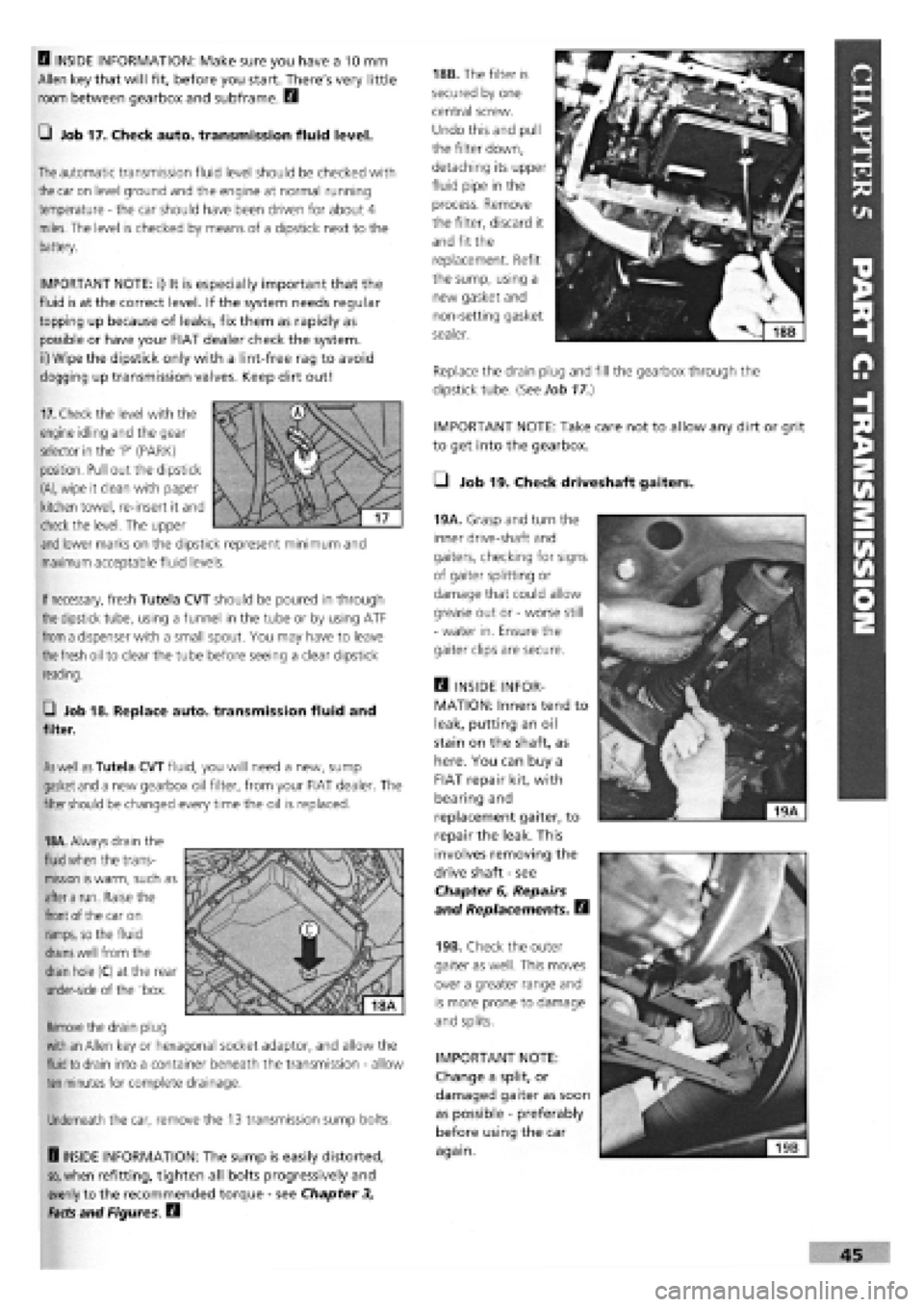
18B. The filter is
secured by one
central screw.
Undo this and pull
the filter down,
detaching its upper
fluid pipe in the
process. Remove
the filter, discard it
and fit the
replacement. Refit
the sump, using a
new gasket and
non-setting gasket
sealer.
Replace the drain plug and fill the gearbox through the
dipstick tube. {See Job
17.)
19A. Grasp and turn the
inner drive-shaft and
gaiters, checking for signs
of gaiter splitting or
damage that could allow
grease out or
-
worse still
-
water in. Ensure the
gaiter clips are secure.
Q INSIDE INFOR-
MATION: Inners tend to
leak, putting an oil
stain on the shaft, as
here. You can buy a
FIAT repair kit, with
bearing and
replacement gaiter, to
repair the leak. This
involves removing the
drive shaft
-
see
Chapter 6, Repairs
and Replacements. B
19B. Check the outer
gaiter as well. This moves
over a greater range and
is more prone to damage
and splits.
IMPORTANT NOTE:
Change a split, or
damaged gaiter as soon
as possible
-
preferably
before using the car
again.
If
necessary,
fresh Tutela CVT should be poured in through
the
dipstick tube, using a funnel in the tube or by using ATF
from
a dispenser with a small spout. You may have to leave
the fresh
oil to clear the tube before seeing a clear dipstick
reading.
G Job 18. Replace auto, transmission fluid and
filter.
As well as
Tutela CVT fluid, you will need a new, sump
gasket
and
a new gearbox oil filter, from your FIAT dealer. The
filter
should
be changed every time the oil is replaced.
18A.
Always drain the
fluid when
the trans-
mission
is
warm, such as
after a
run. Raise the
front
of the car on
ramps,
so the fluid
drains well
from the
drain
hole (C) at the rear
under-side of the 'box.
Remove
the drain plug
with an
Allen key or hexagonal socket adaptor, and allow the
fluid to
drain into a container beneath the transmission
-
allow
ten
minutes for complete drainage.
Underneath the car, remove the 13 transmission sump bolts.
H INSIDE INFORMATION: The sump is easily distorted,
so,
when refitting, tighten all bolts progressively and
evenly to the recommended torque
-
see Chapter 3,
Facts and Figures. B
17.
Check the level with the
engine idling and the gear
selector in the 'P' (PARK)
position. Pull out the dipstick
(A),
wipe it clean with paper
kitchen towel, re-insert it and
check the level. The upper
and
lower marks on the dipstick represent minimum and
maximum acceptable fluid levels.
Page 69 of 171
G Step 17: Now repeat this operation on the remaining
valves.
G Step 18: Wash the whole cylinder head again using
paraffin and an old brush, making sure that all traces of
grinding paste are removed, then dry off. Use compressed air
if
available.
SAFETY FIRST!
•
Treat
compressed air with respect. Always wear
goggles
to protect your eyes.
•
Never
allow the airline nozzle near any of the body Sep apertures.
H INSIDE INFORMATION! Check the height of the valve
springs against new ones if possible, but if not, compare
them with each other. If any are shorter than the others,
play safe and replace the complete set. They are bound
to have suffered fatigue which could cause premature
valve failure. H
G Step 19: To install the valves, start from one end.
Lubricate a valve stem with fresh engine oil and slide it in to its
guide.
G Step 20: Locate a new valve stem seal over the stem of
the valve
(if applicable) and push down into contact with the
guide. Position the seal on its seat using a suitable metal tube.
G Step 21: Refit the flat washer and spring seat.
G Step 22: Position the inner and outer springs and the
spring
cap.
G Step 23: Re-apply the valve spring compressor and
compress
the springs enough to allow you to engage the split
collets
in
the stem grooves.
D INSIDE INFORMATION! Grease the grooves so that the
collets will 'stick' in place. The collets are easily fitted by
'sticking' the backs of them onto the end of a screw-
driver with some grease and feeding them into
position. B
G Step 24: Carefully release the spring compressor and
check
that the collets are correctly located. Tap the end of the
stem with
a hammer, to bed them in.
G Step 25: Fit the remaining valves.
Job 5. Petrol engine -
dismantling.
G Step 1: Familiarise yourself with the layout of the engine.
Refer to
illustration Job
2-1
for an exploded view of the
engine
components.
G Step 2: Drain the engine oil. Remove the cylinder head.
See
Job 2.
G Step 3: Remove the distributor. See PART D: IGNITION
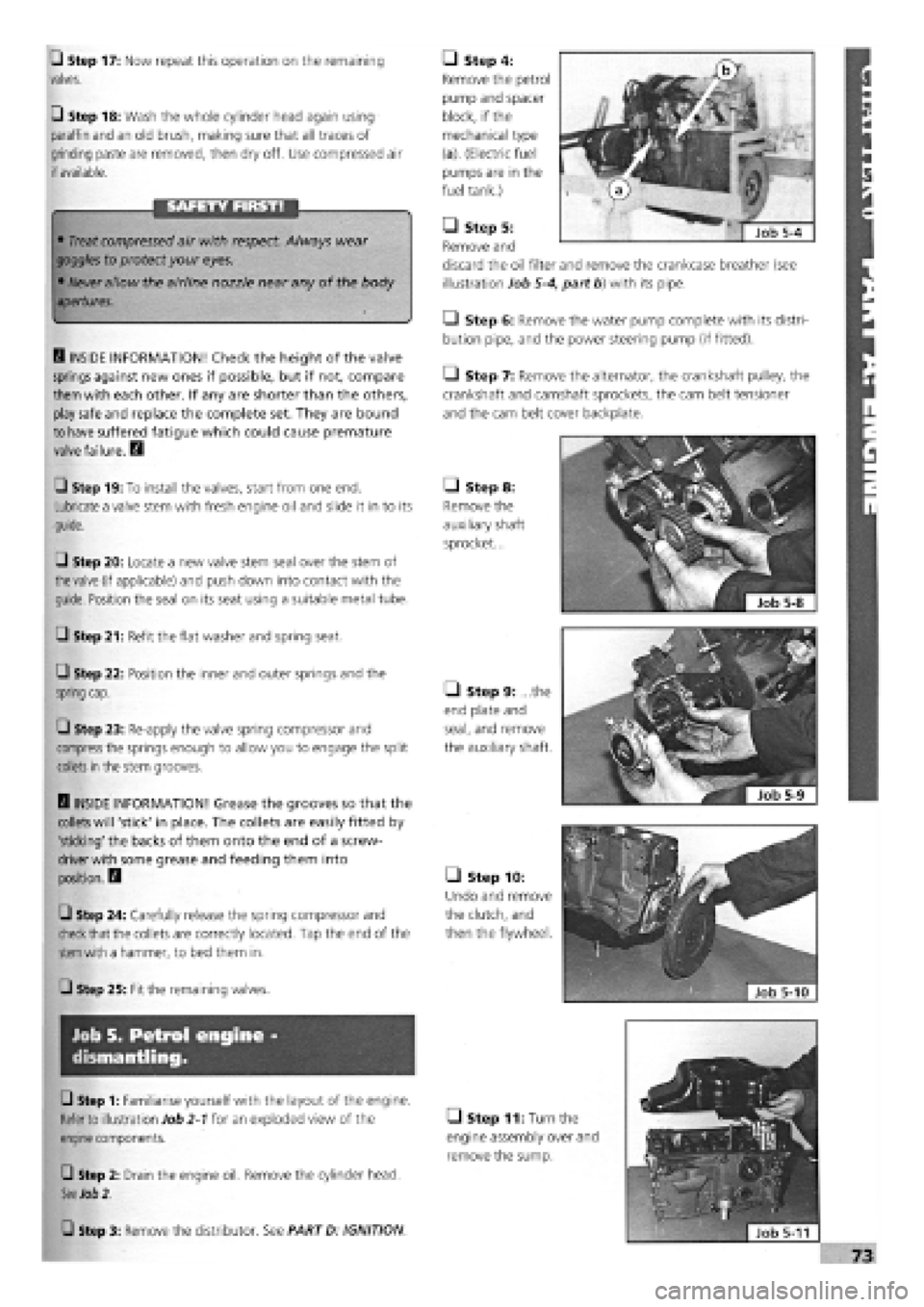
• Step 4:
Remove the petrol
pump and spacer
block, if the
mechanical type
(a). (Electric fuel
pumps are in the
fuel tank.)
• Step 5:
Remove and
discard the oil filter
illustration Job
5-4,
• Step 6: Remove the water pump complete with its distri-
bution pipe, and the power steering pump (if fitted).
Q Step 7: Remove the alternator, the crankshaft pulley, the
crankshaft and camshaft sprockets, the cam belt tensioner
and the cam belt cover backplate.
• Step 8:
Remove the
auxiliary shaft
sprocket...
• Step 9: ...the
end plate and
seal, and remove
the auxiliary shaft.
• Step 10:
Undo and remove
the clutch, and
then the flywheel.
• Step 11: Turr
engine assembly c
remove the sump
and remove the crankcase breather (see
part b) with its pipe.
Page 71 of 171
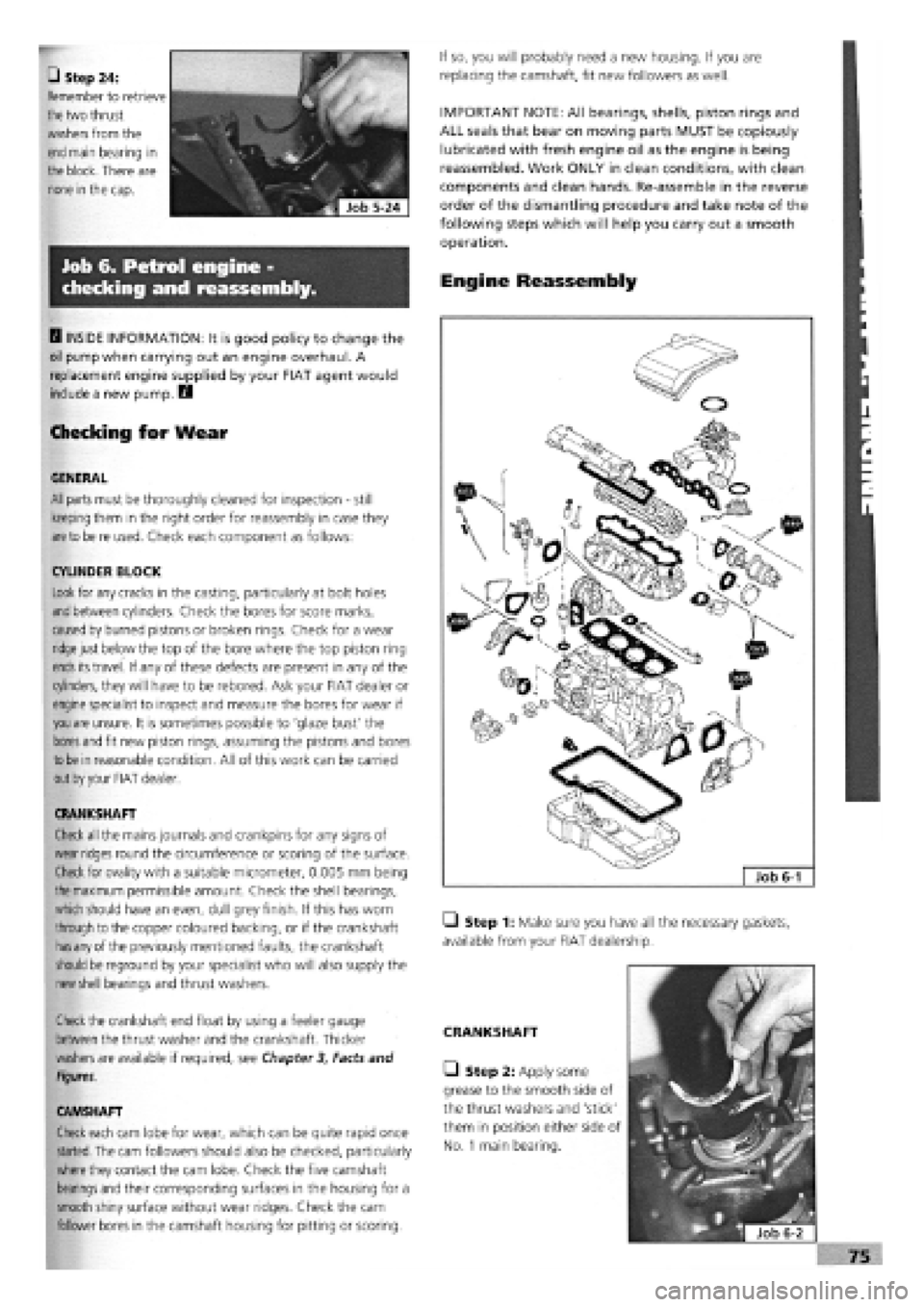
• Step 24:
Remember to retrieve
the
two thrust
washers from the
end
main bearing in
the block. There are
none in the cap.
If so, you will probably need a new housing. If you are
replacing the camshaft, fit new followers as well.
IMPORTANT NOTE: All bearings, shells, piston rings and
ALL seals that bear on moving parts MUST be copiously
lubricated with fresh engine oil as the engine is being
reassembled. Work ONLY in clean conditions, with clean
components and clean hands. Re-assemble in the reverse
order of the dismantling procedure and take note of the
following steps which will help you carry out a smooth
operation.
Engine Reassembly lob 6. Petrol engine -
checking and reassembly.
Q INSIDE INFORMATION: It is good policy to change the
oil pump when carrying out an engine overhaul. A
replacement engine supplied by your FIAT agent would
include a new pump. D
Checking for Wear
GENERAL
All parts must be thoroughly cleaned for inspection
-
still
keeping them in the right order for reassembly in case they
are to
be re used. Check each component as follows:
CYLINDER BLOCK
Look
for any cracks in the casting, particularly at bolt holes
and
between cylinders. Check the bores for score marks,
caused by burned pistons or broken rings. Check for a wear
ridge just
below the top of the bore where the top piston ring
ends its
travel. If any of these defects are present in any of the
cylinders, they will have to be rebored. Ask your FIAT dealer or
engine
specialist to inspect and measure the bores for wear if
you
are unsure. It is sometimes possible to 'glaze bust' the
bores and
fit new piston rings, assuming the pistons and bores
to be in
reasonable condition. All of this work can be carried
out by
your FIAT dealer.
CRANKSHAFT
Check
all
the mains journals and crankpins for any signs of
wear ridges round the circumference or scoring of the surface.
Check
for ovality with a suitable micrometer, 0.005 mm being
the maximum
permissible amount. Check the shell bearings,
which
should have an even, dull grey finish. If this has worn
through
to the copper coloured backing, or if the crankshaft
has any
of the previously mentioned faults, the crankshaft
should
be reground by your specialist who will also supply the
new shell
bearings and thrust washers.
Check
the crankshaft end float by using a feeler gauge
between the thrust washer and the crankshaft. Thicker
washers
are available if required, see Chapter
3,
Facts and
Figures.
CAMSHAFT
Check each cam lobe for wear, which can be quite rapid once
started. The cam followers should also be checked, particularly
where
they contact the cam lobe. Check the five camshaft
bearings
and their corresponding surfaces in the housing for a
smooth
shiny surface without wear ridges. Check the cam
follower bores in the camshaft housing for pitting or scoring.
Job 6-1
Q Step 1: Make sure you have all the necessary gaskets,
available from your FIAT dealership.
CRANKSHAFT
• Step 2: Apply some
grease to the smooth side of
the thrust washers and 'stick'
them in position either side of
No. 1 main bearing.
Page 75 of 171
G Step 43: Stop the engine and allow it to cool, check the
oil
and coolant levels and look for any leaks.
G Step 44: Avoid over-rewing or overloading the engine
during its settling down period of 600 miles. We recommend
an oil
and filter change at this mileage
-
this will help to
extend the life of your new engine.
Job 7. Petrol engine.
Valve clearances - adjustment.
0 INSIDE INFORMATION! Adjustment should always be
made with the engine cold. B
G Step 1: Remove the camshaft cover and the spark plugs.
Jack up a front wheel and engage top gear. Turning the wheel
will rotate the engine and therefore the camshaft. If the
engine
is
out of the car, use a socket and long lever on the
crankshaft pulley nut. If the cylinder head is detached, turn
the
camshaft belt sprocket, by hand.
G Step 2: The inlet and exhaust valves use different clear-
ances
which are checked when each cam lobe is pointing
directly away from its follower. See Chapter
3,
Facts and
Figures.
G Step 3: The order in which the valves are fitted in the
cylinder head is:
Inlet: 2-3-6-7
Exhaust: 1-4-5-8
from
the timing cover end.
G Step 4: Select a feeler blade which is about the thickness
of the
correct valve clearance and insert it between the heel of
the cam
and the cam follower shim when the cam lobe is
uppermost. If necessary, select different thicknesses of feeler
blade until a small amount of drag can be felt as the blade is
pushed in and out. Record the total blade thickness. This is the
valve clearance for this valve.
G Step 5: Rotate the camshaft and repeat this operation on
each
of the remaining seven valves, noting their respective
clearances. Those which have clearances within limits
obviously don't need any further attention.
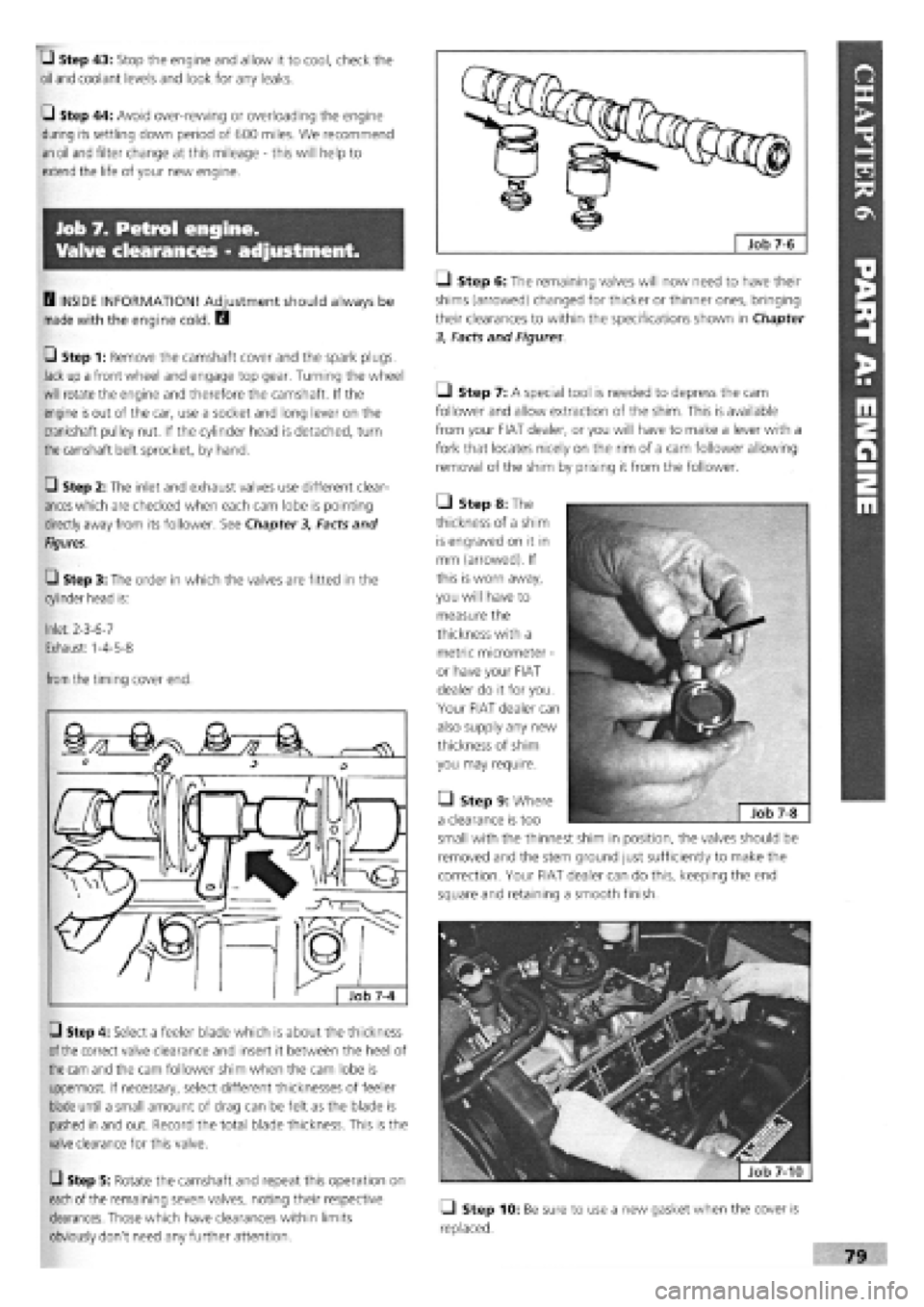
Q Step 6: The remaining valves will now need to have their
shims (arrowed) changed for thicker or thinner ones, bringing
their clearances to within the specifications shown in Chapter
3, Facts and Figures
Ll Step 7: A special tool is needed to depress the cam
follower and allow extraction of the shim. This is available
from your FIAT dealer, or you will have to make a lever with a
fork that locates nicely on the rim of a cam follower allowing
removal of the shim by prising it from the follower.
• Step 8: The
thickness of a shim
is engraved on it in
mm (arrowed). If
this is worn away,
you will have to
measure the
thickness with a
metric micrometer
-
or have your FIAT
dealer do it for you.
Your FIAT dealer can
also supply any new
thickness of shim
you may require.
• Step 9: Where
a clearance is too
small with the thinnest shim in position, the valves should be
removed and the stem ground just sufficiently to make the
correction. Your FIAT dealer can do this, keeping the end
square and retaining a smooth finish.
fjfefe^ | Job 7-10
Q Step 10: Be sure to use a new gasket when the cover is
replaced.
Page 82 of 171
PART A
-
ENGINES PRIOR TO ENGINE NO. 1723291 • Step A15: Ease the timing belt off the sprockets.
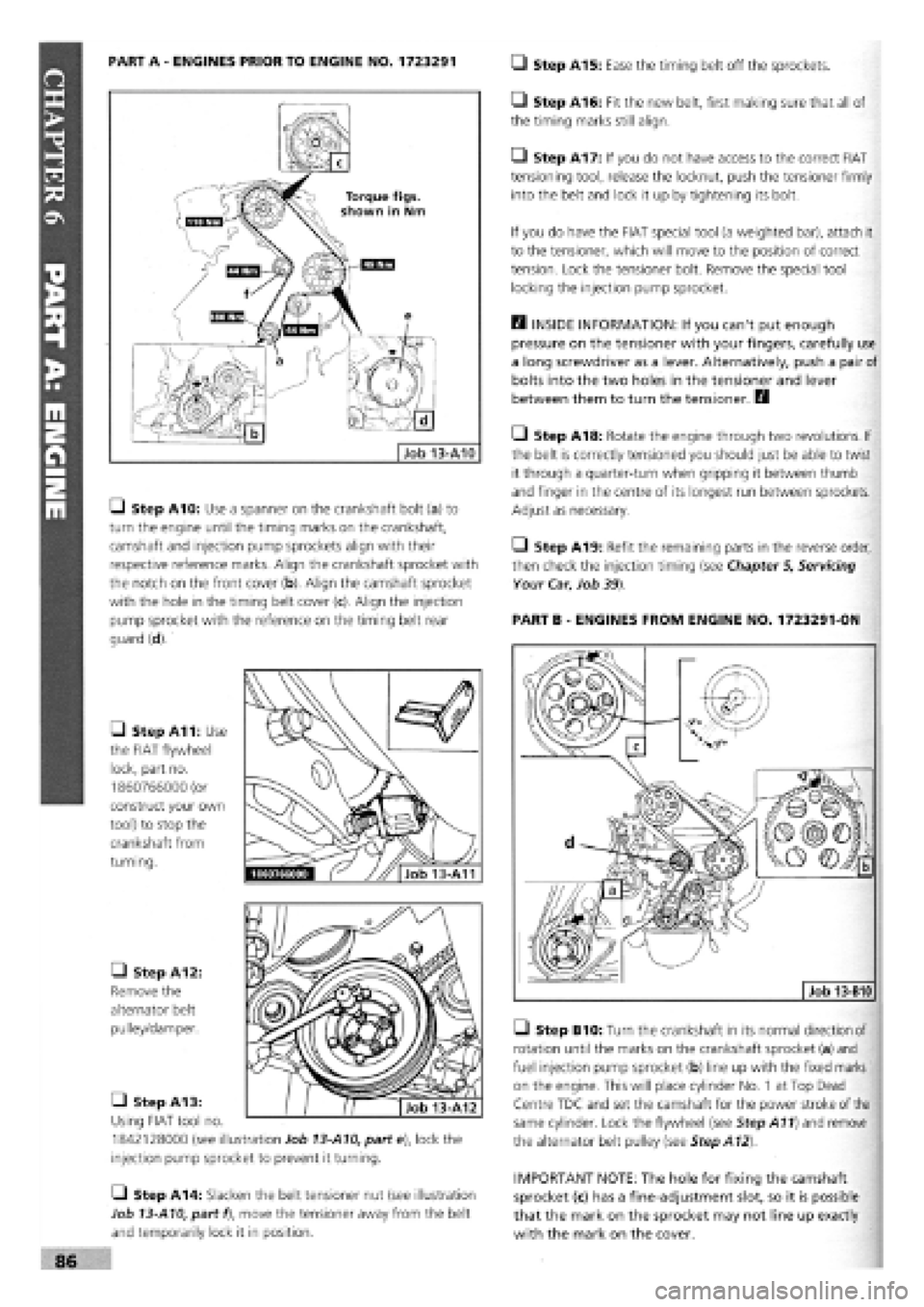
Gl Step A10: Use a spanner on the crankshaft bolt (a) to
turn the engine until the timing marks on the crankshaft,
camshaft and injection pump sprockets align with their
respective reference marks. Align the crankshaft sprocket with
the notch on the front cover (b). Align the camshaft sprocket
with the hole in the timing belt cover (c). Align the injection
pump sprocket with the reference on the timing belt rear
guard (d).
• Step A11: Use
the FIAT flywheel
lock, part no.
1860766000 (or
construct your own
tool) to stop the
crankshaft from
turning.
• Step A12:
Remove the
alternator belt
pulley/damper.
• Step A13:
Using FIAT tool no.
1842128000 (see illustration Job
13-A10,
parte), lock the
injection pump sprocket to prevent it turning.
• Step A14: Slacken the belt tensioner nut (see illustration
Job
13-A10,
part f), move the tensioner away from the belt
and temporarily lock it in position.
• Step A16: Fit the new belt, first making sure that all of
the timing marks still align.
• Step A17: If you do not have access to the correct FIAT
tensioning tool, release the locknut, push the tensioner firmly
into the belt and lock it up by tightening its bolt.
If you do have the FIAT special tool (a weighted bar), attach it
to the tensioner, which will move to the position of correct
tension. Lock the tensioner bolt. Remove the special tool
locking the injection pump sprocket.
E3 INSIDE INFORMATION: If you can't put enough
pressure on the tensioner with your fingers, carefully use
a long screwdriver as a lever. Alternatively, push a pair of
bolts into the two holes in the tensioner and lever
between them to turn the tensioner. E9
Q Step A18: Rotate the engine through two revolutions. If
the belt is correctly tensioned you should just be able to twist
it through a quarter-turn when gripping it between thumb
and finger in the centre of its longest run between sprockets.
Adjust as necessary.
Q Step A19: Refit the remaining parts in the reverse order,
then check the injection timing (see Chapter
5,
Servicing
Your Car, Job
39)
PART B
-
ENGINES FROM ENGINE NO. 1723291-ON
Job 13-B10
Q Step B10: Turn the crankshaft in its normal direction of
rotation until the marks on the crankshaft sprocket (a) and
fuel injection pump sprocket (b) line up with the fixed marks
on the engine. This will place cylinder No. 1 at Top Dead
Centre TDC and set the camshaft for the power stroke of the
same cylinder. Lock the flywheel (see Step A11) and remove
the alternator belt pulley (see Step A12).
IMPORTANT NOTE: The hole for fixing the camshaft
sprocket (c) has a fine-adjustment slot, so it is possible
that the mark on the sprocket may not line up exactly
with the mark on the cover.
Page 85 of 171
SAFETY FIRST!
• The cylinder head is heavy and should be lifted from
the engine bay by two people.
Job 15. Diesel engine.
Cylinder head - refitting.
• Step 1: Put the
pistons at TDC
-
two
at a time
-
and
measure how much
they protrude above
the block surface.
This is ideally done
using a dial gauge
and holder (FIAT tools
1895882000 and
1870404000, respec-
tively) but if surfaces
• Step 15:
Unbolt the inlet
and
exhaust
manifold bolts...
• Step 16:
...and remove the
manifolds.
• Step 17:
Unscrew the
twelve bolts
and
remove
the cam
cover.
• Step 18:
Unbolt the cylinder
head (removing
the oil pipes, if
fitted)...
• Step 20: Not
forgetting the row
of five smaller,
outer bolts.
• Step 13:
Remove the bolt
securing the dipstick
tube (arrowed) and
the bolts fixing the
rear timing belt cover
to
the injection
pump support
bracket (arrowed).
Also, remove the
dipstick tube, if fitted
to the
support
bracket.
• Step 14: Undo
the
three exhaust
flange nuts (arrowed)
and
remove the
springs
from behind
them. Separate the
pipe from
the
manifold.
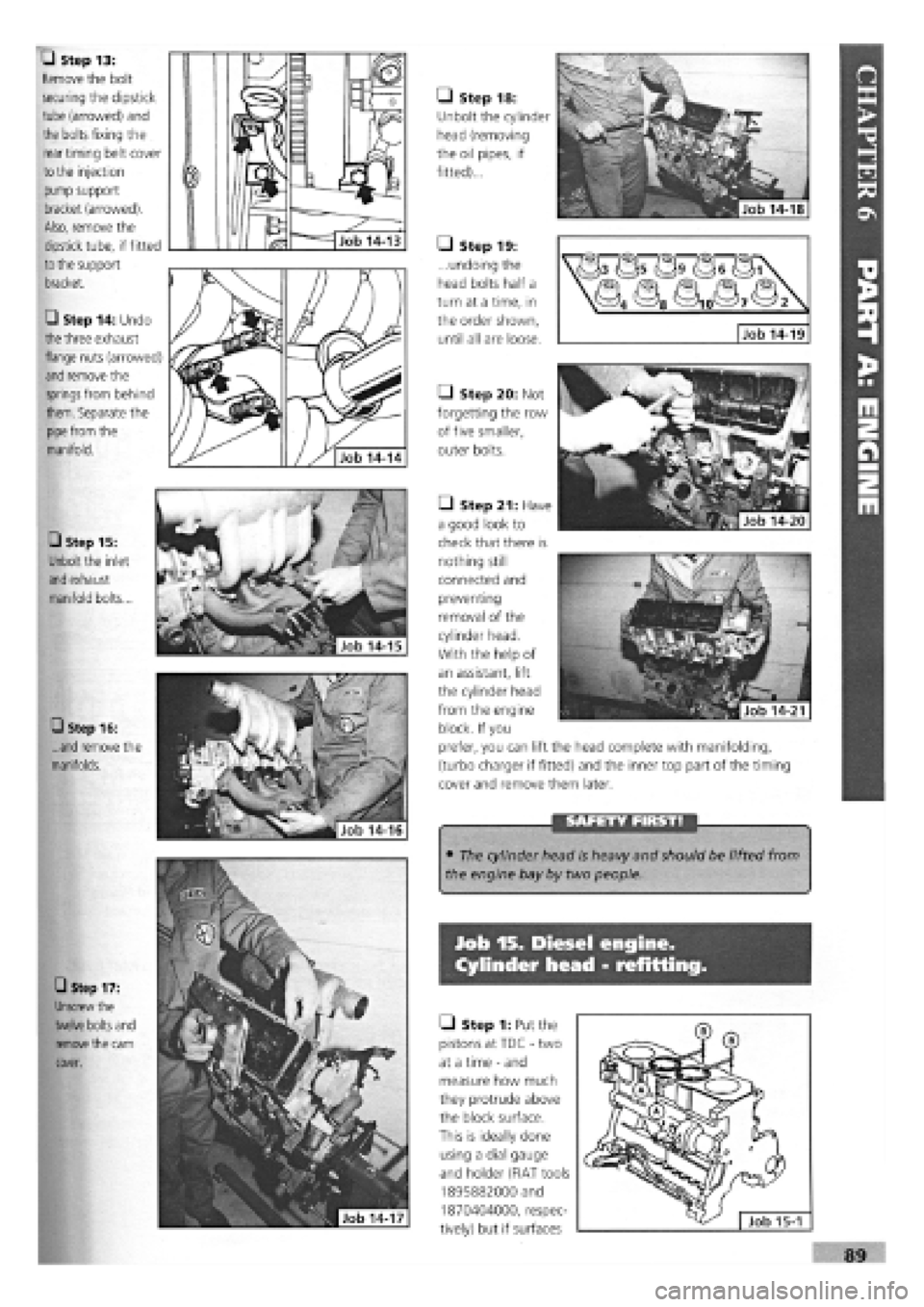
• Step 19:
...undoing the
head bolts half a
turn at a time, in
the order shown,
until all are loose. Job 14-19
• Step 21: Have
a good look to
check that there is
nothing still
connected and
preventing
removal of the
cylinder head.
With the help of
an assistant, lift
the cylinder head
from the engine
block. If you
prefer, you can lift the head complete with manifolding,
(turbo charger if fitted) and the inner top part of the timing
cover and remove them later.
Page 88 of 171
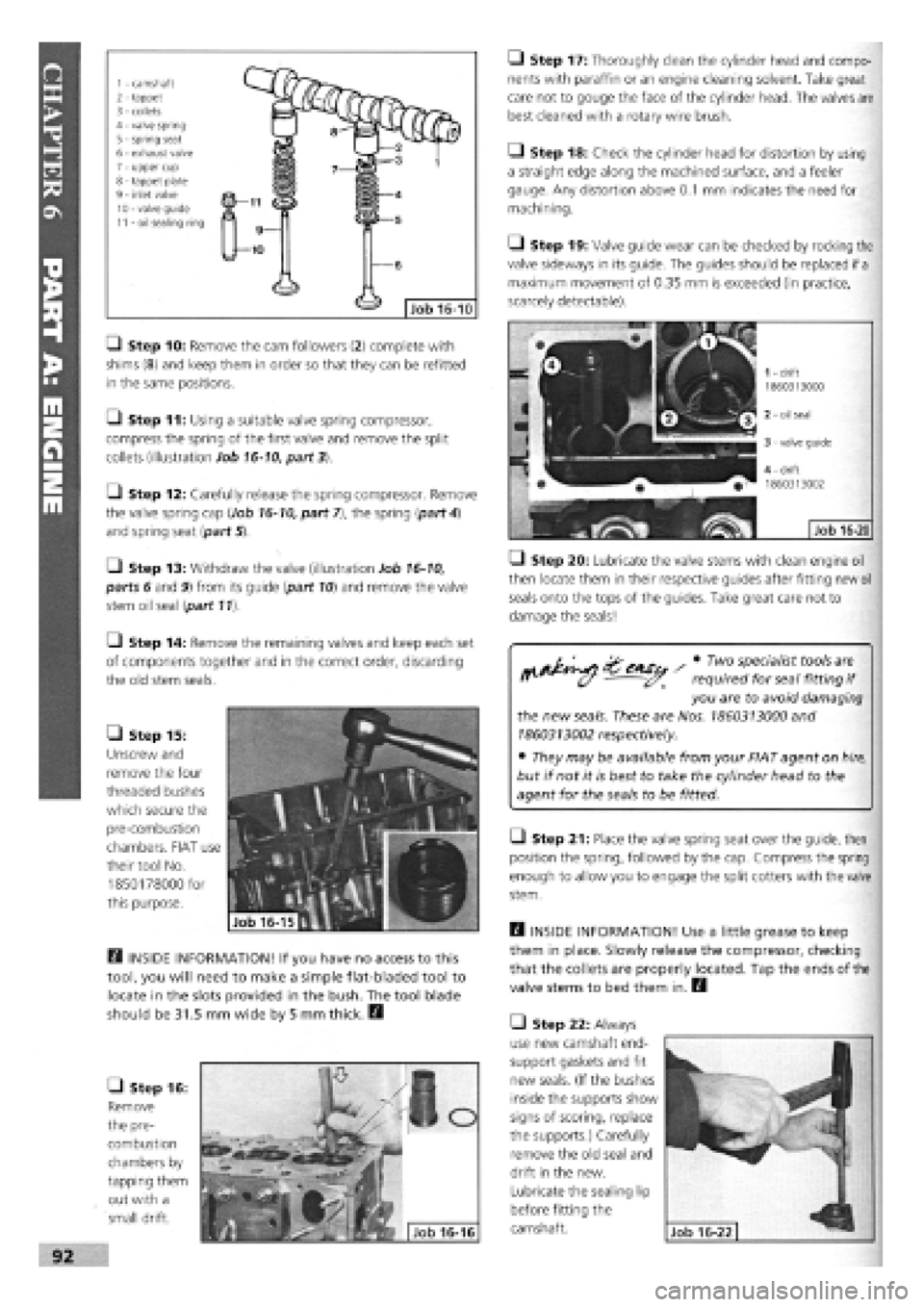
1 - camshaft 2 - tappet 3 - collets 4 - valve spring 5
-
spring seat 6 - exhaust valve 7 - upper cup 8 - tappet plate 9 - inlet valve 10 - valve guide 11 - oil sealing ring
• Step 10: Remove the cam followers (2) complete with
shims
(8)
and keep them in order so that they can be refitted
in the same positions.
O Step 11: Using a suitable valve spring compressor,
compress the spring of the first valve and remove the split
collets (illustration Job
16-10,
part 3).
[J Step 12: Carefully release the spring compressor. Remove
the valve spring cap (Job
16-10,
part 7), the spring {part
4)
and spring seat {part 5).
•
Step 13: Withdraw the valve (illustration Job
16-10,
parts 6 and 9) from its guide {part
10)
and remove the valve
stem oil seal {part 11).
Q Step 14: Remove the remaining valves and keep each set
of components together and in the correct order, discarding
the old stem seals.
• Step 15:
Unscrew and
remove the four
threaded bushes
which secure the
pre-combustion
chambers. FIAT use
their tool No.
1850178000 for
this purpose.
Q INSIDE INFORMATION! If you have no access to this
tool, you will need to make a simple flat-bladed tool to
locate in the slots provided in the bush. The tool blade
should be 31.5 mm wide by 5 mm thick. B
• Step 16:
Remove
the pre-
combustion
chambers by
tapping them
out with a
small drift.
Q Step 17: Thoroughly clean the cylinder head and compo-
nents with paraffin or an engine cleaning solvent. Take great
care not to gouge the face of the cylinder head. The valves are
best cleaned with a rotary wire brush.
• Step 18: Check the cylinder head for distortion by using
a straight edge along the machined surface, and a feeler
gauge. Any distortion above
0.1
mm indicates the need for
machining.
Q Step 19: Valve guide wear can be checked by rocking the
valve sideways in its guide. The guides should be replaced if
a
maximum movement of 0.35 mm is exceeded (in practice,
scarcely detectable).
• Step 20: Lubricate the valve stems with clean engine oil
then locate them in their respective guides after fitting new
oil
seals onto the tops of the guides. Take great care not to
damage the seals!
^ ^^iSu / * TW°
VfaliSt*?0lS
"'I
f' (y - required for seal fitting
if
you are to avoid damaging
the new
seals.
These are Nos.
1860313000
and
1860313002
respectively.
• They may be available from your FIAT agent on
hire,
but if not it is best to take the cylinder head to the
agent for the seals to be fitted.
Q Step 21: Place the valve spring seat over the guide, then
position the spring, followed by the cap. Compress the spring
enough to allow you to engage the split cotters with the valve
stem.
Q INSIDE INFORMATION! Use a little grease to keep
them in place. Slowly release the compressor, checking
that the collets are properly located. Tap the ends of the
valve stems to bed them in. B
• Step 22: Always
use new camshaft end-
support gaskets and fit
new seals. (If the bushes
inside the supports show
signs of scoring, replace
the supports.) Carefully
remove the old seal and
drift in the new.
Lubricate the sealing lip
before fitting the
camshaft.
Page 115 of 171
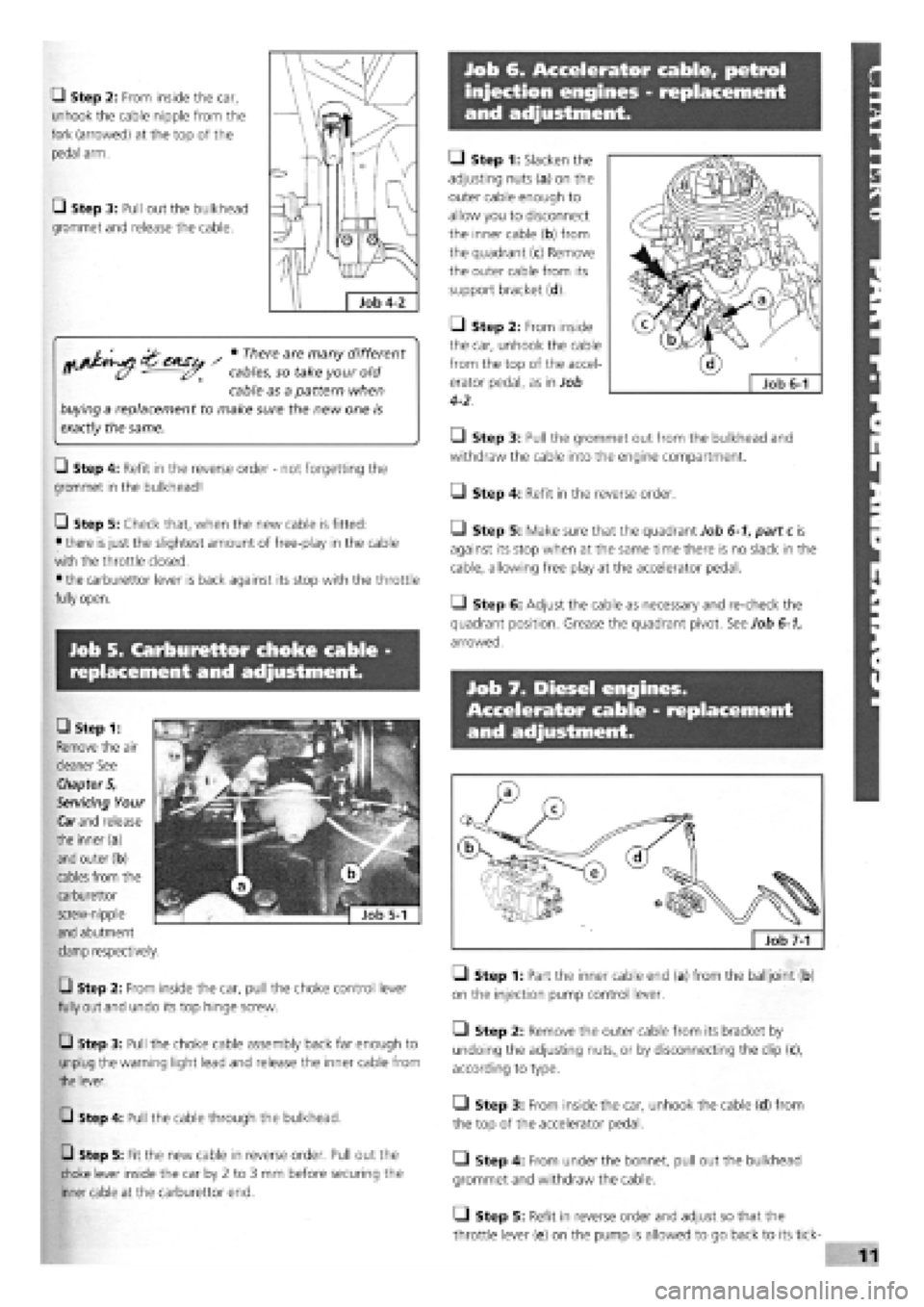
Job 6. Accelerator cable, petrol
injection engines - replacement
and adjustment.
Q Step 2: From inside the car,
unhook the cable nipple from the
fork (arrowed) at the top of the
pedal arm.
• Step 3: Pull out the bulkhead
grommet and release the cable.
^ • There are many different
cables, so take your old
cable as a pattern when
buying a replacement to make sure the new one is
exactly
the same.
Q Step 4: Refit in the reverse order
-
not forgetting the
grommet in the bulkhead!
Q Step 5: Check that, when the new cable is fitted:
• there
is
just the slightest amount of free-play in the cable
with the throttle closed.
• the carburettor lever is back against its stop with the throttle
fully open.
• Step 1: Slacken the
adjusting nuts (a) on the
outer cable enough to
allow you to disconnect
the inner cable (b) from
the quadrant (c) Remove
the outer cable from its
support bracket (d).
Q Step 2: From inside
the car, unhook the cable
from the top of the accel-
erator pedal, as in Job
4-2.
• Step 3: Pull the grommet out from the bulkhead and
withdraw the cable into the engine compartment.
O Step 4: Refit in the reverse order.
• Step 5: Make sure that the quadrant Job 6-1, part c is
against its stop when at the same time there is no slack in the
cable, allowing free play at the accelerator pedal.
• Step 6: Adjust the cable as necessary and re-check the
quadrant position. Grease the quadrant pivot. See Job 6-1,
arrowed.
Job 7. Diesel engines.
Accelerator cable - replacement
and adjustment.
Job 5. Carburettor choke cable -
replacement and adjustment.
Q Step 2: From inside the car, pull the choke control lever
fully out and undo its top hinge screw.
Q Step 3: Pull the choke cable assembly back far enough to
unplug the warning light lead and release the inner cable from
the lever.
Q Step 4: Pull the cable through the bulkhead.
Q Step 5: Fit the new cable in reverse order. Pull out the
choke lever inside the car by 2 to 3 mm before securing the
inner cable at the carburettor end.
Q Step 1: Part the inner cable end (a) from the balljoint (b)
on the injection pump control lever.
• Step 2: Remove the outer cable from its bracket by
undoing the adjusting
nuts,,
or by disconnecting the clip (c),
according to type.
• Step 3: From inside the car, unhook the cable (d) from
the top of the accelerator pedal.
• Step 4: From under the bonnet, pull out the bulkhead
grommet and withdraw the cable.
Q Step 5: Refit in reverse order and adjust so that the
throttle lever (e) on the pump is allowed to go back to its tick-
CD Step 1:
Remove the air
cleaner See
Chapter 5,
Servicing Your
Car
and
release
the inner(a)
and outer (b)
cables from the
carburettor
screw-nipple
and abutment
clamp respectively.