clock FIAT TEMPRA 1988 Service And User Guide
[x] Cancel search | Manufacturer: FIAT, Model Year: 1988, Model line: TEMPRA, Model: FIAT TEMPRA 1988Pages: 171, PDF Size: 18.05 MB
Page 62 of 171
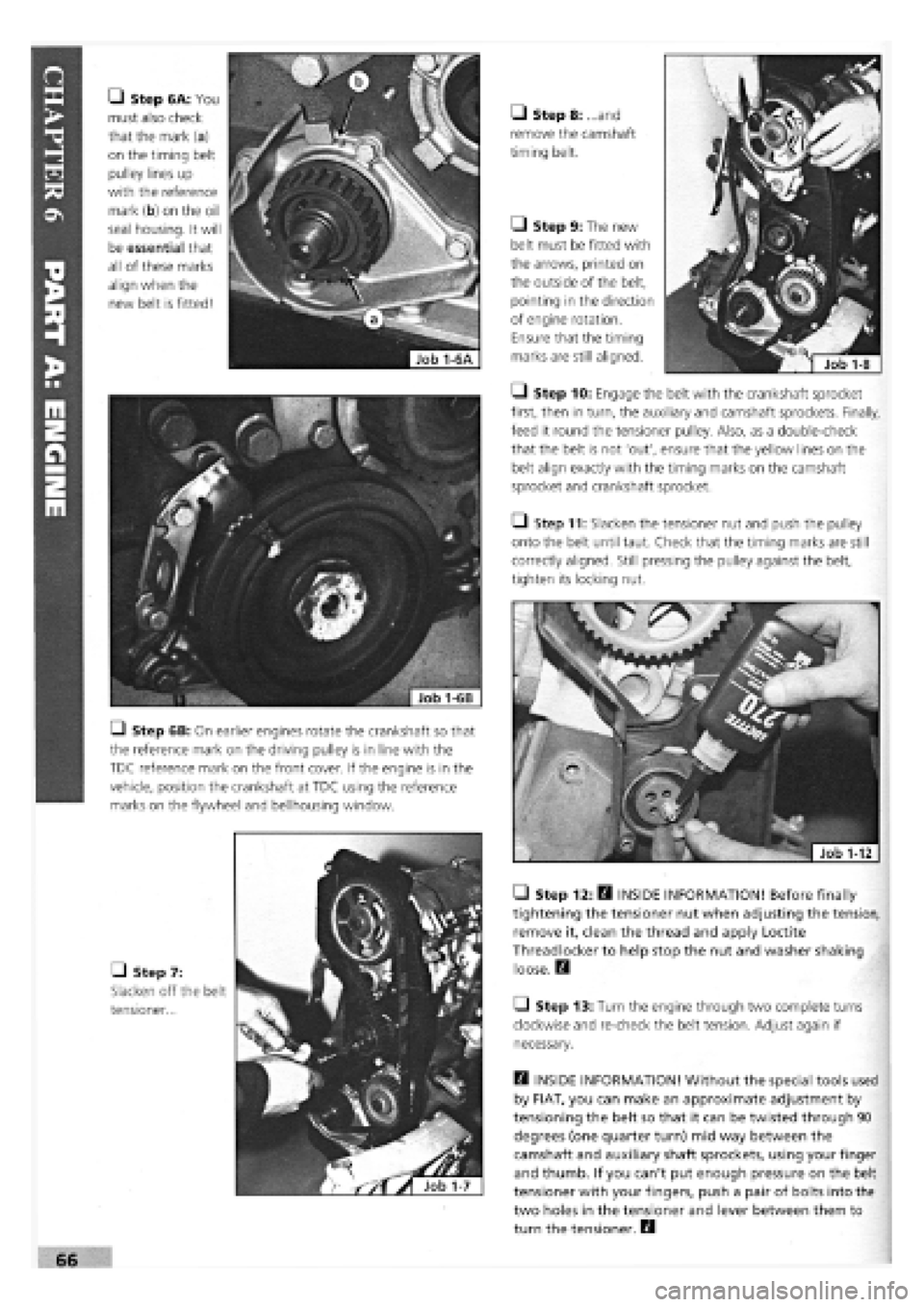
• Step 6A: You
must also check
that the mark (a)
on the timing belt
pulley lines up
with the reference
mark (b) on the oil
seal housing. It will
be essential that
all of these marks
align when the
new belt is fitted!
Q Step 6B: On earlier engines rotate the crankshaft so that
the reference mark on the driving pulley is in line with the
TDC reference mark on the front cover. If the engine is in the
vehicle, position the crankshaft at TDC using the reference
marks on the flywheel and bellhousing window.
• Step 7:
Slacken off the belt
tensioner...
• Step 8: ...and
remove the camshaft
timing belt.
Q Step 9: The new
belt must be fitted with
the arrows, printed on
the outside of the belt,
pointing in the direction
of engine rotation.
Ensure that the timing
marks are still aligned.
• Step 10: Engage the belt with the crankshaft sprocket
first, then in turn, the auxiliary and camshaft sprockets. Finally,
feed it round the tensioner pulley. Also, as a double-check
that the belt is not 'out', ensure that the yellow lines on the
belt align exactly with the timing marks on the camshaft
sprocket and crankshaft sprocket.
Q Step 11: Slacken the tensioner nut and push the pulley
onto the belt until taut. Check that the timing marks are still
correctly aligned. Still pressing the pulley against the belt,
tighten its locking nut.
• Step 12: H INSIDE INFORMATION! Before finally
tightening the tensioner nut when adjusting the tension,
remove it, clean the thread and apply Loctite
Threadlocker to help stop the nut and washer shaking
loose. Q
Q Step 13: Turn the engine through two complete turns
clockwise and re-check the belt tension. Adjust again if
necessary.
Q INSIDE INFORMATION! Without the special tools used
by FIAT, you can make an approximate adjustment by
tensioning the belt so that it can be twisted through 90
degrees (one quarter turn) mid way between the
camshaft and auxiliary shaft sprockets, using your finger
and thumb. If you can't put enough pressure on the belt
tensioner with your fingers, push a pair of bolts into the
two holes in the tensioner and lever between them to
turn the tensioner. B
Page 83 of 171
Q Step B11: Undo the belt tensioner nut (see illustration
Job 13-B10, part d), then remove the timing belt.
Q Step B12: Undo the nuts securing the brake vacuum
pump to the cylinder head (see illustration Job
16-1),
and
remove it.
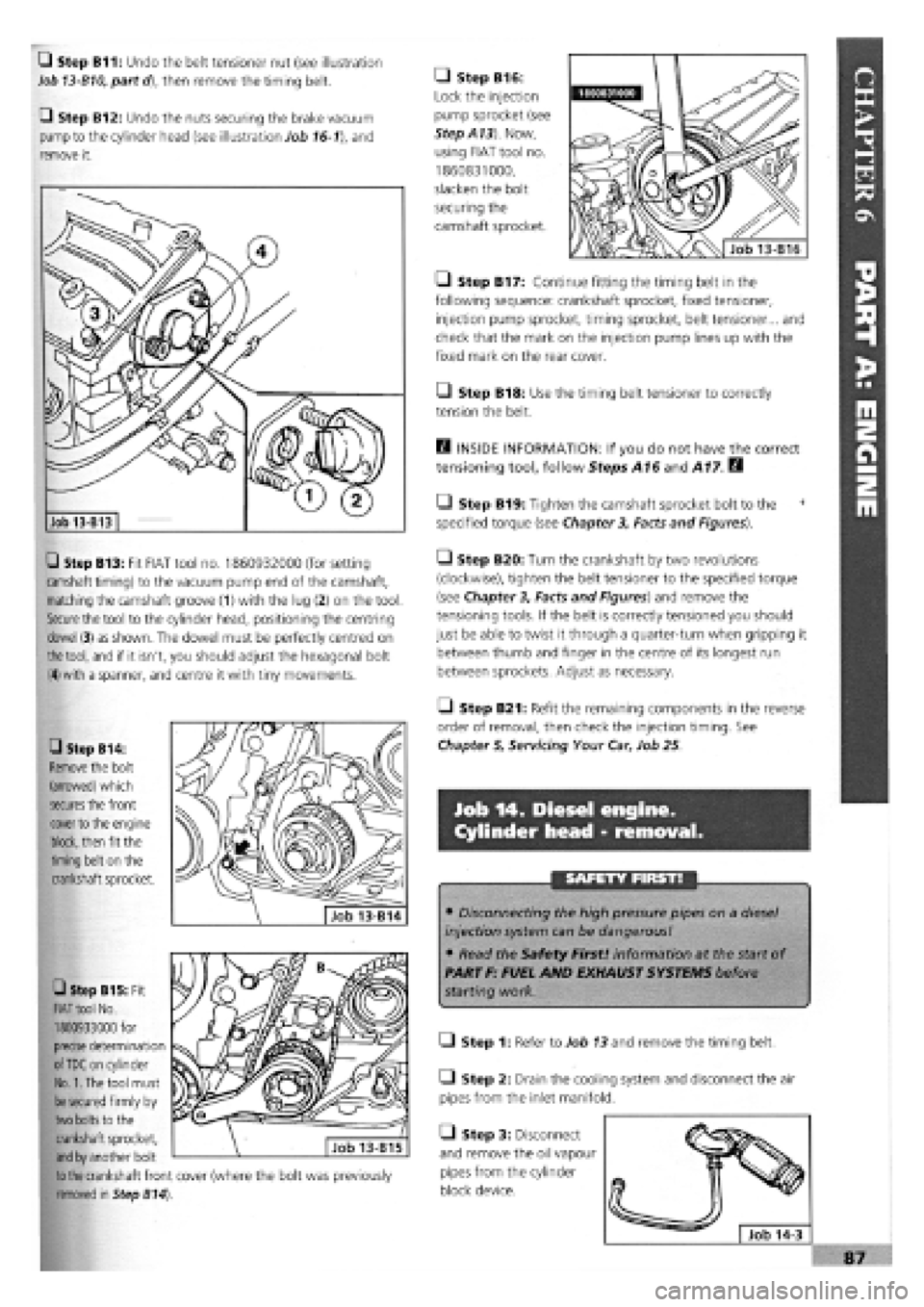
• Step B13: Fit FIAT tool no. 1860932000 (for setting
camshaft timing) to the vacuum pump end of the camshaft,
matching the camshaft groove (1) with the lug (2) on the tool
Secure
the tool to the cylinder head, positioning the centring
dowel
(3) as shown. The dowel must be perfectly centred on
the tool,
and if it isn't, you should adjust the hexagonal bolt
(4) with
a spanner, and centre it with tiny movements.
• Step B14:
Remove
the bolt
(arrowed) which
secures
the front
cover
to the engine
block,
then fit the
timing belt on the
crankshaft sprocket.
• Step B16:
Lock the injection
pump sprocket (see
StepA13). Now,
using FIAT tool no.
1860831000,
slacken the bolt
securing the
camshaft sprocket.
• Step B17: Continue fitting the timing belt in the
following sequence: crankshaft sprocket, fixed tensioner,
injection pump sprocket, timing sprocket, belt tensioner... and
check that the mark on the injection pump lines up with the
fixed mark on the rear cover.
• Step B18: Use the timing belt tensioner to correctly
tension the belt.
B INSIDE INFORMATION: If you do not have the correct
tensioning tool, follow Steps A16 and A17. B
• Step B19: Tighten the camshaft sprocket bolt to the 1
specified torque (see Chapter
3,
Facts and Figures).
Q Step B20: Turn the crankshaft by two revolutions
(clockwise), tighten the belt tensioner to the specified torque
(see Chapter
3,
Facts and Figures) and remove the
tensioning tools. If the belt is correctly tensioned you should
just be able to twist it through a quarter-turn when gripping it
between thumb and finger in the centre of its longest run
between sprockets. Adjust as necessary.
O Step B21: Refit the remaining components in the reverse
order of removal, then check the injection timing. See
Chapter
5,
Servicing Your Car, Job 25.
Job 14. Diesel engine.
Cylinder head - removal.
• Disconnecting the high pressure pipes on a diesel
injection system can be dangerous!
• Read the Safety First! information at the start of
PART F: FUEL AND EXHAUST SYSTEMS before
starting work.
Q Step 1: Refer to Job
13
and remove the timing belt.
• Step 2: Drain the cooling system and disconnect the air
pipes from the inlet manifold.
Q Step 3: Disconnect
and remove the oil vapour
pipes from the cylinder
block device.
Job 13-B13
• Step B15: Fit
FIAT tool
No.
1860933000 for
precise
determination
of TDC
on cylinder
No. 1. The
tool must
be secured
firmly by
two bolts
to the
crankshaft sprocket,
and by
another bolt
to the
crankshaft front cover (where the bolt was previously
removed in Step B14).
Page 91 of 171
Q Step 2: Before starting the engine, make sure all your
electrical connections are sound and your fuel, oil and coolant
connections are correct and secure.
Q Step 3: Run the engine to working temperature and then
allow to cool. Re-check all fluid levels.
Job 20. Diesel engine.
Mountings - replacement.
See
Job
12
and Job
18,
Step 20
Job 21. Diesel engine/
transmission (removed from car)
- separation.
Q Step 1: Remove the starter motor.
• Step 2: On the turbo version, undo the flange bolts see
Job
18,
Step 16A and withdraw the drive-shaft extension, if
still
fitted.
Q Step 3: Unbolt and remove the rear engine plate and the
gearbox, being careful to support the gearbox weight as it is
withdrawn.
Job 22. Diesel engine/
transmission (removed from car)
- reconnection.
Q Step 1: Before proceeding, check the condition of the
clutch and
its release mechanism. Make sure the driven plate
is
properly centred on the flywheel
-
see PART B: TRANS-
MISSION.
Q Step 2: Now reverse the order of separation, but be
careful when
engaging the gearbox input shaft with the
clutch
driven plate that you don't 'hang' its weight on the
splines.
Also,
see
Job 11.
Job 23. Diesel engine -
dismantling.
This Job should
be read in conjunction with Job 5 The
engines are
broadly similar although the information given in
this Job takes
priority for diesel engines. It is MOST
IMPORTANT that you read the FACT FILE on page 84.
SAFETY FIRST!
•
The inside
of diesel engines are particularly filthy
places!
•
Old diesel
oil
is
carcinogenic!
•
Wear suitable
impervious gloves!
I
• Step 1: Remove the timing belt and cylinder head. See
Jobs
13
and 14.
Q Step 2: Remove the alternator, water pump and
thermostat housing distribution pipe.
• Step 3: Remove the crankshaft timing belt sprocket.
Q INSIDE INFORMATION! Note that the bolt securing
the crankshaft sprocket has a left-hand thread and must
be undone clockwise. D
• Step 4: Unbolt the timing belt tensioner and idler pulleys.
• Step 5: Remove the injection pump sprocket.
Q INSIDE INFORMATION! You will need two FIAT tools
for this operation. One (No. 1860473000) is to prevent
the sprocket from turning when undoing the nut, and
the other (extractor No. 1842128000) to pull the sprocket
from the injection pump shaft. Alternatively it may be
possible to improvise a means of preventing sprocket
rotation, and a suitable three-leg puller may be carefully
used to withdraw the sprocket. Take care not to lose the
pump shaft Woodruff key. B
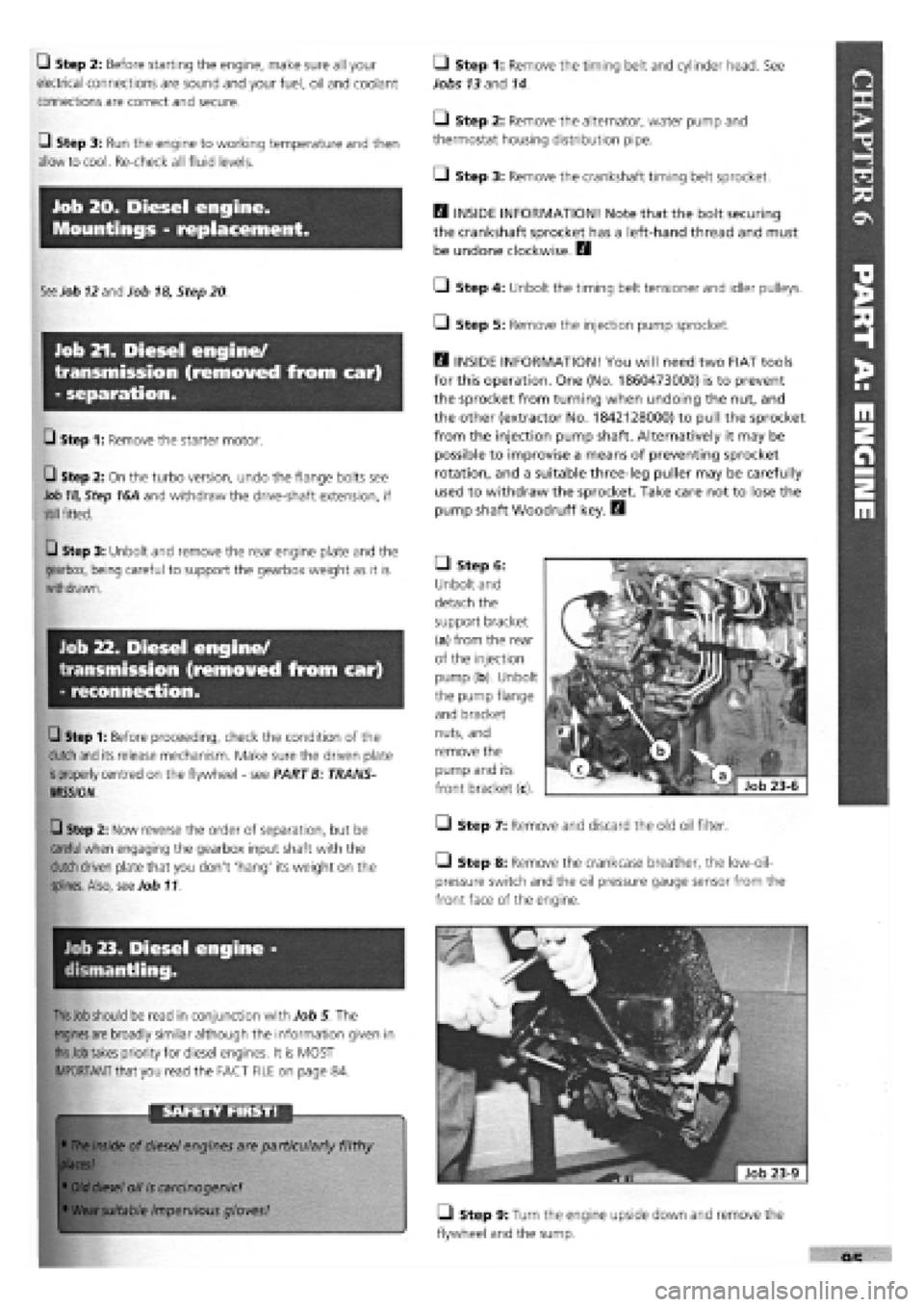
• Step 6:
Unbolt and
detach the
support bracket
(a) from the rear
of the injection
pump (b). Unbolt
the pump flange
and bracket
nuts, and
remove the
pump and its
front bracket (c).
• Step 7: Remove and discard the old oil filter.
Step 8: Remove the crankcase breather, the low-oil-
pressure switch and the oil pressure gauge sensor from the
front face of the engine.
• Step 9: Turn the engine upside down and remove the
flywheel and the sump.
Page 110 of 171
Job 15. Central locking -
replacement off components.
Job 14. Fuel gauge sender unit
removal and refitting.
SAFETY FIRST!
• Carry out this work out of doors, away from sources
of ignition.
• Make the open aperture on top of the fuel tank air
tight as quickly as possible.
• You should carry out this job when the fuel is at a
low level.
VEHICLES WITH ELECTRIC FUEL PUMPS
(NOT ENGINE MOUNTED)
Job 16. Electric windows -
replacement of components.
courtesy light lens and/or panel. The connectors are on
the rear of the unit.
• Step 3: The estate car has a rear courtesy light which is
removed as in Step 1 and 2
LJ Step 4: Refit in the reverse order.
PART A: ELECTRONIC CONTROL UNIT
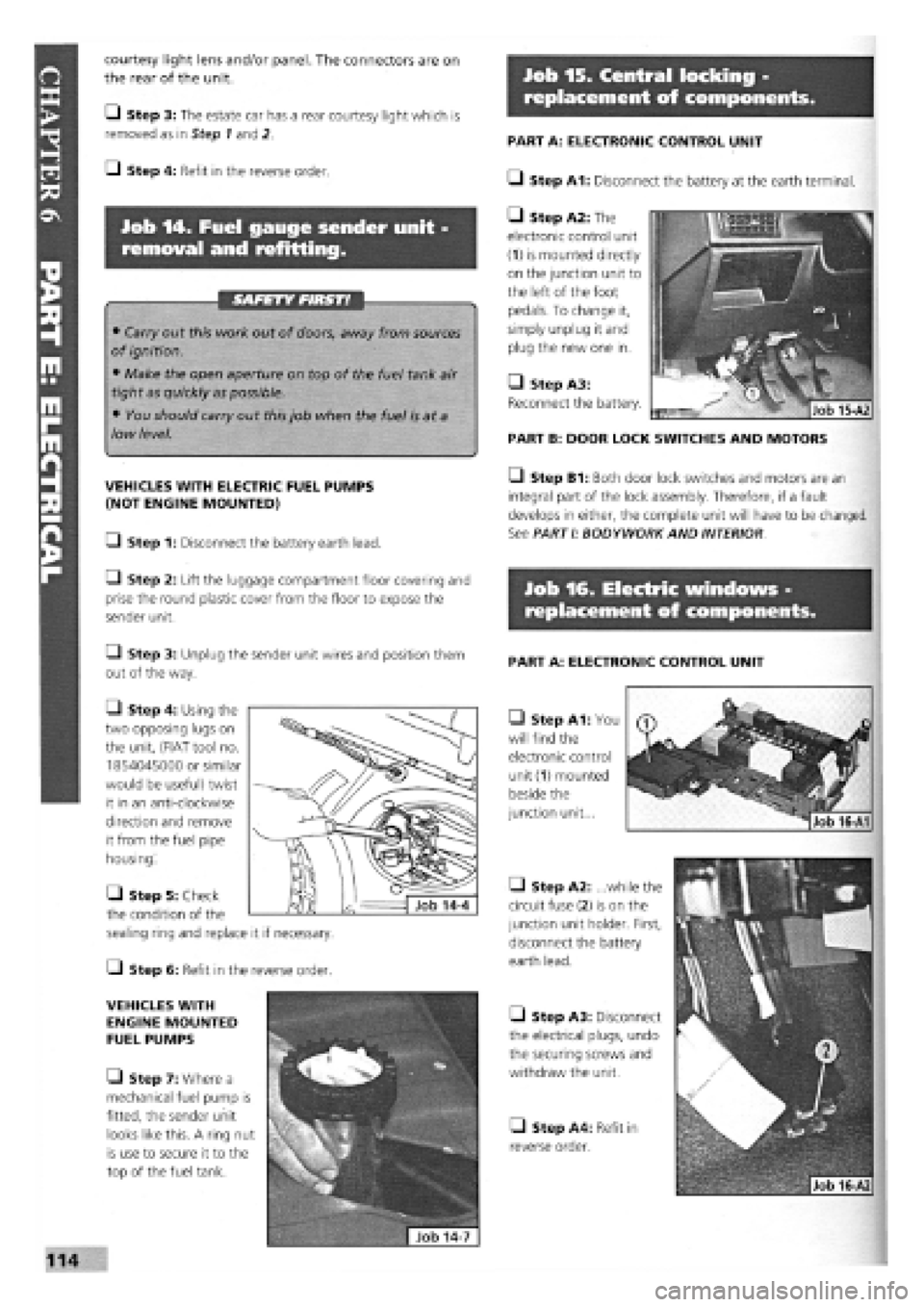
• Step A1: You
will find the
electronic control
unit
(1)
mounted
beside the
junction unit...
PART A: ELECTRONIC CONTROL UNIT
• Step A1: Disconnect the battery at the earth terminal.
• Step A2: The
electronic control unit
(1) is mounted directly
on the junction unit to
the left of the foot
pedals. To change it,
simply unplug it and
plug the new one in.
• Step A3:
Reconnect the battery.
PART B: DOOR LOCK SWITCHES AND MOTORS
• Step B1: Both door lock switches and motors are an
integral part of the lock assembly. Therefore, if a fault
develops in either, the complete unit will have to be changed.
See PARTI: BODYWORK AND INTERIOR
• Step A2: ...while the
circuit fuse (2) is on the
junction unit holder. First,
disconnect the battery
earth lead.
• Step A3: Disconnect
the electrical plugs, undo
the securing screws and
withdraw the unit.
• Step A4: Refit in
reverse order.
Q Step 1: Disconnect the battery earth lead.
Q Step 2: Lift the luggage compartment floor covering and
prise the round plastic cover from the floor to expose the
sender unit.
Q Step 3: Unplug the sender unit wires and position them
out of the way.
• Step 4: Using the
two opposing lugs on
the unit, (FIAT tool no.
1854045000 or similar
would be useful) twist
it in an anti-clockwise
direction and remove
it from the fuel pipe
housing.
C-) Step 6: Refit in the reverse order.
VEHICLES WITH
ENGINE MOUNTED
FUEL PUMPS
• Step 7: Where a
mechanical fuel pump is
fitted, the sender unit
looks like this. A ring nut
is use to secure it to the
top of the fuel tank.
• Step 5: Check
the condition of the
sealing ring and replace it if necessary.
Job 16-A1
Page 116 of 171
over stop and will also reach its 'maximum speed' stop with
the pedal fully depressed.
Job 8. Mechanical fuel pump,
petrol engine (carburettored) -
replacement.
O Step 1: Disconnect the battery earth lead.
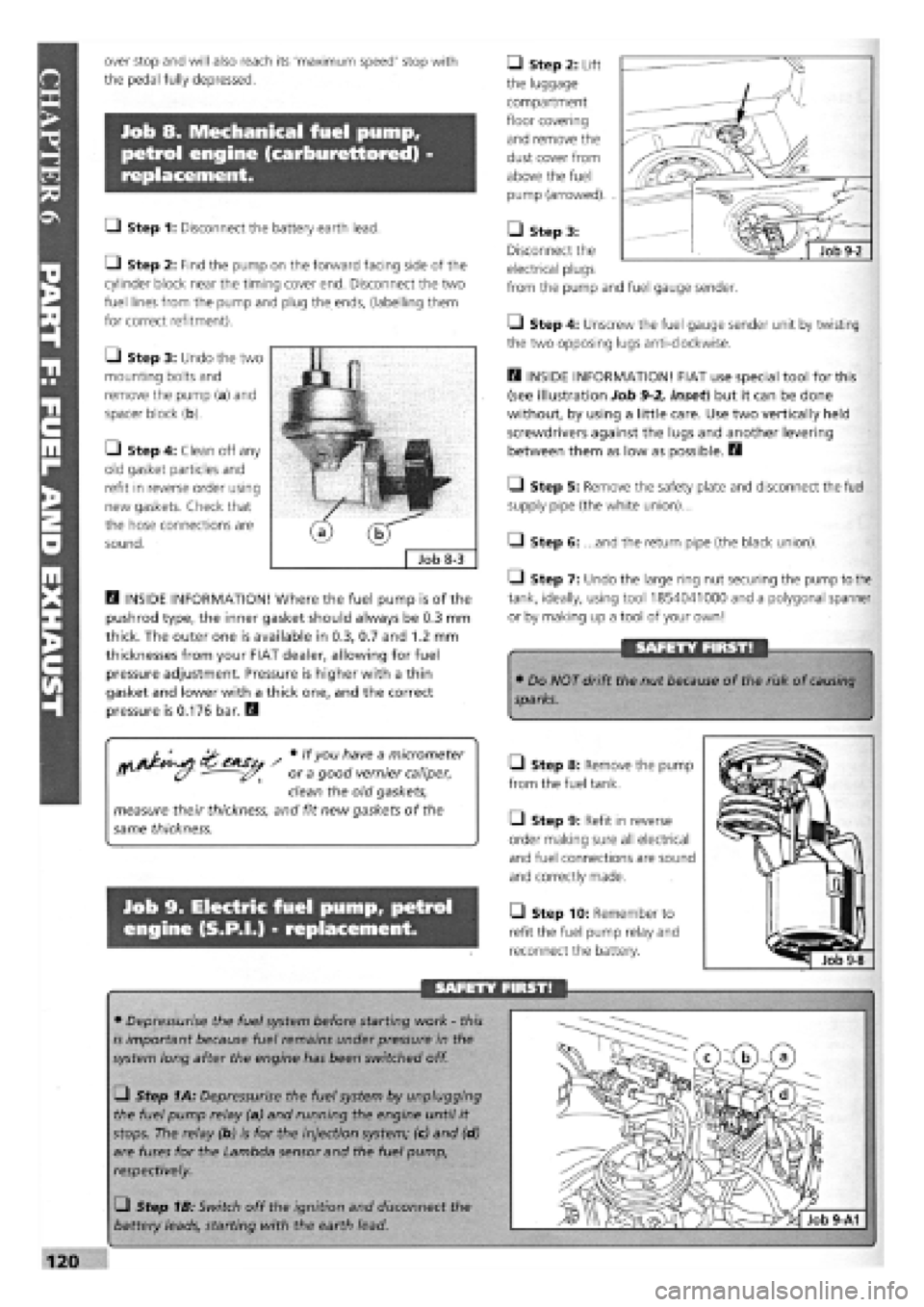
• Step 2: Find the pump on the forward facing side of the
cylinder block near the timing cover end. Disconnect the two
fuel lines from the pump and plug the ends, (labelling them
for correct refitment).
• Step 3: Undo the two
mounting bolts and
remove the pump (a) and
spacer block (b).
• Step 4: Clean off any
old gasket particles and
refit in reverse order using
new gaskets. Check that
the hose connections are
sound.
D INSIDE INFORMATION! Where the fuel pump is of the
pushrod type, the inner gasket should always be 0.3 mm
thick. The outer one is available in 0.3, 0.7 and 1.2 mm
thicknesses from your FIAT dealer, allowing for fuel
pressure adjustment. Pressure is higher with a thin
gasket and lower with a thick one, and the correct
pressure is 0.176 bar. Q
/ # lfyou h"ve a m/cromefer
ff (y - or a good vernier caliper,
clean the old gaskets,
measure their thickness, and fit new gaskets of the
same thickness.
Job 9. Electric fuel pump, petrol
engine (S.P.I.) - replacement.
• Step 2: Lift
the luggage
compartment
floor covering
and remove the
dust cover from
above the fuel
pump (arrowed). .
• Step 3:
Disconnect the
electrical plugs
from the pump and fuel gauge sender.
• Step 4: Unscrew the fuel gauge sender unit by twisting
the two opposing lugs anti-clockwise.
D INSIDE INFORMATION! FIAT use special tool for this
(see illustration Job
9-2,
inset) but it can be done
without, by using a little care. Use two vertically held
screwdrivers against the lugs and another levering
between them as low as possible. H
Q Step 5: Remove the safety plate and disconnect the fuel
supply pipe (the white union)...
Q Step 6: ...and the return pipe (the black union).
1-1 Step 7: Undo the large ring nut securing the pump to the
tank, ideally, using tool 1854041000 and a polygonal spanner
or by making up a tool of your own!
SAFETY FIRST!
• Do NOT drift the nut because of the risk of
causing
sparks.
Q Step 8: Remove the pump
from the fuel tank.
Q Step 9: Refit in reverse
order making sure all electrical
and fuel connections are sound
and correctly made.
• Step 10: Remember to
refit the fuel pump relay and
reconnect the battery.
SAFETY FIRST!
• Depressurise the fuel system before starting work
-
this
is important because fuel remains under pressure in the
system long after the engine has been switched off.
• Step 1A: Depressurise the fuel system by unplugging
the fuel pump relay (a) and running the engine until it
stops. The relay (b) is for the injection system; (c) and (d)
are fuses for the Lambda sensor and the fuel pump,
respectively.
• Step 1B: Switch off the ignition and disconnect the
battery leads, starting with the earth lead.
Page 151 of 171
IMPORTANT NOTE: Not all of the components listed here are fitted to all models.
CHAPTER 7
WIRING DIAGRAMS
IMPORTANT NOTE: Not all of the components listed here
are fitted to all models.
IMPORTANT NOTES:
3. We have sometimes shown the wiring diagram for a
'highest' spec, model, in the knowledge that 'lower'
spec, models are usually similar with the deletion of
certain components.
1. There are several hundred FIAT wiring diagrams for
the whole TIPO range. This is a representative selection,
covering the majority of applications. However, in the
event that your car's details are not covered here,
consult your nearest FIAT dealer.
2 All of the following are Tipo wiring diagrams. Tempra
saloons and estates are essentially similar.
4. 'EEC Stage 2 Engines' In late 1994, Tipo 1.4 and 2 -
Litre and Tempra 1.6 MPI vehicles were modified to suit
new emission regulations. These changes were NOT only
engine-related. Vehicles covered by this manual are Tipo
1.4 (with engine code no. 836A4.000) and Tempra 1.6
(with engine code 159B9.000). See Page 27 for location
of codes.
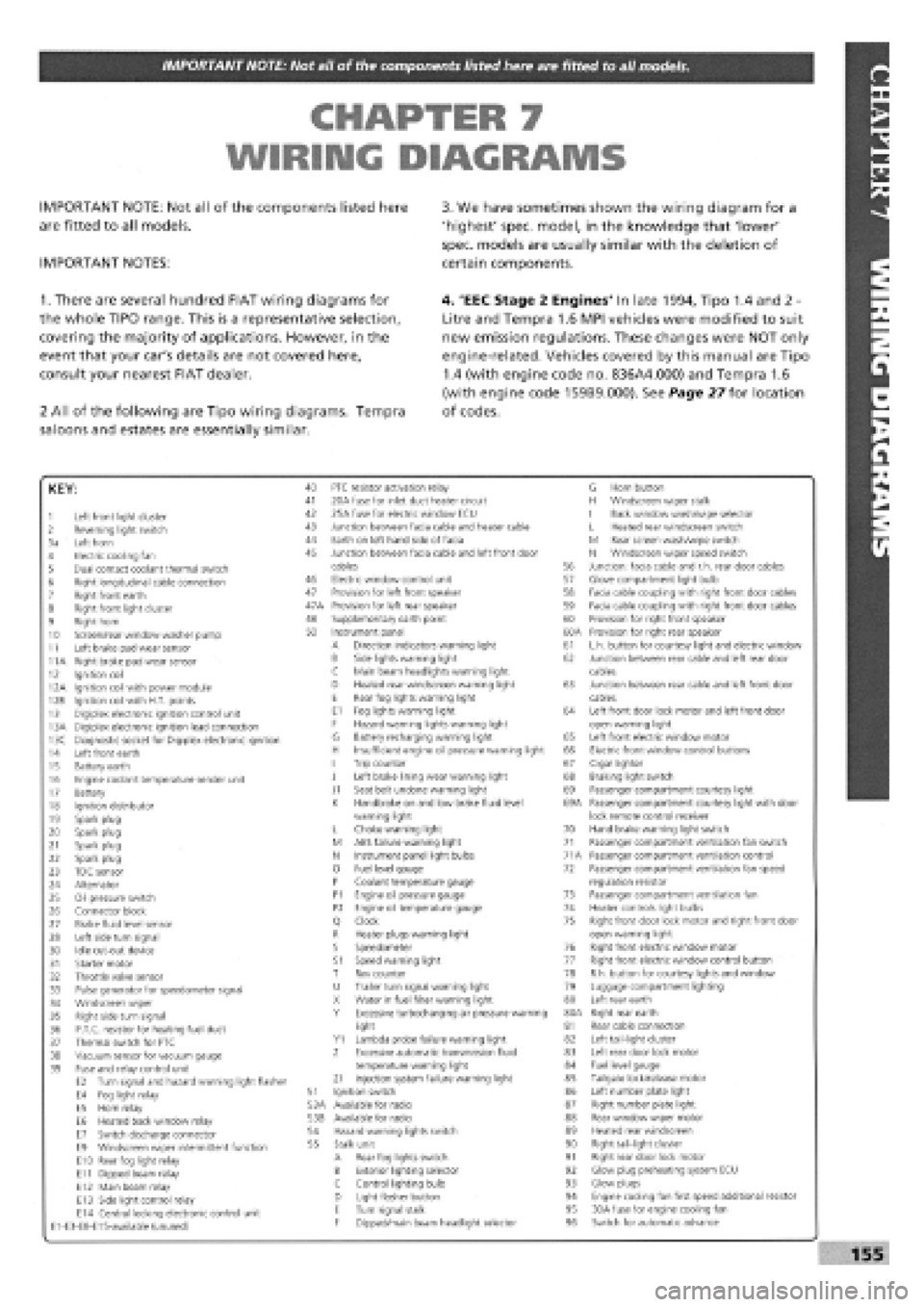
KEY:
1 Left front light cluster 2 Reversing light switch 3a Left horn 4 Electric cooling fan 5 Dual contact coolant thermal switch 6 Right longitudinal cable connection 7 Right front earth 8 Right front light cluster 9 Right horn 10 Screen/rear window washer pump 11 Left brake pad wear sensor 11A Right brake pad wear sensor 12 Ignition coil 12A Ignition coil with power module 12B Ignition coil with H.T. points 13 Digiplex electronic ignition control unit 13A Digiplex electronic ignition lead connection 13C Diagnostic socket for Digiplex electronic ignition 14 Left front earth 15 Battery earth 16 Engine coolant temperature sender unit 17 Battery 18 Ignition distributor 19 Sparkplug 20 Spark plug 21 Sparkplug 22 Spark plug 23 TDC sensor 24 Alternator 25 Oil pressure switch 26 Connector block 27 Brake fluid level sensor 28 Left side turn signal 30 Idle cut-out device 31 Starter motor 32 Throttle valve sensor 33 Pulse generator for speedometer signal 34 Windscreen wiper 35 Right side turn signal 36 P.T.C. resistor for heating fuel duct 37 Thermal switch for PTC 38 Vacuum sensor for vacuum gauge 39 Fuse and relay control unit E2 Turn signal and hazard warning light flasher E4 Fog light relay E5 Horn relay E6 Heated back window relay E7 Switch discharge connector E9 Windscreen wiper intermittent function E10 Rear fog light relay E11 Dipped beam relay E12 Main beam relay E13 Side light control relay E14 Central locking electronic control unit E1-E3-E8-E15-available (unused)
40 PTC resistor activation relay 41 20A fuse for inlet duct heater circuit 42 25A fuse for electric window ECU 43 Junction between facia cable and heater cable 44 Earth on left hand side of facia 45 Junction between facia cable and left front door
G Horn button H Windscreen wiper stalk I Back window wash/wipe selector L Heated rear windscreen switch M Rear screen wash/wipe switch N Windscreen wiper speed switch cables 56 Junction: facia cable and r.h. rear door cables Electric window control unit 57 Glove compartment light bulb Provision for left front speaker 58 Facia cable coupling with right front door cables Provision for left rear speaker 59 Facia cable coupling with right front door cables Supplementary earth point 60 Provision for right front speaker Instrument panel 60A Provision for right rear speaker A Direction indicators warning light 61 L.h. button for courtesy light and electric window B Side lights warning light 62 Junction between rear cable and left rear door C Main beam headlights warning light cables D Heated rear windscreen warning light 63 Junction between rear cable and left front door E Rear fog lights warning light cables E1 Fog lights warning light 64 Left front door lock motor and left front door F Hazard warning lights warning light open warning light G Battery recharging warning light 65 Left front electric window motor H Insufficient engine oil pressure warning light 66 Electric front window control buttons I Trip counter 67 Cigar lighter J Left brake lining wear warning light 68 Braking light switch J1 Seat belt undone warning light 69 Passenger compartment courtesy light K Handbrake on and low brake fluid level 69A Passenger compartment courtesy light with door warning light lock remote control receiver L Choke warning light 70 Hand brake warning light switch M ABS failure warning light 71 Passenger compartment ventilation fan switch N Instrument panel light bulbs 71A Passenger compartment ventilation control 0 Fuel level gauge 72 Passenger compartment ventilation fan speed P Coolant temperature gauge regulation resistor P1 Engine oil pressure gauge 73 Passenger compartment ventilation fan P2 Engine oil temperature gauge 74 Heater controls light bulbs Q Clock 75 Right front door lock motor and right front door R Heater plugs warning light open warning light S Speedometer 76 Right front electric window motor S1 Speed warning light 77 Right front electric window control button T Rev counter 78 R.h. button for courtesy lights and window U Trailer turn signal warning light 79 Luggage compartment lighting X Water in fuel filter warning light 80 Left rear earth Y Excessive turbocharging air pressure warning 80A Right rear earth light 81 Rear cable connection Y1 Lambda probe failure warning light 82 Left tail-light cluster Z Excessive automatic transmission fluid 83 Left rear door lock motor temperature warning light 84 Fuel level gauge Z1 Injection system failure warning light 85 Tailgate lock/release motor Ignition switch 86 Left number plate light Available for radio 87 Right number plate light Available for radio 88 Rear window wiper motor Hazard warning lights switch 89 Heated rear windscreen Stalk unit 90 Right tail-light cluster A Rear fog lights switch 91 Right rear door lock motor B Exterior lighting selector 92 Glow plug preheating system ECU c Control lighting bulb 93 Glow plugs D Light flasher button 94 Engine cooling fan first speed additional resistor E Turn signal stalk 95 30A fuse for engine cooling fan F Dipped/main beam headlight selector 96 Switch for automatic advance
155
Page 164 of 171
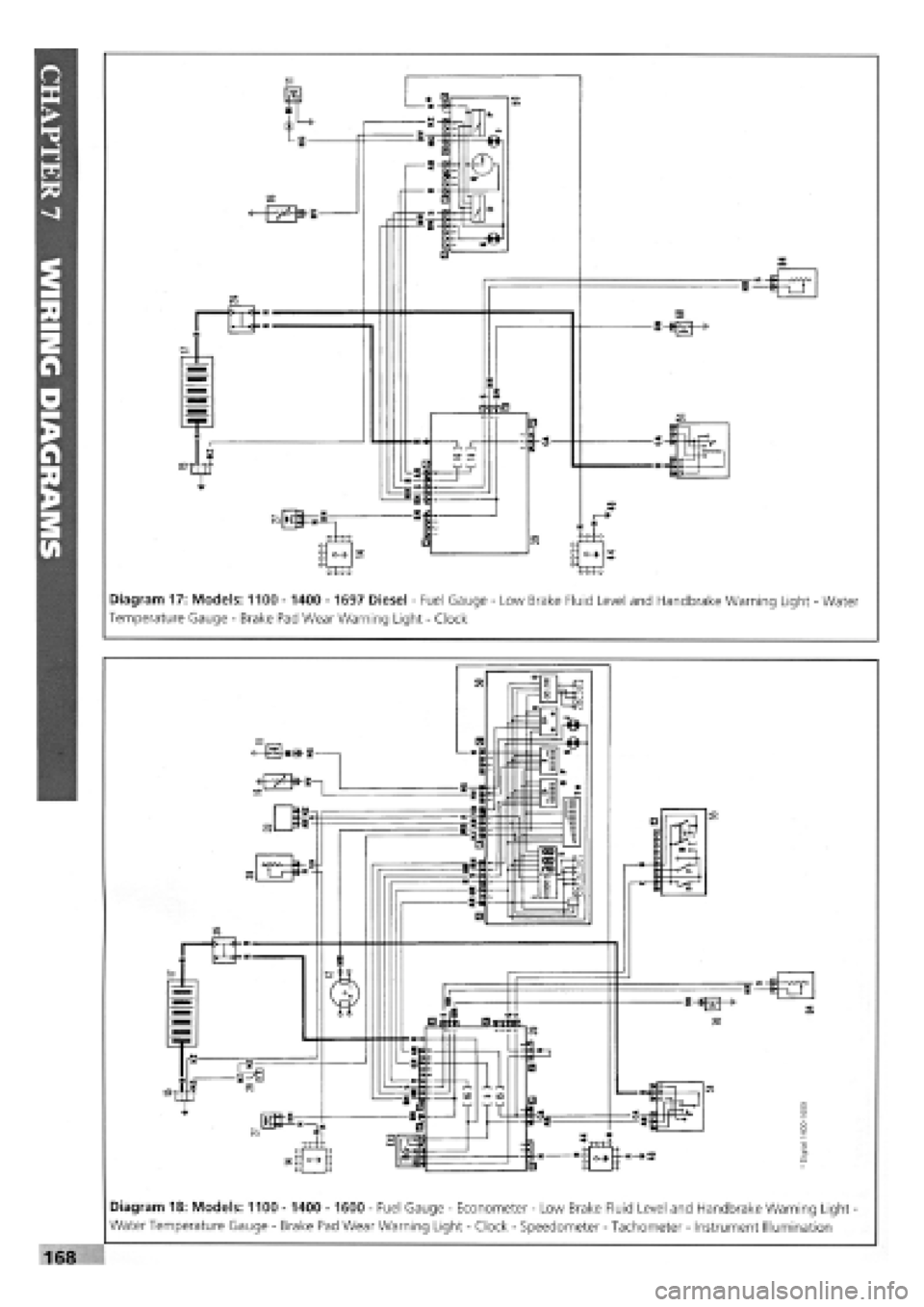
Diagram 17: Models: 1100 -1400
-
1697 Diesel - Fuel Gauge
-
Low Brake Fluid Level and Handbrake Warning Light
-
Water
Temperature Gauge
-
Brake Pad Wear Warning Light
-
Clock
|2n
tnj
•Pf
rrfl,
•5P
-if-•
-Is uu
—
—o— £ —•
i-^-Hi-
a
ZJ
ml
Diagram 18: Models: 1100
-
1400
-
1600
-
Fuel Gauge
-
Econometer
-
Low Brake Fluid Level and Handbrake Warning Light
Water Temperature Gauge
-
Brake Pad Wear Warning Light
-
Clock
-
Speedometer
-
Tachometer
-
Instrument Illumination
Page 165 of 171
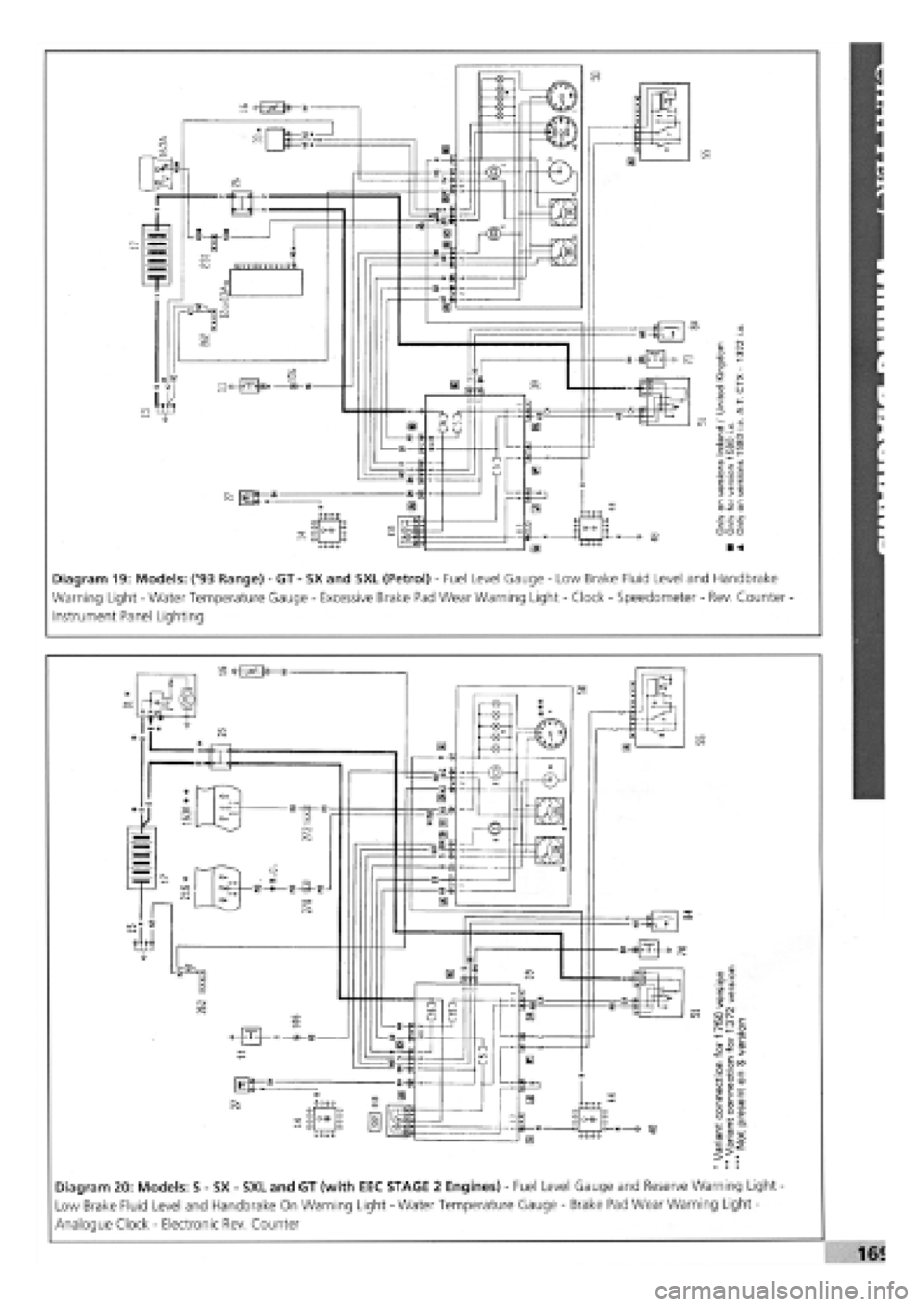
Diagram 19: Models: ('93 Range)
-
GT
-
SX and SXL (Petrol)
-
Fuel Level Gauge
-
Low Brake Fluid Level and Handbrake
Warning Light
-
Water Temperature Gauge
-
Excessive Brake Pad Wear Warning Light
-
Clock
-
Speedometer
-
Rev. Counter
-
Instrument Panel Lighting
.2'55 £
a>
>> Z. CM Ol— £ro c
k. <"
.2 2 c
Sis
8°a> - c Q. C rtj «_ z o
'»-
ra
~z_
2>7
Diagram 20: Models: S
-
SX
-
SXL and GT (with EEC STAGE 2 Engines)
-
Fuel Level Gauge and Reserve Warning Light
Low Brake Fluid Level and Handbrake On Warning Light
-
Water Temperature Gauge
-
Brake Pad Wear Warning Light -
Analogue Clock
-
Electronic Rev. Counter
Page 166 of 171
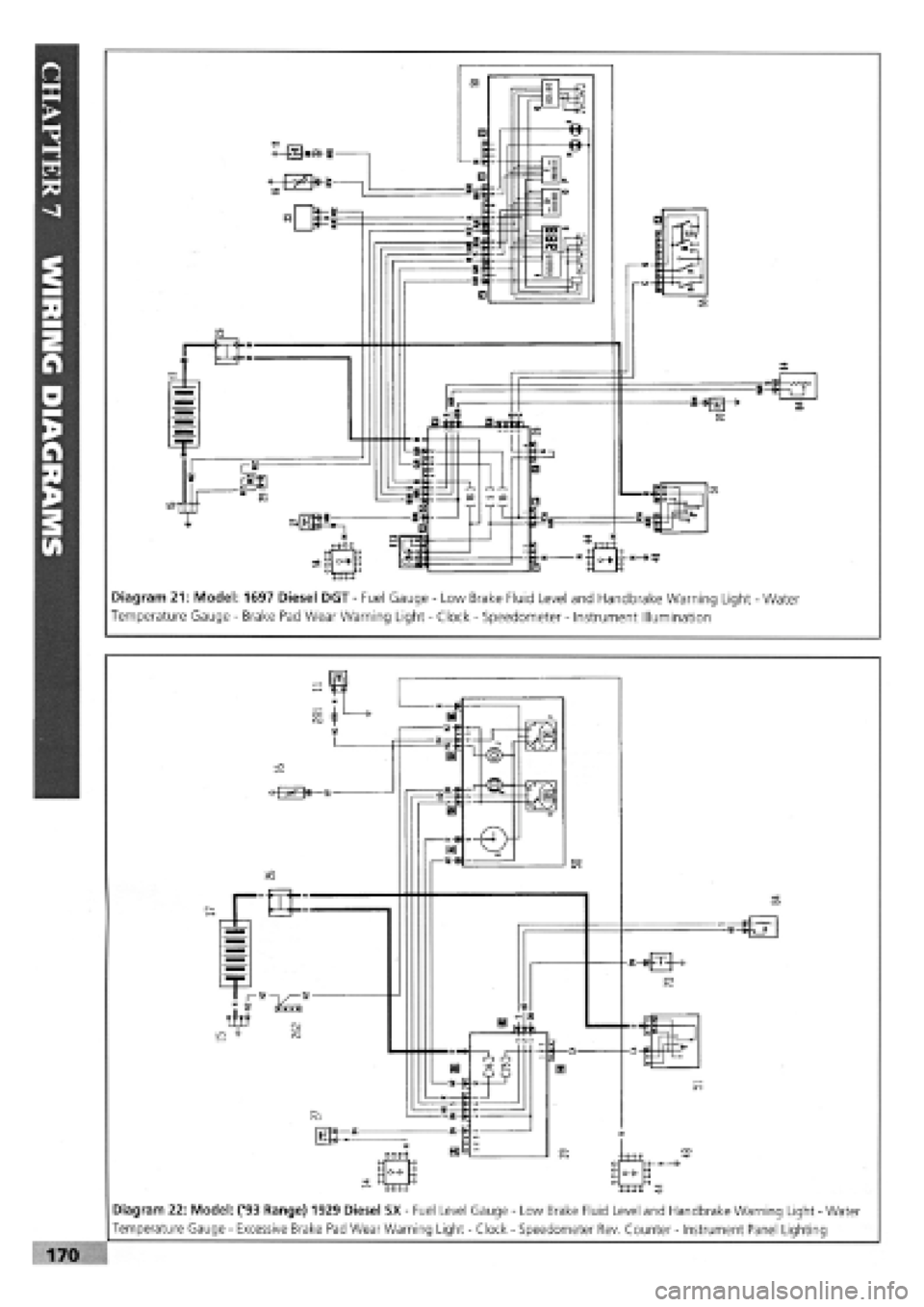
Diagram 21: Model: 1697 Diesel DGT
-
Fuel Gauge
-
Low Brake Fluid Level and Handbrake Warning Light
-
Water
Temperature Gauge
-
Brake Pad Wear Warning Light
-
Clock
-
Speedometer
-
Instrument Illumination
i
V—*
•u |
j* ta—
At
6 S
m
IS a
Diagram 22: Model: ('93 Range) 1929 Diesel SX
-
Fuel Level Gauge
-
Low Brake Fluid Level and Handbrake Warning Light
-
Water
Temperature Gauge
-
Excessive Brake Pad Wear Warning Light
-
Clock
-
Speedometer Rev. Counter
-
Instrument Panel Lighting
Page 167 of 171
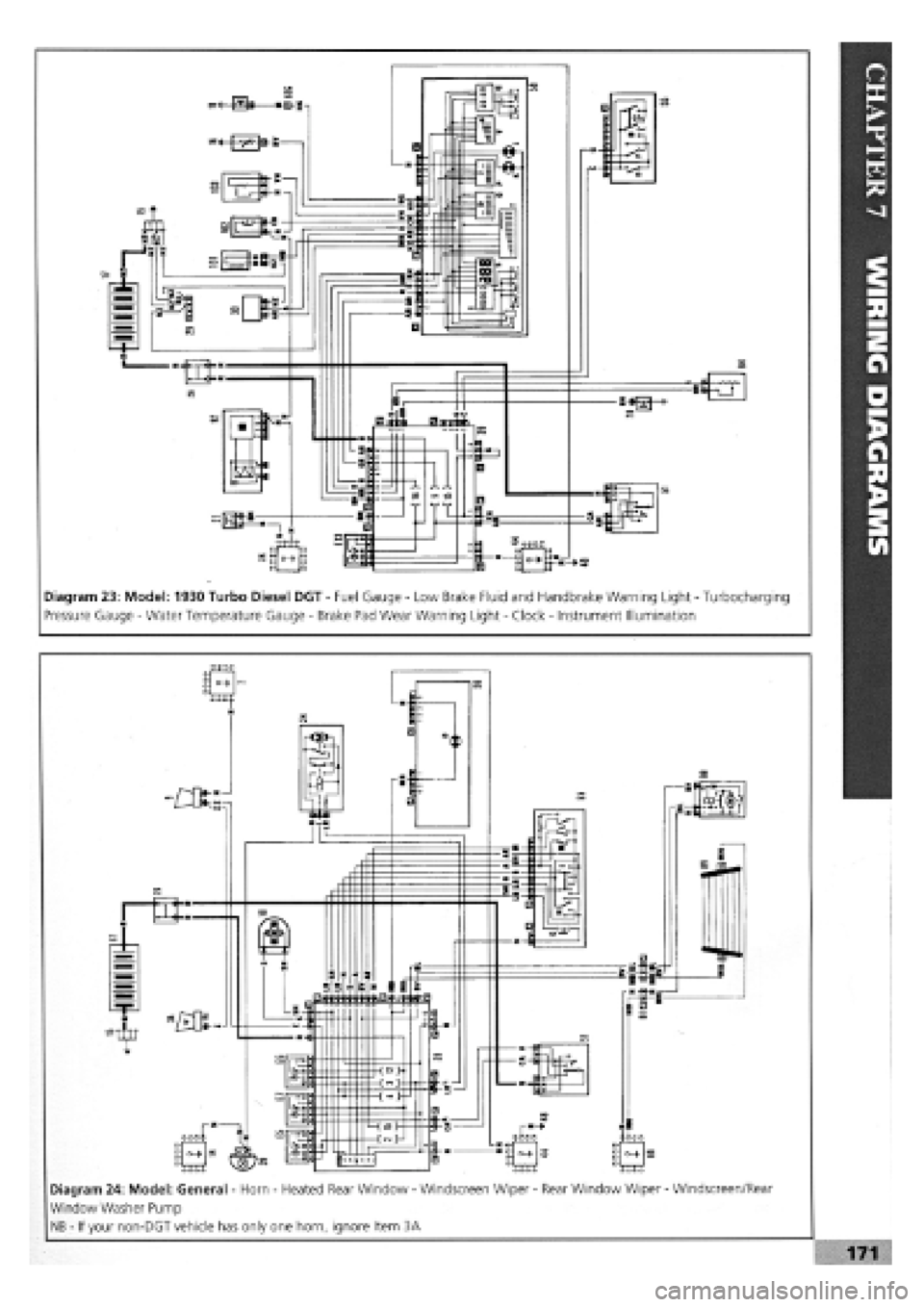
Diagram 23: Model: 1930 Turbo Diesel DGT
-
Fuel Gauge
-
Low Brake Fluid and Handbrake Warning Light
-
Turbocharging
Pressure Gauge
-
Water Temperature Gauge
-
Brake Pad Wear Warning Light
-
Clock
-
Instrument Illumination
Diagram 24: Model: General
-
Horn
-
Heated Rear Window
-
Windscreen Wiper
-
Rear Window Wiper
-
Windscreen/Rear
Window Washer Pump
NB
-
If your non-DGT vehicle has only one horn, ignore Item 3A