engine FIAT TIPO 4DOORS 2017 1.G Owners Manual
[x] Cancel search | Manufacturer: FIAT, Model Year: 2017, Model line: TIPO 4DOORS, Model: FIAT TIPO 4DOORS 2017 1.GPages: 240, PDF Size: 4.15 MB
Page 178 of 240
if high pressure jets or cleaners are
used to wash the vehicle, keep a
distance of at least 40 cm from the
bodywork to avoid damage or
alteration. Build up of water could
cause damage to the vehicle in the long
term;
wash the bodywork using a low
pressure jet of water if possible;
wipe a sponge with a slightly soapy
solution over the bodywork, frequently
rinsing the sponge;
rinse well with water and dry with a
jet of air or a chamois leather.
Dry the less visible parts (e.g. door
frames, bonnet, headlight frames, etc.)
with special care, as water may
stagnate more easily in these areas. Do
not wash the car after it has been left in
the sun or with the bonnet hot: this may
alter the shine of the paintwork.
Exterior plastic parts must be cleaned
in the same way as the rest of the
vehicle.
IMPORTANT NOTES
Avoid parking under trees; the resin
dropped by trees makes the paintwork
go opaque and increases the possibility
of corrosion.
Bird droppings must be washed off
immediately and thoroughly as the acid
they contain is particularly aggressive.Windows
Use specific detergents and clean
cloths to prevent scratching or altering
the transparency.
IMPORTANT Wipe the rear window
inside gently with a cloth following the
direction of the filaments to avoid
damaging the heating device.
Front headlights
Use a soft cloth soaked in water and
detergent for washing cars.
IMPORTANT Never use aromatic
substances (e.g. petrol) or ketones (e.g.
acetone) for cleaning the plastic lenses
of the headlights.
IMPORTANT When cleaning with a
pressure washer, keep the water jet at
least 20 cm away from the headlights.
Engine compartment
At the end of every winter, wash the
engine compartment thoroughly, taking
care not to aim the jet of water directly
at the electronic control units or at the
windscreen wiper motors. Have this
operation performed at a specialised
workshop.
IMPORTANT The washing should take
place with the engine cold and the
ignition device in the STOP position.After the washing operation, make sure
that the various protections (e.g. rubber
caps and guards) have not been
removed or damaged.
IMPORTANT
75)In order to preserve the aesthetic
appearance of the paint abrasive products
and/or polishes should not be used for
cleaning the vehicle.
76)Avoid washing with rollers and/or
brushes in washing stations. Wash the
vehicle only by hand using neutral pH
detergents; dry it with a wet chamois
leather. Abrasive products and/or polishes
should not be used for cleaning the car.
Bird droppings must be washed off
immediately and thoroughly as the acid
they contain is particularly aggressive.
Avoid (if at all possible) parking the vehicle
under trees; remove vegetable resins
immediately as, when dried, it may only be
possible to remove them with abrasive
products and/or polishes, which is highly
inadvisable as they could alter the typical
opaqueness of the paint. Do not use pure
windscreen washer fluid for cleaning the
front windscreen and rear window; dilute it
min. 50% with water. Only use pure screen
washer fluid when strictly necessary due to
outside temperature conditions.
176
SERVICING AND CARE
Page 181 of 240
TECHNICAL DATA
Everything you may find useful for
understanding how your vehicle is
made and works is contained in this
chapter and illustrated with data, tables
and graphics. For the enthusiasts and
the technician, but also just for those
who want to know every detail of their
vehicle.
IDENTIFICATION DATA.........180
ENGINE..................181
WHEELS.................184
DIMENSIONS..............188
WEIGHTS.................189
REFUELLING...............191
FLUIDS AND LUBRICANTS......194
PERFORMANCE............198
FUEL CONSUMPTION.........199
CO2 EMISSIONS............201
PRESCRIPTIONS FOR HANDLING
THE VEHICLE AT THE
END OF ITS LIFE............202
179
Page 182 of 240
IDENTIFICATION
DATA
VEHICLE IDENTIFICATION
NUMBER (VIN) PLATE
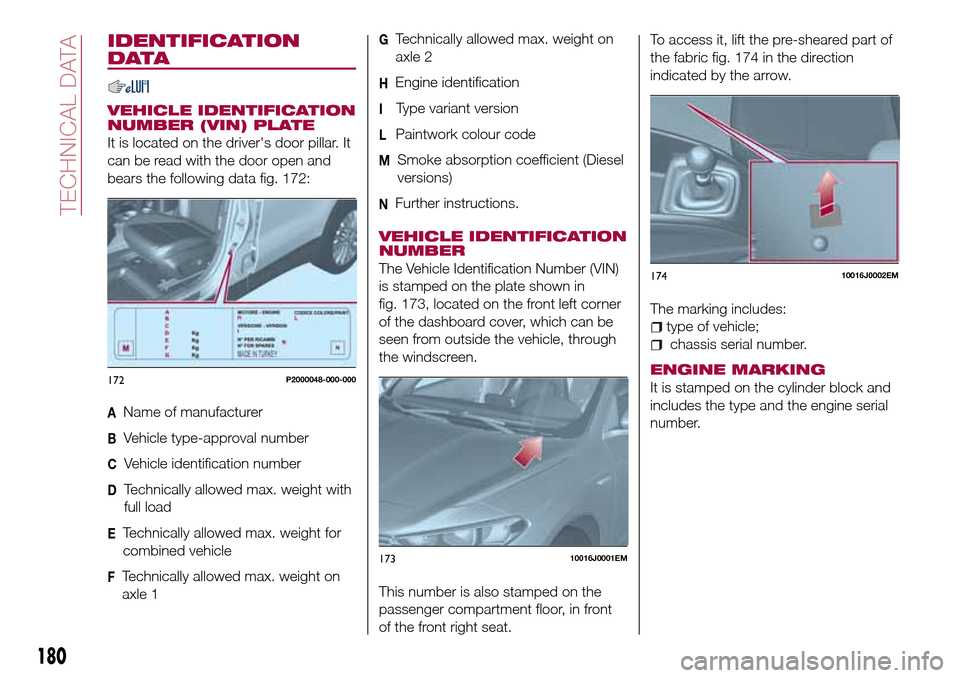
It is located on the driver's door pillar. It
can be read with the door open and
bears the following data fig. 172:
AName of manufacturer
BVehicle type-approval number
CVehicle identification number
DTechnically allowed max. weight with
full load
ETechnically allowed max. weight for
combined vehicle
FTechnically allowed max. weight on
axle 1
GTechnically allowed max. weight on
axle 2
HEngine identification
IType variant version
LPaintwork colour code
MSmoke absorption coefficient (Diesel
versions)
NFurther instructions.
VEHICLE IDENTIFICATION
NUMBER
The Vehicle Identification Number (VIN)
is stamped on the plate shown in
fig. 173, located on the front left corner
of the dashboard cover, which can be
seen from outside the vehicle, through
the windscreen.
This number is also stamped on the
passenger compartment floor, in front
of the front right seat.To access it, lift the pre-sheared part of
the fabric fig. 174 in the direction
indicated by the arrow.
The marking includes:
type of vehicle;
chassis serial number.
ENGINE MARKING
It is stamped on the cylinder block and
includes the type and the engine serial
number.172P2000048-000-000
17310016J0001EM
17410016J0002EM
180
TECHNICAL DATA
Page 183 of 240
ENGINE
171)
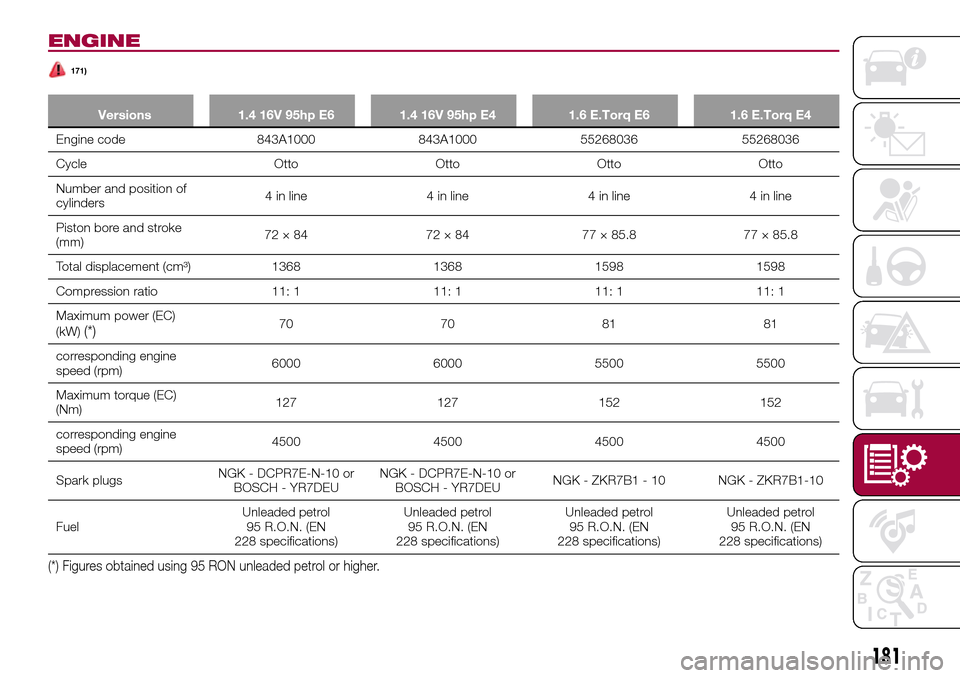
Versions 1.4 16V 95hp E6 1.4 16V 95hp E4 1.6 E.Torq E6 1.6 E.Torq E4
Engine code 843A1000 843A1000 55268036 55268036
Cycle Otto Otto Otto Otto
Number and position of
cylinders4 in line 4 in line 4 in line 4 in line
Piston bore and stroke
(mm)72 × 84 72 × 84 77 × 85.8 77 × 85.8
Total displacement (cm³) 1368 1368 1598 1598
Compression ratio 11: 1 11: 1 11: 1 11: 1
Maximum power (EC)
(kW)
(*)70 70 81 81
corresponding engine
speed (rpm)6000 6000 5500 5500
Maximum torque (EC)
(Nm)127 127 152 152
corresponding engine
speed (rpm)4500 4500 4500 4500
Spark plugsNGK - DCPR7E-N-10 or
BOSCH - YR7DEUNGK - DCPR7E-N-10 or
BOSCH - YR7DEUNGK - ZKR7B1 - 10 NGK - ZKR7B1-10
FuelUnleaded petrol
95 R.O.N. (EN
228 specifications)Unleaded petrol
95 R.O.N. (EN
228 specifications)Unleaded petrol
95 R.O.N. (EN
228 specifications)Unleaded petrol
95 R.O.N. (EN
228 specifications)
(*) Figures obtained using 95 RON unleaded petrol or higher.
181
Page 184 of 240
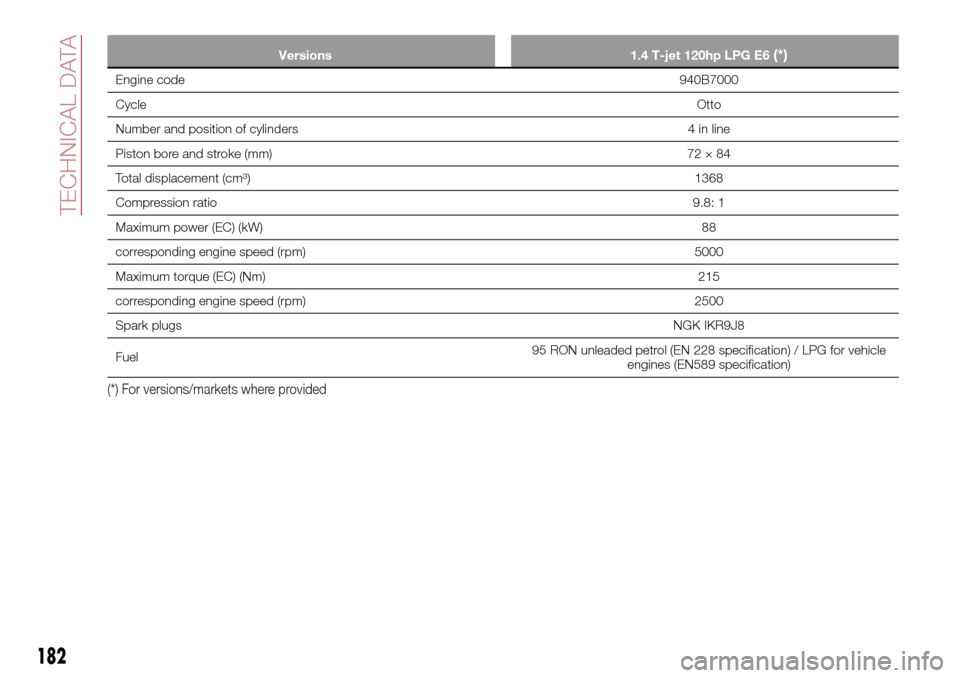
Versions 1.4 T-jet 120hp LPG E6(*)
Engine code940B7000
CycleOtto
Number and position of cylinders 4 in line
Piston bore and stroke (mm)72×84
Total displacement (cm³)1368
Compression ratio9.8: 1
Maximum power (EC) (kW)88
corresponding engine speed (rpm) 5000
Maximum torque (EC) (Nm)215
corresponding engine speed (rpm) 2500
Spark plugsNGK IKR9J8
Fuel95 RON unleaded petrol (EN 228 specification) / LPG for vehicle
engines (EN589 specification)
(*) For versions/markets where provided
182
TECHNICAL DATA
Page 185 of 240
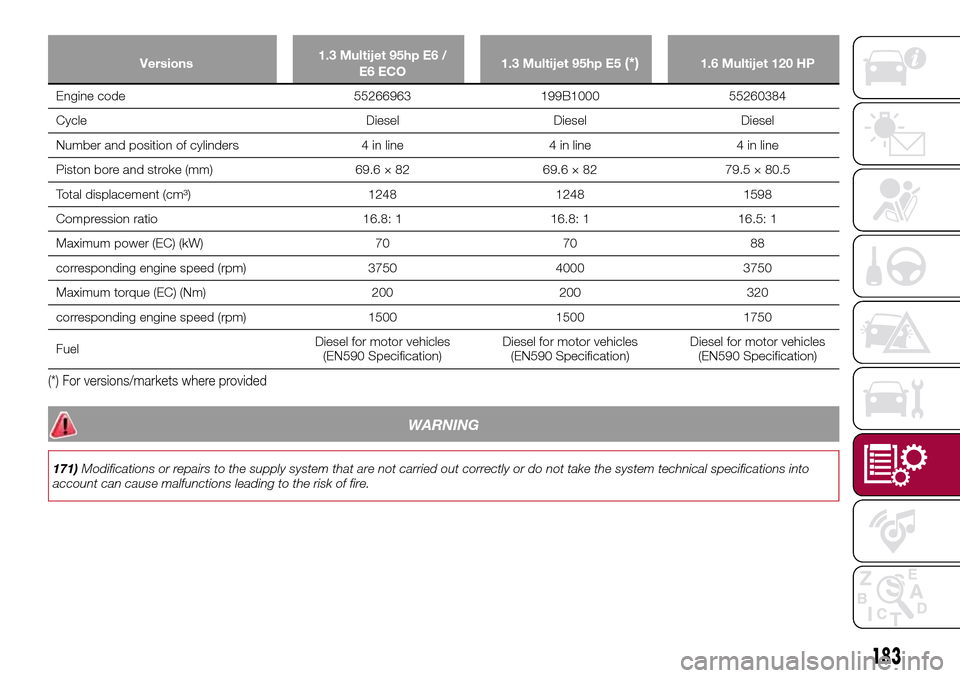
Versions1.3 Multijet 95hp E6 /
E6 ECO1.3 Multijet 95hp E5(*)1.6 Multijet 120 HP
Engine code 55266963 199B1000 55260384
Cycle Diesel Diesel Diesel
Number and position of cylinders 4 in line 4 in line 4 in line
Piston bore and stroke (mm) 69.6 × 82 69.6 × 82 79.5 × 80.5
Total displacement (cm³) 1248 1248 1598
Compression ratio 16.8: 1 16.8: 1 16.5: 1
Maximum power (EC) (kW) 70 70 88
corresponding engine speed (rpm) 3750 4000 3750
Maximum torque (EC) (Nm) 200 200 320
corresponding engine speed (rpm) 1500 1500 1750
FuelDiesel for motor vehicles
(EN590 Specification)Diesel for motor vehicles
(EN590 Specification)Diesel for motor vehicles
(EN590 Specification)
(*) For versions/markets where provided
WARNING
171)Modifications or repairs to the supply system that are not carried out correctly or do not take the system technical specifications into
account can cause malfunctions leading to the risk of fire.
183
Page 193 of 240
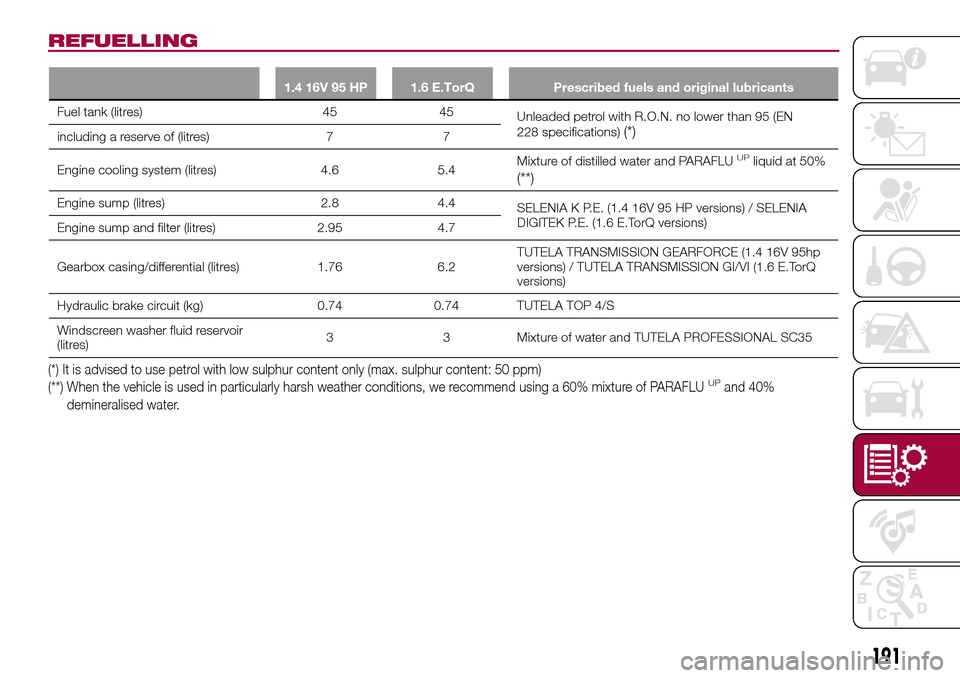
REFUELLING
1.4 16V 95 HP 1.6 E.TorQ Prescribed fuels and original lubricants
Fuel tank (litres) 45 45
Unleaded petrol with R.O.N. no lower than 95 (EN
228 specifications)
(*)including a reserve of (litres) 7 7
Engine cooling system (litres) 4.6 5.4Mixture of distilled water and PARAFLU
UPliquid at 50%
(**)
Engine sump (litres) 2.8 4.4
SELENIA K P.E. (1.4 16V 95 HP versions) / SELENIA
DIGITEK P.E. (1.6 E.TorQ versions)
Engine sump and filter (litres) 2.95 4.7
Gearbox casing/differential (litres) 1.76 6.2TUTELA TRANSMISSION GEARFORCE (1.4 16V 95hp
versions) / TUTELA TRANSMISSION GI/VI (1.6 E.TorQ
versions)
Hydraulic brake circuit (kg) 0.74 0.74 TUTELA TOP 4/S
Windscreen washer fluid reservoir
(litres)3 3 Mixture of water and TUTELA PROFESSIONAL SC35
(*) It is advised to use petrol with low sulphur content only (max. sulphur content: 50 ppm)
(**) When the vehicle is used in particularly harsh weather conditions, we recommend using a 60% mixture of PARAFLUUPand 40%
demineralised water.
191
Page 194 of 240
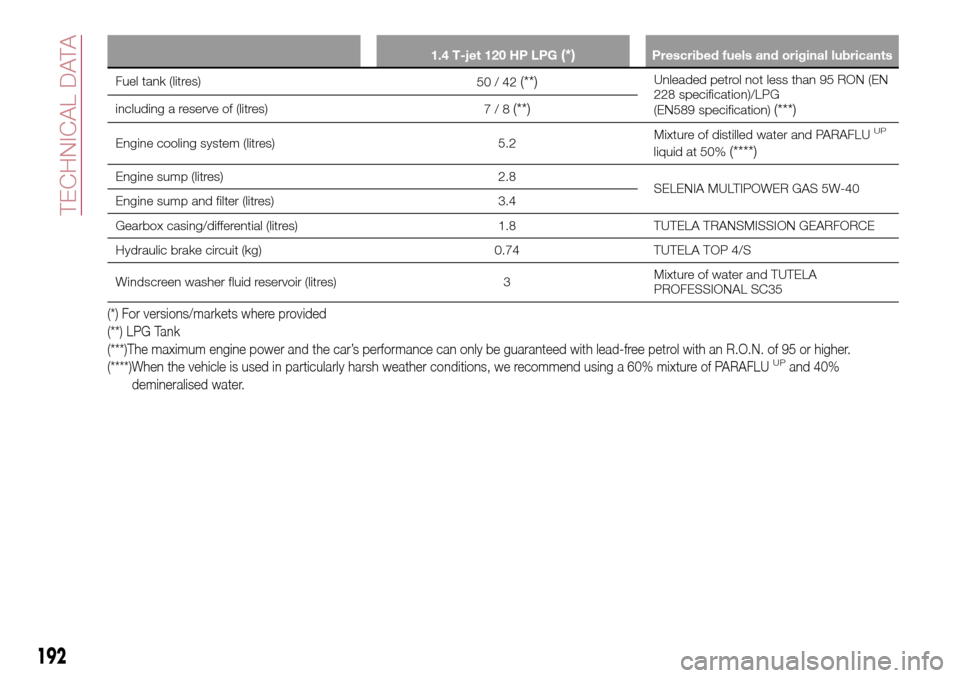
1.4 T-jet 120 HP LPG(*)Prescribed fuels and original lubricants
Fuel tank (litres)
50/42(**)Unleaded petrol not less than 95 RON (EN
228 specification)/LPG
(EN589 specification)
(***)including a reserve of (litres)
7/8(**)
Engine cooling system (litres) 5.2Mixture of distilled water and PARAFLUUP
liquid at 50%(****)
Engine sump (litres) 2.8
SELENIA MULTIPOWER GAS 5W-40
Engine sump and filter (litres) 3.4
Gearbox casing/differential (litres) 1.8 TUTELA TRANSMISSION GEARFORCE
Hydraulic brake circuit (kg) 0.74 TUTELA TOP 4/S
Windscreen washer fluid reservoir (litres) 3Mixture of water and TUTELA
PROFESSIONAL SC35
(*) For versions/markets where provided
(**) LPG Tank
(***)The maximum engine power and the car’s performance can only be guaranteed with lead-free petrol with an R.O.N. of 95 or higher.
(****)When the vehicle is used in particularly harsh weather conditions, we recommend using a 60% mixture of PARAFLU
UPand 40%
demineralised water.
192
TECHNICAL DATA
Page 195 of 240
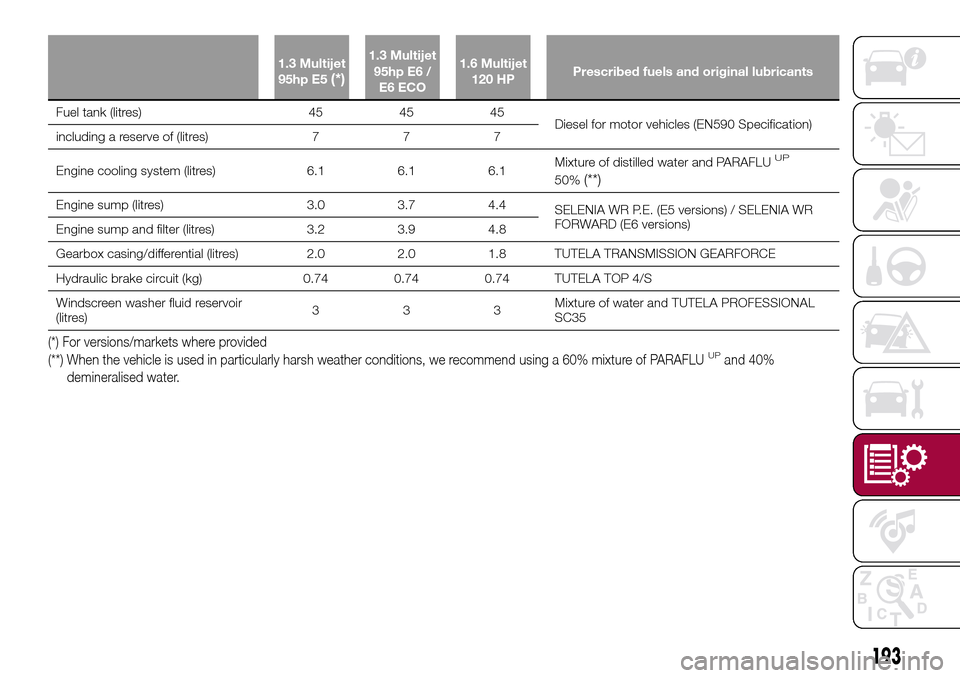
1.3 Multijet
95hp E5(*)
1.3 Multijet
95hp E6 /
E6 ECO1.6 Multijet
120 HPPrescribed fuels and original lubricants
Fuel tank (litres) 45 45 45
Diesel for motor vehicles (EN590 Specification)
including a reserve of (litres) 7 7 7
Engine cooling system (litres) 6.1 6.1 6.1Mixture of distilled water and PARAFLU
UP
50%(**)
Engine sump (litres) 3.0 3.7 4.4
SELENIA WR P.E. (E5 versions) / SELENIA WR
FORWARD (E6 versions)
Engine sump and filter (litres) 3.2 3.9 4.8
Gearbox casing/differential (litres) 2.0 2.0 1.8 TUTELA TRANSMISSION GEARFORCE
Hydraulic brake circuit (kg) 0.74 0.74 0.74 TUTELA TOP 4/S
Windscreen washer fluid reservoir
(litres)333Mixture of water and TUTELA PROFESSIONAL
SC35
(*) For versions/markets where provided
(**) When the vehicle is used in particularly harsh weather conditions, we recommend using a 60% mixture of PARAFLUUPand 40%
demineralised water.
193
Page 196 of 240
FLUIDS AND LUBRICANTS
78)
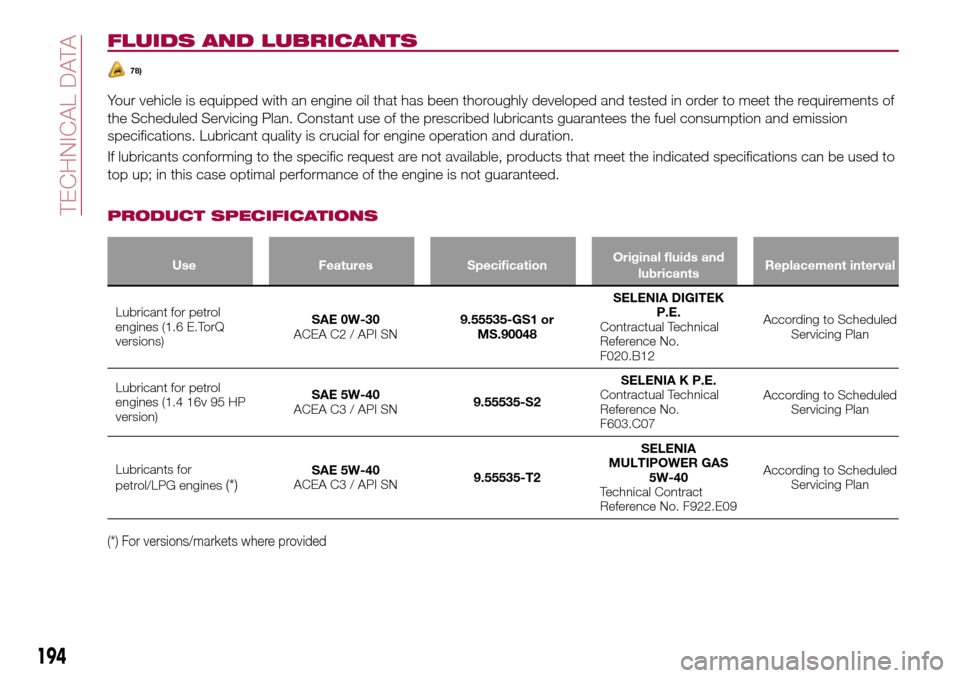
Your vehicle is equipped with an engine oil that has been thoroughly developed and tested in order to meet the requirements of
the Scheduled Servicing Plan. Constant use of the prescribed lubricants guarantees the fuel consumption and emission
specifications. Lubricant quality is crucial for engine operation and duration.
If lubricants conforming to the specific request are not available, products that meet the indicated specifications can be used to
top up; in this case optimal performance of the engine is not guaranteed.
PRODUCT SPECIFICATIONS
Use Features SpecificationOriginal fluids and
lubricantsReplacement interval
Lubricant for petrol
engines (1.6 E.TorQ
versions)SAE 0W-30
ACEA C2 / API SN9.55535-GS1 or
MS.90048SELENIA DIGITEK
P.E.
Contractual Technical
Reference No.
F020.B12According to Scheduled
Servicing Plan
Lubricant for petrol
engines (1.4 16v 95 HP
version)SAE 5W-40
ACEA C3 / API SN9.55535-S2SELENIA K P.E.
Contractual Technical
Reference No.
F603.C07According to Scheduled
Servicing Plan
Lubricants for
petrol/LPG engines
(*)SAE 5W-40
ACEA C3 / API SN9.55535-T2SELENIA
MULTIPOWER GAS
5W-40
Technical Contract
Reference No. F922.E09According to Scheduled
Servicing Plan
(*) For versions/markets where provided
194
TECHNICAL DATA