Central FIAT TIPO 4DOORS 2017 1.G User Guide
[x] Cancel search | Manufacturer: FIAT, Model Year: 2017, Model line: TIPO 4DOORS, Model: FIAT TIPO 4DOORS 2017 1.GPages: 240, PDF Size: 4.15 MB
Page 25 of 240
WARNING
20)The daytime running lights are an
alternative to the dipped headlights for
driving during the daytime in countries
where it is compulsory to have lights on
during the day; where it is not compulsory,
the use of daytime running lights is
permitted.
21)Daytime running lights cannot replace
dipped beam headlights when driving at
night or through tunnels. The use of
daytime running lights is governed by the
highway code of the country in which you
are driving. Comply with legal
requirements.
INTERIOR LIGHTS
FRONT CEILING LIGHT
Singe-bulb ceiling light
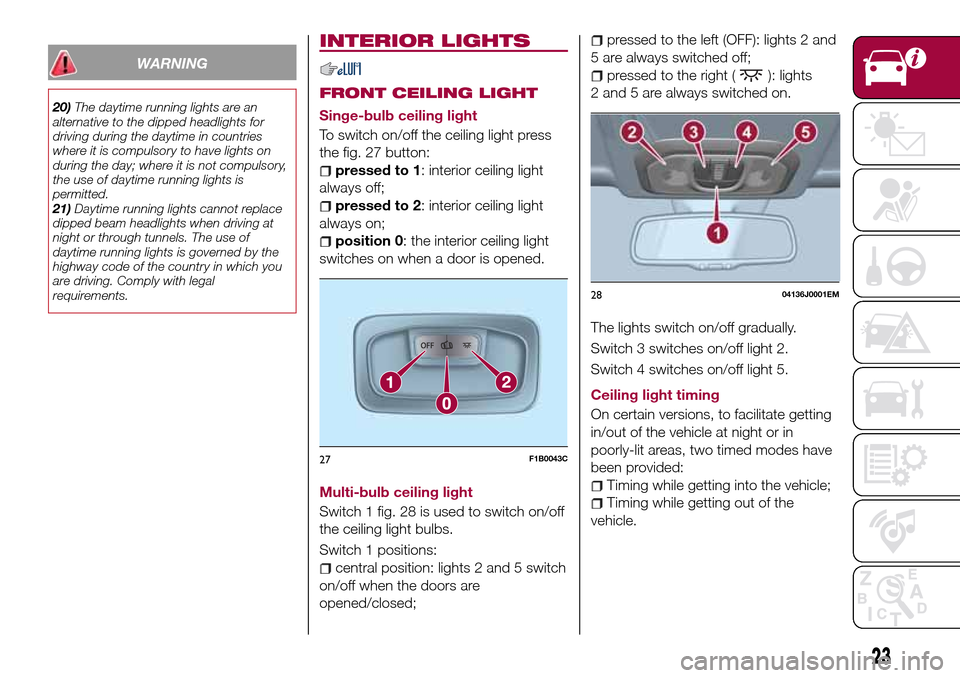
To switch on/off the ceiling light press
the fig. 27 button:
pressed to 1: interior ceiling light
always off;
pressed to 2: interior ceiling light
always on;
position 0: the interior ceiling light
switches on when a door is opened.
Multi-bulb ceiling light
Switch 1 fig. 28 is used to switch on/off
the ceiling light bulbs.
Switch 1 positions:
central position: lights 2 and 5 switch
on/off when the doors are
opened/closed;
pressed to the left (OFF): lights 2 and
5 are always switched off;
pressed to the right (): lights
2 and 5 are always switched on.
The lights switch on/off gradually.
Switch 3 switches on/off light 2.
Switch 4 switches on/off light 5.
Ceiling light timing
On certain versions, to facilitate getting
in/out of the vehicle at night or in
poorly-lit areas, two timed modes have
been provided:
Timing while getting into the vehicle;
Timing while getting out of the
vehicle.
27F1B0043C
2804136J0001EM
23
Page 28 of 240
CLIMATE CONTROL
SYSTEM
1)
PASSENGER
COMPARTMENT AIR
DIFFUSERS
Adjustable air diffusers
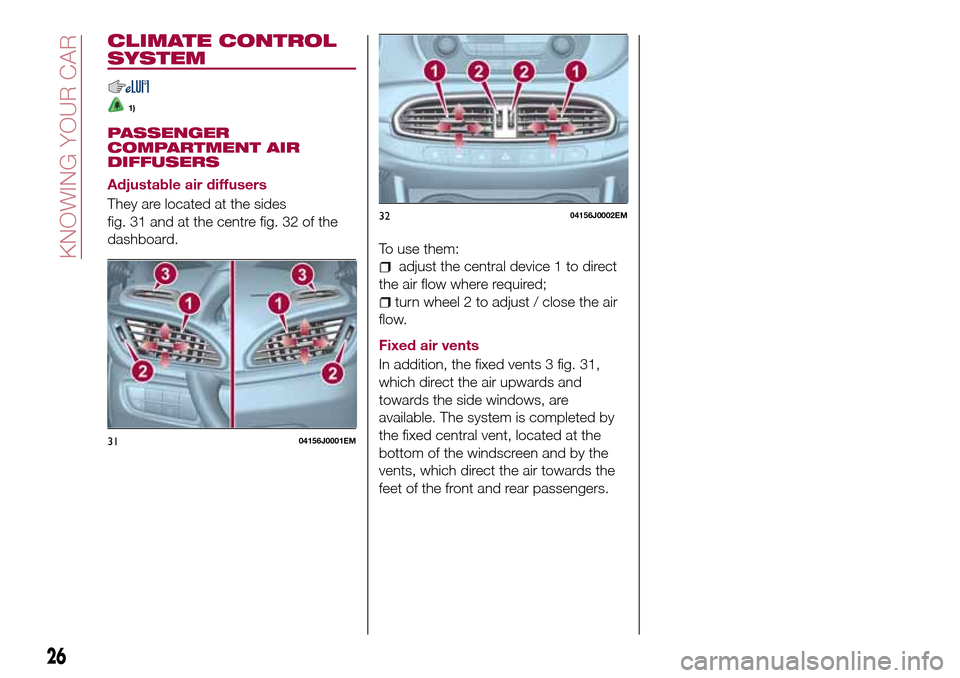
They are located at the sides
fig. 31 and at the centre fig. 32 of the
dashboard.
To use them:
adjust the central device 1 to direct
the air flow where required;
turn wheel 2 to adjust / close the air
flow.
Fixed air vents
In addition, the fixed vents 3 fig. 31,
which direct the air upwards and
towards the side windows, are
available. The system is completed by
the fixed central vent, located at the
bottom of the windscreen and by the
vents, which direct the air towards the
feet of the front and rear passengers.
3104156J0001EM
3204156J0002EM
26
KNOWING YOUR CAR
Page 30 of 240
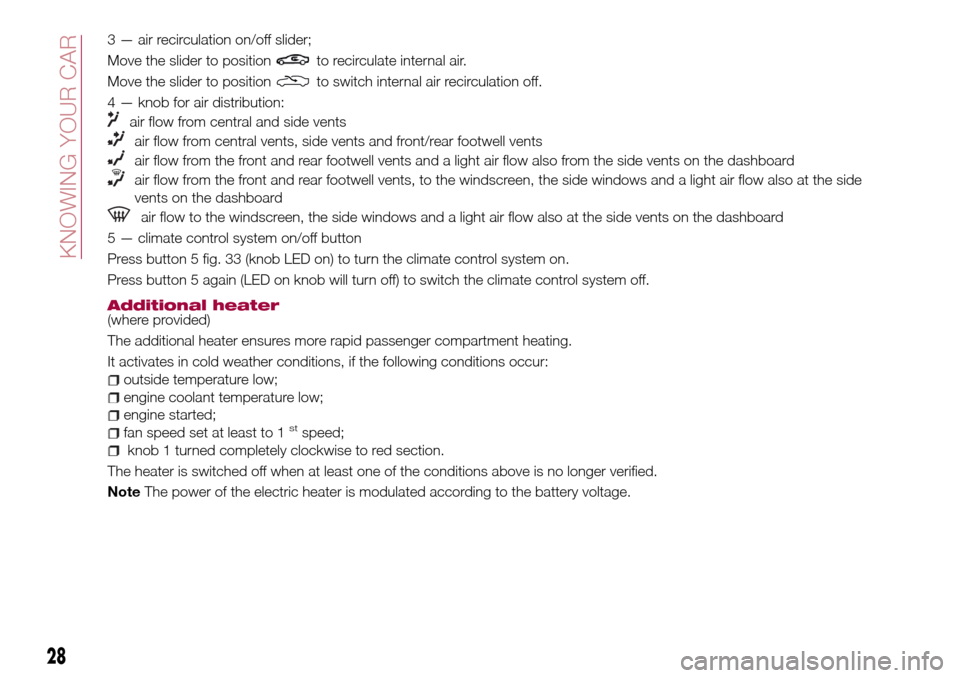
3 — air recirculation on/off slider;
Move the slider to position
to recirculate internal air.
Move the slider to position
to switch internal air recirculation off.
4 — knob for air distribution:
air flow from central and side vents
air flow from central vents, side vents and front/rear footwell vents
air flow from the front and rear footwell vents and a light air flow also from the side vents on the dashboard
air flow from the front and rear footwell vents, to the windscreen, the side windows and a light air flow also at the side
vents on the dashboard
air flow to the windscreen, the side windows and a light air flow also at the side vents on the dashboard
5 — climate control system on/off button
Press button 5 fig. 33 (knob LED on) to turn the climate control system on.
Press button 5 again (LED on knob will turn off) to switch the climate control system off.
Additional heater(where provided)
The additional heater ensures more rapid passenger compartment heating.
It activates in cold weather conditions, if the following conditions occur:
outside temperature low;
engine coolant temperature low;
engine started;
fan speed set at least to 1stspeed;
knob 1 turned completely clockwise to red section.
The heater is switched off when at least one of the conditions above is no longer verified.
NoteThe power of the electric heater is modulated according to the battery voltage.
28
KNOWING YOUR CAR
Page 32 of 240
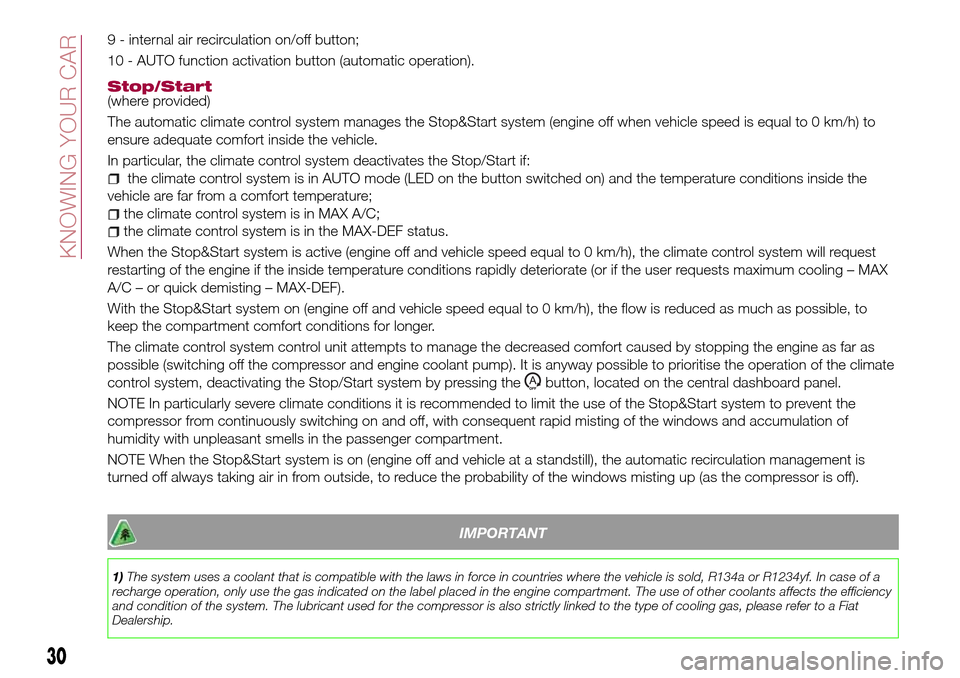
9 - internal air recirculation on/off button;
10 - AUTO function activation button (automatic operation).
Stop/Start(where provided)
The automatic climate control system manages the Stop&Start system (engine off when vehicle speed is equal to 0 km/h) to
ensure adequate comfort inside the vehicle.
In particular, the climate control system deactivates the Stop/Start if:
the climate control system is in AUTO mode (LED on the button switched on) and the temperature conditions inside the
vehicle are far from a comfort temperature;
the climate control system is in MAX A/C;
the climate control system is in the MAX-DEF status.
When the Stop&Start system is active (engine off and vehicle speed equal to 0 km/h), the climate control system will request
restarting of the engine if the inside temperature conditions rapidly deteriorate (or if the user requests maximum cooling – MAX
A/C – or quick demisting – MAX-DEF).
With the Stop&Start system on (engine off and vehicle speed equal to 0 km/h), the flow is reduced as much as possible, to
keep the compartment comfort conditions for longer.
The climate control system control unit attempts to manage the decreased comfort caused by stopping the engine as far as
possible (switching off the compressor and engine coolant pump). It is anyway possible to prioritise the operation of the climate
control system, deactivating the Stop/Start system by pressing the
button, located on the central dashboard panel.
NOTE In particularly severe climate conditions it is recommended to limit the use of the Stop&Start system to prevent the
compressor from continuously switching on and off, with consequent rapid misting of the windows and accumulation of
humidity with unpleasant smells in the passenger compartment.
NOTE When the Stop&Start system is on (engine off and vehicle at a standstill), the automatic recirculation management is
turned off always taking air in from outside, to reduce the probability of the windows misting up (as the compressor is off).
IMPORTANT
1)The system uses a coolant that is compatible with the laws in force in countries where the vehicle is sold, R134a or R1234yf. In case of a
recharge operation, only use the gas indicated on the label placed in the engine compartment. The use of other coolants affects the efficiency
and condition of the system. The lubricant used for the compressor is also strictly linked to the type of cooling gas, please refer to a Fiat
Dealership.
30
KNOWING YOUR CAR
Page 36 of 240
WARNING
28)It is absolutely forbidden to carry out
any after-market operation involving
steering system or steering column
modifications (e.g. installation of anti-theft
device) that could adversely affect
performance, invalidate the warranty, cause
serious safety problems and also result in
the car not meeting type-approval
requirements.
29)Before performing any maintenance
operations, always turn off the engine and
remove the key from the ignition to lock the
steering column (especially when the car
wheels are not touching the ground). If this
is not possible (for example if the key
needs to be turned to MAR or the engine
must be running), remove the main fuse
that protects the electric power steering.
BOOT
9)
IMPORTANT When travelling, do not
put any object on the rear parcel shelf
because they can injure passengers in
the event of an accident or sudden
braking.
OPENING
30)
Rear flap opening
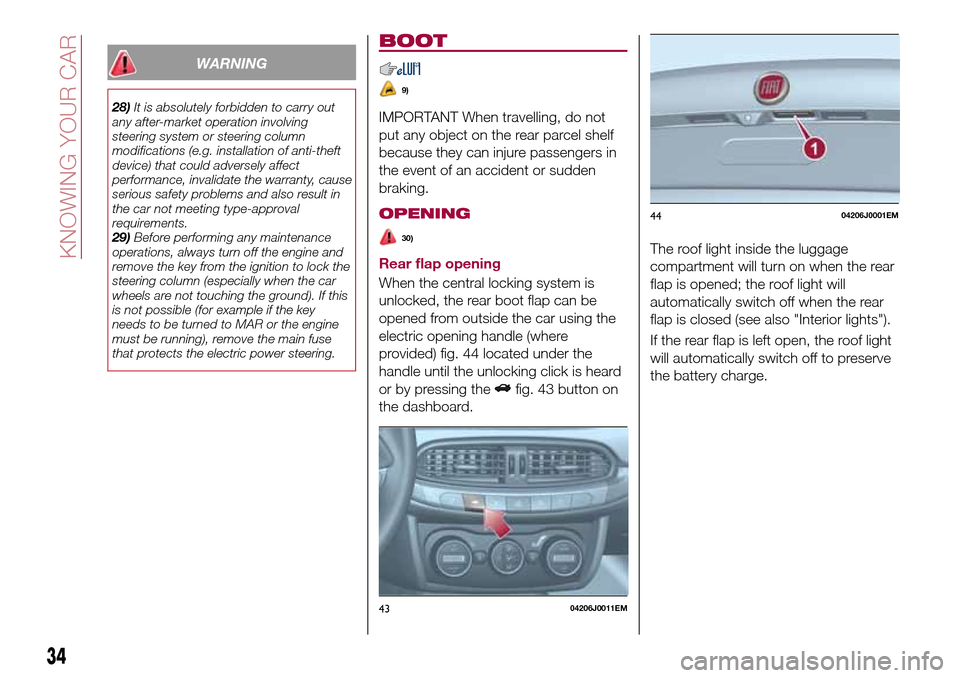
When the central locking system is
unlocked, the rear boot flap can be
opened from outside the car using the
electric opening handle (where
provided) fig. 44 located under the
handle until the unlocking click is heard
or by pressing the
fig. 43 button on
the dashboard.The roof light inside the luggage
compartment will turn on when the rear
flap is opened; the roof light will
automatically switch off when the rear
flap is closed (see also "Interior lights").
If the rear flap is left open, the roof light
will automatically switch off to preserve
the battery charge.
4304206J0011EM
4404206J0001EM
34
KNOWING YOUR CAR
Page 81 of 240
USING THE SEAT BELTS
The seat belt should be worn keeping
the chest straight and rested against
the backrest.
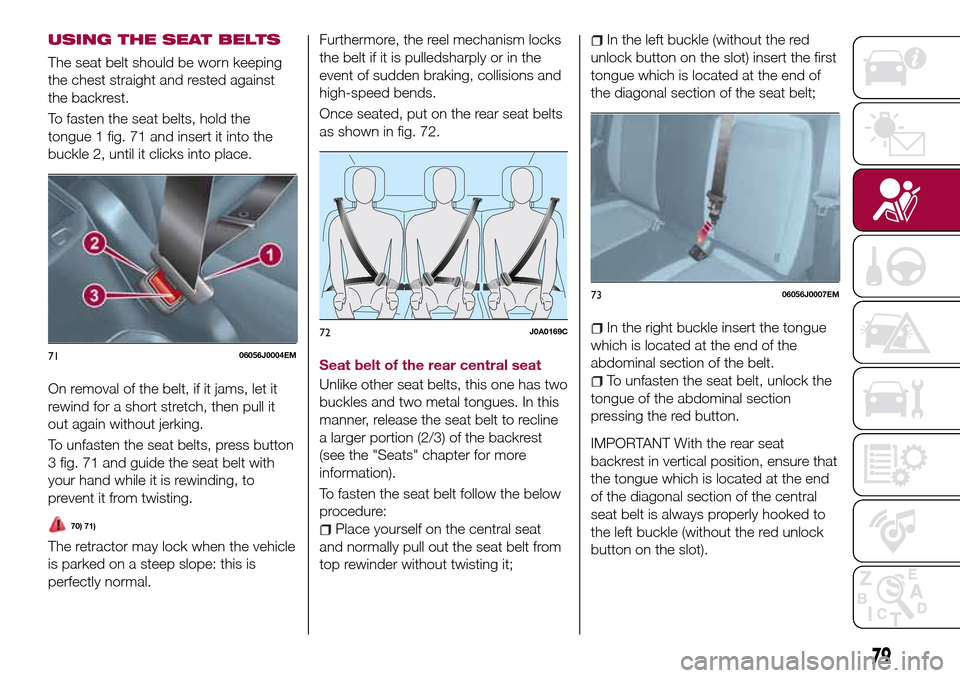
To fasten the seat belts, hold the
tongue 1 fig. 71 and insert it into the
buckle 2, until it clicks into place.
On removal of the belt, if it jams, let it
rewind for a short stretch, then pull it
out again without jerking.
To unfasten the seat belts, press button
3 fig. 71 and guide the seat belt with
your hand while it is rewinding, to
prevent it from twisting.
70) 71)
The retractor may lock when the vehicle
is parked on a steep slope: this is
perfectly normal.Furthermore, the reel mechanism locks
the belt if it is pulledsharply or in the
event of sudden braking, collisions and
high-speed bends.
Once seated, put on the rear seat belts
as shown in fig. 72.
Seat belt of the rear central seat
Unlike other seat belts, this one has two
buckles and two metal tongues. In this
manner, release the seat belt to recline
a larger portion (2/3) of the backrest
(see the "Seats" chapter for more
information).
To fasten the seat belt follow the below
procedure:
Place yourself on the central seat
and normally pull out the seat belt from
top rewinder without twisting it;
In the left buckle (without the red
unlock button on the slot) insert the first
tongue which is located at the end of
the diagonal section of the seat belt;
In the right buckle insert the tongue
which is located at the end of the
abdominal section of the belt.
To unfasten the seat belt, unlock the
tongue of the abdominal section
pressing the red button.
IMPORTANT With the rear seat
backrest in vertical position, ensure that
the tongue which is located at the end
of the diagonal section of the central
seat belt is always properly hooked to
the left buckle (without the red unlock
button on the slot).
7106056J0004EM
72J0A0169C
7306056J0007EM
79
Page 84 of 240
OPERATION OF REAR
SEAT BELT SYMBOLS
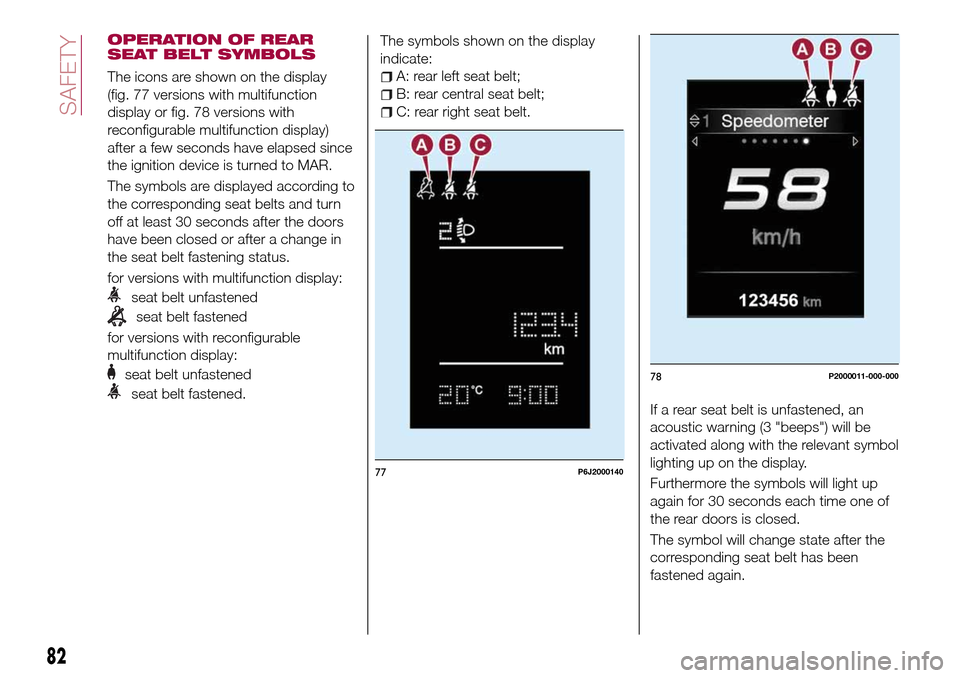
The icons are shown on the display
(fig. 77 versions with multifunction
display or fig. 78 versions with
reconfigurable multifunction display)
after a few seconds have elapsed since
the ignition device is turned to MAR.
The symbols are displayed according to
the corresponding seat belts and turn
off at least 30 seconds after the doors
have been closed or after a change in
the seat belt fastening status.
for versions with multifunction display:
seat belt unfastened
seat belt fastened
for versions with reconfigurable
multifunction display:
seat belt unfastened
seat belt fastened.
The symbols shown on the display
indicate:
A: rear left seat belt;
B: rear central seat belt;
C: rear right seat belt.
If a rear seat belt is unfastened, an
acoustic warning (3 "beeps") will be
activated along with the relevant symbol
lighting up on the display.
Furthermore the symbols will light up
again for 30 seconds each time one of
the rear doors is closed.
The symbol will change state after the
corresponding seat belt has been
fastened again.
77P6J2000140
78P2000011-000-000
82
SAFETY
Page 90 of 240
PASSENGER SEAT COMPLIANCE WITH REGULATIONS ON UNIVERSAL CHILD
RESTRAINT SYSTEM USE
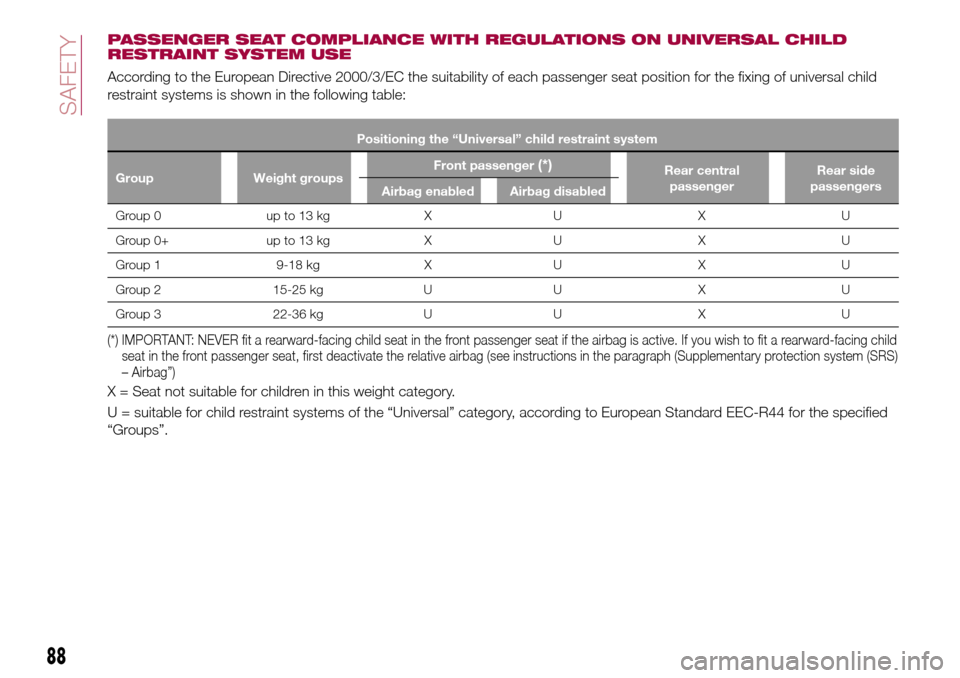
According to the European Directive 2000/3/EC the suitability of each passenger seat position for the fixing of universal child
restraint systems is shown in the following table:
Positioning the “Universal” child restraint system
Group Weight groupsFront passenger
(*)Rear central
passengerRear side
passengers
Airbag enabled Airbag disabled
Group0 upto13kg X U X U
Group 0+ up to 13 kg X U X U
Group 1 9-18 kg X U X U
Group 2 15-25 kg U U X U
Group 3 22-36 kg U U X U
(*) IMPORTANT: NEVER fit a rearward-facing child seat in the front passenger seat if the airbag is active. If you wish to fit a rearward-facing child
seat in the front passenger seat, first deactivate the relative airbag (see instructions in the paragraph (Supplementary protection system (SRS)
– Airbag”)
X = Seat not suitable for children in this weight category.
U = suitable for child restraint systems of the “Universal” category, according to European Standard EEC-R44 for the specified
“Groups”.
88
SAFETY
Page 92 of 240
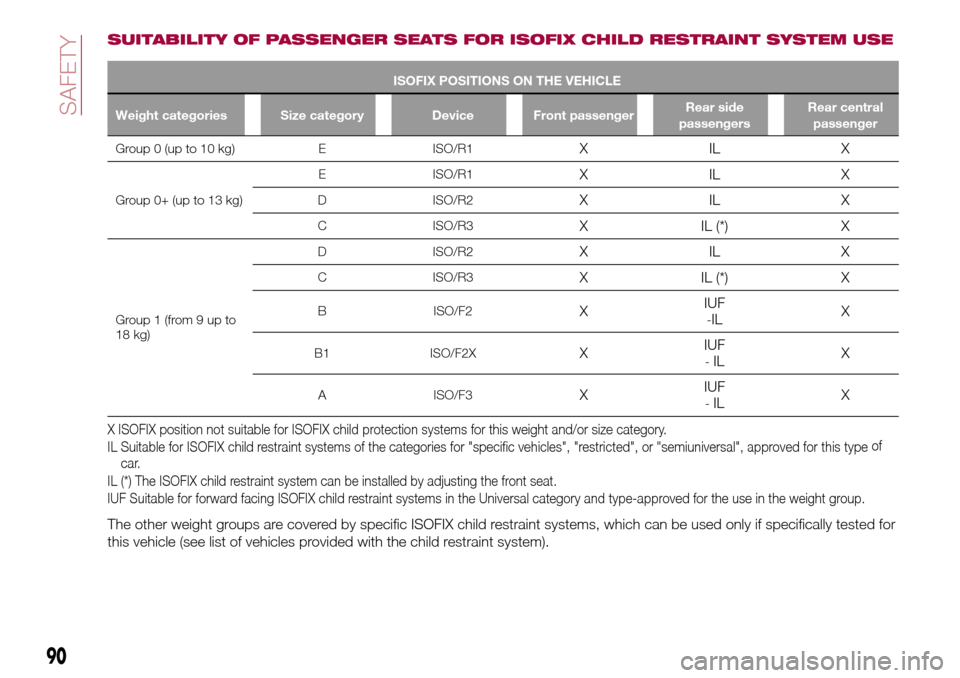
SUITABILITY OF PASSENGER SEATS FOR ISOFIX CHILD RESTRAINT SYSTEM USE
ISOFIX POSITIONS ON THE VEHICLE
Weight categories Size category Device Front passengerRear side
passengersRear central
passenger
Group 0 (up to 10 kg) E ISO/R1XILX
Group 0+ (up to 13 kg)E ISO/R1
XILX
D ISO/R2XILX
C ISO/R3X IL (*) X
Group 1 (from 9 up to
18 kg)D ISO/R2
XILX
C ISO/R3X IL (*) X
B ISO/F2XIUF-ILX
B1 ISO/F2XXIUF-ILX
A ISO/F3XIUF-ILX
X ISOFIX position not suitable for ISOFIX child protection systems for this weight and/or size category.
IL Suitable for ISOFIX child restraint systems of the categories for "specific vehicles", "restricted", or "semiuniversal", approved for this typeof
car.
IL (*) The ISOFIX child restraint system can be installed by adjusting the front seat.
IUF Suitable for forward facing ISOFIX child restraint systems in the Universal category and type-approved for the use in the weight group.
The other weight groups are covered by specific ISOFIX child restraint systems, which can be used only if specifically tested for
this vehicle (see list of vehicles provided with the child restraint system).
90
SAFETY
Page 93 of 240
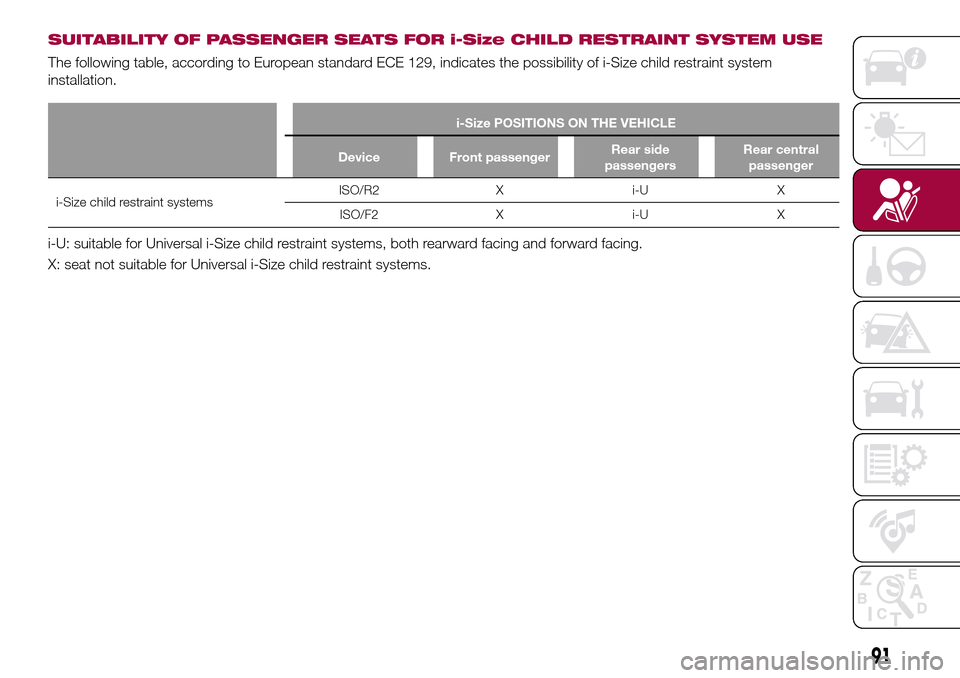
SUITABILITY OF PASSENGER SEATS FOR i-Size CHILD RESTRAINT SYSTEM USE
The following table, according to European standard ECE 129, indicates the possibility of i-Size child restraint system
installation.
i-Size POSITIONS ON THE VEHICLE
Device Front passengerRear side
passengersRear central
passenger
i-Size child restraint systemsISO/R2 X i-U X
ISO/F2 X i-U X
i-U: suitable for Universal i-Size child restraint systems, both rearward facing and forward facing.
X: seat not suitable for Universal i-Size child restraint systems.
91