belt FIAT TIPO 4DOORS 2017 1.G Owner's Manual
[x] Cancel search | Manufacturer: FIAT, Model Year: 2017, Model line: TIPO 4DOORS, Model: FIAT TIPO 4DOORS 2017 1.GPages: 240, PDF Size: 4.15 MB
Page 97 of 240
Main recommendations to carry
children safely
Install the child restraint systems on
the rear seat, which is the most
protected position in the event of an
impact.
Keep children in rearward facing child
restraint systems for as long as
possible, until 3–4 years old if possible.
If the passenger front airbag (where
provided) is deactivated always check
the dedicated warning light on the trim
located on the dashboard to make sure
that it has actually been deactivated.
Carefully follow the instructions
supplied with the child restraint system.
Keep the instructions in the vehicle
along with the other documents and
this handbook. Do not use
second-hand child restraint systems
without instructions.
Only one child is to be strapped into
each restraint system; never carry two
children using one child restraint
system.
Always check that the seat belts do
not rest on the child’s neck.
Always check that the seat belt is
well fastened by pulling on it.
While travelling, do not let the child
sit incorrectly or unfasten the belts.
Never allow a child to put the belt's
diagonal section under an arm or
behind their back.
Never carry children on your lap,
even newborns. No one can hold a
child in the case of an accident.
If the car has been involved in a road
accident, replace the child restraint
system with a new one. In addition, and
depending on the type of child restraint
system installed, replace the isofix
anchorages or the seat belt with which
the child restraint system was
connected.
Any child restraint systems fitted
facing forward on an outside rear seat,
independently of its weight group, must
be fitted after removing the headrest
relative to the seat where it is to be
fitted. This does not apply to child
restraint systems that only consist of a
cushion (without backrest): these child
restraint systems must be installed
when the relative headrest is fitted.
WARNING
78)SEVERE DANGER When a front
passenger airbag is fitted, do not install
rearward facing child restraint systems on
the front passenger seat. Deployment of
the airbag in an accident could cause fatal
injuries to the child regardless of the
severity of the collision. It is advisable to
always carry children in a child restraint
system on the rear seat, which is the most
protected position in the event of a
collision.79)On the sun visor there is a label with
suitable symbols reminding the user that it
is compulsory to deactivate the airbag if a
rearward facing child restraint system is
fitted. Always comply with the instructions
on the passenger side sun visor (see the
"Supplementary Restraint System (SRS) -
Airbag" paragraph).
80)Should it be necessary to carry a child
on the passenger side front seat in a rear
facing child restraint system, the passenger
side front airbag and side bag must be
deactivated through the Connect system
main menu (see the "Supplementary
Restraint System (SRS) - Airbag"
paragraph), verifying deactivation by
checking whether the
LED has
illuminated on the front ceiling light. Move
the passenger's seat as far back as
possible to avoid contact between the
child seat and the dashboard.
81)Do not move the front or rear seat if a
child is seated on it or on the dedicated
child restraint system
82)Incorrect fitting of the child restraint
system may result in an inefficient
protection system. In the event of an
accident the child restraint system may
become loose and the child may be
injured, even fatally. When fitting a restraint
system for newborns or children, strictly
comply with the instructions provided by
the Manufacturer.
83)When the child restraint system is not
used, secure it with the seat belt or with
the ISOFIX anchorages, or remove it from
the vehicle. Do not leave it unsecured
inside the passenger compartment. In this
way, in the case of sudden braking or an
accident, it will not cause injuries to the
occupants.
95
Page 98 of 240
84)After installing a child restraint system,
do not move the seat: always remove the
child restraint system before making any
adjustment.
85)Always make sure that the diagonal
section of the seat belt does not pass
under the arms or behind the back of the
child. In the event of an accident the seat
belt will not be able to secure the child,
with the risk of injury, including fatal injury.
Therefore the child must always wear the
seat belt correctly.
86)Do not use the same lower anchorage
to install more than one child restraint
system.
87)If a Universal ISOFIX child restraint
system is not fixed to all three anchorages,
it will not be able to protect the child
correctly. In a crash, the child could be
seriously or fatally injured.
88)Fit the child restraint system when the
car is stationary. The child restraint system
is correctly fixed to the brackets when you
hear the click. Follow the instructions for
assembly, disassembly and positioning that
the Manufacturer must supply with the
child restraint system.SUPPLEMENTARY
RESTRAINT SYSTEM
(SRS) - AIRBAG
The vehicle is equipped with:
front driver airbag;
passenger front airbag (where
provided);
driver and passenger front side bags
(if present) for pelvis, chest and
shoulder protection (Side bags);
side bags (if present) for head
protection of front seat passengers and
rear side seat passengers (window
bag).
The location of the airbags on the
vehicle is marked by the word "AIR
BAG" in the middle of the steering
wheel, on the dashboard, on the side
trim or on a label placed next to the
airbag deployment area.
FRONT AIRBAGS
The front driver and passenger airbags
(where present) protect the front seat
occupants in the event of head-on
crashes of medium-high severity, by
placing the cushion between the
occupant and the steering wheel or
dashboard.The non-activation of airbags in other
types of collisions (side impacts, rear
shunts, roll-overs, etc...) (if present)
therefore does not indicate a system
malfunction.
Driver and passenger front airbags
(where present) are not a replacement
of but complementary to the seat belts,
which should always be worn, as
specified by law in Europe and most
non-European countries.
In the event of impact, those not
wearing a seat belt are projected
forwards and may come into contact
with the bag which is still inflating. The
protection offered by the bag is
compromised in these circumstances.
Front airbags may not activate in the
following situations:
frontal impacts against highly
deformable objects not involving the
front surface of the vehicle (e.g. wing
collision against guard rail, etc.);
vehicle wedging under other
vehicles or protective barriers (e.g.
trucks or guard rails).
Failure to activate in the conditions
described above is due to the fact that
they may not provide any additional
protection compared with seat belts, so
their activation would be inappropriate.
In these cases, non-deployment does
not indicate a system malfunction.
96
SAFETY
Page 99 of 240
The driver's and passenger's front
airbags (where present) have been
designed and calibrated to protect front
seat occupants wearing seat belts. At
their maximum inflation, their volume
fills most of the space between the
steering wheel and the driver and
between the dashboard and the
passenger.
The airbags are not deployed in the
event of minor frontal impacts (for which
the restraining action of the seat belts is
sufficient).
Seat belts must always be worn. In the
event of frontal impacts they guarantee
correct positioning of the passenger.
Front airbag driver's side
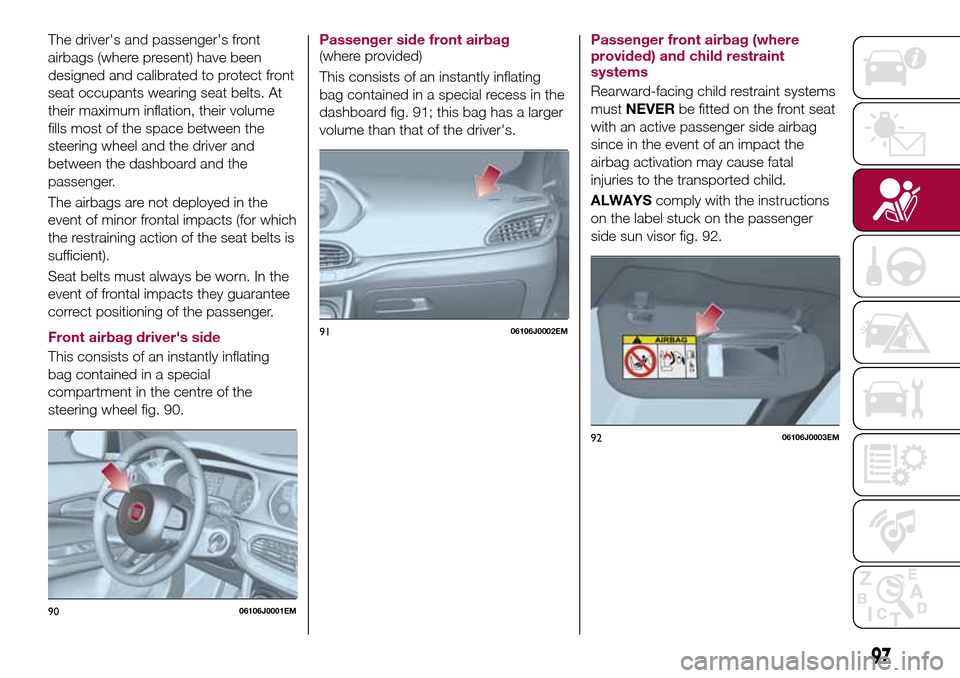
This consists of an instantly inflating
bag contained in a special
compartment in the centre of the
steering wheel fig. 90.Passenger side front airbag
(where provided)
This consists of an instantly inflating
bag contained in a special recess in the
dashboard fig. 91; this bag has a larger
volume than that of the driver's.Passenger front airbag (where
provided) and child restraint
systems
Rearward-facing child restraint systems
mustNEVERbe fitted on the front seat
with an active passenger side airbag
since in the event of an impact the
airbag activation may cause fatal
injuries to the transported child.
ALWAYScomply with the instructions
on the label stuck on the passenger
side sun visor fig. 92.
9006106J0001EM
9106106J0002EM
9206106J0003EM
97
Page 104 of 240
104)The airbag does not replace seat
belts but increases their efficiency.
Because front airbags are not deployed for
low-speed crashes, side collisions,
rear-end shunts or rollovers, occupants are
protected, in addition to any side bags,
only by their seat belts, which must
therefore always be fastened.
102
SAFETY
Page 106 of 240
STARTING THE
ENGINE
Before starting the engine, adjust the
seat, the interior rear view mirrors, the
door mirrors and fasten the seat belt
correctly.
Never press the accelerator pedal for
starting the engine.
If necessary, messages indicating the
starting procedure can be shown on
the display.
ENGINE STARTING
PROCEDURE
105) 106) 107) 108)
36) 37) 38) 39)
Versions with mechanical gearbox
Proceed as follows:
engage the parking brake and place
the gear lever in neutral;
bring the ignition device to MAR,
warning light
will come on in the
instrument panel - wait for the warning
light to switch off;
fully depress the clutch pedal
without touching the accelerator;
turn the ignition device to AVV and
release it as soon as the engine starts;
if the engine does not start within
10 seconds, bring the ignition device
back to STOP and wait for
10-15 seconds before repeating the
starting procedure;
after the manoeuvre has been
repeated, if the problem persists,
contact a Fiat Dealership.
Versions with automatic
transmission
(where provided)
Proceed as follows:
engage the parking brake and set
the gear lever to P (Park) or N (Neutral);
fully depress the brake pedal without
touching the accelerator;
set the ignition device to AVV;
if the engine does not start, bring
the ignition device back to STOP and
wait for 10-15 seconds before
repeating the starting procedure;
after the manoeuvre has been
repeated, if the problem persists,
contact a Fiat Dealership.
ENGINE STARTING
FAILURE
105)
Important notes
Do not try to start the engine by towing
or pushing the vehicle. This manoeuvre
could let unburnt fuel enter the catalytic
converter.When the engine is started, this would
ignite, causing catalytic converter
overheating and damage.
If the battery is flat, you can jump start
the vehicle by connecting the battery
with an auxiliary one or with one on
another vehicle using suitable cables.
This manoeuvre can anyway be
dangerous when not performed
correctly. See the indications in the
"Emergency starting" paragraph in the
"In an emergency" chapter.
WARNING
105)Do not try to start the engine pouring
fuel or other flammable fluid inside the
throttle body air intake: this might damage
the engine and injury people nearby.
106)It is dangerous to run the engine in
enclosed areas. The engine takes in
oxygen and releases carbon dioxide,
carbon monoxide and other toxic gases.
107)The brake servo is not active until the
engine is started, so you would need to
apply much more force than usual to the
brake pedal.
108)Do not start the engine by pushing,
towing or driving downhill. These
manoeuvres may damage the catalytic
converter.
104
STARTING AND DRIVING
Page 112 of 240
When the engine has been stopped
automatically, keeping the brake pedal
pressed, the brake can be released
keeping the engine off by quickly
shifting the gear lever to P (Park).
To restart the engine, just move the
lever out of position P.
SYSTEM MANUAL
ACTIVATION/
DEACTIVATION
To activate/deactivate the system
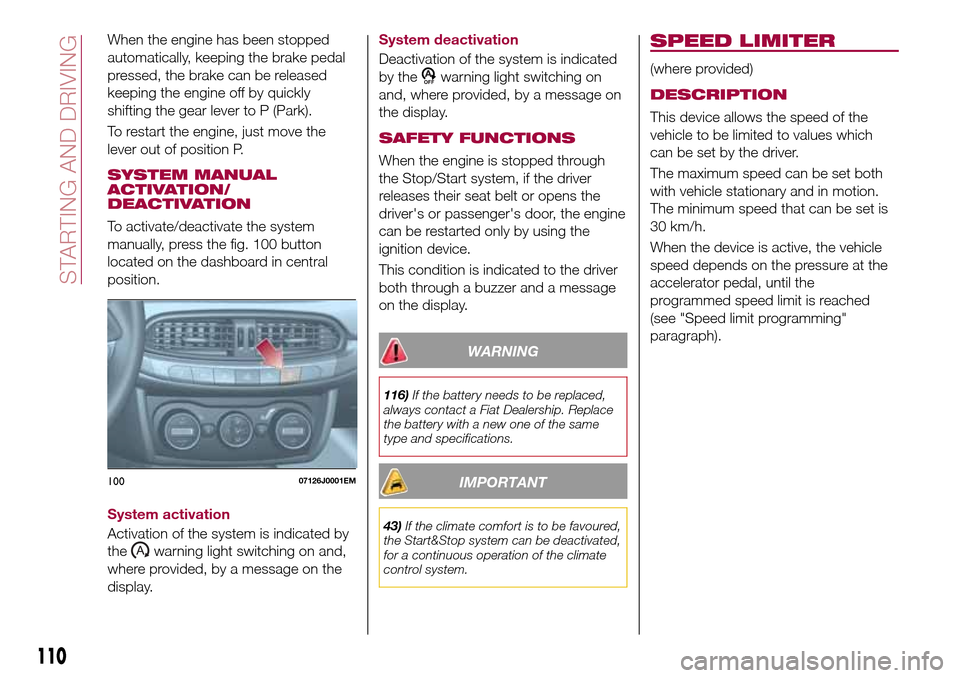
manually, press the fig. 100 button
located on the dashboard in central
position.
System activation
Activation of the system is indicated by
the
warning light switching on and,
where provided, by a message on the
display.System deactivation
Deactivation of the system is indicated
by the
warning light switching on
and, where provided, by a message on
the display.
SAFETY FUNCTIONS
When the engine is stopped through
the Stop/Start system, if the driver
releases their seat belt or opens the
driver's or passenger's door, the engine
can be restarted only by using the
ignition device.
This condition is indicated to the driver
both through a buzzer and a message
on the display.
WARNING
116)If the battery needs to be replaced,
always contact a Fiat Dealership. Replace
the battery with a new one of the same
type and specifications.
IMPORTANT
43)If the climate comfort is to be favoured,
the Start&Stop system can be deactivated,
for a continuous operation of the climate
control system.
SPEED LIMITER
(where provided)
DESCRIPTION
This device allows the speed of the
vehicle to be limited to values which
can be set by the driver.
The maximum speed can be set both
with vehicle stationary and in motion.
The minimum speed that can be set is
30 km/h.
When the device is active, the vehicle
speed depends on the pressure at the
accelerator pedal, until the
programmed speed limit is reached
(see "Speed limit programming"
paragraph).
10007126J0001EM
110
STARTING AND DRIVING
Page 154 of 240
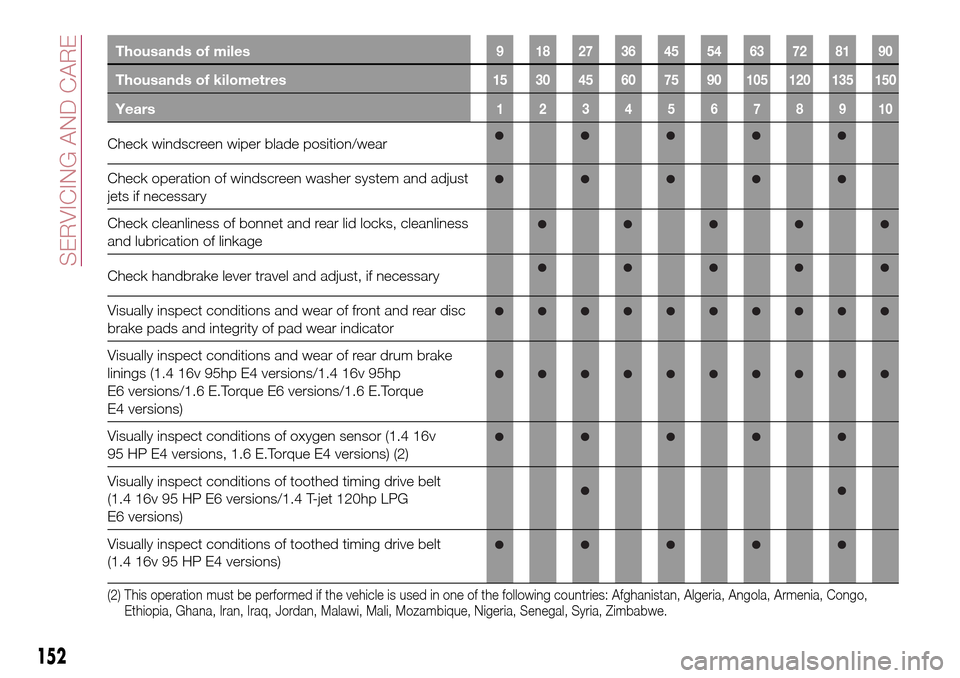
Thousands of miles9 182736455463728190
Thousands of kilometres15 30 45 60 75 90 105 120 135 150
Years12345678910
Check windscreen wiper blade position/wear
Check operation of windscreen washer system and adjust
jets if necessary
Check cleanliness of bonnet and rear lid locks, cleanliness
and lubrication of linkage
Check handbrake lever travel and adjust, if necessary
Visually inspect conditions and wear of front and rear disc
brake pads and integrity of pad wear indicator
Visually inspect conditions and wear of rear drum brake
linings (1.4 16v 95hp E4 versions/1.4 16v 95hp
E6 versions/1.6 E.Torque E6 versions/1.6 E.Torque
E4 versions)
Visually inspect conditions of oxygen sensor (1.4 16v
95 HP E4 versions, 1.6 E.Torque E4 versions) (2)
Visually inspect conditions of toothed timing drive belt
(1.4 16v 95 HP E6 versions/1.4 T-jet 120hp LPG
E6 versions)
Visually inspect conditions of toothed timing drive belt
(1.4 16v 95 HP E4 versions)
(2) This operation must be performed if the vehicle is used in one of the following countries: Afghanistan, Algeria, Angola, Armenia, Congo,
Ethiopia, Ghana, Iran, Iraq, Jordan, Malawi, Mali, Mozambique, Nigeria, Senegal, Syria, Zimbabwe.
152
SERVICING AND CARE
Page 155 of 240
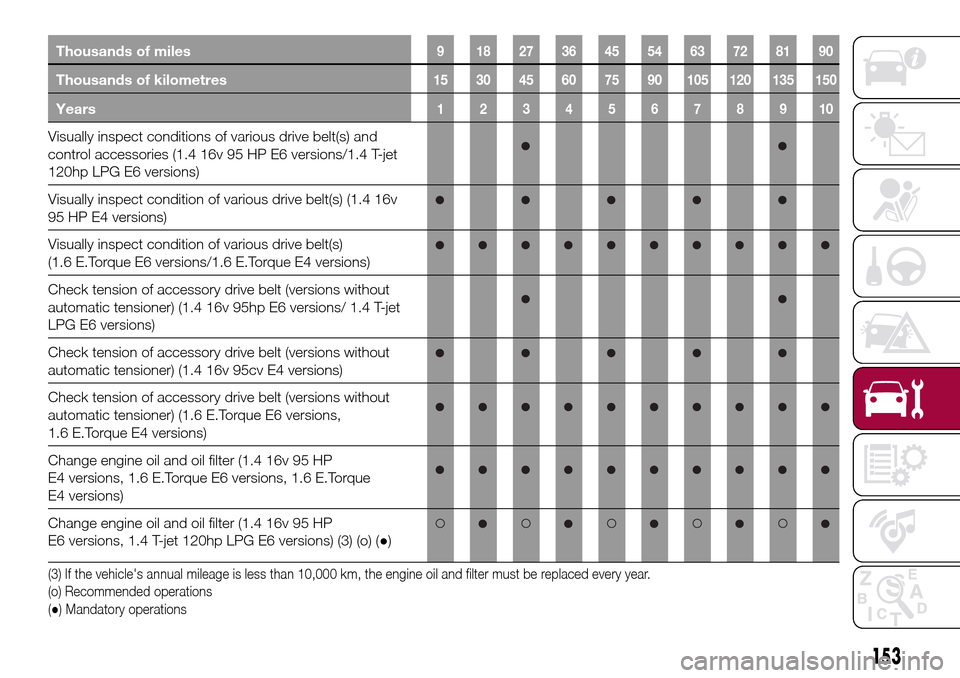
Thousands of miles9 182736455463728190
Thousands of kilometres15 30 45 60 75 90 105 120 135 150
Years12345678910
Visually inspect conditions of various drive belt(s) and
control accessories (1.4 16v 95 HP E6 versions/1.4 T-jet
120hp LPG E6 versions)
Visually inspect condition of various drive belt(s) (1.4 16v
95 HP E4 versions)
Visually inspect condition of various drive belt(s)
(1.6 E.Torque E6 versions/1.6 E.Torque E4 versions)
Check tension of accessory drive belt (versions without
automatic tensioner) (1.4 16v 95hp E6 versions/ 1.4 T-jet
LPG E6 versions)
Check tension of accessory drive belt (versions without
automatic tensioner) (1.4 16v 95cv E4 versions)
Check tension of accessory drive belt (versions without
automatic tensioner) (1.6 E.Torque E6 versions,
1.6 E.Torque E4 versions)
Change engine oil and oil filter (1.4 16v 95 HP
E4 versions, 1.6 E.Torque E6 versions, 1.6 E.Torque
E4 versions)
Change engine oil and oil filter (1.4 16v 95 HP
E6 versions, 1.4 T-jet 120hp LPG E6 versions) (3) (o) (●)
(3) If the vehicle's annual mileage is less than 10,000 km, the engine oil and filter must be replaced every year.
(o) Recommended operations
(●) Mandatory operations
153
Page 156 of 240
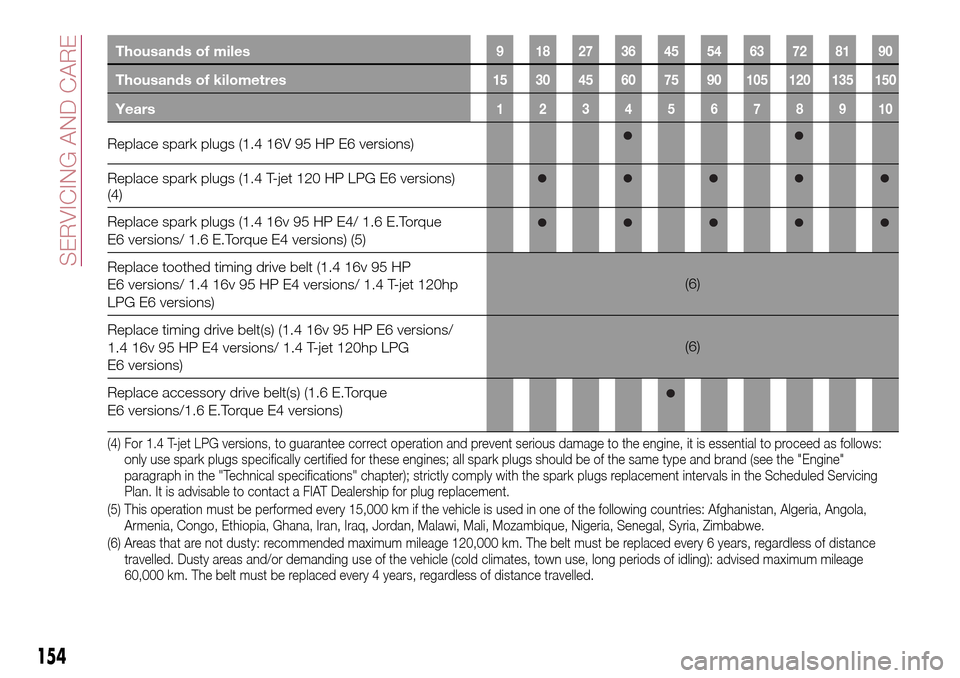
Thousands of miles9 182736455463728190
Thousands of kilometres15 30 45 60 75 90 105 120 135 150
Years12345678910
Replace spark plugs (1.4 16V 95 HP E6 versions)
Replace spark plugs (1.4 T-jet 120 HP LPG E6 versions)
(4)
Replace spark plugs (1.4 16v 95 HP E4/ 1.6 E.Torque
E6 versions/ 1.6 E.Torque E4 versions) (5)
Replace toothed timing drive belt (1.4 16v 95 HP
E6 versions/ 1.4 16v 95 HP E4 versions/ 1.4 T-jet 120hp
LPG E6 versions)(6)
Replace timing drive belt(s) (1.4 16v 95 HP E6 versions/
1.4 16v 95 HP E4 versions/ 1.4 T-jet 120hp LPG
E6 versions)(6)
Replace accessory drive belt(s) (1.6 E.Torque
E6 versions/1.6 E.Torque E4 versions)
(4) For 1.4 T-jet LPG versions, to guarantee correct operation and prevent serious damage to the engine, it is essential to proceed as follows:
only use spark plugs specifically certified for these engines; all spark plugs should be of the same type and brand (see the "Engine"
paragraph in the "Technical specifications" chapter); strictly comply with the spark plugs replacement intervals in the Scheduled Servicing
Plan. It is advisable to contact a FIAT Dealership for plug replacement.
(5) This operation must be performed every 15,000 km if the vehicle is used in one of the following countries: Afghanistan, Algeria, Angola,
Armenia, Congo, Ethiopia, Ghana, Iran, Iraq, Jordan, Malawi, Mali, Mozambique, Nigeria, Senegal, Syria, Zimbabwe.
(6) Areas that are not dusty: recommended maximum mileage 120,000 km. The belt must be replaced every 6 years, regardless of distance
travelled. Dusty areas and/or demanding use of the vehicle (cold climates, town use, long periods of idling): advised maximum mileage
60,000 km. The belt must be replaced every 4 years, regardless of distance travelled.
154
SERVICING AND CARE
Page 159 of 240
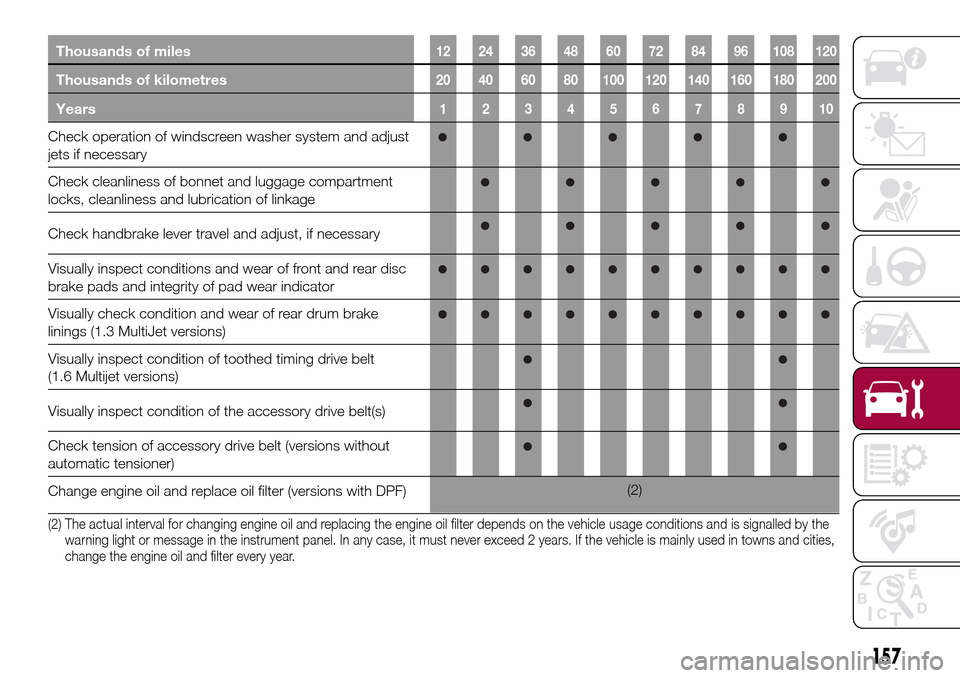
Thousands of miles12 24 36 48 60 72 84 96 108 120
Thousands of kilometres20 40 60 80 100 120 140 160 180 200
Years12345678910
Check operation of windscreen washer system and adjust
jets if necessary
Check cleanliness of bonnet and luggage compartment
locks, cleanliness and lubrication of linkage
Check handbrake lever travel and adjust, if necessary
Visually inspect conditions and wear of front and rear disc
brake pads and integrity of pad wear indicator
Visually check condition and wear of rear drum brake
linings (1.3 MultiJet versions)
Visually inspect condition of toothed timing drive belt
(1.6 Multijet versions)
Visually inspect condition of the accessory drive belt(s)
Check tension of accessory drive belt (versions without
automatic tensioner)
Change engine oil and replace oil filter (versions with DPF)(2)
(2) The actual interval for changing engine oil and replacing the engine oil filter depends on the vehicle usage conditions and is signalled by the
warning light or message in the instrument panel. In any case, it must never exceed 2 years. If the vehicle is mainly used in towns and cities,
change the engine oil and filter every year.
157