belt FIAT TIPO 4DOORS 2020 Owner handbook (in English)
[x] Cancel search | Manufacturer: FIAT, Model Year: 2020, Model line: TIPO 4DOORS, Model: FIAT TIPO 4DOORS 2020Pages: 252, PDF Size: 7.29 MB
Page 100 of 252

Driver and passenger front airbags
(where present) are not a replacement
of but complementary to the seat belts,
which should always be worn, as
specified by law in Europe and most
non-European countries.
In a crash, those not wearing a seat
belt are projected forwards and may
come into contact with the bag which is
still inflating. The protection offered by
the bag is compromised in these
circumstances.
Front airbags may not activate in the
following situations:
frontal impacts against highly
deformable objects not involving the
front surface of the car (e.g. wing
collision against guard rail, etc.);
car wedging under other cars or
protective barriers (e.g. trucks or guard
rails).
Failure to deploy in the conditions
described above is due to the fact that
the airbags may not provide any
additional protection compared with
seat belts, so their activation would be
inappropriate.
In these cases, non-deployment does
not indicate a system malfunction.
The driver's and passenger's front
airbags (where present) have been
designed and calibrated to protect front
seat occupants wearing seat belts.At their maximum inflation, their volume
fills most of the space between the
steering wheel and the driver and
between the dashboard and the
passenger.
The airbags are not deployed in the
event of minor frontal impacts (for which
the restraining action of the seat belts is
sufficient).
Seat belts must always be worn. In the
event of a frontal collision, they ensure
the correct positioning of the occupant.
Front airbag driver's side
This consists of an instantly inflating
bag contained in a special
compartment in the centre of the
steering wheel fig. 90.Passenger front airbag
(where provided)
This consists of an instantly inflating
bag contained in a special recess in the
dashboard fig. 91; this bag has a larger
volume than that of the driver's.
Passenger front airbag (where
provided) and child restraint
systems
Rearward-facing child restraint systems
mustNEVERbe fitted on the front seat
with an active passenger side airbag
since in the event of an impact the
airbag activation may cause fatal
injuries to the transported child.
ALWAYScomply with the instructions
on the label stuck on the passenger
side sun visor fig. 92.
9006106J0001EM
9106106J0002EM
98
SAFETY
Page 104 of 252

90)Always drive with your hands on the
rim of the steering wheel so that the airbag
can inflate freely if required. Do not drive
with your body bent forward. Keep your
back straight against the backrest.
91)When there is an active passenger
airbag, DO NOT install rearward facing
child restraint systems on the front seat.
Deployment of the airbag in an accident
could cause fatal injuries to the child
regardless of the severity of the impact.
Therefore, always deactivate the passenger
side airbag when a rearward facing child
restraint system is installed on the front
passenger seat. The front passenger seat
must also be positioned back as far as
possible in order to prevent the child
restraint system from coming into contact
with the dashboard. Immediately reactivate
the passenger airbag as soon as the child
restraint system has been removed.
92)To deactivate the airbags using the
instrument panel menu, see the description
in the "Knowing the instrument panel"
chapter, "Menu Options" paragraph.
93)Do not affix rigid objects to the
garment hooks or support handles.
94)Do not rest your head, arms or elbows
on the door, windows or the area in which
the Window bag is located to avoid
possible injury during airbag inflation.
95)Never lean your head, arms or elbows
out of the window.96)If, when the ignition device is turned to
MAR, thewarning light does not switch
on or stays on whilst driving, a fault may
have occurred in the restraint systems. In
this case the airbags or pretensioners may
not be deployed in an impact or, in a lower
number of cases, they may be deployed
accidentally. Contact a Fiat Dealership
immediately to have the system checked.
97)In some versions, in case of a LED
failure (located on the plate of the
instrument panel), thewarning light on
the instrument panel turns on and the
passenger side airbags are deactivated.
98)On cars with side bags, do not cover
the front seat backrests with extra covers.
99)Do not travel carrying objects in your
lap, in front of your chest or between your
lips (pipe, pencils, etc.): they could cause
severe injury if the airbag is deployed.
100)If the car has been stolen or in the
case of attempt to steal it, if it has been
subjected to vandalism or floods, have the
airbag system checked by a Fiat
Dealership.
101)If the ignition device is at MAR, even if
the engine is switched off, airbags may be
deployed when the vehicle is stationary
and hit by another vehicle. Therefore, even
if the vehicle is stationary, when an active
front passenger airbag is fitted, DO NOT
install rearward facing child restraint
systems on the front passenger seat.
Deployment of the airbag following an
impact could cause fatal injuries to the
child. Therefore, always deactivate the
passenger side airbag when a rearward
facing child restraint system is installed on
the front passenger seat.The front passenger seat must also be
positioned back as far as possible in order
to prevent the child restraint system from
coming into contact with the dashboard.
Immediately reactivate the passenger
airbag as soon as the child restraint system
has been removed. Also remember that, if
the ignition device is set to STOP, none of
the safety devices (airbags or
pretensioners) will be deployed in the event
of collision. Non-deployment in such cases
does not indicate a system malfunction.
102)Malfunction of thewarning light is
indicated by the activation of an airbag
failure icon and a dedicated message on
the instrument panel display (or, for
versions where provided, by the activation
of a blinking generic failure warning light).
The pyrotechnic charges are not disabled.
Contact a Fiat Dealership immediately to
have the system checked.
103)The airbag deployment threshold is
higher than that of the pretensioners. For
collisions in the range between the two
thresholds, it is normal for only the
pretensioners to be activated.
104)The airbag does not replace seat
belts but increases their efficiency.
Because front airbags are not deployed for
low-speed crashes, side collisions,
rear-end shunts or rollovers, occupants are
protected, in addition to any side bags,
only by their seat belts, which must
therefore always be fastened.
102
SAFETY
Page 106 of 252
STARTING THE
ENGINE
Before starting the engine, adjust the
seat, the interior rear view mirrors, the
door mirrors and fasten the seat belt
correctly.
Never press the accelerator pedal for
starting the engine.
If necessary, messages indicating the
starting procedure can be shown on
the display.
ENGINE STARTING
PROCEDURE
105) 106) 107) 108)
37) 38) 39) 40)
Versions with mechanical gearbox
Proceed as follows:
engage the parking brake and place
the gear lever in neutral;
bring the ignition device to MAR,
warning light
will come on in the
instrument panel - wait for the warning
light to switch off;
fully depress the clutch pedal
without touching the accelerator;
turn the ignition device to AVV and
release it as soon as the engine starts;
if the engine does not start within
10 seconds, bring the ignition device
back to STOP and wait for
10-15 seconds before repeating the
starting procedure;
after the manoeuvre has been
repeated, if the problem persists,
contact a Fiat Dealership.
Versions with automatic
transmission
(where provided)
Proceed as follows:
engage the parking brake and set
the gear lever to P (Park) or N (Neutral);
fully depress the brake pedal without
touching the accelerator;
set the ignition device to AVV;
if the engine does not start, bring
the ignition device back to STOP and
wait for 10-15 seconds before
repeating the starting procedure;
after the manoeuvre has been
repeated, if the problem persists,
contact a Fiat Dealership.
ENGINE STARTING
FAILURE
105)
Important notes
Do not try to start the engine by towing
or pushing the vehicle. This manoeuvre
could let unburnt fuel enter the catalytic
converter.When the engine is started, this would
ignite, causing catalytic converter
overheating and damage.
If the battery is flat, you can jump start
the vehicle by connecting the battery
with an auxiliary one or with one on
another vehicle using suitable cables.
This manoeuvre can anyway be
dangerous when not performed
correctly. See the indications in the
"Emergency starting" paragraph in the
"In an emergency" chapter.
WARNING
105)Do not try to start the engine pouring
fuel or other flammable fluid inside the
throttle body air intake: this might damage
the engine and injury people nearby.
106)It is dangerous to run the engine in
enclosed areas. The engine takes in
oxygen and releases carbon dioxide,
carbon monoxide and other toxic gases.
107)The brake servo is not active until the
engine is started, so you would need to
apply much more force than usual to the
brake pedal.
108)Do not start the engine by pushing,
towing or driving downhill. These
manoeuvres may damage the catalytic
converter.
104
STARTING AND DRIVING
Page 112 of 252
With brake pressed, if the gear lever is
in "AutoStick" mode, the engine can be
restarted by moving the lever to R
(Reverse).
When the engine has been stopped
automatically, keeping the brake pedal
pressed, the brake can be released
keeping the engine off by quickly
shifting the gear lever to P (Park).
To restart the engine, just move the
lever out of position P.
SYSTEM MANUAL
ACTIVATION/
DEACTIVATION
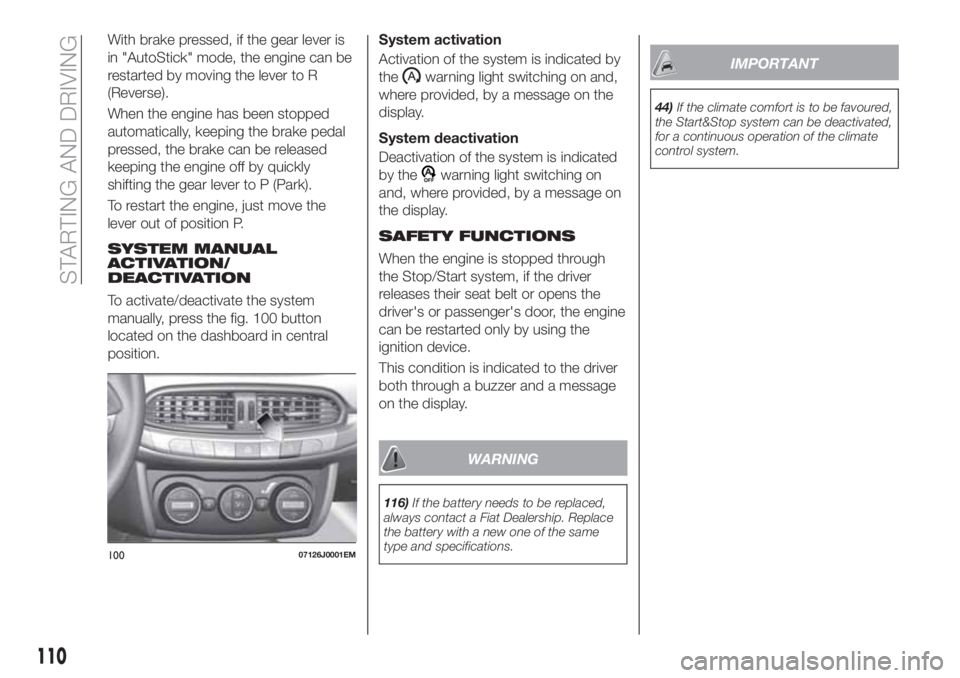
To activate/deactivate the system
manually, press the fig. 100 button
located on the dashboard in central
position.System activation
Activation of the system is indicated by
the
warning light switching on and,
where provided, by a message on the
display.
System deactivation
Deactivation of the system is indicated
by the
warning light switching on
and, where provided, by a message on
the display.
SAFETY FUNCTIONS
When the engine is stopped through
the Stop/Start system, if the driver
releases their seat belt or opens the
driver's or passenger's door, the engine
can be restarted only by using the
ignition device.
This condition is indicated to the driver
both through a buzzer and a message
on the display.
WARNING
116)If the battery needs to be replaced,
always contact a Fiat Dealership. Replace
the battery with a new one of the same
type and specifications.
IMPORTANT
44)If the climate comfort is to be favoured,
the Start&Stop system can be deactivated,
for a continuous operation of the climate
control system.
10007126J0001EM
110
STARTING AND DRIVING
Page 158 of 252
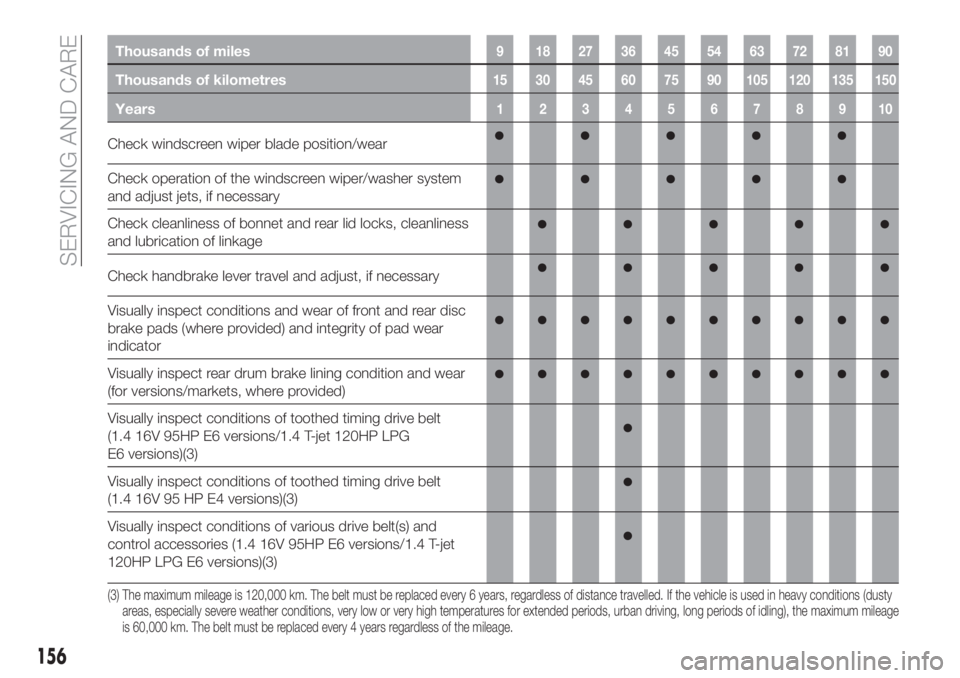
Thousands of miles9 182736455463728190
Thousands of kilometres15 30 45 60 75 90 105 120 135 150
Years12345678910
Check windscreen wiper blade position/wear
Check operation of the windscreen wiper/washer system
and adjust jets, if necessary
Check cleanliness of bonnet and rear lid locks, cleanliness
and lubrication of linkage
Check handbrake lever travel and adjust, if necessary
Visually inspect conditions and wear of front and rear disc
brake pads (where provided) and integrity of pad wear
indicator
Visually inspect rear drum brake lining condition and wear
(for versions/markets, where provided)
Visually inspect conditions of toothed timing drive belt
(1.4 16V 95HP E6 versions/1.4 T-jet 120HP LPG
E6 versions)(3)
Visually inspect conditions of toothed timing drive belt
(1.4 16V 95 HP E4 versions)(3)
Visually inspect conditions of various drive belt(s) and
control accessories (1.4 16V 95HP E6 versions/1.4 T-jet
120HP LPG E6 versions)(3)
(3) The maximum mileage is 120,000 km. The belt must be replaced every 6 years, regardless of distance travelled. If the vehicle is used in heavy conditions (dusty
areas, especially severe weather conditions, very low or very high temperatures for extended periods, urban driving, long periods of idling), the maximum mileage
is 60,000 km. The belt must be replaced every 4 years regardless of the mileage.
156
SERVICING AND CARE
Page 159 of 252

Thousands of miles9 182736455463728190
Thousands of kilometres15 30 45 60 75 90 105 120 135 150
Years12345678910
Visually inspect condition of various drive belt(s) (1.4 16V
95 HP E4 versions)(3)
Visually inspect the condition of the various drive belt(s)
(1.6 E.TorQ E6 versions / 1.6 E.TorQ E4 versions)
Check tension of accessory drive belt (versions without
automatic tensioner) (1.4 16V 95HP E6 versions/ 1.4 T-jet
120HP LPG E6 versions)
Check tension of accessory drive belt (versions without
automatic tensioner) (1.4 16V 95 HP E4 versions)
Check the accessory drive belt tension (versions without
automatic tensioner) (1.6 E.TorQ E6 versions, 1.6 E.TorQ
E4 versions)
Change the engine oil and oil filter (1.4 16V 95 HP E4 /
1.6 E.TorQ E6 versions / 1.6 E.TorQ E4 versions)
Change engine oil and oil filter (1.4 16V 95 HP
E6 versions, 1.4 T-jet 120 HP LPG E6 versions) (4) (o) (●)
(3) The maximum mileage is 120,000 km. The belt must be replaced every 6 years, regardless of distance travelled. If the vehicle is used in heavy conditions (dusty
areas, especially severe weather conditions, very low or very high temperatures for extended periods, urban driving, long periods of idling), the maximum mileage
is 60,000 km. The belt must be replaced every 4 years regardless of the mileage.
(4) If the car's annual mileage is less than 10,000 km, the engine oil and filter must be replaced every year.
(o) Recommended operations
(●) Obligatory operations
157
Page 160 of 252

Thousands of miles9 182736455463728190
Thousands of kilometres15 30 45 60 75 90 105 120 135 150
Years12345678910
Replace the spark plugs (1.4 16V 95 HP E6 versions)(5)
Replace spark plugs (1.4 T-jet 120 HP LPG E6 versions)(5)
Replace the spark plugs (1.4 16V 95 HP E4 versions /
1.6 E.TorQ E6 versions / 1.6 E.TorQ E4 versions)(5) (6)
Replace toothed timing drive belt (1.4 16V 95 HP
E6 versions / 1.4 16V 95 HP E4 versions/ 1.4 T-jet
120 HP LPG E6 versions)(3)
Replace timing drive belt(s) (1.4 16V 95 HP E6 versions /
1.4 16V 95 HP E4 versions / 1.4 T-jet 120 HP LPG
E6 versions)(3)
(5) The replacement must be performed according to mileage and regards of the elapsed time. To guarantee correct operation and prevent serious damageto the
engine, it is essential to only use spark plugs specifically certified for the engine itself; all spark plugs should be of the same type and brand (see the "Engine"
paragraph in the "Technical specifications" chapter); strictly comply with the spark plug replacement intervals in the Scheduled Servicing Plan. It is advisable to
contact a FIAT Dealership for plug replacement.
(6) This operation must be performed every 15,000 km if the vehicle is used in one of the following countries: Algeria, Bahrain, Angola, Bolivia, Cameroon, Congo,
El Salvador, Ethiopia, Philippines, Gabon, Ghana, Jordan, Guatemala, Honduras, Kenya, Libya, Madagascar, Malawi, Mali, Mauritania, Mozambique,Panama,
Peru, Uganda, Zambia, Zimbabwe. (3) The maximum mileage is 120,000 km. The belt must be replaced every 6 years, regardless of distance travelled. If the vehicle is used in heavy conditions (dusty
areas, especially severe weather conditions, very low or very high temperatures for extended periods, urban driving, long periods of idling), the maximum mileage
is 60,000 km. The belt must be replaced every 4 years regardless of the mileage
158
SERVICING AND CARE
Page 161 of 252

Thousands of miles9 182736455463728190
Thousands of kilometres15 30 45 60 75 90 105 120 135 150
Years12345678910
Replace the accessory drive belt(s) (1.6 E.TorQ
E6 versions / 1.6 E.TorQ E4 versions)
Replace air cleaner cartridge (1.4 16V 95HP E6 versions/
1.4 16V 95HP E4 versions/ 1.4 T-jet 120HP LPG
E6 versions)(7)
Replace the air cleaner cartridge (1.6 E.TorQ E6 versions /
1.6 E.TorQ E4 versions)(7)
Replace the oxygen sensor (1.4 16V 95 HP E4 versions /
1.6 E.TorQ E4 versions)(2)
Change the brake fluid(8)
Replace filter inside the pressure regulator (1.4 T-Jet
120 HP LPG E6 versions)
Replace paper filter (LPG in gaseous state) (1.4 T-Jet
120 HP LPG E6 versions)
Replace the passenger compartment cleaner(7) (o) (●)
(7) If the vehicle is used in dusty areas, you are advised to change this filter every 15,000 km. (2) This operation must be performed if the vehicle is used in one of the following countries: Algeria, Bahrain, Angola, Bolivia, Cameroon, Congo, El Salvador,
Ethiopia, Philippines, Gabon, Ghana, Jordan, Guatemala, Honduras, Kenya, Libya, Madagascar, Malawi, Mali, Mauritania, Mozambique, Panama, Peru, Uganda,
Zambia, Zimbabwe.
(8) The brake fluid replacement has to be done every two years, irrespective of the mileage.
(o) Recommended operations
(●) Obligatory operations
159
Page 163 of 252
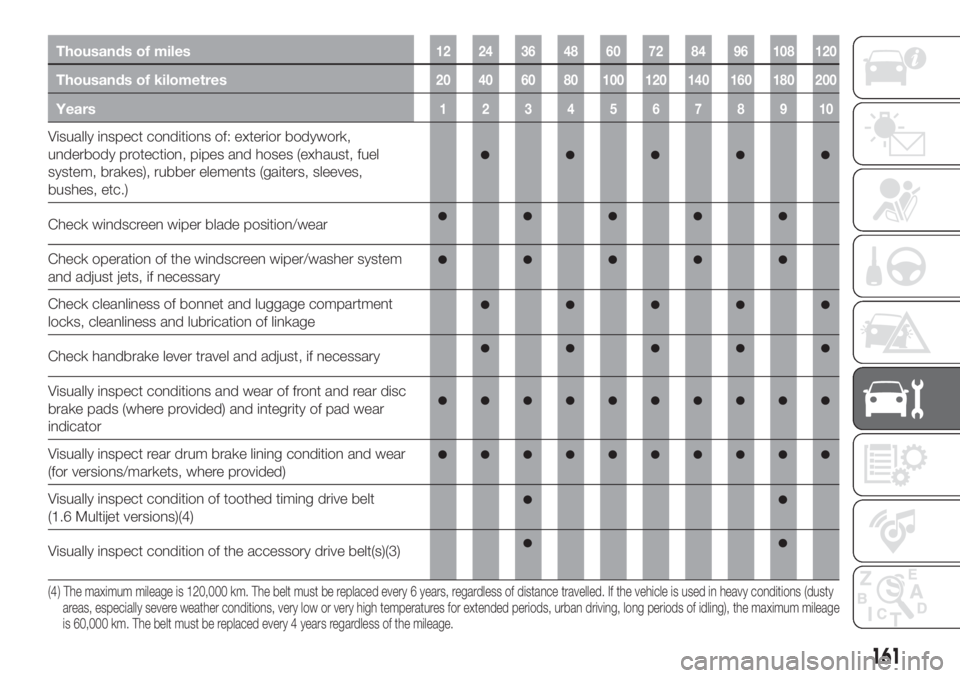
Thousands of miles12 24 36 48 60 72 84 96 108 120
Thousands of kilometres20 40 60 80 100 120 140 160 180 200
Years12345678910
Visually inspect conditions of: exterior bodywork,
underbody protection, pipes and hoses (exhaust, fuel
system, brakes), rubber elements (gaiters, sleeves,
bushes, etc.)
Check windscreen wiper blade position/wear
Check operation of the windscreen wiper/washer system
and adjust jets, if necessary
Check cleanliness of bonnet and luggage compartment
locks, cleanliness and lubrication of linkage
Check handbrake lever travel and adjust, if necessary
Visually inspect conditions and wear of front and rear disc
brake pads (where provided) and integrity of pad wear
indicator
Visually inspect rear drum brake lining condition and wear
(for versions/markets, where provided)
Visually inspect condition of toothed timing drive belt
(1.6 Multijet versions)(4)
Visually inspect condition of the accessory drive belt(s)(3)
(4 ) The maximum mileage is 120,000 km. The belt must be replaced every 6 years, regardless of distance travelled. If the vehicle is used in heavy conditions (dusty
areas, especially severe weather conditions, very low or very high temperatures for extended periods, urban driving, long periods of idling), the maximum mileage
is 60,000 km. The belt must be replaced every 4 years regardless of the mileage.
161
Page 164 of 252
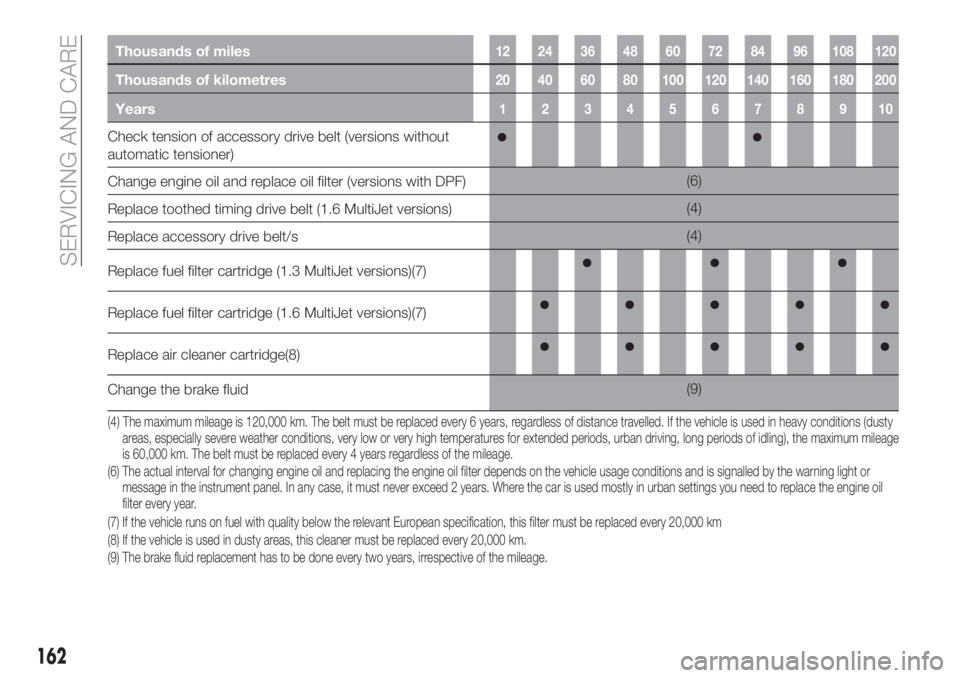
Thousands of miles12 24 36 48 60 72 84 96 108 120
Thousands of kilometres20 40 60 80 100 120 140 160 180 200
Years12345678910
Check tension of accessory drive belt (versions without
automatic tensioner)
Change engine oil and replace oil filter (versions with DPF)(6)
Replace toothed timing drive belt (1.6 MultiJet versions)(4)
Replace accessory drive belt/s(4)
Replace fuel filter cartridge (1.3 MultiJet versions)(7)
Replace fuel filter cartridge (1.6 MultiJet versions)(7)
Replace air cleaner cartridge(8)
Change the brake fluid(9)
(6) The actual interval for changing engine oil and replacing the engine oil filter depends on the vehicle usage conditions and is signalled by the warning light or
message in the instrument panel. In any case, it must never exceed 2 years. Where the car is used mostly in urban settings you need to replace the engine oil
filter every year. (4 ) The maximum mileage is 120,000 km. The belt must be replaced every 6 years, regardless of distance travelled. If the vehicle is used in heavy conditions (dusty
areas, especially severe weather conditions, very low or very high temperatures for extended periods, urban driving, long periods of idling), the maximum mileage
is 60,000 km. The belt must be replaced every 4 years regardless of the mileage.
(7) If the vehicle runs on fuel with quality below the relevant European specification, this filter must be replaced every 20,000 km
(8) If the vehicle is used in dusty areas, this cleaner must be replaced every 20,000 km.
(9) The brake fluid replacement has to be done every two years, irrespective of the mileage.
162
SERVICING AND CARE