ABS FIAT ULYSSE 2007 2.G User Guide
[x] Cancel search | Manufacturer: FIAT, Model Year: 2007, Model line: ULYSSE, Model: FIAT ULYSSE 2007 2.GPages: 254, PDF Size: 3.42 MB
Page 127 of 254
GETTING TO KNOW YOUR CAR
126
Deactivating the passenger’s
front air bag manually
The passenger’s front airbag can be
deactivated if it is absolutely necessary
to carry a child in the front passenger
seat.
Deactivation takes place using the ve-
hicle ignition key in the special key
switch on the right-hand side of the
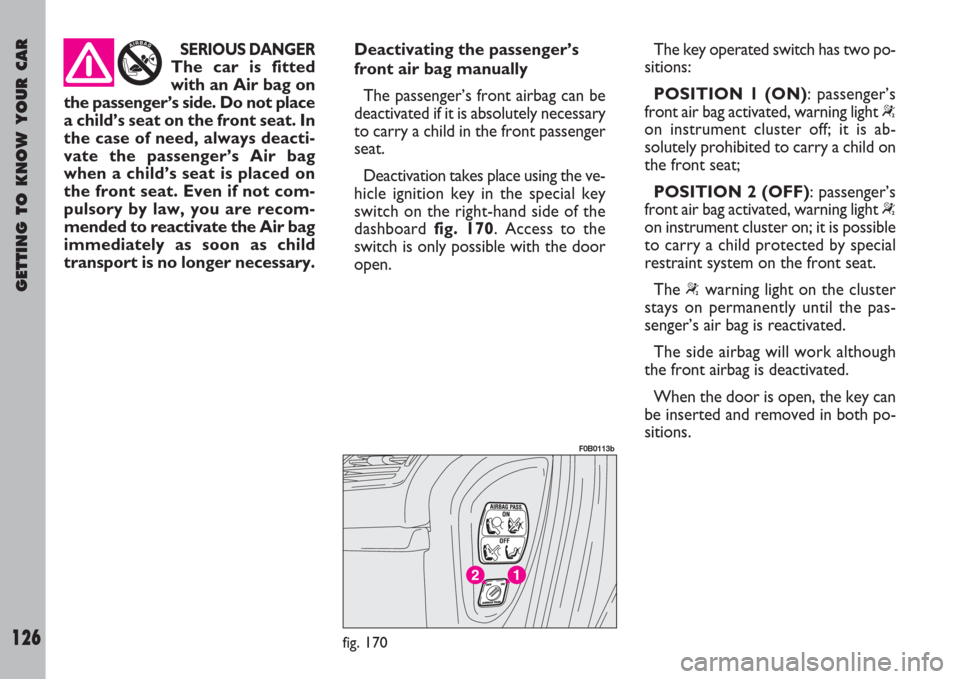
dashboard fig. 170. Access to the
switch is only possible with the door
open.The key operated switch has two po-
sitions:
POSITION 1 (ON): passenger’s
front air bag activated, warning light
“
on instrument cluster off; it is ab-
solutely prohibited to carry a child on
the front seat;
POSITION 2 (OFF): passenger’s
front air bag activated, warning light
“
on instrument cluster on; it is possible
to carry a child protected by special
restraint system on the front seat.
The
“warning light on the cluster
stays on permanently until the pas-
senger’s air bag is reactivated.
The side airbag will work although
the front airbag is deactivated.
When the door is open, the key can
be inserted and removed in both po-
sitions.
fig. 170
F0B0113b
SERIOUS DANGER
The car is fitted
with an Air bag on
the passenger’s side. Do not place
a child’s seat on the front seat. In
the case of need, always deacti-
vate the passenger’s Air bag
when a child’s seat is placed on
the front seat. Even if not com-
pulsory by law, you are recom-
mended to reactivate the Air bag
immediately as soon as child
transport is no longer necessary.
Page 138 of 254
DRIVING YOUR CAR
137
5)Wait for the warning light mto
go out. The hotter the engine is, the
quicker this will happen.
6)Turn the ignition key to Dimme-
diately after the mwarning light
goes out. If you wait too long, you will
lose the benefit of the work done by
the glow plugs. PROCEDURE FOR STARTING
1)Make sure the handbrake is up.
2)Put the gear lever in neutral.
3) Press down the clutch pedal.
4)Turn the ignition key to Mand in-
strument panel warning light mwill
come on.High current absorption electric de-
vices (climate control system, rear
heated window, etc.) are automatical-
ly deactivated during start-up.
If the engine does not start at the
first attempt, return the ignition key
to Sand then again to M. If it is still
impossible to start the engine, try with
the other key provided with the car.
If you are still unable to start the en-
gine, contact a Fiat Dealership.
Page 139 of 254
DRIVING YOUR CAR
138
HOW TO WARM UP
THE ENGINE AFTER
IT HAS JUST STARTED
– Begin to move forward slowly let-
ting the engine turning at medium revs.
Do not accelerate abruptly.
– Do not push the engine to its lim-
it for the first kilometres. You are rec-
ommended to wait until the water
temperature has reached 50° to 60°C.BUMP STARTING
For versions with a cat-
alytic converter, bump
starting by pushing, tow-
ing or rolling downhill must be
avoided at all costs. This ma-
noeuvre could cause a rush of fu-
el into the catalytic exhaust pipe
and damage it beyond repair.STOPPING THE ENGINE
Turn the ignition key to Swhile the
engine is idling.
Remember that as long
as the engine is not run-
ning, the power brakes
and power steering do not work.
You therefore have to use con-
siderably more effort on both the
brake pedal and the steering
wheel than you would do other-
wise.
Gunning the accelerator
before turning off the en-
gine serves absolutely no
practical purpose, wastes fuel and
is damaging, particularly to tur-
bocharged engines.
IMPORTANTAfter a taxing drive,
it is better to allow the engine to
“catch its breath” before turning it off
by letting it idle to allow the temper-
ature in the engine compartment to
fall.
Page 144 of 254
DRIVING YOUR CAR
143
Remember that fog also means the
tarmac is wet and therefore manoeu-
vres of all kinds are more difficult and
stopping distances are longer:
– keep a good distance from the cars
in front of you;
– when possible, avoid spurts of
speed or sudden deceleration;
– do not overtake other vehicles if
you can help it;
– if you are forced to stop your ve-
hicle (breakdown, limited visibility,
etc.), first try to stop off the road.
Then turn on the hazard lights and, if
possible, the dipped headlights;
– rhythmically sound the horn if you
realise another vehicle is approaching.DRIVING IN
THE MOUNTAINS
The main suggestions are the fol-
lowing:
– when driving downhill use the en-
gine brake by engaging a low gear so
as not to overheat the brakes;
– under no circumstances should you
drive downhill with the engine off or
with the vehicle in neutral, let alone
with the ignition key out;
– drive at moderate speed without
“cutting” corners;
– remember that overtaking while
going uphill is slower and therefore re-
quires more clear road. If you are be-
ing overtaken while driving uphill,
make it easier for the other vehicle
to pass. DRIVING IN FOG
If the fog is thick, do not start out on
a journey unless you absolutely have to.
If driving in mist, blanket fog or when
there is the danger of fog patches:
– keep your speed down;
– turn on the dipped headlights, rear
fog lights and front fog lights, if fitted,
even during the day. Do not drive with
your headlights at full-beam.
IMPORTANTOn stretches of
road with good visibility, switch off
your rear foglights; the brightness of
these lights could annoy the people
travelling in the cars behind.
Page 145 of 254
DRIVING YOUR CAR
144
DRIVING WITH ABS
ABS is a part of the braking system
offering 2 advantages:
1)it prevents wheel lock-up and
consequent skidding in emergency
stops, particularly when the road does
not offer much grip;
2)it makes it possible to brake and
steer at the same time so you can
avoid sudden objects on the road and
direct the vehicle where you want
while braking; this compatibly with the
physical limits of overall tyre grip.To get the most out of ABS:
– during emergency stops or when
grip conditions are poor, you will feel
a slight pulsation on the brake pedal.
This is the sign that the ABS is in ac-
tion. Do not release the brake pedal
but continue to press so as not to in-
terrupt the braking action;
– ABS prevents the wheels from
locking but it does not increase actu-
al grip conditions between tyre and
road. Therefore, even if your vehicle
is fitted with ABS, respect the safety
distance from the vehicle in front of
you and keep your speed down when
driving into bends.
ABS serves to increase the control-
lability of the vehicle, not to enable you
to go faster. DRIVING ON SNOW AND ICE
The main suggestions are the fol-
lowing:
– keep you speed down;
– keep a good distance from the cars
in front of you;
– use chains if the roads are covered
in snow. See “Snow chains” in this
chapter;
– do not keep the engine running for
long periods in deep snow as the snow
could push exhaust gases into the pas-
senger compartment;
– mainly use the engine brake and un-
der all circumstances avoid braking
sharply;
– do not accelerate suddenly and
avoid swerving;
– in the winter, even apparently dry
roads may have icy patches. Be care-
ful therefore when driving over
stretches that do not get much expo-
sure to the sun or that are lined by
trees and rocks, where ice might not
have melted.
Page 150 of 254
DRIVING YOUR CAR
149
The weight the trailer exerts on the
vehicle’s tow hitch coupling reduces
the vehicle’s payload capacity by the
same amount.
In order to be sure you are not ex-
ceeding the maximum towing weight
(shown in the vehicle’s registration pa-
pers) you have to take into account the
trailer’s weight fully laden including the
accessories and personal luggage.
Do not exceed the speed limits for
towing a trailer either abroad or at
home. In any case, do not exceed the
top speed of 100 km/h.WINTER TYRES
These tyres have been specifically de-
signed for use on snow and ice and
should be fitted in place of the exist-
ing tyres.
Use winter tyres of the same size as
the tyres provided with the car.
Fiat Dealershipwill be glad to of-
fer advice on the right type of tyres ac-
cording to your needs.
The performance of winter tyres is
greatly reduced when the depth of the
tread is less than 4 mm. In this situa-
tion it would be safer to have them re-
placed.
The ABS system does
not control the trailer
braking system. Particu-
lar care must therefore be taken
on slippery road surfaces.Under no circumstances
modify the vehicle’s brak-
ing system for trailer
braking control. The trailer’s
braking system must be com-
pletely independent of the vehi-
cle’s hydraulic system.
Page 169 of 254
IN AN EMERGENCY
168
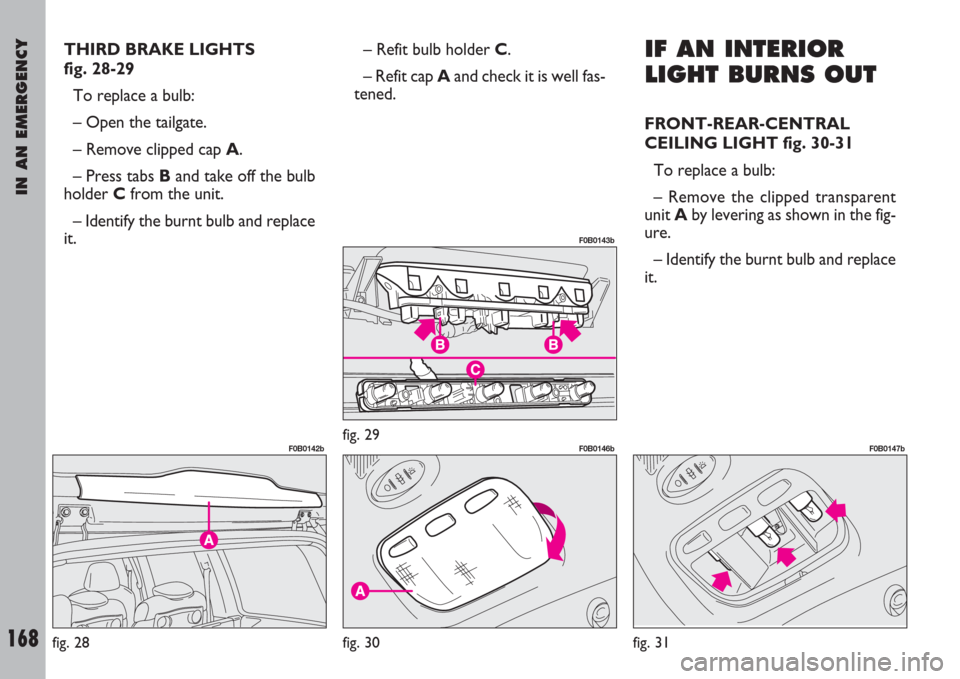
THIRD BRAKE LIGHTS
fig. 28-29
To replace a bulb:
– Open the tailgate.
– Remove clipped cap A.
– Press tabs Band take off the bulb
holder Cfrom the unit.
– Identify the burnt bulb and replace
it.– Refit bulb holder C.
– Refit cap Aand check it is well fas-
tened.IF AN INTERIOR
LIGHT BURNS OUT
FRONT-REAR-CENTRAL
CEILING LIGHT fig. 30-31
To replace a bulb:
– Remove the clipped transparent
unit Aby levering as shown in the fig-
ure.
– Identify the burnt bulb and replace
it.
fig. 28
F0B0142bfig. 29
F0B0143b
fig. 31
F0B0147b
fig. 30
F0B0146b
Page 177 of 254
IN AN EMERGENCY
176
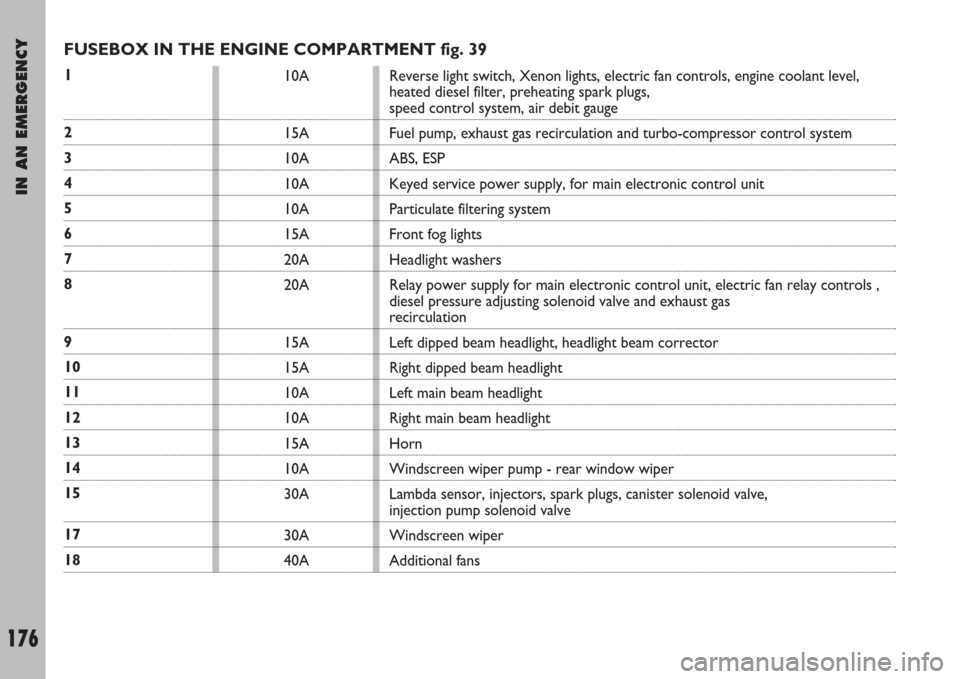
FUSEBOX IN THE ENGINE COMPARTMENT fig. 39
1
2
3
4
5
6
7
8
9
10
11
12
13
14
15
17
1810A
15A
10A
10A
10A
15A
20A
20A
15A
15A
10A
10A
15A
10A
30A
30A
40AReverse light switch, Xenon lights, electric fan controls, engine coolant level,
heated diesel filter, preheating spark plugs,
speed control system, air debit gauge
Fuel pump, exhaust gas recirculation and turbo-compressor control system
ABS, ESP
Keyed service power supply, for main electronic control unit
Particulate filtering system
Front fog lights
Headlight washers
Relay power supply for main electronic control unit, electric fan relay controls ,
diesel pressure adjusting solenoid valve and exhaust gas
recirculation
Left dipped beam headlight, headlight beam corrector
Right dipped beam headlight
Left main beam headlight
Right main beam headlight
Horn
Windscreen wiper pump - rear window wiper
Lambda sensor, injectors, spark plugs, canister solenoid valve,
injection pump solenoid valve
Windscreen wiper
Additional fans
Page 178 of 254
IN AN EMERGENCY
177
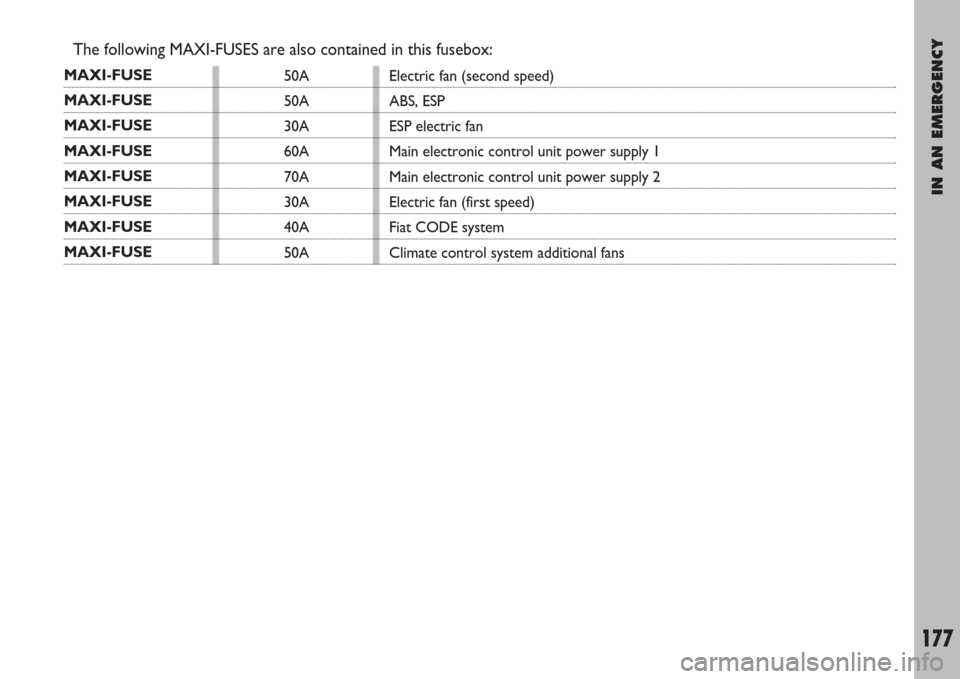
The following MAXI-FUSES are also contained in this fusebox:
MAXI-FUSE
MAXI-FUSE
MAXI-FUSE
MAXI-FUSE
MAXI-FUSE
MAXI-FUSE
MAXI-FUSE
MAXI-FUSE 50A
50A
30A
60A
70A
30A
40A
50AElectric fan (second speed)
ABS, ESP
ESP electric fan
Main electronic control unit power supply 1
Main electronic control unit power supply 2
Electric fan (first speed)
Fiat CODE system
Climate control system additional fans
Page 199 of 254
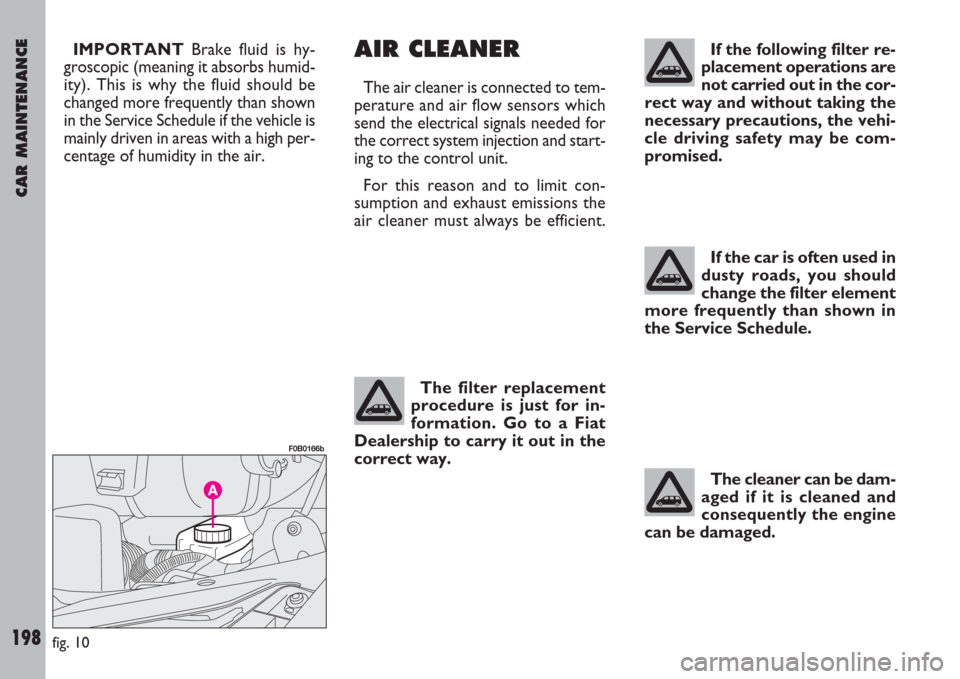
AIR CLEANER
The air cleaner is connected to tem-
perature and air flow sensors which
send the electrical signals needed for
the correct system injection and start-
ing to the control unit.
For this reason and to limit con-
sumption and exhaust emissions the
air cleaner must always be efficient. IMPORTANTBrake fluid is hy-
groscopic (meaning it absorbs humid-
ity). This is why the fluid should be
changed more frequently than shown
in the Service Schedule if the vehicle is
mainly driven in areas with a high per-
centage of humidity in the air.If the following filter re-
placement operations are
not carried out in the cor-
rect way and without taking the
necessary precautions, the vehi-
cle driving safety may be com-
promised.
The filter replacement
procedure is just for in-
formation. Go to a Fiat
Dealership to carry it out in the
correct way.
If the car is often used in
dusty roads, you should
change the filter element
more frequently than shown in
the Service Schedule.
The cleaner can be dam-
aged if it is cleaned and
consequently the engine
can be damaged.
fig. 10
F0B0166b
CAR MAINTENANCE
198