light FIAT ULYSSE 2007 2.G User Guide
[x] Cancel search | Manufacturer: FIAT, Model Year: 2007, Model line: ULYSSE, Model: FIAT ULYSSE 2007 2.GPages: 254, PDF Size: 3.42 MB
Page 35 of 254
GETTING TO KNOW YOUR CAR
34
INDIVIDUAL
SETTINGS
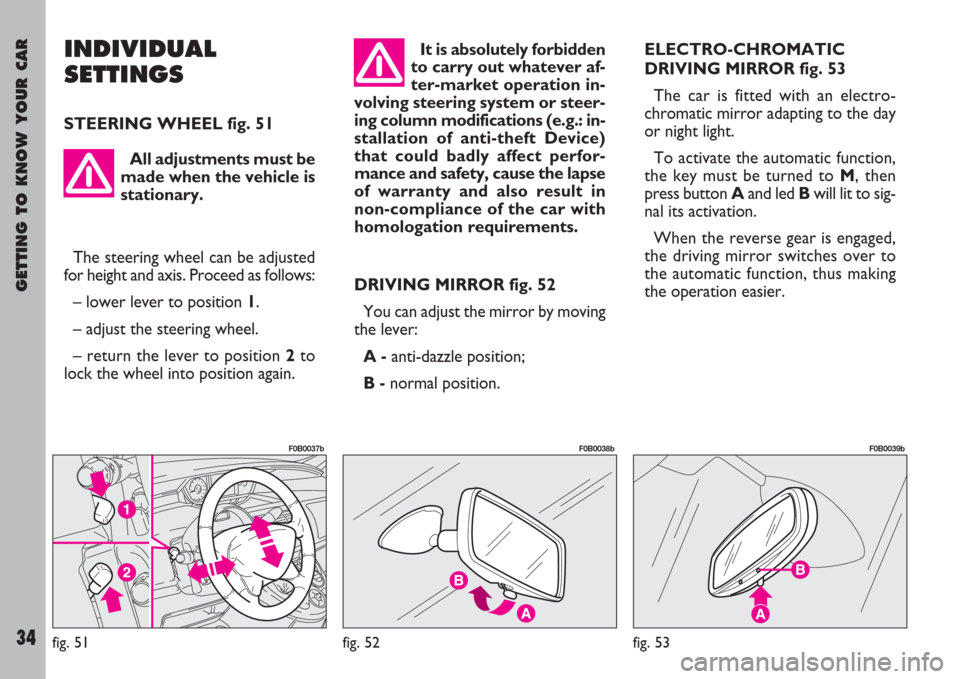
STEERING WHEEL fig. 51
DRIVING MIRROR fig. 52
You can adjust the mirror by moving
the lever:
A -anti-dazzle position;
B -normal position.ELECTRO-CHROMATIC
DRIVING MIRROR fig. 53
The car is fitted with an electro-
chromatic mirror adapting to the day
or night light.
To activate the automatic function,
the key must be turned to M, then
press button Aand led Bwill lit to sig-
nal its activation.
When the reverse gear is engaged,
the driving mirror switches over to
the automatic function, thus making
the operation easier.
fig. 51
F0B0037b
fig. 52
F0B0038b
fig. 53
F0B0039b
All adjustments must be
made when the vehicle is
stationary.
The steering wheel can be adjusted
for height and axis. Proceed as follows:
– lower lever to position 1.
– adjust the steering wheel.
– return the lever to position 2to
lock the wheel into position again.
It is absolutely forbidden
to carry out whatever af-
ter-market operation in-
volving steering system or steer-
ing column modifications (e.g.: in-
stallation of anti-theft Device)
that could badly affect perfor-
mance and safety, cause the lapse
of warranty and also result in
non-compliance of the car with
homologation requirements.
Page 36 of 254
GETTING TO KNOW YOUR CAR
35
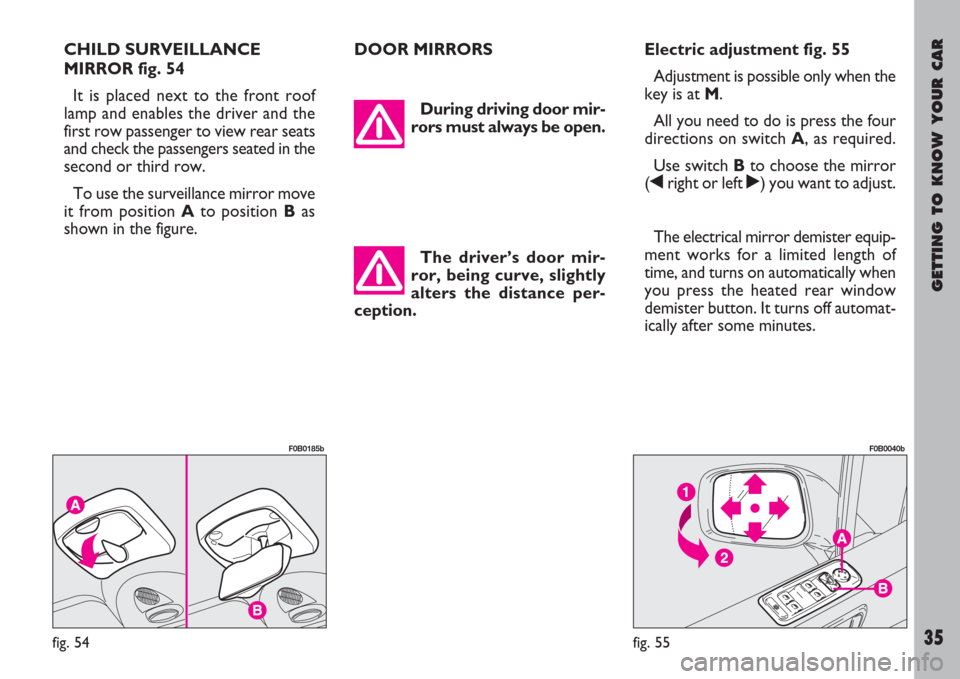
CHILD SURVEILLANCE
MIRROR fig. 54
It is placed next to the front roof
lamp and enables the driver and the
first row passenger to view rear seats
and check the passengers seated in the
second or third row.
To use the surveillance mirror move
it from position Ato position Bas
shown in the figure.DOOR MIRRORS
During driving door mir-
rors must always be open.Electric adjustment fig. 55
Adjustment is possible only when the
key is at M.
All you need to do is press the four
directions on switch A, as required.
Use switch Bto choose the mirror
(¯right or left ˙) you want to adjust.
The electrical mirror demister equip-
ment works for a limited length of
time, and turns on automatically when
you press the heated rear window
demister button. It turns off automat-
ically after some minutes.
fig. 54
F0B0185b
fig. 55
F0B0040b
The driver’s door mir-
ror, being curve, slightly
alters the distance per-
ception.
Page 44 of 254
GETTING TO KNOW YOUR CAR
43
jury, even mortal, regardless of
the seriousness of the crash that
triggered it. Children may be
placed on the front seat of cars
fitted with passenger’s air bag de-
activation.
In this case, it is absolutely nec-
essary to check the warning light
“on the cluster to make sure de-
activation has actually taken
place (see paragraph Front and
side air bags at item Front air
bags). The front passenger seat
shall be adjusted in the most
backward position to prevent any
contact between child’s seat and
dashboard.For optimal protection in the event
of a crash, all passengers must be seat-
ed and wearing adequate restraint sys-
tems.
This is especially relevant for chil-
dren.
This prescription is compulsory in all
EC countries according to EC Direc-
tive 2003/20/EC.
A child’s head is larger and heavier
than an adult’s head with respect to
their body weight. Moreover, a child’s
head muscular and bone structure is
not fully developed. For these reasons,
children require specific restraint sys-
tems, different from those required by
adult passengers.The results of research on the best
child restraint systems are contained
in the European Standard ECE-R44.
This Standard enforces the use of re-
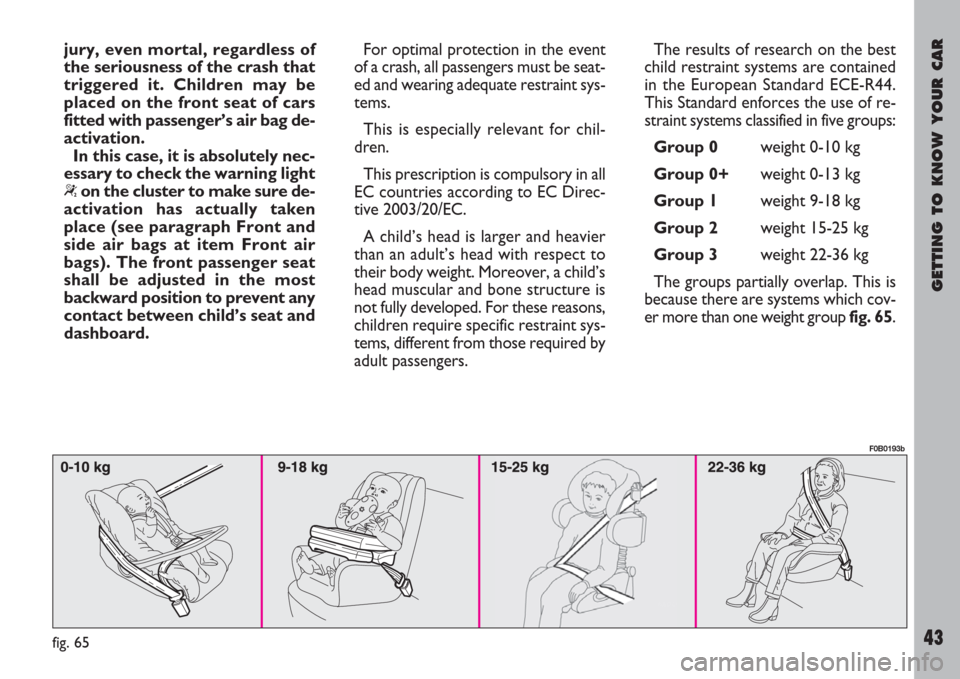
straint systems classified in five groups:
Group 0weight 0-10 kg
Group 0+weight 0-13 kg
Group 1weight 9-18 kg
Group 2weight 15-25 kg
Group 3weight 22-36 kg
The groups partially overlap. This is
because there are systems which cov-
er more than one weight groupfig. 65.
fig. 65
F0B0193b
Page 47 of 254
GroupWeight groupsSeats Third row, 3-seat bench
GETTING TO KNOW YOUR CAR
46
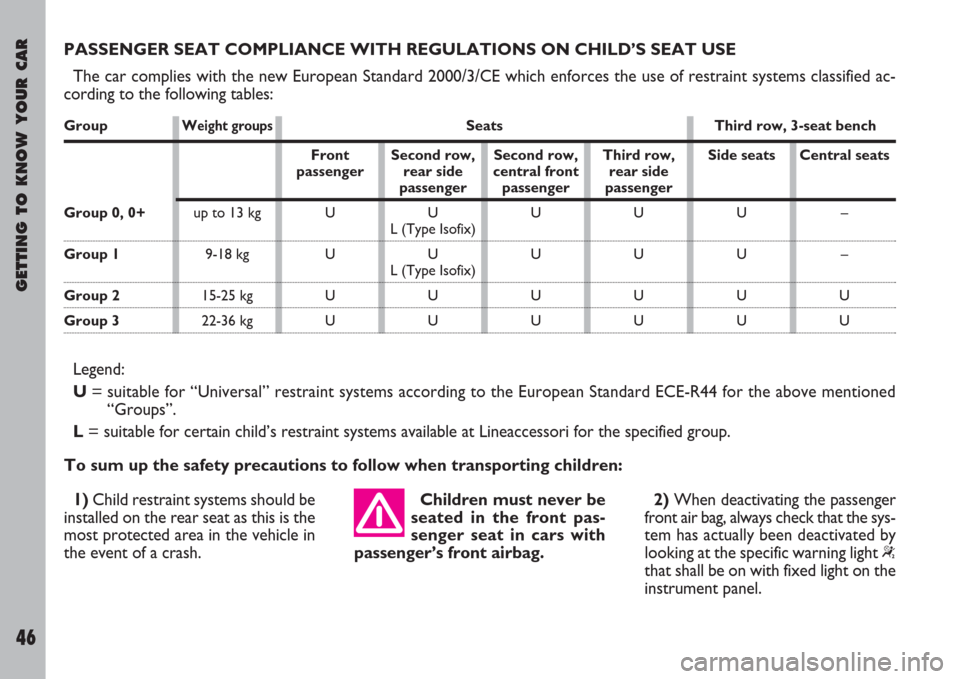
PASSENGER SEAT COMPLIANCE WITH REGULATIONS ON CHILD’S SEAT USE
The car complies with the new European Standard 2000/3/CE which enforces the use of restraint systems classified ac-
cording to the following tables:
1)Child restraint systems should be
installed on the rear seat as this is the
most protected area in the vehicle in
the event of a crash.Children must never be
seated in the front pas-
senger seat in cars with
passenger’s front airbag.2)When deactivating the passenger
front air bag, always check that the sys-
tem has actually been deactivated by
looking at the specific warning light
“
that shall be on with fixed light on the
instrument panel. To sum up the safety precautions to follow when transporting children:
Group 0, 0+
Group 1
Group 2
Group 3Front
passenger
U
U
U
USecond row,
rear side
passenger
U
L (Type Isofix)
U
L (Type Isofix)
U
USecond row,
central front
passenger
U
U
U
UThird row,
rear side
passenger
U
U
U
U
Side seats
U
U
U
UCentral seats
–
–
U
U up to 13 kg
9-18 kg
15-25 kg
22-36 kg
Legend:
U= suitable for “Universal” restraint systems according to the European Standard ECE-R44 for the above mentioned
“Groups”.
L= suitable for certain child’s restraint systems available at Lineaccessori for the specified group.
Page 51 of 254
GETTING TO KNOW YOUR CAR
50
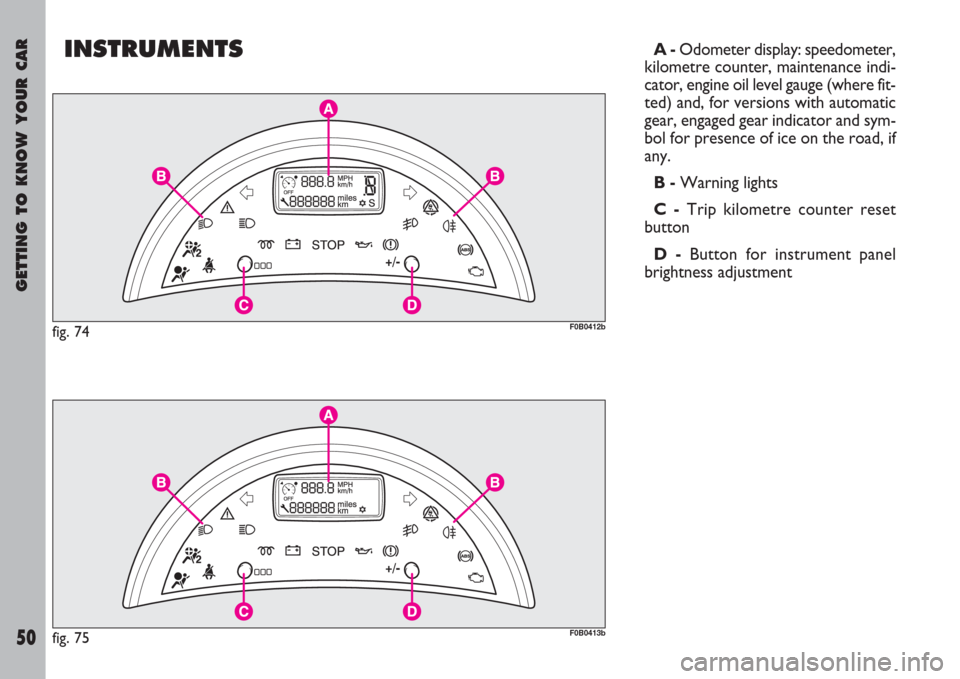
INSTRUMENTSA -Odometer display: speedometer,
kilometre counter, maintenance indi-
cator, engine oil level gauge (where fit-
ted) and, for versions with automatic
gear, engaged gear indicator and sym-
bol for presence of ice on the road, if
any.
B -Warning lights
C -Trip kilometre counter reset
button
D -Button for instrument panel
brightness adjustment
fig. 74F0B0412b
fig. 75F0B0413b
Page 52 of 254
GETTING TO KNOW YOUR CAR
51
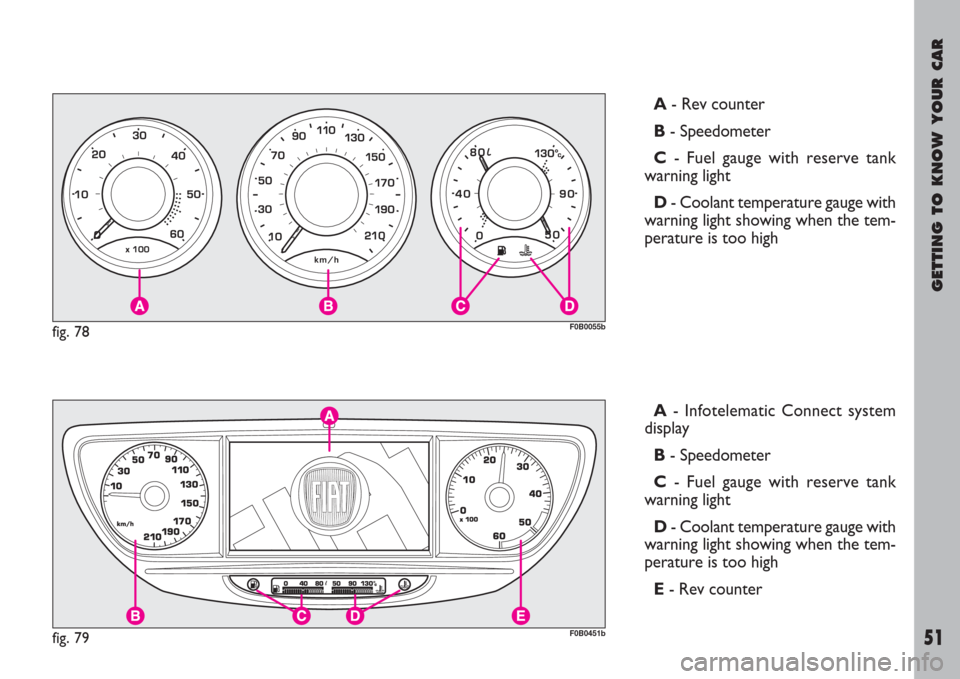
A - Rev counter
B- Speedometer
C- Fuel gauge with reserve tank
warning light
D- Coolant temperature gauge with
warning light showing when the tem-
perature is too high
fig. 78F0B0055b
A- Infotelematic Connect system
display
B- Speedometer
C- Fuel gauge with reserve tank
warning light
D- Coolant temperature gauge with
warning light showing when the tem-
perature is too high
E- Rev counter
fig. 79F0B0451b
Page 53 of 254
GETTING TO KNOW YOUR CAR
52
Warning light ucomes on when the
coolant is too hot.
Even travelling too slowly when the
outside temperature is very hot can
cause the needle to approach the red
sector. In this case it is better to stop
and turn off the engine. After a few
moments you can start the engine
again and accelerate slightly.
FUEL GAUGE
This gauge indicates the litres of fu-
el present in the tank.
When warning light Kcomes on, it
indicates that between 5 and 8 litres
of fuel are left in the tank.
Do not travel with the fuel tank al-
most empty: the gaps in fuel delivery
could damage the catalyser.
MULTIFUNCTION DISPLAY
(with sound system)
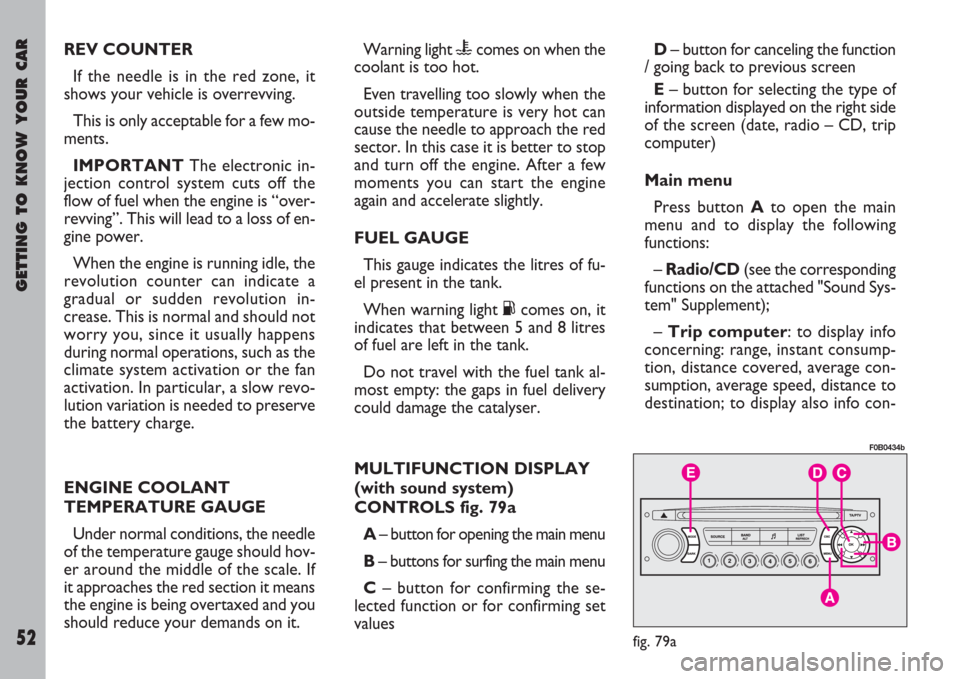
CONTROLS fig. 79a
A– button for opening the main menu
B– buttons for surfing the main menu
C– button for confirming the se-
lected function or for confirming set
values REV COUNTER
If the needle is in the red zone, it
shows your vehicle is overrevving.
This is only acceptable for a few mo-
ments.
IMPORTANTThe electronic in-
jection control system cuts off the
flow of fuel when the engine is “over-
revving”. This will lead to a loss of en-
gine power.
When the engine is running idle, the
revolution counter can indicate a
gradual or sudden revolution in-
crease. This is normal and should not
worry you, since it usually happens
during normal operations, such as the
climate system activation or the fan
activation. In particular, a slow revo-
lution variation is needed to preserve
the battery charge.
ENGINE COOLANT
TEMPERATURE GAUGE
Under normal conditions, the needle
of the temperature gauge should hov-
er around the middle of the scale. If
it approaches the red section it means
the engine is being overtaxed and you
should reduce your demands on it.D– button for canceling the function
/ going back to previous screen
E– button for selecting the type of
information displayed on the right side
of the screen (date, radio – CD, trip
computer)
Main menu
Press button Ato open the main
menu and to display the following
functions:
– Radio/CD(see the corresponding
functions on the attached "Sound Sys-
tem" Supplement);
– Trip computer: to display info
concerning: range, instant consump-
tion, distance covered, average con-
sumption, average speed, distance to
destination; to display also info con-
fig. 79a
F0B0434b
Page 54 of 254
GETTING TO KNOW YOUR CAR
53
cerning: automatic light turning on,
ESP, rain sensor.
To reset the trip computer data,
keep pressed the button set at the end
of the right stalk fig. 79b;
– Personal/set-up menu: to acti-
vate/deactivate electric rear wheel
lock, to activate/deactivate rear win-
dow wiper, to activate/deactivate au-
tomatic light turning on and to set
date, clock, display brightness, units
and language.
MULTIFUNCTION DISPLAY
(with infotelematic Connect /
Connect Nav+ system)
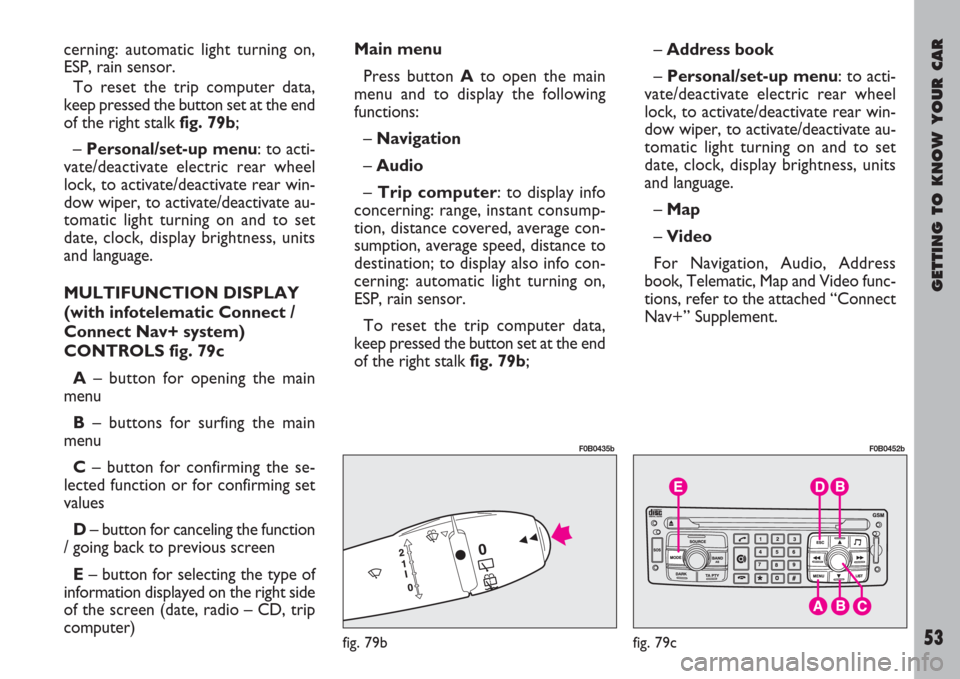
CONTROLS fig. 79c
A– button for opening the main
menu
B– buttons for surfing the main
menu
C– button for confirming the se-
lected function or for confirming set
values
D– button for canceling the function
/ going back to previous screen
E– button for selecting the type of
information displayed on the right side
of the screen (date, radio – CD, trip
computer)Main menu
Press button Ato open the main
menu and to display the following
functions:
– Navigation
– Audio
– Trip computer: to display info
concerning: range, instant consump-
tion, distance covered, average con-
sumption, average speed, distance to
destination; to display also info con-
cerning: automatic light turning on,
ESP, rain sensor.
To reset the trip computer data,
keep pressed the button set at the end
of the right stalk fig. 79b;– Address book
– Personal/set-up menu: to acti-
vate/deactivate electric rear wheel
lock, to activate/deactivate rear win-
dow wiper, to activate/deactivate au-
tomatic light turning on and to set
date, clock, display brightness, units
and language.
– Map
– Video
For Navigation, Audio, Address
book, Telematic, Map and Video func-
tions, refer to the attached “Connect
Nav+” Supplement.
fig. 79b
F0B0435b
fig. 79c
F0B0452b
Page 56 of 254
GETTING TO KNOW YOUR CAR
55
IMPORTANTAny anomalies
should be reported to your Fiat
Dealershipimmediately without
waiting for the next servicing coupon
to be carried out.
A- Maintenance warning lamp.
B- Kilometre counter.
C- Configuration and reset button.
O
PERATION
When the key is turned to M, warn-
ing lamp Awill light up for some sec-
onds and the kilometre counter Bwill
display the number of kilometres
(rounded down) still to be travelled
before the next servicing is due. Af-
ter this period the engine oil level
(where fitted) will be automatically dis-
played and then the total kilometres
travelled will be displayed as well;
– maintenance due after 2000
km until the maintenance dead-
line: when the key is turned to M,
warning lamp Awill light up and the
kilometre counter Bwill display the
number of kilometres (rounded
down) still to be travelled before the
next servicing is due. After some sec-
onds the warning lamp will remain litand the total travelled kilometres will
be displayed;
– maintenance overdue: when
the key is turned to M, warning lamp
Awill flash for some seconds and the
number of kilometres over the main-
tenance limit will be displayed; after
this period the warning lamp will re-
main lit and the total travelled kilo-
metres will be displayed.
IMPORTANTIf, after about
12 months, the kilometres indicated in
the Service Schedule have not been
reached yet, when the key is turned to
M, warning lamp Awill light up and
the kilometre counter will show 0 km.
In this case contact a Fiat Dealer-
ship.
C
ONFIGURATION PROCEDURE
If the vehicle is used in particularly
difficult conditions, you are recom-
mended to reset the system and re-
duce the maintenance frequency from
30,000 to 20,000 km.
To alter the maintenance frequency:
– turn the key to M;
– press button Cand keep it
pressed, so the number of kilometresstill remaining or already passed since
the scheduled servicing will flash;
– release the button immediately to
display the preset maintenance fre-
quency;
– a repeated press on button C will
change the maintenance frequency to
the one required:
30,000 km(recommended in nor-
mal use conditions);
20,000 km(recommended in se-
vere use conditions);
– when the selected maintenance fre-
quency is displayed, press button Cfor
10 seconds (the maintenance fre-
quency selected will flash for 10 sec-
onds);
– release the button to confirm as
soon as the display stops flashing.
Page 58 of 254
GETTING TO KNOW YOUR CAR
57
If the warning lamp
lights up while the vehicle
is moving, switch the en-
gine off and get in touch with a Fi-
at Dealership.
WARNING LIGHTS
IMPORTANTWhen a malfunction
warning lamp lights up, the related
message can be viewed on the display
and two or more sound warnings
(“gong”) are emitted.
The indicator and warning lights
come on in the following circum-
stances:
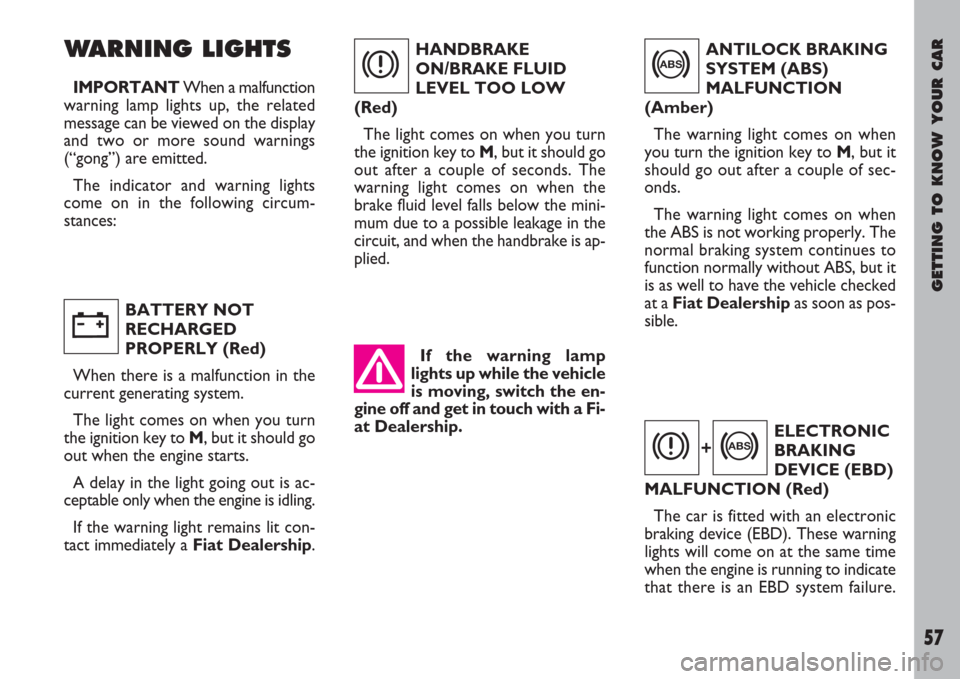
BATTERY NOT
RECHARGED
PROPERLY (Red)
When there is a malfunction in the
current generating system.
The light comes on when you turn
the ignition key to M, but it should go
out when the engine starts.
A delay in the light going out is ac-
ceptable only when the engine is idling.
If the warning light remains lit con-
tact immediately a Fiat Dealership.HANDBRAKE
ON/BRAKE FLUID
LEVEL TOO LOW
(Red)
The light comes on when you turn
the ignition key to M, but it should go
out after a couple of seconds. The
warning light comes on when the
brake fluid level falls below the mini-
mum due to a possible leakage in the
circuit, and when the handbrake is ap-
plied.
w
x
ANTILOCK BRAKING
SYSTEM (ABS)
MALFUNCTION
(Amber)
The warning light comes on when
you turn the ignition key to M, but it
should go out after a couple of sec-
onds.
The warning light comes on when
the ABS is not working properly. The
normal braking system continues to
function normally without ABS, but it
is as well to have the vehicle checked
at a Fiat Dealership as soon as pos-
sible.
>
ELECTRONIC
BRAKING
DEVICE (EBD)
MALFUNCTION (Red)
The car is fitted with an electronic
braking device (EBD). These warning
lights will come on at the same time
when the engine is running to indicate
that there is an EBD system failure.
x>+