lights FIAT ULYSSE 2007 2.G User Guide
[x] Cancel search | Manufacturer: FIAT, Model Year: 2007, Model line: ULYSSE, Model: FIAT ULYSSE 2007 2.GPages: 254, PDF Size: 3.42 MB
Page 62 of 254
GETTING TO KNOW YOUR CAR
61
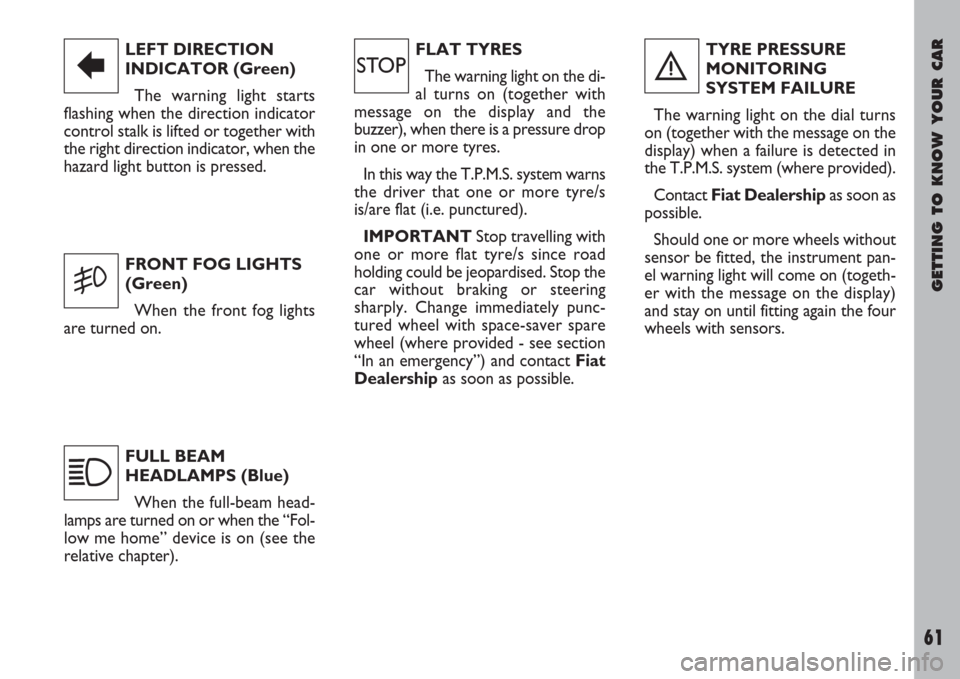
LEFT DIRECTION
INDICATOR (Green)
The warning light starts
flashing when the direction indicator
control stalk is lifted or together with
the right direction indicator, when the
hazard light button is pressed.
FRONT FOG LIGHTS
(Green)
When the front fog lights
are turned on.
FULL BEAM
HEADLAMPS (Blue)
When the full-beam head-
lamps are turned on or when the “Fol-
low me home” device is on (see the
relative chapter).
R
5
1
FLAT TYRES
The warning light on the di-
al turns on (together with
message on the display and the
buzzer), when there is a pressure drop
in one or more tyres.
In this way the T.P.M.S. system warns
the driver that one or more tyre/s
is/are flat (i.e. punctured).
IMPORTANTStop travelling with
one or more flat tyre/s since road
holding could be jeopardised. Stop the
car without braking or steering
sharply. Change immediately punc-
tured wheel with space-saver spare
wheel (where provided - see section
“In an emergency”) and contact Fiat
Dealershipas soon as possible.TYRE PRESSURE
MONITORING
SYSTEM FAILURE
The warning light on the dial turns
on (together with the message on the
display) when a failure is detected in
the T.P.M.S. system (where provided).
Contact Fiat Dealershipas soon as
possible.
Should one or more wheels without
sensor be fitted, the instrument pan-
el warning light will come on (togeth-
er with the message on the display)
and stay on until fitting again the four
wheels with sensors.
ìè
Page 80 of 254
GETTING TO KNOW YOUR CAR
79
STEERING COLUMN
STALKS
LEFT-HAND STALK
The left-hand stalk controls most of
the outside lights. If you leave the lights
on when you take the key out of the
ignition an alarm will sound.
Outside lighting is possible with the
ignition key at M.
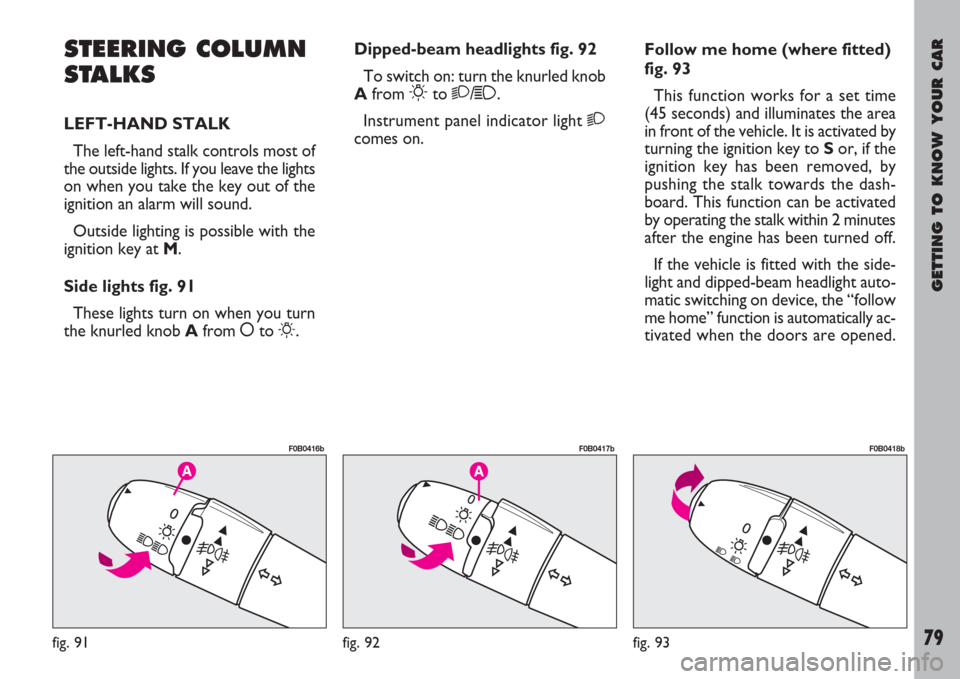
Side lights fig. 91
These lights turn on when you turn
the knurled knob Afrom åto
6.Dipped-beam headlights fig. 92
To switch on: turn the knurled knob
Afrom
6to 2/1.
Instrument panel indicator light 2
comes on.Follow me home (where fitted)
fig. 93
This function works for a set time
(45 seconds) and illuminates the area
in front of the vehicle. It is activated by
turning the ignition key to Sor, if the
ignition key has been removed, by
pushing the stalk towards the dash-
board. This function can be activated
by operating the stalk within 2 minutes
after the engine has been turned off.
If the vehicle is fitted with the side-
light and dipped-beam headlight auto-
matic switching on device, the “follow
me home” function is automatically ac-
tivated when the doors are opened.
fig. 91
F0B0416b
fig. 92
F0B0417b
fig. 93
F0B0418b
Page 81 of 254
GETTING TO KNOW YOUR CAR
80
Side light and dipped-beam
headlight automatic
switching on (where fitted)
This device is fitted with an infrared
sensor installed on the windscreen and
is able to detect the outside light
brightness variations.
To activate /deactivate automatic
light turning on, use the display set-
up menu (see paragraph “Info display”
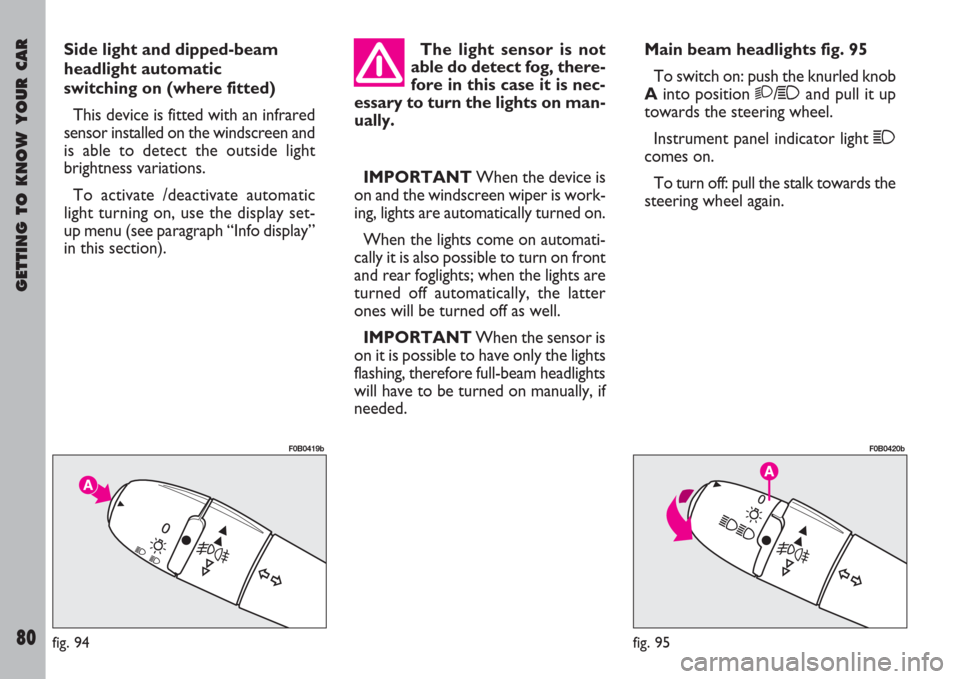
in this section).Main beam headlights fig. 95
To switch on: push the knurled knob
Ainto position 2/1and pull it up
towards the steering wheel.
Instrument panel indicator light 1
comes on.
To turn off: pull the stalk towards the
steering wheel again.
fig. 94
F0B0419b
fig. 95
F0B0420b
The light sensor is not
able do detect fog, there-
fore in this case it is nec-
essary to turn the lights on man-
ually.
IMPORTANTWhen the device is
on and the windscreen wiper is work-
ing, lights are automatically turned on.
When the lights come on automati-
cally it is also possible to turn on front
and rear foglights; when the lights are
turned off automatically, the latter
ones will be turned off as well.
IMPORTANTWhen the sensor is
on it is possible to have only the lights
flashing, therefore full-beam headlights
will have to be turned on manually, if
needed.
Page 82 of 254
GETTING TO KNOW YOUR CAR
81
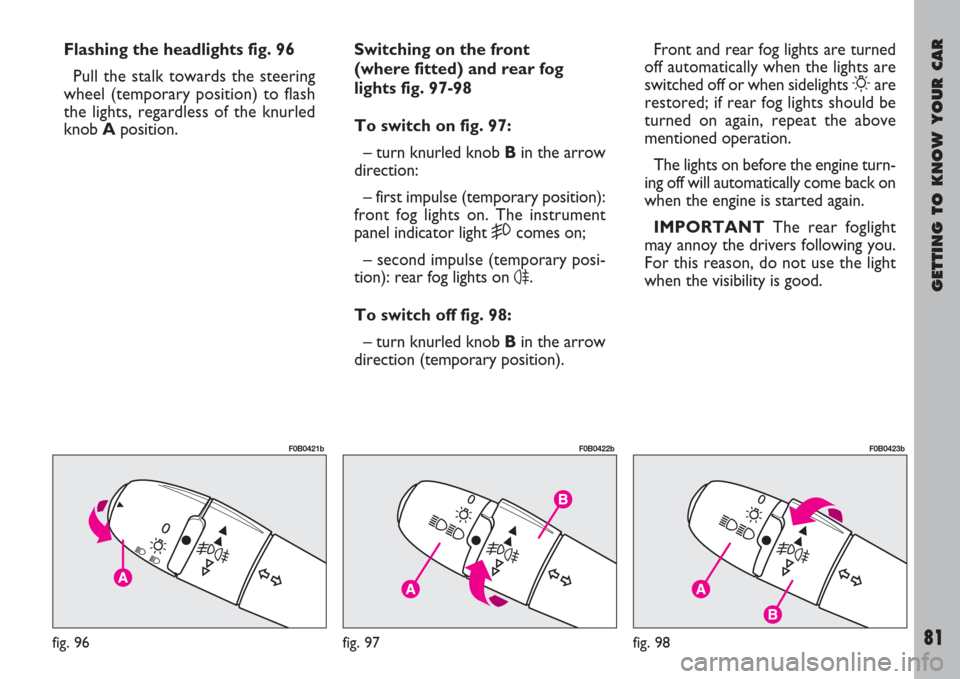
Flashing the headlights fig. 96
Pull the stalk towards the steering
wheel (temporary position) to flash
the lights, regardless of the knurled
knob Aposition.Switching on the front
(where fitted) and rear fog
lights fig. 97-98
To switch on fig. 97:
– turn knurled knob Bin the arrow
direction:
– first impulse (temporary position):
front fog lights on. The instrument
panel indicator light
5comes on;
– second impulse (temporary posi-
tion): rear fog lights on
4.
To switch off fig. 98:
– turn knurled knob Bin the arrow
direction (temporary position).Front and rear fog lights are turned
off automatically when the lights are
switched off or when sidelights
6are
restored; if rear fog lights should be
turned on again, repeat the above
mentioned operation.
The lights on before the engine turn-
ing off will automatically come back on
when the engine is started again.
IMPORTANTThe rear foglight
may annoy the drivers following you.
For this reason, do not use the light
when the visibility is good.
fig. 96
F0B0421b
fig. 97
F0B0422b
fig. 98
F0B0423b
Page 87 of 254
GETTING TO KNOW YOUR CAR
86
HAZARD LIGHTS
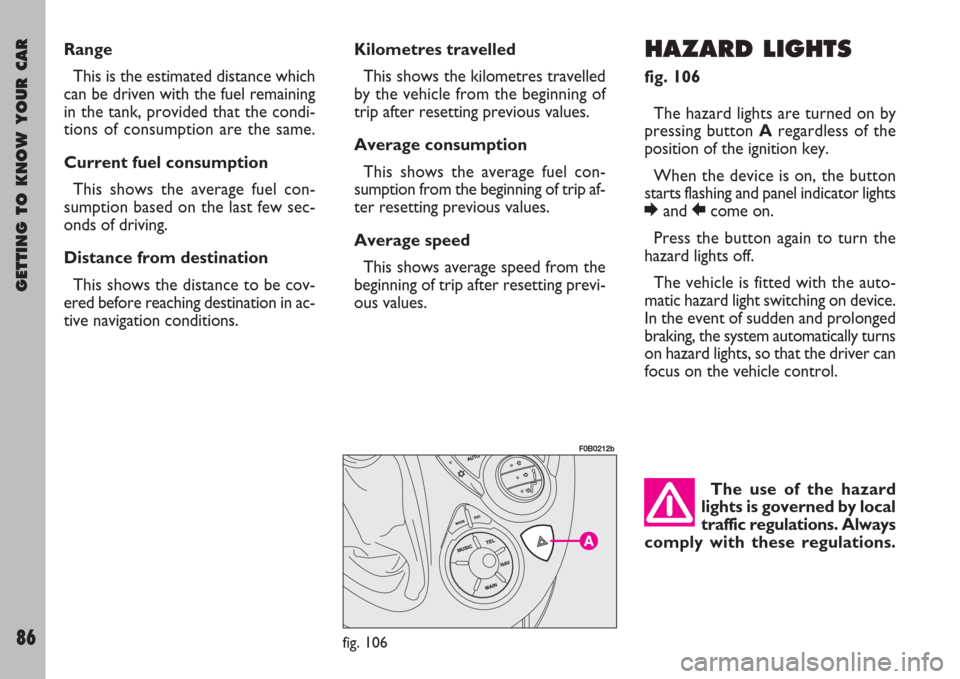
fig. 106
The hazard lights are turned on by
pressing button Aregardless of the
position of the ignition key.
When the device is on, the button
starts flashing and panel indicator lights
Eand Rcome on.
Press the button again to turn the
hazard lights off.
The vehicle is fitted with the auto-
matic hazard light switching on device.
In the event of sudden and prolonged
braking, the system automatically turns
on hazard lights, so that the driver can
focus on the vehicle control. Range
This is the estimated distance which
can be driven with the fuel remaining
in the tank, provided that the condi-
tions of consumption are the same.
Current fuel consumption
This shows the average fuel con-
sumption based on the last few sec-
onds of driving.
Distance from destination
This shows the distance to be cov-
ered before reaching destination in ac-
tive navigation conditions.
The use of the hazard
lights is governed by local
traffic regulations. Always
comply with these regulations.
Kilometres travelled
This shows the kilometres travelled
by the vehicle from the beginning of
trip after resetting previous values.
Average consumption
This shows the average fuel con-
sumption from the beginning of trip af-
ter resetting previous values.
Average speed
This shows average speed from the
beginning of trip after resetting previ-
ous values.
fig. 106
F0B0212b
Page 100 of 254
GETTING TO KNOW YOUR CAR
99
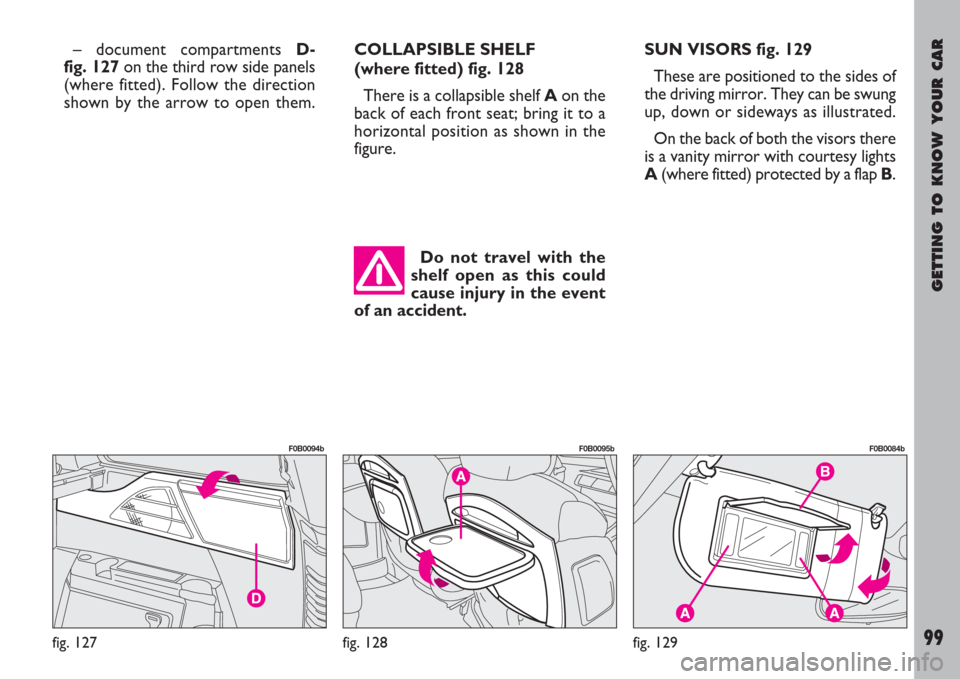
– document compartments D-
fig. 127on the third row side panels
(where fitted). Follow the direction
shown by the arrow to open them.COLLAPSIBLE SHELF
(where fitted) fig. 128
There is a collapsible shelf Aon the
back of each front seat; bring it to a
horizontal position as shown in the
figure.SUN VISORS fig. 129
These are positioned to the sides of
the driving mirror. They can be swung
up, down or sideways as illustrated.
On the back of both the visors there
is a vanity mirror with courtesy lights
A(where fitted) protected by a flap B.
fig. 127
F0B0094b
fig. 128
F0B0095b
fig. 129
F0B0084b
Do not travel with the
shelf open as this could
cause injury in the event
of an accident.
Page 103 of 254
GETTING TO KNOW YOUR CAR
102
CEILING LIGHT UNITS
All the ceiling lights come on for a
limited time, i.e. they turn on and off
gradually.
Ceiling light operation
All the ceiling lights come on auto-
matically when the doors are opened
with the remote control or when the
key is introduced in the door lock. Af-
ter some seconds, the lights will go out
gradually, without opening the doors.
When the door lock button on the
remote control is pressed for a long
time, the so-called “localisation” func-
tion is activated: all the ceiling lights
in the passenger compartment come
on together with the direction indi-
cators. This function is recognised by
the system up to a distance of about
30 meters from the vehicle. If the ignition key is turned to S(or
removed) the first row ceiling light
comes on. It will stay on only for a lim-
ited time and will go out gradually.
When one of the front doors is
opened, the central ceiling light, with-
out the spot lights, and the puddle
lights on the doors come on. They re-
main lit for a set time and after a cou-
ple of seconds the door have been
closed, they go off gradually. When the
engine is started, the lights will go off
progressively after a couple of seconds.
When one of the rear doors is
opened the central ceiling light, with-
out the spot lights, come on. It re-
mains lit for a set time and after a cou-
ple of seconds the door have been
closed, it goes off gradually.When the tailgate is opened the lug-
gage compartment lights come on
(one or two lights according to the
model). The lights will go off gradual-
ly when the tailgate is closed.
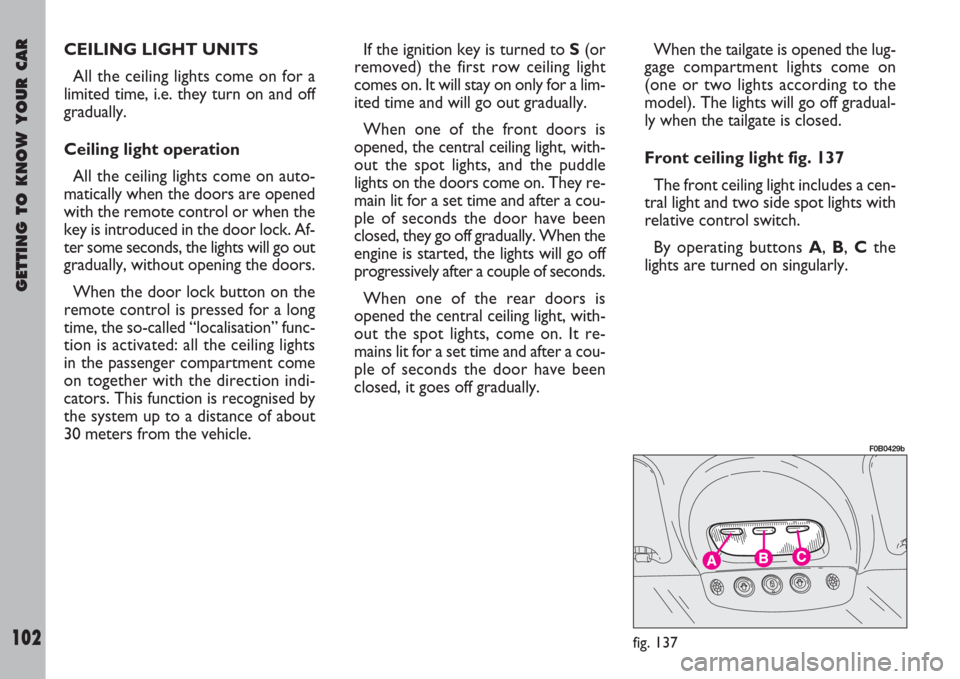
Front ceiling light fig. 137
The front ceiling light includes a cen-
tral light and two side spot lights with
relative control switch.
By operating buttons A, B, Cthe
lights are turned on singularly.
fig. 137
F0B0429b
Page 104 of 254
GETTING TO KNOW YOUR CAR
103
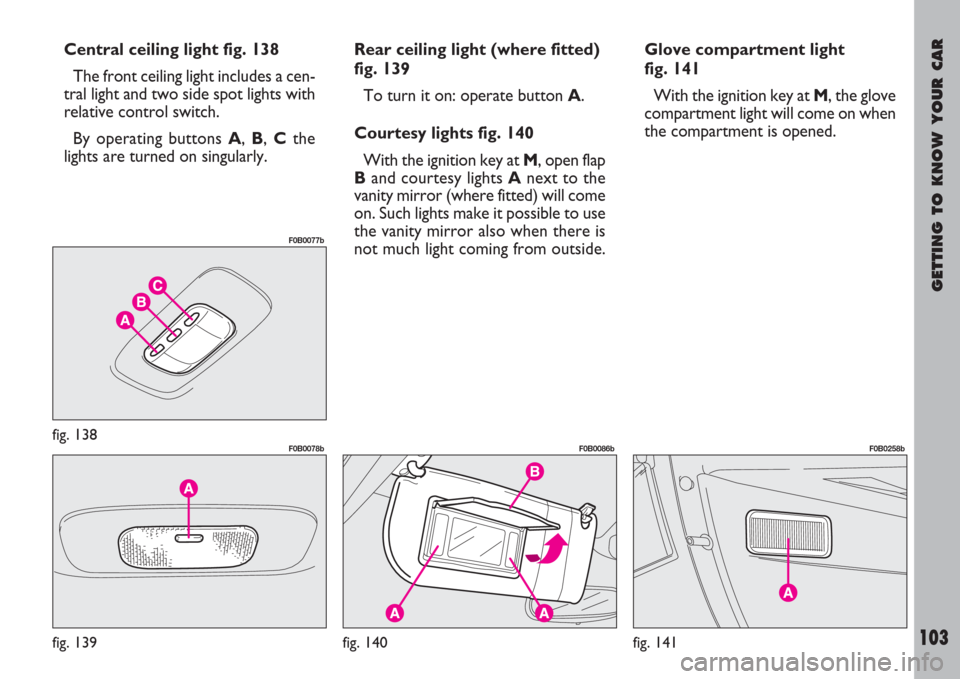
Central ceiling light fig. 138
The front ceiling light includes a cen-
tral light and two side spot lights with
relative control switch.
By operating buttons A, B, Cthe
lights are turned on singularly.Rear ceiling light (where fitted)
fig. 139
To turn it on: operate button A.
Courtesy lights fig. 140
With the ignition key at M, open flap
Band courtesy lights Anext to the
vanity mirror (where fitted) will come
on. Such lights make it possible to use
the vanity mirror also when there is
not much light coming from outside.Glove compartment light
fig. 141
With the ignition key at M, the glove
compartment light will come on when
the compartment is opened.
fig. 138
F0B0077b
fig. 139
F0B0078b
fig. 140
F0B0086b
fig. 141
F0B0258b
Page 105 of 254
GETTING TO KNOW YOUR CAR
104
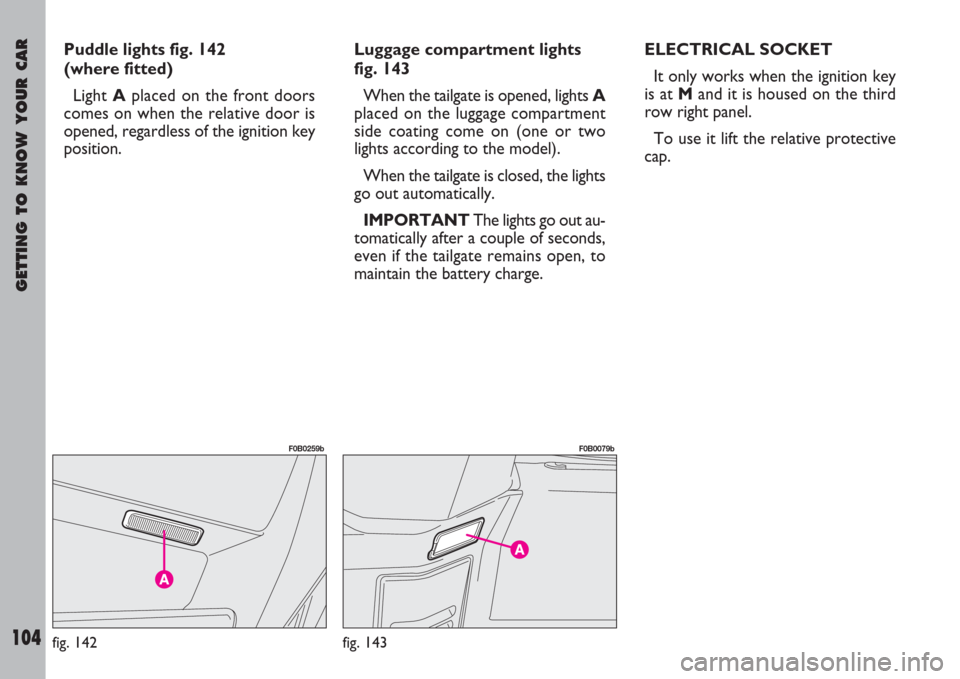
Puddle lights fig. 142
(where fitted)
Light Aplaced on the front doors
comes on when the relative door is
opened, regardless of the ignition key
position.Luggage compartment lights
fig. 143
When the tailgate is opened, lights A
placed on the luggage compartment
side coating come on (one or two
lights according to the model).
When the tailgate is closed, the lights
go out automatically.
IMPORTANTThe lights go out au-
tomatically after a couple of seconds,
even if the tailgate remains open, to
maintain the battery charge.ELECTRICAL SOCKET
It only works when the ignition key
is at Mand it is housed on the third
row right panel.
To use it lift the relative protective
cap.
fig. 142
F0B0259b
fig. 143
F0B0079b
Page 111 of 254
GETTING TO KNOW YOUR CAR
110
Do not travel with the
hatchback open: the ex-
haust fumes could enter
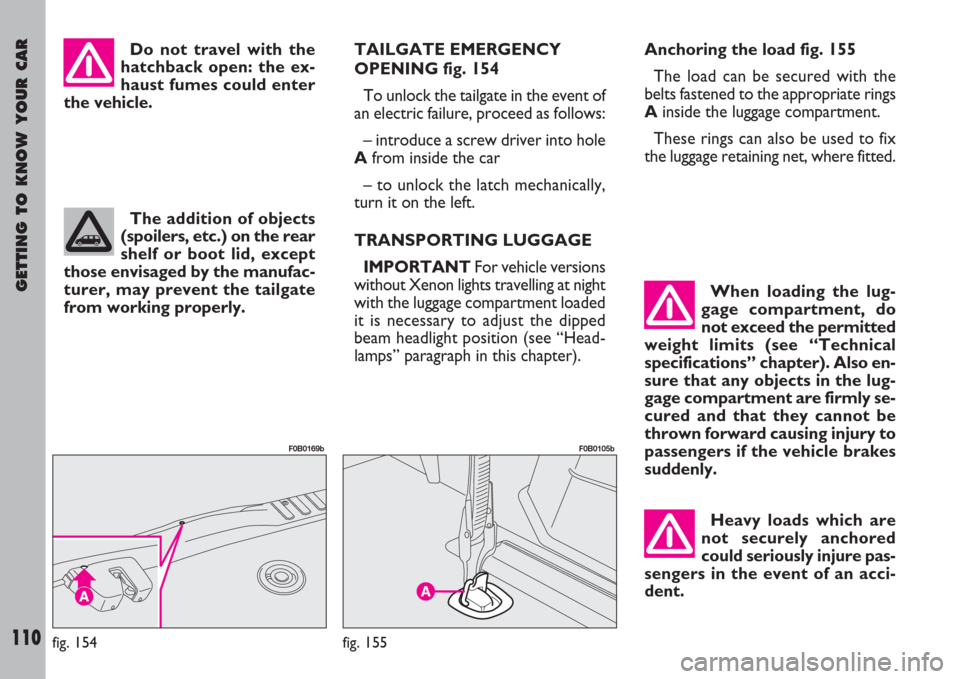
the vehicle.TAILGATE EMERGENCY
OPENING fig. 154
To unlock the tailgate in the event of
an electric failure, proceed as follows:
– introduce a screw driver into hole
A from inside the car
– to unlock the latch mechanically,
turn it on the left.
TRANSPORTING LUGGAGE
IMPORTANTFor vehicle versions
without Xenon lights travelling at night
with the luggage compartment loaded
it is necessary to adjust the dipped
beam headlight position (see “Head-
lamps” paragraph in this chapter).When loading the lug-
gage compartment, do
not exceed the permitted
weight limits (see “Technical
specifications” chapter). Also en-
sure that any objects in the lug-
gage compartment are firmly se-
cured and that they cannot be
thrown forward causing injury to
passengers if the vehicle brakes
suddenly.
Heavy loads which are
not securely anchored
could seriously injure pas-
sengers in the event of an acci-
dent. The addition of objects
(spoilers, etc.) on the rear
shelf or boot lid, except
those envisaged by the manufac-
turer, may prevent the tailgate
from working properly.
fig. 155
F0B0105b
fig. 154
F0B0169b
Anchoring the load fig. 155
The load can be secured with the
belts fastened to the appropriate rings
Ainside the luggage compartment.
These rings can also be used to fix
the luggage retaining net, where fitted.