tow FIAT ULYSSE 2007 2.G User Guide
[x] Cancel search | Manufacturer: FIAT, Model Year: 2007, Model line: ULYSSE, Model: FIAT ULYSSE 2007 2.GPages: 254, PDF Size: 3.42 MB
Page 132 of 254
GETTING TO KNOW YOUR CAR
131
When cleaning parking
sensors make sure they
do not get damaged. Do
not use dry, rough or hard cloth,
but clean water with the addition
of some car washing detergent, if
possible. At seat washing stations
where pressurised water or
steam are used to wash the car,
have the sensors cleaned rapidly,
with the nozzle at a distance of
10 cm.TOWING A TRAILER
Parking sensors are automatically de-
activated when the trailer is connect-
ed electrically to the vehicle.
When the trailer is disconnected, the
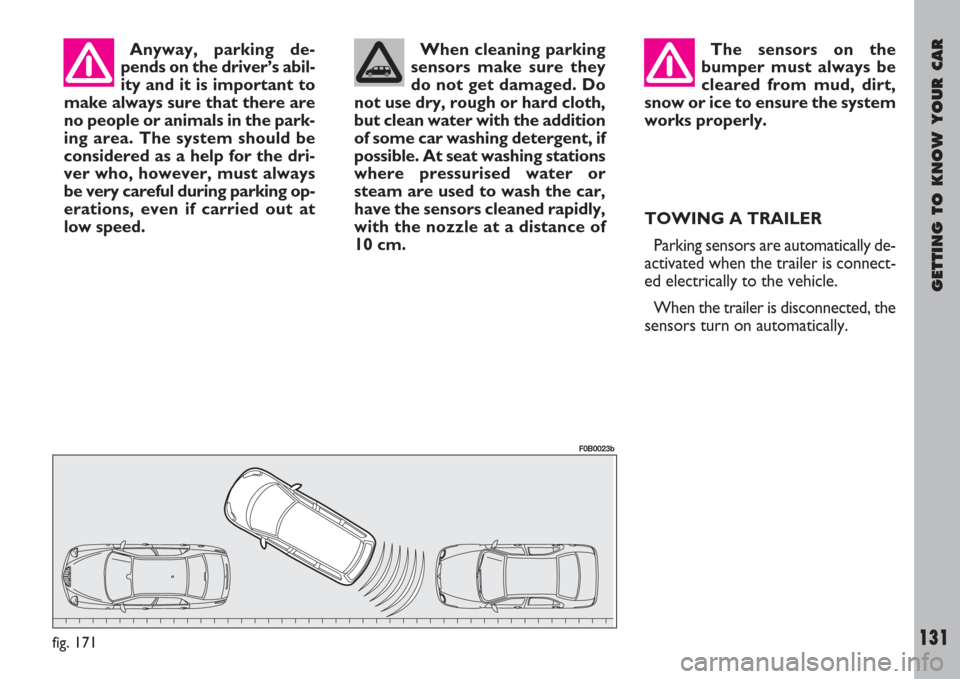
sensors turn on automatically. Anyway, parking de-
pends on the driver’s abil-
ity and it is important to
make always sure that there are
no people or animals in the park-
ing area. The system should be
considered as a help for the dri-
ver who, however, must always
be very careful during parking op-
erations, even if carried out at
low speed.The sensors on the
bumper must always be
cleared from mud, dirt,
snow or ice to ensure the system
works properly.
fig. 171
F0B0023b
Page 139 of 254
DRIVING YOUR CAR
138
HOW TO WARM UP
THE ENGINE AFTER
IT HAS JUST STARTED
– Begin to move forward slowly let-
ting the engine turning at medium revs.
Do not accelerate abruptly.
– Do not push the engine to its lim-
it for the first kilometres. You are rec-
ommended to wait until the water
temperature has reached 50° to 60°C.BUMP STARTING
For versions with a cat-
alytic converter, bump
starting by pushing, tow-
ing or rolling downhill must be
avoided at all costs. This ma-
noeuvre could cause a rush of fu-
el into the catalytic exhaust pipe
and damage it beyond repair.STOPPING THE ENGINE
Turn the ignition key to Swhile the
engine is idling.
Remember that as long
as the engine is not run-
ning, the power brakes
and power steering do not work.
You therefore have to use con-
siderably more effort on both the
brake pedal and the steering
wheel than you would do other-
wise.
Gunning the accelerator
before turning off the en-
gine serves absolutely no
practical purpose, wastes fuel and
is damaging, particularly to tur-
bocharged engines.
IMPORTANTAfter a taxing drive,
it is better to allow the engine to
“catch its breath” before turning it off
by letting it idle to allow the temper-
ature in the engine compartment to
fall.
Page 146 of 254
DRIVING YOUR CAR
145
CONTAINING RUNNING COSTS
AND POLLUTION
Tyres
Tyre pressure should be checked at
least once every four weeks: if the
pressure is too low fuel consumption
increases as the resistance to the
rolling movement of the tyre is
greater. In this state, tyre wear is in-
creased and vehicle handling suffers,
which will effect safety.
Unnecessary loads
Do not travel with too much luggage
stowed in the boot. The weight of the
vehicle (especially when driving in the
city) and its trim greatly effects con-
sumption and stability.
Roof rack/ski rack
Remove the roof/ski rack from the
roof when no longer necessary. These
accessories reduce the vehicle’s aero-
dynamic penetration, which affects
consumption. Use a trailer, if particu-
larly heavy objects are to be trans-
ported. Some suggestions which may help
you to keep the running costs of the
car down and lower the amount of
toxic emissions released into the at-
mosphere are given below.
GENERAL CONSIDERATIONS
Car maintenance
The overall state of the vehicle is an
important factor that has a marked in-
fluence over fuel consumption, driving
comfort and on the life span of your
vehicle. For this reason, care should
be taken to maintain your vehicle by
carrying out the necessary checks and
observing regulations in accordance
with the specifications given in the
Scheduled Maintenance Programme
(see section, idling, air cleaners, tim-
ing).Electrical devices
Use electric devices for the neces-
sary time only. The heated rear win-
dow, supplementary lights, windscreen
wipers, heating system blower require
large amounts of electricity; this means
an increase in the request for power
and consequently an increase in fuel
consumption (up to +25% when dri-
ving in built-up areas).
Climate control system
The climate control unit is an addi-
tional load that greatly affects the en-
gine leading to higher consumption (on
average +20%). When the tempera-
ture outside allows it, use the air
vents.
Spoilers
The use of optional extras which are
not certified for specific use on the car
may reduce the aerodynamic pene-
tration of the car and increase con-
sumption.
Page 147 of 254
DRIVING YOUR CAR
146
DRIVING STYLE
Starting
Do not warm the engine when the
vehicle is stationary or at high or low
revs: in this way the engine will warm
up gradually increasing consumption
and emissions. You should drive off
slowly straight away avoiding high revs
so that the engine will warm up more
quickly.
Unnecessary actions
Avoid revving the engine when
stopped at traffic lights or before
switching off the engine and avoid dou-
ble-clutching as these actions have no
purpose on modern vehicles and serve
only to increase consumption and pol-
lution.
Gear selections
As soon as the traffic and road con-
ditions allow it, shift to a higher gear.
Using a lower gear to liven up accel-
eration greatly increases consumption.
In the same way, improper use of the
higher gears will increase consump-
tion, emissions and wear and tear on
the engine.Top speeds
Fuel consumption increases consid-
erably as speed increases. For exam-
ple, when accelerating from 90 to
120 Kph, fuel consumption increases
by about +30%. Your speed should be
kept as even as possible and superflu-
ous braking and acceleration avoided
as this increases both consumption
and emissions. A “soft” way of driving
should be adopted by attempting to
anticipate manoeuvres to avoid immi-
nent danger and to keep a safe dis-
tance from the vehicle in front to
avoid braking sharply.
Acceleration
Accelerating violently increasing the
revs will greatly effect consumption
and emission: acceleration should be
gradual and not exceed the maximum
torque.CONDITIONS OF USE
Cold starting
Short trips and frequent cold start-
ing will not enable the engine to reach
optimal running temperature (from
+15 to +30% in built up areas) as will
the production of toxic emissions.
Traffic and road conditions
Heavy traffic and higher consumption
are synonymous: for example, when
driving slowly with frequent use of
lower gears or in large towns where
there are numerous traffic lights.
Winding roads, mountain roads and
bumpy roads also have a negative ef-
fect on consumption.
Enforced halts
During prolonged stops (traffic lights,
level crossings, etc.) the engine should
be switched off.
Page 148 of 254
DRIVING YOUR CAR
147
CHEAP RUNNING THAT RESPECTS
THE ENVIRONMENT
LOOKING AFTER EMISSION
CONTROL DEVICES
The correct use of pollution control
devices not only ensures respect for
the environment but also has an effect
on the car’s performance. Keeping
these devices in good condition is
therefore a fundamental rule for dri-
ving that is easy on your pocket and
on the environment too.
The first step to take is to follow the
Service Schedule to the letter.
Only use diesel for motor vehicles
(EN590 specification). Environmental protection has been
one of the guiding principles in the
production of the Ulysse. It is no ac-
cident that its pollution control equip-
ment is much more effective than that
required by current legislation.
Nonetheless, the environment can-
not get by without a concerted effort
from everyone.
By following a few simple rules the
motorist can avoid harming the envi-
ronment and often cut down fuel con-
sumption at the same time.
On this subject, a number of useful
tips have been given below to supple-
ment those marked by symbol
#, at
various points of the manual.
You are asked to read both the for-
mer and latter carefully.If you have trouble starting, do not
turn the ignition key for long periods.
Be especially careful to avoid bump
starting the vehicle by pushing, towing
or rolling downhill: these are all ma-
noeuvres that can damage the catalyt-
ic exhaust.
For emergency starts only use an
auxiliary battery.
If the engine begins to “lose its
smoothness” when travelling, contin-
ue your journey but reduce the de-
mands you are making on the engine
and have the vehicle checked at a Fi-
at Dealership.
When the instrument panel fuel re-
serve warning light comes on, fill up as
soon as possible. A fuel level that is
too low can cause an uneven supply of
fuel with the inevitable increase in ex-
haust temperature; this would seri-
ously damage the catalytic converter.
Page 149 of 254
DRIVING YOUR CAR
148
Do not warm up the engine by let-
ting it idle for a while before moving
off unless the outside temperature is
very low and, even in this case, only
do so for less than thirty seconds.
Do not install other heat shields and
do not remove those already fitted to
the catalytic converter and exhaust
pipe.Do not spray anything
on the Lambda sensor
and exhaust pipe.TOWING A TRAILER
IMPORTANT
The car must be fitted with a ho-
mologated tow hitch and suitable elec-
trical system for towing a caravan or
trailer.
To prevent damages to the electric
system of the car, it is recommended
to install a dedicated trailer electron-
ic control unit.
Have the tow hitch fitted by an ex-
pert who will issue specific documen-
tation for use on roads.
Fit special and/or additional rearview
mirrors in accordance with the High-
way Code.
Remember that towing a trailer
makes it harder for the car to climb
the maximum gradients specified, in-
creases braking and overtaking dis-
tance, proportionally to the overall
weight of the trailer.
Engage a low gear when driving down-
hill rather than constantly braking. When functioning nor-
mally the catalytic con-
verter develops high tem-
peratures. For this reason, do not
park the vehicle over inflamma-
ble material (grass, dry leaves,
pine needles, etc.): fire hazard.Failure to heed these
precautions could cause a
fire.
Page 150 of 254
DRIVING YOUR CAR
149
The weight the trailer exerts on the
vehicle’s tow hitch coupling reduces
the vehicle’s payload capacity by the
same amount.
In order to be sure you are not ex-
ceeding the maximum towing weight
(shown in the vehicle’s registration pa-
pers) you have to take into account the
trailer’s weight fully laden including the
accessories and personal luggage.
Do not exceed the speed limits for
towing a trailer either abroad or at
home. In any case, do not exceed the
top speed of 100 km/h.WINTER TYRES
These tyres have been specifically de-
signed for use on snow and ice and
should be fitted in place of the exist-
ing tyres.
Use winter tyres of the same size as
the tyres provided with the car.
Fiat Dealershipwill be glad to of-
fer advice on the right type of tyres ac-
cording to your needs.
The performance of winter tyres is
greatly reduced when the depth of the
tread is less than 4 mm. In this situa-
tion it would be safer to have them re-
placed.
The ABS system does
not control the trailer
braking system. Particu-
lar care must therefore be taken
on slippery road surfaces.Under no circumstances
modify the vehicle’s brak-
ing system for trailer
braking control. The trailer’s
braking system must be com-
pletely independent of the vehi-
cle’s hydraulic system.
Page 155 of 254
IN AN EMERGENCY
154
Do not carry out this
procedure if you lack ex-
perience; if it is not done
correctly it can cause very in-
tense electrical discharges. In ad-
dition, the fluid contained in the
battery is poisonous and corro-
sive. Avoid contact with skin and
eyes. You are also advised not to
put naked flames or lighted cig-
arettes near the battery and not
to cause sparks.
Remember that until
the engine has started the
brake booster and elec-
trical power steering systems will
not work and a greater effort will
therefore be required to press
the brake pedal or turn the steer-
ing wheel.IF A TYRE
IS PUNCTURED
Certain versions (where provided)
are fitted with wheel identification and
tyre inflation sensors; pressure loss is
signalled to the driver in the follow-
ing way:
pressure loss- the infotelematic
CONNECT system displays the relat-
ed message and a “gong” is emitted by
the system. Contact a Fiat Dealer-
ship;
punctured tyre- warning light
“STOP” comes on and the in-
fotelematic CONNECT system dis-
plays the related message together
with 3 consecutive “gong” sounds.
Change the wheel in the following
way.
The system can also display a dedi-
cated message in the event it should
not be able to detect the tyre pres-
sure. Under no circumstances
should a battery charger
be used to start the en-
gine: it could damage the elec-
tronic systems and in particular
the ignition and injection control
units.
BUMP STARTING
Do not bump start by
pushing, towing or coast-
ing downhill. This way of
starting could cause a rush of fu-
el into the catalytic converter and
damage it beyond repair.
Page 156 of 254
IN AN EMERGENCY
155
An incorrectly posi-
tioned jack may cause the
vehicle to fall. Do not use
the jack to lift loads exceeding
that indicated on the label at-
tached to the jack itself.Do not lubricate the bolt
threads before fitting
them back: they could
come loose.
Never start the engine when the
vehicle is jacked up.
If you are towing a trailer, re-
move the trailer before jacking
up the vehicle.Never tamper with the
inflation valve. Never
place tools between the
rim and the tyre.
Check the tyre and space-saver
spare wheel pressure regularly.
The tyre inflation pressure is
shown in the “Technical specifi-
cations” chapter.
The jack should only be
used to change a wheel
on the vehicle for which it
was designed. It should not be put
to other uses or employed to
raise other models. Under no cir-
cumstances should it be used
when carrying out repairs under
the vehicle.
Check the inflation pres-
sure of the tyres and the
spare wheel regularly. If
you change the type of wheels (al-
loy rims instead of steel rims) you
will have to change the entire set
of fastening bolts with another
set of suitably sized bolts.
You should keep the bolts in
case you decide to use the origi-
nal type of wheel later on.Signal the presence of
the stopped car according
to the laws in force: haz-
ard lights, reflecting triangle, etc.
Any passengers on board should
leave the car, especially if it is
heavily laden. Passengers should
stay away from oncoming traffic
while the wheel is being changed.
If the wheel is being changed on
a steep or badly surfaced road,
place wedges or other suitable
material under the wheels to
stop the car.
GENERAL INSTRUCTIONS
Observe the instructions on this and
the following pages to use the jack and
space-saver spare wheel correctly.
Page 170 of 254
IN AN EMERGENCY
169
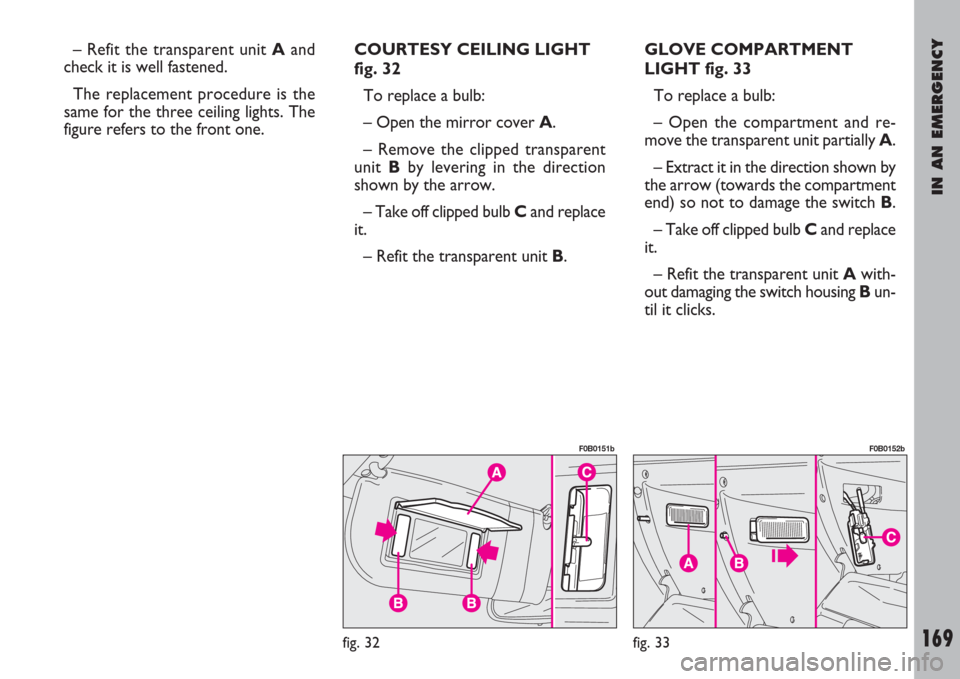
– Refit the transparent unit Aand
check it is well fastened.
The replacement procedure is the
same for the three ceiling lights. The
figure refers to the front one.COURTESY CEILING LIGHT
fig. 32
To replace a bulb:
– Open the mirror cover A.
– Remove the clipped transparent
unit Bby levering in the direction
shown by the arrow.
– Take off clipped bulb Cand replace
it.
– Refit the transparent unit B.GLOVE COMPARTMENT
LIGHT fig. 33
To replace a bulb:
– Open the compartment and re-
move the transparent unit partially A.
– Extract it in the direction shown by
the arrow (towards the compartment
end) so not to damage the switch B.
– Take off clipped bulb Cand replace
it.
– Refit the transparent unit Awith-
out damaging the switch housing Bun-
til it clicks.
fig. 32
F0B0151b
fig. 33
F0B0152b