seats FIAT ULYSSE 2007 2.G Owner's Manual
[x] Cancel search | Manufacturer: FIAT, Model Year: 2007, Model line: ULYSSE, Model: FIAT ULYSSE 2007 2.GPages: 254, PDF Size: 3.42 MB
Page 113 of 254
GETTING TO KNOW YOUR CAR
112
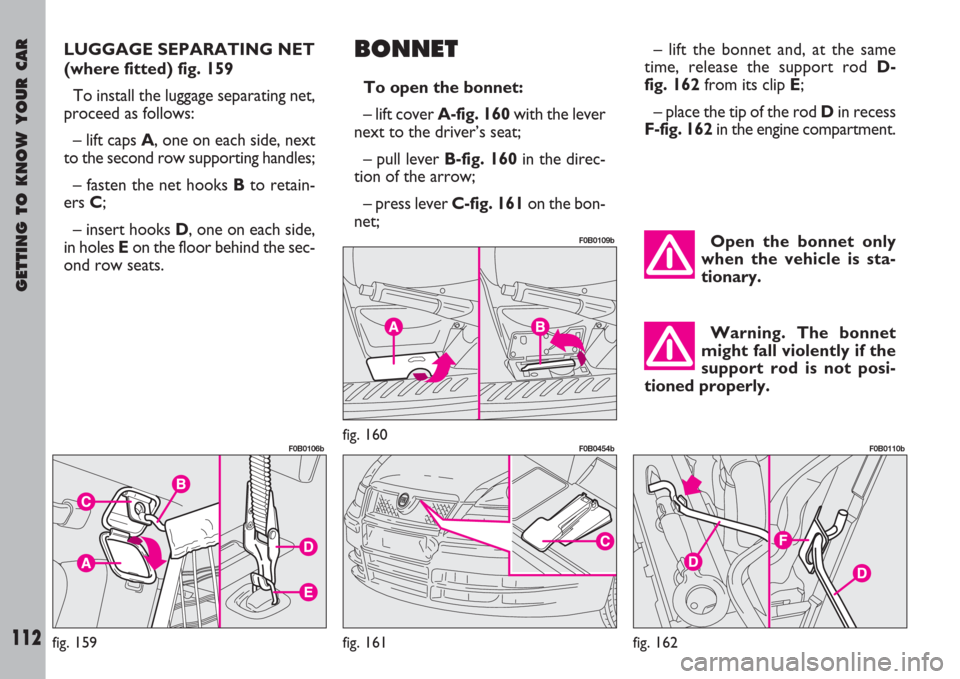
LUGGAGE SEPARATING NET
(where fitted) fig. 159
To install the luggage separating net,
proceed as follows:
– lift caps A, one on each side, next
to the second row supporting handles;
– fasten the net hooks Bto retain-
ers C;
– insert hooks D, one on each side,
in holes Eon the floor behind the sec-
ond row seats.BONNET
To open the bonnet:
– lift cover A-fig. 160with the lever
next to the driver’s seat;
– pull lever B-fig. 160in the direc-
tion of the arrow;
– press lever C-fig. 161on the bon-
net;
Open the bonnet only
when the vehicle is sta-
tionary.
Warning. The bonnet
might fall violently if the
support rod is not posi-
tioned properly.
fig. 159
F0B0106bfig. 160
F0B0109b
fig. 162
F0B0110b
– lift the bonnet and, at the same
time, release the support rod D-
fig. 162from its clip E;
– place the tip of the rod Din recess
F-fig. 162in the engine compartment.
fig. 161
F0B0454b
Page 117 of 254
GETTING TO KNOW YOUR CAR
116
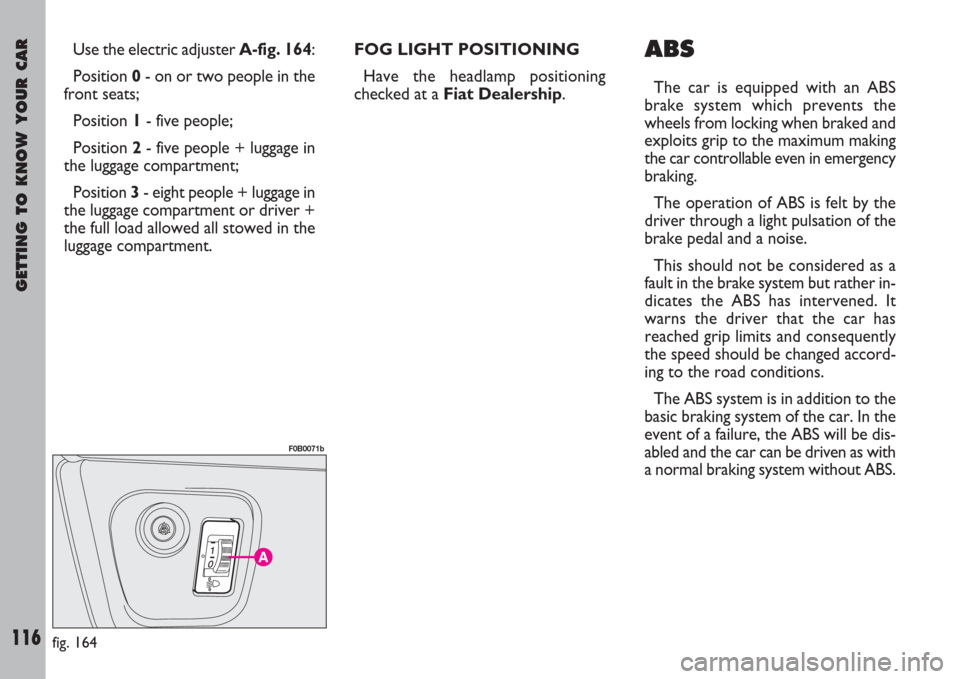
Use the electric adjuster A-fig. 164:
Position 0- on or two people in the
front seats;
Position 1- five people;
Position 2- five people + luggage in
the luggage compartment;
Position 3- eight people + luggage in
the luggage compartment or driver +
the full load allowed all stowed in the
luggage compartment.FOG LIGHT POSITIONING
Have the headlamp positioning
checked at a Fiat Dealership.ABS
The car is equipped with an ABS
brake system which prevents the
wheels from locking when braked and
exploits grip to the maximum making
the car controllable even in emergency
braking.
The operation of ABS is felt by the
driver through a light pulsation of the
brake pedal and a noise.
This should not be considered as a
fault in the brake system but rather in-
dicates the ABS has intervened. It
warns the driver that the car has
reached grip limits and consequently
the speed should be changed accord-
ing to the road conditions.
The ABS system is in addition to the
basic braking system of the car. In the
event of a failure, the ABS will be dis-
abled and the car can be driven as with
a normal braking system without ABS.
fig. 164
F0B0071b
Page 128 of 254
GETTING TO KNOW YOUR CAR
127
SIDE AIR BAGS
(SIDE BAG - WINDOW BAG)
Purpose of the side airbags is to in-
crease passenger protection in the
event of a side impact of medium to
high severity.
They consist of two instantly inflat-
able bag types:
– side bags are housed in the back
rest of the front seats; this solution
makes it possible to always have the
cushion in the optimum position with
respect to the passenger, regardless of
the seat position;
– window bags, being a “curtain” sys-
tem, are housed in the side roof lin-
ing and are covered by a special trim
that enables bag deflation downwards.
This solution, designed to protect the
head, offers the occupants the highest
degree of protection in the case of aside crash due to the wide deflation
surface of the bags.
In the event of a side collision the
electronic control unit processes the
signals coming from a deceleration
sensor and, if required, triggers the in-
flation of the bags.
The bags inflate immediately, setting
as a protective barrier between the
passengers and the car door. The bags
deflate immediately afterwards.
In minor side crashes (for which the
restraining action of the seat belts is
sufficient), the air bags are not de-
ployed.Therefore the side air bags are not
a replacement of but complementary
to the belts, which you are recom-
mended to always wear, as specified
by law in Europe and most non-Euro-
pean countries.
Operation of the side air bags is not
disabled by the passenger’s front air
bag deactivation switch, as described
in the previous paragraph.
IMPORTANTThe front and/or
side air bags may be deployed if the car
is subject to heavy knocks or accidents
involving the underbody area, such as
for example violent shocks against
steps, kerbs or low obstacles, falling of
the car in big holes or sags in the road.
Page 130 of 254
Remember that with the
key engaged and in M po-
sition, even with the en-
gine not running, the air bags may
be triggered on a stationary ve-
hicle if it is bumped by another
moving car. Therefore, never seat
children on the front seat even
when the vehicle is stationary.
On the other hand, remember
that with the vehicle stationary,
without the key engaged and
turned, the air bags are not trig-
gered in the event of an impact;
in these cases, failure to come in-
to action of the air bags cannot
be considered as a sign that the
system is not working properly.
GETTING TO KNOW YOUR CAR
129
Never travel with ob-
jects on your lap, in front
of your chest or with a
pipe, pencil, etc. between your
lips; injury may result in the event
of the air bag being triggered.If the car has been stolen
or an attempt to steal it
has been made, if it has
been subjected to vandals or
floods, have the air bag system
checked by Fiat Dealership.
Do not wash the seat
back rest with pressurised
water or steam at auto-
matic seat washing stations.
Do not cover the back-
rest of front seats with
trims or covers that are
not suitable to be used with side
bags. Always keep you hands
on the steering wheel rim
when driving, so that if
the air bag is triggered, it can in-
flate without meeting any obsta-
cles which could cause serious
harm to you. Do not drive with
the body bent forward, keep the
seat back rest in the erect posi-
tion and lean your back well
against it.
Do not apply stickers or
other objects to the
steering wheel or to the
air bag cover on the passenger’s
side or on the side roof lining.
Never put objects (e.g. mobile
phones) on the dashboard on pas-
senger side since they could in-
terfere with proper passenger air
bag inflation and also cause seri-
ous injury.
Page 141 of 254
DRIVING YOUR CAR
140
BEFORE GETTING BEHIND
THE WHEEL
The main suggestions are the fol-
lowing:
– make sure all lights including the
headlights are working properly;
– adjust the position of the seat,
steering wheel, driving and door mir-
rors properly for the best driving po-
sition;
– adjust the head restraints careful-
ly so that they support the head and
not the neck;
– make sure that nothing (mats, etc.)
gets in the way of the pedals when
they are pushed down;
– make sure that any child restraint
systems (child seats, carriers, etc.) are
properly fixed, preferably on the back
seat as this is the safest place in the
event of an accident;– make sure that objects being trans-
ported are carefully arranged so they
will not fly forward if you have to
brake sharply;
– do not eat a heavy meal before
travelling. Light eating will help keep
your reflexes prompt. Above all, do
not have anything alcoholic to drink.
Using certain prescription drugs can
reduce your ability to drive: read in-
structions for use carefully.
Periodically, remember to check:
– tyre pressure and conditions;
– engine oil level;
– coolant level and conditions of the
system;
– brake fluid level;
– power steering fluid level;
– windscreen washer liquid level.WHEN TRAVELLING
The main suggestions are the fol-
lowing:
– the first rule of safe driving is pru-
dence. Prudence also means putting
yourself into a position where you can
predict wrong or imprudent behaviour
from other drivers;
– stick closely to the rules of the
road in the particular country where
the vehicle is being driven and, above
all, do not exceed speed limits;
– ensure that, besides yourself, all the
other passengers in the vehicle have
their seat belts fastened, that children
are sitting in the appropriate child
seats and any animals in the car are
placed in suitable compartments;
– you should be physically fit and
mentally alert before setting out on
long journeys;
Page 214 of 254
CAR MAINTENANCE
213
CLEANING SEATS
AND FABRICS
Remove dust with a soft brush and
vacuum cleaner.
Brush the seats with a damp sponge
with water and a neutral soap.
CLEANING LEATHER SEATS
Remove the dry dirt with a chamois
leather or very slightly moist cloth
without exerting too much pressure.
Remove liquid or grease stains with
a dry absorbent cloth without rubbing.
Then wipe with a chamois leather or
soft cloth moistened with water and
neutral soap.
IMPORTANTNever use alcohol
or alcohol-based products.STEERING WHEEL/GEAR
LEVER KNOB WITH
GENUINE LEATHER
COVERING
These components shall only be
cleaned with water and neutral soap.
Never use spirit or alcohol-based
products.
Before using special products for
cleaning interiors, read carefully label
instructions and indications to make
sure they are free from spirit and/or
alcohol-based substances.
If when cleaning the windscreen with
special glass products, some drops fall
on the leather covering of the steer-
ing wheel/gear lever knob remove
them immediately and then clean with
water and neutral soap.
IMPORTANTTake the utmost
care when engaging the steering lock
to prevent scratching the leather cov-
ering.PLASTIC PARTS INSIDE
THE CAR
Use special products designed not to
alter the appearance of the compo-
nents.
IMPORTANTDo not use alcohol
or petrol to clean the instrument
panel.
Do not keep aerosol
cans in the vehicle. There
is the risk they might ex-
plode. Aerosol cans must never
be exposed to a temperature
above 50°C; when the weather
starts to get hot the temperature
inside the vehicle might go well
beyond that figure.
Page 219 of 254
TECHNICAL SPECIFICATIONS
218
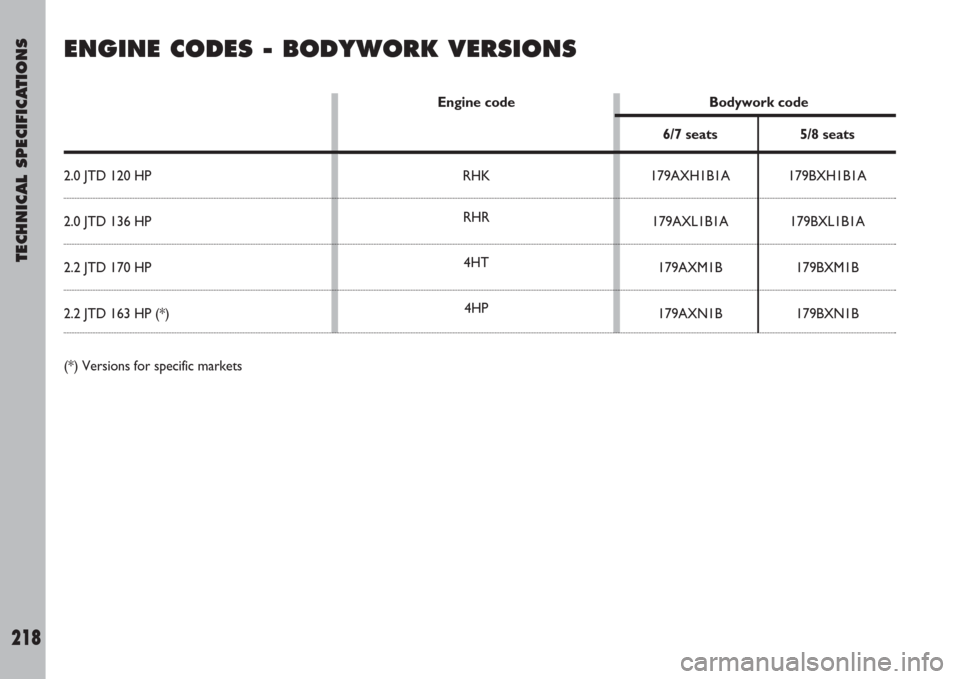
ENGINE CODES - BODYWORK VERSIONS
2.0 JTD 120 HP
2.0 JTD 136 HP
2.2 JTD 170 HP
2.2 JTD 163 HP (*)
(*) Versions for specific marketsEngine code
RHK
RHR
4HT
4HPBodywork code
6/7 seats 5/8 seats
179AXH1B1A 179BXH1B1A
179AXL1B1A 179BXL1B1A
179AXM1B 179BXM1B
179AXN1B 179BXN1B
Page 229 of 254
TECHNICAL SPECIFICATIONS
228
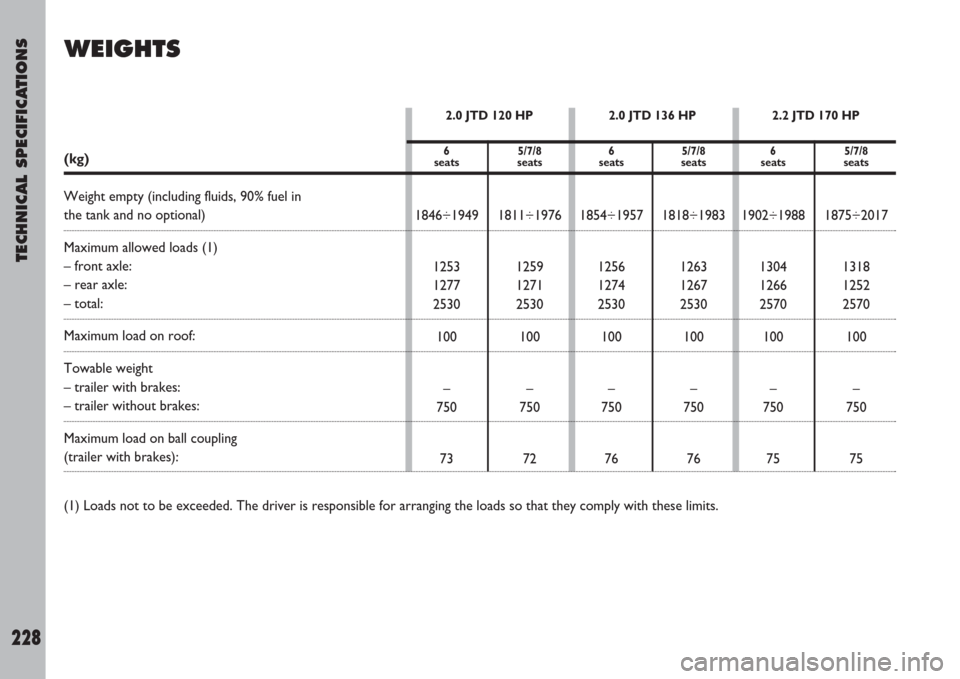
WEIGHTS
2.0 JTD 136 HP
6 5/7/8
seats seats
1854÷1957 1818÷1983
1256 1263
1274 1267
2530 2530
100 100
––
750 750
76 76
2.0 JTD 120 HP
6 5/7/8
seats seats
1846÷1949 1811÷1976
1253 1259
1277 1271
2530 2530
100 100
––
750 750
73 72
2.2 JTD 170 HP
6 5/7/8
seats seats
1902÷1988 1875÷2017
1304 1318
1266 1252
2570 2570
100 100
––
750 750
75 75
(kg)
Weight empty (including fluids, 90% fuel in
the tank and no optional)
Maximum allowed loads (1)
– front axle:
– rear axle:
– total:
Maximum load on roof:
Towable weight
– trailer with brakes:
– trailer without brakes:
Maximum load on ball coupling
(trailer with brakes):
(1) Loads not to be exceeded. The driver is responsible for arranging the loads so that they comply with these limits.
Page 242 of 254
INDEX
241
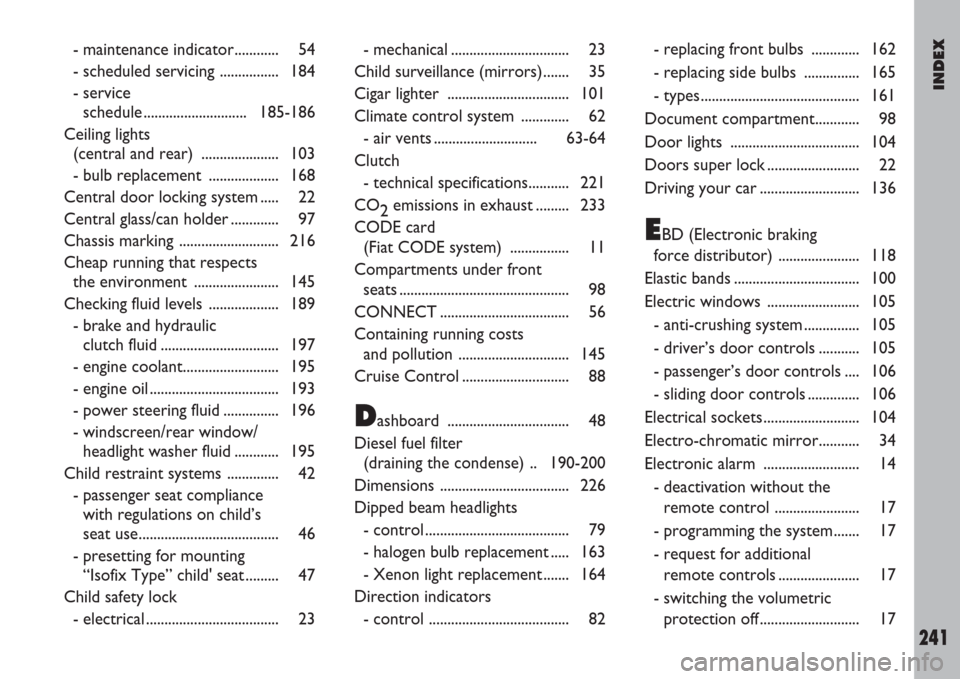
- maintenance indicator............ 54
- scheduled servicing ................ 184
- service
schedule ............................ 185-186
Ceiling lights
(central and rear) ..................... 103
- bulb replacement ................... 168
Central door locking system ..... 22
Central glass/can holder ............. 97
Chassis marking ........................... 216
Cheap running that respects
the environment ....................... 145
Checking fluid levels ................... 189
- brake and hydraulic
clutch fluid ................................ 197
- engine coolant.......................... 195
- engine oil ................................... 193
- power steering fluid ............... 196
- windscreen/rear window/
headlight washer fluid ............ 195
Child restraint systems .............. 42
- passenger seat compliance
with regulations on child’s
seat use...................................... 46
- presetting for mounting
“Isofix Type” child' seat ......... 47
Child safety lock
- electrical .................................... 23- mechanical ................................ 23
Child surveillance (mirrors)....... 35
Cigar lighter ................................. 101
Climate control system ............. 62
- air vents ............................ 63-64
Clutch
- technical specifications........... 221
CO
2emissions in exhaust ......... 233
CODE card
(Fiat CODE system) ................ 11
Compartments under front
seats .............................................. 98
CONNECT ................................... 56
Containing running costs
and pollution .............................. 145
Cruise Control ............................. 88
Dashboard ................................. 48
Diesel fuel filter
(draining the condense) .. 190-200
Dimensions ................................... 226
Dipped beam headlights
- control ....................................... 79
- halogen bulb replacement ..... 163
- Xenon light replacement ....... 164
Direction indicators
- control ...................................... 82- replacing front bulbs ............. 162
- replacing side bulbs ............... 165
- types ........................................... 161
Document compartment............ 98
Door lights ................................... 104
Doors super lock ......................... 22
Driving your car ........................... 136
EBD (Electronic braking
force distributor) ...................... 118
Elastic bands .................................. 100
Electric windows ......................... 105
- anti-crushing system ............... 105
- driver’s door controls ........... 105
- passenger’s door controls .... 106
- sliding door controls .............. 106
Electrical sockets .......................... 104
Electro-chromatic mirror........... 34
Electronic alarm .......................... 14
- deactivation without the
remote control ....................... 17
- programming the system....... 17
- request for additional
remote controls ...................... 17
- switching the volumetric
protection off ........................... 17
Page 243 of 254
INDEX
242
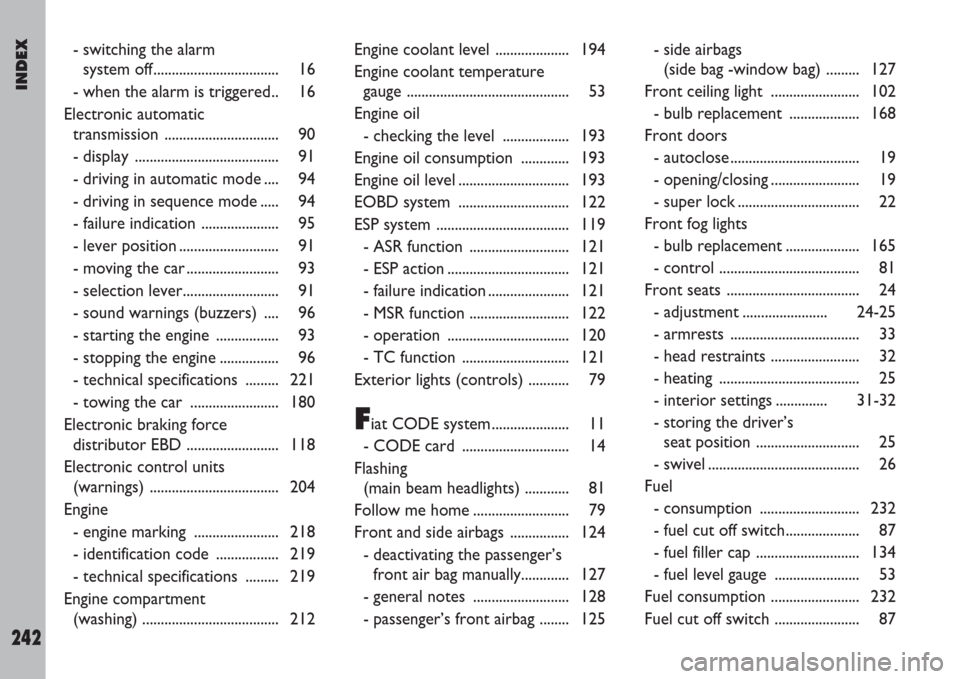
- switching the alarm
system off.................................. 16
- when the alarm is triggered.. 16
Electronic automatic
transmission ............................... 90
- display ....................................... 91
- driving in automatic mode .... 94
- driving in sequence mode ..... 94
- failure indication ..................... 95
- lever position ........................... 91
- moving the car ......................... 93
- selection lever.......................... 91
- sound warnings (buzzers) .... 96
- starting the engine ................. 93
- stopping the engine ................ 96
- technical specifications ......... 221
- towing the car ........................ 180
Electronic braking force
distributor EBD ......................... 118
Electronic control units
(warnings) ................................... 204
Engine
- engine marking ....................... 218
- identification code ................. 219
- technical specifications ......... 219
Engine compartment
(washing) ..................................... 212Engine coolant level .................... 194
Engine coolant temperature
gauge ............................................ 53
Engine oil
- checking the level .................. 193
Engine oil consumption ............. 193
Engine oil level .............................. 193
EOBD system .............................. 122
ESP system .................................... 119
- ASR function ........................... 121
- ESP action ................................. 121
- failure indication ...................... 121
- MSR function ........................... 122
- operation ................................. 120
- TC function ............................. 121
Exterior lights (controls) ........... 79
Fiat CODE system ..................... 11
- CODE card ............................. 14
Flashing
(main beam headlights) ............ 81
Follow me home .......................... 79
Front and side airbags ................ 124
- deactivating the passenger’s
front air bag manually............. 127
- general notes .......................... 128
- passenger’s front airbag ........ 125- side airbags
(side bag -window bag) ......... 127
Front ceiling light ........................ 102
- bulb replacement ................... 168
Front doors
- autoclose ................................... 19
- opening/closing ........................ 19
- super lock ................................. 22
Front fog lights
- bulb replacement .................... 165
- control ...................................... 81
Front seats .................................... 24
- adjustment ....................... 24-25
- armrests ................................... 33
- head restraints ........................ 32
- heating ...................................... 25
- interior settings .............. 31-32
- storing the driver’s
seat position ............................ 25
- swivel ......................................... 26
Fuel
- consumption ........................... 232
- fuel cut off switch.................... 87
- fuel filler cap ............................ 134
- fuel level gauge ....................... 53
Fuel consumption ........................ 232
Fuel cut off switch ....................... 87