warning FIAT ULYSSE 2007 2.G Owner's Manual
[x] Cancel search | Manufacturer: FIAT, Model Year: 2007, Model line: ULYSSE, Model: FIAT ULYSSE 2007 2.GPages: 254, PDF Size: 3.42 MB
Page 97 of 254
GETTING TO KNOW YOUR CAR
96
INTERIOR
EQUIPMENT
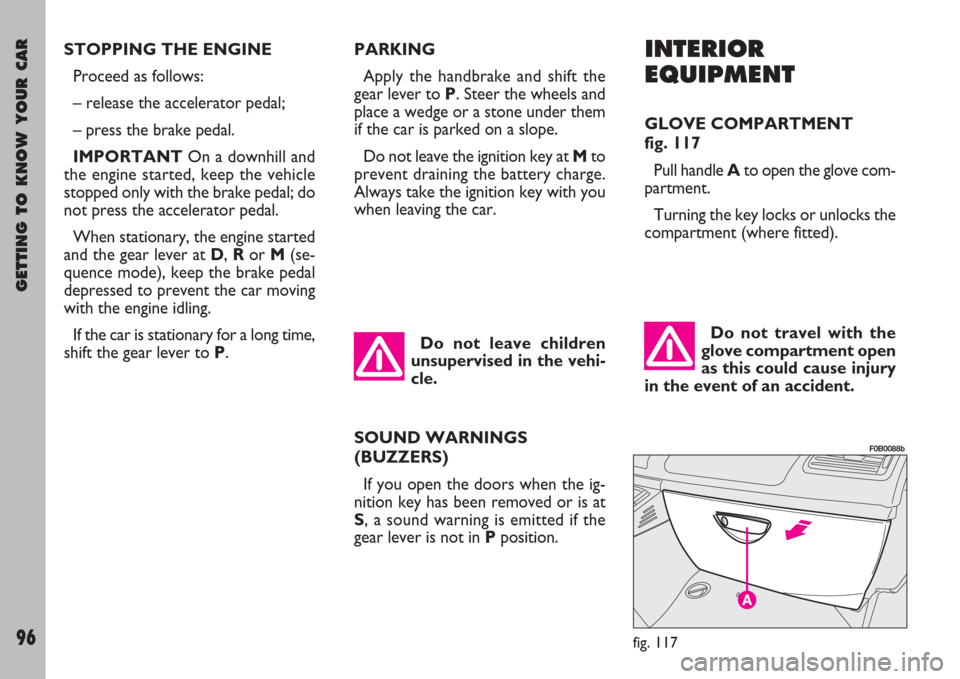
GLOVE COMPARTMENT
fig. 117
Pull handle Ato open the glove com-
partment.
Turning the key locks or unlocks the
compartment (where fitted).
Do not travel with the
glove compartment open
as this could cause injury
in the event of an accident.
fig. 117
F0B0088b
STOPPING THE ENGINE
Proceed as follows:
– release the accelerator pedal;
– press the brake pedal.
IMPORTANTOn a downhill and
the engine started, keep the vehicle
stopped only with the brake pedal; do
not press the accelerator pedal.
When stationary, the engine started
and the gear lever at D, Ror M(se-
quence mode), keep the brake pedal
depressed to prevent the car moving
with the engine idling.
If the car is stationary for a long time,
shift the gear lever to P.PARKING
Apply the handbrake and shift the
gear lever to P. Steer the wheels and
place a wedge or a stone under them
if the car is parked on a slope.
Do not leave the ignition key at Mto
prevent draining the battery charge.
Always take the ignition key with you
when leaving the car.
SOUND WARNINGS
(BUZZERS)
If you open the doors when the ig-
nition key has been removed or is at
S, a sound warning is emitted if the
gear lever is not in Pposition. Do not leave children
unsupervised in the vehi-
cle.
Page 113 of 254
GETTING TO KNOW YOUR CAR
112
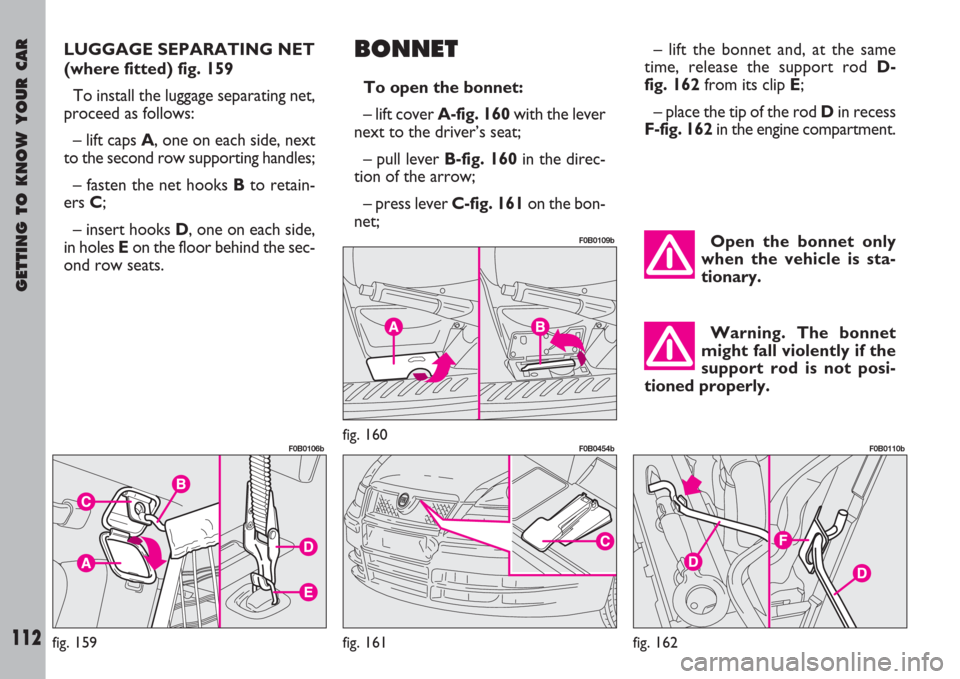
LUGGAGE SEPARATING NET
(where fitted) fig. 159
To install the luggage separating net,
proceed as follows:
– lift caps A, one on each side, next
to the second row supporting handles;
– fasten the net hooks Bto retain-
ers C;
– insert hooks D, one on each side,
in holes Eon the floor behind the sec-
ond row seats.BONNET
To open the bonnet:
– lift cover A-fig. 160with the lever
next to the driver’s seat;
– pull lever B-fig. 160in the direc-
tion of the arrow;
– press lever C-fig. 161on the bon-
net;
Open the bonnet only
when the vehicle is sta-
tionary.
Warning. The bonnet
might fall violently if the
support rod is not posi-
tioned properly.
fig. 159
F0B0106bfig. 160
F0B0109b
fig. 162
F0B0110b
– lift the bonnet and, at the same
time, release the support rod D-
fig. 162from its clip E;
– place the tip of the rod Din recess
F-fig. 162in the engine compartment.
fig. 161
F0B0454b
Page 118 of 254
GETTING TO KNOW YOUR CAR
117
In the event of a failure, the braking
capacity of the car will not be pe-
nalised in any way although the an-
tilocking effect cannot be relied upon.
If this is the first time you are dri-
ving a car with ABS, we recommend
you learn how to use it by testing the
brakes on slippery ground - obvious-
ly in conditions of safety and respect-
ing the highway code enforced in the
country you are driving in - and read
the following notes carefully.
The advantage of ABS with respect
to the traditional braking system is the
fact that maximum drivability is en-
sured even when braking to the grip
limit and wheel locking is prevented.
You should, however, not always ex-
pect the braking distance to decrease.
For example, on soft surfaces - i.e.
gravel or fresh snow on a slippery
road - the braking distance could, in
fact, increase.To make the most of the possibilities
offered by the anti-locking system
when it is required, attain to the fol-
lowing advice.If there is a fault, the in-
strument panel warning
light >will come on. At
this point, reduce speed and go to
a Fiat Dealership to have your car
checked and full system opera-
tion restored.
When the ABS inter-
venes and you feel the
brake pedal pushing, do
not release the pressure on the
pedal but hold it down without
hesitation. This will ensure the
car stops in the shortest time
compatibly to the road surface
conditions.In any case, always pay the utmost
care when braking and cornering even
with ABS.
The most important piece of advice
is, however, the following: The ABS makes the
most of the available grip
but cannot increase it.
Consequently, drive very care-
fully on slippery roads without
taking unnecessary risks.
When the ABS inter-
venes, you have reached
the grip limit between
tyres and road surface: slow
down to suit speed to the avail-
able grip.
Page 119 of 254
GETTING TO KNOW YOUR CAR
118
MBA AND HBA
SYSTEMS
(where fitted)
The MBA (Mechanic Brake Assis-
tance) and HBA (Hydraulic Brake As-
sistance) systems increase braking
pressure in emergency braking. When
the driver is forced by the critical dri-
ving conditions to press violently the
brake pedal, the system increases the
braking pressure to assure the quick-
est vehicle stop.
These two systems behave in the
same way, the only difference is that
one increases braking pressure
through the ESP control unit and the
other with a mechanic action. By following these indications you
will be able to brake in the best con-
ditions in all events.
IMPORTANTVehicles fitted with
ABS may only be fitted with wheel
rims, tyres and brake pads of the make
and model approved by the vehicle
manufacturer.
The system is completed with an
Electronic Brake Distributor EBD
which increases the brake system per-
formance and employs the ABS con-
trol unit and sensors.
If the xbrake fluid low
warning light comes on,
stop the vehicle immedi-
ately and contact the nearest Fi-
at Dealership. Fluid leaks from
the hydraulic system, in fact, can
compromise brake system oper-
ation, both traditional systems
and systems with ABS. The car is fitted with an
electronic braking device
(EBD). The xand >
warning lights will come on at the
same time when the engine is
running to indicate that there is
an EBD system failure. In this
case violent braking may be ac-
companied by early rear wheel
locking with the possibility of
skidding. Drive the car extreme-
ly carefully to the nearest Fiat
Dealership to have the system
checked.Warning light >alone,
with the engine running,
normally indicates a fault
in the ABS system. In this case,
the braking system is still effi-
cient, though without the an-
tilocking device. Under these
conditions, performance of the
EBD system may be reduced. Al-
so in this case, you are advised to
go immediately to the nearest Fi-
at Dealership, driving in such a
way to avoid sharp braking to
have the system checked.
Page 121 of 254
Cars with ESP may only
be fitted with tyres of the
same make, model and
size and be in good conditions.
GETTING TO KNOW YOUR CAR
120
ESP SYSTEM ACTION
The ESP system action is signalled by
warning light
ñflashing to inform the
driver that the vehicle stability and grip
are critical.
ESP failure indication
In the event of an ESP system failure,
it turns off automatically and warning
light
ñcomes on together with the
relative message on the multifunction
display.
In the event of an ESP system failure,
the vehicle behaves as the version
without this type of system. We rec-
ommend you to contact a Fiat Deal-
ership as soon as possible. The ESP main components are:
– an electronic control unit which
processes the sensor signals and ap-
plies the best strategy;
– an angle sensor which detects the
steering position;
– four sensors which detect each
wheel rotation speed;
– a braking system pressure sensor;
– a yawing sensor which detects the
vehicle spinning around a vertical axis;
– a sensor which detects side accel-
eration (centrifugal force).
The ESP heart is the control unit
which processes the centrifugal forces
deriving from cornering on the basis
of the data coming from the sensors
installed on the vehicle. The yawing
sensor detects the vehicle spinning
around its vertical axis. Centrifugal
forces resulting from cornering are de-
tected by a highly sensible side accel-
eration sensor.
The ESP stabilising action is based on
the control unit processing of data
coming from the steering wheel rota-
tion sensors, side acceleration sensors
and wheel rotation speed sensors.These signals make the control unit
recognise the driver’s manoeuvre
when he/she turns the steering wheel.
The control unit processes such in-
formation and is able to detect the ve-
hicle position at any time and compare
it with the driver’s wished direction. If
they do not match, the control unit is
able to adjust the vehicle’s position in-
stantly, by choosing the best strategy:
it can brake one or more wheels with
different force and reduce the engine
power, if needed.
Adjustments are made for continu-
ously adapting to the driver’s wished
travelling direction.
The ESP system action improves the
vehicle safety in many critical situations
and is useful especially when the
roadbed grip changes.
Page 123 of 254
GETTING TO KNOW YOUR CAR
122
EOBD SYSTEM
The EOBD (European On Board
Diagnosis) system fitted in this car
complies with Directive 98/69/CE
(EURO 3).
This system continuously monitors
the engine emission system compo-
nents. Furthermore, the system warns
the driver of deterioration concerning
the emission system components by
means of
Uwarning light on the in-
strument panel.
The objective is to:
– monitor system efficiency;
– warn when failures can increase
emissions over the threshold estab-
lished by the European regulations;
– warn of the need to replace dete-
riorated components.
Furthermore, the system is equipped
with a connector for interfacing with
specific tools used to read the error
codes stored in the control unit mem-
ory along with a set of diagnostic and
engine specific parameters. This check can also be performed by
traffic controller agents.
If, turning the ignition
key to M, the warning
light
Udoes not turn on
or if, while travelling it turns on
glowing steadily or flashing, con-
tact a Fiat Dealership as soon as
possible. Dealership as soon as
possible. Warning light
Uoper-
ation can be checked by traffic
controller agents by means of
special equipment. Always com-
ply with the traffic regulations in
force in the country where you
are travelling.
IMPORTANTAfter eliminating the
problem, your Fiat Dealershipwill
run a bench test to fully check the sys-
tem. In some cases, a long road test
may be required.
TYRE PRESSURE
MONITORING
SYSTEM - T.P.M.S.
(where provided)
The car can be equipped with the
T.P.M.S. (Tyre Pressure Monitoring
System). This system consists of a ra-
dio-frequency sensor, installed on each
wheel (on the rim inside the tyre) that
sends pressure information to the
control unit.
IMPORTANTSystem control unit
monitors the pressure of the four car
tyres but not the space-saver spare
wheel. It is therefore recommended
to always check also the space-saver
spare wheel pressure.
IMPORTANTPay the attention
when checking or inflating tyres. Ex-
cessive pressure impairs road holding,
increases suspension and wheel stress
and causes abnormal tyre wear.
Page 124 of 254
The T.P.M.S. system
does not exempt the dri-
ver to check tyre and
space-saver spare wheel pressure
at regular intervals.
GETTING TO KNOW YOUR CAR
123
IMPORTANTTyre pressure
should be checked with tyres rested
and cold. Should it become necessary
for whatever reason to check pres-
sure with hot tyres, do not reduce
pressure although it is higher than the
prescribed value but repeat the check
when tyres are cold.IMPORTANT NOTES ABOUT
THE T.P.M.S. SYSTEM
Failure indications will not be stored
and therefore will not be displayed
when turning the engine off and on
again. If failure persists, the control
unit will send warning indications to
the instrument panel only after a few
seconds when the car is moving.
IMPORTANTT.P.M.S. system can-
not indicate sudden tyre pressure
drops (e.g.: tyre burst). In this event,
brake the car cautiously and avoid sud-
den steering.
IMPORTANTReplacing standard
tyres with winter tyres and vice ver-
sa involves T.P.M.S. system set-up that
shall be performed at Fiat Dealer-
ships only.
IMPORTANT The T.P.M.S. system
requires special equipment. Consult
Fiat Dealership to know what type
of accessories are compatible with the
system (wheels, wheel caps, etc.). Us-
ing other accessories could cause sys-
tem malfunctioning.IMPORTANTTyre pressure could
change according to outside temper-
ature. For this reason the T.P.M.S. sys-
tem could temporarily indicate low
tyre pressure. In this event check pres-
sure with cold tyres and restore prop-
er inflation values if required.
IMPORTANTIf the car is fitted
with T.P.M.S. system, tyre and/or rim
removal and refitting operations in-
volve special precautions; to prevent
damages or wrong sensor refitting,
contact Fiat Dealership to have tyre
and/or rim changed.
IMPORTANTIf the car is fitted
with T.P.M.S. system, when changing a
tyre, change also the rubber seal of the
valve. Contact a Fiat Dealership.
IMPORTANT Strong radio-fre-
quency disturbances could inhibit
proper TPMS system operation. This
condition is indicated by a dedicated
massage on the display. This indication
will go off automatically as soon as the
radio-frequency disturbance ceases.
Page 127 of 254
GETTING TO KNOW YOUR CAR
126
Deactivating the passenger’s
front air bag manually
The passenger’s front airbag can be
deactivated if it is absolutely necessary
to carry a child in the front passenger
seat.
Deactivation takes place using the ve-
hicle ignition key in the special key
switch on the right-hand side of the
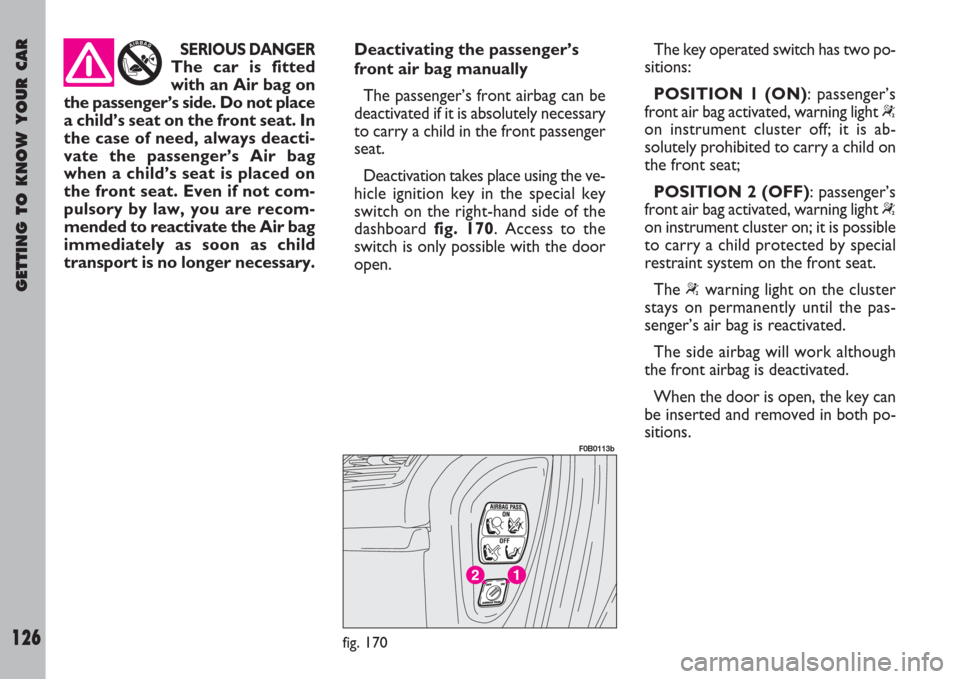
dashboard fig. 170. Access to the
switch is only possible with the door
open.The key operated switch has two po-
sitions:
POSITION 1 (ON): passenger’s
front air bag activated, warning light
“
on instrument cluster off; it is ab-
solutely prohibited to carry a child on
the front seat;
POSITION 2 (OFF): passenger’s
front air bag activated, warning light
“
on instrument cluster on; it is possible
to carry a child protected by special
restraint system on the front seat.
The
“warning light on the cluster
stays on permanently until the pas-
senger’s air bag is reactivated.
The side airbag will work although
the front airbag is deactivated.
When the door is open, the key can
be inserted and removed in both po-
sitions.
fig. 170
F0B0113b
SERIOUS DANGER
The car is fitted
with an Air bag on
the passenger’s side. Do not place
a child’s seat on the front seat. In
the case of need, always deacti-
vate the passenger’s Air bag
when a child’s seat is placed on
the front seat. Even if not com-
pulsory by law, you are recom-
mended to reactivate the Air bag
immediately as soon as child
transport is no longer necessary.
Page 129 of 254
GETTING TO KNOW YOUR CAR
128
All control, repair and replacement
operations concerning the air bags
must only be carried out c/o Fiat
Dealership.
If the car is to be demolished, Fiat
Dealershipshould be contacted to
have the system deactivated.
If the vehicle changes ownership, the
new owner must be informed of the
method of use of air bags and the
above warnings and also be given this
“Owner handbook”.
IMPORTANTThe triggering of
pretensioners, front air bags and side
air bags is decided in a differentiated
manner by the electronic control unit,
depending on the type of crash. The
failure to deploy one or more of them
does not mean that the system is not
working properly.GENERAL NOTES
If the
¬warning light
does not turn on when
turning the ignition key to
M or if it stays on when travelling,
this could indicate a failure in
safety retaining systems; under
this condition air bags or preten-
sioners could not trigger in the
event of collision or, in a re-
stricted number of cases, they
could trigger accidentally. Stop
the car and contact Fiat Dealer-
ship to have the system checked
immediately.
When the ignition key is
turned to M, the warning
light
“(with the passen-
ger’s front air bag deactivation
switch in the ON position) turns
on for about 4 seconds and flash-
es for another 4 seconds to remind
that the passenger’s air bag and
side air bags will be deployed in a
crash, after which it should go off.
IMPORTANTTriggering of the air
bags releases a small amount of pow-
der. This powder is not harmful and
does not indicate the start of fire; al-
so the surface of the deployed bag and
the vehicle interior may be covered by
dusty residue: this may irritate the skin
and eyes. In the event of exposure,
wash with neutral soap and water.
The airbag system has a validity of 14
years for the pyrotechnic charge and
10 years for the coil contact . As this
date approaches, contact a Fiat Deal-
ership.
WARNINGSShould an accident
occur in which the Airbag is activated,
take the vehicle to a Fiat Dealership
to have the safety device, the elec-
tronic control unit, the seat belt, the
pretensioners and the electric system
checked.
Page 131 of 254
GETTING TO KNOW YOUR CAR
130
PARKING SENSORS
(where fitted)
Parking sensors inform the driver
about the presence of obstacles be-
hind the vehicle.
They are a valid support to identify
fences, walls, poles, plant-pots and
alike, together with children playing
behind the car.
The system uses the four sensors on
the bumper fig. 171to detect the dis-
tance between the vehicle and possi-
ble obstacles. When the reverse is en-
gaged, the system is automatically
turned on with a sound signal
(“beep”).
The driver is therefore warned that
the distance between the vehicle and
the rear obstacle is getting reduced by
the increasing of the sound warning
frequency.The sound warning becomes contin-
uous when the distance between the
vehicle and the obstacle is lower than
25 cm.
The sound warning stops as soon as
the distance increases. The sequence
of sound warnings remains constant
if the distance is not changed.
If the car features the CONNECT
Nav+ infotelematic system, the park-
ing sensor buzzer will be completed
with graphic information on the colour
display.
IMPORTANTIn the event a the
system failure, the driver is informed
of it by a repeated alarm consisting of
a short sound followed by long one; in
this case contact aFiat Dealership.
If the sensor detects more than one
obstacle, the control unit signals the
obstacle having the shortest distance
from the vehicle. The airbag is set to be
fired in the event of colli-
sions which are greater
than the pretensioner settings.
Consequently, for collisions in the
bracket between the two thresh-
olds, it is normal for only the pre-
tensioners to be fired.
The air bag does not
substitute the seat belts,
but only increases their
effectiveness. Moreover, since
the air bag does not come into
operation in the event of front
impact at low speed, side colli-
sions, bumps from behind or
overturning, in these circum-
stances the occupants would be
only be protected by the seat
belts which must therefore al-
ways be fastened.