brake FIAT ULYSSE 2007 2.G Owner's Guide
[x] Cancel search | Manufacturer: FIAT, Model Year: 2007, Model line: ULYSSE, Model: FIAT ULYSSE 2007 2.GPages: 254, PDF Size: 3.42 MB
Page 152 of 254
DRIVING YOUR CAR
151
STORING THE CAR
The following precautions should be
taken if the car will not be used for
several months:
– park the vehicle in covered, dry and
if possible well-ventilated premises;
– engage a gear (Pfor versions with
automatic electronic gear);
– make sure the handbrake is not en-
gaged;
– clean and protect the painted parts
using protective wax;
– sprinkle talcum powder on the rub-
ber windscreen and rear window
wiper blades and lift them off the glass;
– slightly open the windows;
– inflate the tyres to 0.5 bar above
the normal specified pressure and
check it at intervals;– switch off the electronic car alarm;
– disconnect the terminals (–) from
the battery poles (negative pole first)
and check the battery charge. When
the vehicle is in storage, this check
should be carried out once a month.
If no-load voltage is less than 12.5V,
recharge the battery;
– do not drain the engine cooling sys-
tem;
– cover the vehicle with a cloth or
perforated plastic sheet. Do not use
sheets of non-perforated plastic as
they do not allow moisture on the car
body to evaporate.RESTARTING THE CAR
AFTER STORAGE
Before restarting the vehicle after a
long storage, make the following op-
erations:
– do not take dust off the bodywork
without water;
– check if there are fluid leakages (oil,
brake and clutch fluid, engine coolant,
etc.);
– have the engine oil and the filter re-
placed;
– check the level of: brake and clutch
fluid, engine coolant;
Page 155 of 254
IN AN EMERGENCY
154
Do not carry out this
procedure if you lack ex-
perience; if it is not done
correctly it can cause very in-
tense electrical discharges. In ad-
dition, the fluid contained in the
battery is poisonous and corro-
sive. Avoid contact with skin and
eyes. You are also advised not to
put naked flames or lighted cig-
arettes near the battery and not
to cause sparks.
Remember that until
the engine has started the
brake booster and elec-
trical power steering systems will
not work and a greater effort will
therefore be required to press
the brake pedal or turn the steer-
ing wheel.IF A TYRE
IS PUNCTURED
Certain versions (where provided)
are fitted with wheel identification and
tyre inflation sensors; pressure loss is
signalled to the driver in the follow-
ing way:
pressure loss- the infotelematic
CONNECT system displays the relat-
ed message and a “gong” is emitted by
the system. Contact a Fiat Dealer-
ship;
punctured tyre- warning light
“STOP” comes on and the in-
fotelematic CONNECT system dis-
plays the related message together
with 3 consecutive “gong” sounds.
Change the wheel in the following
way.
The system can also display a dedi-
cated message in the event it should
not be able to detect the tyre pres-
sure. Under no circumstances
should a battery charger
be used to start the en-
gine: it could damage the elec-
tronic systems and in particular
the ignition and injection control
units.
BUMP STARTING
Do not bump start by
pushing, towing or coast-
ing downhill. This way of
starting could cause a rush of fu-
el into the catalytic converter and
damage it beyond repair.
Page 157 of 254
IN AN EMERGENCY
156
CHANGING A WHEEL
Please note:
– the jack weighs 3.4 kg;
– the jack requires no adjustments;
– the jack cannot be repaired. If it
breaks it must be replaced with a new
jack;
– no tool with the exception of the
handle can be fitted on the jack.
Proceed as follows:
1) Stop the car in a position that is
not dangerous for oncoming traffic
where you can change the wheel safe-
ly. The ground should be flat and ad-
equately firm. 2) Turn the engine off and pull up the
handbrake.
3) Engage first gear or reverse or, for
versions with automatic electronic
gear, select P.
4) Lift the boot mat (see the relative
instructions in the “Bonnet” paragraph
of “Getting to know your car” chap-
ter).
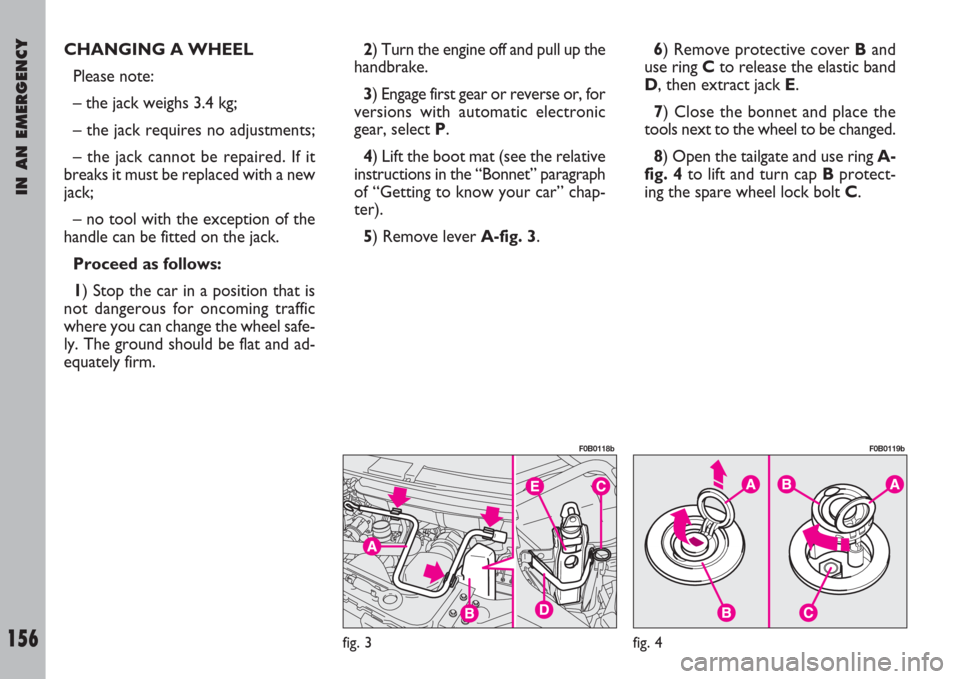
5) Remove lever A-fig. 3.6) Remove protective cover Band
use ring Cto release the elastic band
D, then extract jack E.
7) Close the bonnet and place the
tools next to the wheel to be changed.
8) Open the tailgate and use ringA-
fig. 4to lift and turn cap Bprotect-
ing the spare wheel lock bolt C.
fig. 3
F0B0118b
fig. 4
F0B0119b
Page 162 of 254
IN AN EMERGENCY
161
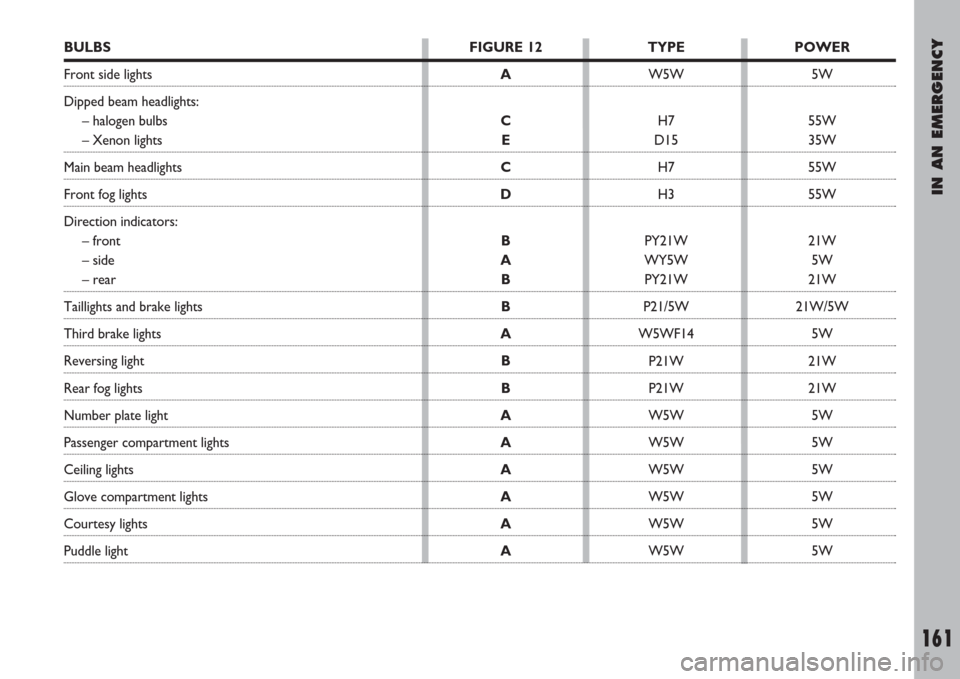
BULBS
Front side lights
Dipped beam headlights:
– halogen bulbs
– Xenon lights
Main beam headlights
Front fog lights
Direction indicators:
– front
– side
– rear
Taillights and brake lights
Third brake lights
Reversing light
Rear fog lights
Number plate light
Passenger compartment lights
Ceiling lights
Glove compartment lights
Courtesy lights
Puddle lightFIGURE 12
A
C
E
C
D
B
A
B
B
A
B
B
A
A
A
A
A
ATYPE
W5W
H7
D15
H7
H3
PY21W
WY5W
PY21W
P21/5W
W5WF14
P21W
P21W
W5W
W5W
W5W
W5W
W5W
W5WPOWER
5W
55W
35W
55W
55W
21W
5W
21W
21W/5W
5W
21W
21W
5W
5W
5W
5W
5W
5W
Page 167 of 254
IN AN EMERGENCY
166
Be careful when remov-
ing the side direction in-
dicator unit not to dam-
age the bodywork or the trans-
parent glass.
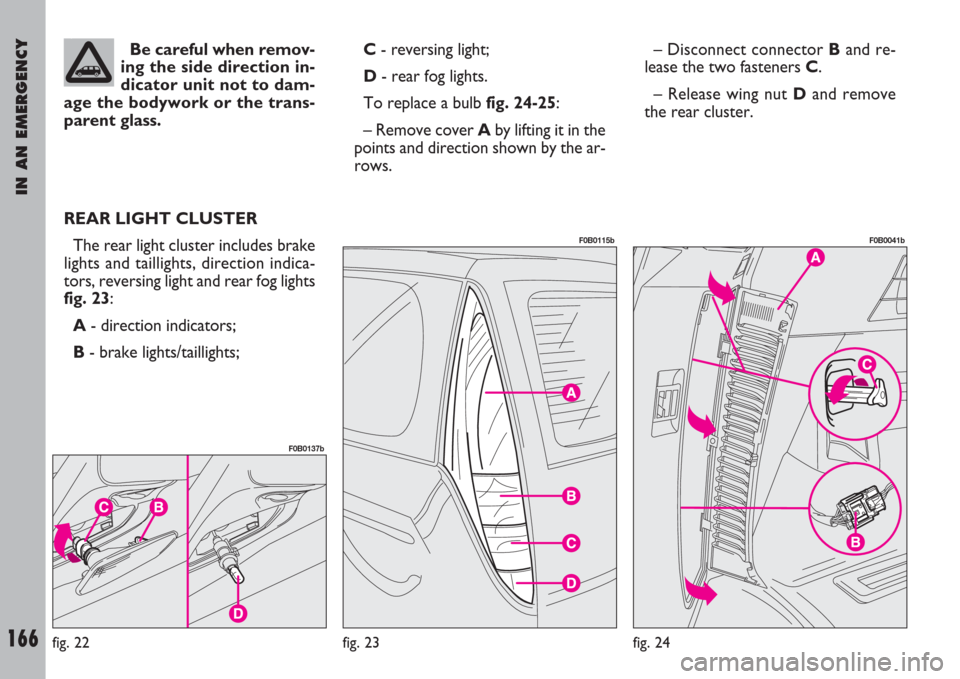
REAR LIGHT CLUSTER
The rear light cluster includes brake
lights and taillights, direction indica-
tors, reversing light and rear fog lights
fig. 23:
A- direction indicators;
B- brake lights/taillights;C- reversing light;
D- rear fog lights.
To replace a bulb fig. 24-25:
– Remove cover Aby lifting it in the
points and direction shown by the ar-
rows.– Disconnect connector Band re-
lease the two fasteners C.
– Release wing nut Dand remove
the rear cluster.
fig. 22
F0B0137b
fig. 24
F0B0041b
fig. 23
F0B0115b
Page 168 of 254
IN AN EMERGENCY
167
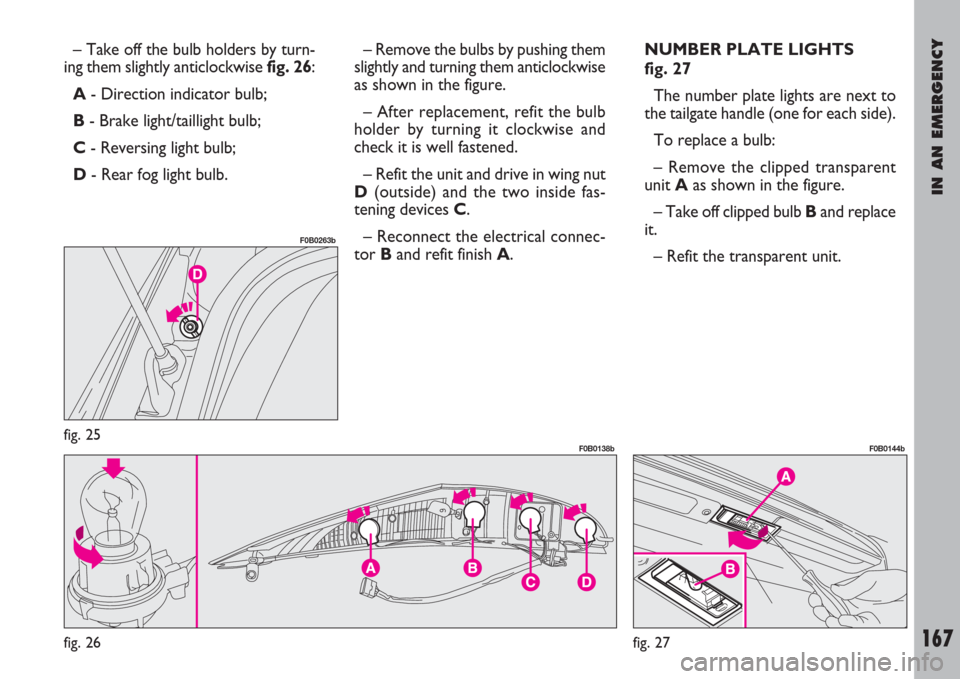
– Take off the bulb holders by turn-
ing them slightly anticlockwise fig. 26:
A- Direction indicator bulb;
B- Brake light/taillight bulb;
C- Reversing light bulb;
D- Rear fog light bulb.– Remove the bulbs by pushing them
slightly and turning them anticlockwise
as shown in the figure.
– After replacement, refit the bulb
holder by turning it clockwise and
check it is well fastened.
– Refit the unit and drive in wing nut
D(outside) and the two inside fas-
tening devices C.
– Reconnect the electrical connec-
tor Band refit finish A.NUMBER PLATE LIGHTS
fig. 27
The number plate lights are next to
the tailgate handle (one for each side).
To replace a bulb:
– Remove the clipped transparent
unit Aas shown in the figure.
– Take off clipped bulb Band replace
it.
– Refit the transparent unit.
fig. 26
F0B0138b
fig. 27
F0B0144bfig. 25
F0B0263b
Page 169 of 254
IN AN EMERGENCY
168
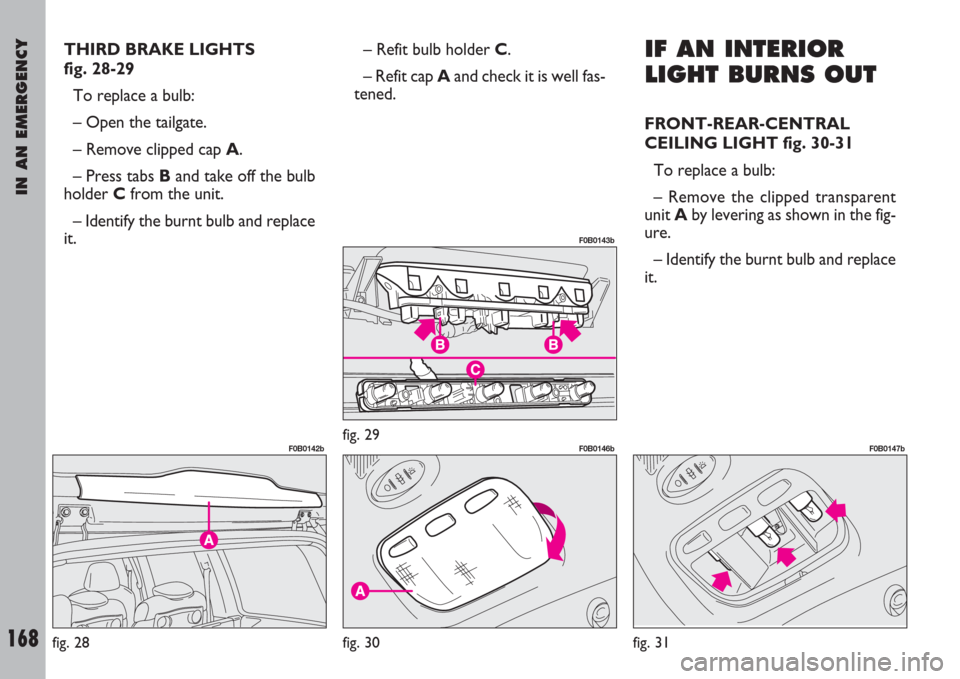
THIRD BRAKE LIGHTS
fig. 28-29
To replace a bulb:
– Open the tailgate.
– Remove clipped cap A.
– Press tabs Band take off the bulb
holder Cfrom the unit.
– Identify the burnt bulb and replace
it.– Refit bulb holder C.
– Refit cap Aand check it is well fas-
tened.IF AN INTERIOR
LIGHT BURNS OUT
FRONT-REAR-CENTRAL
CEILING LIGHT fig. 30-31
To replace a bulb:
– Remove the clipped transparent
unit Aby levering as shown in the fig-
ure.
– Identify the burnt bulb and replace
it.
fig. 28
F0B0142bfig. 29
F0B0143b
fig. 31
F0B0147b
fig. 30
F0B0146b
Page 175 of 254
IN AN EMERGENCY
174
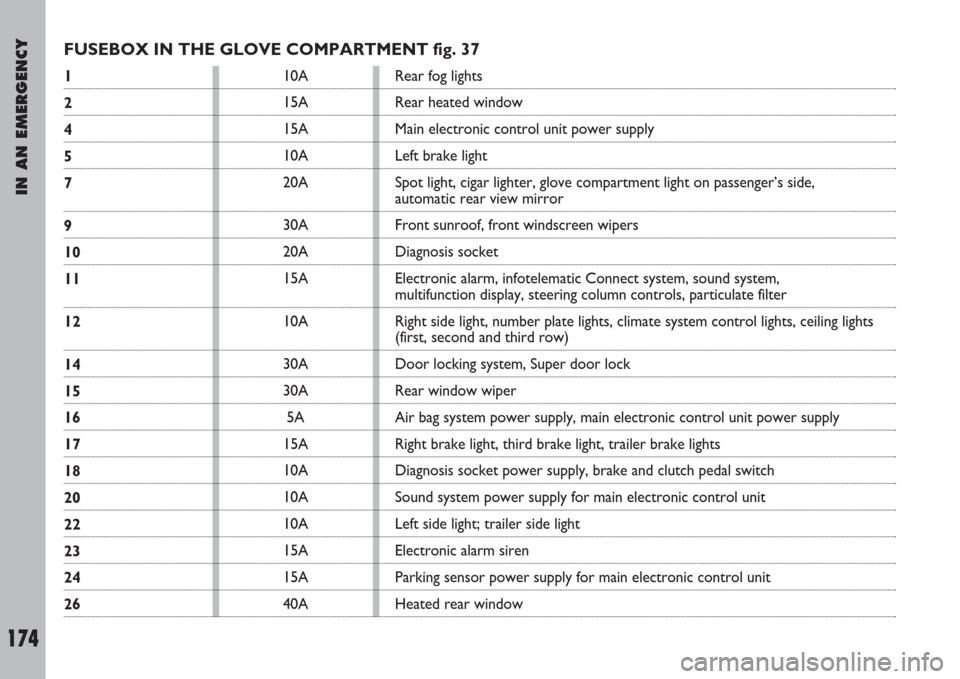
FUSEBOX IN THE GLOVE COMPARTMENT fig. 37
1
2
4
5
7
9
10
11
12
14
15
16
17
18
20
22
23
24
2610A
15A
15A
10A
20A
30A
20A
15A
10A
30A
30A
5A
15A
10A
10A
10A
15A
15A
40ARear fog lights
Rear heated window
Main electronic control unit power supply
Left brake light
Spot light, cigar lighter, glove compartment light on passenger’s side,
automatic rear view mirror
Front sunroof, front windscreen wipers
Diagnosis socket
Electronic alarm, infotelematic Connect system, sound system,
multifunction display, steering column controls, particulate filter
Right side light, number plate lights, climate system control lights, ceiling lights
(first, second and third row)
Door locking system, Super door lock
Rear window wiper
Air bag system power supply, main electronic control unit power supply
Right brake light, third brake light, trailer brake lights
Diagnosis socket power supply, brake and clutch pedal switch
Sound system power supply for main electronic control unit
Left side light; trailer side light
Electronic alarm siren
Parking sensor power supply for main electronic control unit
Heated rear window
Page 182 of 254
IN AN EMERGENCY
181
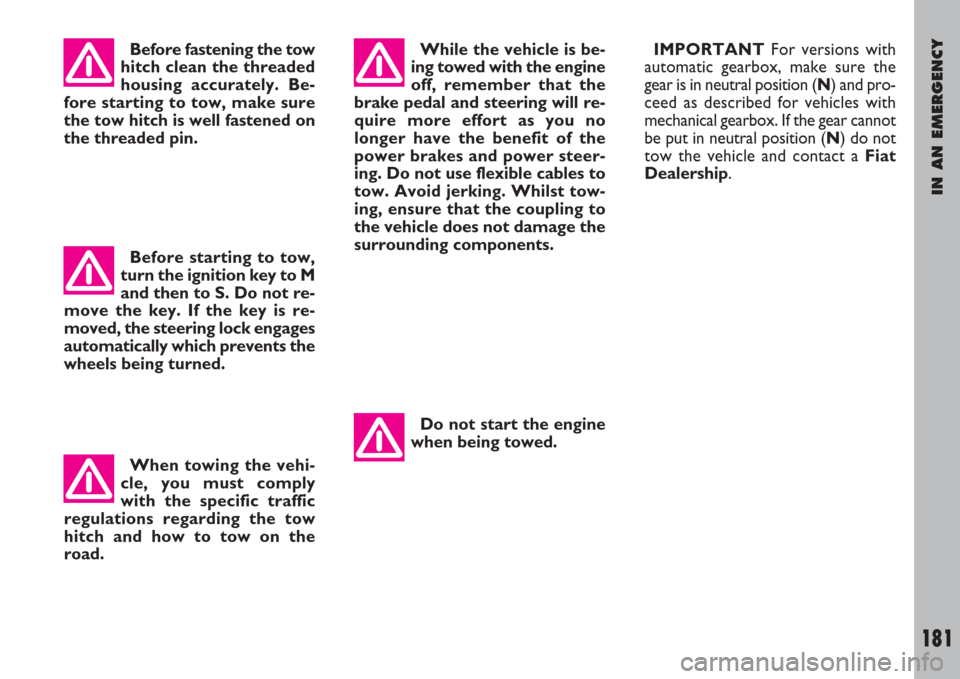
Before fastening the tow
hitch clean the threaded
housing accurately. Be-
fore starting to tow, make sure
the tow hitch is well fastened on
the threaded pin.While the vehicle is be-
ing towed with the engine
off, remember that the
brake pedal and steering will re-
quire more effort as you no
longer have the benefit of the
power brakes and power steer-
ing. Do not use flexible cables to
tow. Avoid jerking. Whilst tow-
ing, ensure that the coupling to
the vehicle does not damage the
surrounding components.IMPORTANTFor versions with
automatic gearbox, make sure the
gear is in neutral position (N) and pro-
ceed as described for vehicles with
mechanical gearbox. If the gear cannot
be put in neutral position (N) do not
tow the vehicle and contact a Fiat
Dealership.
Before starting to tow,
turn the ignition key to M
and then to S. Do not re-
move the key. If the key is re-
moved, the steering lock engages
automatically which prevents the
wheels being turned.
When towing the vehi-
cle, you must comply
with the specific traffic
regulations regarding the tow
hitch and how to tow on the
road.
Do not start the engine
when being towed.
Page 186 of 254
SERVICE SCHEDULE
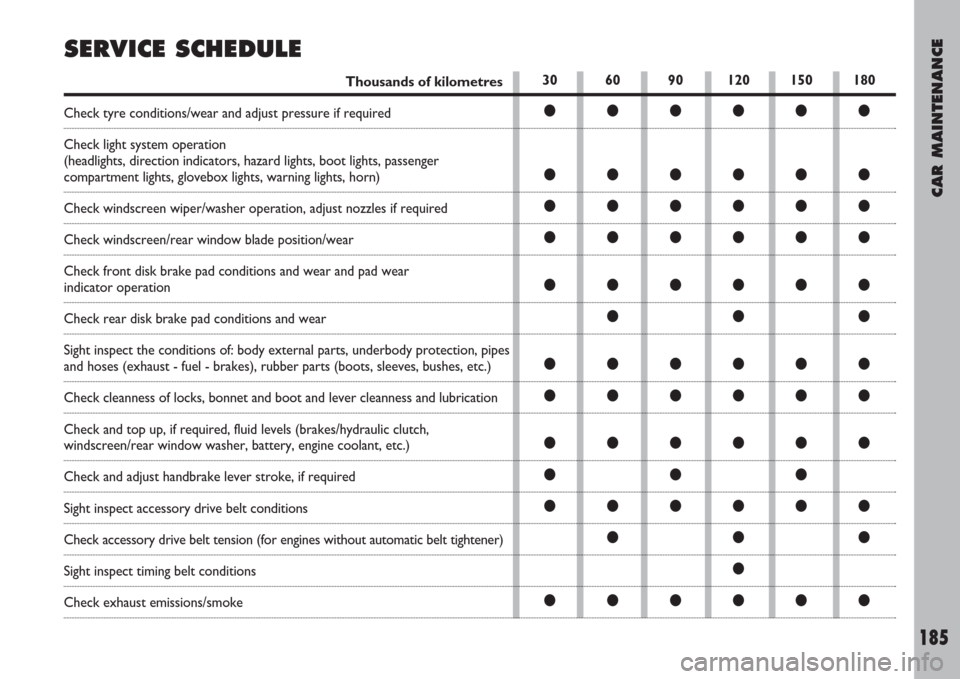
30 60 90 120 150 180
●●●●●●
●●●●●●
●●●●●●
●●●●●●
●●●●●●
●●●
●●●●●●
●●●●●●
●●●●●●
●●●
●●●●●●
●●●
●
●●●●●●
CAR MAINTENANCE
185
Thousands of kilometres
Check tyre conditions/wear and adjust pressure if required
Check light system operation
(headlights, direction indicators, hazard lights, boot lights, passenger
compartment lights, glovebox lights, warning lights, horn)
Check windscreen wiper/washer operation, adjust nozzles if required
Check windscreen/rear window blade position/wear
Check front disk brake pad conditions and wear and pad wear
indicator operation
Check rear disk brake pad conditions and wear
Sight inspect the conditions of: body external parts, underbody protection, pipes
and hoses (exhaust - fuel - brakes), rubber parts (boots, sleeves, bushes, etc.)
Check cleanness of locks, bonnet and boot and lever cleanness and lubrication
Check and top up, if required, fluid levels (brakes/hydraulic clutch,
windscreen/rear window washer, battery, engine coolant, etc.)
Check and adjust handbrake lever stroke, if required
Sight inspect accessory drive belt conditions
Check accessory drive belt tension (for engines without automatic belt tightener)
Sight inspect timing belt conditions
Check exhaust emissions/smoke