fuel FIAT ULYSSE 2008 2.G User Guide
[x] Cancel search | Manufacturer: FIAT, Model Year: 2008, Model line: ULYSSE, Model: FIAT ULYSSE 2008 2.GPages: 254, PDF Size: 3.46 MB
Page 87 of 254
GETTING TO KNOW YOUR CAR
86
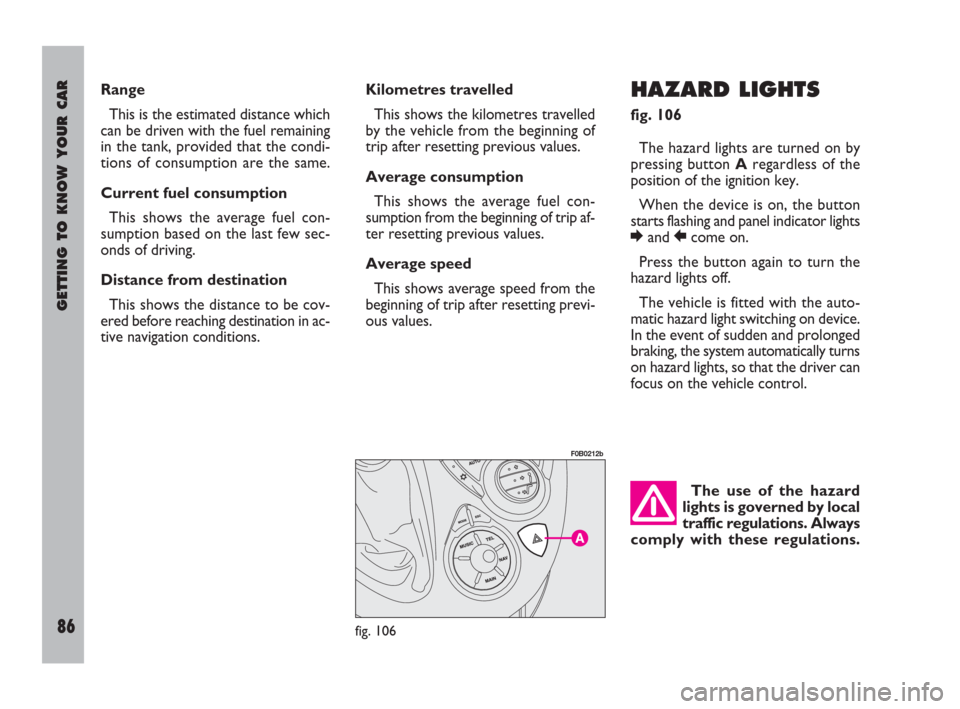
HAZARD LIGHTS
fig. 106
The hazard lights are turned on by
pressing button Aregardless of the
position of the ignition key.
When the device is on, the button
starts flashing and panel indicator lights
Eand Rcome on.
Press the button again to turn the
hazard lights off.
The vehicle is fitted with the auto-
matic hazard light switching on device.
In the event of sudden and prolonged
braking, the system automatically turns
on hazard lights, so that the driver can
focus on the vehicle control. Range
This is the estimated distance which
can be driven with the fuel remaining
in the tank, provided that the condi-
tions of consumption are the same.
Current fuel consumption
This shows the average fuel con-
sumption based on the last few sec-
onds of driving.
Distance from destination
This shows the distance to be cov-
ered before reaching destination in ac-
tive navigation conditions.
The use of the hazard
lights is governed by local
traffic regulations. Always
comply with these regulations.
Kilometres travelled
This shows the kilometres travelled
by the vehicle from the beginning of
trip after resetting previous values.
Average consumption
This shows the average fuel con-
sumption from the beginning of trip af-
ter resetting previous values.
Average speed
This shows average speed from the
beginning of trip after resetting previ-
ous values.
fig. 106
F0B0212b
Page 88 of 254
GETTING TO KNOW YOUR CAR
87
FUEL CUT-OFF
SWITCH
This is a safety switch controlled by
the Airbag control unit. Such switch
cuts in on collision and cuts off the fu-
el supply. This results in the engine
stalling.
The multifunction display informs the
driver that the fuel has been cut off
with a dedicated message.If you do not notice fuel leaks
and the vehicle is in a fit state to
continue on its way, proceed as
follows:
– turn the key to S;
– extract the ignition key; rein-
troduce it and start the engine as
usual.
HANDBRAKE
fig. 107
The handbrake lever is situated next
to the driver’s seat.
Pull the handbrake lever Aupwards
as far as it will go to apply the hand-
brake.
When the ignition key is at Mthe
panel indicator light
xwill come on.
If, after a collision, you
can smell fuel or notice
leaks from the fuel-feed
system, to avoid the risk of fire,
do not re-enable the switch.It should not be possible
to move the vehicle after
the lever has gone
through three or four “clicks”. If
this is not the case, have it ad-
justed at a Fiat Dealership.
To release the handbrake:
– slightly lift the handbrake lever A
and press release button B;
– keep the button pressed in and
lower the lever. The instrument pan-
el indicator light
xwill go out.
Page 135 of 254
GETTING TO KNOW YOUR CAR
134
REFUELLING
To guarantee full tank filling, carry
out two refuelling operations after the
first click of the fuel delivery gun.
Avoid further topping up operations
that could cause damages to the fuel
system.
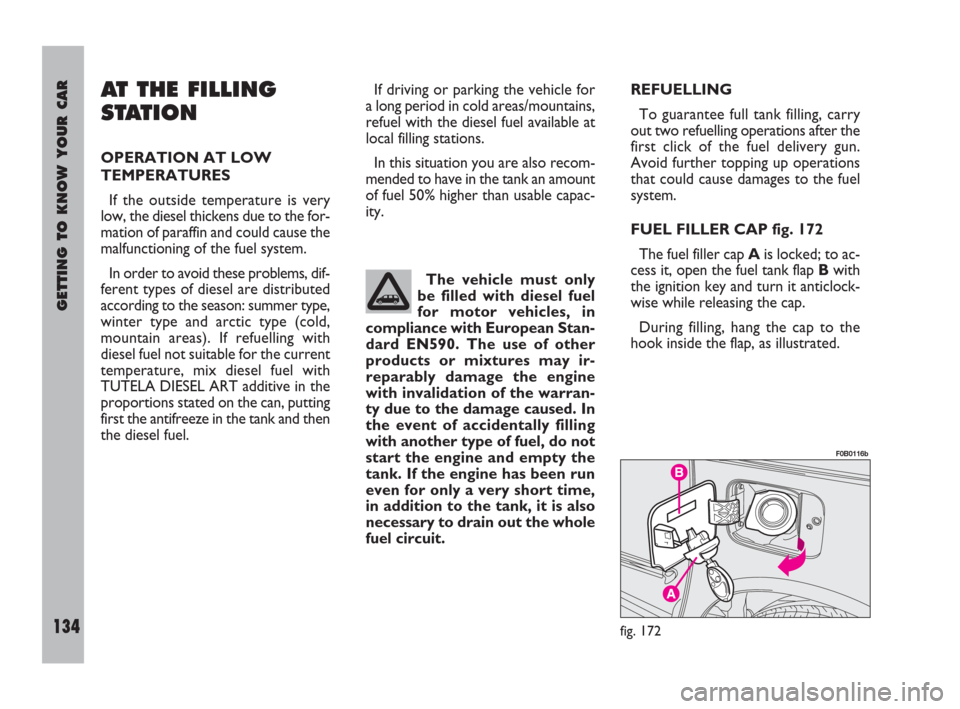
FUEL FILLER CAP fig. 172
The fuel filler cap Ais locked; to ac-
cess it, open the fuel tank flap Bwith
the ignition key and turn it anticlock-
wise while releasing the cap.
During filling, hang the cap to the
hook inside the flap, as illustrated.
fig. 172
F0B0116b
The vehicle must only
be filled with diesel fuel
for motor vehicles, in
compliance with European Stan-
dard EN590. The use of other
products or mixtures may ir-
reparably damage the engine
with invalidation of the warran-
ty due to the damage caused. In
the event of accidentally filling
with another type of fuel, do not
start the engine and empty the
tank. If the engine has been run
even for only a very short time,
in addition to the tank, it is also
necessary to drain out the whole
fuel circuit.
If driving or parking the vehicle for
a long period in cold areas/mountains,
refuel with the diesel fuel available at
local filling stations.
In this situation you are also recom-
mended to have in the tank an amount
of fuel 50% higher than usable capac-
ity.AT THE FILLING
STATION
OPERATION AT LOW
TEMPERATURES
If the outside temperature is very
low, the diesel thickens due to the for-
mation of paraffin and could cause the
malfunctioning of the fuel system.
In order to avoid these problems, dif-
ferent types of diesel are distributed
according to the season: summer type,
winter type and arctic type (cold,
mountain areas). If refuelling with
diesel fuel not suitable for the current
temperature, mix diesel fuel with
TUTELA DIESEL ART additive in the
proportions stated on the can, putting
first the antifreeze in the tank and then
the diesel fuel.
Page 136 of 254
GETTING TO KNOW YOUR CAR
135
PROTECTING THE
ENVIRONMENT
Protecting the environment has been
a constant guiding factor of the
Ulysse’s design and manufacture at
every stage. The result of this atten-
tion is to be seen in the choice of ma-
terials and installation of devices able
to drastically limit or reduce harmful
influences on the environment.
Devices for reducing emissions from
JTD engines are:
– oxidising catalytic converter;
– exhaust gas recirculation system
(E.G.R.);
– particulate filter (where fitted): its
purpose is to trap and burn particulate
(unburnt particles) to reduce harmful
exhaust emissions.
The vehicle, therefore, has great ad-
vantages with respect to the strictest
international anti-pollution directives. Do not put open flames
or lighted cigarettes near
the fuel filler hole as there
is a danger of fire. Do not lean out
too close to the hole either so as
not to breathe in harmful
vapours.
Where necessary, to
avoid compromising the
efficiency of the fuel
vapour recovery system, replace
the fuel cap with another genuine
spare part.
IMPORTANTThe waterproof fu-
el filler cap lock may be slightly pres-
surised. Therefore, do not worry if
some air comes out when the cap is
released.
After filling, drive in the cap by turn-
ing it clockwise until it clicks twice or
thrice, then turn the key clockwise and
remove it. Close the flap.
Page 139 of 254
DRIVING YOUR CAR
138
HOW TO WARM UP
THE ENGINE AFTER
IT HAS JUST STARTED
– Begin to move forward slowly let-
ting the engine turning at medium revs.
Do not accelerate abruptly.
– Do not push the engine to its lim-
it for the first kilometres. You are rec-
ommended to wait until the water
temperature has reached 50° to 60°C.BUMP STARTING
For versions with a cat-
alytic converter, bump
starting by pushing, tow-
ing or rolling downhill must be
avoided at all costs. This ma-
noeuvre could cause a rush of fu-
el into the catalytic exhaust pipe
and damage it beyond repair.STOPPING THE ENGINE
Turn the ignition key to Swhile the
engine is idling.
Remember that as long
as the engine is not run-
ning, the power brakes
and power steering do not work.
You therefore have to use con-
siderably more effort on both the
brake pedal and the steering
wheel than you would do other-
wise.
Gunning the accelerator
before turning off the en-
gine serves absolutely no
practical purpose, wastes fuel and
is damaging, particularly to tur-
bocharged engines.
IMPORTANTAfter a taxing drive,
it is better to allow the engine to
“catch its breath” before turning it off
by letting it idle to allow the temper-
ature in the engine compartment to
fall.
Page 146 of 254
DRIVING YOUR CAR
145
CONTAINING RUNNING COSTS
AND POLLUTION
Tyres
Tyre pressure should be checked at
least once every four weeks: if the
pressure is too low fuel consumption
increases as the resistance to the
rolling movement of the tyre is
greater. In this state, tyre wear is in-
creased and vehicle handling suffers,
which will effect safety.
Unnecessary loads
Do not travel with too much luggage
stowed in the boot. The weight of the
vehicle (especially when driving in the
city) and its trim greatly effects con-
sumption and stability.
Roof rack/ski rack
Remove the roof/ski rack from the
roof when no longer necessary. These
accessories reduce the vehicle’s aero-
dynamic penetration, which affects
consumption. Use a trailer, if particu-
larly heavy objects are to be trans-
ported. Some suggestions which may help
you to keep the running costs of the
car down and lower the amount of
toxic emissions released into the at-
mosphere are given below.
GENERAL CONSIDERATIONS
Car maintenance
The overall state of the vehicle is an
important factor that has a marked in-
fluence over fuel consumption, driving
comfort and on the life span of your
vehicle. For this reason, care should
be taken to maintain your vehicle by
carrying out the necessary checks and
observing regulations in accordance
with the specifications given in the
Scheduled Maintenance Programme
(see section, idling, air cleaners, tim-
ing).Electrical devices
Use electric devices for the neces-
sary time only. The heated rear win-
dow, supplementary lights, windscreen
wipers, heating system blower require
large amounts of electricity; this means
an increase in the request for power
and consequently an increase in fuel
consumption (up to +25% when dri-
ving in built-up areas).
Climate control system
The climate control unit is an addi-
tional load that greatly affects the en-
gine leading to higher consumption (on
average +20%). When the tempera-
ture outside allows it, use the air
vents.
Spoilers
The use of optional extras which are
not certified for specific use on the car
may reduce the aerodynamic pene-
tration of the car and increase con-
sumption.
Page 147 of 254
DRIVING YOUR CAR
146
DRIVING STYLE
Starting
Do not warm the engine when the
vehicle is stationary or at high or low
revs: in this way the engine will warm
up gradually increasing consumption
and emissions. You should drive off
slowly straight away avoiding high revs
so that the engine will warm up more
quickly.
Unnecessary actions
Avoid revving the engine when
stopped at traffic lights or before
switching off the engine and avoid dou-
ble-clutching as these actions have no
purpose on modern vehicles and serve
only to increase consumption and pol-
lution.
Gear selections
As soon as the traffic and road con-
ditions allow it, shift to a higher gear.
Using a lower gear to liven up accel-
eration greatly increases consumption.
In the same way, improper use of the
higher gears will increase consump-
tion, emissions and wear and tear on
the engine.Top speeds
Fuel consumption increases consid-
erably as speed increases. For exam-
ple, when accelerating from 90 to
120 Kph, fuel consumption increases
by about +30%. Your speed should be
kept as even as possible and superflu-
ous braking and acceleration avoided
as this increases both consumption
and emissions. A “soft” way of driving
should be adopted by attempting to
anticipate manoeuvres to avoid immi-
nent danger and to keep a safe dis-
tance from the vehicle in front to
avoid braking sharply.
Acceleration
Accelerating violently increasing the
revs will greatly effect consumption
and emission: acceleration should be
gradual and not exceed the maximum
torque.CONDITIONS OF USE
Cold starting
Short trips and frequent cold start-
ing will not enable the engine to reach
optimal running temperature (from
+15 to +30% in built up areas) as will
the production of toxic emissions.
Traffic and road conditions
Heavy traffic and higher consumption
are synonymous: for example, when
driving slowly with frequent use of
lower gears or in large towns where
there are numerous traffic lights.
Winding roads, mountain roads and
bumpy roads also have a negative ef-
fect on consumption.
Enforced halts
During prolonged stops (traffic lights,
level crossings, etc.) the engine should
be switched off.
Page 148 of 254
DRIVING YOUR CAR
147
CHEAP RUNNING THAT RESPECTS
THE ENVIRONMENT
LOOKING AFTER EMISSION
CONTROL DEVICES
The correct use of pollution control
devices not only ensures respect for
the environment but also has an effect
on the car’s performance. Keeping
these devices in good condition is
therefore a fundamental rule for dri-
ving that is easy on your pocket and
on the environment too.
The first step to take is to follow the
Service Schedule to the letter.
Only use diesel for motor vehicles
(EN590 specification). Environmental protection has been
one of the guiding principles in the
production of the Ulysse. It is no ac-
cident that its pollution control equip-
ment is much more effective than that
required by current legislation.
Nonetheless, the environment can-
not get by without a concerted effort
from everyone.
By following a few simple rules the
motorist can avoid harming the envi-
ronment and often cut down fuel con-
sumption at the same time.
On this subject, a number of useful
tips have been given below to supple-
ment those marked by symbol
#, at
various points of the manual.
You are asked to read both the for-
mer and latter carefully.If you have trouble starting, do not
turn the ignition key for long periods.
Be especially careful to avoid bump
starting the vehicle by pushing, towing
or rolling downhill: these are all ma-
noeuvres that can damage the catalyt-
ic exhaust.
For emergency starts only use an
auxiliary battery.
If the engine begins to “lose its
smoothness” when travelling, contin-
ue your journey but reduce the de-
mands you are making on the engine
and have the vehicle checked at a Fi-
at Dealership.
When the instrument panel fuel re-
serve warning light comes on, fill up as
soon as possible. A fuel level that is
too low can cause an uneven supply of
fuel with the inevitable increase in ex-
haust temperature; this would seri-
ously damage the catalytic converter.
Page 177 of 254
IN AN EMERGENCY
176
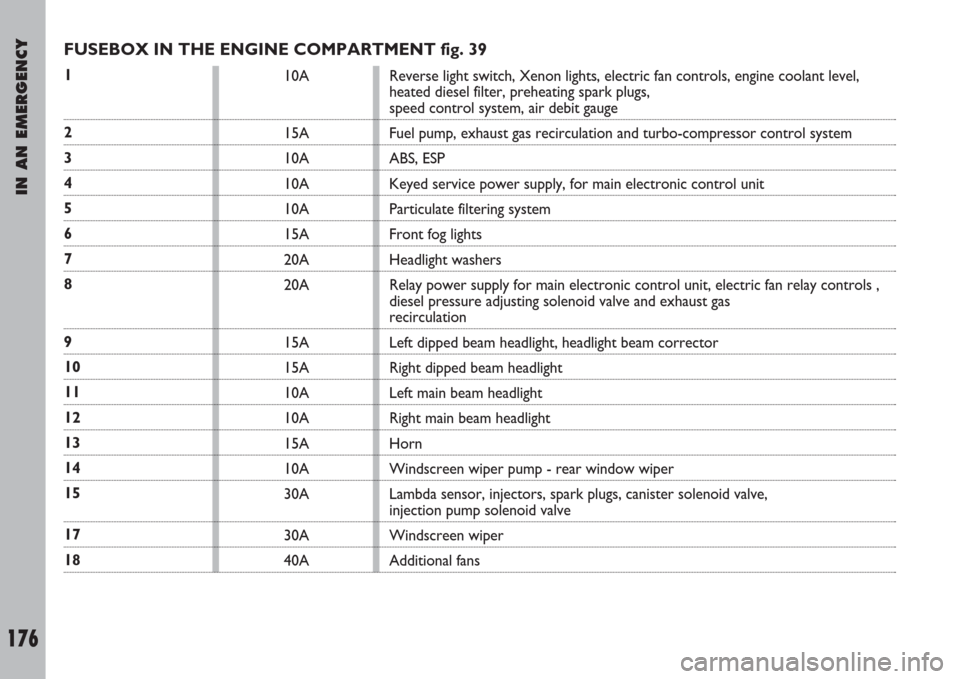
FUSEBOX IN THE ENGINE COMPARTMENT fig. 39
1
2
3
4
5
6
7
8
9
10
11
12
13
14
15
17
1810A
15A
10A
10A
10A
15A
20A
20A
15A
15A
10A
10A
15A
10A
30A
30A
40AReverse light switch, Xenon lights, electric fan controls, engine coolant level,
heated diesel filter, preheating spark plugs,
speed control system, air debit gauge
Fuel pump, exhaust gas recirculation and turbo-compressor control system
ABS, ESP
Keyed service power supply, for main electronic control unit
Particulate filtering system
Front fog lights
Headlight washers
Relay power supply for main electronic control unit, electric fan relay controls ,
diesel pressure adjusting solenoid valve and exhaust gas
recirculation
Left dipped beam headlight, headlight beam corrector
Right dipped beam headlight
Left main beam headlight
Right main beam headlight
Horn
Windscreen wiper pump - rear window wiper
Lambda sensor, injectors, spark plugs, canister solenoid valve,
injection pump solenoid valve
Windscreen wiper
Additional fans
Page 186 of 254
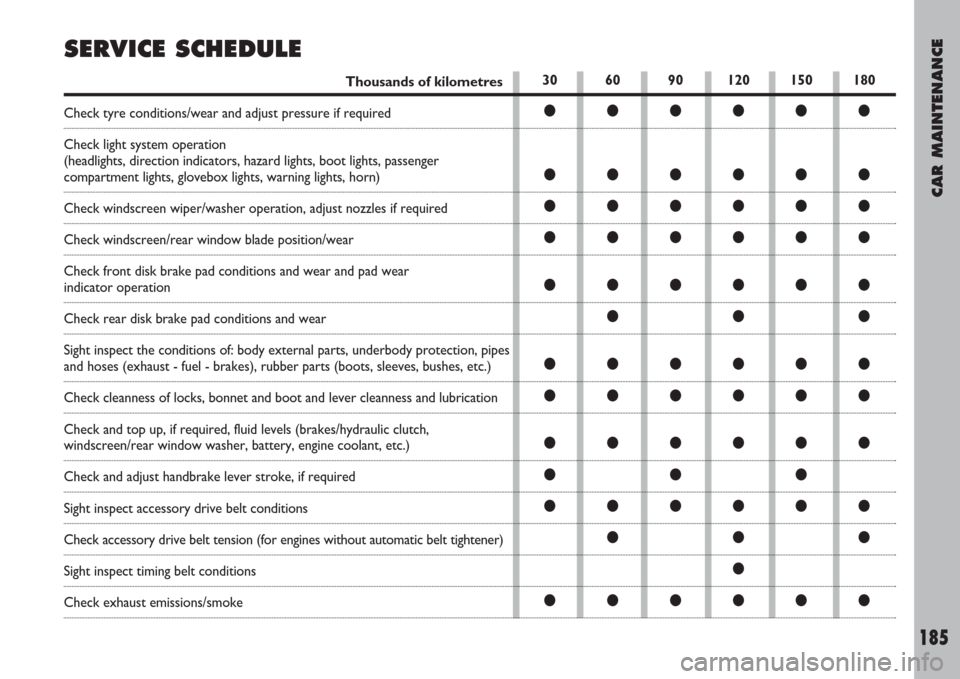
SERVICE SCHEDULE
30 60 90 120 150 180
●●●●●●
●●●●●●
●●●●●●
●●●●●●
●●●●●●
●●●
●●●●●●
●●●●●●
●●●●●●
●●●
●●●●●●
●●●
●
●●●●●●
CAR MAINTENANCE
185
Thousands of kilometres
Check tyre conditions/wear and adjust pressure if required
Check light system operation
(headlights, direction indicators, hazard lights, boot lights, passenger
compartment lights, glovebox lights, warning lights, horn)
Check windscreen wiper/washer operation, adjust nozzles if required
Check windscreen/rear window blade position/wear
Check front disk brake pad conditions and wear and pad wear
indicator operation
Check rear disk brake pad conditions and wear
Sight inspect the conditions of: body external parts, underbody protection, pipes
and hoses (exhaust - fuel - brakes), rubber parts (boots, sleeves, bushes, etc.)
Check cleanness of locks, bonnet and boot and lever cleanness and lubrication
Check and top up, if required, fluid levels (brakes/hydraulic clutch,
windscreen/rear window washer, battery, engine coolant, etc.)
Check and adjust handbrake lever stroke, if required
Sight inspect accessory drive belt conditions
Check accessory drive belt tension (for engines without automatic belt tightener)
Sight inspect timing belt conditions
Check exhaust emissions/smoke