ignition FIAT ULYSSE 2009 2.G Owner's Manual
[x] Cancel search | Manufacturer: FIAT, Model Year: 2009, Model line: ULYSSE, Model: FIAT ULYSSE 2009 2.GPages: 254, PDF Size: 3.56 MB
Page 94 of 254
It is dangerous to let the
engine run in a garage or
other closed area. The
engine consumes oxygen and
gives off carbon dioxide, carbon
monoxide and other poisonous
fumes.
– Make sure the handbrake is up and
the gear lever in Por N: the engine
can be started only with the gear in
these two positions.
– Turn the ignition key to Dwithout
pressing the accelerator pedal.
If the engine does not start at the
first attempt, return the ignition key
to Sbefore trying to start the engine
again.
GETTING TO KNOW YOUR CAR
93
STARTING THE ENGINEIf the instrument panel warning light
stays on when the ignition key is at M,
turn the key to Sand then back to M;
if the warning light still remains lit, try
with the other keys provided with the
vehicle.
If you are still unable to start the en-
gine (see “In an emergency” chapter)
contact a Fiat Dealership as soon as
possible.
IMPORTANTDo not leave the ig-
nition key at Mwhen the engine is off
to prevent draining the battery charge.MOVING THE CAR
Proceed as follows:
– press fully the brake pedal;
– select the required gear lever po-
sition;
– accelerate progressively; the vehi-
cle is started and the gear shift de-
pends on the position selected.
When the ignition key is
at M, it is possible to shift
the gear lever from P on-
ly when the brake pedal is fully
depressed (Shift-lock safety de-
vice).
078-135 ULYSSE ING 10-03-2009 11:39 Pagina 93
Page 97 of 254
GETTING TO KNOW YOUR CAR
96
INTERIOR
EQUIPMENT
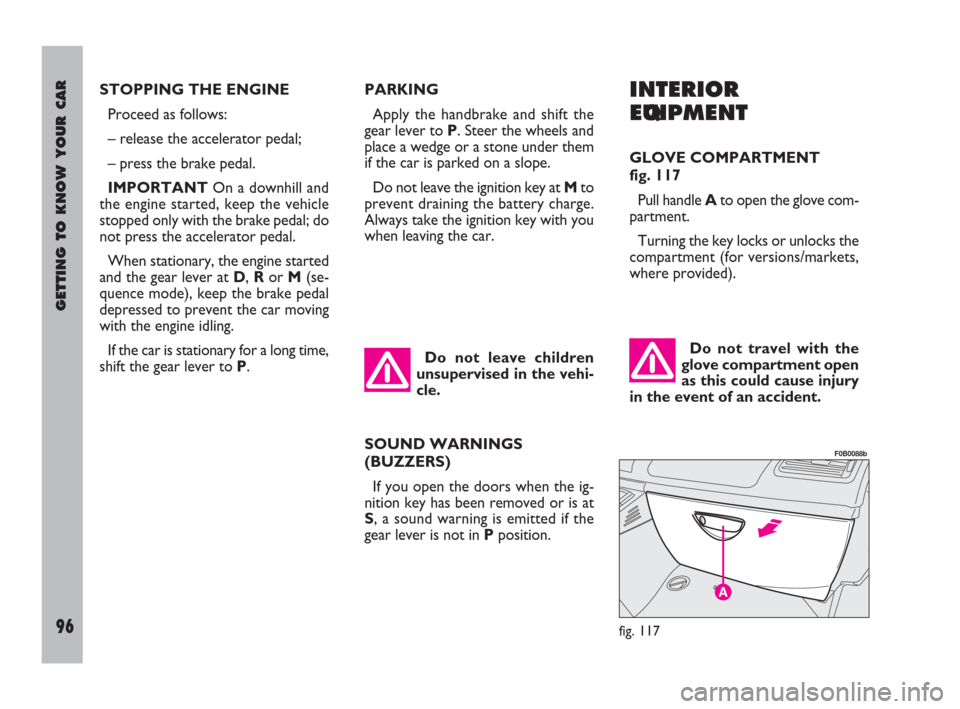
GLOVE COMPARTMENT
fig. 117
Pull handle Ato open the glove com-
partment.
Turning the key locks or unlocks the
compartment (for versions/markets,
where provided).
Do not travel with the
glove compartment open
as this could cause injury
in the event of an accident.
fig. 117
F0B0088b
STOPPING THE ENGINE
Proceed as follows:
– release the accelerator pedal;
– press the brake pedal.
IMPORTANTOn a downhill and
the engine started, keep the vehicle
stopped only with the brake pedal; do
not press the accelerator pedal.
When stationary, the engine started
and the gear lever at D, Ror M(se-
quence mode), keep the brake pedal
depressed to prevent the car moving
with the engine idling.
If the car is stationary for a long time,
shift the gear lever to P.PARKING
Apply the handbrake and shift the
gear lever to P. Steer the wheels and
place a wedge or a stone under them
if the car is parked on a slope.
Do not leave the ignition key at Mto
prevent draining the battery charge.
Always take the ignition key with you
when leaving the car.
SOUND WARNINGS
(BUZZERS)
If you open the doors when the ig-
nition key has been removed or is at
S, a sound warning is emitted if the
gear lever is not in Pposition. Do not leave children
unsupervised in the vehi-
cle.
078-135 ULYSSE ING 10-03-2009 11:39 Pagina 96
Page 103 of 254
GETTING TO KNOW YOUR CAR
102
CEILING LIGHT UNITS
All the ceiling lights come on for a
limited time, i.e. they turn on and off
gradually.
Ceiling light operation
All the ceiling lights come on auto-
matically when the doors are opened
with the remote control or when the
key is introduced in the door lock. Af-
ter some seconds, the lights will go out
gradually, without opening the doors.
When the door lock button on the
remote control is pressed for a long
time, the so-called “localisation” func-
tion is activated: all the ceiling lights
in the passenger compartment come
on together with the direction indi-
cators. This function is recognised by
the system up to a distance of about
30 meters from the vehicle. If the ignition key is turned to S(or
removed) the first row ceiling light
comes on. It will stay on only for a lim-
ited time and will go out gradually.
When one of the front doors is
opened, the central ceiling light, with-
out the spot lights, and the puddle
lights on the doors come on. They re-
main lit for a set time and after a cou-
ple of seconds the door have been
closed, they go off gradually. When the
engine is started, the lights will go off
progressively after a couple of seconds.
When one of the rear doors is
opened the central ceiling light, with-
out the spot lights, come on. It re-
mains lit for a set time and after a cou-
ple of seconds the door have been
closed, it goes off gradually.When the tailgate is opened the lug-
gage compartment lights come on
(one or two lights according to the
model). The lights will go off gradual-
ly when the tailgate is closed.
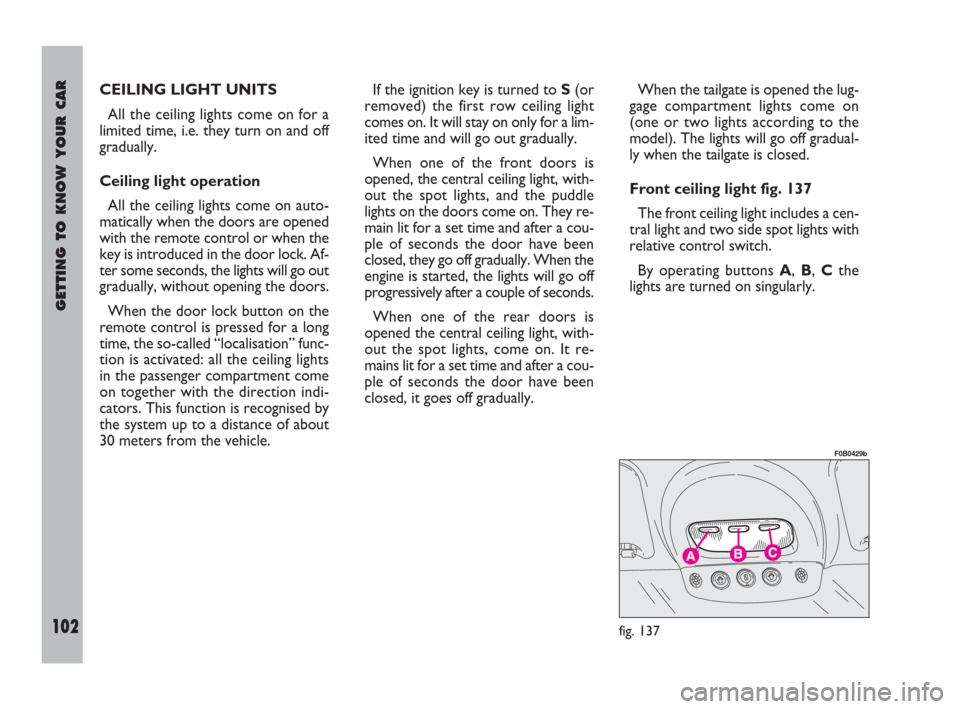
Front ceiling light fig. 137
The front ceiling light includes a cen-
tral light and two side spot lights with
relative control switch.
By operating buttons A, B, Cthe
lights are turned on singularly.
fig. 137
F0B0429b
078-135 ULYSSE ING 10-03-2009 11:39 Pagina 102
Page 104 of 254
GETTING TO KNOW YOUR CAR
103
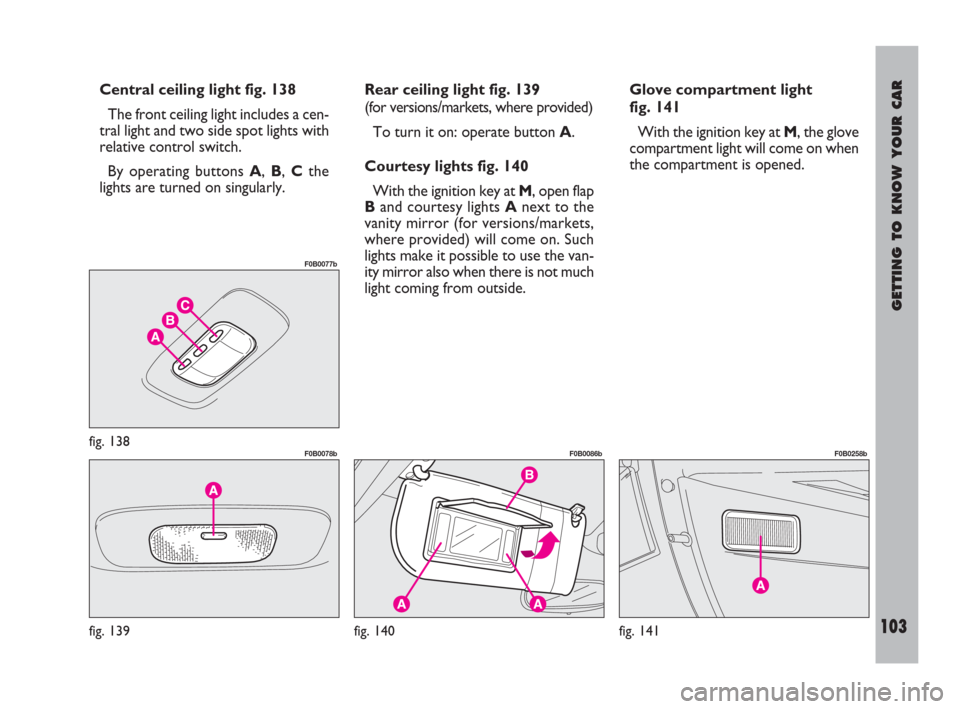
Central ceiling light fig. 138
The front ceiling light includes a cen-
tral light and two side spot lights with
relative control switch.
By operating buttons A, B, Cthe
lights are turned on singularly.Rear ceiling light fig. 139
(for versions/markets, where provided)
To turn it on: operate button A.
Courtesy lights fig. 140
With the ignition key at M, open flap
Band courtesy lights Anext to the
vanity mirror (for versions/markets,
where provided) will come on. Such
lights make it possible to use the van-
ity mirror also when there is not much
light coming from outside.Glove compartment light
fig. 141
With the ignition key at M, the glove
compartment light will come on when
the compartment is opened.
fig. 138
F0B0077b
fig. 139
F0B0078b
fig. 140
F0B0086b
fig. 141
F0B0258b
078-135 ULYSSE ING 10-03-2009 11:39 Pagina 103
Page 105 of 254
GETTING TO KNOW YOUR CAR
104
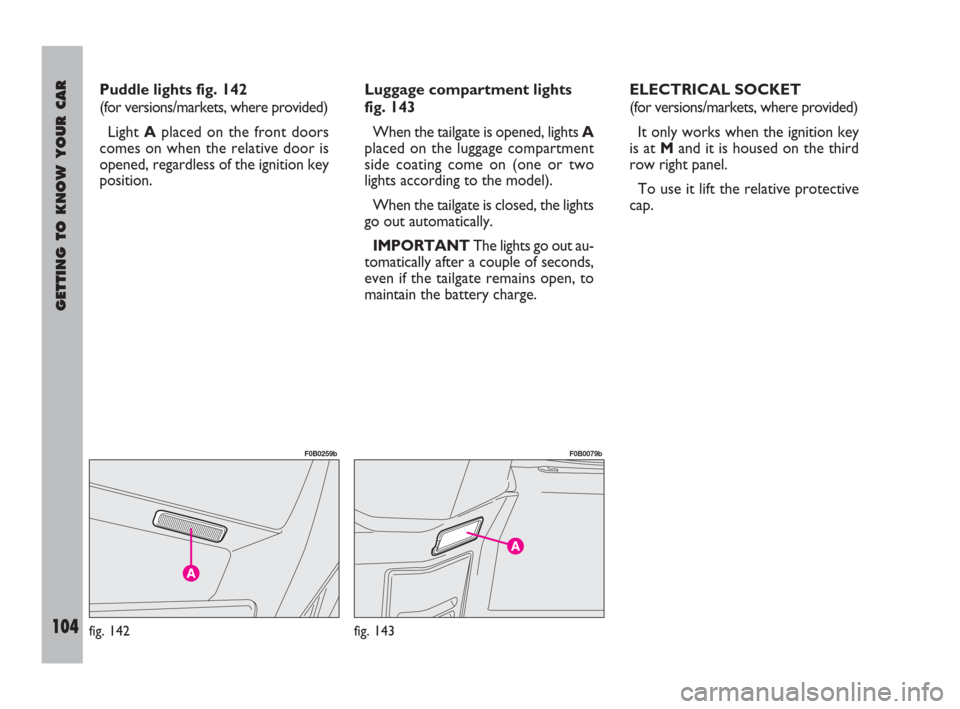
Puddle lights fig. 142
(for versions/markets, where provided)
Light Aplaced on the front doors
comes on when the relative door is
opened, regardless of the ignition key
position.Luggage compartment lights
fig. 143
When the tailgate is opened, lights A
placed on the luggage compartment
side coating come on (one or two
lights according to the model).
When the tailgate is closed, the lights
go out automatically.
IMPORTANTThe lights go out au-
tomatically after a couple of seconds,
even if the tailgate remains open, to
maintain the battery charge.ELECTRICAL SOCKET
(for versions/markets, where provided)
It only works when the ignition key
is at Mand it is housed on the third
row right panel.
To use it lift the relative protective
cap.
fig. 142
F0B0259b
fig. 143
F0B0079b
078-135 ULYSSE ING 10-03-2009 11:39 Pagina 104
Page 106 of 254
GETTING TO KNOW YOUR CAR
105
ELECTRIC WINDOWS
Electric windows are fitted with safe-
ty anti-crushing gaskets. The system
control unit can feel the presence of
an obstacle when winding up the win-
dow: in this case it stops the window
winding up and reverses it immedi-
ately.
IMPORTANTWith the ignition
key at Sor removed, electric windows
work for 1 minute.
IMPORTANTIf, after disconnect-
ing the battery, the electric window
winder does not work, initialize the
system; release the control and oper-
ate it again until the window is com-
pletely closed and keep it pressed for
one second after the limit switch. The
system will start working properly
again.Incorrect use of the elec-
tric windows could be
dangerous. Before and
when pressing the switches, al-
ways make sure that passengers
cannot be injured either directly
by moving glass or by personal ef-
fects being dragged along or hit
by the glass. Always remove the
ignition key when getting out of
the vehicle to make sure that the
electric windows cannot be acci-
dentally operated and constitute
a hazard for passengers remain-
ing in the vehicle.VERSIONS WITH FRONT
DOOR ELECTRIC WINDOWS
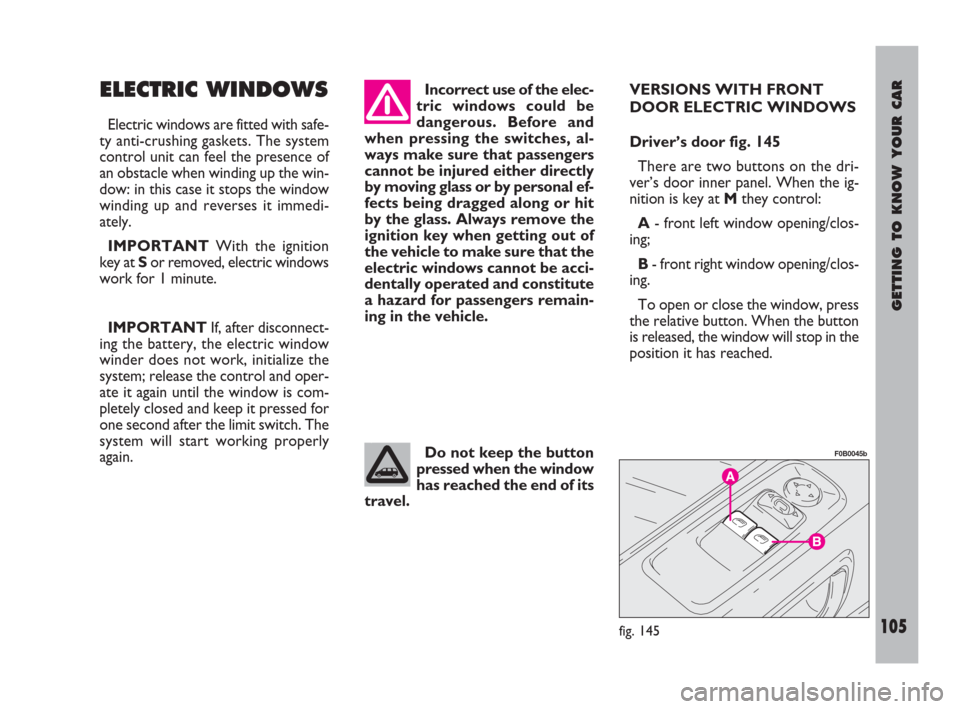
Driver’s door fig. 145
There are two buttons on the dri-
ver’s door inner panel. When the ig-
nition is key at M they control:
A- front left window opening/clos-
ing;
B- front right window opening/clos-
ing.
To open or close the window, press
the relative button. When the button
is released, the window will stop in the
position it has reached.
Do not keep the button
pressed when the window
has reached the end of its
travel.
fig. 145
F0B0045b
078-135 ULYSSE ING 10-03-2009 11:39 Pagina 105
Page 107 of 254
GETTING TO KNOW YOUR CAR
106
The driver’s window winder is fitted
with an “automatic continuous oper-
ation” (working only when the engine
is started) to wind up or lower the
window. Press Abriefly and the win-
dow will automatically reach its trav-
el end. If you press the button a sec-
ond time, the window will stop in the
required position.
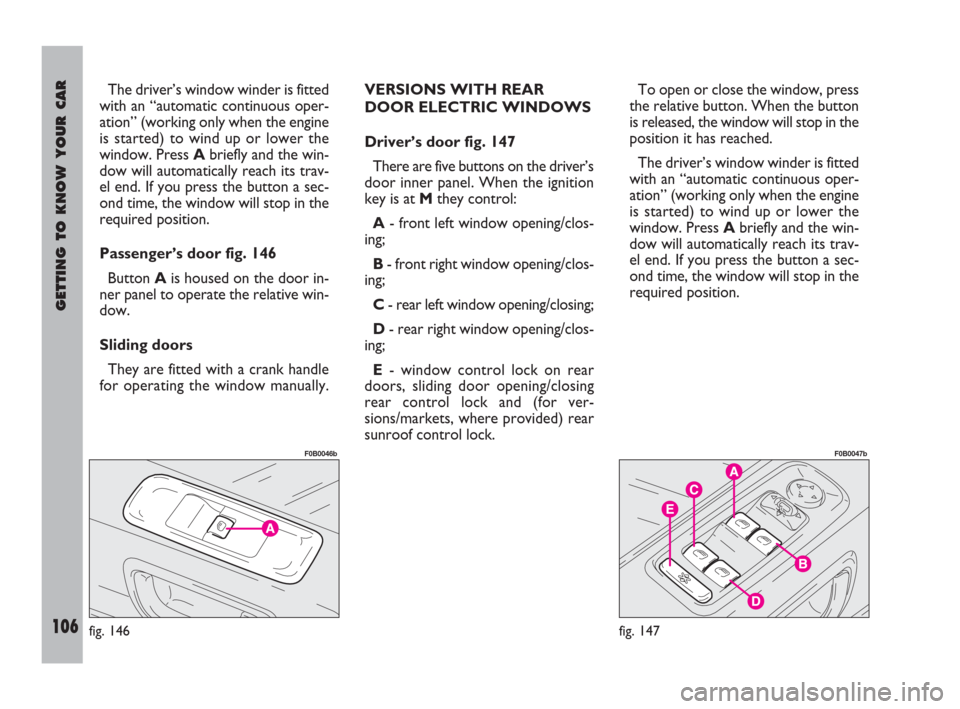
Passenger’s door fig. 146
Button Ais housed on the door in-
ner panel to operate the relative win-
dow.
Sliding doors
They are fitted with a crank handle
for operating the window manually.VERSIONS WITH REAR
DOOR ELECTRIC WINDOWS
Driver’s door fig. 147
There are five buttons on the driver’s
door inner panel. When the ignition
key is at Mthey control:
A- front left window opening/clos-
ing;
B- front right window opening/clos-
ing;
C- rear left window opening/closing;
D- rear right window opening/clos-
ing;
E- window control lock on rear
doors, sliding door opening/closing
rear control lock and (for ver-
sions/markets, where provided) rear
sunroof control lock.To open or close the window, press
the relative button. When the button
is released, the window will stop in the
position it has reached.
The driver’s window winder is fitted
with an “automatic continuous oper-
ation” (working only when the engine
is started) to wind up or lower the
window. Press Abriefly and the win-
dow will automatically reach its trav-
el end. If you press the button a sec-
ond time, the window will stop in the
required position.
fig. 146
F0B0046b
fig. 147
F0B0047b
078-135 ULYSSE ING 10-03-2009 11:39 Pagina 106
Page 108 of 254
GETTING TO KNOW YOUR CAR
107
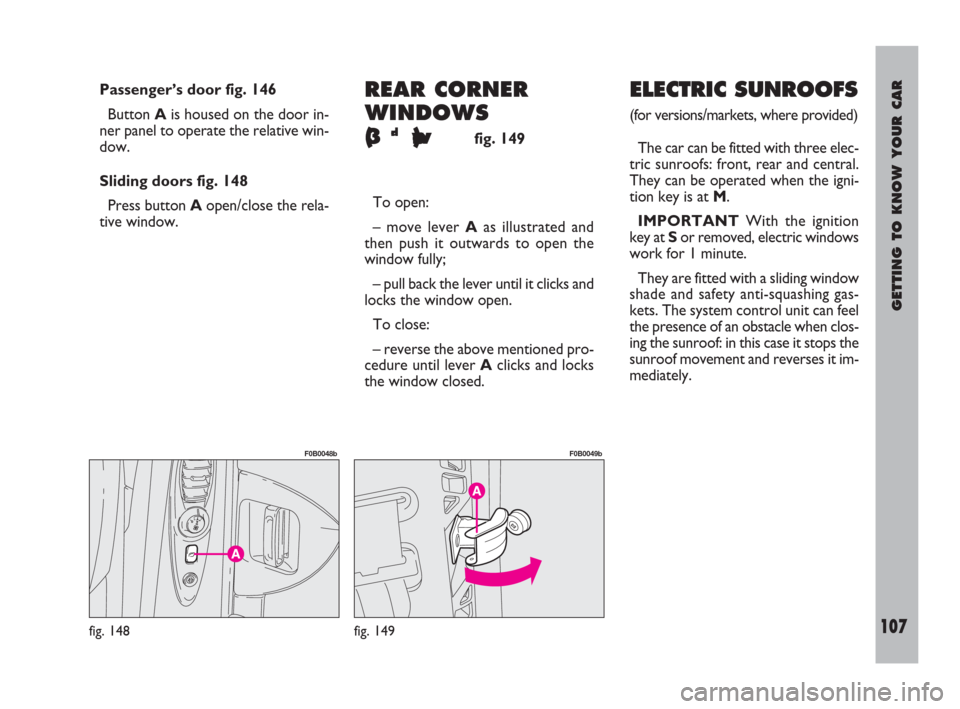
Passenger’s door fig. 146
Button Ais housed on the door in-
ner panel to operate the relative win-
dow.
Sliding doors fig. 148
Press button Aopen/close the rela-
tive window.REAR CORNER
WINDOWS
( 3
r dr o
w )fig. 149
To open:
– move lever Aas illustrated and
then push it outwards to open the
window fully;
– pull back the lever until it clicks and
locks the window open.
To close:
– reverse the above mentioned pro-
cedure until lever Aclicks and locks
the window closed.
ELECTRIC SUNROOFS
(for versions/markets, where provided)
The car can be fitted with three elec-
tric sunroofs: front, rear and central.
They can be operated when the igni-
tion key is at M.
IMPORTANTWith the ignition
key at Sor removed, electric windows
work for 1 minute.
They are fitted with a sliding window
shade and safety anti-squashing gas-
kets. The system control unit can feel
the presence of an obstacle when clos-
ing the sunroof: in this case it stops the
sunroof movement and reverses it im-
mediately.
fig. 148
F0B0048b
fig. 149
F0B0049b
078-135 ULYSSE ING 10-03-2009 11:39 Pagina 107
Page 123 of 254
GETTING TO KNOW YOUR CAR
122
EOBD SYSTEM
The EOBD (European On Board
Diagnosis) system fitted in this car
complies with Directive 98/69/CE
(EURO 3).
This system continuously monitors
the engine emission system compo-
nents. Furthermore, the system warns
the driver of deterioration concerning
the emission system components by
means of
Uwarning light on the in-
strument panel.
The objective is to:
– monitor system efficiency;
– warn when failures can increase
emissions over the threshold estab-
lished by the European regulations;
– warn of the need to replace dete-
riorated components.
Furthermore, the system is equipped
with a connector for interfacing with
specific tools used to read the error
codes stored in the control unit mem-
ory along with a set of diagnostic and
engine specific parameters. This check can also be performed by
traffic controller agents.
If, turning the ignition
key to M, the warning
light
Udoes not turn on
or if, while travelling it turns on
glowing steadily or flashing, con-
tact a Fiat Dealership as soon as
possible. Dealership as soon as
possible. Warning light
Uoper-
ation can be checked by traffic
controller agents by means of
special equipment. Always com-
ply with the traffic regulations in
force in the country where you
are travelling.
IMPORTANTAfter eliminating the
problem, your Fiat Dealershipwill
run a bench test to fully check the sys-
tem. In some cases, a long road test
may be required.
TYRE PRESSURE
MONITORING
SYSTEM - T.P.M.S.
(for versions/markets, where provided)
The car can be equipped with the
T.P.M.S. (Tyre Pressure Monitoring
System). This system consists of a ra-
dio-frequency sensor, installed on each
wheel (on the rim inside the tyre) that
sends pressure information to the
control unit.
IMPORTANTSystem control unit
monitors the pressure of the four car
tyres but not the space-saver spare
wheel. It is therefore recommended
to always check also the space-saver
spare wheel pressure.
IMPORTANTPay the attention
when checking or inflating tyres. Ex-
cessive pressure impairs road holding,
increases suspension and wheel stress
and causes abnormal tyre wear.
078-135 ULYSSE ING 10-03-2009 11:39 Pagina 122
Page 127 of 254
GETTING TO KNOW YOUR CAR
126
Deactivating the passenger’s
front air bag manually
The passenger’s front airbag can be
deactivated if it is absolutely necessary
to carry a child in the front passenger
seat.
Deactivation takes place using the ve-
hicle ignition key in the special key
switch on the right-hand side of the
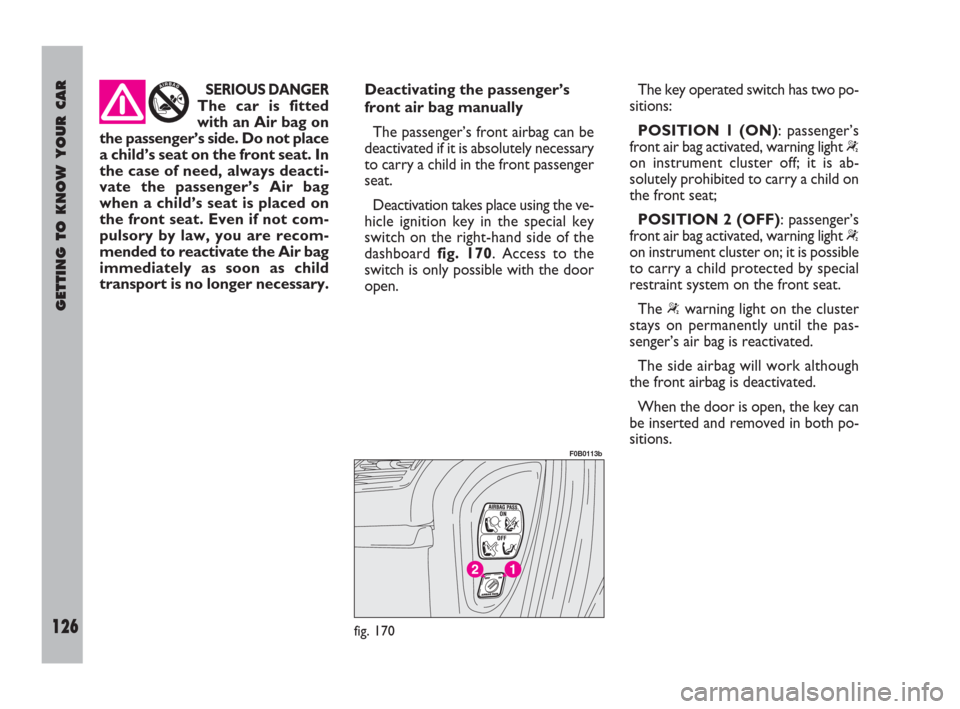
dashboard fig. 170. Access to the
switch is only possible with the door
open.The key operated switch has two po-
sitions:
POSITION 1 (ON): passenger’s
front air bag activated, warning light
“
on instrument cluster off; it is ab-
solutely prohibited to carry a child on
the front seat;
POSITION 2 (OFF): passenger’s
front air bag activated, warning light
“
on instrument cluster on; it is possible
to carry a child protected by special
restraint system on the front seat.
The
“warning light on the cluster
stays on permanently until the pas-
senger’s air bag is reactivated.
The side airbag will work although
the front airbag is deactivated.
When the door is open, the key can
be inserted and removed in both po-
sitions.
fig. 170
F0B0113b
SERIOUS DANGER
The car is fitted
with an Air bag on
the passenger’s side. Do not place
a child’s seat on the front seat. In
the case of need, always deacti-
vate the passenger’s Air bag
when a child’s seat is placed on
the front seat. Even if not com-
pulsory by law, you are recom-
mended to reactivate the Air bag
immediately as soon as child
transport is no longer necessary.
078-135 ULYSSE ING 10-03-2009 11:39 Pagina 126