light FIAT ULYSSE 2009 2.G Owner's Guide
[x] Cancel search | Manufacturer: FIAT, Model Year: 2009, Model line: ULYSSE, Model: FIAT ULYSSE 2009 2.GPages: 254, PDF Size: 3.56 MB
Page 87 of 254
GETTING TO KNOW YOUR CAR
86
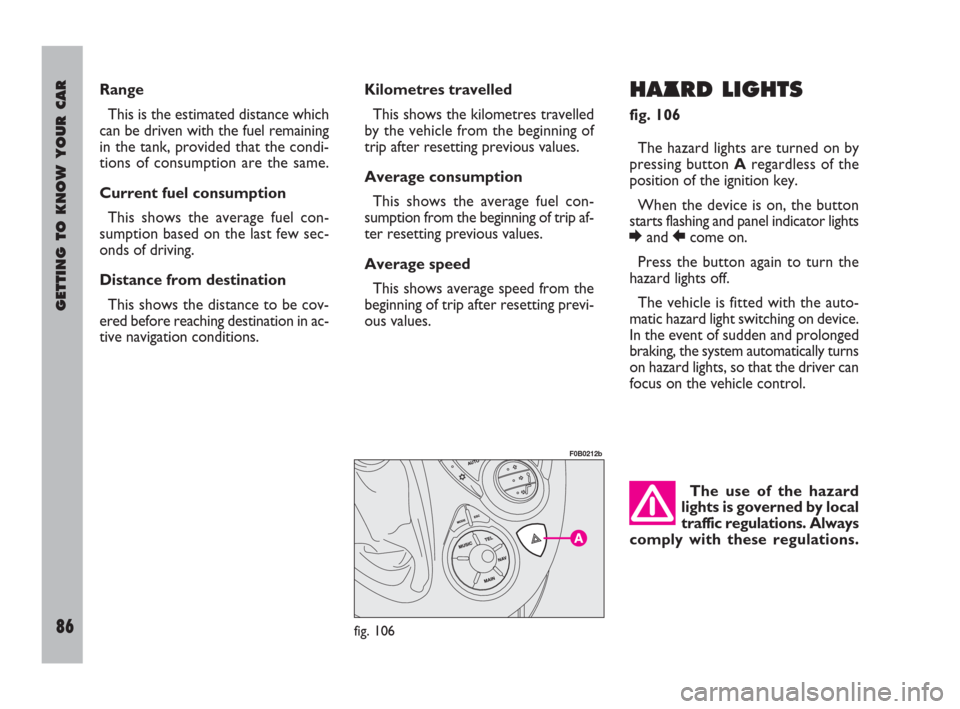
HAZARD LIGHTS
fig. 106
The hazard lights are turned on by
pressing button Aregardless of the
position of the ignition key.
When the device is on, the button
starts flashing and panel indicator lights
Eand Rcome on.
Press the button again to turn the
hazard lights off.
The vehicle is fitted with the auto-
matic hazard light switching on device.
In the event of sudden and prolonged
braking, the system automatically turns
on hazard lights, so that the driver can
focus on the vehicle control. Range
This is the estimated distance which
can be driven with the fuel remaining
in the tank, provided that the condi-
tions of consumption are the same.
Current fuel consumption
This shows the average fuel con-
sumption based on the last few sec-
onds of driving.
Distance from destination
This shows the distance to be cov-
ered before reaching destination in ac-
tive navigation conditions.
The use of the hazard
lights is governed by local
traffic regulations. Always
comply with these regulations.
Kilometres travelled
This shows the kilometres travelled
by the vehicle from the beginning of
trip after resetting previous values.
Average consumption
This shows the average fuel con-
sumption from the beginning of trip af-
ter resetting previous values.
Average speed
This shows average speed from the
beginning of trip after resetting previ-
ous values.
fig. 106
F0B0212b
078-135 ULYSSE ING 10-03-2009 11:39 Pagina 86
Page 88 of 254
GETTING TO KNOW YOUR CAR
87
FUEL CUT-OFF
SWITCH
This is a safety switch controlled by
the Airbag control unit. Such switch
cuts in on collision and cuts off the fu-
el supply. This results in the engine
stalling.
The multifunction display informs the
driver that the fuel has been cut off
with a dedicated message.If you do not notice fuel leaks
and the vehicle is in a fit state to
continue on its way, proceed as
follows:
– turn the key to S;
– extract the ignition key; rein-
troduce it and start the engine as
usual.
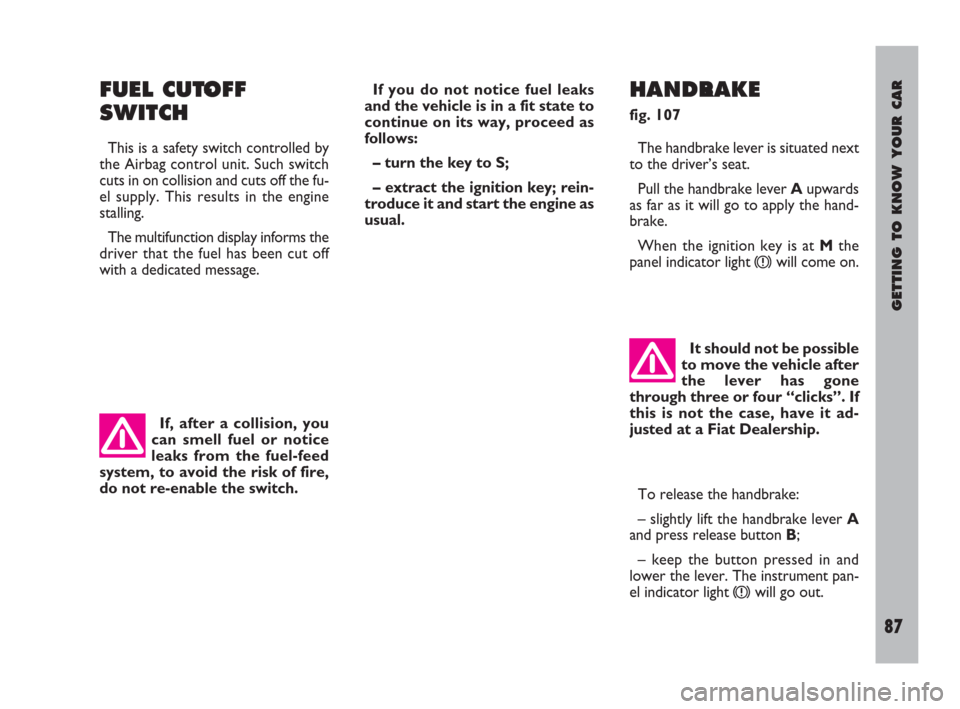
HANDBRAKE
fig. 107
The handbrake lever is situated next
to the driver’s seat.
Pull the handbrake lever Aupwards
as far as it will go to apply the hand-
brake.
When the ignition key is at Mthe
panel indicator light
xwill come on.
If, after a collision, you
can smell fuel or notice
leaks from the fuel-feed
system, to avoid the risk of fire,
do not re-enable the switch.It should not be possible
to move the vehicle after
the lever has gone
through three or four “clicks”. If
this is not the case, have it ad-
justed at a Fiat Dealership.
To release the handbrake:
– slightly lift the handbrake lever A
and press release button B;
– keep the button pressed in and
lower the lever. The instrument pan-
el indicator light
xwill go out.
078-135 ULYSSE ING 10-03-2009 11:39 Pagina 87
Page 94 of 254
It is dangerous to let the
engine run in a garage or
other closed area. The
engine consumes oxygen and
gives off carbon dioxide, carbon
monoxide and other poisonous
fumes.
– Make sure the handbrake is up and
the gear lever in Por N: the engine
can be started only with the gear in
these two positions.
– Turn the ignition key to Dwithout
pressing the accelerator pedal.
If the engine does not start at the
first attempt, return the ignition key
to Sbefore trying to start the engine
again.
GETTING TO KNOW YOUR CAR
93
STARTING THE ENGINEIf the instrument panel warning light
stays on when the ignition key is at M,
turn the key to Sand then back to M;
if the warning light still remains lit, try
with the other keys provided with the
vehicle.
If you are still unable to start the en-
gine (see “In an emergency” chapter)
contact a Fiat Dealership as soon as
possible.
IMPORTANTDo not leave the ig-
nition key at Mwhen the engine is off
to prevent draining the battery charge.MOVING THE CAR
Proceed as follows:
– press fully the brake pedal;
– select the required gear lever po-
sition;
– accelerate progressively; the vehi-
cle is started and the gear shift de-
pends on the position selected.
When the ignition key is
at M, it is possible to shift
the gear lever from P on-
ly when the brake pedal is fully
depressed (Shift-lock safety de-
vice).
078-135 ULYSSE ING 10-03-2009 11:39 Pagina 93
Page 100 of 254
GETTING TO KNOW YOUR CAR
99
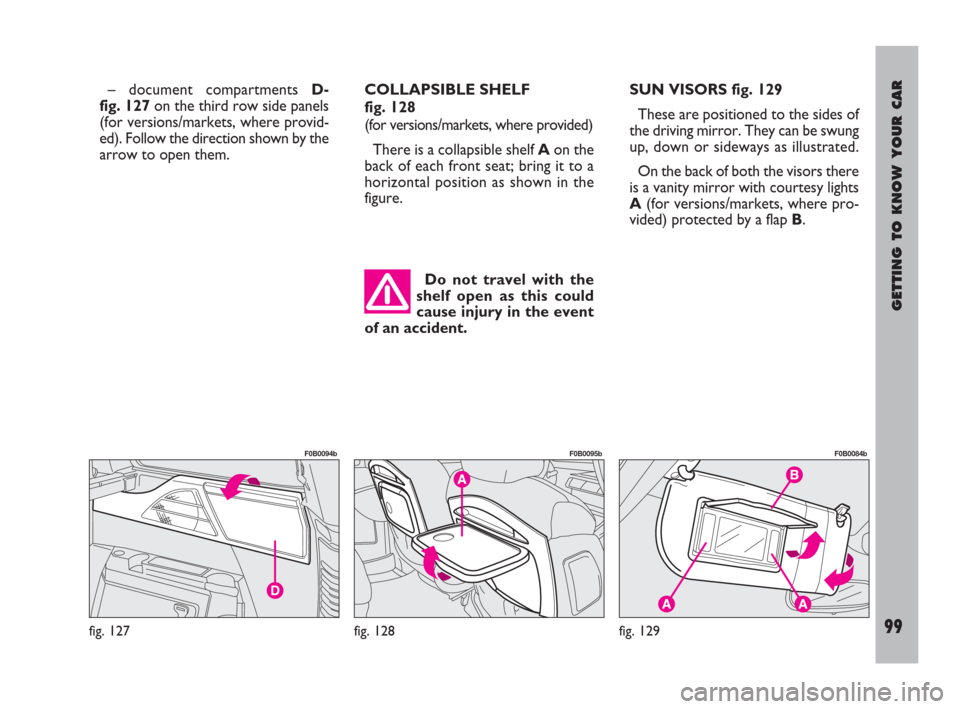
– document compartments D-
fig. 127on the third row side panels
(for versions/markets, where provid-
ed). Follow the direction shown by the
arrow to open them.COLLAPSIBLE SHELF
fig. 128
(for versions/markets, where provided)
There is a collapsible shelf Aon the
back of each front seat; bring it to a
horizontal position as shown in the
figure.SUN VISORS fig. 129
These are positioned to the sides of
the driving mirror. They can be swung
up, down or sideways as illustrated.
On the back of both the visors there
is a vanity mirror with courtesy lights
A(for versions/markets, where pro-
vided) protected by a flap B.
fig. 127
F0B0094b
fig. 128
F0B0095b
fig. 129
F0B0084b
Do not travel with the
shelf open as this could
cause injury in the event
of an accident.
078-135 ULYSSE ING 10-03-2009 11:39 Pagina 99
Page 102 of 254
GETTING TO KNOW YOUR CAR
101
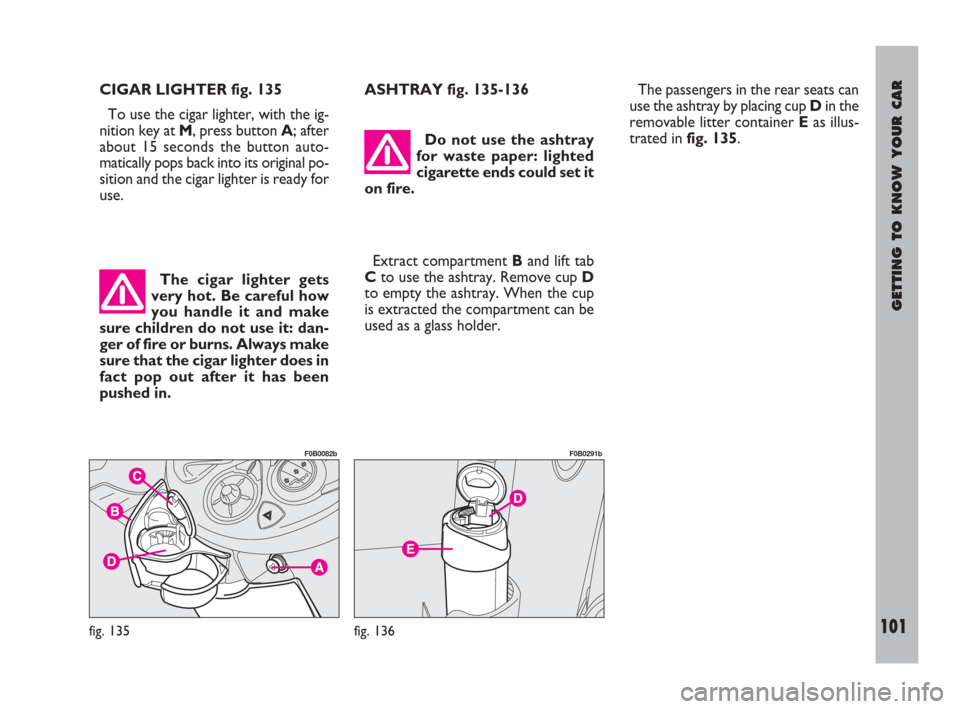
CIGAR LIGHTER fig. 135
To use the cigar lighter, with the ig-
nition key at M, press button A; after
about 15 seconds the button auto-
matically pops back into its original po-
sition and the cigar lighter is ready for
use.ASHTRAY fig. 135-136The passengers in the rear seats can
use the ashtray by placing cup Din the
removable litter container Eas illus-
trated in fig. 135.
Extract compartment Band lift tab
C to use the ashtray. Remove cup D
to empty the ashtray. When the cup
is extracted the compartment can be
used as a glass holder. The cigar lighter gets
very hot. Be careful how
you handle it and make
sure children do not use it: dan-
ger of fire or burns. Always make
sure that the cigar lighter does in
fact pop out after it has been
pushed in.
fig. 135
F0B0082b
fig. 136
F0B0291b
Do not use the ashtray
for waste paper: lighted
cigarette ends could set it
on fire.
078-135 ULYSSE ING 10-03-2009 11:39 Pagina 101
Page 103 of 254
GETTING TO KNOW YOUR CAR
102
CEILING LIGHT UNITS
All the ceiling lights come on for a
limited time, i.e. they turn on and off
gradually.
Ceiling light operation
All the ceiling lights come on auto-
matically when the doors are opened
with the remote control or when the
key is introduced in the door lock. Af-
ter some seconds, the lights will go out
gradually, without opening the doors.
When the door lock button on the
remote control is pressed for a long
time, the so-called “localisation” func-
tion is activated: all the ceiling lights
in the passenger compartment come
on together with the direction indi-
cators. This function is recognised by
the system up to a distance of about
30 meters from the vehicle. If the ignition key is turned to S(or
removed) the first row ceiling light
comes on. It will stay on only for a lim-
ited time and will go out gradually.
When one of the front doors is
opened, the central ceiling light, with-
out the spot lights, and the puddle
lights on the doors come on. They re-
main lit for a set time and after a cou-
ple of seconds the door have been
closed, they go off gradually. When the
engine is started, the lights will go off
progressively after a couple of seconds.
When one of the rear doors is
opened the central ceiling light, with-
out the spot lights, come on. It re-
mains lit for a set time and after a cou-
ple of seconds the door have been
closed, it goes off gradually.When the tailgate is opened the lug-
gage compartment lights come on
(one or two lights according to the
model). The lights will go off gradual-
ly when the tailgate is closed.
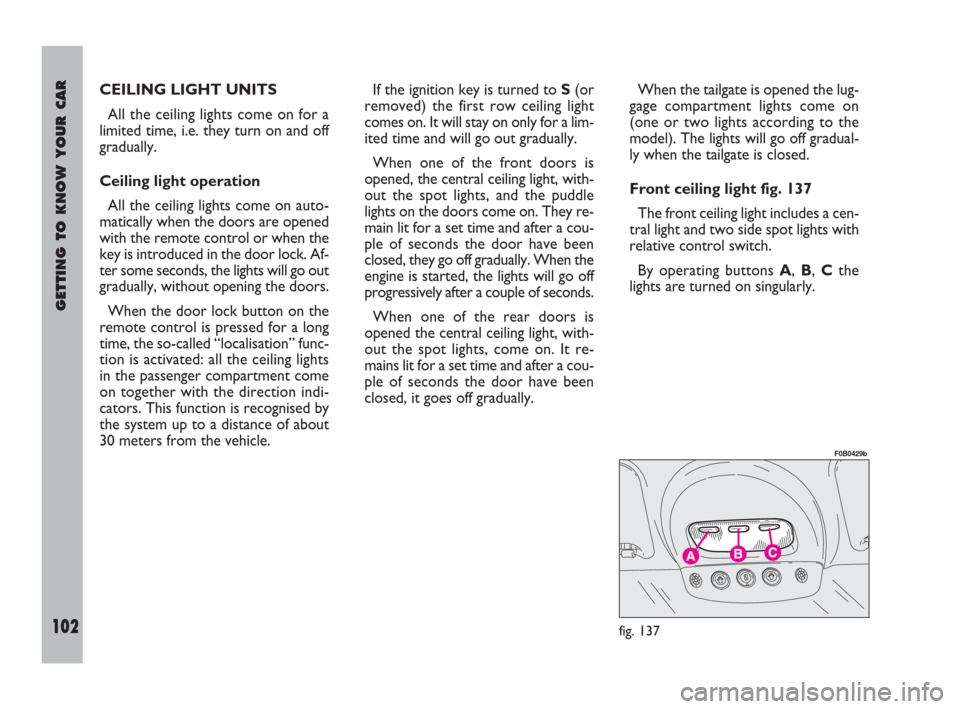
Front ceiling light fig. 137
The front ceiling light includes a cen-
tral light and two side spot lights with
relative control switch.
By operating buttons A, B, Cthe
lights are turned on singularly.
fig. 137
F0B0429b
078-135 ULYSSE ING 10-03-2009 11:39 Pagina 102
Page 104 of 254
GETTING TO KNOW YOUR CAR
103
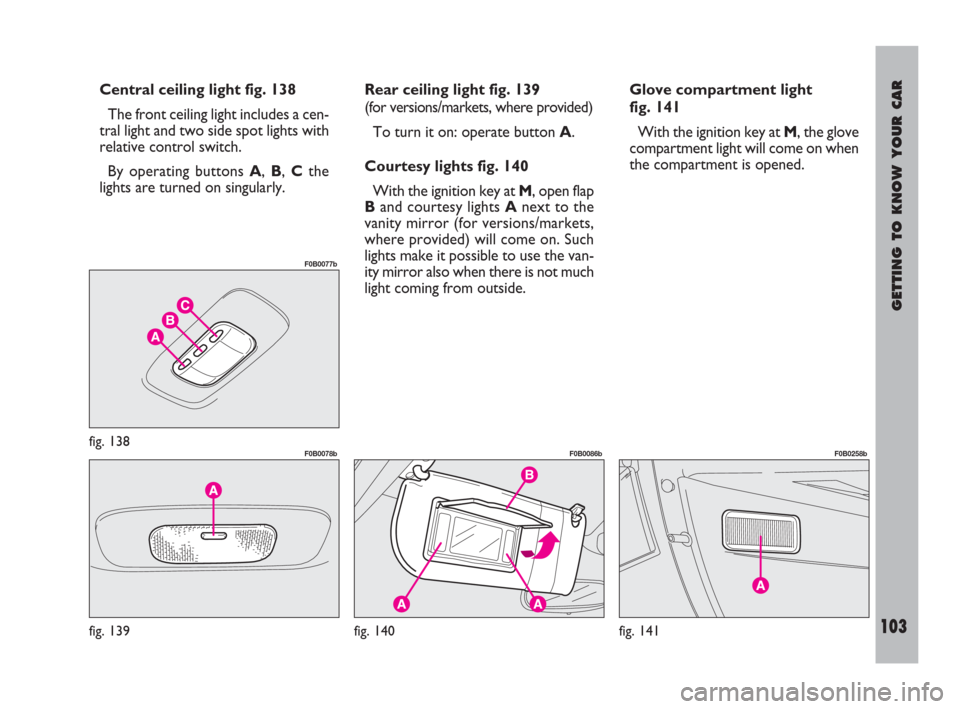
Central ceiling light fig. 138
The front ceiling light includes a cen-
tral light and two side spot lights with
relative control switch.
By operating buttons A, B, Cthe
lights are turned on singularly.Rear ceiling light fig. 139
(for versions/markets, where provided)
To turn it on: operate button A.
Courtesy lights fig. 140
With the ignition key at M, open flap
Band courtesy lights Anext to the
vanity mirror (for versions/markets,
where provided) will come on. Such
lights make it possible to use the van-
ity mirror also when there is not much
light coming from outside.Glove compartment light
fig. 141
With the ignition key at M, the glove
compartment light will come on when
the compartment is opened.
fig. 138
F0B0077b
fig. 139
F0B0078b
fig. 140
F0B0086b
fig. 141
F0B0258b
078-135 ULYSSE ING 10-03-2009 11:39 Pagina 103
Page 105 of 254
GETTING TO KNOW YOUR CAR
104
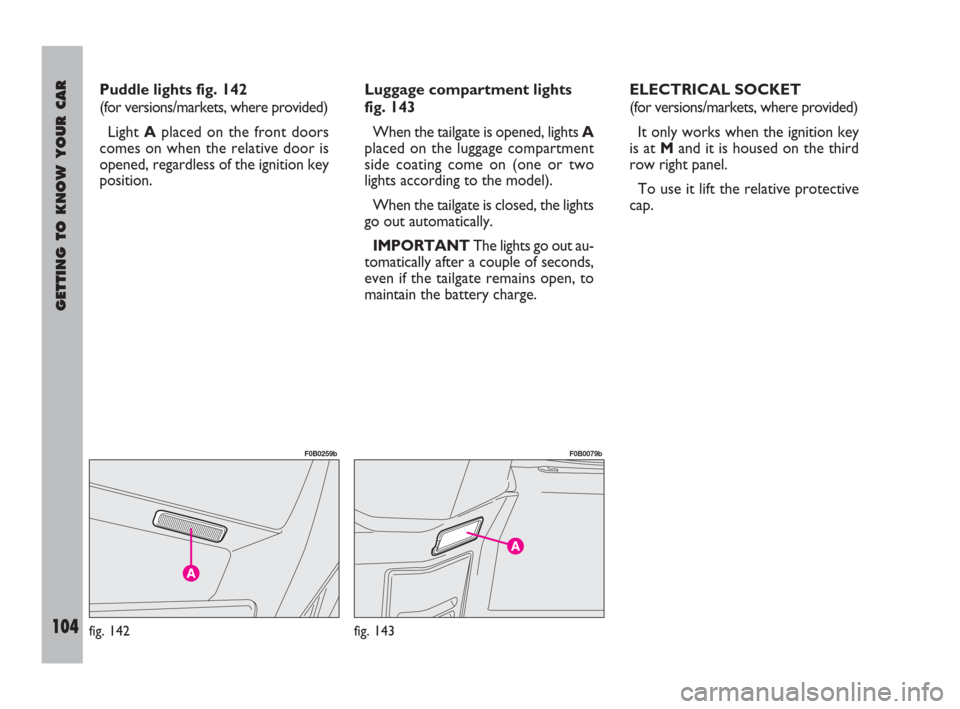
Puddle lights fig. 142
(for versions/markets, where provided)
Light Aplaced on the front doors
comes on when the relative door is
opened, regardless of the ignition key
position.Luggage compartment lights
fig. 143
When the tailgate is opened, lights A
placed on the luggage compartment
side coating come on (one or two
lights according to the model).
When the tailgate is closed, the lights
go out automatically.
IMPORTANTThe lights go out au-
tomatically after a couple of seconds,
even if the tailgate remains open, to
maintain the battery charge.ELECTRICAL SOCKET
(for versions/markets, where provided)
It only works when the ignition key
is at Mand it is housed on the third
row right panel.
To use it lift the relative protective
cap.
fig. 142
F0B0259b
fig. 143
F0B0079b
078-135 ULYSSE ING 10-03-2009 11:39 Pagina 104
Page 111 of 254
GETTING TO KNOW YOUR CAR
110
Do not travel with the
hatchback open: the ex-
haust fumes could enter
the vehicle.TAILGATE EMERGENCY
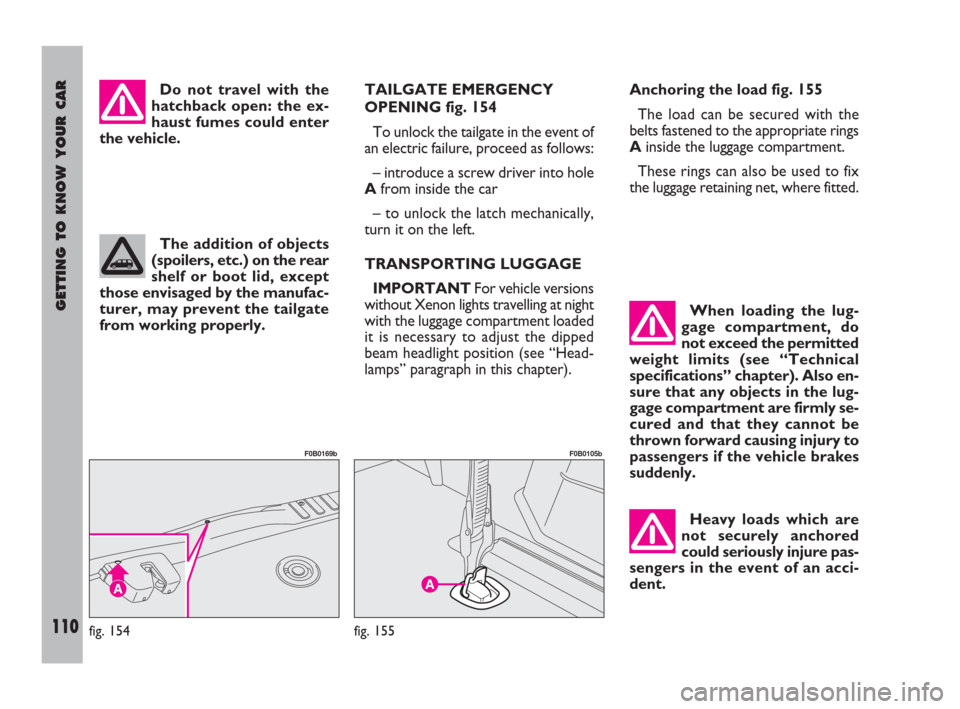
OPENING fig. 154
To unlock the tailgate in the event of
an electric failure, proceed as follows:
– introduce a screw driver into hole
A from inside the car
– to unlock the latch mechanically,
turn it on the left.
TRANSPORTING LUGGAGE
IMPORTANTFor vehicle versions
without Xenon lights travelling at night
with the luggage compartment loaded
it is necessary to adjust the dipped
beam headlight position (see “Head-
lamps” paragraph in this chapter).When loading the lug-
gage compartment, do
not exceed the permitted
weight limits (see “Technical
specifications” chapter). Also en-
sure that any objects in the lug-
gage compartment are firmly se-
cured and that they cannot be
thrown forward causing injury to
passengers if the vehicle brakes
suddenly.
Heavy loads which are
not securely anchored
could seriously injure pas-
sengers in the event of an acci-
dent. The addition of objects
(spoilers, etc.) on the rear
shelf or boot lid, except
those envisaged by the manufac-
turer, may prevent the tailgate
from working properly.
fig. 155
F0B0105b
fig. 154
F0B0169b
Anchoring the load fig. 155
The load can be secured with the
belts fastened to the appropriate rings
Ainside the luggage compartment.
These rings can also be used to fix
the luggage retaining net, where fitted.
078-135 ULYSSE ING 10-03-2009 11:39 Pagina 110
Page 115 of 254
GETTING TO KNOW YOUR CAR
114
HEADLAMPS
XENON LAMPS
(for versions/markets, where provided)
Xenon lamps work with a voltaic arc
in a pressure Xenon saturated envi-
ronment, in place of the traditional fil-
ament.
The produced light is far greater than
that of traditional lamps, both for its
quality (lighter) and its lighting range.
The advantages in using such lamps
are the following: less eyes fatigue, im-
proved driver’s orientation and driving
safety, especially with the bad weath-
er, with fog and/or inadequate road
signs, illumination of side bands usu-
ally in the shadow.Illumination of side bands consider-
ably improves driving safety because
the driver is able to identify other road
users on the road margins (pedestri-
ans, bikers and motor-bikers).
When the lights come on, the volta-
ic arc tension is very high, but then it
falls.
The maximum light is obtained after
0.5 seconds after turning the head-
lamps on.
The great light produced by this type
of headlamps requires an automatic
system for maintaining the headlight
beam constant and preventing dazzling
other vehicles in the event of sudden
braking, acceleration or while carrying
heavy loads. Never load the rack with
more than the weight al-
lowed (see the “Technical
specifications” section).
Be careful not to knock
the tailgate into objects
on the roof rack.
After travelling a few
miles, check that the an-
chorage bolts of the at-
tachments are still fully tight.
078-135 ULYSSE ING 10-03-2009 11:39 Pagina 114