battery FIAT UNO 1983 Service User Guide
[x] Cancel search | Manufacturer: FIAT, Model Year: 1983, Model line: UNO, Model: FIAT UNO 1983Pages: 303, PDF Size: 10.36 MB
Page 40 of 303
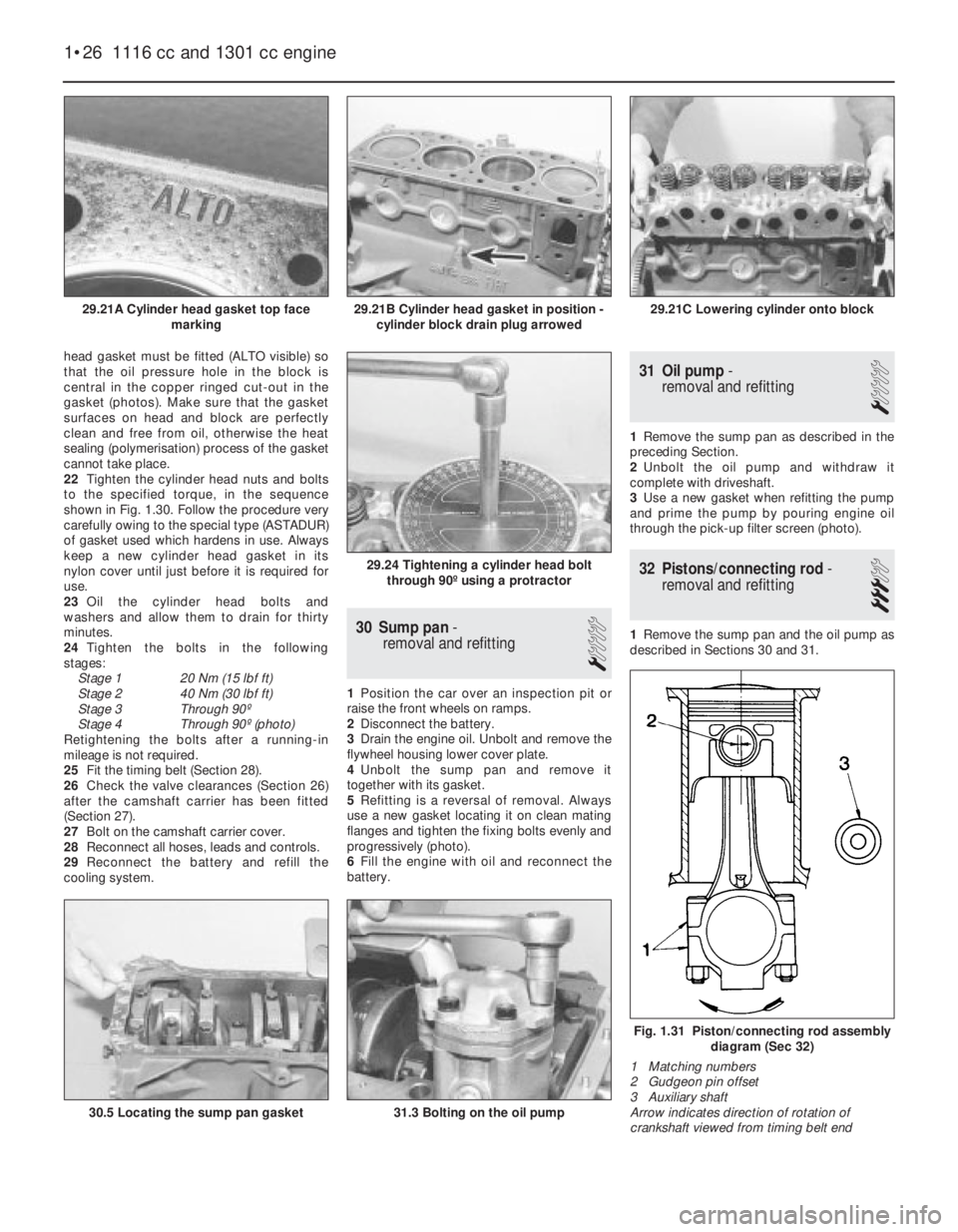
head gasket must be fitted (ALTO visible) so
that the oil pressure hole in the block is
central in the copper ringed cut-out in the
gasket (photos). Make sure that the gasket
surfaces on head and block are perfectly
clean and free from oil, otherwise the heat
sealing (polymerisation) process of the gasket
cannot take place.
22Tighten the cylinder head nuts and bolts
to the specified torque, in the sequence
shown in Fig. 1.30. Follow the procedure very
carefully owing to the special type (ASTADUR)
of gasket used which hardens in use. Always
keep a new cylinder head gasket in its
nylon cover until just before it is required for
use.
23Oil the cylinder head bolts and
washers and allow them to drain for thirty
minutes.
24Tighten the bolts in the following
stages:
Stage 1 20 Nm (15 lbf ft)
Stage 2 40 Nm (30 lbf ft)
Stage 3 Through 90º
Stage 4 Through 90º (photo)
Retightening the bolts after a running-in
mileage is not required.
25Fit the timing belt (Section 28).
26Check the valve clearances (Section 26)
after the camshaft carrier has been fitted
(Section 27).
27Bolt on the camshaft carrier cover.
28Reconnect all hoses, leads and controls.
29Reconnect the battery and refill the
cooling system.
30 Sump pan-
removal and refitting
1
1Position the car over an inspection pit or
raise the front wheels on ramps.
2Disconnect the battery.
3Drain the engine oil. Unbolt and remove the
flywheel housing lower cover plate.
4Unbolt the sump pan and remove it
together with its gasket.
5Refitting is a reversal of removal. Always
use a new gasket locating it on clean mating
flanges and tighten the fixing bolts evenly and
progressively (photo).
6Fill the engine with oil and reconnect the
battery.
31 Oil pump-
removal and refitting
1
1Remove the sump pan as described in the
preceding Section.
2Unbolt the oil pump and withdraw it
complete with driveshaft.
3Use a new gasket when refitting the pump
and prime the pump by pouring engine oil
through the pick-up filter screen (photo).
32 Pistons/connecting rod-
removal and refitting
3
1Remove the sump pan and the oil pump as
described in Sections 30 and 31.
1•26 1116 cc and 1301 cc engine
Fig. 1.31 Piston/connecting rod assembly
diagram (Sec 32)
1 Matching numbers
2 Gudgeon pin offset
3 Auxiliary shaft
Arrow indicates direction of rotation of
crankshaft viewed from timing belt end
29.24 Tightening a cylinder head bolt
through 90º using a protractor
31.3 Bolting on the oil pump30.5 Locating the sump pan gasket
29.21C Lowering cylinder onto block29.21B Cylinder head gasket in position -
cylinder block drain plug arrowed29.21A Cylinder head gasket top face
marking
Page 41 of 303
2The big-end bearing shells can be renewed
without having to remove the cylinder head if
the caps are unbolted and the
piston/connecting rod pushed gently about
one inch up the bore (the crankpin being at its
lowest point). If these shells are worn,
however, the main bearing shells will almost
certainly be worn as well. In this case, the
engine should be removed for complete
overhaul including crankshaft removal.
3To remove the piston/connecting rods,
remove the cylinder head as described in
Section 29.
4Grip the oil pick-up pipe and twist or rock it
from its hole in the crankcase. It is an
interference fit in the hole.
5Unscrew the nuts from the big-end caps,
then remove the caps with their bearing
shells. The caps and their connecting rods are
numbered 1, 2, 3 and 4 from the timing cover
end of the engine. The numbers are adjacent
at the big-end cap joint and on the side of the
crankcase furthest from the auxiliary shaft.
6If the bearing shells are to be used again,
tape them to their respective big-end caps.
7Push each connecting rod/piston assembly
up the bore and out of the cylinder block.
There is one reservation; if a wear ridge has
developed at the top of the bores, remove this
by careful scraping before trying to remove
the piston/rod assemblies. The ridge will
otherwise prevent removal or break the piston
rings during the attempt.
8If the connecting rod bearing shells are to
be used again, tape the shells to their
respective rods.
9Dismantling the piston/connecting rod is
described in Section 18.
Refitting
10Fit the new shells into the connecting rod
and caps, ensuring the surfaces on which the
shells seat, are clean and dry.
11Check that the piston ring gaps are evenly
spaced at 120º intervals. Liberally oil the rings
and the cylinder bores.
12Fit a piston ring clamp to compress the
rings.
13Insert the piston/connecting rod into the
cylinder bore, checking that the rod assembly
is correct for that particular bore. The cap and
rod matching numbers must be furthest away
from the auxiliary shaft (Fig. 1.31).14Push the piston into the bore until the
piston ring clamp is against the cylinder block
and then tap the crown of the piston lightly to
push it out of the ring clamp and into the bore
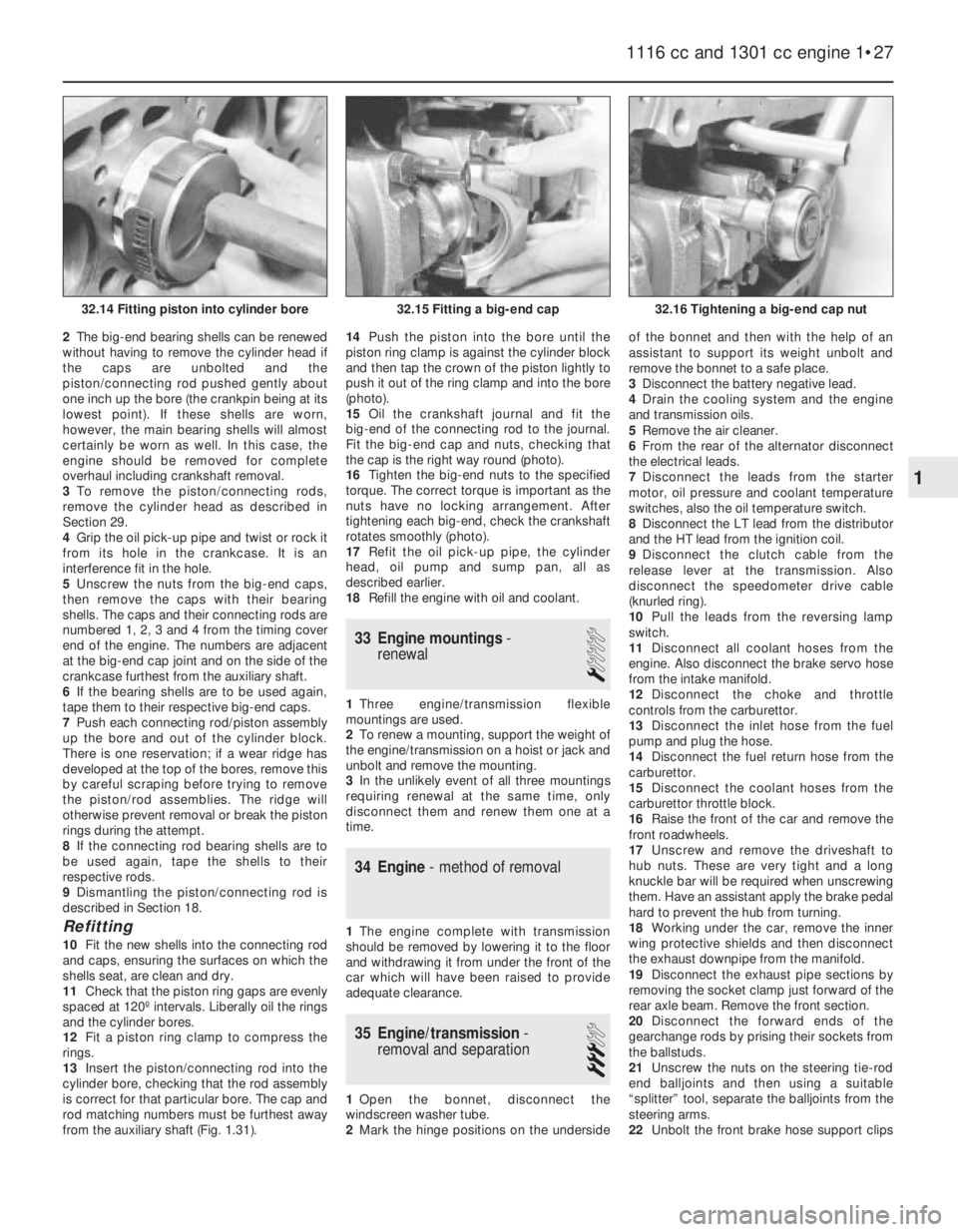
(photo).
15Oil the crankshaft journal and fit the
big-end of the connecting rod to the journal.
Fit the big-end cap and nuts, checking that
the cap is the right way round (photo).
16Tighten the big-end nuts to the specified
torque. The correct torque is important as the
nuts have no locking arrangement. After
tightening each big-end, check the crankshaft
rotates smoothly (photo).
17Refit the oil pick-up pipe, the cylinder
head, oil pump and sump pan, all as
described earlier.
18Refill the engine with oil and coolant.
33 Engine mountings-
renewal
1
1Three engine/transmission flexible
mountings are used.
2To renew a mounting, support the weight of
the engine/transmission on a hoist or jack and
unbolt and remove the mounting.
3In the unlikely event of all three mountings
requiring renewal at the same time, only
disconnect them and renew them one at a
time.
34 Engine- method of removal
1The engine complete with transmission
should be removed by lowering it to the floor
and withdrawing it from under the front of the
car which will have been raised to provide
adequate clearance.
35 Engine/transmission-
removal and separation
3
1Open the bonnet, disconnect the
windscreen washer tube.
2Mark the hinge positions on the undersideof the bonnet and then with the help of an
assistant to support its weight unbolt and
remove the bonnet to a safe place.
3Disconnect the battery negative lead.
4Drain the cooling system and the engine
and transmission oils.
5Remove the air cleaner.
6From the rear of the alternator disconnect
the electrical leads.
7Disconnect the leads from the starter
motor, oil pressure and coolant temperature
switches, also the oil temperature switch.
8Disconnect the LT lead from the distributor
and the HT lead from the ignition coil.
9Disconnect the clutch cable from the
release lever at the transmission. Also
disconnect the speedometer drive cable
(knurled ring).
10Pull the leads from the reversing lamp
switch.
11Disconnect all coolant hoses from the
engine. Also disconnect the brake servo hose
from the intake manifold.
12Disconnect the choke and throttle
controls from the carburettor.
13Disconnect the inlet hose from the fuel
pump and plug the hose.
14Disconnect the fuel return hose from the
carburettor.
15Disconnect the coolant hoses from the
carburettor throttle block.
16Raise the front of the car and remove the
front roadwheels.
17Unscrew and remove the driveshaft to
hub nuts. These are very tight and a long
knuckle bar will be required when unscrewing
them. Have an assistant apply the brake pedal
hard to prevent the hub from turning.
18Working under the car, remove the inner
wing protective shields and then disconnect
the exhaust downpipe from the manifold.
19Disconnect the exhaust pipe sections by
removing the socket clamp just forward of the
rear axle beam. Remove the front section.
20Disconnect the forward ends of the
gearchange rods by prising their sockets from
the ballstuds.
21Unscrew the nuts on the steering tie-rod
end balljoints and then using a suitable
“splitter” tool, separate the balljoints from the
steering arms.
22Unbolt the front brake hose support clips
1116 cc and 1301 cc engine 1•27
32.16 Tightening a big-end cap nut32.15 Fitting a big-end cap32.14 Fitting piston into cylinder bore
1
Page 48 of 303
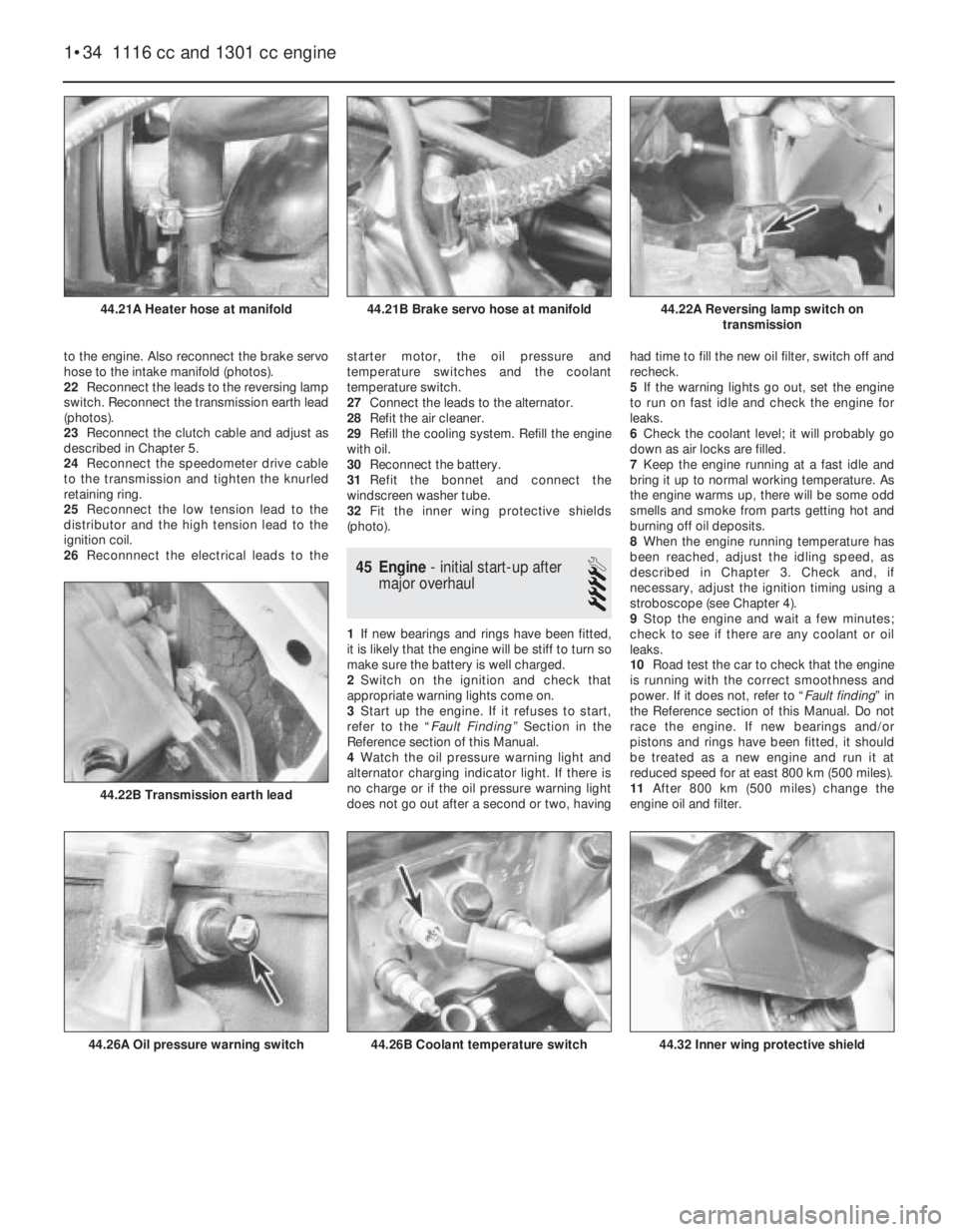
to the engine. Also reconnect the brake servo
hose to the intake manifold (photos).
22Reconnect the leads to the reversing lamp
switch. Reconnect the transmission earth lead
(photos).
23Reconnect the clutch cable and adjust as
described in Chapter 5.
24Reconnect the speedometer drive cable
to the transmission and tighten the knurled
retaining ring.
25Reconnect the low tension lead to the
distributor and the high tension lead to the
ignition coil.
26Reconnnect the electrical leads to thestarter motor, the oil pressure and
temperature switches and the coolant
temperature switch.
27Connect the leads to the alternator.
28Refit the air cleaner.
29Refill the cooling system. Refill the engine
with oil.
30Reconnect the battery.
31Refit the bonnet and connect the
windscreen washer tube.
32Fit the inner wing protective shields
(photo).
45 Engine- initial start-up after
major overhaul
4
1If new bearings and rings have been fitted,
it is likely that the engine will be stiff to turn so
make sure the battery is well charged.
2Switch on the ignition and check that
appropriate warning lights come on.
3Start up the engine. If it refuses to start,
refer to the “Fault Finding” Section in the
Reference section of this Manual.
4Watch the oil pressure warning light and
alternator charging indicator light. If there is
no charge or if the oil pressure warning light
does not go out after a second or two, havinghad time to fill the new oil filter, switch off and
recheck.
5If the warning lights go out, set the engine
to run on fast idle and check the engine for
leaks.
6Check the coolant level; it will probably go
down as air locks are filled.
7Keep the engine running at a fast idle and
bring it up to normal working temperature. As
the engine warms up, there will be some odd
smells and smoke from parts getting hot and
burning off oil deposits.
8When the engine running temperature has
been reached, adjust the idling speed, as
described in Chapter 3. Check and, if
necessary, adjust the ignition timing using a
stroboscope (see Chapter 4).
9Stop the engine and wait a few minutes;
check to see if there are any coolant or oil
leaks.
10Road test the car to check that the engine
is running with the correct smoothness and
power. If it does not, refer to “Fault finding” in
the Reference section of this Manual. Do not
race the engine. If new bearings and/or
pistons and rings have been fitted, it should
be treated as a new engine and run it at
reduced speed for at east 800 km (500 miles).
11After 800 km (500 miles) change the
engine oil and filter.
1•34 1116 cc and 1301 cc engine
44.32 Inner wing protective shield44.26B Coolant temperature switch44.26A Oil pressure warning switch
44.22B Transmission earth lead
44.22A Reversing lamp switch on
transmission44.21B Brake servo hose at manifold44.21A Heater hose at manifold
Page 49 of 303
Fault finding - all engines
Note: When investigating starting and uneven running faults, do not be tempted into snap diagnosis. Start from the beginning of the check
procedure and follow it through. It will take less time in the long run. Poor performance from an engine in terms of power and economy is not
normally diagnosed quickly. In any event, the ignition and fuel systems must be checked first before assuming any further investigation needs to
be made.
All engines 1•35
1
Engine fails to turn when starter operated
m mBattery discharged
m mBattery terminals loose or corroded
m mBattery earth to body defective
m mEngine/transmission earth strap broken or loose
m mDisconnected or broken wire in starter circuit
m mIgnition/starter switch defective
m mStarter motor or solenoid defective (see Chapter 9)
m mMajor mechanical failure (seizure) or long disuse (piston rings rusted
to bores)
Engine turns and fails to start
m mBattery discharged
m mBattery terminals loose or corroded
m mBattery or engine earth strap loose
m mStarter motor connections loose
m mOil in engine/transmission too thick
m mStarter motor defective
m mVapour lock in fuel line (in hot conditions or at high altitude)
m mBlocked float chamber needle valve
m mFuel pump filter blocked
m mChoked or blocked carburettor jets
m mFaulty fuel pump
m mFuel tank empty
m mOther fuel system fault (see Chapter 3)
m mShorted or disconnected low tension leads
m mDirty, incorrectly set, or pitted contact breaker points
m mContact breaker point spring earthed or broken
m mFaulty condenser
m mDefective ignition switch
m mFaulty coil
m mDamp or dirty HT leads, distributor cap or plug bodies
m mBroken, loose or disconnected LT leads
m mIgnition leads connected wrong way round
m mOther ignition fault (see Chapter 4)
m mValve timing incorrect (after rebuild)
Engine fires but will not run
m
mInsufficient choke (cold engine)
m mFuel starvation or tank empty
m mIgnition fault (see Chapter 4)
m mOther fuel system fault (see Chapter 3)
Engine stalls and will not restart
m
mToo much choke allowing too rich a mixture to wet plugs
m mFloat damaged or leaking or needle not seating
m mFloat lever incorrectly adjusted
m mIgnition failure - sudden
m mIgnition failure - misfiring precedes total stoppage
m mIgnition failure - in severe rain or after traversing water splash
m mNo petrol in petrol tank
m mPetrol tank breather choked
m mSudden obstruction in carburettor
m mWater in fuel system
Engine slow to warm up
m
mChoke linkage maladjusted
m mAir cleaner temperature control unit defective
m mThermostat stuck open (see Chapter 2)
m mOther fuel system fault (see Chapter 3)
Difficult starting when cold
m
mInsufficient choke
m mFouled or incorrectly gapped spark plugs
m mDamp or dirty HT leads, distributor cap or spark plug bodies
m mDirty or maladjusted contact breaker points
m mOther ignition fault or timing maladjustment (see Chapter 4)
m mFuel system or emission control fault (see Chapter 3)
m mPoor compression (may be due to incorrect valve clearances, burnt
or sticking valves, blown head gasket, worn or damaged pistons,
rings or bores)
m mIncorrect valve timing (after rebuild)
Difficult starting when hot
m
mIncorrect use of manual choke
m mFuel line vapour lock (especially in hot weather or at high altitudes)
m mIncorrect ignition timing
m mOther fuel system or emission control fault (see Chapter 3)
m mPoor compression (see above)
Engine lacks power
m
mIgnition timing incorrect
m mContact breaker points incorrectly gapped
m mIncorrectly set spark plugs
m mDirty contact breaker points
m mDistributor automatic advance and retard mechanisms not
functioning correctly
m mOther ignition system fault (see Chapter 4)
m mAir cleaner choked
m mCarburation too rich or too weak
m mFuel filter blocked
m mAir filter blocked
m mFaulty fuel pump giving top and fuel starvation
m mOther fuel system fault (see Chapter 3)
m mPoor compression
m mValve clearances incorrect
m mCarbon build-up in cylinder head
m mSticking or leaking valves
m mWeak or broken valve springs
m mWorn valve guides or stems
m mWorn pistons and piston rings
m mBurnt out valves
m mBlown cylinder head gasket (accompanied by increase in noise)
m mWorn pistons and piston rings
m mWorn or scored cylinder bore
m mBrakes binding
Engine misfires throughout speed range
m
mDefective or fouled spark plug
m mLoose, cracked or defective HT lead
m mMaladjusted, sticking or burnt valves
m mIgnition timing incorrect
m mBlown head gasket
m mFuel contaminated
m mOther ignition fault (see Chapter 4)
m mOther fuel system fault (see Chapter 3)
Poor engine braking
m
mHigh idle speed
m mOther fuel system fault (see Chapter 3)
m mLow compression
Page 50 of 303
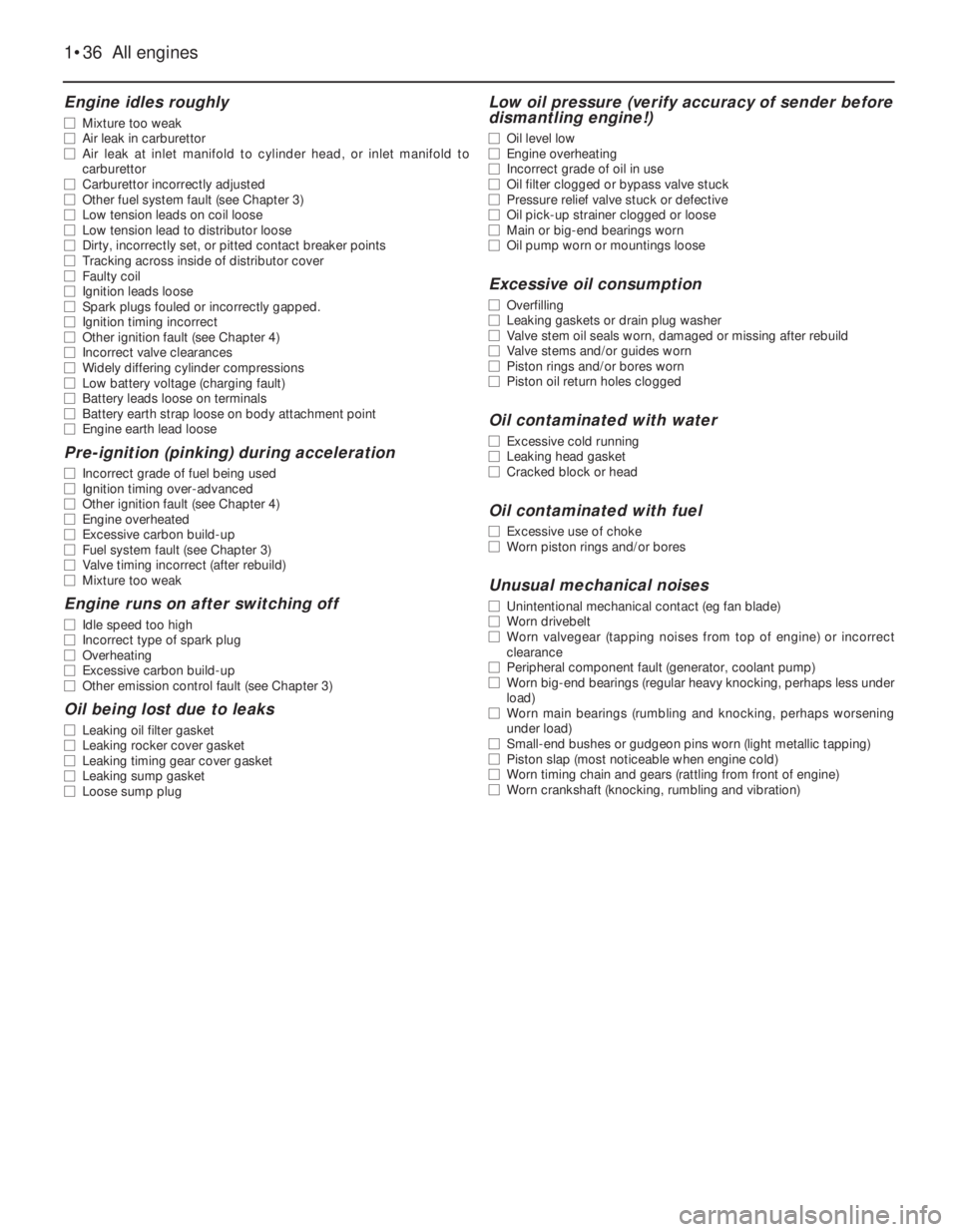
Engine idles roughly
m mMixture too weak
m mAir leak in carburettor
m mAir leak at inlet manifold to cylinder head, or inlet manifold to
carburettor
m mCarburettor incorrectly adjusted
m mOther fuel system fault (see Chapter 3)
m mLow tension leads on coil loose
m mLow tension lead to distributor loose
m mDirty, incorrectly set, or pitted contact breaker points
m mTracking across inside of distributor cover
m mFaulty coil
m mIgnition leads loose
m mSpark plugs fouled or incorrectly gapped.
m mIgnition timing incorrect
m mOther ignition fault (see Chapter 4)
m mIncorrect valve clearances
m mWidely differing cylinder compressions
m mLow battery voltage (charging fault)
m mBattery leads loose on terminals
m mBattery earth strap loose on body attachment point
m mEngine earth lead loose
Pre-ignition (pinking) during acceleration
m
mIncorrect grade of fuel being used
m mIgnition timing over-advanced
m mOther ignition fault (see Chapter 4)
m mEngine overheated
m mExcessive carbon build-up
m mFuel system fault (see Chapter 3)
m mValve timing incorrect (after rebuild)
m mMixture too weak
Engine runs on after switching off
m
mIdle speed too high
m mIncorrect type of spark plug
m mOverheating
m mExcessive carbon build-up
m mOther emission control fault (see Chapter 3)
Oil being lost due to leaks
m
mLeaking oil filter gasket
m mLeaking rocker cover gasket
m mLeaking timing gear cover gasket
m mLeaking sump gasket
m mLoose sump plug
Low oil pressure (verify accuracy of sender before
dismantling engine!)
m mOil level low
m mEngine overheating
m mIncorrect grade of oil in use
m mOil filter clogged or bypass valve stuck
m mPressure relief valve stuck or defective
m mOil pick-up strainer clogged or loose
m mMain or big-end bearings worn
m mOil pump worn or mountings loose
Excessive oil consumption
m
mOverfilling
m mLeaking gaskets or drain plug washer
m mValve stem oil seals worn, damaged or missing after rebuild
m mValve stems and/or guides worn
m mPiston rings and/or bores worn
m mPiston oil return holes clogged
Oil contaminated with water
m
mExcessive cold running
m mLeaking head gasket
m mCracked block or head
Oil contaminated with fuel
m
mExcessive use of choke
m mWorn piston rings and/or bores
Unusual mechanical noises
m
mUnintentional mechanical contact (eg fan blade)
m mWorn drivebelt
m mWorn valvegear (tapping noises from top of engine) or incorrect
clearance
m mPeripheral component fault (generator, coolant pump)
m mWorn big-end bearings (regular heavy knocking, perhaps less under
load)
m mWorn main bearings (rumbling and knocking, perhaps worsening
under load)
m mSmall-end bushes or gudgeon pins worn (light metallic tapping)
m mPiston slap (most noticeable when engine cold)
m mWorn timing chain and gears (rattling from front of engine)
m mWorn crankshaft (knocking, rumbling and vibration)
1•36 All engines
Page 53 of 303
inhibitor should be used. Again, a reputable
make giving full protection must be chosen
and renewed every two years. Inhibitors with
dyes are useful for finding leaks, and on some
makes the dye shows when the inhibiting
ability is finished.
4 Thermostat-
removal, testing and refitting
1
1The thermostat assembly is mounted on the
flywheel end of the cylinder block.
2Unfortunately, the thermostat/housing is a
complete unit and failure of the thermostat will
necessitate the purchase of the complete
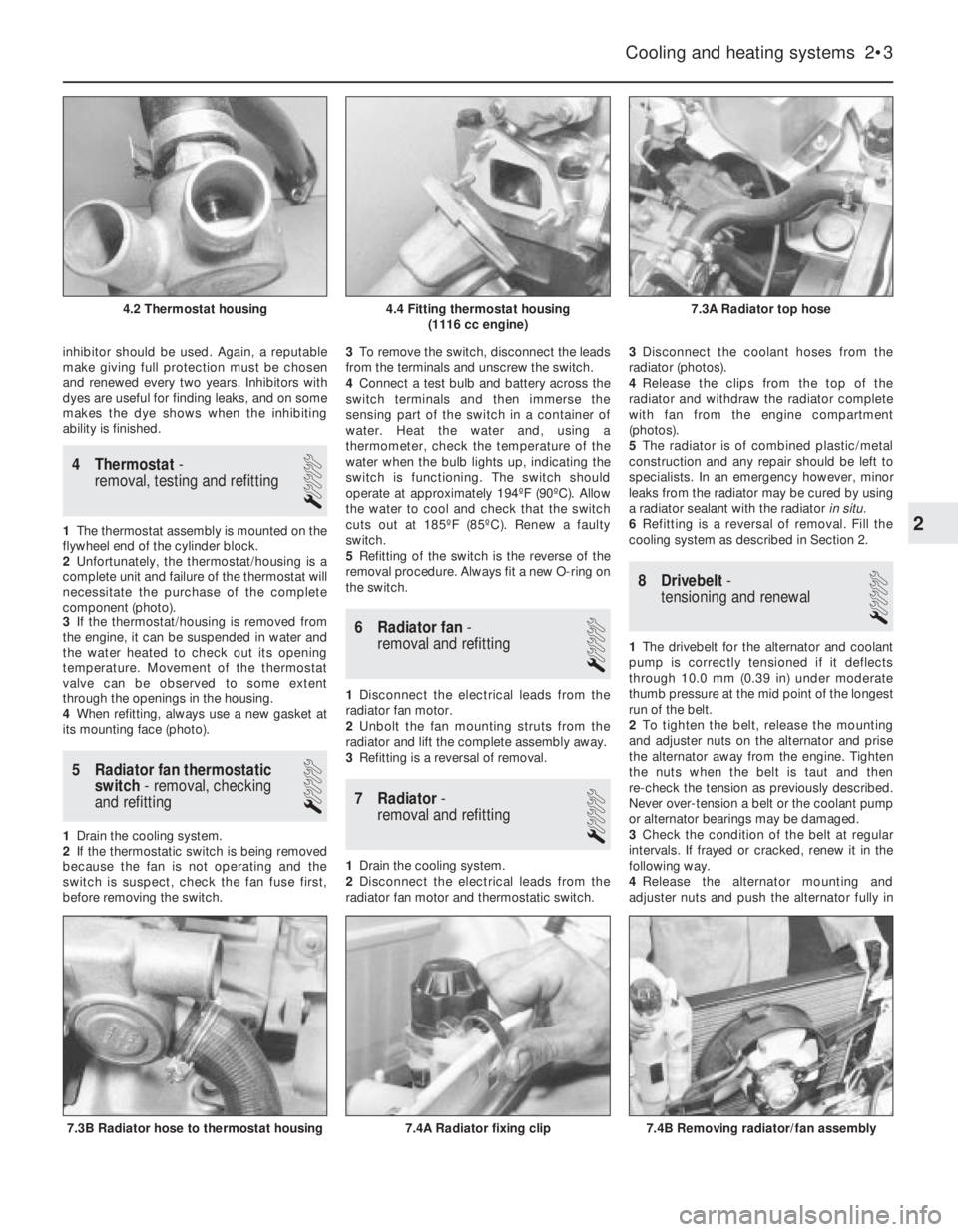
component (photo).
3If the thermostat/housing is removed from
the engine, it can be suspended in water and
the water heated to check out its opening
temperature. Movement of the thermostat
valve can be observed to some extent
through the openings in the housing.
4When refitting, always use a new gasket at
its mounting face (photo).
5 Radiator fan thermostatic
switch- removal, checking
and refitting
1
1Drain the cooling system.
2If the thermostatic switch is being removed
because the fan is not operating and the
switch is suspect, check the fan fuse first,
before removing the switch.3To remove the switch, disconnect the leads
from the terminals and unscrew the switch.
4Connect a test bulb and battery across the
switch terminals and then immerse the
sensing part of the switch in a container of
water. Heat the water and, using a
thermometer, check the temperature of the
water when the bulb lights up, indicating the
switch is functioning. The switch should
operate at approximately 194ºF (90ºC). Allow
the water to cool and check that the switch
cuts out at 185ºF (85ºC). Renew a faulty
switch.
5Refitting of the switch is the reverse of the
removal procedure. Always fit a new O-ring on
the switch.
6 Radiator fan-
removal and refitting
1
1Disconnect the electrical leads from the
radiator fan motor.
2Unbolt the fan mounting struts from the
radiator and lift the complete assembly away.
3Refitting is a reversal of removal.
7 Radiator-
removal and refitting
1
1Drain the cooling system.
2Disconnect the electrical leads from the
radiator fan motor and thermostatic switch.3Disconnect the coolant hoses from the
radiator (photos).
4Release the clips from the top of the
radiator and withdraw the radiator complete
with fan from the engine compartment
(photos).
5The radiator is of combined plastic/metal
construction and any repair should be left to
specialists. In an emergency however, minor
leaks from the radiator may be cured by using
a radiator sealant with the radiator in situ.
6Refitting is a reversal of removal. Fill the
cooling system as described in Section 2.
8 Drivebelt-
tensioning and renewal
1
1The drivebelt for the alternator and coolant
pump is correctly tensioned if it deflects
through 10.0 mm (0.39 in) under moderate
thumb pressure at the mid point of the longest
run of the belt.
2To tighten the belt, release the mounting
and adjuster nuts on the alternator and prise
the alternator away from the engine. Tighten
the nuts when the belt is taut and then
re-check the tension as previously described.
Never over-tension a belt or the coolant pump
or alternator bearings may be damaged.
3Check the condition of the belt at regular
intervals. If frayed or cracked, renew it in the
following way.
4Release the alternator mounting and
adjuster nuts and push the alternator fully in
Cooling and heating systems 2•3
7.3A Radiator top hose4.4 Fitting thermostat housing
(1116 cc engine)4.2 Thermostat housing
7.4B Removing radiator/fan assembly7.4A Radiator fixing clip7.3B Radiator hose to thermostat housing
2
Page 72 of 303
4
System type
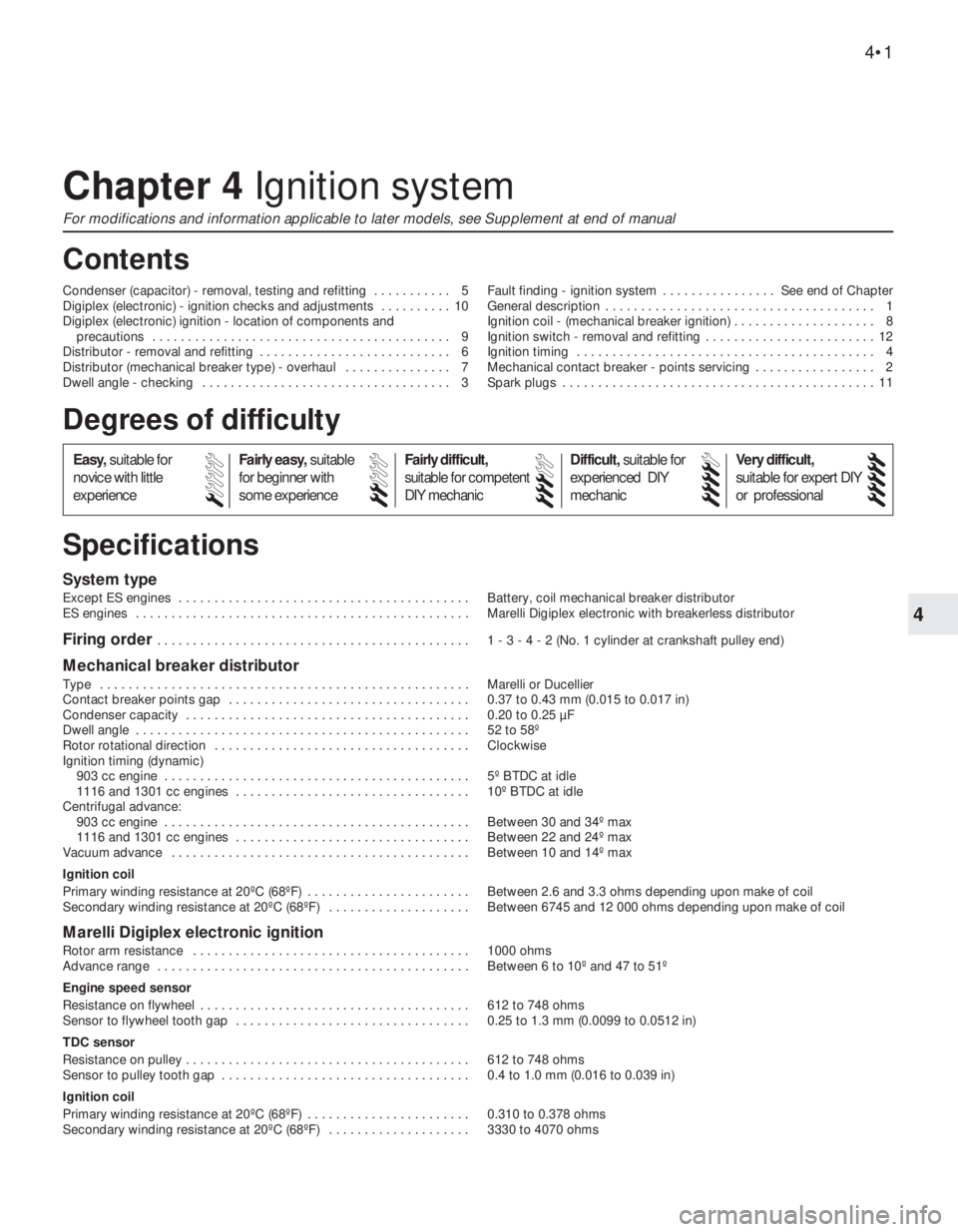
Except ES engines . . . . . . . . . . . . . . . . . . . . . . . . . . . . . . . . . . . . . . . . . Battery, coil mechanical breaker distributor
ES engines . . . . . . . . . . . . . . . . . . . . . . . . . . . . . . . . . . . . . . . . . . . . . . . Marelli Digiplex electronic with breakerless distributor
Firing order . . . . . . . . . . . . . . . . . . . . . . . . . . . . . . . . . . . . . . . . . . . . 1 - 3 - 4 - 2 (No. 1 cylinder at crankshaft pulley end)
Mechanical breaker distributor
Type . . . . . . . . . . . . . . . . . . . . . . . . . . . . . . . . . . . . . . . . . . . . . . . . . . . . Marelli or Ducellier
Contact breaker points gap . . . . . . . . . . . . . . . . . . . . . . . . . . . . . . . . . . 0.37 to 0.43 mm (0.015 to 0.017 in)
Condenser capacity . . . . . . . . . . . . . . . . . . . . . . . . . . . . . . . . . . . . . . . . 0.20 to 0.25 µF
Dwell angle . . . . . . . . . . . . . . . . . . . . . . . . . . . . . . . . . . . . . . . . . . . . . . . 52 to 58º
Rotor rotational direction . . . . . . . . . . . . . . . . . . . . . . . . . . . . . . . . . . . . Clockwise
Ignition timing (dynamic)
903 cc engine . . . . . . . . . . . . . . . . . . . . . . . . . . . . . . . . . . . . . . . . . . . 5º BTDC at idle
1116 and 1301 cc engines . . . . . . . . . . . . . . . . . . . . . . . . . . . . . . . . . 10º BTDC at idle
Centrifugal advance:
903 cc engine . . . . . . . . . . . . . . . . . . . . . . . . . . . . . . . . . . . . . . . . . . . Between 30 and 34º max
1116 and 1301 cc engines . . . . . . . . . . . . . . . . . . . . . . . . . . . . . . . . . Between 22 and 24º max
Vacuum advance . . . . . . . . . . . . . . . . . . . . . . . . . . . . . . . . . . . . . . . . . . Between 10 and 14º max
Ignition coil
Primary winding resistance at 20ºC (68ºF) . . . . . . . . . . . . . . . . . . . . . . . Between 2.6 and 3.3 ohms depending upon make of coil
Secondary winding resistance at 20ºC (68ºF) . . . . . . . . . . . . . . . . . . . . Between 6745 and 12 000 ohms depending upon make of coil
Marelli Digiplex electronic ignition
Rotor arm resistance . . . . . . . . . . . . . . . . . . . . . . . . . . . . . . . . . . . . . . . 1000 ohms
Advance range . . . . . . . . . . . . . . . . . . . . . . . . . . . . . . . . . . . . . . . . . . . . Between 6 to 10º and 47 to 51º
Engine speed sensor
Resistance on flywheel . . . . . . . . . . . . . . . . . . . . . . . . . . . . . . . . . . . . . . 612 to 748 ohms
Sensor to flywheel tooth gap . . . . . . . . . . . . . . . . . . . . . . . . . . . . . . . . . 0.25 to 1.3 mm (0.0099 to 0.0512 in)
TDC sensor
Resistance on pulley . . . . . . . . . . . . . . . . . . . . . . . . . . . . . . . . . . . . . . . . 612 to 748 ohms
Sensor to pulley tooth gap . . . . . . . . . . . . . . . . . . . . . . . . . . . . . . . . . . . 0.4 to 1.0 mm (0.016 to 0.039 in)
Ignition coil
Primary winding resistance at 20ºC (68ºF) . . . . . . . . . . . . . . . . . . . . . . . 0.310 to 0.378 ohms
Secondary winding resistance at 20ºC (68ºF) . . . . . . . . . . . . . . . . . . . . 3330 to 4070 ohms
Chapter 4 Ignition system
For modifications and information applicable to later models, see Supplement at end of manual
Condenser (capacitor) - removal, testing and refitting . . . . . . . . . . . 5
Digiplex (electronic) - ignition checks and adjustments . . . . . . . . . . 10
Digiplex (electronic) ignition - location of components and
precautions . . . . . . . . . . . . . . . . . . . . . . . . . . . . . . . . . . . . . . . . . . 9
Distributor - removal and refitting . . . . . . . . . . . . . . . . . . . . . . . . . . . 6
Distributor (mechanical breaker type) - overhaul . . . . . . . . . . . . . . . 7
Dwell angle - checking . . . . . . . . . . . . . . . . . . . . . . . . . . . . . . . . . . . 3Fault finding - ignition system . . . . . . . . . . . . . . . . See end of Chapter
General description . . . . . . . . . . . . . . . . . . . . . . . . . . . . . . . . . . . . . . 1
Ignition coil - (mechanical breaker ignition) . . . . . . . . . . . . . . . . . . . . 8
Ignition switch - removal and refitting . . . . . . . . . . . . . . . . . . . . . . . . 12
Ignition timing . . . . . . . . . . . . . . . . . . . . . . . . . . . . . . . . . . . . . . . . . . 4
Mechanical contact breaker - points servicing . . . . . . . . . . . . . . . . . 2
Spark plugs . . . . . . . . . . . . . . . . . . . . . . . . . . . . . . . . . . . . . . . . . . . . 11
4•1
Specifications Contents
Easy,suitable for
novice with little
experienceFairly easy,suitable
for beginner with
some experienceFairly difficult,
suitable for competent
DIY mechanic
Difficult,suitable for
experienced DIY
mechanicVery difficult,
suitable for expert DIY
or professional
Degrees of difficulty
54321
Page 73 of 303
Spark plugs
Type . . . . . . . . . . . . . . . . . . . . . . . . . . . . . . . . . . . . . . . . . . . . . . . . . . . . Champion RN9YCC or RN9YC
Electrode gap . . . . . . . . . . . . . . . . . . . . . . . . . . . . . . . . . . . . . . . . . . . . . 0.8 mm (0.031 in)
HT leads
903 cc (45) . . . . . . . . . . . . . . . . . . . . . . . . . . . . . . . . . . . . . . . . . . . . . . . Champion LS-07
1116, 1299 and 1301 cc (55, 60 and 70) . . . . . . . . . . . . . . . . . . . . . . . . Champion LS-05
Torque wrench settingNm lbf ft
Spark plugs . . . . . . . . . . . . . . . . . . . . . . . . . . . . . . . . . . . . . . . . . . . . . . . 25 18
4•2 Ignition system
1 General description
On all models except the 903 ES engine
version, a mechanical contact breaker type
distributor is fitted.
On 45 Super ES models which have the
903 ES engine, an electronic (Digiplex) ignition
system is used which incorporates a
breakerless distributor.
Mechanical contact breaker
system
For the engine to run correctly, it is
necessary for an electrical spark to ignite the
fuel/air mixture in the combustion chamber at
exactly the right moment in relation to engine
speed and load. The ignition system is based
on feeding low tension voltage from the
battery to the coil where it is converted to high
tension voltage. The high tension voltage is
powerful enough to jump the spark plug gap
in the cylinders under high compression
pressures, providing that the system is in
good condition and that all adjustments are
correct.
The ignition system is divided into two
circuits, the low tension (LT) circuit and the
high tension (HT) circuit.
The low tension (sometimes known as the
primary) circuit consists of the battery, the
lead to the ignition switch, the lead from the
ignition switch to the low tension or primary
coil windings, and the lead from the low
tension coil windings to the contact breaker
points and condenser in the distributor.
The high tension circuit consists of the high
tension or secondary coil windings, the heavy
ignition lead from the centre of the coil to the
centre of the distributor cap, the rotor arm,
and the spark plug leads and spark plugs.
The system functions in the following
manner: High tension voltage is generated in
the coil by the interruption of the low tension
circuit. The interruption is effected by the
opening of the contact breaker points in this
low tension circuit. High tension voltage is fed
from the centre of the coil via the carbon
brush in the centre of the distributor cap to
the rotor arm of the distributor.
The rotor arm revolves at half engine speed
inside the distributor cap, and each time it
comes in line with one of the four metal
segments in the cap, which are connected to
the spark plug leads, the opening of thecontact breaker points causes the high
tension voltage to build up, jump the gap from
the rotor arm to the appropriate metal
segment, and so via the spark plug lead to the
spark plug, where it finally jumps the spark
plug gap before going to earth.
The ignition timing is advanced and
retarded automatically, to ensure the sparkoccurs at just the right instant for the
particular load at the prevailing engine speed.
The ignition advance is controlled
mechanically, and by vacuum. The
mechanical governor mechanism consists of
two weights, which move out from the
distributor shaft as the engine speed rises,
due to centrifugal force. As they move
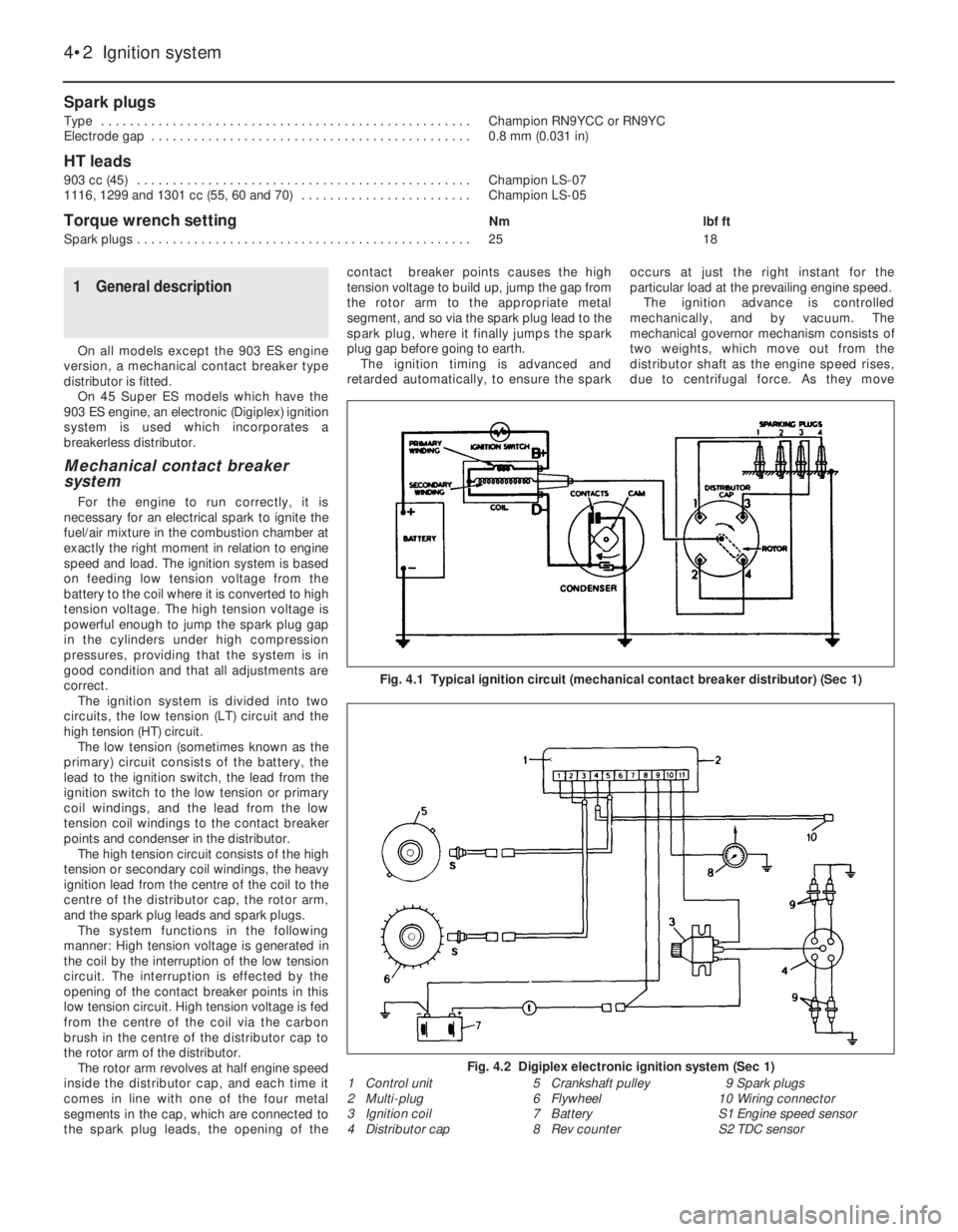
Fig. 4.1 Typical ignition circuit (mechanical contact breaker distributor) (Sec 1)
1 Control unit
2 Multi-plug
3 Ignition coil
4 Distributor cap5 Crankshaft pulley
6 Flywheel
7 Battery
8 Rev counter9 Spark plugs
10 Wiring connector
S1 Engine speed sensor
S2 TDC sensor
Fig. 4.2 Digiplex electronic ignition system (Sec 1)
Page 78 of 303
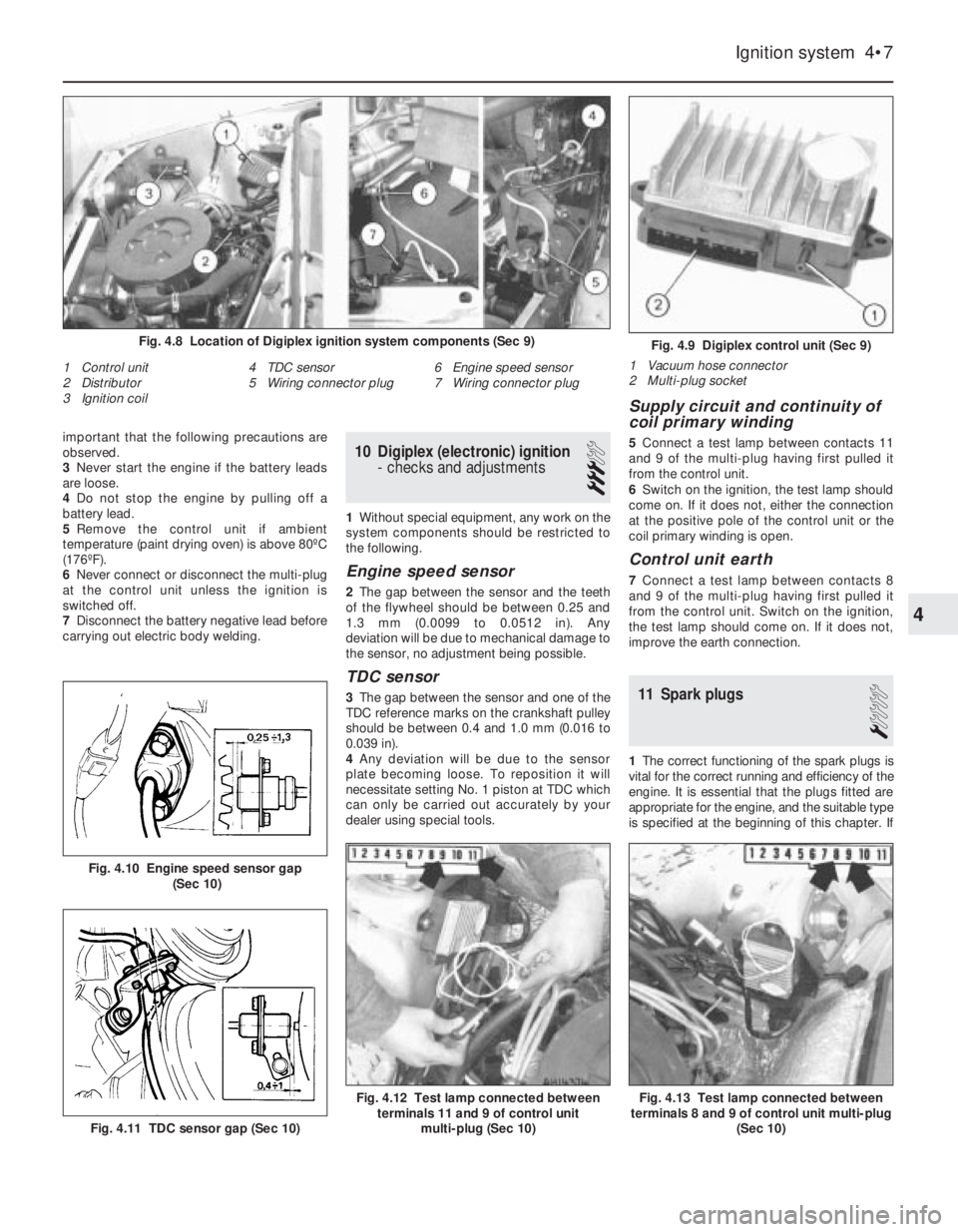
important that the following precautions are
observed.
3Never start the engine if the battery leads
are loose.
4Do not stop the engine by pulling off a
battery lead.
5Remove the control unit if ambient
temperature (paint drying oven) is above 80ºC
(176ºF).
6Never connect or disconnect the multi-plug
at the control unit unless the ignition is
switched off.
7Disconnect the battery negative lead before
carrying out electric body welding.10 Digiplex (electronic) ignition
- checks and adjustments
3
1Without special equipment, any work on the
system components should be restricted to
the following.
Engine speed sensor
2The gap between the sensor and the teeth
of the flywheel should be between 0.25 and
1.3 mm (0.0099 to 0.0512 in). Any
deviation will be due to mechanical damage to
the sensor, no adjustment being possible.
TDC sensor
3The gap between the sensor and one of the
TDC reference marks on the crankshaft pulley
should be between 0.4 and 1.0 mm (0.016 to
0.039 in).
4Any deviation will be due to the sensor
plate becoming loose. To reposition it will
necessitate setting No. 1 piston at TDC which
can only be carried out accurately by your
dealer using special tools.
Supply circuit and continuity of
coil primary winding
5Connect a test lamp between contacts 11
and 9 of the multi-plug having first pulled it
from the control unit.
6Switch on the ignition, the test lamp should
come on. If it does not, either the connection
at the positive pole of the control unit or the
coil primary winding is open.
Control unit earth
7Connect a test lamp between contacts 8
and 9 of the multi-plug having first pulled it
from the control unit. Switch on the ignition,
the test lamp should come on. If it does not,
improve the earth connection.
11 Spark plugs
1
1The correct functioning of the spark plugs is
vital for the correct running and efficiency of the
engine. It is essential that the plugs fitted are
appropriate for the engine, and the suitable type
is specified at the beginning of this chapter. If
Ignition system 4•7
Fig. 4.9 Digiplex control unit (Sec 9)
1 Vacuum hose connector
2 Multi-plug socket
1 Control unit
2 Distributor
3 Ignition coil4 TDC sensor
5 Wiring connector plug6 Engine speed sensor
7 Wiring connector plug
Fig. 4.8 Location of Digiplex ignition system components (Sec 9)
Fig. 4.13 Test lamp connected between
terminals 8 and 9 of control unit multi-plug
(Sec 10)Fig. 4.12 Test lamp connected between
terminals 11 and 9 of control unit
multi-plug (Sec 10)
Fig. 4.11 TDC sensor gap (Sec 10)
Fig. 4.10 Engine speed sensor gap
(Sec 10)
4
Page 79 of 303
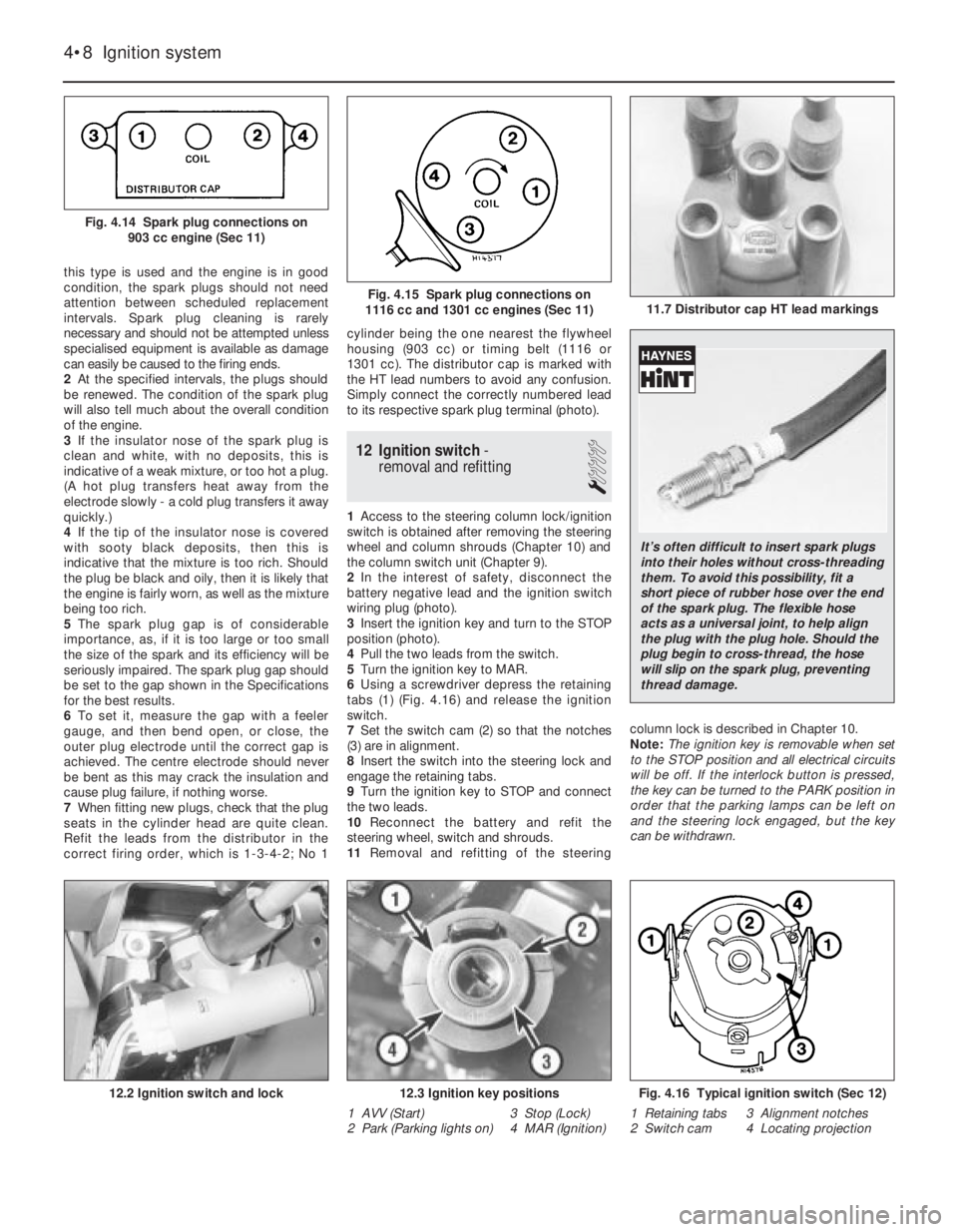
this type is used and the engine is in good
condition, the spark plugs should not need
attention between scheduled replacement
intervals. Spark plug cleaning is rarely
necessary and should not be attempted unless
specialised equipment is available as damage
can easily be caused to the firing ends.
2At the specified intervals, the plugs should
be renewed. The condition of the spark plug
will also tell much about the overall condition
of the engine.
3If the insulator nose of the spark plug is
clean and white, with no deposits, this is
indicative of a weak mixture, or too hot a plug.
(A hot plug transfers heat away from the
electrode slowly - a cold plug transfers it away
quickly.)
4If the tip of the insulator nose is covered
with sooty black deposits, then this is
indicative that the mixture is too rich. Should
the plug be black and oily, then it is likely that
the engine is fairly worn, as well as the mixture
being too rich.
5The spark plug gap is of considerable
importance, as, if it is too large or too small
the size of the spark and its efficiency will be
seriously impaired. The spark plug gap should
be set to the gap shown in the Specifications
for the best results.
6To set it, measure the gap with a feeler
gauge, and then bend open, or close, the
outer plug electrode until the correct gap is
achieved. The centre electrode should never
be bent as this may crack the insulation and
cause plug failure, if nothing worse.
7When fitting new plugs, check that the plug
seats in the cylinder head are quite clean.
Refit the leads from the distributor in the
correct firing order, which is 1-3-4-2; No 1cylinder being the one nearest the flywheel
housing (903 cc) or timing belt (1116 or
1301 cc). The distributor cap is marked with
the HT lead numbers to avoid any confusion.
Simply connect the correctly numbered lead
to its respective spark plug terminal (photo).
12 Ignition switch-
removal and refitting
1
1Access to the steering column lock/ignition
switch is obtained after removing the steering
wheel and column shrouds (Chapter 10) and
the column switch unit (Chapter 9).
2In the interest of safety, disconnect the
battery negative lead and the ignition switch
wiring plug (photo).
3Insert the ignition key and turn to the STOP
position (photo).
4Pull the two leads from the switch.
5Turn the ignition key to MAR.
6Using a screwdriver depress the retaining
tabs (1) (Fig. 4.16) and release the ignition
switch.
7Set the switch cam (2) so that the notches
(3) are in alignment.
8Insert the switch into the steering lock and
engage the retaining tabs.
9Turn the ignition key to STOP and connect
the two leads.
10Reconnect the battery and refit the
steering wheel, switch and shrouds.
11Removal and refitting of the steeringcolumn lock is described in Chapter 10.
Note: The ignition key is removable when set
to the STOP position and all electrical circuits
will be off. If the interlock button is pressed,
the key can be turned to the PARK position in
order that the parking lamps can be left on
and the steering lock engaged, but the key
can be withdrawn.
4•8 Ignition system
Fig. 4.16 Typical ignition switch (Sec 12)
1 Retaining tabs 3 Alignment notches
2 Switch cam 4 Locating projection12.3 Ignition key positions
1 AVV (Start) 3 Stop (Lock)
2 Park (Parking lights on) 4 MAR (Ignition)12.2 Ignition switch and lock
11.7 Distributor cap HT lead markingsFig. 4.15 Spark plug connections on
1116 cc and 1301 cc engines (Sec 11)
Fig. 4.14 Spark plug connections on
903 cc engine (Sec 11)
It’s often difficult to insert spark plugs
into their holes without cross-threading
them. To avoid this possibility, fit a
short piece of rubber hose over the end
of the spark plug. The flexible hose
acts as a universal joint, to help align
the plug with the plug hole. Should the
plug begin to cross-thread, the hose
will slip on the spark plug, preventing
thread damage.