auxiliary battery FIAT UNO 1983 Service Repair Manual
[x] Cancel search | Manufacturer: FIAT, Model Year: 1983, Model line: UNO, Model: FIAT UNO 1983Pages: 303, PDF Size: 10.36 MB
Page 38 of 303
5In practice, if several shims have to be
changed, they can often be interchanged, so
avoiding the necessity of having to buy more
new shims than is necessary.
6If more than two or three valve clearances
are found to be incorrect, it will be more
convenient to remove the camshaft carrier for
easier removal of the shims.
7Where no clearance can be measured, even
with the thinnest available shim in position,
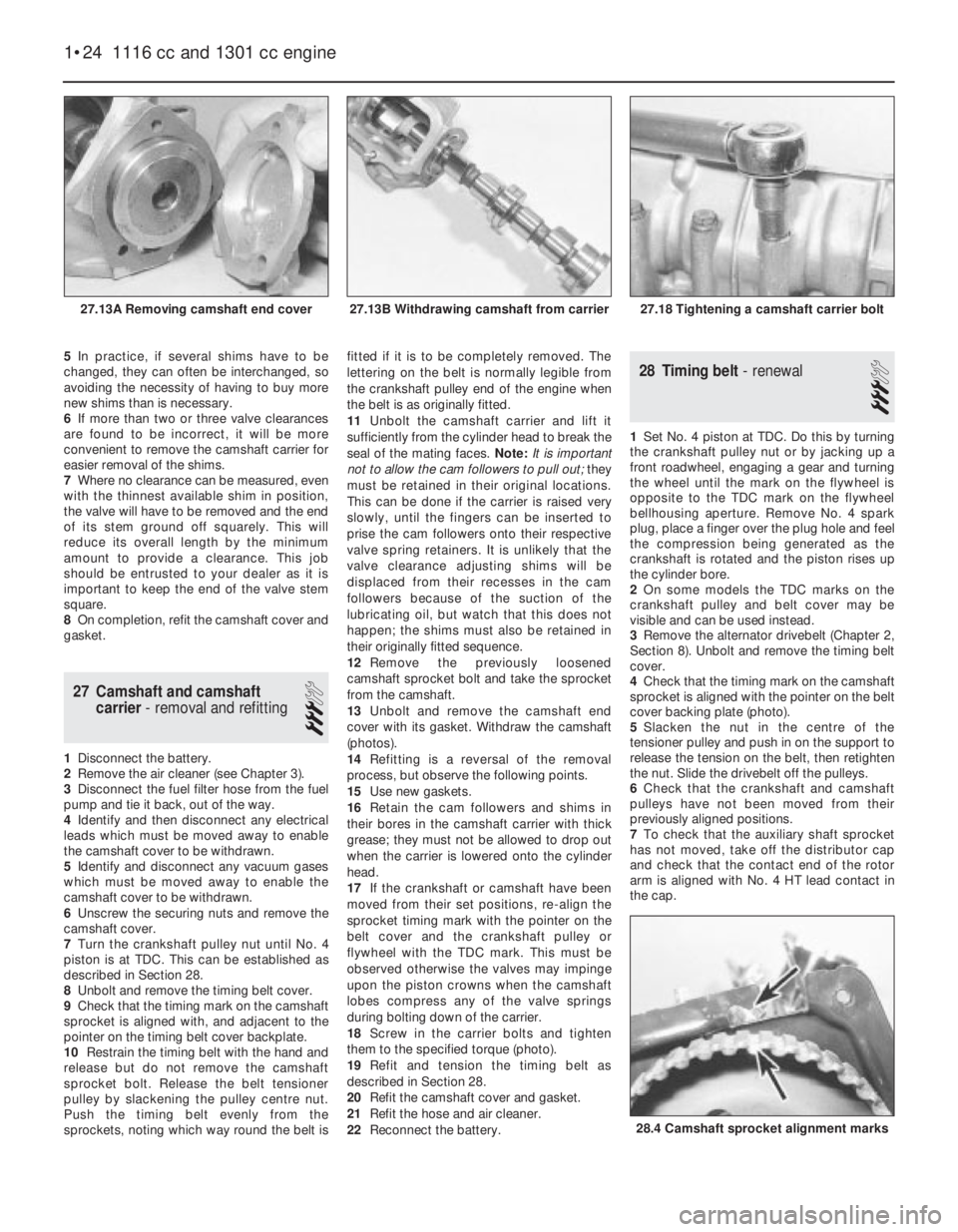
the valve will have to be removed and the end
of its stem ground off squarely. This will
reduce its overall length by the minimum
amount to provide a clearance. This job
should be entrusted to your dealer as it is
important to keep the end of the valve stem
square.
8On completion, refit the camshaft cover and
gasket.
27 Camshaft and camshaft
carrier- removal and refitting
3
1Disconnect the battery.
2Remove the air cleaner (see Chapter 3).
3Disconnect the fuel filter hose from the fuel
pump and tie it back, out of the way.
4Identify and then disconnect any electrical
leads which must be moved away to enable
the camshaft cover to be withdrawn.
5Identify and disconnect any vacuum gases
which must be moved away to enable the
camshaft cover to be withdrawn.
6Unscrew the securing nuts and remove the
camshaft cover.
7Turn the crankshaft pulley nut until No. 4
piston is at TDC. This can be established as
described in Section 28.
8Unbolt and remove the timing belt cover.
9Check that the timing mark on the camshaft
sprocket is aligned with, and adjacent to the
pointer on the timing belt cover backplate.
10Restrain the timing belt with the hand and
release but do not remove the camshaft
sprocket bolt. Release the belt tensioner
pulley by slackening the pulley centre nut.
Push the timing belt evenly from the
sprockets, noting which way round the belt isfitted if it is to be completely removed. The
lettering on the belt is normally legible from
the crankshaft pulley end of the engine when
the belt is as originally fitted.
11Unbolt the camshaft carrier and lift it
sufficiently from the cylinder head to break the
seal of the mating faces. Note: It is important
not to allow the cam followers to pull out; they
must be retained in their original locations.
This can be done if the carrier is raised very
slowly, until the fingers can be inserted to
prise the cam followers onto their respective
valve spring retainers. It is unlikely that the
valve clearance adjusting shims will be
displaced from their recesses in the cam
followers because of the suction of the
lubricating oil, but watch that this does not
happen; the shims must also be retained in
their originally fitted sequence.
12Remove the previously loosened
camshaft sprocket bolt and take the sprocket
from the camshaft.
13Unbolt and remove the camshaft end
cover with its gasket. Withdraw the camshaft
(photos).
14Refitting is a reversal of the removal
process, but observe the following points.
15Use new gaskets.
16Retain the cam followers and shims in
their bores in the camshaft carrier with thick
grease; they must not be allowed to drop out
when the carrier is lowered onto the cylinder
head.
17If the crankshaft or camshaft have been
moved from their set positions, re-align the
sprocket timing mark with the pointer on the
belt cover and the crankshaft pulley or
flywheel with the TDC mark. This must be
observed otherwise the valves may impinge
upon the piston crowns when the camshaft
lobes compress any of the valve springs
during bolting down of the carrier.
18Screw in the carrier bolts and tighten
them to the specified torque (photo).
19Refit and tension the timing belt as
described in Section 28.
20Refit the camshaft cover and gasket.
21Refit the hose and air cleaner.
22Reconnect the battery.
28 Timing belt- renewal
3
1Set No. 4 piston at TDC. Do this by turning
the crankshaft pulley nut or by jacking up a
front roadwheel, engaging a gear and turning
the wheel until the mark on the flywheel is
opposite to the TDC mark on the flywheel
bellhousing aperture. Remove No. 4 spark
plug, place a finger over the plug hole and feel
the compression being generated as the
crankshaft is rotated and the piston rises up
the cylinder bore.
2On some models the TDC marks on the
crankshaft pulley and belt cover may be
visible and can be used instead.
3Remove the alternator drivebelt (Chapter 2,
Section 8). Unbolt and remove the timing belt
cover.
4Check that the timing mark on the camshaft
sprocket is aligned with the pointer on the belt
cover backing plate (photo).
5Slacken the nut in the centre of the
tensioner pulley and push in on the support to
release the tension on the belt, then retighten
the nut. Slide the drivebelt off the pulleys.
6Check that the crankshaft and camshaft
pulleys have not been moved from their
previously aligned positions.
7To check that the auxiliary shaft sprocket
has not moved, take off the distributor cap
and check that the contact end of the rotor
arm is aligned with No. 4 HT lead contact in
the cap.
1•24 1116 cc and 1301 cc engine
28.4 Camshaft sprocket alignment marks
27.18 Tightening a camshaft carrier bolt27.13B Withdrawing camshaft from carrier27.13A Removing camshaft end cover
Page 39 of 303
8Fit the new belt. Start at the crankshaft
drive pulley and, taking care not to kink or
strain the belt, slip it over the camshaft pulley.
The camshaft may have to be turned slightly
to mesh the pulley with the teeth on the belt.
Fit the belt on the tensioner pulley last; if this
is difficult, do not lever or force the belt on,
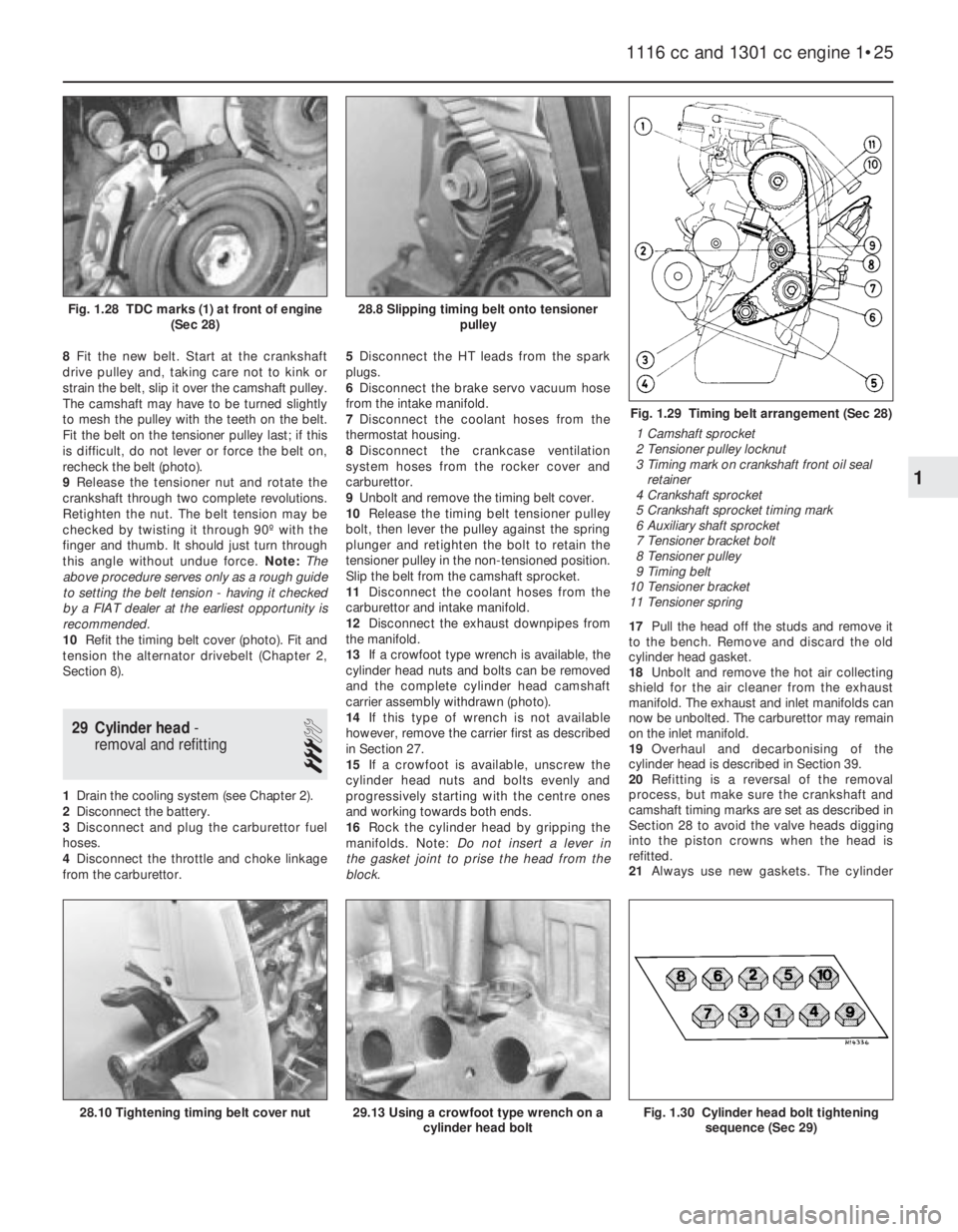
recheck the belt (photo).
9Release the tensioner nut and rotate the
crankshaft through two complete revolutions.
Retighten the nut. The belt tension may be
checked by twisting it through 90º with the
finger and thumb. It should just turn through
this angle without undue force. Note: The
above procedure serves only as a rough guide
to setting the belt tension - having it checked
by a FIAT dealer at the earliest opportunity is
recommended.
10Refit the timing belt cover (photo). Fit and
tension the alternator drivebelt (Chapter 2,
Section 8).
29 Cylinder head-
removal and refitting
3
1Drain the cooling system (see Chapter 2).
2Disconnect the battery.
3Disconnect and plug the carburettor fuel
hoses.
4Disconnect the throttle and choke linkage
from the carburettor. 5Disconnect the HT leads from the spark
plugs.
6Disconnect the brake servo vacuum hose
from the intake manifold.
7Disconnect the coolant hoses from the
thermostat housing.
8Disconnect the crankcase ventilation
system hoses from the rocker cover and
carburettor.
9Unbolt and remove the timing belt cover.
10Release the timing belt tensioner pulley
bolt, then lever the pulley against the spring
plunger and retighten the bolt to retain the
tensioner pulley in the non-tensioned position.
Slip the belt from the camshaft sprocket.
11Disconnect the coolant hoses from the
carburettor and intake manifold.
12Disconnect the exhaust downpipes from
the manifold.
13If a crowfoot type wrench is available, the
cylinder head nuts and bolts can be removed
and the complete cylinder head camshaft
carrier assembly withdrawn (photo).
14If this type of wrench is not available
however, remove the carrier first as described
in Section 27.
15If a crowfoot is available, unscrew the
cylinder head nuts and bolts evenly and
progressively starting with the centre ones
and working towards both ends.
16Rock the cylinder head by gripping the
manifolds. Note: Do not insert a lever in
the gasket joint to prise the head from the
block.17Pull the head off the studs and remove it
to the bench. Remove and discard the old
cylinder head gasket.
18Unbolt and remove the hot air collecting
shield for the air cleaner from the exhaust
manifold. The exhaust and inlet manifolds can
now be unbolted. The carburettor may remain
on the inlet manifold.
19Overhaul and decarbonising of the
cylinder head is described in Section 39.
20Refitting is a reversal of the removal
process, but make sure the crankshaft and
camshaft timing marks are set as described in
Section 28 to avoid the valve heads digging
into the piston crowns when the head is
refitted.
21Always use new gaskets. The cylinder
1116 cc and 1301 cc engine 1•25
Fig. 1.29 Timing belt arrangement (Sec 28)
1 Camshaft sprocket
2 Tensioner pulley locknut
3 Timing mark on crankshaft front oil seal
retainer
4 Crankshaft sprocket
5 Crankshaft sprocket timing mark
6 Auxiliary shaft sprocket
7 Tensioner bracket bolt
8 Tensioner pulley
9 Timing belt
10 Tensioner bracket
11 Tensioner spring
28.8 Slipping timing belt onto tensioner
pulleyFig. 1.28 TDC marks (1) at front of engine
(Sec 28)
Fig. 1.30 Cylinder head bolt tightening
sequence (Sec 29)28.10 Tightening timing belt cover nut29.13 Using a crowfoot type wrench on a
cylinder head bolt
1
Page 40 of 303
head gasket must be fitted (ALTO visible) so
that the oil pressure hole in the block is
central in the copper ringed cut-out in the
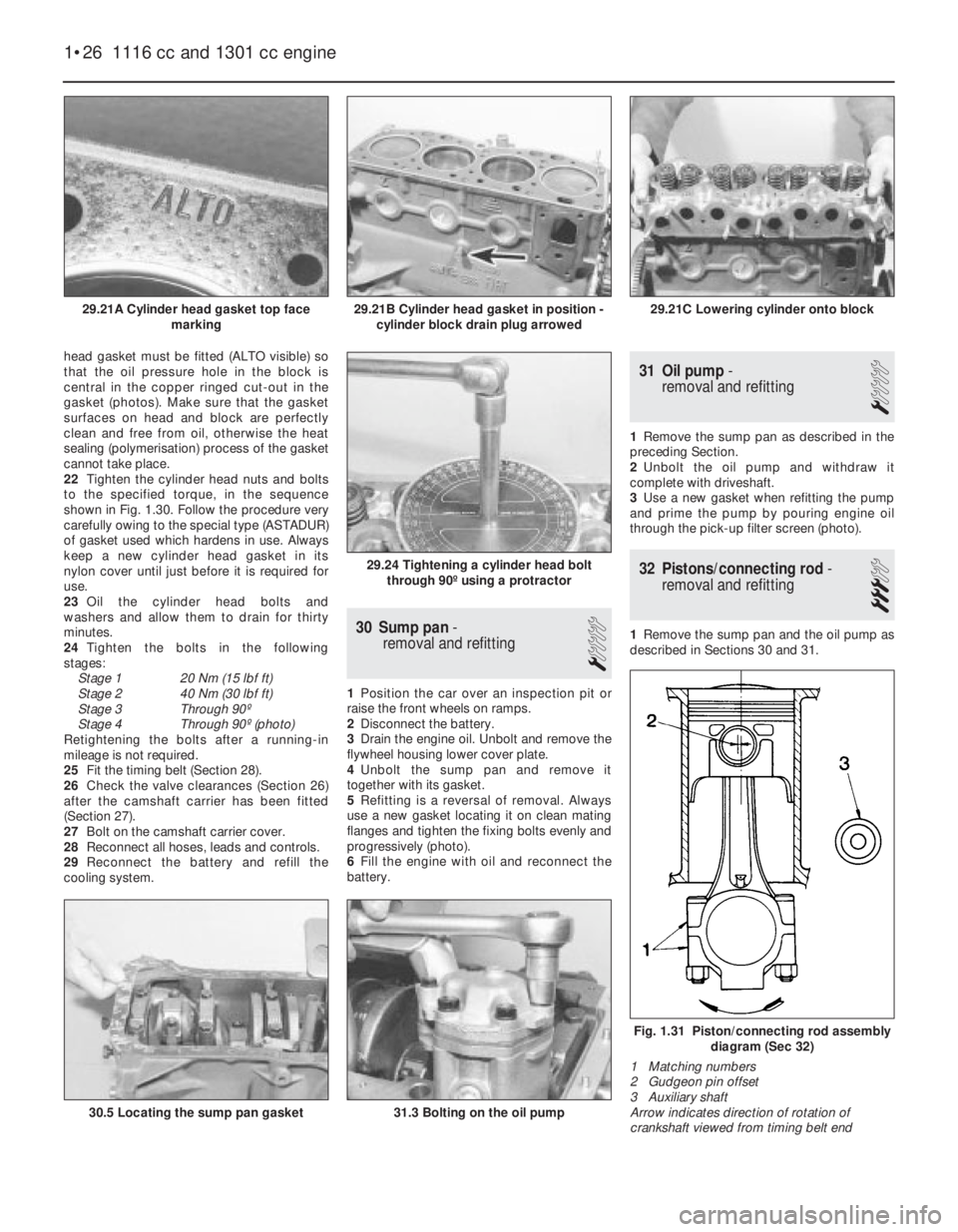
gasket (photos). Make sure that the gasket
surfaces on head and block are perfectly
clean and free from oil, otherwise the heat
sealing (polymerisation) process of the gasket
cannot take place.
22Tighten the cylinder head nuts and bolts
to the specified torque, in the sequence
shown in Fig. 1.30. Follow the procedure very
carefully owing to the special type (ASTADUR)
of gasket used which hardens in use. Always
keep a new cylinder head gasket in its
nylon cover until just before it is required for
use.
23Oil the cylinder head bolts and
washers and allow them to drain for thirty
minutes.
24Tighten the bolts in the following
stages:
Stage 1 20 Nm (15 lbf ft)
Stage 2 40 Nm (30 lbf ft)
Stage 3 Through 90º
Stage 4 Through 90º (photo)
Retightening the bolts after a running-in
mileage is not required.
25Fit the timing belt (Section 28).
26Check the valve clearances (Section 26)
after the camshaft carrier has been fitted
(Section 27).
27Bolt on the camshaft carrier cover.
28Reconnect all hoses, leads and controls.
29Reconnect the battery and refill the
cooling system.
30 Sump pan-
removal and refitting
1
1Position the car over an inspection pit or
raise the front wheels on ramps.
2Disconnect the battery.
3Drain the engine oil. Unbolt and remove the
flywheel housing lower cover plate.
4Unbolt the sump pan and remove it
together with its gasket.
5Refitting is a reversal of removal. Always
use a new gasket locating it on clean mating
flanges and tighten the fixing bolts evenly and
progressively (photo).
6Fill the engine with oil and reconnect the
battery.
31 Oil pump-
removal and refitting
1
1Remove the sump pan as described in the
preceding Section.
2Unbolt the oil pump and withdraw it
complete with driveshaft.
3Use a new gasket when refitting the pump
and prime the pump by pouring engine oil
through the pick-up filter screen (photo).
32 Pistons/connecting rod-
removal and refitting
3
1Remove the sump pan and the oil pump as
described in Sections 30 and 31.
1•26 1116 cc and 1301 cc engine
Fig. 1.31 Piston/connecting rod assembly
diagram (Sec 32)
1 Matching numbers
2 Gudgeon pin offset
3 Auxiliary shaft
Arrow indicates direction of rotation of
crankshaft viewed from timing belt end
29.24 Tightening a cylinder head bolt
through 90º using a protractor
31.3 Bolting on the oil pump30.5 Locating the sump pan gasket
29.21C Lowering cylinder onto block29.21B Cylinder head gasket in position -
cylinder block drain plug arrowed29.21A Cylinder head gasket top face
marking
Page 41 of 303
2The big-end bearing shells can be renewed
without having to remove the cylinder head if
the caps are unbolted and the
piston/connecting rod pushed gently about
one inch up the bore (the crankpin being at its
lowest point). If these shells are worn,
however, the main bearing shells will almost
certainly be worn as well. In this case, the
engine should be removed for complete
overhaul including crankshaft removal.
3To remove the piston/connecting rods,
remove the cylinder head as described in
Section 29.
4Grip the oil pick-up pipe and twist or rock it
from its hole in the crankcase. It is an
interference fit in the hole.
5Unscrew the nuts from the big-end caps,
then remove the caps with their bearing
shells. The caps and their connecting rods are
numbered 1, 2, 3 and 4 from the timing cover
end of the engine. The numbers are adjacent
at the big-end cap joint and on the side of the
crankcase furthest from the auxiliary shaft.
6If the bearing shells are to be used again,
tape them to their respective big-end caps.
7Push each connecting rod/piston assembly
up the bore and out of the cylinder block.
There is one reservation; if a wear ridge has
developed at the top of the bores, remove this
by careful scraping before trying to remove
the piston/rod assemblies. The ridge will
otherwise prevent removal or break the piston
rings during the attempt.
8If the connecting rod bearing shells are to
be used again, tape the shells to their
respective rods.
9Dismantling the piston/connecting rod is
described in Section 18.
Refitting
10Fit the new shells into the connecting rod
and caps, ensuring the surfaces on which the
shells seat, are clean and dry.
11Check that the piston ring gaps are evenly
spaced at 120º intervals. Liberally oil the rings
and the cylinder bores.
12Fit a piston ring clamp to compress the
rings.
13Insert the piston/connecting rod into the
cylinder bore, checking that the rod assembly
is correct for that particular bore. The cap and
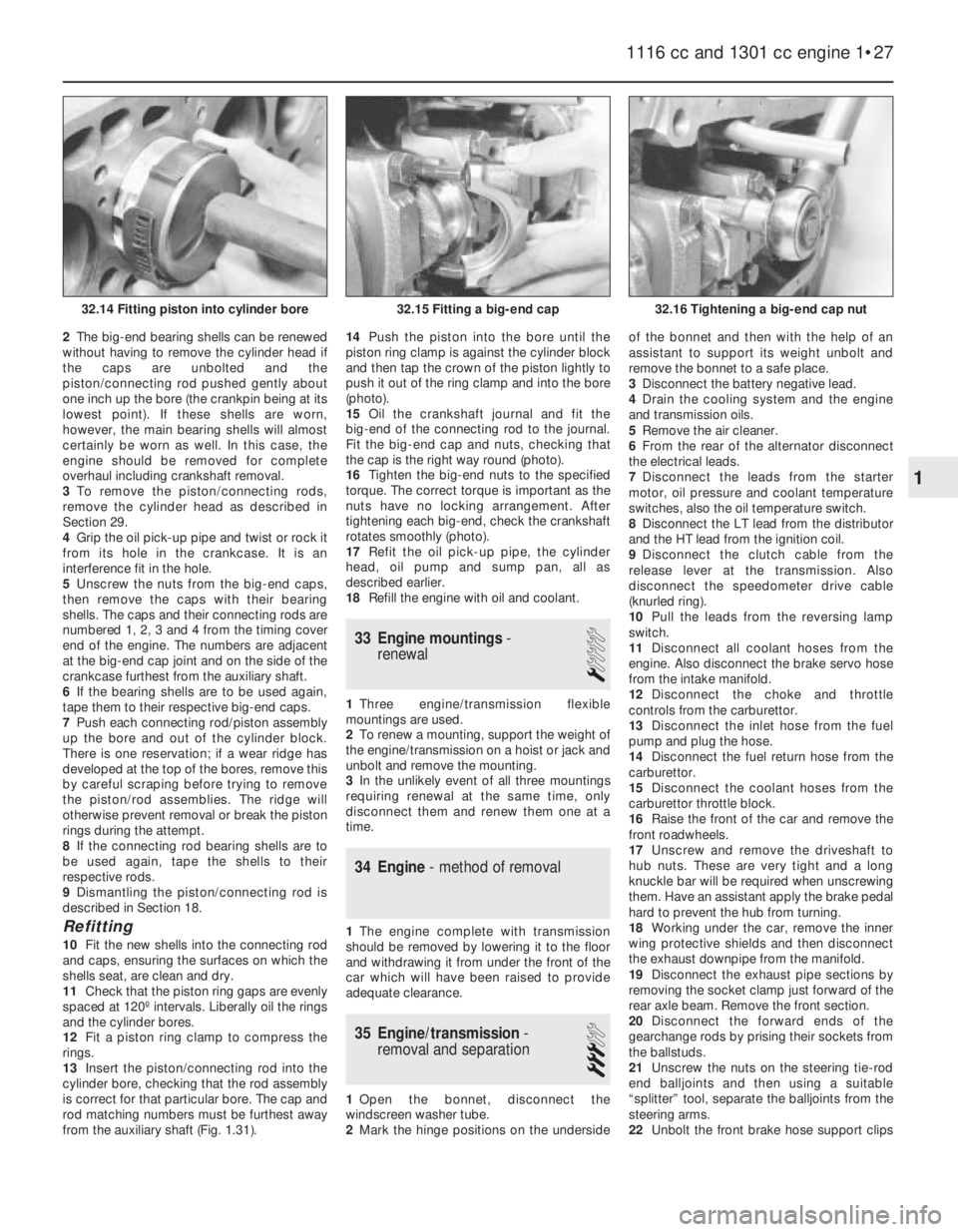
rod matching numbers must be furthest away
from the auxiliary shaft (Fig. 1.31).14Push the piston into the bore until the
piston ring clamp is against the cylinder block
and then tap the crown of the piston lightly to
push it out of the ring clamp and into the bore
(photo).
15Oil the crankshaft journal and fit the
big-end of the connecting rod to the journal.
Fit the big-end cap and nuts, checking that
the cap is the right way round (photo).
16Tighten the big-end nuts to the specified
torque. The correct torque is important as the
nuts have no locking arrangement. After
tightening each big-end, check the crankshaft
rotates smoothly (photo).
17Refit the oil pick-up pipe, the cylinder
head, oil pump and sump pan, all as
described earlier.
18Refill the engine with oil and coolant.
33 Engine mountings-
renewal
1
1Three engine/transmission flexible
mountings are used.
2To renew a mounting, support the weight of
the engine/transmission on a hoist or jack and
unbolt and remove the mounting.
3In the unlikely event of all three mountings
requiring renewal at the same time, only
disconnect them and renew them one at a
time.
34 Engine- method of removal
1The engine complete with transmission
should be removed by lowering it to the floor
and withdrawing it from under the front of the
car which will have been raised to provide
adequate clearance.
35 Engine/transmission-
removal and separation
3
1Open the bonnet, disconnect the
windscreen washer tube.
2Mark the hinge positions on the undersideof the bonnet and then with the help of an
assistant to support its weight unbolt and
remove the bonnet to a safe place.
3Disconnect the battery negative lead.
4Drain the cooling system and the engine
and transmission oils.
5Remove the air cleaner.
6From the rear of the alternator disconnect
the electrical leads.
7Disconnect the leads from the starter
motor, oil pressure and coolant temperature
switches, also the oil temperature switch.
8Disconnect the LT lead from the distributor
and the HT lead from the ignition coil.
9Disconnect the clutch cable from the
release lever at the transmission. Also
disconnect the speedometer drive cable
(knurled ring).
10Pull the leads from the reversing lamp
switch.
11Disconnect all coolant hoses from the
engine. Also disconnect the brake servo hose
from the intake manifold.
12Disconnect the choke and throttle
controls from the carburettor.
13Disconnect the inlet hose from the fuel
pump and plug the hose.
14Disconnect the fuel return hose from the
carburettor.
15Disconnect the coolant hoses from the
carburettor throttle block.
16Raise the front of the car and remove the
front roadwheels.
17Unscrew and remove the driveshaft to
hub nuts. These are very tight and a long
knuckle bar will be required when unscrewing
them. Have an assistant apply the brake pedal
hard to prevent the hub from turning.
18Working under the car, remove the inner
wing protective shields and then disconnect
the exhaust downpipe from the manifold.
19Disconnect the exhaust pipe sections by
removing the socket clamp just forward of the
rear axle beam. Remove the front section.
20Disconnect the forward ends of the
gearchange rods by prising their sockets from
the ballstuds.
21Unscrew the nuts on the steering tie-rod
end balljoints and then using a suitable
“splitter” tool, separate the balljoints from the
steering arms.
22Unbolt the front brake hose support clips
1116 cc and 1301 cc engine 1•27
32.16 Tightening a big-end cap nut32.15 Fitting a big-end cap32.14 Fitting piston into cylinder bore
1
Page 132 of 303
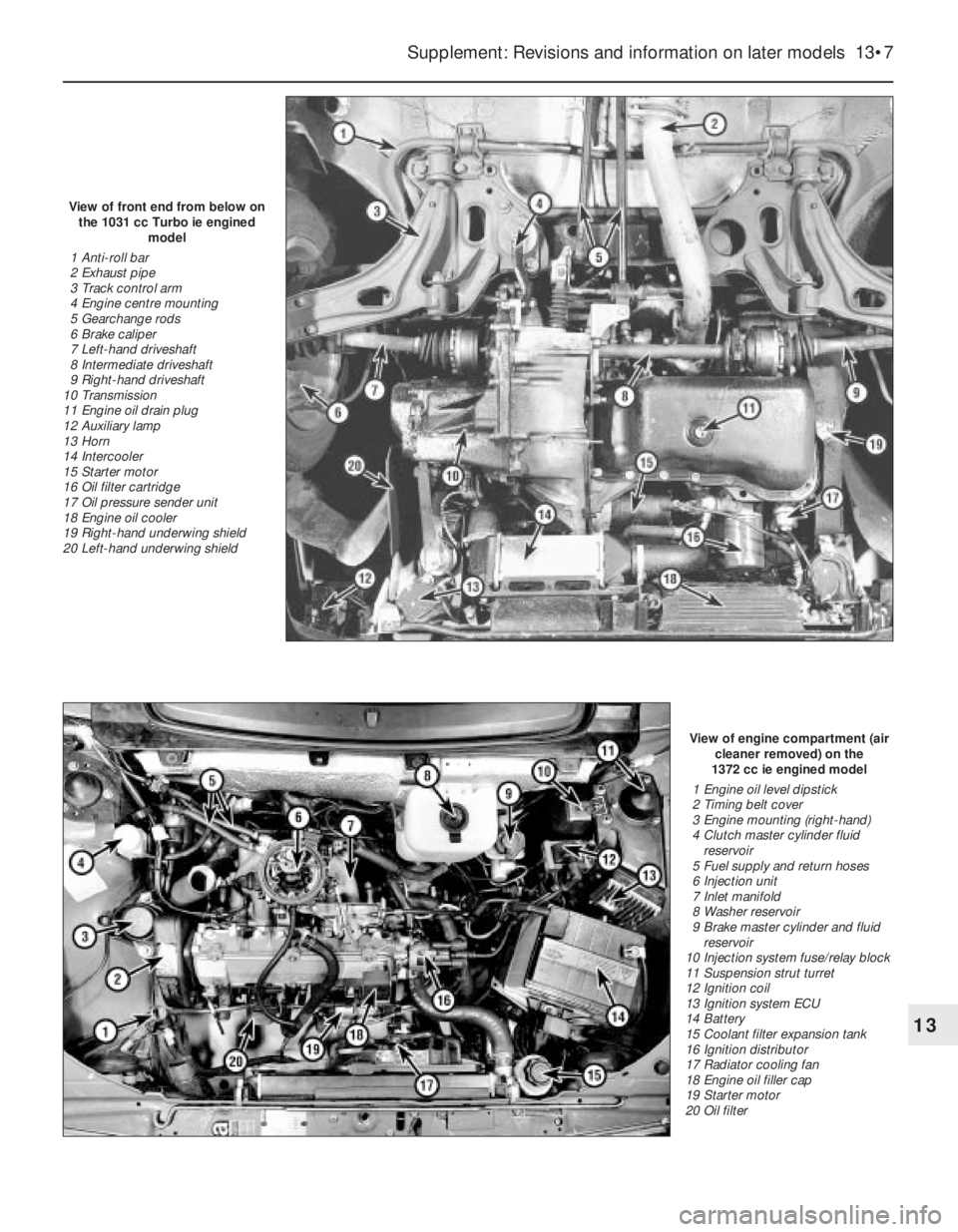
Supplement: Revisions and information on later models 13•7
View of engine compartment (air
cleaner removed) on the
1372 cc ie engined model
1 Engine oil level dipstick
2 Timing belt cover
3 Engine mounting (right-hand)
4 Clutch master cylinder fluid
reservoir
5 Fuel supply and return hoses
6 Injection unit
7 Inlet manifold
8 Washer reservoir
9 Brake master cylinder and fluid
reservoir
10 Injection system fuse/relay block
11 Suspension strut turret
12 Ignition coil
13 Ignition system ECU
14 Battery
15 Coolant filter expansion tank
16 Ignition distributor
17 Radiator cooling fan
18 Engine oil filler cap
19 Starter motor
20 Oil filter
View of front end from below on
the 1031 cc Turbo ie engined
model
1 Anti-roll bar
2 Exhaust pipe
3 Track control arm
4 Engine centre mounting
5 Gearchange rods
6 Brake caliper
7 Left-hand driveshaft
8 Intermediate driveshaft
9 Right-hand driveshaft
10 Transmission
11 Engine oil drain plug
12 Auxiliary lamp
13 Horn
14 Intercooler
15 Starter motor
16 Oil filter cartridge
17 Oil pressure sender unit
18 Engine oil cooler
19 Right-hand underwing shield
20 Left-hand underwing shield
13
Page 166 of 303
thumb and forefinger at the centre of the run
between the auxiliary shaft sprocket and the
camshaft sprocket. Using this method it
should just be possible to twist the belt
through 90º using moderate pressure.
55To adjust the tension, loosen off the
tensioner pulley nut then insert two rods (or
screwdrivers) into position in the pulley holes
and position a lever between them.
56Gently lever the tensioner pulley in the
required direction to set the tension as
described, then initially tighten the pulley nut
to lock the tensioner in the required position.
57Remove the tools from the tensioner,
recheck the tension and then tighten the
tensioner pulley nut securely.
58Rotate the crankshaft clockwise through
two complete turns using a socket or spanner
on the crankshaft pulley nut, then recheck the
belt tension. To avoid the possibility of
unscrewing the pulley nut, remove the spark
plugs to enable the engine to be turned over
easier.
59If further adjustment is required, repeat
the previously mentioned procedures. If in
doubt, err on the slightly tight side when
adjusting the tension. If the belt is set too
loose, it may jump off the sprockets resulting
in serious damage.
60Remove the crankshaft pulley retaining
nut, fit the timing belt cover, then refit and
tighten the pulley nut to the specified torque
setting.
61Refit the remaining components in the
reverse order of removal. Tighten the retaining
nuts/bolts to the specified torque settings
where given. Adjust the tension of the
alternator drivebelt as described in Section 8.
Adjustment using FIAT special
tools
62Assemble the special tools and fit them to
the belt tensioner pulley as shown in
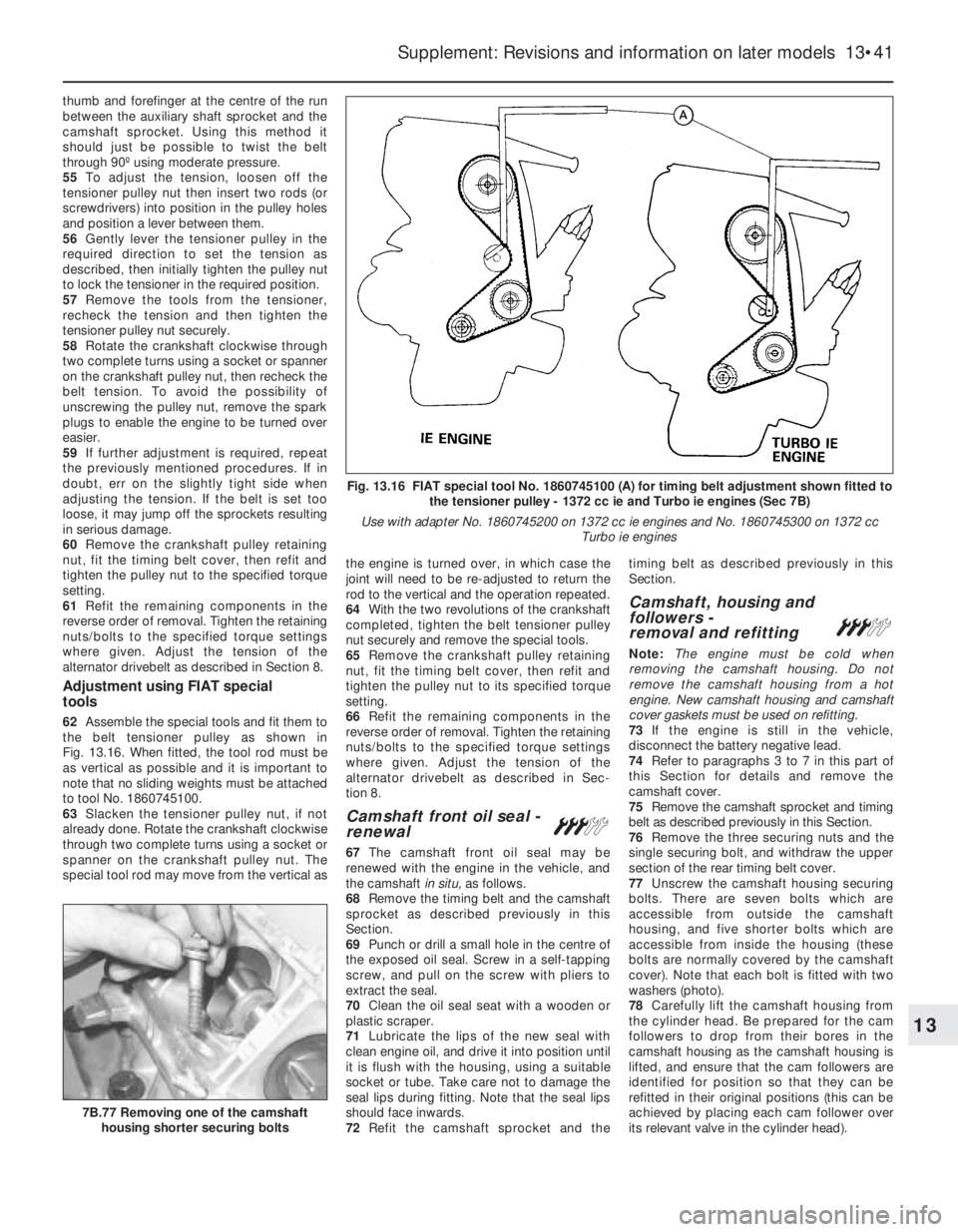
Fig. 13.16. When fitted, the tool rod must be
as vertical as possible and it is important to
note that no sliding weights must be attached
to tool No. 1860745100.
63Slacken the tensioner pulley nut, if not
already done. Rotate the crankshaft clockwise
through two complete turns using a socket or
spanner on the crankshaft pulley nut. The
special tool rod may move from the vertical asthe engine is turned over, in which case the
joint will need to be re-adjusted to return the
rod to the vertical and the operation repeated.
64With the two revolutions of the crankshaft
completed, tighten the belt tensioner pulley
nut securely and remove the special tools.
65Remove the crankshaft pulley retaining
nut, fit the timing belt cover, then refit and
tighten the pulley nut to its specified torque
setting.
66Refit the remaining components in the
reverse order of removal. Tighten the retaining
nuts/bolts to the specified torque settings
where given. Adjust the tension of the
alternator drivebelt as described in Sec-
tion 8.
Camshaft front oil seal -
renewal#
67The camshaft front oil seal may be
renewed with the engine in the vehicle, and
the camshaft in situ, as follows.
68Remove the timing belt and the camshaft
sprocket as described previously in this
Section.
69Punch or drill a small hole in the centre of
the exposed oil seal. Screw in a self-tapping
screw, and pull on the screw with pliers to
extract the seal.
70Clean the oil seal seat with a wooden or
plastic scraper.
71Lubricate the lips of the new seal with
clean engine oil, and drive it into position until
it is flush with the housing, using a suitable
socket or tube. Take care not to damage the
seal lips during fitting. Note that the seal lips
should face inwards.
72Refit the camshaft sprocket and thetiming belt as described previously in this
Section.
Camshaft, housing and
followers -
removal and refitting
#
Note: The engine must be cold when
removing the camshaft housing. Do not
remove the camshaft housing from a hot
engine. New camshaft housing and camshaft
cover gaskets must be used on refitting.
73If the engine is still in the vehicle,
disconnect the battery negative lead.
74Refer to paragraphs 3 to 7 in this part of
this Section for details and remove the
camshaft cover.
75Remove the camshaft sprocket and timing
belt as described previously in this Section.
76Remove the three securing nuts and the
single securing bolt, and withdraw the upper
section of the rear timing belt cover.
77Unscrew the camshaft housing securing
bolts. There are seven bolts which are
accessible from outside the camshaft
housing, and five shorter bolts which are
accessible from inside the housing (these
bolts are normally covered by the camshaft
cover). Note that each bolt is fitted with two
washers (photo).
78Carefully lift the camshaft housing from
the cylinder head. Be prepared for the cam
followers to drop from their bores in the
camshaft housing as the camshaft housing is
lifted, and ensure that the cam followers are
identified for position so that they can be
refitted in their original positions (this can be
achieved by placing each cam follower over
its relevant valve in the cylinder head).
Supplement: Revisions and information on later models 13•41
Fig. 13.16 FIAT special tool No. 1860745100 (A) for timing belt adjustment shown fitted to
the tensioner pulley - 1372 cc ie and Turbo ie engines (Sec 7B)
Use with adapter No. 1860745200 on 1372 cc ie engines and No. 1860745300 on 1372 cc
Turbo ie engines
7B.77 Removing one of the camshaft
housing shorter securing bolts
13
Page 183 of 303
35Clean the mating faces of the thermostat
cover and cylinder head, and use a new
gasket when refitting the cover.
36Refill the cooling system as described
earlier in this Section.
Coolant pump -
removal and refittingÁ
Note: A new coolant pump gasket must be
used on refitting. If the pump is found to be
worn it must be renewed as a complete unit as
dismantling and repair is not possible.
37Disconnect the battery negative lead.
38Drain the cooling system as described
earlier in this Section.
39Remove the coolant/alternator drivebelt
as described in the next sub-Section.
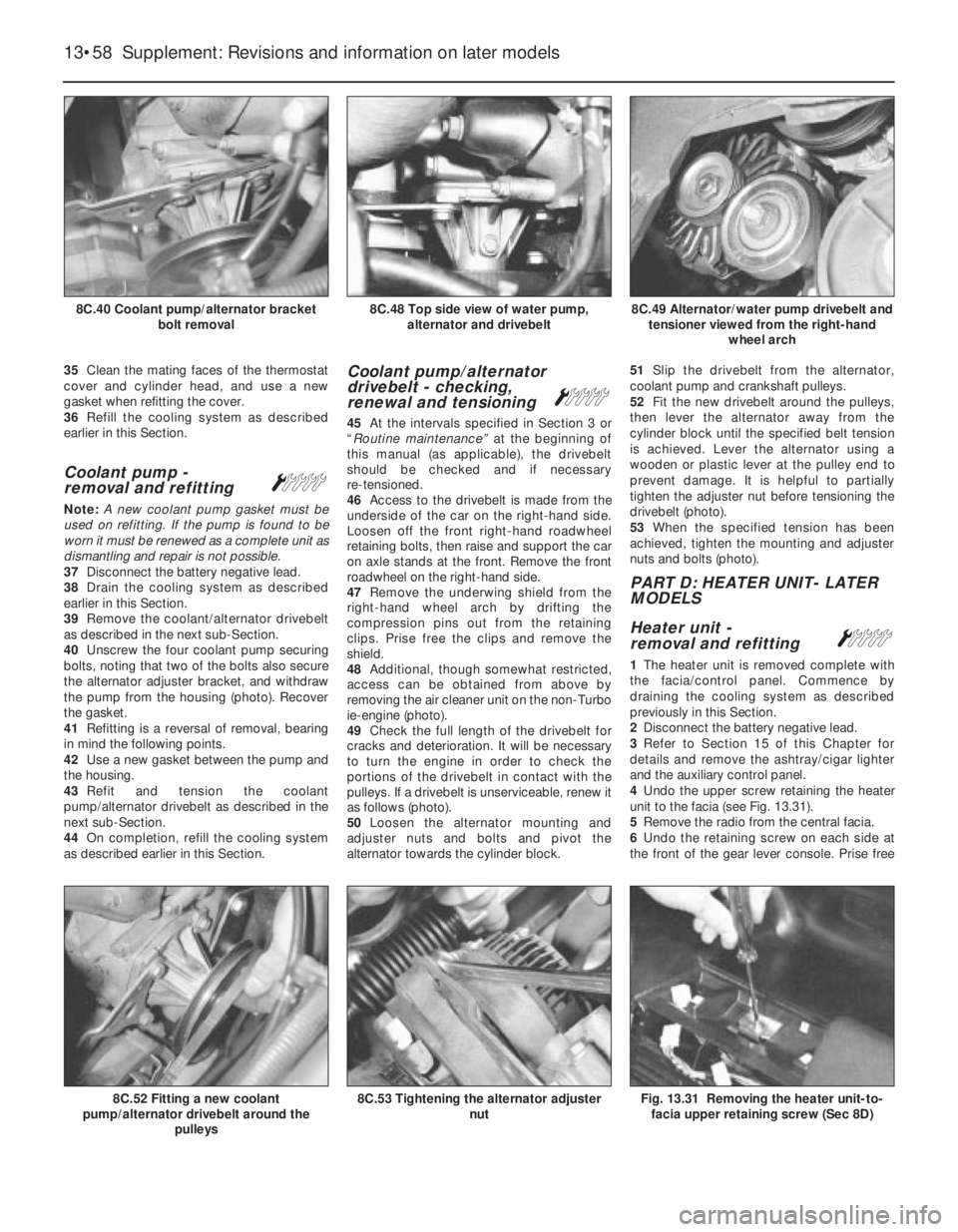
40Unscrew the four coolant pump securing
bolts, noting that two of the bolts also secure
the alternator adjuster bracket, and withdraw
the pump from the housing (photo). Recover
the gasket.
41Refitting is a reversal of removal, bearing
in mind the following points.
42Use a new gasket between the pump and
the housing.
43Refit and tension the coolant
pump/alternator drivebelt as described in the
next sub-Section.
44On completion, refill the cooling system
as described earlier in this Section.
Coolant pump/alternator
drivebelt - checking,
renewal and tensioning
Á
45At the intervals specified in Section 3 or
“Routine maintenance” at the beginning of
this manual (as applicable), the drivebelt
should be checked and if necessary
re-tensioned.
46Access to the drivebelt is made from the
underside of the car on the right-hand side.
Loosen off the front right-hand roadwheel
retaining bolts, then raise and support the car
on axle stands at the front. Remove the front
roadwheel on the right-hand side.
47Remove the underwing shield from the
right-hand wheel arch by drifting the
compression pins out from the retaining
clips. Prise free the clips and remove the
shield.
48Additional, though somewhat restricted,
access can be obtained from above by
removing the air cleaner unit on the non-Turbo
ie-engine (photo).
49Check the full length of the drivebelt for
cracks and deterioration. It will be necessary
to turn the engine in order to check the
portions of the drivebelt in contact with the
pulleys. If a drivebelt is unserviceable, renew it
as follows (photo).
50Loosen the alternator mounting and
adjuster nuts and bolts and pivot the
alternator towards the cylinder block.51Slip the drivebelt from the alternator,
coolant pump and crankshaft pulleys.
52Fit the new drivebelt around the pulleys,
then lever the alternator away from the
cylinder block until the specified belt tension
is achieved. Lever the alternator using a
wooden or plastic lever at the pulley end to
prevent damage. It is helpful to partially
tighten the adjuster nut before tensioning the
drivebelt (photo).
53When the specified tension has been
achieved, tighten the mounting and adjuster
nuts and bolts (photo).
PART D: HEATER UNIT- LATER
MODELS
Heater unit -
removal and refitting
Á
1The heater unit is removed complete with
the facia/control panel. Commence by
draining the cooling system as described
previously in this Section.
2Disconnect the battery negative lead.
3Refer to Section 15 of this Chapter for
details and remove the ashtray/cigar lighter
and the auxiliary control panel.
4Undo the upper screw retaining the heater
unit to the facia (see Fig. 13.31).
5Remove the radio from the central facia.
6Undo the retaining screw on each side at
the front of the gear lever console. Prise free
13•58 Supplement: Revisions and information on later models
Fig. 13.31 Removing the heater unit-to-
facia upper retaining screw (Sec 8D)8C.53 Tightening the alternator adjuster
nut8C.52 Fitting a new coolant
pump/alternator drivebelt around the
pulleys
8C.49 Alternator/water pump drivebelt and
tensioner viewed from the right-hand
wheel arch8C.48 Top side view of water pump,
alternator and drivebelt8C.40 Coolant pump/alternator bracket
bolt removal
Page 211 of 303
6On 999, 1108 and 1372 cc engines, the
distributor is driven from the rear end of the
camshaft.
7On the 1116 and 1299/1301 cc engines, the
distributor is driven from an extension of the
oil pump driveshaft which is geared to the
auxiliary shaft.
8The distributor contains a reluctor mounted
on its shaft, and a magnet and stator fixed to
the baseplate.
9Ignition advance is controlled in the
conventional way mechanically by centrifugal
weights and a diaphragm unit for vacuum
advance.
10Instead of the conventional method of
interrupting the low tension circuit to generate
high tension voltage in the coil by means of a
mechanical contact breaker, when the
electronic ignition is switched on, the
switching of the transistors in the electronic
control unit (ECU) prevents current flow in the
coil primary windings.
11Once the crankshaft rotates, the reluctor
moves through the magnetic field created by
the stator and when the reluctor teeth are in
alignment with the stator projections a small
AC voltage is created. The ECU amplifies this
voltage and applies it to switch the transistors
and so provide an earth path for the primary
circuit.
12As the reluctor teeth move out of
alignment with the stator projections the AC
voltage changes, the transistors in the ECU
are switched again to interrupt the primary
circuit earth path. This causes a high voltage
to be induced in the secondary winding.
Distributor
(breakerless type) -
removal and refitting
#
13Removal of the distributor on the 903,1116, 1299 and 1301 cc engines is as
described in Chapter 4, Section 6.
14On 999, 1108 and 1372 cc engines, mark
the position of the distributor clamp plate in
relation to the cylinder head surface.
15Unclip the distributor cap and move it to
one side with the HT leads attached.
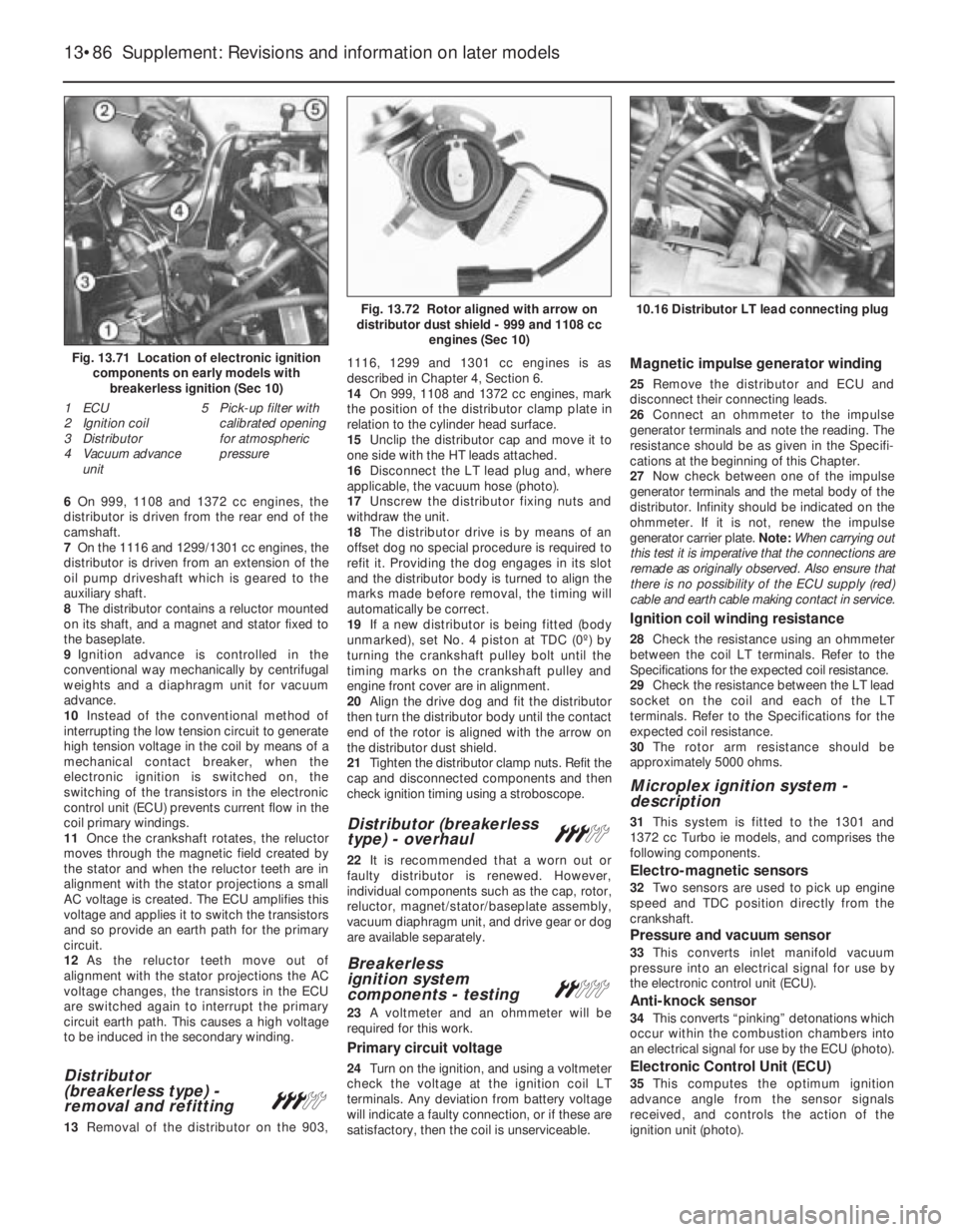
16Disconnect the LT lead plug and, where
applicable, the vacuum hose (photo).
17Unscrew the distributor fixing nuts and
withdraw the unit.
18The distributor drive is by means of an
offset dog no special procedure is required to
refit it. Providing the dog engages in its slot
and the distributor body is turned to align the
marks made before removal, the timing will
automatically be correct.
19If a new distributor is being fitted (body
unmarked), set No. 4 piston at TDC (0º) by
turning the crankshaft pulley bolt until the
timing marks on the crankshaft pulley and
engine front cover are in alignment.
20Align the drive dog and fit the distributor
then turn the distributor body until the contact
end of the rotor is aligned with the arrow on
the distributor dust shield.
21Tighten the distributor clamp nuts. Refit the
cap and disconnected components and then
check ignition timing using a stroboscope.
Distributor (breakerless
type) - overhaul#
22It is recommended that a worn out or
faulty distributor is renewed. However,
individual components such as the cap, rotor,
reluctor, magnet/stator/baseplate assembly,
vacuum diaphragm unit, and drive gear or dog
are available separately.
Breakerless
ignition system
components - testing
ª
23A voltmeter and an ohmmeter will be
required for this work.
Primary circuit voltage
24Turn on the ignition, and using a voltmeter
check the voltage at the ignition coil LT
terminals. Any deviation from battery voltage
will indicate a faulty connection, or if these are
satisfactory, then the coil is unserviceable.
Magnetic impulse generator winding
25Remove the distributor and ECU and
disconnect their connecting leads.
26Connect an ohmmeter to the impulse
generator terminals and note the reading. The
resistance should be as given in the Specifi-
cations at the beginning of this Chapter.
27Now check between one of the impulse
generator terminals and the metal body of the
distributor. Infinity should be indicated on the
ohmmeter. If it is not, renew the impulse
generator carrier plate. Note: When carrying out
this test it is imperative that the connections are
remade as originally observed. Also ensure that
there is no possibility of the ECU supply (red)
cable and earth cable making contact in service.
Ignition coil winding resistance
28Check the resistance using an ohmmeter
between the coil LT terminals. Refer to the
Specifications for the expected coil resistance.
29Check the resistance between the LT lead
socket on the coil and each of the LT
terminals. Refer to the Specifications for the
expected coil resistance.
30The rotor arm resistance should be
approximately 5000 ohms.
Microplex ignition system -
description
31This system is fitted to the 1301 and
1372 cc Turbo ie models, and comprises the
following components.
Electro-magnetic sensors
32Two sensors are used to pick up engine
speed and TDC position directly from the
crankshaft.
Pressure and vacuum sensor
33This converts inlet manifold vacuum
pressure into an electrical signal for use by
the electronic control unit (ECU).
Anti-knock sensor
34This converts “pinking” detonations which
occur within the combustion chambers into
an electrical signal for use by the ECU (photo).
Electronic Control Unit (ECU)
35This computes the optimum ignition
advance angle from the sensor signals
received, and controls the action of the
ignition unit (photo).
13•86 Supplement: Revisions and information on later models
Fig. 13.72 Rotor aligned with arrow on
distributor dust shield - 999 and 1108 cc
engines (Sec 10)
1 ECU
2 Ignition coil
3 Distributor
4 Vacuum advance
unit5 Pick-up filter with
calibrated opening
for atmospheric
pressure
Fig. 13.71 Location of electronic ignition
components on early models with
breakerless ignition (Sec 10)
10.16 Distributor LT lead connecting plug
Page 230 of 303
Starter motor brushes
(later models) - renewal#
25When renewing the starter motor brushes
on later models, the old brushes will need to
be crushed (in a vice or with a hammer) and
their leads then soldered to the new brushes.
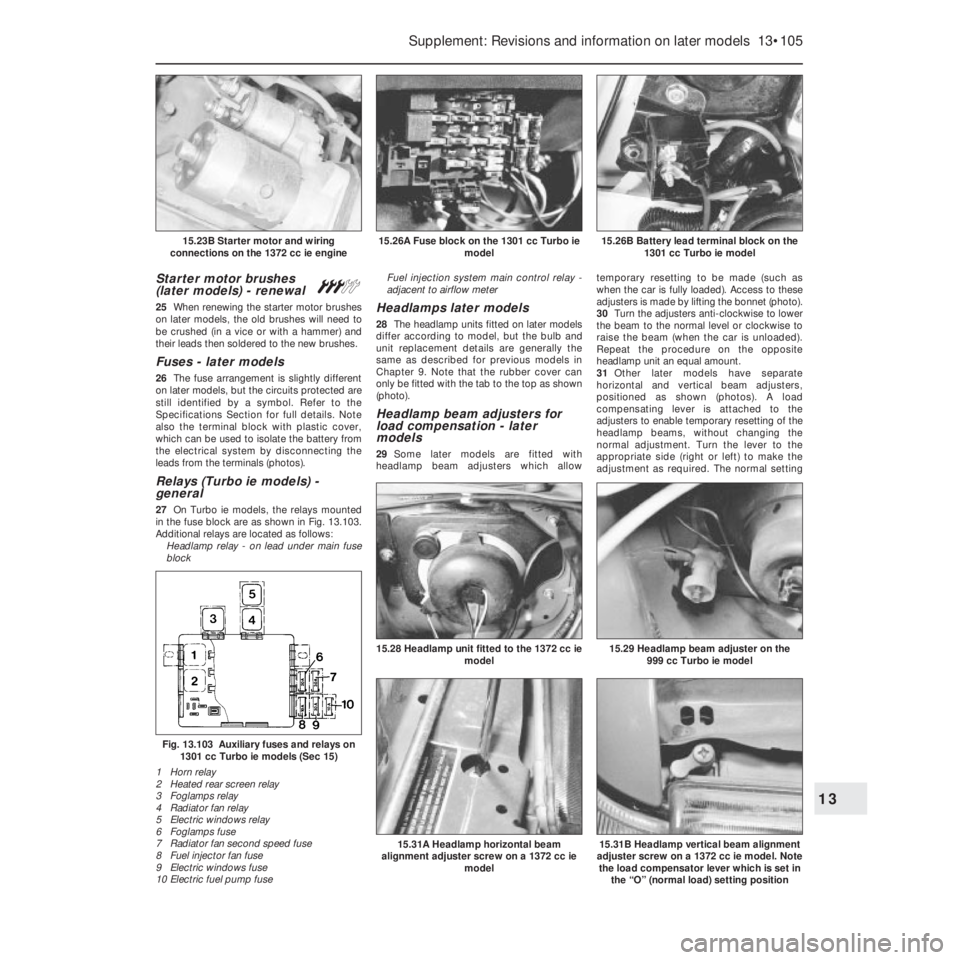
Fuses - later models
26The fuse arrangement is slightly different
on later models, but the circuits protected are
still identified by a symbol. Refer to the
Specifications Section for full details. Note
also the terminal block with plastic cover,
which can be used to isolate the battery from
the electrical system by disconnecting the
leads from the terminals (photos).
Relays (Turbo ie models) -
general
27On Turbo ie models, the relays mounted
in the fuse block are as shown in Fig. 13.103.
Additional relays are located as follows:
Headlamp relay - on lead under main fuse
blockFuel injection system main control relay -
adjacent to airflow meter
Headlamps later models
28The headlamp units fitted on later models
differ according to model, but the bulb and
unit replacement details are generally the
same as described for previous models in
Chapter 9. Note that the rubber cover can
only be fitted with the tab to the top as shown
(photo).
Headlamp beam adjusters for
load compensation - later
models
29Some later models are fitted with
headlamp beam adjusters which allowtemporary resetting to be made (such as
when the car is fully loaded). Access to these
adjusters is made by lifting the bonnet (photo).
30Turn the adjusters anti-clockwise to lower
the beam to the normal level or clockwise to
raise the beam (when the car is unloaded).
Repeat the procedure on the opposite
headlamp unit an equal amount.
31Other later models have separate
horizontal and vertical beam adjusters,
positioned as shown (photos). A load
compensating lever is attached to the
adjusters to enable temporary resetting of the
headlamp beams, without changing the
normal adjustment. Turn the lever to the
appropriate side (right or left) to make the
adjustment as required. The normal setting
Supplement: Revisions and information on later models 13•105
15.26B Battery lead terminal block on the
1301 cc Turbo ie model15.23B Starter motor and wiring
connections on the 1372 cc ie engine
15.31B Headlamp vertical beam alignment
adjuster screw on a 1372 cc ie model. Note
the load compensator lever which is set in
the “O” (normal load) setting position15.31A Headlamp horizontal beam
alignment adjuster screw on a 1372 cc ie
model
15.29 Headlamp beam adjuster on the
999 cc Turbo ie model15.28 Headlamp unit fitted to the 1372 cc ie
model
15.26A Fuse block on the 1301 cc Turbo ie
model
13
Fig. 13.103 Auxiliary fuses and relays on
1301 cc Turbo ie models (Sec 15)
1 Horn relay
2 Heated rear screen relay
3 Foglamps relay
4 Radiator fan relay
5 Electric windows relay
6 Foglamps fuse
7 Radiator fan second speed fuse
8 Fuel injector fan fuse
9 Electric windows fuse
10 Electric fuel pump fuse
Page 233 of 303
Auxiliary control panel
(later models) -
removal and refitting
Á
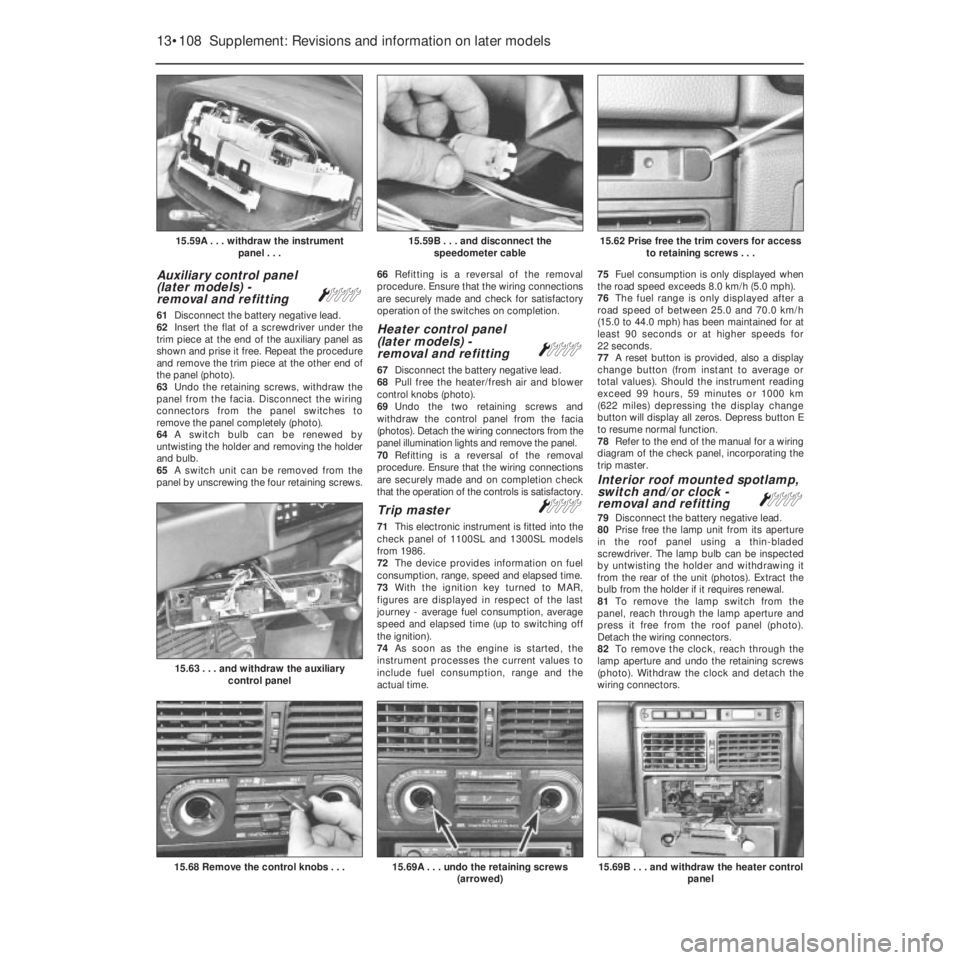
61Disconnect the battery negative lead.
62Insert the flat of a screwdriver under the
trim piece at the end of the auxiliary panel as
shown and prise it free. Repeat the procedure
and remove the trim piece at the other end of
the panel (photo).
63Undo the retaining screws, withdraw the
panel from the facia. Disconnect the wiring
connectors from the panel switches to
remove the panel completely (photo).
64A switch bulb can be renewed by
untwisting the holder and removing the holder
and bulb.
65A switch unit can be removed from the
panel by unscrewing the four retaining screws.66Refitting is a reversal of the removal
procedure. Ensure that the wiring connections
are securely made and check for satisfactory
operation of the switches on completion.
Heater control panel
(later models) -
removal and refitting
Á
67Disconnect the battery negative lead.
68Pull free the heater/fresh air and blower
control knobs (photo).
69Undo the two retaining screws and
withdraw the control panel from the facia
(photos). Detach the wiring connectors from the
panel illumination lights and remove the panel.
70Refitting is a reversal of the removal
procedure. Ensure that the wiring connections
are securely made and on completion check
that the operation of the controls is satisfactory.
Trip master Á
71This electronic instrument is fitted into the
check panel of 1100SL and 1300SL models
from 1986.
72The device provides information on fuel
consumption, range, speed and elapsed time.
73With the ignition key turned to MAR,
figures are displayed in respect of the last
journey - average fuel consumption, average
speed and elapsed time (up to switching off
the ignition).
74As soon as the engine is started, the
instrument processes the current values to
include fuel consumption, range and the
actual time. 75Fuel consumption is only displayed when
the road speed exceeds 8.0 km/h (5.0 mph).
76The fuel range is only displayed after a
road speed of between 25.0 and 70.0 km/h
(15.0 to 44.0 mph) has been maintained for at
least 90 seconds or at higher speeds for
22 seconds.
77A reset button is provided, also a display
change button (from instant to average or
total values). Should the instrument reading
exceed 99 hours, 59 minutes or 1000 km
(622 miles) depressing the display change
button will display all zeros. Depress button E
to resume normal function.
78Refer to the end of the manual for a wiring
diagram of the check panel, incorporating the
trip master.
Interior roof mounted spotlamp,
switch and/or clock -
removal and refitting
Á
79Disconnect the battery negative lead.
80Prise free the lamp unit from its aperture
in the roof panel using a thin-bladed
screwdriver. The lamp bulb can be inspected
by untwisting the holder and withdrawing it
from the rear of the unit (photos). Extract the
bulb from the holder if it requires renewal.
81To remove the lamp switch from the
panel, reach through the lamp aperture and
press it free from the roof panel (photo).
Detach the wiring connectors.
82To remove the clock, reach through the
lamp aperture and undo the retaining screws
(photo). Withdraw the clock and detach the
wiring connectors.
13•108 Supplement: Revisions and information on later models
15.69B . . . and withdraw the heater control
panel15.69A . . . undo the retaining screws
(arrowed)15.68 Remove the control knobs . . .
15.63 . . . and withdraw the auxiliary
control panel
15.62 Prise free the trim covers for access
to retaining screws . . .15.59B . . . and disconnect the
speedometer cable15.59A . . . withdraw the instrument
panel . . .