boot FIAT UNO 1983 Service User Guide
[x] Cancel search | Manufacturer: FIAT, Model Year: 1983, Model line: UNO, Model: FIAT UNO 1983Pages: 303, PDF Size: 10.36 MB
Page 219 of 303
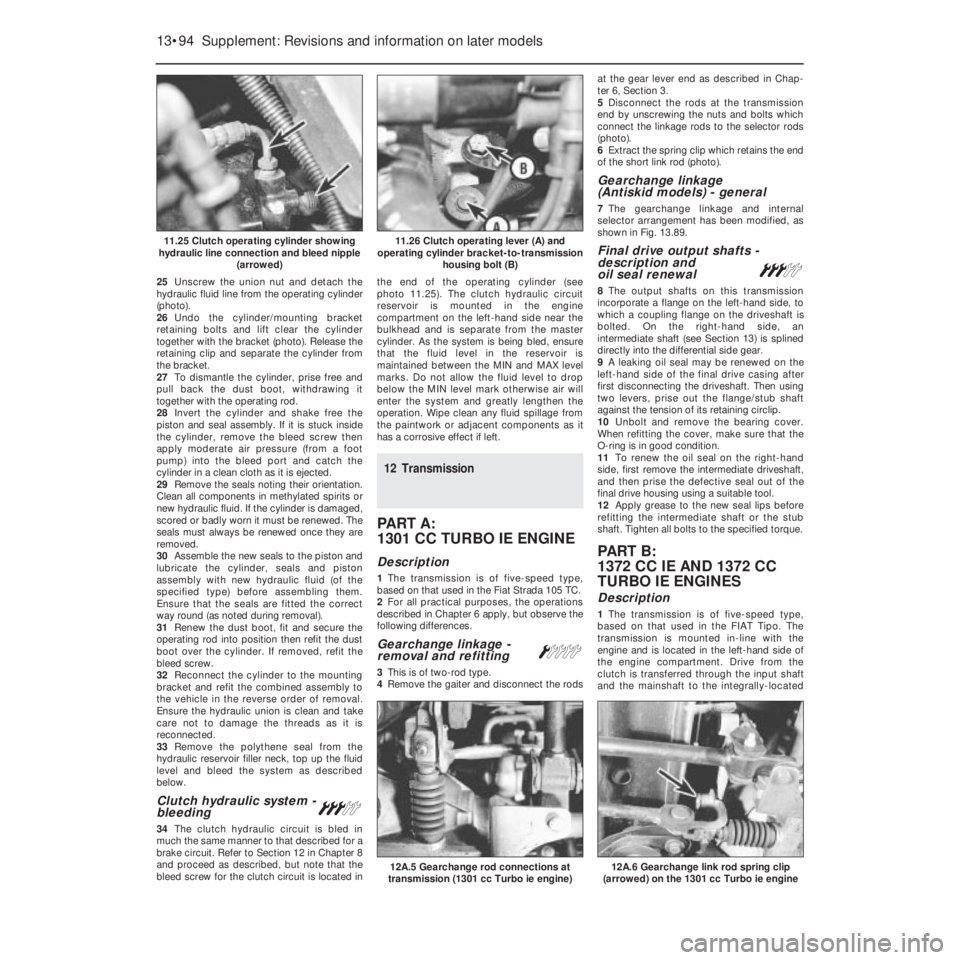
25Unscrew the union nut and detach the
hydraulic fluid line from the operating cylinder
(photo).
26Undo the cylinder/mounting bracket
retaining bolts and lift clear the cylinder
together with the bracket (photo). Release the
retaining clip and separate the cylinder from
the bracket.
27To dismantle the cylinder, prise free and
pull back the dust boot, withdrawing it
together with the operating rod.
28Invert the cylinder and shake free the
piston and seal assembly. If it is stuck inside
the cylinder, remove the bleed screw then
apply moderate air pressure (from a foot
pump) into the bleed port and catch the
cylinder in a clean cloth as it is ejected.
29Remove the seals noting their orientation.
Clean all components in methylated spirits or
new hydraulic fluid. If the cylinder is damaged,
scored or badly worn it must be renewed. The
seals must always be renewed once they are
removed.
30Assemble the new seals to the piston and
lubricate the cylinder, seals and piston
assembly with new hydraulic fluid (of the
specified type) before assembling them.
Ensure that the seals are fitted the correct
way round (as noted during removal).
31Renew the dust boot, fit and secure the
operating rod into position then refit the dust
boot over the cylinder. If removed, refit the
bleed screw.
32Reconnect the cylinder to the mounting
bracket and refit the combined assembly to
the vehicle in the reverse order of removal.
Ensure the hydraulic union is clean and take
care not to damage the threads as it is
reconnected.
33Remove the polythene seal from the
hydraulic reservoir filler neck, top up the fluid
level and bleed the system as described
below.
Clutch hydraulic system -
bleeding#
34The clutch hydraulic circuit is bled in
much the same manner to that described for a
brake circuit. Refer to Section 12 in Chapter 8
and proceed as described, but note that the
bleed screw for the clutch circuit is located inthe end of the operating cylinder (see
photo 11.25). The clutch hydraulic circuit
reservoir is mounted in the engine
compartment on the left-hand side near the
bulkhead and is separate from the master
cylinder. As the system is being bled, ensure
that the fluid level in the reservoir is
maintained between the MIN and MAX level
marks. Do not allow the fluid level to drop
below the MIN level mark otherwise air will
enter the system and greatly lengthen the
operation. Wipe clean any fluid spillage from
the paintwork or adjacent components as it
has a corrosive effect if left.
12 Transmission
PART A:
1301 CC TURBO IE ENGINE
Description
1The transmission is of five-speed type,
based on that used in the Fiat Strada 105 TC.
2For all practical purposes, the operations
described in Chapter 6 apply, but observe the
following differences.
Gearchange linkage -
removal and refitting Á
3This is of two-rod type.
4Remove the gaiter and disconnect the rodsat the gear lever end as described in Chap-
ter 6, Section 3.
5Disconnect the rods at the transmission
end by unscrewing the nuts and bolts which
connect the linkage rods to the selector rods
(photo).
6Extract the spring clip which retains the end
of the short link rod (photo).
Gearchange linkage
(Antiskid models) - general
7The gearchange linkage and internal
selector arrangement has been modified, as
shown in Fig. 13.89.
Final drive output shafts -
description and
oil seal renewal
#
8The output shafts on this transmission
incorporate a flange on the left-hand side, to
which a coupling flange on the driveshaft is
bolted. On the right-hand side, an
intermediate shaft (see Section 13) is splined
directly into the differential side gear.
9A leaking oil seal may be renewed on the
left-hand side of the final drive casing after
first disconnecting the driveshaft. Then using
two levers, prise out the flange/stub shaft
against the tension of its retaining circlip.
10Unbolt and remove the bearing cover.
When refitting the cover, make sure that the
O-ring is in good condition.
11To renew the oil seal on the right-hand
side, first remove the intermediate driveshaft,
and then prise the defective seal out of the
final drive housing using a suitable tool.
12Apply grease to the new seal lips before
refitting the intermediate shaft or the stub
shaft. Tighten all bolts to the specified torque.
PART B:
1372 CC IE AND 1372 CC
TURBO IE ENGINES
Description
1The transmission is of five-speed type,
based on that used in the FIAT Tipo. The
transmission is mounted in-line with the
engine and is located in the left-hand side of
the engine compartment. Drive from the
clutch is transferred through the input shaft
and the mainshaft to the integrally-located
13•94 Supplement: Revisions and information on later models
12A.6 Gearchange link rod spring clip
(arrowed) on the 1301 cc Turbo ie engine12A.5 Gearchange rod connections at
transmission (1301 cc Turbo ie engine)
11.26 Clutch operating lever (A) and
operating cylinder bracket-to-transmission
housing bolt (B)11.25 Clutch operating cylinder showing
hydraulic line connection and bleed nipple
(arrowed)
Page 223 of 303
PART C: 999 CC AND
1108 CC WITH C514 TYPE
TRANSMISSIONS
Description
1A new 5-speed transmission was
introduced to selected models during 1992.
Identified by the way reverse gear is engaged.
The gear knob needs to pressed downwards
whilst pushing the lever to the extreme right.
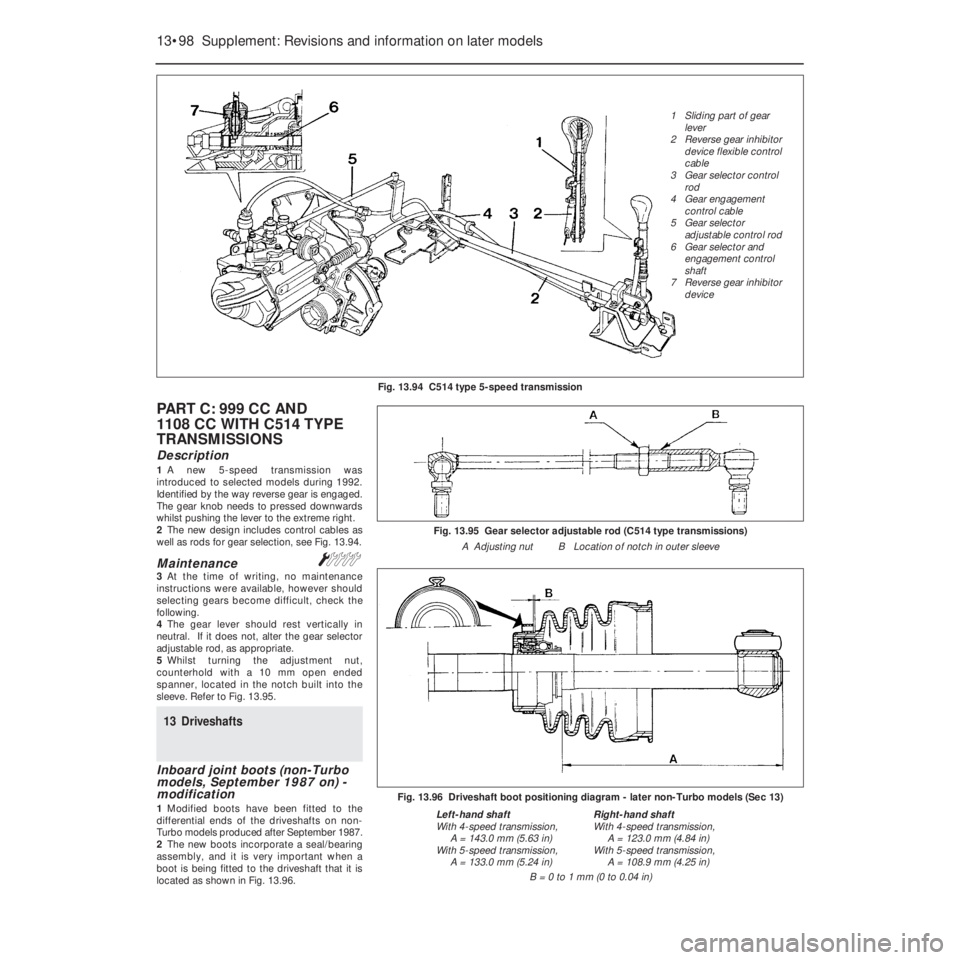
2The new design includes control cables as
well as rods for gear selection, see Fig. 13.94.
MaintenanceÁ3At the time of writing, no maintenance
instructions were available, however should
selecting gears become difficult, check the
following.
4The gear lever should rest vertically in
neutral. If it does not, alter the gear selector
adjustable rod, as appropriate.
5Whilst turning the adjustment nut,
counterhold with a 10 mm open ended
spanner, located in the notch built into the
sleeve. Refer to Fig. 13.95.
13 Driveshafts
Inboard joint boots (non-Turbo
models, September 1987 on) -
modification
1Modified boots have been fitted to the
differential ends of the driveshafts on non-
Turbo models produced after September 1987.
2The new boots incorporate a seal/bearing
assembly, and it is very important when a
boot is being fitted to the driveshaft that it is
located as shown in Fig. 13.96.
13•98 Supplement: Revisions and information on later models
Fig. 13.96 Driveshaft boot positioning diagram - later non-Turbo models (Sec 13)
Left-hand shaft
With 4-speed transmission,
A = 143.0 mm (5.63 in)
With 5-speed transmission,
A = 133.0 mm (5.24 in)Right-hand shaft
With 4-speed transmission,
A = 123.0 mm (4.84 in)
With 5-speed transmission,
A = 108.9 mm (4.25 in)
Fig. 13.94 C514 type 5-speed transmission
1 Sliding part of gear
lever
2 Reverse gear inhibitor
device flexible control
cable
3 Gear selector control
rod
4 Gear engagement
control cable
5 Gear selector
adjustable control rod
6 Gear selector and
engagement control
shaft
7 Reverse gear inhibitor
device
B = 0 to 1 mm (0 to 0.04 in)
Fig. 13.95 Gear selector adjustable rod (C514 type transmissions)
A Adjusting nut B Location of notch in outer sleeve
Page 224 of 303
3The boot retaining band must be crimped
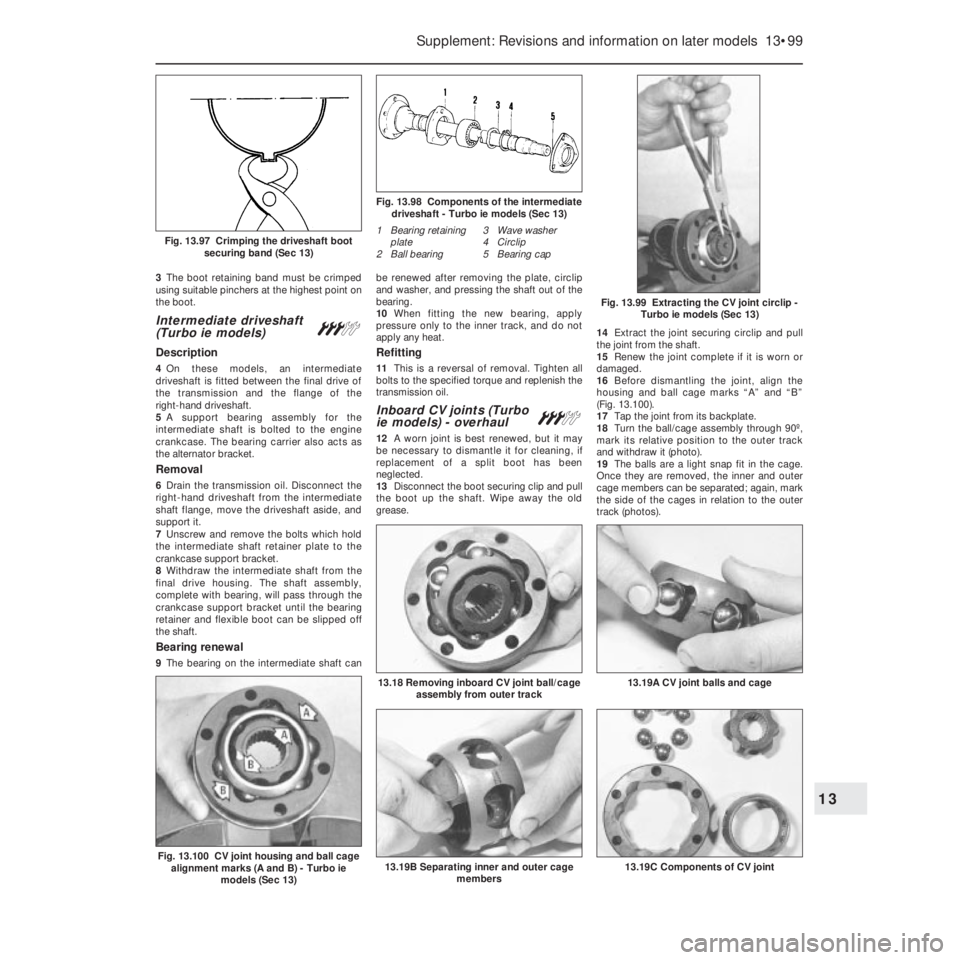
using suitable pinchers at the highest point on
the boot.
Intermediate driveshaft
(Turbo ie models) #
Description
4On these models, an intermediate
driveshaft is fitted between the final drive of
the transmission and the flange of the
right-hand driveshaft.
5A support bearing assembly for the
intermediate shaft is bolted to the engine
crankcase. The bearing carrier also acts as
the alternator bracket.
Removal
6Drain the transmission oil. Disconnect the
right-hand driveshaft from the intermediate
shaft flange, move the driveshaft aside, and
support it.
7Unscrew and remove the bolts which hold
the intermediate shaft retainer plate to the
crankcase support bracket.
8Withdraw the intermediate shaft from the
final drive housing. The shaft assembly,
complete with bearing, will pass through the
crankcase support bracket until the bearing
retainer and flexible boot can be slipped off
the shaft.
Bearing renewal
9The bearing on the intermediate shaft canbe renewed after removing the plate, circlip
and washer, and pressing the shaft out of the
bearing.
10When fitting the new bearing, apply
pressure only to the inner track, and do not
apply any heat.
Refitting
11This is a reversal of removal. Tighten all
bolts to the specified torque and replenish the
transmission oil.
Inboard CV joints (Turbo
ie models) - overhaul #
12A worn joint is best renewed, but it may
be necessary to dismantle it for cleaning, if
replacement of a split boot has been
neglected.
13Disconnect the boot securing clip and pull
the boot up the shaft. Wipe away the old
grease. 14Extract the joint securing circlip and pull
the joint from the shaft.
15Renew the joint complete if it is worn or
damaged.
16Before dismantling the joint, align the
housing and ball cage marks “A” and “B”
(Fig. 13.100).
17Tap the joint from its backplate.
18Turn the ball/cage assembly through 90º,
mark its relative position to the outer track
and withdraw it (photo).
19The balls are a light snap fit in the cage.
Once they are removed, the inner and outer
cage members can be separated; again, mark
the side of the cages in relation to the outer
track (photos).
Supplement: Revisions and information on later models 13•99
Fig. 13.99 Extracting the CV joint circlip -
Turbo ie models (Sec 13)
Fig. 13.98 Components of the intermediate
driveshaft - Turbo ie models (Sec 13)
1 Bearing retaining
plate
2 Ball bearing3 Wave washer
4 Circlip
5 Bearing cap
Fig. 13.97 Crimping the driveshaft boot
securing band (Sec 13)
13.19C Components of CV joint13.19B Separating inner and outer cage
members
13.19A CV joint balls and cage13.18 Removing inboard CV joint ball/cage
assembly from outer track
Fig. 13.100 CV joint housing and ball cage
alignment marks (A and B) - Turbo ie
models (Sec 13)
13
Page 225 of 303
20When reassembling, pack the joint with
special FIAT Tutela MRM2 lubricant; if this is not
available, use molybdenum disulphide grease.
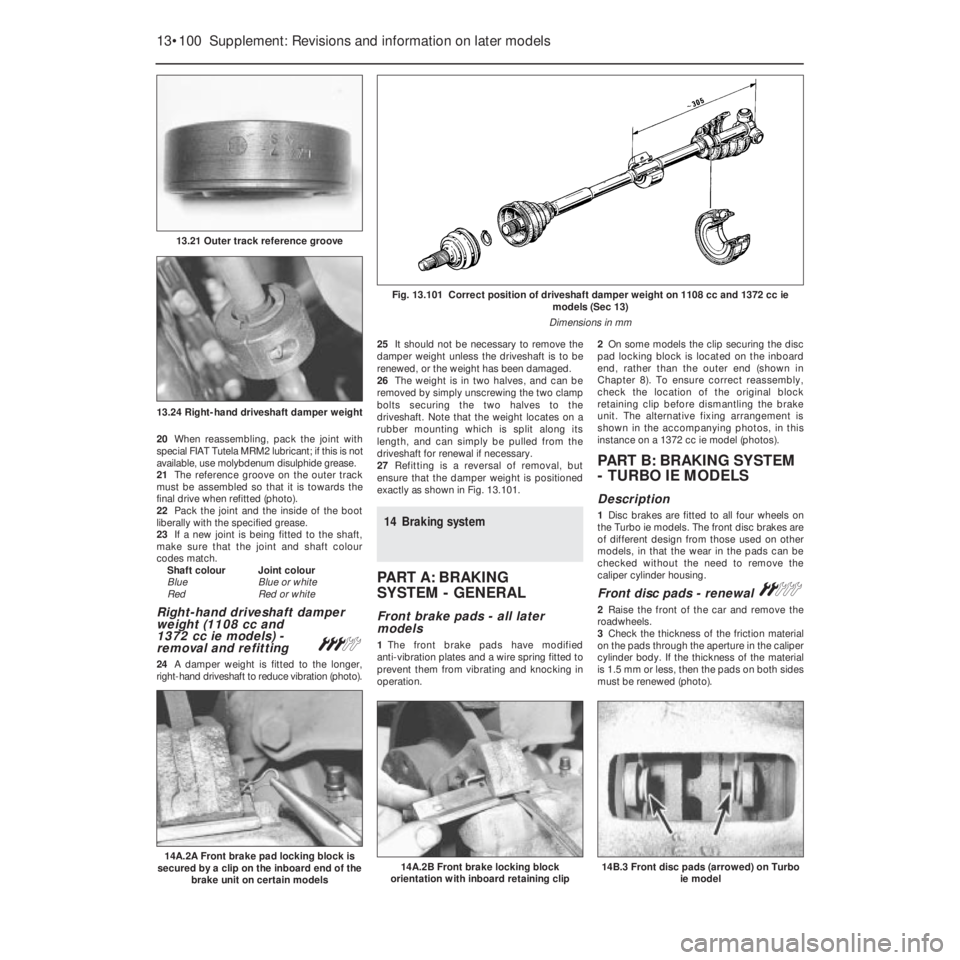
21The reference groove on the outer track
must be assembled so that it is towards the
final drive when refitted (photo).
22Pack the joint and the inside of the boot
liberally with the specified grease.
23If a new joint is being fitted to the shaft,
make sure that the joint and shaft colour
codes match.
Shaft colour Joint colour
Blue Blue or white
Red Red or white
Right-hand driveshaft damper
weight (1108 cc and
1372 cc ie models) -
removal and refitting
#
24A damper weight is fitted to the longer,
right-hand driveshaft to reduce vibration (photo).25It should not be necessary to remove the
damper weight unless the driveshaft is to be
renewed, or the weight has been damaged.
26The weight is in two halves, and can be
removed by simply unscrewing the two clamp
bolts securing the two halves to the
driveshaft. Note that the weight locates on a
rubber mounting which is split along its
length, and can simply be pulled from the
driveshaft for renewal if necessary.
27Refitting is a reversal of removal, but
ensure that the damper weight is positioned
exactly as shown in Fig. 13.101.
14 Braking system
PART A: BRAKING
SYSTEM - GENERAL
Front brake pads - all later
models
1The front brake pads have modified
anti-vibration plates and a wire spring fitted to
prevent them from vibrating and knocking in
operation. 2On some models the clip securing the disc
pad locking block is located on the inboard
end, rather than the outer end (shown in
Chapter 8). To ensure correct reassembly,
check the location of the original block
retaining clip before dismantling the brake
unit. The alternative fixing arrangement is
shown in the accompanying photos, in this
instance on a 1372 cc ie model (photos).
PART B: BRAKING SYSTEM
- TURBO IE MODELS
Description
1Disc brakes are fitted to all four wheels on
the Turbo ie models. The front disc brakes are
of different design from those used on other
models, in that the wear in the pads can be
checked without the need to remove the
caliper cylinder housing.
Front disc pads - renewalª
2Raise the front of the car and remove the
roadwheels.
3Check the thickness of the friction material
on the pads through the aperture in the caliper
cylinder body. If the thickness of the material
is 1.5 mm or less, then the pads on both sides
must be renewed (photo).
13•100 Supplement: Revisions and information on later models
14B.3 Front disc pads (arrowed) on Turbo
ie model14A.2B Front brake locking block
orientation with inboard retaining clip14A.2A Front brake pad locking block is
secured by a clip on the inboard end of the
brake unit on certain models
Fig. 13.101 Correct position of driveshaft damper weight on 1108 cc and 1372 cc ie
models (Sec 13)
Dimensions in mm
13.24 Right-hand driveshaft damper weight
13.21 Outer track reference groove
Page 292 of 303
Fault FindingREF•9
REF
Introduction
The vehicle owner who does his or her own
maintenance according to the recommended
schedules should not have to use this section
of the manual very often. Modern component
reliability is such that, provided those items
subject to wear or deterioration are inspected
or renewed at the specified intervals, sudden
failure is comparatively rare. Faults do not
usually just happen as a result of sudden
failure, but develop over a period of time.
Major mechanical failures in particular are
usually preceded by characteristic symptoms
over hundreds or even thousands of miles.
Those components which do occasionally fail
without warning are often small and easily
carried in the vehicle.
With any fault finding, the first step is to
decide where to begin investigations.
Sometimes this is obvious, but on other
occasions a little detective work will be
necessary. The owner who makes half a
dozen haphazard adjustments or
replacements may be successful in curing a
fault (or its symptoms), but he will be none the
wiser if the fault recurs and he may well have
spent more time and money than was
necessary. A calm and logical approach will
be found to be more satisfactory in the long
run. Always take into account any warning
signs or abnormalities that may have been
noticed in the period preceding the fault –
power loss, high or low gauge readings,
unusual noises or smells, etc – and remember
that failure of components such as fuses or
spark plugs may only be pointers to some
underlying fault.
The pages which follow here are intended
to help in cases of failure to start or
breakdown on the road. There is also a Fault
Diagnosis Section at the end of each Chapter
which should be consulted if the preliminary
checks prove unfruitful. Whatever the fault,
certain basic principles apply. These are as
follows:Verify the fault. This is simply a matter of
being sure that you know what the symptoms
are before starting work. This is particularly
important if you are investigating a fault for
someone else who may not have described it
very accurately.
Don’t overlook the obvious. For example,
if the vehicle won’t start, is there petrol in the
tank? (Don’t take anyone else’s word on this
particular point, and don’t trust the fuel gauge
either!) If an electrical fault is indicated, look
for loose or broken wires before digging out
the test gear.
Cure the disease, not the symptom.
Substituting a flat battery with a fully charged
one will get you off the hard shoulder, but if
the underlying cause is not attended to,the
new battery will go the same way. Similarly,
changing oil-fouled spark plugs for a new set
will get you moving again, but remember that
the reason for the fouling (if it wasn’t simply an
incorrect grade of plug) will have to be
established and corrected.
Don’t take anything for granted.
Particularly, don’t forget that a ‘new’
component may itself be defective (especially
if it’s been rattling round in the boot for
months), and don’t leave components out of a
fault diagnosis sequence just because they
are new or recently fitted. When you do finally
diagnose a difficult fault, you’ll probably
realise that all the evidence was there from
the start.
Electrical faults
Electrical faults can be more puzzling than
straightforward mechanical failures, but they
are no less susceptible to logical analysis if
the basic principles of operation are
understood. Vehicle electrical wiring exists in
extremely unfavourable conditions – heat,
vibration and chemical attack and the first
things to look for are loose or corroded
connections and broken or chafed wires,especially where the wires pass through holes
in the bodywork or are subject to vibration.
All metal-bodied vehicles in current
production have one pole of the battery
‘earthed’, ie connected to the vehicle
bodywork, and in nearly all modern vehicles it
is the negative (–) terminal. The various
electrical components – motors, bulb holders,
etc – are also connected to earth, either by
means of a lead or directly by their mountings.
Electric current flows through the component
and then back to the battery via the
bodywork. If the component mounting is
loose or corroded, or if a good path back to
the battery is not available, the circuit will be
incomplete and malfunction will result. The
engine and/or gearbox are also earthed by
means of flexible metal straps to the body or
subframe; if these straps are loose or missing,
starter motor, generator and ignition trouble
may result.
Assuming the earth return to be
satisfactory, electrical faults will be due either
to component malfunction or to defects in the
current supply. Individual components are
dealt with in Chapter 9. If supply wires are
broken or cracked internally this results in an
open-circuit, and the easiest way to check for
this is to bypass the suspect wire temporarily
with a length of wire having a crocodile clip or
suitable connector at each end. Alternatively,
a 12V test lamp can be used to verify the
presence of supply voltage at various points
along the wire and the break can be thus
isolated.
If a bare portion of a live wire touches the
bodywork or other earthed metal part, the
electricity will take the low-resistance path
thus formed back to the battery: this is known
as a short-circuit. Hopefully a short-circuit will
blow a fuse, but otherwise it may cause
burning of the insulation (and possibly further
short-circuits) or even a fire. This is why it is
inadvisable to bypass persistently blowing
fuses with silver foil or wire.
Page 300 of 303
A
Accelerator cable - 3•12, 13•80
Accelerator control system - 13•75
Accelerator pump -3•7, 3•8, 3•11, 13•66
Acknowledgements - 0•4
Aerial -9•10
Air bags - 0•5
Air cleaner -3•4, 13•60, 13•69, 13•67,
13•75, 13•79
Air pressure switch - 13•70
Air temperature sensor - 13•76
Airflow meter - 13•67, 13•69, 13•80
Alternator -9•3, 13•58, 13•103, 13•104
Alternator fault -9•14
Anti-flooding device -3•8, 3•9, 3•10, 3•11,
13•64
Anti-knock sensor - 13•86, 13•90
Anti-roll bar - 13•111
Antifreeze - 0•6, 0•13, 2•1, 2•2
Antiskid system - 13•103
Armrest - 13•112
Asbestos - 0•5
Auxiliary shaft -1•29, 1•30, 13•51, 13•53
B
Battery -0•5, 9•2
Battery fault -9•14
Bleeding brakes -8•7
Bleeding clutch - 13•94
Bodywork- 12•1et seq, 13•111, REF•4
Bonnet - 12•3, 12•4
Boots -7•2, 10•2, 13•98
Brake fluid -0•13, 8•1, 13•110, 13•111
Braking system-8•1et seq, 13•100,
REF•1, REF•2, REF•3
Braking system fault finding -8•9
Breakerless ignition system - 13•85, 13•86
Bumpers - 12•4, 12•11, 13•113
Burning -0•5
C
Cables -3•12, 5•1, 8•9, 9•8, 13•80
Calipers -8•3, 13•101, 13•102Camshaft -1•19, 1•21, 1•24, 1•29, 1•32,
13•21, 13•30, 13•34, 13•41, 13•42
Capacities -0•6, 13•17
Carburettors -3•6 to 3•11, 13•62 to 13•66
Carpets - 12•2
Cassette player-9•10
Catalytic converter - 13•77
Central door locking -9•11, 13•109
Centre console - 12•9
Check control (warning module) system -
9•12, 9•13, 13•110, 13•111
Choke -3•11, 3•12
Cigar lighter -9•13, 13•109
Clock -9•13, 13•108
Clutch-5•1et seq, 13•83, 13•92, 13•94
Clutch fault finding -5•3
Clutch fluid -0•13
CO emissions (mixture) - REF•4
Coil -4•6, 13•86, 13•90, 13•91
Coil spring - 11•3, 11•4
Condenser -4•5
Connecting rods -1•12, 1•18, 1•22, 1•26,
1•30, 13•25, 13•26, 13•30, 13•35,
13•47, 13•48, 13•53
Console - 12•9
Constant velocity joint -0•13, 7•3, 13•98,
13•99
Contact breaker points -4•2, 4•3
Contents -0•2
Control panel - 13•108
Conversion factors -0•14
Coolant -0•6, 0•13, 2•1, 2•2, 13•69, 13•70,
13•110, 13•111
Coolant pump -2•4, 13•55, 13•58
Cooling and heating systems-2•1et seq,
13•54, 13•55
Cooling and heating systems fault finding -
2•8
Courtesy lamp -9•5, 9•8
Crankcase -1•17
Crankcase ventilation system -1•8
Crankshaft -1•18, 1•20, 1•30, 1•31, 13•44,
13•45, 13•52
Crossmember - 11•4
Crushing -0•5
CV joints -0•13, 7•3, 13•98, 13•99
Cylinder block -1•17Cylinder head -1•10, 1•16, 1•19, 1•22,
1•25, 1•28, 1•32, 13•19, 13•22, 13•30,
13•34, 13•43, 13•44, 13•53
D
Dents in bodywork - 12•2
Depressurisation (fuel system) - 13•75
Digiplex 2 ignition system - 13•90
Dim-dip system - 13•106
Dimensions -0•6, 13•17
Direction indicators -9•7
Discs -8•4, 13•101, 13•102
Distributor -4•3, 4•5, 13•86, 13•89, 13•90,
13•92
Doors -9•11, 12•5, 12•6, 12•7, 13•111,
13•112, 13•114, REF•2
Drivebelts -2•3, 13•58
Driveshaft
Driveshafts and hubs fault finding -7•6
Driveshafts,hubs,roadwheels and tyres-
0•13, 7•1et seq, 10•4, 11•3, 11•6,
13•98, 13•99, REF•3, REF•4
Drums -8•4
Dwell angle -4•4
E
Economy gauge (Econometer) -3•11, 9•12
Electric shock -0•5
Electric windows -9•11, 13•109
Electrical control circuit (ECU) - 13•67,
13•71, 13•81, 13•86, 13•90
Electrical system-9•1et seq,13•103,
REF•2
Electrical system fault finding -9•14,
REF•9
Electronic ignition -4•3, 4•6, 4•7
Engine-1•1et seq, 13•19, 13•33, 13•37
Engine fault finding -1•35, 1•36, 2•8, 3•13,
4•9, 13•92, REF•10, REF•11
Engine oil -0•6, 0•13, 1•3, 1•4, 1•8
Engine speed sensor -4•7, 13•89, 13•91
Environmental considerations - REF•8
Exhaust emission checks - REF•4
Exhaust manifold - 13•77
Exhaust system -3•12, REF•3
IndexREF•17
REF
Note: References throughout this index relate to Chapter•page number