boot FIAT UNO 1983 Service Repair Manual
[x] Cancel search | Manufacturer: FIAT, Model Year: 1983, Model line: UNO, Model: FIAT UNO 1983Pages: 303, PDF Size: 10.36 MB
Page 17 of 303
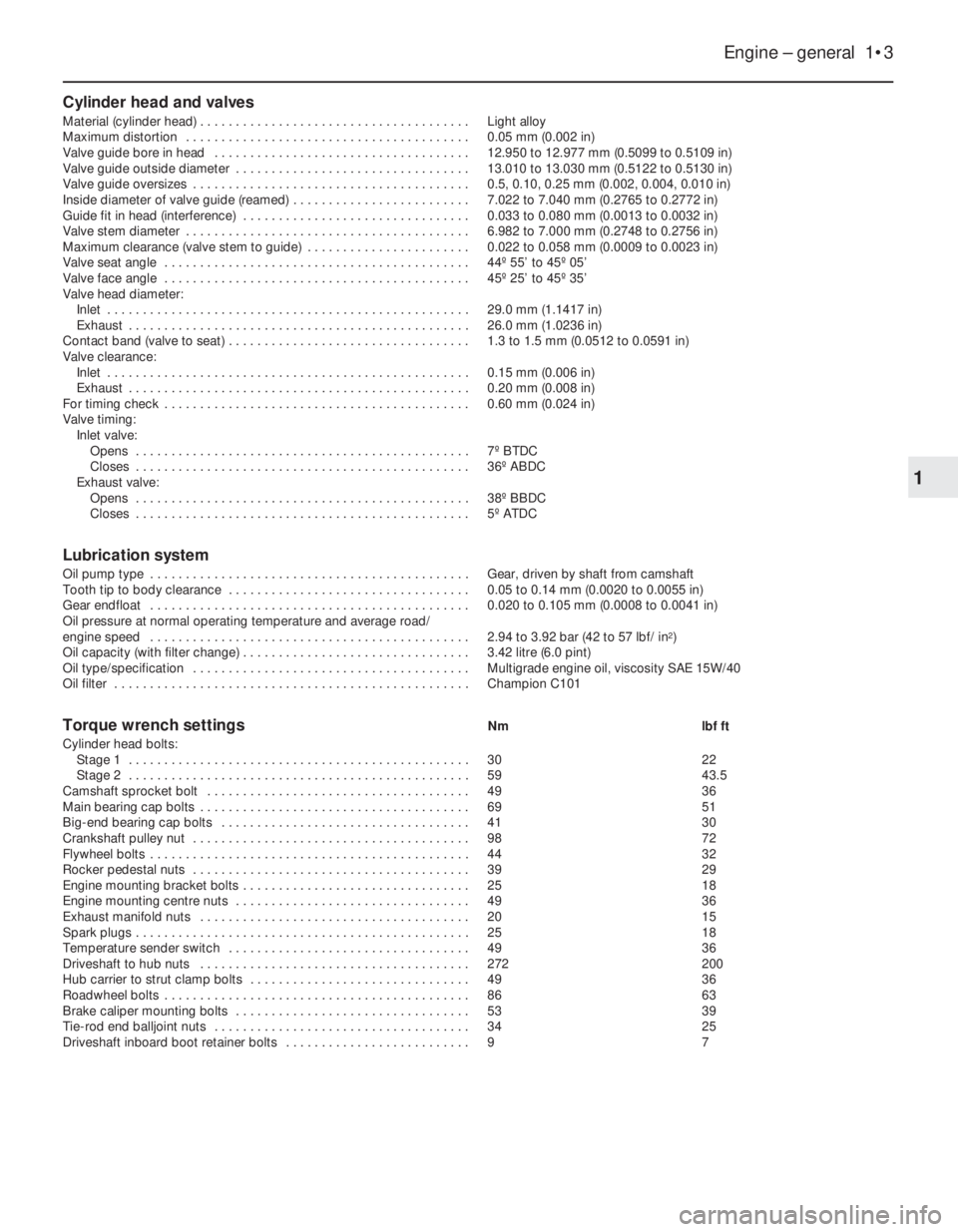
Cylinder head and valves
Material (cylinder head) . . . . . . . . . . . . . . . . . . . . . . . . . . . . . . . . . . . . . . Light alloy
Maximum distortion . . . . . . . . . . . . . . . . . . . . . . . . . . . . . . . . . . . . . . . . 0.05 mm (0.002 in)
Valve guide bore in head . . . . . . . . . . . . . . . . . . . . . . . . . . . . . . . . . . . . 12.950 to 12.977 mm (0.5099 to 0.5109 in)
Valve guide outside diameter . . . . . . . . . . . . . . . . . . . . . . . . . . . . . . . . . 13.010 to 13.030 mm (0.5122 to 0.5130 in)
Valve guide oversizes . . . . . . . . . . . . . . . . . . . . . . . . . . . . . . . . . . . . . . . 0.5, 0.10, 0.25 mm (0.002, 0.004, 0.010 in)
Inside diameter of valve guide (reamed) . . . . . . . . . . . . . . . . . . . . . . . . . 7.022 to 7.040 mm (0.2765 to 0.2772 in)
Guide fit in head (interference) . . . . . . . . . . . . . . . . . . . . . . . . . . . . . . . . 0.033 to 0.080 mm (0.0013 to 0.0032 in)
Valve stem diameter . . . . . . . . . . . . . . . . . . . . . . . . . . . . . . . . . . . . . . . . 6.982 to 7.000 mm (0.2748 to 0.2756 in)
Maximum clearance (valve stem to guide) . . . . . . . . . . . . . . . . . . . . . . . 0.022 to 0.058 mm (0.0009 to 0.0023 in)
Valve seat angle . . . . . . . . . . . . . . . . . . . . . . . . . . . . . . . . . . . . . . . . . . . 44º 55’ to 45º 05’
Valve face angle . . . . . . . . . . . . . . . . . . . . . . . . . . . . . . . . . . . . . . . . . . . 45º 25’ to 45º 35’
Valve head diameter:
Inlet . . . . . . . . . . . . . . . . . . . . . . . . . . . . . . . . . . . . . . . . . . . . . . . . . . . 29.0 mm (1.1417 in)
Exhaust . . . . . . . . . . . . . . . . . . . . . . . . . . . . . . . . . . . . . . . . . . . . . . . . 26.0 mm (1.0236 in)
Contact band (valve to seat) . . . . . . . . . . . . . . . . . . . . . . . . . . . . . . . . . . 1.3 to 1.5 mm (0.0512 to 0.0591 in)
Valve clearance:
Inlet . . . . . . . . . . . . . . . . . . . . . . . . . . . . . . . . . . . . . . . . . . . . . . . . . . . 0.15 mm (0.006 in)
Exhaust . . . . . . . . . . . . . . . . . . . . . . . . . . . . . . . . . . . . . . . . . . . . . . . . 0.20 mm (0.008 in)
For timing check . . . . . . . . . . . . . . . . . . . . . . . . . . . . . . . . . . . . . . . . . . . 0.60 mm (0.024 in)
Valve timing:
Inlet valve:
Opens . . . . . . . . . . . . . . . . . . . . . . . . . . . . . . . . . . . . . . . . . . . . . . . 7º BTDC
Closes . . . . . . . . . . . . . . . . . . . . . . . . . . . . . . . . . . . . . . . . . . . . . . . 36º ABDC
Exhaust valve:
Opens . . . . . . . . . . . . . . . . . . . . . . . . . . . . . . . . . . . . . . . . . . . . . . . 38º BBDC
Closes . . . . . . . . . . . . . . . . . . . . . . . . . . . . . . . . . . . . . . . . . . . . . . . 5º ATDC
Lubrication system
Oil pump type . . . . . . . . . . . . . . . . . . . . . . . . . . . . . . . . . . . . . . . . . . . . . Gear, driven by shaft from camshaft
Tooth tip to body clearance . . . . . . . . . . . . . . . . . . . . . . . . . . . . . . . . . . 0.05 to 0.14 mm (0.0020 to 0.0055 in)
Gear endfloat . . . . . . . . . . . . . . . . . . . . . . . . . . . . . . . . . . . . . . . . . . . . . 0.020 to 0.105 mm (0.0008 to 0.0041 in)
Oil pressure at normal operating temperature and average road/
engine speed . . . . . . . . . . . . . . . . . . . . . . . . . . . . . . . . . . . . . . . . . . . . . 2.94 to 3.92 bar (42 to 57 lbf/ in
2)
Oil capacity (with filter change) . . . . . . . . . . . . . . . . . . . . . . . . . . . . . . . . 3.42 litre (6.0 pint)
Oil type/specification . . . . . . . . . . . . . . . . . . . . . . . . . . . . . . . . . . . . . . . Multigrade engine oil, viscosity SAE 15W/40
Oil filter . . . . . . . . . . . . . . . . . . . . . . . . . . . . . . . . . . . . . . . . . . . . . . . . . . Champion C101
Torque wrench settingsNm lbf ft
Cylinder head bolts:
Stage 1 . . . . . . . . . . . . . . . . . . . . . . . . . . . . . . . . . . . . . . . . . . . . . . . . 30 22
Stage 2 . . . . . . . . . . . . . . . . . . . . . . . . . . . . . . . . . . . . . . . . . . . . . . . . 59 43.5
Camshaft sprocket bolt . . . . . . . . . . . . . . . . . . . . . . . . . . . . . . . . . . . . . 49 36
Main bearing cap bolts . . . . . . . . . . . . . . . . . . . . . . . . . . . . . . . . . . . . . . 69 51
Big-end bearing cap bolts . . . . . . . . . . . . . . . . . . . . . . . . . . . . . . . . . . . 41 30
Crankshaft pulley nut . . . . . . . . . . . . . . . . . . . . . . . . . . . . . . . . . . . . . . . 98 72
Flywheel bolts . . . . . . . . . . . . . . . . . . . . . . . . . . . . . . . . . . . . . . . . . . . . . 44 32
Rocker pedestal nuts . . . . . . . . . . . . . . . . . . . . . . . . . . . . . . . . . . . . . . . 39 29
Engine mounting bracket bolts . . . . . . . . . . . . . . . . . . . . . . . . . . . . . . . . 25 18
Engine mounting centre nuts . . . . . . . . . . . . . . . . . . . . . . . . . . . . . . . . . 49 36
Exhaust manifold nuts . . . . . . . . . . . . . . . . . . . . . . . . . . . . . . . . . . . . . . 20 15
Spark plugs . . . . . . . . . . . . . . . . . . . . . . . . . . . . . . . . . . . . . . . . . . . . . . . 25 18
Temperature sender switch . . . . . . . . . . . . . . . . . . . . . . . . . . . . . . . . . . 49 36
Driveshaft to hub nuts . . . . . . . . . . . . . . . . . . . . . . . . . . . . . . . . . . . . . . 272 200
Hub carrier to strut clamp bolts . . . . . . . . . . . . . . . . . . . . . . . . . . . . . . . 49 36
Roadwheel bolts . . . . . . . . . . . . . . . . . . . . . . . . . . . . . . . . . . . . . . . . . . . 86 63
Brake caliper mounting bolts . . . . . . . . . . . . . . . . . . . . . . . . . . . . . . . . . 53 39
Tie-rod end balljoint nuts . . . . . . . . . . . . . . . . . . . . . . . . . . . . . . . . . . . . 34 25
Driveshaft inboard boot retainer bolts . . . . . . . . . . . . . . . . . . . . . . . . . . 9 7
Engine – general 1•3
1
Page 20 of 303
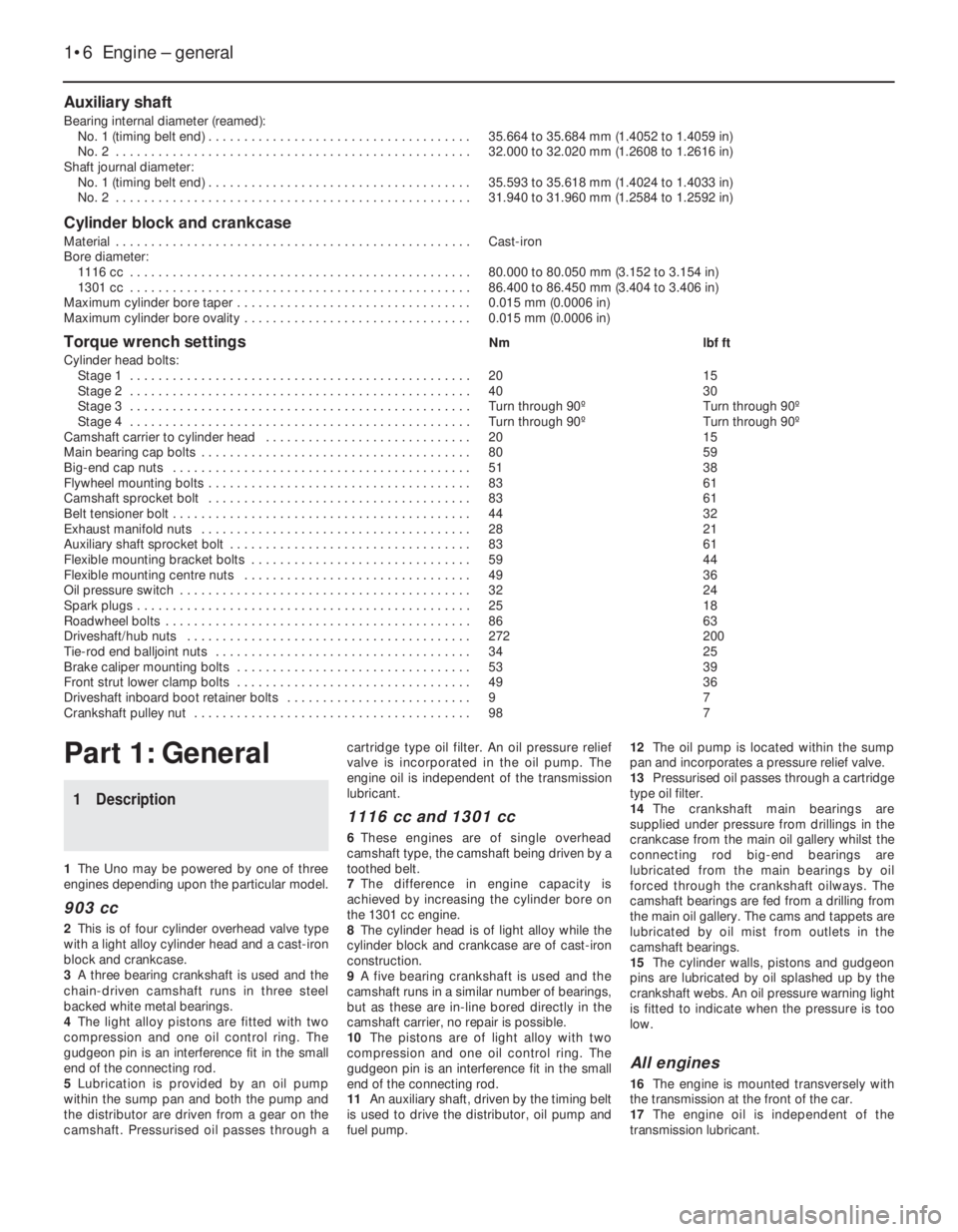
Auxiliary shaft
Bearing internal diameter (reamed):
No. 1 (timing belt end) . . . . . . . . . . . . . . . . . . . . . . . . . . . . . . . . . . . . . 35.664 to 35.684 mm (1.4052 to 1.4059 in)
No. 2 . . . . . . . . . . . . . . . . . . . . . . . . . . . . . . . . . . . . . . . . . . . . . . . . . . 32.000 to 32.020 mm (1.2608 to 1.2616 in)
Shaft journal diameter:
No. 1 (timing belt end) . . . . . . . . . . . . . . . . . . . . . . . . . . . . . . . . . . . . . 35.593 to 35.618 mm (1.4024 to 1.4033 in)
No. 2 . . . . . . . . . . . . . . . . . . . . . . . . . . . . . . . . . . . . . . . . . . . . . . . . . . 31.940 to 31.960 mm (1.2584 to 1.2592 in)
Cylinder block and crankcase
Material . . . . . . . . . . . . . . . . . . . . . . . . . . . . . . . . . . . . . . . . . . . . . . . . . . Cast-iron
Bore diameter:
1116 cc . . . . . . . . . . . . . . . . . . . . . . . . . . . . . . . . . . . . . . . . . . . . . . . . 80.000 to 80.050 mm (3.152 to 3.154 in)
1301 cc . . . . . . . . . . . . . . . . . . . . . . . . . . . . . . . . . . . . . . . . . . . . . . . . 86.400 to 86.450 mm (3.404 to 3.406 in)
Maximum cylinder bore taper . . . . . . . . . . . . . . . . . . . . . . . . . . . . . . . . . 0.015 mm (0.0006 in)
Maximum cylinder bore ovality . . . . . . . . . . . . . . . . . . . . . . . . . . . . . . . . 0.015 mm (0.0006 in)
Torque wrench settingsNm lbf ft
Cylinder head bolts:
Stage 1 . . . . . . . . . . . . . . . . . . . . . . . . . . . . . . . . . . . . . . . . . . . . . . . . 20 15
Stage 2 . . . . . . . . . . . . . . . . . . . . . . . . . . . . . . . . . . . . . . . . . . . . . . . . 40 30
Stage 3 . . . . . . . . . . . . . . . . . . . . . . . . . . . . . . . . . . . . . . . . . . . . . . . . Turn through 90º Turn through 90º
Stage 4 . . . . . . . . . . . . . . . . . . . . . . . . . . . . . . . . . . . . . . . . . . . . . . . . Turn through 90º Turn through 90º
Camshaft carrier to cylinder head . . . . . . . . . . . . . . . . . . . . . . . . . . . . . 20 15
Main bearing cap bolts . . . . . . . . . . . . . . . . . . . . . . . . . . . . . . . . . . . . . . 80 59
Big-end cap nuts . . . . . . . . . . . . . . . . . . . . . . . . . . . . . . . . . . . . . . . . . . 51 38
Flywheel mounting bolts . . . . . . . . . . . . . . . . . . . . . . . . . . . . . . . . . . . . . 83 61
Camshaft sprocket bolt . . . . . . . . . . . . . . . . . . . . . . . . . . . . . . . . . . . . . 83 61
Belt tensioner bolt . . . . . . . . . . . . . . . . . . . . . . . . . . . . . . . . . . . . . . . . . . 44 32
Exhaust manifold nuts . . . . . . . . . . . . . . . . . . . . . . . . . . . . . . . . . . . . . . 28 21
Auxiliary shaft sprocket bolt . . . . . . . . . . . . . . . . . . . . . . . . . . . . . . . . . . 83 61
Flexible mounting bracket bolts . . . . . . . . . . . . . . . . . . . . . . . . . . . . . . . 59 44
Flexible mounting centre nuts . . . . . . . . . . . . . . . . . . . . . . . . . . . . . . . . 49 36
Oil pressure switch . . . . . . . . . . . . . . . . . . . . . . . . . . . . . . . . . . . . . . . . . 32 24
Spark plugs . . . . . . . . . . . . . . . . . . . . . . . . . . . . . . . . . . . . . . . . . . . . . . . 25 18
Roadwheel bolts . . . . . . . . . . . . . . . . . . . . . . . . . . . . . . . . . . . . . . . . . . . 86 63
Driveshaft/hub nuts . . . . . . . . . . . . . . . . . . . . . . . . . . . . . . . . . . . . . . . . 272 200
Tie-rod end balljoint nuts . . . . . . . . . . . . . . . . . . . . . . . . . . . . . . . . . . . . 34 25
Brake caliper mounting bolts . . . . . . . . . . . . . . . . . . . . . . . . . . . . . . . . . 53 39
Front strut lower clamp bolts . . . . . . . . . . . . . . . . . . . . . . . . . . . . . . . . . 49 36
Driveshaft inboard boot retainer bolts . . . . . . . . . . . . . . . . . . . . . . . . . . 9 7
Crankshaft pulley nut . . . . . . . . . . . . . . . . . . . . . . . . . . . . . . . . . . . . . . . 98 7
1•6 Engine – general
Part 1: General
1 Description
1The Uno may be powered by one of three
engines depending upon the particular model.
903 cc
2This is of four cylinder overhead valve type
with a light alloy cylinder head and a cast-iron
block and crankcase.
3A three bearing crankshaft is used and the
chain-driven camshaft runs in three steel
backed white metal bearings.
4The light alloy pistons are fitted with two
compression and one oil control ring. The
gudgeon pin is an interference fit in the small
end of the connecting rod.
5Lubrication is provided by an oil pump
within the sump pan and both the pump and
the distributor are driven from a gear on the
camshaft. Pressurised oil passes through acartridge type oil filter. An oil pressure relief
valve is incorporated in the oil pump. The
engine oil is independent of the transmission
lubricant.
1116 cc and 1301 cc
6These engines are of single overhead
camshaft type, the camshaft being driven by a
toothed belt.
7The difference in engine capacity is
achieved by increasing the cylinder bore on
the 1301 cc engine.
8The cylinder head is of light alloy while the
cylinder block and crankcase are of cast-iron
construction.
9A five bearing crankshaft is used and the
camshaft runs in a similar number of bearings,
but as these are in-line bored directly in the
camshaft carrier, no repair is possible.
10The pistons are of light alloy with two
compression and one oil control ring. The
gudgeon pin is an interference fit in the small
end of the connecting rod.
11An auxiliary shaft, driven by the timing belt
is used to drive the distributor, oil pump and
fuel pump.12The oil pump is located within the sump
pan and incorporates a pressure relief valve.
13Pressurised oil passes through a cartridge
type oil filter.
14The crankshaft main bearings are
supplied under pressure from drillings in the
crankcase from the main oil gallery whilst the
connecting rod big-end bearings are
lubricated from the main bearings by oil
forced through the crankshaft oilways. The
camshaft bearings are fed from a drilling from
the main oil gallery. The cams and tappets are
lubricated by oil mist from outlets in the
camshaft bearings.
15The cylinder walls, pistons and gudgeon
pins are lubricated by oil splashed up by the
crankshaft webs. An oil pressure warning light
is fitted to indicate when the pressure is too
low.
All engines
16The engine is mounted transversely with
the transmission at the front of the car.
17The engine oil is independent of the
transmission lubricant.
Page 42 of 303
from the suspension struts and then remove
the bolts which secure the hub carriers to the
U-clamps at the base of the suspension
struts.
23Pull the tops of the hub carriers down and
then outwards and push the driveshafts from
them.
24Unbolt the driveshaft inboard boot
retainers and then remove the driveshafts
from the transmission.
25Support the engine on a hoist or use a
trolley jack under the engine/transmission.
Remove the bottom mounting and then the
upper left and right-hand ones.
26Lower the power unit to the floor by
pushing it to the left-hand side to clear the
right-hand mounting bracket and then swivel
the gearbox towards the rear of the car.
Withdraw the engine/transmission from under
the car.
27External dirt and grease should now be
removed using paraffin and a stiff brush or a
water-soluble solvent.
28Unbolt and remove the engine mounting
brackets and the starter motor.
29Unbolt and remove the cover plate with
the gearchange ball stud strut from the lower
front face of the flywheel housing.
30With the engine resting squarely on its
sump pan, unscrew the flywheel housing
connecting bolts, noting the location of any
lifting lugs and hose and wiring clips.
31Support the weight of the transmission
and withdraw it in a straight line from the
engine.
36 Engine- dismantling (general)
Refer to Section 14, Part 2.
37 Engine ancillary components
- removal
Refer to Section 15, Part 2 and also remove
the intake manifold.
38 Engine-
complete dismantling
3
1Have the engine resting squarely and
supported securely on the work surface.
2Unbolt and remove the timing belt cover.
3Grip the now exposed timing belt with the
hands and loosen the camshaft sprocket.
4Release the timing belt tensioner pulley
centre bolt, then slip the belt from the pulley
and sprockets to remove it. Note which way
round the belt is fitted, usually so that the
lettering on the belt can be read from the
crankshaft pulley end of the engine.
5Remove the camshaft sprocket.6Unbolt and remove the camshaft timing belt
cover backing plate.
7Unbolt and remove the camshaft carrier
cover.
8Unbolt the camshaft carrier and lift it off
very slowly, at the same time pushing the cam
followers and their shims down with the
fingers securely onto their respective valve
springs. It is easy to remove the camshaft
carrier too quickly with some of the cam
followers stuck in it and as the carrier is lifted
away, the cam followers will fall out. If this
happens, the valve clearances will be upset as
the cam followers and shims cannot be
returned, with any certainty, to their original
positions. Keep the cam followers and shims
in their originally fitted order.
9Unscrew and remove the cylinder head
bolts and nuts, grip the manifold, rock the
head and remove the complete cylinder
head/manifold/carburettor assembly. Remove
and discard the cylinder head gasket.
10Unbolt the coolant pump from the side of
the cylinder block and remove it complete
with coolant distribution pipe. Remove the
crankcase breather.
11Remove the distributor/oil pump
driveshaft. This is simply carried out by
inserting a finger into the hole vacated by the
distributor and wedging it in the hole in the
end of the driveshaft. Lift the shaft out of
mesh with the auxiliary shaft. Where the
distributor is driven by the camshaft, a cover
plate retains the oil pump driveshaft in
position.
12Unbolt and remove the sprocket from the
end of the auxiliary shaft. The sprocket is held
to the shaft with a Woodruff key.
13Unbolt the auxiliary shaft retainer and
withdraw the shaft from the crankcase.
14Unscrew and remove the crankshaft
pulley nut. This is very tight and the flywheel
starter ring gear will have to be jammed with a
cold chisel or a suitably bent piece of steel to
prevent the crankshaft rotating.
15Withdraw the crankshaft sprocket, which
is located by the Woodruff key.
16Unbolt the front engine mounting bracket
from the cylinder block, together with the
timing belt cover screw anchor bush. Unbolt
and remove the timing belt tensioner pulley.
17Unscrew the flywheel securing bolts. Thestarter ring gear will again have to be jammed
to prevent the crankshaft rotating as the bolts
are unscrewed. Mark the flywheel position in
relation to the crankshaft mounting flange,
then remove it.
18Unbolt the front and rear crankshaft oil
seal retainer bolts from the crankcase and the
sump. Remove the oil seal retainers.
19Turn the engine on its side, extract the
remaining sump bolts and remove the sump.
If it is stuck, try tapping it gently with a
soft-faced hammer. If this fails, cut all round
the sump-to-gasket flange with a sharp knife.
Do not try prising with a large screwdriver; this
will only distort the sump mating flange.
20With the sump removed, unbolt and
remove the oil pump.
21Grip the oil pick-up pipe and twist or rock
it from its hole in the crankcase. It is an
interference fit in the hole.
22Remove the piston/connecting rods as
described in Section 32.
23Before unbolting the main bearing caps,
note that they are marked with one, two, three
or four notches. No. 5 main bearing cap is
unmarked. Note that the notches are nearer
the auxiliary shaft side.
24Unbolt and remove the main bearing
caps. If the bearing shells are to be used
again, tape them to their respective caps. The
bearing shell at the centre position is plain,
the others have a lubricating groove.
25Carefully, lift the crankshaft from the
crankcase, noting the thrust washers at No. 5
main bearing. These control the crankshaft
endfloat.
39 Cylinder head- dismantling
and decarbonising
4
1The operations are similar to those
described for the ohv engine in Section 17 in
respect of decarbonising and valve grinding.
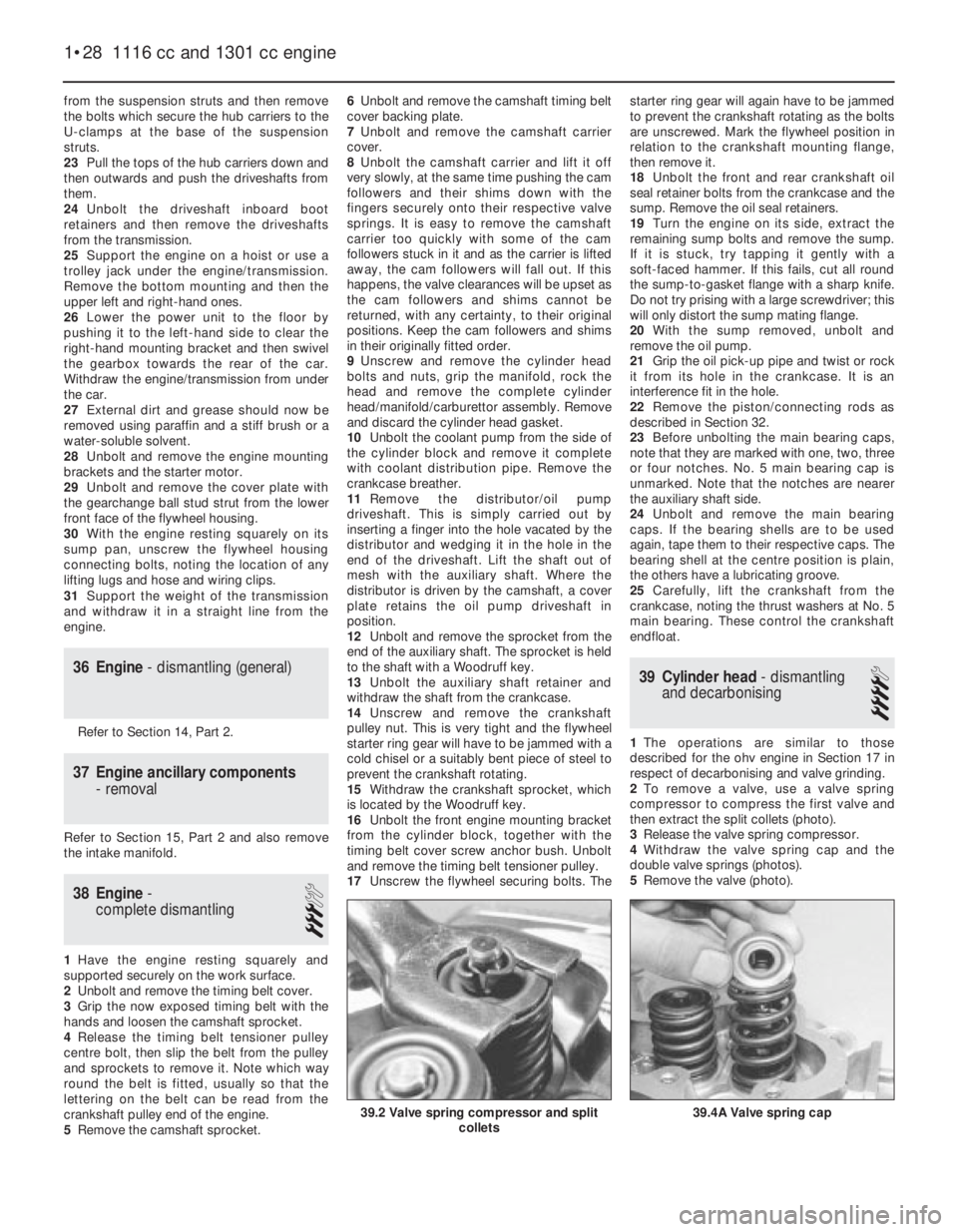
2To remove a valve, use a valve spring
compressor to compress the first valve and
then extract the split collets (photo).
3Release the valve spring compressor.
4Withdraw the valve spring cap and the
double valve springs (photos).
5Remove the valve (photo).
1•28 1116 cc and 1301 cc engine
39.4A Valve spring cap39.2 Valve spring compressor and split
collets
Page 84 of 303
assembly and the flexible pipe, particularly the
fixing bracket and union at the car end of the
flexible pipe.
3Have ready a container suitable to catch
the brake fluid, and sheets of clean
newspaper on which to put parts.
4Take out the spring clips and locking
blocks, and take the caliper off the support
bracket.
5Disconnect the hydraulic flexible pipe at the
under wing support bracket and cap both
pipe ends. It may help to prevent loss of fluid
if the vent in the reservoir cap is sealed with
adhesive tape, to create a vacuum.
6Remove the caliper to the bench or other
work surface, and clean it thoroughly with
hydraulic fluid or methylated spirit.
7Depress the piston until the dust excluding
boot can be removed.
8Now apply air pressure to the flexible hose
and eject the piston. Quite a low pressure is
required for this, such as can be generated
with a hand or foot operated pump.
9Pick out the piston seal from its groove in
the cylinder. Use a sharp probe, but take care
to avoid scratching the cylinder bore.
10Examine the surface of the piston and
cylinder bore. If either is corroded, scored or
shows metal-to-metal rubbed areas, the
complete assembly should be renewed.
11If the components are in good condition,
discard the oil seals, clean the piston and
cylinder and fit the new seal for the piston.
This is included in the repair kit. Use the
fingers only to manipulate it into its groove.
12Lubricate the piston with clean hydraulic
fluid and insert it partially into the cylinder.
13Fit the new dust excluding boot to its
projecting end, push the piston fully into the
cylinder and engage the dust excluder with
the rim of the cylinder.
14Refit the caliper, reconnect the flexible
hose, then bleed the front hydraulic circuit
(refer to Section 12).
6 Brake disc- inspection,
renovation or renewal
2
1Whenever the front disc pads are being
checked for wear, take the opportunity to
inspect the discs for deep scoring or
grooving. After a high mileage the disc may
become reduced in thickness away from the
extreme outer edge of the disc. lf this wear is
rapid, it is possible that the friction pads are of
too hard a type.
2If the disc has evidence of many tiny cracks,
these may be caused by overheating due to a
seized caliper piston in the “applied” position.
3The foregoing conditions may be corrected
by regrinding the disc provided that the
thickness of the disc is not reduced below
that specified by such action. Alternatively, fit
a new disc.
4To remove a disc, take off the caliper andpads as described in Sections 3 and 5. Tie the
caliper up, out of the way.
5Knock back the tabs of the lockplates and
unbolt the caliper support bracket from the
hub carrier.
6Unscrew and remove the two bolts which
hold the disc assembly to the hub. One of
these bolts is for wheel locating purposes.
7Pull the disc from the hub.
8Refitting is a reversal of the removal
process. If the disc has excessive run-out,
repositioning it in relation to the hub may
bring it within tolerance by cancelling out the
run-out characteristics in the hub and disc,
once the most suitable fitted position has
been found.
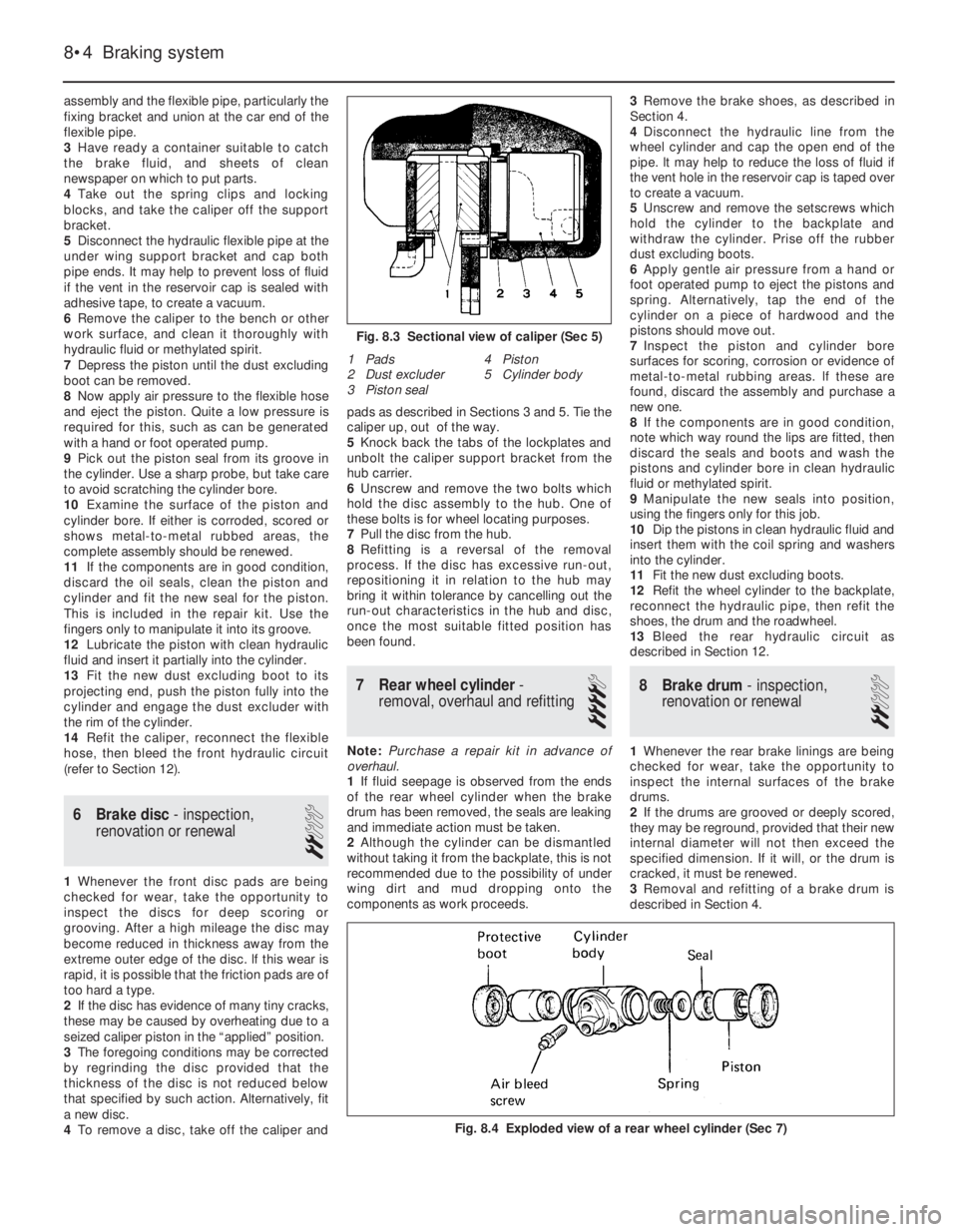
7 Rear wheel cylinder-
removal, overhaul and refitting
4
Note: Purchase a repair kit in advance of
overhaul.
1If fluid seepage is observed from the ends
of the rear wheel cylinder when the brake
drum has been removed, the seals are leaking
and immediate action must be taken.
2Although the cylinder can be dismantled
without taking it from the backplate, this is not
recommended due to the possibility of under
wing dirt and mud dropping onto the
components as work proceeds. 3Remove the brake shoes, as described in
Section 4.
4Disconnect the hydraulic line from the
wheel cylinder and cap the open end of the
pipe. lt may help to reduce the loss of fluid if
the vent hole in the reservoir cap is taped over
to create a vacuum.
5Unscrew and remove the setscrews which
hold the cylinder to the backplate and
withdraw the cylinder. Prise off the rubber
dust excluding boots.
6Apply gentle air pressure from a hand or
foot operated pump to eject the pistons and
spring. Alternatively, tap the end of the
cylinder on a piece of hardwood and the
pistons should move out.
7Inspect the piston and cylinder bore
surfaces for scoring, corrosion or evidence of
metal-to-metal rubbing areas. lf these are
found, discard the assembly and purchase a
new one.
8If the components are in good condition,
note which way round the lips are fitted, then
discard the seals and boots and wash the
pistons and cylinder bore in clean hydraulic
fluid or methylated spirit.
9Manipulate the new seals into position,
using the fingers only for this job.
10Dip the pistons in clean hydraulic fluid and
insert them with the coil spring and washers
into the cylinder.
11Fit the new dust excluding boots.
12Refit the wheel cylinder to the backplate,
reconnect the hydraulic pipe, then refit the
shoes, the drum and the roadwheel.
13Bleed the rear hydraulic circuit as
described in Section 12.
8 Brake drum- inspection,
renovation or renewal
2
1Whenever the rear brake linings are being
checked for wear, take the opportunity to
inspect the internal surfaces of the brake
drums.
2If the drums are grooved or deeply scored,
they may be reground, provided that their new
internal diameter will not then exceed the
specified dimension. If it will, or the drum is
cracked, it must be renewed.
3Removal and refitting of a brake drum is
described in Section 4.
8•4 Braking system
Fig. 8.4 Exploded view of a rear wheel cylinder (Sec 7)
1 Pads
2 Dust excluder
3 Piston seal4 Piston
5 Cylinder body
Fig. 8.3 Sectional view of caliper (Sec 5)
Page 85 of 303
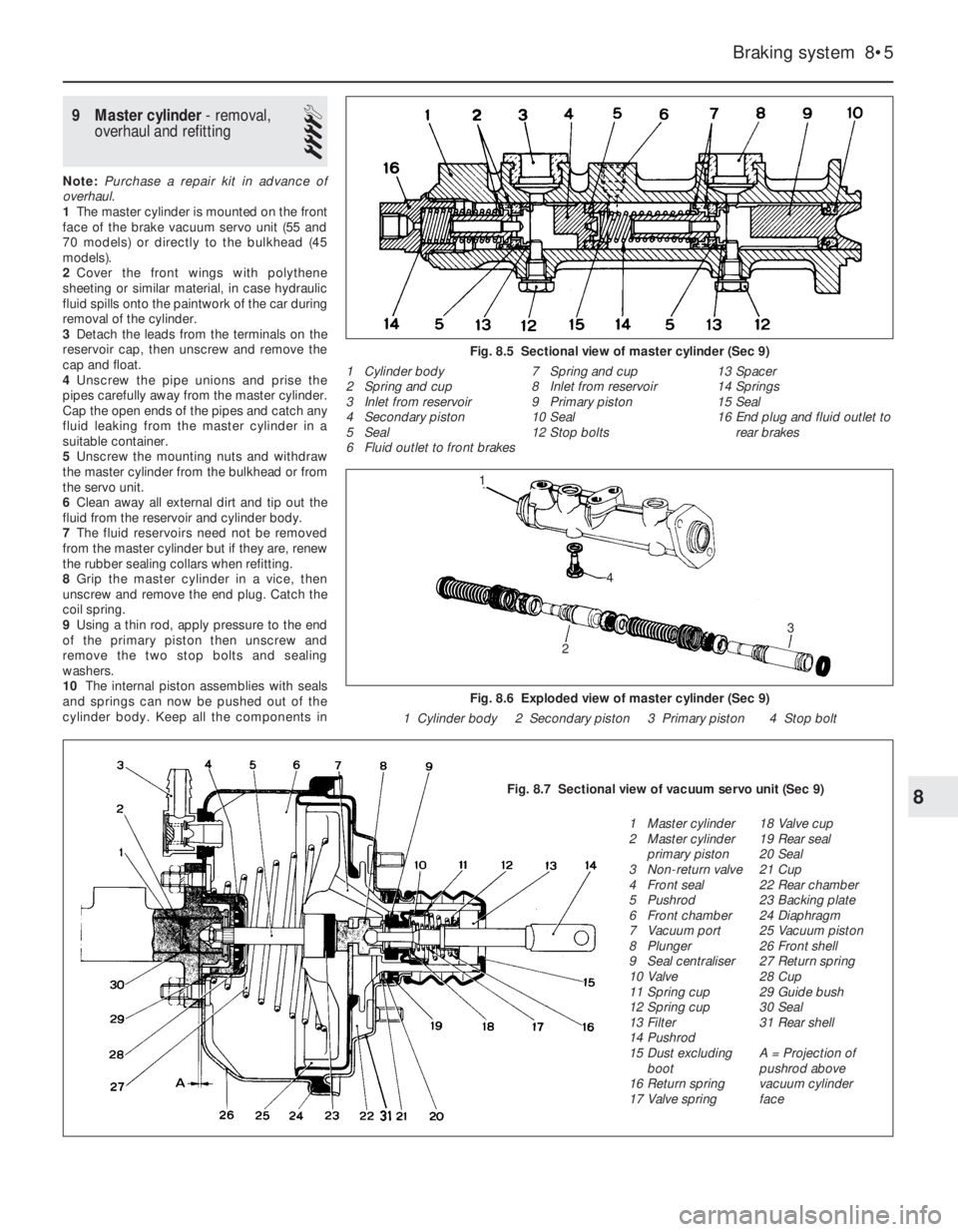
9 Master cylinder- removal,
overhaul and refitting
4
Note: Purchase a repair kit in advance of
overhaul.
1The master cylinder is mounted on the front
face of the brake vacuum servo unit (55 and
70 models) or directly to the bulkhead (45
models).
2Cover the front wings with polythene
sheeting or similar material, in case hydraulic
fluid spills onto the paintwork of the car during
removal of the cylinder.
3Detach the leads from the terminals on the
reservoir cap, then unscrew and remove the
cap and float.
4Unscrew the pipe unions and prise the
pipes carefully away from the master cylinder.
Cap the open ends of the pipes and catch any
fluid leaking from the master cylinder in a
suitable container.
5Unscrew the mounting nuts and withdraw
the master cylinder from the bulkhead or from
the servo unit.
6Clean away all external dirt and tip out the
fluid from the reservoir and cylinder body.
7The fluid reservoirs need not be removed
from the master cylinder but if they are, renew
the rubber sealing collars when refitting.
8Grip the master cylinder in a vice, then
unscrew and remove the end plug. Catch the
coil spring.
9Using a thin rod, apply pressure to the end
of the primary piston then unscrew and
remove the two stop bolts and sealing
washers.
10The internal piston assemblies with seals
and springs can now be pushed out of the
cylinder body. Keep all the components in
Braking system 8•5
Fig. 8.5 Sectional view of master cylinder (Sec 9)
1 Cylinder body
2 Spring and cup
3 Inlet from reservoir
4 Secondary piston
5 Seal
6 Fluid outlet to front brakes7 Spring and cup
8 Inlet from reservoir
9 Primary piston
10 Seal
12 Stop bolts13 Spacer
14 Springs
15 Seal
16 End plug and fluid outlet to
rear brakes
Fig. 8.6 Exploded view of master cylinder (Sec 9)
1 Cylinder body 2 Secondary piston 3 Primary piston 4 Stop bolt
8Fig. 8.7 Sectional view of vacuum servo unit (Sec 9)
1 Master cylinder
2 Master cylinder
primary piston
3 Non-return valve
4 Front seal
5 Pushrod
6 Front chamber
7 Vacuum port
8 Plunger
9 Seal centraliser
10 Valve
11 Spring cup
12 Spring cup
13 Filter
14 Pushrod
15 Dust excluding
boot
16 Return spring
17 Valve spring18 Valve cup
19 Rear seal
20 Seal
21 Cup
22 Rear chamber
23 Backing plate
24 Diaphragm
25 Vacuum piston
26 Front shell
27 Return spring
28 Cup
29 Guide bush
30 Seal
31 Rear shell
A = Projection of
pushrod above
vacuum cylinder
face
2
3
1
4
Page 88 of 303
20By connecting a pressurised container to
the master cylinder fluid reservoir, bleeding is
then carried out by simply opening each bleed
screw in turn and allowing the fluid to run out,
rather like turning on a tap, until no air is
visible in the expelled fluid.
21By using this method, the large reserve of
hydraulic fluid provides a safeguard against
air being drawn into the master cylinder
during bleeding which often occurs if the fluid
level in the reservoir is not maintained.
22Pressure bleeding is particularly effective
when bleeding “difficult” systems or when
bleeding the complete system at time of
routine fluid renewal.
All methods
23When bleeding is completed, check and
top up the fluid level in the master cylinder
reservoir.
24Check the feel of the brake pedal. If it
feels at all spongy, air must still be present in
the system and further bleeding is indicated.
Failure to bleed satisfactorily after a
reasonable period of the bleeding operation,
may be due to worn master cylinder seals.
25Discard brake fluid which has been
expelled. lt is almost certain to be
contaminated with moisture, air and dirt
making it unsuitable for further use. Clean
fluid should always be stored in an airtight
container as it absorbs moisture readily
(hygroscopic) which lowers its boiling point
and could affect braking performance under
severe conditions.
13 Vacuum servo unit-
description
A vacuum servo unit is fitted into the brake
hydraulic circuit on 55 and 70 models in series
with the master cylinder, to provide assistance
to the driver when the brake pedal is
depressed. This reduces the effort required by
the driver to operate the brakes under all
braking conditions.
The unit operates by vacuum obtained from
the induction manifold and comprises basically
a booster diaphragm and non-return valve. The
servo unit and hydraulic master cylinder are
connected together so that the servo unit
piston rod acts as the master cylinder pushrod.
The driver’s braking effort is transmitted
through another pushrod to the servo unit
piston and its built-in control system. The servo
unit piston does not fit tightly into the cylinder,
but has a strong diaphragm to keep its edges
in constant contact with the cylinder wall, so
assuring an air tight seal between the two
parts. The forward chamber is held under
vacuum conditions created in the inlet manifold
of the engine and, during periods when the
brake pedal is not in use, the controls open a
passage to the rear chamber so placing it
under vacuum conditions as well. When the
brake pedal is depressed, the vacuum passageto the rear chamber is cut off and the chamber
opened to atmospheric pressure. The
consequent rush of air pushes the servo piston
forward in the vacuum chamber and operates
the main pushrod to the master cylinder.
The controls are designed so that
assistance is given under all conditions and,
when the brakes are not required, vacuum in
the rear chamber is established when the
brake pedal is released. All air from the
atmosphere entering the rear chamber is
passed through a small air filter.
Under normal operating conditions, the
vacuum servo unit is very reliable and does
not require overhaul except at very high
mileages. In this case, it is far better to obtain
a service exchange unit, rather than repair the
original unit.
It is emphasised that the servo unit assists
in reducing the braking effort required at the
foot pedal and in the event of its failure, the
hydraulic braking system is in no way affected
except that the need for higher pressures will
be noticed.
14 Vacuum servo unit-
servicing and testing
1Regularly, check that the vacuum hose
which runs between the servo unit and the
inlet manifold is in good condition and is a
tight fit at both ends.
2If broken or badly clogged, renew the air
filter which is located around the brake pedal
push rod. Access to this is obtained by
disconnecting the pushrod from the
cross-shaft or pedal arm, withdrawing the
pushrod, dust excluding boot and end cap.
3If the new filter is cut diagonally from its
centre hole, future renewal can be carried out
without the need for disconnection of the
pushrod.
4If the efficiency of the servo unit is suspect,
it can be checked out in the following way.
5Run the engine, then switch off the ignition.
Depress the footbrake pedal; the distinctive
in-rush of air into the servo should be clearly
heard. It should be possible to repeat this
operation several times before the vacuum in
the system is exhausted.
6Start the engine and have an assistant
apply the footbrake pedal and hold it down.
Disconnect the vacuuum hose from the servo.
There should not be any in-rush of air into the
servo through the connecting stub. lf there is,
the servo diaphragm is probably faulty. During
this test, expect the engine to idle roughly,
unless the open end of the hose to the inlet
manifold is plugged. Reconnect the hose.
7With the engine off, depress the brake
pedal fully. Start the engine with the brake
pedal still depressed; the pedal should be felt
to go down fractionally.
8If the results of these tests are not
satisfactory, remove the unit and fit a new one
as described in the next Section.
15 Vacuum servo unit-
removal and refitting
3
1Syphon as much fluid as possible out of the
master cylinder reservolr.
2Disconnect electrical leads from the
terminals in the reservoir cap then uncouple
the rigid pipelines from the master cylinder
body. Be prepared to catch leaking fluid and
plug the open ends of the pipelines.
3The master cylinder can be unbolted now
from the servo unit, or detached later when
the complete assembly is withdrawn.
4Working inside the car, disconnect the
servo pushrod from the pedal then remove the
servo mounting nuts.
5Withdraw the servo assembly into the
engine compartment, then remove it to the
bench. lf the master cylinder is still attached,
cover the wings with protective sheeting, in
case brake fluid is spilled during removal.
6Refitting is a reversal of the removal
process, but adjust the pushrod clearance as
described in Section 9. On completion of
refitting, bleed the complete hydraulic system
as described in Section 12. Note: Where the
help of an assistant is available, the servo
pushrod need not be disconnected from the
pedal. The rod is a sliding fit in the servo and
the servo can be simply pulled off the rod.
Refitting without having disconnected the rod
from the pedal can be difficult unless the help
of an assistant is available.
16 Handbrake- adjustment
1
Adjustment is normally automatic, by the
movement of the rear brake shoes on their
automatic adjusters.
However, owing to cable stretch,
supplementary adjustment is occasionally
required at the control lever adjuster nut. The
need for this adjustment is usually indicated
by excessive movement of the control lever
when fully applied.
1The rear brakes should be fully applied
when the handbrake control lever has been
pulled over four or five notches.
2If adjustment is required, release the
8•8 Braking system
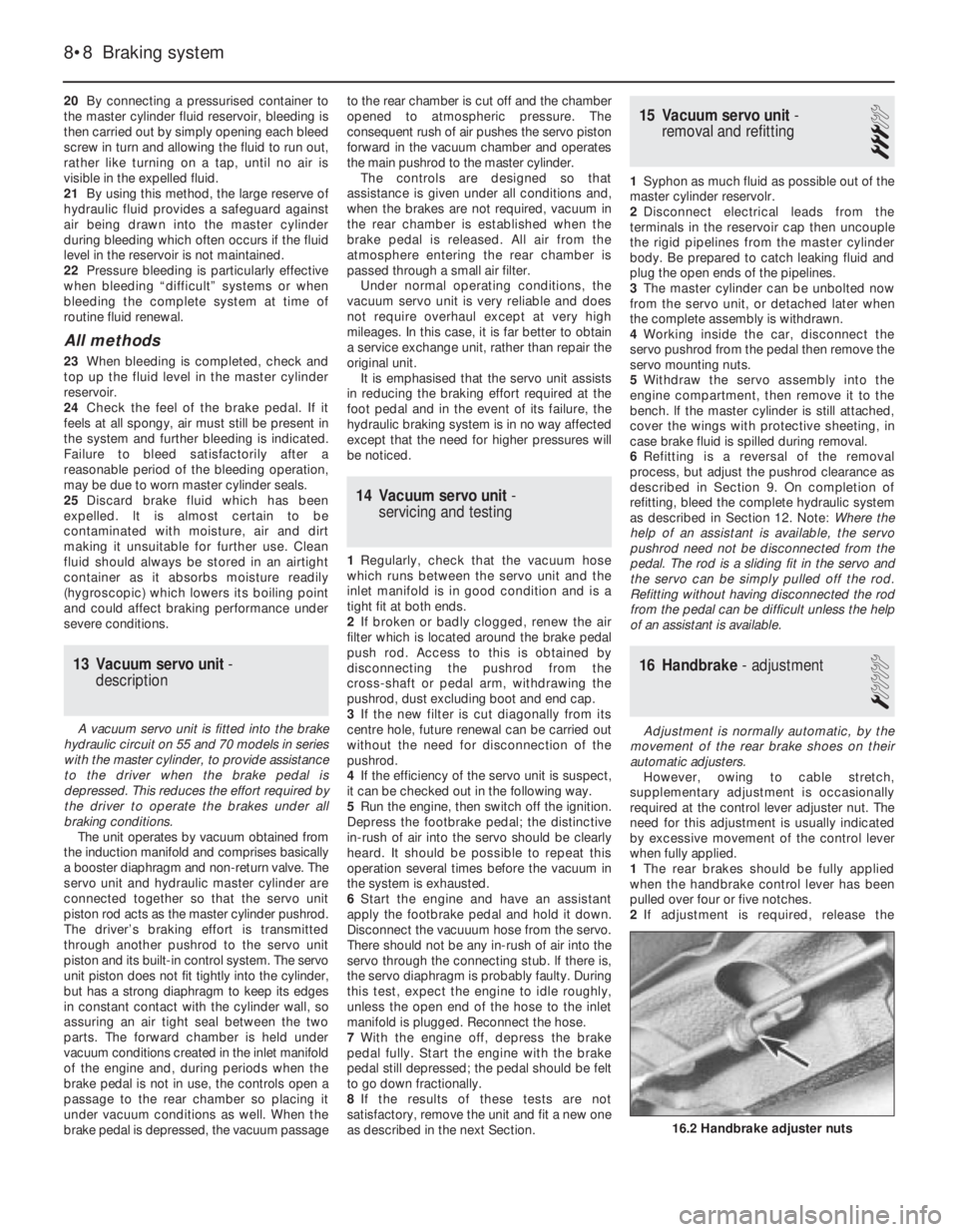
16.2 Handbrake adjuster nuts
Page 109 of 303
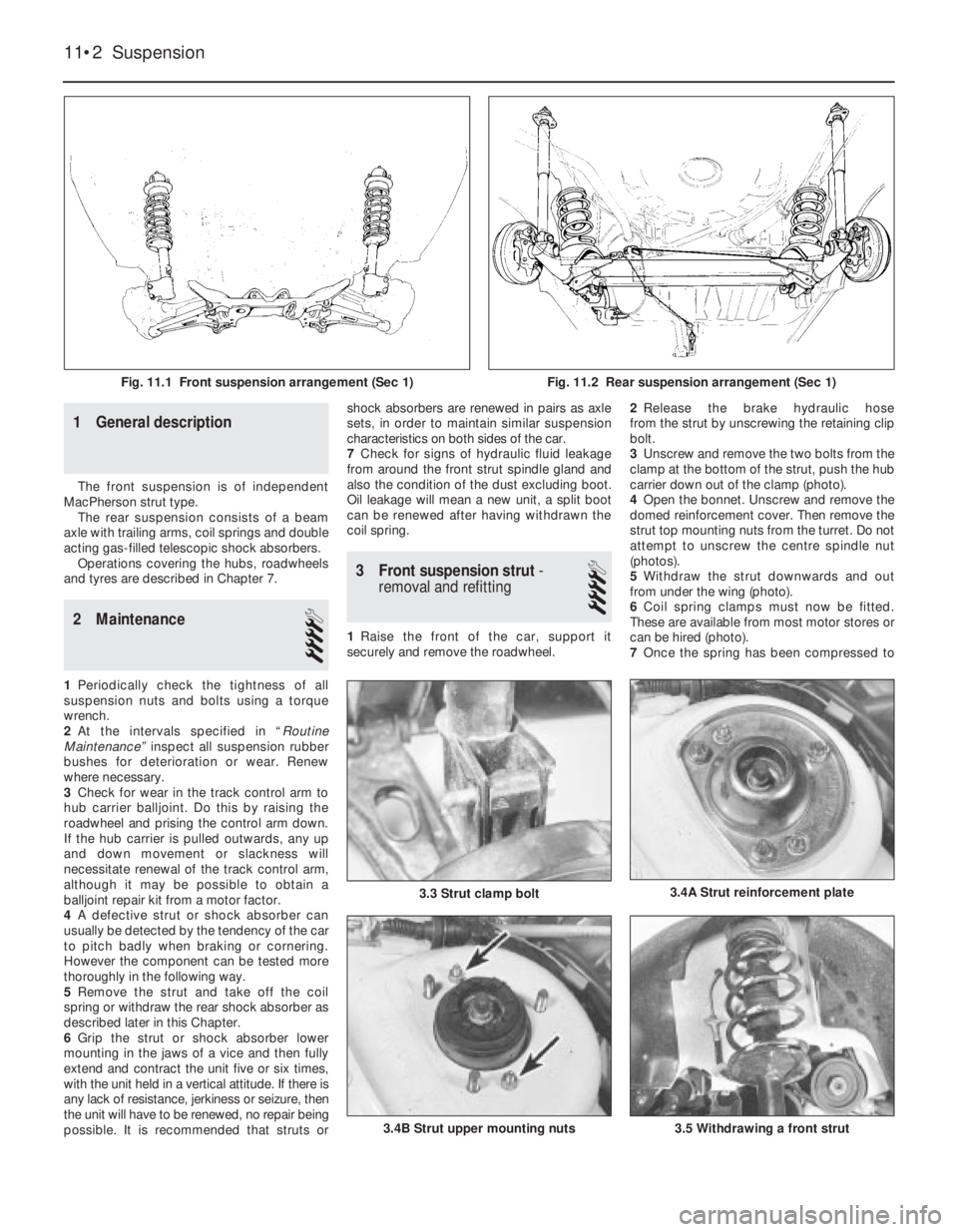
1 General description
The front suspension is of independent
MacPherson strut type.
The rear suspension consists of a beam
axle with trailing arms, coil springs and double
acting gas-filled telescopic shock absorbers.
Operations covering the hubs, roadwheels
and tyres are described in Chapter 7.
2 Maintenance
4
1Periodically check the tightness of all
suspension nuts and bolts using a torque
wrench.
2At the intervals specified in “Routine
Maintenance” inspect all suspension rubber
bushes for deterioration or wear. Renew
where necessary.
3Check for wear in the track control arm to
hub carrier balljoint. Do this by raising the
roadwheel and prising the control arm down.
If the hub carrier is pulled outwards, any up
and down movement or slackness will
necessitate renewal of the track control arm,
although it may be possible to obtain a
balljoint repair kit from a motor factor.
4A defective strut or shock absorber can
usually be detected by the tendency of the car
to pitch badly when braking or cornering.
However the component can be tested more
thoroughly in the following way.
5Remove the strut and take off the coil
spring or withdraw the rear shock absorber as
described later in this Chapter.
6Grip the strut or shock absorber lower
mounting in the jaws of a vice and then fully
extend and contract the unit five or six times,
with the unit held in a vertical attitude. If there is
any lack of resistance, jerkiness or seizure, then
the unit will have to be renewed, no repair being
possible. It is recommended that struts orshock absorbers are renewed in pairs as axle
sets, in order to maintain similar suspension
characteristics on both sides of the car.
7Check for signs of hydraulic fluid leakage
from around the front strut spindle gland and
also the condition of the dust excluding boot.
Oil leakage will mean a new unit, a split boot
can be renewed after having withdrawn the
coil spring.
3 Front suspension strut-
removal and refitting
4
1Raise the front of the car, support it
securely and remove the roadwheel.2Release the brake hydraulic hose
from the strut by unscrewing the retaining clip
bolt.
3Unscrew and remove the two bolts from the
clamp at the bottom of the strut, push the hub
carrier down out of the clamp (photo).
4Open the bonnet. Unscrew and remove the
domed reinforcement cover. Then remove the
strut top mounting nuts from the turret. Do not
attempt to unscrew the centre spindle nut
(photos).
5Withdraw the strut downwards and out
from under the wing (photo).
6Coil spring clamps must now be fitted.
These are available from most motor stores or
can be hired (photo).
7Once the spring has been compressed to
11•2 Suspension
3.5 Withdrawing a front strut3.4B Strut upper mounting nuts
3.4A Strut reinforcement plate3.3 Strut clamp bolt
Fig. 11.1 Front suspension arrangement (Sec 1)Fig. 11.2 Rear suspension arrangement (Sec 1)
Page 110 of 303
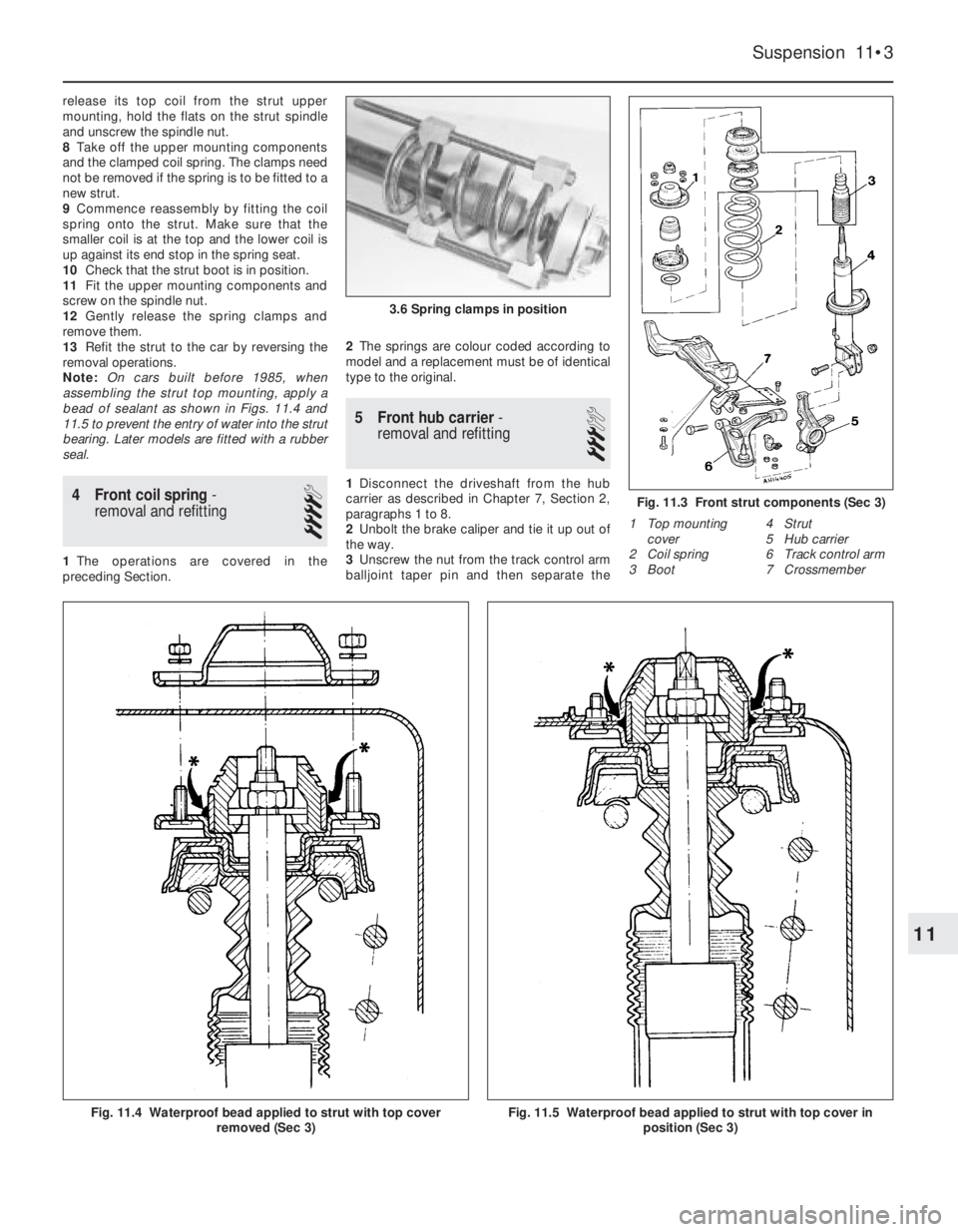
release its top coil from the strut upper
mounting, hold the flats on the strut spindle
and unscrew the spindle nut.
8Take off the upper mounting components
and the clamped coil spring. The clamps need
not be removed if the spring is to be fitted to a
new strut.
9Commence reassembly by fitting the coil
spring onto the strut. Make sure that the
smaller coil is at the top and the lower coil is
up against its end stop in the spring seat.
10Check that the strut boot is in position.
11Fit the upper mounting components and
screw on the spindle nut.
12Gently release the spring clamps and
remove them.
13Refit the strut to the car by reversing the
removal operations.
Note: On cars built before 1985, when
assembling the strut top mounting, apply a
bead of sealant as shown in Figs. 11.4 and
11.5 to prevent the entry of water into the strut
bearing. Later models are fitted with a rubber
seal.
4 Front coil spring-
removal and refitting
4
1The operations are covered in the
preceding Section.2The springs are colour coded according to
model and a replacement must be of identical
type to the original.
5 Front hub carrier-
removal and refitting
3
1Disconnect the driveshaft from the hub
carrier as described in Chapter 7, Section 2,
paragraphs 1 to 8.
2Unbolt the brake caliper and tie it up out of
the way.
3Unscrew the nut from the track control arm
balljoint taper pin and then separate the
Suspension 11•3
1 Top mounting
cover
2 Coil spring
3 Boot4 Strut
5 Hub carrier
6 Track control arm
7 Crossmember
Fig. 11.3 Front strut components (Sec 3)
3.6 Spring clamps in position
Fig. 11.4 Waterproof bead applied to strut with top cover
removed (Sec 3)Fig. 11.5 Waterproof bead applied to strut with top cover in
position (Sec 3)
11
Page 127 of 303
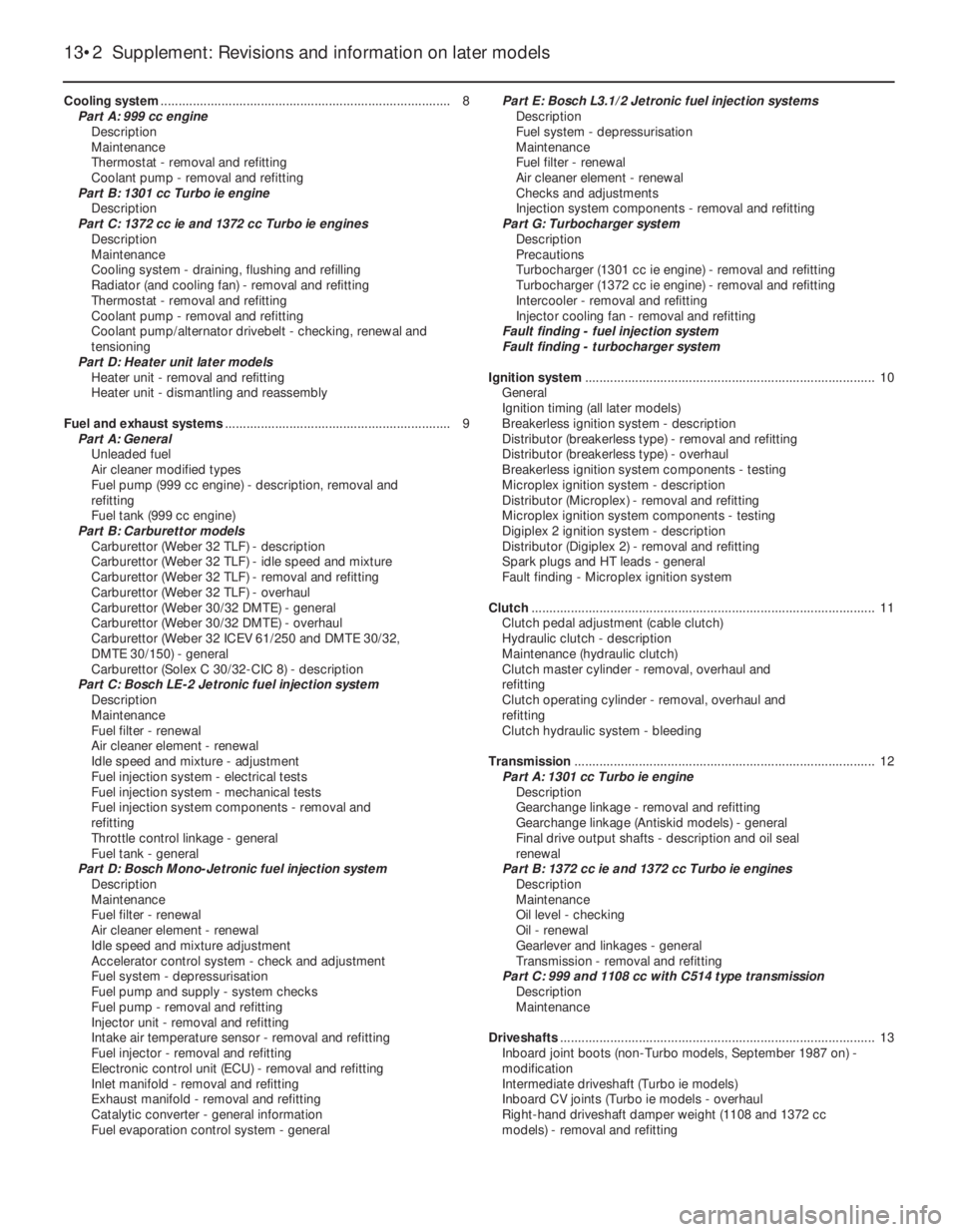
Cooling system................................................................................. 8
Part A: 999 cc engine
Description
Maintenance
Thermostat - removal and refitting
Coolant pump - removal and refitting
Part B: 1301 cc Turbo ie engine
Description
Part C: 1372 cc ie and 1372 cc Turbo ie engines
Description
Maintenance
Cooling system - draining, flushing and refilling
Radiator (and cooling fan) - removal and refitting
Thermostat - removal and refitting
Coolant pump - removal and refitting
Coolant pump/alternator drivebelt - checking, renewal and
tensioning
Part D: Heater unit later models
Heater unit - removal and refitting
Heater unit - dismantling and reassembly
Fuel and exhaust systems............................................................... 9
Part A: General
Unleaded fuel
Air cleaner modified types
Fuel pump (999 cc engine) - description, removal and
refitting
Fuel tank (999 cc engine)
Part B: Carburettor models
Carburettor (Weber 32 TLF) - description
Carburettor (Weber 32 TLF) - idle speed and mixture
Carburettor (Weber 32 TLF) - removal and refitting
Carburettor (Weber 32 TLF) - overhaul
Carburettor (Weber 30/32 DMTE) - general
Carburettor (Weber 30/32 DMTE) - overhaul
Carburettor (Weber 32 ICEV 61/250 and DMTE 30/32,
DMTE 30/150) - general
Carburettor (Solex C 30/32-CIC 8) - description
Part C: Bosch LE-2 Jetronic fuel injection system
Description
Maintenance
Fuel filter - renewal
Air cleaner element - renewal
Idle speed and mixture - adjustment
Fuel injection system - electrical tests
Fuel injection system - mechanical tests
Fuel injection system components - removal and
refitting
Throttle control linkage - general
Fuel tank - general
Part D: Bosch Mono-Jetronic fuel injection system
Description
Maintenance
Fuel filter - renewal
Air cleaner element - renewal
Idle speed and mixture adjustment
Accelerator control system - check and adjustment
Fuel system - depressurisation
Fuel pump and supply - system checks
Fuel pump - removal and refitting
Injector unit - removal and refitting
Intake air temperature sensor - removal and refitting
Fuel injector - removal and refitting
Electronic control unit (ECU) - removal and refitting
Inlet manifold - removal and refitting
Exhaust manifold - removal and refitting
Catalytic converter - general information
Fuel evaporation control system - generalPart E: Bosch L3.1/2 Jetronic fuel injection systems
Description
Fuel system - depressurisation
Maintenance
Fuel filter - renewal
Air cleaner element - renewal
Checks and adjustments
Injection system components - removal and refitting
Part G: Turbocharger system
Description
Precautions
Turbocharger (1301 cc ie engine) - removal and refitting
Turbocharger (1372 cc ie engine) - removal and refitting
Intercooler - removal and refitting
Injector cooling fan - removal and refitting
Fault finding - fuel injection system
Fault finding - turbocharger system
Ignition system................................................................................. 10
General
Ignition timing (all later models)
Breakerless ignition system - description
Distributor (breakerless type) - removal and refitting
Distributor (breakerless type) - overhaul
Breakerless ignition system components - testing
Microplex ignition system - description
Distributor (Microplex) - removal and refitting
Microplex ignition system components - testing
Digiplex 2 ignition system - description
Distributor (Digiplex 2) - removal and refitting
Spark plugs and HT leads - general
Fault finding - Microplex ignition system
Clutch................................................................................................ 11
Clutch pedal adjustment (cable clutch)
Hydraulic clutch - description
Maintenance (hydraulic clutch)
Clutch master cylinder - removal, overhaul and
refitting
Clutch operating cylinder - removal, overhaul and
refitting
Clutch hydraulic system - bleeding
Transmission.................................................................................... 12
Part A: 1301 cc Turbo ie engine
Description
Gearchange linkage - removal and refitting
Gearchange linkage (Antiskid models) - general
Final drive output shafts - description and oil seal
renewal
Part B: 1372 cc ie and 1372 cc Turbo ie engines
Description
Maintenance
Oil level - checking
Oil - renewal
Gearlever and linkages - general
Transmission - removal and refitting
Part C: 999 and 1108 cc with C514 type transmission
Description
Maintenance
Driveshafts........................................................................................ 13
Inboard joint boots (non-Turbo models, September 1987 on) -
modification
Intermediate driveshaft (Turbo ie models)
Inboard CV joints (Turbo ie models - overhaul
Right-hand driveshaft damper weight (1108 and 1372 cc
models) - removal and refitting
13•2 Supplement: Revisions and information on later models
Page 218 of 303
mounted in-line with and just forward of the
clutch pedal. The operating cylinder is
mounted within a housing on top of the
transmission. The fluid reservoir is located in
the engine compartment and is mounted on
the left-hand side near the bulkhead. No
settings or specific procedures are given by
the manufacturer at the time of writing.
Maintenance
(hydraulic clutch)Á
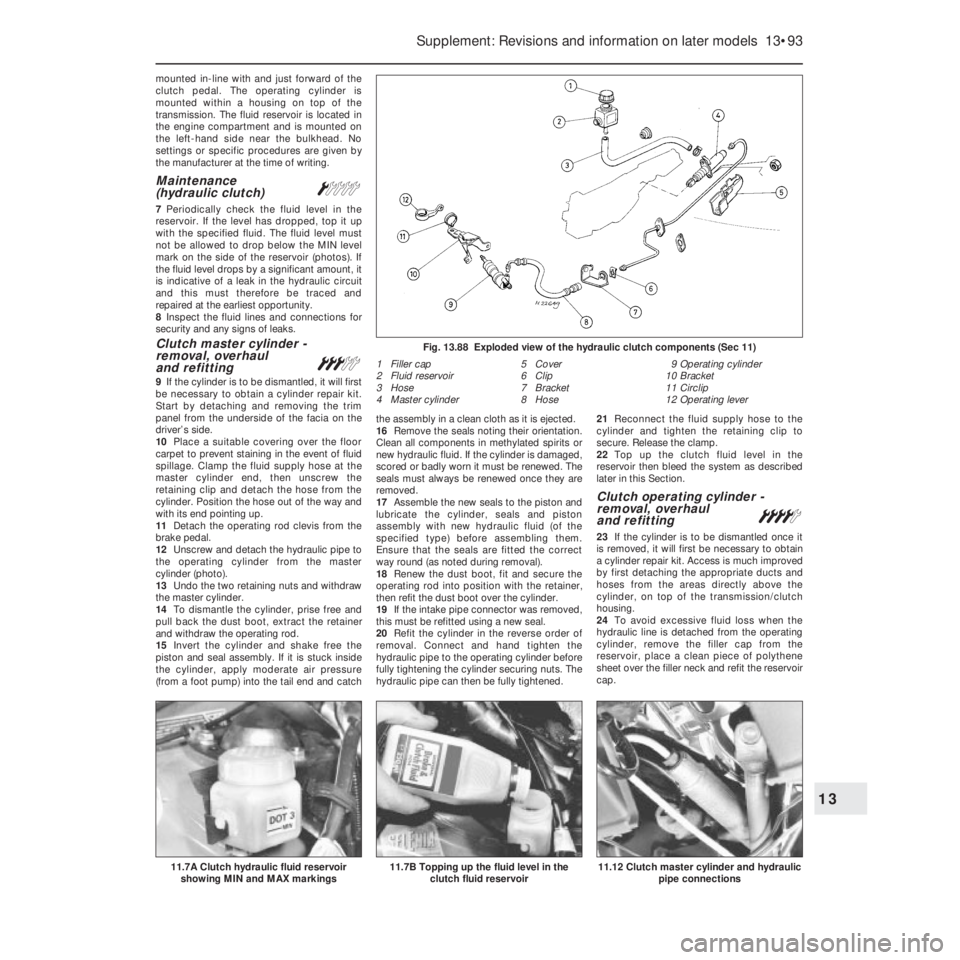
7Periodically check the fluid level in the
reservoir. If the level has dropped, top it up
with the specified fluid. The fluid level must
not be allowed to drop below the MIN level
mark on the side of the reservoir (photos). If
the fluid level drops by a significant amount, it
is indicative of a leak in the hydraulic circuit
and this must therefore be traced and
repaired at the earliest opportunity.
8Inspect the fluid lines and connections for
security and any signs of leaks.
Clutch master cylinder -
removal, overhaul
and refitting
#
9If the cylinder is to be dismantled, it will first
be necessary to obtain a cylinder repair kit.
Start by detaching and removing the trim
panel from the underside of the facia on the
driver’s side.
10Place a suitable covering over the floor
carpet to prevent staining in the event of fluid
spillage. Clamp the fluid supply hose at the
master cylinder end, then unscrew the
retaining clip and detach the hose from the
cylinder. Position the hose out of the way and
with its end pointing up.
11Detach the operating rod clevis from the
brake pedal.
12Unscrew and detach the hydraulic pipe to
the operating cylinder from the master
cylinder (photo).
13Undo the two retaining nuts and withdraw
the master cylinder.
14To dismantle the cylinder, prise free and
pull back the dust boot, extract the retainer
and withdraw the operating rod.
15Invert the cylinder and shake free the
piston and seal assembly. If it is stuck inside
the cylinder, apply moderate air pressure
(from a foot pump) into the tail end and catchthe assembly in a clean cloth as it is ejected.
16Remove the seals noting their orientation.
Clean all components in methylated spirits or
new hydraulic fluid. If the cylinder is damaged,
scored or badly worn it must be renewed. The
seals must always be renewed once they are
removed.
17Assemble the new seals to the piston and
lubricate the cylinder, seals and piston
assembly with new hydraulic fluid (of the
specified type) before assembling them.
Ensure that the seals are fitted the correct
way round (as noted during removal).
18Renew the dust boot, fit and secure the
operating rod into position with the retainer,
then refit the dust boot over the cylinder.
19If the intake pipe connector was removed,
this must be refitted using a new seal.
20Refit the cylinder in the reverse order of
removal. Connect and hand tighten the
hydraulic pipe to the operating cylinder before
fully tightening the cylinder securing nuts. The
hydraulic pipe can then be fully tightened.21Reconnect the fluid supply hose to the
cylinder and tighten the retaining clip to
secure. Release the clamp.
22Top up the clutch fluid level in the
reservoir then bleed the system as described
later in this Section.
Clutch operating cylinder -
removal, overhaul
and refitting
¢
23If the cylinder is to be dismantled once it
is removed, it will first be necessary to obtain
a cylinder repair kit. Access is much improved
by first detaching the appropriate ducts and
hoses from the areas directly above the
cylinder, on top of the transmission/clutch
housing.
24To avoid excessive fluid loss when the
hydraulic line is detached from the operating
cylinder, remove the filler cap from the
reservoir, place a clean piece of polythene
sheet over the filler neck and refit the reservoir
cap.
Supplement: Revisions and information on later models 13•93
Fig. 13.88 Exploded view of the hydraulic clutch components (Sec 11)
1 Filler cap
2 Fluid reservoir
3 Hose
4 Master cylinder5 Cover
6 Clip
7 Bracket
8 Hose9 Operating cylinder
10 Bracket
11 Circlip
12 Operating lever
11.12 Clutch master cylinder and hydraulic
pipe connections11.7B Topping up the fluid level in the
clutch fluid reservoir11.7A Clutch hydraulic fluid reservoir
showing MIN and MAX markings
13