fuel type FIAT UNO 1983 Service User Guide
[x] Cancel search | Manufacturer: FIAT, Model Year: 1983, Model line: UNO, Model: FIAT UNO 1983Pages: 303, PDF Size: 10.36 MB
Page 73 of 303
Spark plugs
Type . . . . . . . . . . . . . . . . . . . . . . . . . . . . . . . . . . . . . . . . . . . . . . . . . . . . Champion RN9YCC or RN9YC
Electrode gap . . . . . . . . . . . . . . . . . . . . . . . . . . . . . . . . . . . . . . . . . . . . . 0.8 mm (0.031 in)
HT leads
903 cc (45) . . . . . . . . . . . . . . . . . . . . . . . . . . . . . . . . . . . . . . . . . . . . . . . Champion LS-07
1116, 1299 and 1301 cc (55, 60 and 70) . . . . . . . . . . . . . . . . . . . . . . . . Champion LS-05
Torque wrench settingNm lbf ft
Spark plugs . . . . . . . . . . . . . . . . . . . . . . . . . . . . . . . . . . . . . . . . . . . . . . . 25 18
4•2 Ignition system
1 General description
On all models except the 903 ES engine
version, a mechanical contact breaker type
distributor is fitted.
On 45 Super ES models which have the
903 ES engine, an electronic (Digiplex) ignition
system is used which incorporates a
breakerless distributor.
Mechanical contact breaker
system
For the engine to run correctly, it is
necessary for an electrical spark to ignite the
fuel/air mixture in the combustion chamber at
exactly the right moment in relation to engine
speed and load. The ignition system is based
on feeding low tension voltage from the
battery to the coil where it is converted to high
tension voltage. The high tension voltage is
powerful enough to jump the spark plug gap
in the cylinders under high compression
pressures, providing that the system is in
good condition and that all adjustments are
correct.
The ignition system is divided into two
circuits, the low tension (LT) circuit and the
high tension (HT) circuit.
The low tension (sometimes known as the
primary) circuit consists of the battery, the
lead to the ignition switch, the lead from the
ignition switch to the low tension or primary
coil windings, and the lead from the low
tension coil windings to the contact breaker
points and condenser in the distributor.
The high tension circuit consists of the high
tension or secondary coil windings, the heavy
ignition lead from the centre of the coil to the
centre of the distributor cap, the rotor arm,
and the spark plug leads and spark plugs.
The system functions in the following
manner: High tension voltage is generated in
the coil by the interruption of the low tension
circuit. The interruption is effected by the
opening of the contact breaker points in this
low tension circuit. High tension voltage is fed
from the centre of the coil via the carbon
brush in the centre of the distributor cap to
the rotor arm of the distributor.
The rotor arm revolves at half engine speed
inside the distributor cap, and each time it
comes in line with one of the four metal
segments in the cap, which are connected to
the spark plug leads, the opening of thecontact breaker points causes the high
tension voltage to build up, jump the gap from
the rotor arm to the appropriate metal
segment, and so via the spark plug lead to the
spark plug, where it finally jumps the spark
plug gap before going to earth.
The ignition timing is advanced and
retarded automatically, to ensure the sparkoccurs at just the right instant for the
particular load at the prevailing engine speed.
The ignition advance is controlled
mechanically, and by vacuum. The
mechanical governor mechanism consists of
two weights, which move out from the
distributor shaft as the engine speed rises,
due to centrifugal force. As they move
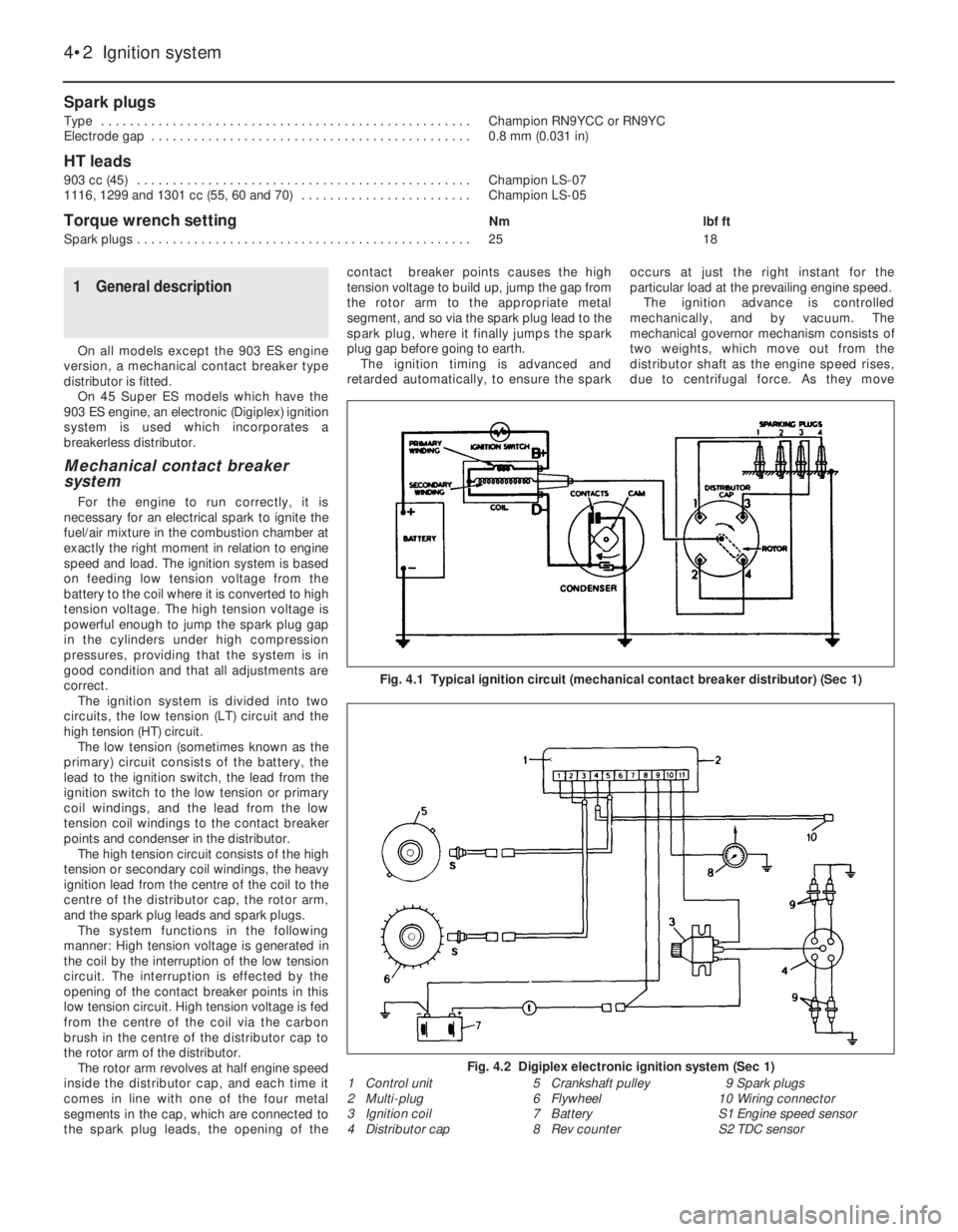
Fig. 4.1 Typical ignition circuit (mechanical contact breaker distributor) (Sec 1)
1 Control unit
2 Multi-plug
3 Ignition coil
4 Distributor cap5 Crankshaft pulley
6 Flywheel
7 Battery
8 Rev counter9 Spark plugs
10 Wiring connector
S1 Engine speed sensor
S2 TDC sensor
Fig. 4.2 Digiplex electronic ignition system (Sec 1)
Page 89 of 303
locknut and turn the adjuster nut on the
handbrake primary rod (photo).
3Raise the rear roadwheels and check that
they turn freely when the handbrake lever is
fully released.
17 Handbrake cable-
renewal
1
1There are two cables, either of which may
be renewed independently
2Disconnect the cable, which is to be renewed,
from the shoe lever at the brake backplate.
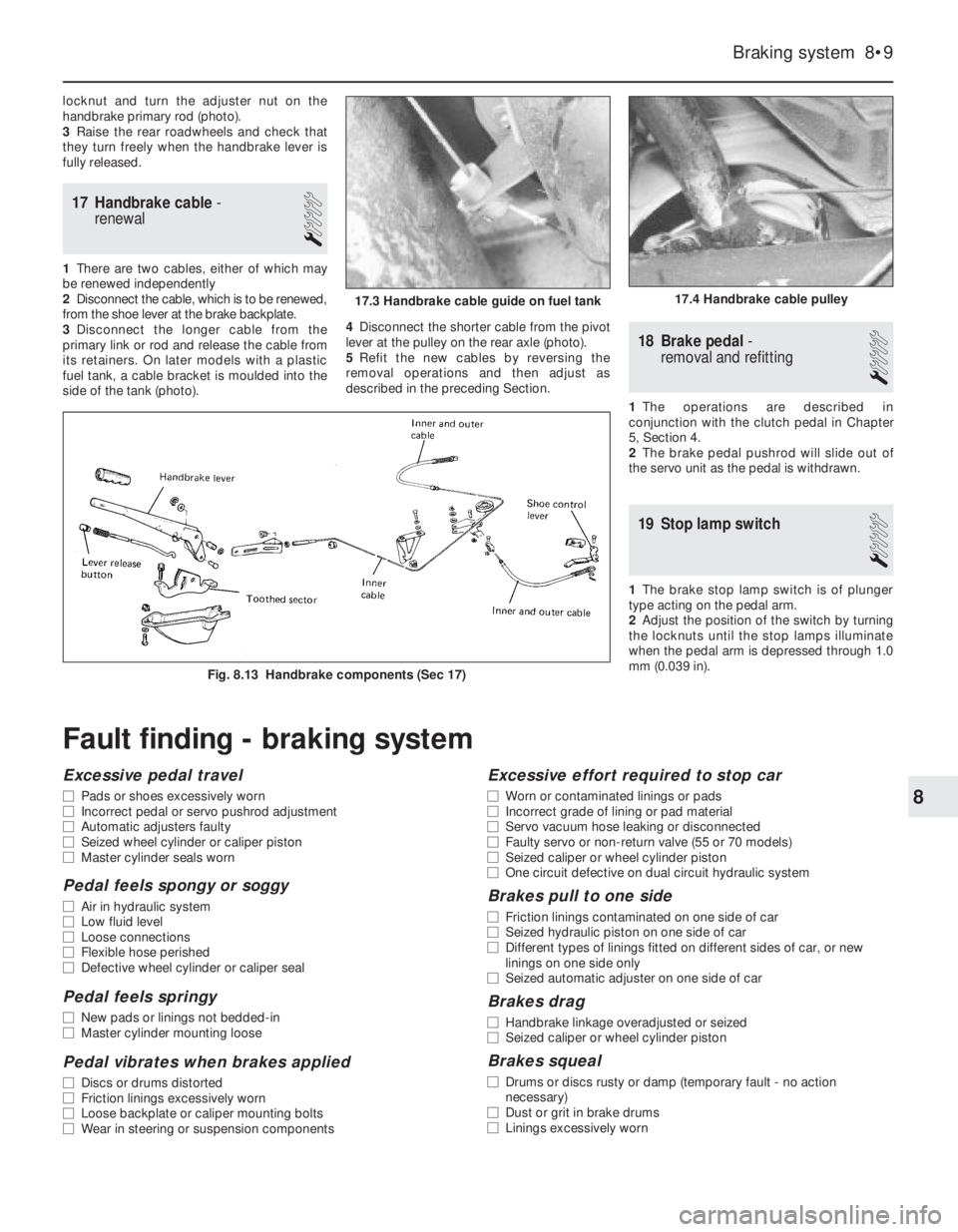
3Disconnect the longer cable from the
primary link or rod and release the cable from
its retainers. On later models with a plastic
fuel tank, a cable bracket is moulded into the
side of the tank (photo).4Disconnect the shorter cable from the pivot
lever at the pulley on the rear axle (photo).
5Refit the new cables by reversing the
removal operations and then adjust as
described in the preceding Section.
18 Brake pedal-
removal and refitting
1
1The operations are described in
conjunction with the clutch pedal in Chapter
5, Section 4.
2The brake pedal pushrod will slide out of
the servo unit as the pedal is withdrawn.
19 Stop lamp switch
1
1The brake stop lamp switch is of plunger
type acting on the pedal arm.
2Adjust the position of the switch by turning
the locknuts until the stop lamps illuminate
when the pedal arm is depressed through 1.0
mm (0.039 in).
Braking system 8•9
Fig. 8.13 Handbrake components (Sec 17)
17.4 Handbrake cable pulley17.3 Handbrake cable guide on fuel tank
8
Fault finding - braking system
Excessive pedal travel
m mPads or shoes excessively worn
m mIncorrect pedal or servo pushrod adjustment
m mAutomatic adjusters faulty
m mSeized wheel cylinder or caliper piston
m mMaster cylinder seals worn
Pedal feels spongy or soggy
m
mAir in hydraulic system
m mLow fluid level
m mLoose connections
m mFlexible hose perished
m mDefective wheel cylinder or caliper seal
Pedal feels springy
m
mNew pads or linings not bedded-in
m mMaster cylinder mounting loose
Pedal vibrates when brakes applied
m
mDiscs or drums distorted
m mFriction linings excessively worn
m mLoose backplate or caliper mounting bolts
m mWear in steering or suspension components
Excessive effort required to stop car
m
mWorn or contaminated linings or pads
m mIncorrect grade of lining or pad material
m mServo vacuum hose leaking or disconnected
m mFaulty servo or non-return valve (55 or 70 models)
m mSeized caliper or wheel cylinder piston
m mOne circuit defective on dual circuit hydraulic system
Brakes pull to one side
m
mFriction linings contaminated on one side of car
m mSeized hydraulic piston on one side of car
m mDifferent types of linings fitted on different sides of car, or new
linings on one side only
m mSeized automatic adjuster on one side of car
Brakes drag
m
mHandbrake linkage overadjusted or seized
m mSeized caliper or wheel cylinder piston
Brakes squeal
m
mDrums or discs rusty or damp (temporary fault - no action
necessary)
m mDust or grit in brake drums
m mLinings excessively worn
Page 127 of 303
Cooling system................................................................................. 8
Part A: 999 cc engine
Description
Maintenance
Thermostat - removal and refitting
Coolant pump - removal and refitting
Part B: 1301 cc Turbo ie engine
Description
Part C: 1372 cc ie and 1372 cc Turbo ie engines
Description
Maintenance
Cooling system - draining, flushing and refilling
Radiator (and cooling fan) - removal and refitting
Thermostat - removal and refitting
Coolant pump - removal and refitting
Coolant pump/alternator drivebelt - checking, renewal and
tensioning
Part D: Heater unit later models
Heater unit - removal and refitting
Heater unit - dismantling and reassembly
Fuel and exhaust systems............................................................... 9
Part A: General
Unleaded fuel
Air cleaner modified types
Fuel pump (999 cc engine) - description, removal and
refitting
Fuel tank (999 cc engine)
Part B: Carburettor models
Carburettor (Weber 32 TLF) - description
Carburettor (Weber 32 TLF) - idle speed and mixture
Carburettor (Weber 32 TLF) - removal and refitting
Carburettor (Weber 32 TLF) - overhaul
Carburettor (Weber 30/32 DMTE) - general
Carburettor (Weber 30/32 DMTE) - overhaul
Carburettor (Weber 32 ICEV 61/250 and DMTE 30/32,
DMTE 30/150) - general
Carburettor (Solex C 30/32-CIC 8) - description
Part C: Bosch LE-2 Jetronic fuel injection system
Description
Maintenance
Fuel filter - renewal
Air cleaner element - renewal
Idle speed and mixture - adjustment
Fuel injection system - electrical tests
Fuel injection system - mechanical tests
Fuel injection system components - removal and
refitting
Throttle control linkage - general
Fuel tank - general
Part D: Bosch Mono-Jetronic fuel injection system
Description
Maintenance
Fuel filter - renewal
Air cleaner element - renewal
Idle speed and mixture adjustment
Accelerator control system - check and adjustment
Fuel system - depressurisation
Fuel pump and supply - system checks
Fuel pump - removal and refitting
Injector unit - removal and refitting
Intake air temperature sensor - removal and refitting
Fuel injector - removal and refitting
Electronic control unit (ECU) - removal and refitting
Inlet manifold - removal and refitting
Exhaust manifold - removal and refitting
Catalytic converter - general information
Fuel evaporation control system - generalPart E: Bosch L3.1/2 Jetronic fuel injection systems
Description
Fuel system - depressurisation
Maintenance
Fuel filter - renewal
Air cleaner element - renewal
Checks and adjustments
Injection system components - removal and refitting
Part G: Turbocharger system
Description
Precautions
Turbocharger (1301 cc ie engine) - removal and refitting
Turbocharger (1372 cc ie engine) - removal and refitting
Intercooler - removal and refitting
Injector cooling fan - removal and refitting
Fault finding - fuel injection system
Fault finding - turbocharger system
Ignition system................................................................................. 10
General
Ignition timing (all later models)
Breakerless ignition system - description
Distributor (breakerless type) - removal and refitting
Distributor (breakerless type) - overhaul
Breakerless ignition system components - testing
Microplex ignition system - description
Distributor (Microplex) - removal and refitting
Microplex ignition system components - testing
Digiplex 2 ignition system - description
Distributor (Digiplex 2) - removal and refitting
Spark plugs and HT leads - general
Fault finding - Microplex ignition system
Clutch................................................................................................ 11
Clutch pedal adjustment (cable clutch)
Hydraulic clutch - description
Maintenance (hydraulic clutch)
Clutch master cylinder - removal, overhaul and
refitting
Clutch operating cylinder - removal, overhaul and
refitting
Clutch hydraulic system - bleeding
Transmission.................................................................................... 12
Part A: 1301 cc Turbo ie engine
Description
Gearchange linkage - removal and refitting
Gearchange linkage (Antiskid models) - general
Final drive output shafts - description and oil seal
renewal
Part B: 1372 cc ie and 1372 cc Turbo ie engines
Description
Maintenance
Oil level - checking
Oil - renewal
Gearlever and linkages - general
Transmission - removal and refitting
Part C: 999 and 1108 cc with C514 type transmission
Description
Maintenance
Driveshafts........................................................................................ 13
Inboard joint boots (non-Turbo models, September 1987 on) -
modification
Intermediate driveshaft (Turbo ie models)
Inboard CV joints (Turbo ie models - overhaul
Right-hand driveshaft damper weight (1108 and 1372 cc
models) - removal and refitting
13•2 Supplement: Revisions and information on later models
Page 128 of 303
Braking system................................................................................. 14
Part A: Braking system general
Front brake pads all later models
Part B: Braking system - Turbo ie models
Description
Front disc pads - renewal
Front disc caliper - removal and refitting
Front disc caliper - overhaul
Front brake disc - inspection, renovation or renewal
Rear disc pads - renewal
Rear disc caliper - removal, overhaul and refitting
Rear brake disc - inspection, renovation and renewal
Pressure regulating valve
Brake pedal - removal and refitting
Vacuum servo unit and master cylinder - general
Antiskid system - description
Electrical system.............................................................................. 15
Alternator (999 cc models) - removal and refitting
Alternator (later models) - removal and refitting
Alternator brushes - renewal
Starter motor (999 cc models) - removal and refitting
Starter motor (1301 cc Turbo ie, 1372 cc ie, 1372 cc Turbo ie)
- removal and refitting
Starter motor brushes (later models) - renewal
Fuses - later models
Relays (Turbo ie models) - general
Headlamps - later models
Headlamp beam adjusters for load compensation - later models
Headlamp unit removal - later models
Headlamp dim-dip system - description
Front fog lamps bulb/unit - removal and refitting and beam
adjustment
Horn - relocation
Steering column combination switches (later models) - removal
and refittingInstrument panel (Turbo ie models) - removal and refitting
Facia-mounted switches (1301 cc Turbo ie model) - removal
and refitting
Instrument panel (later models) - removal and refitting
Auxiliary control panel (later models) - removal and refitting
Heater control panel (later models) - removal and refitting
Trip master
Interior roof mounted spotlamp, switch and/or clock - removal
and refitting
Central door locking system
Cigar lighter (later models) - removal and refitting
Electrically operated window switches - removal and refitting
Windscreen wiper motor (later models) - removal and refitting
Windscreen washer reservoir (Turbo) - removal and refitting
Tailgate wiper motor (later models) - removal and refitting
Radio Check control system sensors - description
Check control system sensors - testing
Suspension....................................................................................... 16
Front anti-roll bar - removal and refitting
Suspension strut later models
Bodywork.......................................................................................... 17
Plastic components
Rear view mirrors
Door armrest
Tailgate (Turbo ie model) - component removal and refitting
Radiator grille (1301 cc Turbo ie model) - removal and
refitting
Radiator grille (1372 cc ie and 1372 cc Turbo ie models) -
removal and refitting
Bumpers (1301 cc Turbo ie, 1372 cc ie and 1372 cc Turbo ie
models) - removal and refitting
Rear hinged windows - removal and refitting
Door trim panel (Turbo ie model) - removal and refitting
Supplement: Revisions and information on later models 13•3
13
1 Introduction
Since its introduction in 1983, the FIAT Uno
has had a number of modifications and
improvements including the fitting of a twin
choke carburettor, low profile tyres, tinted
windows and remotely-controlled central door
locking.
The major mechanical change was the
introduction of the FIRE (Fully Integrated
Robotised Engine) on 45 and 45S models to
be followed by a new 1108 cc “FIRE” engine
on the 60S model from 1989 on.
A 1301 cc Turbo ie engine model wasavailable for a short period. This model had a
Bosch LE2 Jetronic electronic fuel injection
(ie) and a turbocharger to give added
performance. To uprate the braking to suit,
disc brakes were fitted to the rear in place of
the original drum type brakes.
A 1372 cc engine model was introduced in
1989. Two versions were initially available. A
Bosch Mono-Jetronic single-point fuel
injection (SPi) system, as found on the 70 SX
model and Bosch L3.1 or L3.2 Jetronic
multi-point fuel injection (MPi) systems were
fitted to Turbo models. L3.2 MPi system
models were equipped with catalytic
converters, to improve exhaust emission. All
fuel injection engines are fitted with electroni-
cally controlled engine management systems.
A new style instrument panel, switchgearand a revised facia layout was introduced in
1989.
During 1992, SPi fuel systems were fitted to
the 999 cc and 1108 cc engines, along with
catalytic converters for improved exhaust
emissions.
Five speed transmissions were introduced
to 999 cc models in 1993.
It is recommended that this Supplement is
always referred to before the main Chapters
of the Manual.
Project vehicles
The vehicles used in the preparation of this
supplement, and appearing in many of the
photographic sequences were a 1986 Uno
45S FIRE, a 1988 1301 cc Uno Turbo ie and a
1991 1372 cc Uno SXie.
Easy,suitable for
novice with little
experienceFairly easy,suitable
for beginner with
some experienceFairly difficult,
suitable for competent
DIY mechanic
Difficult,suitable for
experienced DIY
mechanicVery difficult,
suitable for expert DIY
or professional
Degrees of difficulty
54321
Page 129 of 303
2 Specifications
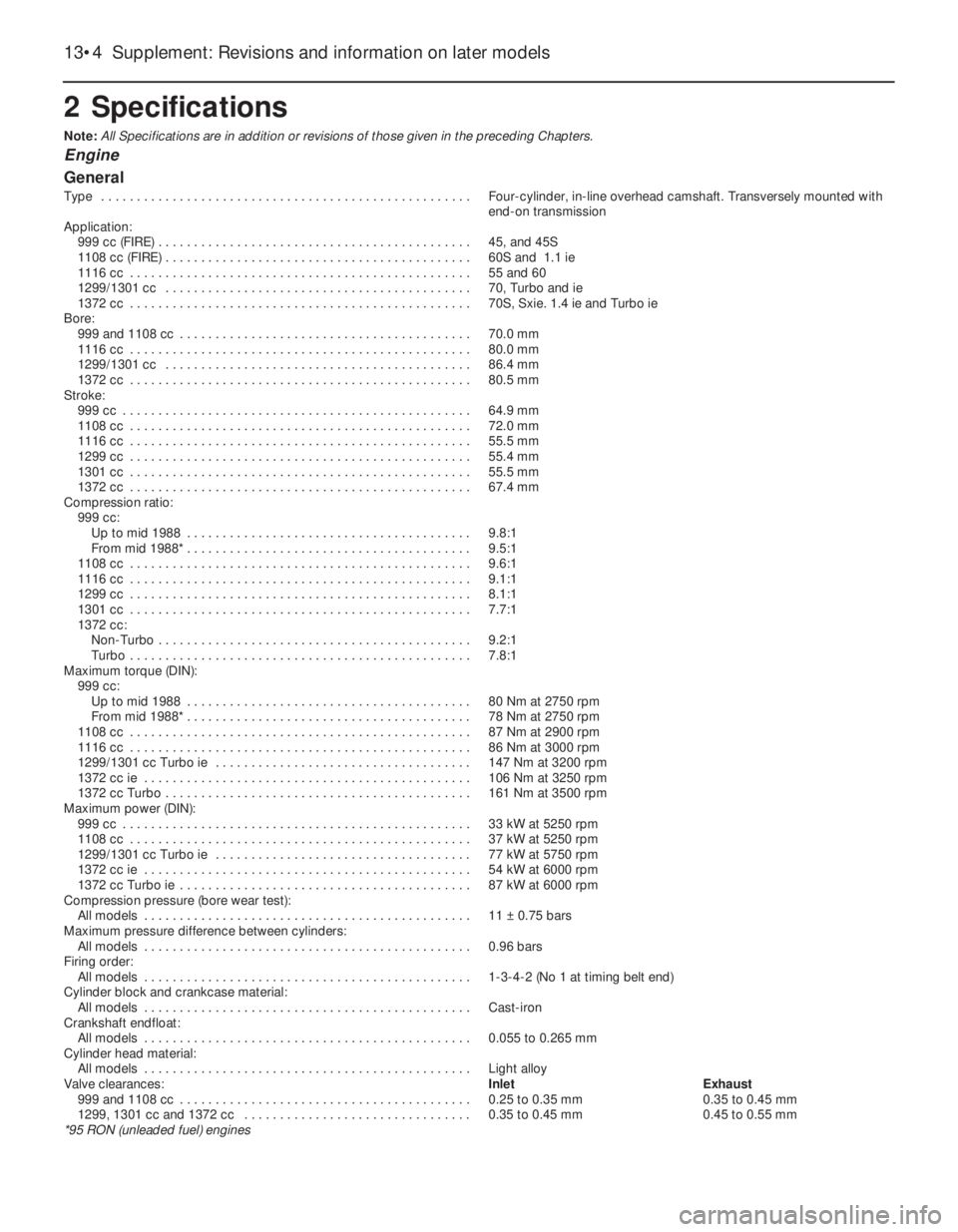
Note: All Specifications are in addition or revisions of those given in the preceding Chapters.
Engine
General
Type . . . . . . . . . . . . . . . . . . . . . . . . . . . . . . . . . . . . . . . . . . . . . . . . . . . . Four-cylinder, in-line overhead camshaft. Transversely mounted with
end-on transmission
Application:
999 cc (FIRE) . . . . . . . . . . . . . . . . . . . . . . . . . . . . . . . . . . . . . . . . . . . . 45, and 45S
1108 cc (FIRE) . . . . . . . . . . . . . . . . . . . . . . . . . . . . . . . . . . . . . . . . . . . 60S and 1.1 ie
1116 cc . . . . . . . . . . . . . . . . . . . . . . . . . . . . . . . . . . . . . . . . . . . . . . . . 55 and 60
1299/1301 cc . . . . . . . . . . . . . . . . . . . . . . . . . . . . . . . . . . . . . . . . . . . 70, Turbo and ie
1372 cc . . . . . . . . . . . . . . . . . . . . . . . . . . . . . . . . . . . . . . . . . . . . . . . . 70S, Sxie. 1.4 ie and Turbo ie
Bore:
999 and 1108 cc . . . . . . . . . . . . . . . . . . . . . . . . . . . . . . . . . . . . . . . . . 70.0 mm
1116 cc . . . . . . . . . . . . . . . . . . . . . . . . . . . . . . . . . . . . . . . . . . . . . . . . 80.0 mm
1299/1301 cc . . . . . . . . . . . . . . . . . . . . . . . . . . . . . . . . . . . . . . . . . . . 86.4 mm
1372 cc . . . . . . . . . . . . . . . . . . . . . . . . . . . . . . . . . . . . . . . . . . . . . . . . 80.5 mm
Stroke:
999 cc . . . . . . . . . . . . . . . . . . . . . . . . . . . . . . . . . . . . . . . . . . . . . . . . . 64.9 mm
1108 cc . . . . . . . . . . . . . . . . . . . . . . . . . . . . . . . . . . . . . . . . . . . . . . . . 72.0 mm
1116 cc . . . . . . . . . . . . . . . . . . . . . . . . . . . . . . . . . . . . . . . . . . . . . . . . 55.5 mm
1299 cc . . . . . . . . . . . . . . . . . . . . . . . . . . . . . . . . . . . . . . . . . . . . . . . . 55.4 mm
1301 cc . . . . . . . . . . . . . . . . . . . . . . . . . . . . . . . . . . . . . . . . . . . . . . . . 55.5 mm
1372 cc . . . . . . . . . . . . . . . . . . . . . . . . . . . . . . . . . . . . . . . . . . . . . . . . 67.4 mm
Compression ratio:
999 cc:
Up to mid 1988 . . . . . . . . . . . . . . . . . . . . . . . . . . . . . . . . . . . . . . . . 9.8:1
From mid 1988* . . . . . . . . . . . . . . . . . . . . . . . . . . . . . . . . . . . . . . . . 9.5:1
1108 cc . . . . . . . . . . . . . . . . . . . . . . . . . . . . . . . . . . . . . . . . . . . . . . . . 9.6:1
1116 cc . . . . . . . . . . . . . . . . . . . . . . . . . . . . . . . . . . . . . . . . . . . . . . . . 9.1:1
1299 cc . . . . . . . . . . . . . . . . . . . . . . . . . . . . . . . . . . . . . . . . . . . . . . . . 8.1:1
1301 cc . . . . . . . . . . . . . . . . . . . . . . . . . . . . . . . . . . . . . . . . . . . . . . . . 7.7:1
1372 cc:
Non-Turbo . . . . . . . . . . . . . . . . . . . . . . . . . . . . . . . . . . . . . . . . . . . . 9.2:1
Turbo . . . . . . . . . . . . . . . . . . . . . . . . . . . . . . . . . . . . . . . . . . . . . . . . 7.8:1
Maximum torque (DIN):
999 cc:
Up to mid 1988 . . . . . . . . . . . . . . . . . . . . . . . . . . . . . . . . . . . . . . . . 80 Nm at 2750 rpm
From mid 1988* . . . . . . . . . . . . . . . . . . . . . . . . . . . . . . . . . . . . . . . . 78 Nm at 2750 rpm
1108 cc . . . . . . . . . . . . . . . . . . . . . . . . . . . . . . . . . . . . . . . . . . . . . . . . 87 Nm at 2900 rpm
1116 cc . . . . . . . . . . . . . . . . . . . . . . . . . . . . . . . . . . . . . . . . . . . . . . . . 86 Nm at 3000 rpm
1299/1301 cc Turbo ie . . . . . . . . . . . . . . . . . . . . . . . . . . . . . . . . . . . . 147 Nm at 3200 rpm
1372 cc ie . . . . . . . . . . . . . . . . . . . . . . . . . . . . . . . . . . . . . . . . . . . . . . 106 Nm at 3250 rpm
1372 cc Turbo . . . . . . . . . . . . . . . . . . . . . . . . . . . . . . . . . . . . . . . . . . . 161 Nm at 3500 rpm
Maximum power (DIN):
999 cc . . . . . . . . . . . . . . . . . . . . . . . . . . . . . . . . . . . . . . . . . . . . . . . . . 33 kW at 5250 rpm
1108 cc . . . . . . . . . . . . . . . . . . . . . . . . . . . . . . . . . . . . . . . . . . . . . . . . 37 kW at 5250 rpm
1299/1301 cc Turbo ie . . . . . . . . . . . . . . . . . . . . . . . . . . . . . . . . . . . . 77 kW at 5750 rpm
1372 cc ie . . . . . . . . . . . . . . . . . . . . . . . . . . . . . . . . . . . . . . . . . . . . . . 54 kW at 6000 rpm
1372 cc Turbo ie . . . . . . . . . . . . . . . . . . . . . . . . . . . . . . . . . . . . . . . . . 87 kW at 6000 rpm
Compression pressure (bore wear test):
All models . . . . . . . . . . . . . . . . . . . . . . . . . . . . . . . . . . . . . . . . . . . . . . 11 ± 0.75 bars
Maximum pressure difference between cylinders:
All models . . . . . . . . . . . . . . . . . . . . . . . . . . . . . . . . . . . . . . . . . . . . . . 0.96 bars
Firing order:
All models . . . . . . . . . . . . . . . . . . . . . . . . . . . . . . . . . . . . . . . . . . . . . . 1-3-4-2 (No 1 at timing belt end)
Cylinder block and crankcase material:
All models . . . . . . . . . . . . . . . . . . . . . . . . . . . . . . . . . . . . . . . . . . . . . . Cast-iron
Crankshaft endfloat:
All models . . . . . . . . . . . . . . . . . . . . . . . . . . . . . . . . . . . . . . . . . . . . . . 0.055 to 0.265 mm
Cylinder head material:
All models . . . . . . . . . . . . . . . . . . . . . . . . . . . . . . . . . . . . . . . . . . . . . . Light alloy
Valve clearances:Inlet Exhaust
999 and 1108 cc . . . . . . . . . . . . . . . . . . . . . . . . . . . . . . . . . . . . . . . . . 0.25 to 0.35 mm 0.35 to 0.45 mm
1299, 1301 cc and 1372 cc . . . . . . . . . . . . . . . . . . . . . . . . . . . . . . . . 0.35 to 0.45 mm 0.45 to 0.55 mm
*95 RON (unleaded fuel) engines
13•4 Supplement: Revisions and information on later models
Page 137 of 303
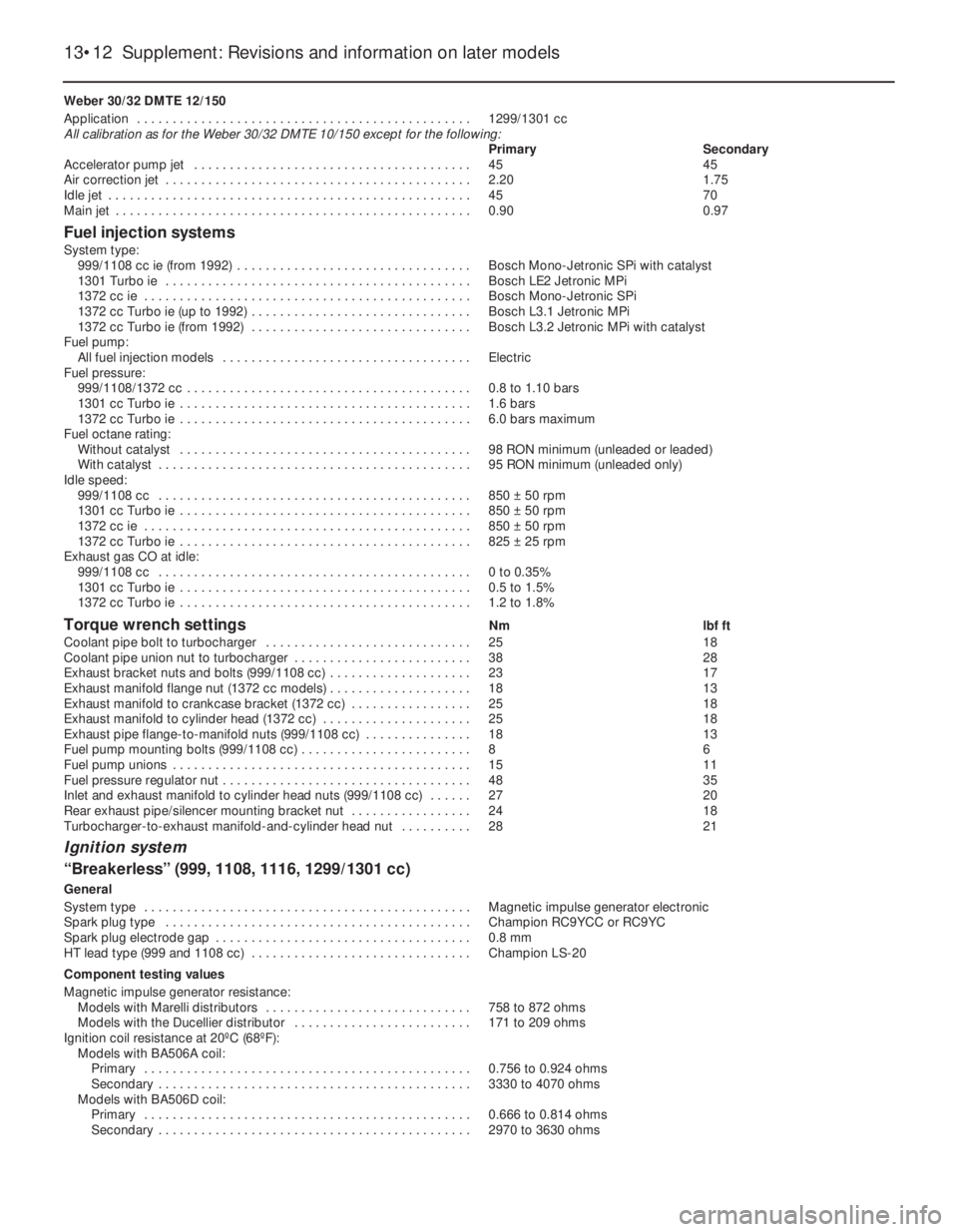
Weber 30/32 DMTE 12/150
Application . . . . . . . . . . . . . . . . . . . . . . . . . . . . . . . . . . . . . . . . . . . . . . . 1299/1301 cc
All calibration as for the Weber 30/32 DMTE 10/150 except for the following:
Primary Secondary
Accelerator pump jet . . . . . . . . . . . . . . . . . . . . . . . . . . . . . . . . . . . . . . . 45 45
Air correction jet . . . . . . . . . . . . . . . . . . . . . . . . . . . . . . . . . . . . . . . . . . . 2.20 1.75
Idle jet . . . . . . . . . . . . . . . . . . . . . . . . . . . . . . . . . . . . . . . . . . . . . . . . . . . 45 70
Main jet . . . . . . . . . . . . . . . . . . . . . . . . . . . . . . . . . . . . . . . . . . . . . . . . . . 0.90 0.97
Fuel injection systems
System type:
999/1108 cc ie (from 1992) . . . . . . . . . . . . . . . . . . . . . . . . . . . . . . . . . Bosch Mono-Jetronic SPi with catalyst
1301 Turbo ie . . . . . . . . . . . . . . . . . . . . . . . . . . . . . . . . . . . . . . . . . . . Bosch LE2 Jetronic MPi
1372 cc ie . . . . . . . . . . . . . . . . . . . . . . . . . . . . . . . . . . . . . . . . . . . . . . Bosch Mono-Jetronic SPi
1372 cc Turbo ie (up to 1992) . . . . . . . . . . . . . . . . . . . . . . . . . . . . . . . Bosch L3.1 Jetronic MPi
1372 cc Turbo ie (from 1992) . . . . . . . . . . . . . . . . . . . . . . . . . . . . . . . Bosch L3.2 Jetronic MPi with catalyst
Fuel pump:
All fuel injection models . . . . . . . . . . . . . . . . . . . . . . . . . . . . . . . . . . . Electric
Fuel pressure:
999/1108/1372 cc . . . . . . . . . . . . . . . . . . . . . . . . . . . . . . . . . . . . . . . . 0.8 to 1.10 bars
1301 cc Turbo ie . . . . . . . . . . . . . . . . . . . . . . . . . . . . . . . . . . . . . . . . . 1.6 bars
1372 cc Turbo ie . . . . . . . . . . . . . . . . . . . . . . . . . . . . . . . . . . . . . . . . . 6.0 bars maximum
Fuel octane rating:
Without catalyst . . . . . . . . . . . . . . . . . . . . . . . . . . . . . . . . . . . . . . . . . 98 RON minimum (unleaded or leaded)
With catalyst . . . . . . . . . . . . . . . . . . . . . . . . . . . . . . . . . . . . . . . . . . . . 95 RON minimum (unleaded only)
Idle speed:
999/1108 cc . . . . . . . . . . . . . . . . . . . . . . . . . . . . . . . . . . . . . . . . . . . . 850 ± 50 rpm
1301 cc Turbo ie . . . . . . . . . . . . . . . . . . . . . . . . . . . . . . . . . . . . . . . . . 850 ± 50 rpm
1372 cc ie . . . . . . . . . . . . . . . . . . . . . . . . . . . . . . . . . . . . . . . . . . . . . . 850 ± 50 rpm
1372 cc Turbo ie . . . . . . . . . . . . . . . . . . . . . . . . . . . . . . . . . . . . . . . . . 825 ± 25 rpm
Exhaust gas CO at idle:
999/1108 cc . . . . . . . . . . . . . . . . . . . . . . . . . . . . . . . . . . . . . . . . . . . . 0 to 0.35%
1301 cc Turbo ie . . . . . . . . . . . . . . . . . . . . . . . . . . . . . . . . . . . . . . . . . 0.5 to 1.5%
1372 cc Turbo ie . . . . . . . . . . . . . . . . . . . . . . . . . . . . . . . . . . . . . . . . . 1.2 to 1.8%
Torque wrench settingsNm lbf ft
Coolant pipe bolt to turbocharger . . . . . . . . . . . . . . . . . . . . . . . . . . . . . 25 18
Coolant pipe union nut to turbocharger . . . . . . . . . . . . . . . . . . . . . . . . . 38 28
Exhaust bracket nuts and bolts (999/1108 cc) . . . . . . . . . . . . . . . . . . . . 23 17
Exhaust manifold flange nut (1372 cc models) . . . . . . . . . . . . . . . . . . . . 18 13
Exhaust manifold to crankcase bracket (1372 cc) . . . . . . . . . . . . . . . . . 25 18
Exhaust manifold to cylinder head (1372 cc) . . . . . . . . . . . . . . . . . . . . . 25 18
Exhaust pipe flange-to-manifold nuts (999/1108 cc) . . . . . . . . . . . . . . . 18 13
Fuel pump mounting bolts (999/1108 cc) . . . . . . . . . . . . . . . . . . . . . . . . 8 6
Fuel pump unions . . . . . . . . . . . . . . . . . . . . . . . . . . . . . . . . . . . . . . . . . . 15 11
Fuel pressure regulator nut . . . . . . . . . . . . . . . . . . . . . . . . . . . . . . . . . . . 48 35
Inlet and exhaust manifold to cylinder head nuts (999/1108 cc) . . . . . . 27 20
Rear exhaust pipe/silencer mounting bracket nut . . . . . . . . . . . . . . . . . 24 18
Turbocharger-to-exhaust manifold-and-cylinder head nut . . . . . . . . . . 28 21
Ignition system
“Breakerless” (999, 1108, 1116, 1299/1301 cc)
General
System type . . . . . . . . . . . . . . . . . . . . . . . . . . . . . . . . . . . . . . . . . . . . . . Magnetic impulse generator electronic
Spark plug type . . . . . . . . . . . . . . . . . . . . . . . . . . . . . . . . . . . . . . . . . . . Champion RC9YCC or RC9YC
Spark plug electrode gap . . . . . . . . . . . . . . . . . . . . . . . . . . . . . . . . . . . . 0.8 mm
HT lead type (999 and 1108 cc) . . . . . . . . . . . . . . . . . . . . . . . . . . . . . . . Champion LS-20
Component testing values
Magnetic impulse generator resistance:
Models with Marelli distributors . . . . . . . . . . . . . . . . . . . . . . . . . . . . . 758 to 872 ohms
Models with the Ducellier distributor . . . . . . . . . . . . . . . . . . . . . . . . . 171 to 209 ohms
Ignition coil resistance at 20ºC (68ºF):
Models with BA506A coil:
Primary . . . . . . . . . . . . . . . . . . . . . . . . . . . . . . . . . . . . . . . . . . . . . . 0.756 to 0.924 ohms
Secondary . . . . . . . . . . . . . . . . . . . . . . . . . . . . . . . . . . . . . . . . . . . . 3330 to 4070 ohms
Models with BA506D coil:
Primary . . . . . . . . . . . . . . . . . . . . . . . . . . . . . . . . . . . . . . . . . . . . . . 0.666 to 0.814 ohms
Secondary . . . . . . . . . . . . . . . . . . . . . . . . . . . . . . . . . . . . . . . . . . . . 2970 to 3630 ohms
13•12 Supplement: Revisions and information on later models
Page 144 of 303
4 Engine-
903 and 1299/1301 cc
Sump pan sealing strips (903 cc
engine) - modification
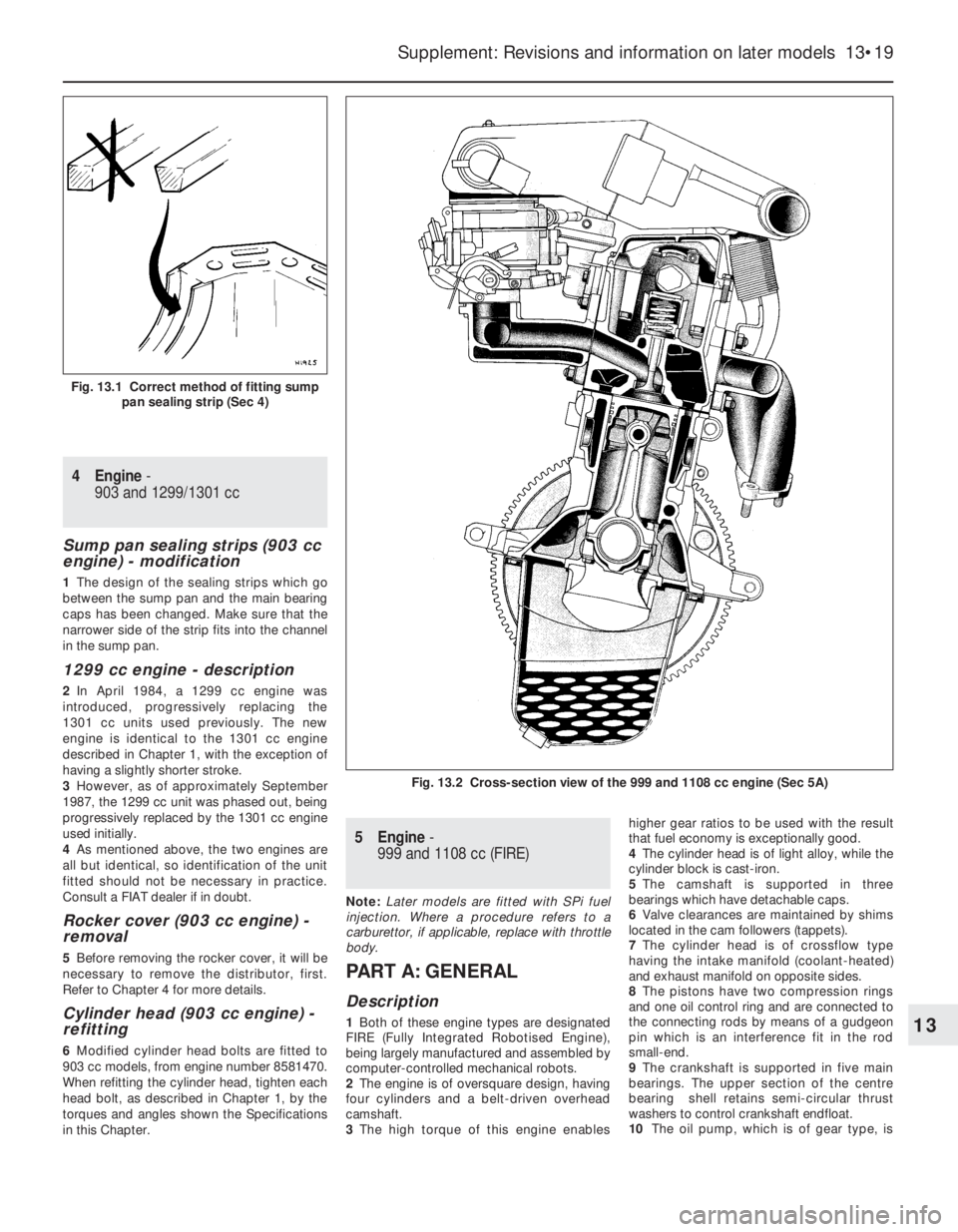
1The design of the sealing strips which go
between the sump pan and the main bearing
caps has been changed. Make sure that the
narrower side of the strip fits into the channel
in the sump pan.
1299 cc engine - description
2In April 1984, a 1299 cc engine was
introduced, progressively replacing the
1301 cc units used previously. The new
engine is identical to the 1301 cc engine
described in Chapter 1, with the exception of
having a slightly shorter stroke.
3However, as of approximately September
1987, the 1299 cc unit was phased out, being
progressively replaced by the 1301 cc engine
used initially.
4As mentioned above, the two engines are
all but identical, so identification of the unit
fitted should not be necessary in practice.
Consult a FIAT dealer if in doubt.
Rocker cover (903 cc engine) -
removal
5Before removing the rocker cover, it will be
necessary to remove the distributor, first.
Refer to Chapter 4 for more details.
Cylinder head (903 cc engine) -
refitting
6Modified cylinder head bolts are fitted to
903 cc models, from engine number 8581470.
When refitting the cylinder head, tighten each
head bolt, as described in Chapter 1, by the
torques and angles shown the Specifications
in this Chapter.
5 Engine-
999 and 1108 cc (FIRE)
Note:Later models are fitted with SPi fuel
injection. Where a procedure refers to a
carburettor, if applicable, replace with throttle
body.
PART A: GENERAL
Description
1Both of these engine types are designated
FIRE (Fully Integrated Robotised Engine),
being largely manufactured and assembled by
computer-controlled mechanical robots.
2The engine is of oversquare design, having
four cylinders and a belt-driven overhead
camshaft.
3The high torque of this engine enableshigher gear ratios to be used with the result
that fuel economy is exceptionally good.
4The cylinder head is of light alloy, while the
cylinder block is cast-iron.
5The camshaft is supported in three
bearings which have detachable caps.
6Valve clearances are maintained by shims
located in the cam followers (tappets).
7The cylinder head is of crossflow type
having the intake manifold (coolant-heated)
and exhaust manifold on opposite sides.
8The pistons have two compression rings
and one oil control ring and are connected to
the connecting rods by means of a gudgeon
pin which is an interference fit in the rod
small-end.
9The crankshaft is supported in five main
bearings. The upper section of the centre
bearing shell retains semi-circular thrust
washers to control crankshaft endfloat.
10The oil pump, which is of gear type, is
Supplement: Revisions and information on later models 13•19
Fig. 13.2 Cross-section view of the 999 and 1108 cc engine (Sec 5A)
Fig. 13.1 Correct method of fitting sump
pan sealing strip (Sec 4)
13
Page 158 of 303
32Fit the hot air collector plate for the air
cleaner (photo).
33Refer to Section 10 and fit the distributor.
34Bolt on the timing belt cover.
35Fit the camshaft cover, using a new
gasket unless the original one is in perfect
condition.
Engine/transmission -
reconnection and refitting#
36Locate the engine in an upright position
on wooden blocks to allow for the greater
depth of the transmission flywheel housing
when it is joined to the engine.
37Make sure that the clutch driven plate has
been centralised, offer the transmission to the
engine and locate the flywheel housing on the
single stud and dowels.
38Tighten the connecting bolts to specifiedtorque, having located the lifting eye (photo).
39Bolt on the starter motor.
40Refit the cover plate to the flywheel
housing, but do not insert the lower bolts at
this stage as they retain the support bracket
for the gearchange rod.
41The engine and transmission are now
ready for refitting. The operations are a direct
reversal of the operations described earlier,
but observe the following points.
42Have the engine/transmission perfectly
horizontal and suspended on the hoist.
43Lower it into position very slowly until it is
possible to engage the driveshaft inboard
joints with the transmission.
44Continue lowering until the driveshafts
can be fully engaged and the mountings
reconnected. Remove the hoist.
45Tighten all nuts and bolts to the specifiedtorque. Note the method shown for
connecting the gearchange rod ball socket
using pliers (photo).
46Refill the engine with oil and coolant and
replenish the transmission oil.
Initial start-up after major
overhaul
47Refer to Chapter 1, Section 45.
6 Engine-
1301 cc Turbo ie
PART A: GENERAL
Description
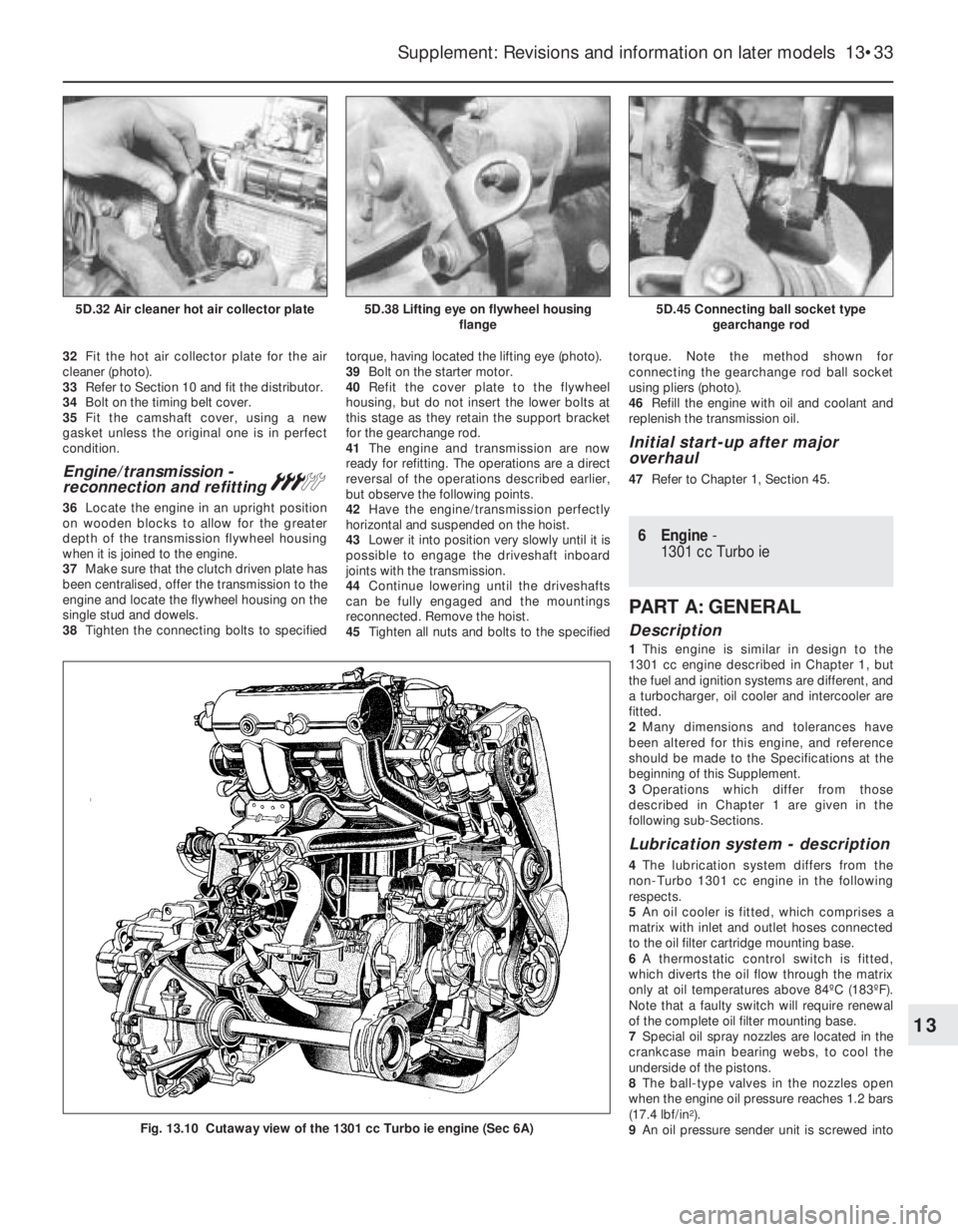
1This engine is similar in design to the
1301 cc engine described in Chapter 1, but
the fuel and ignition systems are different, and
a turbocharger, oil cooler and intercooler are
fitted.
2Many dimensions and tolerances have
been altered for this engine, and reference
should be made to the Specifications at the
beginning of this Supplement.
3Operations which differ from those
described in Chapter 1 are given in the
following sub-Sections.
Lubrication system - description
4The lubrication system differs from the
non-Turbo 1301 cc engine in the following
respects.
5An oil cooler is fitted, which comprises a
matrix with inlet and outlet hoses connected
to the oil filter cartridge mounting base.
6A thermostatic control switch is fitted,
which diverts the oil flow through the matrix
only at oil temperatures above 84ºC (183ºF).
Note that a faulty switch will require renewal
of the complete oil filter mounting base.
7Special oil spray nozzles are located in the
crankcase main bearing webs, to cool the
underside of the pistons.
8The ball-type valves in the nozzles open
when the engine oil pressure reaches 1.2 bars
(17.4 lbf/in
2).
9An oil pressure sender unit is screwed into
Supplement: Revisions and information on later models 13•33
5D.45 Connecting ball socket type
gearchange rod5D.38 Lifting eye on flywheel housing
flange5D.32 Air cleaner hot air collector plate
Fig. 13.10 Cutaway view of the 1301 cc Turbo ie engine (Sec 6A)
13
Page 162 of 303
Initial start-up after major
overhaul
28Refer to Chapter 1, Section 45, but note
that an oil pressure gauge is fitted to indicate
oil pressure.
29Check the ignition static timing as
described in Section 10.
30Check the engine idle speed and CO level
as described in Section 9.
7 Engine-
1372 cc ie and 1372 cc
Turbo ie
PART A: GENERAL
Description
1The 1372 cc engine is similar in design to
the OHC engine fitted to the FIAT Tipo
variants. The engine is of four-cylinder, in-line,
overhead camshaft type, mounted
transversely at the front of the vehicle.
2The crankshaft runs in five main bearings.
Thrustwashers are fitted to the rear (flywheel
end) main bearing in order to control
crankshaft endfloat.
3The connecting rods are attached to the
crankshaft by horizontally split shell-type
big-end bearings. The pistons are attached to
the connecting rods by fully-floating gudgeon
pins which are secured by circlips. The
aluminium alloy pistons are fitted with three
piston rings: two compression rings and an oil
control ring.
4The camshaft is driven by a toothed belt
and operates the valves via bucket and shim
type cam followers. The camshaft is located in
a separate housing on top of the cylinder
head.
5The inlet and exhaust valves are each
closed by double valve springs, and operate
in guides pressed into the cylinder head.
6The auxiliary shaft, which is also driven by
the toothed belt, drives the oil pump.
7Lubrication is by means of a gear type
pump which draws oil through a strainer
located in the sump, and forces it through a
full-flow filter into the engine oil galleries fromwhere it is distributed to the crankshaft,
camshaft and auxiliary shaft. The big-end
bearings are supplied with oil via internal
drillings in the crankshaft. The undersides of
the pistons are cooled by oil spray nozzles
located in each main bearing location in the
crankcase.
8A crankcase ventilation system is
employed, whereby piston blow-by gases are
drawn via an oil separator into the air cleaner,
from where they are drawn into the inlet
manifold and re-burnt with fresh air/fuel
mixture.
9The 1372 cc ie engine is fitted with a Bosch
Mono-Jetronic single point fuel injection (SPi)
system. Whilst the higher performance
1372 cc Turbo ie engine is fitted with a Bosch
L3.1 (L3.2 from 1992) Jetronic multi-point
injection (MPi) system and turbocharger with
intercooler and oil cooling. The L3.2 system
models are fitted with catalytic converters.
Maintenanceª
10At the intervals specified in Section 3 or
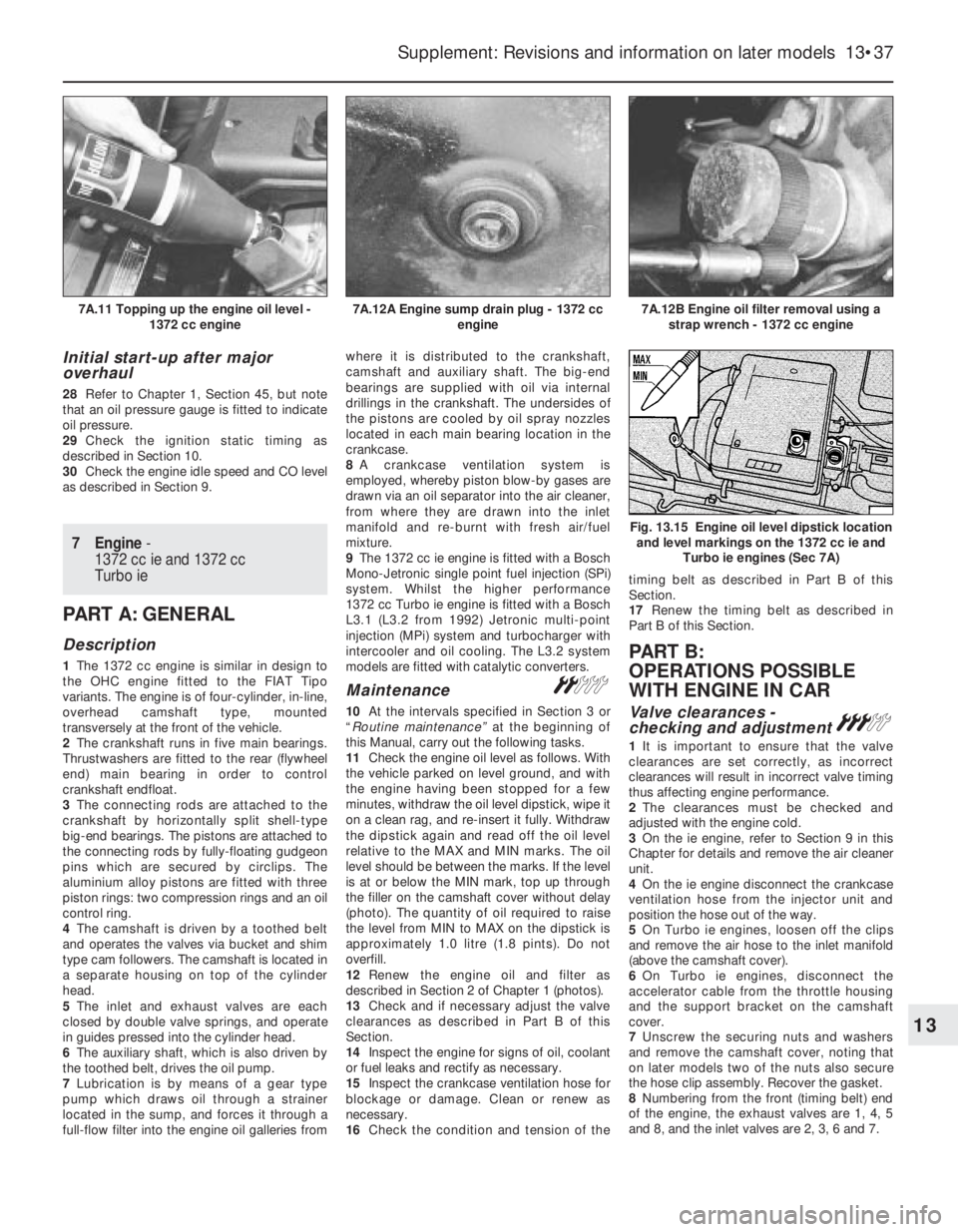
“Routine maintenance” at the beginning of
this Manual, carry out the following tasks.
11Check the engine oil level as follows. With
the vehicle parked on level ground, and with
the engine having been stopped for a few
minutes, withdraw the oil level dipstick, wipe it
on a clean rag, and re-insert it fully. Withdraw
the dipstick again and read off the oil level
relative to the MAX and MIN marks. The oil
level should be between the marks. If the level
is at or below the MIN mark, top up through
the filler on the camshaft cover without delay
(photo). The quantity of oil required to raise
the level from MIN to MAX on the dipstick is
approximately 1.0 litre (1.8 pints). Do not
overfill.
12Renew the engine oil and filter as
described in Section 2 of Chapter 1 (photos).
13Check and if necessary adjust the valve
clearances as described in Part B of this
Section.
14Inspect the engine for signs of oil, coolant
or fuel leaks and rectify as necessary.
15Inspect the crankcase ventilation hose for
blockage or damage. Clean or renew as
necessary.
16Check the condition and tension of thetiming belt as described in Part B of this
Section.
17Renew the timing belt as described in
Part B of this Section.
PART B:
OPERATIONS POSSlBLE
WITH ENGINE IN CAR
Valve clearances -
checking and adjustment#
1It is important to ensure that the valve
clearances are set correctly, as incorrect
clearances will result in incorrect valve timing
thus affecting engine performance.
2The clearances must be checked and
adjusted with the engine cold.
3On the ie engine, refer to Section 9 in this
Chapter for details and remove the air cleaner
unit.
4On the ie engine disconnect the crankcase
ventilation hose from the injector unit and
position the hose out of the way.
5On Turbo ie engines, loosen off the clips
and remove the air hose to the inlet manifold
(above the camshaft cover).
6On Turbo ie engines, disconnect the
accelerator cable from the throttle housing
and the support bracket on the camshaft
cover.
7Unscrew the securing nuts and washers
and remove the camshaft cover, noting that
on later models two of the nuts also secure
the hose clip assembly. Recover the gasket.
8Numbering from the front (timing belt) end
of the engine, the exhaust valves are 1, 4, 5
and 8, and the inlet valves are 2, 3, 6 and 7.
Supplement: Revisions and information on later models 13•37
7A.12B Engine oil filter removal using a
strap wrench - 1372 cc engine7A.12A Engine sump drain plug - 1372 cc
engine7A.11 Topping up the engine oil level -
1372 cc engine
Fig. 13.15 Engine oil level dipstick location
and level markings on the 1372 cc ie and
Turbo ie engines (Sec 7A)
13
Page 185 of 303
9 Fuel and exhaust systems
Warning: Many of the
procedures in this Section
require the removal of fuel lines
and connections that may result
in some fuel spillage. Before carrying out
any operation on the fuel system refer to
the precautions given in ‘Safety first!’ at
the beginning of this Manual and follow
them implicitly. Petrol is a highly
dangerous and volatile liquid, and the
precautions necessary when handling it
cannot be overstressed.
Caution: On fuel injection
models, the system is
pressurised, therefore extra
care must be taken when
disconnecting fuel lines. When
disconnecting a fuel line union, loosen the
union slowly, to avoid a sudden release of
pressure that may cause fuel to spray out
and have a container and cloth ready to
catch spillages. Fuel pressure checking
must be entrusted to a Fiat dealer, or other
specialist, who has the necessary special
equipment.
PART A: GENERAL
Unleaded fuel
Note: On models with catalytic convertersonly unleaded petrol must be used - the use
of leaded petrol will destroy the catalyst.
1It is possible to use unleaded fuel (minimum
95 RON) in the following models with the
indicated serial numbers.
Engine Serial number
903 cc 146A.000
146A.046
146A.048
999 cc 156A2.00
1108 cc 160A3.000
1116 cc 138B.000
138B.046
146A4000
146A4.048
1299/1301 cc 138B2.000
138B2.046
149A7.000
1149A7.000
146A2.000
1372 cc 146C1.000
146A8.000
160A1.046
2On all except the 903 cc engine, the use of
unleaded fuel is conditional upon the
avoidance of constant high speeds and
sudden acceleration.
Air cleaner - modified types
3The air cleaner on later models is of the
automatic temperature controlled type. The
need to move the intake control lever to winter
or summer positions is no longer required.
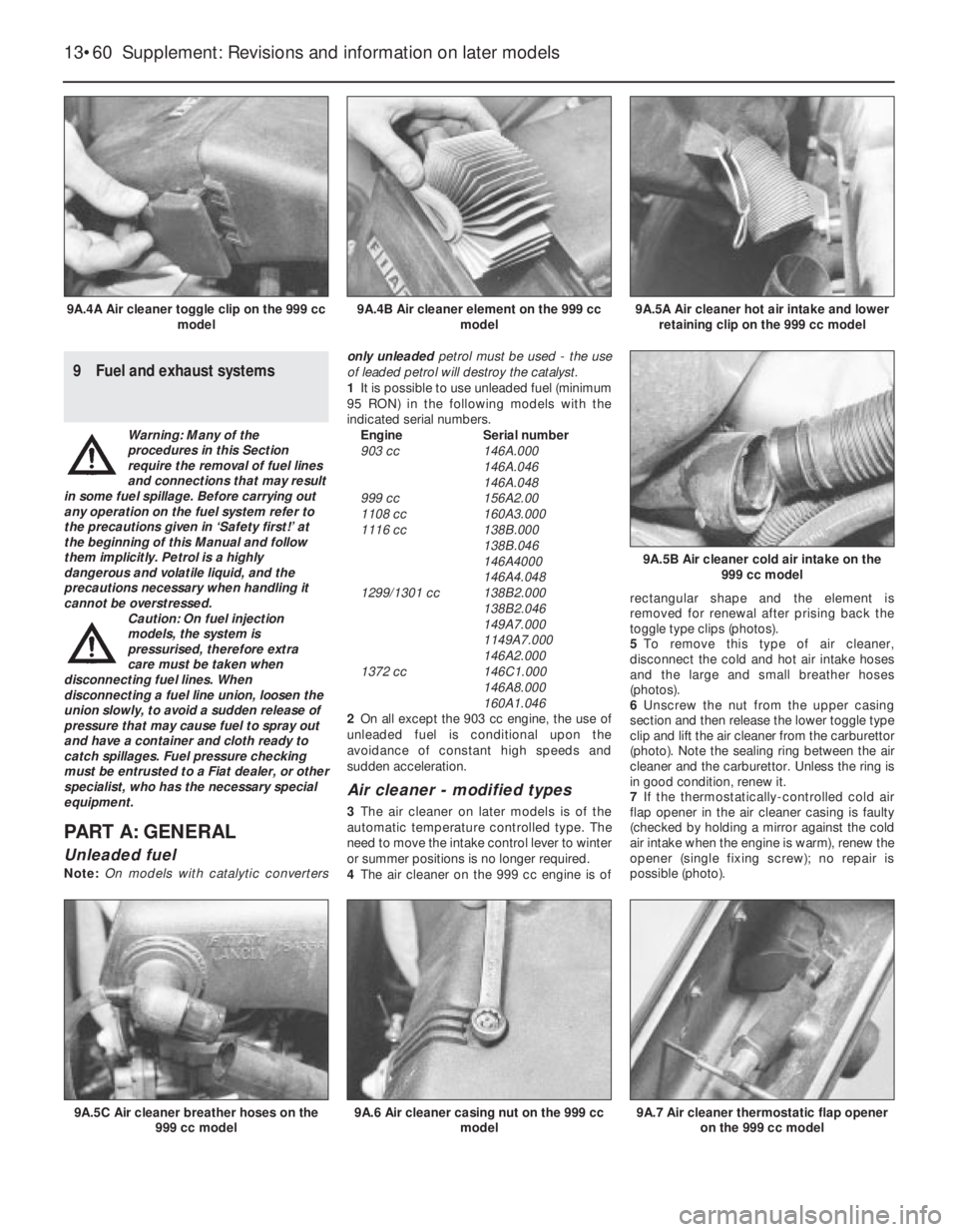
4The air cleaner on the 999 cc engine is ofrectangular shape and the element is
removed for renewal after prising back the
toggle type clips (photos).
5To remove this type of air cleaner,
disconnect the cold and hot air intake hoses
and the large and small breather hoses
(photos).
6Unscrew the nut from the upper casing
section and then release the lower toggle type
clip and lift the air cleaner from the carburettor
(photo). Note the sealing ring between the air
cleaner and the carburettor. Unless the ring is
in good condition, renew it.
7If the thermostatically-controlled cold air
flap opener in the air cleaner casing is faulty
(checked by holding a mirror against the cold
air intake when the engine is warm), renew the
opener (single fixing screw); no repair is
possible (photo).
13•60 Supplement: Revisions and information on later models
9A.7 Air cleaner thermostatic flap opener
on the 999 cc model9A.6 Air cleaner casing nut on the 999 cc
model9A.5C Air cleaner breather hoses on the
999 cc model
9A.5B Air cleaner cold air intake on the
999 cc model
9A.5A Air cleaner hot air intake and lower
retaining clip on the 999 cc model9A.4B Air cleaner element on the 999 cc
model9A.4A Air cleaner toggle clip on the 999 cc
model