heating FIAT UNO 1983 Service User Guide
[x] Cancel search | Manufacturer: FIAT, Model Year: 1983, Model line: UNO, Model: FIAT UNO 1983Pages: 303, PDF Size: 10.36 MB
Page 57 of 303
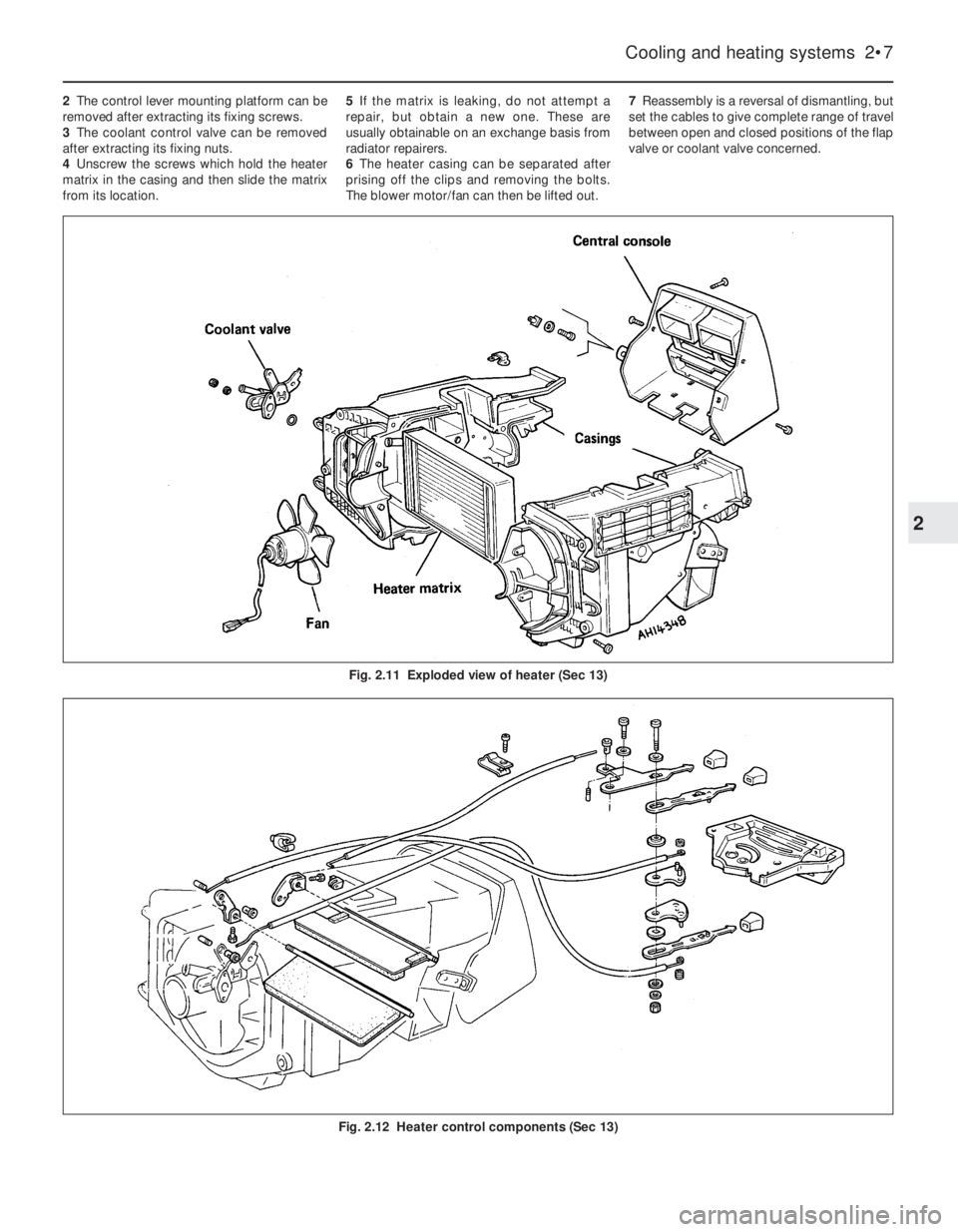
2The control lever mounting platform can be
removed after extracting its fixing screws.
3The coolant control valve can be removed
after extracting its fixing nuts.
4Unscrew the screws which hold the heater
matrix in the casing and then slide the matrix
from its location. 5If the matrix is leaking, do not attempt a
repair, but obtain a new one. These are
usually obtainable on an exchange basis from
radiator repairers.
6The heater casing can be separated after
prising off the clips and removing the bolts.
The blower motor/fan can then be lifted out. 7Reassembly is a reversal of dismantling, but
set the cables to give complete range of travel
between open and closed positions of the flap
valve or coolant valve concerned.
Cooling and heating systems 2•7
Fig. 2.11 Exploded view of heater (Sec 13)
Fig. 2.12 Heater control components (Sec 13)
2
Page 58 of 303
Fault finding - cooling and heating systems
2•8 Cooling and heating systems
Overheating
m mInsufficient coolant in system
m mPump ineffective due to slack drivebelt
m mRadiator blocked either internally or externally
m mKinked or collapsed hose causing coolant flow restriction
m mThermostat not working properly
m mEngine out of tune
m mIgnition timing retarded or auto advance malfunction
m mCylinder head gasket blown
m mEngine not yet run-in
m mExhaust system partially blocked
m mEngine oil level too low
m mBrakes binding
Engine running too cool
m
mFaulty, incorrect or missing thermostat
Loss of coolant
m
mLoose hose clips
m mHoses perished or leaking
m mRadiator leaking
m mFiller/pressure cap defective
m mBlown cylinder head gasket
m mCracked cylinder block or head
Heater gives insufficient output
m
mEngine overcooled (see above)
m mHeater matrix blocked
m mHeater controls maladjusted or broken
m mHeater control valve jammed or otherwise
defective
Page 84 of 303
assembly and the flexible pipe, particularly the
fixing bracket and union at the car end of the
flexible pipe.
3Have ready a container suitable to catch
the brake fluid, and sheets of clean
newspaper on which to put parts.
4Take out the spring clips and locking
blocks, and take the caliper off the support
bracket.
5Disconnect the hydraulic flexible pipe at the
under wing support bracket and cap both
pipe ends. It may help to prevent loss of fluid
if the vent in the reservoir cap is sealed with
adhesive tape, to create a vacuum.
6Remove the caliper to the bench or other
work surface, and clean it thoroughly with
hydraulic fluid or methylated spirit.
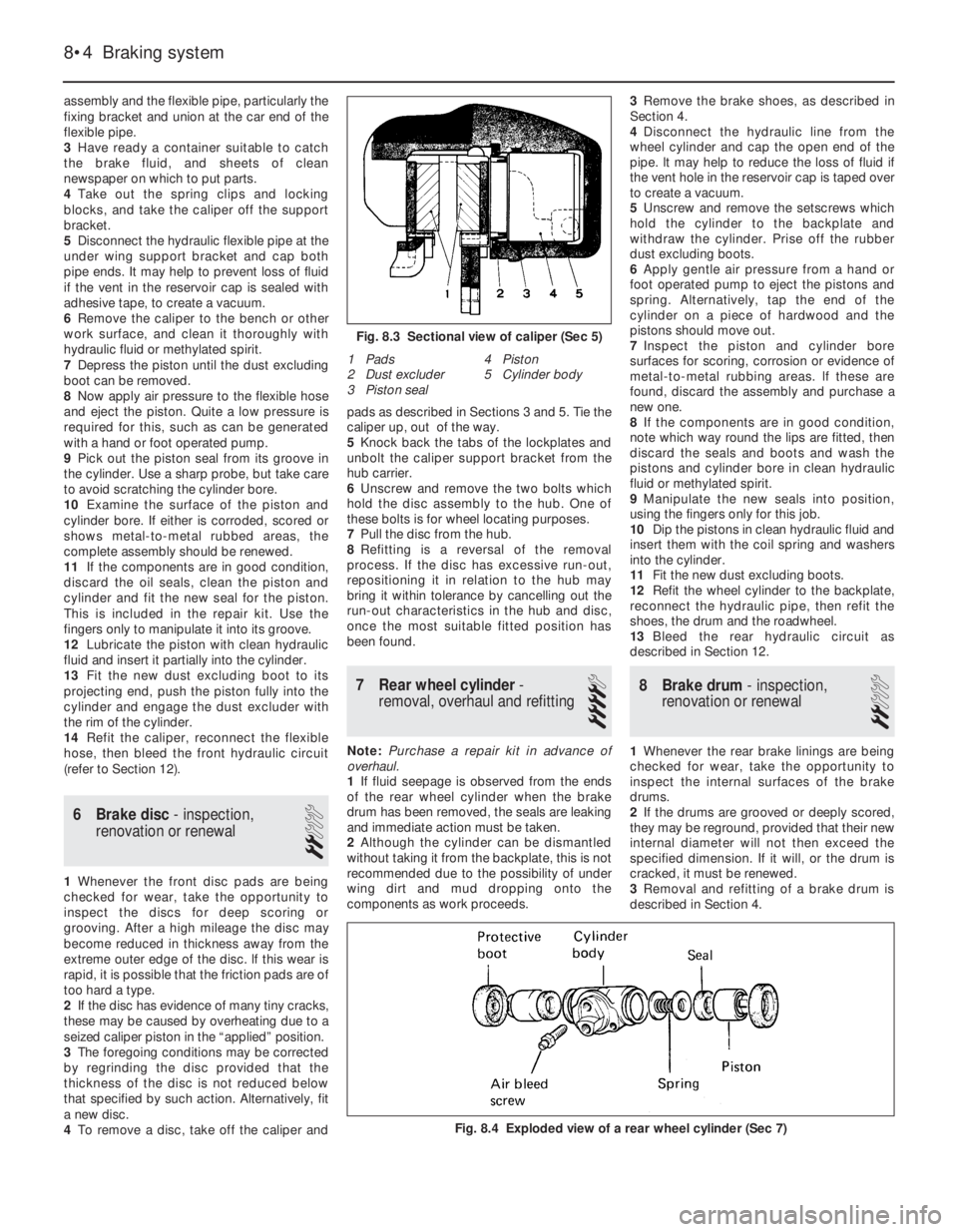
7Depress the piston until the dust excluding
boot can be removed.
8Now apply air pressure to the flexible hose
and eject the piston. Quite a low pressure is
required for this, such as can be generated
with a hand or foot operated pump.
9Pick out the piston seal from its groove in
the cylinder. Use a sharp probe, but take care
to avoid scratching the cylinder bore.
10Examine the surface of the piston and
cylinder bore. If either is corroded, scored or
shows metal-to-metal rubbed areas, the
complete assembly should be renewed.
11If the components are in good condition,
discard the oil seals, clean the piston and
cylinder and fit the new seal for the piston.
This is included in the repair kit. Use the
fingers only to manipulate it into its groove.
12Lubricate the piston with clean hydraulic
fluid and insert it partially into the cylinder.
13Fit the new dust excluding boot to its
projecting end, push the piston fully into the
cylinder and engage the dust excluder with
the rim of the cylinder.
14Refit the caliper, reconnect the flexible
hose, then bleed the front hydraulic circuit
(refer to Section 12).
6 Brake disc- inspection,
renovation or renewal
2
1Whenever the front disc pads are being
checked for wear, take the opportunity to
inspect the discs for deep scoring or
grooving. After a high mileage the disc may
become reduced in thickness away from the
extreme outer edge of the disc. lf this wear is
rapid, it is possible that the friction pads are of
too hard a type.
2If the disc has evidence of many tiny cracks,
these may be caused by overheating due to a
seized caliper piston in the “applied” position.
3The foregoing conditions may be corrected
by regrinding the disc provided that the
thickness of the disc is not reduced below
that specified by such action. Alternatively, fit
a new disc.
4To remove a disc, take off the caliper andpads as described in Sections 3 and 5. Tie the
caliper up, out of the way.
5Knock back the tabs of the lockplates and
unbolt the caliper support bracket from the
hub carrier.
6Unscrew and remove the two bolts which
hold the disc assembly to the hub. One of
these bolts is for wheel locating purposes.
7Pull the disc from the hub.
8Refitting is a reversal of the removal
process. If the disc has excessive run-out,
repositioning it in relation to the hub may
bring it within tolerance by cancelling out the
run-out characteristics in the hub and disc,
once the most suitable fitted position has
been found.
7 Rear wheel cylinder-
removal, overhaul and refitting
4
Note: Purchase a repair kit in advance of
overhaul.
1If fluid seepage is observed from the ends
of the rear wheel cylinder when the brake
drum has been removed, the seals are leaking
and immediate action must be taken.
2Although the cylinder can be dismantled
without taking it from the backplate, this is not
recommended due to the possibility of under
wing dirt and mud dropping onto the
components as work proceeds. 3Remove the brake shoes, as described in
Section 4.
4Disconnect the hydraulic line from the
wheel cylinder and cap the open end of the
pipe. lt may help to reduce the loss of fluid if
the vent hole in the reservoir cap is taped over
to create a vacuum.
5Unscrew and remove the setscrews which
hold the cylinder to the backplate and
withdraw the cylinder. Prise off the rubber
dust excluding boots.
6Apply gentle air pressure from a hand or
foot operated pump to eject the pistons and
spring. Alternatively, tap the end of the
cylinder on a piece of hardwood and the
pistons should move out.
7Inspect the piston and cylinder bore
surfaces for scoring, corrosion or evidence of
metal-to-metal rubbing areas. lf these are
found, discard the assembly and purchase a
new one.
8If the components are in good condition,
note which way round the lips are fitted, then
discard the seals and boots and wash the
pistons and cylinder bore in clean hydraulic
fluid or methylated spirit.
9Manipulate the new seals into position,
using the fingers only for this job.
10Dip the pistons in clean hydraulic fluid and
insert them with the coil spring and washers
into the cylinder.
11Fit the new dust excluding boots.
12Refit the wheel cylinder to the backplate,
reconnect the hydraulic pipe, then refit the
shoes, the drum and the roadwheel.
13Bleed the rear hydraulic circuit as
described in Section 12.
8 Brake drum- inspection,
renovation or renewal
2
1Whenever the rear brake linings are being
checked for wear, take the opportunity to
inspect the internal surfaces of the brake
drums.
2If the drums are grooved or deeply scored,
they may be reground, provided that their new
internal diameter will not then exceed the
specified dimension. If it will, or the drum is
cracked, it must be renewed.
3Removal and refitting of a brake drum is
described in Section 4.
8•4 Braking system
Fig. 8.4 Exploded view of a rear wheel cylinder (Sec 7)
1 Pads
2 Dust excluder
3 Piston seal4 Piston
5 Cylinder body
Fig. 8.3 Sectional view of caliper (Sec 5)
Page 171 of 303
new oil seal, ensuring that it is correctly
orientated, and drive it squarely into position.
149Refit all disturbed components.
Flywheel - removal,
inspection and refitting#
150If not already done, remove the clutch as
described in Chapter 5.
151Prevent the flywheel from turning by
jamming the ring gear teeth, or by bolting a
strap between the flywheel and the cylinder
block.
152Make alignment marks on the flywheel
and the end of the crankshaft, so that the
flywheel can be refitted in its original position.
153Unscrew the securing bolts and remove
the washer plate, then withdraw the flywheel.
Do not drop it, it is very heavy.
154With the flywheel removed, the ring gear
can be examined for wear and damage.
155If the ring gear is badly worn or has
missing teeth it should be renewed. The old
ring gear can be removed from the flywheel by
cutting a notch between two teeth with a
hacksaw and then splitting it with a cold
chisel. Wear eye protection when doing this.
156Fitting of a new ring gear requires heating
the ring to a temperature of 80ºC (176ºF). Do
not overheat, or the hard-wearing properties
will be lost. The gear has a chamfered inner
edge which should fit against the shoulder on
the flywheel. When hot enough, place the gear
in position quickly, tapping it home ifnecessary, and let it cool naturally without
quenching in any way.
157Ensure that the mating faces are clean,
then locate the flywheel on the rear of the
crankshaft, aligning the previously made
marks on the flywheel and crankshaft.
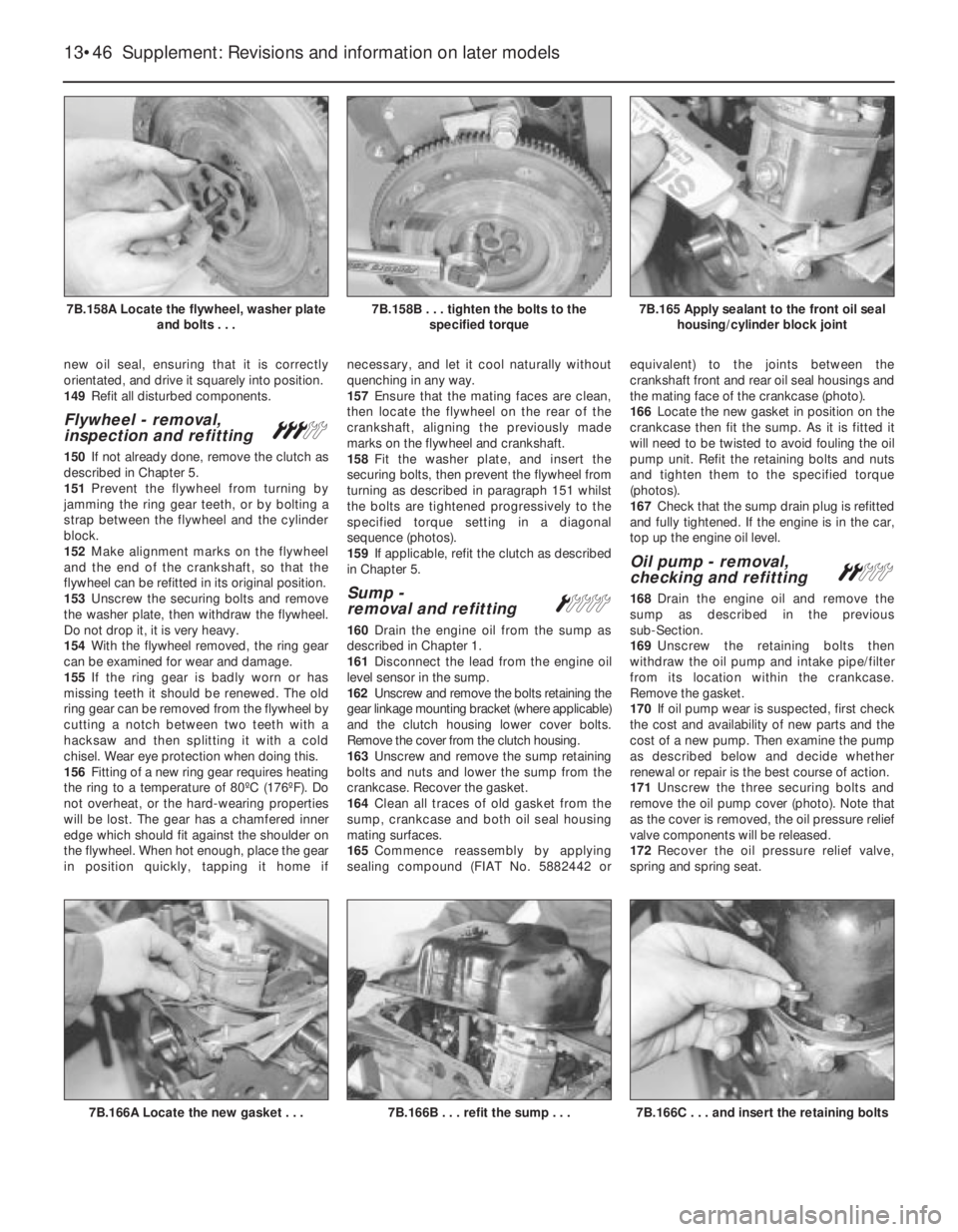
158Fit the washer plate, and insert the
securing bolts, then prevent the flywheel from
turning as described in paragraph 151 whilst
the bolts are tightened progressively to the
specified torque setting in a diagonal
sequence (photos).
159If applicable, refit the clutch as described
in Chapter 5.
Sump -
removal and refittingÁ
160Drain the engine oil from the sump as
described in Chapter 1.
161Disconnect the lead from the engine oil
level sensor in the sump.
162Unscrew and remove the bolts retaining the
gear linkage mounting bracket (where applicable)
and the clutch housing lower cover bolts.
Remove the cover from the clutch housing.
163Unscrew and remove the sump retaining
bolts and nuts and lower the sump from the
crankcase. Recover the gasket.
164Clean all traces of old gasket from the
sump, crankcase and both oil seal housing
mating surfaces.
165Commence reassembly by applying
sealing compound (FIAT No. 5882442 orequivalent) to the joints between the
crankshaft front and rear oil seal housings and
the mating face of the crankcase (photo).
166Locate the new gasket in position on the
crankcase then fit the sump. As it is fitted it
will need to be twisted to avoid fouling the oil
pump unit. Refit the retaining bolts and nuts
and tighten them to the specified torque
(photos).
167Check that the sump drain plug is refitted
and fully tightened. If the engine is in the car,
top up the engine oil level.
Oil pump - removal,
checking and refittingª
168Drain the engine oil and remove the
sump as described in the previous
sub-Section.
169Unscrew the retaining bolts then
withdraw the oil pump and intake pipe/filter
from its location within the crankcase.
Remove the gasket.
170If oil pump wear is suspected, first check
the cost and availability of new parts and the
cost of a new pump. Then examine the pump
as described below and decide whether
renewal or repair is the best course of action.
171Unscrew the three securing bolts and
remove the oil pump cover (photo). Note that
as the cover is removed, the oil pressure relief
valve components will be released.
172Recover the oil pressure relief valve,
spring and spring seat.
13•46 Supplement: Revisions and information on later models
7B.166C . . . and insert the retaining bolts7B.166B . . . refit the sump . . .7B.166A Locate the new gasket . . .
7B.165 Apply sealant to the front oil seal
housing/cylinder block joint7B.158B . . . tighten the bolts to the
specified torque7B.158A Locate the flywheel, washer plate
and bolts . . .
Page 199 of 303
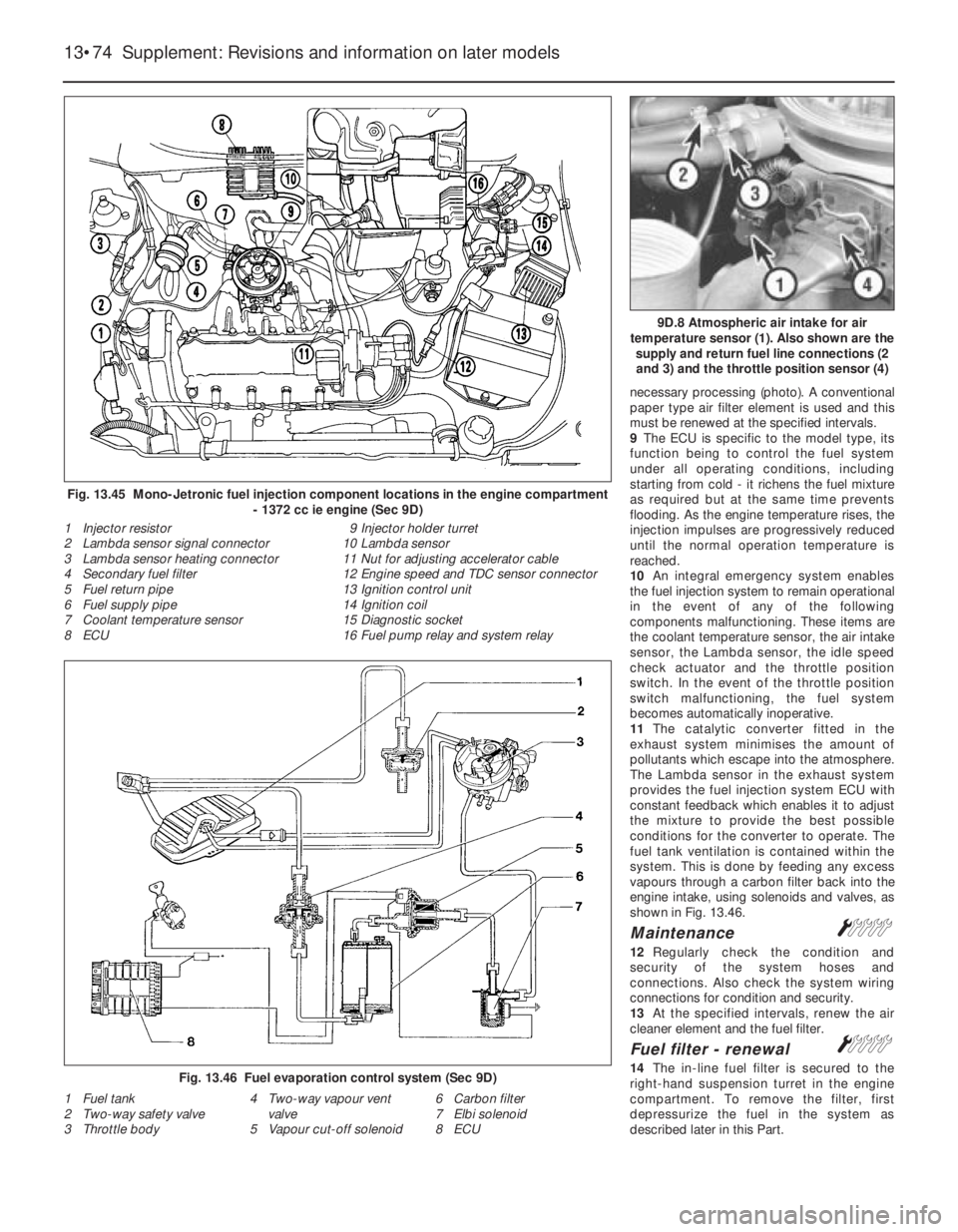
necessary processing (photo). A conventional
paper type air filter element is used and this
must be renewed at the specified intervals.
9The ECU is specific to the model type, its
function being to control the fuel system
under all operating conditions, including
starting from cold - it richens the fuel mixture
as required but at the same time prevents
flooding. As the engine temperature rises, the
injection impulses are progressively reduced
until the normal operation temperature is
reached.
10An integral emergency system enables
the fuel injection system to remain operational
in the event of any of the following
components malfunctioning. These items are
the coolant temperature sensor, the air intake
sensor, the Lambda sensor, the idle speed
check actuator and the throttle position
switch. In the event of the throttle position
switch malfunctioning, the fuel system
becomes automatically inoperative.
11The catalytic converter fitted in the
exhaust system minimises the amount of
pollutants which escape into the atmosphere.
The Lambda sensor in the exhaust system
provides the fuel injection system ECU with
constant feedback which enables it to adjust
the mixture to provide the best possible
conditions for the converter to operate. The
fuel tank ventilation is contained within the
system. This is done by feeding any excess
vapours through a carbon filter back into the
engine intake, using solenoids and valves, as
shown in Fig. 13.46.
MaintenanceÁ
12Regularly check the condition and
security of the system hoses and
connections. Also check the system wiring
connections for condition and security.
13At the specified intervals, renew the air
cleaner element and the fuel filter.
Fuel filter - renewalÁ
14The in-line fuel filter is secured to the
right-hand suspension turret in the engine
compartment. To remove the filter, first
depressurize the fuel in the system as
described later in this Part.
13•74 Supplement: Revisions and information on later models
Fig. 13.46 Fuel evaporation control system (Sec 9D)
1 Fuel tank
2 Two-way safety valve
3 Throttle body4 Two-way vapour vent
valve
5 Vapour cut-off solenoid6 Carbon filter
7 Elbi solenoid
8 ECU
9D.8 Atmospheric air intake for air
temperature sensor (1). Also shown are the
supply and return fuel line connections (2
and 3) and the throttle position sensor (4)
Fig. 13.45 Mono-Jetronic fuel injection component locations in the engine compartment
- 1372 cc ie engine (Sec 9D)
1 Injector resistor
2 Lambda sensor signal connector
3 Lambda sensor heating connector
4 Secondary fuel filter
5 Fuel return pipe
6 Fuel supply pipe
7 Coolant temperature sensor
8 ECU9 Injector holder turret
10 Lambda sensor
11 Nut for adjusting accelerator cable
12 Engine speed and TDC sensor connector
13 Ignition control unit
14 Ignition coil
15 Diagnostic socket
16 Fuel pump relay and system relay
Page 202 of 303
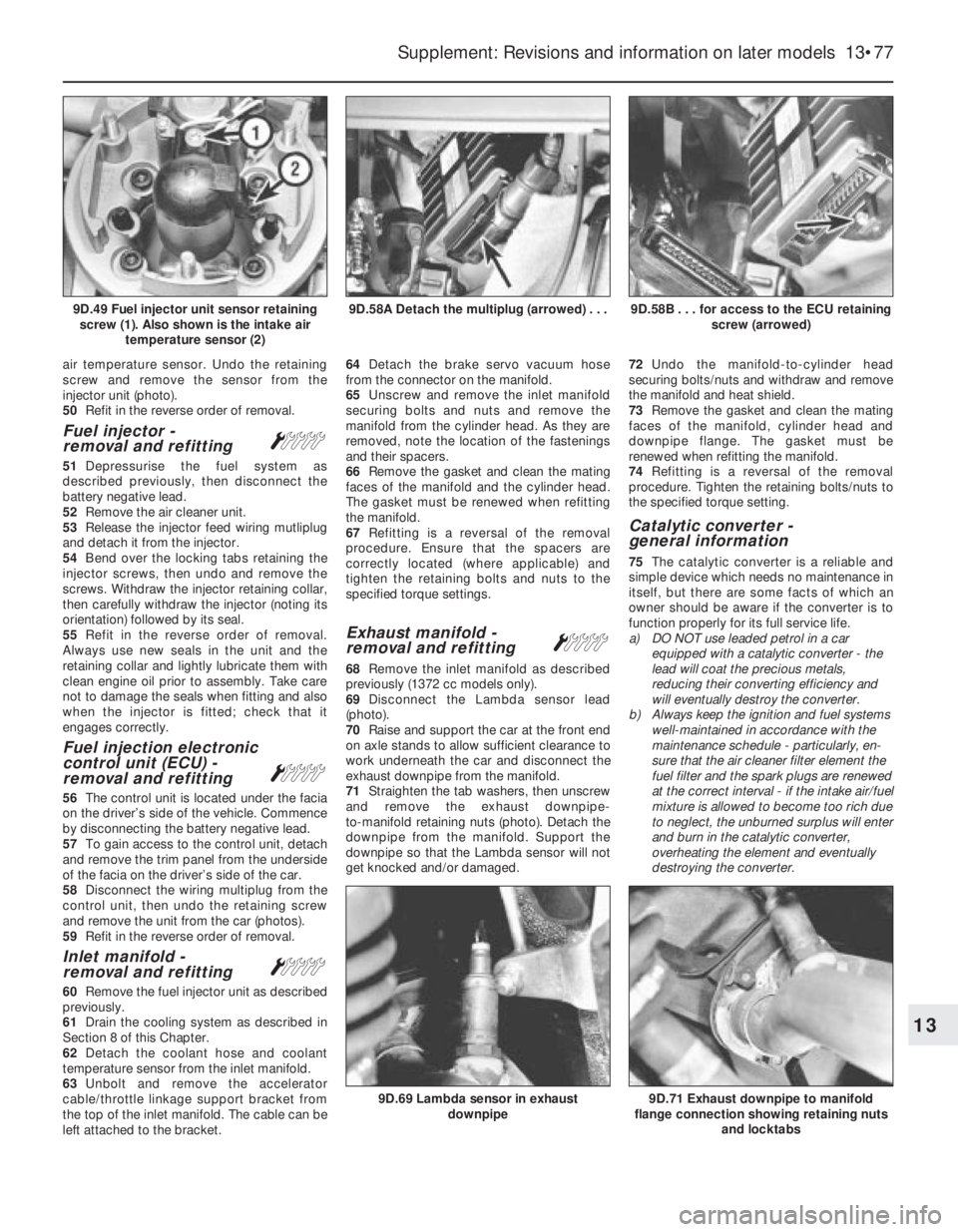
air temperature sensor. Undo the retaining
screw and remove the sensor from the
injector unit (photo).
50Refit in the reverse order of removal.
Fuel injector -
removal and refittingÁ
51Depressurise the fuel system as
described previously, then disconnect the
battery negative lead.
52Remove the air cleaner unit.
53Release the injector feed wiring mutliplug
and detach it from the injector.
54Bend over the locking tabs retaining the
injector screws, then undo and remove the
screws. Withdraw the injector retaining collar,
then carefully withdraw the injector (noting its
orientation) followed by its seal.
55Refit in the reverse order of removal.
Always use new seals in the unit and the
retaining collar and lightly lubricate them with
clean engine oil prior to assembly. Take care
not to damage the seals when fitting and also
when the injector is fitted; check that it
engages correctly.
Fuel injection electronic
control unit (ECU) -
removal and refitting
Á
56The control unit is located under the facia
on the driver’s side of the vehicle. Commence
by disconnecting the battery negative lead.
57To gain access to the control unit, detach
and remove the trim panel from the underside
of the facia on the driver’s side of the car.
58Disconnect the wiring multiplug from the
control unit, then undo the retaining screw
and remove the unit from the car (photos).
59Refit in the reverse order of removal.
Inlet manifold -
removal and refittingÁ
60Remove the fuel injector unit as described
previously.
61Drain the cooling system as described in
Section 8 of this Chapter.
62Detach the coolant hose and coolant
temperature sensor from the inlet manifold.
63Unbolt and remove the accelerator
cable/throttle linkage support bracket from
the top of the inlet manifold. The cable can be
left attached to the bracket.64Detach the brake servo vacuum hose
from the connector on the manifold.
65Unscrew and remove the inlet manifold
securing bolts and nuts and remove the
manifold from the cylinder head. As they are
removed, note the location of the fastenings
and their spacers.
66Remove the gasket and clean the mating
faces of the manifold and the cylinder head.
The gasket must be renewed when refitting
the manifold.
67Refitting is a reversal of the removal
procedure. Ensure that the spacers are
correctly located (where applicable) and
tighten the retaining bolts and nuts to the
specified torque settings.
Exhaust manifold -
removal and refittingÁ
68Remove the inlet manifold as described
previously (1372 cc models only).
69Disconnect the Lambda sensor lead
(photo).
70Raise and support the car at the front end
on axle stands to allow sufficient clearance to
work underneath the car and disconnect the
exhaust downpipe from the manifold.
71Straighten the tab washers, then unscrew
and remove the exhaust downpipe-
to-manifold retaining nuts (photo). Detach the
downpipe from the manifold. Support the
downpipe so that the Lambda sensor will not
get knocked and/or damaged.72Undo the manifold-to-cylinder head
securing bolts/nuts and withdraw and remove
the manifold and heat shield.
73Remove the gasket and clean the mating
faces of the manifold, cylinder head and
downpipe flange. The gasket must be
renewed when refitting the manifold.
74Refitting is a reversal of the removal
procedure. Tighten the retaining bolts/nuts to
the specified torque setting.
Catalytic converter -
general information
75The catalytic converter is a reliable and
simple device which needs no maintenance in
itself, but there are some facts of which an
owner should be aware if the converter is to
function properly for its full service life.
a) DO NOT use leaded petrol in a car
equipped with a catalytic converter - the
lead will coat the precious metals,
reducing their converting efficiency and
will eventually destroy the converter.
b) Always keep the ignition and fuel systems
well-maintained in accordance with the
maintenance schedule - particularly, en-
sure that the air cleaner filter element the
fuel filter and the spark plugs are renewed
at the correct interval - if the intake air/fuel
mixture is allowed to become too rich due
to neglect, the unburned surplus will enter
and burn in the catalytic converter,
overheating the element and eventually
destroying the converter.
Supplement: Revisions and information on later models 13•77
9D.58B . . . for access to the ECU retaining
screw (arrowed)9D.58A Detach the multiplug (arrowed) . . .9D.49 Fuel injector unit sensor retaining
screw (1). Also shown is the intake air
temperature sensor (2)
9D.71 Exhaust downpipe to manifold
flange connection showing retaining nuts
and locktabs9D.69 Lambda sensor in exhaust
downpipe
13
Page 203 of 303
c) If the engine develops a misfire, do not
drive the car at all (or at least as little as
possible) until the fault is cured - the
misfire will allow unburned fuel to enter
the converter, which will result in its
overheating, as noted above.
d) DO NOT push- or tow-start the car - this
will soak the catalytic converter in
unburned fuel, causing it to overheat
when the engine does start - see b)
above.
e) DO NOT switch off the ignition at high
engine speeds - if the ignition is switched
off at anything above idle speed,
unburned fuel will enter the (very hot)
catalytic converter, with the possible risk
of its igniting on the element and
damaging the converter.
f) DO NOT use fuel or engine oil additives -
these may contain substances harmful to
the catalytic converter.
g) DO NOT continue to use the car if the
engine burns oil to the extent of leaving a
visible trail of blue smoke - the unburned
carbon deposits will clog the converter
passages and reduce its efficiency; in
severe cases the element will overheat.
h) Remember that the catalytic converter
operates at very high temperatures and
the casing will become hot enough to
ignite combustible materials which brush
against it. DO NOT, therefore, park the car
in dry undergrowth, over long grass or
piles of dead leaves.
i) Remember that the catalytic converter is
FRAGILE - do not strike it with tools
during servicing work, take great care
when working on the exhaust system,
ensure that the converter is well clear of
any jacks or other lifting gear used to raise
the car and do not drive the car over
rough ground road humps, etc., in such a
way as to ground the exhaust system.
j) In some cases, particularly when the car is
new and/or is used for stop/start driving, a
sulphurous smell (like that of rotten eggs)
may be noticed from the exhaust. This is
common to many catalytic
converter-equipped cars and seems to be
due to the small amount of sulphur found
in some petrols reacting with hydrogen in
the exhaust to produce hydrogen sulphide
(H
2S) gas; while this gas is toxic, it is not
produced in sufficient amounts to be a
problem. Once the car has covered a few
thousand miles the problem should
disappear - in the meanwhile a change of
driving style or of the brand of petrol used
may effect a solution.
k) The catalytic converter, used on a
well-maintained and well driven car,
should last for at least 50 000 miles
(80 000 km) or five years - from this point
on, careful checks should be made at all
specified service intervals on the CO level
to ensure that the converter is still
operating efficiently - if the converter is no
longer effective it must be renewed.
Fuel evaporation control system
- general
76As mentioned earlier, fuel evaporation is
contained within the system. In high outdoor
temperatures, when the vehicle is parked for a
period of time, the fuel in the tank evaporates,
building up pressure. When the pressure builds
up to a predetermined level a vent valve opens
to allow the vapours to pass on to and absorbed
by a carbon filter. However, if extreme pressure
or vacuum should build up, a two way safety
valve opens to allow external venting.
77If the safety valve needs replacing, note
that it must be fitted correctly. The black end
should be connected to the fuel tank and the
blue to the carbon filter.
78The vapours in the carbon filter are
flushed by warm air passing through the filter
on to a ECU controlled vapour cut-off
solenoid.
79The cut-off solenoid is closed when
starting the engine and opens to allow
vapours to be drawn into the inlet manifold,
through a second solenoid. If the cut-off
solenoid needs replacing ensure that the
black arrow on the casing is pointing towards
the inlet manifold.
80The second solenoid, known as an Elbi
solenoid, is closed when the engine is turned
off, thus preventing engine run-on. The side
facing connection is for the inlet manifold
pipe.
PART E:
BOSCH L3.1/2 JETRONIC
FUEL INJECTION SYSTEMS
Warning: Refer to the beginning
of this Section before starting
any work.
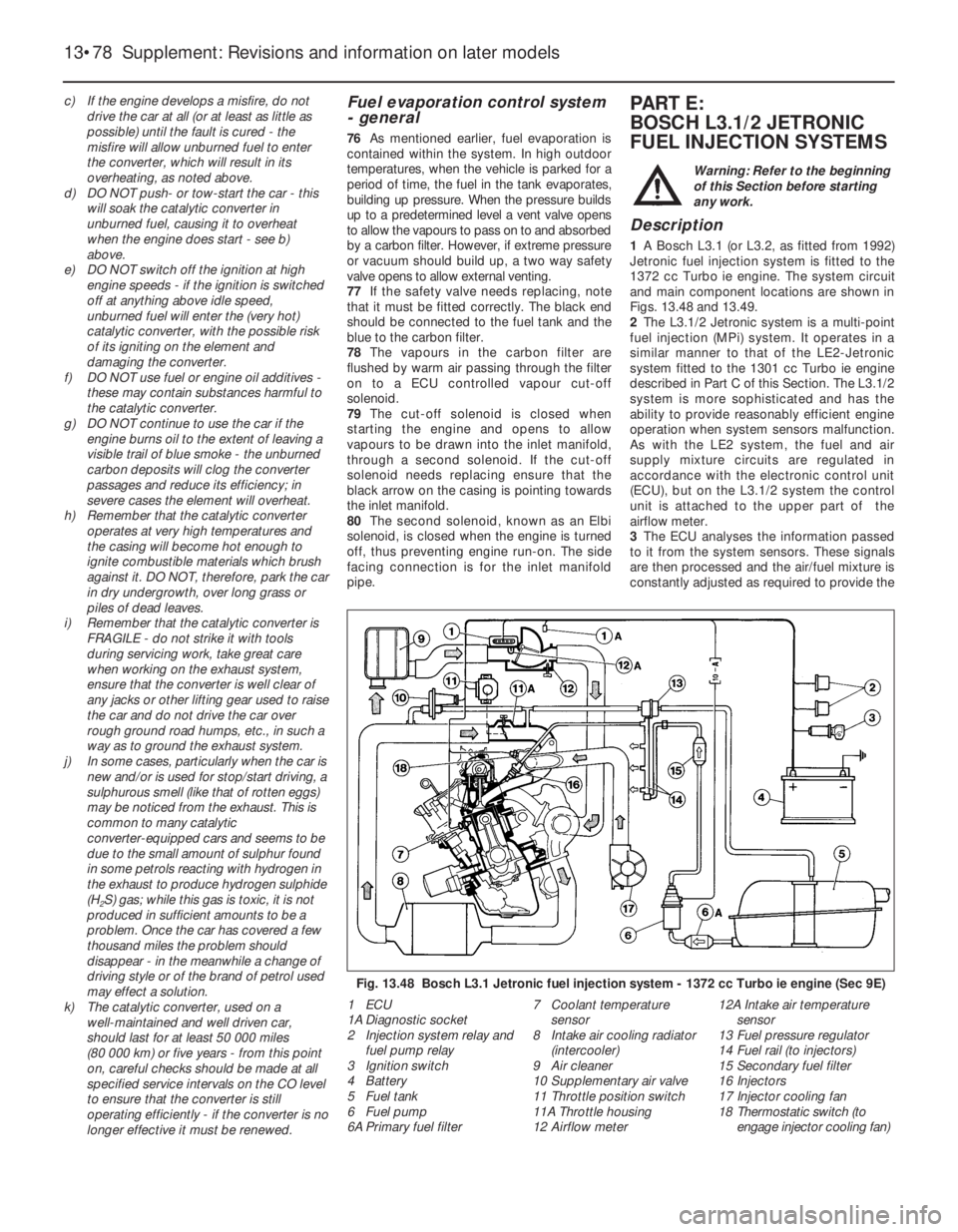
Description
1A Bosch L3.1 (or L3.2, as fitted from 1992)
Jetronic fuel injection system is fitted to the
1372 cc Turbo ie engine. The system circuit
and main component locations are shown in
Figs. 13.48 and 13.49.
2The L3.1/2 Jetronic system is a multi-point
fuel injection (MPi) system. It operates in a
similar manner to that of the LE2-Jetronic
system fitted to the 1301 cc Turbo ie engine
described in Part C of this Section. The L3.1/2
system is more sophisticated and has the
ability to provide reasonably efficient engine
operation when system sensors malfunction.
As with the LE2 system, the fuel and air
supply mixture circuits are regulated in
accordance with the electronic control unit
(ECU), but on the L3.1/2 system the control
unit is attached to the upper part of the
airflow meter.
3The ECU analyses the information passed
to it from the system sensors. These signals
are then processed and the air/fuel mixture is
constantly adjusted as required to provide the
13•78 Supplement: Revisions and information on later models
Fig. 13.48 Bosch L3.1 Jetronic fuel injection system - 1372 cc Turbo ie engine (Sec 9E)
1 ECU
1A Diagnostic socket
2 Injection system relay and
fuel pump relay
3 Ignition switch
4 Battery
5 Fuel tank
6 Fuel pump
6A Primary fuel filter7 Coolant temperature
sensor
8 Intake air cooling radiator
(intercooler)
9 Air cleaner
10 Supplementary air valve
11 Throttle position switch
11A Throttle housing
12 Airflow meter12A Intake air temperature
sensor
13 Fuel pressure regulator
14 Fuel rail (to injectors)
15 Secondary fuel filter
16 Injectors
17 Injector cooling fan
18 Thermostatic switch (to
engage injector cooling fan)
Page 207 of 303
protective shield to gain access to the pump
which is located forward of the fuel tank.
60Disconnect the fuel hoses and the wiring
connector, release the retaining clamp and
withdraw the pump unit.
Refitting all components
61Refitting of all components is a reversal of
the removal procedure, but note the following
specific points.
62Ensure that all components are clean prior
to refitting and where applicable, use new
seals and gaskets. Ensure that all connectionsare securely and correctly made.
63Do not reconnect the battery until all the
refitting procedures are complete.
64When the engine is restarted, check
around the fuel injection system for any signs
of leakage from the fuel supply and return
components.
Lambda sensor - general
65The sensor is screwed into the exhaust in
front of the catalytic converter.
66A faulty sensor can damage the converter,
therefore it must be checked regularly (see
Maintenance schedule, Section 3) by a dealer
using special equipment.
67Use of leaded fuel will also damage this
sensor, as well the converter.
PART F:
TURBOCHARGER SYSTEM
Description
1A turbocharger is fitted to certain 1301 and
1372 cc ie engines. The accompanying
photographs are all taken from a 1301 cc
engine, but the system is much the same for
both engine types.
2The turbocharger is basically a shaft with an
exhaust gas-driven turbine at one end, and a
compressor located at the other end which
draws in outside air and forces it into the inlet
manifold. By compressing the incoming air, a
larger charge can be let into each cylinder,
and greater power output is achieved than
with normal aspiration.3Lubrication of the turbocharger shaft
bearings is provided by pressurised engine
oil, and the unit is cooled by the coolant from
the engine cooling system.
4A wastegate valve is incorporated in the
turbocharger to divert excessive exhaust gas
pressure from the turbine into the exhaust
pipe at a predetermined pressure level.
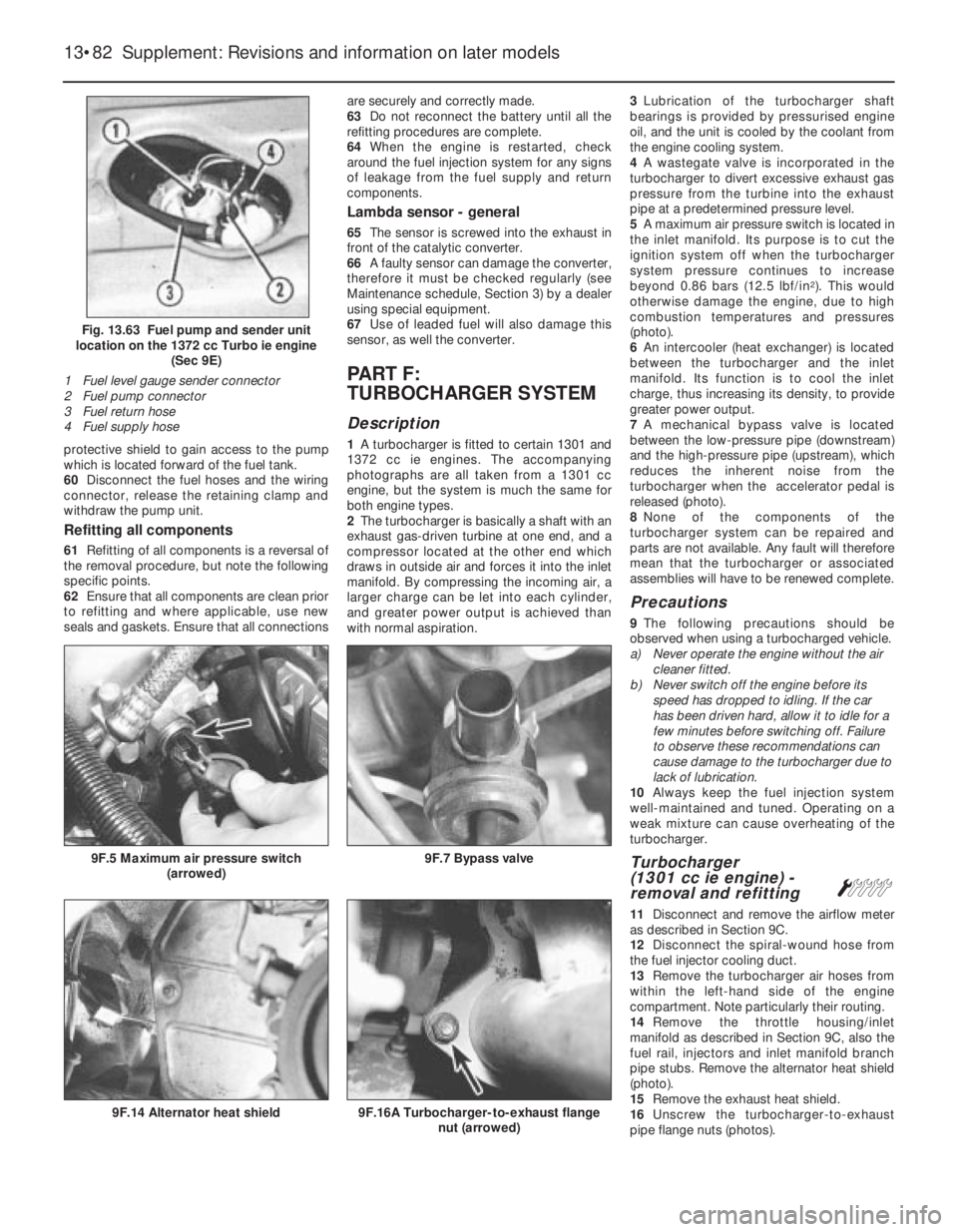
5A maximum air pressure switch is located in
the inlet manifold. Its purpose is to cut the
ignition system off when the turbocharger
system pressure continues to increase
beyond 0.86 bars (12.5 lbf/in
2). This would
otherwise damage the engine, due to high
combustion temperatures and pressures
(photo).
6An intercooler (heat exchanger) is located
between the turbocharger and the inlet
manifold. Its function is to cool the inlet
charge, thus increasing its density, to provide
greater power output.
7A mechanical bypass valve is located
between the low-pressure pipe (downstream)
and the high-pressure pipe (upstream), which
reduces the inherent noise from the
turbocharger when the accelerator pedal is
released (photo).
8None of the components of the
turbocharger system can be repaired and
parts are not available. Any fault will therefore
mean that the turbocharger or associated
assemblies will have to be renewed complete.
Precautions
9The following precautions should be
observed when using a turbocharged vehicle.
a) Never operate the engine without the air
cleaner fitted.
b) Never switch off the engine before its
speed has dropped to idling. If the car
has been driven hard, allow it to idle for a
few minutes before switching off. Failure
to observe these recommendations can
cause damage to the turbocharger due to
lack of lubrication.
10Always keep the fuel injection system
well-maintained and tuned. Operating on a
weak mixture can cause overheating of the
turbocharger.
Turbocharger
(1301 cc ie engine) -
removal and refitting
Á
11Disconnect and remove the airflow meter
as described in Section 9C.
12Disconnect the spiral-wound hose from
the fuel injector cooling duct.
13Remove the turbocharger air hoses from
within the left-hand side of the engine
compartment. Note particularly their routing.
14Remove the throttle housing/inlet
manifold as described in Section 9C, also the
fuel rail, injectors and inlet manifold branch
pipe stubs. Remove the alternator heat shield
(photo).
15Remove the exhaust heat shield.
16Unscrew the turbocharger-to-exhaust
pipe flange nuts (photos).
13•82 Supplement: Revisions and information on later models
9F.16A Turbocharger-to-exhaust flange
nut (arrowed)9F.14 Alternator heat shield
9F.7 Bypass valve9F.5 Maximum air pressure switch
(arrowed)
Fig. 13.63 Fuel pump and sender unit
location on the 1372 cc Turbo ie engine
(Sec 9E)
1 Fuel level gauge sender connector
2 Fuel pump connector
3 Fuel return hose
4 Fuel supply hose
Page 240 of 303
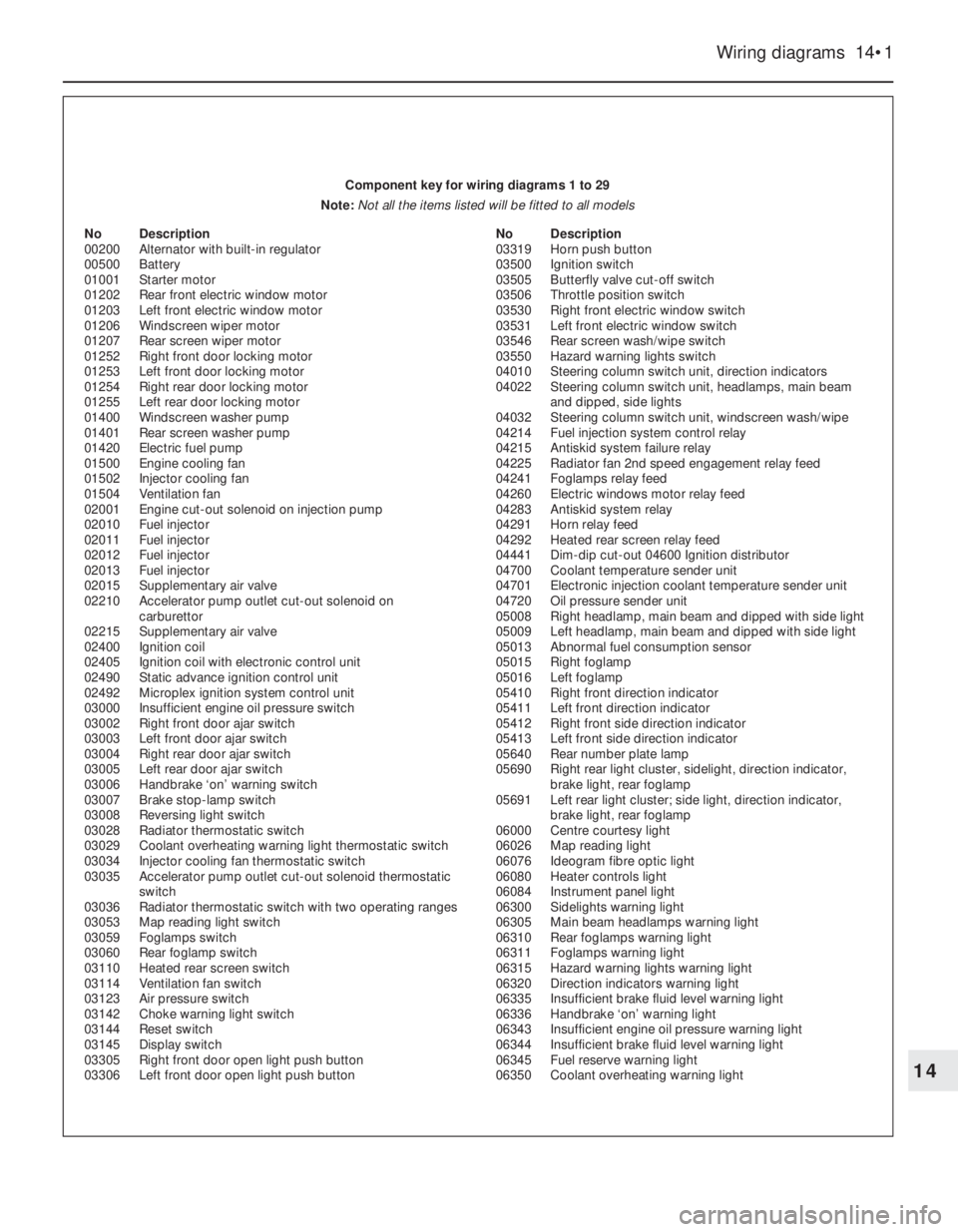
Wiring diagrams 14•1
14
Component key for wiring diagrams 1 to 29
Note: Not all the items listed will be fitted to all models
No Description
00200 Alternator with built-in regulator
00500 Battery
01001 Starter motor
01202 Rear front electric window motor
01203 Left front electric window motor
01206 Windscreen wiper motor
01207 Rear screen wiper motor
01252 Right front door locking motor
01253 Left front door locking motor
01254 Right rear door locking motor
01255 Left rear door locking motor
01400 Windscreen washer pump
01401 Rear screen washer pump
01420 Electric fuel pump
01500 Engine cooling fan
01502 Injector cooling fan
01504 Ventilation fan
02001 Engine cut-out solenoid on injection pump
02010 Fuel injector
02011 Fuel injector
02012 Fuel injector
02013 Fuel injector
02015 Supplementary air valve
02210 Accelerator pump outlet cut-out solenoid on
carburettor
02215 Supplementary air valve
02400 Ignition coil
02405 Ignition coil with electronic control unit
02490 Static advance ignition control unit
02492 Microplex ignition system control unit
03000 Insufficient engine oil pressure switch
03002 Right front door ajar switch
03003 Left front door ajar switch
03004 Right rear door ajar switch
03005 Left rear door ajar switch
03006 Handbrake ‘on’ warning switch
03007 Brake stop-lamp switch
03008 Reversing light switch
03028 Radiator thermostatic switch
03029 Coolant overheating warning light thermostatic switch
03034 Injector cooling fan thermostatic switch
03035 Accelerator pump outlet cut-out solenoid thermostatic
switch
03036 Radiator thermostatic switch with two operating ranges
03053 Map reading light switch
03059 Foglamps switch
03060 Rear foglamp switch
03110 Heated rear screen switch
03114 Ventilation fan switch
03123 Air pressure switch
03142 Choke warning light switch
03144 Reset switch
03145 Display switch
03305 Right front door open light push button
03306 Left front door open light push button No Description
03319 Horn push button
03500 Ignition switch
03505 Butterfly valve cut-off switch
03506 Throttle position switch
03530 Right front electric window switch
03531 Left front electric window switch
03546 Rear screen wash/wipe switch
03550 Hazard warning lights switch
04010 Steering column switch unit, direction indicators
04022 Steering column switch unit, headlamps, main beam
and dipped, side lights
04032 Steering column switch unit, windscreen wash/wipe
04214 Fuel injection system control relay
04215 Antiskid system failure relay
04225 Radiator fan 2nd speed engagement relay feed
04241 Foglamps relay feed
04260 Electric windows motor relay feed
04283 Antiskid system relay
04291 Horn relay feed
04292 Heated rear screen relay feed
04441 Dim-dip cut-out 04600 Ignition distributor
04700 Coolant temperature sender unit
04701 Electronic injection coolant temperature sender unit
04720 Oil pressure sender unit
05008 Right headlamp, main beam and dipped with side light
05009 Left headlamp, main beam and dipped with side light
05013 Abnormal fuel consumption sensor
05015 Right foglamp
05016 Left foglamp
05410 Right front direction indicator
05411 Left front direction indicator
05412 Right front side direction indicator
05413 Left front side direction indicator
05640 Rear number plate lamp
05690 Right rear light cluster, sidelight, direction indicator,
brake light, rear foglamp
05691 Left rear light cluster; side light, direction indicator,
brake light, rear foglamp
06000 Centre courtesy light
06026 Map reading light
06076 Ideogram fibre optic light
06080 Heater controls light
06084 Instrument panel light
06300 Sidelights warning light
06305 Main beam headlamps warning light
06310 Rear foglamps warning light
06311 Foglamps warning light
06315 Hazard warning lights warning light
06320 Direction indicators warning light
06335 Insufficient brake fluid level warning light
06336 Handbrake ‘on’ warning light
06343 Insufficient engine oil pressure warning light
06344 Insufficient brake fluid level warning light
06345 Fuel reserve warning light
06350 Coolant overheating warning light
Page 260 of 303
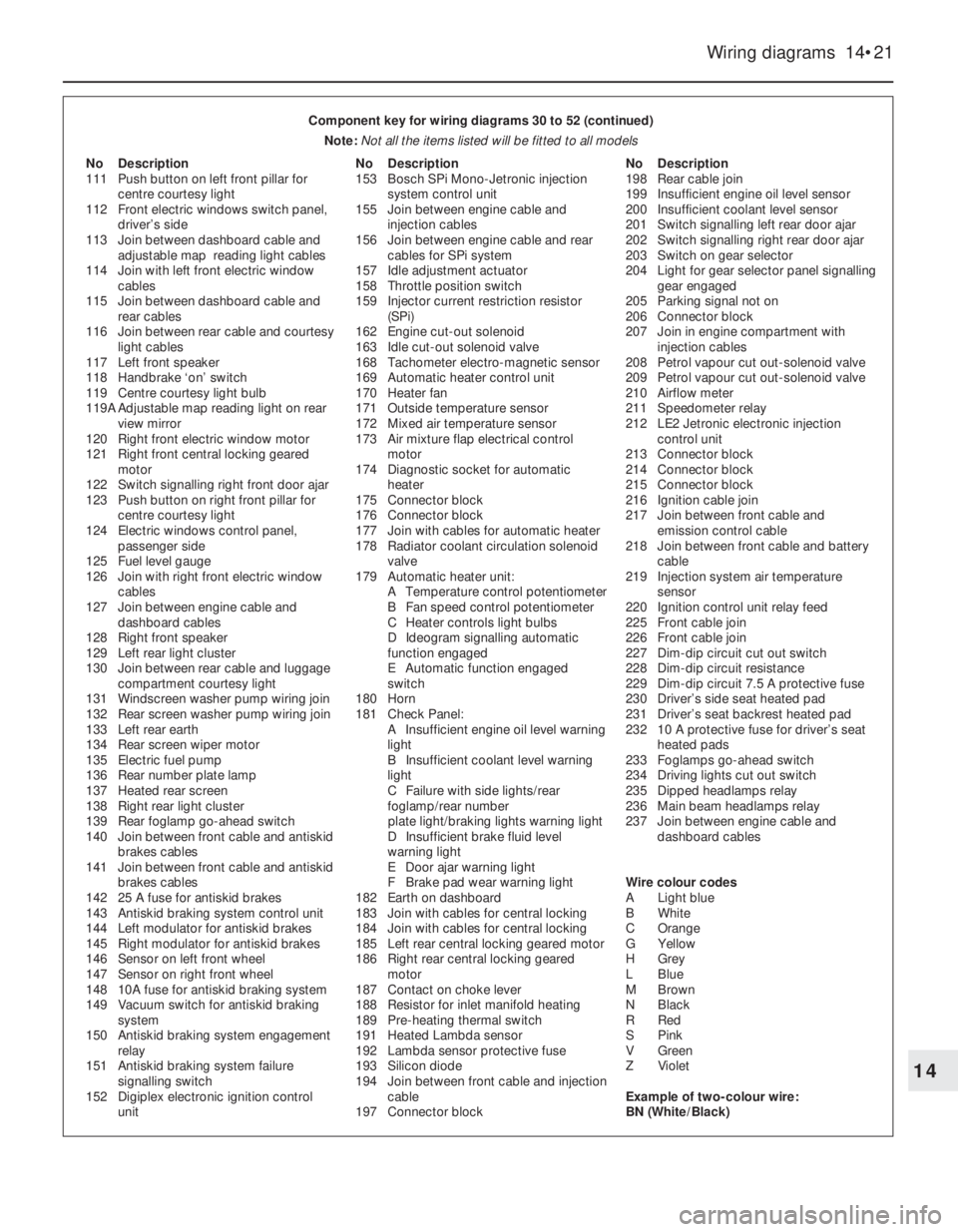
Wiring diagrams 14•21
14
Component key for wiring diagrams 30 to 52 (continued)
Note: Not all the items listed will be fitted to all models
No Description
111 Push button on left front pillar for
centre courtesy light
112 Front electric windows switch panel,
driver’s side
113 Join between dashboard cable and
adjustable map reading light cables
114 Join with left front electric window
cables
115 Join between dashboard cable and
rear cables
116 Join between rear cable and courtesy
light cables
117 Left front speaker
118 Handbrake ‘on’ switch
119 Centre courtesy light bulb
119A Adjustable map reading light on rear
view mirror
120 Right front electric window motor
121 Right front central locking geared
motor
122 Switch signalling right front door ajar
123 Push button on right front pillar for
centre courtesy light
124 Electric windows control panel,
passenger side
125 Fuel level gauge
126 Join with right front electric window
cables
127 Join between engine cable and
dashboard cables
128 Right front speaker
129 Left rear light cluster
130 Join between rear cable and luggage
compartment courtesy light
131 Windscreen washer pump wiring join
132 Rear screen washer pump wiring join
133 Left rear earth
134 Rear screen wiper motor
135 Electric fuel pump
136 Rear number plate lamp
137 Heated rear screen
138 Right rear light cluster
139 Rear foglamp go-ahead switch
140 Join between front cable and antiskid
brakes cables
141 Join between front cable and antiskid
brakes cables
142 25 A fuse for antiskid brakes
143 Antiskid braking system control unit
144 Left modulator for antiskid brakes
145 Right modulator for antiskid brakes
146 Sensor on left front wheel
147 Sensor on right front wheel
148 10A fuse for antiskid braking system
149 Vacuum switch for antiskid braking
system
150 Antiskid braking system engagement
relay
151 Antiskid braking system failure
signalling switch
152 Digiplex electronic ignition control
unitNo Description
153 Bosch SPi Mono-Jetronic injection
system control unit
155 Join between engine cable and
injection cables
156 Join between engine cable and rear
cables for SPi system
157 Idle adjustment actuator
158 Throttle position switch
159 Injector current restriction resistor
(SPi)
162 Engine cut-out solenoid
163 Idle cut-out solenoid valve
168 Tachometer electro-magnetic sensor
169 Automatic heater control unit
170 Heater fan
171 Outside temperature sensor
172 Mixed air temperature sensor
173 Air mixture flap electrical control
motor
174 Diagnostic socket for automatic
heater
175 Connector block
176 Connector block
177 Join with cables for automatic heater
178 Radiator coolant circulation solenoid
valve
179 Automatic heater unit:
A Temperature control potentiometer
B Fan speed control potentiometer
C Heater controls light bulbs
D Ideogram signalling automatic
function engaged
E Automatic function engaged
switch
180 Horn
181 Check Panel:
A Insufficient engine oil level warning
light
B Insufficient coolant level warning
light
C Failure with side lights/rear
foglamp/rear number
plate light/braking lights warning light
D Insufficient brake fluid level
warning light
E Door ajar warning light
F Brake pad wear warning light
182 Earth on dashboard
183 Join with cables for central locking
184 Join with cables for central locking
185 Left rear central locking geared motor
186 Right rear central locking geared
motor
187 Contact on choke lever
188 Resistor for inlet manifold heating
189 Pre-heating thermal switch
191 Heated Lambda sensor
192 Lambda sensor protective fuse
193 Silicon diode
194 Join between front cable and injection
cable
197 Connector blockNo Description
198 Rear cable join
199 Insufficient engine oil level sensor
200 Insufficient coolant level sensor
201 Switch signalling left rear door ajar
202 Switch signalling right rear door ajar
203 Switch on gear selector
204 Light for gear selector panel signalling
gear engaged
205 Parking signal not on
206 Connector block
207 Join in engine compartment with
injection cables
208 Petrol vapour cut out-solenoid valve
209 Petrol vapour cut out-solenoid valve
210 Airflow meter
211 Speedometer relay
212 LE2 Jetronic electronic injection
control unit
213 Connector block
214 Connector block
215 Connector block
216 Ignition cable join
217 Join between front cable and
emission control cable
218 Join between front cable and battery
cable
219 Injection system air temperature
sensor
220 Ignition control unit relay feed
225 Front cable join
226 Front cable join
227 Dim-dip circuit cut out switch
228 Dim-dip circuit resistance
229 Dim-dip circuit 7.5 A protective fuse
230 Driver’s side seat heated pad
231 Driver’s seat backrest heated pad
232 10 A protective fuse for driver’s seat
heated pads
233 Foglamps go-ahead switch
234 Driving lights cut out switch
235 Dipped headlamps relay
236 Main beam headlamps relay
237 Join between engine cable and
dashboard cables
Wire colour codes
A Light blue
B White
C Orange
G Yellow
H Grey
L Blue
M Brown
N Black
R Red
S Pink
V Green
Z Violet
Example of two-colour wire:
BN (White/Black)