heating FIAT UNO 1983 Service Repair Manual
[x] Cancel search | Manufacturer: FIAT, Model Year: 1983, Model line: UNO, Model: FIAT UNO 1983Pages: 303, PDF Size: 10.36 MB
Page 3 of 303

REPAIRS & OVERHAUL
Engine and Associated Systems
Engine (also see Chapter 13)Page 1•1
Cooling and heating systems (also see Chapter 13)Page2•1
Fuel system (also see Chapter 13)Page 3•1
Ignition system (also see Chapter 13)Page4•1
Transmission
Clutch (also see Chapter 13)Page5•1
Transmission (also see Chapter 13)Page6•1
Driveshafts, hubs, roadwheels and tyres (also see Chapter 13)Page7•1
Brakes
Braking system(also see Chapter 13)Page 8•1
Electrical
Electrical system(also see Chapter 13)Page 9•1
Steering and suspension
SteeringPage 10•1
Suspension (also see Chapter 13)Page 11•1
Bodywork
Bodywork (also see Chapter 13)Page 12•1
Additional information
Supplement: Revisions and information on later models Page 13•1
Wiring DiagramsPage 14•1
REFERENCE
MOT Test Checks PageREF•1
Tools and Working Facilities Page REF•5
General Repair Procedures Page REF•8
Fault FindingPage REF•9
Buying Spare Parts & Vehicle Identification Numbers PageREF•12
Glossary of Technical Terms PageREF•13
IndexPage REF•17
Contents
Page 32 of 303
used to check bore wear and taper against
the Specifications, but this is a pointless
operation if the engine is obviously in need of
reboring due to excessive oil consumption.
5Your engine reconditioner will be able to
re-bore the block for you and supply the
correct oversize pistons to give the correct
running clearance.
6If the engine has reached the limit for
reboring then cylinder liners can be fitted, but
here again this is a job for your engine
reconditioner.
7To rectify minor bore wear it is possible to
fit proprietary oil control rings. A good way to
test the condition of the engine is to have it at
normal operating temperature with the spark
plugs removed. Screw a compression gauge
(available from most motor accessory stores)
into the first plug hole. Hold the accelerator
fully depressed and crank the engine on the
starter motor for several revolutions. Record
the reading. Zero the tester and check the
remaining cylinders in the same way. All four
compression figures should be approximately
equal and within the tolerance given in the
Specifications. If they are all low, suspect
piston ring or cylinder bore wear. If only one
reading is down, suspect a valve not seating.
Crankshaft and bearings
8Examine the crankpin and main journal
surfaces for signs of scoring or scratches.
Check the ovality of the crankpins at different
positions with a micrometer. If more than
0.001 inch (0.025 mm) out of round, the
crankpins will have to be reground. They will
also have to be reground if there are any
scores or scratches present. Also check the
journals in the same fashion.
9Wear in a crankshaft can be detected while
the engine is running. Big-end bearing and
crankpin wear is indicated by distinct metallic
knocking, particularly noticeable when the
engine is pulling from low engine speeds. Low
oil pressure will also occur.
10Main bearing and journal wear is indicated
by engine rumble increasing in severity as the
engine speed increases. Low oil pressure will
again be an associated condition.
11Crankshaft grinding should be carried outby specialist engine reconditioners who will
supply the matching undersize bearing shells
to give the required running clearance.
12Inspect the connecting rod big-end and
main bearing shells for signs of general wear,
scoring, pitting and scratching. The bearings
should be matt grey in colour.
13If a copper colour is evident, then the
bearings are badly worn and the surface
material has worn away to expose the underlay.
Renew the bearings as a complete set.
14At the time of major overhaul it is
worthwhile renewing the bearing shells as a
matter of routine even if they appear to be in
reasonably good condition.
15Bearing shells can be identified by the
marking on the back of the shell. Standard
sized shells are usually marked STD or 0.00.
Undersized shells are marked with the
undersize such as 0.25 mm.
Connecting rods
16Check the alignment of the connecting
rods visually. If you suspect distortion, have
them checked by your dealer or engine
reconditioner on the special jig which he will
have.
17The gudgeon pin is an interference fit in
the connecting rod small-end and removal or
refitting and changing a piston is a job best
left to your dealer or engine reconditioner due
to the need for a press and jig and careful
heating of the connecting rod.
Pistons and piston rings
18If the cylinders have been rebored, then
the reconditioner will supply the oversize
pistons and rings and the gudgeon pins. Give
the job of fitting the new pistons to the
connecting rods to him.
19If the original piston rings or just new rings
are to be fitted to the original pistons, use
great care to remove and fit the rings as they
are easily broken if expanded too much.
Always remove and fit rings from the crown
end.
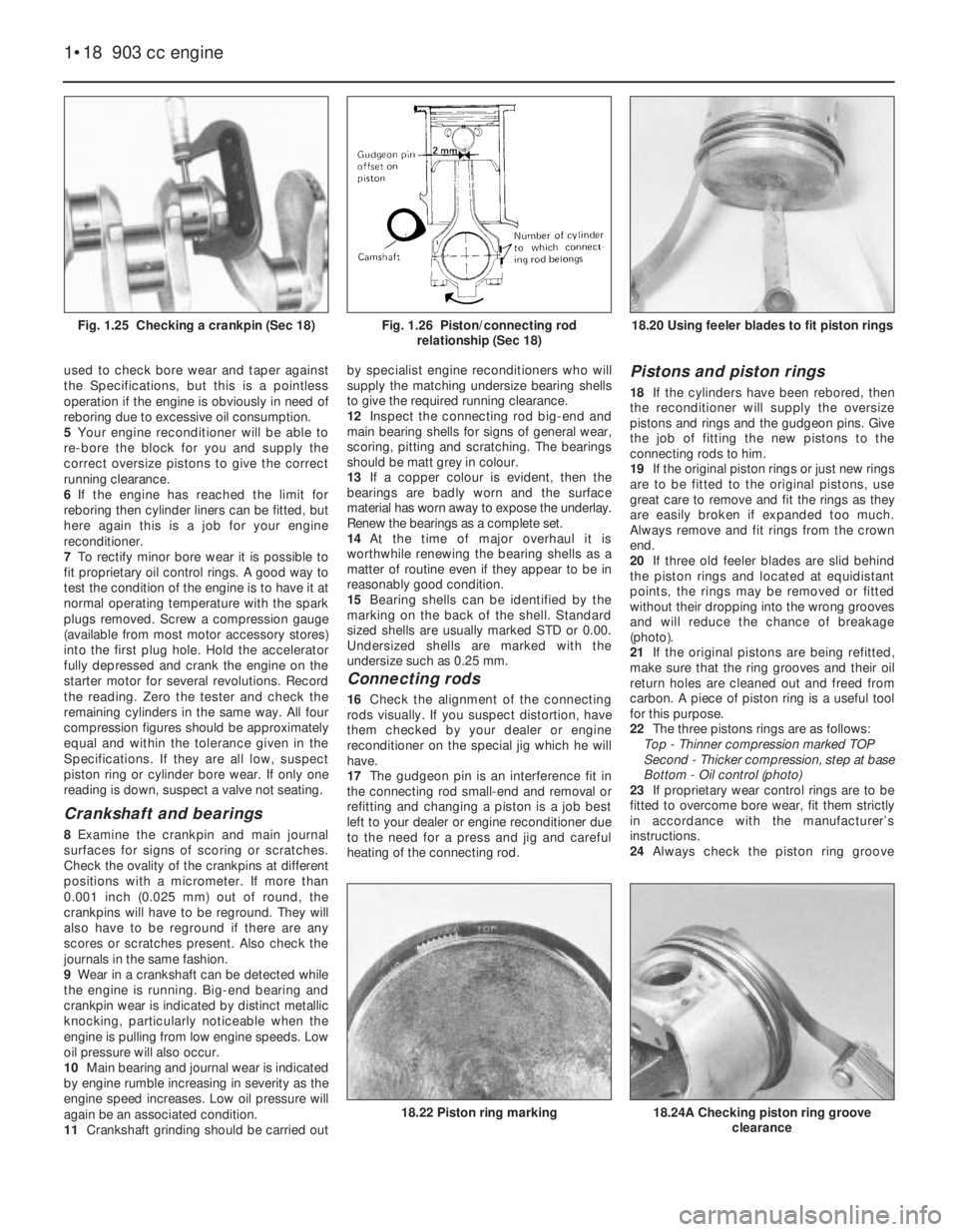
20If three old feeler blades are slid behind
the piston rings and located at equidistant
points, the rings may be removed or fitted
without their dropping into the wrong grooves
and will reduce the chance of breakage
(photo).
21If the original pistons are being refitted,
make sure that the ring grooves and their oil
return holes are cleaned out and freed from
carbon. A piece of piston ring is a useful tool
for this purpose.
22The three pistons rings are as follows:
Top - Thinner compression marked TOP
Second - Thicker compression, step at base
Bottom - Oil control (photo)
23If proprietary wear control rings are to be
fitted to overcome bore wear, fit them strictly
in accordance with the manufacturer’s
instructions.
24Always check the piston ring groove
1•18 903 cc engine
18.24A Checking piston ring groove
clearance18.22 Piston ring marking
18.20 Using feeler blades to fit piston ringsFig. 1.26 Piston/connecting rod
relationship (Sec 18)Fig. 1.25 Checking a crankpin (Sec 18)
Page 33 of 303
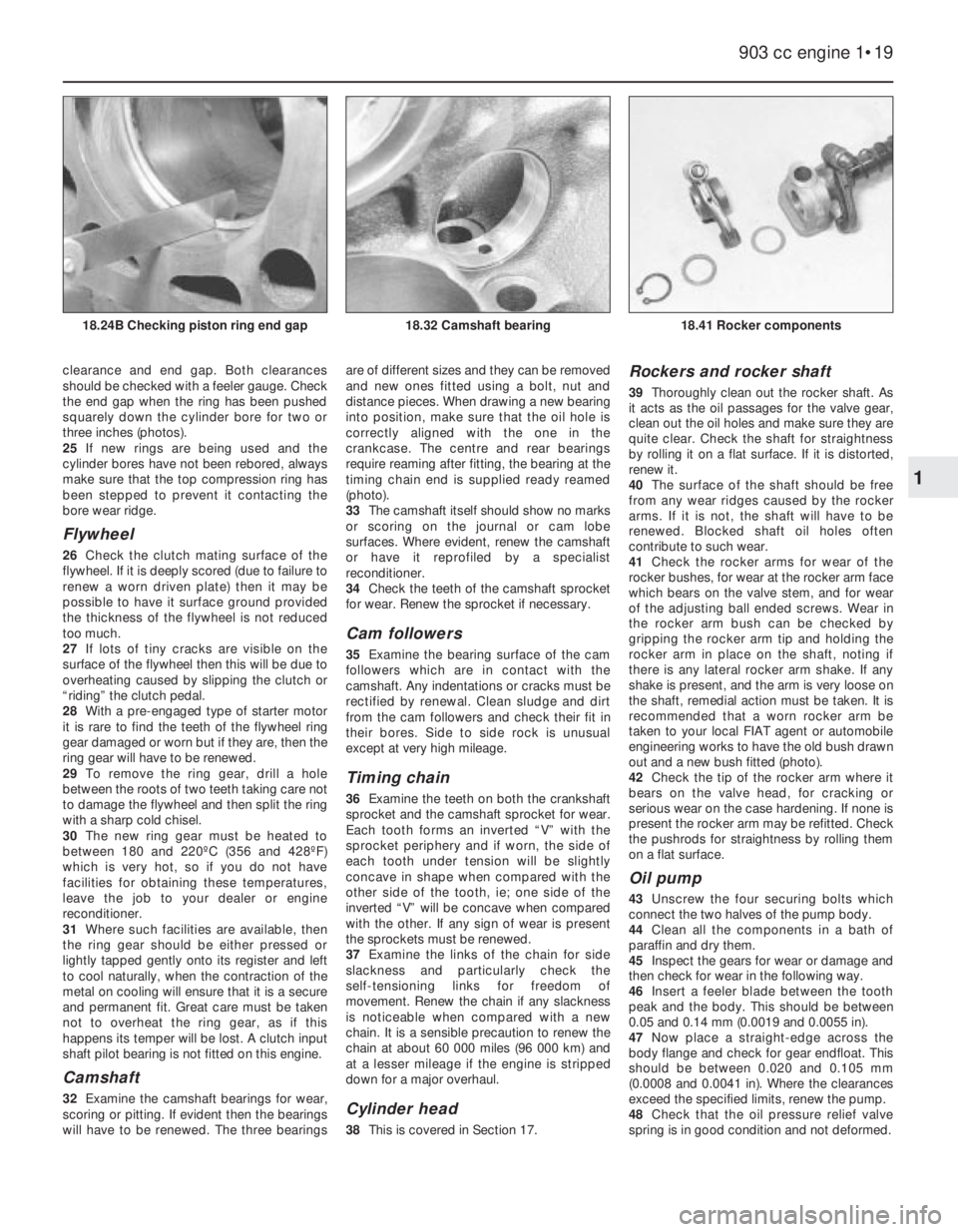
clearance and end gap. Both clearances
should be checked with a feeler gauge. Check
the end gap when the ring has been pushed
squarely down the cylinder bore for two or
three inches (photos).
25If new rings are being used and the
cylinder bores have not been rebored, always
make sure that the top compression ring has
been stepped to prevent it contacting the
bore wear ridge.
Flywheel
26Check the clutch mating surface of the
flywheel. If it is deeply scored (due to failure to
renew a worn driven plate) then it may be
possible to have it surface ground provided
the thickness of the flywheel is not reduced
too much.
27If lots of tiny cracks are visible on the
surface of the flywheel then this will be due to
overheating caused by slipping the clutch or
“riding” the clutch pedal.
28With a pre-engaged type of starter motor
it is rare to find the teeth of the flywheel ring
gear damaged or worn but if they are, then the
ring gear will have to be renewed.
29To remove the ring gear, drill a hole
between the roots of two teeth taking care not
to damage the flywheel and then split the ring
with a sharp cold chisel.
30The new ring gear must be heated to
between 180 and 220ºC (356 and 428ºF)
which is very hot, so if you do not have
facilities for obtaining these temperatures,
leave the job to your dealer or engine
reconditioner.
31Where such facilities are available, then
the ring gear should be either pressed or
lightly tapped gently onto its register and left
to cool naturally, when the contraction of the
metal on cooling will ensure that it is a secure
and permanent fit. Great care must be taken
not to overheat the ring gear, as if this
happens its temper will be lost. A clutch input
shaft pilot bearing is not fitted on this engine.
Camshaft
32Examine the camshaft bearings for wear,
scoring or pitting. If evident then the bearings
will have to be renewed. The three bearingsare of different sizes and they can be removed
and new ones fitted using a bolt, nut and
distance pieces. When drawing a new bearing
into position, make sure that the oil hole is
correctly aligned with the one in the
crankcase. The centre and rear bearings
require reaming after fitting, the bearing at the
timing chain end is supplied ready reamed
(photo).
33The camshaft itself should show no marks
or scoring on the journal or cam lobe
surfaces. Where evident, renew the camshaft
or have it reprofiled by a specialist
reconditioner.
34Check the teeth of the camshaft sprocket
for wear. Renew the sprocket if necessary.
Cam followers
35Examine the bearing surface of the cam
followers which are in contact with the
camshaft. Any indentations or cracks must be
rectified by renewal. Clean sludge and dirt
from the cam followers and check their fit in
their bores. Side to side rock is unusual
except at very high mileage.
Timing chain
36Examine the teeth on both the crankshaft
sprocket and the camshaft sprocket for wear.
Each tooth forms an inverted “V” with the
sprocket periphery and if worn, the side of
each tooth under tension will be slightly
concave in shape when compared with the
other side of the tooth, ie; one side of the
inverted “V” will be concave when compared
with the other. If any sign of wear is present
the sprockets must be renewed.
37Examine the links of the chain for side
slackness and particularly check the
self-tensioning links for freedom of
movement. Renew the chain if any slackness
is noticeable when compared with a new
chain. It is a sensible precaution to renew the
chain at about 60 000 miles (96 000 km) and
at a lesser mileage if the engine is stripped
down for a major overhaul.
Cylinder head
38This is covered in Section 17.
Rockers and rocker shaft
39Thoroughly clean out the rocker shaft. As
it acts as the oil passages for the valve gear,
clean out the oil holes and make sure they are
quite clear. Check the shaft for straightness
by rolling it on a flat surface. If it is distorted,
renew it.
40The surface of the shaft should be free
from any wear ridges caused by the rocker
arms. If it is not, the shaft will have to be
renewed. Blocked shaft oil holes often
contribute to such wear.
41Check the rocker arms for wear of the
rocker bushes, for wear at the rocker arm face
which bears on the valve stem, and for wear
of the adjusting ball ended screws. Wear in
the rocker arm bush can be checked by
gripping the rocker arm tip and holding the
rocker arm in place on the shaft, noting if
there is any lateral rocker arm shake. If any
shake is present, and the arm is very loose on
the shaft, remedial action must be taken. It is
recommended that a worn rocker arm be
taken to your local FIAT agent or automobile
engineering works to have the old bush drawn
out and a new bush fitted (photo).
42Check the tip of the rocker arm where it
bears on the valve head, for cracking or
serious wear on the case hardening. If none is
present the rocker arm may be refitted. Check
the pushrods for straightness by rolling them
on a flat surface.
Oil pump
43Unscrew the four securing bolts which
connect the two halves of the pump body.
44Clean all the components in a bath of
paraffin and dry them.
45Inspect the gears for wear or damage and
then check for wear in the following way.
46Insert a feeler blade between the tooth
peak and the body. This should be between
0.05 and 0.14 mm (0.0019 and 0.0055 in).
47Now place a straight-edge across the
body flange and check for gear endfloat. This
should be between 0.020 and 0.105 mm
(0.0008 and 0.0041 in). Where the clearances
exceed the specified limits, renew the pump.
48Check that the oil pressure relief valve
spring is in good condition and not deformed.
903 cc engine 1•19
18.41 Rocker components18.32 Camshaft bearing18.24B Checking piston ring end gap
1
Page 50 of 303
Engine idles roughly
m mMixture too weak
m mAir leak in carburettor
m mAir leak at inlet manifold to cylinder head, or inlet manifold to
carburettor
m mCarburettor incorrectly adjusted
m mOther fuel system fault (see Chapter 3)
m mLow tension leads on coil loose
m mLow tension lead to distributor loose
m mDirty, incorrectly set, or pitted contact breaker points
m mTracking across inside of distributor cover
m mFaulty coil
m mIgnition leads loose
m mSpark plugs fouled or incorrectly gapped.
m mIgnition timing incorrect
m mOther ignition fault (see Chapter 4)
m mIncorrect valve clearances
m mWidely differing cylinder compressions
m mLow battery voltage (charging fault)
m mBattery leads loose on terminals
m mBattery earth strap loose on body attachment point
m mEngine earth lead loose
Pre-ignition (pinking) during acceleration
m
mIncorrect grade of fuel being used
m mIgnition timing over-advanced
m mOther ignition fault (see Chapter 4)
m mEngine overheated
m mExcessive carbon build-up
m mFuel system fault (see Chapter 3)
m mValve timing incorrect (after rebuild)
m mMixture too weak
Engine runs on after switching off
m
mIdle speed too high
m mIncorrect type of spark plug
m mOverheating
m mExcessive carbon build-up
m mOther emission control fault (see Chapter 3)
Oil being lost due to leaks
m
mLeaking oil filter gasket
m mLeaking rocker cover gasket
m mLeaking timing gear cover gasket
m mLeaking sump gasket
m mLoose sump plug
Low oil pressure (verify accuracy of sender before
dismantling engine!)
m mOil level low
m mEngine overheating
m mIncorrect grade of oil in use
m mOil filter clogged or bypass valve stuck
m mPressure relief valve stuck or defective
m mOil pick-up strainer clogged or loose
m mMain or big-end bearings worn
m mOil pump worn or mountings loose
Excessive oil consumption
m
mOverfilling
m mLeaking gaskets or drain plug washer
m mValve stem oil seals worn, damaged or missing after rebuild
m mValve stems and/or guides worn
m mPiston rings and/or bores worn
m mPiston oil return holes clogged
Oil contaminated with water
m
mExcessive cold running
m mLeaking head gasket
m mCracked block or head
Oil contaminated with fuel
m
mExcessive use of choke
m mWorn piston rings and/or bores
Unusual mechanical noises
m
mUnintentional mechanical contact (eg fan blade)
m mWorn drivebelt
m mWorn valvegear (tapping noises from top of engine) or incorrect
clearance
m mPeripheral component fault (generator, coolant pump)
m mWorn big-end bearings (regular heavy knocking, perhaps less under
load)
m mWorn main bearings (rumbling and knocking, perhaps worsening
under load)
m mSmall-end bushes or gudgeon pins worn (light metallic tapping)
m mPiston slap (most noticeable when engine cold)
m mWorn timing chain and gears (rattling from front of engine)
m mWorn crankshaft (knocking, rumbling and vibration)
1•36 All engines
Page 51 of 303
2
System type . . . . . . . . . . . . . . . . . . . . . . . . . . . . . . . . . . . . . . . . . . . “No loss” with radiator and integral expansion tank. Electric cooling
fan, belt-driven coolant pump, thermostat on cylinder head
General
Radiator fan cuts in . . . . . . . . . . . . . . . . . . . . . . . . . . . . . . . . . . . . . . . . . 90 to 94ºC (194 to 201ºF)
Radiator fan switches off . . . . . . . . . . . . . . . . . . . . . . . . . . . . . . . . . . . . 85 to 89ºC (185 to 192ºF)
Thermostat opens:
903 cc engine . . . . . . . . . . . . . . . . . . . . . . . . . . . . . . . . . . . . . . . . . . . 85 to 89ºC (185 to 192ºF)
1116 cc and 1301 cc engines . . . . . . . . . . . . . . . . . . . . . . . . . . . . . . . 83 to 87ºC (181 to 188.6ºF)
Fully open:
903 cc . . . . . . . . . . . . . . . . . . . . . . . . . . . . . . . . . . . . . . . . . . . . . . . . . 100ºC (212ºF)
1116 cc and 1301 cc . . . . . . . . . . . . . . . . . . . . . . . . . . . . . . . . . . . . . 95ºC (203ºF)
Expansion tank pressure cap rating . . . . . . . . . . . . . . . . . . . . . . . . . . . . 0.78 bar (11 lbf/in2)
Coolant
Capacity:
903 cc . . . . . . . . . . . . . . . . . . . . . . . . . . . . . . . . . . . . . . . . . . . . . . . . . 4.6 litre (8.1 pint)
1116 cc . . . . . . . . . . . . . . . . . . . . . . . . . . . . . . . . . . . . . . . . . . . . . . . . 6.0 litre (10.6 pint)
1301 cc . . . . . . . . . . . . . . . . . . . . . . . . . . . . . . . . . . . . . . . . . . . . . . . . 6.2 litre (10.9 pint)
Type . . . . . . . . . . . . . . . . . . . . . . . . . . . . . . . . . . . . . . . . . . . . . . . . . . . . Ethylene glycol based antifreeze
Torque wrench settingsNm lbf ft
Temperature sender switch . . . . . . . . . . . . . . . . . . . . . . . . . . . . . . . . . . 49 36
Coolant pump mounting bolts . . . . . . . . . . . . . . . . . . . . . . . . . . . . . . . . 34 25
Alternator adjuster and mountings nuts . . . . . . . . . . . . . . . . . . . . . . . . . 49 36
Chapter 2 Cooling and heating systems
For modifications, and information applicable to later models, see Supplement at end of manual
Coolant mixtures . . . . . . . . . . . . . . . . . . . . . . . . . . . . . . . . . . . . . . . . 3
Coolant pump - removal, overhaul and refitting . . . . . . . . . . . . . . . . 9
Cooling system - draining, flushing and refilling . . . . . . . . . . . . . . . . 2
Cooling system sensors . . . . . . . . . . . . . . . . . . . . . . . . . . . . . . . . . . 10
Description and maintenance . . . . . . . . . . . . . . . . . . . . . . . . . . . . . . 1
Drivebelt - tensioning and renewal . . . . . . . . . . . . . . . . . . . . . . . . . . 8
Fault finding - cooling and heating . . . . . . . . . . . . See end of ChapterHeater - dismantling, overhaul and reassembly . . . . . . . . . . . . . . . . 13
Heater unit - removal and refitting . . . . . . . . . . . . . . . . . . . . . . . . . . 12
Heating and ventilation system - description . . . . . . . . . . . . . . . . . . 11
Radiator - removal and refitting . . . . . . . . . . . . . . . . . . . . . . . . . . . . 7
Radiator fan thermostatic switch - removal, checking and refitting . 5
Radiator fan - removal and refitting . . . . . . . . . . . . . . . . . . . . . . . . . 6
Thermostat - removal, testing and refitting . . . . . . . . . . . . . . . . . . . . 4
2•1
Specifications Contents
1 Description and
maintenance
1
1The cooling system consists of a
front-mounted radiator with built-in expansion
tank, a coolant pump (belt-driven from the
crankshaft pulley) and a thermostatically-
controlled electric cooling fan.
2In order to assist rapid warm-up, athermostat is located in a housing at the
left-hand end of the cylinder head. The hose
connections to the thermostat housing vary
according to model.
3The heater is supplied with coolant from the
engine and incorporates a matrix and blower
with the necessary controls.
4The throttle valve plate block of the
carburettor is coolant-heated as a means of
improving fuel atomisation.
5Maintenance is minimal as in theory no
coolant should ever be lost from theexpansion tank. Regularly check that the
coolant level is between 50.0 and 70.0 mm
(1.97 and 2.8 in) above the MIN mark on the
tank with the engine cold. The need for
regular topping up will indicate a leak
somewhere in the system. If one cannot be
found suspect an internal leak in the engine
although this is usually confirmed by a rise in
the engine oil level and water on the dipstick
(photo). Any topping-up should be done using
an antifreeze mixture (see Section 3), not plain
water.
Easy,suitable for
novice with little
experienceFairly easy,suitable
for beginner with
some experienceFairly difficult,
suitable for competent
DIY mechanic
Difficult,suitable for
experienced DIY
mechanicVery difficult,
suitable for expert DIY
or professional
Degrees of difficulty
54321
Page 52 of 303
6Avoid unscrewing the expansion tank cap
when the engine is hot, but if this must be
done, cover the cap with a cloth to avoid
scalding by escaping steam.
7Periodically, check the condition of all
coolant hoses and tighten the clips.
2 Cooling system- draining,
flushing and refilling
1
1Set the heater temperature lever to
maximum.
2Unscrew the cap from the expansion tank.
3Disconnect the radiator bottom hose and
unscrew the cylinder block drain plug (1116
cc and 1301 cc engines) and allow the coolant
to drain. Refer to photo 29.21B, page 64.
4If the system is in good condition with no
sign of rust or dirt in the drained coolant, then
it may be refilled immediately. If the system
has been neglected and the antifreeze has notbeen regularly renewed and there is evidence
of rust and sediment in the drained liquid then
flush the system through with a cold water
hose.
5If the radiator should appear to be clogged,
it may be necessary to remove it (Section 7)
invert it and reverse flush it using a cold water
hose. If, after a reasonable period the water
still does not run clear, the radiator should be
flushed with a good proprietary cleaning
system. Extensive damage should be repaired
by a specialist or the unit exchanged for a
new or reconditioned radiator.
6Reconnect the bottom hose and screw in
the drain plug.
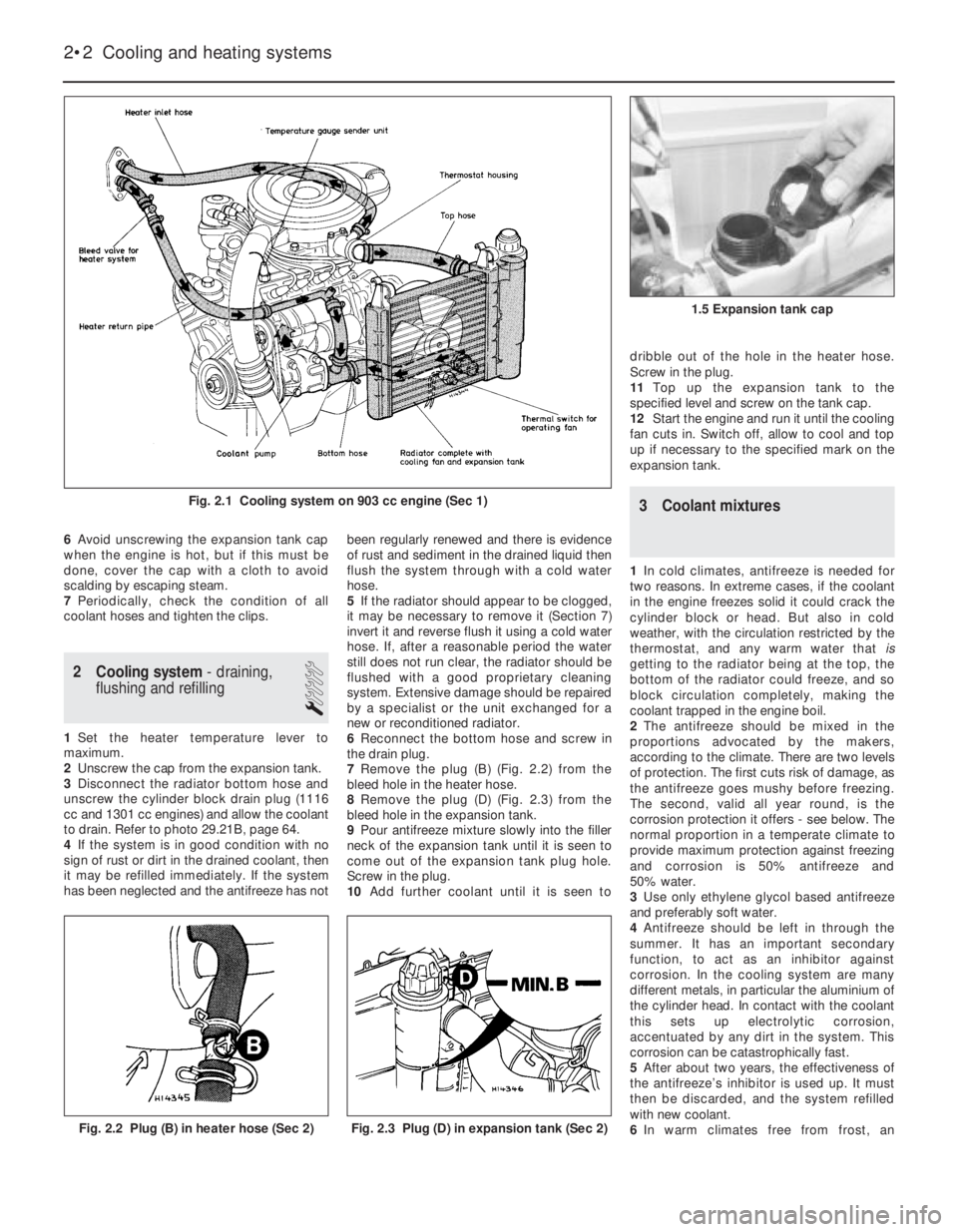
7Remove the plug (B) (Fig. 2.2) from the
bleed hole in the heater hose.
8Remove the plug (D) (Fig. 2.3) from the
bleed hole in the expansion tank.
9Pour antifreeze mixture slowly into the filler
neck of the expansion tank until it is seen to
come out of the expansion tank plug hole.
Screw in the plug.
10Add further coolant until it is seen todribble out of the hole in the heater hose.
Screw in the plug.
11Top up the expansion tank to the
specified level and screw on the tank cap.
12Start the engine and run it until the cooling
fan cuts in. Switch off, allow to cool and top
up if necessary to the specified mark on the
expansion tank.
3 Coolant mixtures
1In cold climates, antifreeze is needed for
two reasons. In extreme cases, if the coolant
in the engine freezes solid it could crack the
cylinder block or head. But also in cold
weather, with the circulation restricted by the
thermostat, and any warm water that is
getting to the radiator being at the top, the
bottom of the radiator could freeze, and so
block circulation completely, making the
coolant trapped in the engine boil.
2The antifreeze should be mixed in the
proportions advocated by the makers,
according to the climate. There are two levels
of protection. The first cuts risk of damage, as
the antifreeze goes mushy before freezing.
The second, valid all year round, is the
corrosion protection it offers - see below. The
normal proportion in a temperate climate to
provide maximum protection against freezing
and corrosion is 50% antifreeze and
50% water.
3Use only ethylene glycol based antifreeze
and preferably soft water.
4Antifreeze should be left in through the
summer. It has an important secondary
function, to act as an inhibitor against
corrosion. In the cooling system are many
different metals, in particular the aluminium of
the cylinder head. In contact with the coolant
this sets up electrolytic corrosion,
accentuated by any dirt in the system. This
corrosion can be catastrophically fast.
5After about two years, the effectiveness of
the antifreeze’s inhibitor is used up. It must
then be discarded, and the system refilled
with new coolant.
6In warm climates free from frost, an
2•2 Cooling and heating systems
Fig. 2.3 Plug (D) in expansion tank (Sec 2)Fig. 2.2 Plug (B) in heater hose (Sec 2)
1.5 Expansion tank cap
Fig. 2.1 Cooling system on 903 cc engine (Sec 1)
Page 53 of 303
inhibitor should be used. Again, a reputable
make giving full protection must be chosen
and renewed every two years. Inhibitors with
dyes are useful for finding leaks, and on some
makes the dye shows when the inhibiting
ability is finished.
4 Thermostat-
removal, testing and refitting
1
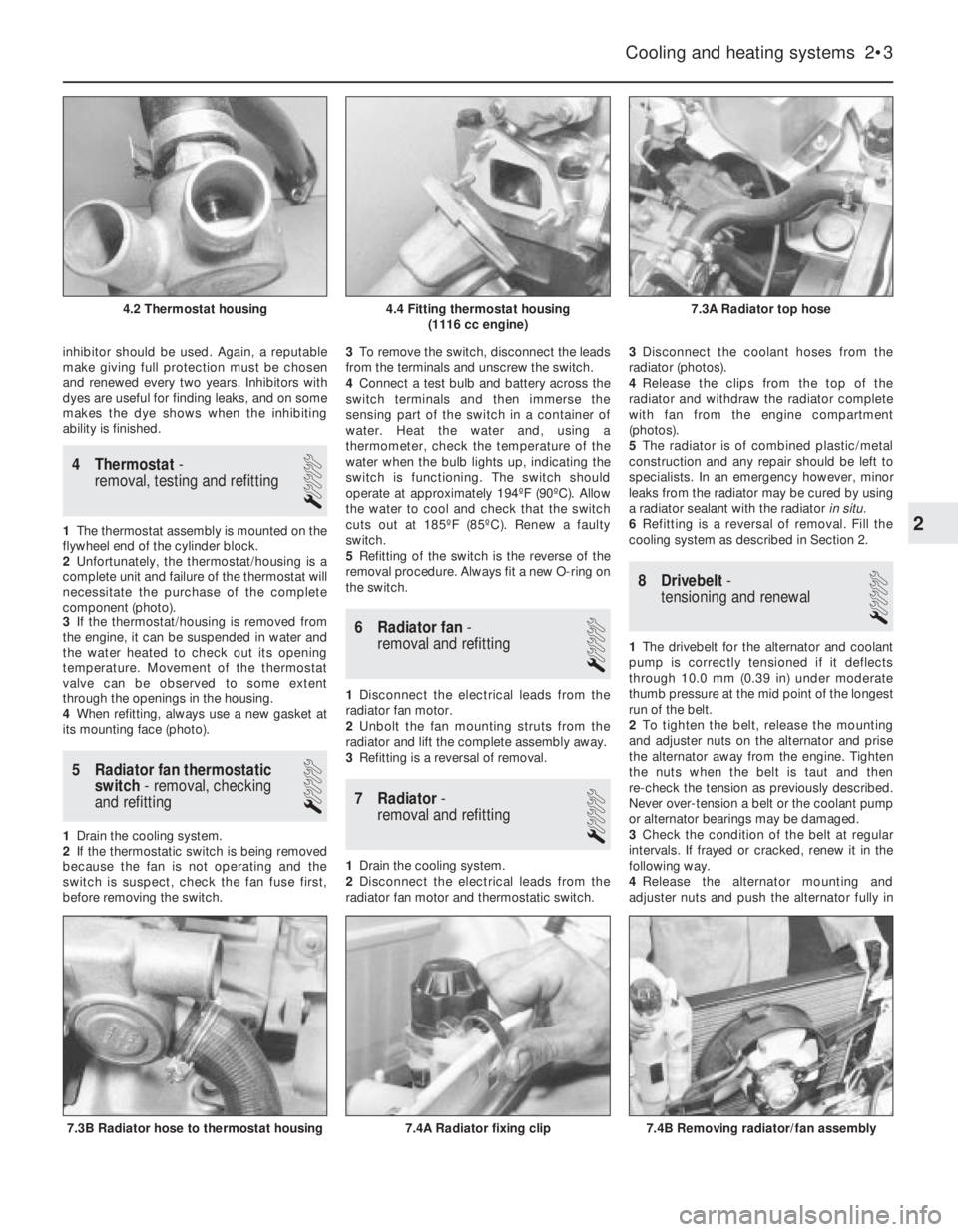
1The thermostat assembly is mounted on the
flywheel end of the cylinder block.
2Unfortunately, the thermostat/housing is a
complete unit and failure of the thermostat will
necessitate the purchase of the complete
component (photo).
3If the thermostat/housing is removed from
the engine, it can be suspended in water and
the water heated to check out its opening
temperature. Movement of the thermostat
valve can be observed to some extent
through the openings in the housing.
4When refitting, always use a new gasket at
its mounting face (photo).
5 Radiator fan thermostatic
switch- removal, checking
and refitting
1
1Drain the cooling system.
2If the thermostatic switch is being removed
because the fan is not operating and the
switch is suspect, check the fan fuse first,
before removing the switch.3To remove the switch, disconnect the leads
from the terminals and unscrew the switch.
4Connect a test bulb and battery across the
switch terminals and then immerse the
sensing part of the switch in a container of
water. Heat the water and, using a
thermometer, check the temperature of the
water when the bulb lights up, indicating the
switch is functioning. The switch should
operate at approximately 194ºF (90ºC). Allow
the water to cool and check that the switch
cuts out at 185ºF (85ºC). Renew a faulty
switch.
5Refitting of the switch is the reverse of the
removal procedure. Always fit a new O-ring on
the switch.
6 Radiator fan-
removal and refitting
1
1Disconnect the electrical leads from the
radiator fan motor.
2Unbolt the fan mounting struts from the
radiator and lift the complete assembly away.
3Refitting is a reversal of removal.
7 Radiator-
removal and refitting
1
1Drain the cooling system.
2Disconnect the electrical leads from the
radiator fan motor and thermostatic switch.3Disconnect the coolant hoses from the
radiator (photos).
4Release the clips from the top of the
radiator and withdraw the radiator complete
with fan from the engine compartment
(photos).
5The radiator is of combined plastic/metal
construction and any repair should be left to
specialists. In an emergency however, minor
leaks from the radiator may be cured by using
a radiator sealant with the radiator in situ.
6Refitting is a reversal of removal. Fill the
cooling system as described in Section 2.
8 Drivebelt-
tensioning and renewal
1
1The drivebelt for the alternator and coolant
pump is correctly tensioned if it deflects
through 10.0 mm (0.39 in) under moderate
thumb pressure at the mid point of the longest
run of the belt.
2To tighten the belt, release the mounting
and adjuster nuts on the alternator and prise
the alternator away from the engine. Tighten
the nuts when the belt is taut and then
re-check the tension as previously described.
Never over-tension a belt or the coolant pump
or alternator bearings may be damaged.
3Check the condition of the belt at regular
intervals. If frayed or cracked, renew it in the
following way.
4Release the alternator mounting and
adjuster nuts and push the alternator fully in
Cooling and heating systems 2•3
7.3A Radiator top hose4.4 Fitting thermostat housing
(1116 cc engine)4.2 Thermostat housing
7.4B Removing radiator/fan assembly7.4A Radiator fixing clip7.3B Radiator hose to thermostat housing
2
Page 54 of 303
towards the engine. Slip the belt off the
pulleys. If this is difficult, turn the crankshaft
pulley using a spanner on its retaining nut
while pressing the belt over the edge of the
pulley rim. Use this method to fit the new belt
after first having engaged it with the coolant
pump and alternator pulley grooves.
5Tension the belt as previously described.
6The tension of a new belt should be
checked and adjusted after the first few
hundred miles of running.
9 Coolant pump- removal,
overhaul and refitting
4
Note: The design of the pump differs between
the 903 cc and the other two engines, but the
removal, overhaul and refitting operations are
essentially similar.
1To gain access to the coolant pump, open
the bonnet and remove the air cleaner.
2Slacken the alternator pivot and adjustment
nuts, push the alternator in towards the
engine and slip the drivebelt from the coolant
pump pulley. Unplug and remove the
alternator.3Drain the cooling system as previously
described.
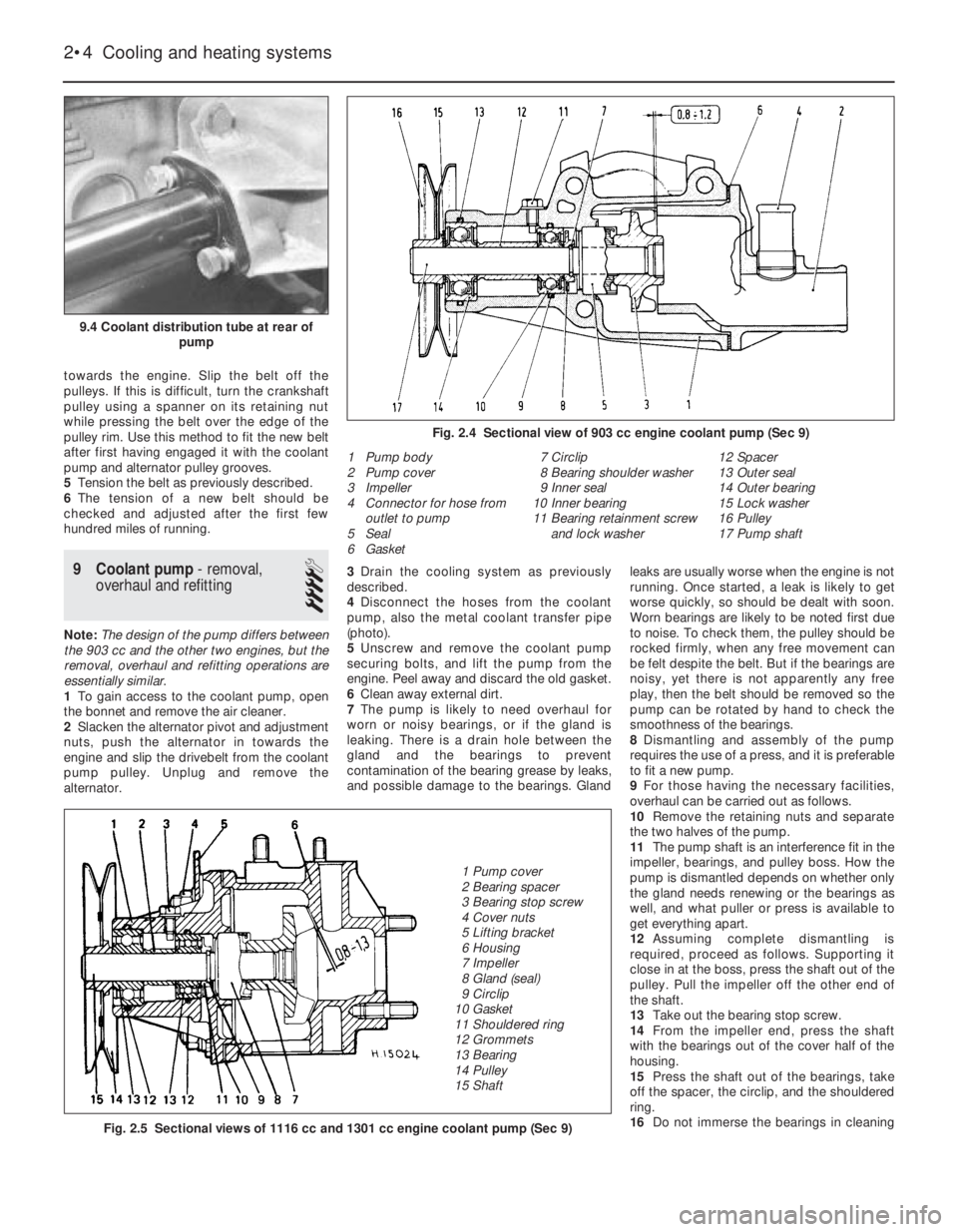
4Disconnect the hoses from the coolant
pump, also the metal coolant transfer pipe
(photo).
5Unscrew and remove the coolant pump
securing bolts, and lift the pump from the
engine. Peel away and discard the old gasket.
6Clean away external dirt.
7The pump is likely to need overhaul for
worn or noisy bearings, or if the gland is
leaking. There is a drain hole between the
gland and the bearings to prevent
contamination of the bearing grease by leaks,
and possible damage to the bearings. Glandleaks are usually worse when the engine is not
running. Once started, a leak is likely to get
worse quickly, so should be dealt with soon.
Worn bearings are likely to be noted first due
to noise. To check them, the pulley should be
rocked firmly, when any free movement can
be felt despite the belt. But if the bearings are
noisy, yet there is not apparently any free
play, then the belt should be removed so the
pump can be rotated by hand to check the
smoothness of the bearings.
8Dismantling and assembly of the pump
requires the use of a press, and it is preferable
to fit a new pump.
9For those having the necessary facilities,
overhaul can be carried out as follows.
10Remove the retaining nuts and separate
the two halves of the pump.
11The pump shaft is an interference fit in the
impeller, bearings, and pulley boss. How the
pump is dismantled depends on whether only
the gland needs renewing or the bearings as
well, and what puller or press is available to
get everything apart.
12Assuming complete dismantling is
required, proceed as follows. Supporting it
close in at the boss, press the shaft out of the
pulley. Pull the impeller off the other end of
the shaft.
13Take out the bearing stop screw.
14From the impeller end, press the shaft
with the bearings out of the cover half of the
housing.
15Press the shaft out of the bearings, take
off the spacer, the circlip, and the shouldered
ring.
16Do not immerse the bearings in cleaning
2•4 Cooling and heating systems
1 Pump body
2 Pump cover
3 Impeller
4 Connector for hose from
outlet to pump
5 Seal
6 Gasket7 Circlip
8 Bearing shoulder washer
9 Inner seal
10 Inner bearing
11 Bearing retainment screw
and lock washer12 Spacer
13 Outer seal
14 Outer bearing
15 Lock washer
16 Pulley
17 Pump shaft
Fig. 2.5 Sectional views of 1116 cc and 1301 cc engine coolant pump (Sec 9)
Fig. 2.4 Sectional view of 903 cc engine coolant pump (Sec 9)
9.4 Coolant distribution tube at rear of
pump
1 Pump cover
2 Bearing spacer
3 Bearing stop screw
4 Cover nuts
5 Lifting bracket
6 Housing
7 Impeller
8 Gland (seal)
9 Circlip
10 Gasket
11 Shouldered ring
12 Grommets
13 Bearing
14 Pulley
15 Shaft
Page 55 of 303
fluid. They are “sealed”. Liquid will get in, but
a thorough clean will be impracticable, and it
will be impossible to get new grease in.
17Check all the parts, get a new gland, two
new grommets, (1116 cc and 1301 cc) and a
new gasket. Scrape all deposits out of the
housing and off the impeller.
18To reassemble, start by inserting the new
grommets (1116 cc and 1301 cc) in the
grooves by each bearing. Fit the circlip to the
shaft, then the shouldered ring, bearings and
spacer. Fit the shaft and bearing assembly
into the cover. Fit the stop screw. Press on
the pulley.
19Fit the new gland (seal), seating it in its
location in the cover. Press the impeller onto
the shaft. The impeller must be put on part
way, and then the housing held in place to see
how far the impeller must go down the shaft
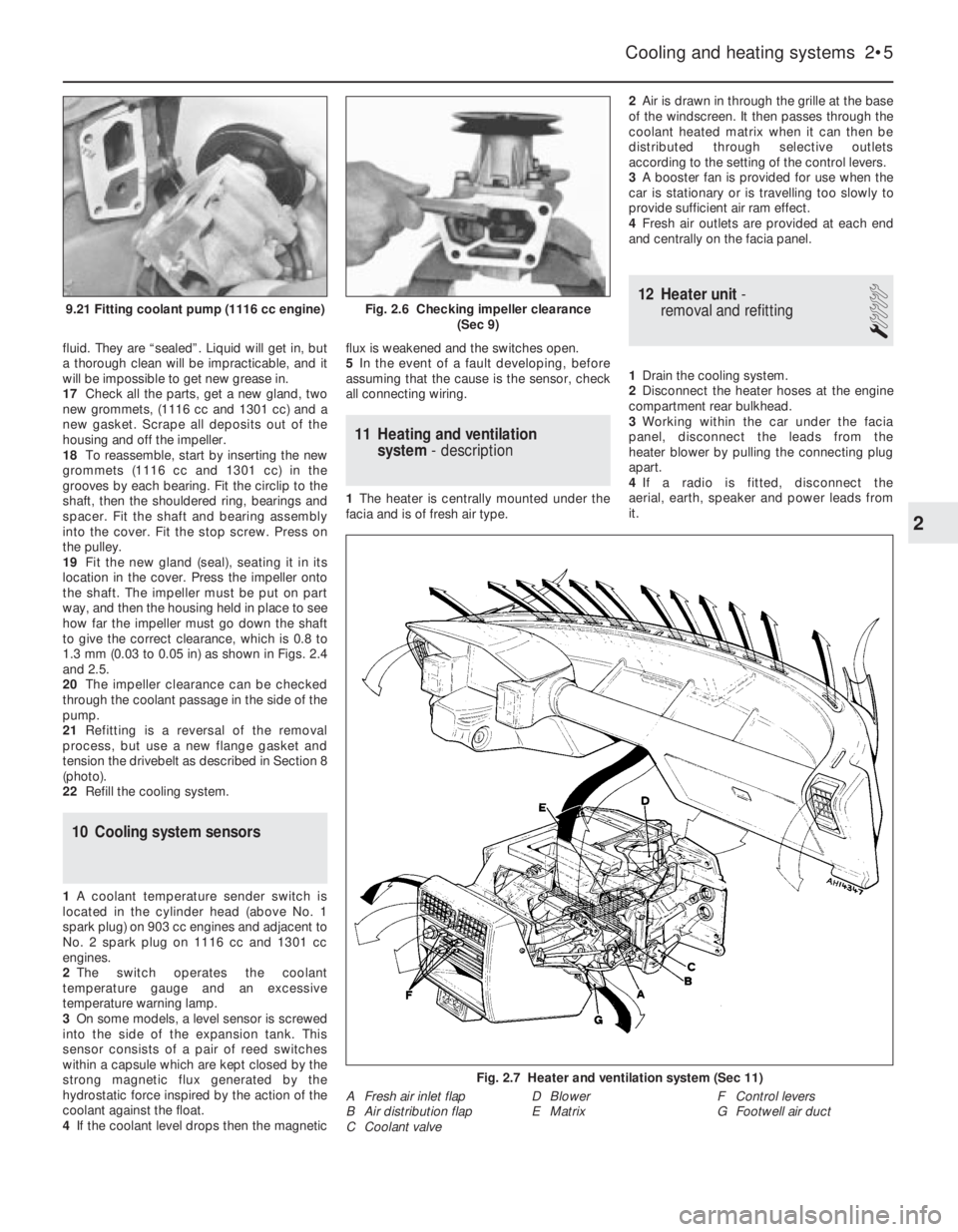
to give the correct clearance, which is 0.8 to
1.3 mm (0.03 to 0.05 in) as shown in Figs. 2.4
and 2.5.
20The impeller clearance can be checked
through the coolant passage in the side of the
pump.
21Refitting is a reversal of the removal
process, but use a new flange gasket and
tension the drivebelt as described in Section 8
(photo).
22Refill the cooling system.
10 Cooling system sensors
1A coolant temperature sender switch is
located in the cylinder head (above No. 1
spark plug) on 903 cc engines and adjacent to
No. 2 spark plug on 1116 cc and 1301 cc
engines.
2The switch operates the coolant
temperature gauge and an excessive
temperature warning lamp.
3On some models, a level sensor is screwed
into the side of the expansion tank. This
sensor consists of a pair of reed switches
within a capsule which are kept closed by the
strong magnetic flux generated by the
hydrostatic force inspired by the action of the
coolant against the float.
4If the coolant level drops then the magneticflux is weakened and the switches open.
5In the event of a fault developing, before
assuming that the cause is the sensor, check
all connecting wiring.
11 Heating and ventilation
system- description
1The heater is centrally mounted under the
facia and is of fresh air type.2Air is drawn in through the grille at the base
of the windscreen. It then passes through the
coolant heated matrix when it can then be
distributed through selective outlets
according to the setting of the control levers.
3A booster fan is provided for use when the
car is stationary or is travelling too slowly to
provide sufficient air ram effect.
4Fresh air outlets are provided at each end
and centrally on the facia panel.
12 Heater unit-
removal and refitting
1
1Drain the cooling system.
2Disconnect the heater hoses at the engine
compartment rear bulkhead.
3Working within the car under the facia
panel, disconnect the leads from the
heater blower by pulling the connecting plug
apart.
4If a radio is fitted, disconnect the
aerial, earth, speaker and power leads from
it.
Cooling and heating systems 2•5
Fig. 2.6 Checking impeller clearance
(Sec 9)9.21 Fitting coolant pump (1116 cc engine)
Fig. 2.7 Heater and ventilation system (Sec 11)
A Fresh air inlet flap
B Air distribution flap
C Coolant valveD Blower
E MatrixF Control levers
G Footwell air duct
2
Page 56 of 303
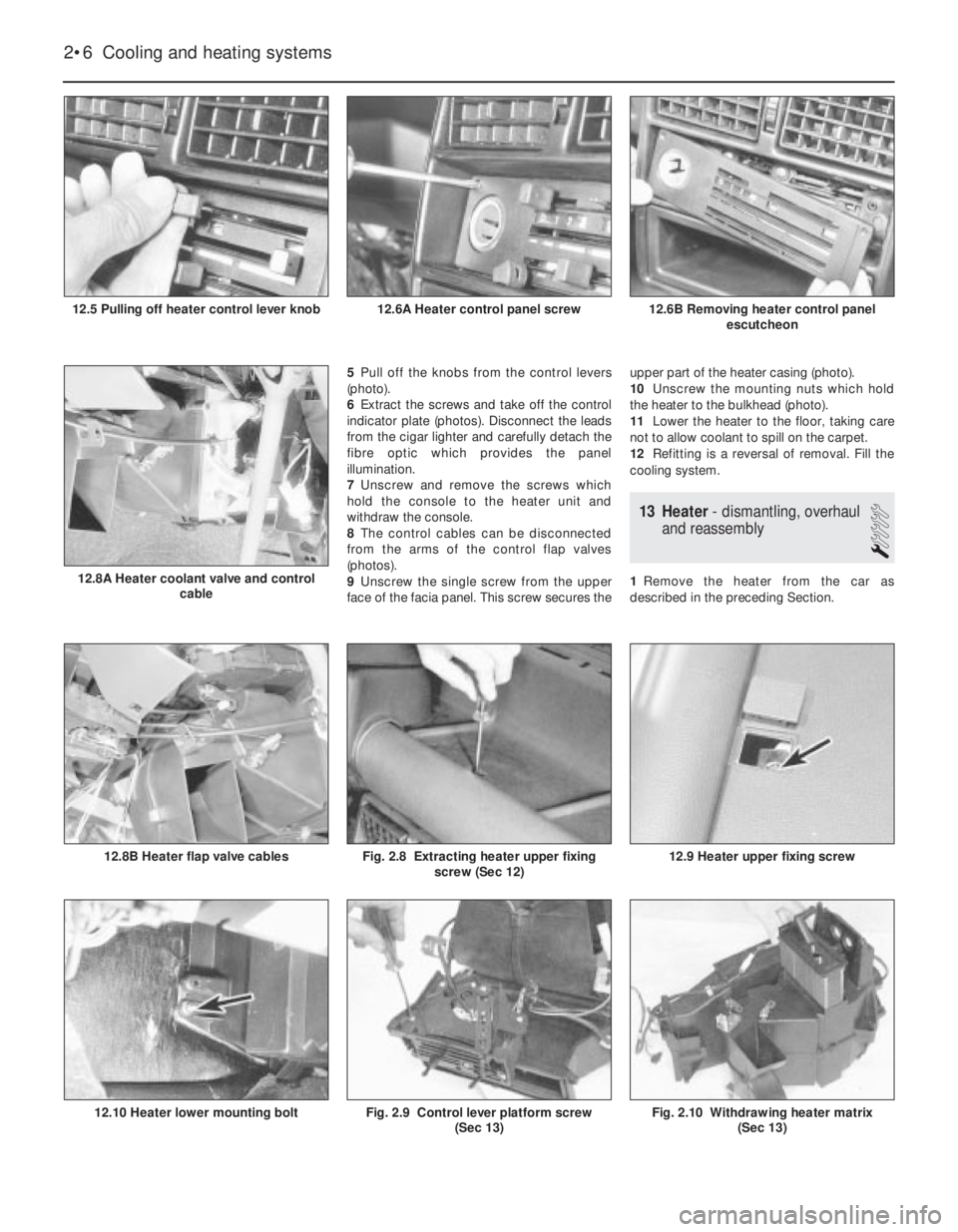
5Pull off the knobs from the control levers
(photo).
6Extract the screws and take off the control
indicator plate (photos). Disconnect the leads
from the cigar lighter and carefully detach the
fibre optic which provides the panel
illumination.
7Unscrew and remove the screws which
hold the console to the heater unit and
withdraw the console.
8The control cables can be disconnected
from the arms of the control flap valves
(photos).
9Unscrew the single screw from the upper
face of the facia panel. This screw secures theupper part of the heater casing (photo).
10Unscrew the mounting nuts which hold
the heater to the bulkhead (photo).
11Lower the heater to the floor, taking care
not to allow coolant to spill on the carpet.
12Refitting is a reversal of removal. Fill the
cooling system.
13 Heater- dismantling, overhaul
and reassembly
1
1Remove the heater from the car as
described in the preceding Section.
2•6 Cooling and heating systems
Fig. 2.10 Withdrawing heater matrix
(Sec 13)Fig. 2.9 Control lever platform screw
(Sec 13)12.10 Heater lower mounting bolt
12.9 Heater upper fixing screw
12.8A Heater coolant valve and control
cable
Fig. 2.8 Extracting heater upper fixing
screw (Sec 12)12.8B Heater flap valve cables
12.6B Removing heater control panel
escutcheon12.6A Heater control panel screw12.5 Pulling off heater control lever knob