seats FIAT UNO 1983 Service User Guide
[x] Cancel search | Manufacturer: FIAT, Model Year: 1983, Model line: UNO, Model: FIAT UNO 1983Pages: 303, PDF Size: 10.36 MB
Page 178 of 303
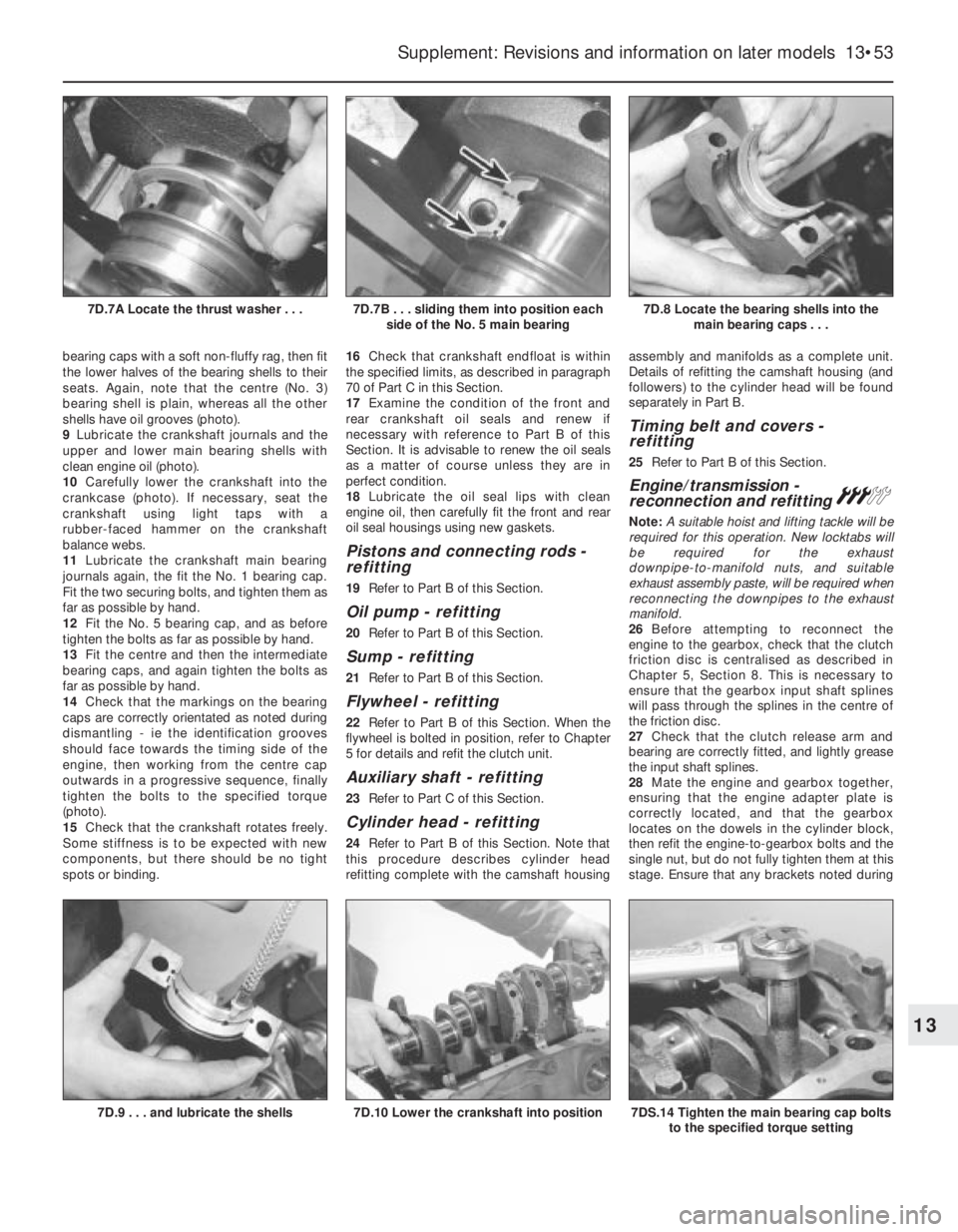
bearing caps with a soft non-fluffy rag, then fit
the lower halves of the bearing shells to their
seats. Again, note that the centre (No. 3)
bearing shell is plain, whereas all the other
shells have oil grooves (photo).
9Lubricate the crankshaft journals and the
upper and lower main bearing shells with
clean engine oil (photo).
10Carefully lower the crankshaft into the
crankcase (photo). If necessary, seat the
crankshaft using light taps with a
rubber-faced hammer on the crankshaft
balance webs.
11Lubricate the crankshaft main bearing
journals again, the fit the No. 1 bearing cap.
Fit the two securing bolts, and tighten them as
far as possible by hand.
12Fit the No. 5 bearing cap, and as before
tighten the bolts as far as possible by hand.
13Fit the centre and then the intermediate
bearing caps, and again tighten the bolts as
far as possible by hand.
14Check that the markings on the bearing
caps are correctly orientated as noted during
dismantling - ie the identification grooves
should face towards the timing side of the
engine, then working from the centre cap
outwards in a progressive sequence, finally
tighten the bolts to the specified torque
(photo).
15Check that the crankshaft rotates freely.
Some stiffness is to be expected with new
components, but there should be no tight
spots or binding.16Check that crankshaft endfloat is within
the specified limits, as described in paragraph
70 of Part C in this Section.
17Examine the condition of the front and
rear crankshaft oil seals and renew if
necessary with reference to Part B of this
Section. It is advisable to renew the oil seals
as a matter of course unless they are in
perfect condition.
18Lubricate the oil seal lips with clean
engine oil, then carefully fit the front and rear
oil seal housings using new gaskets.
Pistons and connecting rods -
refitting
19Refer to Part B of this Section.
Oil pump - refitting
20Refer to Part B of this Section.
Sump - refitting
21Refer to Part B of this Section.
Flywheel - refitting
22Refer to Part B of this Section. When the
flywheel is bolted in position, refer to Chapter
5 for details and refit the clutch unit.
Auxiliary shaft - refitting
23Refer to Part C of this Section.
Cylinder head - refitting
24Refer to Part B of this Section. Note that
this procedure describes cylinder head
refitting complete with the camshaft housingassembly and manifolds as a complete unit.
Details of refitting the camshaft housing (and
followers) to the cylinder head will be found
separately in Part B.
Timing belt and covers -
refitting
25Refer to Part B of this Section.
Engine/transmission -
reconnection and refitting#
Note: A suitable hoist and lifting tackle will be
required for this operation. New locktabs will
be required for the exhaust
downpipe-to-manifold nuts, and suitable
exhaust assembly paste, will be required when
reconnecting the downpipes to the exhaust
manifold.
26Before attempting to reconnect the
engine to the gearbox, check that the clutch
friction disc is centralised as described in
Chapter 5, Section 8. This is necessary to
ensure that the gearbox input shaft splines
will pass through the splines in the centre of
the friction disc.
27Check that the clutch release arm and
bearing are correctly fitted, and lightly grease
the input shaft splines.
28Mate the engine and gearbox together,
ensuring that the engine adapter plate is
correctly located, and that the gearbox
locates on the dowels in the cylinder block,
then refit the engine-to-gearbox bolts and the
single nut, but do not fully tighten them at this
stage. Ensure that any brackets noted during
Supplement: Revisions and information on later models 13•53
7D.8 Locate the bearing shells into the
main bearing caps . . .7D.7B . . . sliding them into position each
side of the No. 5 main bearing
7DS.14 Tighten the main bearing cap bolts
to the specified torque setting7D.10 Lower the crankshaft into position7D.9 . . . and lubricate the shells
13
7D.7A Locate the thrust washer . . .
Page 201 of 303
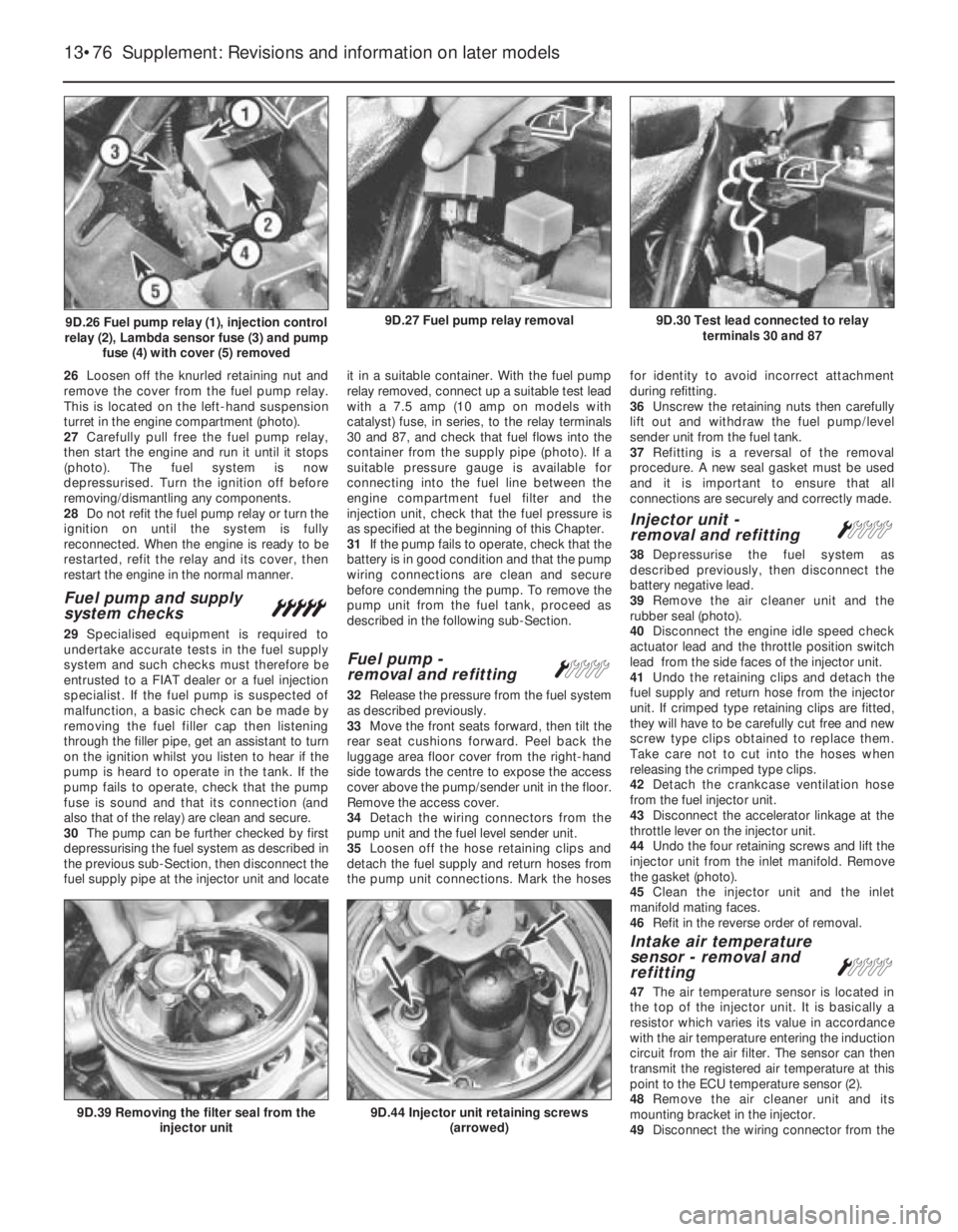
26Loosen off the knurled retaining nut and
remove the cover from the fuel pump relay.
This is located on the left-hand suspension
turret in the engine compartment (photo).
27Carefully pull free the fuel pump relay,
then start the engine and run it until it stops
(photo). The fuel system is now
depressurised. Turn the ignition off before
removing/dismantling any components.
28Do not refit the fuel pump relay or turn the
ignition on until the system is fully
reconnected. When the engine is ready to be
restarted, refit the relay and its cover, then
restart the engine in the normal manner.
Fuel pump and supply
system checks°
29Specialised equipment is required to
undertake accurate tests in the fuel supply
system and such checks must therefore be
entrusted to a FIAT dealer or a fuel injection
specialist. If the fuel pump is suspected of
malfunction, a basic check can be made by
removing the fuel filler cap then listening
through the filler pipe, get an assistant to turn
on the ignition whilst you listen to hear if the
pump is heard to operate in the tank. If the
pump fails to operate, check that the pump
fuse is sound and that its connection (and
also that of the relay) are clean and secure.
30The pump can be further checked by first
depressurising the fuel system as described in
the previous sub-Section, then disconnect the
fuel supply pipe at the injector unit and locateit in a suitable container. With the fuel pump
relay removed, connect up a suitable test lead
with a 7.5 amp (10 amp on models with
catalyst) fuse, in series, to the relay terminals
30 and 87, and check that fuel flows into the
container from the supply pipe (photo). If a
suitable pressure gauge is available for
connecting into the fuel line between the
engine compartment fuel filter and the
injection unit, check that the fuel pressure is
as specified at the beginning of this Chapter.
31If the pump fails to operate, check that the
battery is in good condition and that the pump
wiring connections are clean and secure
before condemning the pump. To remove the
pump unit from the fuel tank, proceed as
described in the following sub-Section.
Fuel pump -
removal and refittingÁ
32Release the pressure from the fuel system
as described previously.
33Move the front seats forward, then tilt the
rear seat cushions forward. Peel back the
luggage area floor cover from the right-hand
side towards the centre to expose the access
cover above the pump/sender unit in the floor.
Remove the access cover.
34Detach the wiring connectors from the
pump unit and the fuel level sender unit.
35Loosen off the hose retaining clips and
detach the fuel supply and return hoses from
the pump unit connections. Mark the hosesfor identity to avoid incorrect attachment
during refitting.
36Unscrew the retaining nuts then carefully
lift out and withdraw the fuel pump/level
sender unit from the fuel tank.
37Refitting is a reversal of the removal
procedure. A new seal gasket must be used
and it is important to ensure that all
connections are securely and correctly made.
Injector unit -
removal and refittingÁ
38Depressurise the fuel system as
described previously, then disconnect the
battery negative lead.
39Remove the air cleaner unit and the
rubber seal (photo).
40Disconnect the engine idle speed check
actuator lead and the throttle position switch
lead from the side faces of the injector unit.
41Undo the retaining clips and detach the
fuel supply and return hose from the injector
unit. If crimped type retaining clips are fitted,
they will have to be carefully cut free and new
screw type clips obtained to replace them.
Take care not to cut into the hoses when
releasing the crimped type clips.
42Detach the crankcase ventilation hose
from the fuel injector unit.
43Disconnect the accelerator linkage at the
throttle lever on the injector unit.
44Undo the four retaining screws and lift the
injector unit from the inlet manifold. Remove
the gasket (photo).
45Clean the injector unit and the inlet
manifold mating faces.
46Refit in the reverse order of removal.
Intake air temperature
sensor - removal and
refitting
Á
47The air temperature sensor is located in
the top of the injector unit. It is basically a
resistor which varies its value in accordance
with the air temperature entering the induction
circuit from the air filter. The sensor can then
transmit the registered air temperature at this
point to the ECU temperature sensor (2).
48Remove the air cleaner unit and its
mounting bracket in the injector.
49Disconnect the wiring connector from the
13•76 Supplement: Revisions and information on later models
9D.44 Injector unit retaining screws
(arrowed)9D.39 Removing the filter seal from the
injector unit
9D.30 Test lead connected to relay
terminals 30 and 879D.27 Fuel pump relay removal9D.26 Fuel pump relay (1), injection control
relay (2), Lambda sensor fuse (3) and pump
fuse (4) with cover (5) removed
Page 285 of 303
REF•2MOT Test Checks
Seat belts and seats
Note: The following checks are applicable to
all seat belts, front and rear.
MExamine the webbing of all the belts
(including rear belts if fitted) for cuts, serious
fraying or deterioration. Fasten and unfasten
each belt to check the buckles. If applicable,
check the retracting mechanism. Check the
security of all seat belt mountings accessible
from inside the vehicle.
MThe front seats themselves must be
securely attached and the backrests must
lock in the upright position.
Doors
MBoth front doors must be able to be opened
and closed from outside and inside, and must
latch securely when closed.
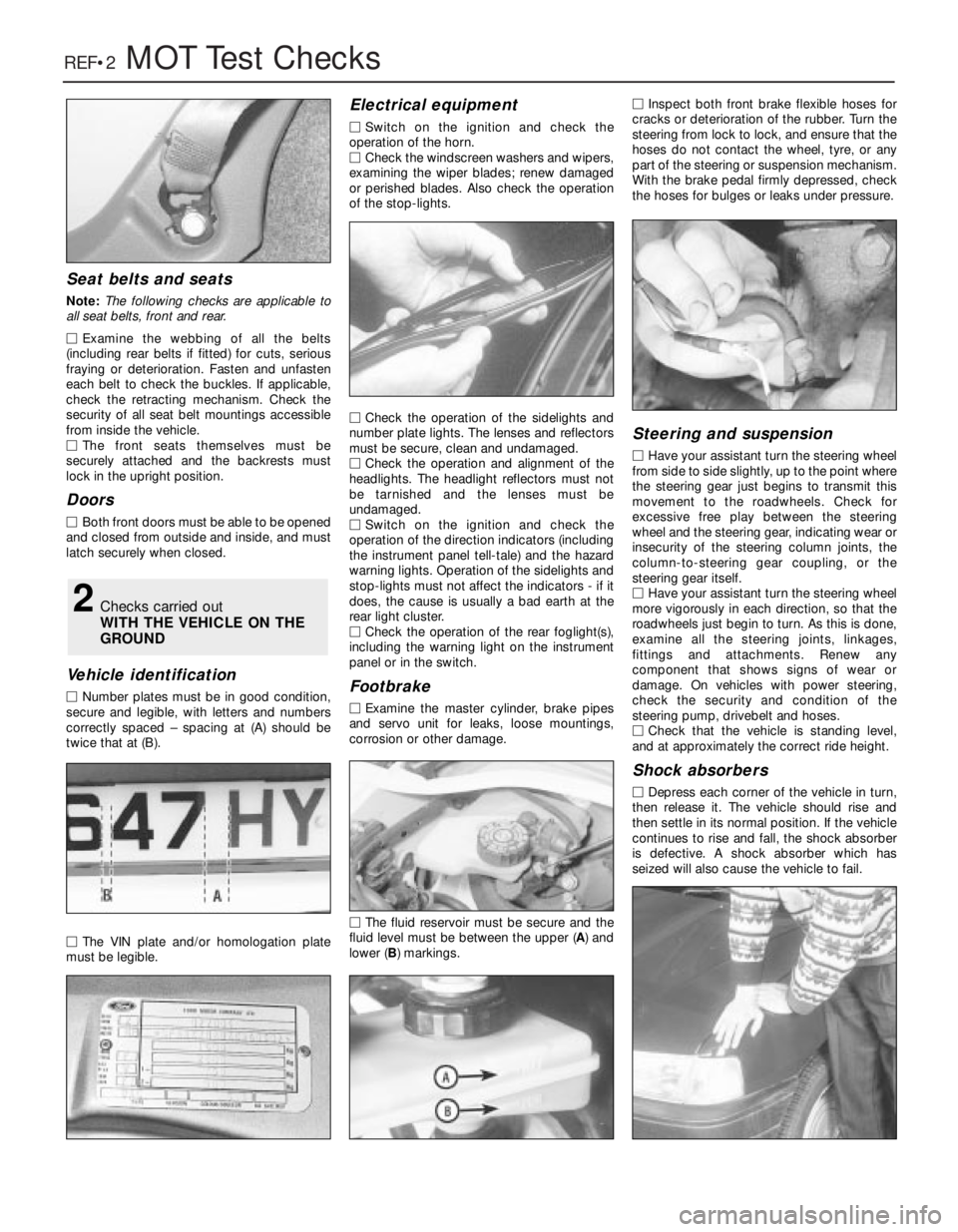
Vehicle identification
MNumber plates must be in good condition,
secure and legible, with letters and numbers
correctly spaced – spacing at (A) should be
twice that at (B).
MThe VIN plate and/or homologation plate
must be legible.
Electrical equipment
MSwitch on the ignition and check the
operation of the horn.
MCheck the windscreen washers and wipers,
examining the wiper blades; renew damaged
or perished blades. Also check the operation
of the stop-lights.
MCheck the operation of the sidelights and
number plate lights. The lenses and reflectors
must be secure, clean and undamaged.
MCheck the operation and alignment of the
headlights. The headlight reflectors must not
be tarnished and the lenses must be
undamaged.
MSwitch on the ignition and check the
operation of the direction indicators (including
the instrument panel tell-tale) and the hazard
warning lights. Operation of the sidelights and
stop-lights must not affect the indicators - if it
does, the cause is usually a bad earth at the
rear light cluster.
MCheck the operation of the rear foglight(s),
including the warning light on the instrument
panel or in the switch.
Footbrake
MExamine the master cylinder, brake pipes
and servo unit for leaks, loose mountings,
corrosion or other damage.
MThe fluid reservoir must be secure and the
fluid level must be between the upper (A) and
lower (B) markings.MInspect both front brake flexible hoses for
cracks or deterioration of the rubber. Turn the
steering from lock to lock, and ensure that the
hoses do not contact the wheel, tyre, or any
part of the steering or suspension mechanism.
With the brake pedal firmly depressed, check
the hoses for bulges or leaks under pressure.
Steering and suspension
MHave your assistant turn the steering wheel
from side to side slightly, up to the point where
the steering gear just begins to transmit this
movement to the roadwheels. Check for
excessive free play between the steering
wheel and the steering gear, indicating wear or
insecurity of the steering column joints, the
column-to-steering gear coupling, or the
steering gear itself.
MHave your assistant turn the steering wheel
more vigorously in each direction, so that the
roadwheels just begin to turn. As this is done,
examine all the steering joints, linkages,
fittings and attachments. Renew any
component that shows signs of wear or
damage. On vehicles with power steering,
check the security and condition of the
steering pump, drivebelt and hoses.
MCheck that the vehicle is standing level,
and at approximately the correct ride height.
Shock absorbers
MDepress each corner of the vehicle in turn,
then release it. The vehicle should rise and
then settle in its normal position. If the vehicle
continues to rise and fall, the shock absorber
is defective. A shock absorber which has
seized will also cause the vehicle to fail.
2Checks carried out
WITH THE VEHICLE ON THE
GROUND
Page 286 of 303
MOT Test ChecksREF•3
REF
Exhaust system
MStart the engine. With your assistant
holding a rag over the tailpipe, check the
entire system for leaks. Repair or renew
leaking sections.
Jack up the front and rear of the vehicle,
and securely support it on axle stands.
Position the stands clear of the suspension
assemblies. Ensure that the wheels are
clear of the ground and that the steering
can be turned from lock to lock.
Steering mechanism
MHave your assistant turn the steering from
lock to lock. Check that the steering turns
smoothly, and that no part of the steering
mechanism, including a wheel or tyre, fouls
any brake hose or pipe or any part of the body
structure.
MExamine the steering rack rubber gaiters
for damage or insecurity of the retaining clips.
If power steering is fitted, check for signs of
damage or leakage of the fluid hoses, pipes or
connections. Also check for excessive
stiffness or binding of the steering, a missing
split pin or locking device, or severe corrosion
of the body structure within 30 cm of any
steering component attachment point.
Front and rear suspension and
wheel bearings
MStarting at the front right-hand side, grasp
the roadwheel at the 3 o’clock and 9 o’clock
positions and shake it vigorously. Check for
free play or insecurity at the wheel bearings,
suspension balljoints, or suspension mount-
ings, pivots and attachments.
MNow grasp the wheel at the 12 o’clock and
6 o’clock positions and repeat the previous
inspection. Spin the wheel, and check for
roughness or tightness of the front wheel
bearing.
MIf excess free play is suspected at a
component pivot point, this can be confirmed
by using a large screwdriver or similar tool and
levering between the mounting and the
component attachment. This will confirm
whether the wear is in the pivot bush, its
retaining bolt, or in the mounting itself (the bolt
holes can often become elongated).
MCarry out all the above checks at the other
front wheel, and then at both rear wheels.
Springs and shock absorbers
MExamine the suspension struts (when
applicable) for serious fluid leakage, corrosion,
or damage to the casing. Also check the
security of the mounting points.
MIf coil springs are fitted, check that the
spring ends locate in their seats, and that the
spring is not corroded, cracked or broken.
MIf leaf springs are fitted, check that all
leaves are intact, that the axle is securely
attached to each spring, and that there is no
deterioration of the spring eye mountings,
bushes, and shackles.MThe same general checks apply to vehicles
fitted with other suspension types, such as
torsion bars, hydraulic displacer units, etc.
Ensure that all mountings and attachments are
secure, that there are no signs of excessive
wear, corrosion or damage, and (on hydraulic
types) that there are no fluid leaks or damaged
pipes.
MInspect the shock absorbers for signs of
serious fluid leakage. Check for wear of the
mounting bushes or attachments, or damage
to the body of the unit.
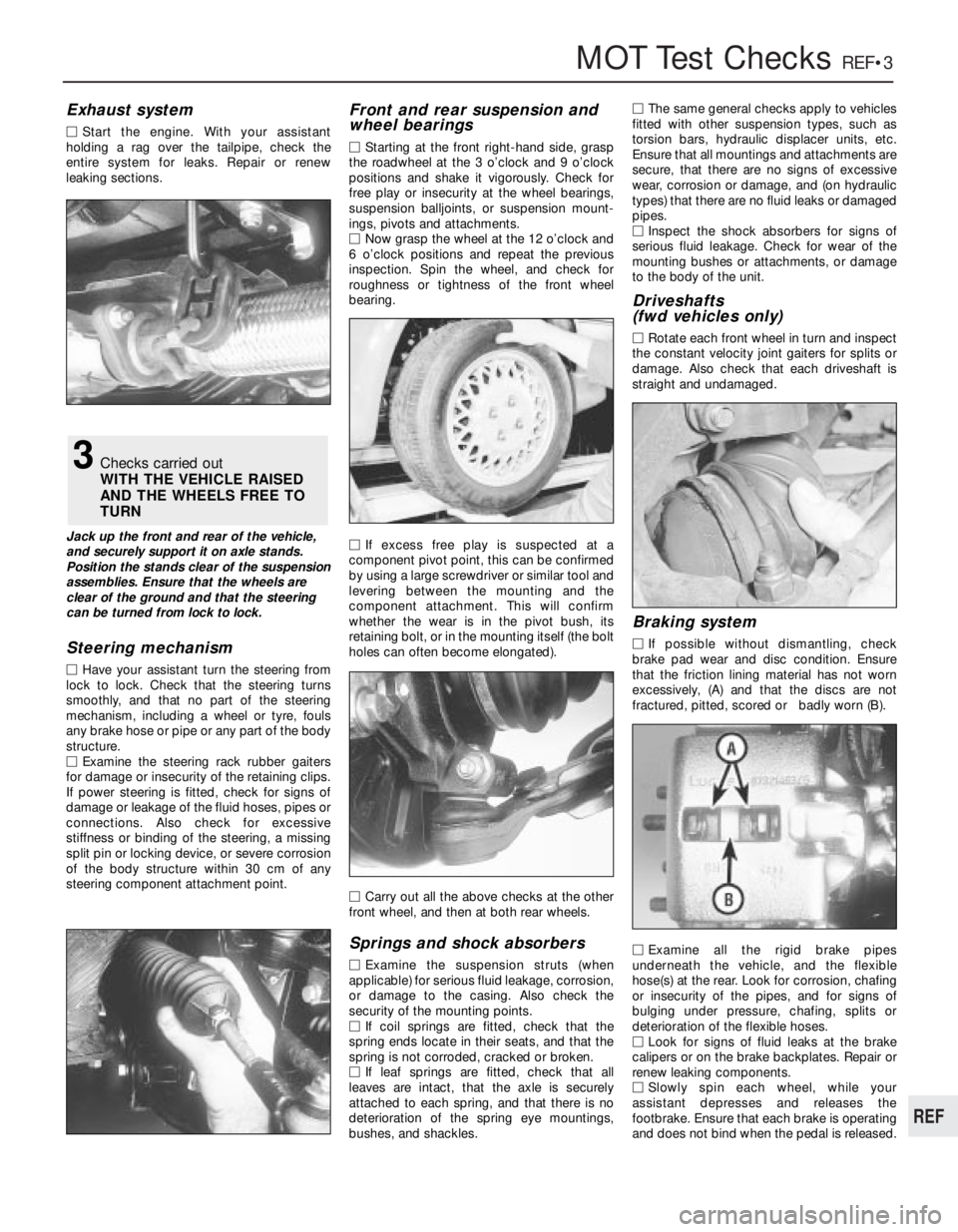
Driveshafts
(fwd vehicles only)
MRotate each front wheel in turn and inspect
the constant velocity joint gaiters for splits or
damage. Also check that each driveshaft is
straight and undamaged.
Braking system
MIf possible without dismantling, check
brake pad wear and disc condition. Ensure
that the friction lining material has not worn
excessively, (A) and that the discs are not
fractured, pitted, scored or badly worn (B).
MExamine all the rigid brake pipes
underneath the vehicle, and the flexible
hose(s) at the rear. Look for corrosion, chafing
or insecurity of the pipes, and for signs of
bulging under pressure, chafing, splits or
deterioration of the flexible hoses.
MLook for signs of fluid leaks at the brake
calipers or on the brake backplates. Repair or
renew leaking components.
MSlowly spin each wheel, while your
assistant depresses and releases the
footbrake. Ensure that each brake is operating
and does not bind when the pedal is released.
3Checks carried out
WITH THE VEHICLE RAISED
AND THE WHEELS FREE TO
TURN
Page 302 of 303
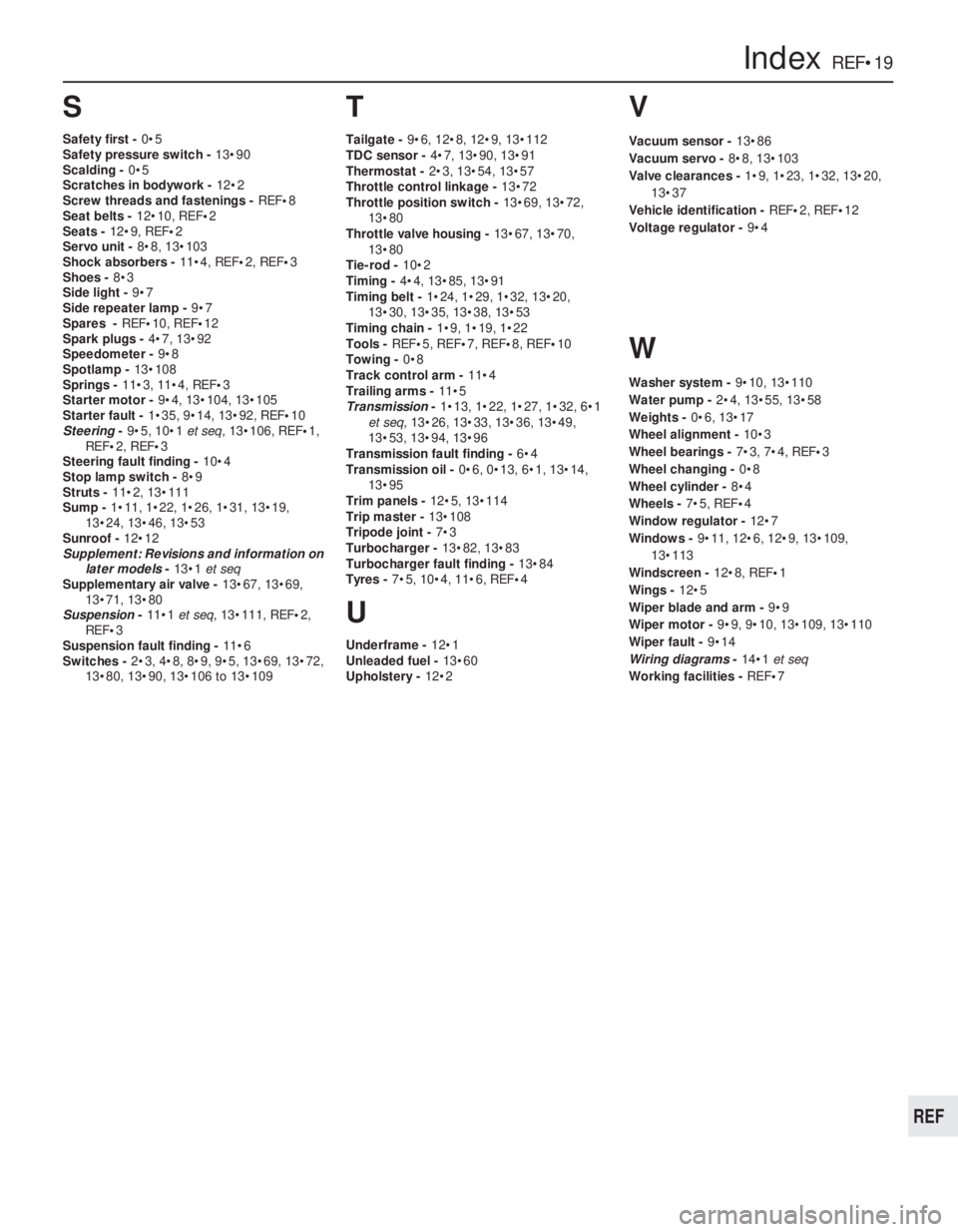
S
Safety first -0•5
Safety pressure switch - 13•90
Scalding -0•5
Scratches in bodywork - 12•2
Screw threads and fastenings - REF•8
Seat belts - 12•10, REF•2
Seats - 12•9, REF•2
Servo unit -8•8, 13•103
Shock absorbers - 11•4, REF•2, REF•3
Shoes -8•3
Side light -9•7
Side repeater lamp -9•7
Spares - REF•10, REF•12
Spark plugs -4•7, 13•92
Speedometer -9•8
Spotlamp - 13•108
Springs - 11•3, 11•4, REF•3
Starter motor -9•4, 13•104, 13•105
Starter fault -1•35, 9•14, 13•92, REF•10
Steering-9•5, 10•1et seq, 13•106, REF•1,
REF•2, REF•3
Steering fault finding - 10•4
Stop lamp switch -8•9
Struts - 11•2, 13•111
Sump -1•11, 1•22, 1•26, 1•31, 13•19,
13•24, 13•46, 13•53
Sunroof - 12•12
Supplement: Revisions and information on
later models- 13•1et seq
Supplementary air valve - 13•67, 13•69,
13•71, 13•80
Suspension- 11•1et seq, 13•111, REF•2,
REF•3
Suspension fault finding - 11•6
Switches -2•3, 4•8, 8•9, 9•5, 13•69, 13•72,
13•80, 13•90, 13•106 to 13•109
T
Tailgate -9•6, 12•8, 12•9, 13•112
TDC sensor -4•7, 13•90, 13•91
Thermostat -2•3, 13•54, 13•57
Throttle control linkage - 13•72
Throttle position switch - 13•69, 13•72,
13•80
Throttle valve housing - 13•67, 13•70,
13•80
Tie-rod - 10•2
Timing -4•4, 13•85, 13•91
Timing belt -1•24, 1•29, 1•32, 13•20,
13•30, 13•35, 13•38, 13•53
Timing chain -1•9, 1•19, 1•22
Tools - REF•5, REF•7, REF•8, REF•10
Towing -0•8
Track control arm - 11•4
Trailing arms - 11•5
Transmission-1•13, 1•22, 1•27, 1•32, 6•1
et seq, 13•26, 13•33, 13•36, 13•49,
13•53, 13•94, 13•96
Transmission fault finding -6•4
Transmission oil -0•6, 0•13, 6•1, 13•14,
13•95
Trim panels - 12•5, 13•114
Trip master - 13•108
Tripode joint -7•3
Turbocharger - 13•82, 13•83
Turbocharger fault finding - 13•84
Tyres -7•5, 10•4, 11•6, REF•4
U
Underframe - 12•1
Unleaded fuel - 13•60
Upholstery - 12•2
V
Vacuum sensor - 13•86
Vacuum servo -8•8, 13•103
Valve clearances -1•9, 1•23, 1•32, 13•20,
13•37
Vehicle identification - REF•2, REF•12
Voltage regulator -9•4
W
Washer system -9•10, 13•110
Water pump -2•4, 13•55, 13•58
Weights -0•6, 13•17
Wheel alignment - 10•3
Wheel bearings -7•3, 7•4, REF•3
Wheel changing -0•8
Wheel cylinder -8•4
Wheels -7•5, REF•4
Window regulator - 12•7
Windows -9•11, 12•6, 12•9, 13•109,
13•113
Windscreen - 12•8, REF•1
Wings - 12•5
Wiper blade and arm -9•9
Wiper motor -9•9, 9•10, 13•109, 13•110
Wiper fault -9•14
Wiring diagrams- 14•1et seq
Working facilities - REF•7
IndexREF•19
REF