steering FIAT UNO 1983 Service User Guide
[x] Cancel search | Manufacturer: FIAT, Model Year: 1983, Model line: UNO, Model: FIAT UNO 1983Pages: 303, PDF Size: 10.36 MB
Page 87 of 303
The hose ends can then be unclipped from
the brackets. The mounting brackets,
particularly on the body frame, are not very
heavy gauge and care must be taken not to
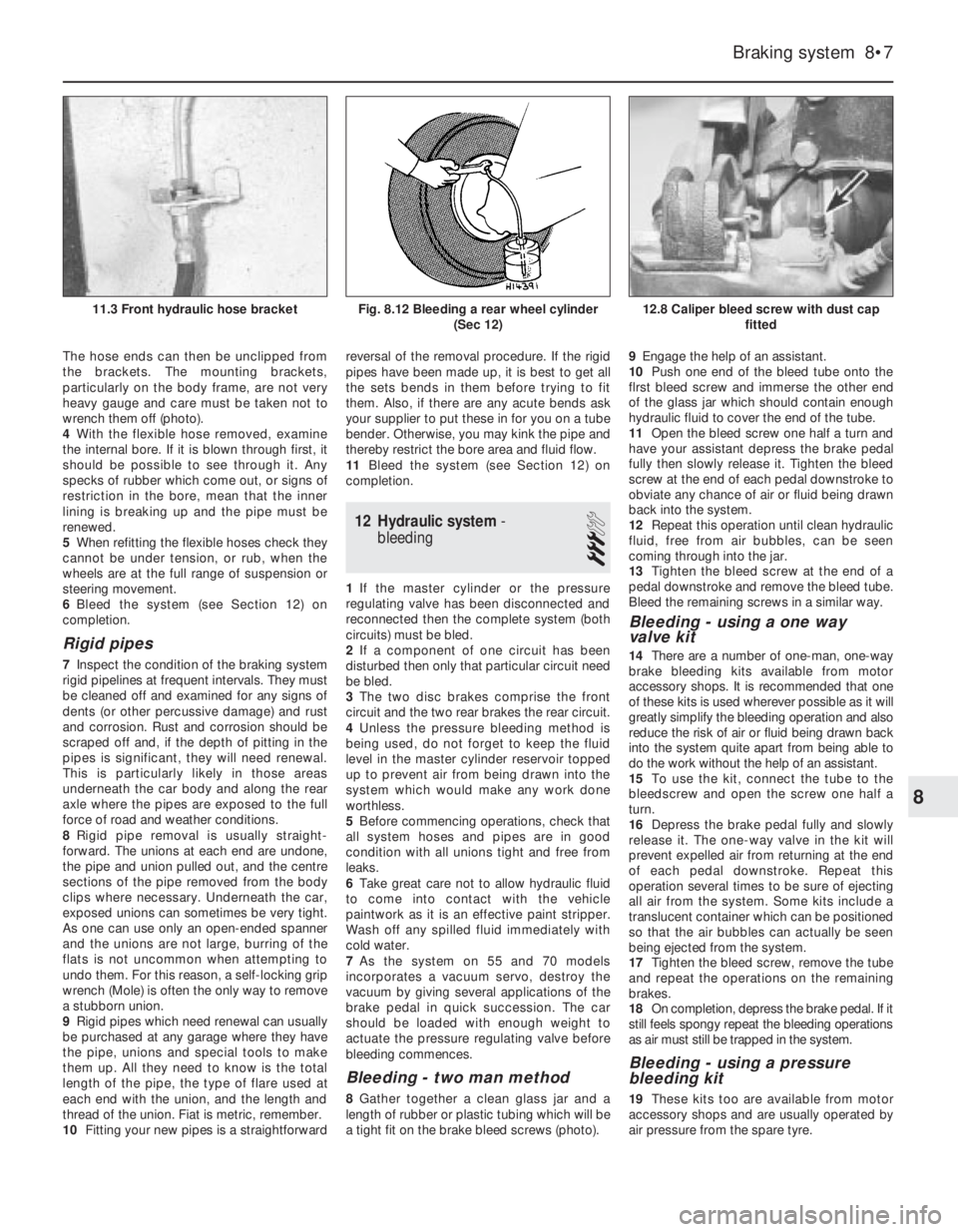
wrench them off (photo).
4With the flexible hose removed, examine
the internal bore. If it is blown through first, it
should be possible to see through it. Any
specks of rubber which come out, or signs of
restriction in the bore, mean that the inner
lining is breaking up and the pipe must be
renewed.
5When refitting the flexible hoses check they
cannot be under tension, or rub, when the
wheels are at the full range of suspension or
steering movement.
6Bleed the system (see Section 12) on
completion.
Rigid pipes
7Inspect the condition of the braking system
rigid pipelines at frequent intervals. They must
be cleaned off and examined for any signs of
dents (or other percussive damage) and rust
and corrosion. Rust and corrosion should be
scraped off and, if the depth of pitting in the
pipes is significant, they will need renewal.
This is particularly likely in those areas
underneath the car body and along the rear
axle where the pipes are exposed to the full
force of road and weather conditions.
8Rigid pipe removal is usually straight-
forward. The unions at each end are undone,
the pipe and union pulled out, and the centre
sections of the pipe removed from the body
clips where necessary. Underneath the car,
exposed unions can sometimes be very tight.
As one can use only an open-ended spanner
and the unions are not large, burring of the
flats is not uncommon when attempting to
undo them. For this reason, a self-locking grip
wrench (Mole) is often the only way to remove
a stubborn union.
9Rigid pipes which need renewal can usually
be purchased at any garage where they have
the pipe, unions and special tools to make
them up. All they need to know is the total
length of the pipe, the type of flare used at
each end with the union, and the length and
thread of the union. Fiat is metric, remember.
10Fitting your new pipes is a straightforwardreversal of the removal procedure. If the rigid
pipes have been made up, it is best to get all
the sets bends in them before trying to fit
them. Also, if there are any acute bends ask
your supplier to put these in for you on a tube
bender. Otherwise, you may kink the pipe and
thereby restrict the bore area and fluid flow.
11Bleed the system (see Section 12) on
completion.
12 Hydraulic system-
bleeding
3
1If the master cylinder or the pressure
regulating valve has been disconnected and
reconnected then the complete system (both
circuits) must be bled.
2If a component of one circuit has been
disturbed then only that particular circuit need
be bled.
3The two disc brakes comprise the front
circuit and the two rear brakes the rear circuit.
4Unless the pressure bleeding method is
being used, do not forget to keep the fluid
level in the master cylinder reservoir topped
up to prevent air from being drawn into the
system which would make any work done
worthless.
5Before commencing operations, check that
all system hoses and pipes are in good
condition with all unions tight and free from
leaks.
6Take great care not to allow hydraulic fluid
to come into contact with the vehicle
paintwork as it is an effective paint stripper.
Wash off any spilled fluid immediately with
cold water.
7As the system on 55 and 70 models
incorporates a vacuum servo, destroy the
vacuum by giving several applications of the
brake pedal in quick succession. The car
should be loaded with enough weight to
actuate the pressure regulating valve before
bleeding commences.
Bleeding - two man method
8Gather together a clean glass jar and a
length of rubber or plastic tubing which will be
a tight fit on the brake bleed screws (photo).9Engage the help of an assistant.
10Push one end of the bleed tube onto the
flrst bleed screw and immerse the other end
of the glass jar which should contain enough
hydraulic fluid to cover the end of the tube.
11Open the bleed screw one half a turn and
have your assistant depress the brake pedal
fully then slowly release it. Tighten the bleed
screw at the end of each pedal downstroke to
obviate any chance of air or fluid being drawn
back into the system.
12Repeat this operation until clean hydraulic
fluid, free from air bubbles, can be seen
coming through into the jar.
13Tighten the bleed screw at the end of a
pedal downstroke and remove the bleed tube.
Bleed the remaining screws in a similar way.
Bleeding - using a one way
valve kit
14There are a number of one-man, one-way
brake bleeding kits available from motor
accessory shops. It is recommended that one
of these kits is used wherever possible as it will
greatly simplify the bleeding operation and also
reduce the risk of air or fluid being drawn back
into the system quite apart from being able to
do the work without the help of an assistant.
15To use the kit, connect the tube to the
bleedscrew and open the screw one half a
turn.
16Depress the brake pedal fully and slowly
release it. The one-way valve in the kit will
prevent expelled air from returning at the end
of each pedal downstroke. Repeat this
operation several times to be sure of ejecting
all air from the system. Some kits include a
translucent container which can be positioned
so that the air bubbles can actually be seen
being ejected from the system.
17Tighten the bleed screw, remove the tube
and repeat the operations on the remaining
brakes.
18On completion, depress the brake pedal. If it
still feels spongy repeat the bleeding operations
as air must still be trapped in the system.
Bleeding - using a pressure
bleeding kit
19These kits too are available from motor
accessory shops and are usually operated by
air pressure from the spare tyre.
Braking system 8•7
12.8 Caliper bleed screw with dust cap
fittedFig. 8.12 Bleeding a rear wheel cylinder
(Sec 12)11.3 Front hydraulic hose bracket
8
Page 89 of 303
locknut and turn the adjuster nut on the
handbrake primary rod (photo).
3Raise the rear roadwheels and check that
they turn freely when the handbrake lever is
fully released.
17 Handbrake cable-
renewal
1
1There are two cables, either of which may
be renewed independently
2Disconnect the cable, which is to be renewed,
from the shoe lever at the brake backplate.
3Disconnect the longer cable from the
primary link or rod and release the cable from
its retainers. On later models with a plastic
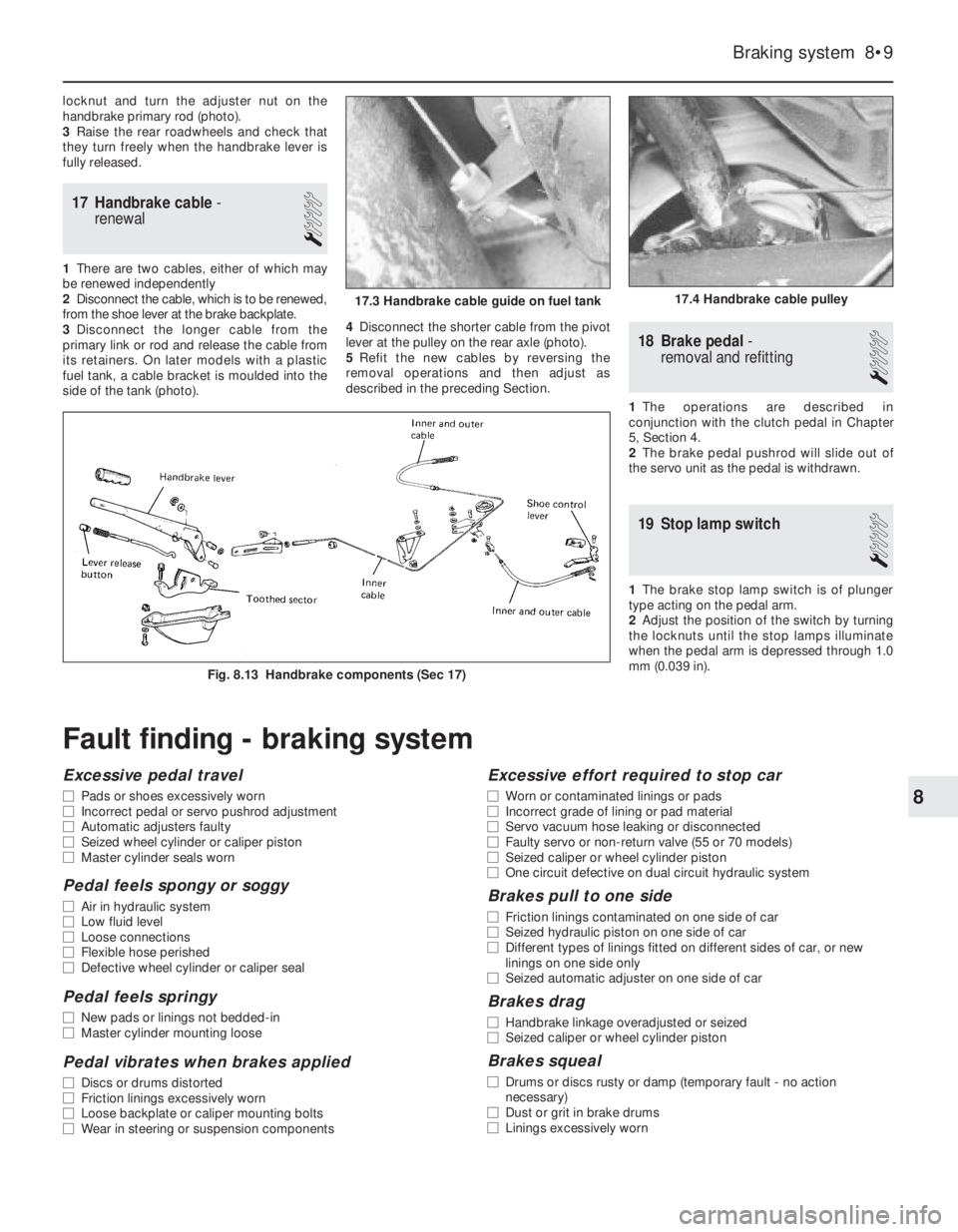
fuel tank, a cable bracket is moulded into the
side of the tank (photo).4Disconnect the shorter cable from the pivot
lever at the pulley on the rear axle (photo).
5Refit the new cables by reversing the
removal operations and then adjust as
described in the preceding Section.
18 Brake pedal-
removal and refitting
1
1The operations are described in
conjunction with the clutch pedal in Chapter
5, Section 4.
2The brake pedal pushrod will slide out of
the servo unit as the pedal is withdrawn.
19 Stop lamp switch
1
1The brake stop lamp switch is of plunger
type acting on the pedal arm.
2Adjust the position of the switch by turning
the locknuts until the stop lamps illuminate
when the pedal arm is depressed through 1.0
mm (0.039 in).
Braking system 8•9
Fig. 8.13 Handbrake components (Sec 17)
17.4 Handbrake cable pulley17.3 Handbrake cable guide on fuel tank
8
Fault finding - braking system
Excessive pedal travel
m mPads or shoes excessively worn
m mIncorrect pedal or servo pushrod adjustment
m mAutomatic adjusters faulty
m mSeized wheel cylinder or caliper piston
m mMaster cylinder seals worn
Pedal feels spongy or soggy
m
mAir in hydraulic system
m mLow fluid level
m mLoose connections
m mFlexible hose perished
m mDefective wheel cylinder or caliper seal
Pedal feels springy
m
mNew pads or linings not bedded-in
m mMaster cylinder mounting loose
Pedal vibrates when brakes applied
m
mDiscs or drums distorted
m mFriction linings excessively worn
m mLoose backplate or caliper mounting bolts
m mWear in steering or suspension components
Excessive effort required to stop car
m
mWorn or contaminated linings or pads
m mIncorrect grade of lining or pad material
m mServo vacuum hose leaking or disconnected
m mFaulty servo or non-return valve (55 or 70 models)
m mSeized caliper or wheel cylinder piston
m mOne circuit defective on dual circuit hydraulic system
Brakes pull to one side
m
mFriction linings contaminated on one side of car
m mSeized hydraulic piston on one side of car
m mDifferent types of linings fitted on different sides of car, or new
linings on one side only
m mSeized automatic adjuster on one side of car
Brakes drag
m
mHandbrake linkage overadjusted or seized
m mSeized caliper or wheel cylinder piston
Brakes squeal
m
mDrums or discs rusty or damp (temporary fault - no action
necessary)
m mDust or grit in brake drums
m mLinings excessively worn
Page 90 of 303
9System type . . . . . . . . . . . . . . . . . . . . . . . . . . . . . . . . . . . . . . . . . . . 12 negative earth, battery alternator and pre-engaged starter
Battery
Except 70S . . . . . . . . . . . . . . . . . . . . . . . . . . . . . . . . . . . . . . . . . . . . . . . 30 Ah
70S . . . . . . . . . . . . . . . . . . . . . . . . . . . . . . . . . . . . . . . . . . . . . . . . . . . . 40 Ah
Alternator
Type . . . . . . . . . . . . . . . . . . . . . . . . . . . . . . . . . . . . . . . . . . . . . . . . . . . . Marelli, Valeo or Bosch 45A, 55A or 65A, with integral voltage
regulator
Nominal voltage . . . . . . . . . . . . . . . . . . . . . . . . . . . . . . . . . . . . . . . . . . . 14 V
Minimum brush (wear) length . . . . . . . . . . . . . . . . . . . . . . . . . . . . . . . . . 6.0 mm (0.236 in)
Starter motor
Type . . . . . . . . . . . . . . . . . . . . . . . . . . . . . . . . . . . . . . . . . . . . . . . . . . . . Marelli, Bosch or Femsa pre-engaged
Nominal power . . . . . . . . . . . . . . . . . . . . . . . . . . . . . . . . . . . . . . . . . . . . 0.8 kW or 1.0 kW
Armature shaft endfloat . . . . . . . . . . . . . . . . . . . . . . . . . . . . . . . . . . . . . 0.1 to 0.5 mm (0.0039 to 0.0197 in)
Minimum brush (wear) length . . . . . . . . . . . . . . . . . . . . . . . . . . . . . . . . . 10.0 mm (0.39 in)
Wiper blades
Front . . . . . . . . . . . . . . . . . . . . . . . . . . . . . . . . . . . . . . . . . . . . . . . . . . . . Champion X-4801 (19 in) or X-4503 (18 in)
Rear . . . . . . . . . . . . . . . . . . . . . . . . . . . . . . . . . . . . . . . . . . . . . . . . . . . . Champion X-3303
Chapter 9 Electrical system
For modifications, and information applicable to later models, see Supplement at end of manual
Alternator - maintenance and precautions . . . . . . . . . . . . . . . . . . . . 3
Alternator - overhaul . . . . . . . . . . . . . . . . . . . . . . . . . . . . . . . . . . . . . 5
Alternator - removal and refitting . . . . . . . . . . . . . . . . . . . . . . . . . . . 4
Battery - inspection, charging, removal and refitting . . . . . . . . . . . . 2
Central door locking system . . . . . . . . . . . . . . . . . . . . . . . . . . . . . . . 32
Check control (warning module) system . . . . . . . . . . . . . . . . . . . . . . 34
Cigar lighter . . . . . . . . . . . . . . . . . . . . . . . . . . . . . . . . . . . . . . . . . . . . 36
Clocks - setting . . . . . . . . . . . . . . . . . . . . . . . . . . . . . . . . . . . . . . . . . 35
Courtesy lamp switch . . . . . . . . . . . . . . . . . . . . . . . . . . . . . . . . . . . . 12
Economy gauge (Econometer) . . . . . . . . . . . . . . . . . . . . . . . . . . . . . 33
Electrically-operated front door windows . . . . . . . . . . . . . . . . . . . . . 31
Exterior lamps - bulb renewal . . . . . . . . . . . . . . . . . . . . . . . . . . . . . . 19
Fault finding - electrical system . . . . . . . . . . . . . . See end of Chapter
Fuses and relays . . . . . . . . . . . . . . . . . . . . . . . . . . . . . . . . . . . . . . . . 10
General description . . . . . . . . . . . . . . . . . . . . . . . . . . . . . . . . . . . . . . 1
Headlamp - removal and refitting . . . . . . . . . . . . . . . . . . . . . . . . . . . 18
Headlamp beam - alignment . . . . . . . . . . . . . . . . . . . . . . . . . . . . . . . 17
Headlamp bulb - renewal . . . . . . . . . . . . . . . . . . . . . . . . . . . . . . . . . 16
Heated tailgate window - precautions and repair . . . . . . . . . . . . . . . 29Horns . . . . . . . . . . . . . . . . . . . . . . . . . . . . . . . . . . . . . . . . . . . . . . . . . 15
Instrument panel - dismantling . . . . . . . . . . . . . . . . . . . . . . . . . . . . . 22
Instrument panel - removal and refitting . . . . . . . . . . . . . . . . . . . . . . 21
Interior lamps - bulb renewal . . . . . . . . . . . . . . . . . . . . . . . . . . . . . . 20
Radio/cassette - fitting . . . . . . . . . . . . . . . . . . . . . . . . . . . . . . . . . . . 30
Rocker and push-button switches . . . . . . . . . . . . . . . . . . . . . . . . . . 13
Speedometer drive cable - renewal . . . . . . . . . . . . . . . . . . . . . . . . . 23
Starter motor - description and testing . . . . . . . . . . . . . . . . . . . . . . . 7
Starter motor - overhaul . . . . . . . . . . . . . . . . . . . . . . . . . . . . . . . . . . 9
Starter motor - removal and refitting . . . . . . . . . . . . . . . . . . . . . . . . . 8
Steering column combination switch . . . . . . . . . . . . . . . . . . . . . . . . 11
Tailgate contacts . . . . . . . . . . . . . . . . . . . . . . . . . . . . . . . . . . . . . . . . 14
Tailgate wiper blade and arm - removal and refitting . . . . . . . . . . . . 26
Tailgate wiper motor - removal and refitting . . . . . . . . . . . . . . . . . . . 27
Voltage regulator . . . . . . . . . . . . . . . . . . . . . . . . . . . . . . . . . . . . . . . . 6
Washer system . . . . . . . . . . . . . . . . . . . . . . . . . . . . . . . . . . . . . . . . . 28
Windscreen wiper blade and arm - removal and refitting . . . . . . . . . 24
Windscreen wiper motor - removal and refitting . . . . . . . . . . . . . . . . 25
9•1
Specifications Contents
Easy,suitable for
novice with little
experienceFairly easy,suitable
for beginner with
some experienceFairly difficult,
suitable for competent
DIY mechanic
Difficult,suitable for
experienced DIY
mechanicVery difficult,
suitable for expert DIY
or professional
Degrees of difficulty
54321
Page 94 of 303
8Withdraw the solenoid and yoke off the
armature and from the drive end bracket.
Note the steel and fibre washers and the
shims on the armature shaft (photo).
9Extract the split pin and tap out the
engagement lever pivot pin.
10Pull the rubber packing piece from the
drive end bracket.
11Withdraw the armature with solenoid
plunger, coil spring and engagement lever.
12Clean the commutator with a fuel soaked
rag or very fine glass paper. Do not undercut
the mica insulators on the commutator.
Drive
13To remove the drive assembly from the
armature shaft, use a piece of tubing to tap
the stop collar down the shaft to expose the
snap ring. Remove the snap ring and stop
collar and slide the drive assembly from the
shaft.
14Refitting is a reversal of removal, but use a
new snap ring to secure the drive to the
armature shaft.
10 Fuses and relays
1
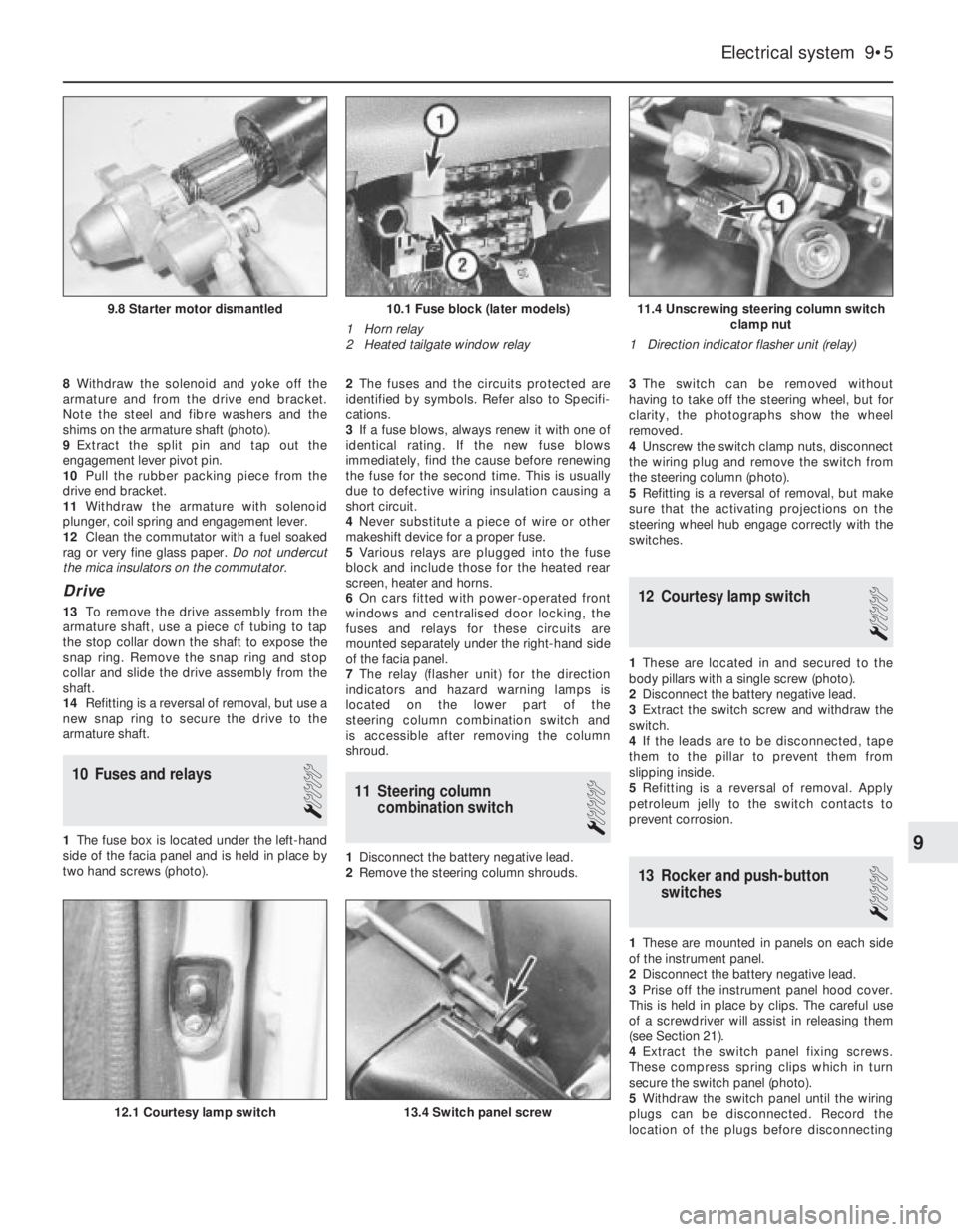
1The fuse box is located under the left-hand
side of the facia panel and is held in place by
two hand screws (photo).2The fuses and the circuits protected are
identified by symbols. Refer also to Specifi-
cations.
3If a fuse blows, always renew it with one of
identical rating. If the new fuse blows
immediately, find the cause before renewing
the fuse for the second time. This is usually
due to defective wiring insulation causing a
short circuit.
4Never substitute a piece of wire or other
makeshift device for a proper fuse.
5Various relays are plugged into the fuse
block and include those for the heated rear
screen, heater and horns.
6On cars fitted with power-operated front
windows and centralised door locking, the
fuses and relays for these circuits are
mounted separately under the right-hand side
of the facia panel.
7The relay (flasher unit) for the direction
indicators and hazard warning lamps is
located on the lower part of the
steering column combination switch and
is accessible after removing the column
shroud.
11 Steering column
combination switch
1
1Disconnect the battery negative lead.
2Remove the steering column shrouds. 3The switch can be removed without
having to take off the steering wheel, but for
clarity, the photographs show the wheel
removed.
4Unscrew the switch clamp nuts, disconnect
the wiring plug and remove the switch from
the steering column (photo).
5Refitting is a reversal of removal, but make
sure that the activating projections on the
steering wheel hub engage correctly with the
switches.
12 Courtesy lamp switch
1
1These are located in and secured to the
body pillars with a single screw (photo).
2Disconnect the battery negative lead.
3Extract the switch screw and withdraw the
switch.
4If the leads are to be disconnected, tape
them to the pillar to prevent them from
slipping inside.
5Refitting is a reversal of removal. Apply
petroleum jelly to the switch contacts to
prevent corrosion.
13 Rocker and push-button
switches
1
1These are mounted in panels on each side
of the instrument panel.
2Disconnect the battery negative lead.
3Prise off the instrument panel hood cover.
This is held in place by clips. The careful use
of a screwdriver will assist in releasing them
(see Section 21).
4Extract the switch panel fixing screws.
These compress spring clips which in turn
secure the switch panel (photo).
5Withdraw the switch panel until the wiring
plugs can be disconnected. Record the
location of the plugs before disconnecting
Electrical system 9•5
11.4 Unscrewing steering column switch
clamp nut
1 Direction indicator flasher unit (relay)10.1 Fuse block (later models)
1 Horn relay
2 Heated tailgate window relay9.8 Starter motor dismantled
13.4 Switch panel screw12.1 Courtesy lamp switch
9
Page 97 of 303
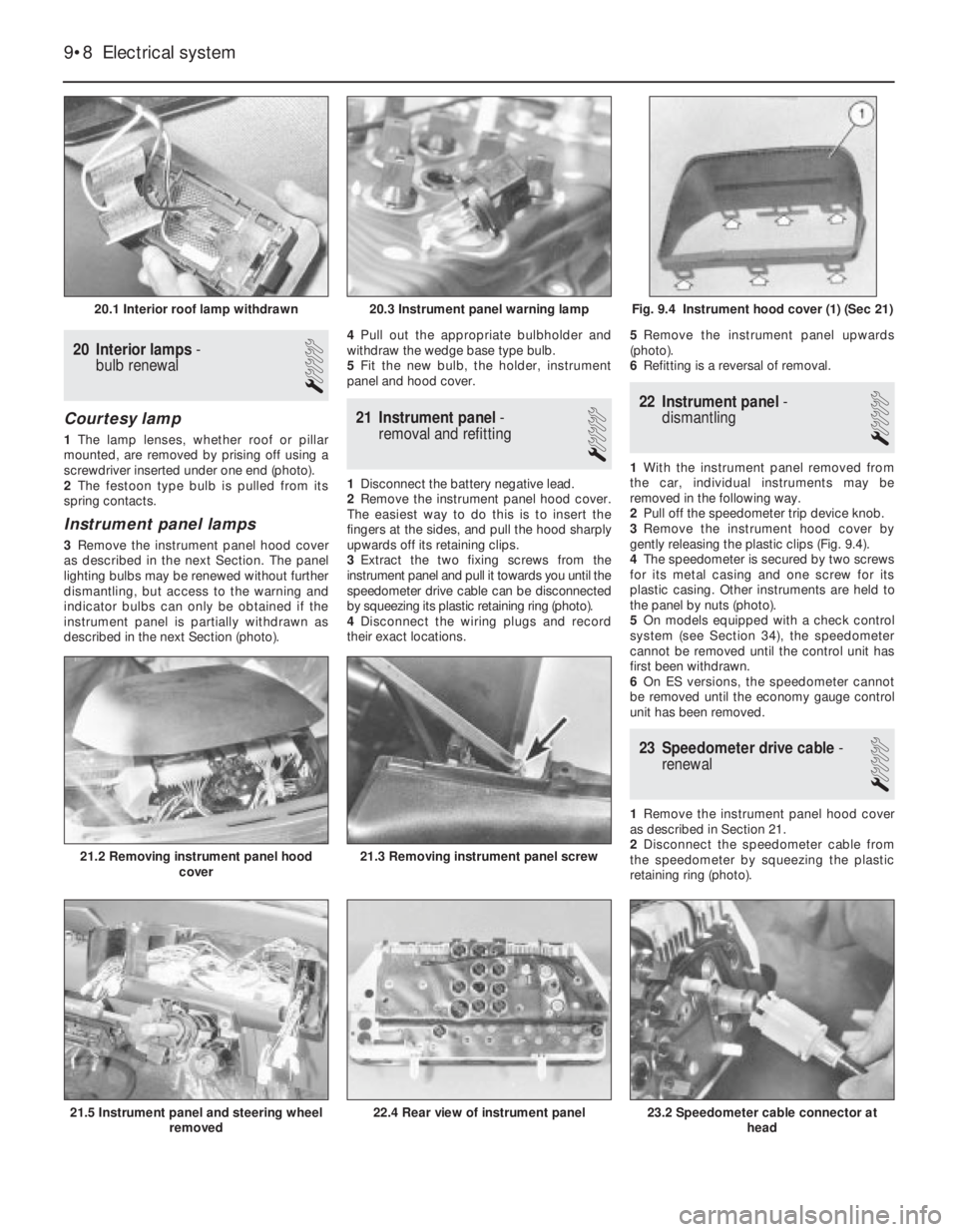
20 Interior lamps-
bulb renewal
1
Courtesy lamp
1The lamp lenses, whether roof or pillar
mounted, are removed by prising off using a
screwdriver inserted under one end (photo).
2The festoon type bulb is pulled from its
spring contacts.
Instrument panel lamps
3Remove the instrument panel hood cover
as described in the next Section. The panel
lighting bulbs may be renewed without further
dismantling, but access to the warning and
indicator bulbs can only be obtained if the
instrument panel is partially withdrawn as
described in the next Section (photo). 4Pull out the appropriate bulbholder and
withdraw the wedge base type bulb.
5Fit the new bulb, the holder, instrument
panel and hood cover.
21 Instrument panel-
removal and refitting
1
1Disconnect the battery negative lead.
2Remove the instrument panel hood cover.
The easiest way to do this is to insert the
fingers at the sides, and pull the hood sharply
upwards off its retaining clips.
3Extract the two fixing screws from the
instrument panel and pull it towards you until the
speedometer drive cable can be disconnected
by squeezing its plastic retaining ring (photo).
4Disconnect the wiring plugs and record
their exact locations. 5Remove the instrument panel upwards
(photo).
6Refitting is a reversal of removal.
22 Instrument panel-
dismantling
1
1With the instrument panel removed from
the car, individual instruments may be
removed in the following way.
2Pull off the speedometer trip device knob.
3Remove the instrument hood cover by
gently releasing the plastic clips (Fig. 9.4).
4The speedometer is secured by two screws
for its metal casing and one screw for its
plastic casing. Other instruments are held to
the panel by nuts (photo).
5On models equipped with a check control
system (see Section 34), the speedometer
cannot be removed until the control unit has
first been withdrawn.
6On ES versions, the speedometer cannot
be removed until the economy gauge control
unit has been removed.
23 Speedometer drive cable-
renewal
1
1Remove the instrument panel hood cover
as described in Section 21.
2Disconnect the speedometer cable from
the speedometer by squeezing the plastic
retaining ring (photo).
9•8 Electrical system
23.2 Speedometer cable connector at
head22.4 Rear view of instrument panel21.5 Instrument panel and steering wheel
removed
21.3 Removing instrument panel screw21.2 Removing instrument panel hood
cover
Fig. 9.4 Instrument hood cover (1) (Sec 21)20.3 Instrument panel warning lamp20.1 Interior roof lamp withdrawn
Page 104 of 303
10
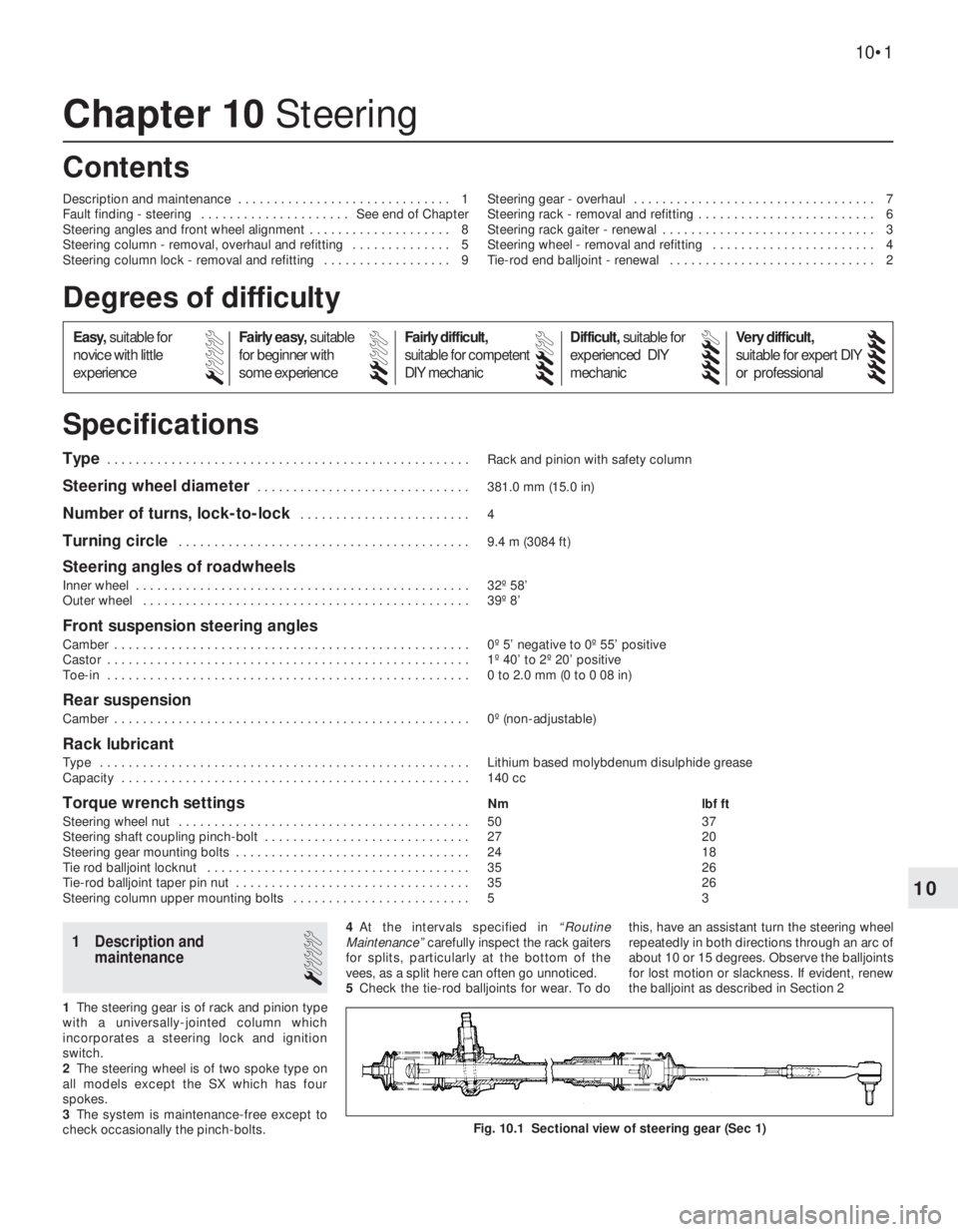
Type . . . . . . . . . . . . . . . . . . . . . . . . . . . . . . . . . . . . . . . . . . . . . . . . . . . Rack and pinion with safety column
Steering wheel diameter . . . . . . . . . . . . . . . . . . . . . . . . . . . . . . 381.0 mm (15.0 in)
Number of turns, lock-to-lock . . . . . . . . . . . . . . . . . . . . . . . . 4
Turning circle . . . . . . . . . . . . . . . . . . . . . . . . . . . . . . . . . . . . . . . . . 9.4 m (3084 ft)
Steering angles of roadwheels
Inner wheel . . . . . . . . . . . . . . . . . . . . . . . . . . . . . . . . . . . . . . . . . . . . . . . 32º 58’
Outer wheel . . . . . . . . . . . . . . . . . . . . . . . . . . . . . . . . . . . . . . . . . . . . . . 39º 8’
Front suspension steering angles
Camber . . . . . . . . . . . . . . . . . . . . . . . . . . . . . . . . . . . . . . . . . . . . . . . . . . 0º 5’ negative to 0º 55’ positive
Castor . . . . . . . . . . . . . . . . . . . . . . . . . . . . . . . . . . . . . . . . . . . . . . . . . . . 1º 40’ to 2º 20’ positive
Toe-in . . . . . . . . . . . . . . . . . . . . . . . . . . . . . . . . . . . . . . . . . . . . . . . . . . . 0 to 2.0 mm (0 to 0 08 in)
Rear suspension
Camber . . . . . . . . . . . . . . . . . . . . . . . . . . . . . . . . . . . . . . . . . . . . . . . . . . 0º (non-adjustable)
Rack lubricant
Type . . . . . . . . . . . . . . . . . . . . . . . . . . . . . . . . . . . . . . . . . . . . . . . . . . . . Lithium based molybdenum disulphide grease
Capacity . . . . . . . . . . . . . . . . . . . . . . . . . . . . . . . . . . . . . . . . . . . . . . . . . 140 cc
Torque wrench settingsNm lbf ft
Steering wheel nut . . . . . . . . . . . . . . . . . . . . . . . . . . . . . . . . . . . . . . . . . 50 37
Steering shaft coupling pinch-bolt . . . . . . . . . . . . . . . . . . . . . . . . . . . . . 27 20
Steering gear mounting bolts . . . . . . . . . . . . . . . . . . . . . . . . . . . . . . . . . 24 18
Tie rod balljoint locknut . . . . . . . . . . . . . . . . . . . . . . . . . . . . . . . . . . . . . 35 26
Tie-rod balljoint taper pin nut . . . . . . . . . . . . . . . . . . . . . . . . . . . . . . . . . 35 26
Steering column upper mounting bolts . . . . . . . . . . . . . . . . . . . . . . . . . 5 3
Chapter 10 Steering
Description and maintenance . . . . . . . . . . . . . . . . . . . . . . . . . . . . . . 1
Fault finding - steering . . . . . . . . . . . . . . . . . . . . . See end of Chapter
Steering angles and front wheel alignment . . . . . . . . . . . . . . . . . . . . 8
Steering column - removal, overhaul and refitting . . . . . . . . . . . . . . 5
Steering column lock - removal and refitting . . . . . . . . . . . . . . . . . . 9Steering gear - overhaul . . . . . . . . . . . . . . . . . . . . . . . . . . . . . . . . . . 7
Steering rack - removal and refitting . . . . . . . . . . . . . . . . . . . . . . . . . 6
Steering rack gaiter - renewal . . . . . . . . . . . . . . . . . . . . . . . . . . . . . . 3
Steering wheel - removal and refitting . . . . . . . . . . . . . . . . . . . . . . . 4
Tie-rod end balljoint - renewal . . . . . . . . . . . . . . . . . . . . . . . . . . . . . 2
10•1
Specifications Contents
Easy,suitable for
novice with little
experienceFairly easy,suitable
for beginner with
some experienceFairly difficult,
suitable for competent
DIY mechanic
Difficult,suitable for
experienced DIY
mechanicVery difficult,
suitable for expert DIY
or professional
Degrees of difficulty
54321
1 Description and
maintenance
1
1The steering gear is of rack and pinion type
with a universally-jointed column which
incorporates a steering lock and ignition
switch.
2The steering wheel is of two spoke type on
all models except the SX which has four
spokes.
3The system is maintenance-free except to
check occasionally the pinch-bolts.4At the intervals specified in“Routine
Maintenance”carefully inspect the rack gaiters
for splits, particularly at the bottom of the
vees, as a split here can often go unnoticed.
5Check the tie-rod balljoints for wear. To dothis, have an assistant turn the steering wheel
repeatedly in both directions through an arc of
about 10 or 15 degrees. Observe the balljoints
for lost motion or slackness. If evident, renew
the balljoint as described in Section 2
Fig. 10.1 Sectional view of steering gear (Sec 1)
Page 105 of 303
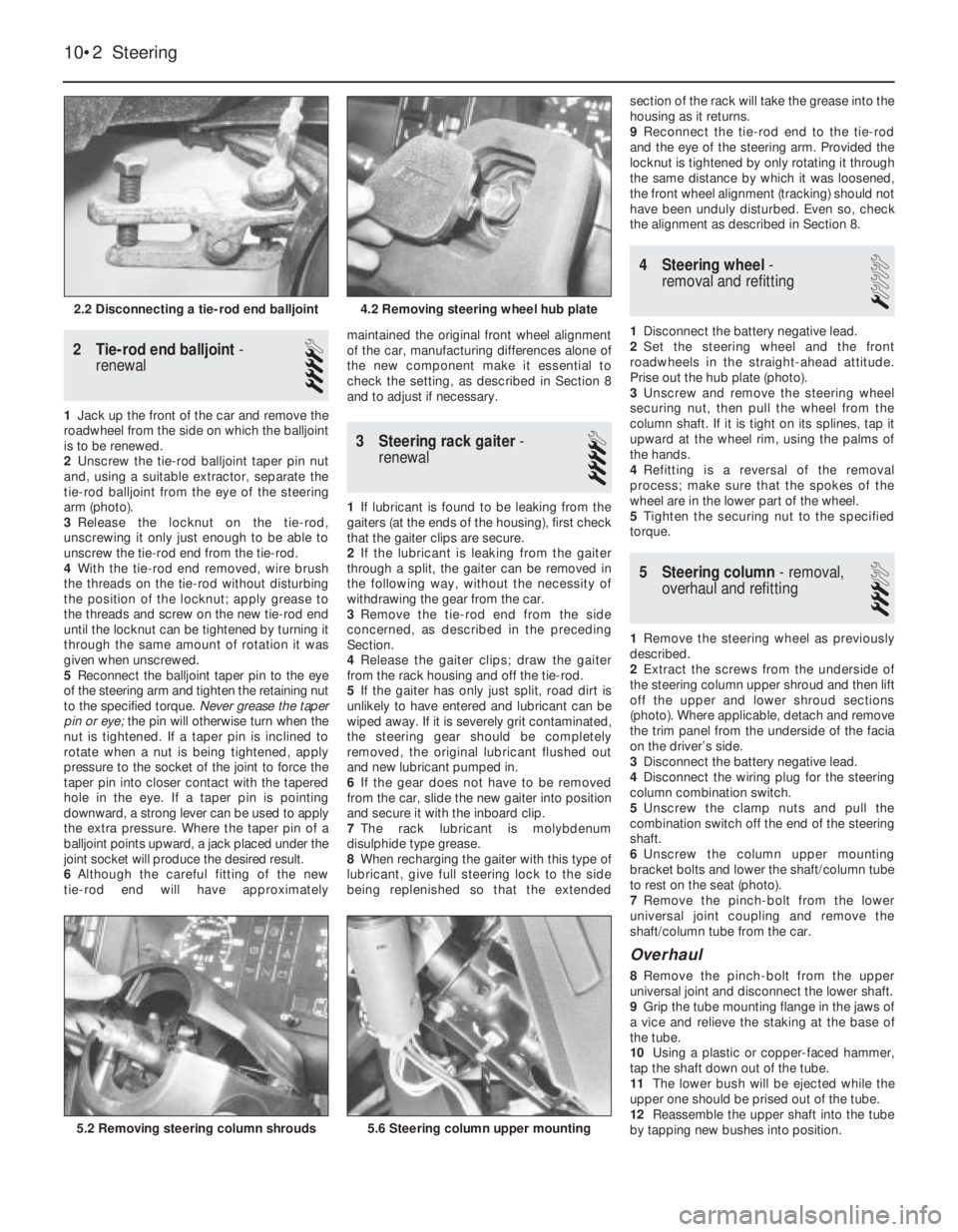
2 Tie-rod end balljoint-
renewal
4
1Jack up the front of the car and remove the
roadwheel from the side on which the balljoint
is to be renewed.
2Unscrew the tie-rod balljoint taper pin nut
and, using a suitable extractor, separate the
tie-rod balljoint from the eye of the steering
arm (photo).
3Release the locknut on the tie-rod,
unscrewing it only just enough to be able to
unscrew the tie-rod end from the tie-rod.
4With the tie-rod end removed, wire brush
the threads on the tie-rod without disturbing
the position of the locknut; apply grease to
the threads and screw on the new tie-rod end
until the locknut can be tightened by turning it
through the same amount of rotation it was
given when unscrewed.
5Reconnect the balljoint taper pin to the eye
of the steering arm and tighten the retaining nut
to the specified torque. Never grease the taper
pin or eye; the pin will otherwise turn when the
nut is tightened. If a taper pin is inclined to
rotate when a nut is being tightened, apply
pressure to the socket of the joint to force the
taper pin into closer contact with the tapered
hole in the eye. If a taper pin is pointing
downward, a strong lever can be used to apply
the extra pressure. Where the taper pin of a
balljoint points upward, a jack placed under the
joint socket will produce the desired result.
6Although the careful fitting of the new
tie-rod end will have approximatelymaintained the original front wheel alignment
of the car, manufacturing differences alone of
the new component make it essential to
check the setting, as described in Section 8
and to adjust if necessary.
3 Steering rack gaiter-
renewal
4
1If lubricant is found to be leaking from the
gaiters (at the ends of the housing), first check
that the gaiter clips are secure.
2If the lubricant is leaking from the gaiter
through a split, the gaiter can be removed in
the following way, without the necessity of
withdrawing the gear from the car.
3Remove the tie-rod end from the side
concerned, as described in the preceding
Section.
4Release the gaiter clips; draw the gaiter
from the rack housing and off the tie-rod.
5If the gaiter has only just split, road dirt is
unlikely to have entered and lubricant can be
wiped away. If it is severely grit contaminated,
the steering gear should be completely
removed, the original lubricant flushed out
and new lubricant pumped in.
6If the gear does not have to be removed
from the car, slide the new gaiter into position
and secure it with the inboard clip.
7The rack lubricant is molybdenum
disulphide type grease.
8When recharging the gaiter with this type of
lubricant, give full steering lock to the side
being replenished so that the extendedsection of the rack will take the grease into the
housing as it returns.
9Reconnect the tie-rod end to the tie-rod
and the eye of the steering arm. Provided the
locknut is tightened by only rotating it through
the same distance by which it was loosened,
the front wheel alignment (tracking) should not
have been unduly disturbed. Even so, check
the alignment as described in Section 8.
4 Steering wheel-
removal and refitting
1
1Disconnect the battery negative lead.
2Set the steering wheel and the front
roadwheels in the straight-ahead attitude.
Prise out the hub plate (photo).
3Unscrew and remove the steering wheel
securing nut, then pull the wheel from the
column shaft. If it is tight on its splines, tap it
upward at the wheel rim, using the palms of
the hands.
4Refitting is a reversal of the removal
process; make sure that the spokes of the
wheel are in the lower part of the wheel.
5Tighten the securing nut to the specified
torque.
5 Steering column- removal,
overhaul and refitting
3
1Remove the steering wheel as previously
described.
2Extract the screws from the underside of
the steering column upper shroud and then lift
off the upper and lower shroud sections
(photo). Where applicable, detach and remove
the trim panel from the underside of the facia
on the driver’s side.
3Disconnect the battery negative lead.
4Disconnect the wiring plug for the steering
column combination switch.
5Unscrew the clamp nuts and pull the
combination switch off the end of the steering
shaft.
6Unscrew the column upper mounting
bracket bolts and lower the shaft/column tube
to rest on the seat (photo).
7Remove the pinch-bolt from the lower
universal joint coupling and remove the
shaft/column tube from the car.
Overhaul
8Remove the pinch-bolt from the upper
universal joint and disconnect the lower shaft.
9Grip the tube mounting flange in the jaws of
a vice and relieve the staking at the base of
the tube.
10Using a plastic or copper-faced hammer,
tap the shaft down out of the tube.
11The lower bush will be ejected while the
upper one should be prised out of the tube.
12Reassemble the upper shaft into the tube
by tapping new bushes into position.
10•2 Steering
5.6 Steering column upper mounting5.2 Removing steering column shrouds
4.2 Removing steering wheel hub plate2.2 Disconnecting a tie-rod end balljoint
Page 106 of 303
13Stake the lower end of the tube to retain
the bush.
14Reassembly is a reversal of removal,
noting that the universal joint coupling
pinch-bolts should pass smoothly through the
grooves in the steering shaft.
15Fit the steering wheel when the
roadwheels are in the straight-ahead position.
16Tighten all nuts and bolts to the specified
torque. Reconnect the battery.
6 Steering rack-
removal and refitting
4
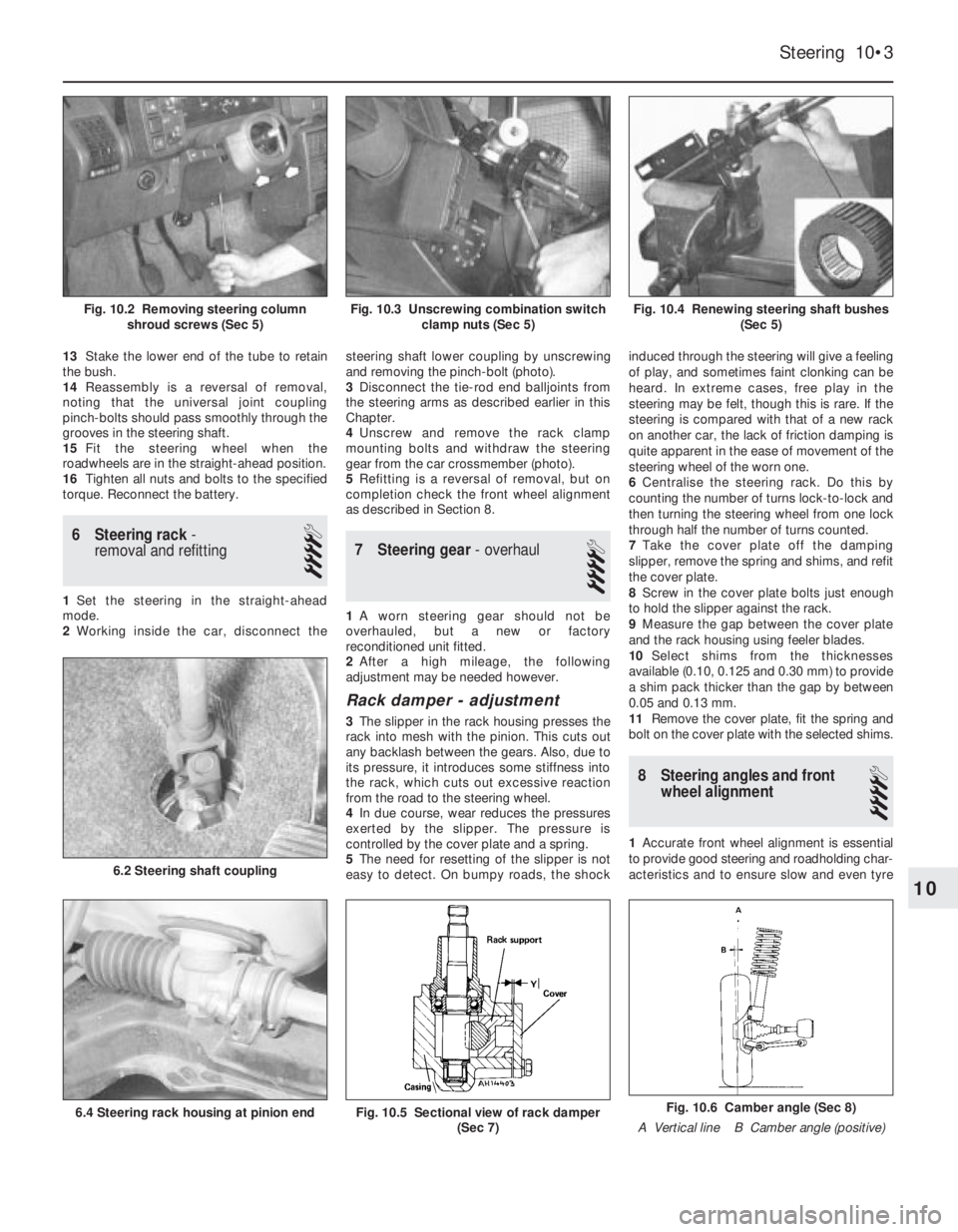
1Set the steering in the straight-ahead
mode.
2Working inside the car, disconnect thesteering shaft lower coupling by unscrewing
and removing the pinch-bolt (photo).
3Disconnect the tie-rod end balljoints from
the steering arms as described earlier in this
Chapter.
4Unscrew and remove the rack clamp
mounting bolts and withdraw the steering
gear from the car crossmember (photo).
5Refitting is a reversal of removal, but on
completion check the front wheel alignment
as described in Section 8.
7 Steering gear- overhaul
4
1A worn steering gear should not be
overhauled, but a new or factory
reconditioned unit fitted.
2After a high mileage, the following
adjustment may be needed however.
Rack damper - adjustment
3The slipper in the rack housing presses the
rack into mesh with the pinion. This cuts out
any backlash between the gears. Also, due to
its pressure, it introduces some stiffness into
the rack, which cuts out excessive reaction
from the road to the steering wheel.
4In due course, wear reduces the pressures
exerted by the slipper. The pressure is
controlled by the cover plate and a spring.
5The need for resetting of the slipper is not
easy to detect. On bumpy roads, the shockinduced through the steering will give a feeling
of play, and sometimes faint clonking can be
heard. In extreme cases, free play in the
steering may be felt, though this is rare. If the
steering is compared with that of a new rack
on another car, the lack of friction damping is
quite apparent in the ease of movement of the
steering wheel of the worn one.
6Centralise the steering rack. Do this by
counting the number of turns lock-to-lock and
then turning the steering wheel from one lock
through half the number of turns counted.
7Take the cover plate off the damping
slipper, remove the spring and shims, and refit
the cover plate.
8Screw in the cover plate bolts just enough
to hold the slipper against the rack.
9Measure the gap between the cover plate
and the rack housing using feeler blades.
10Select shims from the thicknesses
available (0.10, 0.125 and 0.30 mm) to provide
a shim pack thicker than the gap by between
0.05 and 0.13 mm.
11Remove the cover plate, fit the spring and
bolt on the cover plate with the selected shims.
8 Steering angles and front
wheel alignment
4
1Accurate front wheel alignment is essential
to provide good steering and roadholding char-
acteristics and to ensure slow and even tyre
Steering 10•3
Fig. 10.4 Renewing steering shaft bushes
(Sec 5)Fig. 10.3 Unscrewing combination switch
clamp nuts (Sec 5)Fig. 10.2 Removing steering column
shroud screws (Sec 5)
Fig. 10.6 Camber angle (Sec 8)
A Vertical line B Camber angle (positive)Fig. 10.5 Sectional view of rack damper
(Sec 7)6.4 Steering rack housing at pinion end
10
6.2 Steering shaft coupling
Page 107 of 303
Note: Before diagnosing steering faults, be
sure that trouble is not due to incorrect or
uneven tyre pressures, inappropriate tyre
combinations, or braking system or
suspension defects.
Car pulls to one side
m mIncorrect steering geometry
m mCollision damage
Vibration at steering wheel
m
mRoadwheels out of balance or loose
m mTyre damage
m mLoose driveshaft-to-hub nuts
Car wanders
m
mPlay in steering gear
m mWear in steering balljoints
Heavy or stiff steering
m
mLack of lubricant in steering gear or balljoints
m mIncorrect steering geometry
m mCollision damage
Play at steering wheel
m
mWear in steering rack or balljoints
m mLoose steering shaft coupling pinch-bolt or
worn splines
m mWorn steering column/shaft universal joints
Rattles from steering
m
mSteering damper defective or in need of
adjustment
m mLoose steering column mounting bolts
m mLoose steering column/shaft coupling
pinch-bolts
m mLoose steering rack housing mounting bolts
m mWorn steering shaft bushes
Excessive or uneven tyre wear
m
mIncorrect steering geometry
m mWorn steering components
m mCollision damage wear. Before considering the steering angles,
check that the tyres are correctly inflated, that
the front wheels are not buckled, the hub
bearings are not worn or incorrectly adjusted
and that the steering linkage is in good order,
without slackness or wear at the joints.
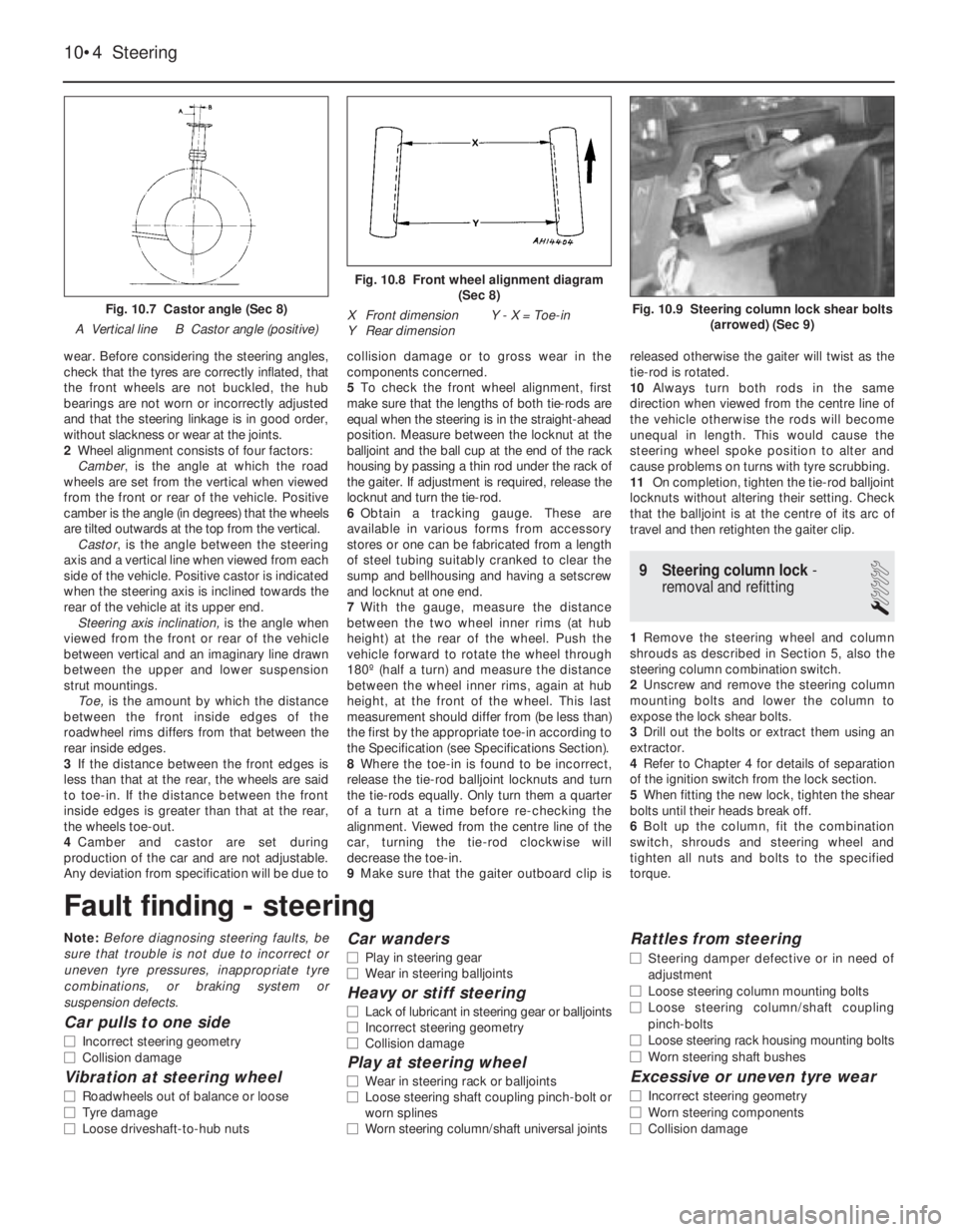
2Wheel alignment consists of four factors:
Camber, is the angle at which the road
wheels are set from the vertical when viewed
from the front or rear of the vehicle. Positive
camber is the angle (in degrees) that the wheels
are tilted outwards at the top from the vertical.
Castor, is the angle between the steering
axis and a vertical line when viewed from each
side of the vehicle. Positive castor is indicated
when the steering axis is inclined towards the
rear of the vehicle at its upper end.
Steering axis inclination, is the angle when
viewed from the front or rear of the vehicle
between vertical and an imaginary line drawn
between the upper and lower suspension
strut mountings.
Toe,is the amount by which the distance
between the front inside edges of the
roadwheel rims differs from that between the
rear inside edges.
3If the distance between the front edges is
less than that at the rear, the wheels are said
to toe-in. If the distance between the front
inside edges is greater than that at the rear,
the wheels toe-out.
4Camber and castor are set during
production of the car and are not adjustable.
Any deviation from specification will be due tocollision damage or to gross wear in the
components concerned.
5To check the front wheel alignment, first
make sure that the lengths of both tie-rods are
equal when the steering is in the straight-ahead
position. Measure between the locknut at the
balljoint and the ball cup at the end of the rack
housing by passing a thin rod under the rack of
the gaiter. If adjustment is required, release the
locknut and turn the tie-rod.
6Obtain a tracking gauge. These are
available in various forms from accessory
stores or one can be fabricated from a length
of steel tubing suitably cranked to clear the
sump and bellhousing and having a setscrew
and locknut at one end.
7With the gauge, measure the distance
between the two wheel inner rims (at hub
height) at the rear of the wheel. Push the
vehicle forward to rotate the wheel through
180º (half a turn) and measure the distance
between the wheel inner rims, again at hub
height, at the front of the wheel. This last
measurement should differ from (be less than)
the first by the appropriate toe-in according to
the Specification (see Specifications Section).
8Where the toe-in is found to be incorrect,
release the tie-rod balljoint locknuts and turn
the tie-rods equally. Only turn them a quarter
of a turn at a time before re-checking the
alignment. Viewed from the centre line of the
car, turning the tie-rod clockwise will
decrease the toe-in.
9Make sure that the gaiter outboard clip isreleased otherwise the gaiter will twist as the
tie-rod is rotated.
10Always turn both rods in the same
direction when viewed from the centre line of
the vehicle otherwise the rods will become
unequal in length. This would cause the
steering wheel spoke position to alter and
cause problems on turns with tyre scrubbing.
11On completion, tighten the tie-rod balljoint
locknuts without altering their setting. Check
that the balljoint is at the centre of its arc of
travel and then retighten the gaiter clip.
9 Steering column lock-
removal and refitting
1
1Remove the steering wheel and column
shrouds as described in Section 5, also the
steering column combination switch.
2Unscrew and remove the steering column
mounting bolts and lower the column to
expose the lock shear bolts.
3Drill out the bolts or extract them using an
extractor.
4Refer to Chapter 4 for details of separation
of the ignition switch from the lock section.
5When fitting the new lock, tighten the shear
bolts until their heads break off.
6Bolt up the column, fit the combination
switch, shrouds and steering wheel and
tighten all nuts and bolts to the specified
torque.
10•4 Steering
Fig. 10.9 Steering column lock shear bolts
(arrowed) (Sec 9)
Fig. 10.8 Front wheel alignment diagram
(Sec 8)
X Front dimension Y - X = Toe-in
Y Rear dimension
Fig. 10.7 Castor angle (Sec 8)
A Vertical line B Castor angle (positive)
Fault finding - steering
Page 111 of 303
balljoint from the hub carrier using a suitable
“splitter” tool. If such a tool is not available,
support the base of the brake disc and drive
the balljoint taper pin downwards, but screw
on the nut to protect the threads.
4Remove the hub carrier.
5Refitting is a reversal of removal, use a new
driveshaft nut and tighten all nuts and bolts to
the specified torque. Stake the driveshaft nut
after tightening.
6 Track control arm-
removal and refitting
3
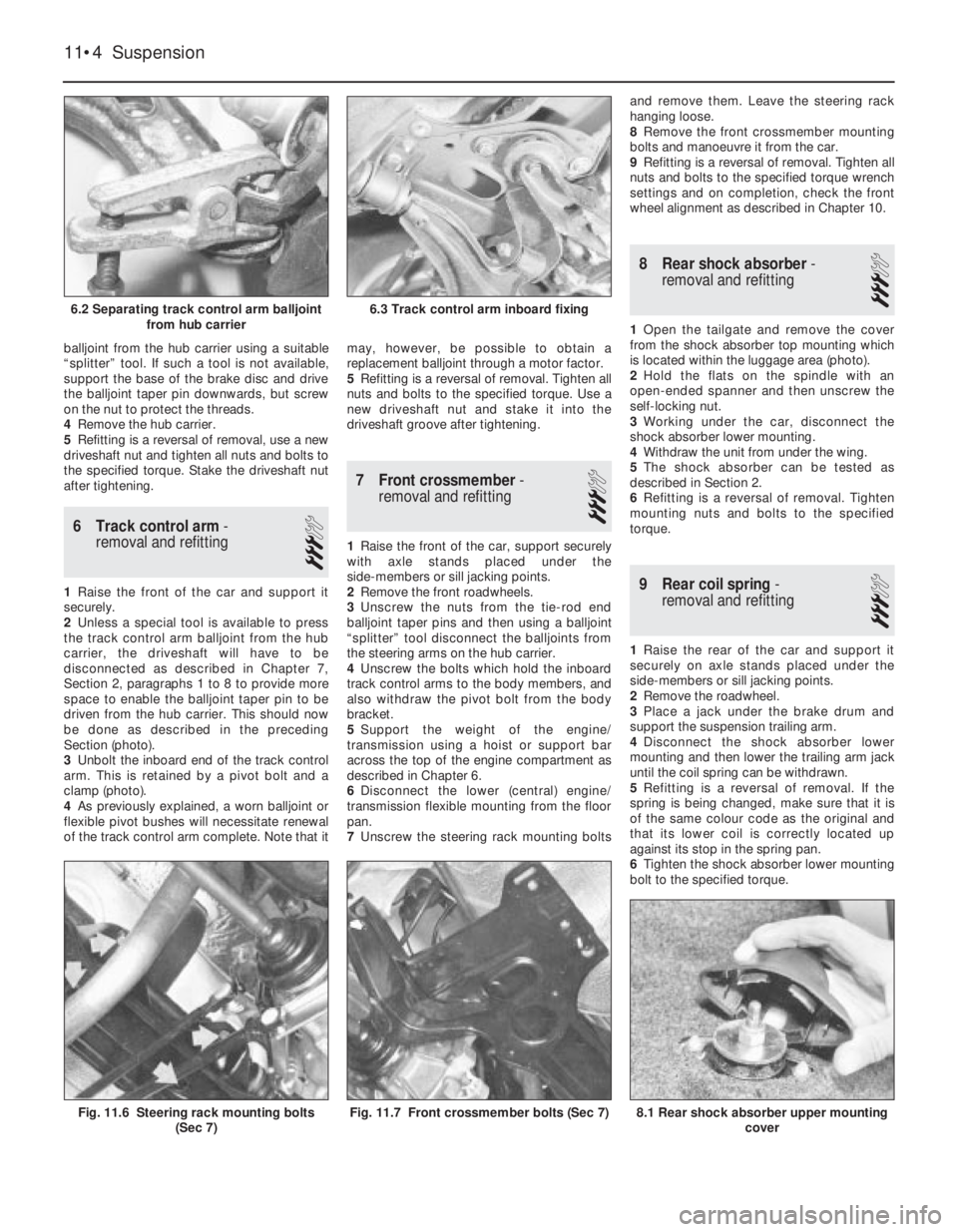
1Raise the front of the car and support it
securely.
2Unless a special tool is available to press
the track control arm balljoint from the hub
carrier, the driveshaft will have to be
disconnected as described in Chapter 7,
Section 2, paragraphs 1 to 8 to provide more
space to enable the balljoint taper pin to be
driven from the hub carrier. This should now
be done as described in the preceding
Section (photo).
3Unbolt the inboard end of the track control
arm. This is retained by a pivot bolt and a
clamp (photo).
4As previously explained, a worn balljoint or
flexible pivot bushes will necessitate renewal
of the track control arm complete. Note that itmay, however, be possible to obtain a
replacement balljoint through a motor factor.
5Refitting is a reversal of removal. Tighten all
nuts and bolts to the specified torque. Use a
new driveshaft nut and stake it into the
driveshaft groove after tightening.
7 Front crossmember-
removal and refitting
3
1Raise the front of the car, support securely
with axle stands placed under the
side-members or sill jacking points.
2Remove the front roadwheels.
3Unscrew the nuts from the tie-rod end
balljoint taper pins and then using a balljoint
“splitter” tool disconnect the balljoints from
the steering arms on the hub carrier.
4Unscrew the bolts which hold the inboard
track control arms to the body members, and
also withdraw the pivot bolt from the body
bracket.
5Support the weight of the engine/
transmission using a hoist or support bar
across the top of the engine compartment as
described in Chapter 6.
6Disconnect the lower (central) engine/
transmission flexible mounting from the floor
pan.
7Unscrew the steering rack mounting boltsand remove them. Leave the steering rack
hanging loose.
8Remove the front crossmember mounting
bolts and manoeuvre it from the car.
9Refitting is a reversal of removal. Tighten all
nuts and bolts to the specified torque wrench
settings and on completion, check the front
wheel alignment as described in Chapter 10.
8 Rear shock absorber-
removal and refitting
3
1Open the tailgate and remove the cover
from the shock absorber top mounting which
is located within the luggage area (photo).
2Hold the flats on the spindle with an
open-ended spanner and then unscrew the
self-locking nut.
3Working under the car, disconnect the
shock absorber lower mounting.
4Withdraw the unit from under the wing.
5The shock absorber can be tested as
described in Section 2.
6Refitting is a reversal of removal. Tighten
mounting nuts and bolts to the specified
torque.
9 Rear coil spring-
removal and refitting
3
1Raise the rear of the car and support it
securely on axle stands placed under the
side-members or sill jacking points.
2Remove the roadwheel.
3Place a jack under the brake drum and
support the suspension trailing arm.
4Disconnect the shock absorber lower
mounting and then lower the trailing arm jack
until the coil spring can be withdrawn.
5Refitting is a reversal of removal. If the
spring is being changed, make sure that it is
of the same colour code as the original and
that its lower coil is correctly located up
against its stop in the spring pan.
6Tighten the shock absorber lower mounting
bolt to the specified torque.
11•4 Suspension
8.1 Rear shock absorber upper mounting
coverFig. 11.7 Front crossmember bolts (Sec 7)Fig. 11.6 Steering rack mounting bolts
(Sec 7)
6.3 Track control arm inboard fixing6.2 Separating track control arm balljoint
from hub carrier