change wheel FIAT UNO 1983 Service Owner's Manual
[x] Cancel search | Manufacturer: FIAT, Model Year: 1983, Model line: UNO, Model: FIAT UNO 1983Pages: 303, PDF Size: 10.36 MB
Page 161 of 303
Engine oil cooler -
removal and refittingÁ
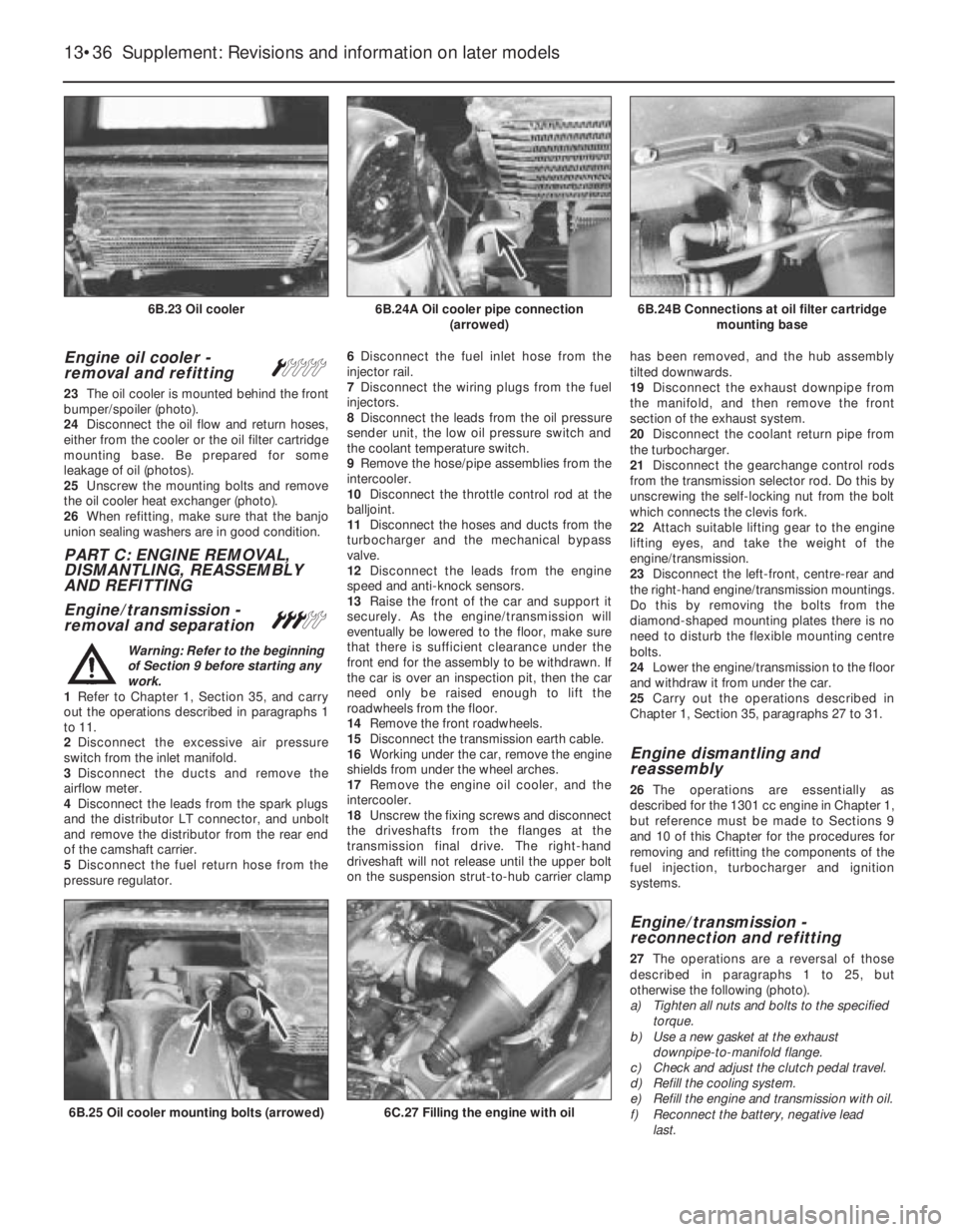
23The oil cooler is mounted behind the front
bumper/spoiler (photo).
24Disconnect the oil flow and return hoses,
either from the cooler or the oil filter cartridge
mounting base. Be prepared for some
leakage of oil (photos).
25Unscrew the mounting bolts and remove
the oil cooler heat exchanger (photo).
26When refitting, make sure that the banjo
union sealing washers are in good condition.
PART C: ENGINE REMOVAL,
DISMANTLING, REASSEMBLY
AND REFITTING
Engine/transmission -
removal and separation
#
Warning: Refer to the beginning
of Section 9 before starting any
work.
1Refer to Chapter 1, Section 35, and carry
out the operations described in paragraphs 1
to 11.
2Disconnect the excessive air pressure
switch from the inlet manifold.
3Disconnect the ducts and remove the
airflow meter.
4Disconnect the leads from the spark plugs
and the distributor LT connector, and unbolt
and remove the distributor from the rear end
of the camshaft carrier.
5Disconnect the fuel return hose from the
pressure regulator. 6Disconnect the fuel inlet hose from the
injector rail.
7Disconnect the wiring plugs from the fuel
injectors.
8Disconnect the leads from the oil pressure
sender unit, the low oil pressure switch and
the coolant temperature switch.
9Remove the hose/pipe assemblies from the
intercooler.
10Disconnect the throttle control rod at the
balljoint.
11Disconnect the hoses and ducts from the
turbocharger and the mechanical bypass
valve.
12Disconnect the leads from the engine
speed and anti-knock sensors.
13Raise the front of the car and support it
securely. As the engine/transmission will
eventually be lowered to the floor, make sure
that there is sufficient clearance under the
front end for the assembly to be withdrawn. If
the car is over an inspection pit, then the car
need only be raised enough to lift the
roadwheels from the floor.
14Remove the front roadwheels.
15Disconnect the transmission earth cable.
16Working under the car, remove the engine
shields from under the wheel arches.
17Remove the engine oil cooler, and the
intercooler.
18Unscrew the fixing screws and disconnect
the driveshafts from the flanges at the
transmission final drive. The right-hand
driveshaft will not release until the upper bolt
on the suspension strut-to-hub carrier clamphas been removed, and the hub assembly
tilted downwards.
19Disconnect the exhaust downpipe from
the manifold, and then remove the front
section of the exhaust system.
20Disconnect the coolant return pipe from
the turbocharger.
21Disconnect the gearchange control rods
from the transmission selector rod. Do this by
unscrewing the self-locking nut from the bolt
which connects the clevis fork.
22Attach suitable lifting gear to the engine
lifting eyes, and take the weight of the
engine/transmission.
23Disconnect the left-front, centre-rear and
the right-hand engine/transmission mountings.
Do this by removing the bolts from the
diamond-shaped mounting plates there is no
need to disturb the flexible mounting centre
bolts.
24Lower the engine/transmission to the floor
and withdraw it from under the car.
25Carry out the operations described in
Chapter 1, Section 35, paragraphs 27 to 31.
Engine dismantling and
reassembly
26The operations are essentially as
described for the 1301 cc engine in Chapter 1,
but reference must be made to Sections 9
and 10 of this Chapter for the procedures for
removing and refitting the components of the
fuel injection, turbocharger and ignition
systems.
Engine/transmission -
reconnection and refitting
27The operations are a reversal of those
described in paragraphs 1 to 25, but
otherwise the following (photo).
a) Tighten all nuts and bolts to the specified
torque.
b) Use a new gasket at the exhaust
downpipe-to-manifold flange.
c) Check and adjust the clutch pedal travel.
d) Refill the cooling system.
e) Refill the engine and transmission with oil.
f) Reconnect the battery, negative lead
last.
13•36 Supplement: Revisions and information on later models
6C.27 Filling the engine with oil6B.25 Oil cooler mounting bolts (arrowed)
6B.24B Connections at oil filter cartridge
mounting base6B.24A Oil cooler pipe connection
(arrowed)6B.23 Oil cooler
Page 163 of 303
9Turn the engine clockwise using a suitable
socket on the crankshaft pulley bolt, until the
exhaust valve of No 1 cylinder (valve No 1) is
fully closed; ie the cam lobe is pointing
directly upwards. Alternatively, the engine can
be turned by jacking up one front corner of
the vehicle and supporting it securely on an
axle stand (apply the handbrake and chock
the diagonally-opposite rear wheel before
jacking), engaging top gear and turning the
raised roadwheel in the forward direction of
travel. In both cases, it will be easier to turn
the engine if the spark plugs are removed, but
if this is done, take care not to allow dirt or
other foreign matter to enter the spark plug
holes.
10Insert a feeler gauge of the correct
thickness between the cam follower shim and
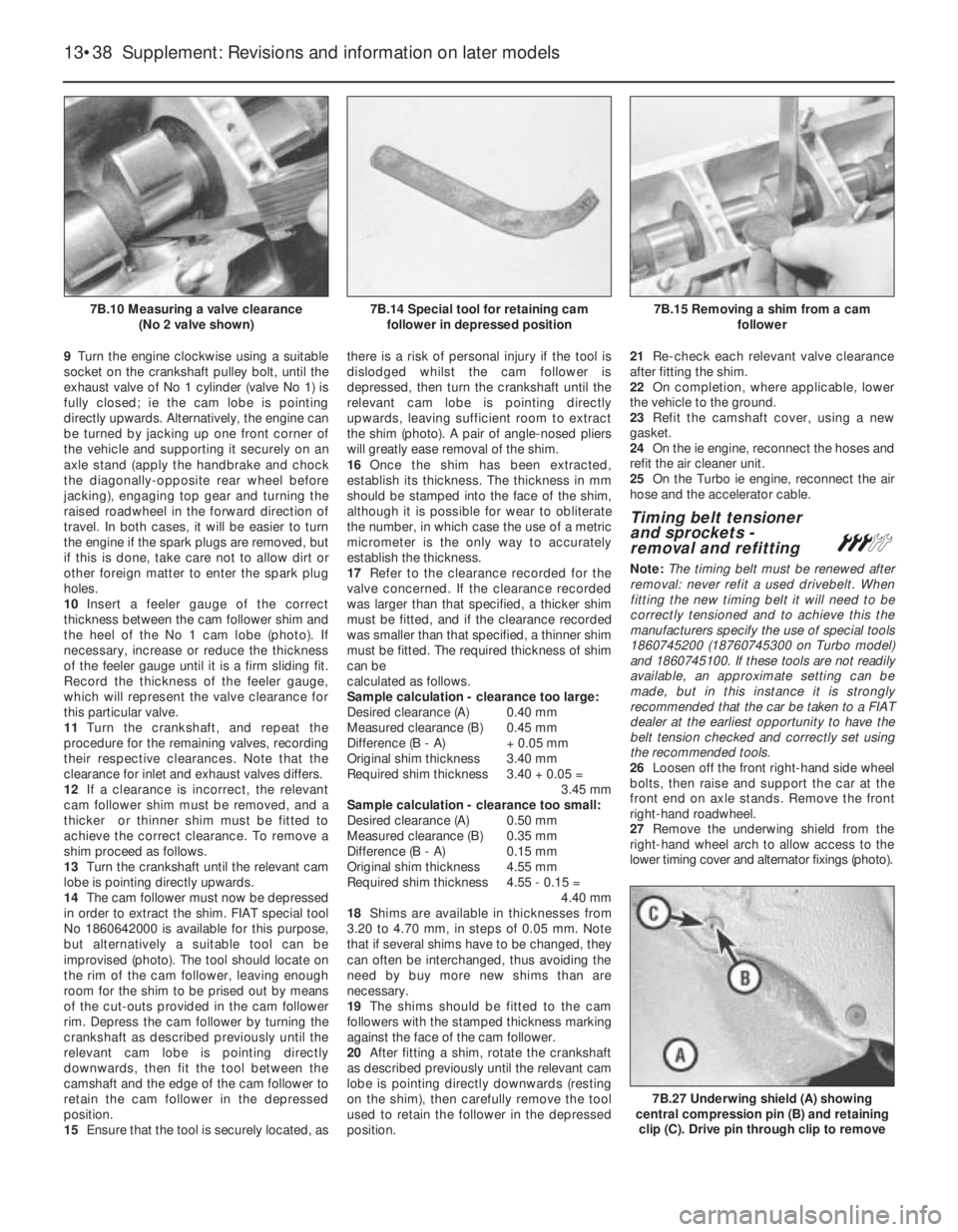
the heel of the No 1 cam lobe (photo). If
necessary, increase or reduce the thickness
of the feeler gauge until it is a firm sliding fit.
Record the thickness of the feeler gauge,
which will represent the valve clearance for
this particular valve.
11Turn the crankshaft, and repeat the
procedure for the remaining valves, recording
their respective clearances. Note that the
clearance for inlet and exhaust valves differs.
12If a clearance is incorrect, the relevant
cam follower shim must be removed, and a
thicker or thinner shim must be fitted to
achieve the correct clearance. To remove a
shim proceed as follows.
13Turn the crankshaft until the relevant cam
lobe is pointing directly upwards.
14The cam follower must now be depressed
in order to extract the shim. FIAT special tool
No 1860642000 is available for this purpose,
but alternatively a suitable tool can be
improvised (photo). The tool should locate on
the rim of the cam follower, leaving enough
room for the shim to be prised out by means
of the cut-outs provided in the cam follower
rim. Depress the cam follower by turning the
crankshaft as described previously until the
relevant cam lobe is pointing directly
downwards, then fit the tool between the
camshaft and the edge of the cam follower to
retain the cam follower in the depressed
position.
15Ensure that the tool is securely located, asthere is a risk of personal injury if the tool is
dislodged whilst the cam follower is
depressed, then turn the crankshaft until the
relevant cam lobe is pointing directly
upwards, leaving sufficient room to extract
the shim (photo). A pair of angle-nosed pliers
will greatly ease removal of the shim.
16Once the shim has been extracted,
establish its thickness. The thickness in mm
should be stamped into the face of the shim,
although it is possible for wear to obliterate
the number, in which case the use of a metric
micrometer is the only way to accurately
establish the thickness.
17Refer to the clearance recorded for the
valve concerned. If the clearance recorded
was larger than that specified, a thicker shim
must be fitted, and if the clearance recorded
was smaller than that specified, a thinner shim
must be fitted. The required thickness of shim
can be
calculated as follows.
Sample calculation - clearance too large:
Desired clearance (A) 0.40 mm
Measured clearance (B) 0.45 mm
Difference (B - A) + 0.05 mm
Original shim thickness 3.40 mm
Required shim thickness 3.40 + 0.05 =
3.45 mm
Sample calculation - clearance too small:
Desired clearance (A) 0.50 mm
Measured clearance (B) 0.35 mm
Difference (B - A) 0.15 mm
Original shim thickness 4.55 mm
Required shim thickness 4.55 - 0.15 =
4.40 mm
18Shims are available in thicknesses from
3.20 to 4.70 mm, in steps of 0.05 mm. Note
that if several shims have to be changed, they
can often be interchanged, thus avoiding the
need by buy more new shims than are
necessary.
19The shims should be fitted to the cam
followers with the stamped thickness marking
against the face of the cam follower.
20After fitting a shim, rotate the crankshaft
as described previously until the relevant cam
lobe is pointing directly downwards (resting
on the shim), then carefully remove the tool
used to retain the follower in the depressed
position.21Re-check each relevant valve clearance
after fitting the shim.
22On completion, where applicable, lower
the vehicle to the ground.
23Refit the camshaft cover, using a new
gasket.
24On the ie engine, reconnect the hoses and
refit the air cleaner unit.
25On the Turbo ie engine, reconnect the air
hose and the accelerator cable.
Timing belt tensioner
and sprockets -
removal and refitting
#
Note: The timing belt must be renewed after
removal: never refit a used drivebelt. When
fitting the new timing belt it will need to be
correctly tensioned and to achieve this the
manufacturers specify the use of special tools
1860745200 (18760745300 on Turbo model)
and 1860745100. If these tools are not readily
available, an approximate setting can be
made, but in this instance it is strongly
recommended that the car be taken to a FIAT
dealer at the earliest opportunity to have the
belt tension checked and correctly set using
the recommended tools.
26Loosen off the front right-hand side wheel
bolts, then raise and support the car at the
front end on axle stands. Remove the front
right-hand roadwheel.
27Remove the underwing shield from the
right-hand wheel arch to allow access to the
lower timing cover and alternator fixings (photo).
13•38 Supplement: Revisions and information on later models
7B.27 Underwing shield (A) showing
central compression pin (B) and retaining
clip (C). Drive pin through clip to remove
7B.15 Removing a shim from a cam
follower7B.14 Special tool for retaining cam
follower in depressed position7B.10 Measuring a valve clearance
(No 2 valve shown)
Page 222 of 303
27The engine must now be supported at its
left-hand end. If the engine/transmission lift
bracket is unbolted it can be attached at
another suitable position on the engine and
the lift sling/tool attached to it, but take care
not to attach it to a weak fixing point.
28The engine will need to be supported
using an engine lift beam/support bar of the
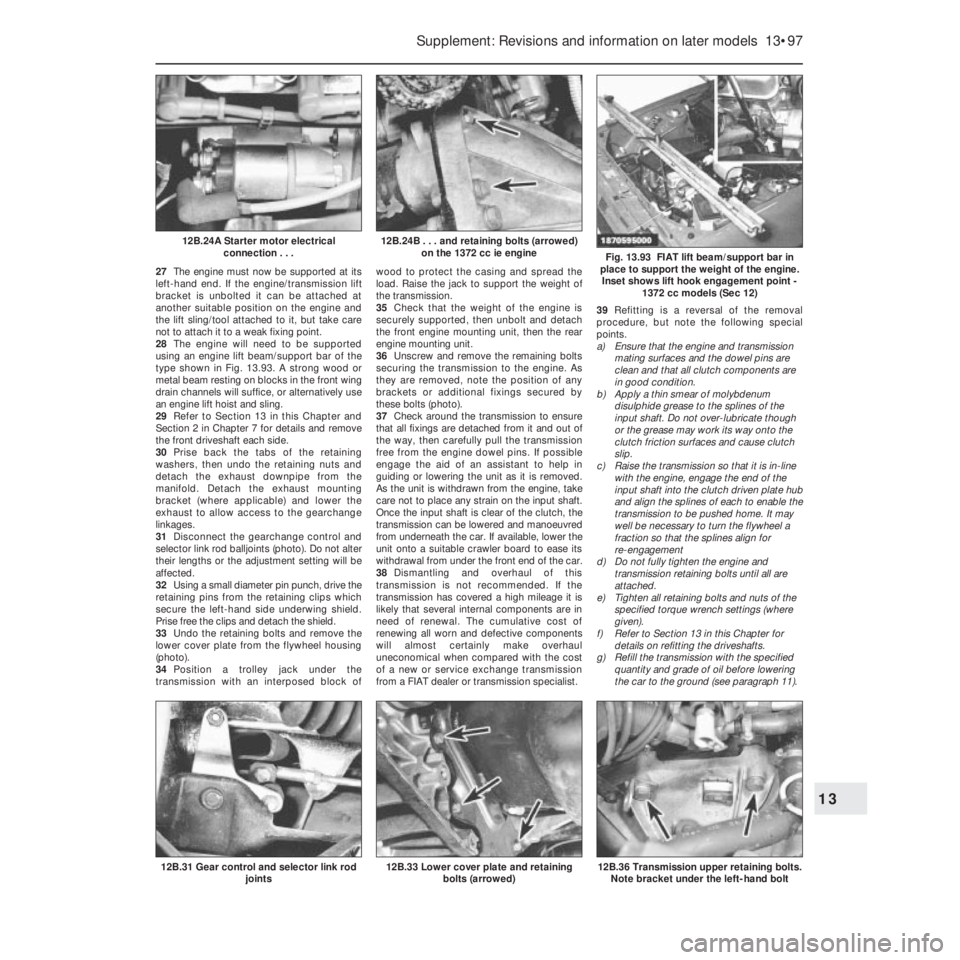
type shown in Fig. 13.93. A strong wood or
metal beam resting on blocks in the front wing
drain channels will suffice, or alternatively use
an engine lift hoist and sling.
29Refer to Section 13 in this Chapter and
Section 2 in Chapter 7 for details and remove
the front driveshaft each side.
30Prise back the tabs of the retaining
washers, then undo the retaining nuts and
detach the exhaust downpipe from the
manifold. Detach the exhaust mounting
bracket (where applicable) and lower the
exhaust to allow access to the gearchange
linkages.
31Disconnect the gearchange control and
selector link rod balljoints (photo). Do not alter
their lengths or the adjustment setting will be
affected.
32Using a small diameter pin punch, drive the
retaining pins from the retaining clips which
secure the left-hand side underwing shield.
Prise free the clips and detach the shield.
33Undo the retaining bolts and remove the
lower cover plate from the flywheel housing
(photo).
34Position a trolley jack under the
transmission with an interposed block ofwood to protect the casing and spread the
load. Raise the jack to support the weight of
the transmission.
35Check that the weight of the engine is
securely supported, then unbolt and detach
the front engine mounting unit, then the rear
engine mounting unit.
36Unscrew and remove the remaining bolts
securing the transmission to the engine. As
they are removed, note the position of any
brackets or additional fixings secured by
these bolts (photo).
37Check around the transmission to ensure
that all fixings are detached from it and out of
the way, then carefully pull the transmission
free from the engine dowel pins. If possible
engage the aid of an assistant to help in
guiding or lowering the unit as it is removed.
As the unit is withdrawn from the engine, take
care not to place any strain on the input shaft.
Once the input shaft is clear of the clutch, the
transmission can be lowered and manoeuvred
from underneath the car. If available, lower the
unit onto a suitable crawler board to ease its
withdrawal from under the front end of the car.
38Dismantling and overhaul of this
transmission is not recommended. If the
transmission has covered a high mileage it is
likely that several internal components are in
need of renewal. The cumulative cost of
renewing all worn and defective components
will almost certainly make overhaul
uneconomical when compared with the cost
of a new or service exchange transmission
from a FIAT dealer or transmission specialist.39Refitting is a reversal of the removal
procedure, but note the following special
points.
a) Ensure that the engine and transmission
mating surfaces and the dowel pins are
clean and that all clutch components are
in good condition.
b) Apply a thin smear of molybdenum
disulphide grease to the splines of the
input shaft. Do not over-lubricate though
or the grease may work its way onto the
clutch friction surfaces and cause clutch
slip.
c) Raise the transmission so that it is in-line
with the engine, engage the end of the
input shaft into the clutch driven plate hub
and align the splines of each to enable the
transmission to be pushed home. It may
well be necessary to turn the flywheel a
fraction so that the splines align for
re-engagement
d) Do not fully tighten the engine and
transmission retaining bolts until all are
attached.
e) Tighten all retaining bolts and nuts of the
specified torque wrench settings (where
given).
f) Refer to Section 13 in this Chapter for
details on refitting the driveshafts.
g) Refill the transmission with the specified
quantity and grade of oil before lowering
the car to the ground (see paragraph 11).
Supplement: Revisions and information on later models 13•97
Fig. 13.93 FIAT lift beam/support bar in
place to support the weight of the engine.
Inset shows lift hook engagement point -
1372 cc models (Sec 12)
12B.24B . . . and retaining bolts (arrowed)
on the 1372 cc ie engine12B.24A Starter motor electrical
connection . . .
12B.36 Transmission upper retaining bolts.
Note bracket under the left-hand bolt12B.33 Lower cover plate and retaining
bolts (arrowed)12B.31 Gear control and selector link rod
joints
13
Page 236 of 303
Door closure sensor
117The sensor consists of a microswitch
within the lock. The switch actuates the
warning lamp according to whether the lock is
in the open or closed mode.
Check control system sensors -
testing
Brake fluid level sensor
118With the fluid level correct, switch on the
ignition and depress the centre of the
reservoir cap. If the sensor switches are
working correctly, then “FAULT” should be
indicated on the check panel.
Coolant level sensor
119With the coolant level in the expansion
tank correct, switch on the ignition and then
pull the wiring plug from the sensor. “FAULT”
should be indicated on the check panel. If it is
not, then it is the panel which is faulty.
120An ohmmeter should be used to check
for continuity, holding the float in both the full
and low level positions.
Engine oil level sensor
121With the oil level correct, disconnect the
wiring plug from the dipstick, and then bridge
the plug terminals (not dipstick side) with a 12
ohm resistor. Switch on the ignition.
122If the red light on the check panel goes
out, then the fault is due to the sensor.
123If the light stays on, then it is the check
panel module which is faulty.
Door closure sensor
124Any fault in the lock microswitch can best
be detected using an ohmmeter.
16 Suspension
Front anti-roll bar -
removal and refittingª
1A front anti-roll bar is fitted to the 1301 cc,
1372 cc ie and 1372 cc Turbo ie engined
models. Removal of the bar on all models isas follows. Firstly loosen off the front
roadwheel bolts, then raise the front of the
car, securely support it on axle stands and
remove the front roadwheels.
2Disconnect the two gearchange rods from
the transmission.
3Unbolt and disconnect the anti-roll bar
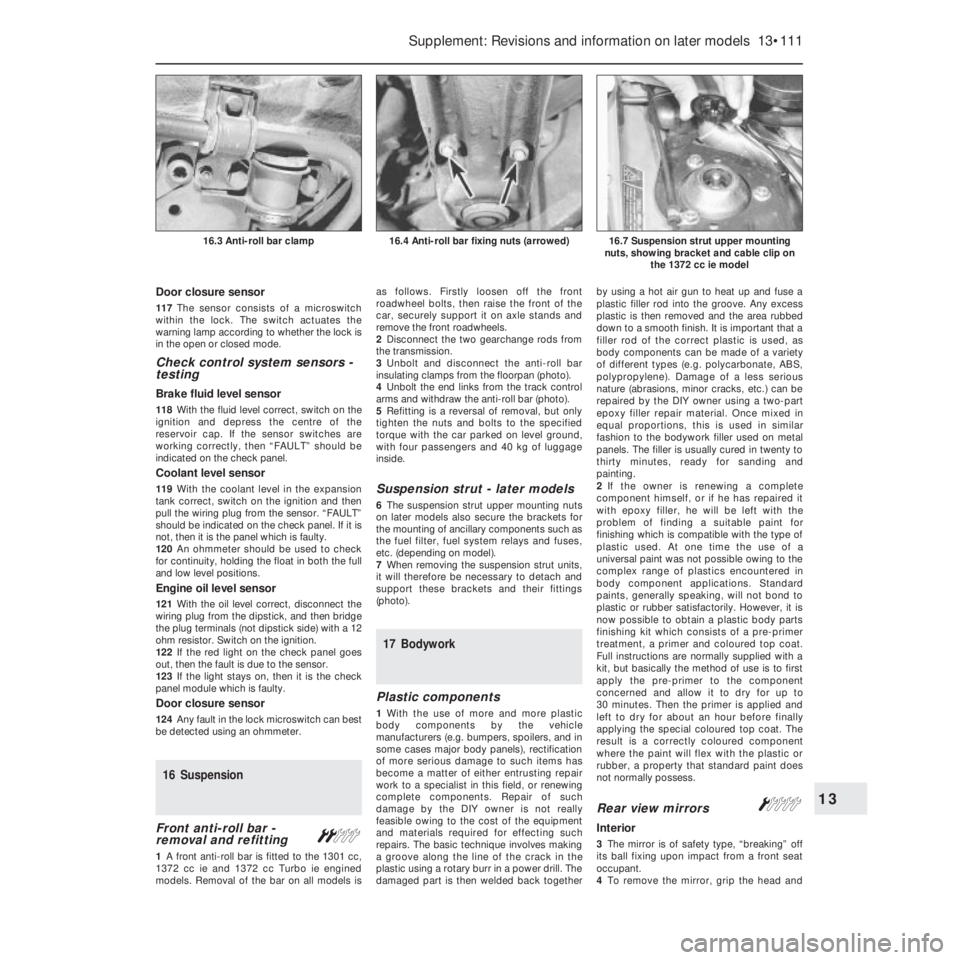
insulating clamps from the floorpan (photo).
4Unbolt the end links from the track control
arms and withdraw the anti-roll bar (photo).
5Refitting is a reversal of removal, but only
tighten the nuts and bolts to the specified
torque with the car parked on level ground,
with four passengers and 40 kg of luggage
inside.
Suspension strut - later models
6The suspension strut upper mounting nuts
on later models also secure the brackets for
the mounting of ancillary components such as
the fuel filter, fuel system relays and fuses,
etc. (depending on model).
7When removing the suspension strut units,
it will therefore be necessary to detach and
support these brackets and their fittings
(photo).
17 Bodywork
Plastic components
1With the use of more and more plastic
body components by the vehicle
manufacturers (e.g. bumpers, spoilers, and in
some cases major body panels), rectification
of more serious damage to such items has
become a matter of either entrusting repair
work to a specialist in this field, or renewing
complete components. Repair of such
damage by the DIY owner is not really
feasible owing to the cost of the equipment
and materials required for effecting such
repairs. The basic technique involves making
a groove along the line of the crack in the
plastic using a rotary burr in a power drill. The
damaged part is then welded back togetherby using a hot air gun to heat up and fuse a
plastic filler rod into the groove. Any excess
plastic is then removed and the area rubbed
down to a smooth finish. It is important that a
filler rod of the correct plastic is used, as
body components can be made of a variety
of different types (e.g. polycarbonate, ABS,
polypropylene). Damage of a less serious
nature (abrasions, minor cracks, etc.) can be
repaired by the DIY owner using a two-part
epoxy filler repair material. Once mixed in
equal proportions, this is used in similar
fashion to the bodywork filler used on metal
panels. The filler is usually cured in twenty to
thirty minutes, ready for sanding and
painting.
2If the owner is renewing a complete
component himself, or if he has repaired it
with epoxy filler, he will be left with the
problem of finding a suitable paint for
finishing which is compatible with the type of
plastic used. At one time the use of a
universal paint was not possible owing to the
complex range of plastics encountered in
body component applications. Standard
paints, generally speaking, will not bond to
plastic or rubber satisfactorily. However, it is
now possible to obtain a plastic body parts
finishing kit which consists of a pre-primer
treatment, a primer and coloured top coat.
Full instructions are normally supplied with a
kit, but basically the method of use is to first
apply the pre-primer to the component
concerned and allow it to dry for up to
30 minutes. Then the primer is applied and
left to dry for about an hour before finally
applying the special coloured top coat. The
result is a correctly coloured component
where the paint will flex with the plastic or
rubber, a property that standard paint does
not normally possess.
Rear view mirrors Á
Interior
3The mirror is of safety type, “breaking” off
its ball fixing upon impact from a front seat
occupant.
4To remove the mirror, grip the head and
Supplement: Revisions and information on later models 13•111
16.7 Suspension strut upper mounting
nuts, showing bracket and cable clip on
the 1372 cc ie model16.4 Anti-roll bar fixing nuts (arrowed)16.3 Anti-roll bar clamp
13
Page 301 of 303
F
Facia - 12•10, 13•107
Fan -2•3, 13•57, 13•71, 13•84
Fast idle adjustment -3•7, 3•9, 3•10, 3•11,
13•64
Fault finding- REF`•9et seq
Fault finding - braking system -8•9
Fault finding - clutch -5•3
Fault finding - cooling and heating systems
-2•8
Fault finding - driveshafts and hubs -7•6
Fault finding - Econometer -9•12
Fault finding - electrical system -9•14,
REF•9
Fault finding - engine -1•35, 1•36, 2•8,
3•13, 4•9, 13•92, REF•10, REF•11
Fault finding - fuel system -3•9, 3•13,
13•84
Fault finding - ignition system -4•9,
REF•11
Fault finding - Microplex ignition system -
13•92
Fault finding - steering - 10•4
Fault finding - suspension - 11•6
Fault finding - transmission -6•4
Fault finding - turbocharger system - 13•84
Filling - 12•3
Final drive output shafts - 13•94
Fire -0•5
Float adjustment -3•7, 3•8, 3•10, 3•11,
13•64, 13•66
Flywheel -1•19, 1•21, 1•31, 13•46, 13•53
Fog lamps - 13•106
Fuel evaporation control system - 13•78
Fuel filter - 13•67, 13•72, 13•74, 13•79
Fuel gauge fault -9•14
Fuel injection electronic control unit (ECU)
- 13•77
Fuel injection system - 13•68, 13•69
Fuel injection system fault finding - 13•84
Fuel injectors - 13•69, 13•70, 13•71, 13•76,
13•77, 13•81, 13•84
Fuel level transmitter -3•5
Fuel pressure regulator - 13•70
Fuel pump -3•5, 13•61, 13•69, 13•72,
13•76, 13•80, 13•81
Fuel rail - 13•70, 13•81
Fuel system-3•1et seq, 13•60, REF•4
Fuel system fault finding -3•9, 3•13
Fuel tank -3•5, 13•61, 13•72
Fume or gas intoxication -0•5
Fuses -9•5, 13•105
G
Gaiters -7•2, 10•2, 13•98
Gashes in bodywork - 12•2
Gaskets -1•20
Gearbox - SeeTransmission
Gearchange lever -6•2
Gearchange linkage - 13•94, 13•95
Glossary of technical terms- REF•13et seq
Grille - 12•3, 13•113
H
Handbrake -8•8, 8•9, REF•1
Handles - 12•11
HC emissions - REF•4
Headlamp -9•6, 9•7, 13•105, 13•106
Heated tailgate window -9•10
Heater -2•5, 2•6, 13•58, 13•59, 13•108
Heater fault -2•8
Horn -9•6, 13•106
Horn fault -9•14
HT leads - 13•92
Hubs -7•3, 7•4, 11•3
Hydraulic hoses and pipes -8•6
Hydraulic system -8•7
Hydrofluoric acid -0•5
I
Idle speed adjustment -3•7, 13•62, 13•65,
13•68, 13•75, 13•79
Idling fault -1•36, 3•13, 13•84
Ignition coil - 13•86, 13•90, 13•91
Ignition switch -4•8
Ignition system-4•1et seq, 13•85
Ignition system fault finding -4•9, 9•14,
REF•11
Ignition unit - 13•89
Indicators -9•7
Injectors - 13•69, 13•70, 13•71, 13•76,
13•77, 13•81, 13•84
Inlet manifold - 13•70, 13•77, 13•80
Instrument panel -9•8, 13•107
Intercooler - 13•84
Interior lamps -9•5, 9•8
Introduction to the Fiat Uno -0•4
J
Jacking -0•8
Joint mating faces and gaskets - REF•8
Jump starting -0•7
L
Lambda sensor - 13•82
Lamps -9•6, 9•7, 9•8
Leaks -0•9, 1•36, 13•84
LED (light emitter diode) -9•12
Lights fault -9•14
Locknuts,locktabs and washers - REF•8
Locks -9•11, 10•4, 12•4, 12•6, 12•7,
13•109
Loudspeakers -9•11
Lubricants and fluids -0•13
M
Magnetic impulse generator winding -
13•86
Main bearings -1•20, 1•30, 13•52
Maintenance -0•10, 13•18
Manifolds -3•12, 13•70, 13•77, 13•80
Master cylinder -8•5, 13•103, 13•93
Microplex ignition system - 13•86, 13•89Microplex ignition system fault finding -
13•92
Mirrors - 12•11, 13•111, REF•1
Misfire -1•35, 4•9, REF•11
Mixture adjustment -3•7, 13•62, 13•65,
13•68, 13•75, 13•79
MOT test checks- REF•1et seq
Mountings -1•13, 1•27, 13•26, 13•35,
13•49
N
Needle valve - 13•66
Number plate lamp -9•7
O
Oil cooler - 13•36
Oil filter -1•8
Oil level sensor - 13•110, 13•111
Oil pressure fault -1•36, REF•11
Oil pump -1•13, 1•19, 1•22, 1•26, 1•29,
13•24, 13•30, 13•35, 13•46, 13•53
Oil seals -1•20, 13•41, 13•44, 13•45,
13•94, REF•8
Oil,engine -0•6, 0•13, 1•3, 1•4, 1•8
Oil,transmission -0•6, 0•13, 6•1, 13•14,
13•95
Overheating -2•8, 4•9, REF•11
P
Pad wear sensor - 13•110
Pads -8•2, 13•100, 13•101
Parking lamp -9•7
Pedals -5•2, 8•9, 13•92, 13•102
Pinking -1•36, 13•84, REF•11
Pistons -1•12, 1•18, 1•22, 1•26, 1•30,
13•25, 13•26, 13•30, 13•35, 13•47,
13•48, 13•53
Plastic components - 13•111
Points -4•2, 4•3
Poisonous or irritant substances -0•5
Power module - 13•90
Pre-ignition -1•36, 13•84, REF•11
Pressure regulating valve -8•6, 13•102
Pressure sensor - 13•86
R
Radiator -2•3, 12•3, 13•57, 13•113
Radio -9•10, 13•110
Rear lamp cluster -9•7
Regulator (voltage) -9•4
Regulator (window) - 12•7
Relays -9•5, 13•71, 13•105
Repair procedures - REF•8
Respraying - 12•3
Rocker cover - 13•19
Rockers -1•19
Roof rack - 12•11
Routine maintenance -0•10, 13•18
Rust holes in bodywork - 12•2
REF•18Index