change wheel FIAT UNO 1983 Service User Guide
[x] Cancel search | Manufacturer: FIAT, Model Year: 1983, Model line: UNO, Model: FIAT UNO 1983Pages: 303, PDF Size: 10.36 MB
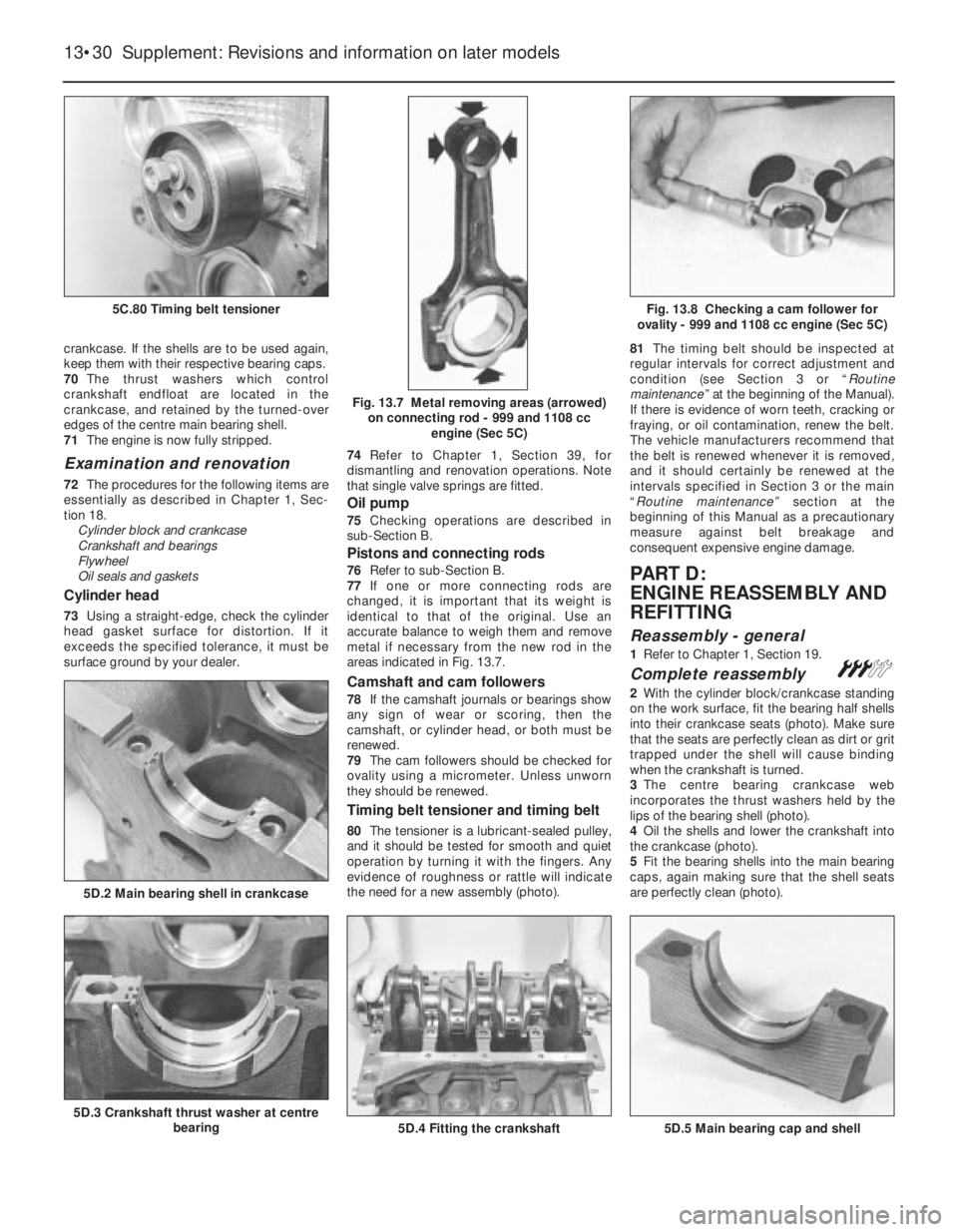
Page 42 of 303
from the suspension struts and then remove
the bolts which secure the hub carriers to the
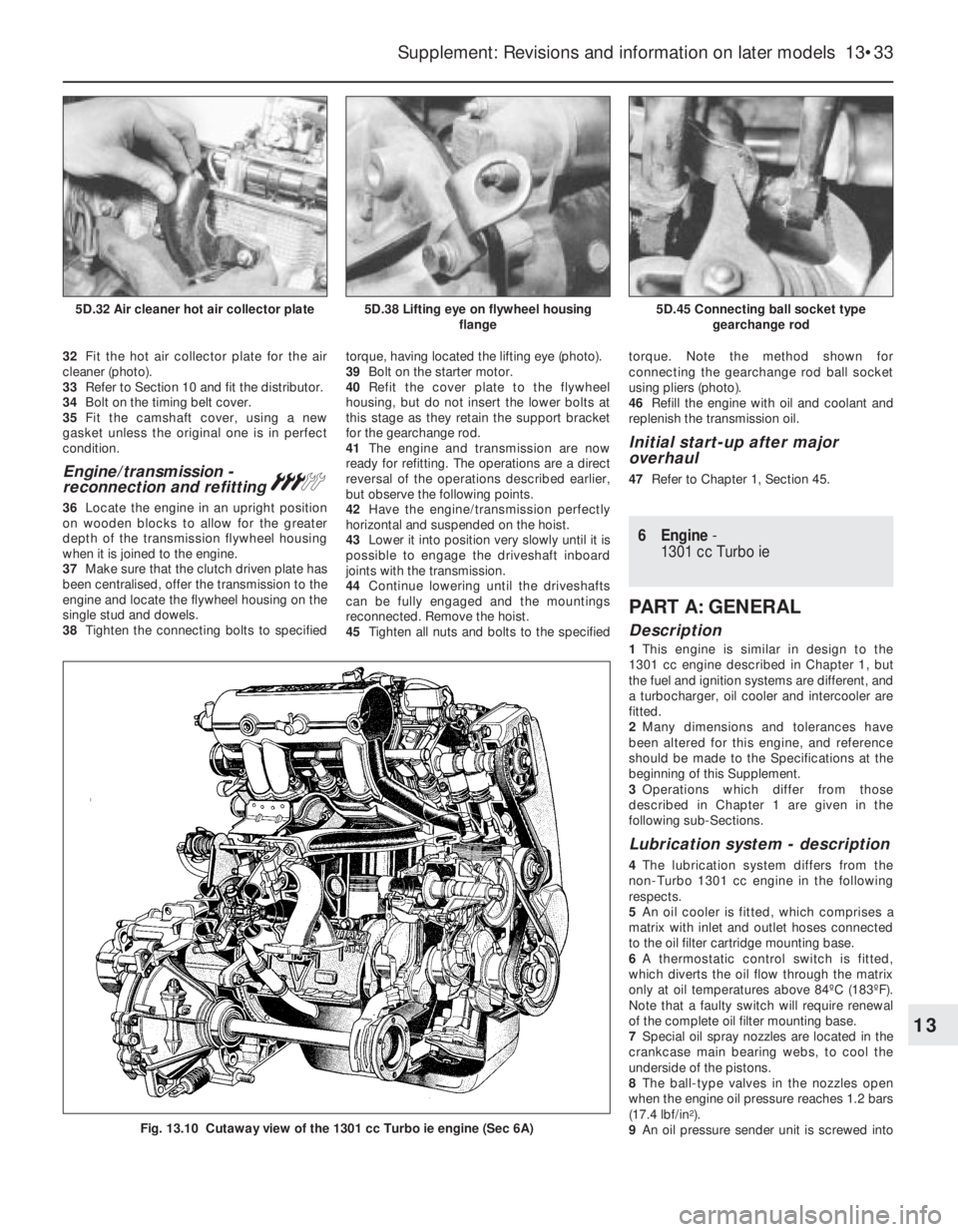
U-clamps at the base of the suspension
struts.
23Pull the tops of the hub carriers down and
then outwards and push the driveshafts from
them.
24Unbolt the driveshaft inboard boot
retainers and then remove the driveshafts
from the transmission.
25Support the engine on a hoist or use a
trolley jack under the engine/transmission.
Remove the bottom mounting and then the
upper left and right-hand ones.
26Lower the power unit to the floor by
pushing it to the left-hand side to clear the
right-hand mounting bracket and then swivel
the gearbox towards the rear of the car.
Withdraw the engine/transmission from under
the car.
27External dirt and grease should now be
removed using paraffin and a stiff brush or a
water-soluble solvent.
28Unbolt and remove the engine mounting
brackets and the starter motor.
29Unbolt and remove the cover plate with
the gearchange ball stud strut from the lower
front face of the flywheel housing.
30With the engine resting squarely on its
sump pan, unscrew the flywheel housing
connecting bolts, noting the location of any
lifting lugs and hose and wiring clips.
31Support the weight of the transmission
and withdraw it in a straight line from the
engine.
36 Engine- dismantling (general)
Refer to Section 14, Part 2.
37 Engine ancillary components
- removal
Refer to Section 15, Part 2 and also remove
the intake manifold.
38 Engine-
complete dismantling
3
1Have the engine resting squarely and
supported securely on the work surface.
2Unbolt and remove the timing belt cover.
3Grip the now exposed timing belt with the
hands and loosen the camshaft sprocket.
4Release the timing belt tensioner pulley
centre bolt, then slip the belt from the pulley
and sprockets to remove it. Note which way
round the belt is fitted, usually so that the
lettering on the belt can be read from the
crankshaft pulley end of the engine.
5Remove the camshaft sprocket.6Unbolt and remove the camshaft timing belt
cover backing plate.
7Unbolt and remove the camshaft carrier
cover.
8Unbolt the camshaft carrier and lift it off
very slowly, at the same time pushing the cam
followers and their shims down with the
fingers securely onto their respective valve
springs. It is easy to remove the camshaft
carrier too quickly with some of the cam
followers stuck in it and as the carrier is lifted
away, the cam followers will fall out. If this
happens, the valve clearances will be upset as
the cam followers and shims cannot be
returned, with any certainty, to their original
positions. Keep the cam followers and shims
in their originally fitted order.
9Unscrew and remove the cylinder head
bolts and nuts, grip the manifold, rock the
head and remove the complete cylinder
head/manifold/carburettor assembly. Remove
and discard the cylinder head gasket.
10Unbolt the coolant pump from the side of
the cylinder block and remove it complete
with coolant distribution pipe. Remove the
crankcase breather.
11Remove the distributor/oil pump
driveshaft. This is simply carried out by
inserting a finger into the hole vacated by the
distributor and wedging it in the hole in the
end of the driveshaft. Lift the shaft out of
mesh with the auxiliary shaft. Where the
distributor is driven by the camshaft, a cover
plate retains the oil pump driveshaft in
position.
12Unbolt and remove the sprocket from the
end of the auxiliary shaft. The sprocket is held
to the shaft with a Woodruff key.
13Unbolt the auxiliary shaft retainer and
withdraw the shaft from the crankcase.
14Unscrew and remove the crankshaft
pulley nut. This is very tight and the flywheel
starter ring gear will have to be jammed with a
cold chisel or a suitably bent piece of steel to
prevent the crankshaft rotating.
15Withdraw the crankshaft sprocket, which
is located by the Woodruff key.
16Unbolt the front engine mounting bracket
from the cylinder block, together with the
timing belt cover screw anchor bush. Unbolt
and remove the timing belt tensioner pulley.
17Unscrew the flywheel securing bolts. Thestarter ring gear will again have to be jammed
to prevent the crankshaft rotating as the bolts
are unscrewed. Mark the flywheel position in
relation to the crankshaft mounting flange,
then remove it.
18Unbolt the front and rear crankshaft oil
seal retainer bolts from the crankcase and the
sump. Remove the oil seal retainers.
19Turn the engine on its side, extract the
remaining sump bolts and remove the sump.
If it is stuck, try tapping it gently with a
soft-faced hammer. If this fails, cut all round
the sump-to-gasket flange with a sharp knife.
Do not try prising with a large screwdriver; this
will only distort the sump mating flange.
20With the sump removed, unbolt and
remove the oil pump.
21Grip the oil pick-up pipe and twist or rock
it from its hole in the crankcase. It is an
interference fit in the hole.
22Remove the piston/connecting rods as
described in Section 32.
23Before unbolting the main bearing caps,
note that they are marked with one, two, three
or four notches. No. 5 main bearing cap is
unmarked. Note that the notches are nearer
the auxiliary shaft side.
24Unbolt and remove the main bearing
caps. If the bearing shells are to be used
again, tape them to their respective caps. The
bearing shell at the centre position is plain,
the others have a lubricating groove.
25Carefully, lift the crankshaft from the
crankcase, noting the thrust washers at No. 5
main bearing. These control the crankshaft
endfloat.
39 Cylinder head- dismantling
and decarbonising
4
1The operations are similar to those
described for the ohv engine in Section 17 in
respect of decarbonising and valve grinding.
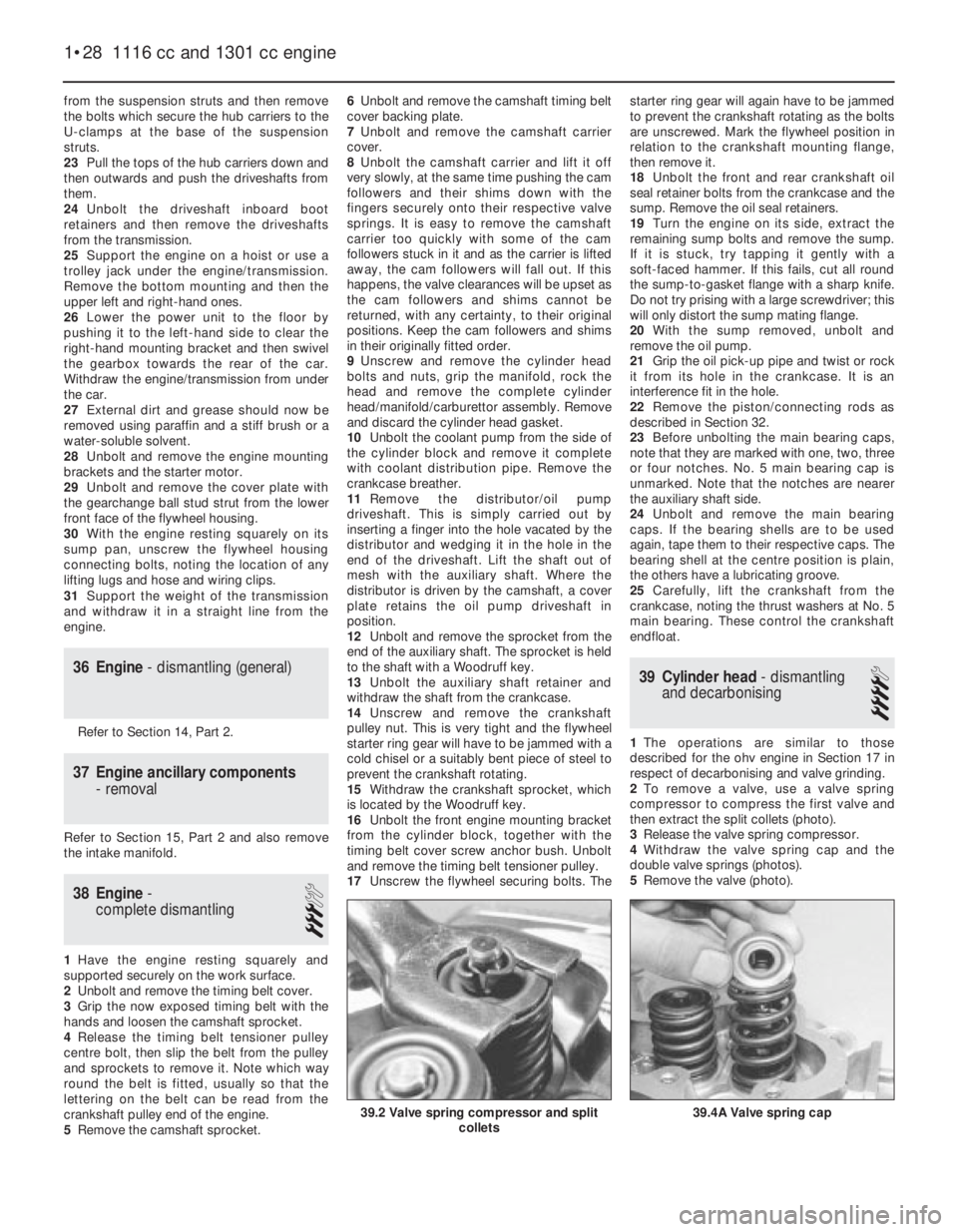
2To remove a valve, use a valve spring
compressor to compress the first valve and
then extract the split collets (photo).
3Release the valve spring compressor.
4Withdraw the valve spring cap and the
double valve springs (photos).
5Remove the valve (photo).
1•28 1116 cc and 1301 cc engine
39.4A Valve spring cap39.2 Valve spring compressor and split
collets
Page 43 of 303
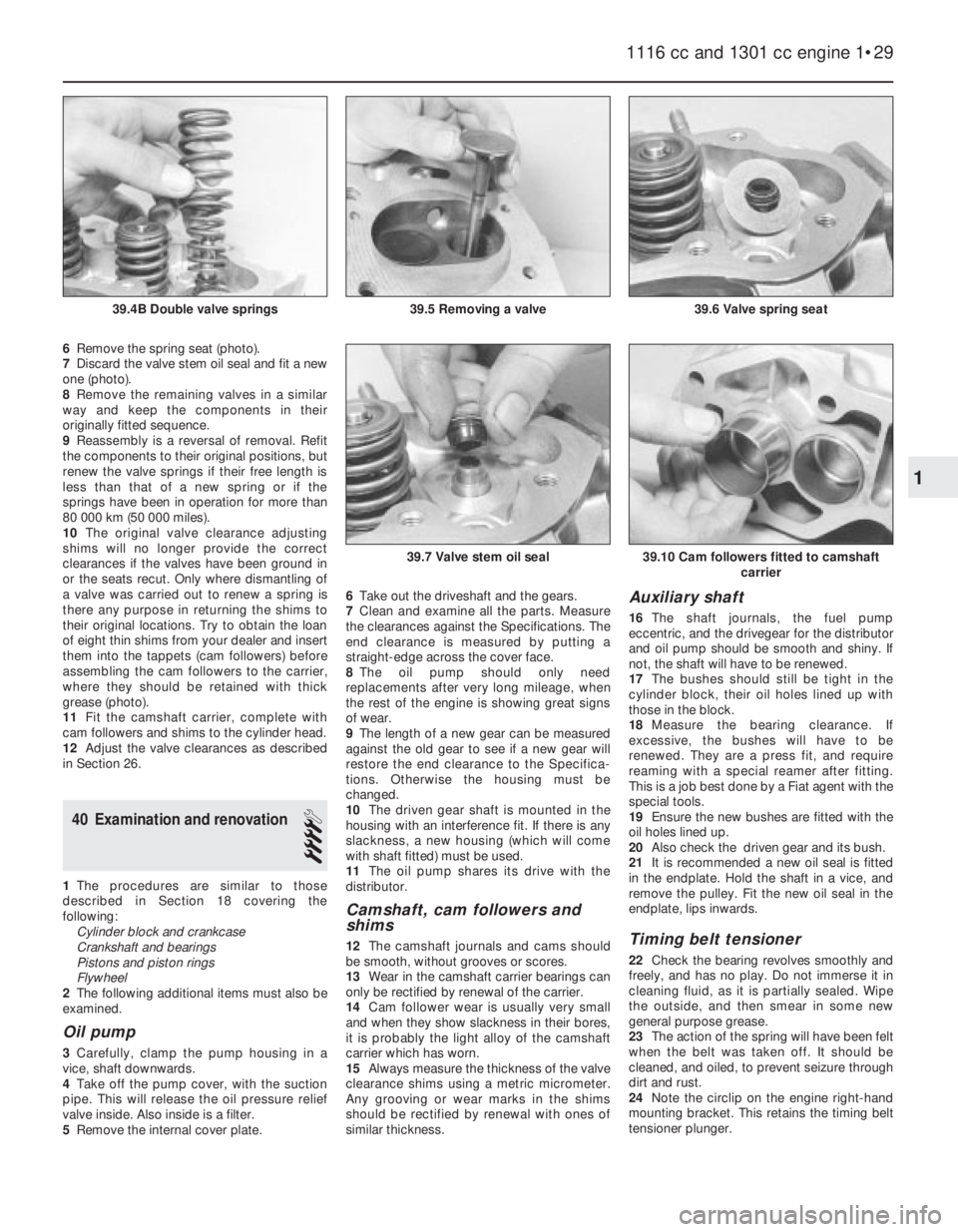
6Remove the spring seat (photo).
7Discard the valve stem oil seal and fit a new
one (photo).
8Remove the remaining valves in a similar
way and keep the components in their
originally fitted sequence.
9Reassembly is a reversal of removal. Refit
the components to their original positions, but
renew the valve springs if their free length is
less than that of a new spring or if the
springs have been in operation for more than
80 000 km (50 000 miles).
10The original valve clearance adjusting
shims will no longer provide the correct
clearances if the valves have been ground in
or the seats recut. Only where dismantling of
a valve was carried out to renew a spring is
there any purpose in returning the shims to
their original locations. Try to obtain the loan
of eight thin shims from your dealer and insert
them into the tappets (cam followers) before
assembling the cam followers to the carrier,
where they should be retained with thick
grease (photo).
11Fit the camshaft carrier, complete with
cam followers and shims to the cylinder head.
12Adjust the valve clearances as described
in Section 26.
40 Examination and renovation
4
1The procedures are similar to those
described in Section 18 covering the
following:
Cylinder block and crankcase
Crankshaft and bearings
Pistons and piston rings
Flywheel
2The following additional items must also be
examined.
Oil pump
3Carefully, clamp the pump housing in a
vice, shaft downwards.
4Take off the pump cover, with the suction
pipe. This will release the oil pressure relief
valve inside. Also inside is a filter.
5Remove the internal cover plate.6Take out the driveshaft and the gears.
7Clean and examine all the parts. Measure
the clearances against the Specifications. The
end clearance is measured by putting a
straight-edge across the cover face.
8The oil pump should only need
replacements after very long mileage, when
the rest of the engine is showing great signs
of wear.
9The length of a new gear can be measured
against the old gear to see if a new gear will
restore the end clearance to the Specifica-
tions. Otherwise the housing must be
changed.
10The driven gear shaft is mounted in the
housing with an interference fit. If there is any
slackness, a new housing (which will come
with shaft fitted) must be used.
11The oil pump shares its drive with the
distributor.
Camshaft, cam followers and
shims
12The camshaft journals and cams should
be smooth, without grooves or scores.
13Wear in the camshaft carrier bearings can
only be rectified by renewal of the carrier.
14Cam follower wear is usually very small
and when they show slackness in their bores,
it is probably the light alloy of the camshaft
carrier which has worn.
15Always measure the thickness of the valve
clearance shims using a metric micrometer.
Any grooving or wear marks in the shims
should be rectified by renewal with ones of
similar thickness.
Auxiliary shaft
16The shaft journals, the fuel pump
eccentric, and the drivegear for the distributor
and oil pump should be smooth and shiny. If
not, the shaft will have to be renewed.
17The bushes should still be tight in the
cylinder block, their oil holes lined up with
those in the block.
18Measure the bearing clearance. If
excessive, the bushes will have to be
renewed. They are a press fit, and require
reaming with a special reamer after fitting.
This is a job best done by a Fiat agent with the
special tools.
19Ensure the new bushes are fitted with the
oil holes lined up.
20Also check the driven gear and its bush.
21It is recommended a new oil seal is fitted
in the endplate. Hold the shaft in a vice, and
remove the pulley. Fit the new oil seal in the
endplate, lips inwards.
Timing belt tensioner
22Check the bearing revolves smoothly and
freely, and has no play. Do not immerse it in
cleaning fluid, as it is partially sealed. Wipe
the outside, and then smear in some new
general purpose grease.
23The action of the spring will have been felt
when the belt was taken off. It should be
cleaned, and oiled, to prevent seizure through
dirt and rust.
24Note the circlip on the engine right-hand
mounting bracket. This retains the timing belt
tensioner plunger.
1116 cc and 1301 cc engine 1•29
39.6 Valve spring seat39.5 Removing a valve39.4B Double valve springs
39.10 Cam followers fitted to camshaft
carrier39.7 Valve stem oil seal
1
Page 44 of 303
42.9 Fitting the auxiliary shaft
41 Engine- reassembly (general)
Refer to Section 19, Part 2.
42 Engine-
complete reassembly
4
Crankshaft and main bearings
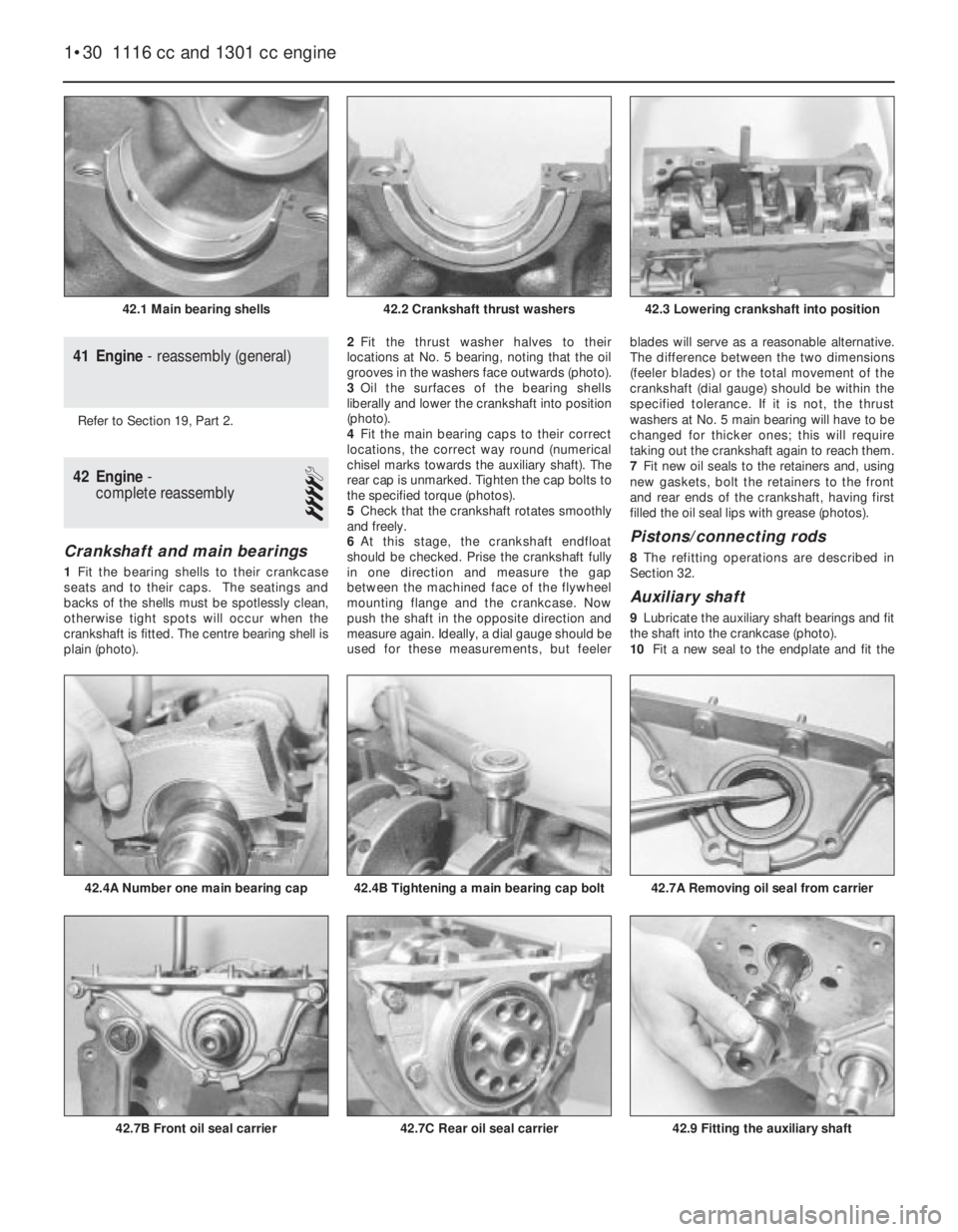
1Fit the bearing shells to their crankcase
seats and to their caps. The seatings and
backs of the shells must be spotlessly clean,
otherwise tight spots will occur when the
crankshaft is fitted. The centre bearing shell is
plain (photo).2Fit the thrust washer halves to their
locations at No. 5 bearing, noting that the oil
grooves in the washers face outwards (photo).
3Oil the surfaces of the bearing shells
liberally and lower the crankshaft into position
(photo).
4Fit the main bearing caps to their correct
locations, the correct way round (numerical
chisel marks towards the auxiliary shaft). The
rear cap is unmarked. Tighten the cap bolts to
the specified torque (photos).
5Check that the crankshaft rotates smoothly
and freely.
6At this stage, the crankshaft endfloat
should be checked. Prise the crankshaft fully
in one direction and measure the gap
between the machined face of the flywheel
mounting flange and the crankcase. Now
push the shaft in the opposite direction and
measure again. Ideally, a dial gauge should be
used for these measurements, but feelerblades will serve as a reasonable alternative.
The difference between the two dimensions
(feeler blades) or the total movement of the
crankshaft (dial gauge) should be within the
specified tolerance. If it is not, the thrust
washers at No. 5 main bearing will have to be
changed for thicker ones; this will require
taking out the crankshaft again to reach them.
7Fit new oil seals to the retainers and, using
new gaskets, bolt the retainers to the front
and rear ends of the crankshaft, having first
filled the oil seal lips with grease (photos).
Pistons/connecting rods
8The refitting operations are described in
Section 32.
Auxiliary shaft
9Lubricate the auxiliary shaft bearings and fit
the shaft into the crankcase (photo).
10Fit a new seal to the endplate and fit the
1•30 1116 cc and 1301 cc engine
42.7C Rear oil seal carrier42.7B Front oil seal carrier
42.7A Removing oil seal from carrier42.4B Tightening a main bearing cap bolt42.4A Number one main bearing cap
42.3 Lowering crankshaft into position42.2 Crankshaft thrust washers42.1 Main bearing shells
Page 47 of 303
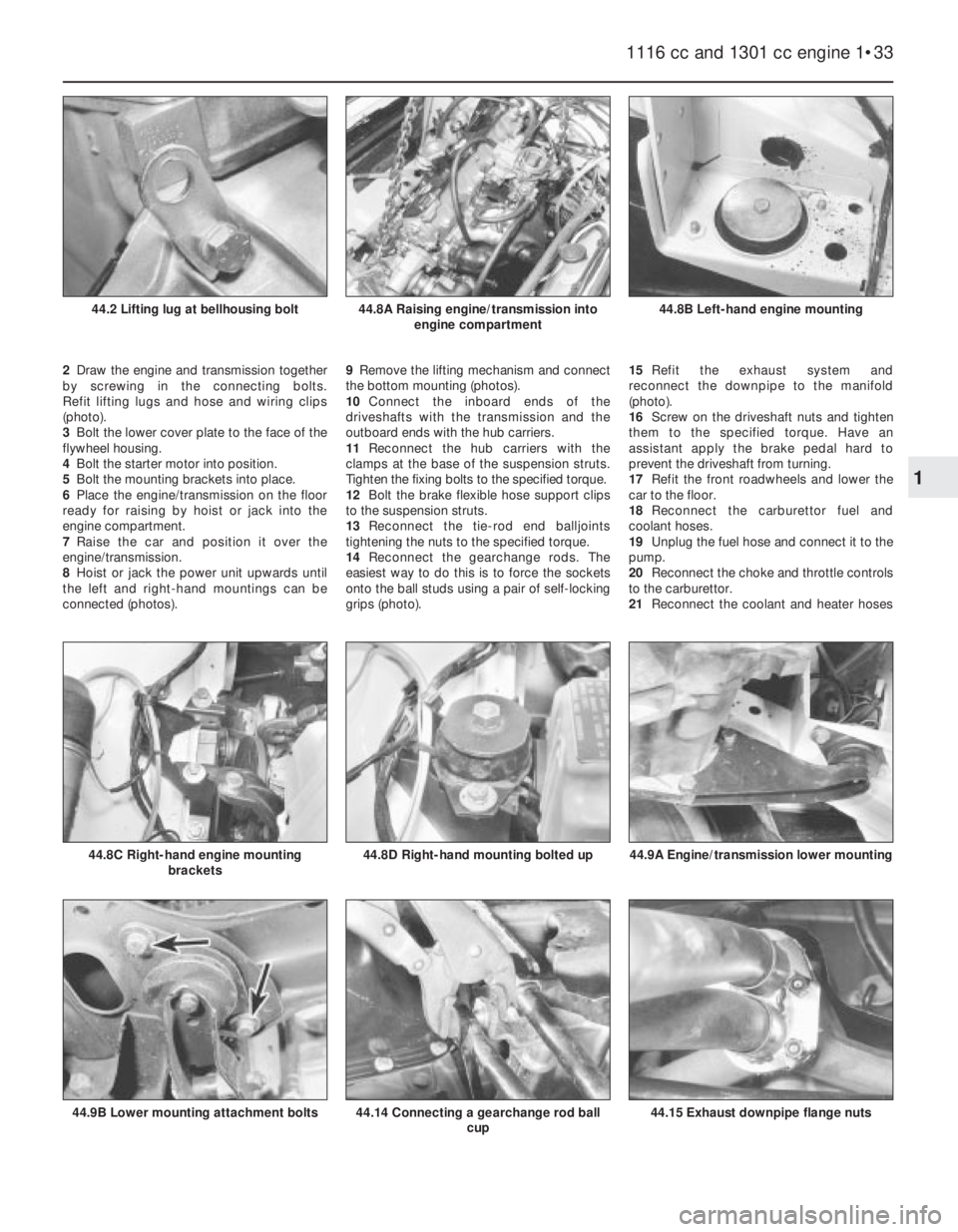
2Draw the engine and transmission together
by screwing in the connecting bolts.
Refit lifting lugs and hose and wiring clips
(photo).
3Bolt the lower cover plate to the face of the
flywheel housing.
4Bolt the starter motor into position.
5Bolt the mounting brackets into place.
6Place the engine/transmission on the floor
ready for raising by hoist or jack into the
engine compartment.
7Raise the car and position it over the
engine/transmission.
8Hoist or jack the power unit upwards until
the left and right-hand mountings can be
connected (photos).9Remove the lifting mechanism and connect
the bottom mounting (photos).
10Connect the inboard ends of the
driveshafts with the transmission and the
outboard ends with the hub carriers.
11Reconnect the hub carriers with the
clamps at the base of the suspension struts.
Tighten the fixing bolts to the specified torque.
12Bolt the brake flexible hose support clips
to the suspension struts.
13Reconnect the tie-rod end balljoints
tightening the nuts to the specified torque.
14Reconnect the gearchange rods. The
easiest way to do this is to force the sockets
onto the ball studs using a pair of self-locking
grips (photo).15Refit the exhaust system and
reconnect the downpipe to the manifold
(photo).
16Screw on the driveshaft nuts and tighten
them to the specified torque. Have an
assistant apply the brake pedal hard to
prevent the driveshaft from turning.
17Refit the front roadwheels and lower the
car to the floor.
18Reconnect the carburettor fuel and
coolant hoses.
19Unplug the fuel hose and connect it to the
pump.
20Reconnect the choke and throttle controls
to the carburettor.
21Reconnect the coolant and heater hoses
1116 cc and 1301 cc engine 1•33
44.8B Left-hand engine mounting44.8A Raising engine/transmission into
engine compartment44.2 Lifting lug at bellhousing bolt
44.15 Exhaust downpipe flange nuts44.14 Connecting a gearchange rod ball
cup44.9B Lower mounting attachment bolts
44.9A Engine/transmission lower mounting44.8D Right-hand mounting bolted up44.8C Right-hand engine mounting
brackets
1
Page 92 of 303
3 Alternator-
maintenance and precautions
1
To avoid damage to the alternator, the
following precautions should be observed.
1Disconnect the leads from the battery
before connecting a mains charger to the
battery terminals.
2Never stop the engine by pulling off one of
the battery leads.
3Disconnect the battery if electric welding is
to be carried out on the vehicle.
4If using booster cables from another battery
to start the car, make sure that they are
connected positive to positive and negative to
negative.
5Maintenance consists of keeping the
outside of the alternator clean, the electrical
connections secure and the drivebelt correctly
tensioned, see Chapter 2, Section 8.
4 Alternator-
removal and refitting
1
Note: Depending on the model, access to the
alternator from above may be poor in which
case it will be necessary to work from the
underside of the vehicle, through the
right-hand wheel arch (after removing the
roadwheel and the lower undershield). Refer
to Chapter 13 for details.
1Disconnect the leads from the rear of the
alternator.2Release the mounting and adjuster link nuts
and push the alternator as far as it will go in
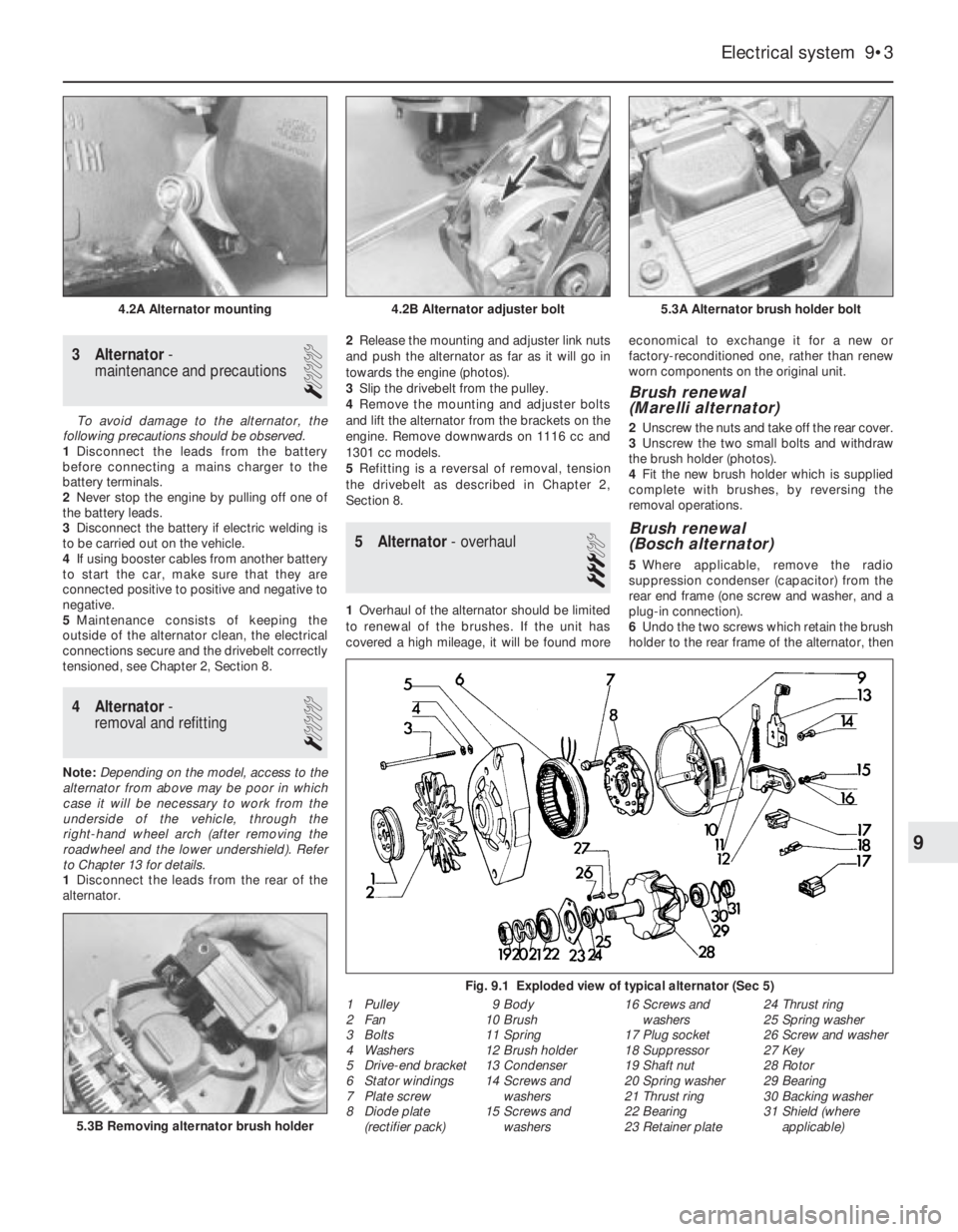
towards the engine (photos).
3Slip the drivebelt from the pulley.
4Remove the mounting and adjuster bolts
and lift the alternator from the brackets on the
engine. Remove downwards on 1116 cc and
1301 cc models.
5Refitting is a reversal of removal, tension
the drivebelt as described in Chapter 2,
Section 8.
5 Alternator- overhaul
3
1Overhaul of the alternator should be limited
to renewal of the brushes. If the unit has
covered a high mileage, it will be found moreeconomical to exchange it for a new or
factory-reconditioned one, rather than renew
worn components on the original unit.
Brush renewal
(Marelli alternator)
2Unscrew the nuts and take off the rear cover.
3Unscrew the two small bolts and withdraw
the brush holder (photos).
4Fit the new brush holder which is supplied
complete with brushes, by reversing the
removal operations.
Brush renewal
(Bosch alternator)
5Where applicable, remove the radio
suppression condenser (capacitor) from the
rear end frame (one screw and washer, and a
plug-in connection).
6Undo the two screws which retain the brush
holder to the rear frame of the alternator, then
Electrical system 9•3
5.3A Alternator brush holder bolt4.2B Alternator adjuster bolt4.2A Alternator mounting
Fig. 9.1 Exploded view of typical alternator (Sec 5)
1 Pulley
2 Fan
3 Bolts
4 Washers
5 Drive-end bracket
6 Stator windings
7 Plate screw
8 Diode plate
(rectifier pack)9 Body
10 Brush
11 Spring
12 Brush holder
13 Condenser
14 Screws and
washers
15 Screws and
washers16 Screws and
washers
17 Plug socket
18 Suppressor
19 Shaft nut
20 Spring washer
21 Thrust ring
22 Bearing
23 Retainer plate24 Thrust ring
25 Spring washer
26 Screw and washer
27 Key
28 Rotor
29 Bearing
30 Backing washer
31 Shield (where
applicable)
5.3B Removing alternator brush holder
9
Page 111 of 303
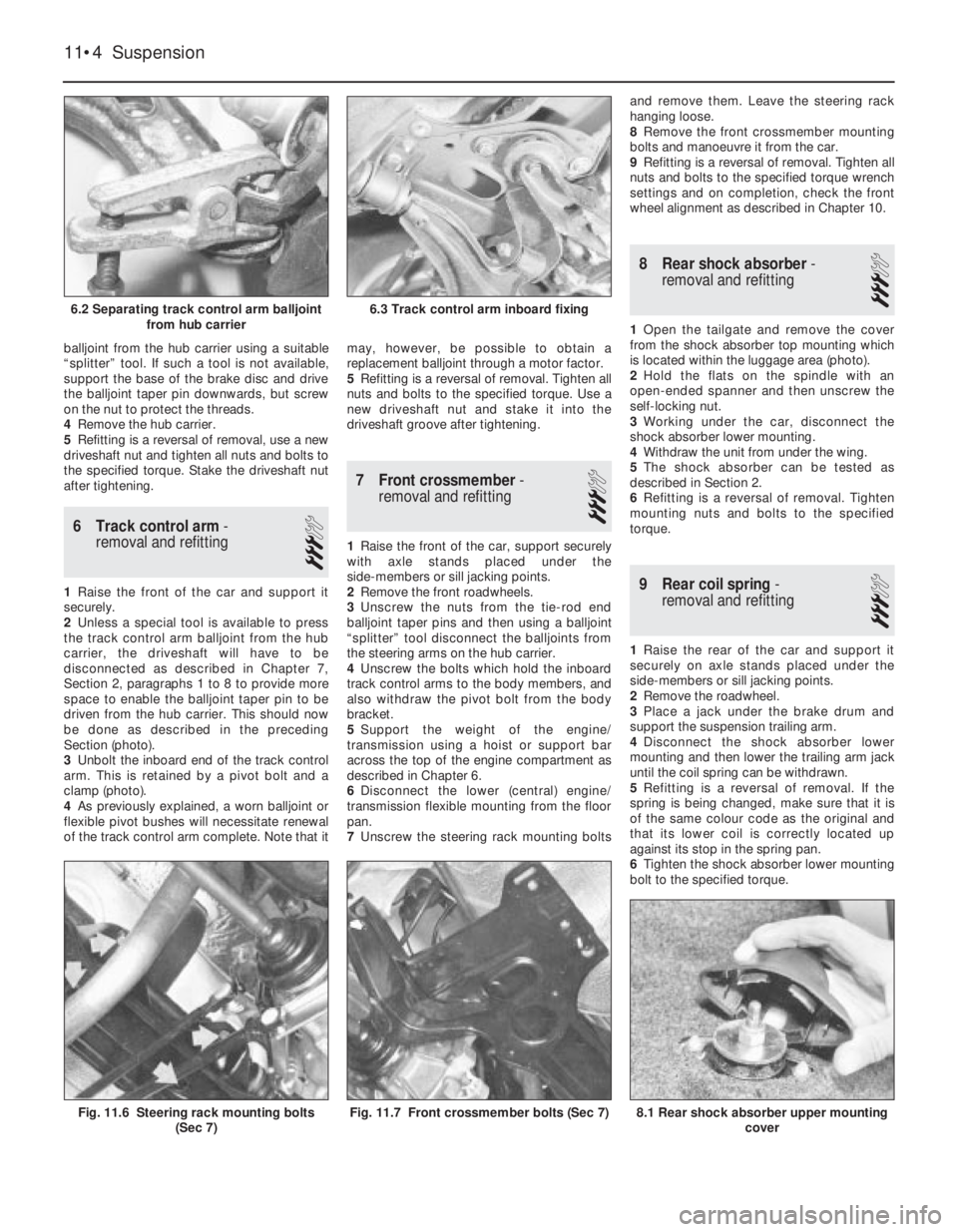
balljoint from the hub carrier using a suitable
“splitter” tool. If such a tool is not available,
support the base of the brake disc and drive
the balljoint taper pin downwards, but screw
on the nut to protect the threads.
4Remove the hub carrier.
5Refitting is a reversal of removal, use a new
driveshaft nut and tighten all nuts and bolts to
the specified torque. Stake the driveshaft nut
after tightening.
6 Track control arm-
removal and refitting
3
1Raise the front of the car and support it
securely.
2Unless a special tool is available to press
the track control arm balljoint from the hub
carrier, the driveshaft will have to be
disconnected as described in Chapter 7,
Section 2, paragraphs 1 to 8 to provide more
space to enable the balljoint taper pin to be
driven from the hub carrier. This should now
be done as described in the preceding
Section (photo).
3Unbolt the inboard end of the track control
arm. This is retained by a pivot bolt and a
clamp (photo).
4As previously explained, a worn balljoint or
flexible pivot bushes will necessitate renewal
of the track control arm complete. Note that itmay, however, be possible to obtain a
replacement balljoint through a motor factor.
5Refitting is a reversal of removal. Tighten all
nuts and bolts to the specified torque. Use a
new driveshaft nut and stake it into the
driveshaft groove after tightening.
7 Front crossmember-
removal and refitting
3
1Raise the front of the car, support securely
with axle stands placed under the
side-members or sill jacking points.
2Remove the front roadwheels.
3Unscrew the nuts from the tie-rod end
balljoint taper pins and then using a balljoint
“splitter” tool disconnect the balljoints from
the steering arms on the hub carrier.
4Unscrew the bolts which hold the inboard
track control arms to the body members, and
also withdraw the pivot bolt from the body
bracket.
5Support the weight of the engine/
transmission using a hoist or support bar
across the top of the engine compartment as
described in Chapter 6.
6Disconnect the lower (central) engine/
transmission flexible mounting from the floor
pan.
7Unscrew the steering rack mounting boltsand remove them. Leave the steering rack
hanging loose.
8Remove the front crossmember mounting
bolts and manoeuvre it from the car.
9Refitting is a reversal of removal. Tighten all
nuts and bolts to the specified torque wrench
settings and on completion, check the front
wheel alignment as described in Chapter 10.
8 Rear shock absorber-
removal and refitting
3
1Open the tailgate and remove the cover
from the shock absorber top mounting which
is located within the luggage area (photo).
2Hold the flats on the spindle with an
open-ended spanner and then unscrew the
self-locking nut.
3Working under the car, disconnect the
shock absorber lower mounting.
4Withdraw the unit from under the wing.
5The shock absorber can be tested as
described in Section 2.
6Refitting is a reversal of removal. Tighten
mounting nuts and bolts to the specified
torque.
9 Rear coil spring-
removal and refitting
3
1Raise the rear of the car and support it
securely on axle stands placed under the
side-members or sill jacking points.
2Remove the roadwheel.
3Place a jack under the brake drum and
support the suspension trailing arm.
4Disconnect the shock absorber lower
mounting and then lower the trailing arm jack
until the coil spring can be withdrawn.
5Refitting is a reversal of removal. If the
spring is being changed, make sure that it is
of the same colour code as the original and
that its lower coil is correctly located up
against its stop in the spring pan.
6Tighten the shock absorber lower mounting
bolt to the specified torque.
11•4 Suspension
8.1 Rear shock absorber upper mounting
coverFig. 11.7 Front crossmember bolts (Sec 7)Fig. 11.6 Steering rack mounting bolts
(Sec 7)
6.3 Track control arm inboard fixing6.2 Separating track control arm balljoint
from hub carrier
Page 149 of 303
Sump pan -
removal and refitting Á
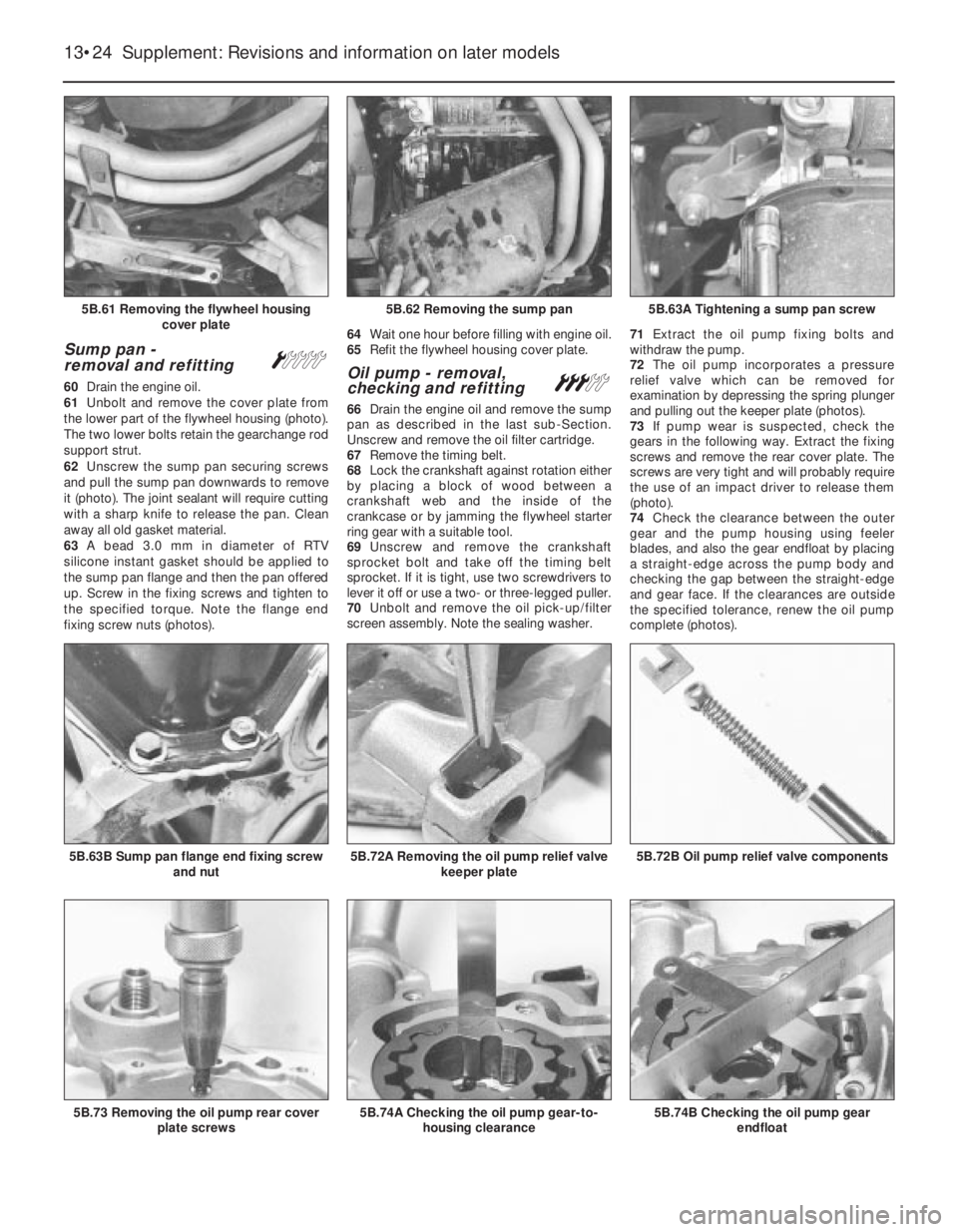
60Drain the engine oil.
61Unbolt and remove the cover plate from
the lower part of the flywheel housing (photo).
The two lower bolts retain the gearchange rod
support strut.
62Unscrew the sump pan securing screws
and pull the sump pan downwards to remove
it (photo). The joint sealant will require cutting
with a sharp knife to release the pan. Clean
away all old gasket material.
63A bead 3.0 mm in diameter of RTV
silicone instant gasket should be applied to
the sump pan flange and then the pan offered
up. Screw in the fixing screws and tighten to
the specified torque. Note the flange end
fixing screw nuts (photos).64Wait one hour before filling with engine oil.
65Refit the flywheel housing cover plate.Oil pump - removal,
checking and refitting#
66Drain the engine oil and remove the sump
pan as described in the last sub-Section.
Unscrew and remove the oil filter cartridge.
67Remove the timing belt.
68Lock the crankshaft against rotation either
by placing a block of wood between a
crankshaft web and the inside of the
crankcase or by jamming the flywheel starter
ring gear with a suitable tool.
69Unscrew and remove the crankshaft
sprocket bolt and take off the timing belt
sprocket. If it is tight, use two screwdrivers to
lever it off or use a two- or three-legged puller.
70Unbolt and remove the oil pick-up/filter
screen assembly. Note the sealing washer.71Extract the oil pump fixing bolts and
withdraw the pump.
72The oil pump incorporates a pressure
relief valve which can be removed for
examination by depressing the spring plunger
and pulling out the keeper plate (photos).
73If pump wear is suspected, check the
gears in the following way. Extract the fixing
screws and remove the rear cover plate. The
screws are very tight and will probably require
the use of an impact driver to release them
(photo).
74Check the clearance between the outer
gear and the pump housing using feeler
blades, and also the gear endfloat by placing
a straight-edge across the pump body and
checking the gap between the straight-edge
and gear face. If the clearances are outside
the specified tolerance, renew the oil pump
complete (photos).
13•24 Supplement: Revisions and information on later models
5B.74B Checking the oil pump gear
endfloat5B.74A Checking the oil pump gear-to-
housing clearance5B.73 Removing the oil pump rear cover
plate screws
5B.72B Oil pump relief valve components5B.72A Removing the oil pump relief valve
keeper plate5B.63B Sump pan flange end fixing screw
and nut
5B.63A Tightening a sump pan screw5B.62 Removing the sump pan5B.61 Removing the flywheel housing
cover plate
Page 153 of 303
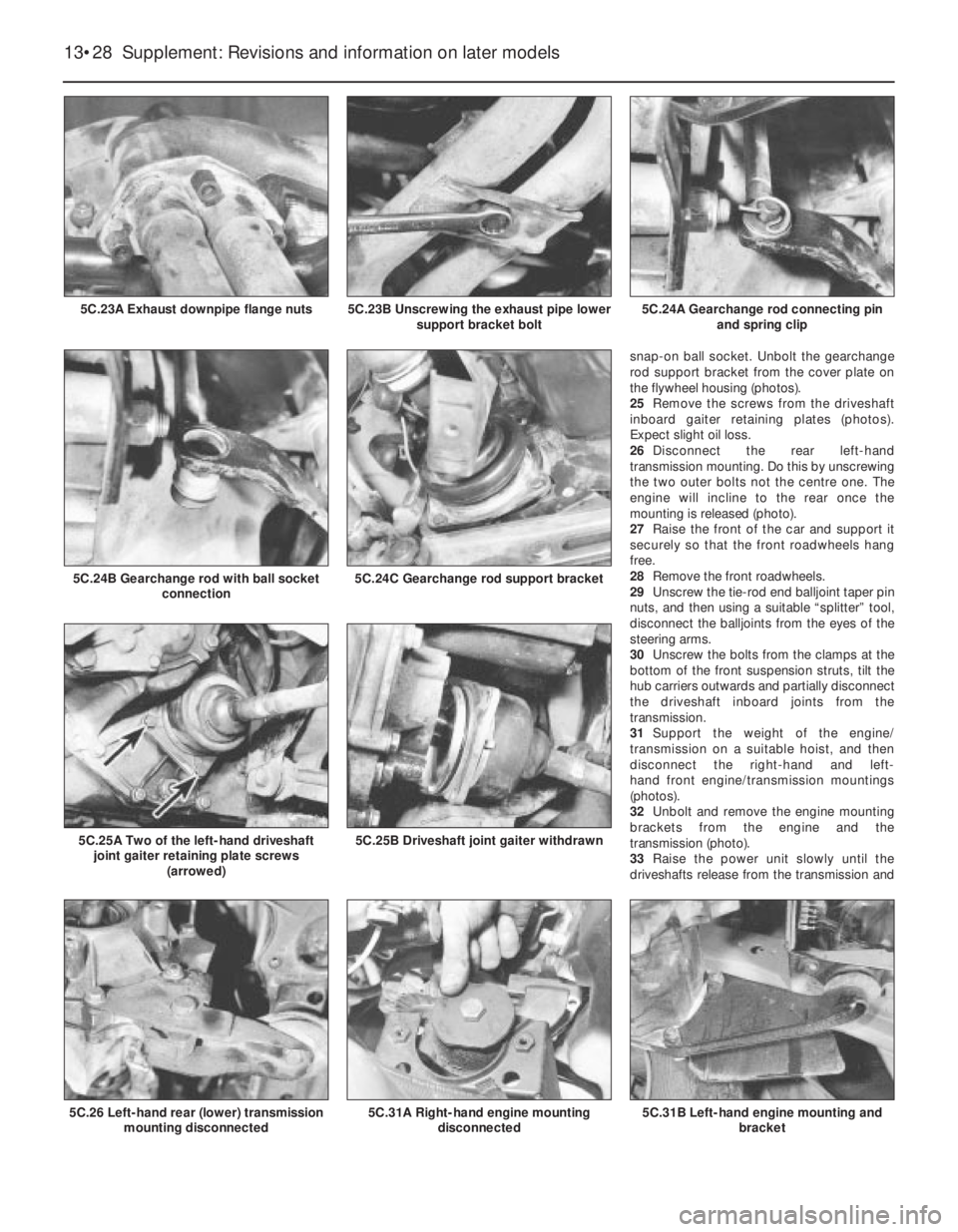
snap-on ball socket. Unbolt the gearchange
rod support bracket from the cover plate on
the flywheel housing (photos).
25Remove the screws from the driveshaft
inboard gaiter retaining plates (photos).
Expect slight oil loss.
26Disconnect the rear left-hand
transmission mounting. Do this by unscrewing
the two outer bolts not the centre one. The
engine will incline to the rear once the
mounting is released (photo).
27Raise the front of the car and support it
securely so that the front roadwheels hang
free.
28Remove the front roadwheels.
29Unscrew the tie-rod end balljoint taper pin
nuts, and then using a suitable “splitter” tool,
disconnect the balljoints from the eyes of the
steering arms.
30Unscrew the bolts from the clamps at the
bottom of the front suspension struts, tilt the
hub carriers outwards and partially disconnect
the driveshaft inboard joints from the
transmission.
31Support the weight of the engine/
transmission on a suitable hoist, and then
disconnect the right-hand and left-
hand front engine/transmission mountings
(photos).
32Unbolt and remove the engine mounting
brackets from the engine and the
transmission (photo).
33Raise the power unit slowly until the
driveshafts release from the transmission and
13•28 Supplement: Revisions and information on later models
5C.31B Left-hand engine mounting and
bracket5C.31A Right-hand engine mounting
disconnected5C.26 Left-hand rear (lower) transmission
mounting disconnected
5C.25B Driveshaft joint gaiter withdrawn5C.25A Two of the left-hand driveshaft
joint gaiter retaining plate screws
(arrowed)
5C.24C Gearchange rod support bracket5C.24B Gearchange rod with ball socket
connection
5C.24A Gearchange rod connecting pin
and spring clip5C.23B Unscrewing the exhaust pipe lower
support bracket bolt5C.23A Exhaust downpipe flange nuts
Page 155 of 303
crankcase. If the shells are to be used again,
keep them with their respective bearing caps.
70The thrust washers which control
crankshaft endfloat are located in the
crankcase, and retained by the turned-over
edges of the centre main bearing shell.
71The engine is now fully stripped.
Examination and renovation
72The procedures for the following items are
essentially as described in Chapter 1, Sec-
tion 18.
Cylinder block and crankcase
Crankshaft and bearings
Flywheel
Oil seals and gaskets
Cylinder head
73Using a straight-edge, check the cylinder
head gasket surface for distortion. If it
exceeds the specified tolerance, it must be
surface ground by your dealer.74Refer to Chapter 1, Section 39, for
dismantling and renovation operations. Note
that single valve springs are fitted.
Oil pump
75Checking operations are described in
sub-Section B.
Pistons and connecting rods
76Refer to sub-Section B.
77If one or more connecting rods are
changed, it is important that its weight is
identical to that of the original. Use an
accurate balance to weigh them and remove
metal if necessary from the new rod in the
areas indicated in Fig. 13.7.
Camshaft and cam followers
78If the camshaft journals or bearings show
any sign of wear or scoring, then the
camshaft, or cylinder head, or both must be
renewed.
79The cam followers should be checked for
ovality using a micrometer. Unless unworn
they should be renewed.
Timing belt tensioner and timing belt
80The tensioner is a lubricant-sealed pulley,
and it should be tested for smooth and quiet
operation by turning it with the fingers. Any
evidence of roughness or rattle will indicate
the need for a new assembly (photo).81The timing belt should be inspected at
regular intervals for correct adjustment and
condition (see Section 3 or “Routine
maintenance” at the beginning of the Manual).
If there is evidence of worn teeth, cracking or
fraying, or oil contamination, renew the belt.
The vehicle manufacturers recommend that
the belt is renewed whenever it is removed,
and it should certainly be renewed at the
intervals specified in Section 3 or the main
“Routine maintenance” section at the
beginning of this Manual as a precautionary
measure against belt breakage and
consequent expensive engine damage.
PART D:
ENGINE REASSEMBLY AND
REFITTING
Reassembly - general
1Refer to Chapter 1, Section 19.
Complete reassembly#
2With the cylinder block/crankcase standing
on the work surface, fit the bearing half shells
into their crankcase seats (photo). Make sure
that the seats are perfectly clean as dirt or grit
trapped under the shell will cause binding
when the crankshaft is turned.
3The centre bearing crankcase web
incorporates the thrust washers held by the
lips of the bearing shell (photo).
4Oil the shells and lower the crankshaft into
the crankcase (photo).
5Fit the bearing shells into the main bearing
caps, again making sure that the shell seats
are perfectly clean (photo).
13•30 Supplement: Revisions and information on later models
5D.5 Main bearing cap and shell5D.4 Fitting the crankshaft5D.3 Crankshaft thrust washer at centre
bearing
5D.2 Main bearing shell in crankcase
Fig. 13.8 Checking a cam follower for
ovality - 999 and 1108 cc engine (Sec 5C)
Fig. 13.7 Metal removing areas (arrowed)
on connecting rod - 999 and 1108 cc
engine (Sec 5C)
5C.80 Timing belt tensioner
Page 158 of 303
32Fit the hot air collector plate for the air
cleaner (photo).
33Refer to Section 10 and fit the distributor.
34Bolt on the timing belt cover.
35Fit the camshaft cover, using a new
gasket unless the original one is in perfect
condition.
Engine/transmission -
reconnection and refitting#
36Locate the engine in an upright position
on wooden blocks to allow for the greater
depth of the transmission flywheel housing
when it is joined to the engine.
37Make sure that the clutch driven plate has
been centralised, offer the transmission to the
engine and locate the flywheel housing on the
single stud and dowels.
38Tighten the connecting bolts to specifiedtorque, having located the lifting eye (photo).
39Bolt on the starter motor.
40Refit the cover plate to the flywheel
housing, but do not insert the lower bolts at
this stage as they retain the support bracket
for the gearchange rod.
41The engine and transmission are now
ready for refitting. The operations are a direct
reversal of the operations described earlier,
but observe the following points.
42Have the engine/transmission perfectly
horizontal and suspended on the hoist.
43Lower it into position very slowly until it is
possible to engage the driveshaft inboard
joints with the transmission.
44Continue lowering until the driveshafts
can be fully engaged and the mountings
reconnected. Remove the hoist.
45Tighten all nuts and bolts to the specifiedtorque. Note the method shown for
connecting the gearchange rod ball socket
using pliers (photo).
46Refill the engine with oil and coolant and
replenish the transmission oil.
Initial start-up after major
overhaul
47Refer to Chapter 1, Section 45.
6 Engine-
1301 cc Turbo ie
PART A: GENERAL
Description
1This engine is similar in design to the
1301 cc engine described in Chapter 1, but
the fuel and ignition systems are different, and
a turbocharger, oil cooler and intercooler are
fitted.
2Many dimensions and tolerances have
been altered for this engine, and reference
should be made to the Specifications at the
beginning of this Supplement.
3Operations which differ from those
described in Chapter 1 are given in the
following sub-Sections.
Lubrication system - description
4The lubrication system differs from the
non-Turbo 1301 cc engine in the following
respects.
5An oil cooler is fitted, which comprises a
matrix with inlet and outlet hoses connected
to the oil filter cartridge mounting base.
6A thermostatic control switch is fitted,
which diverts the oil flow through the matrix
only at oil temperatures above 84ºC (183ºF).
Note that a faulty switch will require renewal
of the complete oil filter mounting base.
7Special oil spray nozzles are located in the
crankcase main bearing webs, to cool the
underside of the pistons.
8The ball-type valves in the nozzles open
when the engine oil pressure reaches 1.2 bars
(17.4 lbf/in
2).
9An oil pressure sender unit is screwed into
Supplement: Revisions and information on later models 13•33
5D.45 Connecting ball socket type
gearchange rod5D.38 Lifting eye on flywheel housing
flange5D.32 Air cleaner hot air collector plate
Fig. 13.10 Cutaway view of the 1301 cc Turbo ie engine (Sec 6A)
13