engine coolant FIAT UNO 1983 Service Workshop Manual
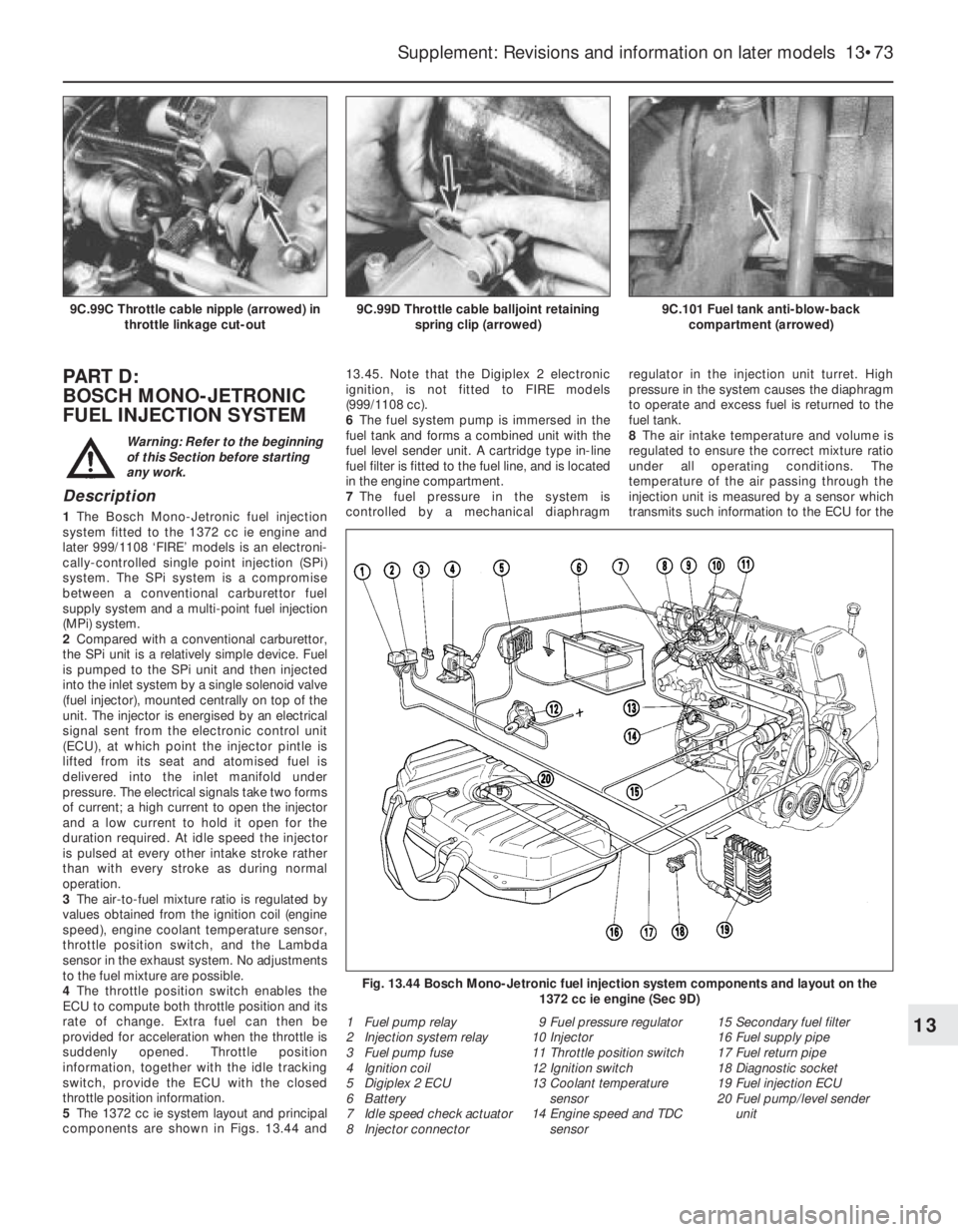
[x] Cancel search | Manufacturer: FIAT, Model Year: 1983, Model line: UNO, Model: FIAT UNO 1983Pages: 303, PDF Size: 10.36 MB
Page 183 of 303
35Clean the mating faces of the thermostat
cover and cylinder head, and use a new
gasket when refitting the cover.
36Refill the cooling system as described
earlier in this Section.
Coolant pump -
removal and refittingÁ
Note: A new coolant pump gasket must be
used on refitting. If the pump is found to be
worn it must be renewed as a complete unit as
dismantling and repair is not possible.
37Disconnect the battery negative lead.
38Drain the cooling system as described
earlier in this Section.
39Remove the coolant/alternator drivebelt
as described in the next sub-Section.
40Unscrew the four coolant pump securing
bolts, noting that two of the bolts also secure
the alternator adjuster bracket, and withdraw
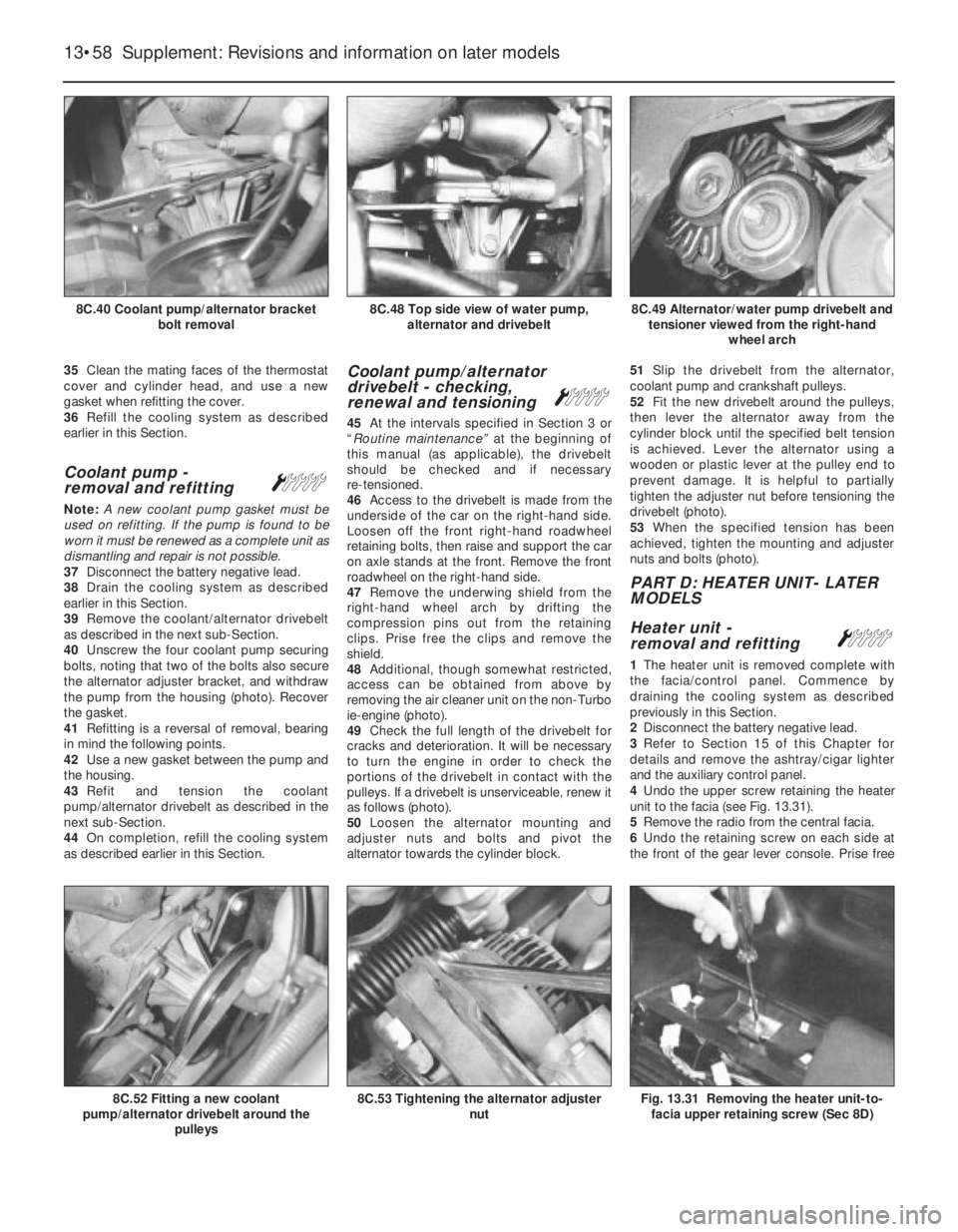
the pump from the housing (photo). Recover
the gasket.
41Refitting is a reversal of removal, bearing
in mind the following points.
42Use a new gasket between the pump and
the housing.
43Refit and tension the coolant
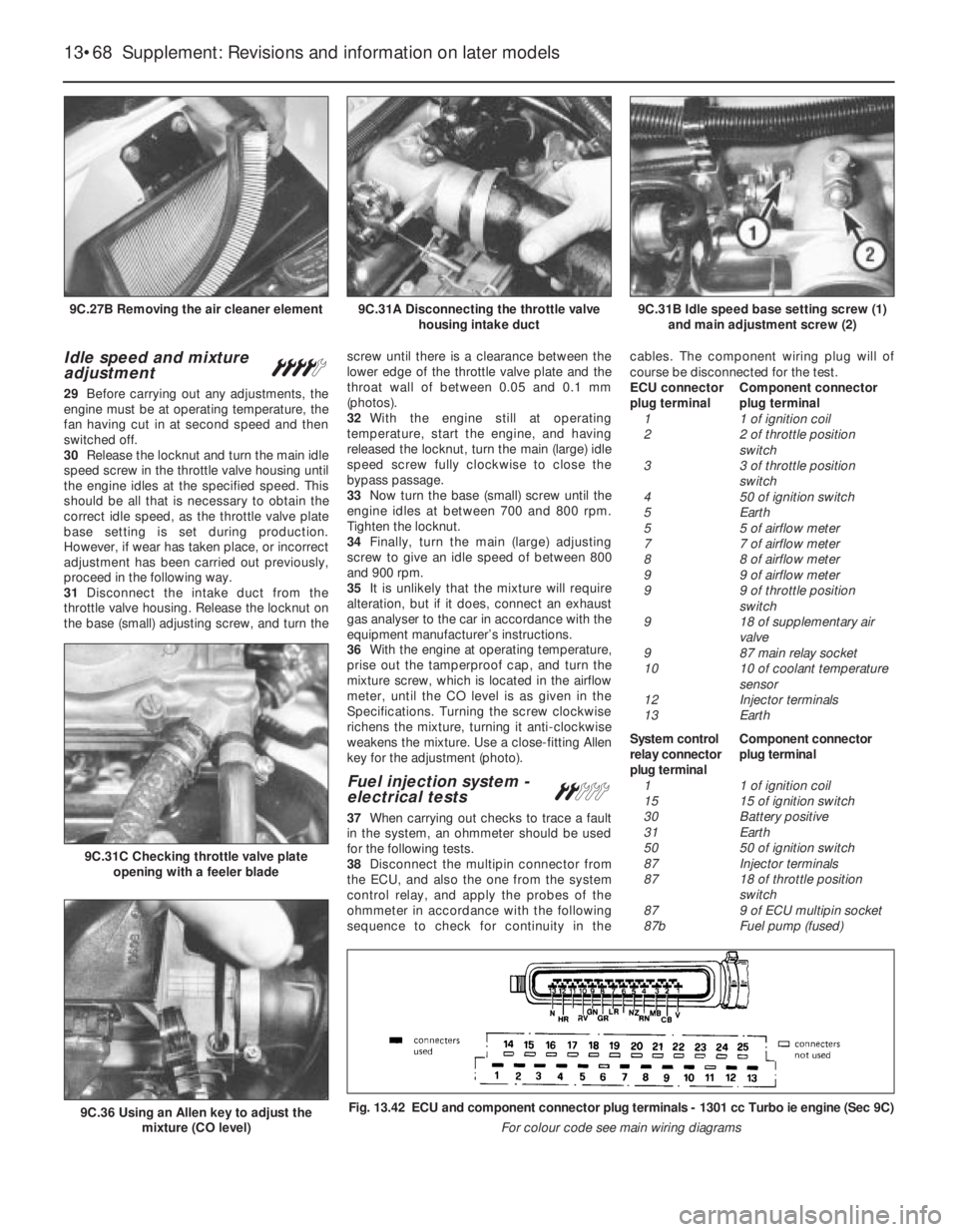
pump/alternator drivebelt as described in the
next sub-Section.
44On completion, refill the cooling system
as described earlier in this Section.
Coolant pump/alternator
drivebelt - checking,
renewal and tensioning
Á
45At the intervals specified in Section 3 or
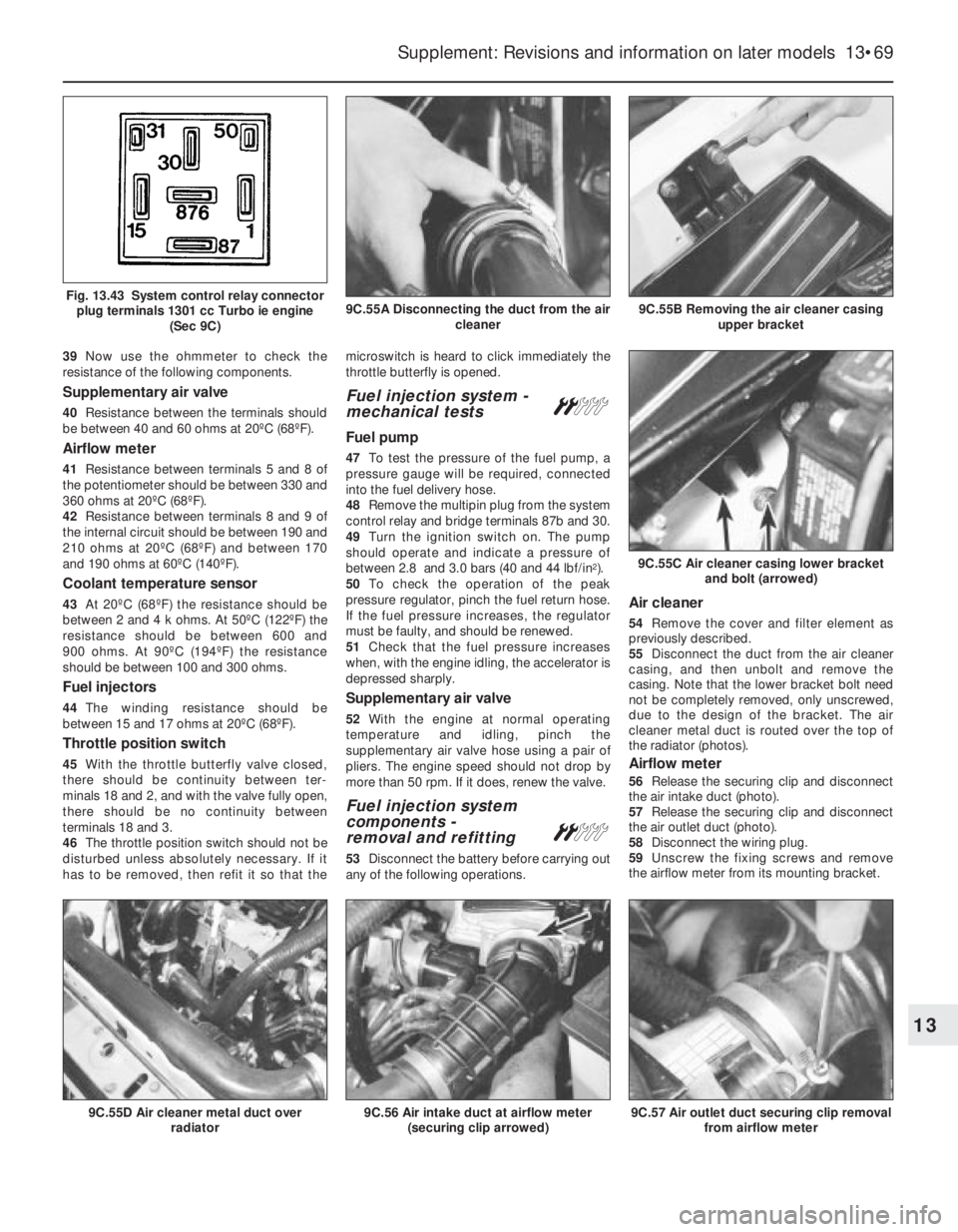
“Routine maintenance” at the beginning of
this manual (as applicable), the drivebelt
should be checked and if necessary
re-tensioned.
46Access to the drivebelt is made from the
underside of the car on the right-hand side.
Loosen off the front right-hand roadwheel
retaining bolts, then raise and support the car
on axle stands at the front. Remove the front
roadwheel on the right-hand side.
47Remove the underwing shield from the
right-hand wheel arch by drifting the
compression pins out from the retaining
clips. Prise free the clips and remove the
shield.
48Additional, though somewhat restricted,
access can be obtained from above by
removing the air cleaner unit on the non-Turbo
ie-engine (photo).
49Check the full length of the drivebelt for
cracks and deterioration. It will be necessary
to turn the engine in order to check the
portions of the drivebelt in contact with the
pulleys. If a drivebelt is unserviceable, renew it
as follows (photo).
50Loosen the alternator mounting and
adjuster nuts and bolts and pivot the
alternator towards the cylinder block.51Slip the drivebelt from the alternator,
coolant pump and crankshaft pulleys.
52Fit the new drivebelt around the pulleys,
then lever the alternator away from the
cylinder block until the specified belt tension
is achieved. Lever the alternator using a
wooden or plastic lever at the pulley end to
prevent damage. It is helpful to partially
tighten the adjuster nut before tensioning the
drivebelt (photo).
53When the specified tension has been
achieved, tighten the mounting and adjuster
nuts and bolts (photo).
PART D: HEATER UNIT- LATER
MODELS
Heater unit -
removal and refitting
Á
1The heater unit is removed complete with
the facia/control panel. Commence by
draining the cooling system as described
previously in this Section.
2Disconnect the battery negative lead.
3Refer to Section 15 of this Chapter for
details and remove the ashtray/cigar lighter
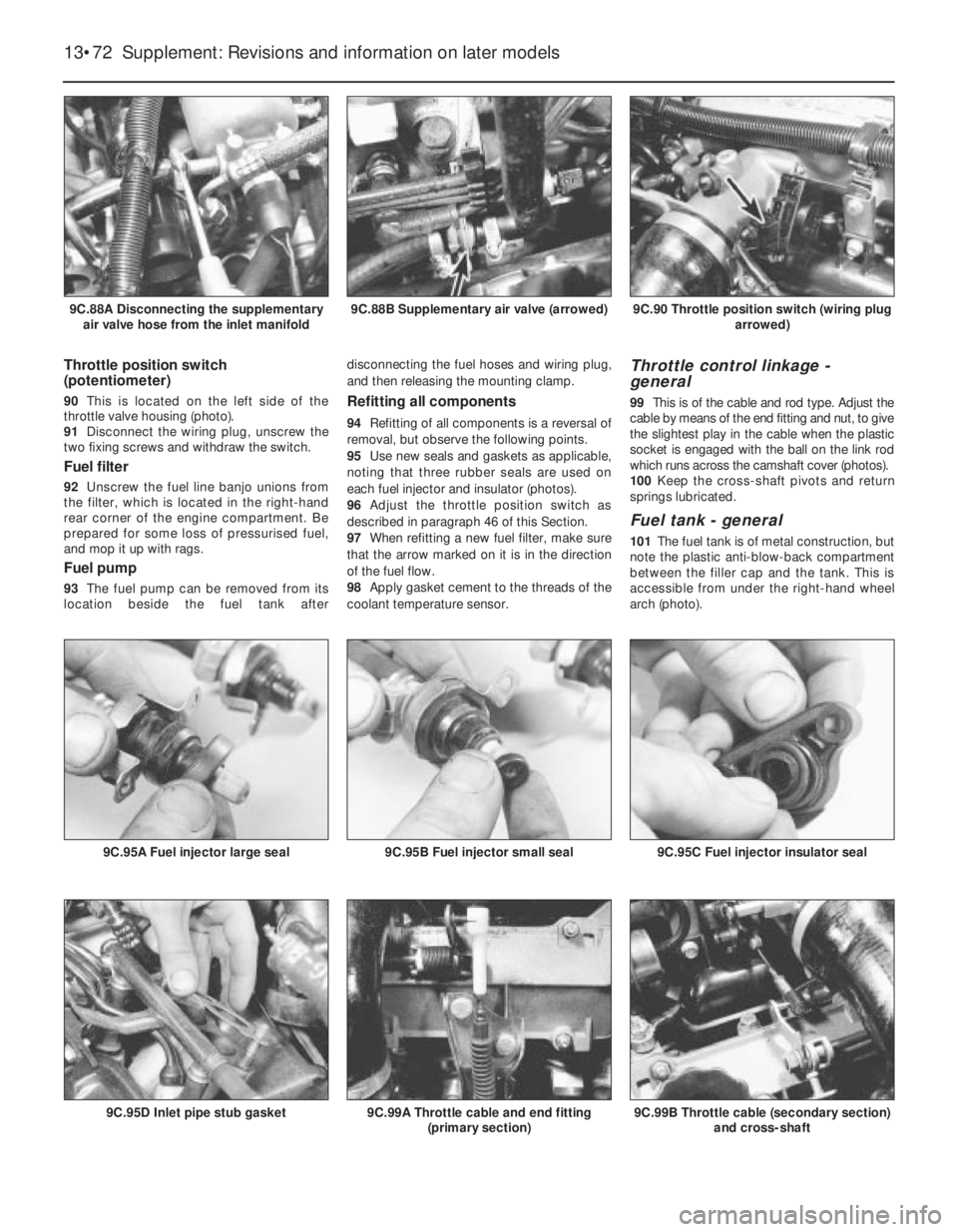
and the auxiliary control panel.
4Undo the upper screw retaining the heater
unit to the facia (see Fig. 13.31).
5Remove the radio from the central facia.
6Undo the retaining screw on each side at
the front of the gear lever console. Prise free
13•58 Supplement: Revisions and information on later models
Fig. 13.31 Removing the heater unit-to-
facia upper retaining screw (Sec 8D)8C.53 Tightening the alternator adjuster
nut8C.52 Fitting a new coolant
pump/alternator drivebelt around the
pulleys
8C.49 Alternator/water pump drivebelt and
tensioner viewed from the right-hand
wheel arch8C.48 Top side view of water pump,
alternator and drivebelt8C.40 Coolant pump/alternator bracket
bolt removal
Page 187 of 303
PART B:
CARBURETTOR MODELS
Carburettor (Weber 32 TLF) -
description
Warning: Refer to the beginning
of this Section before starting
any work.
1This carburettor is used on the 999 cc
engine and is of the single venturi
downdraught type, with a manually-operated
choke (cold start).
2The unit incorporates an automatic
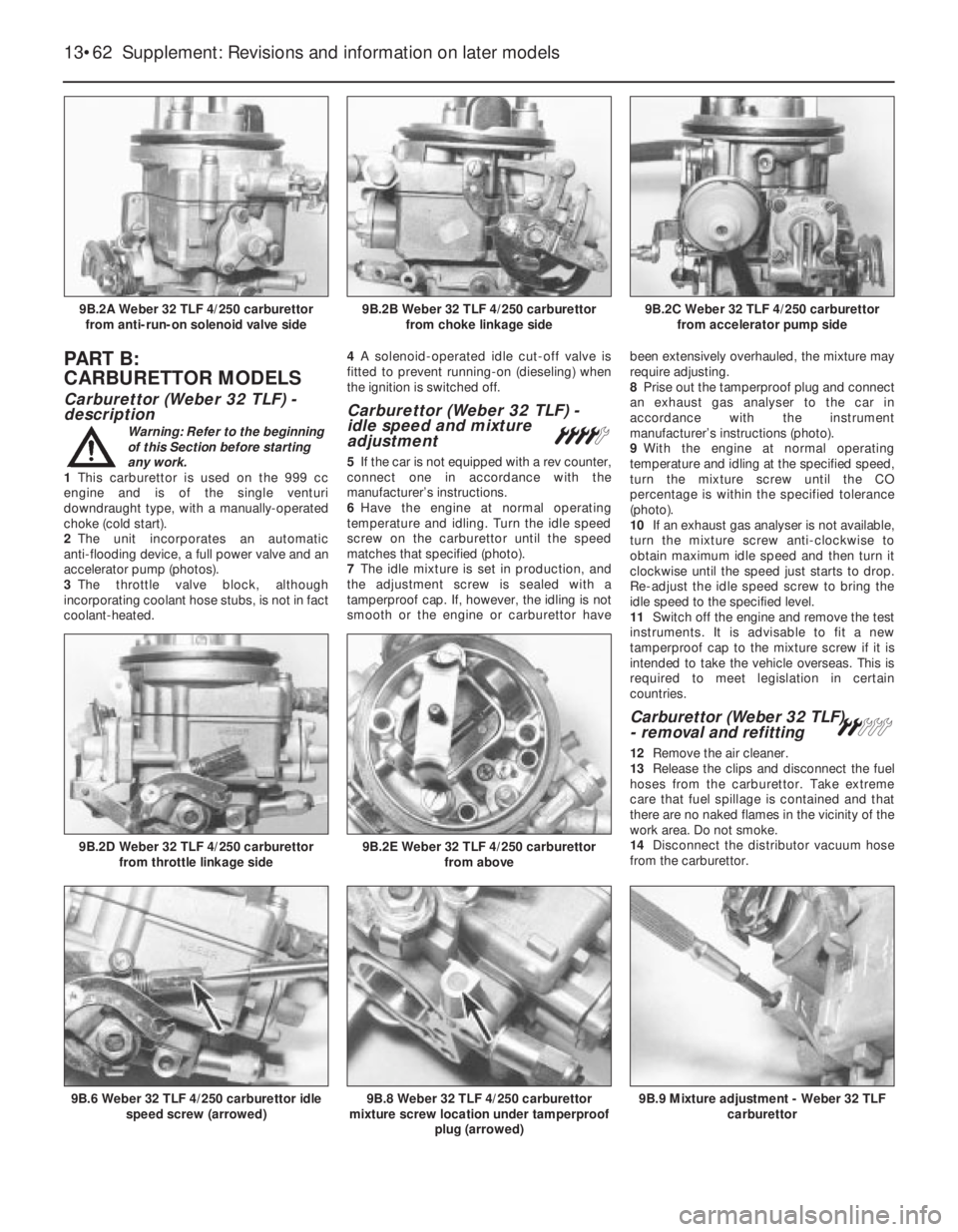
anti-flooding device, a full power valve and an
accelerator pump (photos).
3The throttle valve block, although
incorporating coolant hose stubs, is not in fact
coolant-heated.4A solenoid-operated idle cut-off valve is
fitted to prevent running-on (dieseling) when
the ignition is switched off.
Carburettor (Weber 32 TLF) -
idle speed and mixture
adjustment
¢
5If the car is not equipped with a rev counter,
connect one in accordance with the
manufacturer’s instructions.
6Have the engine at normal operating
temperature and idling. Turn the idle speed
screw on the carburettor until the speed
matches that specified (photo).
7The idle mixture is set in production, and
the adjustment screw is sealed with a
tamperproof cap. If, however, the idling is not
smooth or the engine or carburettor havebeen extensively overhauled, the mixture may
require adjusting.
8Prise out the tamperproof plug and connect
an exhaust gas analyser to the car in
accordance with the instrument
manufacturer’s instructions (photo).
9With the engine at normal operating
temperature and idling at the specified speed,
turn the mixture screw until the CO
percentage is within the specified tolerance
(photo).
10If an exhaust gas analyser is not available,
turn the mixture screw anti-clockwise to
obtain maximum idle speed and then turn it
clockwise until the speed just starts to drop.
Re-adjust the idle speed screw to bring the
idle speed to the specified level.
11Switch off the engine and remove the test
instruments. It is advisable to fit a new
tamperproof cap to the mixture screw if it is
intended to take the vehicle overseas. This is
required to meet legislation in certain
countries.
Carburettor (Weber 32 TLF)
- removal and refitting ª
12Remove the air cleaner.
13Release the clips and disconnect the fuel
hoses from the carburettor. Take extreme
care that fuel spillage is contained and that
there are no naked flames in the vicinity of the
work area. Do not smoke.
14Disconnect the distributor vacuum hose
from the carburettor.
13•62 Supplement: Revisions and information on later models
9B.9 Mixture adjustment - Weber 32 TLF
carburettor9B.8 Weber 32 TLF 4/250 carburettor
mixture screw location under tamperproof
plug (arrowed)9B.6 Weber 32 TLF 4/250 carburettor idle
speed screw (arrowed)
9B.2E Weber 32 TLF 4/250 carburettor
from above9B.2D Weber 32 TLF 4/250 carburettor
from throttle linkage side
9B.2C Weber 32 TLF 4/250 carburettor
from accelerator pump side9B.2B Weber 32 TLF 4/250 carburettor
from choke linkage side9B.2A Weber 32 TLF 4/250 carburettor
from anti-run-on solenoid valve side
Page 191 of 303
adjustments described in this sub-Section,
however, will require removal of the
carburettor.
39Disconnect the short, curved diaphragm
hose from the top cover.
40Extract the top cover screws, lift the cover
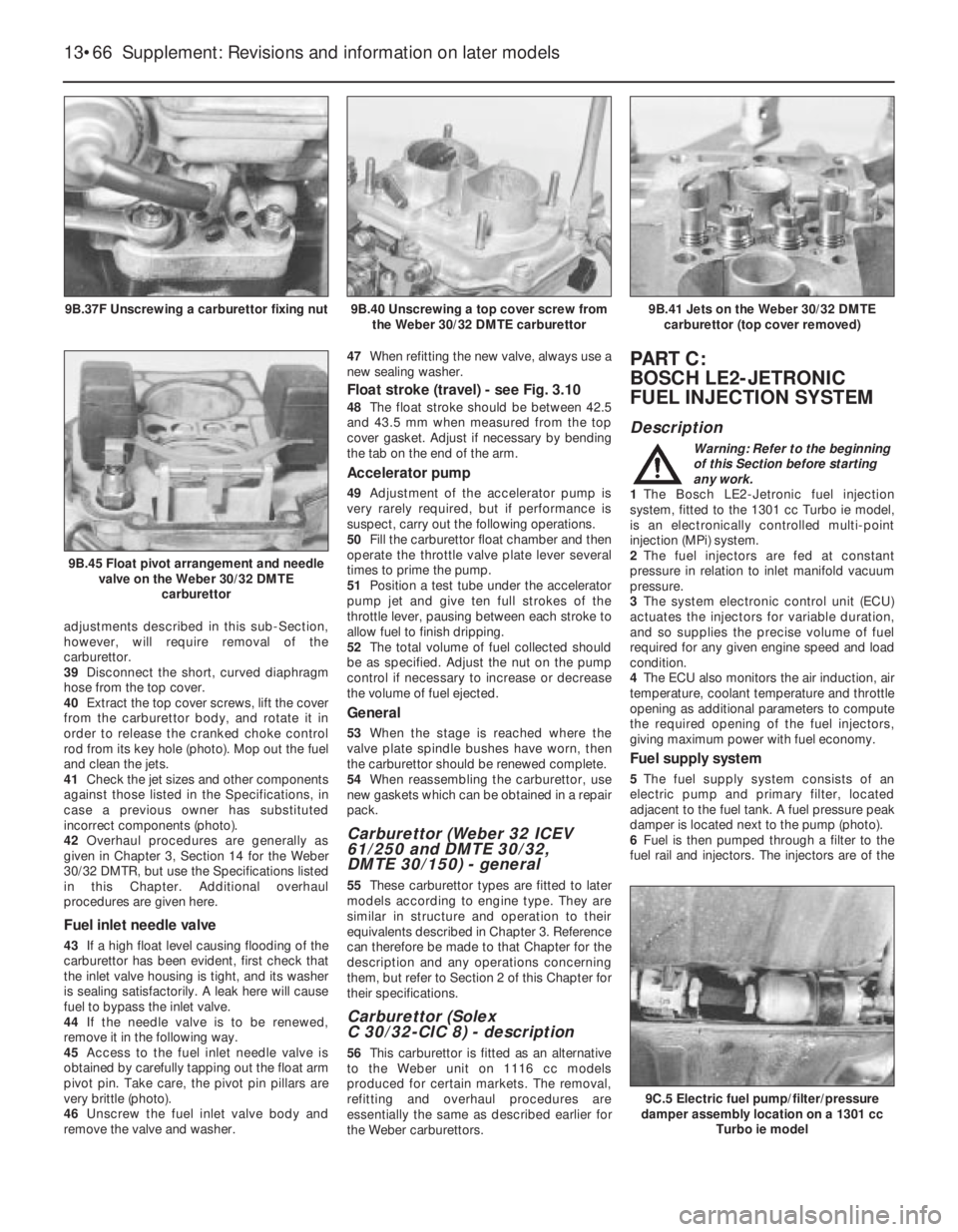
from the carburettor body, and rotate it in
order to release the cranked choke control
rod from its key hole (photo). Mop out the fuel
and clean the jets.
41Check the jet sizes and other components
against those listed in the Specifications, in
case a previous owner has substituted
incorrect components (photo).
42Overhaul procedures are generally as
given in Chapter 3, Section 14 for the Weber
30/32 DMTR, but use the Specifications listed
in this Chapter. Additional overhaul
procedures are given here.
Fuel inlet needle valve
43If a high float level causing flooding of the
carburettor has been evident, first check that
the inlet valve housing is tight, and its washer
is sealing satisfactorily. A leak here will cause
fuel to bypass the inlet valve.
44If the needle valve is to be renewed,
remove it in the following way.
45Access to the fuel inlet needle valve is
obtained by carefully tapping out the float arm
pivot pin. Take care, the pivot pin pillars are
very brittle (photo).
46Unscrew the fuel inlet valve body and
remove the valve and washer.47When refitting the new valve, always use a
new sealing washer.
Float stroke (travel) - see Fig. 3.10
48The float stroke should be between 42.5
and 43.5 mm when measured from the top
cover gasket. Adjust if necessary by bending
the tab on the end of the arm.
Accelerator pump
49Adjustment of the accelerator pump is
very rarely required, but if performance is
suspect, carry out the following operations.
50Fill the carburettor float chamber and then
operate the throttle valve plate lever several
times to prime the pump.
51Position a test tube under the accelerator
pump jet and give ten full strokes of the
throttle lever, pausing between each stroke to
allow fuel to finish dripping.
52The total volume of fuel collected should
be as specified. Adjust the nut on the pump
control if necessary to increase or decrease
the volume of fuel ejected.
General
53When the stage is reached where the
valve plate spindle bushes have worn, then
the carburettor should be renewed complete.
54When reassembling the carburettor, use
new gaskets which can be obtained in a repair
pack.
Carburettor (Weber 32 ICEV
61/250 and DMTE 30/32,
DMTE 30/150) - general
55These carburettor types are fitted to later
models according to engine type. They are
similar in structure and operation to their
equivalents described in Chapter 3. Reference
can therefore be made to that Chapter for the
description and any operations concerning
them, but refer to Section 2 of this Chapter for
their specifications.
Carburettor (Solex
C 30/32-CIC 8) - description
56This carburettor is fitted as an alternative
to the Weber unit on 1116 cc models
produced for certain markets. The removal,
refitting and overhaul procedures are
essentially the same as described earlier for
the Weber carburettors.
PART C:
BOSCH LE2-JETRONIC
FUEL INJECTION SYSTEM
Description
Warning: Refer to the beginning
of this Section before starting
any work.
1The Bosch LE2-Jetronic fuel injection
system, fitted to the 1301 cc Turbo ie model,
is an electronically controlled multi-point
injection (MPi) system.
2The fuel injectors are fed at constant
pressure in relation to inlet manifold vacuum
pressure.
3The system electronic control unit (ECU)
actuates the injectors for variable duration,
and so supplies the precise volume of fuel
required for any given engine speed and load
condition.
4The ECU also monitors the air induction, air
temperature, coolant temperature and throttle
opening as additional parameters to compute
the required opening of the fuel injectors,
giving maximum power with fuel economy.
Fuel supply system
5The fuel supply system consists of an
electric pump and primary filter, located
adjacent to the fuel tank. A fuel pressure peak
damper is located next to the pump (photo).
6Fuel is then pumped through a filter to the
fuel rail and injectors. The injectors are of the
13•66 Supplement: Revisions and information on later models
9C.5 Electric fuel pump/filter/pressure
damper assembly location on a 1301 cc
Turbo ie model
9B.41 Jets on the Weber 30/32 DMTE
carburettor (top cover removed)
9B.45 Float pivot arrangement and needle
valve on the Weber 30/32 DMTE
carburettor
9B.40 Unscrewing a top cover screw from
the Weber 30/32 DMTE carburettor9B.37F Unscrewing a carburettor fixing nut
Page 192 of 303
solenoid-operated type, actuated from the
ECU.
7Fuel pressure is regulated according to inlet
manifold vacuum pressure by a fuel pressure
regulator. Excess unpressurised fuel is
returned to the fuel tank.
Airflow meter
8This component measures the quantity of
air drawn into the engine, and converts this
into an electric signal which is transmitted to
the ECU.
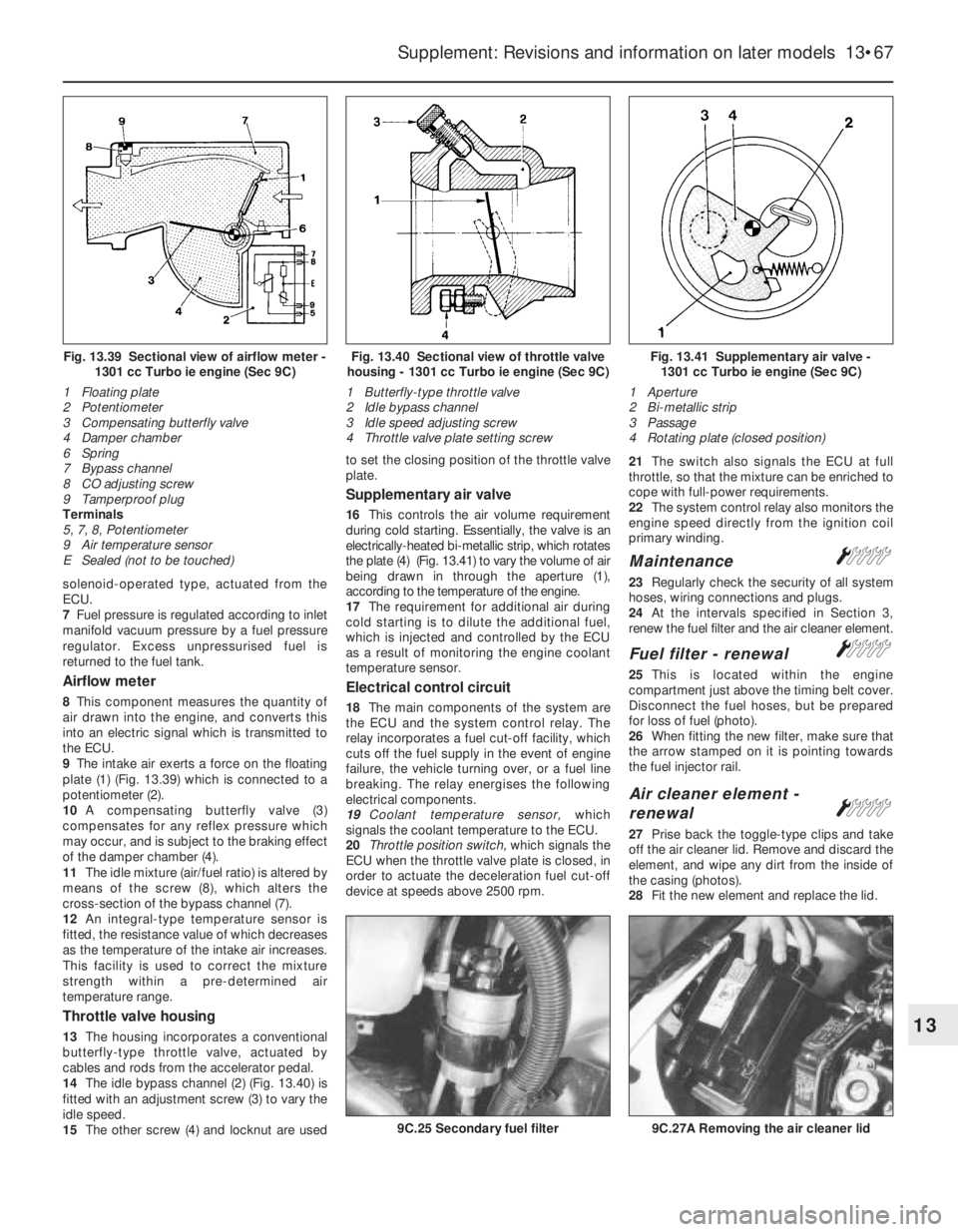
9The intake air exerts a force on the floating
plate (1) (Fig. 13.39) which is connected to a
potentiometer (2).
10A compensating butterfly valve (3)
compensates for any reflex pressure which
may occur, and is subject to the braking effect
of the damper chamber (4).
11The idle mixture (air/fuel ratio) is altered by
means of the screw (8), which alters the
cross-section of the bypass channel (7).
12An integral-type temperature sensor is
fitted, the resistance value of which decreases
as the temperature of the intake air increases.
This facility is used to correct the mixture
strength within a pre-determined air
temperature range.
Throttle valve housing
13The housing incorporates a conventional
butterfly-type throttle valve, actuated by
cables and rods from the accelerator pedal.
14The idle bypass channel (2) (Fig. 13.40) is
fitted with an adjustment screw (3) to vary the
idle speed.
15The other screw (4) and locknut are usedto set the closing position of the throttle valve
plate.
Supplementary air valve
16This controls the air volume requirement
during cold starting. Essentially, the valve is an
electrically-heated bi-metallic strip, which rotates
the plate (4) (Fig. 13.41) to vary the volume of air
being drawn in through the aperture (1),
according to the temperature of the engine.
17The requirement for additional air during
cold starting is to dilute the additional fuel,
which is injected and controlled by the ECU
as a result of monitoring the engine coolant
temperature sensor.
Electrical control circuit
18The main components of the system are
the ECU and the system control relay. The
relay incorporates a fuel cut-off facility, which
cuts off the fuel supply in the event of engine
failure, the vehicle turning over, or a fuel line
breaking. The relay energises the following
electrical components.
19Coolant temperature sensor, which
signals the coolant temperature to the ECU.
20Throttle position switch, which signals the
ECU when the throttle valve plate is closed, in
order to actuate the deceleration fuel cut-off
device at speeds above 2500 rpm.21The switch also signals the ECU at full
throttle, so that the mixture can be enriched to
cope with full-power requirements.
22The system control relay also monitors the
engine speed directly from the ignition coil
primary winding.
MaintenanceÁ
23Regularly check the security of all system
hoses, wiring connections and plugs.
24At the intervals specified in Section 3,
renew the fuel filter and the air cleaner element.
Fuel filter - renewalÁ
25This is located within the engine
compartment just above the timing belt cover.
Disconnect the fuel hoses, but be prepared
for loss of fuel (photo).
26When fitting the new filter, make sure that
the arrow stamped on it is pointing towards
the fuel injector rail.
Air cleaner element -
renewal
Á
27Prise back the toggle-type clips and take
off the air cleaner lid. Remove and discard the
element, and wipe any dirt from the inside of
the casing (photos).
28Fit the new element and replace the lid.
Supplement: Revisions and information on later models 13•67
Fig. 13.41 Supplementary air valve -
1301 cc Turbo ie engine (Sec 9C)
1 Aperture
2 Bi-metallic strip
3 Passage
4 Rotating plate (closed position)Fig. 13.40 Sectional view of throttle valve
housing - 1301 cc Turbo ie engine (Sec 9C)
1 Butterfly-type throttle valve
2 Idle bypass channel
3 Idle speed adjusting screw
4 Throttle valve plate setting screwFig. 13.39 Sectional view of airflow meter -
1301 cc Turbo ie engine (Sec 9C)
1 Floating plate
2 Potentiometer
3 Compensating butterfly valve
4 Damper chamber
6 Spring
7 Bypass channel
8 CO adjusting screw
9 Tamperproof plug
Terminals
5, 7, 8, Potentiometer
9 Air temperature sensor
E Sealed (not to be touched)
9C.27A Removing the air cleaner lid9C.25 Secondary fuel filter
13
Page 193 of 303
Idle speed and mixture
adjustment¢
29Before carrying out any adjustments, the
engine must be at operating temperature, the
fan having cut in at second speed and then
switched off.
30Release the locknut and turn the main idle
speed screw in the throttle valve housing until
the engine idles at the specified speed. This
should be all that is necessary to obtain the
correct idle speed, as the throttle valve plate
base setting is set during production.
However, if wear has taken place, or incorrect
adjustment has been carried out previously,
proceed in the following way.
31Disconnect the intake duct from the
throttle valve housing. Release the locknut on
the base (small) adjusting screw, and turn thescrew until there is a clearance between the
lower edge of the throttle valve plate and the
throat wall of between 0.05 and 0.1 mm
(photos).
32With the engine still at operating
temperature, start the engine, and having
released the locknut, turn the main (large) idle
speed screw fully clockwise to close the
bypass passage.
33Now turn the base (small) screw until the
engine idles at between 700 and 800 rpm.
Tighten the locknut.
34Finally, turn the main (large) adjusting
screw to give an idle speed of between 800
and 900 rpm.
35It is unlikely that the mixture will require
alteration, but if it does, connect an exhaust
gas analyser to the car in accordance with the
equipment manufacturer’s instructions.
36With the engine at operating temperature,
prise out the tamperproof cap, and turn the
mixture screw, which is located in the airflow
meter, until the CO level is as given in the
Specifications. Turning the screw clockwise
richens the mixture, turning it anti-clockwise
weakens the mixture. Use a close-fitting Allen
key for the adjustment (photo).
Fuel injection system -
electrical testsª
37When carrying out checks to trace a fault
in the system, an ohmmeter should be used
for the following tests.
38Disconnect the multipin connector from
the ECU, and also the one from the system
control relay, and apply the probes of the
ohmmeter in accordance with the following
sequence to check for continuity in thecables. The component wiring plug will of
course be disconnected for the test.
ECU connector Component connector
plug terminal plug terminal
1 1 of ignition coil
2 2 of throttle position
switch
3 3 of throttle position
switch
4 50 of ignition switch
5 Earth
5 5 of airflow meter
7 7 of airflow meter
8 8 of airflow meter
9 9 of airflow meter
9 9 of throttle position
switch
9 18 of supplementary air
valve
9 87 main relay socket
10 10 of coolant temperature
sensor
12 Injector terminals
13 Earth
System control Component connector
relay connector plug terminal
plug terminal
1 1 of ignition coil
15 15 of ignition switch
30 Battery positive
31 Earth
50 50 of ignition switch
87 Injector terminals
87 18 of throttle position
switch
87 9 of ECU multipin socket
87b Fuel pump (fused)
13•68 Supplement: Revisions and information on later models
Fig. 13.42 ECU and component connector plug terminals - 1301 cc Turbo ie engine (Sec 9C)
For colour code see main wiring diagrams
9C.31C Checking throttle valve plate
opening with a feeler blade
9C.36 Using an Allen key to adjust the
mixture (CO level)
9C.31B Idle speed base setting screw (1)
and main adjustment screw (2)9C.31A Disconnecting the throttle valve
housing intake duct9C.27B Removing the air cleaner element
Page 194 of 303
39Now use the ohmmeter to check the
resistance of the following components.
Supplementary air valve
40Resistance between the terminals should
be between 40 and 60 ohms at 20ºC (68ºF).
Airflow meter
41Resistance between terminals 5 and 8 of
the potentiometer should be between 330 and
360 ohms at 20ºC (68ºF).
42Resistance between terminals 8 and 9 of
the internal circuit should be between 190 and
210 ohms at 20ºC (68ºF) and between 170
and 190 ohms at 60ºC (140ºF).
Coolant temperature sensor
43At 20ºC (68ºF) the resistance should be
between 2 and 4 k ohms. At 50ºC (122ºF) the
resistance should be between 600 and
900 ohms. At 90ºC (194ºF) the resistance
should be between 100 and 300 ohms.
Fuel injectors
44The winding resistance should be
between 15 and 17 ohms at 20ºC (68ºF).
Throttle position switch
45With the throttle butterfly valve closed,
there should be continuity between ter-
minals 18 and 2, and with the valve fully open,
there should be no continuity between
terminals 18 and 3.
46The throttle position switch should not be
disturbed unless absolutely necessary. If it
has to be removed, then refit it so that themicroswitch is heard to click immediately the
throttle butterfly is opened.
Fuel injection system -
mechanical tests ª
Fuel pump
47To test the pressure of the fuel pump, a
pressure gauge will be required, connected
into the fuel delivery hose.
48Remove the multipin plug from the system
control relay and bridge terminals 87b and 30.
49Turn the ignition switch on. The pump
should operate and indicate a pressure of
between 2.8 and 3.0 bars (40 and 44 lbf/in
2).
50To check the operation of the peak
pressure regulator, pinch the fuel return hose.
If the fuel pressure increases, the regulator
must be faulty, and should be renewed.
51Check that the fuel pressure increases
when, with the engine idling, the accelerator is
depressed sharply.
Supplementary air valve
52With the engine at normal operating
temperature and idling, pinch the
supplementary air valve hose using a pair of
pliers. The engine speed should not drop by
more than 50 rpm. If it does, renew the valve.
Fuel injection system
components -
removal and refitting
ª
53Disconnect the battery before carrying out
any of the following operations.
Air cleaner
54Remove the cover and filter element as
previously described.
55Disconnect the duct from the air cleaner
casing, and then unbolt and remove the
casing. Note that the lower bracket bolt need
not be completely removed, only unscrewed,
due to the design of the bracket. The air
cleaner metal duct is routed over the top of
the radiator (photos).
Airflow meter
56Release the securing clip and disconnect
the air intake duct (photo).
57Release the securing clip and disconnect
the air outlet duct (photo).
58Disconnect the wiring plug.
59Unscrew the fixing screws and remove
the airflow meter from its mounting bracket.
Supplement: Revisions and information on later models 13•69
9C.55B Removing the air cleaner casing
upper bracket9C.55A Disconnecting the duct from the air
cleanerFig. 13.43 System control relay connector
plug terminals 1301 cc Turbo ie engine
(Sec 9C)
9C.57 Air outlet duct securing clip removal
from airflow meter
9C.55C Air cleaner casing lower bracket
and bolt (arrowed)
9C.56 Air intake duct at airflow meter
(securing clip arrowed)9C.55D Air cleaner metal duct over
radiator
13
Page 197 of 303
Throttle position switch
(potentiometer)
90This is located on the left side of the
throttle valve housing (photo).
91Disconnect the wiring plug, unscrew the
two fixing screws and withdraw the switch.
Fuel filter
92Unscrew the fuel line banjo unions from
the filter, which is located in the right-hand
rear corner of the engine compartment. Be
prepared for some loss of pressurised fuel,
and mop it up with rags.
Fuel pump
93The fuel pump can be removed from its
location beside the fuel tank afterdisconnecting the fuel hoses and wiring plug,
and then releasing the mounting clamp.
Refitting all components
94Refitting of all components is a reversal of
removal, but observe the following points.
95Use new seals and gaskets as applicable,
noting that three rubber seals are used on
each fuel injector and insulator (photos).
96Adjust the throttle position switch as
described in paragraph 46 of this Section.
97When refitting a new fuel filter, make sure
that the arrow marked on it is in the direction
of the fuel flow.
98Apply gasket cement to the threads of the
coolant temperature sensor.
Throttle control linkage -
general
99This is of the cable and rod type. Adjust the
cable by means of the end fitting and nut, to give
the slightest play in the cable when the plastic
socket is engaged with the ball on the link rod
which runs across the camshaft cover (photos).
100Keep the cross-shaft pivots and return
springs lubricated.
Fuel tank - general
101The fuel tank is of metal construction, but
note the plastic anti-blow-back compartment
between the filler cap and the tank. This is
accessible from under the right-hand wheel
arch (photo).
13•72 Supplement: Revisions and information on later models
9C.99B Throttle cable (secondary section)
and cross-shaft9C.99A Throttle cable and end fitting
(primary section)9C.95D Inlet pipe stub gasket
9C.95C Fuel injector insulator seal9C.95B Fuel injector small seal9C.95A Fuel injector large seal
9C.90 Throttle position switch (wiring plug
arrowed)9C.88B Supplementary air valve (arrowed)9C.88A Disconnecting the supplementary
air valve hose from the inlet manifold
Page 198 of 303
PART D:
BOSCH MONO-JETRONIC
FUEL INJECTION SYSTEM
Warning: Refer to the beginning
of this Section before starting
any work.
Description
1The Bosch Mono-Jetronic fuel injection
system fitted to the 1372 cc ie engine and
later 999/1108 ‘FIRE’ models is an electroni-
cally-controlled single point injection (SPi)
system. The SPi system is a compromise
between a conventional carburettor fuel
supply system and a multi-point fuel injection
(MPi) system.
2Compared with a conventional carburettor,
the SPi unit is a relatively simple device. Fuel
is pumped to the SPi unit and then injected
into the inlet system by a single solenoid valve
(fuel injector), mounted centrally on top of the
unit. The injector is energised by an electrical
signal sent from the electronic control unit
(ECU), at which point the injector pintle is
lifted from its seat and atomised fuel is
delivered into the inlet manifold under
pressure. The electrical signals take two forms
of current; a high current to open the injector
and a low current to hold it open for the
duration required. At idle speed the injector
is pulsed at every other intake stroke rather
than with every stroke as during normal
operation.
3The air-to-fuel mixture ratio is regulated by
values obtained from the ignition coil (engine
speed), engine coolant temperature sensor,
throttle position switch, and the Lambda
sensor in the exhaust system. No adjustments
to the fuel mixture are possible.
4The throttle position switch enables the
ECU to compute both throttle position and its
rate of change. Extra fuel can then be
provided for acceleration when the throttle is
suddenly opened. Throttle position
information, together with the idle tracking
switch, provide the ECU with the closed
throttle position information.
5The 1372 cc ie system layout and principal
components are shown in Figs. 13.44 and13.45. Note that the Digiplex 2 electronic
ignition, is not fitted to FIRE models
(999/1108 cc).
6The fuel system pump is immersed in the
fuel tank and forms a combined unit with the
fuel level sender unit. A cartridge type in-line
fuel filter is fitted to the fuel line, and is located
in the engine compartment.
7The fuel pressure in the system is
controlled by a mechanical diaphragmregulator in the injection unit turret. High
pressure in the system causes the diaphragm
to operate and excess fuel is returned to the
fuel tank.
8The air intake temperature and volume is
regulated to ensure the correct mixture ratio
under all operating conditions. The
temperature of the air passing through the
injection unit is measured by a sensor which
transmits such information to the ECU for the
Supplement: Revisions and information on later models 13•73
9C.101 Fuel tank anti-blow-back
compartment (arrowed)9C.99D Throttle cable balljoint retaining
spring clip (arrowed)9C.99C Throttle cable nipple (arrowed) in
throttle linkage cut-out
Fig. 13.44 Bosch Mono-Jetronic fuel injection system components and layout on the
1372 cc ie engine (Sec 9D)
1 Fuel pump relay
2 Injection system relay
3 Fuel pump fuse
4 Ignition coil
5 Digiplex 2 ECU
6 Battery
7 Idle speed check actuator
8 Injector connector9 Fuel pressure regulator
10 Injector
11 Throttle position switch
12 Ignition switch
13 Coolant temperature
sensor
14 Engine speed and TDC
sensor15 Secondary fuel filter
16 Fuel supply pipe
17 Fuel return pipe
18 Diagnostic socket
19 Fuel injection ECU
20 Fuel pump/level sender
unit13
Page 199 of 303
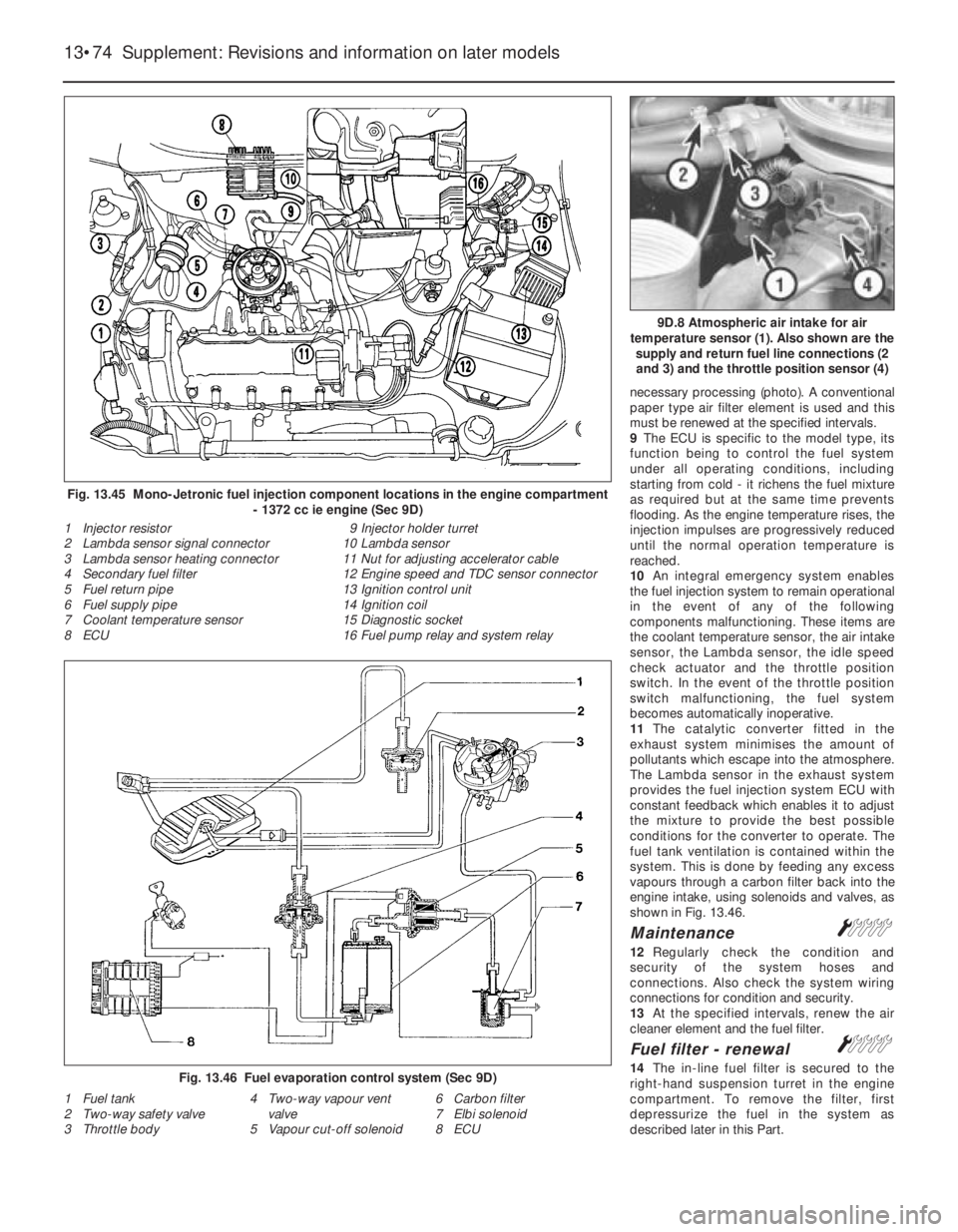
necessary processing (photo). A conventional
paper type air filter element is used and this
must be renewed at the specified intervals.
9The ECU is specific to the model type, its
function being to control the fuel system
under all operating conditions, including
starting from cold - it richens the fuel mixture
as required but at the same time prevents
flooding. As the engine temperature rises, the
injection impulses are progressively reduced
until the normal operation temperature is
reached.
10An integral emergency system enables
the fuel injection system to remain operational
in the event of any of the following
components malfunctioning. These items are
the coolant temperature sensor, the air intake
sensor, the Lambda sensor, the idle speed
check actuator and the throttle position
switch. In the event of the throttle position
switch malfunctioning, the fuel system
becomes automatically inoperative.
11The catalytic converter fitted in the
exhaust system minimises the amount of
pollutants which escape into the atmosphere.
The Lambda sensor in the exhaust system
provides the fuel injection system ECU with
constant feedback which enables it to adjust
the mixture to provide the best possible
conditions for the converter to operate. The
fuel tank ventilation is contained within the
system. This is done by feeding any excess
vapours through a carbon filter back into the
engine intake, using solenoids and valves, as
shown in Fig. 13.46.
MaintenanceÁ
12Regularly check the condition and
security of the system hoses and
connections. Also check the system wiring
connections for condition and security.
13At the specified intervals, renew the air
cleaner element and the fuel filter.
Fuel filter - renewalÁ
14The in-line fuel filter is secured to the
right-hand suspension turret in the engine
compartment. To remove the filter, first
depressurize the fuel in the system as
described later in this Part.
13•74 Supplement: Revisions and information on later models
Fig. 13.46 Fuel evaporation control system (Sec 9D)
1 Fuel tank
2 Two-way safety valve
3 Throttle body4 Two-way vapour vent
valve
5 Vapour cut-off solenoid6 Carbon filter
7 Elbi solenoid
8 ECU
9D.8 Atmospheric air intake for air
temperature sensor (1). Also shown are the
supply and return fuel line connections (2
and 3) and the throttle position sensor (4)
Fig. 13.45 Mono-Jetronic fuel injection component locations in the engine compartment
- 1372 cc ie engine (Sec 9D)
1 Injector resistor
2 Lambda sensor signal connector
3 Lambda sensor heating connector
4 Secondary fuel filter
5 Fuel return pipe
6 Fuel supply pipe
7 Coolant temperature sensor
8 ECU9 Injector holder turret
10 Lambda sensor
11 Nut for adjusting accelerator cable
12 Engine speed and TDC sensor connector
13 Ignition control unit
14 Ignition coil
15 Diagnostic socket
16 Fuel pump relay and system relay
Page 202 of 303
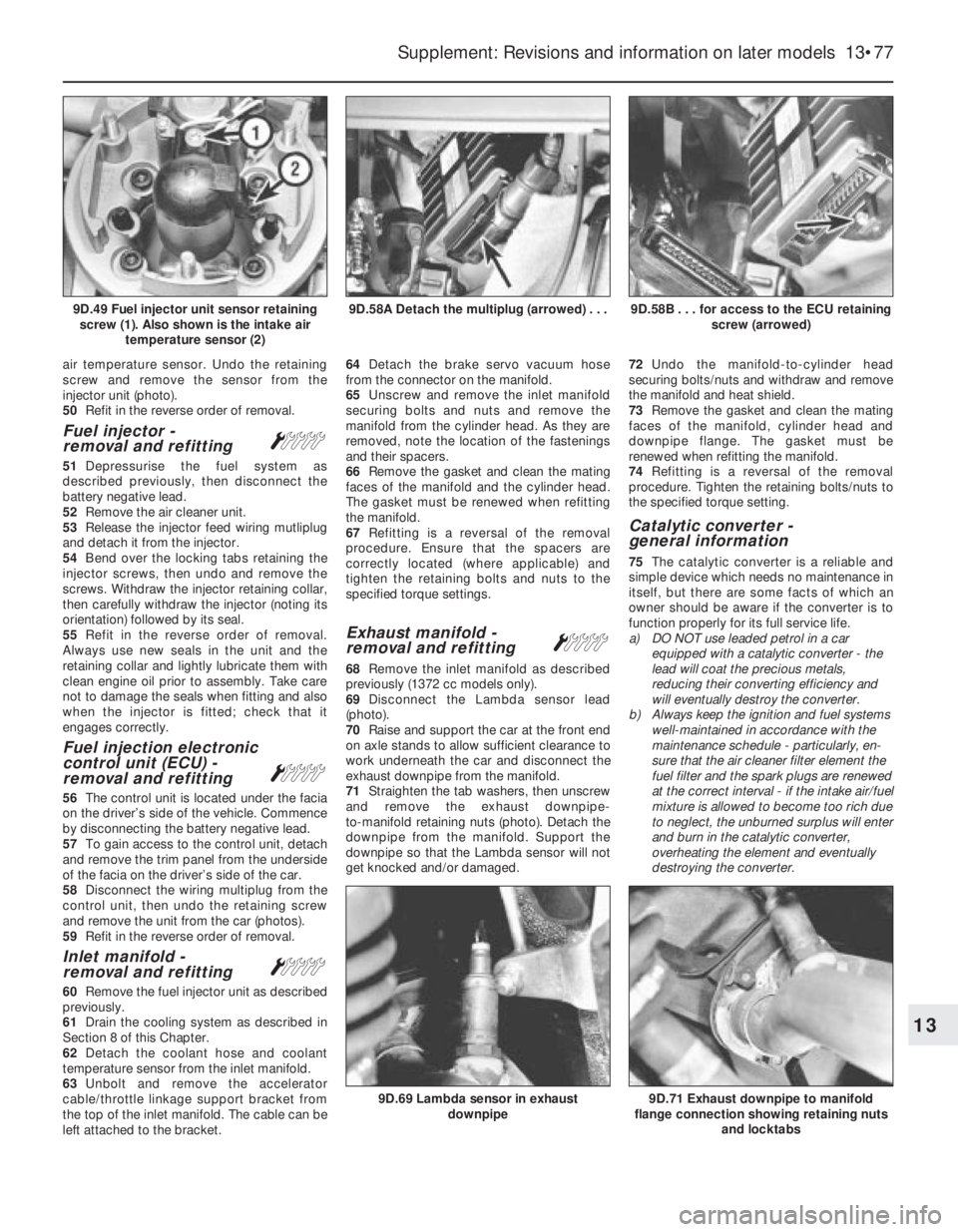
air temperature sensor. Undo the retaining
screw and remove the sensor from the
injector unit (photo).
50Refit in the reverse order of removal.
Fuel injector -
removal and refittingÁ
51Depressurise the fuel system as
described previously, then disconnect the
battery negative lead.
52Remove the air cleaner unit.
53Release the injector feed wiring mutliplug
and detach it from the injector.
54Bend over the locking tabs retaining the
injector screws, then undo and remove the
screws. Withdraw the injector retaining collar,
then carefully withdraw the injector (noting its
orientation) followed by its seal.
55Refit in the reverse order of removal.
Always use new seals in the unit and the
retaining collar and lightly lubricate them with
clean engine oil prior to assembly. Take care
not to damage the seals when fitting and also
when the injector is fitted; check that it
engages correctly.
Fuel injection electronic
control unit (ECU) -
removal and refitting
Á
56The control unit is located under the facia
on the driver’s side of the vehicle. Commence
by disconnecting the battery negative lead.
57To gain access to the control unit, detach
and remove the trim panel from the underside
of the facia on the driver’s side of the car.
58Disconnect the wiring multiplug from the
control unit, then undo the retaining screw
and remove the unit from the car (photos).
59Refit in the reverse order of removal.
Inlet manifold -
removal and refittingÁ
60Remove the fuel injector unit as described
previously.
61Drain the cooling system as described in
Section 8 of this Chapter.
62Detach the coolant hose and coolant
temperature sensor from the inlet manifold.
63Unbolt and remove the accelerator
cable/throttle linkage support bracket from
the top of the inlet manifold. The cable can be
left attached to the bracket.64Detach the brake servo vacuum hose
from the connector on the manifold.
65Unscrew and remove the inlet manifold
securing bolts and nuts and remove the
manifold from the cylinder head. As they are
removed, note the location of the fastenings
and their spacers.
66Remove the gasket and clean the mating
faces of the manifold and the cylinder head.
The gasket must be renewed when refitting
the manifold.
67Refitting is a reversal of the removal
procedure. Ensure that the spacers are
correctly located (where applicable) and
tighten the retaining bolts and nuts to the
specified torque settings.
Exhaust manifold -
removal and refittingÁ
68Remove the inlet manifold as described
previously (1372 cc models only).
69Disconnect the Lambda sensor lead
(photo).
70Raise and support the car at the front end
on axle stands to allow sufficient clearance to
work underneath the car and disconnect the
exhaust downpipe from the manifold.
71Straighten the tab washers, then unscrew
and remove the exhaust downpipe-
to-manifold retaining nuts (photo). Detach the
downpipe from the manifold. Support the
downpipe so that the Lambda sensor will not
get knocked and/or damaged.72Undo the manifold-to-cylinder head
securing bolts/nuts and withdraw and remove
the manifold and heat shield.
73Remove the gasket and clean the mating
faces of the manifold, cylinder head and
downpipe flange. The gasket must be
renewed when refitting the manifold.
74Refitting is a reversal of the removal
procedure. Tighten the retaining bolts/nuts to
the specified torque setting.
Catalytic converter -
general information
75The catalytic converter is a reliable and
simple device which needs no maintenance in
itself, but there are some facts of which an
owner should be aware if the converter is to
function properly for its full service life.
a) DO NOT use leaded petrol in a car
equipped with a catalytic converter - the
lead will coat the precious metals,
reducing their converting efficiency and
will eventually destroy the converter.
b) Always keep the ignition and fuel systems
well-maintained in accordance with the
maintenance schedule - particularly, en-
sure that the air cleaner filter element the
fuel filter and the spark plugs are renewed
at the correct interval - if the intake air/fuel
mixture is allowed to become too rich due
to neglect, the unburned surplus will enter
and burn in the catalytic converter,
overheating the element and eventually
destroying the converter.
Supplement: Revisions and information on later models 13•77
9D.58B . . . for access to the ECU retaining
screw (arrowed)9D.58A Detach the multiplug (arrowed) . . .9D.49 Fuel injector unit sensor retaining
screw (1). Also shown is the intake air
temperature sensor (2)
9D.71 Exhaust downpipe to manifold
flange connection showing retaining nuts
and locktabs9D.69 Lambda sensor in exhaust
downpipe
13