mileage FIAT UNO 1983 Service Repair Manual
[x] Cancel search | Manufacturer: FIAT, Model Year: 1983, Model line: UNO, Model: FIAT UNO 1983Pages: 303, PDF Size: 10.36 MB
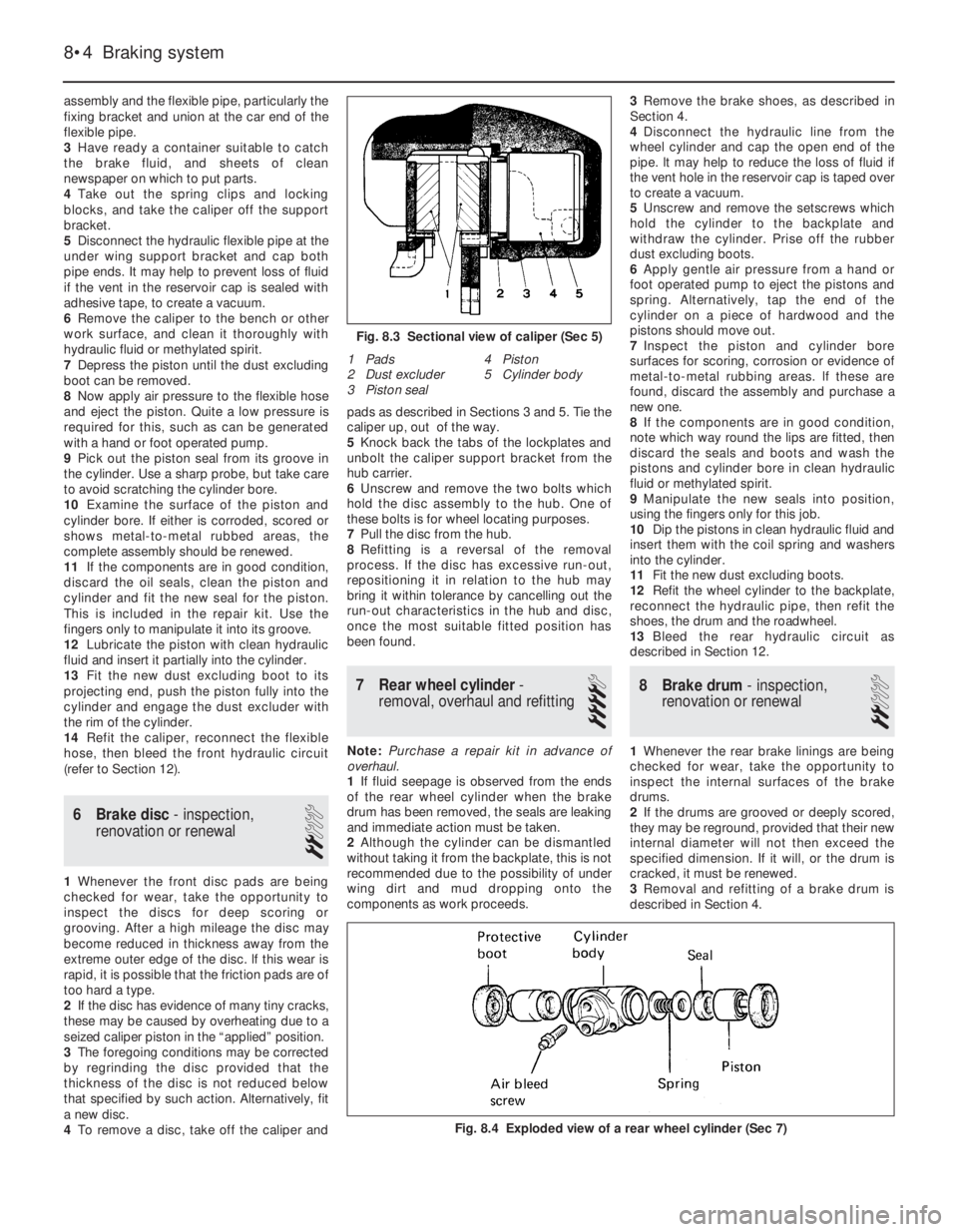
Page 33 of 303
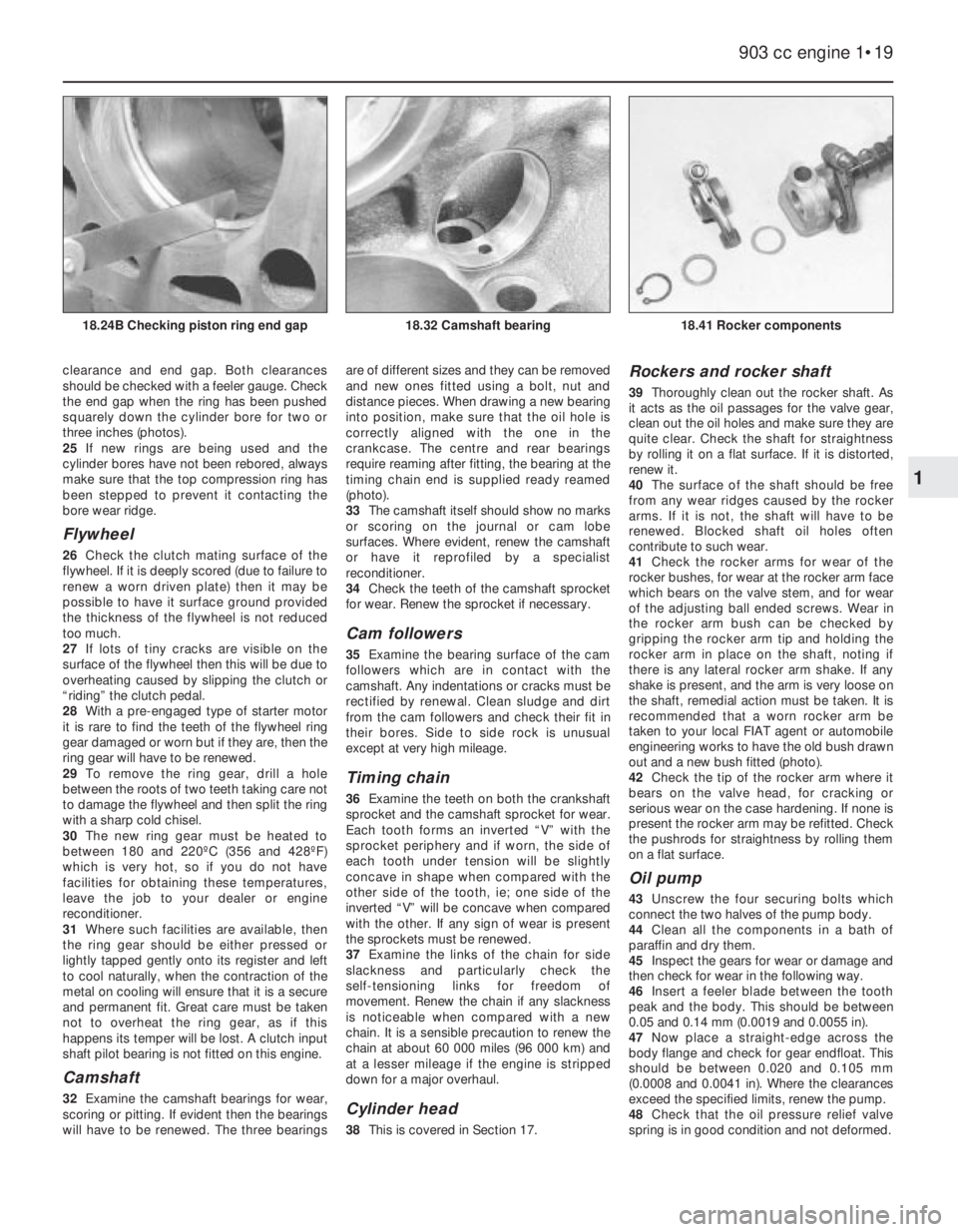
clearance and end gap. Both clearances
should be checked with a feeler gauge. Check
the end gap when the ring has been pushed
squarely down the cylinder bore for two or
three inches (photos).
25If new rings are being used and the
cylinder bores have not been rebored, always
make sure that the top compression ring has
been stepped to prevent it contacting the
bore wear ridge.
Flywheel
26Check the clutch mating surface of the
flywheel. If it is deeply scored (due to failure to
renew a worn driven plate) then it may be
possible to have it surface ground provided
the thickness of the flywheel is not reduced
too much.
27If lots of tiny cracks are visible on the
surface of the flywheel then this will be due to
overheating caused by slipping the clutch or
“riding” the clutch pedal.
28With a pre-engaged type of starter motor
it is rare to find the teeth of the flywheel ring
gear damaged or worn but if they are, then the
ring gear will have to be renewed.
29To remove the ring gear, drill a hole
between the roots of two teeth taking care not
to damage the flywheel and then split the ring
with a sharp cold chisel.
30The new ring gear must be heated to
between 180 and 220ºC (356 and 428ºF)
which is very hot, so if you do not have
facilities for obtaining these temperatures,
leave the job to your dealer or engine
reconditioner.
31Where such facilities are available, then
the ring gear should be either pressed or
lightly tapped gently onto its register and left
to cool naturally, when the contraction of the
metal on cooling will ensure that it is a secure
and permanent fit. Great care must be taken
not to overheat the ring gear, as if this
happens its temper will be lost. A clutch input
shaft pilot bearing is not fitted on this engine.
Camshaft
32Examine the camshaft bearings for wear,
scoring or pitting. If evident then the bearings
will have to be renewed. The three bearingsare of different sizes and they can be removed
and new ones fitted using a bolt, nut and
distance pieces. When drawing a new bearing
into position, make sure that the oil hole is
correctly aligned with the one in the
crankcase. The centre and rear bearings
require reaming after fitting, the bearing at the
timing chain end is supplied ready reamed
(photo).
33The camshaft itself should show no marks
or scoring on the journal or cam lobe
surfaces. Where evident, renew the camshaft
or have it reprofiled by a specialist
reconditioner.
34Check the teeth of the camshaft sprocket
for wear. Renew the sprocket if necessary.
Cam followers
35Examine the bearing surface of the cam
followers which are in contact with the
camshaft. Any indentations or cracks must be
rectified by renewal. Clean sludge and dirt
from the cam followers and check their fit in
their bores. Side to side rock is unusual
except at very high mileage.
Timing chain
36Examine the teeth on both the crankshaft
sprocket and the camshaft sprocket for wear.
Each tooth forms an inverted “V” with the
sprocket periphery and if worn, the side of
each tooth under tension will be slightly
concave in shape when compared with the
other side of the tooth, ie; one side of the
inverted “V” will be concave when compared
with the other. If any sign of wear is present
the sprockets must be renewed.
37Examine the links of the chain for side
slackness and particularly check the
self-tensioning links for freedom of
movement. Renew the chain if any slackness
is noticeable when compared with a new
chain. It is a sensible precaution to renew the
chain at about 60 000 miles (96 000 km) and
at a lesser mileage if the engine is stripped
down for a major overhaul.
Cylinder head
38This is covered in Section 17.
Rockers and rocker shaft
39Thoroughly clean out the rocker shaft. As
it acts as the oil passages for the valve gear,
clean out the oil holes and make sure they are
quite clear. Check the shaft for straightness
by rolling it on a flat surface. If it is distorted,
renew it.
40The surface of the shaft should be free
from any wear ridges caused by the rocker
arms. If it is not, the shaft will have to be
renewed. Blocked shaft oil holes often
contribute to such wear.
41Check the rocker arms for wear of the
rocker bushes, for wear at the rocker arm face
which bears on the valve stem, and for wear
of the adjusting ball ended screws. Wear in
the rocker arm bush can be checked by
gripping the rocker arm tip and holding the
rocker arm in place on the shaft, noting if
there is any lateral rocker arm shake. If any
shake is present, and the arm is very loose on
the shaft, remedial action must be taken. It is
recommended that a worn rocker arm be
taken to your local FIAT agent or automobile
engineering works to have the old bush drawn
out and a new bush fitted (photo).
42Check the tip of the rocker arm where it
bears on the valve head, for cracking or
serious wear on the case hardening. If none is
present the rocker arm may be refitted. Check
the pushrods for straightness by rolling them
on a flat surface.
Oil pump
43Unscrew the four securing bolts which
connect the two halves of the pump body.
44Clean all the components in a bath of
paraffin and dry them.
45Inspect the gears for wear or damage and
then check for wear in the following way.
46Insert a feeler blade between the tooth
peak and the body. This should be between
0.05 and 0.14 mm (0.0019 and 0.0055 in).
47Now place a straight-edge across the
body flange and check for gear endfloat. This
should be between 0.020 and 0.105 mm
(0.0008 and 0.0041 in). Where the clearances
exceed the specified limits, renew the pump.
48Check that the oil pressure relief valve
spring is in good condition and not deformed.
903 cc engine 1•19
18.41 Rocker components18.32 Camshaft bearing18.24B Checking piston ring end gap
1
Page 37 of 303
removed and the weight of the car is again on
its roadwheels.
4Fill the cooling system.
5Fill the engine with oil.
6Replenish lost transmission oil.
7Reconnect the battery.
8Adjust the clutch pedal as described in
Chapter 5.
24 Engine- initial start-up after
overhaul or major repair
4
1Make sure that the battery is fully charged
and that all lubricants, coolant and fuel are
replenished.
2If the fuel system has been dismantled it will
require several revolutions of the engine on
the starter motor to pump the petrol up to the
carburettor.
3Turn the carburettor throttle speed screwthrough one complete turn to increase the idle
speed in order to offset the initial stiffness of
new engine internal components.
4As soon as the engine fires and runs, keep
it going at a fast idle speed and bring it up to
normal working temperature.
5As the engine warms up there will be odd
smells and some smoke from parts getting
hot and burning off oil deposits. The signs to
look for are leaks of water or oil which will be
obvious.
6Check also the exhaust pipe and manifold
connections as these do not always “find”
their exact gas tight position until the warmth
and vibration have acted on them and it is
almost certain that they will need tightening
further. This should be done, of course, with
the engine stopped.
7When normal running temperature has
been reached, adjust the engine idle speed as
described in Chapter 3.
8Stop the engine and wait a few minutes tosee if any lubricant or coolant is dripping out
when the engine is stationary.
9Road test the car to check that the timing is
correct and that the engine is giving the
necessary smoothness and power. Do not
race the engine - if new bearings and/or
pistons have been fitted it should be treated
as a new engine and run in at a reduced
speed for the first 500 km (300 miles).
10After the first 1500 km (900 miles) the
cylinder head bolts must be re-torqued in the
following way (engine cold).
11Remove the air cleaner and rocker cover.
Unscrew the first bolt (Fig. 1.7) through a
quarter turn and then tighten it to final stage 2
torque (see Specifications).
12Repeat on the remaining bolts, one at a
time.
13Check and adjust the valve clearances
(Section 5).
14Refit the rocker cover and air cleaner.
903 cc engine 1•23
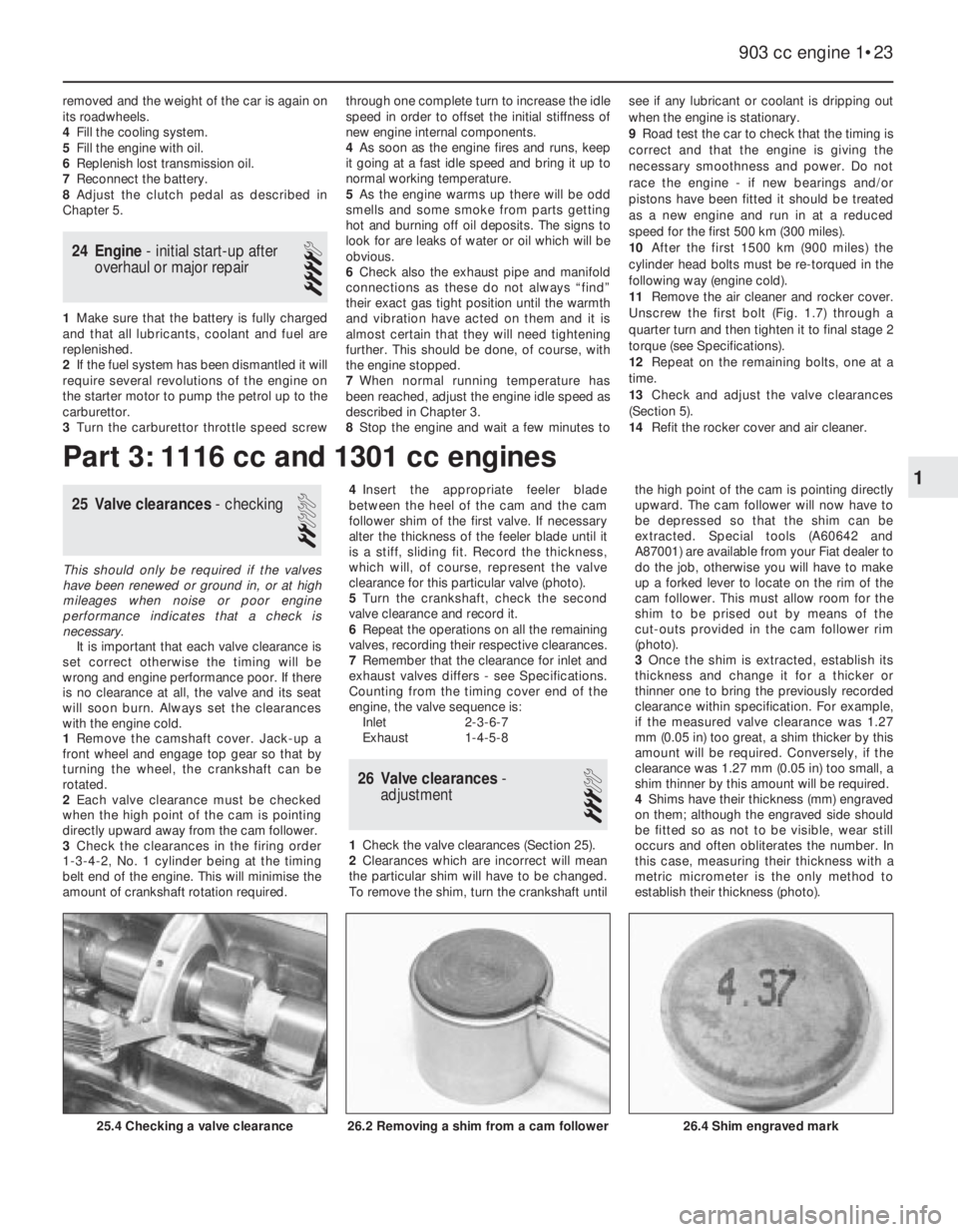
26.4 Shim engraved mark26.2 Removing a shim from a cam follower25.4 Checking a valve clearance
1
Part 3: 1116 cc and 1301 cc engines
25 Valve clearances- checking
2
This should only be required if the valves
have been renewed or ground in, or at high
mileages when noise or poor engine
performance indicates that a check is
necessary.
It is important that each valve clearance is
set correct otherwise the timing will be
wrong and engine performance poor. If there
is no clearance at all, the valve and its seat
will soon burn. Always set the clearances
with the engine cold.
1Remove the camshaft cover. Jack-up a
front wheel and engage top gear so that by
turning the wheel, the crankshaft can be
rotated.
2Each valve clearance must be checked
when the high point of the cam is pointing
directly upward away from the cam follower.
3Check the clearances in the firing order
1-3-4-2, No. 1 cylinder being at the timing
belt end of the engine. This will minimise the
amount of crankshaft rotation required.4Insert the appropriate feeler blade
between the heel of the cam and the cam
follower shim of the first valve. If necessary
alter the thickness of the feeler blade until it
is a stiff, sliding fit. Record the thickness,
which will, of course, represent the valve
clearance for this particular valve (photo).
5Turn the crankshaft, check the second
valve clearance and record it.
6Repeat the operations on all the remaining
valves, recording their respective clearances.
7Remember that the clearance for inlet and
exhaust valves differs - see Specifications.
Counting from the timing cover end of the
engine, the valve sequence is:
Inlet 2-3-6-7
Exhaust 1-4-5-8
26 Valve clearances-
adjustment
3
1Check the valve clearances (Section 25).
2Clearances which are incorrect will mean
the particular shim will have to be changed.
To remove the shim, turn the crankshaft untilthe high point of the cam is pointing directly
upward. The cam follower will now have to
be depressed so that the shim can be
extracted. Special tools (A60642 and
A87001) are available from your Fiat dealer to
do the job, otherwise you will have to make
up a forked lever to locate on the rim of the
cam follower. This must allow room for the
shim to be prised out by means of the
cut-outs provided in the cam follower rim
(photo).
3Once the shim is extracted, establish its
thickness and change it for a thicker or
thinner one to bring the previously recorded
clearance within specification. For example,
if the measured valve clearance was 1.27
mm (0.05 in) too great, a shim thicker by this
amount will be required. Conversely, if the
clearance was 1.27 mm (0.05 in) too small, a
shim thinner by this amount will be required.
4Shims have their thickness (mm) engraved
on them; although the engraved side should
be fitted so as not to be visible, wear still
occurs and often obliterates the number. In
this case, measuring their thickness with a
metric micrometer is the only method to
establish their thickness (photo).
Page 40 of 303
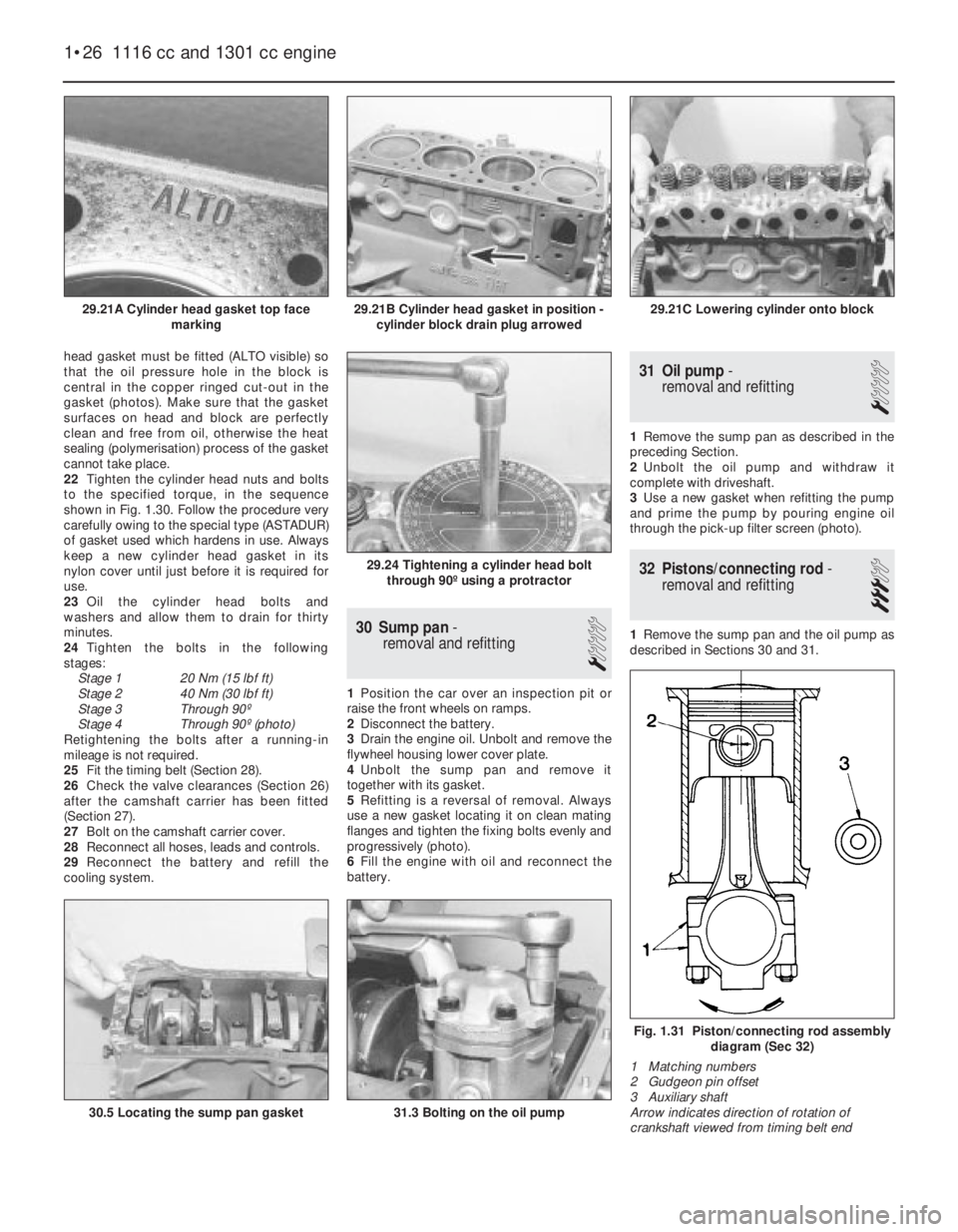
head gasket must be fitted (ALTO visible) so
that the oil pressure hole in the block is
central in the copper ringed cut-out in the
gasket (photos). Make sure that the gasket
surfaces on head and block are perfectly
clean and free from oil, otherwise the heat
sealing (polymerisation) process of the gasket
cannot take place.
22Tighten the cylinder head nuts and bolts
to the specified torque, in the sequence
shown in Fig. 1.30. Follow the procedure very
carefully owing to the special type (ASTADUR)
of gasket used which hardens in use. Always
keep a new cylinder head gasket in its
nylon cover until just before it is required for
use.
23Oil the cylinder head bolts and
washers and allow them to drain for thirty
minutes.
24Tighten the bolts in the following
stages:
Stage 1 20 Nm (15 lbf ft)
Stage 2 40 Nm (30 lbf ft)
Stage 3 Through 90º
Stage 4 Through 90º (photo)
Retightening the bolts after a running-in
mileage is not required.
25Fit the timing belt (Section 28).
26Check the valve clearances (Section 26)
after the camshaft carrier has been fitted
(Section 27).
27Bolt on the camshaft carrier cover.
28Reconnect all hoses, leads and controls.
29Reconnect the battery and refill the
cooling system.
30 Sump pan-
removal and refitting
1
1Position the car over an inspection pit or
raise the front wheels on ramps.
2Disconnect the battery.
3Drain the engine oil. Unbolt and remove the
flywheel housing lower cover plate.
4Unbolt the sump pan and remove it
together with its gasket.
5Refitting is a reversal of removal. Always
use a new gasket locating it on clean mating
flanges and tighten the fixing bolts evenly and
progressively (photo).
6Fill the engine with oil and reconnect the
battery.
31 Oil pump-
removal and refitting
1
1Remove the sump pan as described in the
preceding Section.
2Unbolt the oil pump and withdraw it
complete with driveshaft.
3Use a new gasket when refitting the pump
and prime the pump by pouring engine oil
through the pick-up filter screen (photo).
32 Pistons/connecting rod-
removal and refitting
3
1Remove the sump pan and the oil pump as
described in Sections 30 and 31.
1•26 1116 cc and 1301 cc engine
Fig. 1.31 Piston/connecting rod assembly
diagram (Sec 32)
1 Matching numbers
2 Gudgeon pin offset
3 Auxiliary shaft
Arrow indicates direction of rotation of
crankshaft viewed from timing belt end
29.24 Tightening a cylinder head bolt
through 90º using a protractor
31.3 Bolting on the oil pump30.5 Locating the sump pan gasket
29.21C Lowering cylinder onto block29.21B Cylinder head gasket in position -
cylinder block drain plug arrowed29.21A Cylinder head gasket top face
marking
Page 43 of 303
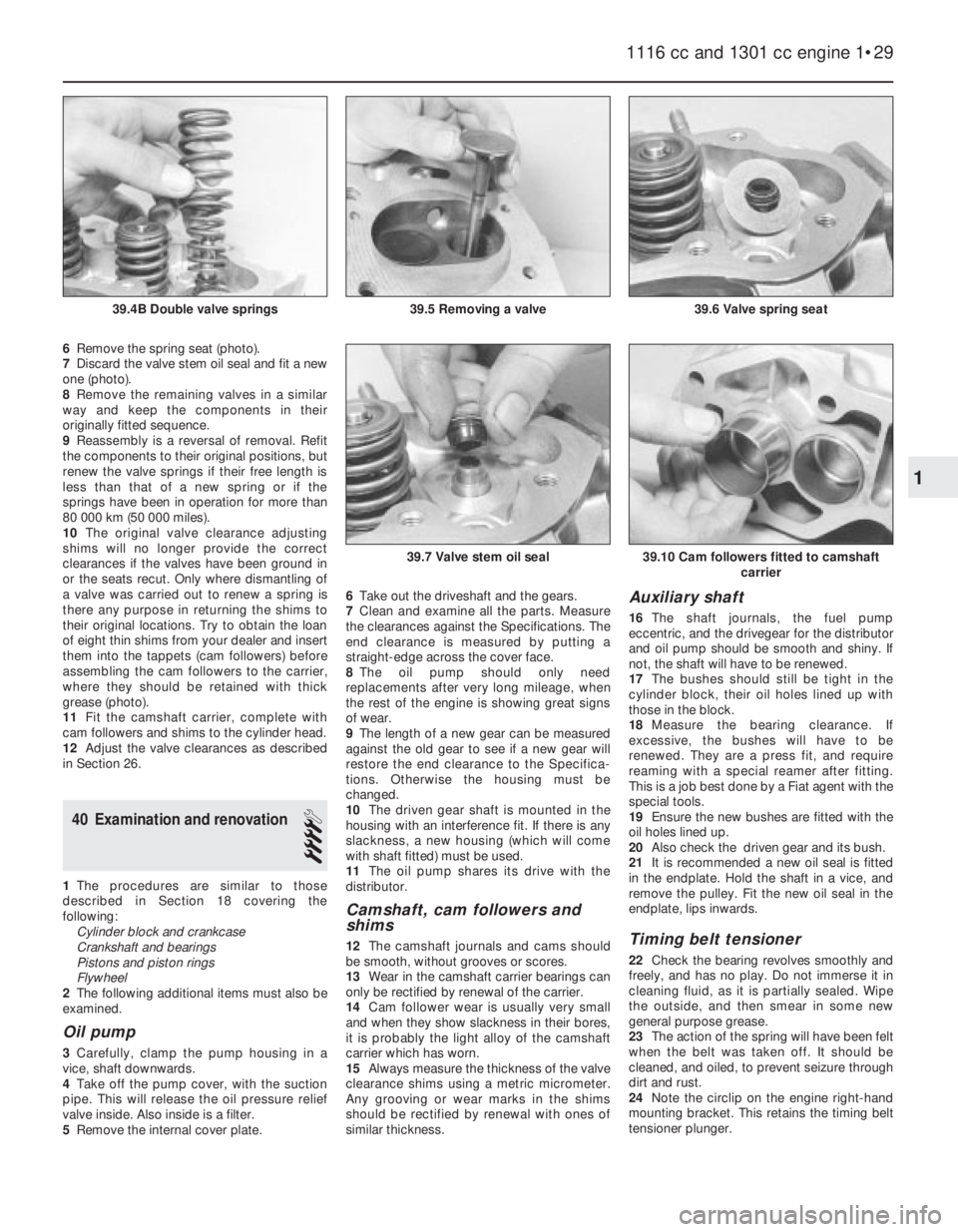
6Remove the spring seat (photo).
7Discard the valve stem oil seal and fit a new
one (photo).
8Remove the remaining valves in a similar
way and keep the components in their
originally fitted sequence.
9Reassembly is a reversal of removal. Refit
the components to their original positions, but
renew the valve springs if their free length is
less than that of a new spring or if the
springs have been in operation for more than
80 000 km (50 000 miles).
10The original valve clearance adjusting
shims will no longer provide the correct
clearances if the valves have been ground in
or the seats recut. Only where dismantling of
a valve was carried out to renew a spring is
there any purpose in returning the shims to
their original locations. Try to obtain the loan
of eight thin shims from your dealer and insert
them into the tappets (cam followers) before
assembling the cam followers to the carrier,
where they should be retained with thick
grease (photo).
11Fit the camshaft carrier, complete with
cam followers and shims to the cylinder head.
12Adjust the valve clearances as described
in Section 26.
40 Examination and renovation
4
1The procedures are similar to those
described in Section 18 covering the
following:
Cylinder block and crankcase
Crankshaft and bearings
Pistons and piston rings
Flywheel
2The following additional items must also be
examined.
Oil pump
3Carefully, clamp the pump housing in a
vice, shaft downwards.
4Take off the pump cover, with the suction
pipe. This will release the oil pressure relief
valve inside. Also inside is a filter.
5Remove the internal cover plate.6Take out the driveshaft and the gears.
7Clean and examine all the parts. Measure
the clearances against the Specifications. The
end clearance is measured by putting a
straight-edge across the cover face.
8The oil pump should only need
replacements after very long mileage, when
the rest of the engine is showing great signs
of wear.
9The length of a new gear can be measured
against the old gear to see if a new gear will
restore the end clearance to the Specifica-
tions. Otherwise the housing must be
changed.
10The driven gear shaft is mounted in the
housing with an interference fit. If there is any
slackness, a new housing (which will come
with shaft fitted) must be used.
11The oil pump shares its drive with the
distributor.
Camshaft, cam followers and
shims
12The camshaft journals and cams should
be smooth, without grooves or scores.
13Wear in the camshaft carrier bearings can
only be rectified by renewal of the carrier.
14Cam follower wear is usually very small
and when they show slackness in their bores,
it is probably the light alloy of the camshaft
carrier which has worn.
15Always measure the thickness of the valve
clearance shims using a metric micrometer.
Any grooving or wear marks in the shims
should be rectified by renewal with ones of
similar thickness.
Auxiliary shaft
16The shaft journals, the fuel pump
eccentric, and the drivegear for the distributor
and oil pump should be smooth and shiny. If
not, the shaft will have to be renewed.
17The bushes should still be tight in the
cylinder block, their oil holes lined up with
those in the block.
18Measure the bearing clearance. If
excessive, the bushes will have to be
renewed. They are a press fit, and require
reaming with a special reamer after fitting.
This is a job best done by a Fiat agent with the
special tools.
19Ensure the new bushes are fitted with the
oil holes lined up.
20Also check the driven gear and its bush.
21It is recommended a new oil seal is fitted
in the endplate. Hold the shaft in a vice, and
remove the pulley. Fit the new oil seal in the
endplate, lips inwards.
Timing belt tensioner
22Check the bearing revolves smoothly and
freely, and has no play. Do not immerse it in
cleaning fluid, as it is partially sealed. Wipe
the outside, and then smear in some new
general purpose grease.
23The action of the spring will have been felt
when the belt was taken off. It should be
cleaned, and oiled, to prevent seizure through
dirt and rust.
24Note the circlip on the engine right-hand
mounting bracket. This retains the timing belt
tensioner plunger.
1116 cc and 1301 cc engine 1•29
39.6 Valve spring seat39.5 Removing a valve39.4B Double valve springs
39.10 Cam followers fitted to camshaft
carrier39.7 Valve stem oil seal
1
Page 84 of 303
assembly and the flexible pipe, particularly the
fixing bracket and union at the car end of the
flexible pipe.
3Have ready a container suitable to catch
the brake fluid, and sheets of clean
newspaper on which to put parts.
4Take out the spring clips and locking
blocks, and take the caliper off the support
bracket.
5Disconnect the hydraulic flexible pipe at the
under wing support bracket and cap both
pipe ends. It may help to prevent loss of fluid
if the vent in the reservoir cap is sealed with
adhesive tape, to create a vacuum.
6Remove the caliper to the bench or other
work surface, and clean it thoroughly with
hydraulic fluid or methylated spirit.
7Depress the piston until the dust excluding
boot can be removed.
8Now apply air pressure to the flexible hose
and eject the piston. Quite a low pressure is
required for this, such as can be generated
with a hand or foot operated pump.
9Pick out the piston seal from its groove in
the cylinder. Use a sharp probe, but take care
to avoid scratching the cylinder bore.
10Examine the surface of the piston and
cylinder bore. If either is corroded, scored or
shows metal-to-metal rubbed areas, the
complete assembly should be renewed.
11If the components are in good condition,
discard the oil seals, clean the piston and
cylinder and fit the new seal for the piston.
This is included in the repair kit. Use the
fingers only to manipulate it into its groove.
12Lubricate the piston with clean hydraulic
fluid and insert it partially into the cylinder.
13Fit the new dust excluding boot to its
projecting end, push the piston fully into the
cylinder and engage the dust excluder with
the rim of the cylinder.
14Refit the caliper, reconnect the flexible
hose, then bleed the front hydraulic circuit
(refer to Section 12).
6 Brake disc- inspection,
renovation or renewal
2
1Whenever the front disc pads are being
checked for wear, take the opportunity to
inspect the discs for deep scoring or
grooving. After a high mileage the disc may
become reduced in thickness away from the
extreme outer edge of the disc. lf this wear is
rapid, it is possible that the friction pads are of
too hard a type.
2If the disc has evidence of many tiny cracks,
these may be caused by overheating due to a
seized caliper piston in the “applied” position.
3The foregoing conditions may be corrected
by regrinding the disc provided that the
thickness of the disc is not reduced below
that specified by such action. Alternatively, fit
a new disc.
4To remove a disc, take off the caliper andpads as described in Sections 3 and 5. Tie the
caliper up, out of the way.
5Knock back the tabs of the lockplates and
unbolt the caliper support bracket from the
hub carrier.
6Unscrew and remove the two bolts which
hold the disc assembly to the hub. One of
these bolts is for wheel locating purposes.
7Pull the disc from the hub.
8Refitting is a reversal of the removal
process. If the disc has excessive run-out,
repositioning it in relation to the hub may
bring it within tolerance by cancelling out the
run-out characteristics in the hub and disc,
once the most suitable fitted position has
been found.
7 Rear wheel cylinder-
removal, overhaul and refitting
4
Note: Purchase a repair kit in advance of
overhaul.
1If fluid seepage is observed from the ends
of the rear wheel cylinder when the brake
drum has been removed, the seals are leaking
and immediate action must be taken.
2Although the cylinder can be dismantled
without taking it from the backplate, this is not
recommended due to the possibility of under
wing dirt and mud dropping onto the
components as work proceeds. 3Remove the brake shoes, as described in
Section 4.
4Disconnect the hydraulic line from the
wheel cylinder and cap the open end of the
pipe. lt may help to reduce the loss of fluid if
the vent hole in the reservoir cap is taped over
to create a vacuum.
5Unscrew and remove the setscrews which
hold the cylinder to the backplate and
withdraw the cylinder. Prise off the rubber
dust excluding boots.
6Apply gentle air pressure from a hand or
foot operated pump to eject the pistons and
spring. Alternatively, tap the end of the
cylinder on a piece of hardwood and the
pistons should move out.
7Inspect the piston and cylinder bore
surfaces for scoring, corrosion or evidence of
metal-to-metal rubbing areas. lf these are
found, discard the assembly and purchase a
new one.
8If the components are in good condition,
note which way round the lips are fitted, then
discard the seals and boots and wash the
pistons and cylinder bore in clean hydraulic
fluid or methylated spirit.
9Manipulate the new seals into position,
using the fingers only for this job.
10Dip the pistons in clean hydraulic fluid and
insert them with the coil spring and washers
into the cylinder.
11Fit the new dust excluding boots.
12Refit the wheel cylinder to the backplate,
reconnect the hydraulic pipe, then refit the
shoes, the drum and the roadwheel.
13Bleed the rear hydraulic circuit as
described in Section 12.
8 Brake drum- inspection,
renovation or renewal
2
1Whenever the rear brake linings are being
checked for wear, take the opportunity to
inspect the internal surfaces of the brake
drums.
2If the drums are grooved or deeply scored,
they may be reground, provided that their new
internal diameter will not then exceed the
specified dimension. If it will, or the drum is
cracked, it must be renewed.
3Removal and refitting of a brake drum is
described in Section 4.
8•4 Braking system
Fig. 8.4 Exploded view of a rear wheel cylinder (Sec 7)
1 Pads
2 Dust excluder
3 Piston seal4 Piston
5 Cylinder body
Fig. 8.3 Sectional view of caliper (Sec 5)
Page 88 of 303
20By connecting a pressurised container to
the master cylinder fluid reservoir, bleeding is
then carried out by simply opening each bleed
screw in turn and allowing the fluid to run out,
rather like turning on a tap, until no air is
visible in the expelled fluid.
21By using this method, the large reserve of
hydraulic fluid provides a safeguard against
air being drawn into the master cylinder
during bleeding which often occurs if the fluid
level in the reservoir is not maintained.
22Pressure bleeding is particularly effective
when bleeding “difficult” systems or when
bleeding the complete system at time of
routine fluid renewal.
All methods
23When bleeding is completed, check and
top up the fluid level in the master cylinder
reservoir.
24Check the feel of the brake pedal. If it
feels at all spongy, air must still be present in
the system and further bleeding is indicated.
Failure to bleed satisfactorily after a
reasonable period of the bleeding operation,
may be due to worn master cylinder seals.
25Discard brake fluid which has been
expelled. lt is almost certain to be
contaminated with moisture, air and dirt
making it unsuitable for further use. Clean
fluid should always be stored in an airtight
container as it absorbs moisture readily
(hygroscopic) which lowers its boiling point
and could affect braking performance under
severe conditions.
13 Vacuum servo unit-
description
A vacuum servo unit is fitted into the brake
hydraulic circuit on 55 and 70 models in series
with the master cylinder, to provide assistance
to the driver when the brake pedal is
depressed. This reduces the effort required by
the driver to operate the brakes under all
braking conditions.
The unit operates by vacuum obtained from
the induction manifold and comprises basically
a booster diaphragm and non-return valve. The
servo unit and hydraulic master cylinder are
connected together so that the servo unit
piston rod acts as the master cylinder pushrod.
The driver’s braking effort is transmitted
through another pushrod to the servo unit
piston and its built-in control system. The servo
unit piston does not fit tightly into the cylinder,
but has a strong diaphragm to keep its edges
in constant contact with the cylinder wall, so
assuring an air tight seal between the two
parts. The forward chamber is held under
vacuum conditions created in the inlet manifold
of the engine and, during periods when the
brake pedal is not in use, the controls open a
passage to the rear chamber so placing it
under vacuum conditions as well. When the
brake pedal is depressed, the vacuum passageto the rear chamber is cut off and the chamber
opened to atmospheric pressure. The
consequent rush of air pushes the servo piston
forward in the vacuum chamber and operates
the main pushrod to the master cylinder.
The controls are designed so that
assistance is given under all conditions and,
when the brakes are not required, vacuum in
the rear chamber is established when the
brake pedal is released. All air from the
atmosphere entering the rear chamber is
passed through a small air filter.
Under normal operating conditions, the
vacuum servo unit is very reliable and does
not require overhaul except at very high
mileages. In this case, it is far better to obtain
a service exchange unit, rather than repair the
original unit.
It is emphasised that the servo unit assists
in reducing the braking effort required at the
foot pedal and in the event of its failure, the
hydraulic braking system is in no way affected
except that the need for higher pressures will
be noticed.
14 Vacuum servo unit-
servicing and testing
1Regularly, check that the vacuum hose
which runs between the servo unit and the
inlet manifold is in good condition and is a
tight fit at both ends.
2If broken or badly clogged, renew the air
filter which is located around the brake pedal
push rod. Access to this is obtained by
disconnecting the pushrod from the
cross-shaft or pedal arm, withdrawing the
pushrod, dust excluding boot and end cap.
3If the new filter is cut diagonally from its
centre hole, future renewal can be carried out
without the need for disconnection of the
pushrod.
4If the efficiency of the servo unit is suspect,
it can be checked out in the following way.
5Run the engine, then switch off the ignition.
Depress the footbrake pedal; the distinctive
in-rush of air into the servo should be clearly
heard. It should be possible to repeat this
operation several times before the vacuum in
the system is exhausted.
6Start the engine and have an assistant
apply the footbrake pedal and hold it down.
Disconnect the vacuuum hose from the servo.
There should not be any in-rush of air into the
servo through the connecting stub. lf there is,
the servo diaphragm is probably faulty. During
this test, expect the engine to idle roughly,
unless the open end of the hose to the inlet
manifold is plugged. Reconnect the hose.
7With the engine off, depress the brake
pedal fully. Start the engine with the brake
pedal still depressed; the pedal should be felt
to go down fractionally.
8If the results of these tests are not
satisfactory, remove the unit and fit a new one
as described in the next Section.
15 Vacuum servo unit-
removal and refitting
3
1Syphon as much fluid as possible out of the
master cylinder reservolr.
2Disconnect electrical leads from the
terminals in the reservoir cap then uncouple
the rigid pipelines from the master cylinder
body. Be prepared to catch leaking fluid and
plug the open ends of the pipelines.
3The master cylinder can be unbolted now
from the servo unit, or detached later when
the complete assembly is withdrawn.
4Working inside the car, disconnect the
servo pushrod from the pedal then remove the
servo mounting nuts.
5Withdraw the servo assembly into the
engine compartment, then remove it to the
bench. lf the master cylinder is still attached,
cover the wings with protective sheeting, in
case brake fluid is spilled during removal.
6Refitting is a reversal of the removal
process, but adjust the pushrod clearance as
described in Section 9. On completion of
refitting, bleed the complete hydraulic system
as described in Section 12. Note: Where the
help of an assistant is available, the servo
pushrod need not be disconnected from the
pedal. The rod is a sliding fit in the servo and
the servo can be simply pulled off the rod.
Refitting without having disconnected the rod
from the pedal can be difficult unless the help
of an assistant is available.
16 Handbrake- adjustment
1
Adjustment is normally automatic, by the
movement of the rear brake shoes on their
automatic adjusters.
However, owing to cable stretch,
supplementary adjustment is occasionally
required at the control lever adjuster nut. The
need for this adjustment is usually indicated
by excessive movement of the control lever
when fully applied.
1The rear brakes should be fully applied
when the handbrake control lever has been
pulled over four or five notches.
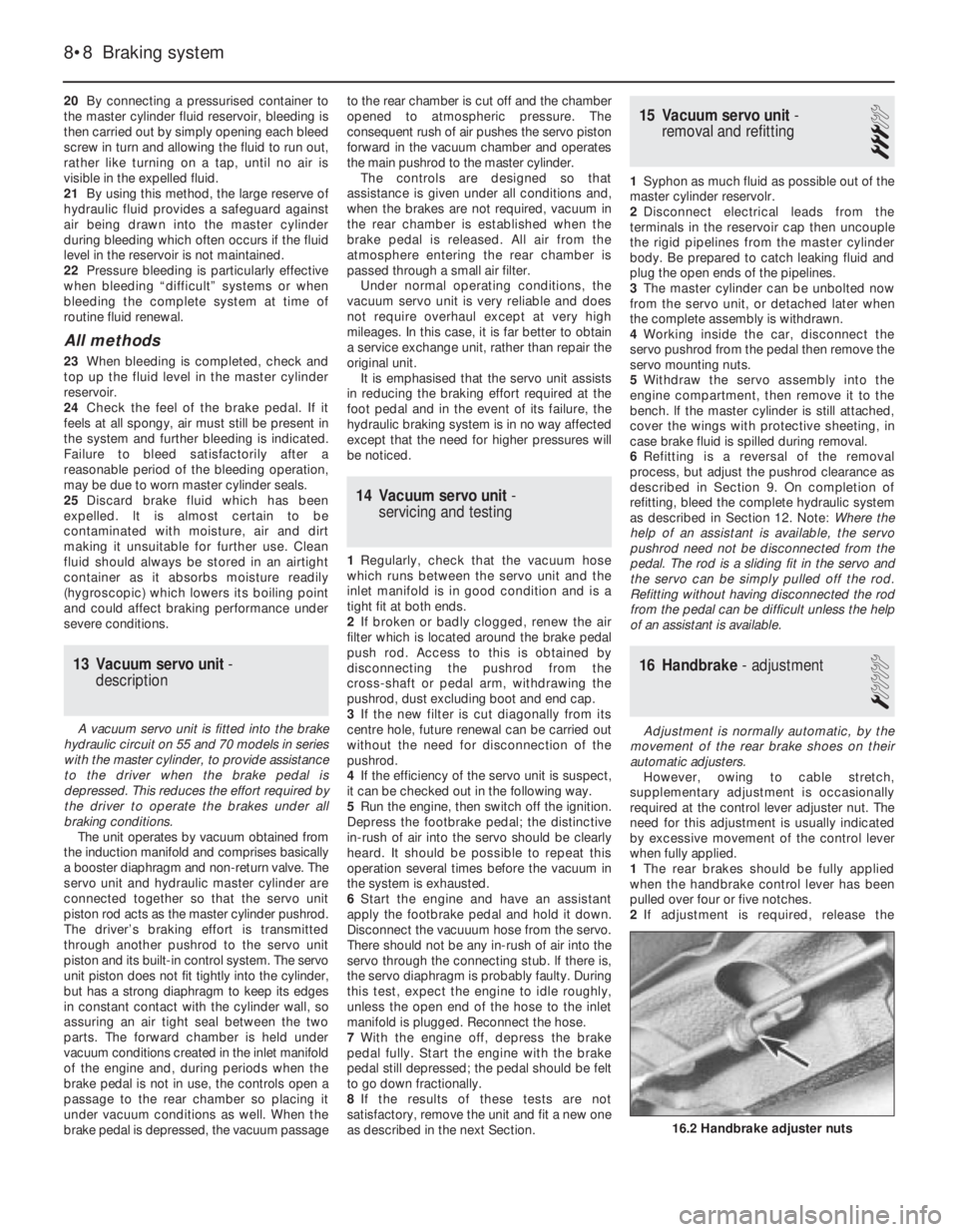
2If adjustment is required, release the
8•8 Braking system
16.2 Handbrake adjuster nuts
Page 91 of 303
1 General description
The electrical system is of 12 volt negative
earth type and employs a belt-driven
alternator and a pre-engaged type starter
motor.
The models in the range are all adequately
equipped with electrical accessories, while SX
versions also have power windows and
centralised door locking plus a check control
system (Section 34).
2 Battery- inspection, charging,
removal and refitting
2
1The battery is of maintenance-free type and
under normal circumstances, no topping up
will be required, but regularly check that the
electrolyte level is between the minimum and
maximum lines on the translucent battery
casing.
2If the electrolyte level does drop below theminimum line, suspect a leak in the battery
casing or that the alternator is overcharging. If
the latter is the case, rectify the alternator fault
and then prise out the two rectangular plugs
from the top of the battery and top up with
distilled or purified water.
3Always keep the battery terminals clean
and smear them with petroleum jelly to
prevent corrosion.
4The battery will normally be kept fully
charged by the alternator, but it is possible for
the battery to become discharged if the daily
mileage is very low with much use being
made of the starter and electrical accessories.
5When the battery begins to deteriorate with
age it may also require a boost from a mains
charger.
6Disconnect both battery leads before
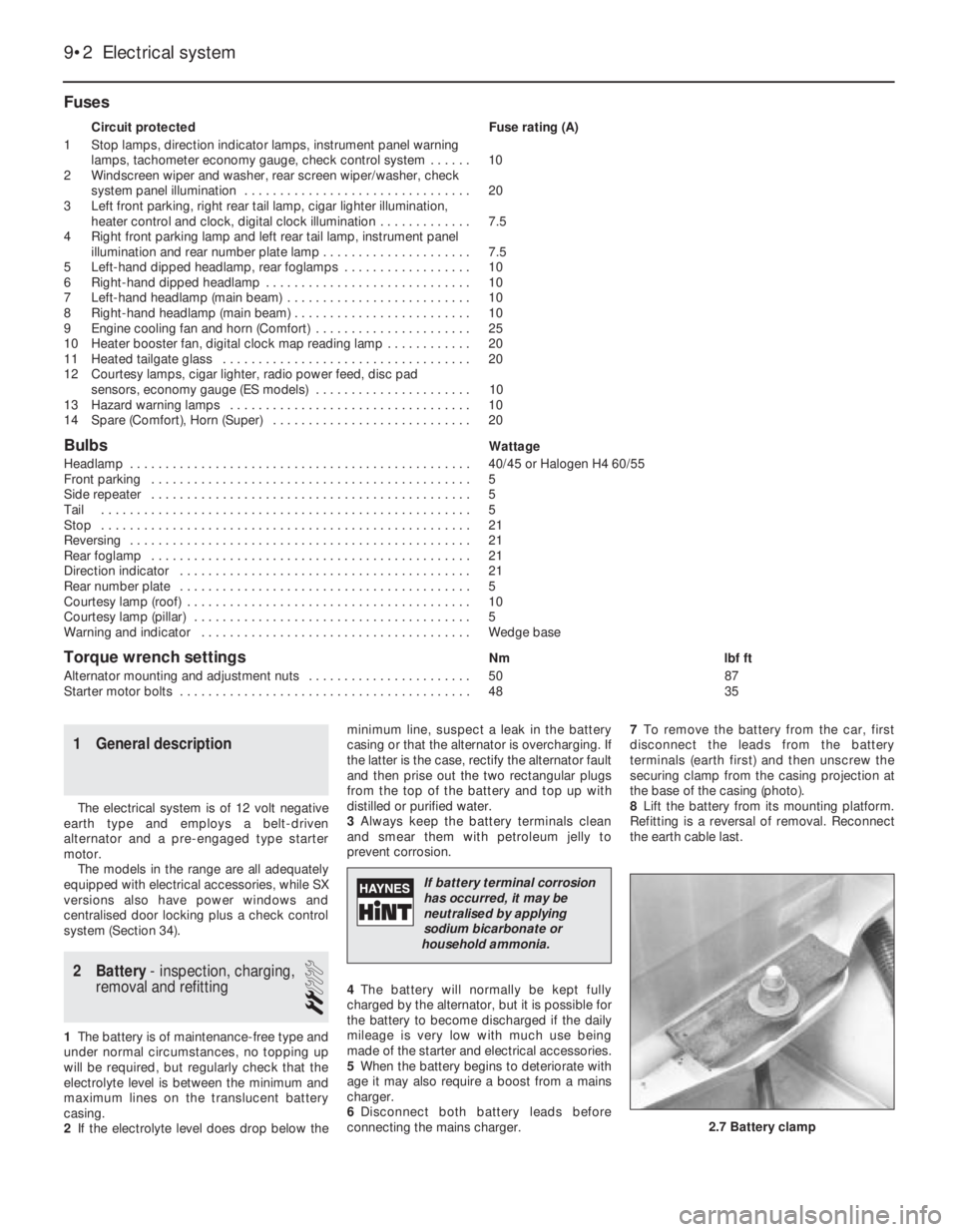
connecting the mains charger. 7To remove the battery from the car, first
disconnect the leads from the battery
terminals (earth first) and then unscrew the
securing clamp from the casing projection at
the base of the casing (photo).
8Lift the battery from its mounting platform.
Refitting is a reversal of removal. Reconnect
the earth cable last.
Fuses
Circuit protected Fuse rating (A)
1 Stop lamps, direction indicator lamps, instrument panel warning
lamps, tachometer economy gauge, check control system . . . . . . 10
2 Windscreen wiper and washer, rear screen wiper/washer, check
system panel illumination . . . . . . . . . . . . . . . . . . . . . . . . . . . . . . . . 20
3 Left front parking, right rear tail lamp, cigar lighter illumination,
heater control and clock, digital clock illumination . . . . . . . . . . . . . 7.5
4 Right front parking lamp and left rear tail lamp, instrument panel
illumination and rear number plate lamp . . . . . . . . . . . . . . . . . . . . . 7.5
5 Left-hand dipped headlamp, rear foglamps . . . . . . . . . . . . . . . . . . 10
6 Right-hand dipped headlamp . . . . . . . . . . . . . . . . . . . . . . . . . . . . . 10
7 Left-hand headlamp (main beam) . . . . . . . . . . . . . . . . . . . . . . . . . . 10
8 Right-hand headlamp (main beam) . . . . . . . . . . . . . . . . . . . . . . . . . 10
9 Engine cooling fan and horn (Comfort) . . . . . . . . . . . . . . . . . . . . . . 25
10 Heater booster fan, digital clock map reading lamp . . . . . . . . . . . . 20
11 Heated tailgate glass . . . . . . . . . . . . . . . . . . . . . . . . . . . . . . . . . . . 20
12 Courtesy lamps, cigar lighter, radio power feed, disc pad
sensors, economy gauge (ES models) . . . . . . . . . . . . . . . . . . . . . . 10
13 Hazard warning lamps . . . . . . . . . . . . . . . . . . . . . . . . . . . . . . . . . . 10
14 Spare (Comfort), Horn (Super) . . . . . . . . . . . . . . . . . . . . . . . . . . . . 20
BulbsWattage
Headlamp . . . . . . . . . . . . . . . . . . . . . . . . . . . . . . . . . . . . . . . . . . . . . . . . 40/45 or Halogen H4 60/55
Front parking . . . . . . . . . . . . . . . . . . . . . . . . . . . . . . . . . . . . . . . . . . . . . 5
Side repeater . . . . . . . . . . . . . . . . . . . . . . . . . . . . . . . . . . . . . . . . . . . . . 5
Tail . . . . . . . . . . . . . . . . . . . . . . . . . . . . . . . . . . . . . . . . . . . . . . . . . . . . 5
Stop . . . . . . . . . . . . . . . . . . . . . . . . . . . . . . . . . . . . . . . . . . . . . . . . . . . . 21
Reversing . . . . . . . . . . . . . . . . . . . . . . . . . . . . . . . . . . . . . . . . . . . . . . . . 21
Rear foglamp . . . . . . . . . . . . . . . . . . . . . . . . . . . . . . . . . . . . . . . . . . . . . 21
Direction indicator . . . . . . . . . . . . . . . . . . . . . . . . . . . . . . . . . . . . . . . . . 21
Rear number plate . . . . . . . . . . . . . . . . . . . . . . . . . . . . . . . . . . . . . . . . . 5
Courtesy lamp (roof) . . . . . . . . . . . . . . . . . . . . . . . . . . . . . . . . . . . . . . . . 10
Courtesy lamp (pillar) . . . . . . . . . . . . . . . . . . . . . . . . . . . . . . . . . . . . . . . 5
Warning and indicator . . . . . . . . . . . . . . . . . . . . . . . . . . . . . . . . . . . . . . Wedge base
Torque wrench settingsNm lbf ft
Alternator mounting and adjustment nuts . . . . . . . . . . . . . . . . . . . . . . . 50 87
Starter motor bolts . . . . . . . . . . . . . . . . . . . . . . . . . . . . . . . . . . . . . . . . . 48 35
9•2 Electrical system
2.7 Battery clamp
If battery terminal corrosion
has occurred, it may be
neutralised by applying
sodium bicarbonate or
household ammonia.
Page 92 of 303
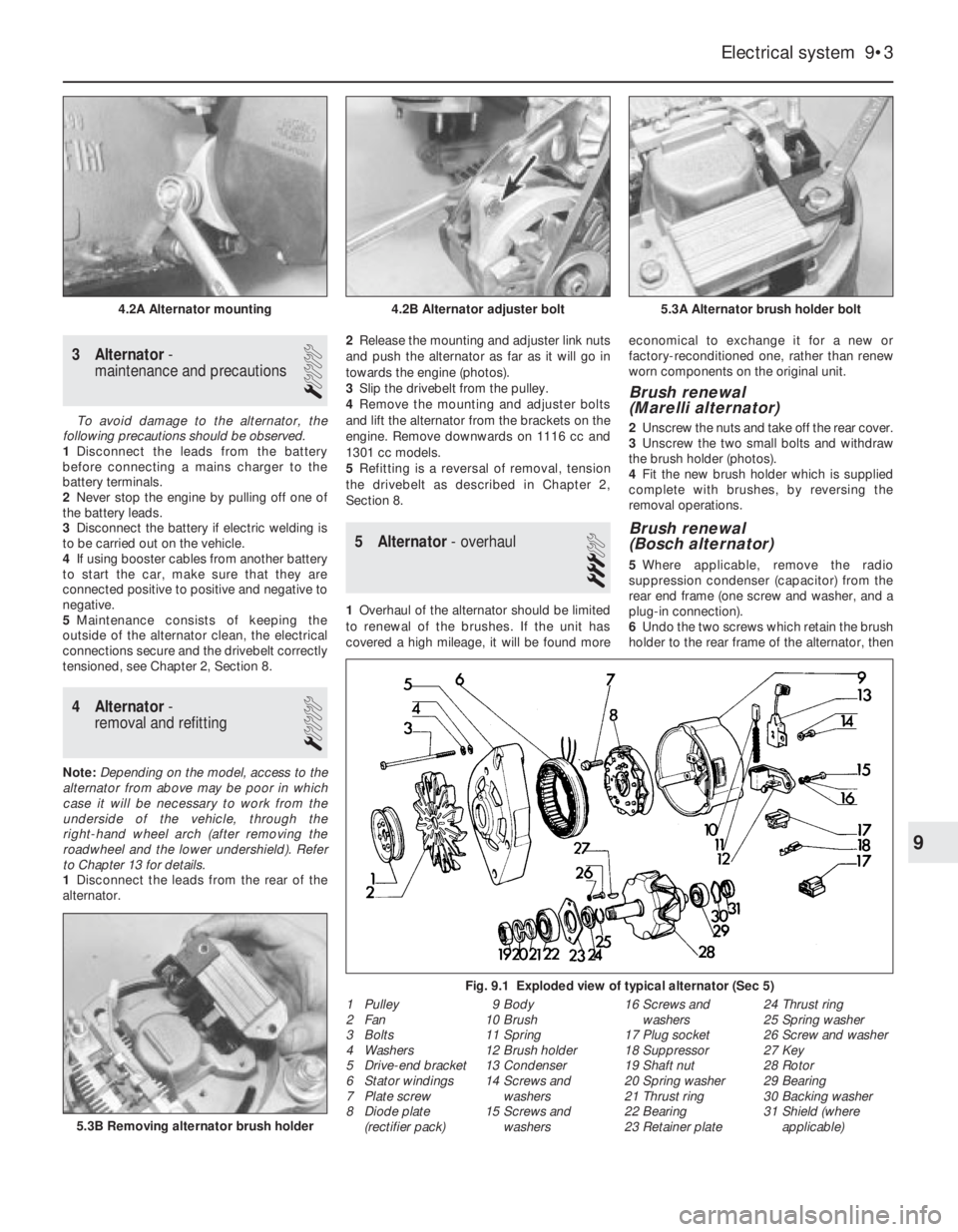
3 Alternator-
maintenance and precautions
1
To avoid damage to the alternator, the
following precautions should be observed.
1Disconnect the leads from the battery
before connecting a mains charger to the
battery terminals.
2Never stop the engine by pulling off one of
the battery leads.
3Disconnect the battery if electric welding is
to be carried out on the vehicle.
4If using booster cables from another battery
to start the car, make sure that they are
connected positive to positive and negative to
negative.
5Maintenance consists of keeping the
outside of the alternator clean, the electrical
connections secure and the drivebelt correctly
tensioned, see Chapter 2, Section 8.
4 Alternator-
removal and refitting
1
Note: Depending on the model, access to the
alternator from above may be poor in which
case it will be necessary to work from the
underside of the vehicle, through the
right-hand wheel arch (after removing the
roadwheel and the lower undershield). Refer
to Chapter 13 for details.
1Disconnect the leads from the rear of the
alternator.2Release the mounting and adjuster link nuts
and push the alternator as far as it will go in
towards the engine (photos).
3Slip the drivebelt from the pulley.
4Remove the mounting and adjuster bolts
and lift the alternator from the brackets on the
engine. Remove downwards on 1116 cc and
1301 cc models.
5Refitting is a reversal of removal, tension
the drivebelt as described in Chapter 2,
Section 8.
5 Alternator- overhaul
3
1Overhaul of the alternator should be limited
to renewal of the brushes. If the unit has
covered a high mileage, it will be found moreeconomical to exchange it for a new or
factory-reconditioned one, rather than renew
worn components on the original unit.
Brush renewal
(Marelli alternator)
2Unscrew the nuts and take off the rear cover.
3Unscrew the two small bolts and withdraw
the brush holder (photos).
4Fit the new brush holder which is supplied
complete with brushes, by reversing the
removal operations.
Brush renewal
(Bosch alternator)
5Where applicable, remove the radio
suppression condenser (capacitor) from the
rear end frame (one screw and washer, and a
plug-in connection).
6Undo the two screws which retain the brush
holder to the rear frame of the alternator, then
Electrical system 9•3
5.3A Alternator brush holder bolt4.2B Alternator adjuster bolt4.2A Alternator mounting
Fig. 9.1 Exploded view of typical alternator (Sec 5)
1 Pulley
2 Fan
3 Bolts
4 Washers
5 Drive-end bracket
6 Stator windings
7 Plate screw
8 Diode plate
(rectifier pack)9 Body
10 Brush
11 Spring
12 Brush holder
13 Condenser
14 Screws and
washers
15 Screws and
washers16 Screws and
washers
17 Plug socket
18 Suppressor
19 Shaft nut
20 Spring washer
21 Thrust ring
22 Bearing
23 Retainer plate24 Thrust ring
25 Spring washer
26 Screw and washer
27 Key
28 Rotor
29 Bearing
30 Backing washer
31 Shield (where
applicable)
5.3B Removing alternator brush holder
9
Page 93 of 303
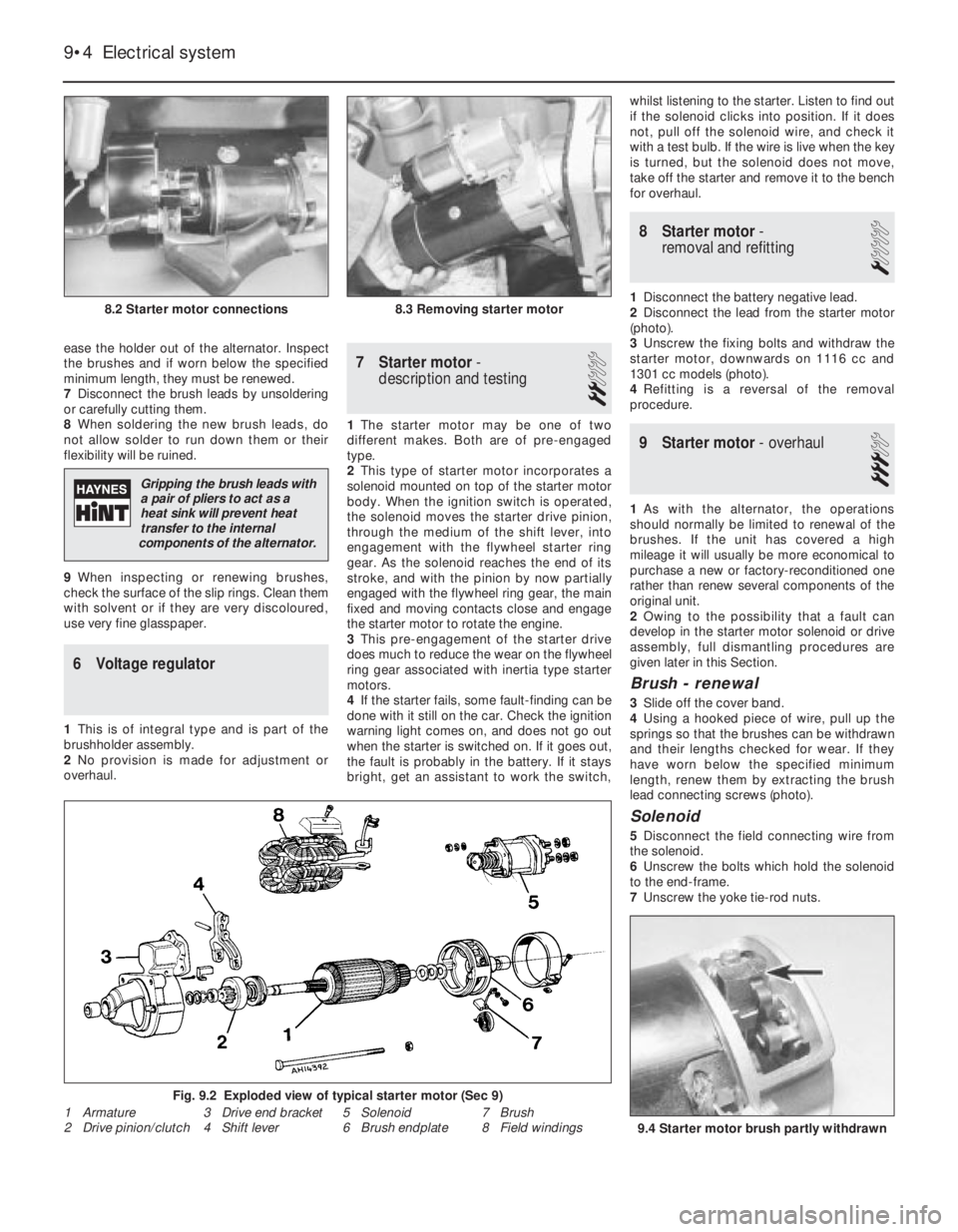
ease the holder out of the alternator. Inspect
the brushes and if worn below the specified
minimum length, they must be renewed.
7Disconnect the brush leads by unsoldering
or carefully cutting them.
8When soldering the new brush leads, do
not allow solder to run down them or their
flexibility will be ruined.
9When inspecting or renewing brushes,
check the surface of the slip rings. Clean them
with solvent or if they are very discoloured,
use very fine glasspaper.
6 Voltage regulator
1This is of integral type and is part of the
brushholder assembly.
2No provision is made for adjustment or
overhaul.
7 Starter motor-
description and testing
2
1The starter motor may be one of two
different makes. Both are of pre-engaged
type.
2This type of starter motor incorporates a
solenoid mounted on top of the starter motor
body. When the ignition switch is operated,
the solenoid moves the starter drive pinion,
through the medium of the shift lever, into
engagement with the flywheel starter ring
gear. As the solenoid reaches the end of its
stroke, and with the pinion by now partially
engaged with the flywheel ring gear, the main
fixed and moving contacts close and engage
the starter motor to rotate the engine.
3This pre-engagement of the starter drive
does much to reduce the wear on the flywheel
ring gear associated with inertia type starter
motors.
4If the starter fails, some fault-finding can be
done with it still on the car. Check the ignition
warning light comes on, and does not go out
when the starter is switched on. If it goes out,
the fault is probably in the battery. If it stays
bright, get an assistant to work the switch,whilst listening to the starter. Listen to find out
if the solenoid clicks into position. If it does
not, pull off the solenoid wire, and check it
with a test bulb. If the wire is live when the key
is turned, but the solenoid does not move,
take off the starter and remove it to the bench
for overhaul.
8 Starter motor-
removal and refitting
1
1Disconnect the battery negative lead.
2Disconnect the lead from the starter motor
(photo).
3Unscrew the fixing bolts and withdraw the
starter motor, downwards on 1116 cc and
1301 cc models (photo).
4Refitting is a reversal of the removal
procedure.
9 Starter motor- overhaul
3
1As with the alternator, the operations
should normally be limited to renewal of the
brushes. If the unit has covered a high
mileage it will usually be more economical to
purchase a new or factory-reconditioned one
rather than renew several components of the
original unit.
2Owing to the possibility that a fault can
develop in the starter motor solenoid or drive
assembly, full dismantling procedures are
given later in this Section.
Brush - renewal
3Slide off the cover band.
4Using a hooked piece of wire, pull up the
springs so that the brushes can be withdrawn
and their lengths checked for wear. If they
have worn below the specified minimum
length, renew them by extracting the brush
lead connecting screws (photo).
Solenoid
5Disconnect the field connecting wire from
the solenoid.
6Unscrew the bolts which hold the solenoid
to the end-frame.
7Unscrew the yoke tie-rod nuts.
9•4 Electrical system
9.4 Starter motor brush partly withdrawn
8.2 Starter motor connections8.3 Removing starter motor
Fig. 9.2 Exploded view of typical starter motor (Sec 9)
1 Armature
2 Drive pinion/clutch3 Drive end bracket
4 Shift lever5 Solenoid
6 Brush endplate7 Brush
8 Field windings
Gripping the brush leads with
a pair of pliers to act as a
heat sink will prevent heat
transfer to the internal
components of the alternator.
Page 106 of 303
13Stake the lower end of the tube to retain
the bush.
14Reassembly is a reversal of removal,
noting that the universal joint coupling
pinch-bolts should pass smoothly through the
grooves in the steering shaft.
15Fit the steering wheel when the
roadwheels are in the straight-ahead position.
16Tighten all nuts and bolts to the specified
torque. Reconnect the battery.
6 Steering rack-
removal and refitting
4
1Set the steering in the straight-ahead
mode.
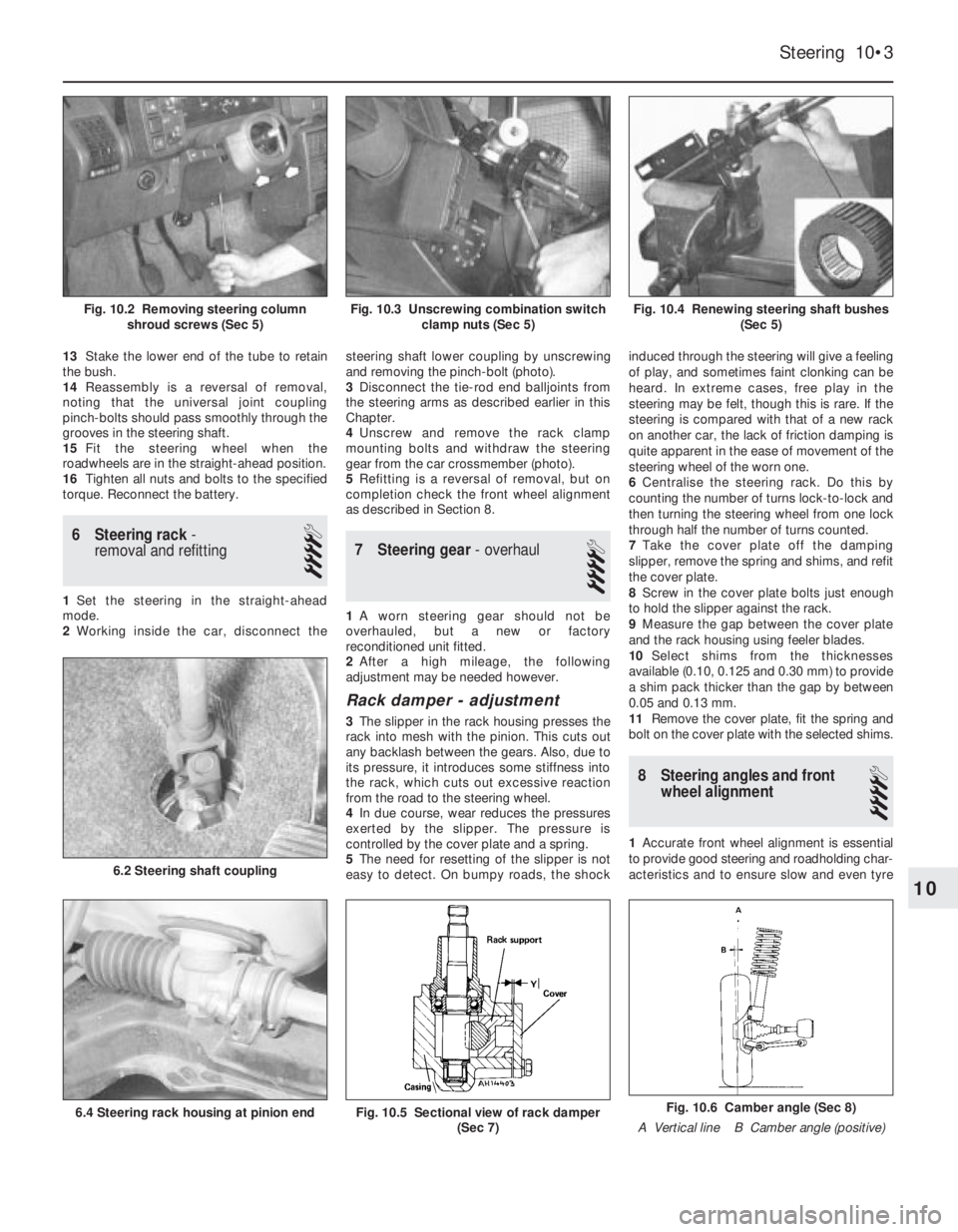
2Working inside the car, disconnect thesteering shaft lower coupling by unscrewing
and removing the pinch-bolt (photo).
3Disconnect the tie-rod end balljoints from
the steering arms as described earlier in this
Chapter.
4Unscrew and remove the rack clamp
mounting bolts and withdraw the steering
gear from the car crossmember (photo).
5Refitting is a reversal of removal, but on
completion check the front wheel alignment
as described in Section 8.
7 Steering gear- overhaul
4
1A worn steering gear should not be
overhauled, but a new or factory
reconditioned unit fitted.
2After a high mileage, the following
adjustment may be needed however.
Rack damper - adjustment
3The slipper in the rack housing presses the
rack into mesh with the pinion. This cuts out
any backlash between the gears. Also, due to
its pressure, it introduces some stiffness into
the rack, which cuts out excessive reaction
from the road to the steering wheel.
4In due course, wear reduces the pressures
exerted by the slipper. The pressure is
controlled by the cover plate and a spring.
5The need for resetting of the slipper is not
easy to detect. On bumpy roads, the shockinduced through the steering will give a feeling
of play, and sometimes faint clonking can be
heard. In extreme cases, free play in the
steering may be felt, though this is rare. If the
steering is compared with that of a new rack
on another car, the lack of friction damping is
quite apparent in the ease of movement of the
steering wheel of the worn one.
6Centralise the steering rack. Do this by
counting the number of turns lock-to-lock and
then turning the steering wheel from one lock
through half the number of turns counted.
7Take the cover plate off the damping
slipper, remove the spring and shims, and refit
the cover plate.
8Screw in the cover plate bolts just enough
to hold the slipper against the rack.
9Measure the gap between the cover plate
and the rack housing using feeler blades.
10Select shims from the thicknesses
available (0.10, 0.125 and 0.30 mm) to provide
a shim pack thicker than the gap by between
0.05 and 0.13 mm.
11Remove the cover plate, fit the spring and
bolt on the cover plate with the selected shims.
8 Steering angles and front
wheel alignment
4
1Accurate front wheel alignment is essential
to provide good steering and roadholding char-
acteristics and to ensure slow and even tyre
Steering 10•3
Fig. 10.4 Renewing steering shaft bushes
(Sec 5)Fig. 10.3 Unscrewing combination switch
clamp nuts (Sec 5)Fig. 10.2 Removing steering column
shroud screws (Sec 5)
Fig. 10.6 Camber angle (Sec 8)
A Vertical line B Camber angle (positive)Fig. 10.5 Sectional view of rack damper
(Sec 7)6.4 Steering rack housing at pinion end
10
6.2 Steering shaft coupling