oil dipstick FIAT UNO 1983 Service Repair Manual
[x] Cancel search | Manufacturer: FIAT, Model Year: 1983, Model line: UNO, Model: FIAT UNO 1983Pages: 303, PDF Size: 10.36 MB
Page 22 of 303
2 Engine oil and filter
1
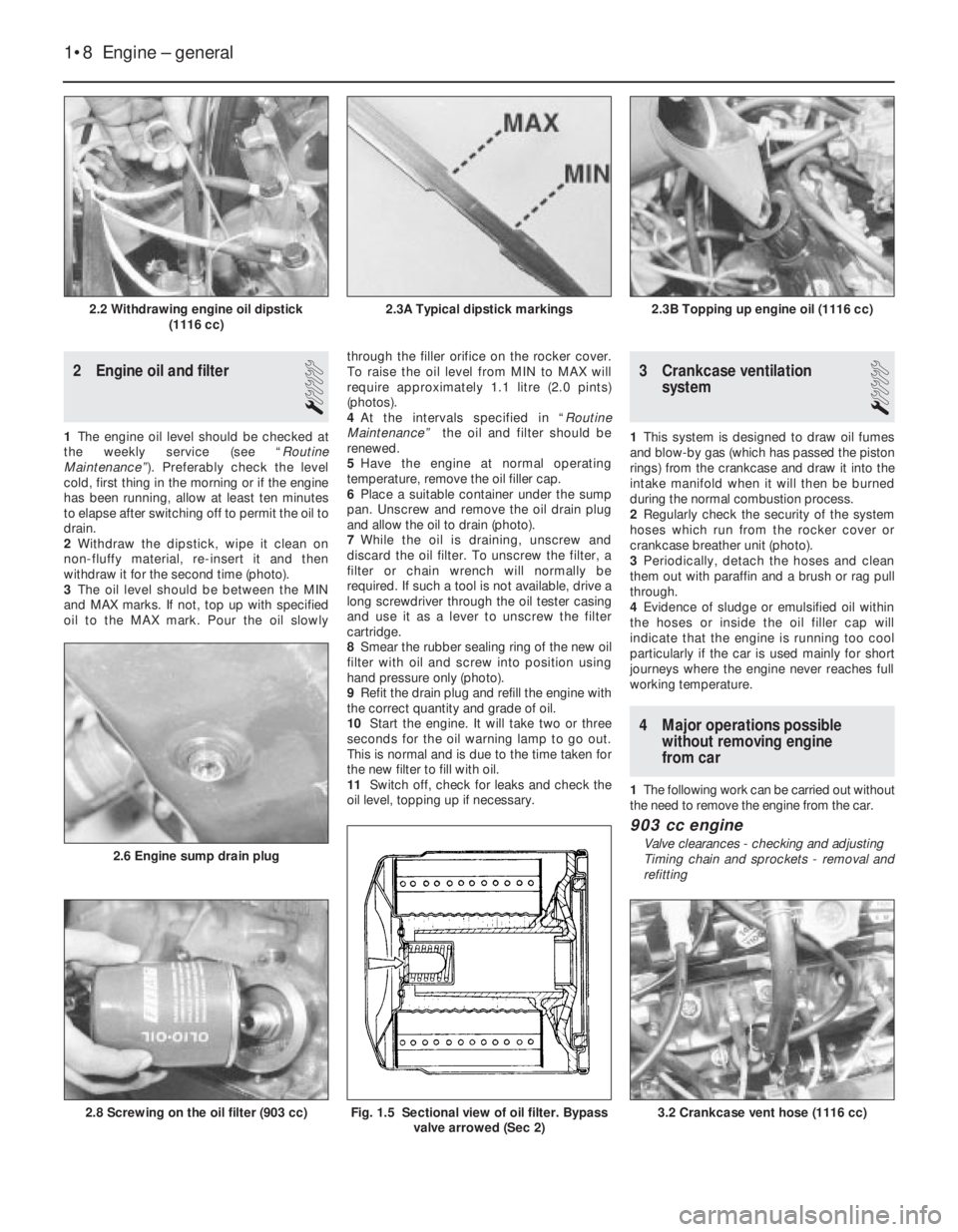
1The engine oil level should be checked at
the weekly service (see “Routine
Maintenance”). Preferably check the level
cold, first thing in the morning or if the engine
has been running, allow at least ten minutes
to elapse after switching off to permit the oil to
drain.
2Withdraw the dipstick, wipe it clean on
non-fluffy material, re-insert it and then
withdraw it for the second time (photo).
3The oil level should be between the MIN
and MAX marks. If not, top up with specified
oil to the MAX mark. Pour the oil slowlythrough the filler orifice on the rocker cover.
To raise the oil level from MIN to MAX will
require approximately 1.1 litre (2.0 pints)
(photos).
4At the intervals specified in “Routine
Maintenance” the oil and filter should be
renewed.
5Have the engine at normal operating
temperature, remove the oil filler cap.
6Place a suitable container under the sump
pan. Unscrew and remove the oil drain plug
and allow the oil to drain (photo).
7While the oil is draining, unscrew and
discard the oil filter. To unscrew the filter, a
filter or chain wrench will normally be
required. If such a tool is not available, drive a
long screwdriver through the oil tester casing
and use it as a lever to unscrew the filter
cartridge.
8Smear the rubber sealing ring of the new oil
filter with oil and screw into position using
hand pressure only (photo).
9Refit the drain plug and refill the engine with
the correct quantity and grade of oil.
10Start the engine. It will take two or three
seconds for the oil warning lamp to go out.
This is normal and is due to the time taken for
the new filter to fill with oil.
11Switch off, check for leaks and check the
oil level, topping up if necessary.
3 Crankcase ventilation
system
1
1This system is designed to draw oil fumes
and blow-by gas (which has passed the piston
rings) from the crankcase and draw it into the
intake manifold when it will then be burned
during the normal combustion process.
2Regularly check the security of the system
hoses which run from the rocker cover or
crankcase breather unit (photo).
3Periodically, detach the hoses and clean
them out with paraffin and a brush or rag pull
through.
4Evidence of sludge or emulsified oil within
the hoses or inside the oil filler cap will
indicate that the engine is running too cool
particularly if the car is used mainly for short
journeys where the engine never reaches full
working temperature.
4 Major operations possible
without removing engine
from car
1The following work can be carried out without
the need to remove the engine from the car.
903 cc engine
Valve clearances - checking and adjusting
Timing chain and sprockets - removal and
refitting
1•8 Engine – general
3.2 Crankcase vent hose (1116 cc)Fig. 1.5 Sectional view of oil filter. Bypass
valve arrowed (Sec 2)2.8 Screwing on the oil filter (903 cc)
2.6 Engine sump drain plug
2.3B Topping up engine oil (1116 cc)2.3A Typical dipstick markings2.2 Withdrawing engine oil dipstick
(1116 cc)
Page 30 of 303
16 Engine-
complete dismantling
3
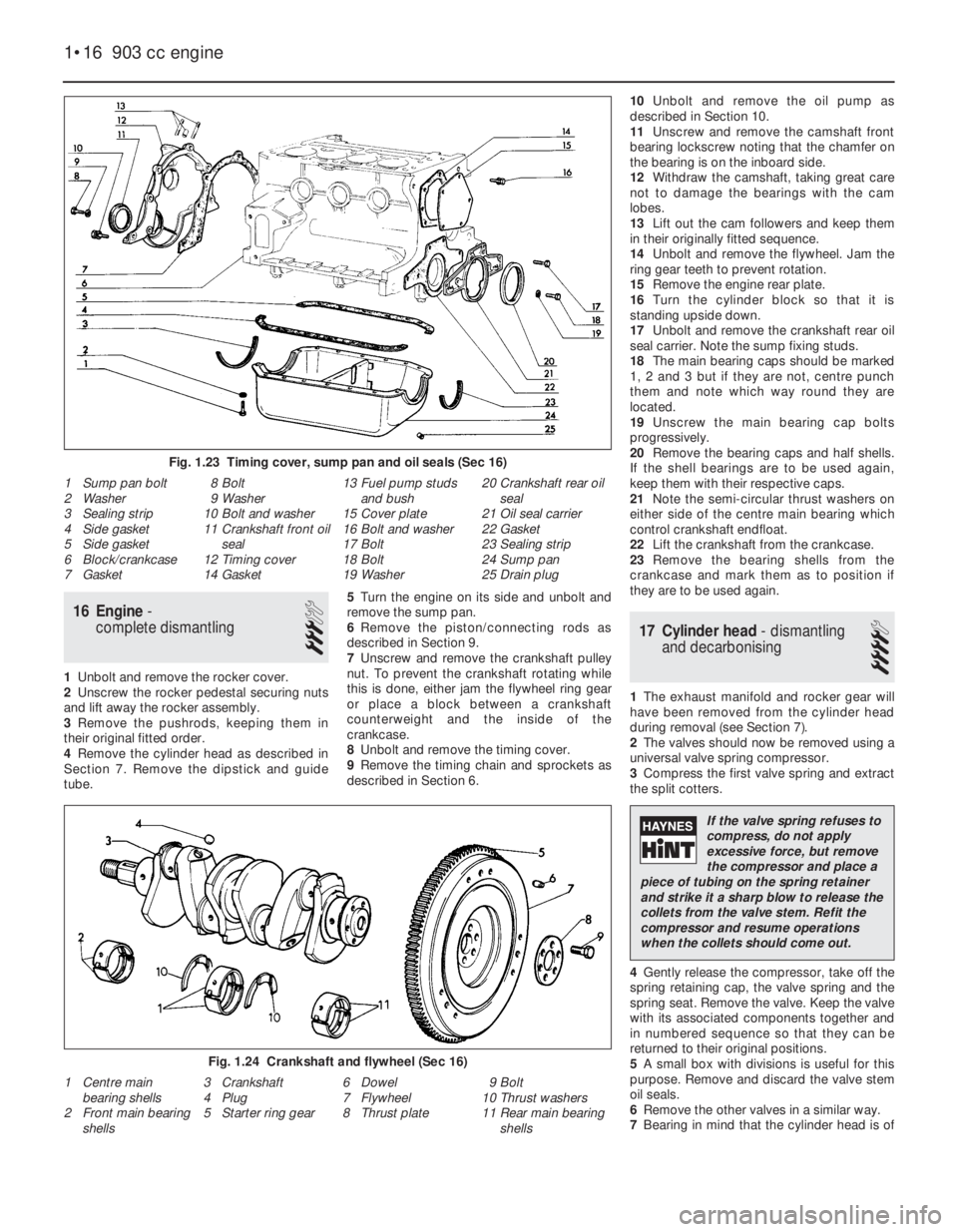
1Unbolt and remove the rocker cover.
2Unscrew the rocker pedestal securing nuts
and lift away the rocker assembly.
3Remove the pushrods, keeping them in
their original fitted order.
4Remove the cylinder head as described in
Section 7. Remove the dipstick and guide
tube.5Turn the engine on its side and unbolt and
remove the sump pan.
6Remove the piston/connecting rods as
described in Section 9.
7Unscrew and remove the crankshaft pulley
nut. To prevent the crankshaft rotating while
this is done, either jam the flywheel ring gear
or place a block between a crankshaft
counterweight and the inside of the
crankcase.
8Unbolt and remove the timing cover.
9Remove the timing chain and sprockets as
described in Section 6. 10Unbolt and remove the oil pump as
described in Section 10.
11Unscrew and remove the camshaft front
bearing lockscrew noting that the chamfer on
the bearing is on the inboard side.
12Withdraw the camshaft, taking great care
not to damage the bearings with the cam
lobes.
13Lift out the cam followers and keep them
in their originally fitted sequence.
14Unbolt and remove the flywheel. Jam the
ring gear teeth to prevent rotation.
15Remove the engine rear plate.
16Turn the cylinder block so that it is
standing upside down.
17Unbolt and remove the crankshaft rear oil
seal carrier. Note the sump fixing studs.
18The main bearing caps should be marked
1, 2 and 3 but if they are not, centre punch
them and note which way round they are
located.
19Unscrew the main bearing cap bolts
progressively.
20Remove the bearing caps and half shells.
If the shell bearings are to be used again,
keep them with their respective caps.
21Note the semi-circular thrust washers on
either side of the centre main bearing which
control crankshaft endfloat.
22Lift the crankshaft from the crankcase.
23Remove the bearing shells from the
crankcase and mark them as to position if
they are to be used again.
17 Cylinder head- dismantling
and decarbonising
4
1The exhaust manifold and rocker gear will
have been removed from the cylinder head
during removal (see Section 7).
2The valves should now be removed using a
universal valve spring compressor.
3Compress the first valve spring and extract
the split cotters.
4Gently release the compressor, take off the
spring retaining cap, the valve spring and the
spring seat. Remove the valve. Keep the valve
with its associated components together and
in numbered sequence so that they can be
returned to their original positions.
5A small box with divisions is useful for this
purpose. Remove and discard the valve stem
oil seals.
6Remove the other valves in a similar way.
7Bearing in mind that the cylinder head is of
1•16 903 cc engine
Fig. 1.23 Timing cover, sump pan and oil seals (Sec 16)
Fig. 1.24 Crankshaft and flywheel (Sec 16)
1 Sump pan bolt
2 Washer
3 Sealing strip
4 Side gasket
5 Side gasket
6 Block/crankcase
7 Gasket8 Bolt
9 Washer
10 Bolt and washer
11 Crankshaft front oil
seal
12 Timing cover
14 Gasket13 Fuel pump studs
and bush
15 Cover plate
16 Bolt and washer
17 Bolt
18 Bolt
19 Washer20 Crankshaft rear oil
seal
21 Oil seal carrier
22 Gasket
23 Sealing strip
24 Sump pan
25 Drain plug
1 Centre main
bearing shells
2 Front main bearing
shells3 Crankshaft
4 Plug
5 Starter ring gear6 Dowel
7 Flywheel
8 Thrust plate9 Bolt
10 Thrust washers
11 Rear main bearing
shells
If the valve spring refuses to
compress, do not apply
excessive force, but remove
the compressor and place a
piece of tubing on the spring retainer
and strike it a sharp blow to release the
collets from the valve stem. Refit the
compressor and resume operations
when the collets should come out.
Page 36 of 303
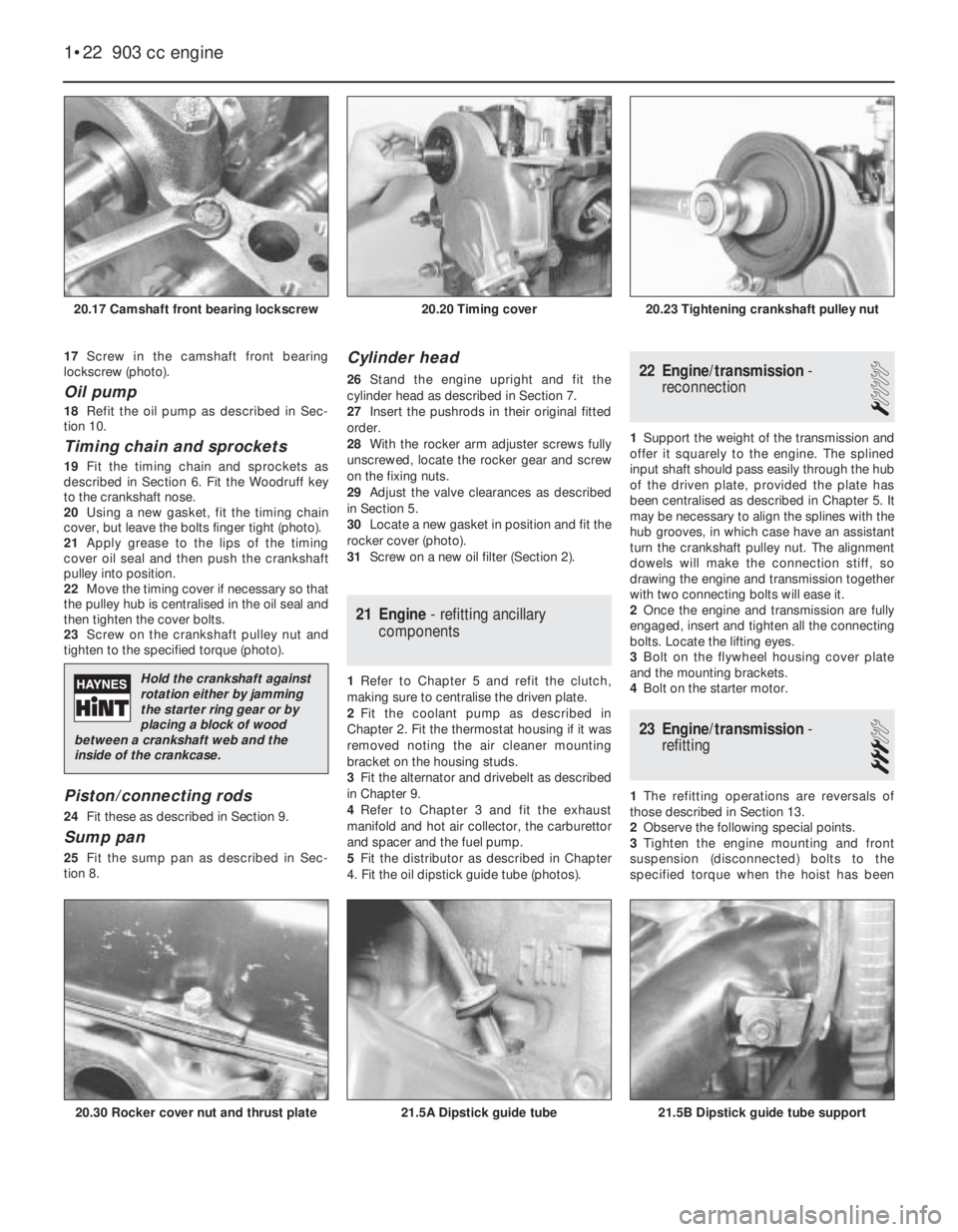
17Screw in the camshaft front bearing
lockscrew (photo).
Oil pump
18Refit the oil pump as described in Sec-
tion 10.
Timing chain and sprockets
19Fit the timing chain and sprockets as
described in Section 6. Fit the Woodruff key
to the crankshaft nose.
20Using a new gasket, fit the timing chain
cover, but leave the bolts finger tight (photo).
21Apply grease to the lips of the timing
cover oil seal and then push the crankshaft
pulley into position.
22Move the timing cover if necessary so that
the pulley hub is centralised in the oil seal and
then tighten the cover bolts.
23Screw on the crankshaft pulley nut and
tighten to the specified torque (photo).
Piston/connecting rods
24Fit these as described in Section 9.
Sump pan
25Fit the sump pan as described in Sec-
tion 8.
Cylinder head
26Stand the engine upright and fit the
cylinder head as described in Section 7.
27Insert the pushrods in their original fitted
order.
28With the rocker arm adjuster screws fully
unscrewed, locate the rocker gear and screw
on the fixing nuts.
29Adjust the valve clearances as described
in Section 5.
30Locate a new gasket in position and fit the
rocker cover (photo).
31Screw on a new oil filter (Section 2).
21 Engine- refitting ancillary
components
1Refer to Chapter 5 and refit the clutch,
making sure to centralise the driven plate.
2Fit the coolant pump as described in
Chapter 2. Fit the thermostat housing if it was
removed noting the air cleaner mounting
bracket on the housing studs.
3Fit the alternator and drivebelt as described
in Chapter 9.
4Refer to Chapter 3 and fit the exhaust
manifold and hot air collector, the carburettor
and spacer and the fuel pump.
5Fit the distributor as described in Chapter
4. Fit the oil dipstick guide tube (photos).
22 Engine/transmission-
reconnection
1
1Support the weight of the transmission and
offer it squarely to the engine. The splined
input shaft should pass easily through the hub
of the driven plate, provided the plate has
been centralised as described in Chapter 5. It
may be necessary to align the splines with the
hub grooves, in which case have an assistant
turn the crankshaft pulley nut. The alignment
dowels will make the connection stiff, so
drawing the engine and transmission together
with two connecting bolts will ease it.
2Once the engine and transmission are fully
engaged, insert and tighten all the connecting
bolts. Locate the lifting eyes.
3Bolt on the flywheel housing cover plate
and the mounting brackets.
4Bolt on the starter motor.
23 Engine/transmission-
refitting
3
1The refitting operations are reversals of
those described in Section 13.
2Observe the following special points.
3Tighten the engine mounting and front
suspension (disconnected) bolts to the
specified torque when the hoist has been
1•22 903 cc engine
21.5B Dipstick guide tube support21.5A Dipstick guide tube20.30 Rocker cover nut and thrust plate
20.23 Tightening crankshaft pulley nut20.20 Timing cover20.17 Camshaft front bearing lockscrew
Hold the crankshaft against
rotation either by jamming
the starter ring gear or by
placing a block of wood
between a crankshaft web and the
inside of the crankcase.
Page 51 of 303
2
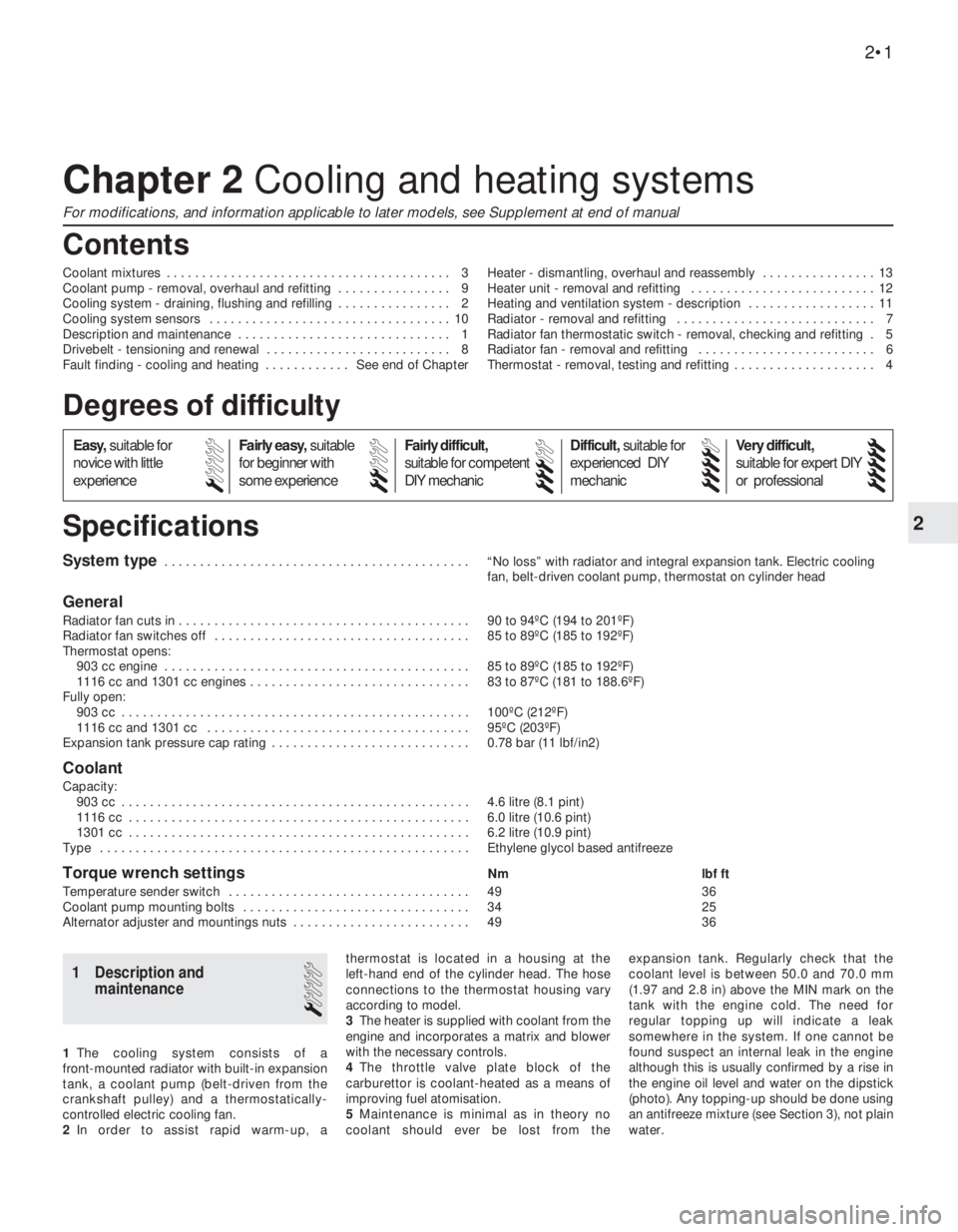
System type . . . . . . . . . . . . . . . . . . . . . . . . . . . . . . . . . . . . . . . . . . . “No loss” with radiator and integral expansion tank. Electric cooling
fan, belt-driven coolant pump, thermostat on cylinder head
General
Radiator fan cuts in . . . . . . . . . . . . . . . . . . . . . . . . . . . . . . . . . . . . . . . . . 90 to 94ºC (194 to 201ºF)
Radiator fan switches off . . . . . . . . . . . . . . . . . . . . . . . . . . . . . . . . . . . . 85 to 89ºC (185 to 192ºF)
Thermostat opens:
903 cc engine . . . . . . . . . . . . . . . . . . . . . . . . . . . . . . . . . . . . . . . . . . . 85 to 89ºC (185 to 192ºF)
1116 cc and 1301 cc engines . . . . . . . . . . . . . . . . . . . . . . . . . . . . . . . 83 to 87ºC (181 to 188.6ºF)
Fully open:
903 cc . . . . . . . . . . . . . . . . . . . . . . . . . . . . . . . . . . . . . . . . . . . . . . . . . 100ºC (212ºF)
1116 cc and 1301 cc . . . . . . . . . . . . . . . . . . . . . . . . . . . . . . . . . . . . . 95ºC (203ºF)
Expansion tank pressure cap rating . . . . . . . . . . . . . . . . . . . . . . . . . . . . 0.78 bar (11 lbf/in2)
Coolant
Capacity:
903 cc . . . . . . . . . . . . . . . . . . . . . . . . . . . . . . . . . . . . . . . . . . . . . . . . . 4.6 litre (8.1 pint)
1116 cc . . . . . . . . . . . . . . . . . . . . . . . . . . . . . . . . . . . . . . . . . . . . . . . . 6.0 litre (10.6 pint)
1301 cc . . . . . . . . . . . . . . . . . . . . . . . . . . . . . . . . . . . . . . . . . . . . . . . . 6.2 litre (10.9 pint)
Type . . . . . . . . . . . . . . . . . . . . . . . . . . . . . . . . . . . . . . . . . . . . . . . . . . . . Ethylene glycol based antifreeze
Torque wrench settingsNm lbf ft
Temperature sender switch . . . . . . . . . . . . . . . . . . . . . . . . . . . . . . . . . . 49 36
Coolant pump mounting bolts . . . . . . . . . . . . . . . . . . . . . . . . . . . . . . . . 34 25
Alternator adjuster and mountings nuts . . . . . . . . . . . . . . . . . . . . . . . . . 49 36
Chapter 2 Cooling and heating systems
For modifications, and information applicable to later models, see Supplement at end of manual
Coolant mixtures . . . . . . . . . . . . . . . . . . . . . . . . . . . . . . . . . . . . . . . . 3
Coolant pump - removal, overhaul and refitting . . . . . . . . . . . . . . . . 9
Cooling system - draining, flushing and refilling . . . . . . . . . . . . . . . . 2
Cooling system sensors . . . . . . . . . . . . . . . . . . . . . . . . . . . . . . . . . . 10
Description and maintenance . . . . . . . . . . . . . . . . . . . . . . . . . . . . . . 1
Drivebelt - tensioning and renewal . . . . . . . . . . . . . . . . . . . . . . . . . . 8
Fault finding - cooling and heating . . . . . . . . . . . . See end of ChapterHeater - dismantling, overhaul and reassembly . . . . . . . . . . . . . . . . 13
Heater unit - removal and refitting . . . . . . . . . . . . . . . . . . . . . . . . . . 12
Heating and ventilation system - description . . . . . . . . . . . . . . . . . . 11
Radiator - removal and refitting . . . . . . . . . . . . . . . . . . . . . . . . . . . . 7
Radiator fan thermostatic switch - removal, checking and refitting . 5
Radiator fan - removal and refitting . . . . . . . . . . . . . . . . . . . . . . . . . 6
Thermostat - removal, testing and refitting . . . . . . . . . . . . . . . . . . . . 4
2•1
Specifications Contents
1 Description and
maintenance
1
1The cooling system consists of a
front-mounted radiator with built-in expansion
tank, a coolant pump (belt-driven from the
crankshaft pulley) and a thermostatically-
controlled electric cooling fan.
2In order to assist rapid warm-up, athermostat is located in a housing at the
left-hand end of the cylinder head. The hose
connections to the thermostat housing vary
according to model.
3The heater is supplied with coolant from the
engine and incorporates a matrix and blower
with the necessary controls.
4The throttle valve plate block of the
carburettor is coolant-heated as a means of
improving fuel atomisation.
5Maintenance is minimal as in theory no
coolant should ever be lost from theexpansion tank. Regularly check that the
coolant level is between 50.0 and 70.0 mm
(1.97 and 2.8 in) above the MIN mark on the
tank with the engine cold. The need for
regular topping up will indicate a leak
somewhere in the system. If one cannot be
found suspect an internal leak in the engine
although this is usually confirmed by a rise in
the engine oil level and water on the dipstick
(photo). Any topping-up should be done using
an antifreeze mixture (see Section 3), not plain
water.
Easy,suitable for
novice with little
experienceFairly easy,suitable
for beginner with
some experienceFairly difficult,
suitable for competent
DIY mechanic
Difficult,suitable for
experienced DIY
mechanicVery difficult,
suitable for expert DIY
or professional
Degrees of difficulty
54321
Page 132 of 303
Supplement: Revisions and information on later models 13•7
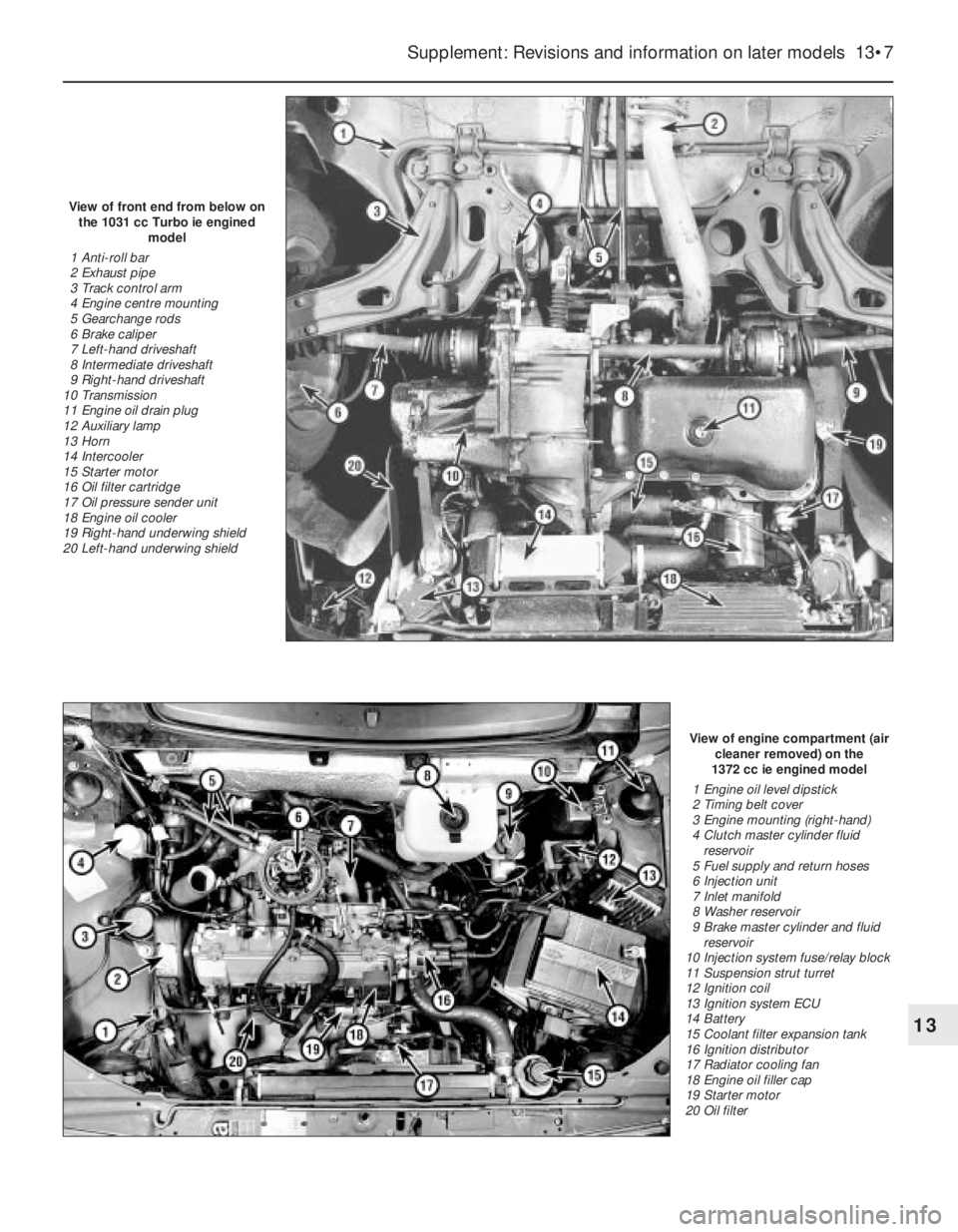
View of engine compartment (air
cleaner removed) on the
1372 cc ie engined model
1 Engine oil level dipstick
2 Timing belt cover
3 Engine mounting (right-hand)
4 Clutch master cylinder fluid
reservoir
5 Fuel supply and return hoses
6 Injection unit
7 Inlet manifold
8 Washer reservoir
9 Brake master cylinder and fluid
reservoir
10 Injection system fuse/relay block
11 Suspension strut turret
12 Ignition coil
13 Ignition system ECU
14 Battery
15 Coolant filter expansion tank
16 Ignition distributor
17 Radiator cooling fan
18 Engine oil filler cap
19 Starter motor
20 Oil filter
View of front end from below on
the 1031 cc Turbo ie engined
model
1 Anti-roll bar
2 Exhaust pipe
3 Track control arm
4 Engine centre mounting
5 Gearchange rods
6 Brake caliper
7 Left-hand driveshaft
8 Intermediate driveshaft
9 Right-hand driveshaft
10 Transmission
11 Engine oil drain plug
12 Auxiliary lamp
13 Horn
14 Intercooler
15 Starter motor
16 Oil filter cartridge
17 Oil pressure sender unit
18 Engine oil cooler
19 Right-hand underwing shield
20 Left-hand underwing shield
13
Page 150 of 303
75If the pump is unworn, refit the rear cover
plate and tighten the screws fully.
76Apply air pressure from a tyre pump to the
oil pump oil ducts to clear any sludge or other
material and then prime the pump by pouring
clean engine oil into its intake duct at the
same time turning the oil pump inner gear with
the fingers.
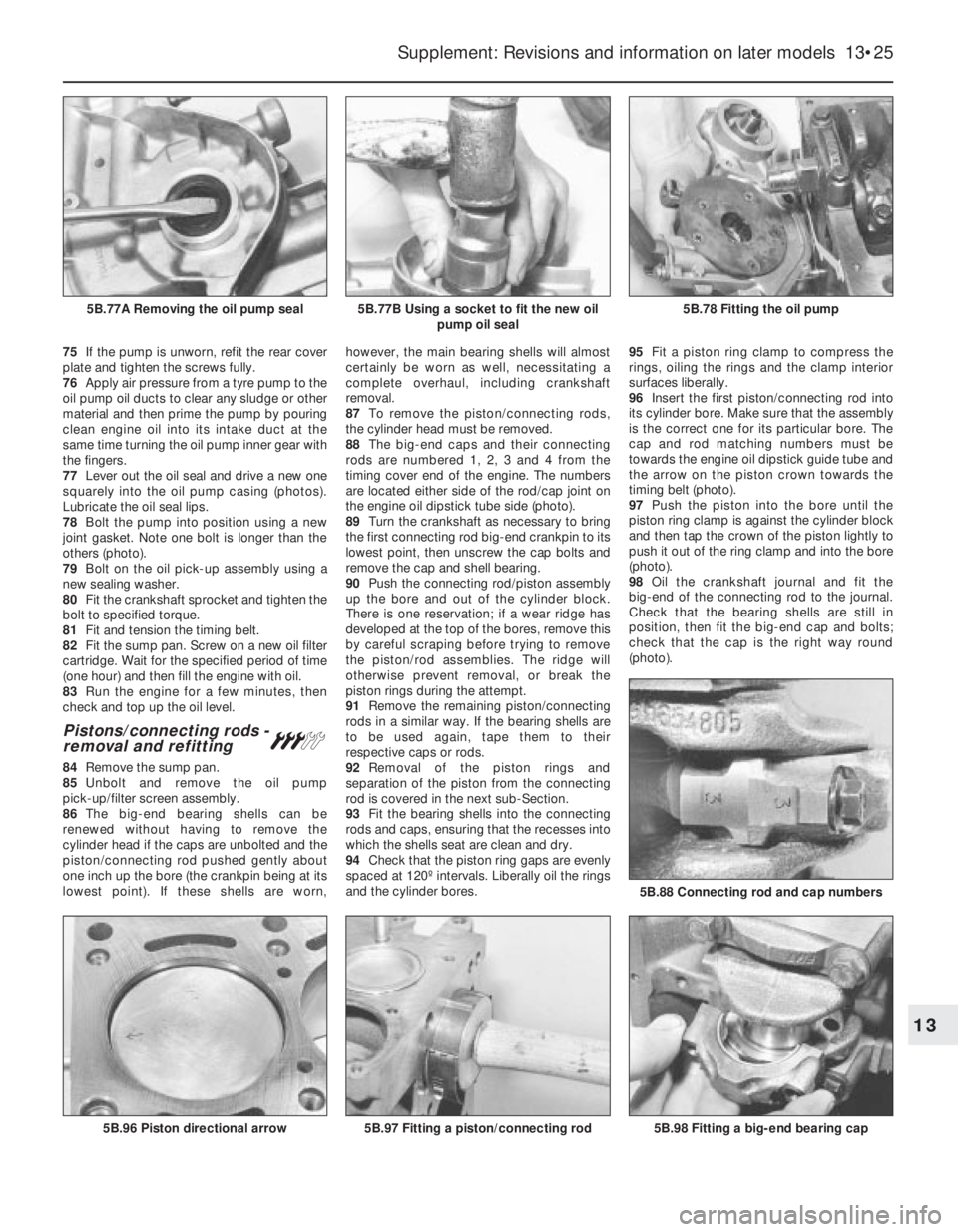
77Lever out the oil seal and drive a new one
squarely into the oil pump casing (photos).
Lubricate the oil seal lips.
78Bolt the pump into position using a new
joint gasket. Note one bolt is longer than the
others (photo).
79Bolt on the oil pick-up assembly using a
new sealing washer.
80Fit the crankshaft sprocket and tighten the
bolt to specified torque.
81Fit and tension the timing belt.
82Fit the sump pan. Screw on a new oil filter
cartridge. Wait for the specified period of time
(one hour) and then fill the engine with oil.
83Run the engine for a few minutes, then
check and top up the oil level.
Pistons/connecting rods -
removal and refitting#
84Remove the sump pan.
85Unbolt and remove the oil pump
pick-up/filter screen assembly.
86The big-end bearing shells can be
renewed without having to remove the
cylinder head if the caps are unbolted and the
piston/connecting rod pushed gently about
one inch up the bore (the crankpin being at its
lowest point). If these shells are worn,however, the main bearing shells will almost
certainly be worn as well, necessitating a
complete overhaul, including crankshaft
removal.
87To remove the piston/connecting rods,
the cylinder head must be removed.
88The big-end caps and their connecting
rods are numbered 1, 2, 3 and 4 from the
timing cover end of the engine. The numbers
are located either side of the rod/cap joint on
the engine oil dipstick tube side (photo).
89Turn the crankshaft as necessary to bring
the first connecting rod big-end crankpin to its
lowest point, then unscrew the cap bolts and
remove the cap and shell bearing.
90Push the connecting rod/piston assembly
up the bore and out of the cylinder block.
There is one reservation; if a wear ridge has
developed at the top of the bores, remove this
by careful scraping before trying to remove
the piston/rod assemblies. The ridge will
otherwise prevent removal, or break the
piston rings during the attempt.
91Remove the remaining piston/connecting
rods in a similar way. If the bearing shells are
to be used again, tape them to their
respective caps or rods.
92Removal of the piston rings and
separation of the piston from the connecting
rod is covered in the next sub-Section.
93Fit the bearing shells into the connecting
rods and caps, ensuring that the recesses into
which the shells seat are clean and dry.
94Check that the piston ring gaps are evenly
spaced at 120º intervals. Liberally oil the rings
and the cylinder bores.95Fit a piston ring clamp to compress the
rings, oiling the rings and the clamp interior
surfaces liberally.
96Insert the first piston/connecting rod into
its cylinder bore. Make sure that the assembly
is the correct one for its particular bore. The
cap and rod matching numbers must be
towards the engine oil dipstick guide tube and
the arrow on the piston crown towards the
timing belt (photo).
97Push the piston into the bore until the
piston ring clamp is against the cylinder block
and then tap the crown of the piston lightly to
push it out of the ring clamp and into the bore
(photo).
98Oil the crankshaft journal and fit the
big-end of the connecting rod to the journal.
Check that the bearing shells are still in
position, then fit the big-end cap and bolts;
check that the cap is the right way round
(photo).
Supplement: Revisions and information on later models 13•25
5B.78 Fitting the oil pump5B.77B Using a socket to fit the new oil
pump oil seal5B.77A Removing the oil pump seal
5B.98 Fitting a big-end bearing cap
5B.88 Connecting rod and cap numbers
5B.97 Fitting a piston/connecting rod5B.96 Piston directional arrow
13
Page 154 of 303
can be lowered to rest on the exhaust and
bodymember.
34Continue to raise the engine and the
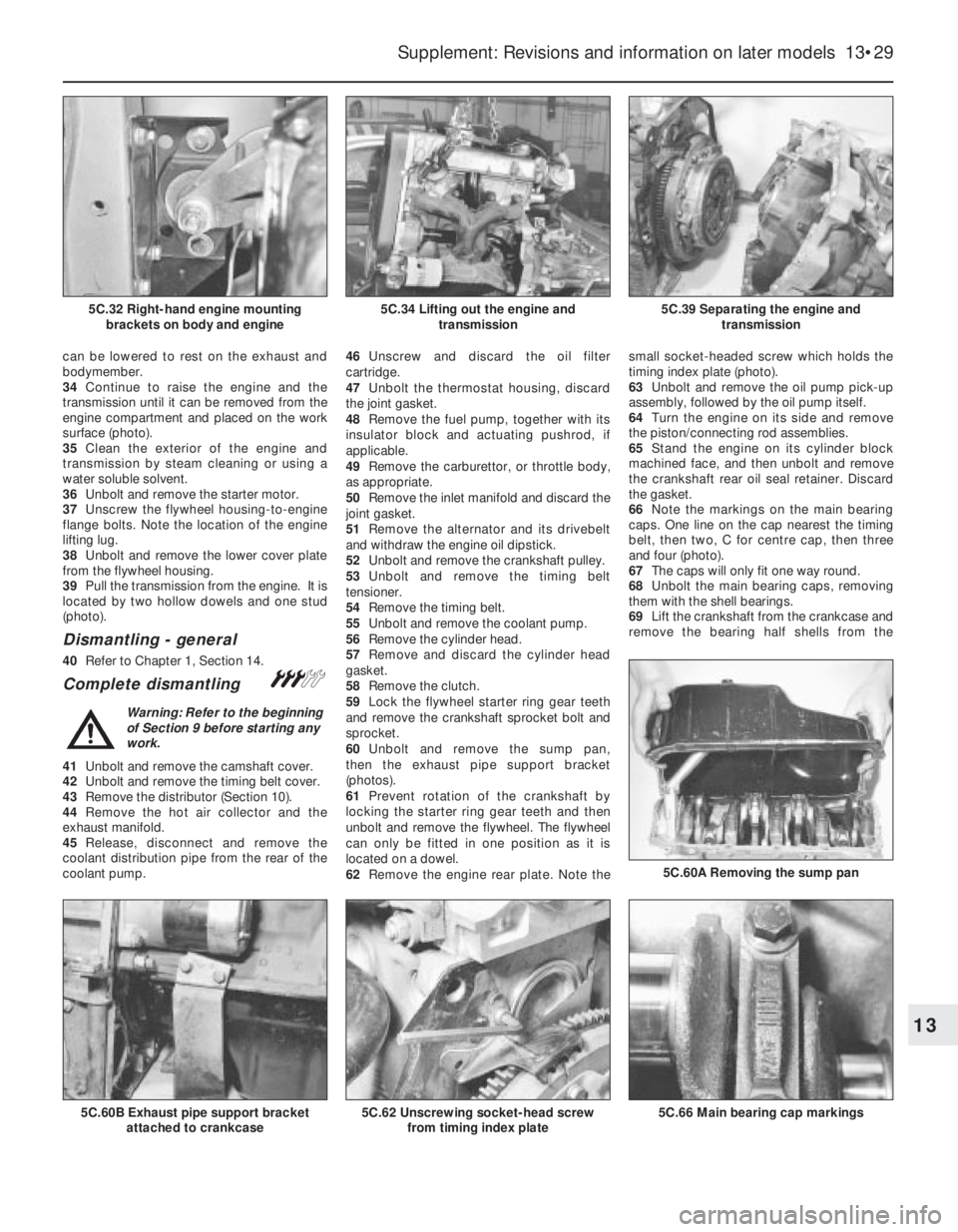
transmission until it can be removed from the
engine compartment and placed on the work
surface (photo).
35Clean the exterior of the engine and
transmission by steam cleaning or using a
water soluble solvent.
36Unbolt and remove the starter motor.
37Unscrew the flywheel housing-to-engine
flange bolts. Note the location of the engine
lifting lug.
38Unbolt and remove the lower cover plate
from the flywheel housing.
39Pull the transmission from the engine. It is
located by two hollow dowels and one stud
(photo).
Dismantling - general
40Refer to Chapter 1, Section 14.
Complete dismantling#
Warning: Refer to the beginning
of Section 9 before starting any
work.
41Unbolt and remove the camshaft cover.
42Unbolt and remove the timing belt cover.
43Remove the distributor (Section 10).
44Remove the hot air collector and the
exhaust manifold.
45Release, disconnect and remove the
coolant distribution pipe from the rear of the
coolant pump.46Unscrew and discard the oil filter
cartridge.
47Unbolt the thermostat housing, discard
the joint gasket.
48Remove the fuel pump, together with its
insulator block and actuating pushrod, if
applicable.
49Remove the carburettor, or throttle body,
as appropriate.
50Remove the inlet manifold and discard the
joint gasket.
51Remove the alternator and its drivebelt
and withdraw the engine oil dipstick.
52Unbolt and remove the crankshaft pulley.
53Unbolt and remove the timing belt
tensioner.
54Remove the timing belt.
55Unbolt and remove the coolant pump.
56Remove the cylinder head.
57Remove and discard the cylinder head
gasket.
58Remove the clutch.
59Lock the flywheel starter ring gear teeth
and remove the crankshaft sprocket bolt and
sprocket.
60Unbolt and remove the sump pan,
then the exhaust pipe support bracket
(photos).
61Prevent rotation of the crankshaft by
locking the starter ring gear teeth and then
unbolt and remove the flywheel. The flywheel
can only be fitted in one position as it is
located on a dowel.
62Remove the engine rear plate. Note thesmall socket-headed screw which holds the
timing index plate (photo).
63Unbolt and remove the oil pump pick-up
assembly, followed by the oil pump itself.
64Turn the engine on its side and remove
the piston/connecting rod assemblies.
65Stand the engine on its cylinder block
machined face, and then unbolt and remove
the crankshaft rear oil seal retainer. Discard
the gasket.
66Note the markings on the main bearing
caps. One line on the cap nearest the timing
belt, then two, C for centre cap, then three
and four (photo).
67The caps will only fit one way round.
68Unbolt the main bearing caps, removing
them with the shell bearings.
69Lift the crankshaft from the crankcase and
remove the bearing half shells from the
Supplement: Revisions and information on later models 13•29
5C.39 Separating the engine and
transmission5C.34 Lifting out the engine and
transmission5C.32 Right-hand engine mounting
brackets on body and engine
5C.66 Main bearing cap markings
5C.60A Removing the sump pan
5C.62 Unscrewing socket-head screw
from timing index plate5C.60B Exhaust pipe support bracket
attached to crankcase
13
Page 157 of 303
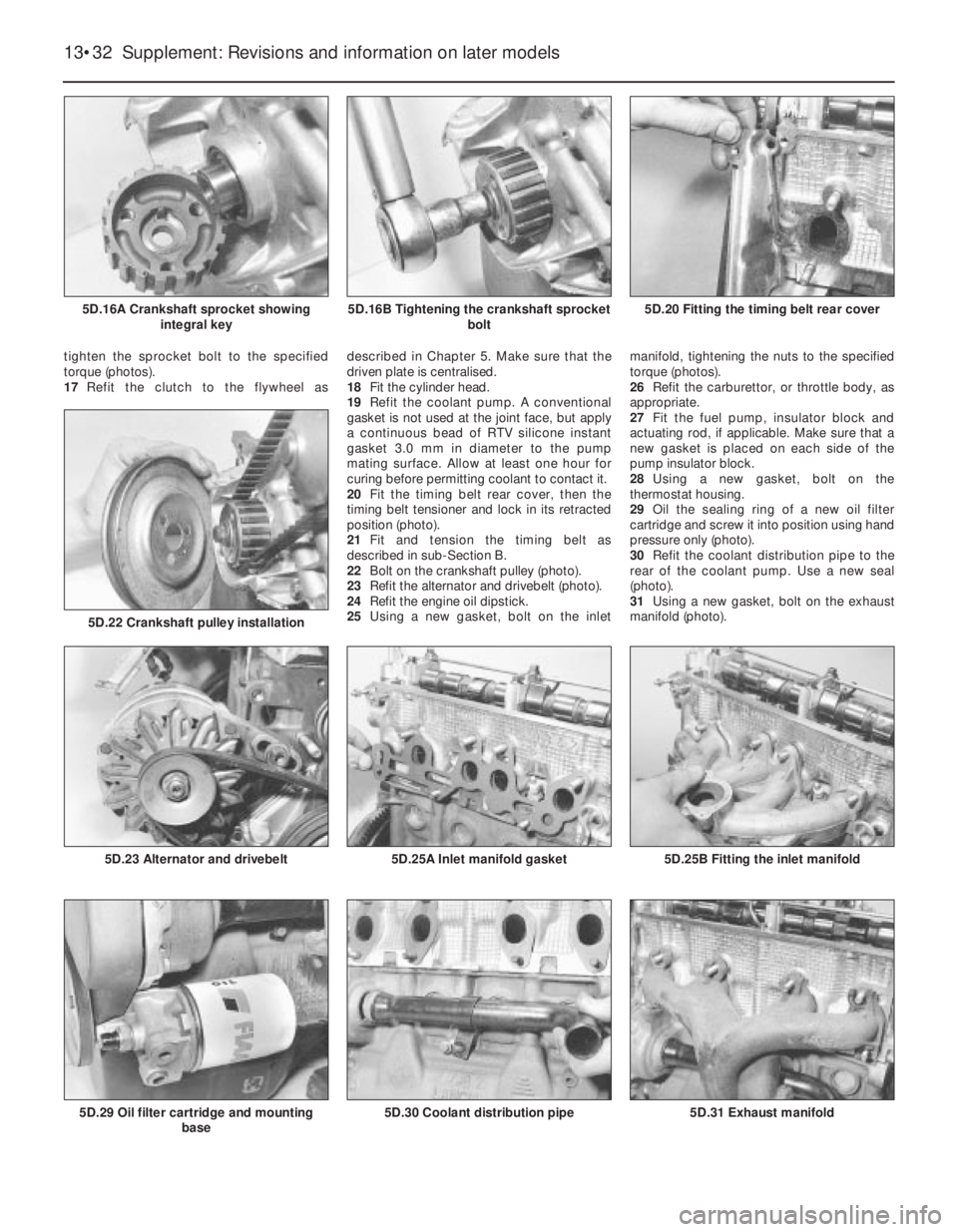
tighten the sprocket bolt to the specified
torque (photos).
17Refit the clutch to the flywheel asdescribed in Chapter 5. Make sure that the
driven plate is centralised.
18Fit the cylinder head.
19Refit the coolant pump. A conventional
gasket is not used at the joint face, but apply
a continuous bead of RTV silicone instant
gasket 3.0 mm in diameter to the pump
mating surface. Allow at least one hour for
curing before permitting coolant to contact it.
20Fit the timing belt rear cover, then the
timing belt tensioner and lock in its retracted
position (photo).
21Fit and tension the timing belt as
described in sub-Section B.
22Bolt on the crankshaft pulley (photo).
23Refit the alternator and drivebelt (photo).
24Refit the engine oil dipstick.
25Using a new gasket, bolt on the inletmanifold, tightening the nuts to the specified
torque (photos).
26Refit the carburettor, or throttle body, as
appropriate.
27Fit the fuel pump, insulator block and
actuating rod, if applicable. Make sure that a
new gasket is placed on each side of the
pump insulator block.
28Using a new gasket, bolt on the
thermostat housing.
29Oil the sealing ring of a new oil filter
cartridge and screw it into position using hand
pressure only (photo).
30Refit the coolant distribution pipe to the
rear of the coolant pump. Use a new seal
(photo).
31Using a new gasket, bolt on the exhaust
manifold (photo).
13•32 Supplement: Revisions and information on later models
5D.31 Exhaust manifold5D.30 Coolant distribution pipe5D.29 Oil filter cartridge and mounting
base
5D.25B Fitting the inlet manifold5D.25A Inlet manifold gasket5D.23 Alternator and drivebelt
5D.22 Crankshaft pulley installation
5D.20 Fitting the timing belt rear cover5D.16B Tightening the crankshaft sprocket
bolt5D.16A Crankshaft sprocket showing
integral key
Page 162 of 303
Initial start-up after major
overhaul
28Refer to Chapter 1, Section 45, but note
that an oil pressure gauge is fitted to indicate
oil pressure.
29Check the ignition static timing as
described in Section 10.
30Check the engine idle speed and CO level
as described in Section 9.
7 Engine-
1372 cc ie and 1372 cc
Turbo ie
PART A: GENERAL
Description
1The 1372 cc engine is similar in design to
the OHC engine fitted to the FIAT Tipo
variants. The engine is of four-cylinder, in-line,
overhead camshaft type, mounted
transversely at the front of the vehicle.
2The crankshaft runs in five main bearings.
Thrustwashers are fitted to the rear (flywheel
end) main bearing in order to control
crankshaft endfloat.
3The connecting rods are attached to the
crankshaft by horizontally split shell-type
big-end bearings. The pistons are attached to
the connecting rods by fully-floating gudgeon
pins which are secured by circlips. The
aluminium alloy pistons are fitted with three
piston rings: two compression rings and an oil
control ring.
4The camshaft is driven by a toothed belt
and operates the valves via bucket and shim
type cam followers. The camshaft is located in
a separate housing on top of the cylinder
head.
5The inlet and exhaust valves are each
closed by double valve springs, and operate
in guides pressed into the cylinder head.
6The auxiliary shaft, which is also driven by
the toothed belt, drives the oil pump.
7Lubrication is by means of a gear type
pump which draws oil through a strainer
located in the sump, and forces it through a
full-flow filter into the engine oil galleries fromwhere it is distributed to the crankshaft,
camshaft and auxiliary shaft. The big-end
bearings are supplied with oil via internal
drillings in the crankshaft. The undersides of
the pistons are cooled by oil spray nozzles
located in each main bearing location in the
crankcase.
8A crankcase ventilation system is
employed, whereby piston blow-by gases are
drawn via an oil separator into the air cleaner,
from where they are drawn into the inlet
manifold and re-burnt with fresh air/fuel
mixture.
9The 1372 cc ie engine is fitted with a Bosch
Mono-Jetronic single point fuel injection (SPi)
system. Whilst the higher performance
1372 cc Turbo ie engine is fitted with a Bosch
L3.1 (L3.2 from 1992) Jetronic multi-point
injection (MPi) system and turbocharger with
intercooler and oil cooling. The L3.2 system
models are fitted with catalytic converters.
Maintenanceª
10At the intervals specified in Section 3 or
“Routine maintenance” at the beginning of
this Manual, carry out the following tasks.
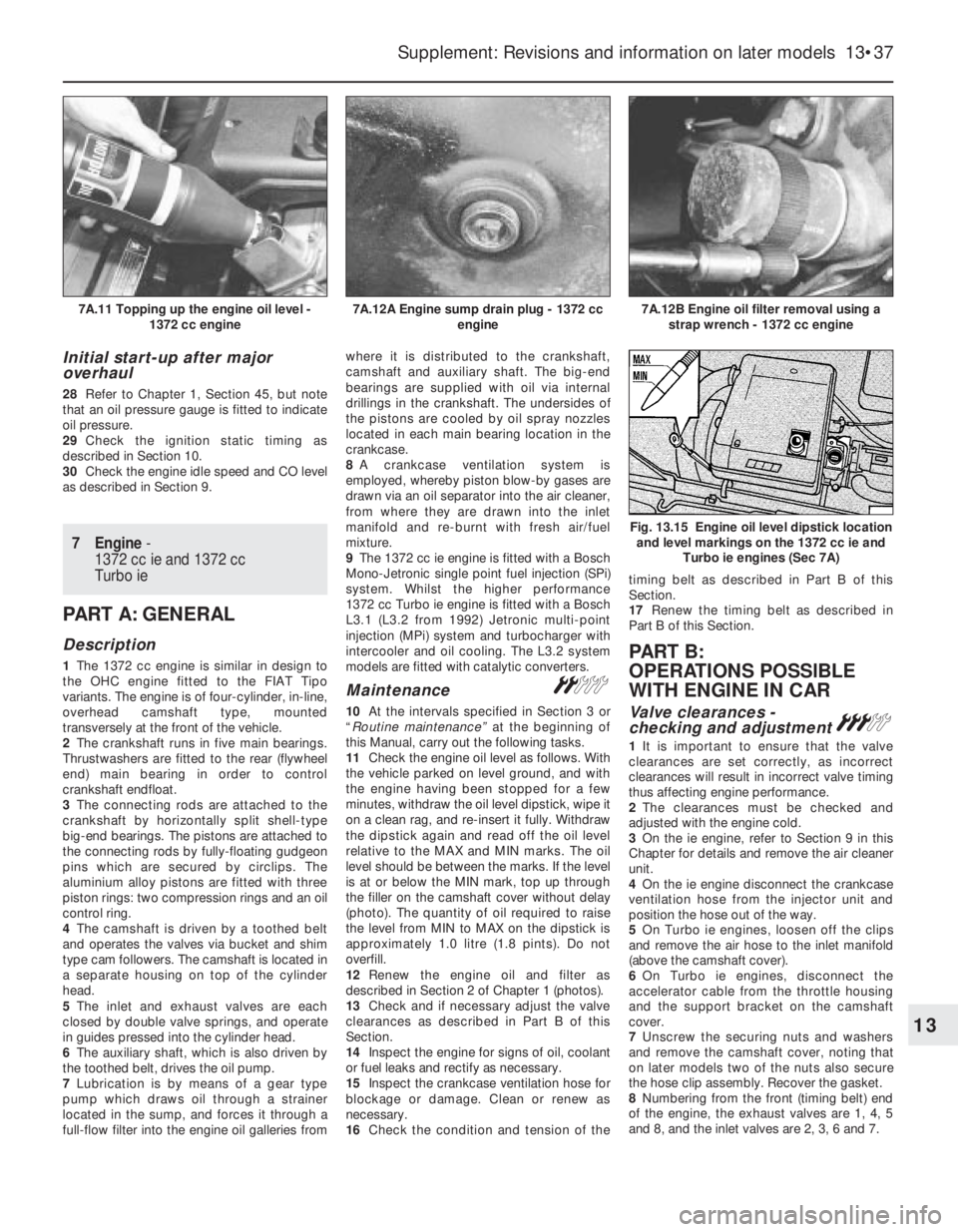
11Check the engine oil level as follows. With
the vehicle parked on level ground, and with
the engine having been stopped for a few
minutes, withdraw the oil level dipstick, wipe it
on a clean rag, and re-insert it fully. Withdraw
the dipstick again and read off the oil level
relative to the MAX and MIN marks. The oil
level should be between the marks. If the level
is at or below the MIN mark, top up through
the filler on the camshaft cover without delay
(photo). The quantity of oil required to raise
the level from MIN to MAX on the dipstick is
approximately 1.0 litre (1.8 pints). Do not
overfill.
12Renew the engine oil and filter as
described in Section 2 of Chapter 1 (photos).
13Check and if necessary adjust the valve
clearances as described in Part B of this
Section.
14Inspect the engine for signs of oil, coolant
or fuel leaks and rectify as necessary.
15Inspect the crankcase ventilation hose for
blockage or damage. Clean or renew as
necessary.
16Check the condition and tension of thetiming belt as described in Part B of this
Section.
17Renew the timing belt as described in
Part B of this Section.
PART B:
OPERATIONS POSSlBLE
WITH ENGINE IN CAR
Valve clearances -
checking and adjustment#
1It is important to ensure that the valve
clearances are set correctly, as incorrect
clearances will result in incorrect valve timing
thus affecting engine performance.
2The clearances must be checked and
adjusted with the engine cold.
3On the ie engine, refer to Section 9 in this
Chapter for details and remove the air cleaner
unit.
4On the ie engine disconnect the crankcase
ventilation hose from the injector unit and
position the hose out of the way.
5On Turbo ie engines, loosen off the clips
and remove the air hose to the inlet manifold
(above the camshaft cover).
6On Turbo ie engines, disconnect the
accelerator cable from the throttle housing
and the support bracket on the camshaft
cover.
7Unscrew the securing nuts and washers
and remove the camshaft cover, noting that
on later models two of the nuts also secure
the hose clip assembly. Recover the gasket.
8Numbering from the front (timing belt) end
of the engine, the exhaust valves are 1, 4, 5
and 8, and the inlet valves are 2, 3, 6 and 7.
Supplement: Revisions and information on later models 13•37
7A.12B Engine oil filter removal using a
strap wrench - 1372 cc engine7A.12A Engine sump drain plug - 1372 cc
engine7A.11 Topping up the engine oil level -
1372 cc engine
Fig. 13.15 Engine oil level dipstick location
and level markings on the 1372 cc ie and
Turbo ie engines (Sec 7A)
13
Page 176 of 303
fittings are disconnected from the engine and
transmission and positioned out of the way.
Enlist the aid of an assistant to help steady
and guide the power unit down through the
engine compartment as it is removed, If
available, position a suitable engine trolley or
crawler board under the engine/transmission
so that when lowered, the power unit can be
withdrawn from the front end of the vehicle
and moved to the area where it is to be
cleaned and dismantled.
38Carefully lower the engine and
transmission unit, ensuring that no fittings
become snagged. Detach the hoist and
withdraw the power unit from under the
vehicle.
39To separate the engine from the
transmission, unbolt and remove the starter
motor, then unscrew the retaining bolts and
withdraw the transmission from the engine. As
it is withdrawn, do not allow the weight of the
engine or transmission to be taken by the
input shaft.
40To remove the clutch unit, refer to
Chapter 5 for details.
1372 cc Turbo ie
engine/transmission -
removal and separation
#
41The engine and transmission removal and
refitting details for Turbo-engined models are
similar to those described for the non-Turbo
models in the previous sub-Section, but the
following differences should be noted.
42To provide access for the disconnection
of the turbo and related components, first
remove the inlet manifold. Removal of the inlet
manifold and the turbocharger is described in
Section 9 of this Chapter.
43The ignition distributor on the Turbo
engine is driven from the auxiliary shaft and is
mounted at the front of the engine, towards
the timing cover end.
44The right-hand driveshaft has a steady
bearing and this will need to be unbolted and
detached.
Engine dismantling - general
45Refer to Chapter 1, Section 14 for details.
Auxiliary shaft - removal,
inspection and refitting #
46Remove the engine and transmission from
the vehicle as described previously in this
Section part.
47Drain the engine oil and remove the sump
as described in Part B of this Section.
48Remove the oil pump as described in Part
B of this Section.
49Remove the timing belt and the auxiliary
shaft sprocket as described in Part B of this
Section.
50Unscrew the three retaining bolts and
remove the auxiliary shaft cover. Remove the
gasket.
51Withdraw the auxiliary shaft from the
cylinder block.
52Examine the shaft and its bearing bushes
in the cylinder block for signs of excessive
wear and/or damage and renew it if
necessary. Bush renewal is described in
paragraph 79 in this Section.
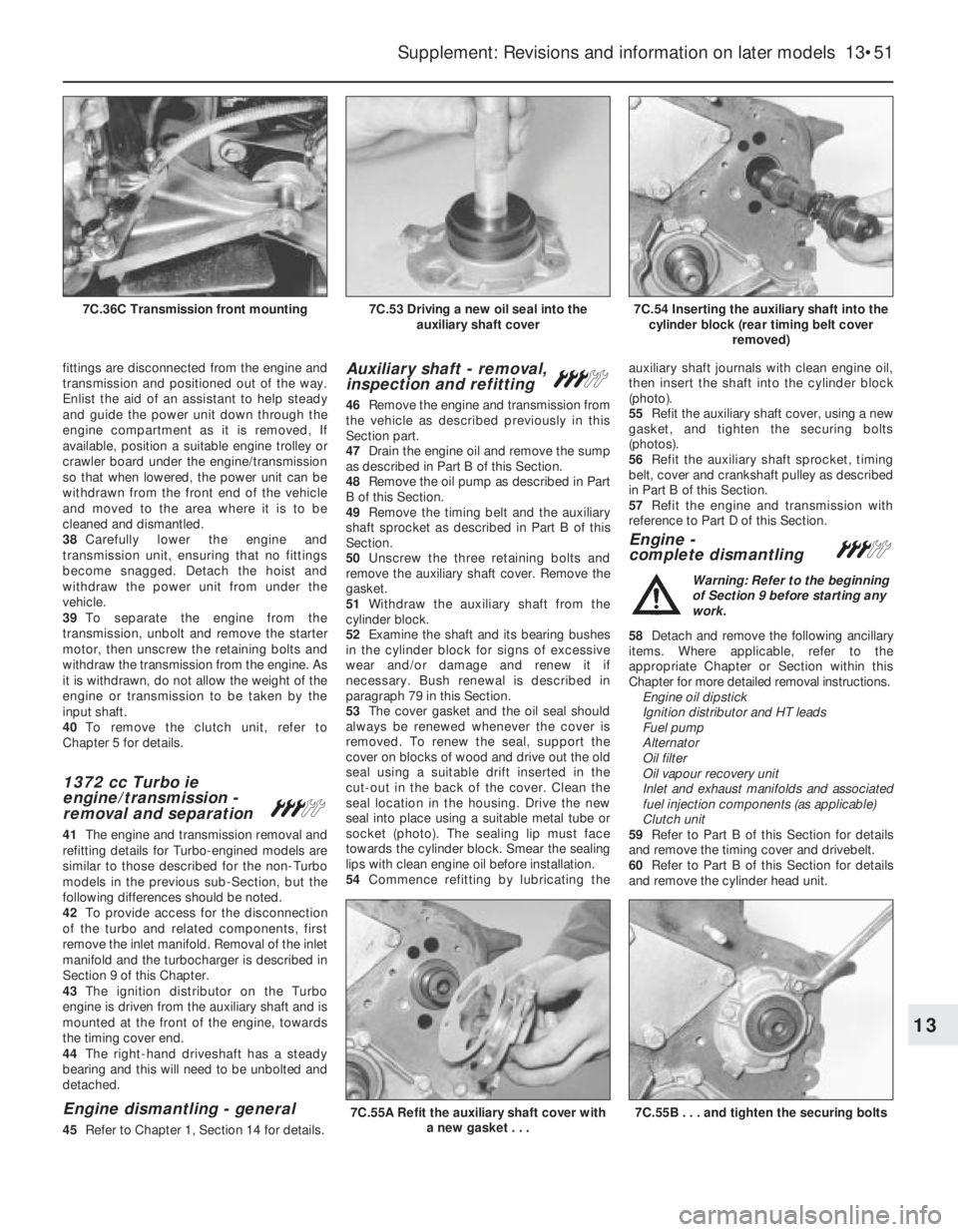
53The cover gasket and the oil seal should
always be renewed whenever the cover is
removed. To renew the seal, support the
cover on blocks of wood and drive out the old
seal using a suitable drift inserted in the
cut-out in the back of the cover. Clean the
seal location in the housing. Drive the new
seal into place using a suitable metal tube or
socket (photo). The sealing lip must face
towards the cylinder block. Smear the sealing
lips with clean engine oil before installation.
54Commence refitting by lubricating theauxiliary shaft journals with clean engine oil,
then insert the shaft into the cylinder block
(photo).
55Refit the auxiliary shaft cover, using a new
gasket, and tighten the securing bolts
(photos).
56Refit the auxiliary shaft sprocket, timing
belt, cover and crankshaft pulley as described
in Part B of this Section.
57Refit the engine and transmission with
reference to Part D of this Section.
Engine -
complete dismantling#
Warning: Refer to the beginning
of Section 9 before starting any
work.
58Detach and remove the following ancillary
items. Where applicable, refer to the
appropriate Chapter or Section within this
Chapter for more detailed removal instructions.
Engine oil dipstick
Ignition distributor and HT leads
Fuel pump
Alternator
Oil filter
Oil vapour recovery unit
Inlet and exhaust manifolds and associated
fuel injection components (as applicable)
Clutch unit
59Refer to Part B of this Section for details
and remove the timing cover and drivebelt.
60Refer to Part B of this Section for details
and remove the cylinder head unit.
Supplement: Revisions and information on later models 13•51
7C.54 Inserting the auxiliary shaft into the
cylinder block (rear timing belt cover
removed)7C.53 Driving a new oil seal into the
auxiliary shaft cover7C.36C Transmission front mounting
7C.55B . . . and tighten the securing bolts7C.55A Refit the auxiliary shaft cover with
a new gasket . . .
13