wheel FORD B MAX 2013 1.G User Guide
[x] Cancel search | Manufacturer: FORD, Model Year: 2013, Model line: B MAX, Model: FORD B MAX 2013 1.GPages: 298, PDF Size: 20.63 MB
Page 63 of 298
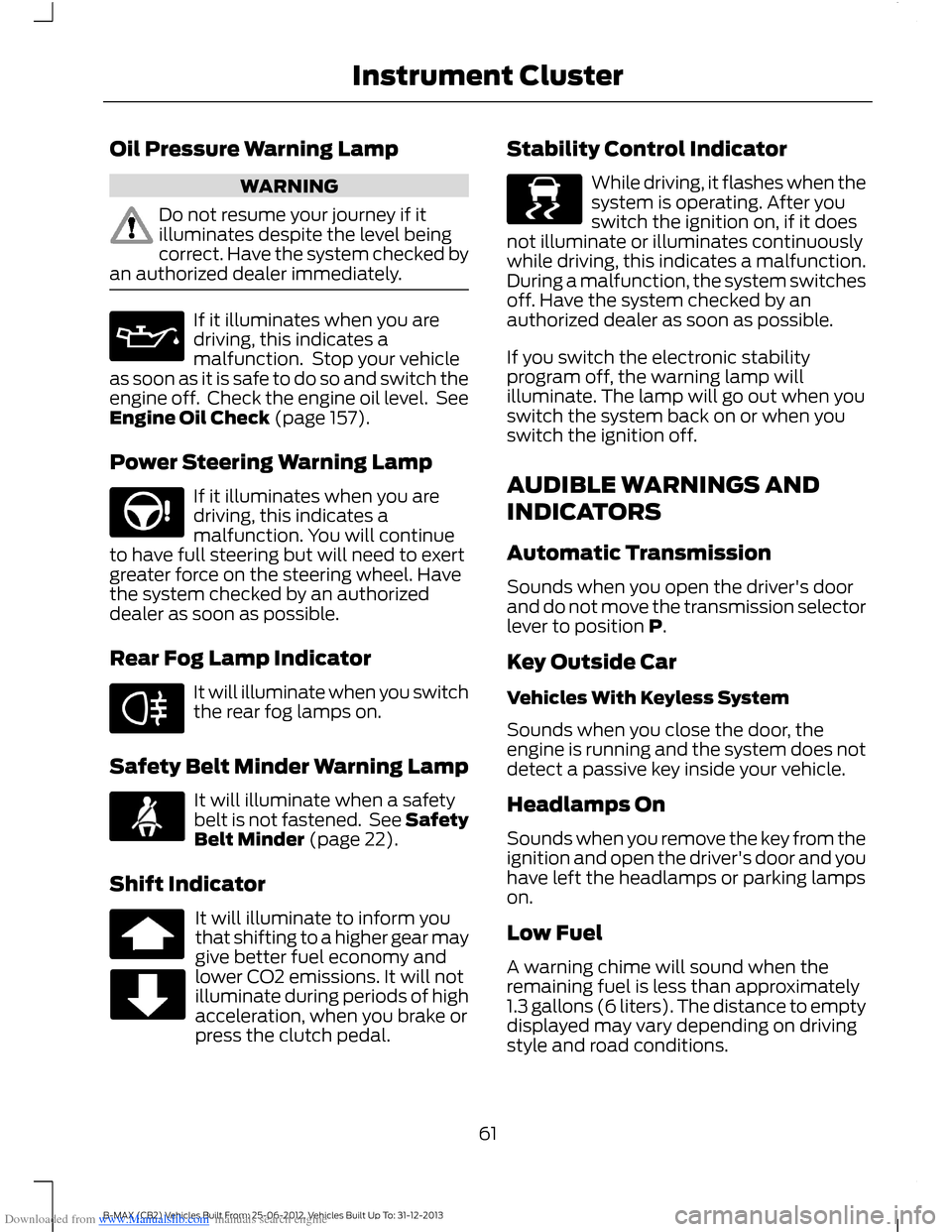
Downloaded from www.Manualslib.com manuals search engine Oil Pressure Warning Lamp
WARNING
Do not resume your journey if itilluminates despite the level beingcorrect. Have the system checked byan authorized dealer immediately.
If it illuminates when you aredriving, this indicates amalfunction. Stop your vehicleas soon as it is safe to do so and switch theengine off. Check the engine oil level. SeeEngine Oil Check (page 157).
Power Steering Warning Lamp
If it illuminates when you aredriving, this indicates amalfunction. You will continueto have full steering but will need to exertgreater force on the steering wheel. Havethe system checked by an authorizeddealer as soon as possible.
Rear Fog Lamp Indicator
It will illuminate when you switchthe rear fog lamps on.
Safety Belt Minder Warning Lamp
It will illuminate when a safetybelt is not fastened. See SafetyBelt Minder (page 22).
Shift Indicator
It will illuminate to inform youthat shifting to a higher gear maygive better fuel economy andlower CO2 emissions. It will notilluminate during periods of highacceleration, when you brake orpress the clutch pedal.
Stability Control Indicator
While driving, it flashes when thesystem is operating. After youswitch the ignition on, if it doesnot illuminate or illuminates continuouslywhile driving, this indicates a malfunction.During a malfunction, the system switchesoff. Have the system checked by anauthorized dealer as soon as possible.
If you switch the electronic stabilityprogram off, the warning lamp willilluminate. The lamp will go out when youswitch the system back on or when youswitch the ignition off.
AUDIBLE WARNINGS AND
INDICATORS
Automatic Transmission
Sounds when you open the driver's doorand do not move the transmission selectorlever to position P.
Key Outside Car
Vehicles With Keyless System
Sounds when you close the door, theengine is running and the system does notdetect a passive key inside your vehicle.
Headlamps On
Sounds when you remove the key from theignition and open the driver's door and youhave left the headlamps or parking lampson.
Low Fuel
A warning chime will sound when theremaining fuel is less than approximately1.3 gallons (6 liters). The distance to emptydisplayed may vary depending on drivingstyle and road conditions.
61B-MAX (CB2) Vehicles Built From: 25-06-2012, Vehicles Built Up To: 31-12-2013Instrument Cluster
Page 72 of 298
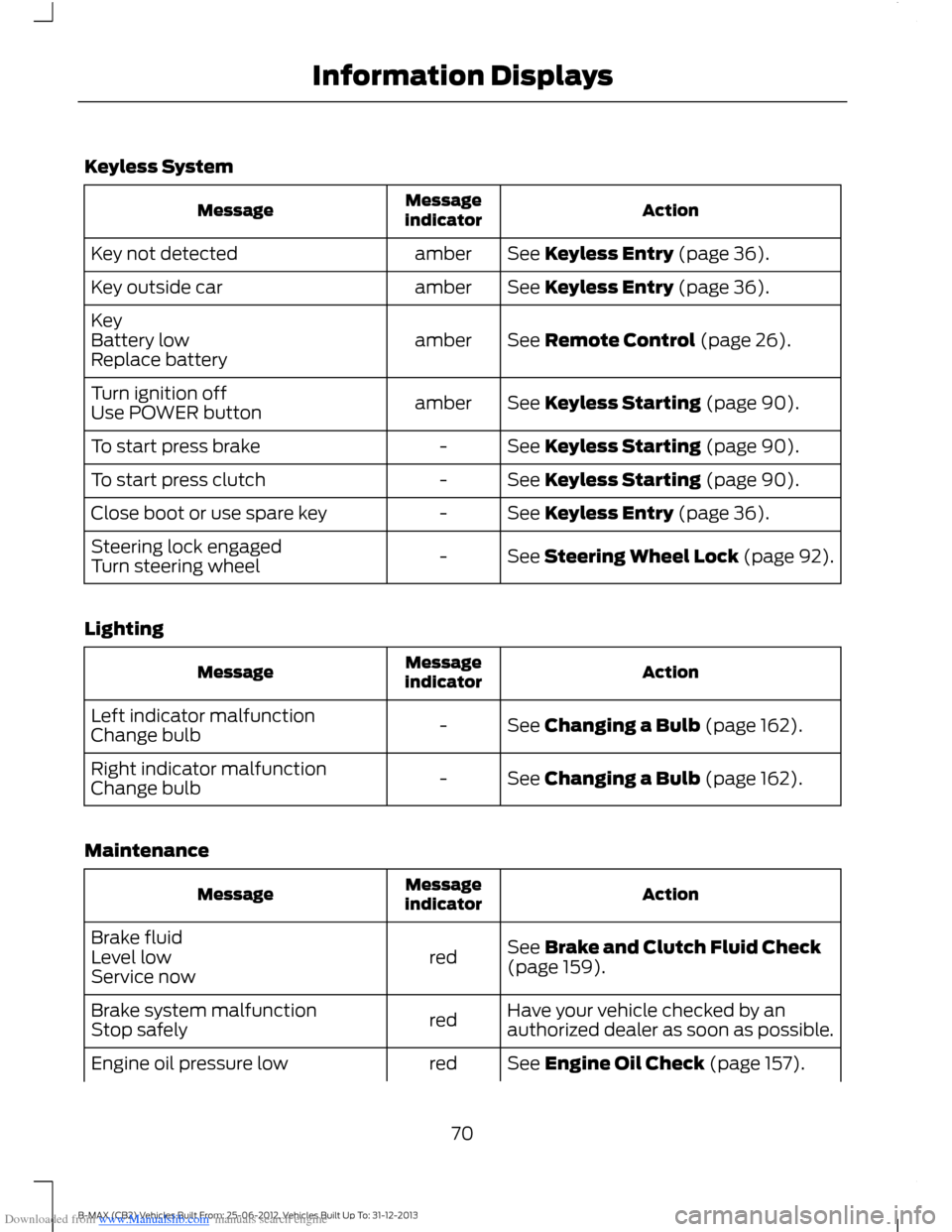
Downloaded from www.Manualslib.com manuals search engine Keyless System
ActionMessageindicatorMessage
See Keyless Entry (page 36).amberKey not detected
See Keyless Entry (page 36).amberKey outside car
See Remote Control (page 26).amberKeyBattery lowReplace battery
See Keyless Starting (page 90).amberTurn ignition offUse POWER button
See Keyless Starting (page 90).-To start press brake
See Keyless Starting (page 90).-To start press clutch
See Keyless Entry (page 36).-Close boot or use spare key
See Steering Wheel Lock (page 92).-Steering lock engagedTurn steering wheel
Lighting
ActionMessageindicatorMessage
See Changing a Bulb (page 162).-Left indicator malfunctionChange bulb
See Changing a Bulb (page 162).-Right indicator malfunctionChange bulb
Maintenance
ActionMessageindicatorMessage
See Brake and Clutch Fluid Check(page 159).redBrake fluidLevel lowService now
Have your vehicle checked by anauthorized dealer as soon as possible.redBrake system malfunctionStop safely
See Engine Oil Check (page 157).redEngine oil pressure low
70B-MAX (CB2) Vehicles Built From: 25-06-2012, Vehicles Built Up To: 31-12-2013Information Displays
Page 74 of 298
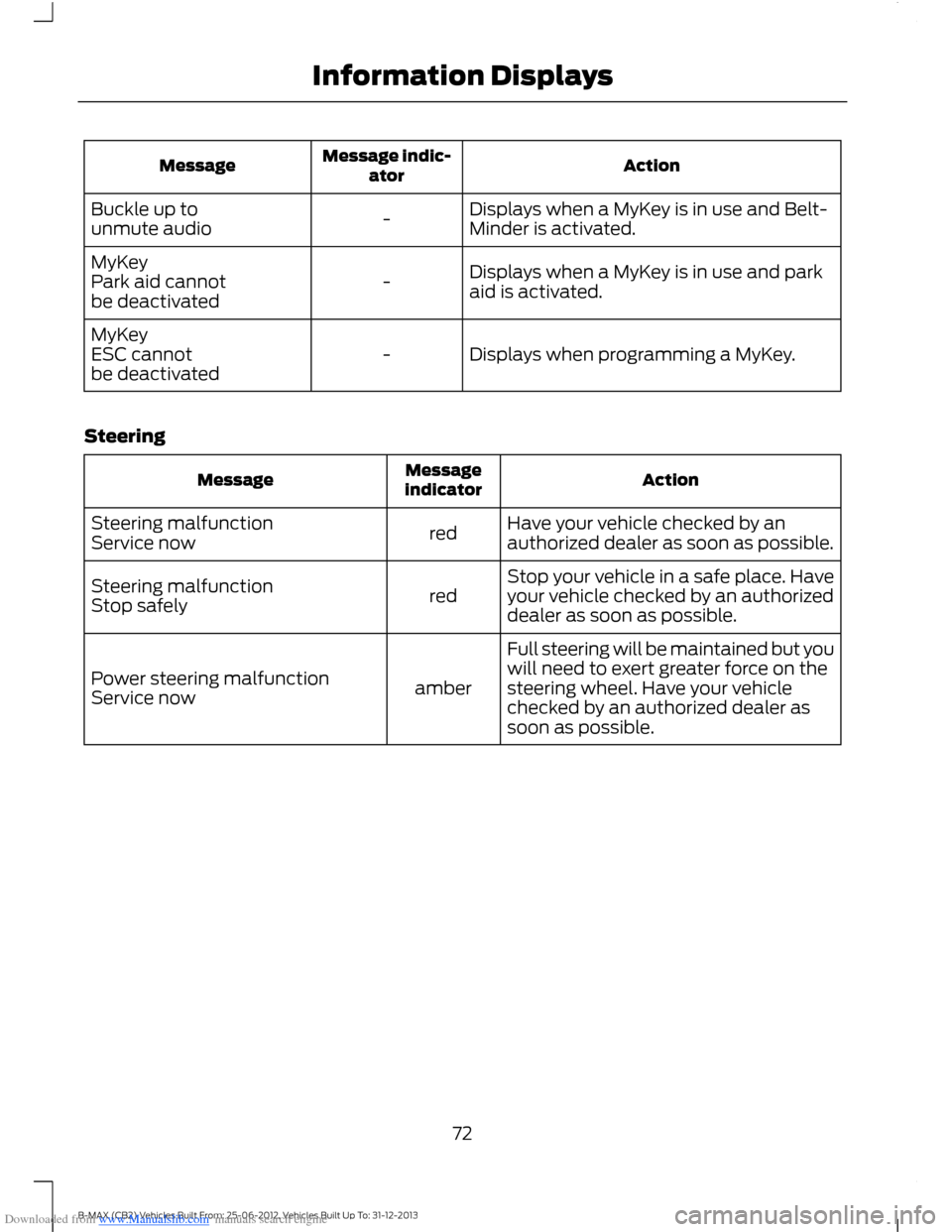
Downloaded from www.Manualslib.com manuals search engine ActionMessage indic-atorMessage
Displays when a MyKey is in use and Belt-Minder is activated.-Buckle up tounmute audio
Displays when a MyKey is in use and parkaid is activated.-MyKeyPark aid cannotbe deactivated
Displays when programming a MyKey.-MyKeyESC cannotbe deactivated
Steering
ActionMessageindicatorMessage
Have your vehicle checked by anauthorized dealer as soon as possible.redSteering malfunctionService now
Stop your vehicle in a safe place. Haveyour vehicle checked by an authorizeddealer as soon as possible.redSteering malfunctionStop safely
Full steering will be maintained but youwill need to exert greater force on thesteering wheel. Have your vehiclechecked by an authorized dealer assoon as possible.
amberPower steering malfunctionService now
72B-MAX (CB2) Vehicles Built From: 25-06-2012, Vehicles Built Up To: 31-12-2013Information Displays
Page 85 of 298
Downloaded from www.Manualslib.com manuals search engine SITTING IN THE CORRECT
POSITION
WARNINGS
Do not recline the seatback too faras this can cause the occupant toslide under the safety belt, resultingin serious injury in the event of a collision.
Sitting improperly, out of position orwith the seatback reclined too far,can result in serious injury or deathin the event of a collision. Always situpright against your seatback, with yourfeet on the floor.
Do not place objects higher than theseatback to reduce the risk of seriousinjury in the event of a collision orduring heavy braking.
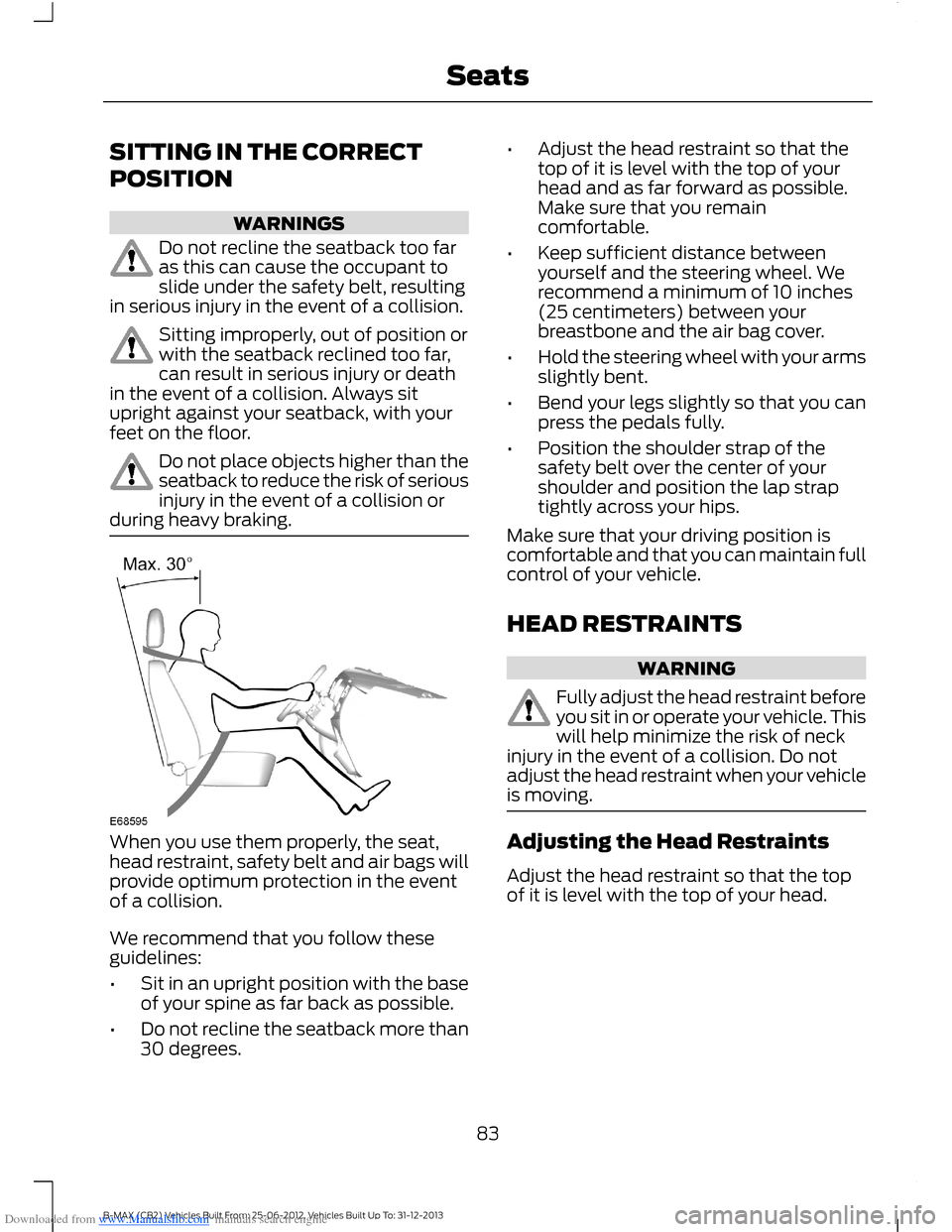
When you use them properly, the seat,head restraint, safety belt and air bags willprovide optimum protection in the eventof a collision.
We recommend that you follow theseguidelines:
•Sit in an upright position with the baseof your spine as far back as possible.
•Do not recline the seatback more than30 degrees.
•Adjust the head restraint so that thetop of it is level with the top of yourhead and as far forward as possible.Make sure that you remaincomfortable.
•Keep sufficient distance betweenyourself and the steering wheel. Werecommend a minimum of 10 inches(25 centimeters) between yourbreastbone and the air bag cover.
•Hold the steering wheel with your armsslightly bent.
•Bend your legs slightly so that you canpress the pedals fully.
•Position the shoulder strap of thesafety belt over the center of yourshoulder and position the lap straptightly across your hips.
Make sure that your driving position iscomfortable and that you can maintain fullcontrol of your vehicle.
HEAD RESTRAINTS
WARNING
Fully adjust the head restraint beforeyou sit in or operate your vehicle. Thiswill help minimize the risk of neckinjury in the event of a collision. Do notadjust the head restraint when your vehicleis moving.
Adjusting the Head Restraints
Adjust the head restraint so that the topof it is level with the top of your head.
83B-MAX (CB2) Vehicles Built From: 25-06-2012, Vehicles Built Up To: 31-12-2013Seats
Page 92 of 298
Downloaded from www.Manualslib.com manuals search engine GENERAL INFORMATION
WARNINGS
Extended idling at high enginespeeds can produce very hightemperatures in the engine andexhaust system, creating the risk of fire orother damage.
Do not park, idle or drive your vehicleon dry grass or other dry groundcover. The emission system heats upthe engine compartment and exhaustsystem, creating the risk of fire.
Do not start the engine in a closedgarage or in other enclosed areas.Exhaust fumes can be toxic. Alwaysopen the garage door before you start theengine.
If you smell exhaust fumes insideyour vehicle, have your vehiclechecked by an authorized dealerimmediately. Do not drive your vehicle ifyou smell exhaust fumes.
If you disconnect the battery, your vehiclemay exhibit some unusual drivingcharacteristics for approximately 5 miles(8 kilometers) after you reconnect it. Thisis because the engine management systemmust realign itself with the engine. You candisregard any unusual drivingcharacteristics during this period.
The powertrain control system meets allCanadian interference-causing equipmentstandard requirements regulating theimpulse electrical field or radio noise.
When you start the engine, avoid pressingthe accelerator pedal before and duringoperation. Only use the accelerator pedalwhen you have difficulty starting theengine.
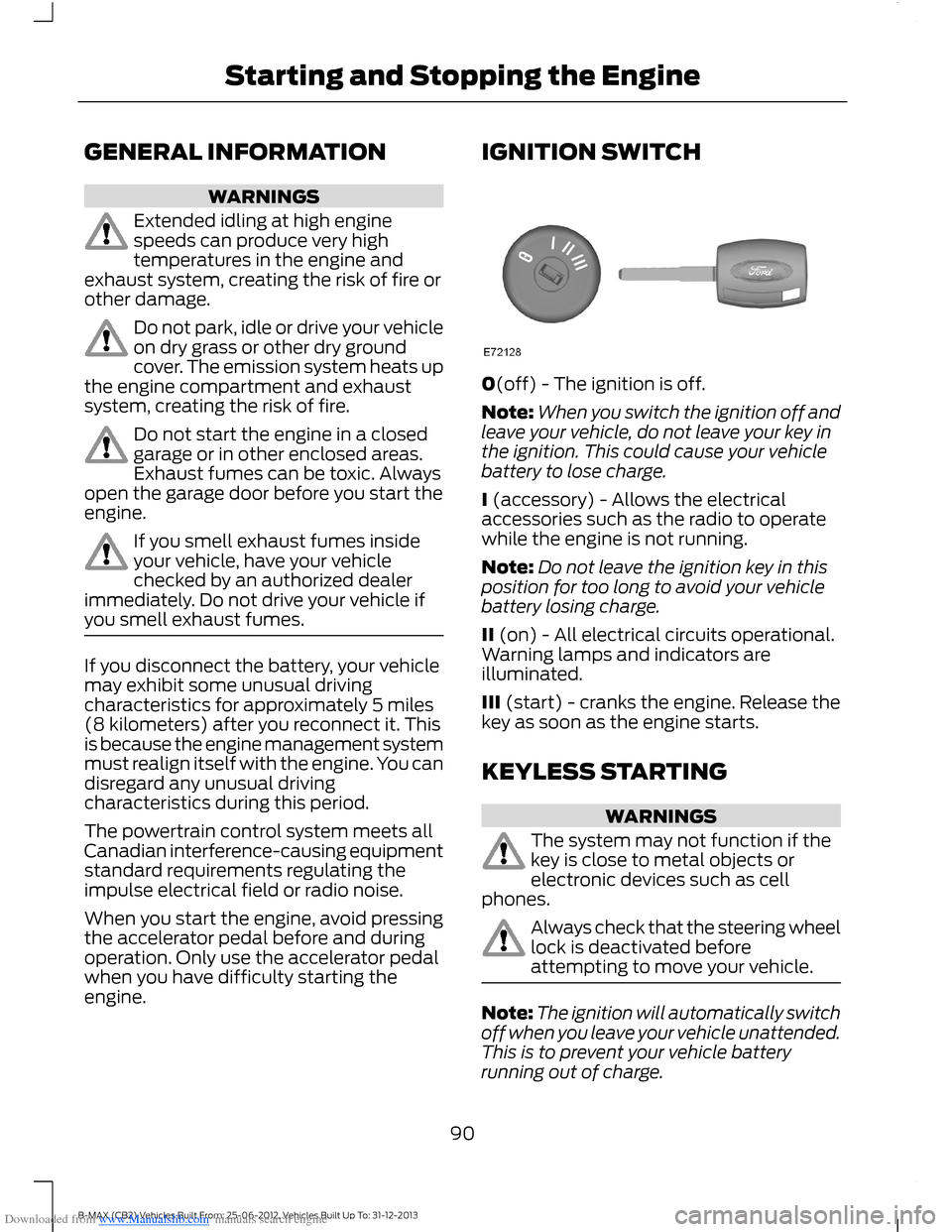
IGNITION SWITCH
0(off) - The ignition is off.
Note:When you switch the ignition off andleave your vehicle, do not leave your key inthe ignition. This could cause your vehiclebattery to lose charge.
I (accessory) - Allows the electricalaccessories such as the radio to operatewhile the engine is not running.
Note:Do not leave the ignition key in thisposition for too long to avoid your vehiclebattery losing charge.
II (on) - All electrical circuits operational.Warning lamps and indicators areilluminated.
III (start) - cranks the engine. Release thekey as soon as the engine starts.
KEYLESS STARTING
WARNINGS
The system may not function if thekey is close to metal objects orelectronic devices such as cellphones.
Always check that the steering wheellock is deactivated beforeattempting to move your vehicle.
Note:The ignition will automatically switchoff when you leave your vehicle unattended.This is to prevent your vehicle batteryrunning out of charge.
90B-MAX (CB2) Vehicles Built From: 25-06-2012, Vehicles Built Up To: 31-12-2013Starting and Stopping the Engine
Page 93 of 298
Downloaded from www.Manualslib.com manuals search engine Note:A valid key must be located insideyour vehicle to switch the ignition on andstart the engine.
Ignition On
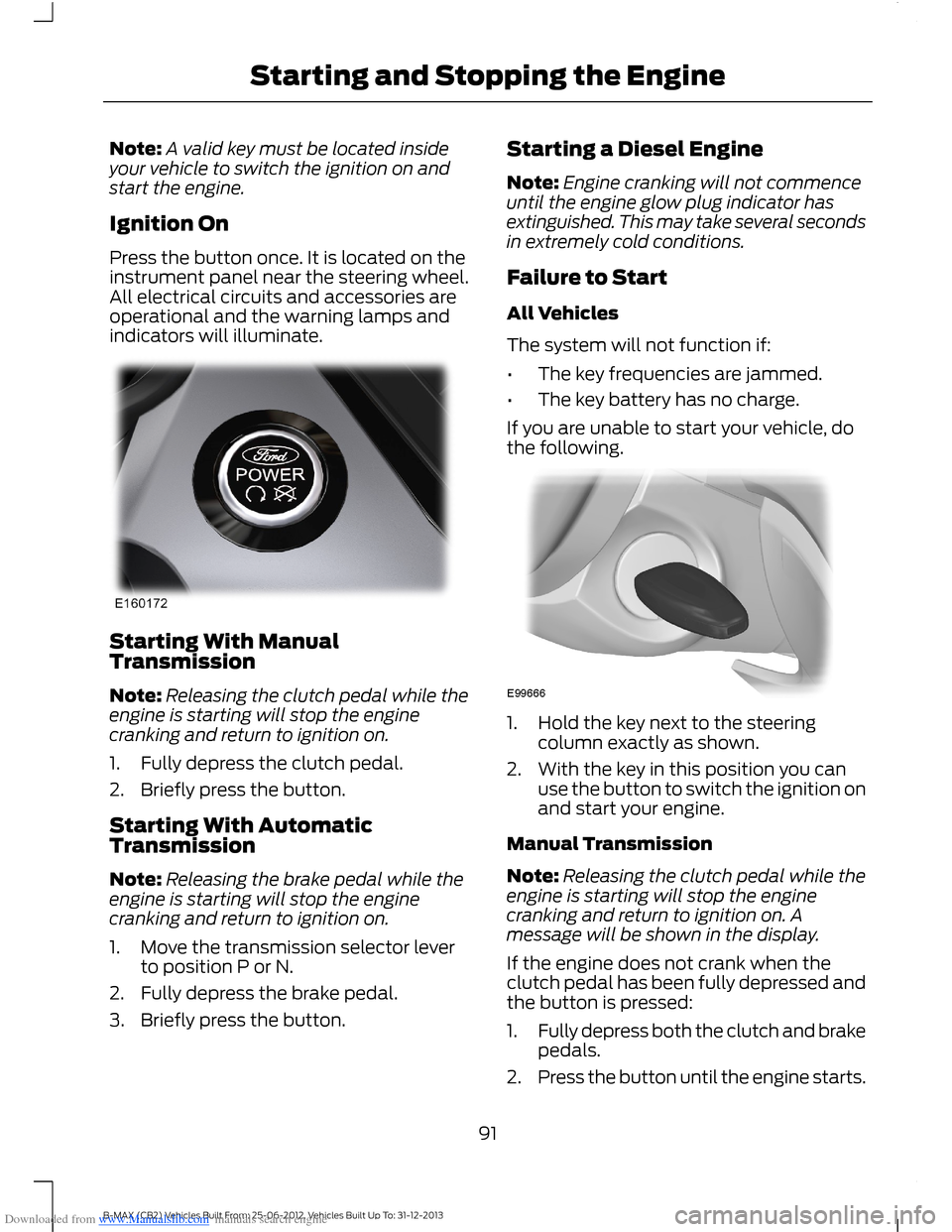
Press the button once. It is located on theinstrument panel near the steering wheel.All electrical circuits and accessories areoperational and the warning lamps andindicators will illuminate.
Starting With ManualTransmission
Note:Releasing the clutch pedal while theengine is starting will stop the enginecranking and return to ignition on.
1.Fully depress the clutch pedal.
2.Briefly press the button.
Starting With AutomaticTransmission
Note:Releasing the brake pedal while theengine is starting will stop the enginecranking and return to ignition on.
1.Move the transmission selector leverto position P or N.
2.Fully depress the brake pedal.
3.Briefly press the button.
Starting a Diesel Engine
Note:Engine cranking will not commenceuntil the engine glow plug indicator hasextinguished. This may take several secondsin extremely cold conditions.
Failure to Start
All Vehicles
The system will not function if:
•The key frequencies are jammed.
•The key battery has no charge.
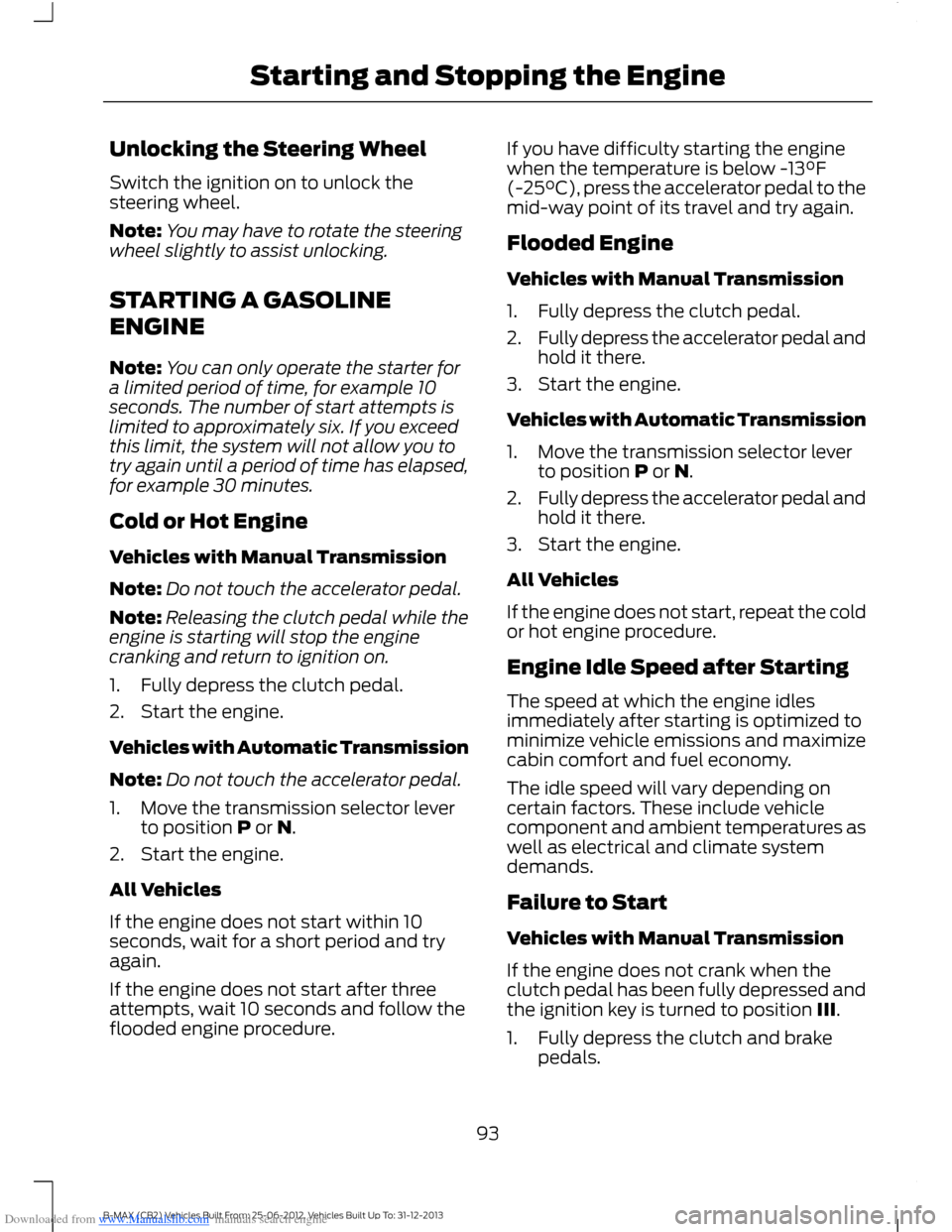
If you are unable to start your vehicle, dothe following.
1.Hold the key next to the steeringcolumn exactly as shown.
2.With the key in this position you canuse the button to switch the ignition onand start your engine.
Manual Transmission
Note:Releasing the clutch pedal while theengine is starting will stop the enginecranking and return to ignition on. Amessage will be shown in the display.
If the engine does not crank when theclutch pedal has been fully depressed andthe button is pressed:
1.Fully depress both the clutch and brakepedals.
2.Press the button until the engine starts.
91B-MAX (CB2) Vehicles Built From: 25-06-2012, Vehicles Built Up To: 31-12-2013Starting and Stopping the Engine
Page 94 of 298
Downloaded from www.Manualslib.com manuals search engine Stopping the Engine When YourVehicle is Stationary
Note:The ignition, all electrical circuitswarning lamps and indicators will beswitched off.
Manual Transmission
Press the button.
Automatic Transmission
1.Move the transmission selector leverto position P.
2.Press the button.
Stopping the Engine When YourVehicle is Moving
WARNING
Switching off the engine when yourvehicle is still moving will result in aloss of brake and steering assistance.The steering will not lock, but higher effortwill be required. With the ignition switchedoff some electrical circuits, warning lampsand indicators may also be off.
1.Press and hold the button for at leastone second or press it three timeswithin two seconds.
2.Move the transmission selector leverto position N and use the brakes tobring your vehicle to a safe stop.
3.When your vehicle has stopped, movethe transmission selector lever toposition P or N and switch the ignitionoff.
STEERING WHEEL LOCK -
VEHICLES WITHOUT: KEYLESS
ENTRY AND PUSH BUTTON
START/PUSH BUTTON START
WARNING
Always check that the steering isunlocked before attempting to moveyour vehicle.
To lock the steering wheel:
1.Remove the key from the ignitionswitch.
2.Rotate the steering wheel slightly toengage the lock.
To unlock the steering wheel:
1.Insert the key in the ignition switch.
2.Turn the key to position I.
Note:You may need to rotate the steeringwheel slightly to assist unlocking if there isa steering wheel load applied.
STEERING WHEEL LOCK -
VEHICLES WITH: KEYLESS
ENTRY AND PUSH BUTTON
START/PUSH BUTTON START
Your vehicle has an electronicallycontrolled steering wheel lock thatoperates automatically.
The system will lock the steering wheelafter a short period of time once you haveparked your vehicle and the passive key isoutside your vehicle, or when you lock yourvehicle.
Note:The system will not lock the steeringwheel when the ignition is on or while yourvehicle is moving.
92B-MAX (CB2) Vehicles Built From: 25-06-2012, Vehicles Built Up To: 31-12-2013Starting and Stopping the Engine
Page 95 of 298
Downloaded from www.Manualslib.com manuals search engine Unlocking the Steering Wheel
Switch the ignition on to unlock thesteering wheel.
Note:You may have to rotate the steeringwheel slightly to assist unlocking.
STARTING A GASOLINE
ENGINE
Note:You can only operate the starter fora limited period of time, for example 10seconds. The number of start attempts islimited to approximately six. If you exceedthis limit, the system will not allow you totry again until a period of time has elapsed,for example 30 minutes.
Cold or Hot Engine
Vehicles with Manual Transmission
Note:Do not touch the accelerator pedal.
Note:Releasing the clutch pedal while theengine is starting will stop the enginecranking and return to ignition on.
1.Fully depress the clutch pedal.
2.Start the engine.
Vehicles with Automatic Transmission
Note:Do not touch the accelerator pedal.
1.Move the transmission selector leverto position P or N.
2.Start the engine.
All Vehicles
If the engine does not start within 10seconds, wait for a short period and tryagain.
If the engine does not start after threeattempts, wait 10 seconds and follow theflooded engine procedure.
If you have difficulty starting the enginewhen the temperature is below -13°F(-25°C), press the accelerator pedal to themid-way point of its travel and try again.
Flooded Engine
Vehicles with Manual Transmission
1.Fully depress the clutch pedal.
2.Fully depress the accelerator pedal andhold it there.
3.Start the engine.
Vehicles with Automatic Transmission
1.Move the transmission selector leverto position P or N.
2.Fully depress the accelerator pedal andhold it there.
3.Start the engine.
All Vehicles
If the engine does not start, repeat the coldor hot engine procedure.
Engine Idle Speed after Starting
The speed at which the engine idlesimmediately after starting is optimized tominimize vehicle emissions and maximizecabin comfort and fuel economy.
The idle speed will vary depending oncertain factors. These include vehiclecomponent and ambient temperatures aswell as electrical and climate systemdemands.
Failure to Start
Vehicles with Manual Transmission
If the engine does not crank when theclutch pedal has been fully depressed andthe ignition key is turned to position III.
1.Fully depress the clutch and brakepedals.
93B-MAX (CB2) Vehicles Built From: 25-06-2012, Vehicles Built Up To: 31-12-2013Starting and Stopping the Engine
Page 107 of 298
Downloaded from www.Manualslib.com manuals search engine WARNINGS
Apply the parking brake and movethe transmission selector lever topark before leaving your vehicle.Make sure that the transmission selectorlever is latched in position.
Note:An audible warning will sound if youopen the driver's door and you have notmoved the transmission selector lever topark.
In this position, power is not transmittedto the drive wheels and the transmissionis locked. You can start the engine with thetransmission selector lever in this position.
R (Reverse)
WARNINGS
Move the transmission selector leverto reverse only when your vehicle isstationary and the engine is at idlespeed.
Always come to a complete stopbefore shifting the transmissionselector lever out of reverse.
Move the transmission selector lever toreverse to allow your vehicle to movebackward.
N (Neutral)
In this position, power is not transmittedto the drive wheels but the transmission isnot locked. You can start the engine withthe transmission selector lever in thisposition.
D (Drive)
Note:A shift will occur only when yourvehicle speed and the engine speed areappropriate.
Note:You may temporarily override thecurrent gear selected using the + and -buttons.
Select drive to shift automatically throughthe forward gears.
The transmission will select theappropriate gear for optimum performancebased on ambient temperature, roadgradient, vehicle load and your input.
Sport Mode and Manual Shifting
Sport Mode
Note:In sport mode the transmissionoperates as normal but gears are selectedmore quickly and at higher engine speeds.
Note:In sport mode S will be shown in theinformation display.
Switch on sport mode by moving thetransmission selector lever to position S.Sport mode will remain on until either youshift manually up or down the gears using+ and - or move the transmission selectorlever to position D.
Manual Shifting
WARNINGS
Do not hold the buttons permanentlyin - or +.
The transmission will automaticallydownshift when the engine speed istoo low.
Press the - button to shift down and pressthe + button to shift up.
Gears may be skipped by pressing thebuttons repeatedly at short intervals.
Manual mode also provides a kickdownfunction. See Kickdown.
105B-MAX (CB2) Vehicles Built From: 25-06-2012, Vehicles Built Up To: 31-12-2013Transmission
Page 111 of 298
Downloaded from www.Manualslib.com manuals search engine GENERAL INFORMATION
WARNING
The system does not relieve you ofyour responsibility to drive with duecare and attention.
Note:Occasional brake noise is normal. Ifa metal-to-metal, continuous grinding orcontinuous squeal sound is present, thebrake linings may be worn-out. If the vehiclehas continuous vibration or shudder in thesteering wheel while braking, have yourvehicle checked by an authorized dealer.
Note:Brake dust may accumulate on thewheels, even under normal drivingconditions. Some dust is inevitable as thebrakes wear. See Cleaning the AlloyWheels (page 173).
Wet brakes result in reduced brakingefficiency. Gently press the brake pedal afew times when driving from a car wash orstanding water to dry the brakes.
Emergency Brake Assist
Emergency brake assist detects when youbrake heavily by measuring the rate atwhich you press the brake pedal. Itprovides maximum braking efficiency aslong as you press the pedal. Emergencybrake assist can reduce stopping distancesin critical situations.
Anti-lock Brake System
This system helps you maintain steeringcontrol and vehicle stability duringemergency stops by keeping the brakesfrom locking.
HINTS ON DRIVING WITH
ANTI-LOCK BRAKES
Note:When the system is operating, thebrake pedal will pulse and may travelfurther. Maintain pressure on the brakepedal. You may also hear a noise from thesystem. This is normal.
The anti-lock braking system will noteliminate the risks when:
•you drive too closely to the vehicle infront of you
•your vehicle is hydroplaning
•you take corners too fast
•the road surface is poor.
PARKING BRAKE
Vehicles With AutomaticTransmission
WARNING
Always set the parking brake fullyand leave your vehicle with thetransmission selector lever inposition P.
Note:If you park your vehicle on a hill andfacing uphill move the transmission selectorlever to position P and turn the steeringwheel away from the curb.
Note:If you park your vehicle on a hill andfacing downhill move the transmissionselector lever to position P and turn thesteering wheel toward the curb.
Vehicles With ManualTransmission
Note:If you park your vehicle on a hill andfacing uphill select first gear and turn thesteering wheel away from the curb.
109B-MAX (CB2) Vehicles Built From: 25-06-2012, Vehicles Built Up To: 31-12-2013Brakes