fuel FORD C MAX 2011 2.G Owner's Manual
[x] Cancel search | Manufacturer: FORD, Model Year: 2011, Model line: C MAX, Model: FORD C MAX 2011 2.GPages: 296, PDF Size: 7.87 MB
Page 138 of 296
Downloaded from www.Manualslib.com manuals search engine SAFETY PRECAUTIONS
WARNINGS
Stop refuelling after the fuel nozzle
stops the second time. Additional
fuel will fill the expansion space in
the fuel tank which could lead to fuel
overflowing. Fuel spillage could be
hazardous to other road users. Do not use any kind of flames or heat
near the fuel system. The fuel system
is under pressure. There is a risk of
injury if the fuel system is leaking. FUEL QUALITY - PETROL
CAUTION
Do not use leaded petrol or petrol with
additives containing other metallic
compounds (e.g. manganese-based).
They could damage the emission system. Note:
We recommend that you use only
high quality fuel without additives or other
engine treatments.
Use minimum 95 octane unleaded
petrol that meets the specification defined
by EN 228, or equivalent.
FUEL QUALITY - DIESEL WARNING
Do not mix diesel with oil, petrol or
other liquids. This could cause a
chemical reaction.
CAUTIONS
Do not add kerosene, paraffin or
petrol to diesel. This could cause
damage to the fuel system. CAUTIONS
Use diesel that meets the
specification defined by EN 590, or
the relevant national specification.
Note:
We recommend that you use only
high quality fuel.
Note: The use of additives or other engine
treatments not approved by Ford is not
recommended.
Note: We do not recommend the prolonged
use of additives intended to prevent fuel
waxing.
Long-term storage
Most diesel fuels contain bio-diesel, it is
recommended to fill the tank with purely
mineral diesel (where available) or add an
anti-oxidant prior to long-term storage of
your vehicle exceeding two months. Your
dealer can help you with a suitable
anti-oxidant.
CATALYTIC CONVERTER WARNING
Do not park or idle your vehicle over
dry leaves, dry grass or other
combustible materials. The exhaust
will radiate a considerable amount of heat
during use, and after you have switched
the engine off. This is a potential fire
hazard. Driving with a catalytic converter
CAUTIONS
Avoid running out of fuel.
Do not crank the engine for long
periods.
Do not run the engine when a spark
plug lead is disconnected.
136
Fuel and Refuelling
Page 139 of 296
Downloaded from www.Manualslib.com manuals search engine CAUTIONS
Do not push-start or tow-start your
vehicle. Use booster cables. See
Jump-Starting the Vehicle (page
197). Do not switch the ignition off when
driving.
FUEL FILLER FLAP
WARNINGS
Take care when refuelling to avoid
spilling any residual fuel from the fuel
nozzle.
Do not use any kind of flames or heat
near the fuel system. The fuel system
is under pressure. There is a risk of
injury if the fuel system is leaking. CAUTION
If you use a high pressure spray to
wash your vehicle, only spray the fuel
filler flap briefly from a distance not
less than 200 millimetres (8 inches). Note:
The sliding door is inhibited from
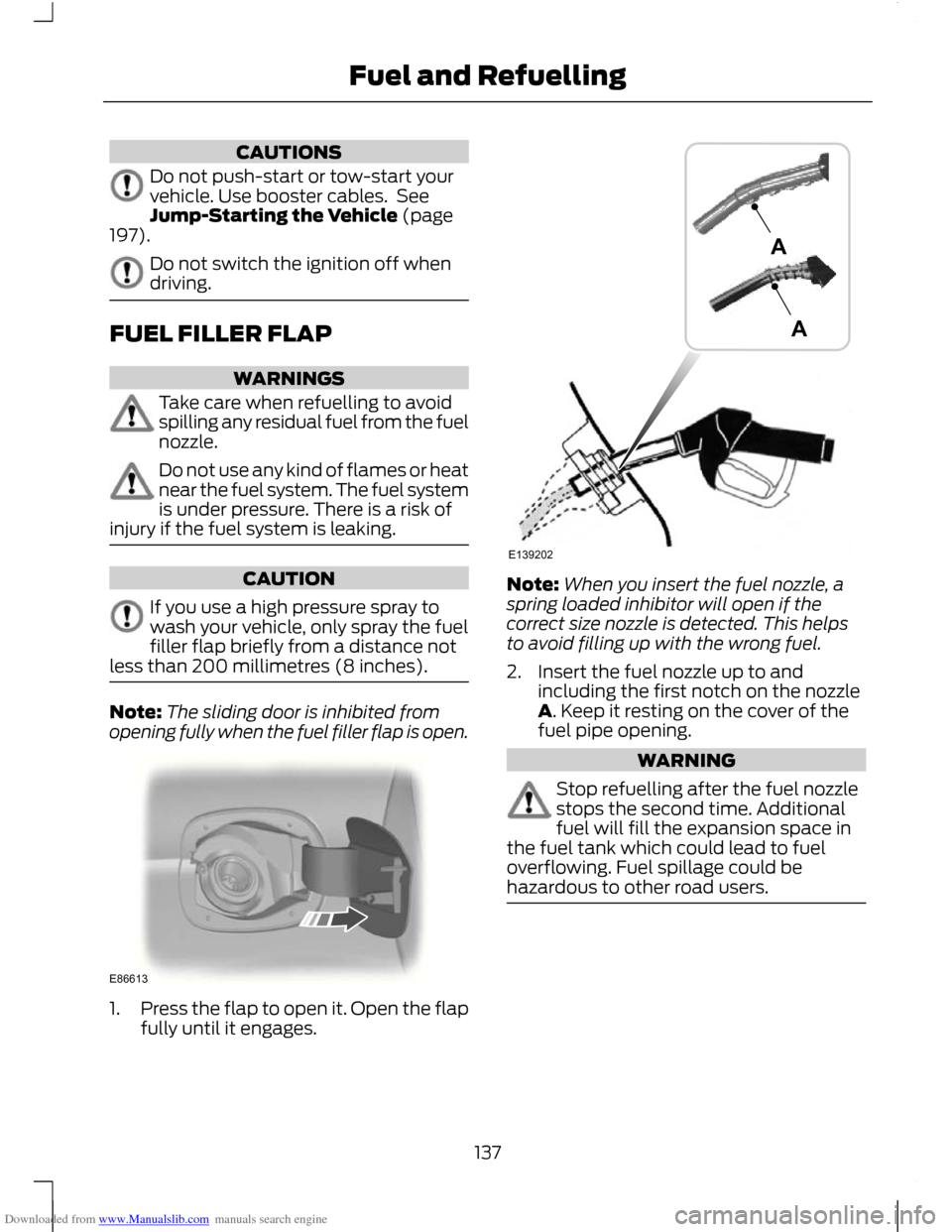
opening fully when the fuel filler flap is open. 1.
Press the flap to open it. Open the flap
fully until it engages. Note:
When you insert the fuel nozzle, a
spring loaded inhibitor will open if the
correct size nozzle is detected. This helps
to avoid filling up with the wrong fuel.
2. Insert the fuel nozzle up to and including the first notch on the nozzle
A. Keep it resting on the cover of the
fuel pipe opening. WARNING
Stop refuelling after the fuel nozzle
stops the second time. Additional
fuel will fill the expansion space in
the fuel tank which could lead to fuel
overflowing. Fuel spillage could be
hazardous to other road users. 137
Fuel and RefuellingE86613 E139202AA
Page 140 of 296
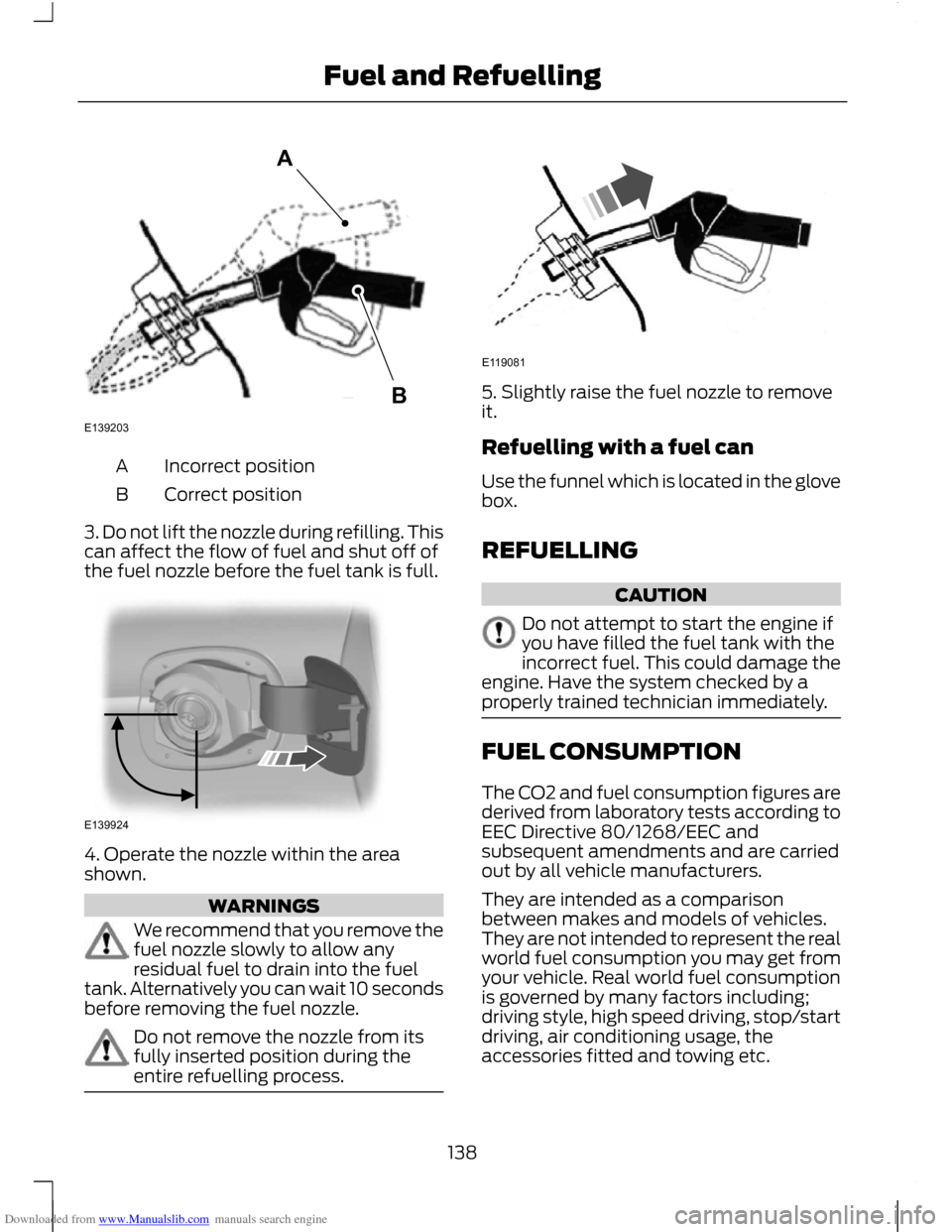
Downloaded from www.Manualslib.com manuals search engine Incorrect position
A
Correct position
B
3. Do not lift the nozzle during refilling. This
can affect the flow of fuel and shut off of
the fuel nozzle before the fuel tank is full. 4. Operate the nozzle within the area
shown.
WARNINGS
We recommend that you remove the
fuel nozzle slowly to allow any
residual fuel to drain into the fuel
tank. Alternatively you can wait 10 seconds
before removing the fuel nozzle. Do not remove the nozzle from its
fully inserted position during the
entire refuelling process. 5. Slightly raise the fuel nozzle to remove
it.
Refuelling with a fuel can
Use the funnel which is located in the glove
box.
REFUELLING
CAUTION
Do not attempt to start the engine if
you have filled the fuel tank with the
incorrect fuel. This could damage the
engine. Have the system checked by a
properly trained technician immediately. FUEL CONSUMPTION
The CO2 and fuel consumption figures are
derived from laboratory tests according to
EEC Directive 80/1268/EEC and
subsequent amendments and are carried
out by all vehicle manufacturers.
They are intended as a comparison
between makes and models of vehicles.
They are not intended to represent the real
world fuel consumption you may get from
your vehicle. Real world fuel consumption
is governed by many factors including;
driving style, high speed driving, stop/start
driving, air conditioning usage, the
accessories fitted and towing etc.
138
Fuel and RefuellingE139203AB E139924 E119081
Page 141 of 296
Downloaded from www.Manualslib.com manuals search engine Your Ford dealer can give you advice on
improving your fuel consumption.
TECHNICAL SPECIFICATIONS
C-MAX
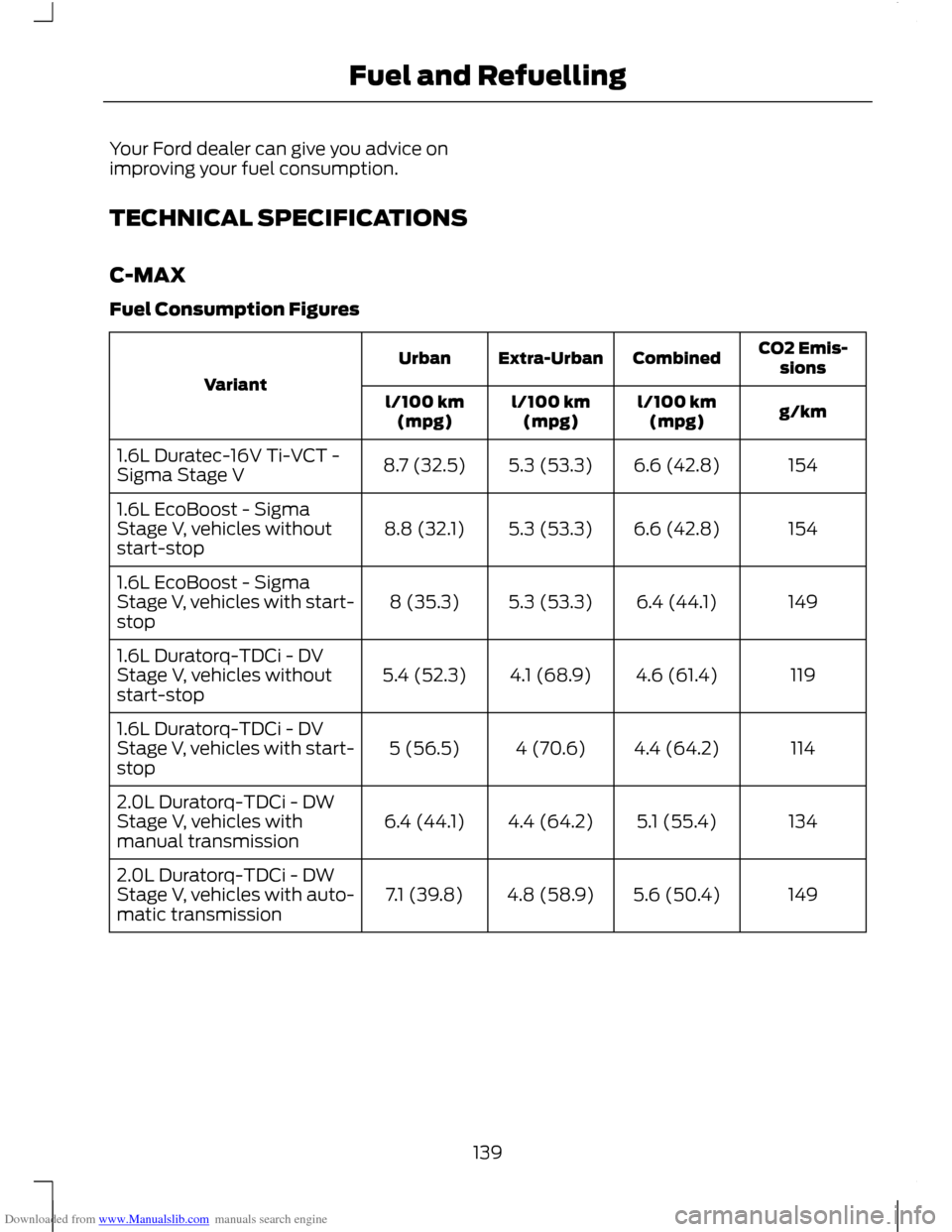
Fuel Consumption Figures
CO2 Emis-
sions
Combined
Extra-Urban
Urban
Variant g/km
l/100 km
(mpg)
l/100 km
(mpg)
l/100 km
(mpg)
154
6.6 (42.8)
5.3 (53.3)
8.7 (32.5)
1.6L Duratec-16V Ti-VCT -
Sigma Stage V
154
6.6 (42.8)
5.3 (53.3)
8.8 (32.1)
1.6L EcoBoost - Sigma
Stage V, vehicles without
start-stop
149
6.4 (44.1)
5.3 (53.3)
8 (35.3)
1.6L EcoBoost - Sigma
Stage V, vehicles with start-
stop
119
4.6 (61.4)
4.1 (68.9)
5.4 (52.3)
1.6L Duratorq-TDCi - DV
Stage V, vehicles without
start-stop
114
4.4 (64.2)
4 (70.6)
5 (56.5)
1.6L Duratorq-TDCi - DV
Stage V, vehicles with start-
stop
134
5.1 (55.4)
4.4 (64.2)
6.4 (44.1)
2.0L Duratorq-TDCi - DW
Stage V, vehicles with
manual transmission
149
5.6 (50.4)
4.8 (58.9)
7.1 (39.8)
2.0L Duratorq-TDCi - DW
Stage V, vehicles with auto-
matic transmission
139
Fuel and Refuelling
Page 142 of 296
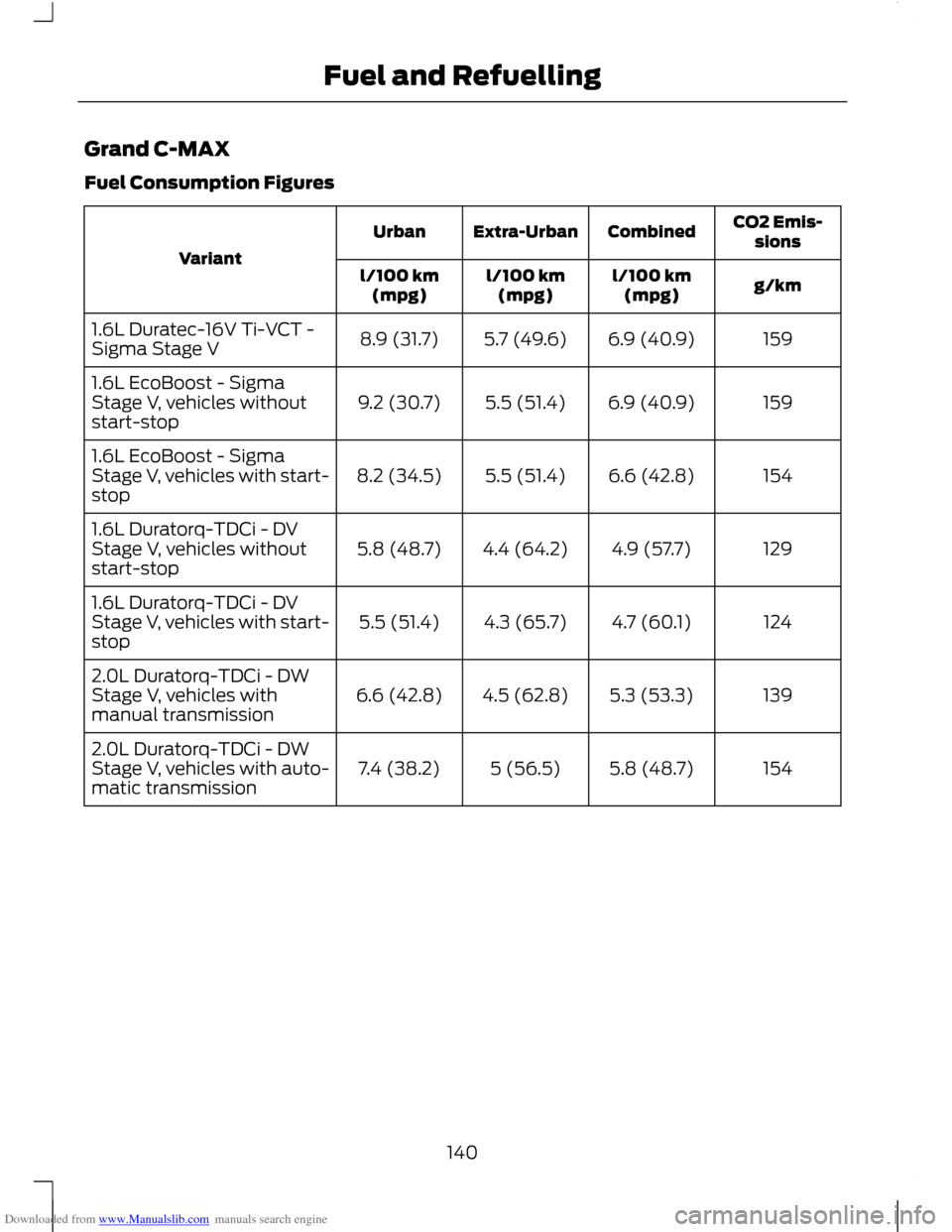
Downloaded from www.Manualslib.com manuals search engine Grand C-MAX
Fuel Consumption Figures
CO2 Emis-
sions
Combined
Extra-Urban
Urban
Variant g/km
l/100 km
(mpg)
l/100 km
(mpg)
l/100 km
(mpg)
159
6.9 (40.9)
5.7 (49.6)
8.9 (31.7)
1.6L Duratec-16V Ti-VCT -
Sigma Stage V
159
6.9 (40.9)
5.5 (51.4)
9.2 (30.7)
1.6L EcoBoost - Sigma
Stage V, vehicles without
start-stop
154
6.6 (42.8)
5.5 (51.4)
8.2 (34.5)
1.6L EcoBoost - Sigma
Stage V, vehicles with start-
stop
129
4.9 (57.7)
4.4 (64.2)
5.8 (48.7)
1.6L Duratorq-TDCi - DV
Stage V, vehicles without
start-stop
124
4.7 (60.1)
4.3 (65.7)
5.5 (51.4)
1.6L Duratorq-TDCi - DV
Stage V, vehicles with start-
stop
139
5.3 (53.3)
4.5 (62.8)
6.6 (42.8)
2.0L Duratorq-TDCi - DW
Stage V, vehicles with
manual transmission
154
5.8 (48.7)
5 (56.5)
7.4 (38.2)
2.0L Duratorq-TDCi - DW
Stage V, vehicles with auto-
matic transmission
140
Fuel and Refuelling
Page 167 of 296
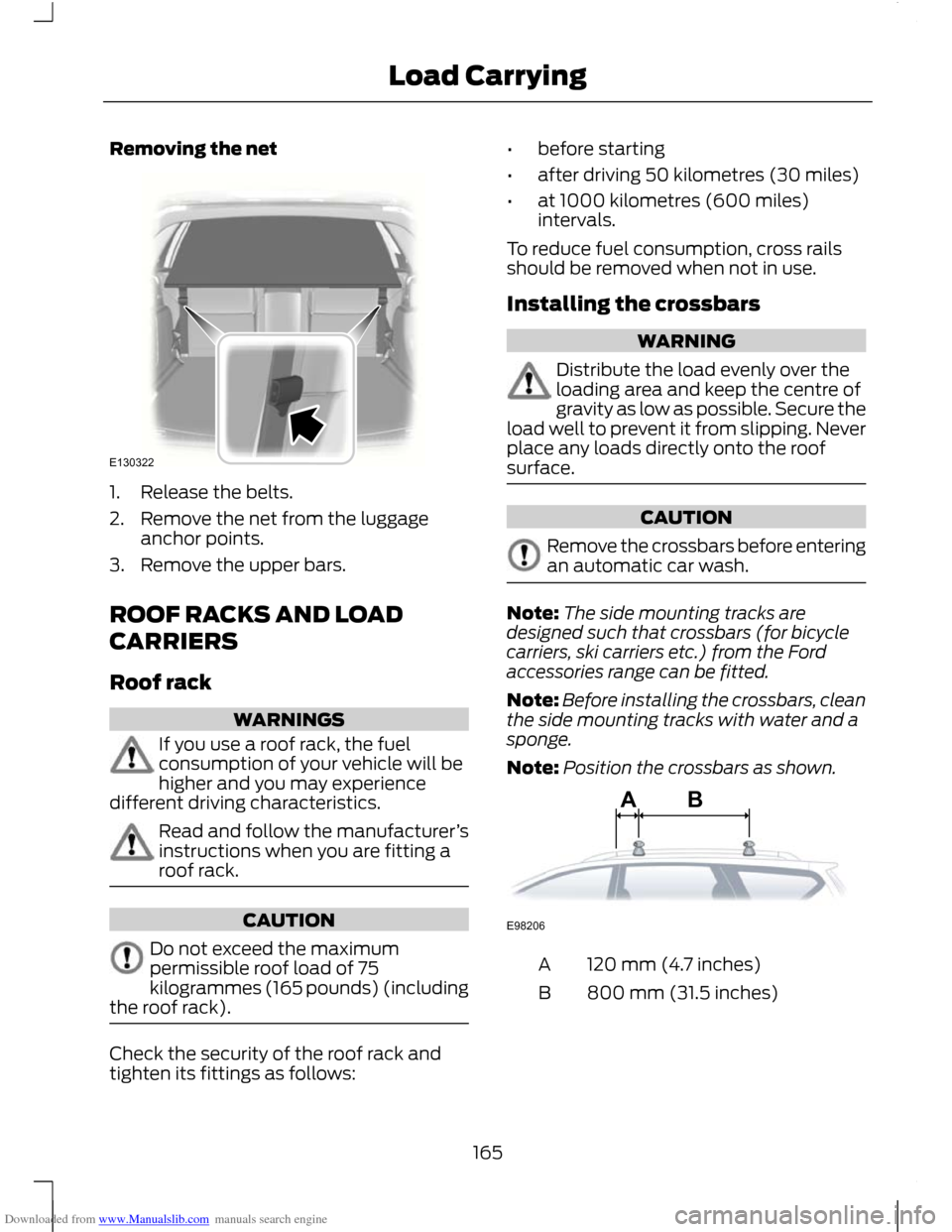
Downloaded from www.Manualslib.com manuals search engine Removing the net
1. Release the belts.
2. Remove the net from the luggage
anchor points.
3. Remove the upper bars.
ROOF RACKS AND LOAD
CARRIERS
Roof rack WARNINGS
If you use a roof rack, the fuel
consumption of your vehicle will be
higher and you may experience
different driving characteristics. Read and follow the manufacturer
’s
instructions when you are fitting a
roof rack. CAUTION
Do not exceed the maximum
permissible roof load of 75
kilogrammes (165 pounds) (including
the roof rack). Check the security of the roof rack and
tighten its fittings as follows: •
before starting
• after driving 50 kilometres (30 miles)
• at 1000 kilometres (600 miles)
intervals.
To reduce fuel consumption, cross rails
should be removed when not in use.
Installing the crossbars WARNING
Distribute the load evenly over the
loading area and keep the centre of
gravity as low as possible. Secure the
load well to prevent it from slipping. Never
place any loads directly onto the roof
surface. CAUTION
Remove the crossbars before entering
an automatic car wash.
Note:
The side mounting tracks are
designed such that crossbars (for bicycle
carriers, ski carriers etc.) from the Ford
accessories range can be fitted.
Note: Before installing the crossbars, clean
the side mounting tracks with water and a
sponge.
Note: Position the crossbars as shown. 120 mm (4.7 inches)
A
800 mm (31.5 inches)
B
165
Load CarryingE130322 ABE98206
Page 178 of 296
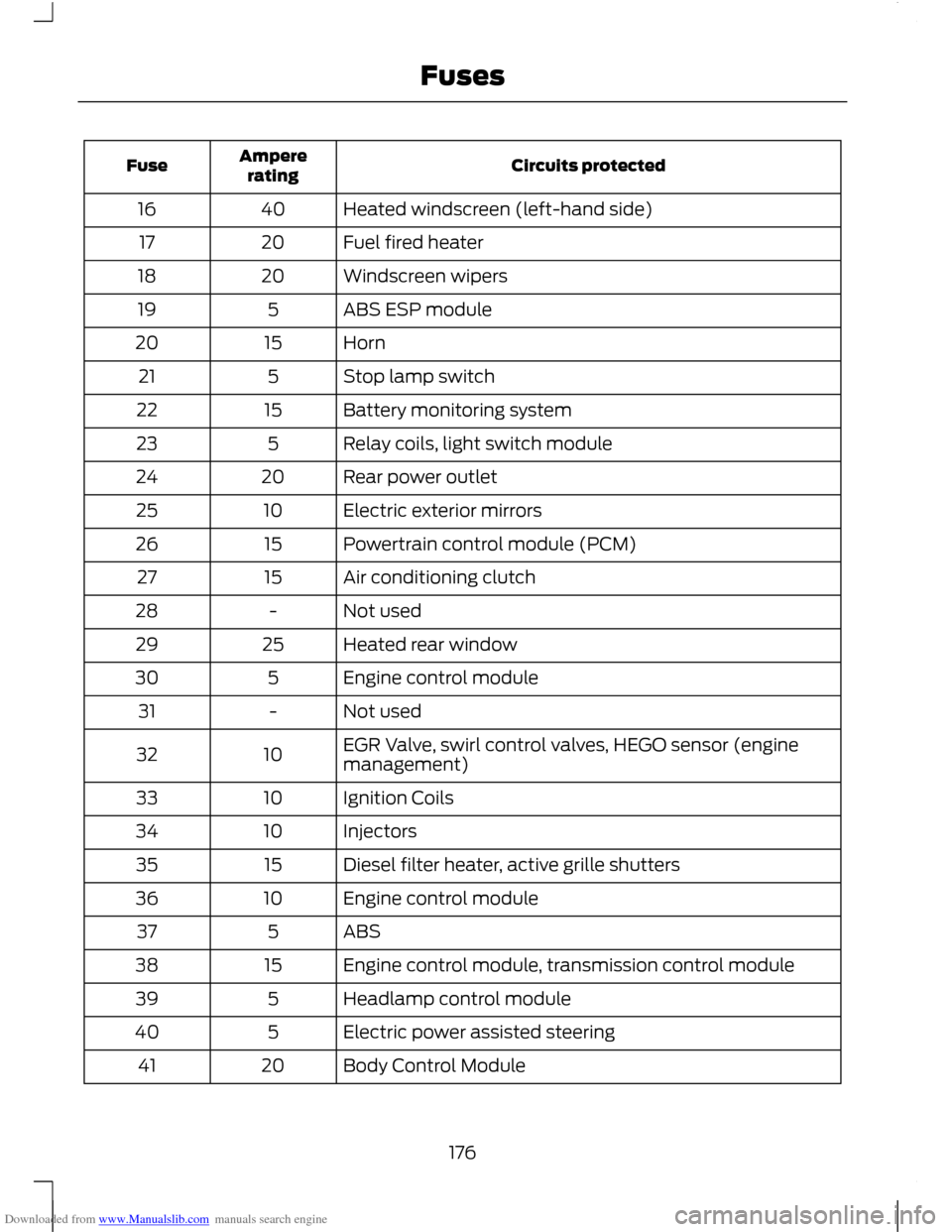
Downloaded from www.Manualslib.com manuals search engine Circuits protected
Ampere
rating
Fuse
Heated windscreen (left-hand side)
40
16
Fuel fired heater
20
17
Windscreen wipers
20
18
ABS ESP module
5
19
Horn
15
20
Stop lamp switch
5
21
Battery monitoring system
15
22
Relay coils, light switch module
5
23
Rear power outlet
20
24
Electric exterior mirrors
10
25
Powertrain control module (PCM)
15
26
Air conditioning clutch
15
27
Not used
-
28
Heated rear window
25
29
Engine control module
5
30
Not used
-
31
EGR Valve, swirl control valves, HEGO sensor (engine
management)
10
32
Ignition Coils
10
33
Injectors
10
34
Diesel filter heater, active grille shutters
15
35
Engine control module
10
36
ABS
5
37
Engine control module, transmission control module
15
38
Headlamp control module
5
39
Electric power assisted steering
5
40
Body Control Module
20
41
176
Fuses
Page 180 of 296
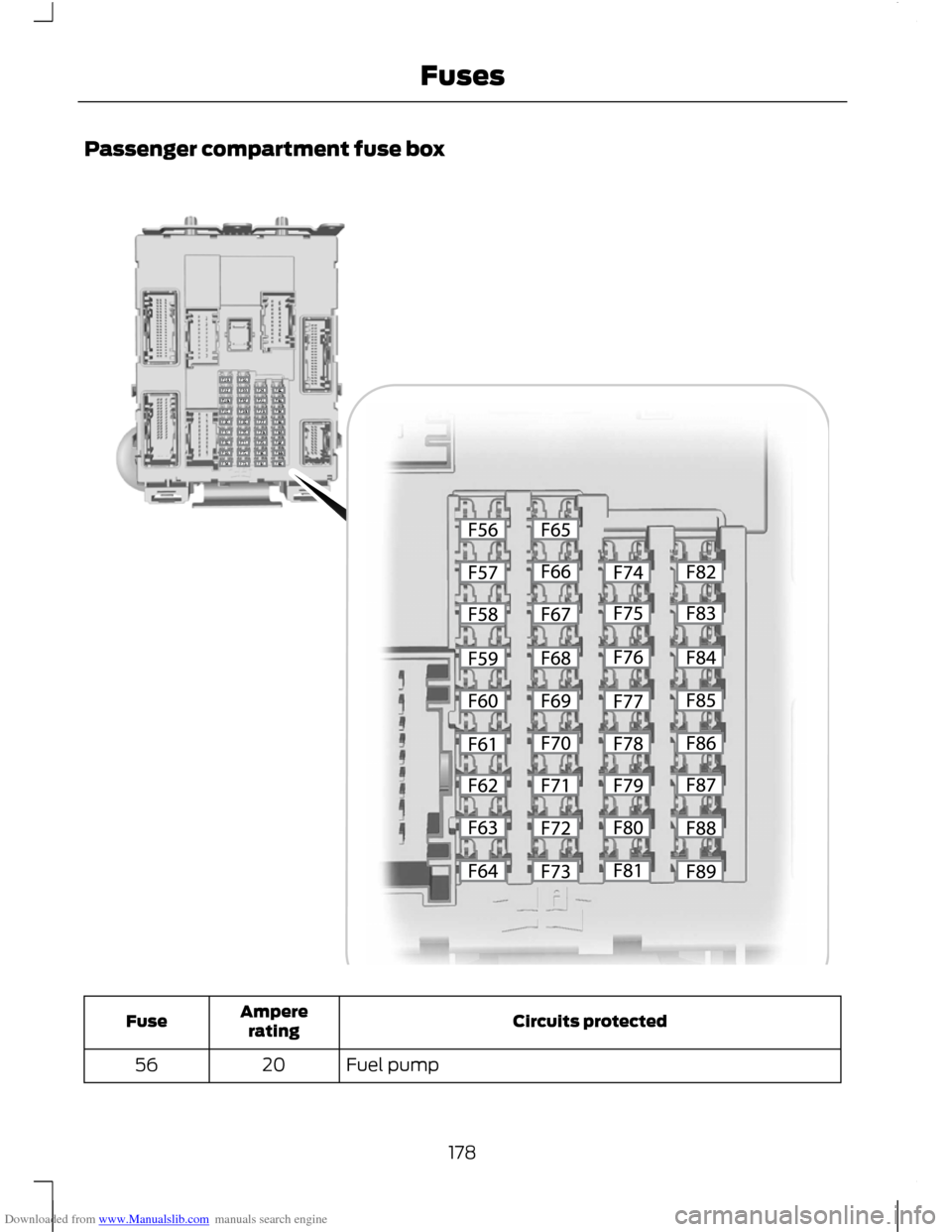
Downloaded from www.Manualslib.com manuals search engine Passenger compartment fuse box
Circuits protected
Ampere
rating
Fuse
Fuel pump
20
56
178
FusesE129926
Page 187 of 296
Downloaded from www.Manualslib.com manuals search engine GENERAL INFORMATION
Have your vehicle serviced regularly to help
maintain its roadworthiness and resale
value. There is a large network of Ford
Authorised Repairers that are there to help
you with their professional servicing
expertise. We believe that their specially
trained technicians are best qualified to
service your vehicle properly and expertly.
They are supported by a wide range of
highly specialised tools developed
specifically for servicing your vehicle.
In addition to regular servicing, we
recommend that you carry out the
following additional checks.
WARNINGS
Switch the ignition off before
touching or attempting adjustment
of any kind.
Do not touch the electronic ignition
system parts after you have switched
the ignition on or when the engine is
running. The system operates at high
voltage. Keep your hands and clothing clear
of the engine cooling fan. Under
certain conditions, the fan may
continue to run for several minutes after
you have switched the engine off. CAUTION
When carrying out maintenance
checks, make sure that filler caps are
fitted securely.
Daily checks
•
Exterior lamps.
• Interior lamps.
• Warning lamps and indicators. Check when refuelling
•
Engine oil level. See Engine Oil Check
(page 190).
• Brake fluid level. See Brake and
Clutch Fluid Check (page 191).
• Washer fluid level. See Washer Fluid
Check (page 192).
• Tyre pressures (when cold). See
Technical Specifications (page 209).
• Tyre condition. See Wheels and Tyres
(page 199).
Monthly checks
• Engine coolant level (engine cold). See
Engine Coolant Check (page 191).
• Pipes, hoses and reservoirs for leaks.
• Air conditioning operation.
• Parking brake operation.
• Horn operation.
• Tightness of wheel nuts. See
Technical Specifications (page 209).
OPENING AND CLOSING THE
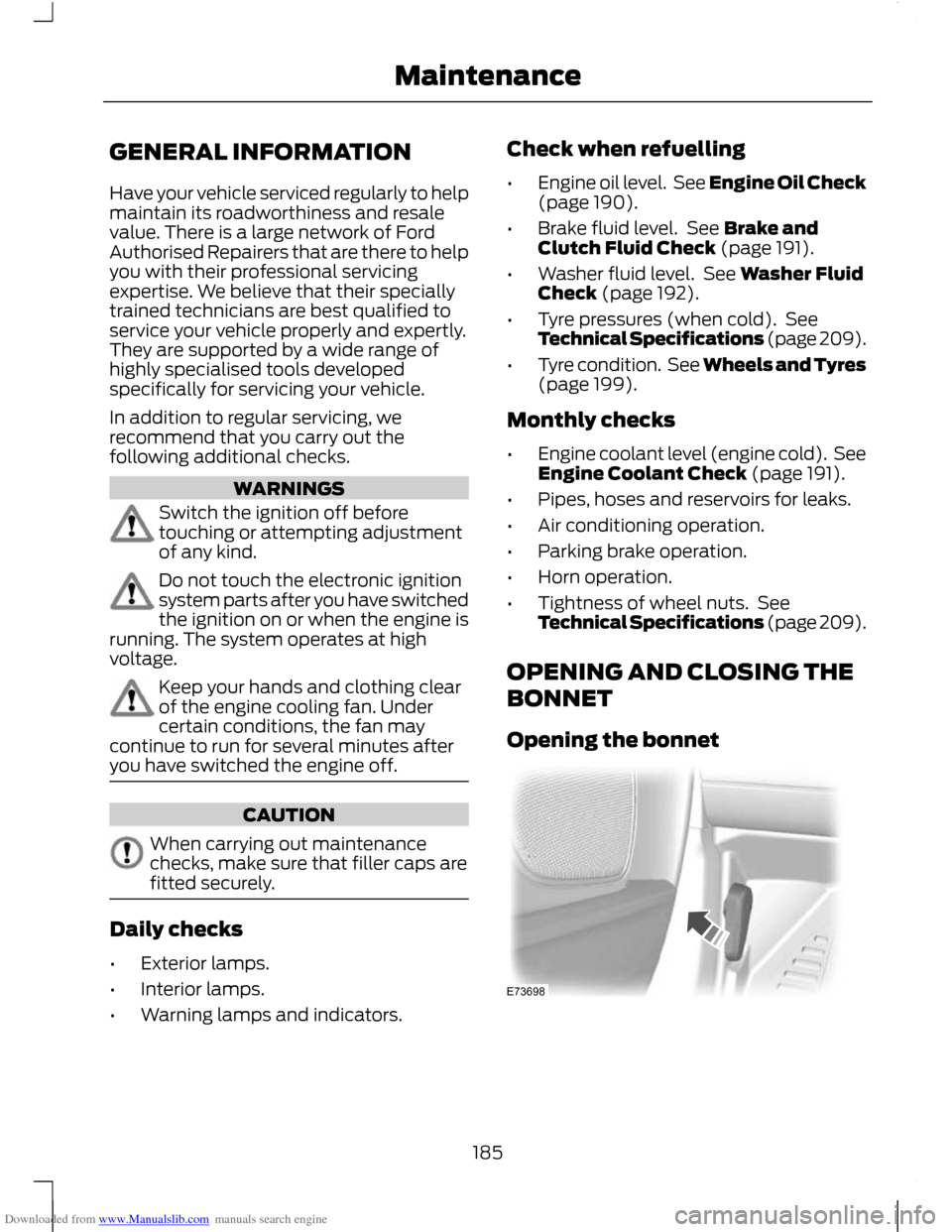
BONNET
Opening the bonnet 185
MaintenanceE73698
Page 194 of 296
Downloaded from www.Manualslib.com manuals search engine Top up with fluid that meets the Ford
specification. See Technical
Specifications (page 192).
WASHER FLUID CHECK
Note:
The front and rear washer systems
are supplied from the same reservoir. When topping up, use a mixture of washer
fluid and water to help prevent freezing in
cold weather and improve the cleaning
capability. We recommend that you use
only high quality washer fluid.
For information on fluid dilution, refer to
the product instructions.
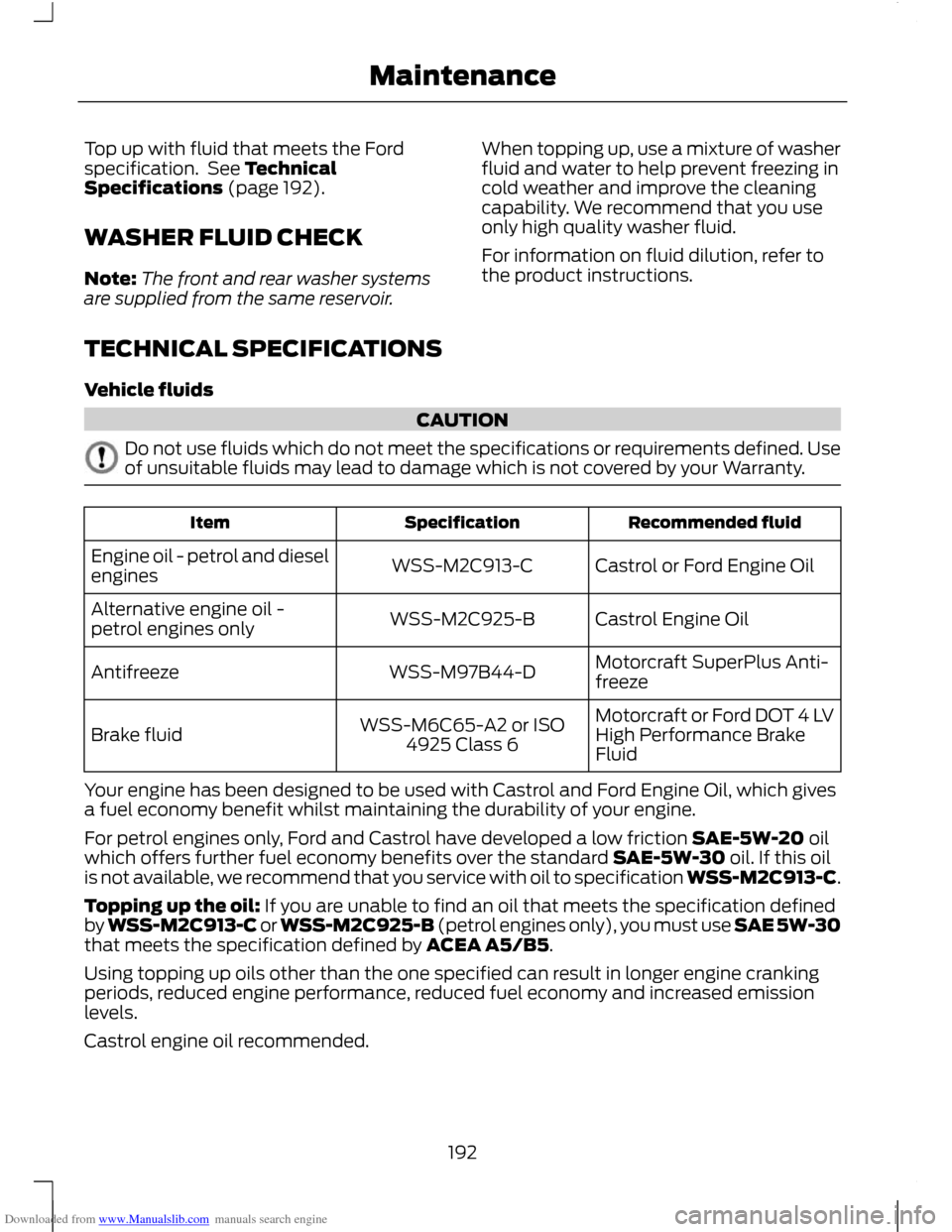
TECHNICAL SPECIFICATIONS
Vehicle fluids CAUTION
Do not use fluids which do not meet the specifications or requirements defined. Use
of unsuitable fluids may lead to damage which is not covered by your Warranty.
Recommended fluid
Specification
Item
Castrol or Ford Engine Oil
WSS-M2C913-C
Engine oil - petrol and diesel
engines
Castrol Engine Oil
WSS-M2C925-B
Alternative engine oil -
petrol engines only
Motorcraft SuperPlus Anti-
freeze
WSS-M97B44-D
Antifreeze
Motorcraft or Ford DOT 4 LV
High Performance Brake
Fluid
WSS-M6C65-A2 or ISO
4925 Class 6
Brake fluid
Your engine has been designed to be used with Castrol and Ford Engine Oil, which gives
a fuel economy benefit whilst maintaining the durability of your engine.
For petrol engines only, Ford and Castrol have developed a low friction SAE-5W-20 oil
which offers further fuel economy benefits over the standard SAE-5W-30 oil. If this oil
is not available, we recommend that you service with oil to specification WSS-M2C913-C.
Topping up the oil: If you are unable to find an oil that meets the specification defined
by WSS-M2C913-C or WSS-M2C925-B (petrol engines only), you must use SAE 5W-30
that meets the specification defined by ACEA A5/B5.
Using topping up oils other than the one specified can result in longer engine cranking
periods, reduced engine performance, reduced fuel economy and increased emission
levels.
Castrol engine oil recommended.
192
Maintenance