battery FORD C MAX 2013 Workshop Manual
[x] Cancel search | Manufacturer: FORD, Model Year: 2013, Model line: C MAX, Model: FORD C MAX 2013Pages: 552, PDF Size: 8.55 MB
Page 214 of 552
AUTOMATIC TRANSMISSION
WARNING:Always set the parking brake fully and make sure
the gearshift is latched inP(Park). Turn the ignition to the off
position and remove the key whenever you leave your vehicle
WARNING:When parking, do not use the gearshift in place of
the parking brake. Always set the parking brake fully and make
sure that the gearshift is securely latched inP(Park). Turn off the
ignition whenever you leave your vehicle. Never leave your vehicle
unattended while it is running. If you do not take these precautions,
your vehicle may move unexpectedly and injure someone.
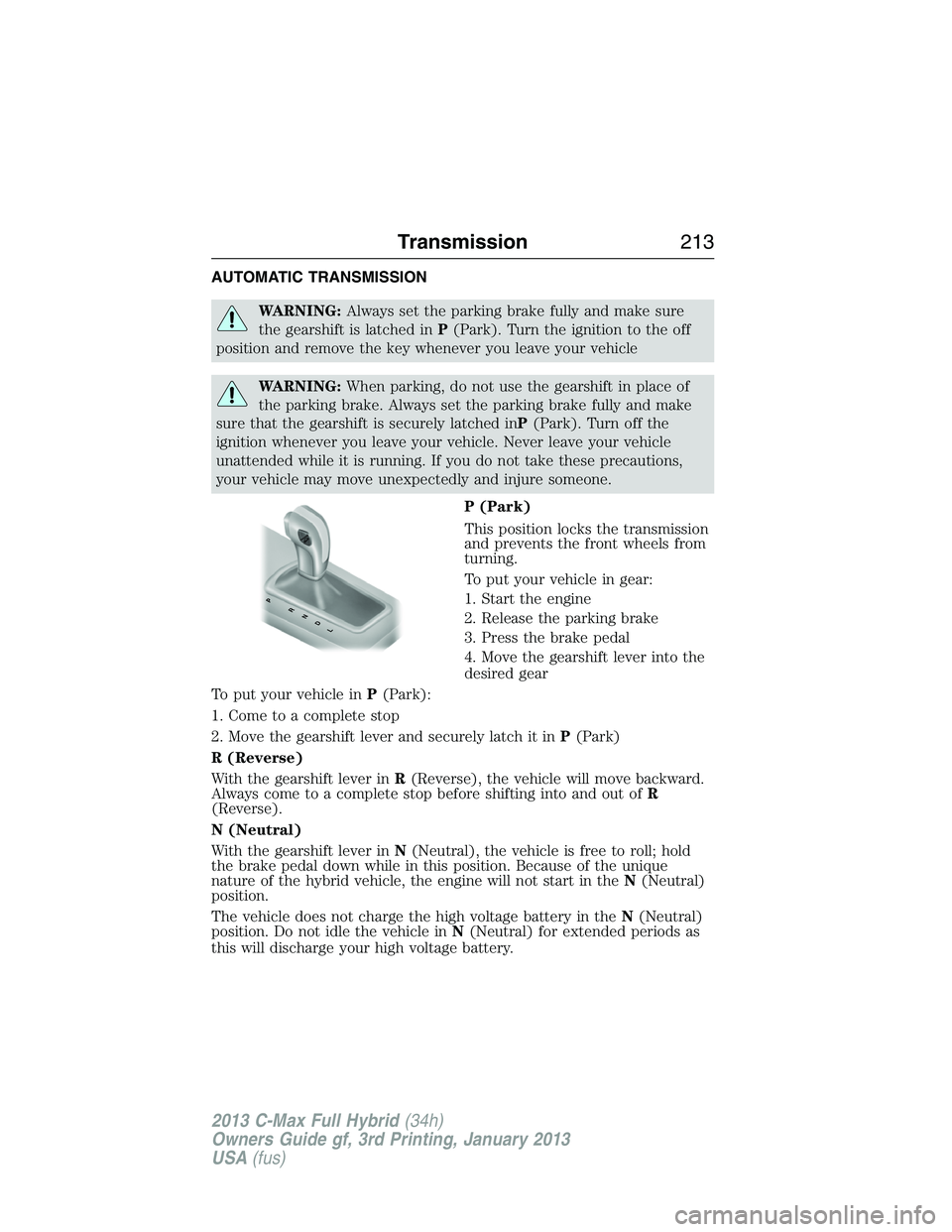
P (Park)
This position locks the transmission
and prevents the front wheels from
turning.
To put your vehicle in gear:
1. Start the engine
2. Release the parking brake
3. Press the brake pedal
4. Move the gearshift lever into the
desired gear
To put your vehicle inP(Park):
1. Come to a complete stop
2. Move the gearshift lever and securely latch it inP(Park)
R (Reverse)
With the gearshift lever inR(Reverse), the vehicle will move backward.
Always come to a complete stop before shifting into and out ofR
(Reverse).
N (Neutral)
With the gearshift lever inN(Neutral), the vehicle is free to roll; hold
the brake pedal down while in this position. Because of the unique
nature of the hybrid vehicle, the engine will not start in theN(Neutral)
position.
The vehicle does not charge the high voltage battery in theN(Neutral)
position. Do not idle the vehicle inN(Neutral) for extended periods as
this will discharge your high voltage battery.
PRNDL
Transmission213
2013 C-Max Full Hybrid(34h)
Owners Guide gf, 3rd Printing, January 2013
USA(fus)
Page 215 of 552
D (Drive)
The normal driving position for the best fuel economy.
D (Drive) with Grade Assist
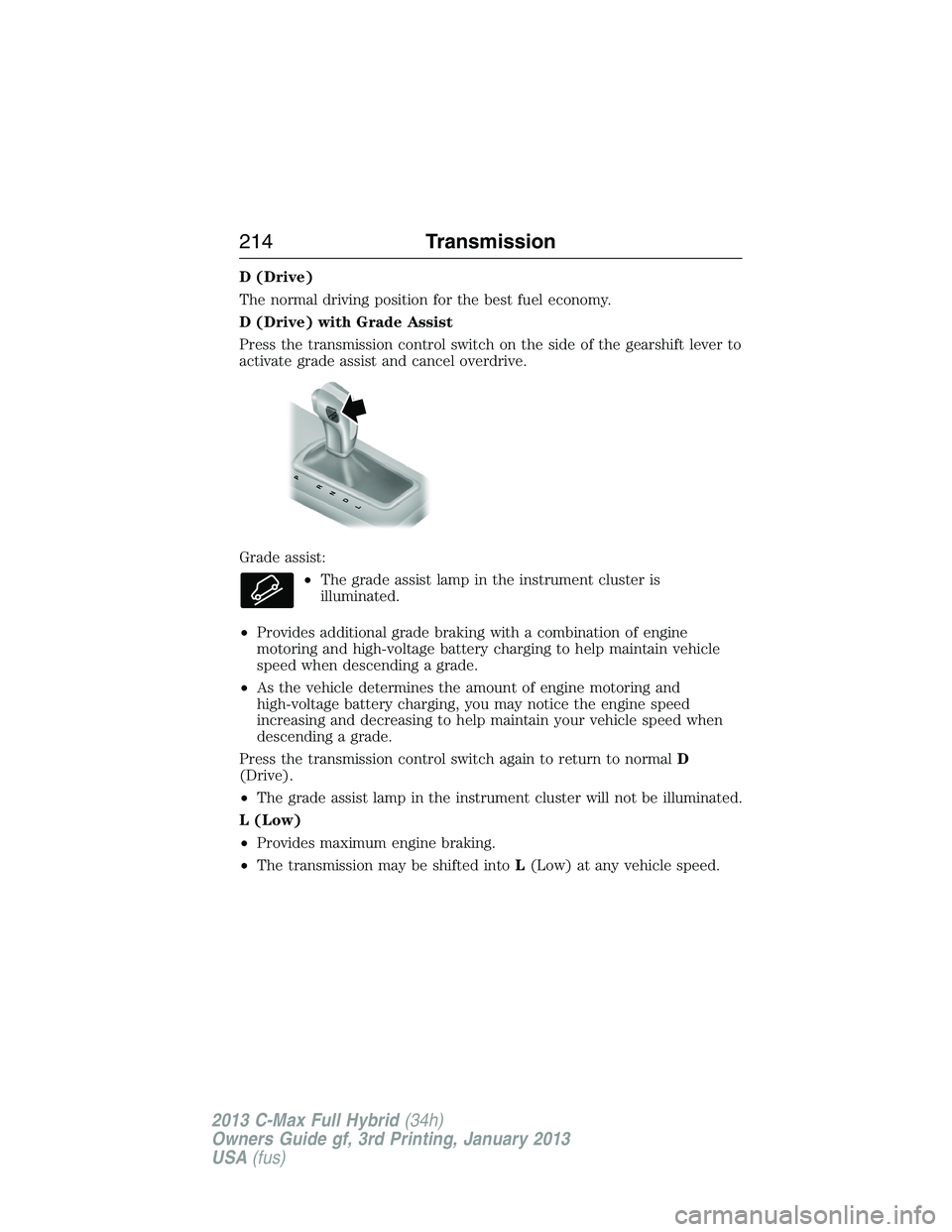
Press the transmission control switch on the side of the gearshift lever to
activate grade assist and cancel overdrive.
Grade assist:
•The grade assist lamp in the instrument cluster is
illuminated.
•Provides additional grade braking with a combination of engine
motoring and high-voltage battery charging to help maintain vehicle
speed when descending a grade.
•As the vehicle determines the amount of engine motoring and
high-voltage battery charging, you may notice the engine speed
increasing and decreasing to help maintain your vehicle speed when
descending a grade.
Press the transmission control switch again to return to normalD
(Drive).
•The grade assist lamp in the instrument cluster will not be illuminated.
L (Low)
•Provides maximum engine braking.
•The transmission may be shifted intoL(Low) at any vehicle speed.
PRNDL
214Transmission
2013 C-Max Full Hybrid(34h)
Owners Guide gf, 3rd Printing, January 2013
USA(fus)
Page 220 of 552
Regenerative Braking System
This feature is used to simulate the engine braking of an internal
combustion engine and assist the standard brake system while recovering
some of the energy of motion and storing it in the battery to improve fuel
economy. The standard brake system is designed to fully stop the car if
regenerative braking is not available. During regenerative braking, the
motor is spun as a generator to create electrical current. This recharges
the battery and slows the vehicle. In effect, once the accelerator pedal is
released, the motor changes from an energy user to an energy producer.
When the accelerator pedal is released or the brake pedal is applied,
the brake controller automatically detects the amount of deceleration
requested and optimizes how much of the deceleration will be produced
by regenerative braking. The remaining portion is generated by standard
friction braking. When the battery is almost fully charged, the amount of
regenerative braking is limited to avoid overcharging, and the requested
deceleration is produced by standard friction braking alone.
Regenerative braking does not take the place of the standard friction
brakes; it only assists them. Regenerative braking has also been designed
to interact with the anti-lock brake system. Regenerative braking is
disabled when the anti-lock brake system is activated or the battery is
fully charged.
HINTS ON DRIVING WITH ANTI-LOCK BRAKES
When the system is operating, the brake pedal will pulse and may travel
further. Maintain pressure on the brake pedal. You may also hear a noise
from the system. This is normal.
The anti-lock braking system will not eliminate the dangers inherent when:
•you drive too closely to the vehicle in front of you.
•your vehicle is hydroplaning.
•you take corners too fast.
•the road surface is poor.
Brakes219
2013 C-Max Full Hybrid(34h)
Owners Guide gf, 3rd Printing, January 2013
USA(fus)
Page 255 of 552
In the event of damage or fire involving an electric vehicle (EV) or
hybrid-electric vehicle (HEV):
•Always assume the high-voltage battery and associated components
are energized and fully charged.
•Exposed electrical components, wires, and high-voltage batteries
present potential high-voltage shock hazards.
•Venting/off-gassing high-voltage battery vapors are potentially toxic
and flammable.
•Physical damage to the vehicle or high-voltage battery may result in
immediate or delayed release of toxic and/or flammable gases and fire.
Vehicle information and general safety practices:
•Know the make and model of your vehicle.
•Review the Owner’s Manual and become familiar with your vehicle’s
safety information and recommended safety practices.
•Do not attempt to repair damaged electric and hybrid-electric vehicles
yourself. Contact an authorized Ford Dealer or vehicle manufacturer
representative for service.
Crashes
A crash or impact significant enough to require an emergency response
for conventional vehicles would also require the same response for an
electric or hybrid-electric vehicle.
If possible
•Move your car to a safe, nearby location and remain on the scene.
•Roll down windows before shutting vehicle off.
•Place vehicle in Park, set parking brake, turn off the vehicle, activate
hazard lights, and move key(s) at least 16 feet (5 meters) away from
the vehicle.
254Roadside Emergencies
2013 C-Max Full Hybrid(34h)
Owners Guide gf, 3rd Printing, January 2013
USA(fus)
Page 256 of 552
Always
•Call 911 if assistance is needed and advise that an electric or
hybrid-electric vehicle is involved.
•Do not touch exposed electrical components or the engine
compartment, as a shock hazard may exist.
•Avoid contact with leaking fluids and gases, and remain out of the way
of oncoming traffic until emergency responders arrive.
•When emergency responders arrive, tell them that the vehicle involved
is an electric vehicle or hybrid-electric vehicle.
Fires
As with any vehicle, call 911 immediately if you see sparks, smoke, or
flames coming from the vehicle.
•Exit the vehicle immediately.
•Advise 911 that an electric or hybrid-electric vehicle is involved.
•As with any vehicle fire, do not inhale smoke, vapors, or gas from the
vehicle, as they may be hazardous.
•Remain a safe distance upwind and uphill from the vehicle fire.
•Stay out of the roadway and stay out of the way of any oncoming
traffic while awaiting the arrival of emergency responders.
Post-Incident
•Do not store a severely damaged vehicle with a lithium-ion battery
inside a structure or within 50 feet (15 meters) of any structure or
vehicle.
•Ensure that passenger and cargo compartments remain ventilated
(i.e., open door, trunk or liftgate).
•
For vehicles in the United States, notify Ford Motor Company
1-800-392-3673 (then follow the prompts on the voice response menu),
an authorized Ford dealer or service center as soon as possible as there
may be other steps to secure and/or discharge the HV battery.
•For vehicles in Canada, notify Ford Motor Company 1-800-565-3673
(then follow the prompts on the voice response menu), an authorized
Ford dealer or service center as soon as possible as there may be
other steps to secure and/or discharge the HV battery.
•Call 911 if you observe leaking fluids, sparks, smoke, or flames, or
hear gurgling or bubbling from the HV battery.
Roadside Emergencies255
2013 C-Max Full Hybrid(34h)
Owners Guide gf, 3rd Printing, January 2013
USA(fus)
Page 257 of 552
ROADSIDE ASSISTANCE
Vehicles Sold in the U.S.: Getting Roadside Assistance
To fully assist you should you have a vehicle concern, Ford Motor
Company offers a complimentary roadside assistance program.
This program is separate from the New Vehicle Limited Warranty.
The service is available:
•24 hours a day, seven days a week
•for the coverage period listed on the Roadside Assistance Card
included in your owner’s manual portfolio.
Roadside assistance will cover:
•a flat tire change with a good spare (except vehicles that have been
supplied with a tire inflation kit).
•battery jump start.
•lock-out assistance (key replacement cost is the customer’s
responsibility).
•fuel delivery – Independent Service Contractors, if not prohibited by
state, local or municipal law, shall deliver up to 2.0 gallons (7.5 liters)
of gasoline or 5.0 gallons (18.9 liters) of diesel fuel to a disabled
vehicle. Fuel delivery service is limited to two no-charge occurrences
within a 12-month period.
•winch out – available within 100 feet (30.5 meters) of a paved or
county maintained road, no recoveries.
•towing – Ford and Lincoln eligible vehicles towed to an authorized
dealer within 35 miles (56 kilometers) of the disablement location or
to the nearest authorized dealer. If a member requests to be towed to
an authorized dealer more than 35 miles (56 kilometers) from the
disablement location, the member shall be responsible for any mileage
costs in excess of 35 miles (56 kilometers).
Trailers shall be covered up to $200 if the disabled eligible vehicle
requires service at the nearest authorized dealer. If the trailer is disabled,
but the towing vehicle is operational, the trailer does not qualify for any
roadside services.
256Roadside Emergencies
2013 C-Max Full Hybrid(34h)
Owners Guide gf, 3rd Printing, January 2013
USA(fus)
Page 258 of 552
Vehicles Sold in the U.S.: Using Roadside Assistance
Complete the roadside assistance identification card and place it in your
wallet for quick reference. This card is found in the owner’s manual
portfolio in the glove compartment.
U.S. Ford vehicle customers who require Roadside Assistance, call
1-800-241-3673.
If you need to arrange roadside assistance for yourself, Ford Motor
Company will reimburse a reasonable amount for towing to the nearest
dealership within 35 miles (56 kilometers). To obtain reimbursement
information, U.S. Ford vehicle customers call 1-800-241-3673. Customers
will be asked to submit their original receipts.
Vehicles Sold in Canada: Getting Roadside Assistance
Canadian customers who require roadside assistance, call
1–800–665–2006.
Vehicles Sold in Canada: Using Roadside Assistance
Complete the roadside assistance identification card and place it in your
wallet for quick reference. In Canada, the card is found in the warranty
information in the glove box.
Canadian roadside coverage and benefits may differ from the U.S.
coverage. Please see your warranty information or visit our website at
www.ford.ca for information on Canadian services and benefits.
Canadian customers who need to obtain roadside information, call
1-800-665-2006 or visit our website at www.ford.ca.
HAZARD WARNING FLASHERS
The hazard flasher control is located on the instrument panel
by the radio. Use it when your vehicle is disabled and is
creating a safety hazard for other motorists.
•Press the flasher control and all front and rear direction signals will
flash.
•Press the flasher control again to turn them off.
Note:With extended use, the flashers may run down your 12–volt
battery.
Roadside Emergencies257
2013 C-Max Full Hybrid(34h)
Owners Guide gf, 3rd Printing, January 2013
USA(fus)
Page 259 of 552
FUEL CUT-OFF SWITCH
WARNING:Failure to inspect and if necessary repair fuel leaks
after a collision may increase the risk of fire and serious injury.
Ford Motor Company recommends that the fuel system be inspected by
an authorized dealer after any collision.
In the event of a moderate to severe collision, this vehicle is equipped
with a fuel pump shut-off feature that stops the flow of fuel to the
engine. Not every impact will cause a shutoff.
1. Turn the ignition off.
2. Turn the ignition to crank.
3. Turn the ignition to crank.
4. Turn the ignition on again to re-enable the fuel pump.
For vehicles equipped with a push button start system:
1. Press the START/STOP button to power the vehicle off.
2. Press the START/STOP button to power the vehicle on.
3. Repeat steps 1 and 2 to re-enable fuel pump.
HIGH VOLTAGE SHUT OFF
In the event of a crash:
•Take the same actions as you would take in a crash involving a
gasoline-powered vehicle — exit the vehicle safely or await the
assistance of an emergency responder if they are unable to get out on
their own, move a safe distance away from the vehicle, and notify the
authorities of the crash.
•If possible, inform emergency responders that the vehicle is electric
powered.
•Vehicle owners should not store a severely damaged vehicle in a
garage or near other vehicles.
The high voltage shut off operation shuts off power from the high voltage
battery after a collision, or if your vehicle receives a substantial physical jolt.
258Roadside Emergencies
2013 C-Max Full Hybrid(34h)
Owners Guide gf, 3rd Printing, January 2013
USA(fus)
Page 260 of 552
To reactivate the vehicle after either event perform the following steps:
1. Press the START/STOP button to power the vehicle on.
2. Press the START/STOP button to power the vehicle off.
3. Press the START/STOP button to power the vehicle on again.
Note:After completing this process the vehicle will detect if the
electrical system is safe and reactivate. Once your vehicle determines the
electrical system safe you can start your vehicle as you would normally
by pressing the brake in combination with the START/STOP button.
JUMP STARTING THE VEHICLE
WARNING:Batteries contain sulfuric acid which can burn skin,
eyes and clothing, if contacted.
Note:Use only a 12 volt supply to start your vehicle.
Note:The high-voltage battery cannot be jumped with a standard
12 volt battery.
Note:Do not disconnect the battery of the disabled vehicle as this could
damage the vehicle’s electrical system. The 12 volt battery controls the
switches and contacts that engage the high-voltage battery.
Preparing your vehicle
1. Park the booster vehicle close to the hood of the disabled vehicle
making sure the two vehicles do not touch. Set the parking brake on
both vehicles. Stay clear of any moving parts on both vehicles that can
cause harm.
2. Check all battery terminals and remove any excessive corrosion before
you attach the battery cables. Ensure that vent caps are tight and level.
3. Turn the heater fan on in both vehicles to protect from any electrical
surges. Turn all other accessories off.
Roadside Emergencies259
2013 C-Max Full Hybrid(34h)
Owners Guide gf, 3rd Printing, January 2013
USA(fus)
Page 261 of 552
Connecting the Jumper Cables
WARNING:Do not connect the end of the second cable to the
negative (-) terminal of the battery to be jumped. A spark may
cause an explosion of the gases that surround the battery or a surge of
the battery.
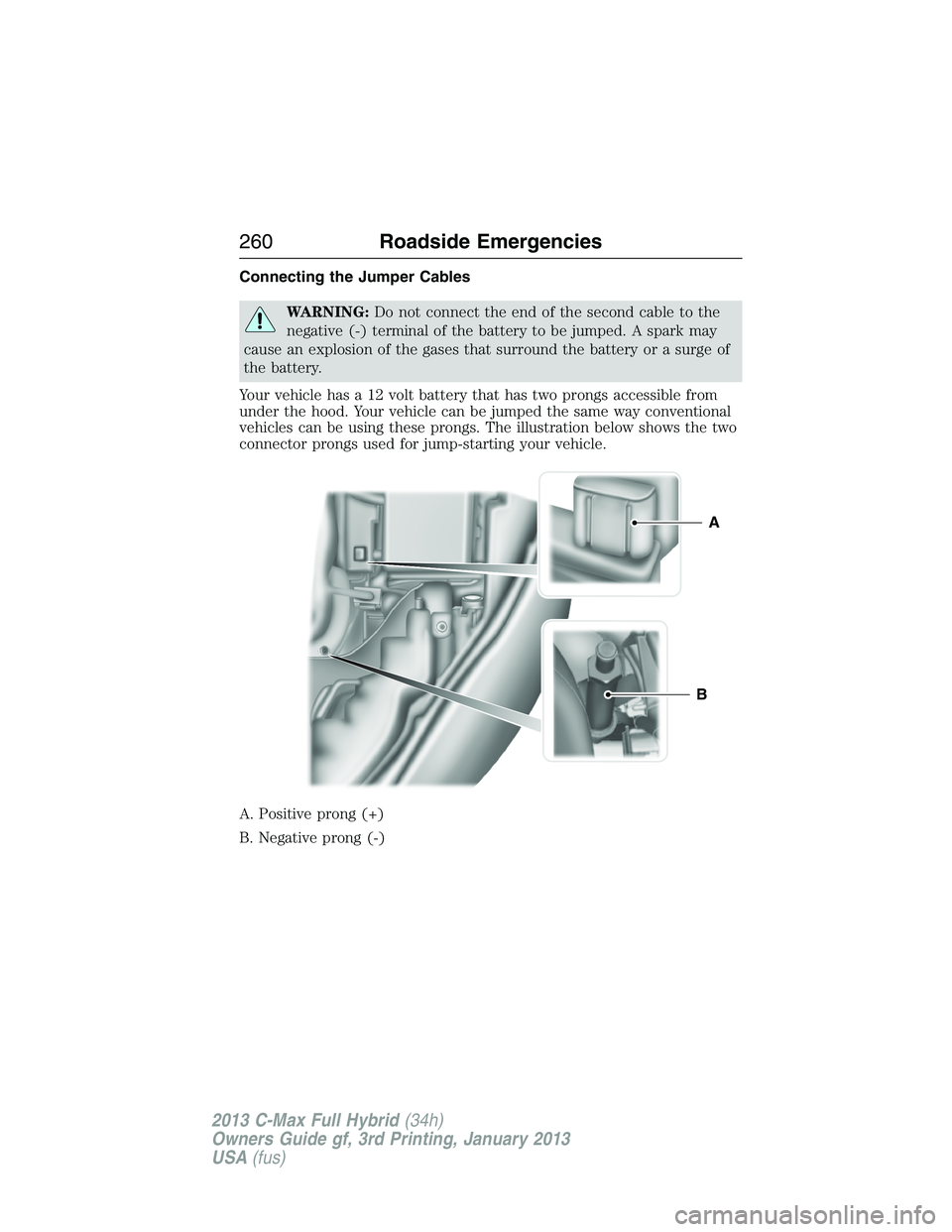
Your vehicle has a 12 volt battery that has two prongs accessible from
under the hood. Your vehicle can be jumped the same way conventional
vehicles can be using these prongs. The illustration below shows the two
connector prongs used for jump-starting your vehicle.
A. Positive prong (+)
B. Negative prong (-)
B
A
260Roadside Emergencies
2013 C-Max Full Hybrid(34h)
Owners Guide gf, 3rd Printing, January 2013
USA(fus)