brake FORD C MAX 2015 Service Manual
[x] Cancel search | Manufacturer: FORD, Model Year: 2015, Model line: C MAX, Model: FORD C MAX 2015Pages: 469, PDF Size: 6.16 MB
Page 208 of 469
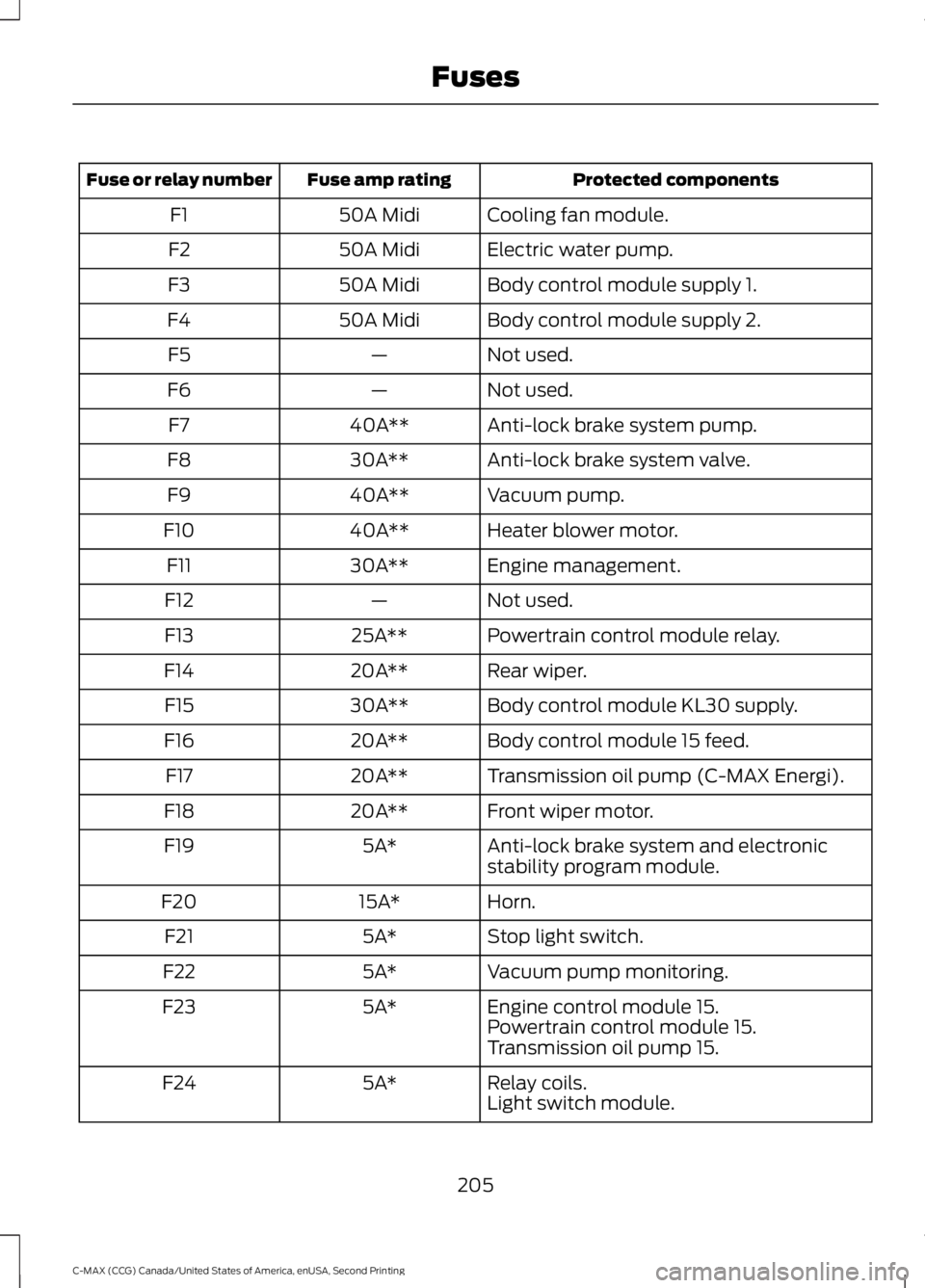
Protected components
Fuse amp rating
Fuse or relay number
Cooling fan module.
50A Midi
F1
Electric water pump.
50A Midi
F2
Body control module supply 1.
50A Midi
F3
Body control module supply 2.
50A Midi
F4
Not used.
—
F5
Not used.
—
F6
Anti-lock brake system pump.
40A**
F7
Anti-lock brake system valve.
30A**
F8
Vacuum pump.
40A**
F9
Heater blower motor.
40A**
F10
Engine management.
30A**
F11
Not used.
—
F12
Powertrain control module relay.
25A**
F13
Rear wiper.
20A**
F14
Body control module KL30 supply.
30A**
F15
Body control module 15 feed.
20A**
F16
Transmission oil pump (C-MAX Energi).
20A**
F17
Front wiper motor.
20A**
F18
Anti-lock brake system and electronic
stability program module.
5A*
F19
Horn.
15A*
F20
Stop light switch.
5A*
F21
Vacuum pump monitoring.
5A*
F22
Engine control module 15.
5A*
F23
Powertrain control module 15.
Transmission oil pump 15.
Relay coils.
5A*
F24
Light switch module.
205
C-MAX (CCG) Canada/United States of America, enUSA, Second Printing Fuses
Page 216 of 469
GENERAL INFORMATION
Have your vehicle serviced regularly to help
maintain its roadworthiness and resale
value. There is a large network of
authorized dealers that are there to help
you with their professional servicing
expertise. We believe that their specially
trained technicians are best qualified to
service your vehicle properly and expertly.
They are supported by a wide range of
highly specialized tools developed
specifically for servicing your vehicle.
To help you service your vehicle, we
provide scheduled maintenance
information which makes tracking routine
service easy. See Scheduled
Maintenance (page 420).
If your vehicle requires professional service,
an authorized dealer can provide the
necessary parts and service. Check your
warranty information to find out which
parts and services are covered.
Use only recommended fuels, lubricants,
fluids and service parts conforming to
specifications. Motorcraft® parts are
designed and built to provide the best
performance in your vehicle.
Precautions
• Do not work on a hot engine.
• Make sure that nothing gets caught in
moving parts.
• Do not work on a vehicle with the
engine running in an enclosed space,
unless you are sure you have enough
ventilation.
• Keep all open flames and other burning
material (such as cigarettes) away
from the battery and all fuel related
parts. Working with the Engine Off
1.
Set the parking brake and shift to park
(P).
2. Switch off the engine.
3. Block the wheels.
Working with the Engine On WARNING
To reduce the risk of vehicle damage
and/or personal burn injuries, do not
start your engine with the air cleaner
removed and do not remove it while the
engine is running. 1.
Set the parking brake and shift to park
(P).
2. Block the wheels
OPENING AND CLOSING THE
HOOD
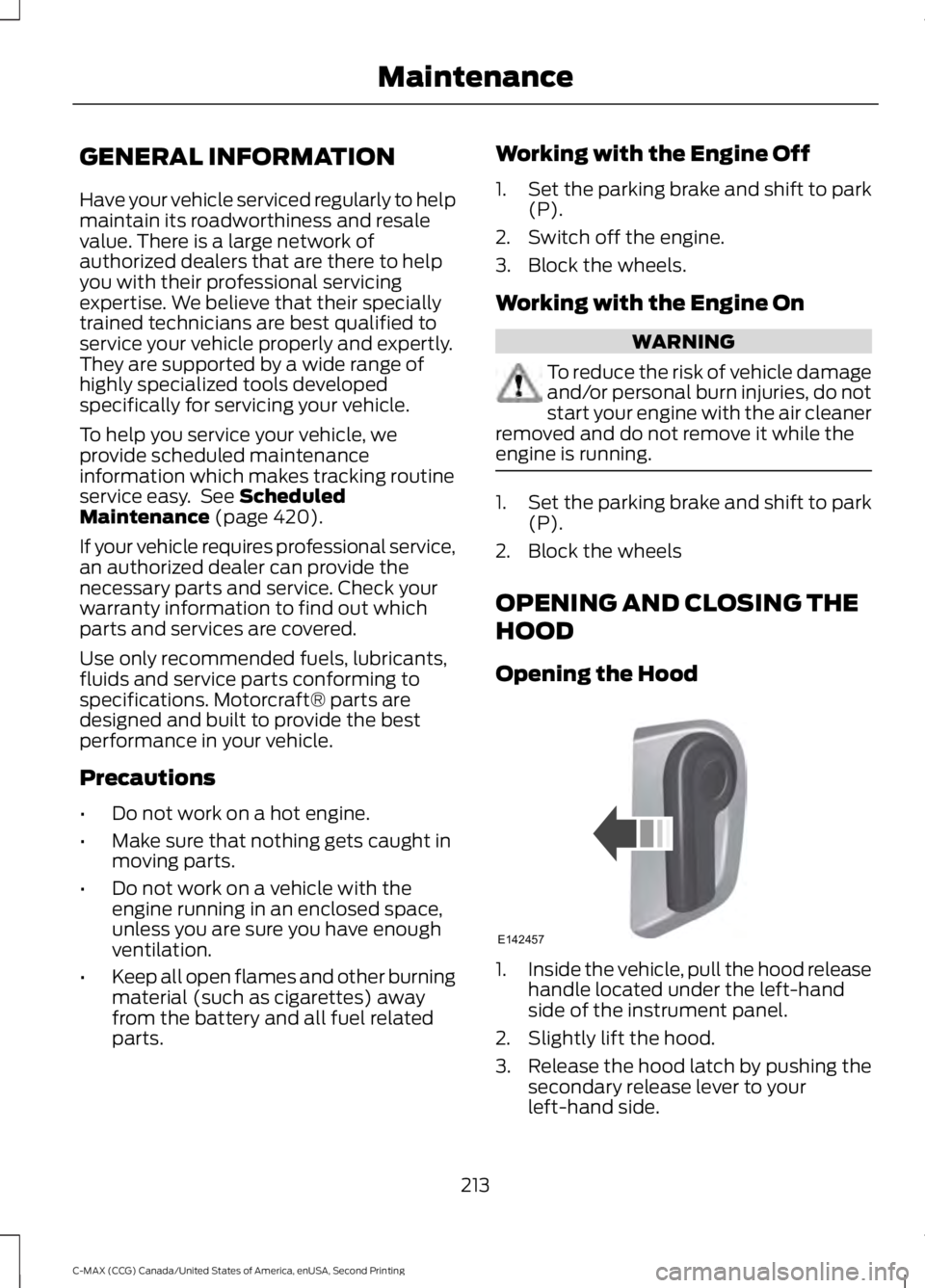
Opening the Hood 1.
Inside the vehicle, pull the hood release
handle located under the left-hand
side of the instrument panel.
2. Slightly lift the hood.
3. Release the hood latch by pushing the secondary release lever to your
left-hand side.
213
C-MAX (CCG) Canada/United States of America, enUSA, Second Printing MaintenanceE142457
Page 218 of 469
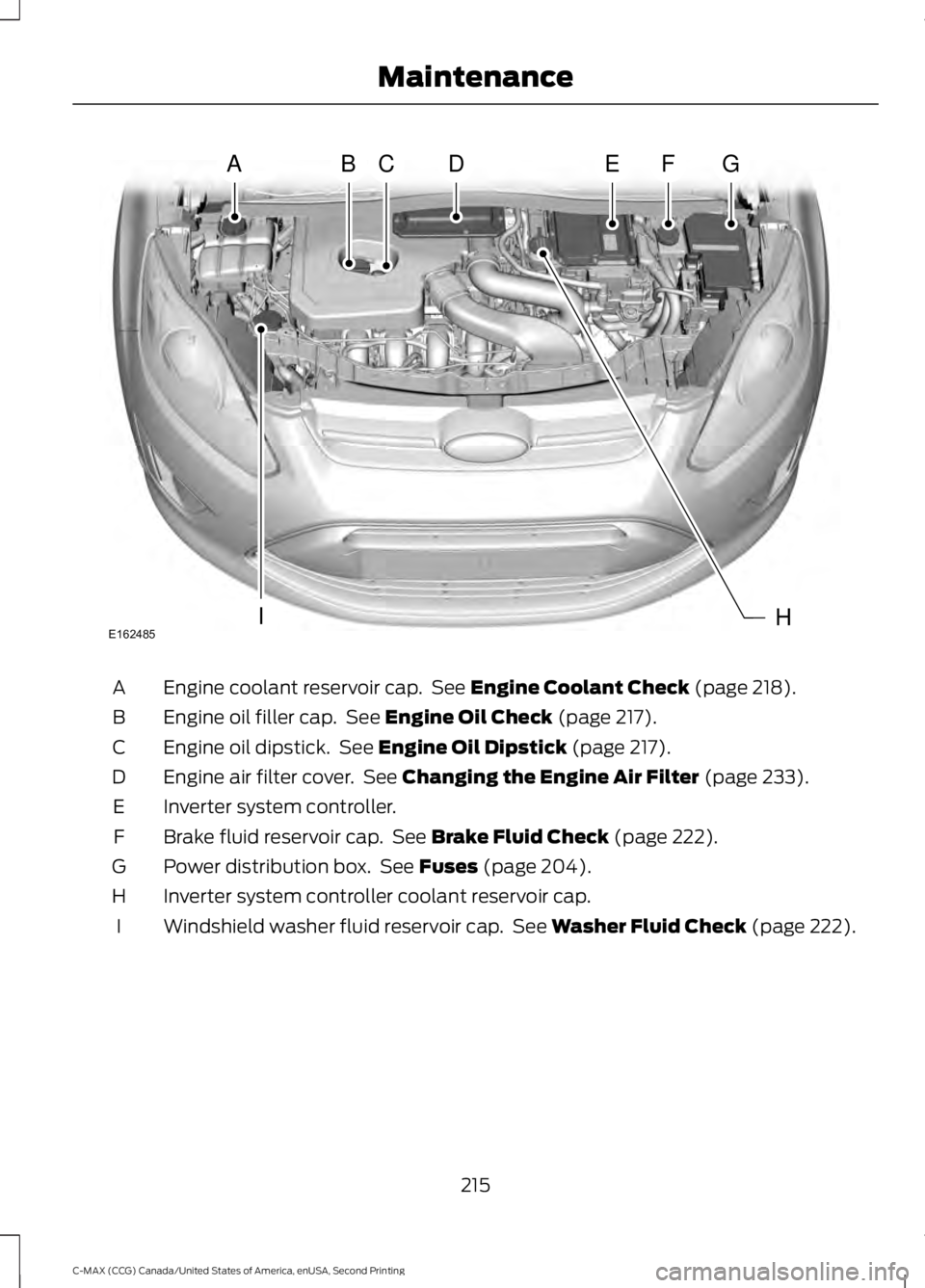
Engine coolant reservoir cap. See Engine Coolant Check (page 218).
A
Engine oil filler cap. See
Engine Oil Check (page 217).
B
Engine oil dipstick. See
Engine Oil Dipstick (page 217).
C
Engine air filter cover. See
Changing the Engine Air Filter (page 233).
D
Inverter system controller.
E
Brake fluid reservoir cap. See
Brake Fluid Check (page 222).
F
Power distribution box. See
Fuses (page 204).
G
Inverter system controller coolant reservoir cap.
H
Windshield washer fluid reservoir cap. See
Washer Fluid Check (page 222).
I
215
C-MAX (CCG) Canada/United States of America, enUSA, Second Printing MaintenanceABCDEFG
HIE162485
Page 219 of 469
UNDER HOOD OVERVIEW -
PLUG-IN HYBRID ELECTRIC
VEHICLE (PHEV)
WARNING
The inverter system controller
contains various high-voltage
components that can cause serious
bodily harm or death. The inverter system
controller is not serviceable and should
never be touched, probed, or tampered
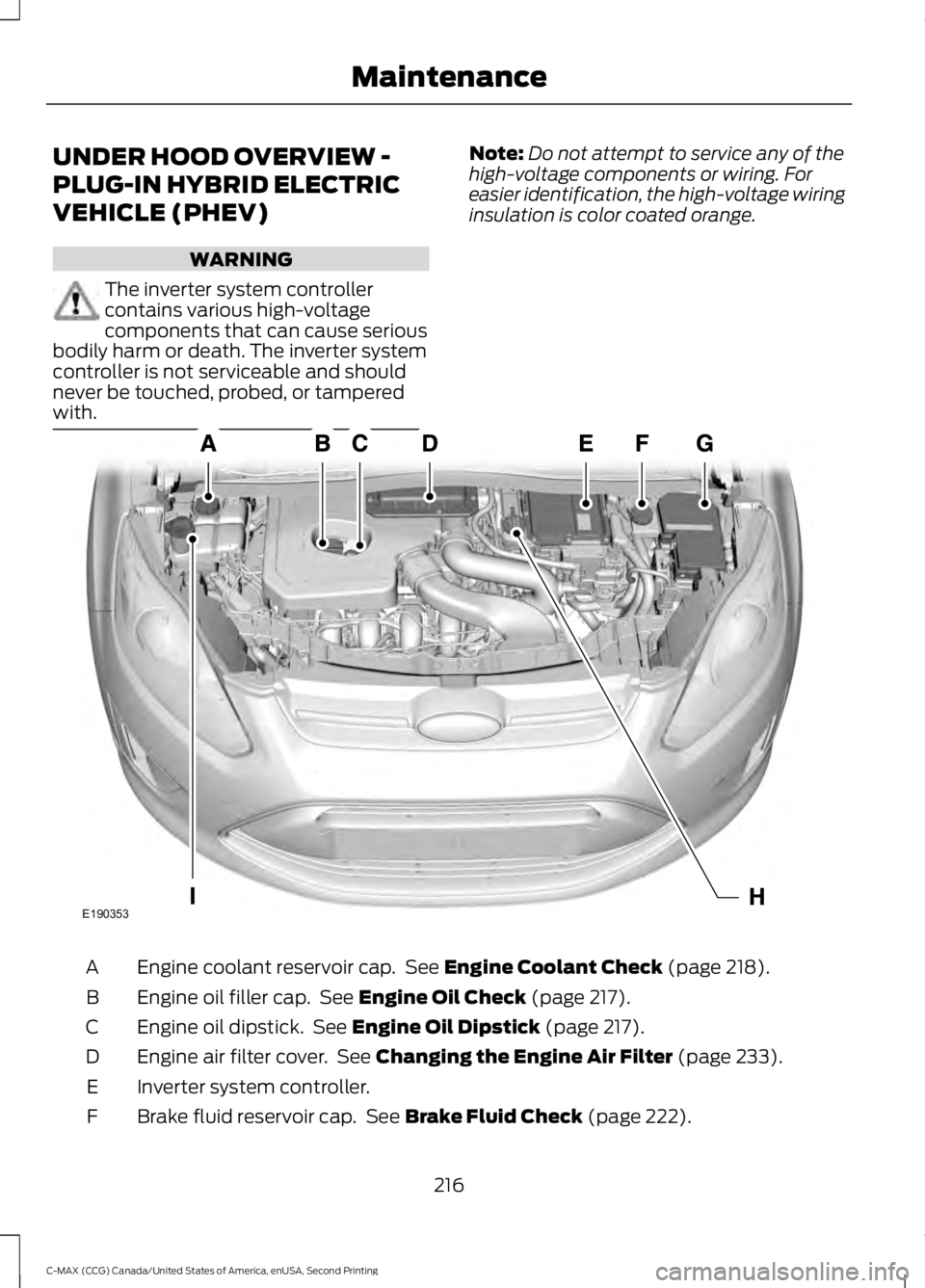
with. Note:
Do not attempt to service any of the
high-voltage components or wiring. For
easier identification, the high-voltage wiring
insulation is color coated orange. Engine coolant reservoir cap. See Engine Coolant Check (page 218).
A
Engine oil filler cap. See
Engine Oil Check (page 217).
B
Engine oil dipstick. See
Engine Oil Dipstick (page 217).
C
Engine air filter cover. See
Changing the Engine Air Filter (page 233).
D
Inverter system controller.
E
Brake fluid reservoir cap. See
Brake Fluid Check (page 222).
F
216
C-MAX (CCG) Canada/United States of America, enUSA, Second Printing MaintenanceE190353
Page 224 of 469
Vehicles driven year-round in non-extreme
climates should use prediluted coolant
meeting the Ford specification for
optimum cooling system and engine
protection.
What You Should Know About Fail-
Safe Cooling
If the engine coolant supply is depleted,
this feature allows the vehicle to be driven
temporarily before incremental component
damage is incurred. The
“fail-safe”
distance depends on ambient
temperatures, vehicle load and terrain.
How Fail-Safe Cooling Works
If the engine begins to overheat, the engine
coolant temperature gauge will move to
the red (hot) area and: The coolant temperature
warning light will illuminate.
The service engine soon
indicator will illuminate.
If the engine reaches a preset
over-temperature condition, the engine
will automatically switch to alternating
cylinder operation. Each disabled cylinder
acts as an air pump and cools the engine.
When this occurs the vehicle will still
operate. However:
• The engine power will be limited.
• The air conditioning system will be
disabled.
Continued operation will increase the
engine temperature and the engine will
completely shut down, causing steering
and braking effort to increase.
Once the engine temperature cools, the
engine can be re-started. Take your vehicle
to an authorized dealer as soon as possible
to minimize engine damage. When Fail-Safe Mode Is Activated WARNINGS
Fail-safe mode is for use during
emergencies only. Operate your
vehicle in fail-safe mode only as long
as necessary to bring your vehicle to rest
in a safe location and seek immediate
repairs. When in fail-safe mode, your
vehicle will have limited power, will not be
able to maintain high-speed operation, and
may completely shut down without
warning, potentially losing engine power,
power steering assist, and power brake
assist, which may increase the possibility
of a crash resulting in serious injury. Never remove the coolant reservoir
cap while the engine is running or hot.
Note:
Driving the vehicle without repairing
the engine problem increases the chance of
engine damage. Take your vehicle to an
authorized dealer as soon as possible.
You have limited engine power when in the
fail-safe mode, so drive the vehicle with
caution. The vehicle will not be able to
maintain high-speed operation and the
engine will run rough. Remember that the
engine is capable of completely shutting
down automatically to prevent engine
damage, therefore:
1. Pull off the road as soon as safely possible and turn off the engine.
2. Arrange for the vehicle to be taken to an authorized dealer.
3. If this is not possible, wait a short period for the engine to cool.
4. Check the coolant level and replenish if low.
5. Re-start the engine and take your vehicle to an authorized dealer.
221
C-MAX (CCG) Canada/United States of America, enUSA, Second Printing Maintenance
Page 225 of 469
AUTOMATIC TRANSMISSION
FLUID CHECK
If required, have an authorized dealer check
and change the transmission fluid at the
correct service interval. See Scheduled
Maintenance (page 420).
The automatic transmission does not have
a transmission fluid dipstick. Your
transmission does not consume fluid.
An authorized dealer should check the
fluid:
• If the transmission is not working
properly.
• If you notice signs of fluid leakage.
Do not use supplemental transmission
fluid additives, treatments or cleaning
agents. The use of these materials may
affect transmission operation and result
in damage to internal transmission
components.
BRAKE FLUID CHECK
Fluid levels between the MIN and MAX
lines are within the normal operating range;
there is no need to add fluid. If the fluid
levels are outside of the normal operating
range, the performance of the system
could be compromised; seek service from
your authorized dealer immediately.
POWER STEERING FLUID
CHECK
Your vehicle is equipped with an electric
power steering (EPS) system. There is no
fluid reservoir to check or fill. WASHER FLUID CHECK WARNING
If you operate your vehicle in
temperatures below 40°F (5°C), use
washer fluid with antifreeze
protection. Failure to use washer fluid with
antifreeze protection in cold weather could
result in impaired windshield vision and
increase the risk of injury or accident. Note:
The front and rear washer systems
are supplied from the same reservoir.
Add fluid to fill the reservoir if the level is
low. Only use a washer fluid that meets
Ford specifications. See
Capacities and
Specifications (page 275).
State or local regulations on volatile
organic compounds may restrict the use
of methanol, a common windshield washer
antifreeze additive. Washer fluids
containing non-methanol antifreeze
agents should be used only if they provide
cold weather protection without damaging
the vehicle ’s paint finish, wiper blades or
washer system.
FUEL FILTER
Your vehicle is equipped with a lifetime
fuel filter that is integrated with the fuel
tank. Regular maintenance or replacement
is not needed.
222
C-MAX (CCG) Canada/United States of America, enUSA, Second Printing Maintenance
Page 227 of 469
presets, are also maintained in memory by
power from the low voltage battery. When
a technician disconnects and connects the
low voltage battery, these settings are
erased. Complete the following procedure
in order to restore the settings:
1. With the vehicle at a complete stop,
set the parking brake.
2. Shift into park (P).
3. Switch off all accessories.
4. Fully press the brake pedal and start the vehicle.
5. Run the engine until it reaches normal operating temperature. While the
engine is warming up, complete the
following: Reset the clock. See Audio
System (page 282). Reset the power
windows bounce-back feature. See
Windows and Mirrors
(page 79).
Reset the radio station presets. See
Audio System
(page 282).
6. Allow the engine to idle for at least one
minute. If the engine turns off, press
the accelerator pedal to start the
engine.
7. While the engine is running, press the brake pedal and shift into neutral (N).
8. Allow the engine to run for at least one
minute by pressing on the accelerator
pedal.
9. Drive the vehicle at least 12 mi (20 km)
to completely relearn the idle and fuel
trim strategy.
Note: If you do not allow the engine to
relearn the idle and fuel trim strategy, the
idle quality of your vehicle may be adversely
affected until the engine computer
eventually relearns the idle trim and fuel
trim strategy.
Make sure that you dispose of old batteries
in an environmentally friendly way. Seek
advice from your local authority about
recycling old batteries. CHECKING THE WIPER
BLADES
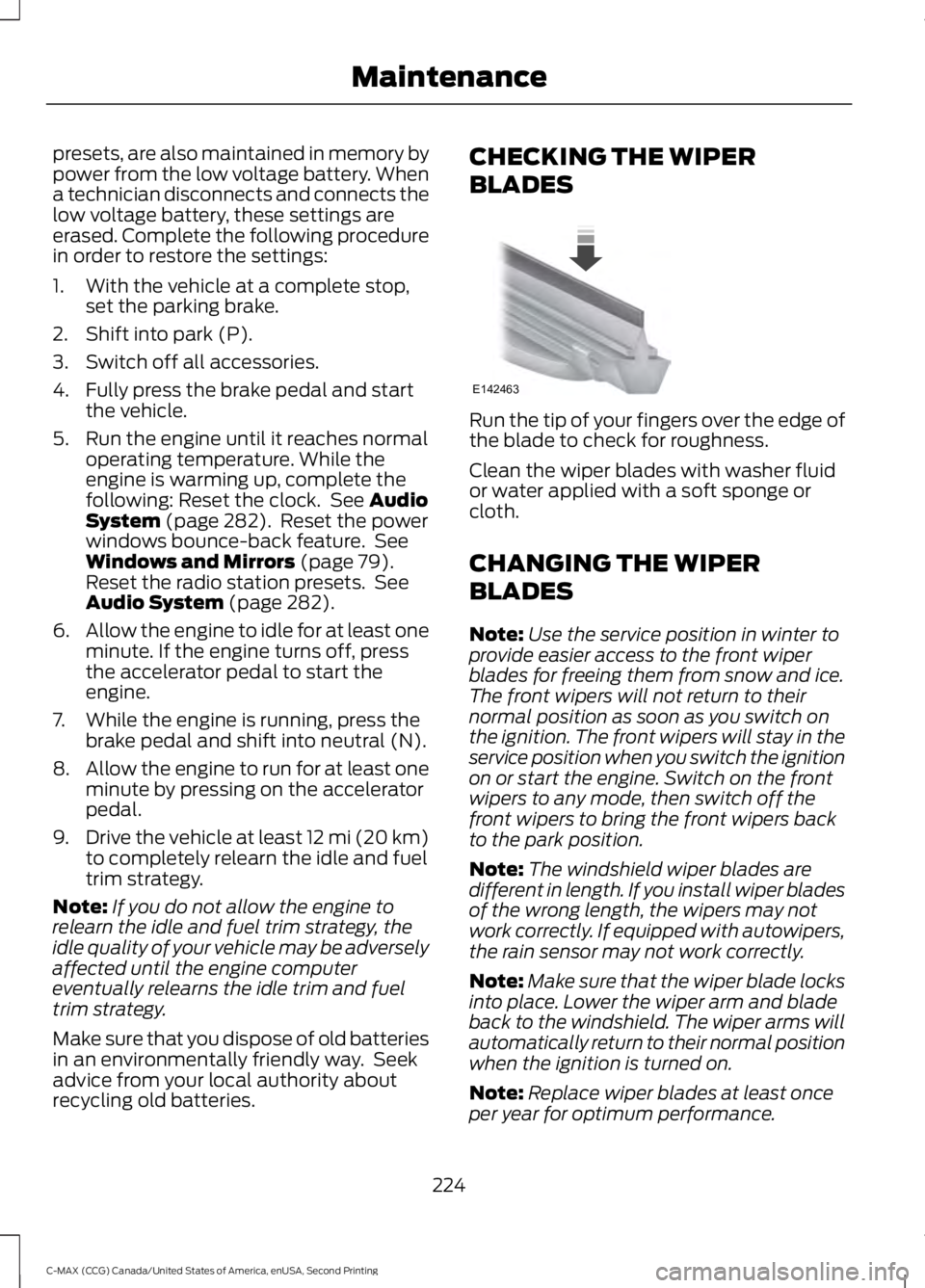
Run the tip of your fingers over the edge of
the blade to check for roughness.
Clean the wiper blades with washer fluid
or water applied with a soft sponge or
cloth.
CHANGING THE WIPER
BLADES
Note:
Use the service position in winter to
provide easier access to the front wiper
blades for freeing them from snow and ice.
The front wipers will not return to their
normal position as soon as you switch on
the ignition. The front wipers will stay in the
service position when you switch the ignition
on or start the engine. Switch on the front
wipers to any mode, then switch off the
front wipers to bring the front wipers back
to the park position.
Note: The windshield wiper blades are
different in length. If you install wiper blades
of the wrong length, the wipers may not
work correctly. If equipped with autowipers,
the rain sensor may not work correctly.
Note: Make sure that the wiper blade locks
into place. Lower the wiper arm and blade
back to the windshield. The wiper arms will
automatically return to their normal position
when the ignition is turned on.
Note: Replace wiper blades at least once
per year for optimum performance.
224
C-MAX (CCG) Canada/United States of America, enUSA, Second Printing MaintenanceE142463
Page 232 of 469
Replacing Fog, Park and Direction
Indicator Bulbs
Note:
You cannot separate the fog lamp
bulb from the bulb holder.
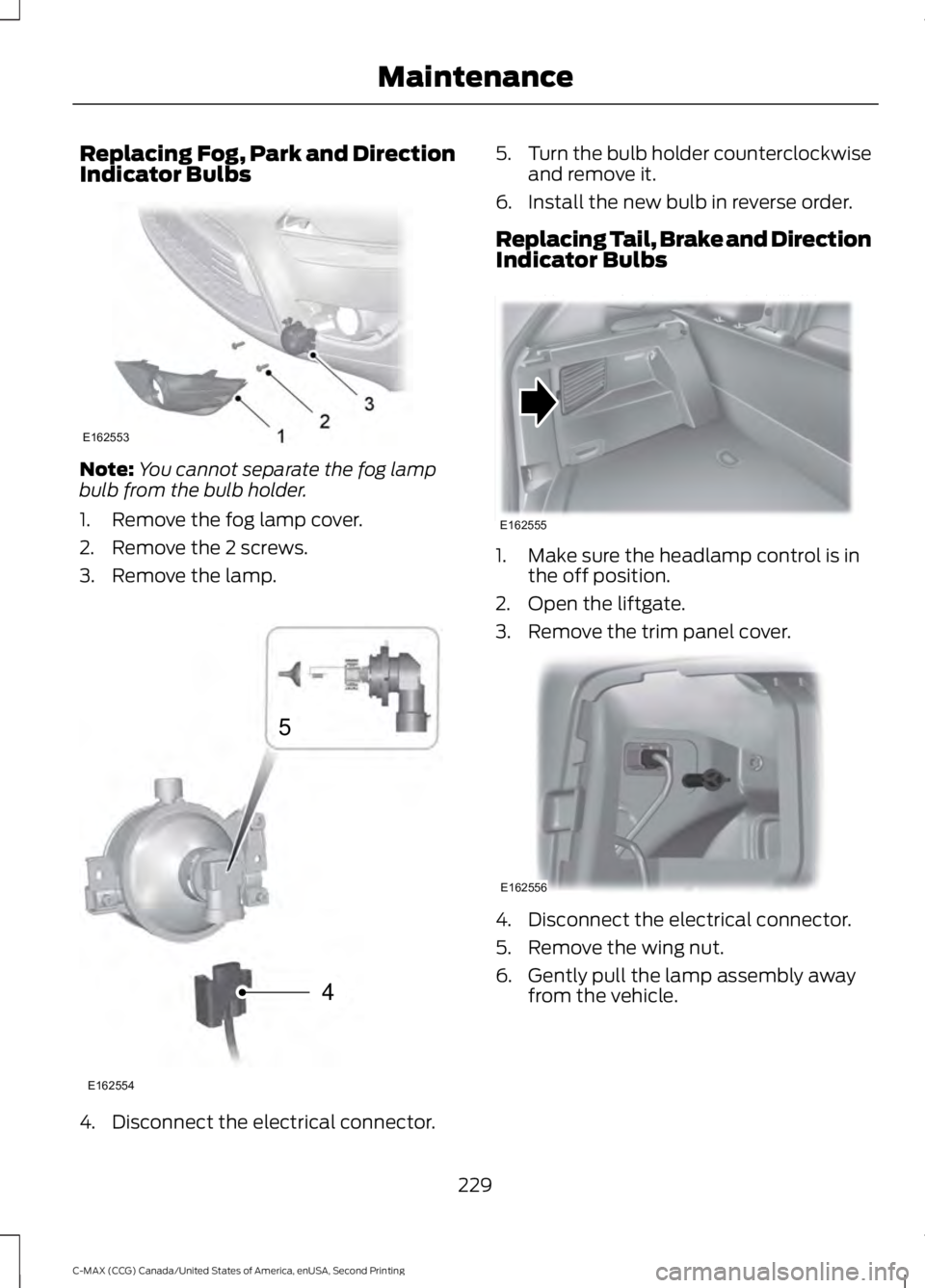
1. Remove the fog lamp cover.
2. Remove the 2 screws.
3. Remove the lamp. 4. Disconnect the electrical connector. 5.
Turn the bulb holder counterclockwise
and remove it.
6. Install the new bulb in reverse order.
Replacing Tail, Brake and Direction
Indicator Bulbs 1. Make sure the headlamp control is in
the off position.
2. Open the liftgate.
3. Remove the trim panel cover. 4. Disconnect the electrical connector.
5. Remove the wing nut.
6. Gently pull the lamp assembly away
from the vehicle.
229
C-MAX (CCG) Canada/United States of America, enUSA, Second Printing MaintenanceE162553 4
5
E162554 E162555 E162556
Page 233 of 469
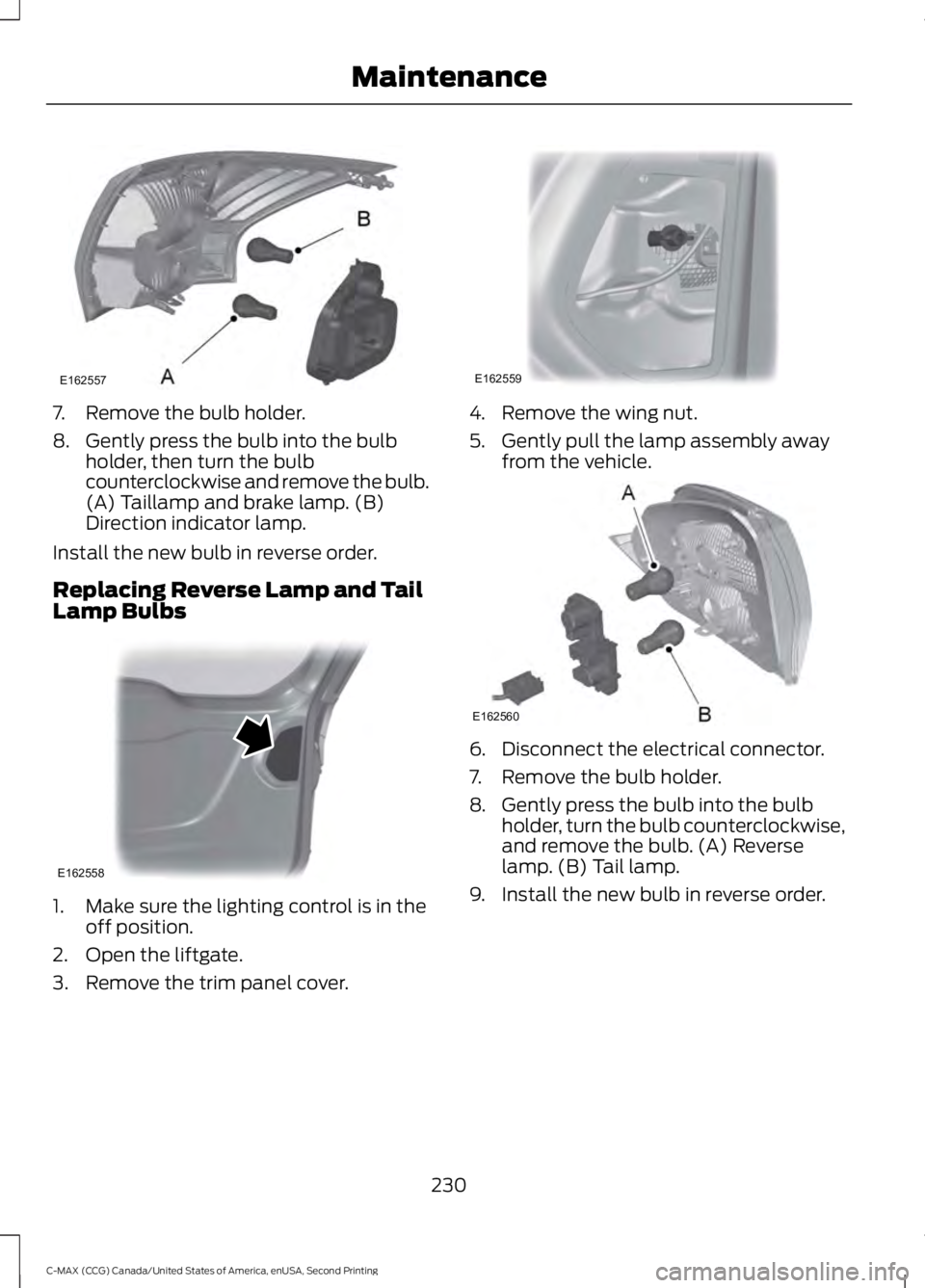
7. Remove the bulb holder.
8. Gently press the bulb into the bulb
holder, then turn the bulb
counterclockwise and remove the bulb.
(A) Taillamp and brake lamp. (B)
Direction indicator lamp.
Install the new bulb in reverse order.
Replacing Reverse Lamp and Tail
Lamp Bulbs 1. Make sure the lighting control is in the
off position.
2. Open the liftgate.
3. Remove the trim panel cover. 4. Remove the wing nut.
5. Gently pull the lamp assembly away
from the vehicle. 6. Disconnect the electrical connector.
7. Remove the bulb holder.
8. Gently press the bulb into the bulb
holder, turn the bulb counterclockwise,
and remove the bulb. (A) Reverse
lamp. (B) Tail lamp.
9. Install the new bulb in reverse order.
230
C-MAX (CCG) Canada/United States of America, enUSA, Second Printing MaintenanceE162557 E162558 E162559 E162560
Page 234 of 469
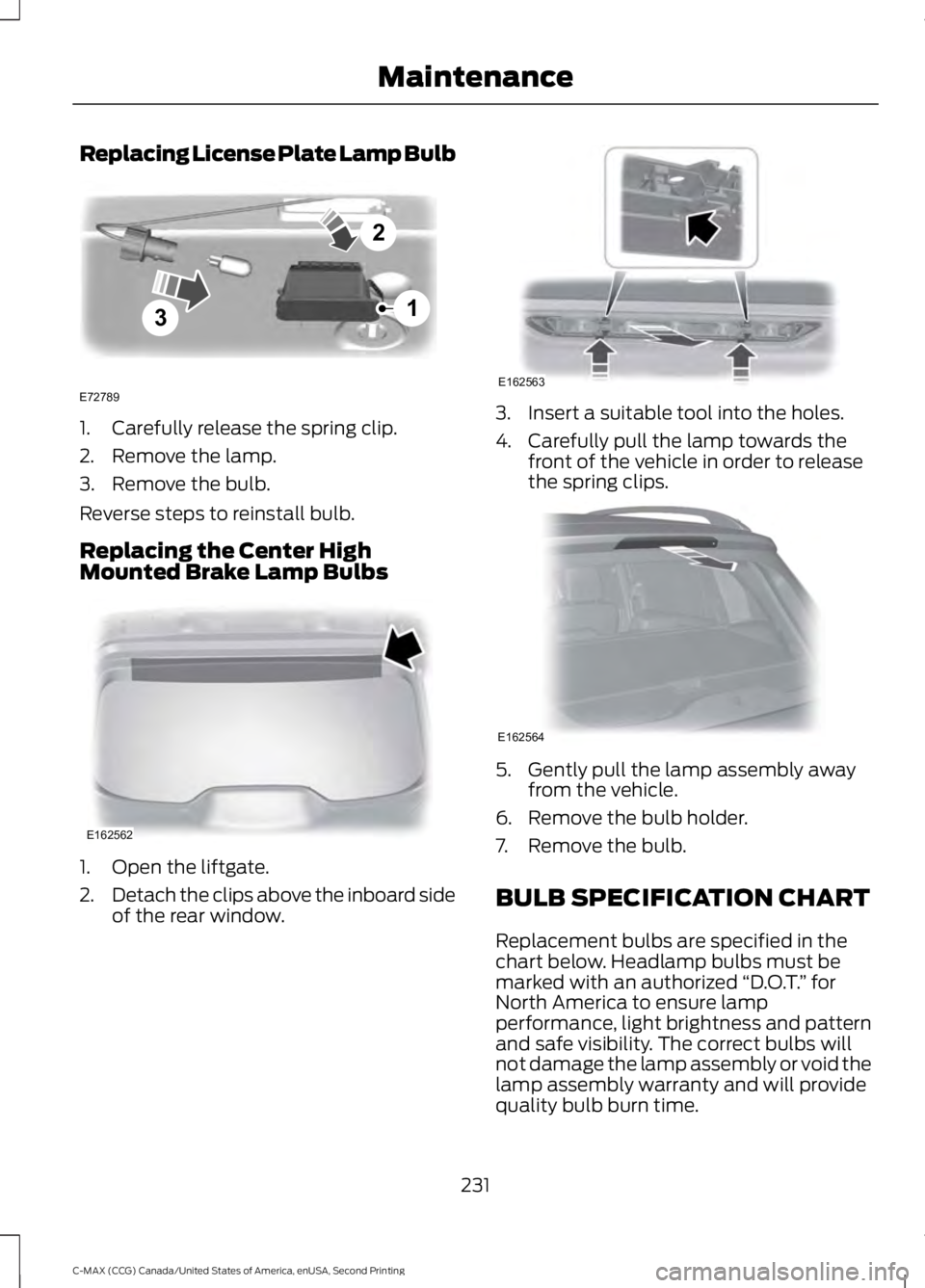
Replacing License Plate Lamp Bulb
1. Carefully release the spring clip.
2. Remove the lamp.
3. Remove the bulb.
Reverse steps to reinstall bulb.
Replacing the Center High
Mounted Brake Lamp Bulbs
1. Open the liftgate.
2.
Detach the clips above the inboard side
of the rear window. 3. Insert a suitable tool into the holes.
4. Carefully pull the lamp towards the
front of the vehicle in order to release
the spring clips. 5. Gently pull the lamp assembly away
from the vehicle.
6. Remove the bulb holder.
7. Remove the bulb.
BULB SPECIFICATION CHART
Replacement bulbs are specified in the
chart below. Headlamp bulbs must be
marked with an authorized “D.O.T.” for
North America to ensure lamp
performance, light brightness and pattern
and safe visibility. The correct bulbs will
not damage the lamp assembly or void the
lamp assembly warranty and will provide
quality bulb burn time.
231
C-MAX (CCG) Canada/United States of America, enUSA, Second Printing Maintenance3
2
1
E72789 E162562 E162563 E162564