fuel cap FORD C MAX 2016 User Guide
[x] Cancel search | Manufacturer: FORD, Model Year: 2016, Model line: C MAX, Model: FORD C MAX 2016Pages: 395, PDF Size: 5.78 MB
Page 149 of 395
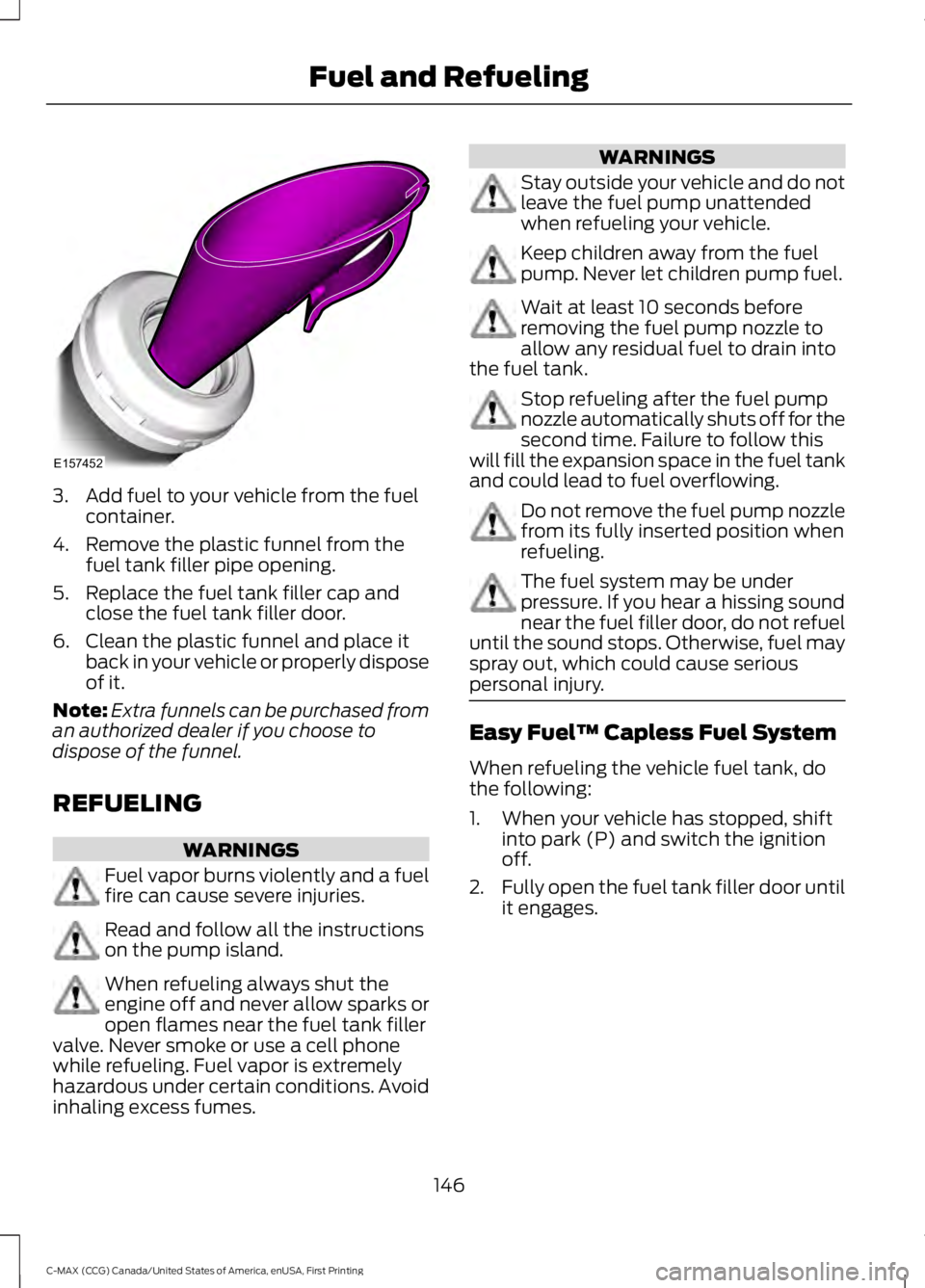
3. Add fuel to your vehicle from the fuel
container.
4. Remove the plastic funnel from the fuel tank filler pipe opening.
5. Replace the fuel tank filler cap and close the fuel tank filler door.
6. Clean the plastic funnel and place it back in your vehicle or properly dispose
of it.
Note: Extra funnels can be purchased from
an authorized dealer if you choose to
dispose of the funnel.
REFUELING WARNINGS
Fuel vapor burns violently and a fuel
fire can cause severe injuries.
Read and follow all the instructions
on the pump island.
When refueling always shut the
engine off and never allow sparks or
open flames near the fuel tank filler
valve. Never smoke or use a cell phone
while refueling. Fuel vapor is extremely
hazardous under certain conditions. Avoid
inhaling excess fumes. WARNINGS
Stay outside your vehicle and do not
leave the fuel pump unattended
when refueling your vehicle.
Keep children away from the fuel
pump. Never let children pump fuel.
Wait at least 10 seconds before
removing the fuel pump nozzle to
allow any residual fuel to drain into
the fuel tank. Stop refueling after the fuel pump
nozzle automatically shuts off for the
second time. Failure to follow this
will fill the expansion space in the fuel tank
and could lead to fuel overflowing. Do not remove the fuel pump nozzle
from its fully inserted position when
refueling.
The fuel system may be under
pressure. If you hear a hissing sound
near the fuel filler door, do not refuel
until the sound stops. Otherwise, fuel may
spray out, which could cause serious
personal injury. Easy Fuel
™ Capless Fuel System
When refueling the vehicle fuel tank, do
the following:
1. When your vehicle has stopped, shift into park (P) and switch the ignition
off.
2. Fully open the fuel tank filler door until
it engages.
146
C-MAX (CCG) Canada/United States of America, enUSA, First Printing Fuel and RefuelingE157452
Page 150 of 395
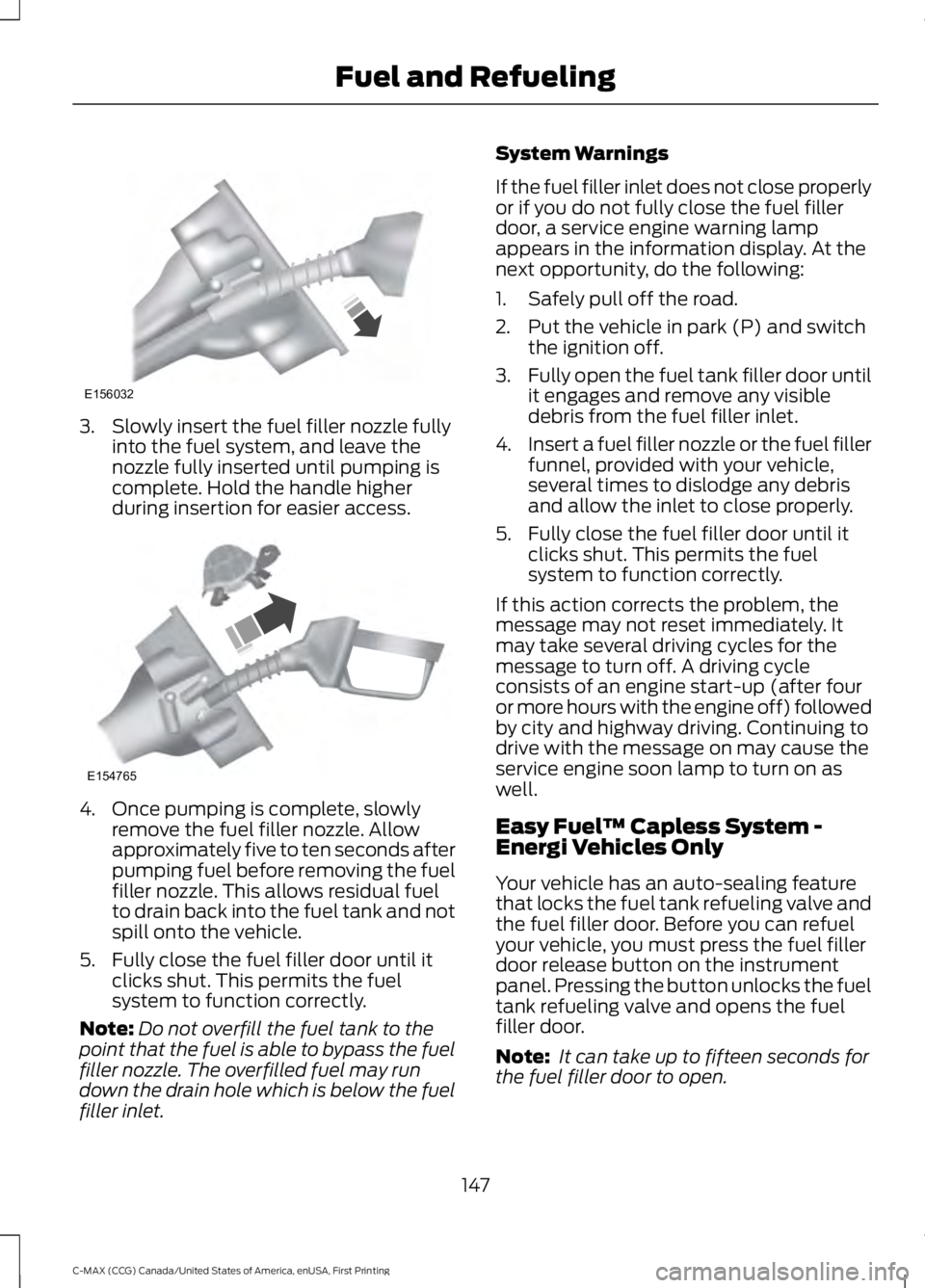
3. Slowly insert the fuel filler nozzle fully
into the fuel system, and leave the
nozzle fully inserted until pumping is
complete. Hold the handle higher
during insertion for easier access. 4. Once pumping is complete, slowly
remove the fuel filler nozzle. Allow
approximately five to ten seconds after
pumping fuel before removing the fuel
filler nozzle. This allows residual fuel
to drain back into the fuel tank and not
spill onto the vehicle.
5. Fully close the fuel filler door until it clicks shut. This permits the fuel
system to function correctly.
Note: Do not overfill the fuel tank to the
point that the fuel is able to bypass the fuel
filler nozzle. The overfilled fuel may run
down the drain hole which is below the fuel
filler inlet. System Warnings
If the fuel filler inlet does not close properly
or if you do not fully close the fuel filler
door, a service engine warning lamp
appears in the information display. At the
next opportunity, do the following:
1. Safely pull off the road.
2. Put the vehicle in park (P) and switch
the ignition off.
3. Fully open the fuel tank filler door until
it engages and remove any visible
debris from the fuel filler inlet.
4. Insert a fuel filler nozzle or the fuel filler
funnel, provided with your vehicle,
several times to dislodge any debris
and allow the inlet to close properly.
5. Fully close the fuel filler door until it clicks shut. This permits the fuel
system to function correctly.
If this action corrects the problem, the
message may not reset immediately. It
may take several driving cycles for the
message to turn off. A driving cycle
consists of an engine start-up (after four
or more hours with the engine off) followed
by city and highway driving. Continuing to
drive with the message on may cause the
service engine soon lamp to turn on as
well.
Easy Fuel ™ Capless System -
Energi Vehicles Only
Your vehicle has an auto-sealing feature
that locks the fuel tank refueling valve and
the fuel filler door. Before you can refuel
your vehicle, you must press the fuel filler
door release button on the instrument
panel. Pressing the button unlocks the fuel
tank refueling valve and opens the fuel
filler door.
Note: It can take up to fifteen seconds for
the fuel filler door to open.
147
C-MAX (CCG) Canada/United States of America, enUSA, First Printing Fuel and RefuelingE156032 E154765
Page 153 of 395
5. Switch the ignition off and refuel your
vehicle within 20 minutes. If more than
20 minutes is required, fully close the
fuel filler door and repeat the
procedure.
FUEL CONSUMPTION
Note: The amount of usable fuel in the
empty reserve varies and should not be
relied upon to increase driving range. When
refueling your vehicle after the fuel gauge
indicates empty, you might not be able to
refuel the full amount of the advertised
capacity of the fuel tank due to the empty
reserve still present in the tank.
Empty reserve is the amount of fuel
remaining in the tank after the fuel gauge
indicates empty. Do not rely on this fuel for
driving. The usable capacity of the fuel
tank is the amount of fuel that can be put
into the tank after the gauge indicates
empty. The advertised capacity is the total
fuel tank size – it is the combined usable
capacity plus the empty reserve.
Filling the Tank
For consistent results when filling the fuel
tank:
• Turn the ignition off before fueling; an
inaccurate reading results if the engine
is left running.
• Use the same fill rate
(low-medium-high) each time the tank
is filled.
• Allow no more than two automatic
click-offs when filling.
Results are most accurate when the filling
method is consistent. Calculating Fuel Economy
Do not measure fuel economy during the
first 1000 miles (1600 kilometers) of
driving (this is your engine
’s break-in
period); a more accurate measurement is
obtained after 2000 miles - 3000 miles
(3200 kilometers - 4800 kilometers). Also,
fuel expense, frequency of fill ups or fuel
gauge readings are not accurate ways to
measure fuel economy.
1. Fill the fuel tank completely and record
the initial odometer reading.
2. Each time you fill the tank, record the amount of fuel added.
3. After at least three to five tank fill ups, fill the fuel tank and record the current
odometer reading.
4. Subtract your initial odometer reading from the current odometer reading.
5. Calculate fuel economy by dividing miles traveled by gallons used (For
Metric: Multiply liters used by 100, then
divide by kilometers traveled).
Keep a record for at least one month and
record the type of driving (city or highway).
This provides an accurate estimate of the
vehicle ’s fuel economy under current
driving conditions. Additionally, keeping
records during summer and winter show
how temperature impacts fuel economy.
In general, lower temperatures mean lower
fuel economy.
EMISSION CONTROL SYSTEM WARNINGS
Do not park, idle, or drive your vehicle
in dry grass or other dry ground cover.
The emission system heats up the
engine compartment and exhaust system,
which can start a fire.
150
C-MAX (CCG) Canada/United States of America, enUSA, First Printing Fuel and Refueling
Page 195 of 395
BREAKING-IN
You need to break in new tires for
approximately 300 miles (480
kilometers). During this time, your vehicle
may exhibit some unusual driving
characteristics. The engine also needs to
break in. Avoid hard accelerations and
driving too fast for the first 1000 miles
(1600 kilometers). If possible, avoid
carrying heavy loads up steep grades
during the break-in period.
ECONOMICAL DRIVING
Your fuel economy depends on:
•
How you drive your vehicle.
• How you maintain your vehicle.
• The conditions you drive your vehicle
in.
You may improve your fuel economy by
keeping these in mind:
• Drive your vehicle at reasonable
speeds. Traveling at 65 mph
(105 km/h) uses about 15% less fuel
than traveling at 75 mph (121 km/h).
• Drive at steady speeds without
stopping.
• Anticipate stops. Slowing down your
vehicle may eliminate the need to stop.
• Keep the tires properly inflated and use
only the recommended size.
• Switch off the heater if you do not need
it. When you have the heater on, keep
it at the lowest blower and
temperature setting necessary to be
comfortable.
• When it is cold outside, park in a sunny
location or a climate-controlled
environment. This may save fuel by
reducing the energy needed to heat the
cabin. •
Switch off the air conditioning if you do
not need it. When you have the air
conditioning on, keep it at the lowest
blower and highest temperature
setting necessary to be comfortable.
• When it is hot or sunny outside, parking
in a shaded or climate-controlled
environment will save fuel by reducing
the energy needed to cool the cabin.
• For the C-MAX Energi, use
preconditioning to improve your fuel
economy. See
High Voltage Battery
(page 153).
• Switch off the heated seats if you are
not using them.
• Switch off the defroster when you no
longer need it for visibility.
• For the C-MAX Energi, plug in and
recharge the high voltage battery
whenever possible.
• Use ECO Cruise Control, especially in
hilly terrain. For information on
enabling eco-cruise, See
Cruise
Control (page 179).
• Shift into low gear (L) when enhanced
engine braking is needed. Otherwise,
use drive gear (D) shift position.
• Combine errands and minimize
stop-and-go driving. A warmed up
engine works more efficiently. When
running errands, go to the farthest
destination first and then work your
way back home.
• Close the windows for high-speed
driving.
• Use the recommended engine oil. See
Capacities and Specifications (page
276
).
192
C-MAX (CCG) Canada/United States of America, enUSA, First Printing Driving Hints
Page 200 of 395
Note:
When you try to restart your vehicle
after a fuel shutoff, the vehicle makes sure
that the electrical system is safe to restart.
Once your vehicle determines that the
electrical system is safe, then the vehicle
will allow you to restart.
Note: In the event that your vehicle does
not restart after your third attempt, contact
an authorized dealer.
JUMP STARTING THE VEHICLE WARNINGS
The gases around the battery can
explode if exposed to flames, sparks
or lit cigarettes. An explosion could
result in injury or vehicle damage. Batteries contain sulfuric acid which
can burn skin, eyes and clothing, if
contacted.
Do not attempt to push-start your
automatic transmission vehicle. Automatic
transmissions do not have push-start
capability. Attempting to push-start a
vehicle with an automatic transmission
may cause transmission damage.
Preparing Your Vehicle
Note:
Use only a 12-volt supply to start your
vehicle.
Note: Do not disconnect the battery of the
disabled vehicle as this could damage the
vehicle's electrical system.
1. Park the booster vehicle close to the hood of the disabled vehicle making
sure the two vehicles do not touch. Set
the parking brake on both vehicles and
stay clear of the engine cooling fan and
other moving parts.
2. Check all battery terminals and remove
any excessive corrosion before you
attach the battery cables. Ensure that
vent caps are tight and level. 3.
Turn the heater fan on in both vehicles
to protect from any electrical surges.
Turn all other accessories off.
Connecting the Jumper Cables
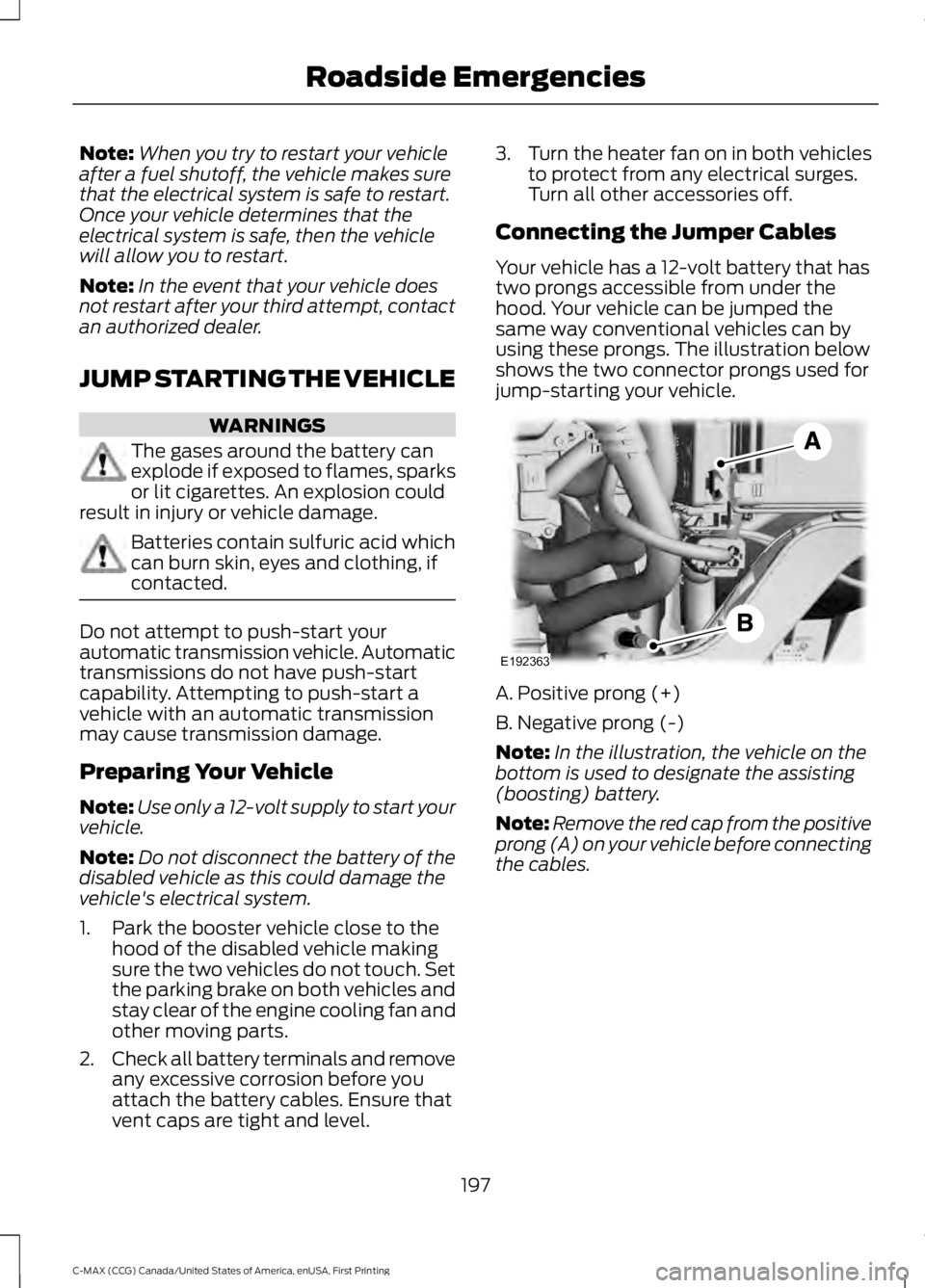
Your vehicle has a 12-volt battery that has
two prongs accessible from under the
hood. Your vehicle can be jumped the
same way conventional vehicles can by
using these prongs. The illustration below
shows the two connector prongs used for
jump-starting your vehicle. A. Positive prong (+)
B. Negative prong (-)
Note:
In the illustration, the vehicle on the
bottom is used to designate the assisting
(boosting) battery.
Note: Remove the red cap from the positive
prong (A) on your vehicle before connecting
the cables.
197
C-MAX (CCG) Canada/United States of America, enUSA, First Printing Roadside EmergenciesE192363
Page 225 of 395
Inverter system controller.
E
Brake fluid reservoir cap. See Brake Fluid Check (page 227).
F
Power distribution box. See
Fuses (page 209).
G
Inverter system controller coolant reservoir cap.
H
Windshield washer fluid reservoir cap. See
Washer Fluid Check (page 227).
I
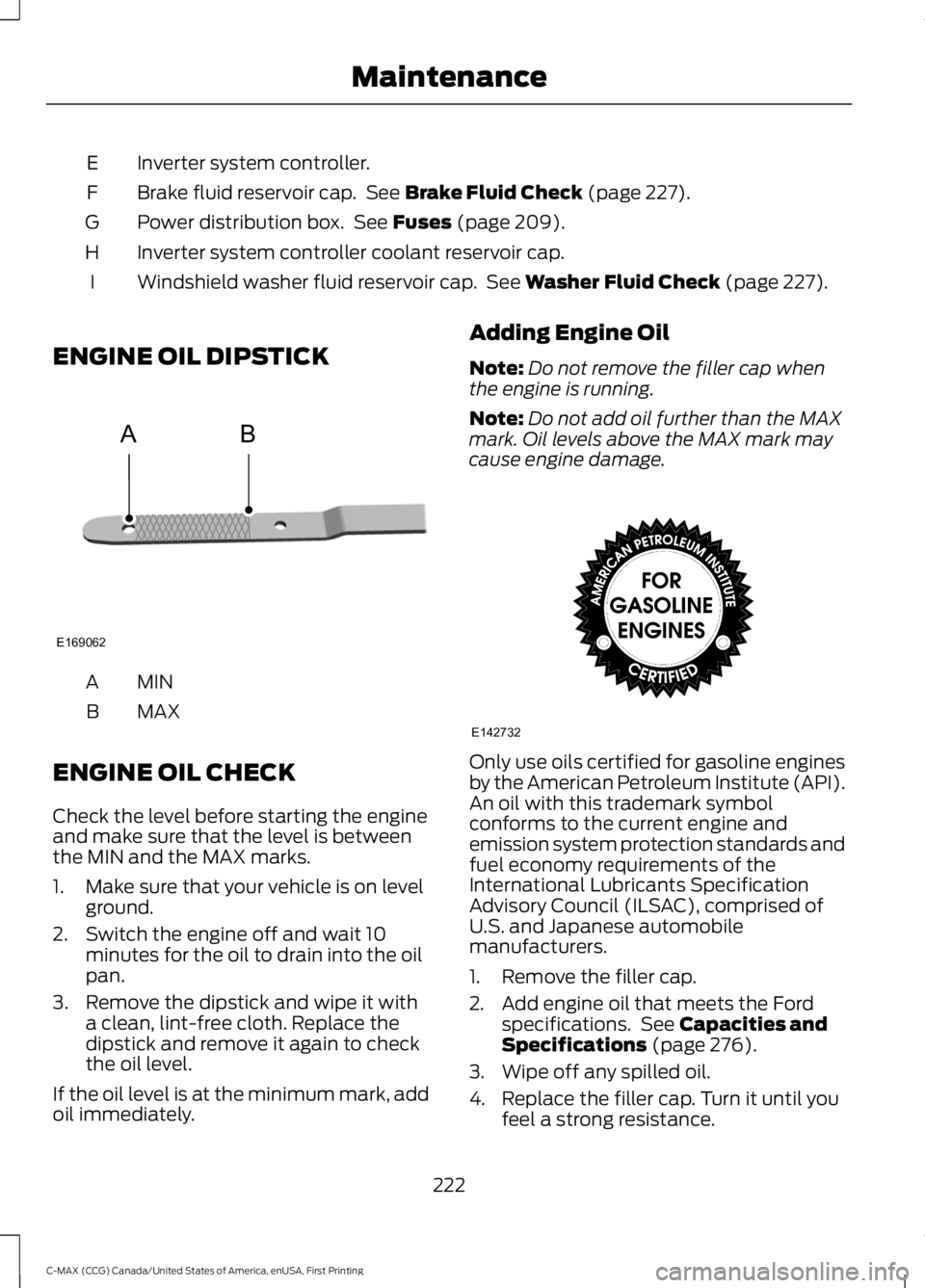
ENGINE OIL DIPSTICK MINA
MAX
B
ENGINE OIL CHECK
Check the level before starting the engine
and make sure that the level is between
the MIN and the MAX marks.
1. Make sure that your vehicle is on level ground.
2. Switch the engine off and wait 10 minutes for the oil to drain into the oil
pan.
3. Remove the dipstick and wipe it with a clean, lint-free cloth. Replace the
dipstick and remove it again to check
the oil level.
If the oil level is at the minimum mark, add
oil immediately. Adding Engine Oil
Note:
Do not remove the filler cap when
the engine is running.
Note: Do not add oil further than the MAX
mark. Oil levels above the MAX mark may
cause engine damage. Only use oils certified for gasoline engines
by the American Petroleum Institute (API).
An oil with this trademark symbol
conforms to the current engine and
emission system protection standards and
fuel economy requirements of the
International Lubricants Specification
Advisory Council (ILSAC), comprised of
U.S. and Japanese automobile
manufacturers.
1. Remove the filler cap.
2. Add engine oil that meets the Ford
specifications. See
Capacities and
Specifications (page 276).
3. Wipe off any spilled oil.
4. Replace the filler cap. Turn it until you feel a strong resistance.
222
C-MAX (CCG) Canada/United States of America, enUSA, First Printing MaintenanceAB
E169062 E142732
Page 230 of 395
AUTOMATIC TRANSMISSION
FLUID CHECK
If required, have an authorized dealer check
and change the transmission fluid at the
correct service interval. See Scheduled
Maintenance (page 348).
The automatic transmission does not have
a transmission fluid dipstick. Your
transmission does not consume fluid.
An authorized dealer should check the
fluid:
• If the transmission is not working
properly.
• If you notice signs of fluid leakage.
Do not use supplemental transmission
fluid additives, treatments or cleaning
agents. The use of these materials may
affect transmission operation and result
in damage to internal transmission
components.
BRAKE FLUID CHECK
Fluid levels between the MIN and MAX
lines are within the normal operating range;
there is no need to add fluid. If the fluid
levels are outside of the normal operating
range, the performance of the system
could be compromised; seek service from
your authorized dealer immediately.
POWER STEERING FLUID
CHECK
Your vehicle is equipped with an electric
power steering (EPS) system. There is no
fluid reservoir to check or fill. WASHER FLUID CHECK WARNING
If you operate your vehicle in
temperatures below 40°F (5°C), use
washer fluid with antifreeze
protection. Failure to use washer fluid with
antifreeze protection in cold weather could
result in impaired windshield vision and
increase the risk of injury or accident. Note:
The front and rear washer systems
are supplied from the same reservoir.
Add fluid to fill the reservoir if the level is
low. Only use a washer fluid that meets
Ford specifications. See
Capacities and
Specifications (page 276).
State or local regulations on volatile
organic compounds may restrict the use
of methanol, a common windshield washer
antifreeze additive. Washer fluids
containing non-methanol antifreeze
agents should be used only if they provide
cold weather protection without damaging
the vehicle ’s paint finish, wiper blades or
washer system.
FUEL FILTER
Your vehicle is equipped with a lifetime
fuel filter that is integrated with the fuel
tank. Regular maintenance or replacement
is not needed.
227
C-MAX (CCG) Canada/United States of America, enUSA, First Printing Maintenance
Page 231 of 395
CHANGING THE 12V BATTERY
WARNINGS
Batteries normally produce explosive
gases which can cause personal
injury. Therefore, do not allow
flames, sparks or lighted substances to
come near the battery. When working near
the battery, always shield your face and
protect your eyes. Always provide correct
ventilation. When lifting a plastic-cased battery,
excessive pressure on the end walls
could cause acid to flow through the
vent caps, resulting in personal injury and
damage to the vehicle or battery. Lift the
battery with a battery carrier or with your
hands on opposite corners. Keep batteries out of reach of
children. Batteries contain sulfuric
acid. Avoid contact with skin, eyes or
clothing. Shield your eyes when working
near the battery to protect against possible
splashing of acid solution. In case of acid
contact with skin or eyes, flush
immediately with water for a minimum of
15 minutes and get prompt medical
attention. If acid is swallowed, call a
physician immediately. Battery posts, terminals and related
accessories contain lead and lead
compounds. Wash hands after
handling. Your vehicle has a Motorcraft®
maintenance-free battery which normally
does not require additional water during
its life of service.
Note:
If your vehicle's battery has a cover
or shield, make sure it is reinstalled after the
battery has been cleaned or replaced.
Note: See an authorized dealer for low
voltage battery access, testing, or
replacement. When a low voltage battery replacement
is necessary, see an authorized dealer to
replace the low voltage battery with a Ford
recommended replacement low voltage
battery that matches the electrical
requirements of the vehicle.
To ensure proper operation of the battery
management system (BMS), do not allow
a technician to connect any electrical
device ground connection directly to the
low voltage battery negative post. A
connection at the low voltage battery
negative post can cause inaccurate
measurements of the battery condition
and potential incorrect system operation.
Note:
If a person adds electrical or
electronic accessories or components to the
vehicle, the accessories or components may
adversely affect the low voltage battery
performance and durability and may also
affect the performance of other electrical
systems in the vehicle.
For longer, trouble-free operation, keep the
top of the battery clean and dry. Also,
make certain the battery cables are always
tightly fastened to the battery terminals.
If you see any corrosion on the battery or
terminals, remove the cables from the
terminals and clean with a wire brush. You
can neutralize the acid with a solution of
baking soda and water.
When a battery replacement is required,
the battery should only be replaced with
a Ford recommended replacement battery
that matches the electrical requirements
of the vehicle.
Because your vehicle ’s engine is
electronically-controlled by a computer,
some engine control settings are
maintained by power from the low voltage
battery. Some engine computer settings,
like the idle trim and fuel trim strategy,
optimize the driveability and performance
of the engine. Some other computer
settings, like the clock and radio station
228
C-MAX (CCG) Canada/United States of America, enUSA, First Printing Maintenance
Page 279 of 395
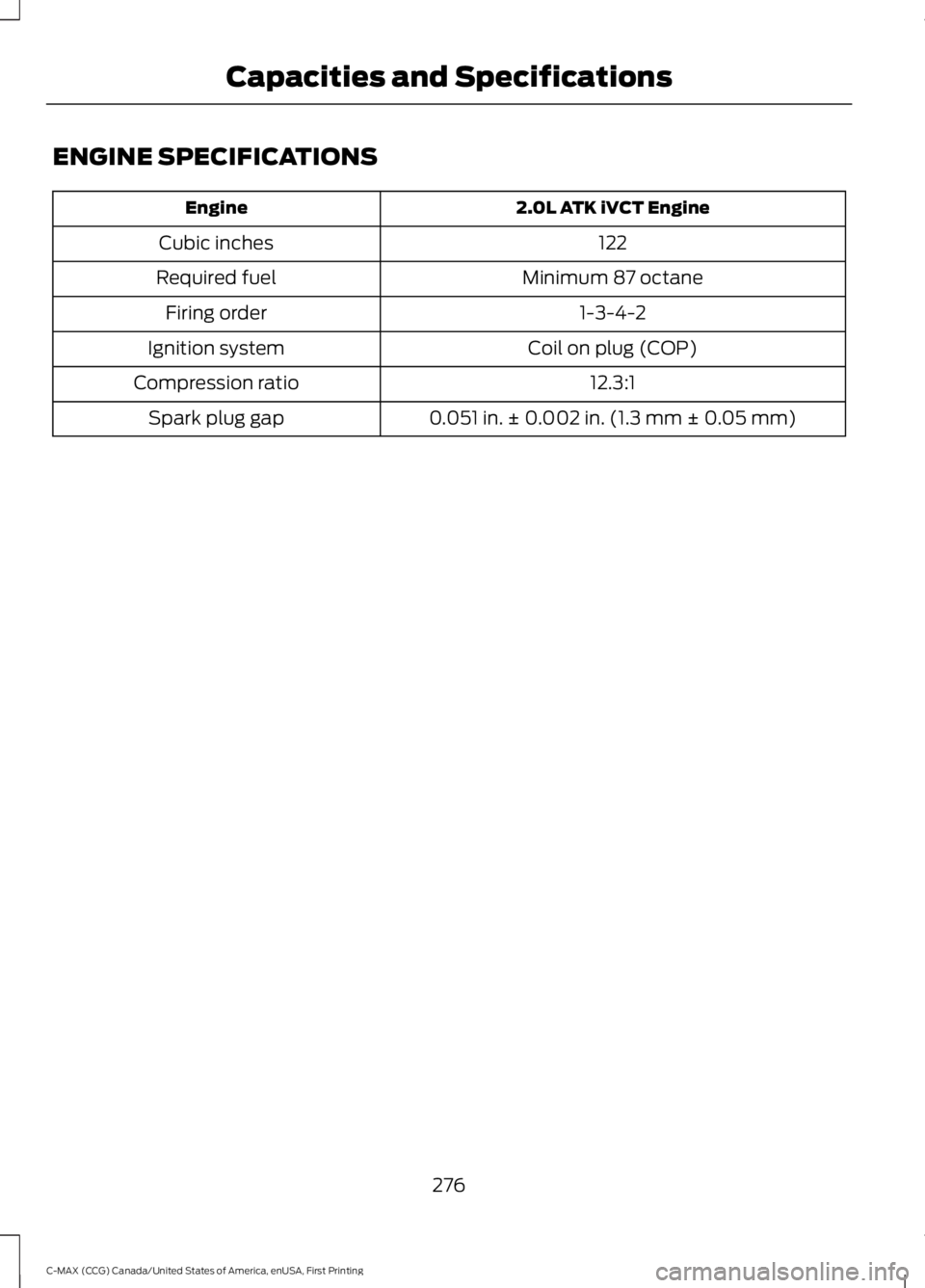
ENGINE SPECIFICATIONS
2.0L ATK iVCT Engine
Engine
122
Cubic inches
Minimum 87 octane
Required fuel
1-3-4-2
Firing order
Coil on plug (COP)
Ignition system
12.3:1
Compression ratio
0.051 in. ± 0.002 in. (1.3 mm ± 0.05 mm)
Spark plug gap
276
C-MAX (CCG) Canada/United States of America, enUSA, First Printing Capacities and Specifications
Page 283 of 395
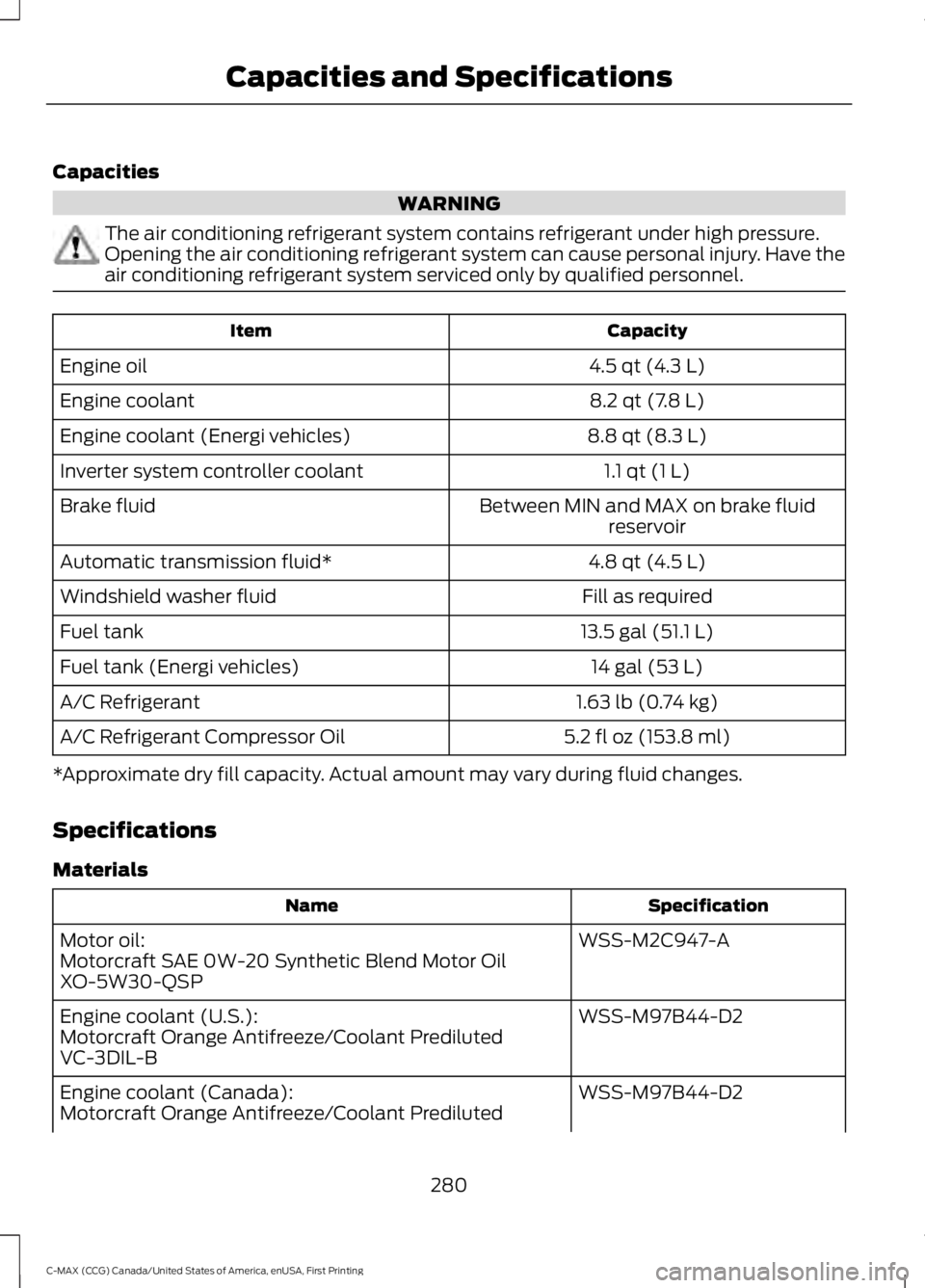
Capacities
WARNING
The air conditioning refrigerant system contains refrigerant under high pressure.
Opening the air conditioning refrigerant system can cause personal injury. Have the
air conditioning refrigerant system serviced only by qualified personnel.
Capacity
Item
4.5 qt (4.3 L)
Engine oil
8.2 qt (7.8 L)
Engine coolant
8.8 qt (8.3 L)
Engine coolant (Energi vehicles)
1.1 qt (1 L)
Inverter system controller coolant
Between MIN and MAX on brake fluidreservoir
Brake fluid
4.8 qt (4.5 L)
Automatic transmission fluid*
Fill as required
Windshield washer fluid
13.5 gal (51.1 L)
Fuel tank
14 gal (53 L)
Fuel tank (Energi vehicles)
1.63 lb (0.74 kg)
A/C Refrigerant
5.2 fl oz (153.8 ml)
A/C Refrigerant Compressor Oil
*Approximate dry fill capacity. Actual amount may vary during fluid changes.
Specifications
Materials Specification
Name
WSS-M2C947-A
Motor oil:
Motorcraft SAE 0W-20 Synthetic Blend Motor Oil
XO-5W30-QSP
WSS-M97B44-D2
Engine coolant (U.S.):
Motorcraft Orange Antifreeze/Coolant Prediluted
VC-3DIL-B
WSS-M97B44-D2
Engine coolant (Canada):
Motorcraft Orange Antifreeze/Coolant Prediluted
280
C-MAX (CCG) Canada/United States of America, enUSA, First Printing Capacities and Specifications