fuel FORD CONTOUR 1998 2.G Owner's Manual
[x] Cancel search | Manufacturer: FORD, Model Year: 1998, Model line: CONTOUR, Model: FORD CONTOUR 1998 2.GPages: 200, PDF Size: 2.7 MB
Page 93 of 200

Driving
93 •D (Overdrive)
Note that the vehicle’s gearshift is
console-mounted on the floor. The
transaxle control switch (TCS) is
located on the gearshift handle.
The transaxle control indicator
light (O/D light) is located on the
instrument panel.
Overdrive is not shown on the
display, but is the default mode for
the D gearshift position. This is the
normal driving mode for the best
fuel economy. The transaxle
operates in gears one through four.
The O/D light is off (not
illuminated) during normal vehicle
operation.
Overdrive can be deactivated by
pressing the transaxle control
switch (TCS) located on the
gearshift handle. The O/D OFF
indicator light will illuminate in the
instrument cluster. •N(Neutral)
The wheels of the transaxle are not
locked. Your vehicle will roll freely,
even on the slightest incline, unless
the parking brake or brakes are on.
CDW IVB1-10Driving en C 5/15/97 8:52 PM Page 93
Page 97 of 200
Driving
97 22
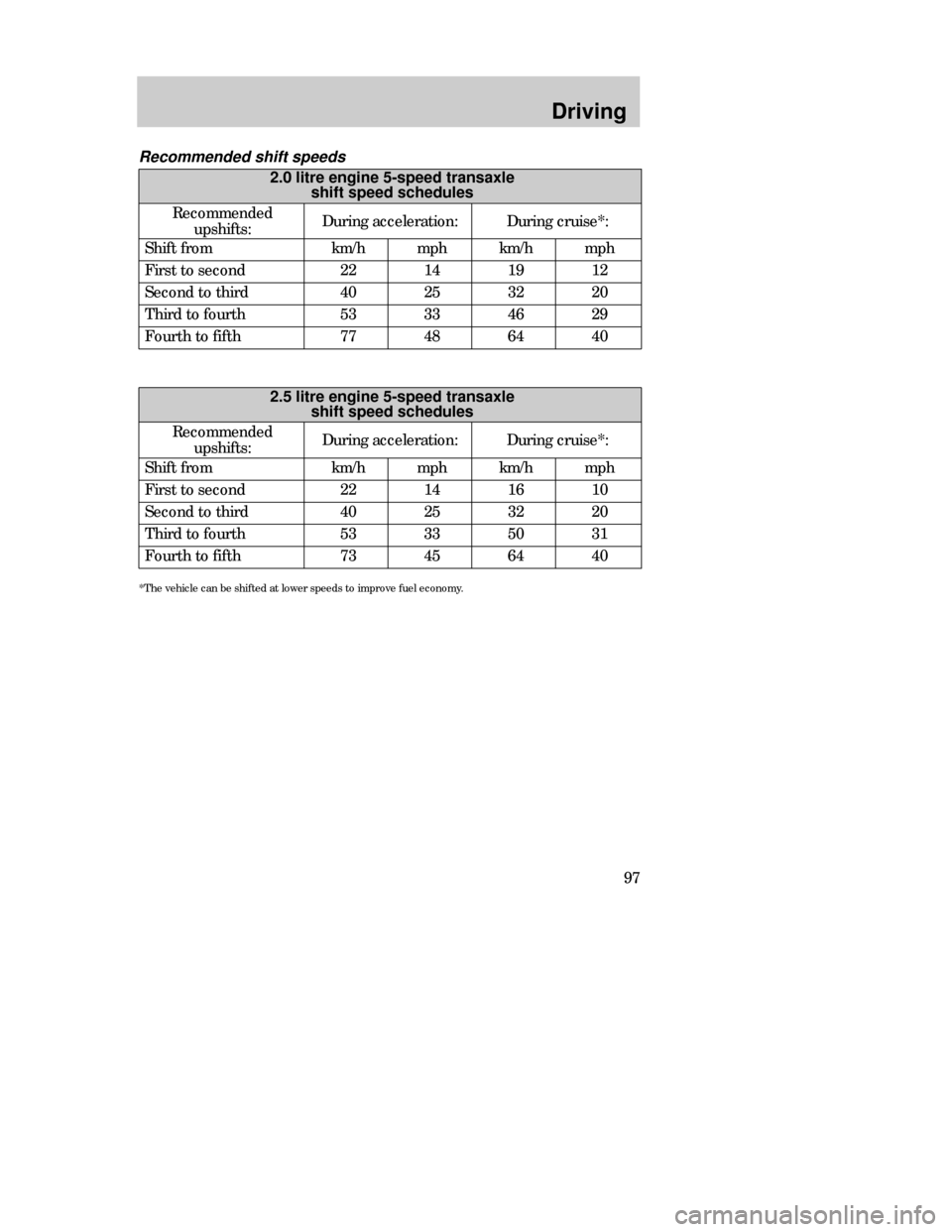
Recommended shift speeds
2.0 litre engine 5-speed transaxle
shift speed schedules
Recommended
upshifts:
Shift fromkm/hmph
14
25
33
48
40
53
77mph
12
20
29
40
km/h
19
32
64 First to second
Second to third
Third to fourth
Fourth to fifthDuring acceleration:During cruise*:
46
2.5 litre engine 5-speed transaxle
shift speed schedules
km/h
mphkm/hmph
10
20
31
40 16
32
50
64
14
25
33
4522
40
53
73
Shift from
First to second
Second to third
Third to fourth
Fourth to fifth
Recommended
upshifts:During acceleration:During cruise*:
*The vehicle can be shifted at lower speeds to improve fuel economy.
CDW IVB1-10Driving en C 5/15/97 8:52 PM Page 97
Page 109 of 200

Driving
109 FUELCONSUMPTION
Fuel economy can be improved by
avoiding:
•lack of regular, scheduled
maintenance,
•excessive speed,
•rapid acceleration,
•driving with the brake pedal
depressed,
•sudden stops,
•extended engine idling,
•use of speed control in hilly
terrain,
•extended use of the air
conditioner, defroster, rear
window defroster and other
accessories,
•underinflated tires,
•heavy loads,
•aftermarked add-ons such as
bike, ski or luggage racks, bug
deflectors, etc.
CDW IVB1-10Driving en C 5/15/97 8:52 PM Page 109
Page 110 of 200
110
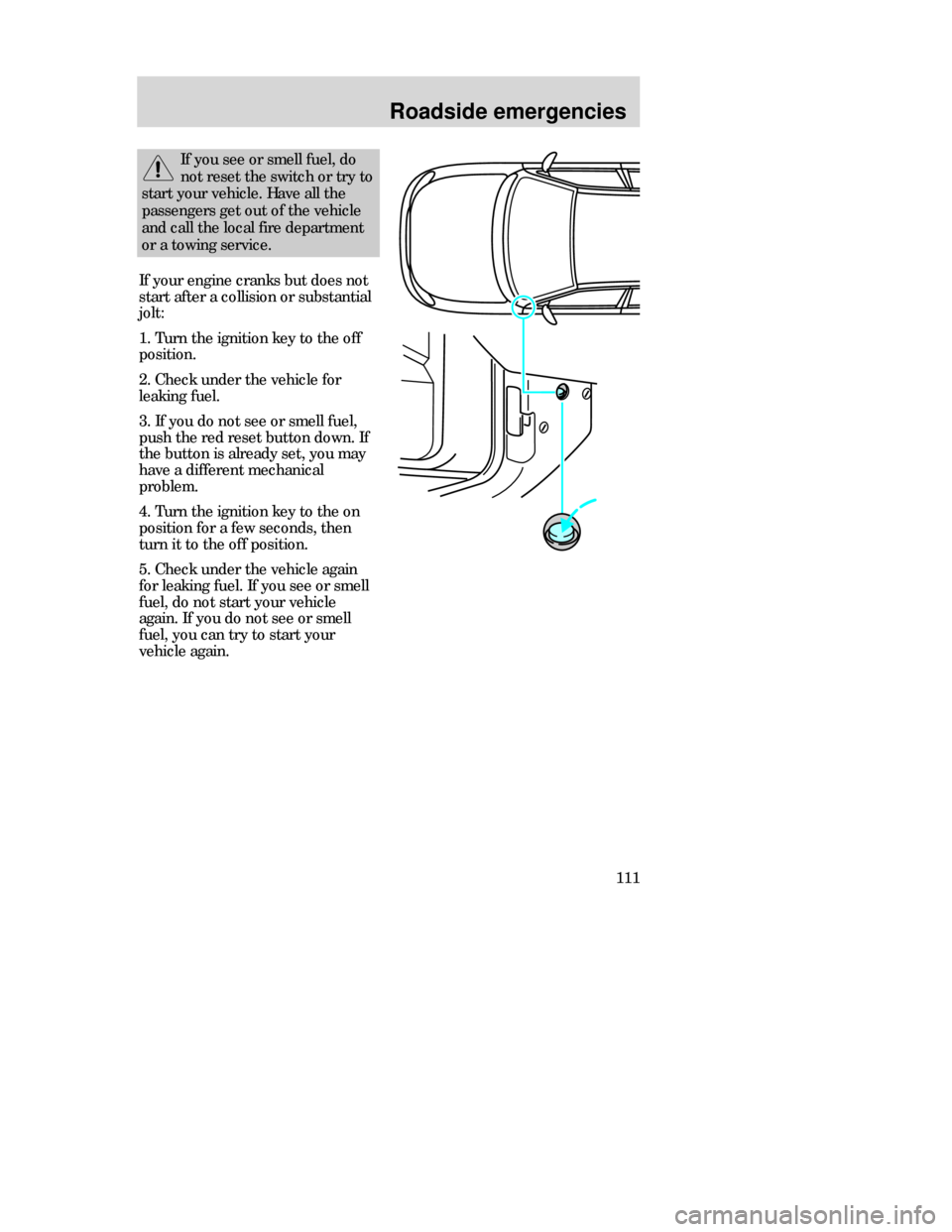
FUELPUMPSHUT-OFF SWITCH
If the engine cranks, but does not
start or does not start after a
collision, the fuel pump shut-off
switch may have been activated.
The shut-off switch is a device
intended to stop the electric fuel
pump when your vehicle has been
involved in a substantial jolt.
Once the shut-off switch is
activated, you must reset the
switch by hand before you can start
your vehicle. The switch is located
on the side panel in front of the
driver’s side door.
Roadside emergencies
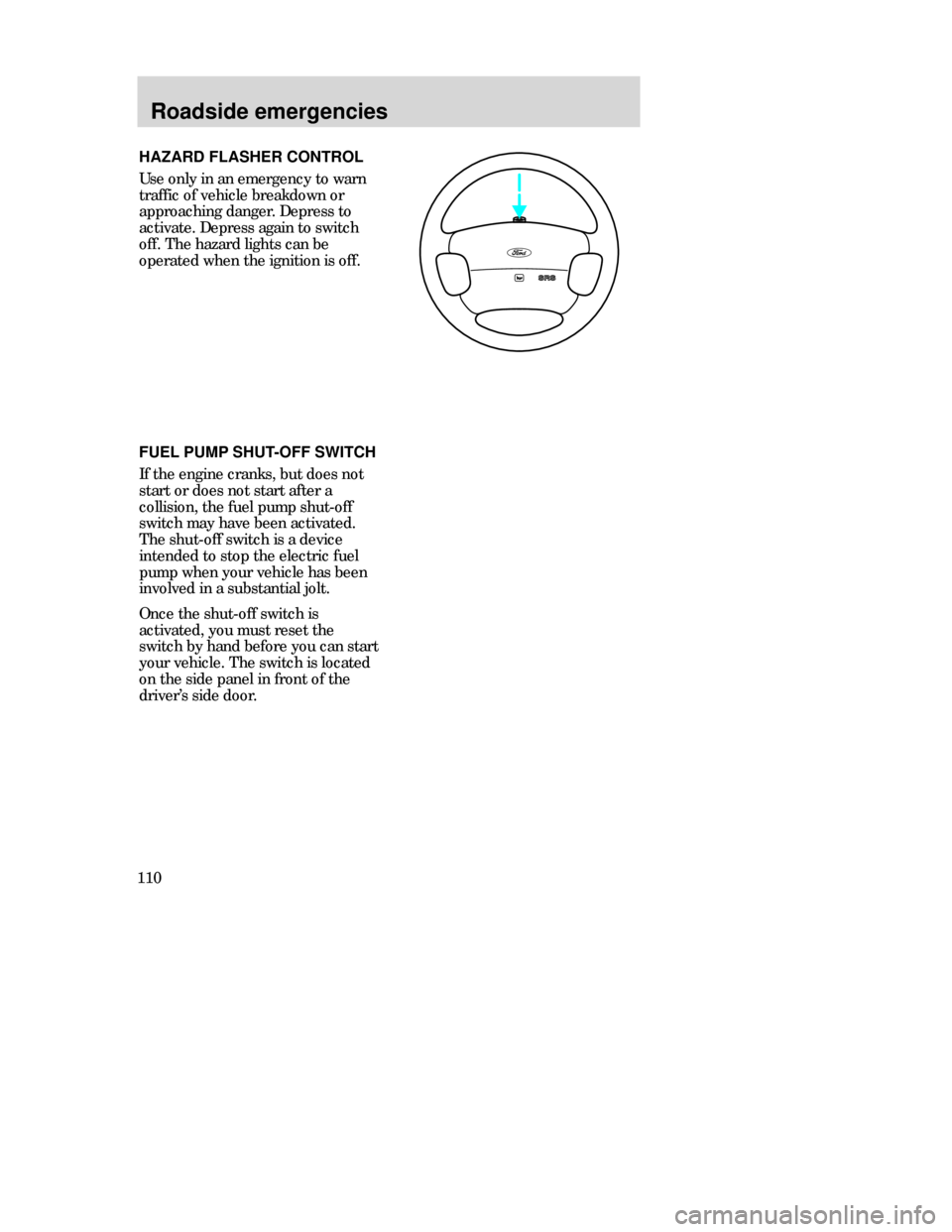
HAZARD FLASHER CONTROL
Use only in an emergency to warn
traffic of vehicle breakdown or
approaching danger. Depress to
activate. Depress again to switch
off. The hazard lights can be
operated when the ignition is off.
CDW IVC1-6Roads en C 5/15/97 8:53 PM Page 110
Page 111 of 200
Roadside emergencies
111
If your engine cranks but does not
start after a collision or substantial
jolt:
1. Turn the ignition key to the off
position.
2. Check under the vehicle for
leaking fuel.
3. If you do not see or smell fuel,
push the red reset button down. If
the button is already set, you may
have a different mechanical
problem.
4. Turn the ignition key to the on
position for a few seconds, then
turn it to the off position.
5. Check under the vehicle again
for leaking fuel. If you see or smell
fuel, do not start your vehicle
again. If you do not see or smell
fuel, you can try to start your
vehicle again.
If you see or smell fuel, do
not reset the switch or try to
start your vehicle. Have all the
passengers get out of the vehicle
and call the local fire department
or a towing service.
CDW IVC1-6Roads en C 5/15/97 8:53 PM Page 111
Page 114 of 200
Roadside emergencies
114Ampere
rating
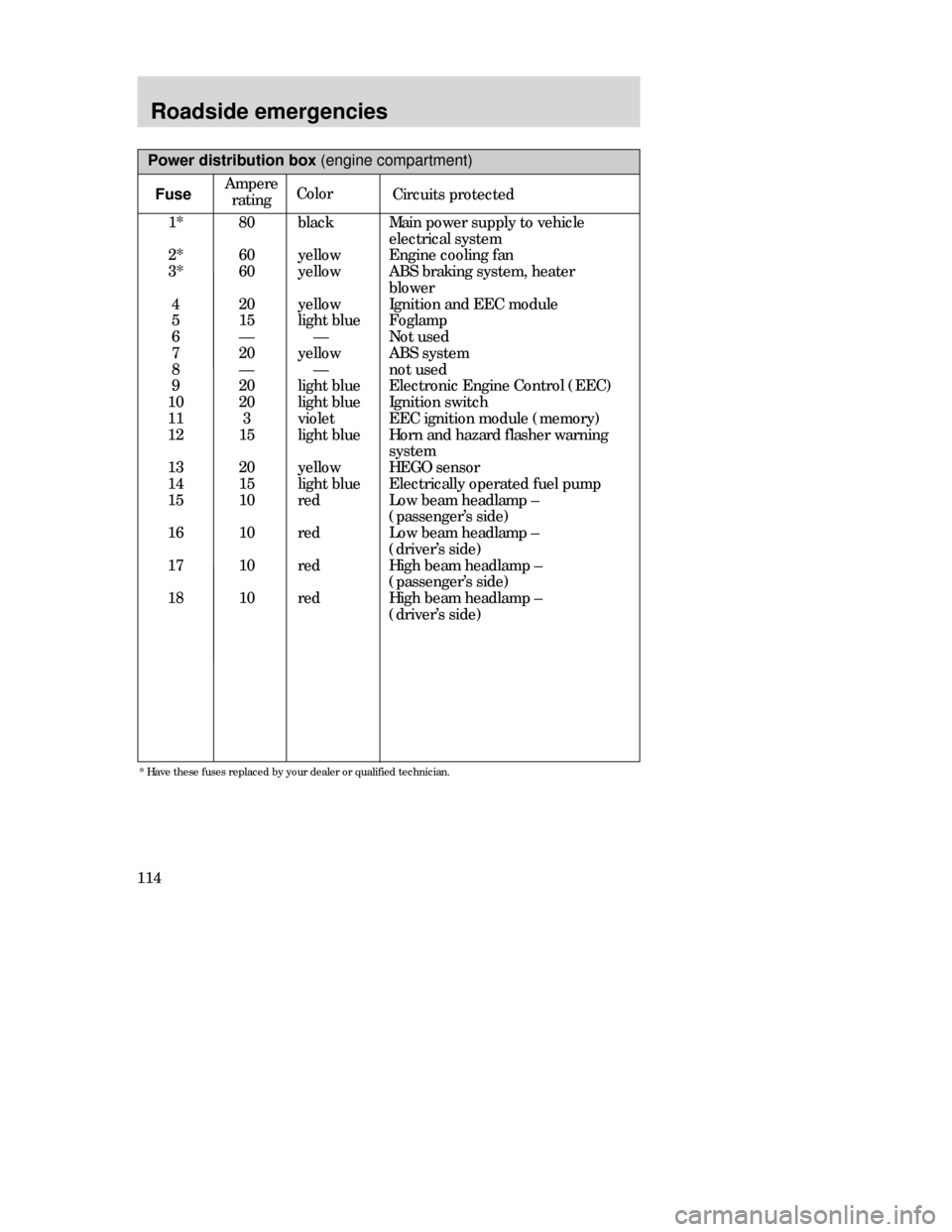
Power distribution box (engine compartment)
Color
Circuits protected
1*
2*
3*
4
5
6
7
8
9
10
11
12
13
14
15
16
17
1880
60
60
20
15
—
20
—
20
20
3
15
20
15
10
10
10
10black
yellow
yellow
yellow
light blue
—
yellow
—
light blue
light blue
violet
light blue
yellow
light blue
red
red
red
redMain power supply to vehicle
electrical system
Engine cooling fan
ABS braking system, heater
blower
Ignition and EEC module
Foglamp
Not used
ABS system
not used
Electronic Engine Control (EEC)
Ignition switch
EEC ignition module (memory)
Horn and hazard flasher warning
system
HEGO sensor
Electrically operated fuel pump
Low beam headlamp –
(passenger’s side)
Low beam headlamp –
(driver’s side)
High beam headlamp –
(passenger’s side)
High beam headlamp –
(driver’s side)
* Have these fuses replaced by your dealer or qualified technician.
Fuse
CDW IVC1-6Roads en C 5/15/97 8:53 PM Page 114
Page 115 of 200
Roadside emergencies
115
Power distribution box (engine compartment)
RelayCircuits switched
R 1
R 2
R 3
R 4
R 5
R 6
R 7
R 8
R 9
R 10
R 11
D1
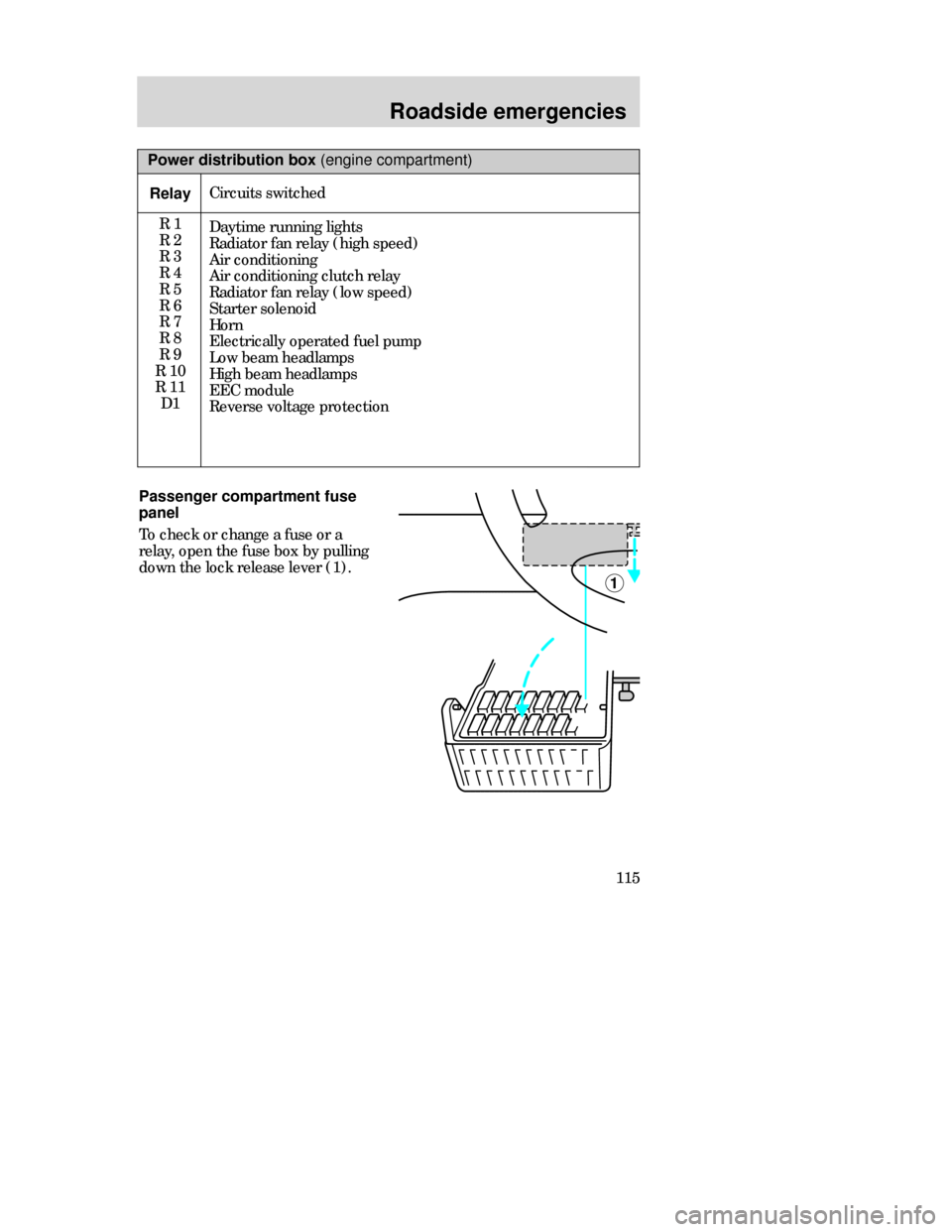
Passenger compartment fuse
panel
To check or change a fuse or a
relay, open the fuse box by pulling
down the lock release lever (1).
1
Daytime running lights
Radiator fan relay (high speed)
Air conditioning
Air conditioning clutch relay
Radiator fan relay (low speed)
Starter solenoid
Horn
Electrically operated fuel pump
Low beam headlamps
High beam headlamps
EEC module
Reverse voltage protection
CDW IVC1-6Roads en C 5/15/97 8:53 PM Page 115
Page 128 of 200
Maintenance and care
128SERVICE RECOMMENDATIONS
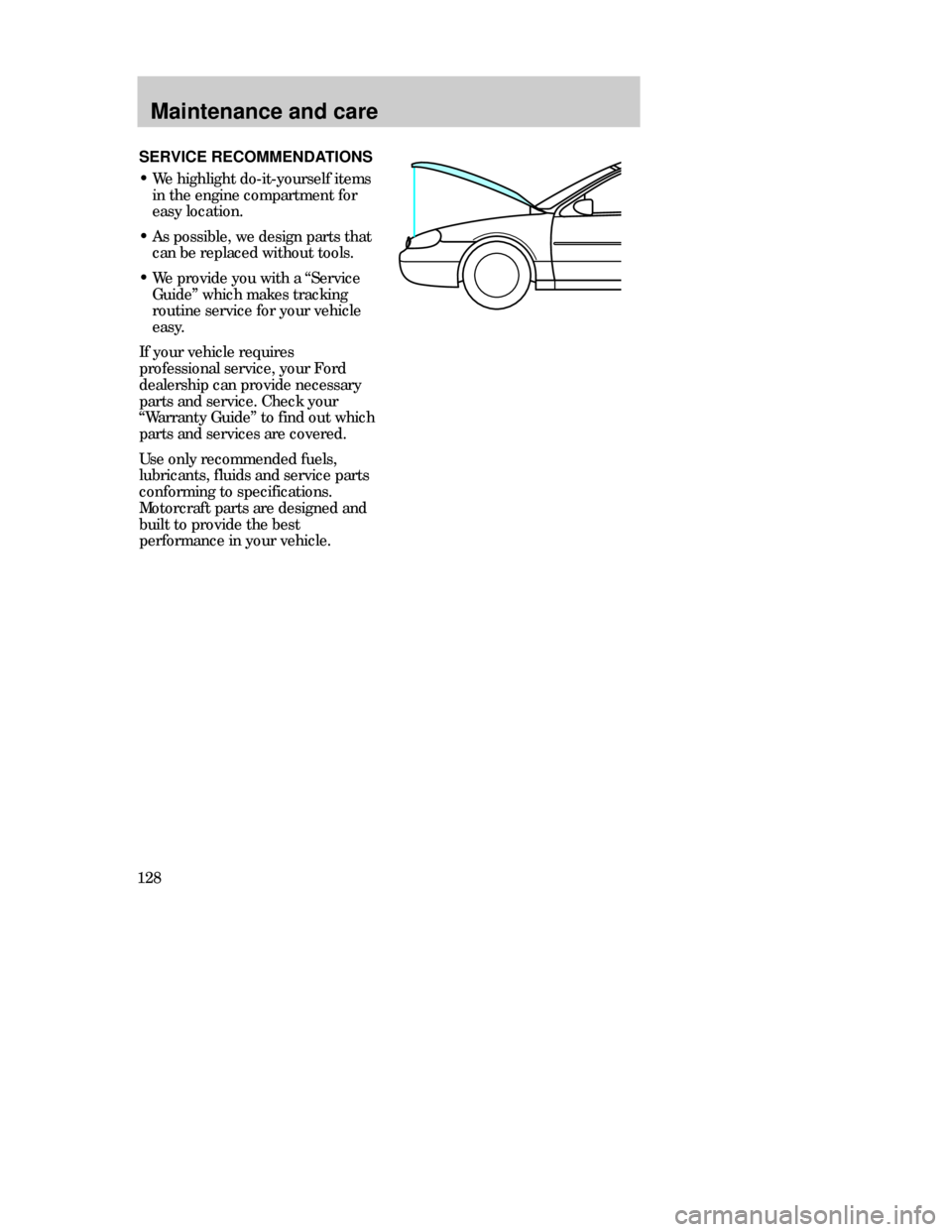
•We highlight do-it-yourself items
in the engine compartment for
easy location.
•As possible, we design parts that
can be replaced without tools.
•We provide you with a “Service
Guide” which makes tracking
routine service for your vehicle
easy.
If your vehicle requires
professional service, your Ford
dealership can provide necessary
parts and service. Check your
“Warranty Guide” to find out which
parts and services are covered.
Use only recommended fuels,
lubricants, fluids and service parts
conforming to specifications.
Motorcraft parts are designed and
built to provide the best
performance in your vehicle.
CDW VA1-19Maint en C 5/15/97 8:55 PM Page 128
Page 129 of 200
Maintenance and care
129 Precautions when servicing
your vehicle
Be especially careful when
inspecting or servicing your
vehicle. Here are some general
precautions for your safety:
•Do not work on a hot engine.
The cooling fan is automatic
and may come on at any
time. Always disconnect the
negative terminal of the battery
before working near the fan.
•If you must work with the engine
running, avoid wearing loose
clothing or jewelry that could get
caught in moving parts. Take
precautions with long hair.
•Do not work on a vehicle with the
engine running in an enclosed
space, unless you are sure you
have enough ventilation.
•Keep all lit cigarettes, open
flames and other lit material
away from the battery and all fuel
related parts.
If you disconnect the battery, the
engine must “relearn” its idle
conditions before your vehicle will
drive properly, as explained under
Battery in this chapter.
CDW VA1-19Maint en C 5/15/97 8:55 PM Page 129
Page 132 of 200
Maintenance and care
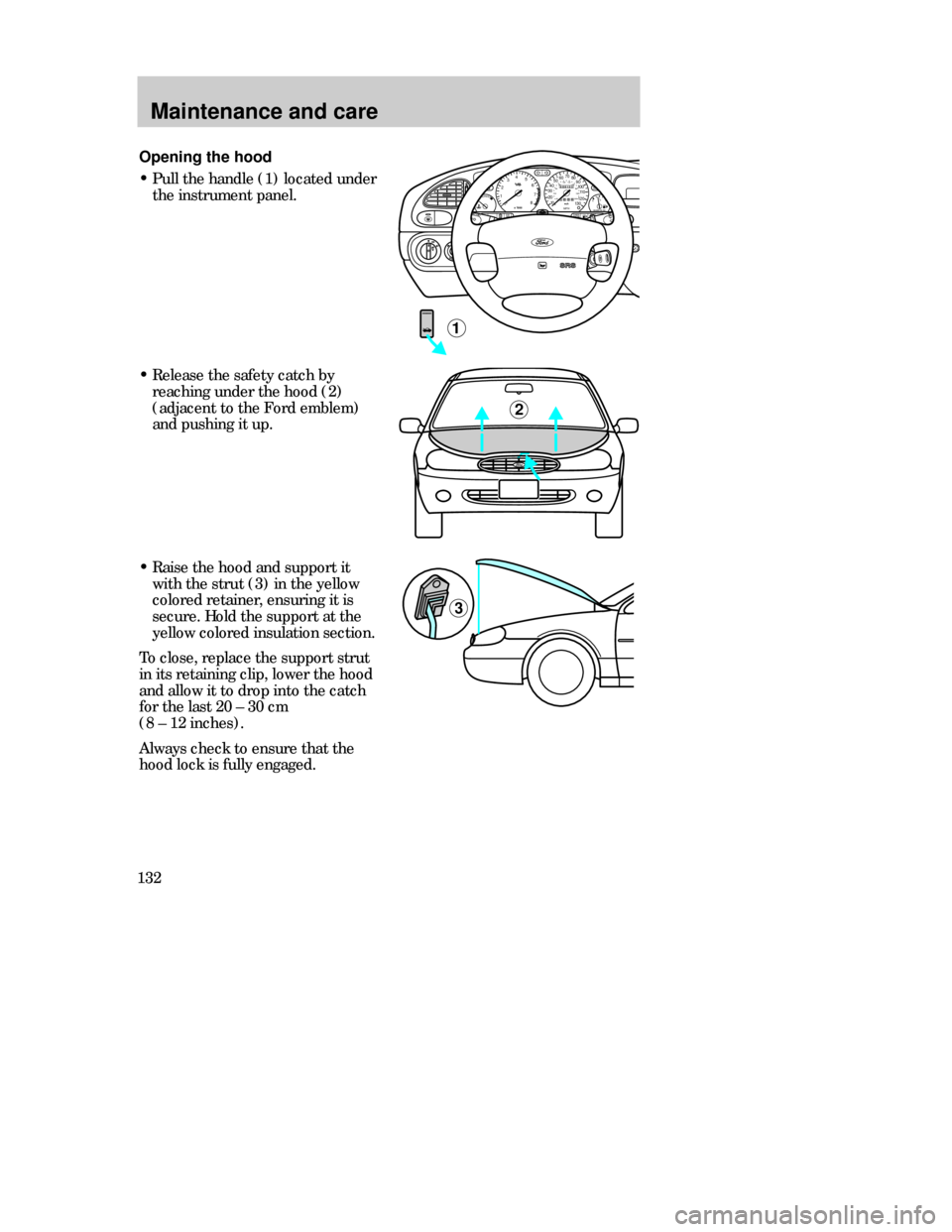
132Opening the hood
•Pull the handle (1) located under
the instrument panel.
000123000010 20 3040506070
80
90
100
110
120
130MPH20 406055
80120 100
140
160
180
200EF 1
/
2UNLEADED FUEL ONLY12
03x 1000
4
5
6
7
8
NORMALBRAKE
CHECK
ENGINE TRACTION
CONTROLO/D
OFF
MIRRORS
1
•Release the safety catch by
reaching under the hood (2)
(adjacent to the Ford emblem)
and pushing it up.
2
3
•Raise the hood and support it
with the strut (3) in the yellow
colored retainer, ensuring it is
secure. Hold the support at the
yellow colored insulation section.
To close, replace the support strut
in its retaining clip, lower the hood
and allow it to drop into the catch
for the last 20 – 30 cm
(8 – 12 inches).
Always check to ensure that the
hood lock is fully engaged.
CDW VA1-19Maint en C 5/15/97 8:56 PM Page 132