engine FORD CONTOUR 1998 2.G Repair Manual
[x] Cancel search | Manufacturer: FORD, Model Year: 1998, Model line: CONTOUR, Model: FORD CONTOUR 1998 2.GPages: 200, PDF Size: 2.7 MB
Page 141 of 200
Maintenance and care
141 Always dispose of used
automotive fluids in a
responsible manner. Follow your
community’s standards for recycling
and disposing of automotive fluids.
Recycled engine coolant
Ford Motor Company recommends
that Ford and Lincoln-Mercury
dealers use recycled engine coolant
produced by Ford-approved
processes. Not all coolant recycling
processes produce coolant which
meets Ford specifications ESE-
M97B44-A, and use of such coolant
may harm engine and cooling
system components.
CDW VA1-19Maint en C 5/15/97 8:56 PM Page 141
Page 142 of 200
Maintenance and care
142
MAX
MIN
Adding engine coolant
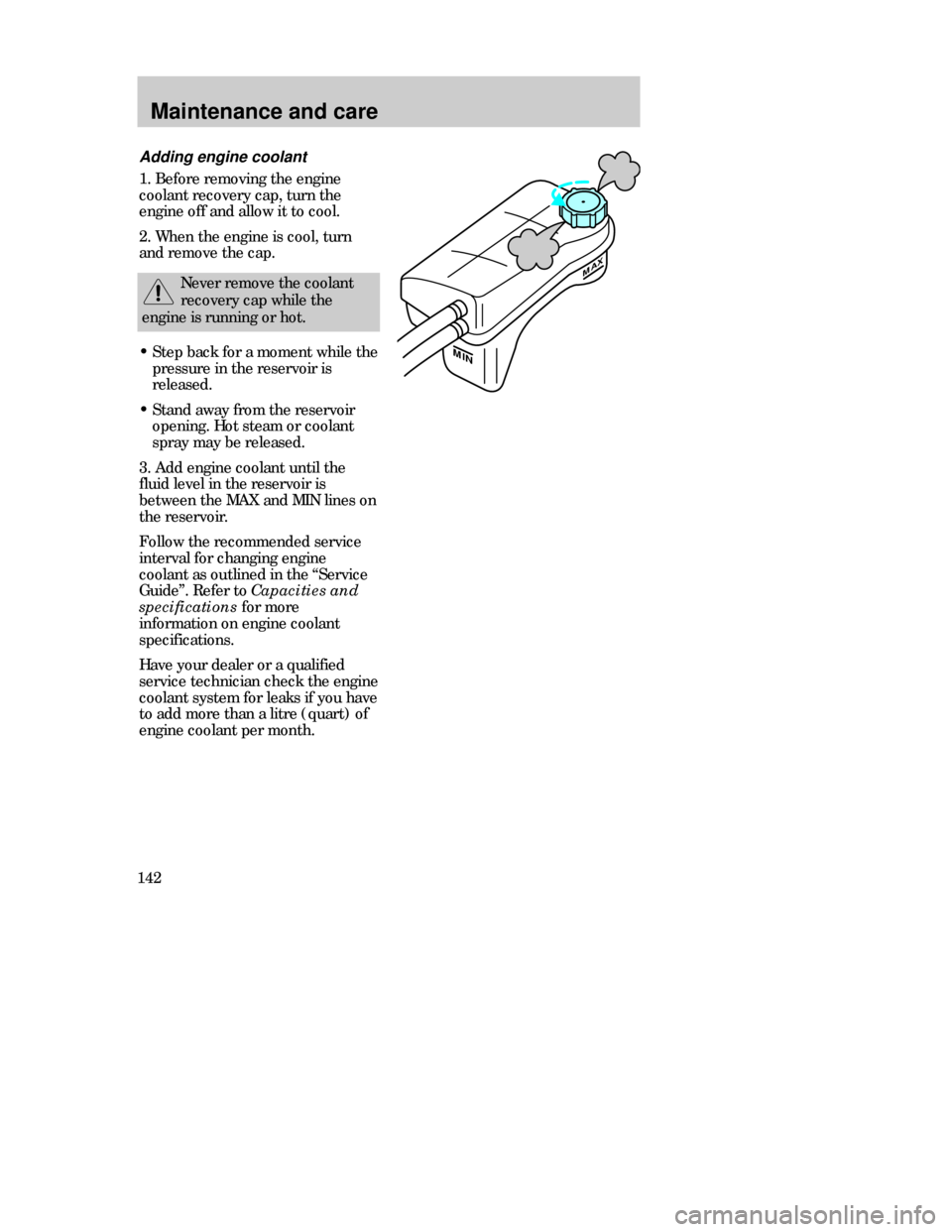
1. Before removing the engine
coolant recovery cap, turn the
engine off and allow it to cool.
2. When the engine is cool, turn
and remove the cap.
Never remove the coolant
recovery cap while the
engine is running or hot.
•Step back for a moment while the
pressure in the reservoir is
released.
•Stand away from the reservoir
opening. Hot steam or coolant
spray may be released.
3. Add engine coolant until the
fluid level in the reservoir is
between the MAX and MIN lines on
the reservoir.
Follow the recommended service
interval for changing engine
coolant as outlined in the “Service
Guide”. Refer to Capacities and
specifications for more
information on engine coolant
specifications.
Have your dealer or a qualified
service technician check the engine
coolant system for leaks if you have
to add more than a litre (quart) of
engine coolant per month.
CDW VA1-19Maint en C 5/15/97 8:56 PM Page 142
Page 143 of 200
Maintenance and care
143
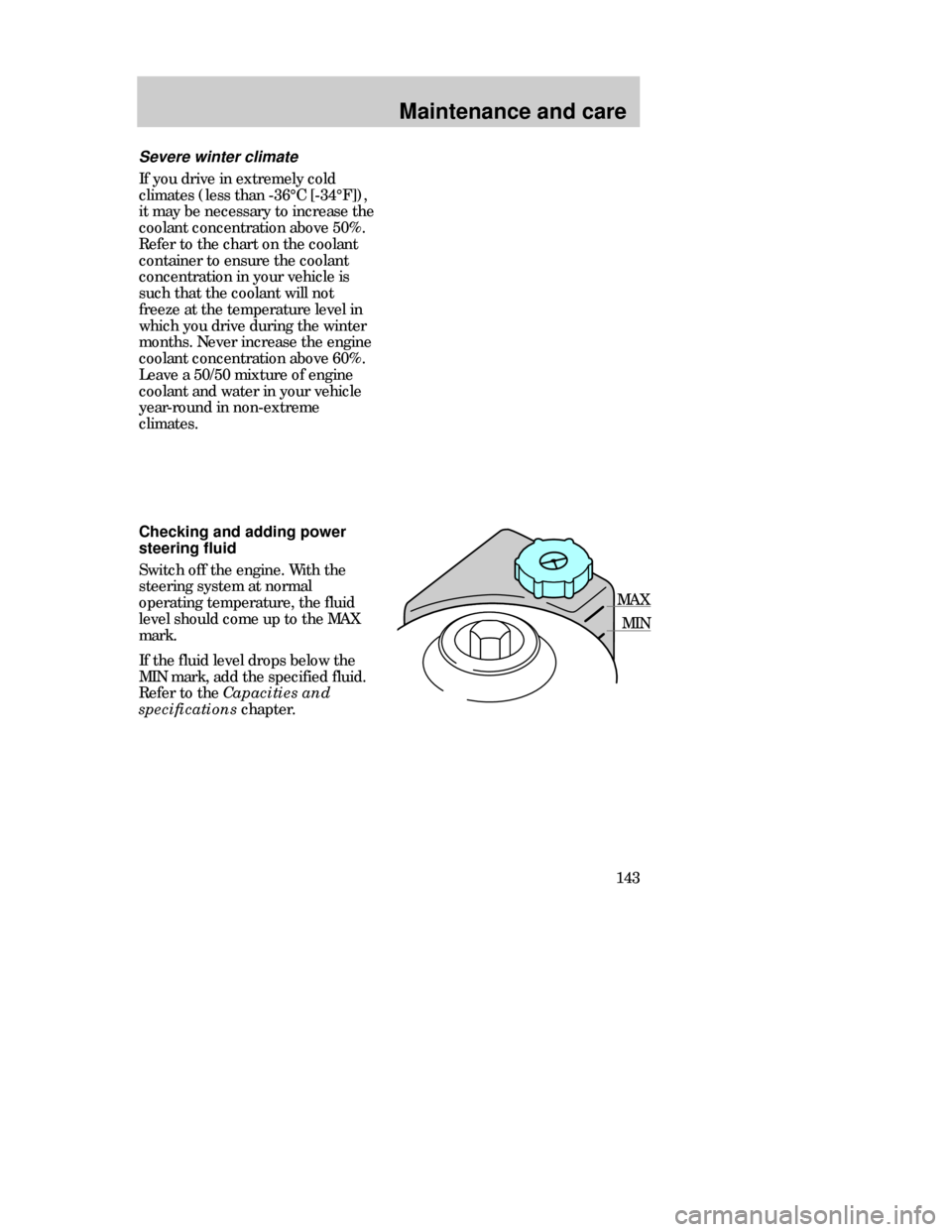
Checking and adding power
steering fluid
Switch off the engine. With the
steering system at normal
operating temperature, the fluid
level should come up to the MAX
mark.
If the fluid level drops below the
MIN mark, add the specified fluid.
Refer to the Capacities and
specificationschapter.
Severe winter climate
If you drive in extremely cold
climates (less than -36°C [-34°F]),
it may be necessary to increase the
coolant concentration above 50%.
Refer to the chart on the coolant
container to ensure the coolant
concentration in your vehicle is
such that the coolant will not
freeze at the temperature level in
which you drive during the winter
months. Never increase the engine
coolant concentration above 60%.
Leave a 50/50 mixture of engine
coolant and water in your vehicle
year-round in non-extreme
climates.
MAX
MIN
CDW VA1-19Maint en C 5/15/97 8:56 PM Page 143
Page 145 of 200

Maintenance and care
145
Checking the automatic
transaxle fluid
With the vehicle on a level surface
and the brake fully applied, start
the engine and move the gearshift
lever through all of the gears.
Securely latch the lever in P
(Park). Set parking brake and leave
the engine running.
Wipe off the dipstick cap and pull
the dipstick out. Wipe indicator
clean. Put dipstick back into filler
tube and make sure it is fully
seated. Pull the dipstick out and
read the fluid level.
Note that your vehicle should not
be driven until some fluid has been
added if the fluid level is below the
bottom dimple on the dipstick and
the outside temperature is above
10°C (50°F). Add only enough fluid
to bring the level above the bottom
hole.
If the vehicle has not been driven
and the fluid level is above the
bottom dimple on the dipstick,
don’t add fluid. Recheck the level
after driving your vehicle
approximately 30 km (20 miles)
when the engine has reached
normal operating temperature. The
fluid level should be within the
crosshatched area on the dipstick.
CDW VA1-19Maint en C 5/15/97 8:56 PM Page 145
Page 149 of 200

Maintenance and care
149 Relearning the idle function
Because your vehicle’s engine is
electronically controlled, some
control conditions are maintained
by power from the battery. When
the battery is disconnected or a
new battery is installed, the
computer must “relearn” its idle
conditions before your vehicle can
drive properly. To begin this
process:
1. Put the automatic transaxle
gearshift in P (Park). Put the
manual transaxle gearshift in
neutral.
2. Turn off all accessories and start
the vehicle.
3. Let the engine idle for at least
one minute.
4. The “relearning” process will
automatically complete as you
drive the vehicle.
•If you do not allow the engine to
“relearn” its idle, the idle quality
of your vehicle may be adversely
affected until the idle is
eventually “relearned”.
•If the battery has been
disconnected or if a new battery
has been installed, the clock and
preset radio stations must be
reset once the battery is
reconnected.
CDW VA1-19Maint en C 5/15/97 8:56 PM Page 149
Page 151 of 200
Maintenance and care
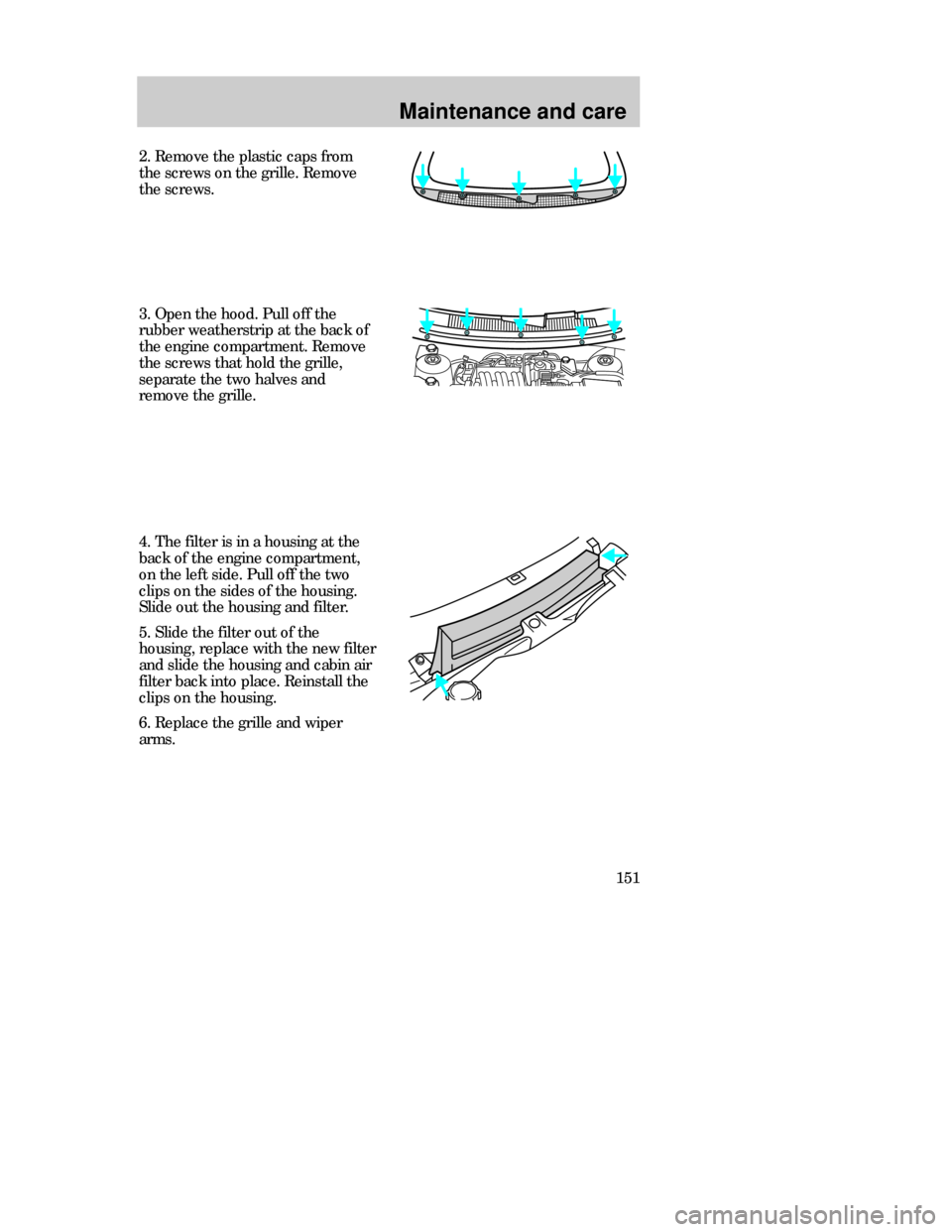
151 2. Remove the plastic caps from
the screws on the grille. Remove
the screws.
3. Open the hood. Pull off the
rubber weatherstrip at the back of
the engine compartment. Remove
the screws that hold the grille,
separate the two halves and
remove the grille.
4. The filter is in a housing at the
back of the engine compartment,
on the left side. Pull off the two
clips on the sides of the housing.
Slide out the housing and filter.
5. Slide the filter out of the
housing, replace with the new filter
and slide the housing and cabin air
filter back into place. Reinstall the
clips on the housing.
6. Replace the grille and wiper
arms.
CDW VA1-19Maint en C 5/15/97 8:56 PM Page 151
Page 161 of 200

Maintenance and care
161 Observe the following guidelines
when handling automotive fuel:
•Extinguish all smoking materials
and any open flames before
fueling your vehicle.
•Always turn off the vehicle
before fueling.
•Make sure the fuel cap is
correctly fitted after fueling.
Failure to do so may cause the on
board diagnostic system to
illuminate the CHECK ENGINE
light.
•Automotive fuels can be harmful
or fatal if swallowed. If fuel is
swallowed, call a physician
immediately, even if no
symptoms are immediately
apparent. The toxic effects of
fuel may not be visible for hours.
•Fuels can also be harmful if
absorbed through the skin. If fuel
is splashed on the skin, promptly
remove contaminated clothing
and wash skin thoroughly with
soap and water.
•If fuel is splashed in the eyes,
remove contact lenses (if worn),
flush with water for 15 minutes
and seek medical attention.
•Be particularly careful if you are
taking “Antabuse” or other forms
of disulfiram for the treatment of
alcoholism. Breathing gasoline
vapors or skin contact could
cause an adverse reaction.
Consult a physician immediately.
CDW VA1-19Maint en C 5/15/97 8:56 PM Page 161
Page 162 of 200

Maintenance and care
162Choosing the right fuel
Use only UNLEADED FUEL. The
use of leaded fuel is prohibited by
law and could damage your vehicle.
The damage may not be covered by
your warranty.
Your vehicle was not designed to
use fuel containing manganese-
based additives such as MMT.
Additionally, vehicles certified to
California emission standards
(indicated on the underhood
Vehicle Emission Control
Information label) are designed to
operate on California reformulated
gasolines. If California reformulated
gasoline is not available when you
refuel, your vehicle can be
operated on non-California fuels.
However, even though your engine
will perform adequately on other
gasolines, the performance of the
emission control devices and
systems may be adversely affected.
Repair of damage caused by a fuel
that your vehicle was not designed
for may not be covered by your
warranty.
CDW VA1-19Maint en C 5/15/97 8:56 PM Page 162
Page 163 of 200
Maintenance and care
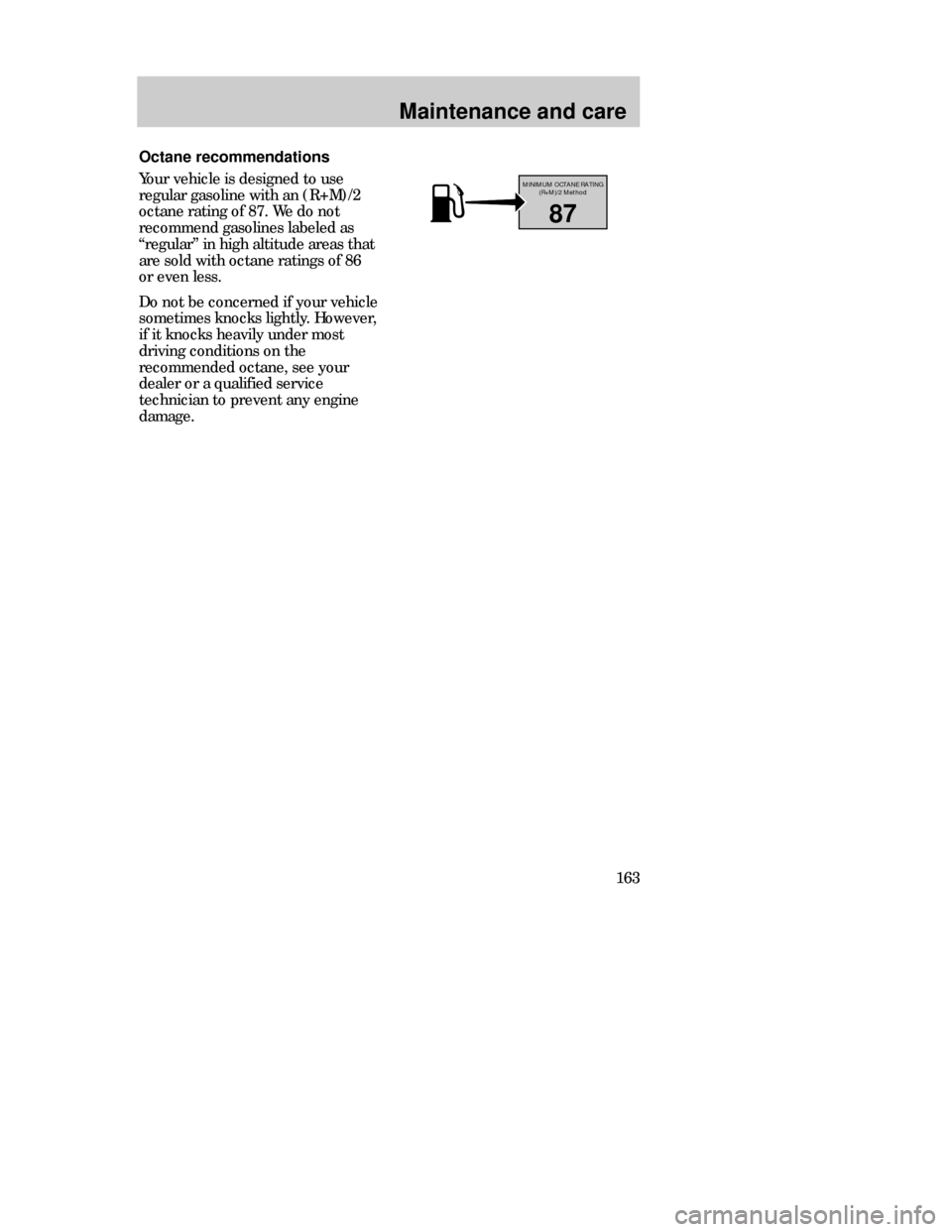
163 Octane recommendations
Your vehicle is designed to use
regular gasoline with an (R+M)/2
octane rating of 87. We do not
recommend gasolines labeled as
“regular” in high altitude areas that
are sold with octane ratings of 86
or even less.
Do not be concerned if your vehicle
sometimes knocks lightly. However,
if it knocks heavily under most
driving conditions on the
recommended octane, see your
dealer or a qualified service
technician to prevent any engine
damage.
87
MINIMUM OCTANE RATING
(R+M)/2 Method
CDW VA1-19Maint en C 5/15/97 8:56 PM Page 163
Page 166 of 200
Maintenance and care
166WHAT YOU SHOULD KNOW
ABOUT THE EMISSION
CONTROLSYSTEM
For more information about your
vehicle’s emission control system,
refer to the Vehicle Emission
Control Information Decal located
on the inside, left of the engine
compartment.
The catalytic converter enables the
vehicle’s emission control system to
operate properly.
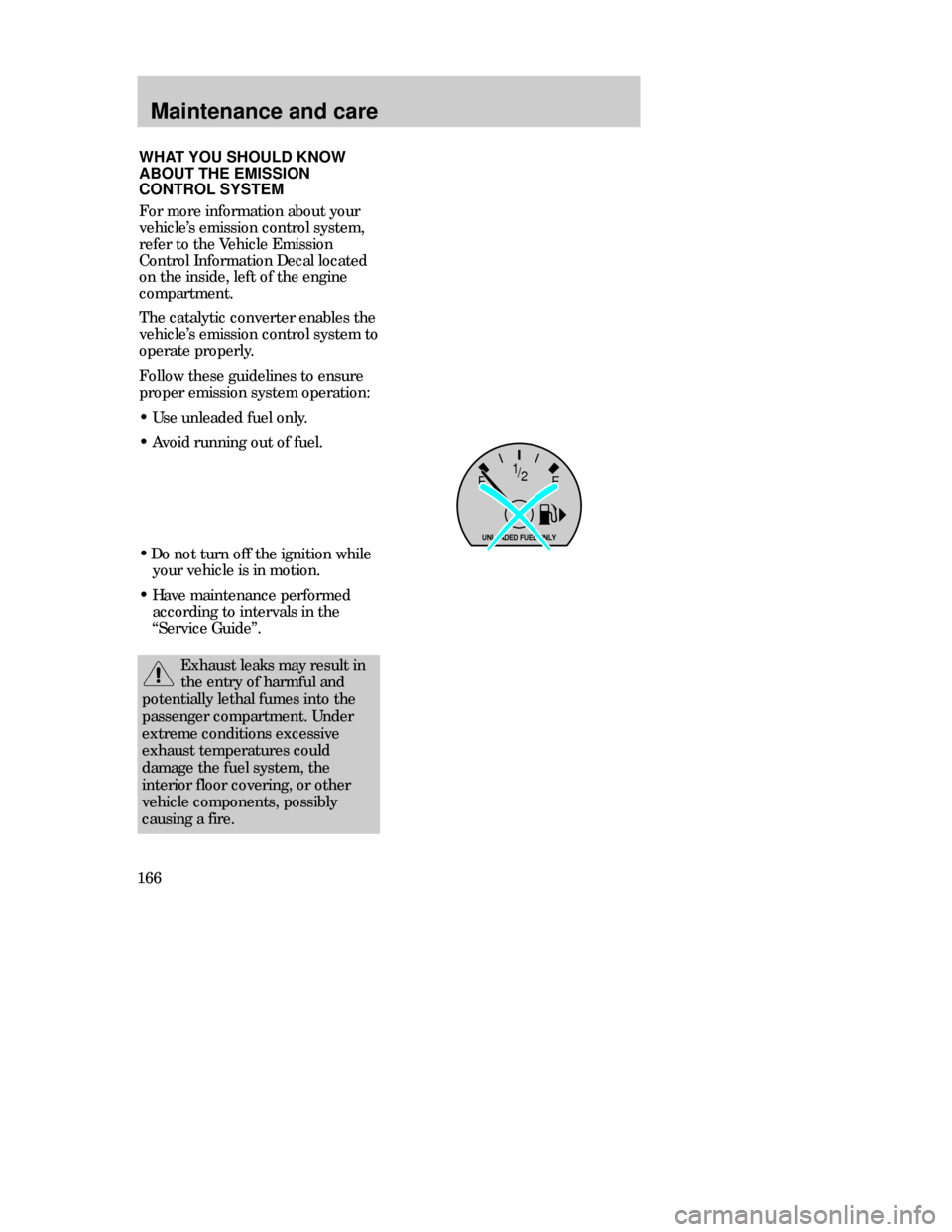
Follow these guidelines to ensure
proper emission system operation:
•Use unleaded fuel only.
•Avoid running out of fuel.
EF 1
/
2
UNLEADED FUEL ONLY
• Do not turn off the ignition while
your vehicle is in motion.
•Have maintenance performed
according to intervals in the
“Service Guide”.
Exhaust leaks may result in
the entry of harmful and
potentially lethal fumes into the
passenger compartment. Under
extreme conditions excessive
exhaust temperatures could
damage the fuel system, the
interior floor covering, or other
vehicle components, possibly
causing a fire.
CDW VA1-19Maint en C 5/15/97 8:56 PM Page 166