air conditioning FORD CROWN VICTORIA 2000 2.G Owners Manual
[x] Cancel search | Manufacturer: FORD, Model Year: 2000, Model line: CROWN VICTORIA, Model: FORD CROWN VICTORIA 2000 2.GPages: 224, PDF Size: 1.05 MB
Page 26 of 224
Press the rear defroster control to clear the rear window of thin ice and
fog.
•A small LED will illuminate when the rear defroster is activated.
The ignition must be in the ON position to operate the rear window
defroster.
The defroster turns off automatically after 10 minutes or when the
ignition is turned to the OFF position. To manually turn off the defroster
before 10 minutes have passed, push the control again.
CLIMATE CONTROL SYSTEM
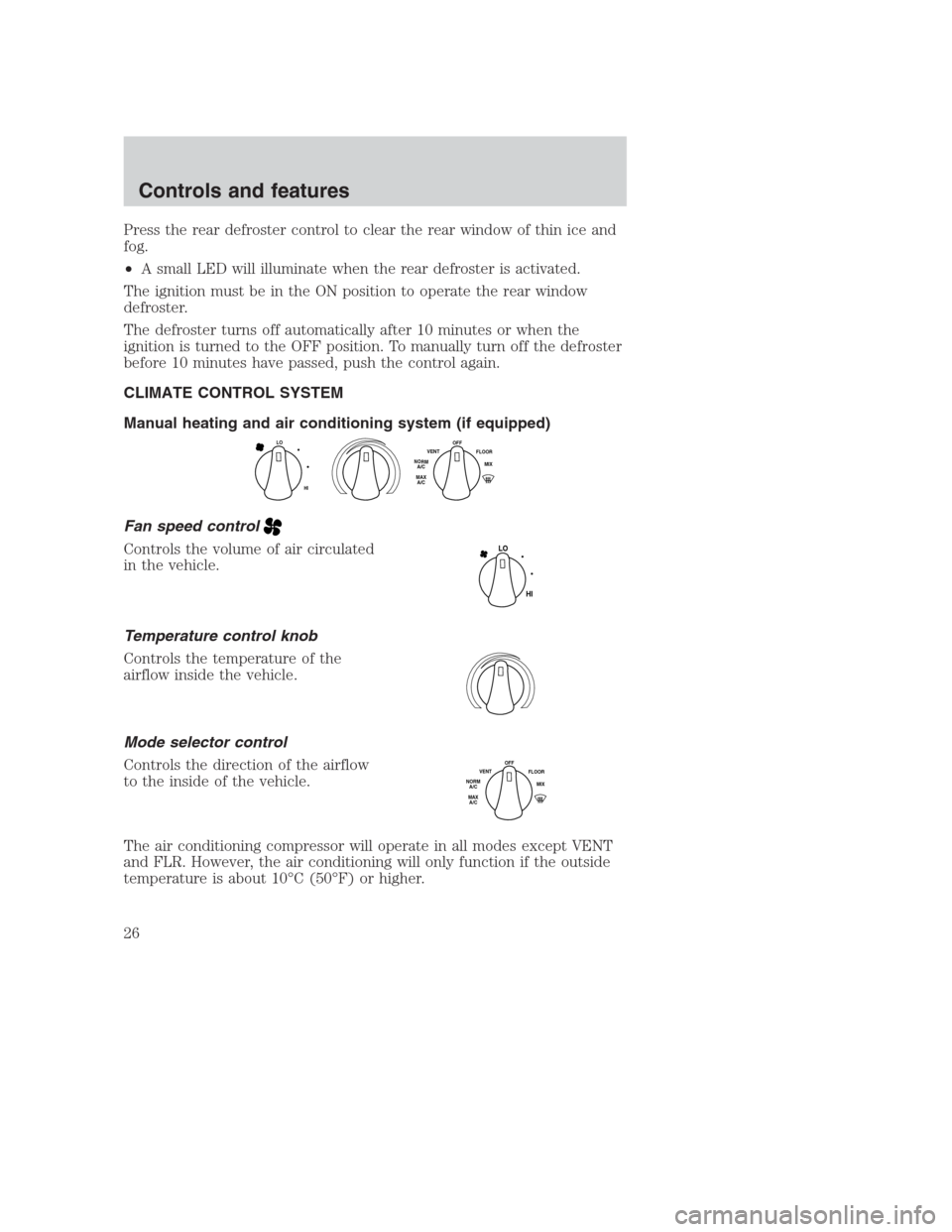
Manual heating and air conditioning system (if equipped)
Fan speed control
Controls the volume of air circulated
in the vehicle.
Temperature control knob
Controls the temperature of the
airflow inside the vehicle.
Mode selector control
Controls the direction of the airflow
to the inside of the vehicle.
The air conditioning compressor will operate in all modes except VENT
and FLR. However, the air conditioning will only function if the outside
temperature is about 10°C (50°F) or higher.
LO
HIOFF
MIX VENTFLOOR
MAX
A/C NO
RM
A/C
LO
HI
OFF
MIX VENTFLOOR
MAX
A/C NORM
A/C
Controls and features
26
Page 27 of 224
Since the air conditioner removes considerable moisture from the air
during operation, it is normal if clear water drips on the ground under
the air conditioner drain while the system is working and even after you
have stopped the vehicle.
•MAX A/C-Uses recirculated air to cool the vehicle. MAX A/C is noisier
than NORM A/C but more economical and will cool the inside of the
vehicle faster. Airflow will be from the instrument panel registers. This
mode can also be used to prevent undesirable odors from entering the
vehicle.
•NORM A/C-Uses outside air to cool the vehicle. It is quieter than MAX
A/C but not as economical. Airflow will be from the instrument panel
registers.
•VENT-Distributes outside air through the instrument panel registers.
However, the air will not be cooled below the outside temperature
because the air conditioning does not operate in this mode.
•OFF-Outside air is shut out and the fan will not operate. For short
periods of time only, use this mode to prevent undesirable odors from
entering the vehicle.
•FLR-Allows for maximum heating by distributing outside air through
the floor ducts. However, the air will not be cooled below the outside
temperature because the air conditioning does not operate in this
mode.
•MIX-Distributes outside air through the windshield defroster ducts and
the floor ducts. Heating and air conditioning capabilities are provided
in this mode. For added customer comfort, when the temperature
control knob is anywhere in between the full hot and full cold
positions, the air distributed through the floor ducts will be slightly
warmer than the air sent to the windshield defroster ducts. If the
temperature is about 10°C (50°F) or higher, the air conditioner will
automatically dehumidify the air to reduce fogging.
•DEF
-Distributes outside air through the windshield defroster
ducts. It can be used to clear ice or fog from the windshield. If the
temperature is about 10°C (50°F) or higher, the air conditioner will
automatically dehumidify the air to reduce fogging.
Controls and features
27
Page 31 of 224
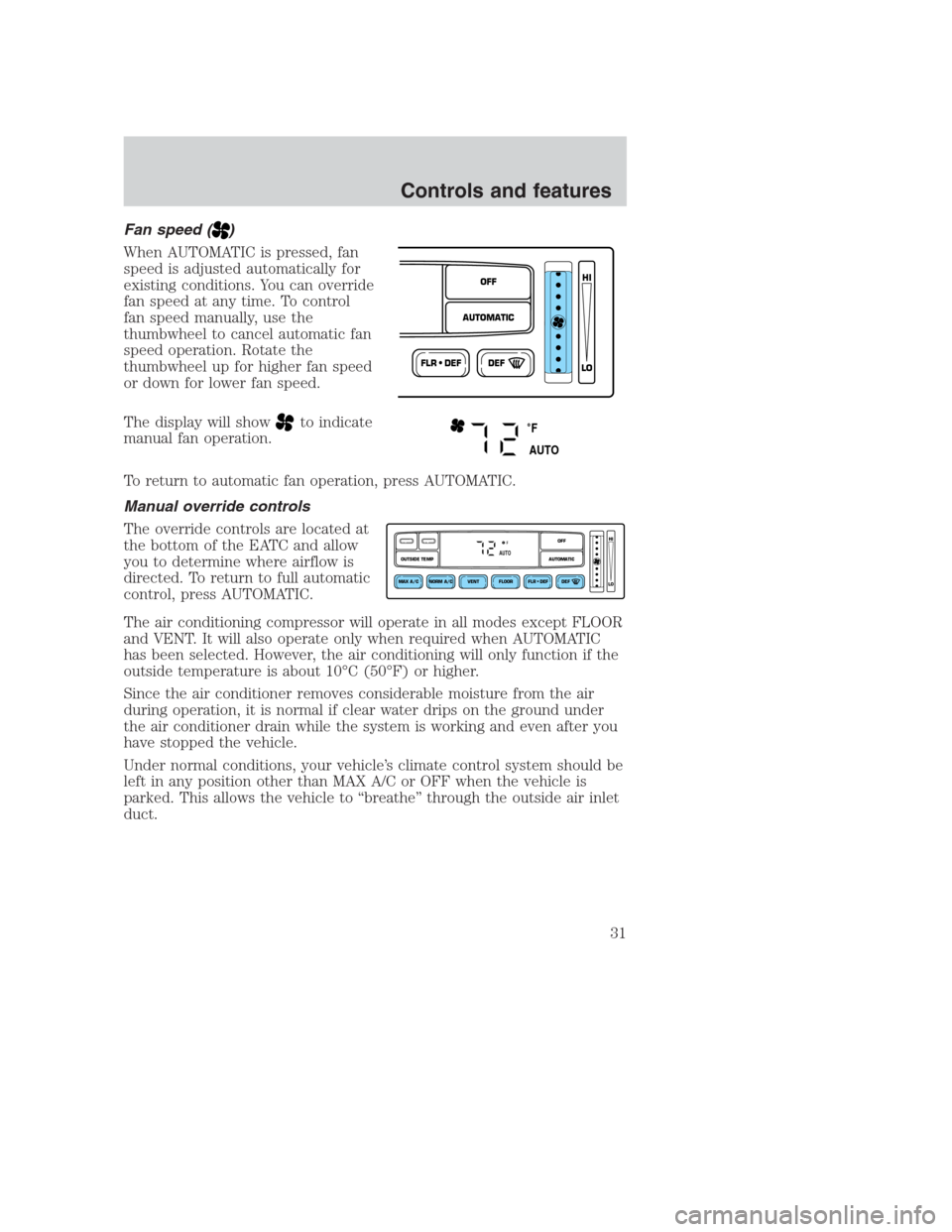
Fan speed ()
When AUTOMATIC is pressed, fan
speed is adjusted automatically for
existing conditions. You can override
fan speed at any time. To control
fan speed manually, use the
thumbwheel to cancel automatic fan
speed operation. Rotate the
thumbwheel up for higher fan speed
or down for lower fan speed.
The display will show
to indicate
manual fan operation.
To return to automatic fan operation, press AUTOMATIC.
Manual override controls
The override controls are located at
the bottom of the EATC and allow
you to determine where airflow is
directed. To return to full automatic
control, press AUTOMATIC.
The air conditioning compressor will operate in all modes except FLOOR
and VENT. It will also operate only when required when AUTOMATIC
has been selected. However, the air conditioning will only function if the
outside temperature is about 10°C (50°F) or higher.
Since the air conditioner removes considerable moisture from the air
during operation, it is normal if clear water drips on the ground under
the air conditioner drain while the system is working and even after you
have stopped the vehicle.
Under normal conditions, your vehicle’s climate control system should be
left in any position other than MAX A/C or OFF when the vehicle is
parked. This allows the vehicle to “breathe” through the outside air inlet
duct.
FLR • DEFDEF
HI
LO
AUTOMATICOFF
˚F
AUTO
NORM A/CVENT FLOOR FLR • DEF DEF
HI
LO
MAX A/C
OUTSIDE TEMP AUTOMATICOFF
FAUTO
Controls and features
31
Page 32 of 224
•MAX A/C-Uses recirculated air to cool the vehicle. The temperature
display will remain the same and air will be cooled based on the
selected temperature. To exit, press AUTOMATIC or any other
override controls. MAX A/C is noisier than NORM A/C but more
economical and will cool the inside of the vehicle faster. Airflow is
from the instrument panel registers. This mode can also be used to
prevent undesirable odors from entering the vehicle.
•NORM A/C-Uses outside air to cool the vehicle. The temperature
display will remain the same and air will be cooled based on the
selected temperature. It is quieter than MAX A/C but not as
economical. Fan speed will remain automatic. Airflow is from the
instrument panel registers.
•VENT-Distributes outside air through the instrument panel registers.
However, the air cannot be cooled below the outside temperature
because the air conditioning does not operate in this mode.
•FLOOR-Allows for maximum heating by distributing outside air
through the floor ducts. However, the air cannot be cooled below the
outside temperature because the air conditioning does not operate in
this mode.
•FLR•DEF-Distributes outside air through the windshield defroster
ducts and the floor ducts. Heating and air conditioning capabilities are
provided in this mode. The air will be heated or cooled based on the
temperature selection. For added customer comfort, the air
distributed through the floor ducts will be slightly warmer than the air
sent to the windshield defroster ducts. If the temperature is about
10°C (50°F) or higher, the air conditioner will automatically
dehumidify the air to reduce fogging.
•DEF
-Distributes outside air through the windshield defroster
ducts. It can be used to clear ice or fog from the windshield. If the
outside air temperature is about 10°C (50°F) or higher, the air
conditioner will automatically dehumidify the air to reduce fogging.
•OFF-Outside air is shut out and the fan will not operate. For short
periods of time, use this mode to reduce undesirable odors from
entering the vehicle.
Controls and features
32
Page 121 of 224
To prevent electrical shock, do not use your heater with
ungrounded electrical systems or two-pronged (cheater)
adapters.
Guarding against exhaust fumes
Although odorless and colorless, carbon monoxide is present in exhaust
fumes. Take precautions to avoid its dangerous effects.
If you ever smell exhaust fumes of any kind inside your vehicle,
have your dealer inspect and fix your vehicle immediately. Do
not drive if you smell exhaust fumes. These fumes are harmful and
could kill you.
Have the exhaust and body ventilation systems checked whenever:
•the vehicle is raised for service.
•the sound of the exhaust system changes.
•the vehicle has been damaged in a collision.
Engine exhaust, some of its constituents, and certain vehicle
components contain or emit chemicals known to the State of
California to cause cancer, and birth defects or other reproductive
harm.
Important ventilating information
If the engine is idling while the vehicle is stopped in an open area for
long periods of time, open the windows at least 2.5 cm (one inch).
Adjust the heating or air conditioning (if equipped) to bring in fresh air.
Improve vehicle ventilation by
keeping all air inlet vents clear of
snow, leaves and other debris.
Starting
121
Page 166 of 224
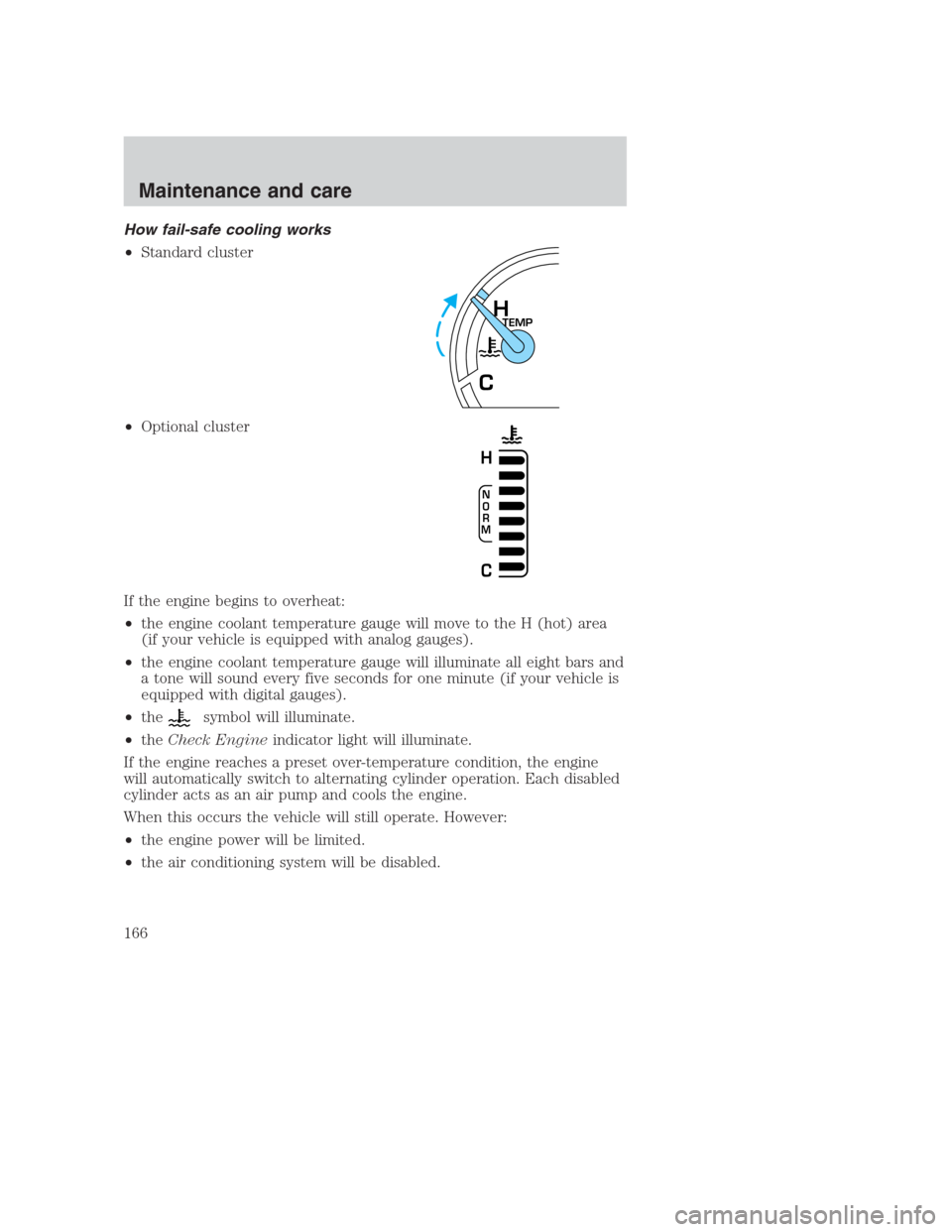
How fail-safe cooling works
•Standard cluster
•Optional cluster
If the engine begins to overheat:
•the engine coolant temperature gauge will move to the H (hot) area
(if your vehicle is equipped with analog gauges).
•the engine coolant temperature gauge will illuminate all eight bars and
a tone will sound every five seconds for one minute (if your vehicle is
equipped with digital gauges).
•the
symbol will illuminate.
•theCheck Engineindicator light will illuminate.
If the engine reaches a preset over-temperature condition, the engine
will automatically switch to alternating cylinder operation. Each disabled
cylinder acts as an air pump and cools the engine.
When this occurs the vehicle will still operate. However:
•the engine power will be limited.
•the air conditioning system will be disabled.
TEMPH
C
N
O
R
M
H
C
Maintenance and care
166
Page 219 of 224
Air bag supplemental
restraint system ........................106
and child safety seats ............108
description ..............................106
disposal ....................................110
driver air bag ..........................108
indicator light ....................10,110
operation .................................108
passenger air bag ...................108
Air cleaner filter ................173,201
Air conditioning ..........................26
automatic temperature
control system ..........................28
Air suspension ...........................127
description ..............................127
warning light .............................12
Antifreeze
(see Engine coolant) ................161
Anti-lock brake system
(see Brakes) .......................122,123
Audio system (see Radio) .........35
Automatic transmission
driving an automatic
overdrive .................................128
fluid, adding ............................168
fluid, checking ........................168
fluid, refill capacities ..............201
fluid, specification ..................204
Axle
lubricant specifications ...202,204
refill capacities ........................201
traction lok ..............................130
Battery .......................................171
acid, treating emergencies .....171
charging system
warning light .............................12
jumping a disabled battery ....148
maintenance-free ....................171
replacement, specifications ...201
servicing ..................................171
voltage gauge ............................19
Belt minder ...............................102Brakes ........................................122
anti-lock ............................122,123
anti-lock brake system
(ABS) warning light ..........11,123
brake warning light ..................11
fluid, checking and adding ....160
fluid, refill capacities ..............201
fluid, specifications ..........202,204
lubricant specifications ...202,204
shift interlock ..........................127
Break-in period .............................3
Capacities for refilling fluids ....201
Cassette tape player ...................50
CD changer .................................59
Certification Label ....................206
Child safety restraints ..............111
child safety belts ....................111
Child safety seats ......................112
attaching with tether straps ..116
in front seat ............................113
in rear seat .......................113,116
Cleaning your vehicle ...............194
engine compartment ..............197
exterior ....................................196
exterior lamps .........................196
instrument panel ....................198
instrument panel lens ............199
interior ..............................199,200
mirrors .....................................196
plastic parts ............................196
safety belts ..............................199
washing ....................................195
waxing .....................................195
wheels ......................................196
windows ..................................199
wiper blades ............................197
woodtone trim ........................199
Climate control (see Air
conditioning or Heating) ............26
Clock ............................................34
Compass, electronic ....................74
calibration .................................75
Index
219
Page 221 of 224
quality ......................................183
running out of fuel .................183
safety information relating to
automotive fuels .....................179
Fuses ...................................139,140
Garage door opener ....................70
Gas cap (see Fuel cap) ............181
Gas mileage
(see Fuel economy) .................184
Gauges .........................................15
battery voltage gauge ...............19
engine coolant
temperature gauge ...................18
engine oil pressure gauge ........19
fuel gauge ..................................15
odometer ...................................17
speedometer .............................16
trip odometer ............................18
GAWR
(Gross Axle Weight Rating) .....131
definition .................................131
driving with a heavy load ......131
location ....................................131
GVWR (Gross
Vehicle Weight Rating) .............131
calculating ...............................131
definition .................................131
driving with a heavy load ......131
location ....................................131
Hazard flashers .........................138
Head restraints ...........................92
Headlamps ...................................24
aiming ......................................194
autolamp system .......................25
bulb specifications ..................194
daytime running lights .............24
flash to pass ..............................25
high beam ............................11,25
replacing bulbs .......................189
turning on and off ....................24
warning chime ..........................15
Heating ........................................26heating and air conditioning
system .......................................26
HomeLink universal
transceiver (see Garage
door opener) ................70,71,72,73
Hood ..........................................155
Ignition .......................................204
positions of the ignition ...........65
Infant seats
(see Safety seats) .....................112
Inspection/maintenance
(I/M) testing ..............................188
Instrument panel
cleaning ...................................198
cluster ...................................8,199
lighting up
panel and interior .....................24
location of components ..............8
Jump-starting your vehicle ......148
Keyless entry system .................87
autolock .....................................81
keypad .......................................87
programming entry code .........88
Keys
key in ignition chime ...............14
positions of the ignition ...........65
Lamps
autolamp system .......................25
bulb replacement
specifications chart ................194
cargo lamps ...............................24
daytime running light ...............24
headlamps .................................24
headlamps, flash to pass ..........25
instrument panel, dimming .....24
interior lamps ....................24,193
replacing bulbs .........189,191,193
Lane change indicator
(see Turn signal) ........................64
Lights, warning and indicator ......8
air bag ........................................10
air suspension ...........................12
Index
221