fuel pressure FORD CROWN VICTORIA 2002 2.G Owners Manual
[x] Cancel search | Manufacturer: FORD, Model Year: 2002, Model line: CROWN VICTORIA, Model: FORD CROWN VICTORIA 2002 2.GPages: 240, PDF Size: 1.88 MB
Page 162 of 240
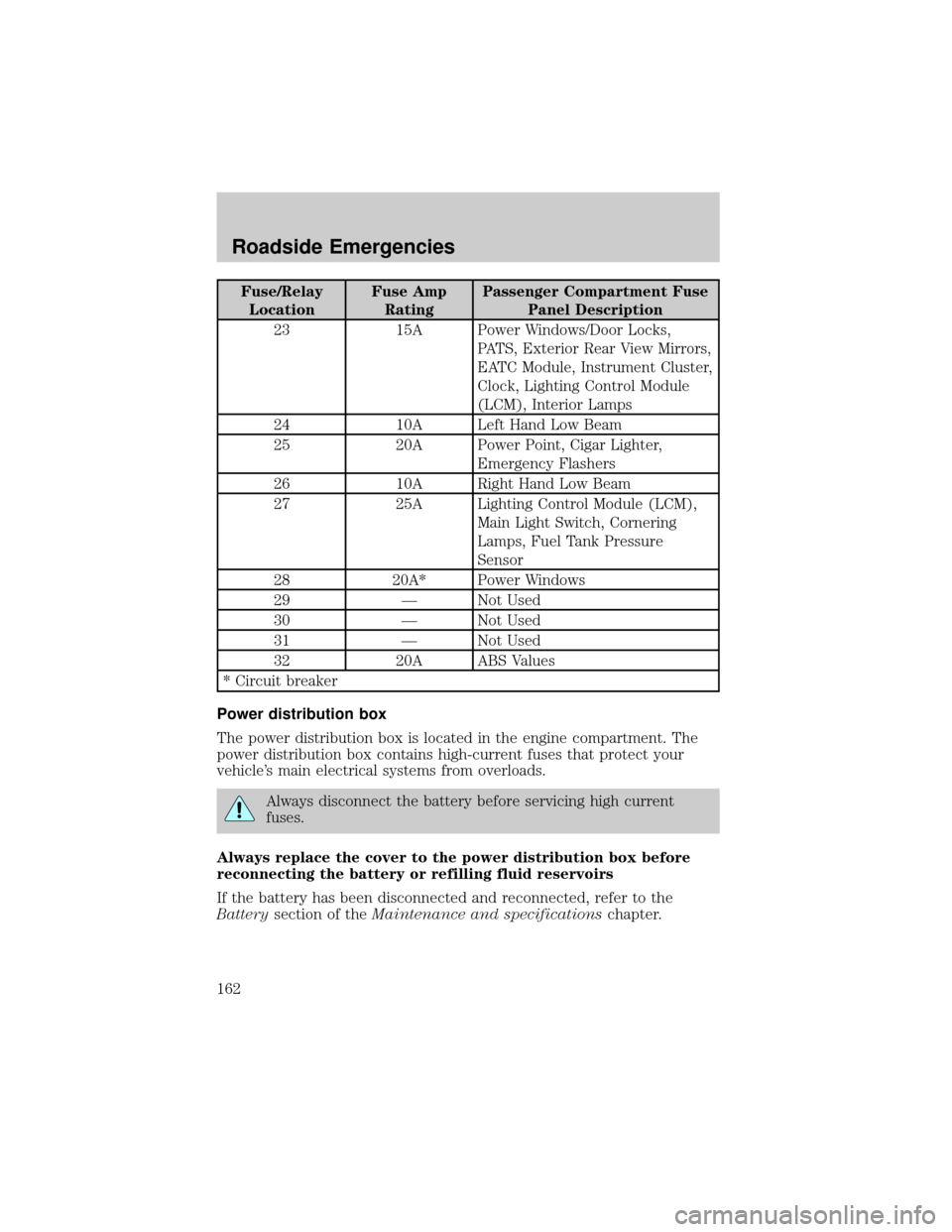
Fuse/Relay
LocationFuse Amp
RatingPassenger Compartment Fuse
Panel Description
23 15A Power Windows/Door Locks,
PATS, Exterior Rear View Mirrors,
EATC Module, Instrument Cluster,
Clock, Lighting Control Module
(LCM), Interior Lamps
24 10A Left Hand Low Beam
25 20A Power Point, Cigar Lighter,
Emergency Flashers
26 10A Right Hand Low Beam
27 25A Lighting Control Module (LCM),
Main Light Switch, Cornering
Lamps, Fuel Tank Pressure
Sensor
28 20A* Power Windows
29 Ð Not Used
30 Ð Not Used
31 Ð Not Used
32 20A ABS Values
* Circuit breaker
Power distribution box
The power distribution box is located in the engine compartment. The
power distribution box contains high-current fuses that protect your
vehicle's main electrical systems from overloads.
Always disconnect the battery before servicing high current
fuses.
Always replace the cover to the power distribution box before
reconnecting the battery or refilling fluid reservoirs
If the battery has been disconnected and reconnected, refer to the
Batterysection of theMaintenance and specificationschapter.
Roadside Emergencies
162
Page 198 of 240
When lifting a plastic-cased battery, excessive pressure on the
end walls could cause acid to flow through the vent caps,
resulting in personal injury and/or damage to the vehicle or battery.
Lift the battery with a battery carrier or with your hands on opposite
corners.
Keep batteries out of reach of children. Batteries contain sulfuric
acid. Avoid contact with skin, eyes or clothing. Shield your eyes
when working near the battery to protect against possible splashing of
acid solution. In case of acid contact with skin or eyes, flush
immediately with water for a minimum of 15 minutes and get prompt
medical attention. If acid is swallowed, call a physician immediately.
Battery posts, terminals and related accessories contain lead and
lead compounds.Wash hands after handling.
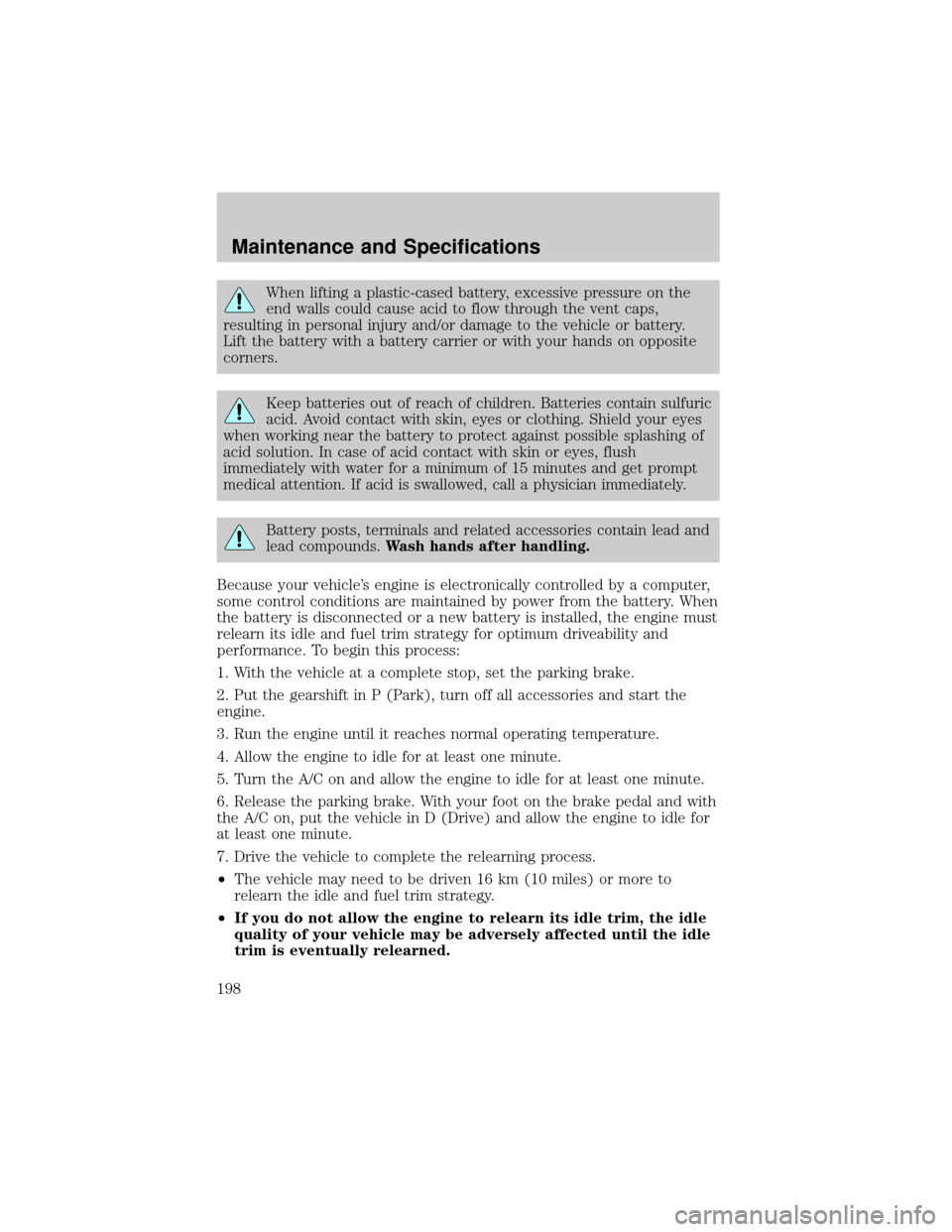
Because your vehicle's engine is electronically controlled by a computer,
some control conditions are maintained by power from the battery. When
the battery is disconnected or a new battery is installed, the engine must
relearn its idle and fuel trim strategy for optimum driveability and
performance. To begin this process:
1. With the vehicle at a complete stop, set the parking brake.
2. Put the gearshift in P (Park), turn off all accessories and start the
engine.
3. Run the engine until it reaches normal operating temperature.
4. Allow the engine to idle for at least one minute.
5. Turn the A/C on and allow the engine to idle for at least one minute.
6. Release the parking brake. With your foot on the brake pedal and with
the A/C on, put the vehicle in D (Drive) and allow the engine to idle for
at least one minute.
7. Drive the vehicle to complete the relearning process.
²The vehicle may need to be driven 16 km (10 miles) or more to
relearn the idle and fuel trim strategy.
²If you do not allow the engine to relearn its idle trim, the idle
quality of your vehicle may be adversely affected until the idle
trim is eventually relearned.
Maintenance and Specifications
198
Page 206 of 240
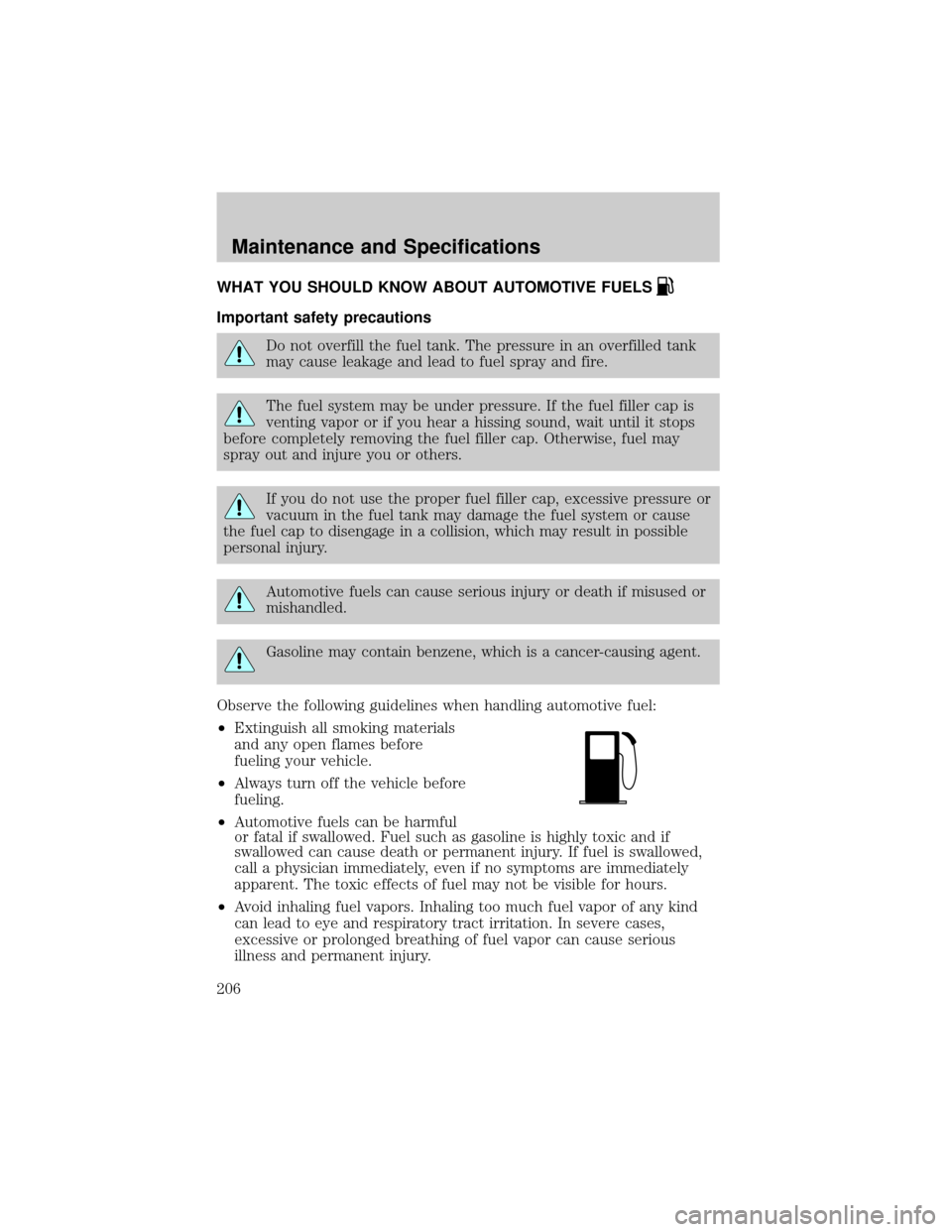
WHAT YOU SHOULD KNOW ABOUT AUTOMOTIVE FUELS
Important safety precautions
Do not overfill the fuel tank. The pressure in an overfilled tank
may cause leakage and lead to fuel spray and fire.
The fuel system may be under pressure. If the fuel filler cap is
venting vapor or if you hear a hissing sound, wait until it stops
before completely removing the fuel filler cap. Otherwise, fuel may
spray out and injure you or others.
If you do not use the proper fuel filler cap, excessive pressure or
vacuum in the fuel tank may damage the fuel system or cause
the fuel cap to disengage in a collision, which may result in possible
personal injury.
Automotive fuels can cause serious injury or death if misused or
mishandled.
Gasoline may contain benzene, which is a cancer-causing agent.
Observe the following guidelines when handling automotive fuel:
²Extinguish all smoking materials
and any open flames before
fueling your vehicle.
²Always turn off the vehicle before
fueling.
²Automotive fuels can be harmful
or fatal if swallowed. Fuel such as gasoline is highly toxic and if
swallowed can cause death or permanent injury. If fuel is swallowed,
call a physician immediately, even if no symptoms are immediately
apparent. The toxic effects of fuel may not be visible for hours.
²Avoid inhaling fuel vapors. Inhaling too much fuel vapor of any kind
can lead to eye and respiratory tract irritation. In severe cases,
excessive or prolonged breathing of fuel vapor can cause serious
illness and permanent injury.
Maintenance and Specifications
206
Page 208 of 240
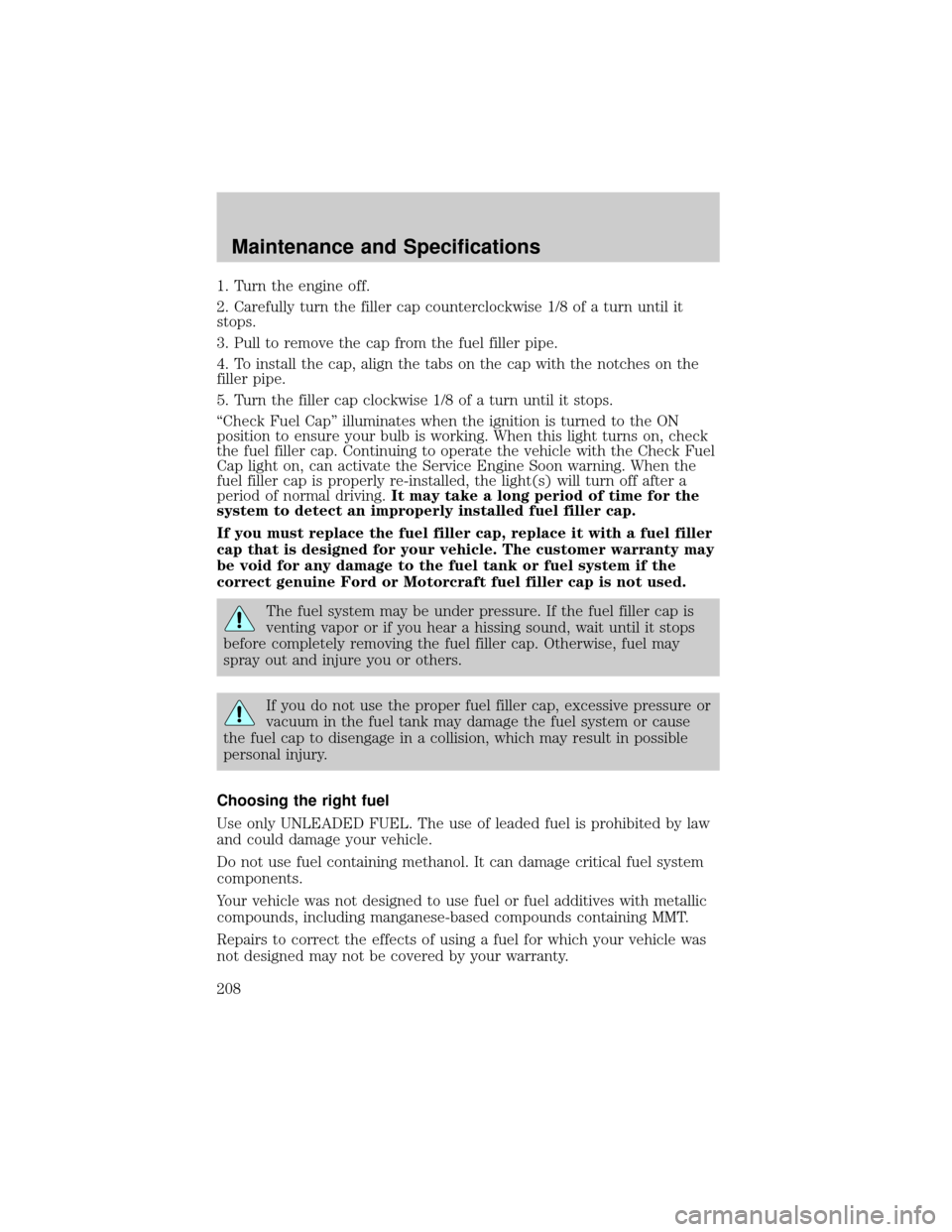
1. Turn the engine off.
2. Carefully turn the filler cap counterclockwise 1/8 of a turn until it
stops.
3. Pull to remove the cap from the fuel filler pipe.
4. To install the cap, align the tabs on the cap with the notches on the
filler pipe.
5. Turn the filler cap clockwise 1/8 of a turn until it stops.
ªCheck Fuel Capº illuminates when the ignition is turned to the ON
position to ensure your bulb is working. When this light turns on, check
the fuel filler cap. Continuing to operate the vehicle with the Check Fuel
Cap light on, can activate the Service Engine Soon warning. When the
fuel filler cap is properly re-installed, the light(s) will turn off after a
period of normal driving.It may take a long period of time for the
system to detect an improperly installed fuel filler cap.
If you must replace the fuel filler cap, replace it with a fuel filler
cap that is designed for your vehicle. The customer warranty may
be void for any damage to the fuel tank or fuel system if the
correct genuine Ford or Motorcraft fuel filler cap is not used.
The fuel system may be under pressure. If the fuel filler cap is
venting vapor or if you hear a hissing sound, wait until it stops
before completely removing the fuel filler cap. Otherwise, fuel may
spray out and injure you or others.
If you do not use the proper fuel filler cap, excessive pressure or
vacuum in the fuel tank may damage the fuel system or cause
the fuel cap to disengage in a collision, which may result in possible
personal injury.
Choosing the right fuel
Use only UNLEADED FUEL. The use of leaded fuel is prohibited by law
and could damage your vehicle.
Do not use fuel containing methanol. It can damage critical fuel system
components.
Your vehicle was not designed to use fuel or fuel additives with metallic
compounds, including manganese-based compounds containing MMT.
Repairs to correct the effects of using a fuel for which your vehicle was
not designed may not be covered by your warranty.
Maintenance and Specifications
208
Page 213 of 240
²Adding certain accessories to your vehicle (for example bug
deflectors, rollbars/light bars, running boards, ski/luggage racks) may
reduce fuel economy.
²Using fuel blended with alcohol may lower fuel economy.
²Fuel economy may decrease with lower temperatures during the first
12±16 km (8±10 miles) of driving.
²Driving on flat terrain offers improved fuel economy as compared to
driving on hilly terrain.
²Transmissions give their best fuel economy when operated in the top
cruise gear and with steady pressure on the gas pedal.
²Close windows for high speed driving.
EPA window sticker
Every new vehicle should have the EPA window sticker. Contact your
dealer if the window sticker is not supplied with your vehicle. The EPA
window sticker should be your guide for the fuel economy comparisons
with other vehicles.
It is important to note the box in the lower left corner of the window
sticker. These numbers represent the Range of L/100 km (MPG)
expected on the vehicle under optimum conditions. Your fuel economy
may vary depending upon the method of operation and conditions.
EMISSION CONTROL SYSTEM
Your vehicle is equipped with various emission control components and a
catalytic converter which will enable your vehicle to comply with applicable
exhaust emission standards. To make sure that the catalytic converter and
other emission control components continue to work properly:
²Use only the specified fuel listed.
²Avoid running out of fuel.
²Do not turn off the ignition while your vehicle is moving, especially at
high speeds.
²Have the items listed in your scheduled maintenance guide performed
according to the specified schedule.
The scheduled maintenance items listed in the scheduled maintenance
guide are essential to the life and performance of your vehicle and to its
emissions system.
If other than Ford, Motorcraft or Ford-authorized parts are used for
maintenance replacements or for service of components affecting
emission control, such non-Ford parts should be equivalent to genuine
Ford Motor Company parts in performance and durability.
Maintenance and Specifications
213
Page 235 of 240

cleaning ...................................186
coolant .....................................199
fail-safe coolant ......................204
idle speed control ...................197
lubrication specifications ......226,
228
refill capacities ........................225
service points ..........................192
starting after a collision .........158
Engine block heater .................140
Engine oil ..................................193
change oil soon warning,
message center .......................193
checking and adding ..............193
dipstick ....................................193
filter, specifications ........196, 224
recommendations ...................196
refill capacities ........................225
specifications ..................226, 228
Exhaust fumes ..........................140
F
Fail safe cooling ........................204
Floor mats ...................................90
Fluid capacities .........................225
Fuel ............................................206
calculating fuel economy .......210
cap .....................................11, 207
capacity ...................................225
choosing the right fuel ...........208
comparisons with EPA fuel
economy estimates .................213
detergent in fuel .....................209
filling your vehicle with
fuel ...........................206±207, 210
filter, specifications ........210, 224
fuel filler door override ............89
fuel filler door release ..............88
fuel pump shut-off switch .....158gauge .........................................19
improving fuel economy ........210
low fuel warning light ..............14
octane rating ...................209, 228
quality ......................................209
running out of fuel .................210
safety information relating to
automotive fuels .....................206
Fuses ..................................159±160
G
Gas cap (see Fuel cap) ......11, 207
Gas mileage (see Fuel
economy) ...................................210
Gauges .........................................17
battery voltage gauge ...............19
engine coolant temperature
gauge .........................................17
engine oil pressure gauge ........18
fuel gauge ..................................19
odometer ...................................20
speedometer .............................20
trip odometer ............................21
GAWR (Gross Axle Weight
Rating) .......................................151
definition .................................151
driving with a heavy load ......151
location ....................................151
GVWR (Gross Vehicle Weight
Rating) .......................................151
calculating ...............................151
definition .................................151
driving with a heavy load ......151
location ....................................151
H
Hazard flashers .........................157
Head restraints .........................104
Index
235
Page 236 of 240

Headlamps ...................................63
aiming ........................................65
autolamp system .......................63
bulb specifications ....................66
daytime running lights .............63
flash to pass ..............................64
high beam ...........................15, 64
replacing bulbs .........................67
turning on and off ....................63
warning chime ..........................16
Heating
heating and air conditioning
system .................................54, 56
Hood ..........................................192
I
Ignition ...............................137, 228
Infant seats
(see Safety seats) .....................130
Inspection/maintenance (I/M)
testing ........................................214
Instrument panel
cleaning ...................................188
cluster ................................10, 188
lighting up panel and
interior .......................................64
J
Jack ............................................164
positioning ...............................164
storage .....................................164
Jump-starting your vehicle ......169
K
Keyless entry system .................98
autolock .....................................97
keypad .......................................98programming entry code .........99
Keys ...................................100±102
key in ignition chime ...............16
positions of the ignition .........137
L
Lamps
autolamp system .......................63
bulb replacement
specifications chart ..................66
cargo lamps ...............................64
daytime running light ...............63
headlamps .................................63
headlamps, flash to pass ..........64
instrument panel, dimming .....64
interior lamps ...............63, 65, 67
replacing bulbs .............65, 67±71
Lane change indicator
(see Turn signal) ........................65
Lights, warning and indicator ....10
air bag ........................................13
air suspension ...........................14
anti-lock brakes (ABS) ....12, 143
brake ..........................................12
charging system ........................13
check engine .............................10
fuel cap light .............................11
high beam .................................15
low coolant ................................13
low fuel ......................................14
oil pressure ...............................13
overdrive off ..............................14
safety belt .................................13
speed control ............................82
traction control active ..............14
turn signal indicator .................15
Limited slip axle (see Traction
Loc) ............................................150
Load limits .................................151
GAWR ......................................151
Index
236